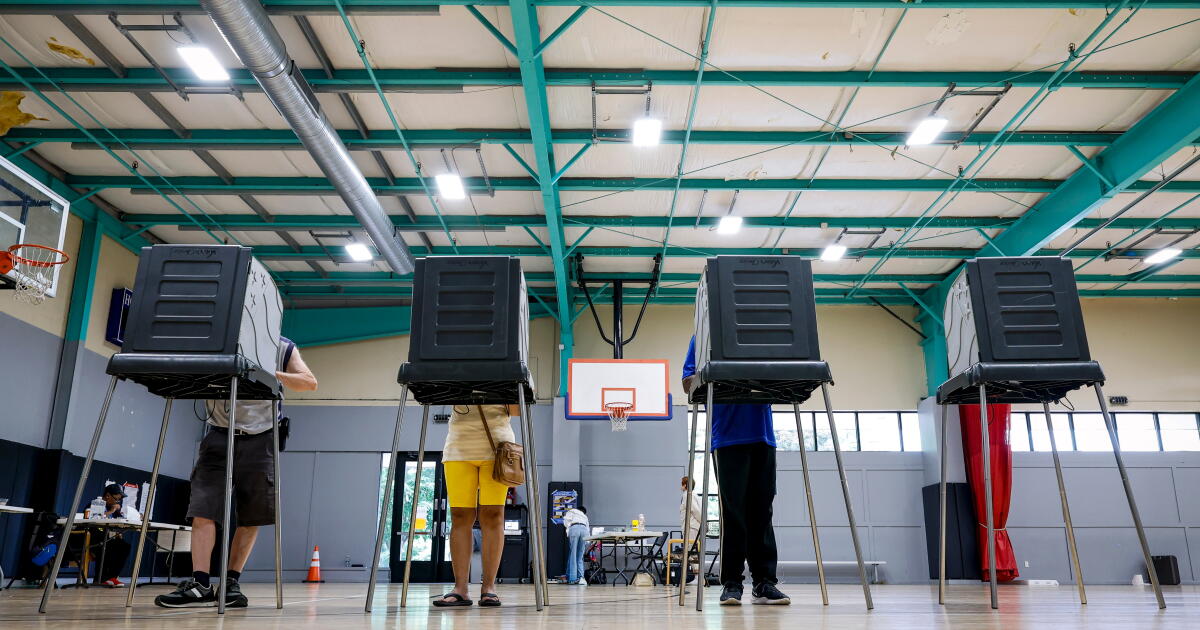
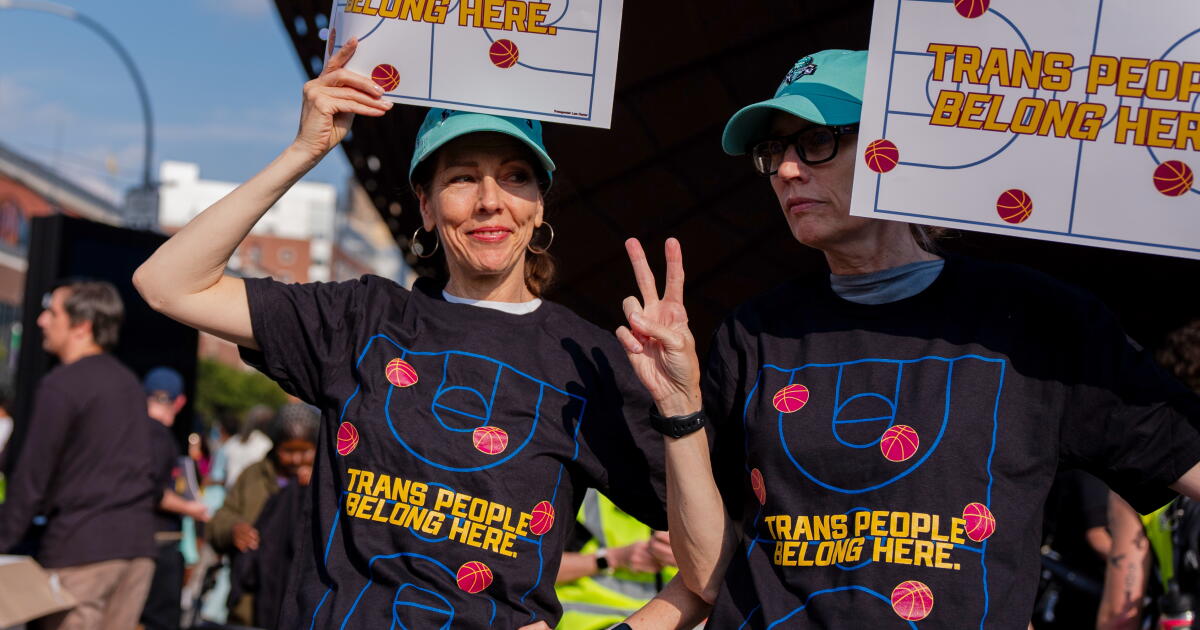
California Gov. Gavin Newsom does not like being on Donald Trump’s side on any issue.
But when it comes to transgender girls and women in sports, particularly at the school level, the Democrat said he largely agrees with the Republican president. Newsom, one of his party’s leading White House prospects, believes it’s “deeply unfair” for people who are assigned male at birth to compete against girls.
“I don’t want to be on that side of it, but I’m being honest — I’d be lying to you if I said differently,” Newsom told the Associated Press as he was campaigning recently in South Carolina. “I haven’t been able to figure out how to make it fair from my perspective.”
Newsom is not alone.
While most Democratic officials remain steadfast supporters of the transgender community, an increasing number in red and blue states are distancing themselves from their party’s unflinching support for the transgender community’s policy priorities, such as allowing athletes to compete on teams that match their gender identity. The shift follows years of conservative attacks against Democrats on the divisive issue, which affects a relatively small number of transgender people and their families, but has emerged as one of Republicans’ most potent political weapons in the Trump era.
Soul searching over transgender issues is one facet of a sprawling identity crisis that Democrats are confronting during the midterms and before the next presidential election. Although they risk a backlash from their progressive base, there is also a sense in some corners that the party must evolve on an issue where the overwhelming majority of voters — even many Democrats — agree with Trump.
The issue was a central theme for Trump and his Republican allies on the main stage at their midterm convention in Dallas last week, where the president said he hoped Democrats would continue to stand up for transgender girls and women who want to compete in girls’ and women’s sports.
“I’m petrified that they’ll change,” he said. “That will really hurt us.”
Republicans are already replaying some of the same political attacks that they used against Kamala Harris in the presidential campaign two years ago, when they said she’s “for they/them, not you.” On Friday, they released a new advertisement targeting James Talarico, the Democratic nominee for Senate in Texas, with the same phrase.
Democrats confront difficult political terrain
A political group backed by billionaire Trump ally Elon Musk has begun running digital ads targeting Democrats in key Senate races in Texas, Ohio and Alaska, accusing them of allowing men to compete in women’s sports.
In Texas’ pivotal Senate contest, the new ad from Musk’s America PAC opens with a video clip of Talarico saying that “God is nonbinary.”
Talarico began to distance himself from those positions months ago. He went further in a Fox News interview last week, saying he would vote in favor of a national ban for gender-affirming surgeries for transgender minors, which are rare.
“I’ve missed the mark on some of my past statements. I will be the first to admit it,” Talarico said in an interview near the Republican convention site. “I think the reason that politicians in that convention center across the street want to talk about six sexes is because they don’t want to talk about $6 diesel.”
In Iowa, State Auditor Rob Sand, the Democratic Party’s nominee for governor, has spoken out against transgender athletes competing in women’s sports as a matter of fairness. Ohio Democratic gubernatorial nominee Amy Acton has taken a similar position, although she has drawn criticism from the left for adopting Trump’s language after saying she opposed “boys playing in girls’ sports.”
And in deep-blue Massachusetts, transgender rights became a defining campaign issue during the state’s recent Democratic U.S. Senate primary, illustrating the potential backlash that party members can face.
Sen. Ed Markey, 80, secured the nomination and later credited his win to not shying away from advocating for transgender rights. He used the issue to attack his Democratic opponent, Rep. Seth Moulton, who had said he wouldn’t want his daughters to play against transgender athletes.
Moulton apologized for his comments, which drew outrage from some progressives, but the damage was done.
While Moulton lost his primary, his position — not Markey’s — is in line with the majority of voters nationally.
A June poll from Quinnipiac University found that about 7 in 10 registered voters think that transgender women and girls should not be allowed to play on women’s and girls’ sports teams. About one-quarter think they should. Democrats are divided, with about half saying transgender women and girls should be allowed and about half saying they should not.
A Pew Research Center poll conducted last year found that just over half, 55%, of Democrats would be “not too” or “not at all” comfortable with athletes playing on teams that don’t match their sex at birth, while 21% said they were “somewhat” comfortable and only 23% said they were “extremely” or “very” comfortable with this.
There’s division among activists
Markey’s public commitment to transgender rights stood out because Democratic politicians are increasingly running away from the issue, said Tyler Hack, executive director of the Christopher Street Project, which is dedicated to electing supporters of transgender rights to federal office.
“The reality of being a transgender person in America in 2026 is that on election nights, while other folks are talking about who had a good night and who had a bad night, sometimes you are quietly wondering, ‘Am I going to be OK?’” Hack said.
At the same time, even transgender activists are divided over supporting Democrats who have positions that are unfriendly to transgender people.
Erin Reed, an advocate and independent journalist covering transgender issues, this month put out a guide flagging Democratic candidates who she accused of taking anti-transgender positions. She highlighted 15 states that have such Democrats, saying that she would not vote for the “worst offenders” even if it means a Republican wins.
She doesn’t want Democrats to see that “throwing transgender people under the bus is a winning strategy.”
“One seat can be won back,” Reed wrote. “A party cannot.”
Meanwhile, Hack would probably vote for a Democrat even if that candidate supports some policies the Christopher Street Project opposes, in hopes that the party can take control of Congress. However, those candidates shouldn’t expect the organization’s endorsement.
“While I hope many of them win, I think they can do it without our resources and without our support,” Hack said.
Laws are changing around the country
The political debate is evolving as transgender people increasingly become the target of conservative backlash through state laws and the Trump administration.
Sports participation has become one of the main fronts in a political battle over transgender rights, although most Republican-controlled states have also implemented policies that affect a bigger slice of the population. There are bans on some gender-affirming health care for transgender young people and rules against transgender people from using the bathrooms that match their gender identity in schools and occasionally other public places.
At least 25 states are now enforcing laws or policies banning transgender women and girls from competing in at least some women’s and girls’ sports and three others have adopted laws but have enforcement blocked by the courts.
Earlier this year, the U.S. Supreme Court upheld state laws barring transgender girls from school teams.
Transgender athletes make up a small portion of team rosters. NCAA president Charlie Baker testified in 2024 that he knew of fewer than 10 transgender college student-athletes out of more than 500,000 total.
The debate is a preview for 2028
The debate within the Democratic Party heading into the 2026 midterms offers a preview for those Democrats contemplating presidential bids in 2028.
Newsom, who is considered a frontrunner in the shadow primary, highlighted his long record of supporting LGBTQ+ priorities, including sanctioning same-sex marriage as the San Francisco mayor decades ago and later appointing the first trans judge in California history.
But in sports, he thinks it’s unfair to allow people assigned as males at birth to compete against girls.
“It’s a hard issue. I struggle with it,” Newsom said. “I think people know where my heart is, my soul is. I have a trans godson.”
Illinois Gov. JB Pritzker, another likely Democratic presidential contender, has taken the opposite position.
He has consistently criticized state-level bans and restrictions on transgender athletes, calling them “bullying” and a “setback for equality.” Following the recent Supreme Court ruling that upheld state bans on transgender athletes, Pritzker, whose cousin is transgender, reaffirmed his position on social media.
“There’s a place for you in Illinois,” he wrote.
In Pennsylvania, Democratic Gov. Josh Shapiro opposes bans on transgender athletes in school sports, which he’s called cruel and designed to discriminate. He argues that athletic participation and eligibility should not be dictated by politicians, but rather handled by local athletic organizations — a stance in line with several LGBTQ+ groups.
He’s also raised questions of fairness, however.
“Look, I think it’s a tough deal being born into the wrong body. And I don’t think these kids deserve to be persecuted and bullied by the president of the United States,” Shapiro told The Atlantic last year. “I also don’t think they deserve an unfair advantage on the playing field.” Research has been mixed on whether transgender women have advantages in sports, and it depends partly on whether they went through puberty as boys.
Former Transportation Secretary Pete Buttigieg, who is gay and a potential presidential contender, said on Fox earlier in the year that he takes people seriously on both sides of the debate “whether you’re talking about parents who are wondering what this means for fairness for their kids competing, or parents who want to make sure that their kids aren’t being discriminated against and get a chance to participate.”
“But I also have to tell you,” he added, “I would be surprised if this is a top three or even a top 10 voter issue in the midterms this year.” ___
Peoples and Mulvihill write for the Associated Press. AP writers Kimberlee Kruesi in Providence, R.I., and Amelia Thomson DeVeaux in Washington contributed to this report.