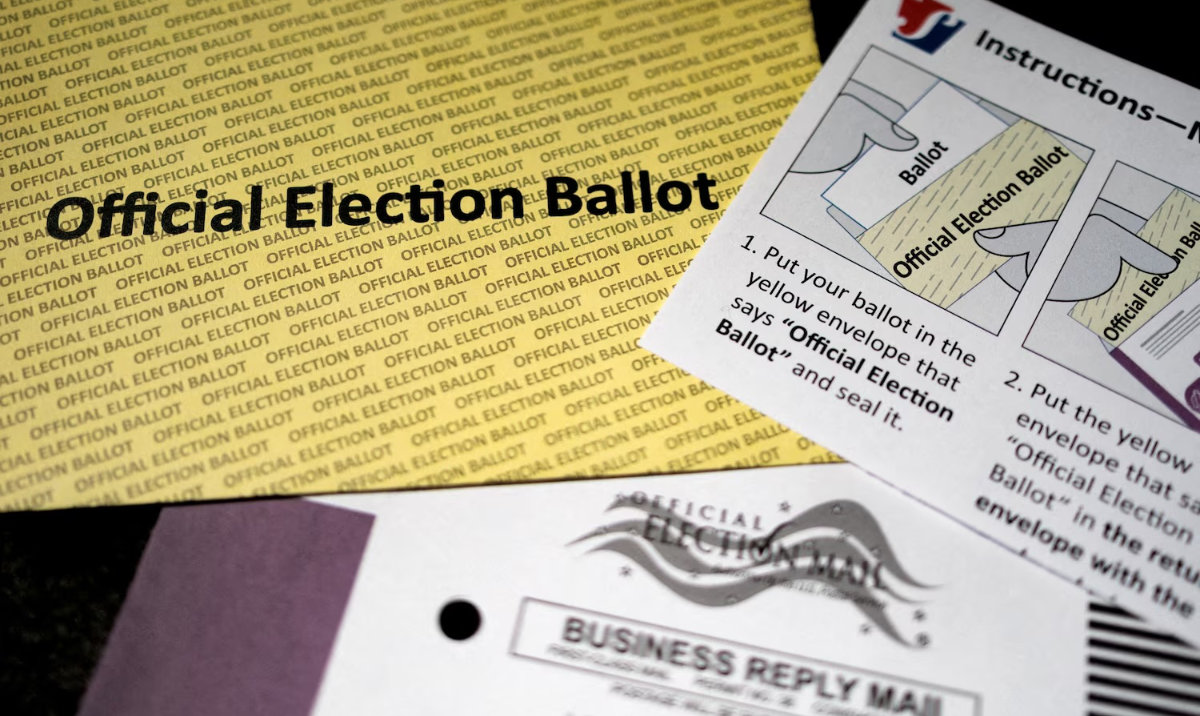
mailin

US judge sides with NAACP over proposed mail-in ballot restrictions | Elections News

President Donald Trump has sought to limit mail-in voting and has ordered his administration to impose limits on the practice.

A federal judge in the United States has blocked proposed restrictions on mail-in voting that were championed by President Donald Trump.

On Wednesday in Washington, DC, District Judge Emmet Sullivan sided with the NAACP, a civil rights organisation, in its case against the US Postal Service (USPS).

Recommended Stories

list of 3 itemsend of list

Sullivan found that the restrictions would likely violate a 2021 settlement requiring expedited handling for mail-in ballots.

He therefore granted the NAACP’s motion to enforce compliance with the settlement, dealing another setback to the Trump administration’s efforts to reshape the US voting landscape.

“NAACP has plausibly suggested — and the Postal Service has not disputed — that the Proposed Rule is already having a ‘real impact on present day affairs’,” Sullivan wrote in his ruling.

The case revolves around a rule the Postal Service put forward in May that would require states to provide lists of absentee and mail-in voters. Ballots that do not conform to the list would be returned.

The proposed rule would also require a new envelope design for mail-in ballots, governing logos and barcode placements. Failure to comply would result in the Postal Service refusing to deliver the ballots.

The NAACP argued that the proposal would run afoul of a 2021 legal settlement that forces Postal Service officials to take “extraordinary measures” to ensure timely delivery of ballot mail.

The settlement “stipulated that the Postal Service agreed ‘to prioritize monitoring and timely delivery of election mail’”, Sullivan wrote in Wednesday’s ruling.

The decision comes less than five months before the November 3 midterm elections, which will decide whether Trump’s Republican Party retains control over both chambers of Congress.

Trump has expressed fears that he may be subject to a third impeachment if Democrats flip the legislature.

He has also spread unfounded theories that US elections are vulnerable to “vote rigging”, pointing to commonplace election tools like mail-in voting and electronic voting machines.

Elections are administered by state and local election officials, as established in the US Constitution. But the Postal Service’s proposed rule came as the result of efforts under the Trump administration to impose new limits on voting.

In March, Trump issued an executive order called “Preserving and Protecting the Integrity of American Elections”. In it, he directed the Department of Justice to take action against states that “fail to comply” with certain standards for mail-in ballots.

He also accused states that accepted absentee or mail-in ballots after Election Day of violating the law.

But in another blow to Trump, the Supreme Court on Monday upheld a state law that allows mail-in ballots to be counted even if they were received after Election Day, so long as they were postmarked on or before that date. The president’s executive order has also been blocked by lower courts.

Civil rights advocates applauded the court’s Wednesday decision and warned against Trump’s efforts to limit mail-in voting.

“The court today correctly recognized that USPS’s plan to create roadblocks to mail-in voting was inconsistent with its commitment to timely deliver election mail,” said Allison Zieve, director of the Public Citizen Litigation Group, which argued on behalf of the NAACP.

“USPS’s plan was unwise, unlawful, and a threat to the millions of voters who rely on mailed ballots to participate in our democracy.”

Sam Spital, the associate director-counsel of the Legal Defense Fund, which also argued for the NAACP, called the Postal Service’s proposed plan “a blatant attempt” to disenfranchise voters who rely on mailed ballots.

“Today’s decision recognizes that USPS cannot disregard its legal obligation to timely deliver mail-in ballots to all voters,” Spital said.

Source link

Federal court hears arguments over efforts to halt Trump’s mail-in executive order

A federal judge on Tuesday heard from voting rights groups and a coalition of two dozen states that want the courts to halt President Trump’s executive order seeking to create a federal voter list and limit who can receive a mail ballot.

The plaintiffs argued in two lawsuits that Trump’s order should be found unconstitutional because the states and Congress, not the president, have the power to set election rules. They also told the court that the move imposes a costly burden on state election officials to comply and would spread fear about the possibility of prosecution.

“This is going to be a sea change in the way that some states administer their ballots,” said Michael Cohen, who was part of a team representing California, adding that “it will be difficult to overstate the disruption that this will cause.”

Trump’s executive order, the second one aimed at elections during his second term, comes as he continues to raise the specter of widespread voting by noncitizens as a reason to change election rules. But states already have detailed processes aimed at keeping their voter rolls accurate, and voting by noncitizens has been shown to be rare. It also is a felony that can be punishable by deportation.

His latest order is being challenged through multiple lawsuits, including two filed in U.S. District Court in Boston.

The American Civil Liberties Union, which represented the League of Women Voters in one of the two Boston cases, has called the order “a dangerous attempt to disenfranchise eligible voters nationwide.” The group said the order transforms “the U.S. Postal Service from a neutral mail carrier to an arbiter of who may cast a ballot by mail.”

“This case challenges an extraordinary and abusive assertion of executive power over the administration of federal elections,” the organization said in its complaint.

The hearing comes less than a week after another judge declined to halt the order. U.S. District Judge Carl Nichols, a Trump appointee in Washington, agreed with the Trump administration’s contention that it was too early to block the order because it has yet to be implemented.

The administration, in its motions to dismiss the lawsuits, argued that the plaintiffs lack standing to bring their claims. They also argued the motions are premature and that plaintiffs lack the legal basis to bring their Administrative Procedure Act claim, which governs how federal agencies develop and issue regulations.

Stephen Pezzi, a lawyer for the Trump administration, said the harms the plaintiffs referred to were subjective, since much can change with the voting list before it is finalized. He also said no one would be prosecuted for violating the executive order.

Missouri Solicitor Gen. Lou Capozzi, speaking for the states supporting the list, argued it was too early to say how his state might use the list, but that it was “unlikely” any voter would be removed this year from the voter rolls because of it.

“We are not exactly sure how we would use it,” Capozzi said, adding that “we don’t want this process to be strangled in the crib, so to speak.”

U.S. District Judge Indira Talwani took the requests for motions to halt the order, along with motions to dismiss the cases under advisement.

During oral arguments, Talwani expressed concerns about whether the federal system envisioned under the executive order could be ready for the upcoming midterm elections and about the risks posed to election workers who rely on a state list that differs from the federal one. She also raised doubts about the reliability of a federal list — noting, for example, women who changed their names after getting married or someone who has moved from state to state might be missed.

“Isn’t there a reasonable fear and concern on behalf of voters that they will be precluded?” Talwani asked.

Trump issued the order in March after a bill he supported to overhaul voting stalled in Congress. The order would have had the federal government create a list of eligible voters and then directed the postal service to deliver mail ballots only to those on the list. Election officials argued that it was ripe for abuse and could cause chaos, and the postal union has objected to the idea of mail carriers policing ballots.

The postal service has published a proposed rule required by Trump’s executive order in the Federal Register. Among other things, the rule would not apply to primary elections or overseas ballots.

Since his 2020 presidential election loss to Democrat Joe Biden, Trump has groundlessly claimed mail voting is rife with fraud and has launched a federal investigation into that year’s vote, even though repeated audits and investigations, including ones run by Republicans, found it was free of widespread fraud. Trump also has said he wants to “take over” election administration in Democratic areas.

Casey writes for the Associated Press.

Source link