Great British Bake Off winner Nadiya Hussain has spoken out about the Channel 4 series
Nadiya Hussain has had her say on Bake Off(Image: Dave Benett, Dave Benett/Getty Images)
More than a decade since she was crowned winner of The Great British Bake Off and became one of TV’s most successful new stars, Nadiya Hussain has admitted that she no longer watches the Channel 4 show.
Despite going on to enjoy a huge TV career, the last 12 months have proved something of a torrid time for the 41-year-old mum-of-three as the BBC cancelled her shows.
In a new interview with the Radio Times, Nadiya admits “it’s sad” how it ended but “near the end” of her relationship with the Beeb, she had voiced concerns about how her programmes were being made.
And as far as Bake Off is concerned, she admits it’s not a show she watches any more. She said: “The magic has disappeared for me. Sometimes it feels like it’s competing with some of the shows on Netflix where it’s bigger and bolder and more outrageous, and I don’t think it needs any of that. It’s a beautiful show, it’s a classic.”
As for new judge Nigella Lawson replacing Prue Leith, Nadia said: “Nigella’s got a lot to live up to following Prue. It’s very easy to become quite stuffy and very proper, and I love that she’s got a little wild streak about her. I want to be like Prue when I’m older. If I get to that lovely age.”
Following her triumph on GBBO in 2015, Nadiya went on to front numerous BBC shows including Nadiya Bakes, Nadiya’s Fast Flavours and Nadiya’s Simple Spices. She has also appeared as a guest panellist on ITV’s Loose Women.
Other achievements include being named by Debrett’s as one of the 500 most influential people in the UK, included on BBC News’ 100 Women list and invited to bake a cake for the 90th birthday celebrations of Queen Elizabeth II.
After gaining a publishing deal she was also shortlisted for Children’s Book of the Year prize at the British Book Awards for Bake Me A Story.
However, in a social media post last year, the presenter disclosed that the BBC had axed her series, calling it a “turning point” in her professional journey.
At the time, a BBC spokesperson said: “After several wonderful series we have made the difficult decision not to commission another cookery show with Nadiya Hussain at the moment. Nadiya remains a much-valued part of the BBC family, and we look forward to working together on future projects.”
In conversation with the Sun’s Fabulous magazine, she reflected: “The last year has been physically and mentally one of the hardest so my next biggest achievement would be choosing myself and deciding what’s right for me.”
This follows Nadiya describing her three children, Musa, 19, Dawud, 18, and Maryam, 15, as her “biggest achievement”. Nadiya shares her children with husband Abdal Hussain, whom she wed in Bangladesh at the age of 20.
Following the axing of her programme, she took the decision to switch careers and move into education. She’s now employed in schools as a teaching assistant, with aspirations of potentially qualifying as a teacher down the line.
She revealed that other broadcasters, including ITV and Channel 4, approached her about another series, but insists it’s “not something that I want to do”.
Speaking to woman&home magazine, she explained: “I’m currently working as a teaching assistant at a lovely little primary school. The plan is to gain some training and maybe in the future become a teacher.”
For the latest showbiz, TV, movie and streaming news, go to the new **Everything Gossip** website.
Live Nation has reached a settlement with the Justice Department in an antitrust case that put the entertainment giant at risk of being separated from Ticketmaster.
The ticket vendor’s settlement offer was announced, in a court hearing on Monday, less than a week after the long-awaited trial began. With pending approval from the judge, Live Nation will have to pay damages to the suing states and allow competitors to sell tickets on its platform. Media reports have said the company agreed to pay more than $200 million as part of the settlement.
The settlement caught Judge Arun Subramanian off guard. He said no one informed him of the tentative deal until late Sunday, even though a term sheet for a possible settlement was signed on Thursday, according to the Associated Press.
A 12-person jury was seated last Tuesday in a Manhattan federal courthouse and the trial had reached witness testimony by the end of last week. The complaint was filed in 2024, when the federal government, 39 states including California and the District of Columbia, alleged that Live Nation and Ticketmaster have monopolies in various aspects of the live music industry, such as concert promotion, venue operations, artist management and ticketing services.
Live Nation could not immediately be reached for a comment.
Many of the large monopoly claims were thrown out during a pretrial hearing last month, including an allegation that Live Nation’s industry power raises ticket prices and harms consumers. But the new settlement offers major structural changes to the company’s ticketing services.
If the trial judge approves the settlement, the Beverly Hills-based company will have to open parts of its platform to rival ticketing operators. This means third-party sellers like SeatGeek could list tickets and have access to Ticketmaster’s technology.
Another key claim in the lawsuit concerned Ticketmaster’s alleged exclusivity contracts, which required artists who booked Live Nation-owned venues to also use its ticketing services. The settlement now limits these contracts to four years and allows venues to place a number of its tickets on competing platforms.
The original lawsuit also argued that Live Nation manages more than 400 artists and controls more than 265 venues in North America — all while Ticketmaster simultaneously controls around 80% of the primary ticket marketplace and is increasing its involvement in the resale market. Under the pending legal agreement, Live Nation would have to divest more than 10 of its venues and Ticketmaster would also have to cap service fees at 15%.
Serona Elton, attorney and interim vice dean at the University of Miami’s Frost School of Music, said this outcome can be understood in two ways — it’s either a win that addresses anti-competitive behaviors or a deal that does not go far enough.
“It is important to understand that it is not illegal to be a monopoly and control a large portion of the market,” said Elton in a statement. “What is illegal is the use of anti-competitive tactics. In analyzing the settlement, the question to ask is if it does enough to address the alleged tactics and the harm they may have caused.”
Elton added that venues could benefit from these adjustments, but “music fans should not think this is going to bring ticket prices down to an affordable level as there are other causes behind the sky-high ticket prices.”
Stephen Parker, the executive director of the National Independent Venue Association, similarly expressed some skepticism about the potential settlement.
“The reported settlement does not appear to include any specific and explicit protections for fans, artists, or independent venues and festivals,” he said in a statement.
“Reported details also indicate that ticket resale platforms could be further empowered through new requirements for Ticketmaster to host their listings, which would likely exacerbate the price gouging potential for predatory resellers and the platforms that serve them,” Parker added . “If these facts are true, NIVA views this as a failure of the justice system.”
A settlement could mark the potential end to one of the major legal battles Live Nation is facing. The company is also being sued by the Federal Trade Commission and is dealing with a handful of class-action lawsuits from groups of concertgoers.
After the news of the settlement broke, Live Nation’s stock jumped over 5% to $164.03.
“Why were state law enforcement officers excluded?” U.S. District Judge Christina A. Snyder wanted to know.
The judge pressed California Deputy Atty. Gen. Cameron Bell to explain the thinking behind a pair of trailblazing new laws meant to unmask the federal immigration agents patrolling Golden State streets and compel them to identify themselves.
One of the laws required all law enforcement operating in the state to visibly display identification while on duty, with narrow exclusions for plainclothes, undercover and SWAT details. It applied to everyone else, including U.S. Immigration and Customs Enforcement officers.
But the other law, a ban on masks worn by on-duty law enforcement officers, applied only to local cops and federal agents, with a broad exemption for the California Highway Patrol and other state peace officers.
Snyder wanted to know: Why were the laws different?
She never got an answer. Bell said she couldn’t comment on the actions of the Legislature.
State Sen. Scott Wiener attends the California Democratic Party convention in San Francisco in February.
(Jeff Chiu / Associated Press)
In the halls of the statehouse last year, Sen. Scott Wiener’s (D-San Francisco) No Secret Police Act and Sen. Sasha Renée Pérez’s (D-Alhambra) No Vigilantes Act were referred to as “legislative twins,” a nod to their shared gestation and conjoined legal fate. If passed, both would immediately be challenged by the Trump administration.
That’s precisely what happened. Both measures became law — but only the ID law survived its first court battle, sending state legislators back to the drawing board on the mask ban.
Polls show unmasking ICE is overwhelmingly popular with voters, and both Wiener and Gov. Gavin Newsom took credit for getting the bill passed.
But behind the scenes, according to nearly two dozen sources familiar with the legislative process who spoke to The Times, a fight had been brewing between the two Democrats.
Days before the amendment deadline last summer, Newsom’s office proposed changes to Wiener’s mask ban that, according to legal experts and opponents, would have exempted most ICE and Customs and Border Protection operations from the bill. The governor’s team denies that was the intent of their proposal. The resulting compromise exempted state peace officers from the law instead.
Snyder struck it down on Feb. 9, writing that she was “constrained” to do so because the exemption of state police “unlawfully discriminates against federal officers.”
Interviews with more than 20 lawmakers, policy advisors, law enforcement and legal experts show how the Labor Day weekend deal came together, ensuring both Wiener and the governor a political victory that in short order became a court triumph for the president.
There are now more than a dozen similar bills winding through statehouses from Olympia, Wash., to Albany, N.Y., as legislators try to rein in a practice the majority of Americans see as dangerous and corrosive. In Sacramento, similar efforts are underway to pass a narrower version of the law, and both Newsom and Wiener have said they were proud to make California the first state to pass an ICE mask ban.
Both sides said the legislative process is messy, and that eleventh-hour amendment fights are inevitable in a statehouse where more than 900 bills were passed and close to 800 signed into law last year.
Yet neither the governor’s office nor the legislator’s team has offered clear answers for why both accepted a last-minute change on a nationally watched bill that each was informed could kneecap the law’s constitutional standing in court.
“Seeing the carve-out, I was immediately really surprised,” said Bridget Lavender, staff attorney at the State Democracy Research Initiative, the nation’s leading expert on the myriad legal efforts to unmask ICE across the U.S. “That’s ultimately what doomed it.”
Others were more blunt.
“When I saw the final bill I said, ‘What happened here?’” said one prominent constitutional scholar, who asked not to be identified because they were advising several other state legislatures on similar mask ban efforts. “I can’t believe this happened.”
All eyes were really on California.
— Bridget Lavender, staff attorney at the State Democracy Research Initiative
Legally, the mask ban was always going to be a cat fight. Law enforcement groups loathed it. Constitutional scholars were wary. The Justice Department contends both the mask ban and the ID law illegally interfere with the operation of the federal government, a violation of the Constitution’s supremacy clause, while California likens them to highway speed limits, which apply to everyone equally.
“There is a very strong argument that the law is constitutional so long as it applies to all law enforcement,” said Erwin Chemerinsky, dean of the UC Berekely Law School and an early champion of the original No Secret Police Act, known in Sacramento as SB 627.
Others saw it differently.
“It’s a very complicated question as to whether states can enact law enforcement policies that bind the federal government,” said Eric J. Segall, a professor at Georgia State University College of Law. “The answer [here] is probably not. I regret that’s the law, but I’m pretty sure that’s the law.”
Everyone agreed, the Golden State would set the precedent.
“All eyes were really on California,” Lavender said.
Judge Snyder agreed with the state, upholding the ID law. Judges for the 9th Circuit Court of Appeals sharply questioned both the federal government and California in a hearing Tuesday, repeatedly emphasizing the lack of clear precedent and constitutional uncertainty of the law.
“California has done something that we just haven’t seen before,” said Judge Jacqueline Nguyen.
Most scholars believe it will ultimately be settled by the Supreme Court.
The mask ban would be on the same track now, if not for the state police exemption.
“We knew we really had to thread that needle very carefully,” said state Sen. Patricia Fahy of New York, whose mask ban bill could soon be fast-tracked in Albany. “You had to put all law enforcement in it. I say that as a non-lawyer, but I knew that.”
Wiener knew it too. A Harvard-trained lawyer and a former deputy city attorney for San Francisco, he’d rebuffed early requests to exempt state and local officers from the bill and circulated Chemerinsky’s July 23 op-ed in the Sacramento Bee explaining the necessity of a universal ban, including to the governor’s team.
The state’s powerful law enforcement unions were livid. They railed against the bill in public and in the Legislature, testifying relentlessly about the harm that would flow to them from a ban — including being required to enforce it against armed federal agents.
“The last thing you want is two people with firearms on their hips getting into an argument,” said Marshall McClain, a regional director in the Peace Officers Research Assn. of California, among the state’s richest and most powerful lobbying groups.
Law enforcement objections shaped the changes the governor’s legislative office sought just days before the Sept. 5 amendment deadline, according to a stakeholder involved in those discussions.
Gov. Gavin Newsom speaks during a news conference in Los Angeles in 2024.
(Eric Thayer / Associated Press)
The most controversial ask from Newsom’s team was an exemption for all types of officers engaged in “warrant and arrest related operations” — precisely the type of enforcement Alex Pretti was filming when masked CBP agents tackled him to the ground and shot him to death in Minneapolis last month.
The governor’s office also sought an exemption for all officers engaged in “crowd management, intervention, and control” — the work ICE agent Jonathan Ross was doing when he shot and killed Renee Good less than three weeks earlier.
“We were working to ensure state officer safety and operational effectiveness, not exempt ICE,” said Diana Crofts-Pelayo, Newsom’s chief deputy director of communications.
Yet California Deputy Solicitor Gen. Mica Moore told the 9th Circuit on Tuesday that the state’s ID law only applies to officers engaged in “arrest or detention operations or … crowd control” — activities she characterized as central to its purpose.
Rather than swallow bad terms or risk Newsom’s veto, Wiener countered with the state police carve-out — a move constitutional experts advised him would leave the law at least some chance of survival.
The governor’s legislative team quickly accepted, leaving Bell and the attorney general’s office on the hook to defend the exemption.
Boosters argue that even with its fatal flaw, California’s law advanced such bans nationally in a pivotal moment last September.
“The politics have changed dramatically,” said Hector Villagra, vice president of policy advocacy for MALDEF, one of the mask ban’s sponsors. “[Today] people realize this is not normal in a democracy like ours.”
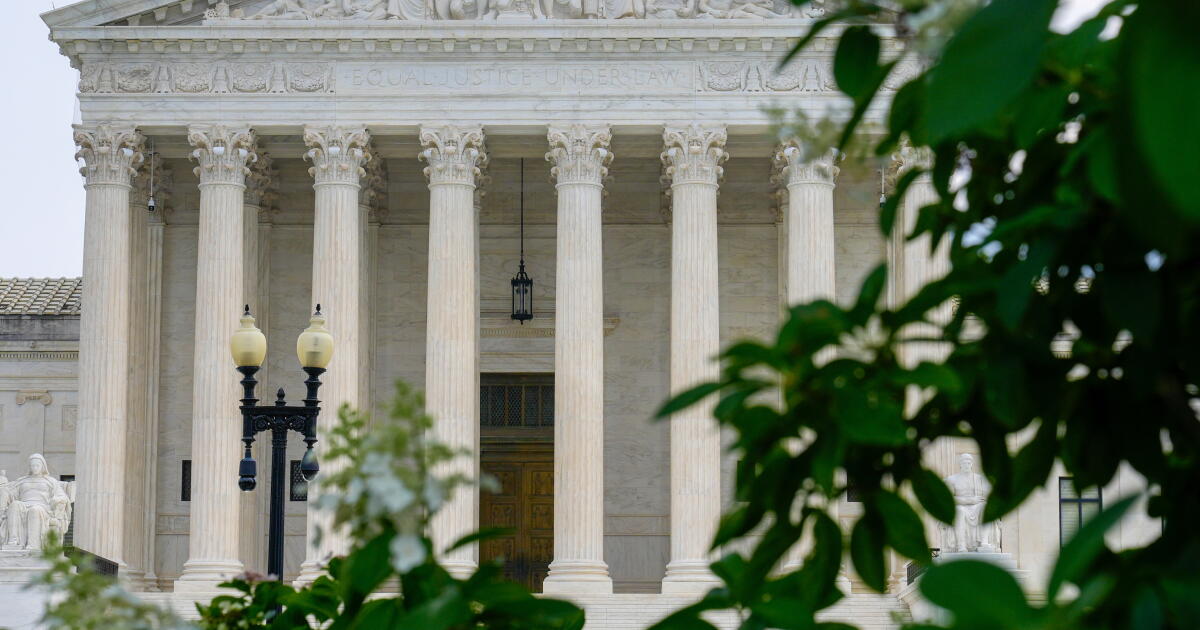
WASHINGTON — The Supreme Court revived a San Diego judge’s order Monday and said parents have a right to know about their child’s gender identity at school.
The decision came in a 6-3 order granting an emergency appeal from lawyers for Chicago-based Thomas More Society.
They said the student privacy policy enforced in California infringes parents’ rights and the free exercise of religion.
“The parents object that these policies prevent schools from telling them about their children’s efforts to engage in gender transitioning at school unless the children consent to parental notification,” the court said. “The parents also take issue with California’s requirement that schools use children’s preferred names and pronouns regardless of their parents’ wishes.”
The judge’s injunction “does not provide relief for all the parents of California public school students, but only for those parents who object to the challenged policies or seek religious exemptions,” the justices added.
The six conservatives were in the majority, while the three liberals dissented.
Religious liberty advocates hailed the decision.
“Parents’ fundamental right to raise their children according to their faith doesn’t stop at the schoolhouse door,” said Mark Rienzi, president of the Becket Fund for Religious Liberty. “California tried cutting parents out of their children’s lives while forcing teachers to hide the school’s behavior from parents. We’re glad the Court stepped in to block this anti-family, anti-American policy.”
The 9th Circuit Court of Appeals had put on hold a late December ruling by U.S. District Judge Roger Benitez, who held that the student privacy rules enforced by California school officials were unconstitutional.
“Parents and guardians have a federal constitutional right to be informed if their public school student child expresses gender incongruence,” Benitez wrote. “Teachers and school staff have a federal constitutional right to accurately inform the parent or guardian of their student when the student expresses gender incongruence.”
Escondido public schoolteachers Elizabeth Mirabelli and Lori Ann West, who described themselves as “devout Catholics,” sued in 2023, and they were later joined by parents in Pasadena and Clovis.
The Supreme Court’s ruling refers only to the parents.
The parents who brought the case “have sincere religious beliefs about sex and gender, and they feel a religious obligation to raise their children in accordance with those beliefs,” the court said.
The court added: “Gender dysphoria is a condition that has an important bearing on a child’s mental health, but when a child exhibits symptoms of gender dysphoria at school, California’s policies conceal that information from parents and facilitate a degree of gender transitioning during school hours.”
“This is a watershed moment for parental rights in America,” said Paul M. Jonna, special counsel at Thomas More Society. “The Supreme Court has told California and every state in the nation in no uncertain terms: you cannot secretly transition a child behind a parent’s back.”
The 9th Circuit had agreed with the state’s attorneys who said the judge had misstated California law.
“The state does not categorically forbid disclosure of information about students’ gender identities to parents without student consent,” they said in a 3-0 decision.
“For example, guidance from the California Attorney General expressly states that schools can ‘allow disclosure where a student does not consent where there is a compelling need to do so to protect the student’s wellbeing,’ and California Education Code allows disclosure to avert a clear danger to the well-being of a child.”
In their parents’ rights appeal to the Supreme Court, attorneys said school employees are secretly encouraging gender transitions.
“California is requiring public schools to hide children’s expressed transgender status at school from their own parents — including religious parents — and to actively facilitate those children’s social transitions over their parents’ express objection,” they told the court.
“Right now, California’s parental deception scheme is keeping families in the dark and causing irreparable harm. That’s why we’re asking the U.S. Supreme Court to intervene immediately,” Jonna wrote in his appeal. “Every day these gender secrecy policies stay in effect, children suffer and parents are left in the dark.”
California state attorneys had urged the court to put the case on hold while it is under appeal.
They said the judge’s order “appears to categorically bar schools across the State from ever respecting a student’s desire for privacy about their gender identity or expression — or respecting a student’s request to be addressed by a particular name or pronouns—over a parent’s objection.”
They said the order “would allow no exceptions, even for extreme cases where students or teachers reasonably fear that the student will suffer physical or mental abuse.”
Simon Cowell, who was known for his brutal takedowns of fame-hungry hopefuls, is ‘back’ according to Britain’s Got Talent co-star Amanda Holden, who says his toned-down persona is gone
Amanda Holden says ‘the old Simon Cowell is back’ as BGT judge ditches ‘Mr Soft act’(Image: Netflix)
Amanda Holden believes her Britain’s Got Talent co-star Simon Cowell is back to his former, more straight-talking self, having ditched his “Mr Soft” act. As the ITV talent hunt gets underway, Amanda is glad to see the return of Simon’s infamous “one liners”, on the “chaotic” new series.
The new series, which began on 21st February, has already frustrated viewers at home. During the first episode fans were getting worked up over the ‘overuse’ of the infamous golden buzzer. As Ant and Dec reminded viewers at the start of the show, the golden buzzer is used when one of the judges deemed a contestant good enough to bypass the rest of the auditions and go straight through to the semi-final.
But while fans were already complaining, Amanda Holden has promised this series will be full of drama. As reported by the Mail, she explained: “Simon is back. He’s been Mr Soft in recent years, and I think it has a lot to do with the fact that KSI is so honest on the other end of the panel.”
Explaining he is done with ‘sugar coating’ his comments, she added: “I’m glad to see that Simon is no longer being soft serve ice-cream, although it was nice for a year or so!”
Ensure our latest headlines always appear at the top of your Google Search by making us a Preferred Source.Click here to activateor add us as your Preferred Source in your Google search settings.
Amanda says the new series “feels very loose and very chaotic”, with KSI helping the show thanks to his “succint” answers. Meanwhile “the old Simon” is back, with the Heart Radio host saying she is “loving” that Simon’s “one liners are better than ever”.
Simon has assured fans there will be “lots of surprises”, with more behind-the-scenes filming, letting the audience at home “behind the Wizard of Oz’s curtain”. But Amanda has recently admitted he “hated” one aspect of filming the new series.
The star was forced to step into head judge Simon’s role, after he had to miss filming after falling down some steps and hitting his head. The brief shake up saw Amanda thrust into head judge duties, with X Factor runner up Stacey Solomon joining the panel as a guest.
As reported by the Daily Star, Amanda explained: “I must admit I hated sitting in that seat! I’ve been on the show the longest, so I understand why I probably need to sit in that seat, but when I was there, I felt very outcast on the end.
“It’s okay if your team are sat to the left of you, Simon’s got dozens of staff and family watching from the side and communicating with him. Mine all decided to eat my snacks and sit in the dressing room paying no attention to the show or me whatsoever!
“Simon said to me, ‘You must have loved it. Did you feel powerful?’ I said I hated it because I had to keep leaning in to be part of the conversation. I never want to sit in that seat again! I’m juicy in the middle, it’s such a good spot.”
Elsewhere, talking about Stacey joining the judging panel, Amanda said: “She’s so lovely and I think we’ve got quite a similar style of judging.
“She’s warm, she’s super funny, she has a great understanding of what it’s like to be on the other side, because she obviously auditioned for The X Factor all those years ago.
“Even though she’s smashing it in the real world now, she’s very down to earth and doesn’t have an ego, so I think that worked really nicely for the day that she was pulled in. We’re all fans of her and her crafting is through the roof. If only I could be that type of mother!”
MINNEAPOLIS — A federal judge Friday extended an order protecting refugees in Minnesota who are lawfully in the U.S. from being arrested and deported, saying a Trump administration policy turns the “American Dream into a dystopian nightmare.”
U.S. District Judge John Tunheim granted a motion by advocates for refugees to convert a temporary restraining order that he issued in January into a more permanent preliminary injunction while the case develops.
The order applies only in Minnesota. But the implications of a new national policy on refugees that the Department of Homeland Security announced Feb. 18 were a major part of the discussion at a hearing held by the judge the next day.
“Minnesota refugees can now live their lives without fear that their own government will snatch them off the street and imprison them far from loved ones,” Kimberly Grano, an attorney with the International Refugee Assistance Project, told the Associated Press.
The Trump administration asserts that it has the right to arrest potentially tens of thousands of refugees across the U.S. who entered the country legally but don’t yet have green cards. A new Homeland Security memo interprets immigration law to say that refugees applying for green cards must return to federal custody one year after they were admitted to the U.S. so that their applications can be reviewed.
The judge expressed disbelief in a 66-page opinion.
“This Court will not allow federal authorities to use a new and erroneous statutory interpretation to terrorize refugees who immigrated to this country under the promise that they would be welcomed and allowed to live in peace, far from the persecution they fled,” Tunheim said.
He said the U.S. decades ago promised refugees fleeing persecution that they could build a new life after rigorous background checks.
“We promised them the hope that one day they could achieve the American Dream,” Tunheim wrote. “The Government’s new policy breaks that promise — without congressional authorization — and raises serious constitutional concerns. The new policy turns the refugees’ American Dream into a dystopian nightmare.”
Homeland Security and U.S. Citizenship and Immigration Services said in a statement Friday night that the ruling was “yet another lawless and activist order from a federal judge” and that the Trump administration expected to be “vindicated in court.”
“USCIS is committed to rooting out fraud and protecting the public safety and national security interests of the American people by screening and vetting aliens,” the statement said.
Justice Department attorney Brantley Mayers said during a court hearing last week that the government should have the right to arrest refugees one year after entering the U.S., but he also indicated that would not always happen.
The judge noted that one refugee in the case, identified as D. Doe, was arrested in January after being told that someone had struck his car.
“He was immediately flown to Texas, where he was interrogated about his refugee status. He was kept in ‘shackles and handcuffs’ for sixteen hours. D. Doe was ultimately released on the streets of Texas, left to find his way back to Minnesota,” Tunheim said.
Karnowski and White write for the Associated Press and reported from Minneapolis and Detroit, respectively. AP writer Rebecca Boone in Boise, Idaho, contributed to this report.
US judge says that rapid deportation of migrants to countries other than their own violates due process.
A United States federal judge has ruled that the administration of President Donald Trump had violated the law through the swift deportation of migrants to countries other than their own, without giving them an opportunity to appeal their removal.
US District Judge Brian Murphy declared the policy invalid on Wednesday, teeing up a possible appeal from the Department of Homeland Security (DHS) to the Supreme Court.
Recommended Stories
list of 3 itemsend of list
“It is not fine, nor is it legal,” Murphy wrote in his decision, adding that migrants could not be sent to an “unfamiliar and potentially dangerous country” without any legal recourse.
He added that due process – the right to receive fair legal proceedings – is an essential component of the US Constitution.
“These are our laws, and it is with profound gratitude for the unbelievable luck of being born in the United States of America that this Court affirms these and our nation’s bedrock principle: that no ‘person’ in this country may be ‘deprived of life, liberty, or property, without due process of law’,” Murphy said.
The ruling is the latest legal setback in the Trump administration’s mass deportation campaign.
Trump has long pledged to remove immigrants from the country who violate the law or are in the country without legal paperwork. But critics argue that his immigration crackdown has been marked by widespread neglect of due process rights.
They also point out that some of the deportees have been in the country legally, with their cases being processed through legal immigration pathways like asylum.
Murphy said in his ruling that the swift nature of the deportation obscures the details of each case, preventing courts from weighing whether each deportation is legal.
“The simple reality is that nobody knows the merits of any individual class member’s claim because [administration officials] are withholding the predicate fact: the country of removal,” wrote Murphy.
In the decision, Murphy also addressed some of the Trump administration’s arguments in favour of swift deportation.
He highlighted one argument, for instance, where the administration asserted it would be “fine” to deport migrants to third-party countries, so long as the Department of Homeland Security was not aware of anyone waiting to kill them upon arrival.
“It is not fine, nor is it legal,” Murphy responded in his decision.
Murphy has previously ruled against efforts to swiftly deport migrants to countries where they have no ties, and over the past year, he has seen some decisions overturned by the Supreme Court.
Noting that trend, Murphy said Wednesday’s decision would not take effect for 15 days, in order to give the administration the opportunity to appeal.
Last year, for instance, the conservative-majority Supreme Court lifted an injunction Murphy issued in April that sought to protect the due process rights of migrants being deported to third-party countries.
The injunction had come as part of a case where the Trump administration attempted to send eight men to South Sudan, despite concerns about human rights conditions there.
Wednesday’s decision, meanwhile, stemmed from a class-action lawsuit brought by immigrants similarly facing deportation to countries they had no relation to.
A lawyer for the plaintiffs, Trina Realmuto from the National Immigration Litigation Alliance, hailed Murphy’s latest ruling.
“Under the government’s policy, people have been forcibly returned to countries where US immigration judges have found they will be persecuted or tortured,” Realmuto said in a statement.
Realmuto added that the ruling was a “forceful statement” about the policy’s constitutionality.
1 of 5 | Former Justice Department special counsel Jack Smith testifies at a House Judiciary Committee oversight hearing on Capitol Hill in Washington, D.C., on January 22. A federal judge on Monday blocked Smith’s report on his investigation into President Donald Trump’s handling of classified documents held at Mar-a-Lago. File Photo by Bonnie Cash/UPI | License Photo
Feb. 23 (UPI) — A federal judge in Florida on Monday blocked the public release of former special counsel Jack Smith’s report on his investigation into classified documents held at President Donald Trump‘s Mar-a-Lago estate.
In the order, U.S. District Judge Aileen M. Cannon of the Southern District of Florida said Smith’s report should not be made public after she previously ruled that he was illegally appointed to spearhead the case.
In July 2024, she said Smith’s appointment as special counsel by President Joe Biden violated the Appointments Clause of the Constitution. She took issue with what she described as the “broad power” given to Smith, the “indefinite” appropriate given to the task and his lack of supervision.
Biden appointed Smith to investigate whether Trump — then the former president — mishandled classified documents by storing them at his Mar-a-Lago estate in Palm Beach, Fla. Smith’s probe resulted in 41 criminal counts against Trump, but Cannon dismissed the case in 2024.
In her order Monday, she accused Smith of accelerating efforts to prepare the report after her ruling so it could be completed before he left his position in January 2025 upon Trump’s inauguration to a second term. She said Smith used “discover materials generated in this case,” and there was a 2023 protective order preventing the public release of such materials unless approved by a court.
Cannon said she’s also blocking the release of the report because doing so “would cause irreparable damage to former defendants” involved in the case. Also named in the indictment against Trump were his aide, Walton Nauta, and Carlos De Oliveira, a maintenance worker accused of helping Nauta move 30 boxes of classified documents at Mar-a-Lago into a storage room under Trump’s direction.
Smith defended his investigation into the handling of classified documents — and another into Trump’s alleged attempts to interfere with the 2020 election — to Congress in December. He said if given the same evidence, he would charge Trump with crimes again.
“Our investigation developed proof beyond a reasonable doubt that President Trump engaged in a criminal scheme to overturn the results of the 2020 presidential election and to prevent the lawful transfer of power,” Smith said.
“Our investigation also developed powerful evidence that showed President Trump willfully retained highly classified documents after he left office in January 2021, storing them at his social club, including in a bathroom and a ballroom where events and gatherings took place.”
President Donald Trump speaks alongside Administrator of the Environmental Protection Agency Lee Zeldin in the Roosevelt Room of the White House on Thursday. The Trump administration has announced the finalization of rules that revoke the EPA’s ability to regulate climate pollution by ending the endangerment finding that determined six greenhouse gases could be categorized as dangerous to human health. Photo by Will Oliver/UPI | License Photo
NEW ORLEANS — A U.S. appeals court has cleared the way for a Louisiana law requiring poster-sized displays of the Ten Commandments in public school classrooms to take effect.
The 5th U.S. Circuit Court of Appeals voted 12 to 6 to lift a block that a lower court first placed on the law in 2024. In the opinion released Friday, the court said it was too early to make a judgment call on the constitutionality of the law.
That’s partly because it’s not yet clear how prominently schools may display the religious text, whether teachers will refer to the Ten Commandments during classes or if other texts like the Mayflower Compact or the Declaration of Independence will also be displayed, the majority opinion said.
Without those sorts of details, the panel decided that it did not have enough information to weigh any 1st Amendment issues that might arise from the law. In other words, there aren’t enough facts available to “permit judicial judgment rather than speculation,” the majority wrote in the opinion.
In a concurring opinion, Circuit Judge James Ho, an appointee of President Trump, wrote that the law “is not just constitutional — it affirms our nation’s highest and most noble traditions.”
The six judges who voted against the decision wrote a series of dissents, with some arguing that the law exposes children to government-endorsed religion in a place they are required to be, presenting a clear constitutional burden.
Circuit Judge James L. Dennis, an appointee of President Clinton, wrote that the law “is precisely the kind of establishment the Framers anticipated and sought to prevent.”
The ruling is the result of the court’s choice to rehear the case with all judges present after three of them ruled in June that the Louisiana law was unconstitutional. The reversal comes from one of the nation’s most conservative appeals courts, and one that’s known for propelling Republican policies to a similarly conservative U.S. Supreme Court.
Republican Gov. Jeff Landry celebrated the ruling Friday, declaring, “Common sense is making a comeback!”
The ACLU of Louisiana, one of several groups representing plaintiffs, pledged to explore all legal pathways to continue fighting the law.
Arkansas has a similar law that has been challenged in federal court. And a Texas law took effect on Sept. 1, marking the widest reaching attempt in the nation to hang the Ten Commandments in public schools.
Some Texas school districts were barred from posting them after federal judges issued injunctions in two cases challenging the law, but they have already gone up in many classrooms across the state as districts paid to have the posters printed themselves or accepted donations.
The laws are among pushes by Republicans, including Trump, to incorporate religion into public school classrooms. Critics say doing so violates the separation of church and state, while backers say the Ten Commandments are historical and part of the foundation of U.S. law.
Joseph Davis, an attorney representing Louisiana in the case, applauded the court for upholding the nation’s “time-honored tradition of recognizing faith in the public square.”
Families from a variety of religious backgrounds, including Christianity, Judaism and Hinduism, have challenged the laws, as have clergy members and nonreligious families.
The Freedom From Religion Foundation, another group involved in the challenge, called the ruling “extremely disappointing” and said the law will force families “into a game of constitutional whack-a-mole” where they will have to separately challenge each school district’s displays.
Louisiana Atty. Gen. Liz Murrill said after the ruling that she had sent schools several correct examples of the required poster.
In 1980, the Supreme Court ruled that a similar Kentucky law violated the Establishment Clause of the U.S. Constitution, which says Congress can “make no law respecting an establishment of religion.” The court found that the law had no secular purpose but served a plainly religious purpose.
And in 2005, the Supreme Court held that such displays in a pair of Kentucky courthouses violated the Constitution. At the same time, the court upheld a Ten Commandments marker on the grounds of the Texas state Capitol in Austin.
Schoenbaum and Boone write for the Associated Press.
Britain’s Got Talent returns on Saturday night – but without former Strictly star Bruno Tonioli as he quit the show in 2025 after just two years of service
Bruno Tonioli quit Britain’s Got Talent in 2025 after two years and three seasons of work(Image: GettyImages)
Britain’s Got Talent fans will notice Bruno Tonioli is missing from the line-up when the show returns to ITV on Saturday night. The former Strictly Come Dancing judge exited the series after just two years.
Head judge Simon Cowell will be joined as usual by presenter Amanda Holden and singer Alesha Dixon as the long-running series returns for a 19th season. And the Bruno-shaped hole has been seamlessly filled by YouTube sensation KSI, who BGT fans will recall appeared on the 2025 season as a guest judge.
Fans of the ITV talent show were surprised when Bruno ditched rival BBC show Strictly to join the panel in 2023, replacing controversial judge David Walliams, who appeared on the panel from 2012 until 2022. After just two years and three seasons of red and golden buzzer bashing, Bruno decided it was time to vacate his Got Talent chair – but reportedly left the show on good terms. Here is a look back at the reason Bruno quit Britain’s Got Talent.
Ensure our latest headlines always appear at the top of your Google Search by making us a Preferred Source. Click here to activate or add us as your Preferred Source in your Google search settings.
Why did Bruno Tonioli quit Britain’s Got Talent in 2025?
Despite appearing on BGT for three seasons, Bruno Tonioli is arguably still best known for being a judge on the BBC’s Strictly Come Dancing from 2004 until 2019. The Italian TV star is also a judge on the American version of Strictly – Dancing With The Stars – and has appeared on the panel across the Atlantic since 2005.
While Bruno had been able to balance judging both Strictly and DWTS, the filming schedule for Britain’s Got Talent proved to be too challenging – with clashes ultimately forcing Bruno to walk away. In a statement released last year, Bruno explained why he was leaving the ITV show – and threw his support behind his replacement.
The 70-year-old star said: “After three incredible series, I’ve sadly had to walk away from a job which has opened my eyes to so much incredible talent and step down as a judge on BGT.
“And whilst I look forward to filming a new series of Dancing with the Stars in the US, I will miss the chaos and joy that BGT brings, as well as all the wonderful people I’ve had the privilege of working with. They truly are a brilliant team who make brilliant television, and I know KSI will be a fantastic judge too, as he’s already proven this year.”
Bruno previously opened up to the Daily Mail about the strain the constant travel between the UK and the USA was having on him. He revealed: “There is no animosity, it was a mutual decision with both of us saying, ‘Listen, this is not going to work like it used to.’ I just couldn’t do the flying anymore. I don’t know how I survived that schedule. To be honest, it’s a miracle.”
What has KSI said of replacing Bruno as a BGT judge?
Britain’s Got Talent fans will recall seeing YouTube star and rapper KSI – real name Olajide Olatunji, 32 – filling in for Bruno at certain points during the 2025 season as his busy schedule kept him away from the UK. After wowing audiences as well as the fellow judges, KSI seemed like an obvious choice to take over from Bruno full-time.
The rap star has been enthusiastic about his promotion as a full-time judge – and vowed to help the panel uncover more undisputable talent via the ITV show. He said in a past statement: “I’m so grateful and happy to be a part of Britain’s Got Talent team for another season.”
He added: “I had such a good time last year, and I can’t wait to see some more top talent. I’m full of energy, ready to go, and can’t wait to make this the most entertaining BGT season ever. Let’s do this.”
What has Simon Cowell said about losing Bruno as a judge?
While head judge Simon Cowell, 66, has not explicitly commented on Bruno’s BGT exit, it has been reported that he supported the dance expert’s decision to leave – and consulted his young son Eric, 12, before announcing KSI as a replacement. A source told The Sun last year: “Simon’s been friends with Bruno for over 35 years and loved working with him on BGT.
“It was really tough knowing he had to let Bruno go because they couldn’t get the filming dates to work out with his commitments on Dancing with the Stars. Simon is always looking for new ways to keep the show evolving and loves to get the opinion of his young son. Eric was a big influence for Simon in choosing Bruno’s replacement. He’s obsessed with him and adores him. KSI is Eric’s favourite influencer. Plus, he’s been such a hit as a guest judge, and Simon recognises they need to keep the show different by moving forward to keep attracting the younger audience.”
The source added: “Bruno was popular with the grannies, but KSI is for the youngsters. KSI has a huge social media presence and Simon knows how important it is to keep the show more modern.”
Britain’s Got Talent returns to ITV and ITVX on Saturday night at 7pm.
RICHMOND, Va. — Democrats passed a new congressional map through the Virginia legislature on Friday that aims to help their party win four more seats in the national redistricting battle. It’s a flex of state Democrats’ political power, however hurdles remain before they can benefit from friendlier U.S. House district boundaries in this year’s midterm elections.
A judge in Tazewell, a conservative area in Southwest Virginia, has effectively blocked a voter referendum on the redrawn maps from happening on April 21 by granting a temporary restraining order, issued Thursday.
Democrats are appealing that decision and another by the same judge, who ruled last month that Democrats illegally rushed the planned voter referendum on their constitutional amendment to allow the remapping. The state’s Supreme Court picked up the party’s appeal of the earlier ruling.
The judge’s order prohibits officials from preparing for the referendum through March 18. But early voting for it was slated to start March 6, meaning Democrats would have to get a favorable court ruling within two weeks to stick with that timeline.
If Democrats get to carry out a referendum, voters will choose whether to temporarily adopt new congressional districts and then return to Virginia’s standard process after the 2030 census. Democrats wanted to publish the new map ahead of the April vote.
President Trump launched an unusual mid-decade redistricting battle last year by pushing Republican officials in Texas to redraw districts to help his party win more seats. The goal was for the GOP to hold on to a narrow House majority in the face of political headwinds that typically favor the party out of power in midterms.
Instead, it created a burst of redistricting efforts nationwide. So far, Republicans believe they can win nine more House seats in Texas, Missouri, North Carolina and Ohio. Democrats think they can win six more seats in California and Utah, and are hoping to fully or partially make up the remaining three-seat margin in Virginia.
Democratic lawmakers in Virginia have sought to portray their redistricting push as a response to Trump’s overreach.
“The president of the United States, who apparently only one half of this chamber knows how to stand up to, basically directed states to grab power,” Virginia’s Democratic Senate Majority Leader Scott Surovell said in February. “To basically maintain his power indefinitely — to rig the game, rig the system.”
Republicans have sounded aghast. House Minority Leader Terry Kilgore described the remap as a way for liberals in northern Virginia’s Arlington, Fairfax and Prince William counties to commandeer the rest of the state.
“In southwest Virginia, we have this saying … They say, ‘Terry, you do a good job up there, but you know, Virginia stops at Roanoke,” Kilgore previously said, referring to how some people across Virginia’s Appalachian region feel unrepresented in state politics. “That’s not going to be the same saying anymore, because Virginia is now going to stop just a little bit west of Prince William County.”
Virginia is currently represented in the U.S. House by six Democrats and five Republicans who ran in districts imposed by a court after a bipartisan legislative commission failed to agree on a map after the 2020 census.
Legislation that would put the Democrats’ more gerrymandered map into effect if voters approve the referendum now awaits the signature of Democratic Gov. Abigail Spanberger, who has indicated that she would support it.
“Virginia has the opportunity and responsibility to be responsive in the face of efforts across the country to change maps,” Spanberger said as she approved the referendum.
Democratic candidates are already lining up in anticipation. “Dopesick” author Beth Macy and former U.S. Rep. Tom Perriello launched campaigns in red areas that would be moved into districts with more registered Democrats.
Virginia Del. Dan Helmer and former federal prosecutor J.P. Cooney, who helped investigate Trump and was fired by him, have launched campaigns in a formerly rural district that would now mostly include voters just outside the nation’s capital. And former Democratic congresswoman Elaine Luria is mounting a comeback against Republican Rep. Jen Kiggans, who ousted her in 2022, in a competitive district that the map has made slightly more favorable to Democrats.
HARRISBURG, Pa. — A federal judge in Pennsylvania on Saturday threw out a lawsuit filed by President Trump’s campaign, dismissing its challenges to the battleground state’s poll-watching law and the campaign’s efforts to limit how mail-in ballots can be collected and which of them can be counted.
Elements of the ruling by U.S. District Judge J. Nicholas Ranjan could be appealed by Trump’s campaign, with just over three weeks to go until election day in a state hotly contested by Trump and Democratic presidential nominee Joe Biden.
The lawsuit was opposed by Democratic Gov. Tom Wolf’s administration, the state Democratic Party, the League of Women Voters, the NAACP’s Pennsylvania office and other allied groups.
“The court’s decision today affirms what we’ve long known, that Pennsylvania’s elections are safe, secure and accurate, and residents can vote on Nov. 3 with confidence that their votes will be counted and their voices heard,” Wolf’s office said in a statement.
“The ruling is a complete rejection of the continued misinformation about voter fraud and corruption and those who seek to sow chaos and discord ahead of the upcoming election,” the statement added.
However, Trump’s campaign indicated in a statement that it would appeal and looked forward to a quick decision “that will further protect Pennsylvania voters from the Democrats’ radical voting system.”
The lawsuit is one of many partisan battles being fought in the state Legislature and the courts over mail-in voting amid the prospect that a presidential election result could be delayed for days by a drawn-out vote count in Pennsylvania.
In this case, Trump’s campaign wanted the court to bar counties from collecting mail ballots using drop boxes or mobile sites that are not “staffed, secured and employed consistently within and across all 67 of Pennsylvania’s counties.”
More than 20 counties — including Philadelphia and most other heavily populated Democratic-leaning counties — have told the state elections office that they plan to use drop boxes and satellite election offices to help collect mail-in ballots.
Trump’s campaign also wanted the court to free county election officials to disqualify mail-in ballots where the voter’s signature may not match their signature on file and to remove a county residency requirement for poll watchers.
In guidance last month, Wolf’s top elections official told counties that state law does not require or permit them to reject a mail-in ballot solely over a perceived signature inconsistency.
The Trump campaign had asked Ranjan to declare that guidance unconstitutional and to block counties from following it.
In throwing out the case, Ranjan wrote that the Trump campaign could not prove its central claim that election fraud in Pennsylvania threatened to cost Trump the election and that adopting the changes the campaign sought would remove that threat.
“While plaintiffs may not need to prove actual voter fraud, they must at least prove that such fraud is ‘certainly impending,’” Ranjan wrote. “They haven’t met that burden. At most, they have pieced together a sequence of uncertain assumptions.”
Ranjan also cited decisions in recent days by the U.S. Supreme Court and the U.S. 11th Circuit Court of Appeals in hot-button election cases, saying he should not second-guess decisions by state lawmakers and election officials.
The decision comes as Trump claims he can’t lose the state unless Democrats cheat, and, as he did in the 2016 campaign, suggests that the Democratic bastion of Philadelphia needs to be watched closely for election fraud.
Democrats counter that Trump is running on a conspiracy theory of election fraud because he cannot win on his own record of fraud and mismanagement.
Mahdawi, a Palestinian student activist, faced deportation proceedings amid a protest crackdown under the Trump administration.
An immigration judge in the United States has ruled against an attempt under President Donald Trump to deport Mohsen Mahdawi, a Columbia University student arrested last year for his protests against Israel’s genocide in Gaza.
The decision, issued on February 13, became public as part of court filings on Tuesday from Mahdawi’s lawyers.
Recommended Stories
list of 3 itemsend of list
The filing was submitted to a federal appeals court in New York, which has been considering a challenge from the Trump administration against Mahdawi’s release from custody.
In a public statement released through the American Civil Liberties Union (ACLU), Mahdawi thanked the immigration court for its decision, which he framed as a strike in favour of free-speech rights.
“I am grateful to the court for honoring the rule of law and holding the line against the government’s attempts to trample on due process,” Mahdawi said. “This decision is an important step towards upholding what fear tried to destroy: the right to speak for peace and justice.”
But the ACLU indicated that the immigration court’s decision was made “without prejudice”, a legal term that means the Trump administration could refile its case against Mahdawi.
Raised in a Palestinian refugee camp in the occupied West Bank, Mahdawi is a lawful permanent resident who has lived in Vermont for 10 years.
He enrolled at Columbia, a prestigious Ivy League university, to study philosophy. But he was also a visible member of the campus’s activist community, founding a Palestinian student society alongside fellow student Mahmoud Khalil.
Columbia became a hub for pro-Palestinian protests in 2024, and Trump campaigned for re-election, in part, on cracking down on the demonstrations.
Khalil became the first student protester to be detained by Immigration and Customs Enforcement (ICE) in March of last year, less than three months into Trump’s second term.
Then, on April 14, Mahdawi was arrested at a meeting set up by the government, allegedly to process his citizenship application.
ICE detained him in “direct retaliation for his advocacy of Palestinian rights”, the ACLU said in a statement at the time.
The Trump administration attempted to transfer Mahdawi out of state to Louisiana, but a court order ultimately blocked it from doing so.
Mahdawi was ultimately released on April 30, after US Judge Geoffrey Crawford accused the Trump administration of doing “great harm” to someone who had committed no crime.
Human rights advocates have described the Trump administration’s attempts to deport foreign-born student activists as a campaign to chill free speech.
After his release last year, Mahdawi walked out of the court with both hands in the air, flashing peace signs as supporters greeted him with cheers.
As he spoke, he shared a message for Trump. “I am not afraid of you,” Mahdawi said to Trump.
He also addressed the people of Palestine and sought to dispel perceptions that the student protest movement was anything but peaceful.
“We are pro-peace and antiwar,” Mahdawi explained. “To my people in Palestine: I feel your pain, I see your suffering, and I see freedom, and it is very soon.”
Mahdawi’s arrest comes as part of a wider push by the Trump administration to target visa holders and permanent residents for their pro-Palestine advocacy.
Trump has also pressured top universities to crack down on pro-Palestine protests in the name of combating anti-Semitism. In some cases, the Trump administration has opened investigations into campuses where pro-Palestinian protests were prominent, accusing them of civil rights violations.
Last July, Columbia University entered into a $200m settlement with the Trump administration, with a further $21m given to end a probe into allegations of religious-based harassment.
The university, however, did not admit to wrongdoing.
Judge states Trump administration has made ‘one empty threat after another’ to deport Salvadoran national to Africa.
Published On 17 Feb 202617 Feb 2026
Share
A United States federal judge has ruled that the administration of US President Donald Trump cannot re-detain Kilmar Abrego Garcia, a Salvadoran national who was wrongfully deported last year and who the federal government has sought to deport again.
US District Judge Paula Xinis stated on Tuesday that a 90-day detention period had passed without the administration presenting a workable plan to deport Abrego Garcia, whose lawyers say he is being punished because his wrongful detention embarrassed the government.
Recommended Stories
list of 3 itemsend of list
Xinis said that the government “made one empty threat after another to remove him to countries in Africa with no real chance of success”.
“From this, the court easily concludes that there is no ‘good reason to believe’ removal is likely in the reasonably foreseeable future,” he added.
The ruling is a victory for Abrego Garcia, who has been fighting his attempted deportation by US immigration authorities who have tried to send him to African nations such as Uganda, Eswatini, Ghana, and Liberia. Abrego Garcia was released from an immigration detention facility in December.
His wrongful deportation to El Salvador, where he was held in a prison known for poor conditions and widespread abuse, became an early flashpoint in the Trump administration’s push to deport non-citizens from the US, often with few efforts to abide by due process requirements. The Trump administration had also accused Abrego Garcia of being a member of the criminal group MS-13, without offering any evidence.
His mistaken deportation prompted widespread anger and calls for the Trump administration to bring him back to the US. After initially stating that it had no authority to do so, the Trump administration brought Abrego Garcia back to the US in June following a court order mandating his return. It has since charged him with human smuggling, an allegation that he denies.
A federal judge on Thursday blocked a Trump administration order slashing $600 million in federal grant funding for HIV programs in California and three other states, finding merit in the states’ argument that the move was politically motivated by disagreements over unrelated state sanctuary policies.
U.S. District Judge Manish Shah, an Obama appointee in Illinois, found that California, Colorado, Illinois and Minnesota were likely to succeed in arguing that President Trump and other administration officials targeted the U.S. Centers for Disease Control and Prevention funding for termination “based on arbitrary, capricious, or unconstitutional rationales.”
Namely, Shah wrote that while Trump administration officials said the programs were cut for breaking with CDC priorities, other “recent statements” by officials “plausibly suggest that the reason for the direction is hostility to what the federal government calls ‘sanctuary jurisdictions’ or ‘sanctuary cities.’”
Shah found that the states had shown they would “suffer irreparable harm” from the cuts, and that the public interest would not be harmed by temporarily halting them — and as a result granted the states a temporary restraining order halting the administration’s action for 14 days while the litigation continues.
Shah wrote that while he may not have jurisdiction to block a simple grant termination, he did have jurisdiction to halt an administration directive to terminate funding based on unconstitutional grounds.
“More factual development is necessary and it may be that the only government action at issue is termination of grants for which I have no jurisdiction to review,” Shah wrote. “But as discussed, plaintiffs have made a sufficient showing that defendants issued internal guidance to terminate public-health grants for unlawful reasons; that guidance is enjoined as the parties develop a record.”
The cuts targeted a slate of programs aimed at tracking and curtailing HIV and other disease outbreaks, including one of California’s main early-warning systems for HIV outbreaks, state and local officials said. Some were oriented toward serving the LGBTQ+ community. California Atty. Gen. Rob Bonta’s office said California faced “the largest share” of the cuts.
The White House said the cuts were to programs that “promote DEI and radical gender ideology,” while federal health officials said the programs in question did not reflect the CDC’s “priorities.”
Bonta cheered Shah’s order in a statement, saying he and his fellow attorneys general who sued are “confident that the facts and the law favor a permanent block of these reckless and illegal funding cuts.”
A United States judge has granted an injunction preventing the Department of Defense from stripping Senator Mark Kelly, a military veteran, of his retirement pension and military rank.
The Defense Department had taken punitive action against Kelly for critical statements he had made against President Donald Trump.
Recommended Stories
list of 3 itemsend of list
But on Thursday, Judge Richard J Leon, an appointee of Republican President George W Bush, issued a forceful rebuke, accusing the Trump administration of trying to stifle veterans’ free speech rights.
Leon directed much of his ruling at Defense Secretary Pete Hegseth, a senior Trump official who announced on January 5 that Kelly would be censured for what he characterised as “seditious” statements.
“Rather than trying to shrink the First Amendment liberties of retired service members, Secretary Hegseth and his fellow Defendants might reflect and be grateful for the wisdom and expertise that retired service members have brought to public discussions and debate on military matters in our Nation over the past 250 years,” Leon wrote.
“If so, they will more fully appreciate why the Founding Fathers made free speech the first Amendment in the Bill of Rights!”
History of the case
Thursday’s decision comes after Kelly, a Democratic member of Congress, filed a lawsuit against the Trump administration on January 12, alleging “punitive retribution”.
He had drawn the Trump administration’s ire with several public statements questioning the president’s military decisions.
Kelly, who represents the swing state of Arizona, had condemned the administration for sending military troops to quell protests in Los Angeles in June 2025.
Then, in November, he was also one of six former members of the US’s military and intelligence communities to participate in a video reminding current service members of their duty to “refuse illegal orders”.
That video quickly attracted Trump’s attention, and the president issued a string of social media posts threatening imprisonment and even the death penalty.
“This is really bad, and Dangerous to our Country. Their words cannot be allowed to stand. SEDITIOUS BEHAVIOR FROM TRAITORS!!! LOCK THEM UP?” Trump wrote in one post.
In another, he suggested a harsher punishment: “SEDITIOUS BEHAVIOR, punishable by DEATH!”
Shortly thereafter, the Defense Department announced it had launched an investigation into the video and Kelly specifically, given his role as a retired Navy captain.
Hegseth accused Kelly of using “his rank and service affiliation” to discredit the US armed forces, and he echoed Trump’s claims that the video was “reckless and seditious”.
His decision to pen a formal letter of censure against Kelly prompted the senator to sue.
Such a letter serves as a procedural step towards lowering Kelly’s military rank at the time of his retirement, as well as curbing his post-military benefits.
But Kelly argued that such punishment would serve to dampen the rights of veterans to participate in political discourse – and would additionally hinder his work as a member of Congress.
An exclamation-filled ruling
In Thursday’s ruling, Judge Leon determined that Kelly was likely to prevail on the merits of his case – and, citing the folk singer Bob Dylan, he added that it was easy to see why.
“This Court has all it needs to conclude that Defendants have trampled on Senator Kelly’s First Amendment freedoms and threatened the constitutional liberties of millions of military retirees,” Leon said in his often quippy ruling.
“After all, as Bob Dylan famously said, ‘You don’t need a weatherman to know which way the wind blows.’”
Leon acknowledged that granting an injunction against the government is an “extraordinary remedy”. But he argued it was necessary, given the gravity of the case.
The judge conceded that the Defense Department does have the ability to restrict the speech of active-service military members, given the need for discipline among troops.
But the Trump administration argued in its court filings that those restrictions extended to retired military veterans as well.
Leon, however, dismissed that assertion with the verbal equivalent of a snort: “Horsefeathers!”
“Speech from retired servicemembers – even speech opining on the lawfulness of military operations – does not threaten ‘obedience, unity, commitment, and esprit de corps’ in the same way as speech from active-duty soldiers,” Leon wrote.
“Nor can speech from retired servicemembers ‘undermine the effectiveness of response to command’ as directly as speech from active-duty soldiers.”
Leon also acknowledged that Kelly’s role as a lawmaker in Congress compounded the harms from any attempts to curtail his free-speech rights.
“If legislators do not feel free to express their views and the views of their constituents without fear of reprisal by the Executive, our representative system of Government cannot function!” he wrote, in one of his many exclamatory statements.
The judge was also harshly critical of the Trump administration’s arguments that Kelly’s rank and retirement benefits were solely a military matter, not a judicial one.
Leon described Hegseth’s letter of censure as making Kelly’s punishment a “fait accompli” – a foregone conclusion – given that such a document cannot be appealed and could itself serve as the basis for a demotion.
“Here, the retaliation framework fits like a glove,” Leon said, appearing to validate the crux of Kelly’s lawsuit.
At another point, he rejected the government’s arguments by saying, “Put simply, Defendants’ response is anemic!”
The injunction he offered, though, is temporary and will last only until the lawsuit reaches a resolution.
Trump administration responds
In the wake of the injunction, Kelly took to social media to say the short-term victory was a win for all military veterans.
“Today a federal court made clear that Pete Hegseth violated the Constitution when he tried to punish me for something I said,” Kelly said in a video statement.
“But this case was never just about me. This administration was sending a message to millions of retired veterans that they, too, can be censured or demoted just for speaking out.”
He added that the US faces a “critical moment” in its history, warning of the erosion of fundamental rights.
Kelly then proceeded to accuse the Trump administration of “cracking down on our rights and trying to make examples of anybody they can”. He also acknowledged that the legal showdown had only just begun.
“I appreciate the judge’s careful consideration of this case,” Kelly said. “But I also know that this might not be over yet, because this president and this administration do not know how to admit when they’re wrong.”
Within a couple of hours of Kelly’s post, Hegseth himself shared a message on social media, confirming that the Trump administration would forge ahead with contesting Thursday’s decision.
“This will be immediately appealed,” Hegseth said of the injunction. “Sedition is sedition, ‘Captain.’”
Kelly is considered a Democratic contender for the presidency in 2028.
Lawyers say immigration judge found that the Department of Homeland Security failed to prove the Tufts student should be removed from the US.
A judge in the United States has blocked the deportation of Rumeysa Ozturk, a Turkish Tufts University student who was arrested last year as part of a crackdown on pro-Palestinian activists, according to her lawyers.
Ozturk’s lawyers detailed the decision in a letter filed at the 2nd US Circuit Court of Appeals on Monday.
Recommended Stories
list of 4 itemsend of list
They said the immigration judge concluded on January 29 that the US Department of Homeland Security had not met its burden of proving she was removable and terminated the proceedings against her.
Ozturk, a PhD student studying children’s relationship to social media, was arrested last March while walking down a street as the administration of US President Donald Trump began targeting foreign-born students and activists involved in pro-Palestinian advocacy.
Video showed masked agents handcuffing her and putting her into an unmarked vehicle.
The sole basis authorities provided for revoking her visa was an editorial she co-authored in Tufts’ student newspaper a year earlier, criticising her university’s response to Israel’s genocidal war on Gaza.
A petition to release her was first filed in federal court in Boston, where Tufts is located, and then moved to the city of Burlington in Vermont. In May of last year, a federal judge ordered her immediate release after finding she raised a substantial claim that her detention constituted unlawful retaliation in violation of her free speech rights.
Ozturk, who spent 45 days in a detention centre in southern Louisiana, has been back on the Tufts campus since.
The federal government appealed her release to the 2nd US Circuit Court of Appeals.
The January 29 decision, however, ends those proceedings for now.
Ozturk said it was heartening to know that some justice can prevail.
“Today, I breathe a sigh of relief knowing that despite the justice system’s flaws, my case may give hope to those who have also been wronged by the US government,” she said in a statement released by her lawyers.
Ozturk’s immigration lawyer, Mahsa Khanbabai, said the decision was issued by Immigration Judge Roopal Patel in Boston.
Patel’s decision is not itself public, and the Trump administration could challenge it before the Board of Immigration Appeals, which is part of the US Department of Justice.
Khanbabai hailed Patel’s decision, while slamming what she called the Trump administration’s weaponisation of the US immigration system to target “valued members of our society”.
“It has manipulated immigration laws to silence people who advocate for Palestinian human rights and the ongoing humanitarian crisis in Gaza,” she said. “With this ruling, Judge Patel has delivered justice for Rumeysa; now, I hope that other immigration judges will follow her lead and decline to rubber-stamp the president’s cruel deportation agenda.”
The Department of Homeland Security, which oversees US Immigration and Customs Enforcement, said in a statement that Judge Patel’s decision reflected “judicial activism”.
Homeland Security Secretary Kristi Noem “has made it clear that anyone who thinks they can come to America and hide behind the First Amendment to advocate for anti-American and anti-Semitic violence and terrorism – think again”.
The video of Ozturk’s arrest in the Boston suburb of Somerville was widely shared, turning her case into one of the highest-profile instances of the effort by Trump’s administration to deport non-citizen students with pro-Palestinian views.
Separately, a federal judge in Boston last month ruled that Noem and Secretary of State Marco Rubio had adopted an unlawful policy of detaining and deporting scholars like Ozturk that chilled the free speech of non-citizen academics at universities.
The Justice Department on Monday moved to appeal that decision.
A federal judge on Monday struck down a new California law that banned federal immigration agents and other law enforcement officers from wearing masks in the state, but an effort already is underway to revive the statute.
U.S. District Judge Christina A. Snyder in Los Angeles ruled that the No Secret Police Act does not apply equally to all law enforcement officers because it excludes state law enforcement, and therefore “unlawfully discriminates against federal officers.”
But, Snyder said, the ban does not impede federal officers from performing their federal functions, indicating that a revised law that remedies that discrimination may be constitutional.
State Sen. Scott Wiener (D-San Francisco), the author of the legislation, on Monday proposed a new prohibition on mask-wearing by all law enforcement officers in California, a change he argued would bring the ban into compliance with Snyder’s ruling.
Wiener said he will immediately file his updated bill in order to unmask U.S. Immigration and Customs Enforcement and other federal agents conducting unconstitutional enforcement in the state as soon as possible.
“We will unmask these thugs and hold them accountable. Full stop,” Wiener said, calling Snyder’s ruling a “huge win.”
Atty. Gen. Pam Bondi, who sued California to block the law from taking effect, cast the ruling in starkly different terms, as a win for the federal government and immigration agents doing a difficult job under intense scrutiny.
“ANOTHER key court victory thanks to our outstanding [Justice Department] attorneys,” Bondi wrote on X.
“Following our arguments, a district court in California BLOCKED the enforcement of a law that would have banned federal agents from wearing masks to protect their identities,” Bondi wrote. “These federal agents are harassed, doxxed, obstructed, and attacked on a regular basis just for doing their jobs.”
Wiener helped push two new California laws last year — the No Secret Police Act and the No Vigilantes Act — in the wake of intense and aggressive immigration enforcement by masked ICE and other federal agents in California and around the country.
The No Secret Police Act banned local law enforcement officers, officers from other states and federal law enforcement personnel from wearing masks except in specific circumstances — such as in tactical, SWAT or undercover operations. It did not apply those restrictions on California’s state law enforcement officers.
The No Vigilantes Act required any law enforcement officer operating in California to visibly display identification, including the name of their agency and their name or badge number, except in undercover and other specific scenarios.
Gov. Gavin Newsom signed the measures into law in September, though the state agreed to not enforce the measures against federal agents in the state while the Justice Department’s challenge was heard in court.
In her ruling Monday, Snyder blocked only the ban on masking by federal agents, and on seemingly narrow grounds.
Snyder said that the court “finds that federal officers can perform their federal functions without wearing masks. However, because the No Secret Police Act, as presently enacted, does not apply equally to all law enforcement officers in the state, it unlawfully discriminates against federal officers.”
“Because such discrimination violates the Supremacy Clause, the Court is constrained to enjoin the facial covering prohibition,” she wrote.
Weiner said it was “hard to overstate how important this ruling is for our efforts to ensure full accountability for ICE and Border Patrol’s terror campaign.”
Wiener said he and colleagues had crafted the No Secret Police Act in consultation with constitutional law experts, but had “removed state police from the bill” based on conversations with Newsom’s office.
“Now that the Court has made clear that state officers must be included, I am immediately introducing new legislation to include state officers,” Wiener said. “I will do everything in my power to expedite passage of this adjustment to the No Secret Police Act.”
He said ICE and Customs and Border Protection officers were “covering their faces to maximize their terror campaign and to insulate themselves from accountability. We won’t let them get away with it.”
Wiener is also pushing new legislation — called the No Kings Act — that would allow people in California to sue federal agents for violating their rights. Democrats in Congress are also demanding that immigration agents stop wearing masks as a condition for extending Department of Homeland Security funding.
In response to Wiener’s suggestion that he had removed state officers from the bill based on conversations with the governor’s office, Newsom’s office posted on X that Wiener “rejected our proposed fixes to his bill” and “chose a different approach, and today the court found his approach unlawful.”
In a separate statement, Newsom hailed Snyder’s upholding the identification requirement for officers as “a clear win for the rule of law.”
“No badge and no name mean no accountability. California will keep standing up for civil rights and our democracy.”
Bondi said her office would continue defending federal agents from such state action.
“We will continue fighting and winning in court for President Trump’s law-and-order agenda — and we will ALWAYS have the backs of our great federal law enforcement officers,” she said.