citizen

Court halts Shasta County measure that eliminates most mail-in voting — for now

A judge in a Northern California county that has become a poster child for election skepticism has halted a voter-approved measure that would dramatically reshape elections there, including by eliminating most voting by mail and requiring ballots to be hand-counted.

Shasta County Superior Court Judge Benjamin L. Hanna on Friday issued a preliminary injunction that temporarily blocks Measure B, a citizens’ initiative approved by 56% of voters in the June primary.

None of the measure’s sweeping changes will be implemented for the November general election, and all active registered voters in Shasta County will receive ballots by mail, as mandated by state law, the county said in a statement.

California Atty. Gen. Rob Bonta and Secretary of State Shirley Weber, the state’s top elections official, sued Shasta County in mid-June, days after the primary, arguing that Measure B violates multiple state election laws and must be struck down before the November election.

The case initially was filed in California’s 3rd District Court of Appeal, but judges there declined to review it, saying the case first should proceed through the trial court.

In his ruling last week, Hanna wrote that he was halting implementation of Measure B while the case proceeds because allowing it to go into effect now “would likely result in the disenfranchisement of many Shasta County voters who would be clearly eligible to vote under state law, but would not meet the improperly narrow criteria to vote under Measure B.”

The measure, Hanna wrote, “seeks to create a whole new electoral system that would require creation of new voter rolls and re-registration of existing voters.” Doing so “would be “difficult under normal time frames, let alone three months before the November general election.”

Hanna cited the state’s “high likelihood” of success in the lawsuit.

Weber said in a statement that the judge’s decision “made clear what we already know — creating unnecessary barriers does not strengthen our democracy, it weakens it.”

An observation room with chairs, video monitors and a large window.

The new public observation room at the Shasta County elections office.

(Jason Armond / Los Angeles Times)

The Shasta Election Task Force, the citizens’ group that wrote the initiative and collected thousands of signatures to get it on the ballot, said in a statement that Measure B “was enacted by the voters” and that they do not believe the state has established a lawful basis for blocking it “merely because Sacramento objects to the election reforms they adopted.”

The fight over election integrity in mostly-rural, deeply conservative Shasta County comes as President Trump — who remains fixated on his 2020 election loss — is calling for the federal government to “nationalize” state-run elections and fighting to restrict voting by mail.

Measure B gained popularity amid Trump’s baseless claims of cheating. California’s anticipated but painfully slow vote count after the June primary — largely the result of the labor-intensive process for tallying millions of mailed ballots — only fueled such claims. But it also prompted Gov. Gavin Newsom and Democratic state lawmakers this summer to allocate $40 million to help counties speed up the process.

The citizens’ initiative approved in Shasta County would limit voting by mail, the method used by an overwhelming majority of Californians, to only “the infirm, military, and U.S. citizens living overseas.”

Measure B would require elections to be held in person on a single day and create a separate county voter registration system disconnected from the state’s uniform system. It also would require residents to present government-issued photo identification to cast a ballot (as would a statewide ballot measure that voters will decide upon in November).

The measure drew steep opposition from numerous civil and voting rights organizations — including the ACLU, the League of Women Voters, Disability Rights California, the Asian Law Caucus, and Asian Americans Advancing Justice Southern California — who said it would disenfranchise voters.

One prominent supporter of Measure B told The Times in May that he expected the county to be sued if voters approved it.

“We don’t like the state laws,” said Richard Gallardo, a leader of Save Shasta Elections. “We want to enact our own local election reform. … There’s a lot in there, so, yes, we do expect the state to sue us.”

Gallardo, an election integrity activist who once tried, unsuccessfully, to place all of the county supervisors under citizen’s arrest during the COVID-19 pandemic, is among the “real parties in interest” named in the state’s lawsuit. He said he believed the onus was on the county to “fully and fervently” defend Measure B in court because it’s “the will of the voters.”

A man talks to a guard who is blocking his progress with two raised arms, as a woman looks on with open mouth.

Richard Gallardo, a leader of the citizens’ group that wrote Shasta County’s Measure B, is blocked by a guard in November 2022 after attempting to go into a restricted area to observe ballots at the elections office in Redding. At right is then-assistant county registrar Joanna Francescut.

(Mel Melcon / Los Angeles Times)

In recent years, the election skepticism movement bolstered by Trump has found a strong foothold in Shasta County.

In 2023, the Shasta County Board of Supervisors, swept up in unfounded election fraud allegations promoted by the president, ditched Dominion voting machines and opted to hand-count ballots for the county’s more than 110,000 registered voters — quickly prompting a new state law that banned them from doing so.

Last year, the supervisors appointed Clint Curtis — a Florida-based attorney whose claims about rigged voting machines stretch back to the early 2000s — to be the Shasta County registrar of voters, a position vacated by two previous registrars who resigned for health reasons, saying they were exacerbated by the stress of the job.

Curtis promptly eliminated nine of the vast county’s 13 ballot drop boxes. He accused his predecessors in the registrar’s office, without evidence, of stuffing ballots to sabotage conservative Republicans. And he called for federal authorities to raid his office and seize ballots.

Curtis — a vocal proponent of hand-counting ballots who has worked with MyPillow Chief Executive and pro-Trump conspiracy theorist Mike Lindell — advocated for Measure B and is named as a defendant in the state’s lawsuit.

He was voted out of office in June and will be replaced in January by Joanna Francescut, the former longtime assistant registrar, whom he fired.

Source link

After Supreme Court loss, Trump again targets birthright citizenship with new orders

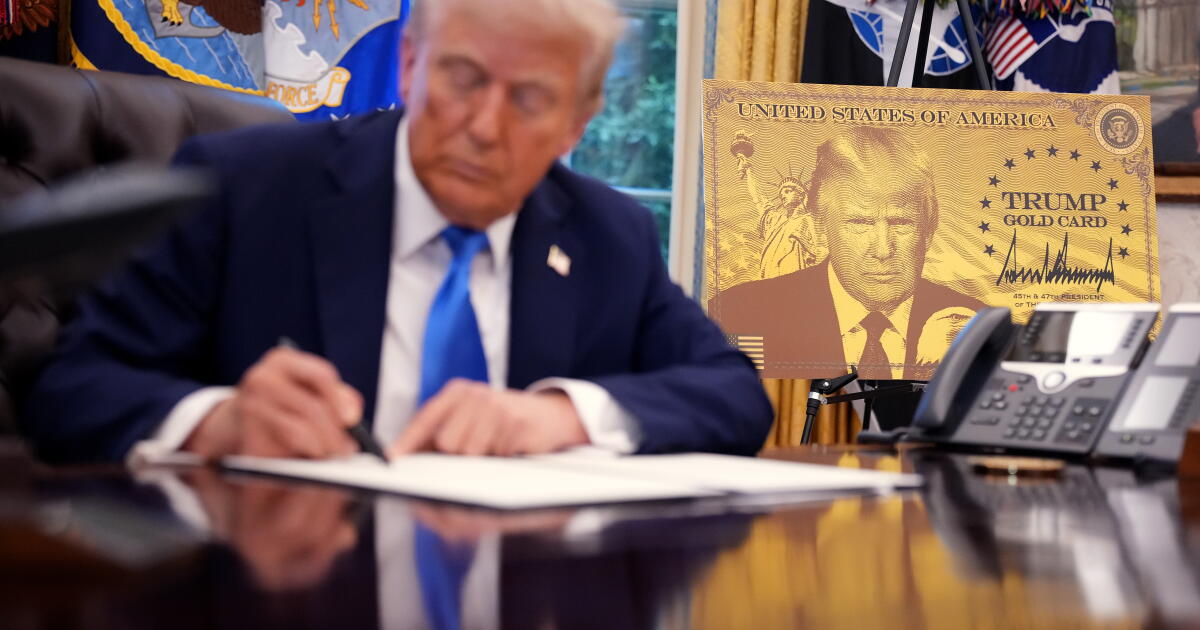
President Trump targeted birthright citizenship again Thursday by signing a pair of executive orders purporting to narrow it — including by cracking down on “birth tourism” and limiting which children born to immigrants in the U.S. qualify.

The new orders follow a U.S. Supreme Court ruling in June that rejected an attempt by Trump to end birthright citizenship outright.

During a signing ceremony in the Oval Office, Trump called that decision by the high court “very unfair” and said the new orders were an attempt to end birthright citizenship by other means.

“Our country suffers because of it, and we’re ending it a different way,” he said.

Trump promised “big crackdowns” on birth tourism, or the practice of pregnant foreign mothers coming to the United States, or foreign fathers using surrogates already in the U.S., specifically to ensure their children receive U.S. citizenship.

Trump said an entire industry has been built up around the practice, turning birthright citizenship into “a joke.”

“Wealthy people are building businesses around birthright citizenship. That’s not the way it’s supposed to work. It’s a disgrace,” he said. “They’re buying their way in, and we’re not going to let it happen.”

The orders were immediately criticized by proponents of birthright citizenship as an indefensible attempt by the president and his administration to make an end run around the Supreme Court’s clear finding that the 14th Amendment to the U.S. Constitution cannot be undone by the president.

The amendment reads in part, “All persons born or naturalized in the United States, and subject to the jurisdiction thereof, are citizens of the United States and of the State wherein they reside.”

In an apparent response to the president’s new orders, California Gov. Gavin Newsom posted that exact language to the social media platform X. Sen. Alex Padilla (D-Calif.) also responded on the platform, writing, “Trump doesn’t understand the Constitution — but the 14th Amendment’s promise of birthright citizenship and equality speaks for itself.”

Senate Minority Leader Chuck Schumer (D-N.Y.) said in a statement that Trump’s “continued crusade to end birthright citizenship is blatantly illegal,” that Democrats would challenge the orders, and that the president had “set himself up for yet another loss in the courts.”

“If you are born in America, you are American — period. The Constitution says it and the Supreme Court has affirmed it,” Schumer said.

A spokesperson for California Atty. Gen. Rob Bonta’s office, which successfully sued alongside other Democrat-led states to block Trump’s first order purporting to end birthright citizenship, said attorneys there were reviewing the latest orders late Thursday.

The American Civil Liberties Union, which also sued to block the first order, denounced the new orders — and predicted they, too, would fall.

“The Supreme Court already decided this issue: Birthright citizenship is guaranteed by the Constitution. No additional executive order can change the meaning of the Constitution,” Cody Wofsy, deputy director of the ACLU’s Immigrants’ Rights Project, said in a statement. “Any executive order that tries to rewrite birthright citizenship will meet the same fate as the last one.”

Trump’s order on birth tourism defines the practice as “the entry of any foreign national into the United States via a nonimmigrant visa for the purpose of giving birth on American soil,” or “any effort by any foreign national to facilitate” such entry.

It orders the Homeland Security and State departments to ramp up controls to block such entries, including through the denial or revocation of visas and other travel authorizations for individuals suspecting of participating in such efforts.

“Foreign nationals seeking temporary admission into the United States must adhere to the purposes for which the Congress has authorized their temporary admission, and cannot be permitted to circumvent the immigration laws in an attempt to vest themselves and their children with lasting benefits that are irreconcilable with their nonimmigrant status,” the order reads.

The order purporting to limit which children born in the U.S. are eligible for birthright citizenship describes “certain categories of children” who it says “do not fall within the rule of birthright citizenship as announced by the Supreme Court.”

It orders U.S. agencies not to provide citizenship documents to any child whose parents are not citizens if either of their parents is a foreign government employee, ambassador or a member of a foreign terrorist organization; was “engaged in a commercial transaction to purchase or access birthright citizenship” for them or to ensure their mother was in the U.S. when she gave birth to them; or had paid for a surrogate in the U.S. to give birth to them.

Echoing arguments made before the Supreme Court in defense of Trump’s first order purporting to end birthright citizenship, Trump and other White House officials claimed on Thursday that birthright citizenship was only ever intended for the children of slaves.

“This was done right after the Civil War. This was for the babies of slaves,” Trump said.

Others have said that argument “disregards the historical record” — which clearly shows lawmakers understood that the amendment’s language was much broader than that.

White House officials said the orders would prevent a large number of children from receiving birthright citizenship, hailing it as momentous.

“It ends what has been one of the gravest and most egregious abuses of the American system, and it keeps American citizenship safe,” said Stephen Miller, one of Trump’s top advisors on immigration.

Asked if the new orders would withstand judicial scrutiny, Trump predicted they would, before directing the question to White House staff secretary Will Scharf.

“What we’re doing is taking legally validated means that are clearly within our disposal and targeting them square on to this birth tourism industry,” Scharf said. “There’s absolutely nothing in here that runs afoul of any of the Supreme Court’s opinions on the subject.”

Vice President JD Vance also hailed the move.

“Our immigration system has been exploited by those who treat citizenship as a commercial transaction, not a sacred bond. President Trump is taking bold steps to combat birth tourism and restore our sovereignty. A serious nation owes its citizens nothing less,” he wrote on X.

In its 6-3 decision in June, the Supreme Court rejected Trump’s first order purporting to end birthright citizenship outright, finding that the 14th Amendment — with very few exceptions — provided a right to children born in the U.S. that could not be undone by the president.

“Citizenship, then and now, was the right to have rights — to freely participate in our political community,” Chief Justice John G. Roberts wrote for the court. “The Framers of the 14th Amendment extended that promise to ‘every free-born person in this land.’ We keep that promise today.”

Justices Sonia Sotomayor, Elena Kagan, Amy Coney Barrett and Ketanji Brown Jackson joined Roberts in full, with Justice Brett M. Kavanaugh concurring with the outcome based on separate federal law. Justices Clarence Thomas, Samuel A. Alito and Neil M. Gorsuch dissented.

The ruling was a major defeat for Trump, and was cheered by immigrant rights advocates, including many in California, as the final say on the matter — though Trump signaled almost immediately that the fight wasn’t over.

Source link

Trump lawyer urges Supreme Court to allow order targeting mail-in voting before midterms

The Trump administration urged the Supreme Court on Monday to lift a judge’s order and clear the way for state-by-state lists of citizens who are eligible to vote by mail.

Solicitor Gen. D. John Sauer filed an emergency appeal and said judges in Boston had wrongly intervened too soon.

In March, Trump ordered the U.S. Postal Service to direct states to compile a list of citizens who are eligible to vote. This list would limit who may receive a mail ballot.

He also ordered the Department of Homeland Security to “compile and transmit state-specific lists of individuals who are citizens and will be 18 years of age or older at the time of an upcoming election,” Sauer said.

Lawyers for California and 22 other Democratic-led states sued, arguing the states, not the federal government, have the constitutional authority to set the rules for voting and elections.

In June, they won before a federal judge in Boston who blocked Trump’s order from going forward, at least in the 23 states which had sued. Her decision was upheld over the weekend by the 1st Circuit Court of Appeals.

In his appeal, Trump’s solicitor general focused on a procedural question, not the issue of whether the president has the legal authority to impose national rules on state-run elections.

Sauer said the U.S. Postal Service and the Department of Homeland Security had not issued final specific plans to comply with Trump’s directive.

“Courts cannot enjoin implementation of Executive Orders that leave open material issues that still need to be resolved by agencies,” he wrote.

He asked the court to lift or stay the “premature injunctions.”

Time is running short, he said.

“Absent a stay … there will not be sufficient time to obtain appellate relief before the November election,” Sauer said. “That is especially true because implementation efforts for any USPS rule or DHS policy will need to begin well before November … particularly given that absentee and mail-in voting begin (in some States) several weeks prior to Election Day.”

The justices asked for a response from the 23 Democratic states by Aug. 3.

Source link

Trump: Iran releases ‘wrongfully detained’ U.S. citizen

President Donald Trump signs an executive order Monday in the Oval Office of the White House in Washington, D.C. Wednesday night, Trump said Iran released a U.S. citizen who’d been detained in the country since December 2024. Photo by Aaron Schwartz/UPI | License Photo

July 15 (UPI) — U.S. President Donald Trump said Wednesday evening that Iran has freed a U.S. citizen detained in the country since 2024 as a “gesture of goodwill.”

In a social media post, Trump said Iran wrongfully detained the woman in December 2024.

“She is now safely outside of Iran, and in good condition,” Trump wrote. He did not identify the woman but said the United States appreciated the gesture.

Lawyer Jared Genser said in a social media post that the woman is Dena Karari, a client of his trapped in Iran on “bogus charges.” Genser said Karari is safe and traveling back to the United States. He said her freedom wouldn’t have happened without “extraordinary and relentless efforts” by Trump.

Genser said in a further statement that Karari is a U.S.-Iranian citizen who ran a nonprofit called the Children of Mehr Foundation, ABC News reported. The foundation’s Instagram page says that it works to empower children “through education, creativity and opportunity.”

Genser said she visiting her family when she was detained and interrogated by Iran’s Ministry of Intelligence and Security, suffering “enormous physical and psychological hardship.”

On Wednesday night, the United States military struck Iranian targets for the fifth straight day, with Iran hitting several U.S. military targets Tuesday in Jordan, Bahrain and Kuwait.


Source link

On birthright citizenship, Supreme Court ‘originalists’ are split

The Supreme Court’s conservative justices say they decide cases based on the words and original history of the Constitution — and not on their personal or political views.

Following the lead set by the late Justice Antonin Scalia, they say they see history and “originalism” as a guiding principle to prevent judges from changing the Constitution to adjust to new and changing times.

This text-and-history approach is said to contrast with an evolving or “living Constitution” favored by progressives and liberal activists.

But this year saw a flip of sorts on birthright citizenship.

The foremost conservatives agreed with President Trump that the surge of illegal immigration called for reconsidering the promise of citizenship at birth set out in the 14th Amendment of 1868.

“The number of illegal immigrants in this country exploded” in recent years, Justice Samuel A. Alito Jr. wrote in dissent. The rule of citizenship at birth provides “a powerful incentive to enter or remain in this country illegally,” he added.

“The Constitution is an enduring document,” wrote Justice Brett M. Kavanaugh, but its rules and meaning must adjust to “modern situations that were unknown or unanticipated by the Constitution’s Framers.”

In a concurring opinion, he said that “significant illegal immigration into the United States is a new circumstance that was largely unknown as of 1868.”

There were no federal immigration laws in the mid-19th century, but it was an era when a surge of Irish immigrants had settled on the East Coast and large numbers of Chinese immigrants came to California.

Under the law, their children were deemed to be citizens at birth.

Among the conservative originalists, only Justice Amy Coney Barrett signed the majority opinion that was written by Chief Justice John G. Roberts Jr. and joined by the three liberals.

The opening words of the 14th Amendment of 1868 say: “All persons born or naturalized in the United States and subject to the jurisdiction thereof are citizens of the United States.”

In 1898, the Supreme Court upheld the rule of citizenship at birth in the case of Wong Kim Ark, who was born in San Francisco to Chinese parents.

In an executive order, Trump proposed to end birthright citizenship for the newborns whose parents were in the country illegally or temporarily.

Writing for the court, the chief justice said the words of the 14th Amendment were clear and were clearly understood at the time. He dismissed the “dramatically revisionist view” that has been cited recently.

Kavanaugh voted with the majority to block Trump’s order from taking effect. He did so because Congress had adopted birthright citizenship in a 1952 law.

“Consistent with the 14th Amendment, Congress could … enact new legislation establishing exceptions to birthright citizenship,” he wrote.

Justices Clarence Thomas and Alito wrote long dissents arguing that the framers of the 14th Amendment did not or would not have favored birthright citizenship.

They pointed to recent scholarship by law professors that raised questions about the accepted understanding of the 14th Amendment and the citizenship rule.

Thomas said citizenship of the child should turn on whether the parents were “domiciled” in this country. Black people who were enslaved were undoubtedly domiciled here, but the same is not true of temporary visitors.

Justice Neil M. Gorsuch agreed in part with Thomas and questioned whether the newborns of temporary visitors should be deemed as citizens at birth.

Many court commentators were surprised by the close 5-4 divide on the constitutional issue.

“Given how clear the language was, I expected it to be 7 to 2,” said Melissa Murray, a New York University law professor. “I really gasped when I saw it was 5-4. This is not settled. We’re not done with this debate.”

Sarah Isgur, a podcaster and SCOTUSblog analyst, said that “originalism is getting more and more muddled. Either the history matters or it doesn’t.”

However, she agreed with Kavanaugh’s approach of leaving it to Congress to reconsider the issue.

Not all originalists are conservative.

Yale Law Professor Akhil Amar, a constitutional historian, argued that the history of birthright citizenship is clear and not subject to revisionist thinking. He said the Reconstruction Congress adopted this principle of citizenship at birth and stated their intent in clear words in the 14th Amendment.

“When a baby is born on American soil and an American flag flies above, that baby is a birthright citizen, as the Reconstruction Republicans across the land understood,” he wrote in February. This rule “has virtually nothing to do with the baby’s parents.”

Last week, he was mostly cheered by the court’s ruling.

“It’s a triumph, but it should have been 9-0,” Amar said on a review of the court term sponsored by SCOTUSblog. “Shame on the dissenters. They didn’t even the address the statute” and its wording.

But the majority led by Roberts “clearly affirmed the plain meaning of the constitutional text and its history. And that’s a win,” he said.

History has a recurring role at the Supreme Court.

Isgur noted the court will hear arguments in the fall on whether the 2nd Amendment of 1791 gives gun owners a right to have “assault weapons” like AR-15 rifles.

She said the court will decide then between history and changed circumstances.

At issue is whether these modern rapid-fire rifles fit within the history of the gun rights protected by the 2nd Amendment or instead represent a new and dangerous threat to public safety that was unknown in 1791.

Scalia’s opinion upholding gun rights in 2008 is often cited as a model of originalism, but it too emerged from a court divided 5-4.

The 2nd Amendment says, “A well-regulated Militia, being necessary to the security of a free state, the right of the people to keep and bears Arms, shall not be infringed.”

For decades, the Supreme Court had all but ignored the 2nd Amendment, viewing it as a somewhat outdated provision involving militias, akin to the 3rd Amendment. It forbids having soldiers “quartered in any house … in time of peace.”

Four liberal dissenters in 2008 said the court should stand by that understanding of history.

Justice John Paul Stevens said the 2nd Amendment was added to the Constitution to protect state militias from federal interference. Moreover, the reference to “bear arms” suggests it was about militias, he said.

But Scalia’s opinion stands as the landmark precedent, and he said the dissenters had the history all wrong.

The right to have guns for self-defense arose in England and came to the American colonies. “By the time of the founding, the right to have arms had become fundamental for English subjects,” he wrote.

The 2nd Amendment did not establish a new right, he said. Rather, it “codified a pre-existing right [of] having and using arms for self-preservation and [defense],” he wrote.

“There seems to us no doubt, on the basis of both text and history,” Scalia wrote, “that the 2nd Amendment conferred an individual right to keep and bear arms.”

Source link

How Roberts led a fractured Supreme Court to wins for the right and defeats for Trump

Chief Justice John G. Roberts Jr. led a fractured Supreme Court this year that both expanded a president’s power to run the government and dealt major defeats to President Trump.

In Trump’s second year back in the White House, Roberts and the court punctured his claim to have power with no limits.

The justices struck down his worldwide tariffs, ruling these import taxes are a matter for Congress, not the president.

They also threw out his executive order that would end the principle of birthright citizenship. The Constitution wrote this promise into law, Roberts said, and the president may not change it.

The court also ruled in December that the president did not have the power to put National Guard troops on the streets of Chicago.

The three decisions came over fierce dissents from conservative Justices Clarence Thomas and Samuel A. Alito Jr. and with Neil M. Gorsuch in two of them.

The three liberal justices dissented angrily when the court ruled the administration may end Temporary Protected Status for Haitians and Syrians.

They did the same when the court ruled the president may replace the top appointees of semi-independent agencies.

But they joined Roberts in a 5-4 ruling that affirmed the independence of the Federal Reserve and blocked Trump’s move to fire Fed Governor Lisa Cook.

Trump has won on most immigration fronts because Roberts and the conservatives believe Congress put the enforcement power in the hands of the administration. They point to the law authorizing temporary protection which says there shall be “no judicial review” of the decision to end the protection.

Roberts is a solid conservative who also tries to keep the court on a middle course. It’s an approach that rarely wins plaudits from the right and almost never from the left.

This year the chief justice prevailed with different coalitions.

This week, the court ruled by a 5-4 vote against the Republican National Committee and upheld state laws that allow for counting late-arriving mail ballots. Justice Amy Coney Barrett joined with Roberts and Justices Sonia Sotomayor, Elena Kagan and Ketanji Brown Jackson.

Barrett also joined the chief justice in the rulings on tariffs and birthright citizenship.

A man with gray hair, in a gray suit with striped tie, gestures while speaking and facing the left

Chief Justice John G. Roberts Jr. speaks to the Georgetown Law School graduating class in 2025.

(Manuel Balce Ceneta / Associated Press)

This week, the court also limited the power of police to use cellphone data to look for crime suspects. This too came on a 5-4 vote when Justice Brett M. Kavanaugh joined Roberts and the three liberals.

Harvard law professor Richard Lazarus, who has been a friend of Roberts’ since their time in law school, said the chief justice “is clearly working very hard” to put together majorities.

“It is not easy to formally preside over a court in which five of its members (Justices Thomas, Alito and Gorsuch on the right and Justices Sotomayor and Jackson on the left) deride the kind of efforts at moderation that is the chief’s preferred signature and harshly condemn him when he strays from their own views.”

Washington attorney Roman Martinez, a former clerk for Roberts, said the court is “clearly right of center” but the decision on tariffs was the most important of the year.

“It is a huge deal for the court to say ‘no’ to the president on his major policy initiative,” he said.

Stanford law professor Michael McConnell agreed. “It’s hard to claim the court is in Trump’s pocket when he lost the major cases,” he said.

Trump responded to the tariff defeat by calling the justices in the majority a “disgrace to our nation” and “disloyal to the Constitution.”

They “sicken me,” he said of Justices Barrett and Gorsuch, his two appointees who joined Roberts in the 6-3 majority.

Trump went to the court in April to hear his top attorney defend his executive order on birthright citizenship. He left after an hour of mostly skeptical questions.

On the term’s last day, Roberts issued a clear and eloquent 26-page opinion setting out America’s history of according citizenship to children who were born in this country, without regard to their parents.

This view came from England “and crossed the Atlantic with the colonists — and was adopted with little fanfare after the Revolution,” he wrote. “Nothing is better settled,” Justice Joseph Story wrote in 1830.

But it was unsettled by the fight over slavery.

“In the odious decision of Dred Scott v. Sandford, this Court imposed the Southern States’ beliefs onto the Nation” and decreed Blacks could not become citizens, Roberts wrote.

Abraham Lincoln and Frederick Douglass were among the many who condemned the court’s decision, he said.

“It took more than a decade — and the addition of names such as Antietam, Gettysburg, and Chancellorsville to our national canon — but Douglass’s vision of ‘our common humanity’ would be fulfilled,” he wrote.

The Reconstruction Congress wrote this rule into the 14th Amendment and said “All persons born” here are citizens by birth.

The principle of birthright citizenship had been upheld by the Supreme Court in 1898, the chief justice wrote, and it had gone unchallenged until Trump returned to the White House last year.

But Thomas filed a 91-page dissent arguing that immigrants must be “domiciled” here before their children may become citizens.

Alito filed a separate 39-page opinion branding the Roberts opinion a “serious mistake.”

On that note, the court adjourned for its summer recess.

Source link

Ukrainian citizen charged with Nord Stream gas pipeline attack in 2022

July 2 (UPI) — A Ukrainian national has been charged in Germany in connection with the 2022 bombing of the Nord Stream pipelines bringing natural gas 760 miles via the Baltic Sea from northwestern Russia to Lubmin in northeastern Germany.

Authorities allege the suspect, named only as Serhii K, led and coordinated an operation with seven others to sabotage the $17 billion gas projects on Sept. 26, 2022, according to reports in German media Wednesday. He is also charged with attacking and destroying civilian energy infrastructure and causing an explosion.

Prosecutors said he is the same individual who was detained by Italian authorities in August and extradited to Germany in November.

He denies all wrongdoing.

German prosecutors further allege he was a serving Ukrainian officer and that he and the others, who were also members of the Ukraine military, were “acting on behalf of state bodies in Ukraine” to deprive Moscow of energy revenues from the pipelines to fund its war against Ukraine.

The finger has variously been pointed at Ukraine, along with Britain and the United States, and even Russian itself, but the Federal Public Prosecutor General’s claim the attack was ordered by Kyiv was highly significant because Germany is one of Ukraine’s staunchest allies, providing military aid and political support.

Kyiv , which has always denied involvement, did not immediately respond to the accusation.

Three of the four pipelines were ruptured east of the Danish island of Bornholm in the attack. Nord Stream 1 was shut down at the time due to technical problems.

Nord Stream 2, a subsidiary of the Russian state-run energy giant Gazprom, was completed in September 2021 after being plagued problems including legal wrangles and U.S. sanctions targeting companies party to the project.

However, it never opened because Germany cancelled its certification process shortly before Russia’s full-scale invasion of Ukraine in February 2022 as it moved to wean itself from its reliance on Russian gas.

The project, which would have doubled Nord Stream’s gas capacity to 110 billion cubic meters annually — said by the company to be sufficient to supply to 26 million homes in Europe and critical to efforts to guarantee the European Union’s “security of supply of natural gas.”

Source link

Supreme Court rejects Trump’s plan to limit birthright citizenship

The Supreme Court on Tuesday upheld the Constitution’s promise that all those born here are citizens of the United States, regardless of the status of their parents.

In a 6-3 decision, the justices rejected President Trump’s plan to revise the Constitution by executive order and to end citizenship at birth for newborns whose parents were here illegally or temporarily.

Chief Justice John G. Roberts spoke for the court to reject Trump’s proposed limits on birthright citizenship.

“Citizenship, then and now, was the right to have rights — to freely participate in our political community,” he said. “The Framers of the 14th Amendment extended that promise to ‘every free-born person in this land.’ We keep that promise today.”

Justices Sonia Sotomayor, Elena Kagan, Amy Coney Barrett and Ketanji Brown Jackson joined in full. Justice Brett M. Kavanaugh concurred in the outcome based on the federal law that incorporates birthright citizenship.

But the outcome was closer than most had predicted.

Justices Clarence Thomas, Samuel A. Alito and Neil M. Gorsuch dissented in agreement with Trump.

The decision is the second major defeat for Trump from a conservative court that usually supports broad presidential power.

In February, the court struck down Trump’s sweeping worldwide tariffs, his signature economic policy. Roberts said Congress, not the president, has the power to raise revenue and impose taxes, including duties on imports.

In April, Trump came to the court to hear the arguments over birthright citizenship. He sat in the gallery while the justices posed steadily skeptical questions to his solicitor general.

He left after an hour having heard enough to know he was likely to lose.

It was the rare Supreme Court case which was decided based simply on the words of the Constitution.

The justices, both conservative and liberal, say they look to what the Constitution says and how its words were originally understood.

The 14th Amendment adopted in 1868 says: “All persons born or naturalized in the United States and subject to the jurisdiction thereof are citizens of the United States and of the State where they reside.”

The amendment overturned the infamous Dred Scott decision of 1857, which declared that Black persons could not become U.S. citizens.

In its place, the Reconstruction Congress adopted the broad view of citizenship based on the place of birth, not parentage, that had been part of English law for centuries.

In the 19th Century, it was understood that the only exceptions to this rule of birthright citizenship were for the children of foreign diplomats, foreign troops on American soil or, for a time, Native Americans who lived on tribal reservations.

In 1924, Congress extended full citizenship to all Native Americans who were born in this country.

The Supreme Court had also confirmed the broad understanding of birthright citizenship in 1898. The justices upheld the U.S. citizenship of Wong Kim Ark who born in San Francisco to Chinese parents who later returned to China.

“The 14th Amendment affirms the ancient and fundamental rule of citizenship by birth within the territory,” the court said then. “In clear words and in manifest intent, [it] includes the children born, within the territory of the United States, of all other persons, of whatever race or color.”

Congress added birthright citizenship to the immigration laws in 1952.

But in his first day back in the White House, Trump signed an executive order to revise the citizenship laws.

“The privilege of United States citizenship is a priceless and profound gift,” he wrote, and in the future, it will not extend to newborns whose parents are in this country unlawfully or temporarily, such as on tourist, student or work visa, he said.

His proposal was quickly blocked by judges as unconstitutional, and it never went into effect.

In his appeal, Trump’s attorney argued that judges have been “misreading” the phrase “subject to the jurisdiction.”
He said this refers to “political allegiance.”

By that standard, the children of temporary visitors and unlawful immigrants are not citizens because they and their parents “not completely subject to the United States’ political jurisdiction,” according to the administration.

Trump could have proposed legislation on tariffs and birthright citizenship and urged the Republican-led Congress to adopt new laws. Instead, he chose to try to change the law and revise the Constitution by executive order.

Before the Supreme Court, Trump’s attorney pointed to the surge of illegal immigration in recent decades.

“We’re in a new world now,” he said, one that calls for new restrictions on citizenship.

“It’s a new world. It’s the same Constitution,” responded Roberts.

Source link

Mike Trout says he’ll likely not participate in home run derby

Mike Trout said Friday he is unlikely to participate in the All-Star home run derby in Philadelphia because of his strained right hamstring.

Trout expects to return from the injury in plenty of time to play in the July 14 All-Star Game, but it likely will prevent the Angels center fielder from joining the home run-hitting contest the night before.

“They asked me when we were in Sacramento [last weekend], but I probably won’t do it,” Trout said before the Angels’ game against the Athletics. “It would have been cool to do it, but the injury kind of threw things off.”

Trout, a three-time American League MVP and 11-time All-Star, has turned down numerous invitations to participate in the derby because he felt the high volume of maximum-effort swings the event requires would throw him off at the plate.

He always maintained that he would take part in the derby at least once before he retires, and this seemed to be the year to do it, with All-Star Game festivities in Citizens Bank Park about 45 miles north of his hometown of Millville, N.J.

Trout, who’s among American League leaders with 17 homers, fueled more speculation that he would participate in the derby last weekend when he told USA Today that he was “considering” it.

But Trout, placed on the 10-day injured list on June 18, had a change of heart over the last week.

“When it came out that the All-Star Game was in Philly, I thought it definitely would have been cool to do,” said Trout, who ranks second behind New York Yankees slugger Aaron Judge in All-Star voting for AL outfielders. “Then I hurt my leg, so I’m leaning toward not doing it.”

Source link

Former head of Iowa school district sentenced to 2 years for falsely claiming to be a US citizen

The former superintendent of Iowa’s largest school district who was arrested last year in the Trump administration’s immigration crackdown was sentenced Friday to two years in prison.

Ian Roberts is likely to be deported to his native Guyana in South America once he serves the sentence. He pleaded guilty in January to falsely claiming to be a U.S. citizen and illegally possessing firearms, which together carry a maximum sentence of 20 years in prison. His lawyers had proposed that he be put on probation “to facilitate his removal from the United States,” but prosecutors had argued that his likely deportation should not be a factor.

Prosecutors alleged Roberts knowingly lacked employment authorization for nearly all of his two-decade career in urban education and submitted a counterfeit Social Security card when he was hired as superintendent of the Des Moines public school district, which serves 30,000 students.

Roberts’ stunning case bookended the school year. His September arrest occurred as President Trump’s administration was sending increased numbers of federal immigration officers into American cities to round up immigrants.

Des Moines Public Schools said last month that it revised its conflict-of-interest policy after an audit found Roberts awarded district business to a consulting firm he worked for, affirming findings first reported by the Associated Press in the weeks after federal immigration officers detained him.

Roberts was in his school-issued vehicle when officers stopped him on Sept. 26 in a targeted U.S. Immigration and Customs Enforcement operation. He allegedly fled before he was located with the help of state troopers. Authorities said a loaded handgun was wrapped in a towel under the seat and $3,000 in cash was in the car. Three other weapons were recovered during a search of his home.

In a court filing, attorneys for Roberts said he has dedicated his life in the U.S. to public service and has not been a threat to public safety. After Roberts married a U.S. citizen, his attorneys said, he was denied lawful permanent residency because he failed to disclose that he had been arrested. He said he did not think he needed to because the charges against him were dropped.

“While Dr. Roberts tried to adjust his status three more times, this initial mistake by Dr. Roberts sealed his fate,” his attorneys wrote. “In the background of his career for the next 24 years, this denial of his adjustment of status haunted Dr. Roberts like a ghost, eventually derailing his life and career.”

Dozens of people submitted letters on Roberts’ behalf to dispute how he has been portrayed and provide details of his positive impact. His lawyers wrote that he likely faces deportation to Guyana, where he will “be left without his career, without his wife, without his children, in a country where he has not lived for thirty years.”

In recommending a three-year sentence, prosecutors described a yearslong and deliberate misrepresentation of his legal status. Prosecutors said a reduced sentence is not appropriate just because Roberts is likely to be deported.

They said they do not know what documents Roberts presented to show eligibility for work dating back to 2008, years before he was approved for temporary status in 2018, but he “deliberately obtained employment without work authorization at school after school, within state after state.”

Fingerhut writes for the Associated Press.

Source link

U.S. review of Mexican consulates stokes worries vital services may be lost

Mexico’s consulate in Los Angeles helps thousands of citizens each week, assisting them with registering births, obtaining passports and, increasingly since President Trump’s second term began, accessing legal help for loved ones who have fallen afoul of his administration’s immigration policies.

Although it serves the country’s biggest Mexican community, all 53 Mexican consulates in the U.S. provide services that make Mexican people’s lives easier — just like the nine U.S. consulates in Mexico improve the lives of Americans south of the border.

The U.S. State Department has launched a review that might lead to the closure of an unknown number of Mexican consulates. Although it hasn’t said why, the review is happening against the backdrop of the immigration crackdown, some thorny bilateral issues and far-right theories that the consulates have been interfering in U.S. politics and encouraging Mexicans to migrate northward.

Azucena Aviles, a 33-year-old mother who drove more than an hour to the L.A. consulate this month to renew her Mexican passport and get one for her daughter, said consular services are invaluable — especially in California, which is home to nearly 13 million people of Mexican descent, including an estimated 1.7 million who are in the U.S. illegally.

“It wouldn’t be fair if they messed with the Mexican people, especially with our support systems, which come from the Mexican consulate and which, in some way, help or protect our fellow Mexicans,” she said.

Trump has been exerting growing pressure on Mexico, with questions looming over issues including human rights, national sovereignty and regional diplomacy.

His administration has given only the broadest of explanations for launching its review.

“Department of State is constantly reviewing all aspects of American foreign relations to ensure they are in line with the President’s America First foreign policy agenda and advance American interests,” Dylan Johnson, assistant secretary of State for global public affairs, wrote in an email.

Among the possible reasons for the review is that it could somehow fit into the Trump administration’s immigration efforts to deport people in the U.S. illegally. The largest contingent of such people — an estimated 4.3 million, according to the Pew Research Center — are Mexican.

Relations between the two countries could also play a role, with Trump increasing pressure on Mexico in the run-up to free trade negotiations important to both nations’ economies, taking a more aggressive approach toward the U.S.’ southern neighbor and even threatening to take military action against Mexican cartels.

Mexican President Claudia Sheinbaum has avoided head-on conflicts with Trump and instead relied on diplomacy, including sending top officials to Washington and seeking to maintain a strong relationship with the Trump administration by cracking down on Mexican cartels. Sheinbaum and her predecessor have also been key allies in slowing migration to the U.S. and speeding up the deportation of other Latin American migrants.

But Sheinbaum has taken a firmer stance in regards to the deaths of Mexicans in U.S. immigration detention centers, calling them unacceptable and saying the conditions in such lockups were “incompatible with human rights standards and the protection of life.” She instructed Mexican consulates to visit detention centers daily to help ensure detained citizens are being held in safe conditions.

Relations rapidly deteriorated in recent weeks after the U.S. indicted several Mexican officials on drug trafficking charges, and two CIA officers died following an anti-narcotics operation in northern Mexico — American involvement that Sheinbaum said her government had not authorized. That drug raid raised uncomfortable questions in Mexico about the extent of U.S. involvement in domestic security operations.

Years of tit-for-tat tariffs between the two countries have also added strain.

A review of foreign consulates is “usually a sign that a bilateral relationship is in a very, very rocky moment,” said Arturo Sarukhan, a former Mexican ambassador to the U.S. In Mexico’s case, it comes at “the worst moment of the U.S.-Mexico relations” in decades, given all the current points of contention, he said.

Further straining relations is a theory being amplified by Peter Schweizer, a writer with a following among Trump loyalist who has claimed that Mexican consulates interfere in U.S. politics and encourage migration to the U.S. Experts say that although a few Mexican consulate officials may have sought to influence politics back home, there is no evidence of them interfering in U.S. elections.

In response to the State Department review, Sheinbaum said the idea that Mexican consulates are “playing politics in the United States is completely false.” She said the job of consulates anywhere is to “always protect” citizens.

Sarukhan too said that although consulates defend the rights of Mexican citizens, there is no evidence that they are interfering in U.S. elections.

Whatever the reasons for the consulate review, it has stoked worries.

During a weekly public forum at the L.A. consulate, a woman who didn’t give her name and whose husband had been in U.S. immigration detention asked for help finding him a lawyer, highlighting one crucial service consulates provide for their citizens.

An older man said he had heard about the review and asked about possible closures.

Carlos González Gutiérrez, Mexico’s top diplomat in Los Angeles, responded that, as Sheinbaum said, there would be “no reason whatsoever” for the U.S. to close a Mexican consulate.

Indeed, consulates would have significant, devastating effects for Mexican immigrants,” especially in isolated areas, said Ariel Ruiz Soto, a senior policy analyst for the Migration Policy Institute.

Every day, consular officials go to the Immigration and Customs Enforcement holding center in downtown Los Angeles to identify and interview as many detained Mexican nationals as they can.

González Gutiérrez, 62, begins every weekly public forum by noting how many detained Mexicans consular officials have interviewed since the immigration crackdown began in Los Angeles last June.

At that May 11 meeting, the figure stood at 1,940. Nearly half had deep roots in the U.S., he said. About 46% have been deported, 35% have children born in the U.S., 69% entered the country through a port of entry, 6% overstayed a visa and 2.5% requested asylum. Most were men, and many worked in construction, agriculture, gardening and the service industry.

He also disputed the claim that Mexican consulates are interfering in U.S. politics.

“We are guests of this country’s government, just as U.S. consuls are guests of the Mexican government. In that sense, we are neither activists nor spies,” said González Gutiérrez. “We carry out our work openly, within a pluralistic and democratic society.”

Pineda and Janetsky write for the Associated Press. Janetsky reported from Mexico City.

Source link