voting

Virginia voting on new congressional map drawn by Democrats

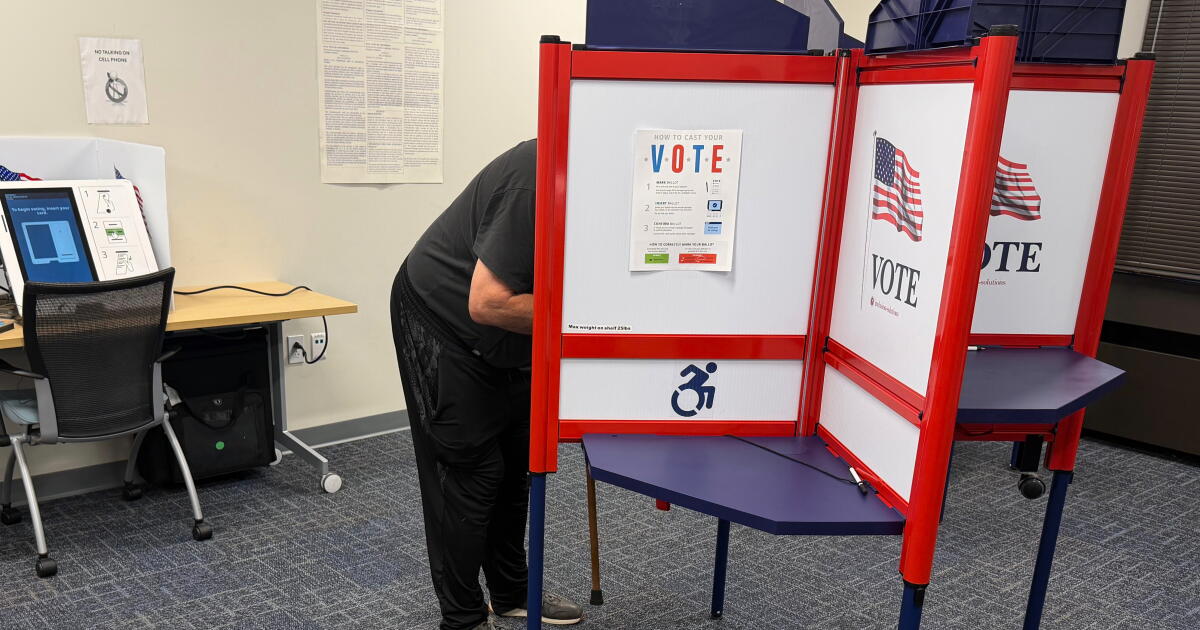
April 21 (UPI) — Voters are heading to the polls in Virginia on Tuesday to vote on a new congressional map drawn by state lawmakers.

Polls are open until 7 p.m. EST., with nearly 1.4 million early ballots already cast on a constitutional amendment to change the congressional map. The result of Tuesday’s vote could have significant implications for the midterm elections in November.

If the map, drawn by Democratic lawmakers, is approved by voters, Democrats would be favored to win 10 of the state’s 11 congressional districts. Democrats currently hold six of the state’s 11 congressional seats and Republicans hold five.

Virginia is just the latest state to weigh redrawing its congressional map mid-decade after Texas approved a map that will favor Republicans last year. Four Republican-led states have approved new congressional maps.

Democrats and Republicans outside of the state have lent their voices to campaigns for and against Virginia’s redistricting plan. President Donald Trump and House Speaker Mike Johnson, R-La., voiced their opposition to the plan, with Trump calling it “unfair.”

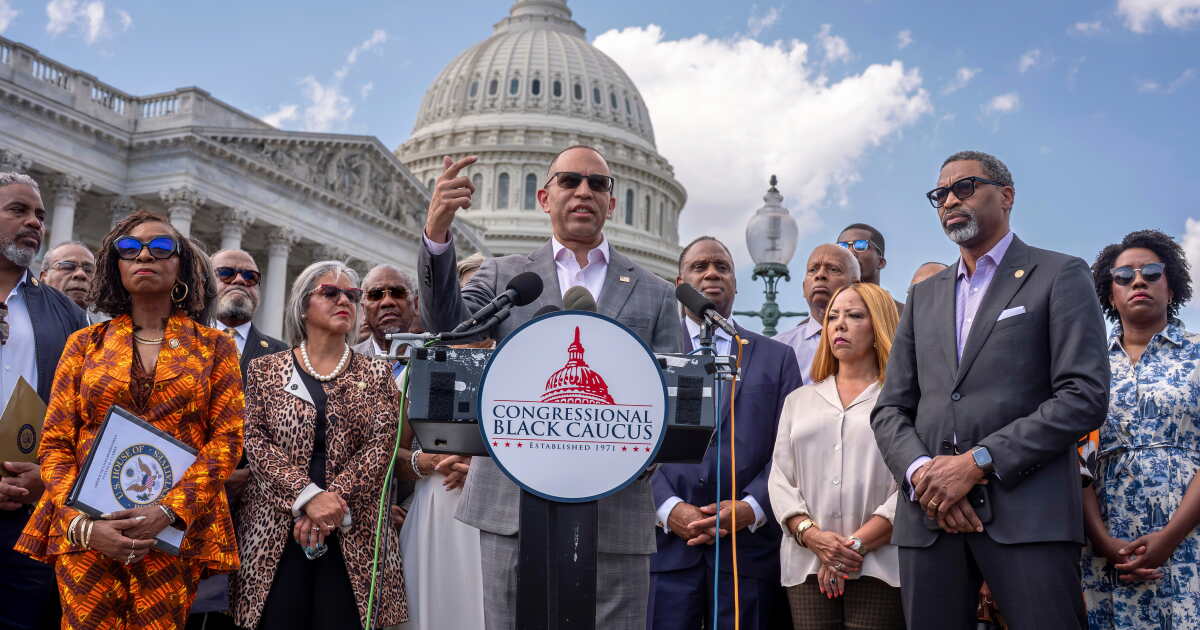
House Minority Leader Hakeem Jeffries, D-N.Y., has joined Virginia lawmakers Sen. Mark Warner and Sen. Tim Kaine at rallies to support redistricting. Former President Barack Obama has also been involved, appearing in ad campaigns calling on voters to vote “yes.”

“We’re giving Virginians a chance to vote — which Republican states have not done — about whether they want to have a congressional delegation that will stand up against Donald Trump’s tyranny if he tries to interfere with our elections,” Kaine said in an appearance on Fox News on Sunday.

The Virginia Supreme Court allowed Tuesday’s election to move forward but may still weigh in on whether the new congressional map is legal or not.

Secretary of Health and Human Services Robert F. Kennedy, Jr. speaks during a House Appropriations Subcommittee on Labor, Health and Human Services, Education, and Related Agencies hearing on the budget for the Department of Health and Human Services in the Rayburn House Office Building near the U.S. Capitol on Thursday. Photo by Bonnie Cash/UPI | License Photo

Source link

Judge sides with Arizona election official in ruling that has implications for midterm voting

The top election official in Arizona’s most populous county will get more authority in running elections after a judge sided with his office in a prolonged legal fight with the local board that shares responsibility for overseeing the vote.

The decision could have broad implications in one of the nation’s most prominent battleground states, which will have several high-profile races this fall. Maricopa County, which includes Phoenix, has been roiled by election conspiracy theorists ever since President Trump lost the state to Democrat Joe Biden during his bid for reelection in 2020.

Justin Heap, the Republican recorder in Maricopa County, sued the predominantly Republican county board of supervisors last summer, alleging it had illegally taken control of certain aspects of election administration. Heap claimed the board transferred funding, IT staff and some key functions — including management of ballot drop boxes and establishing early voting sites — away from his office through an agreement negotiated with his predecessor, whom he had recently defeated in a GOP primary.

Maricopa County Superior Court Judge Scott Blaney mostly sided with Heap’s office in his ruling, which was filed Thursday but appeared on the public docket Friday. The board of supervisors “acted unlawfully and exceeded its statutory authority by seizing the Recorder’s personnel, systems and equipment and refusing to return them” to the recorder, he wrote.

Blaney also ruled that the recorder’s office is responsible for overseeing in-person early voting, among other duties, while the board is responsible for other operations, such as selecting election day voting locations, supplying polling locations and hiring poll workers.

“The Board’s assertion of plenary authority over election administration through its general supervisory powers is inconsistent with Arizona law,” the judge wrote.

Board Chairwoman Kate Brophy McGee said the board will consider an appeal.

“I disagree with other portions of the ruling, and I will explore all options with the Board of Supervisors, including an expeditious appeal,” McGee, a Republican, said in a statement. “From day one, the Board of Supervisors has provided Recorder Heap the resources and staffing needed to fulfill his statutory duties. We will continue to do so because voters always come first.”

In a statement, Heap praised the ruling as a “clear and decisive victory for the rule of law and for the voters of Maricopa County.”

“The court confirmed that the Board cannot override state law, use funding as leverage, or take control of election duties assigned to the Recorder,” Heap said. “This ruling restores both the authority and the resources necessary for my office to do its job.”

Heap, a former Republican state lawmaker, was elected in 2024 after unseating incumbent Stephen Richer in the GOP primary and defeating a Democratic candidate in the general election. In the past, Heap has stopped short of repeating false claims that the 2020 and 2022 elections were stolen but has said voters don’t trust the state’s voting system and that it’s poorly run.

False claims of fraud since the 2020 presidential election led to threats of violence against Richer and others in the Maricopa County elections office. Richer blamed Heap for contributing to an atmosphere of distrust and vitriol directed toward the office.

“He catered to the really ugly stuff that the people in that office had to live through,” Richer said of Heap, in an interview last month. “And he allied with people who were very much in the eye of the storm in terms of creating it.”

Once he took office, Heap terminated a previous agreement that was reached between Richer and the board that had revised how election operations were divided between the two offices. Heap filed his lawsuit with the backing of America First Legal, a conservative public interest group founded by Stephen Miller, now deputy chief of staff in the White House.

Kelety writes for the Associated Press.

Source link

Canadians voting in federal byelections as Carney seeks majority

Voters in Ontario and Quebec, Canada are voting in byelections Monday that could give Prime Minister Mark Carney a liberal majority. File Photo by Eric Reid/EPA-EFE

April 13 (UPI) — Voters in Ontario and Quebec, Canada, are voting in byelections on Monday that could give Prime Minister Mark Carney a liberal majority.

The ballot boxes are open in two ridings, or electoral districts, in Ontario as well as one in Quebec. The Liberal Party of Canada needs to win one of three elections to establish majority control of the government.

Liberal hold 171 of 343 seats in the House of Commons.

Both Ontario districts, Scarborough Southwest and University-Rosedale, are in the Toronto area. They were previously held by liberal members of Parliament.

The district in Quebec, Terrebonne, is in the Montreal area. A liberal candidate won in that district by one vote last year. Canada’s high court nullified the result of that election in February, citing a clerical error.

The Liberals have bolstered their control of the House with four members of the Conservative Party of Canada defecting. A member of the New Democratic Party also defected to join the Liberals.

The most recent defection occurred last week when Marilyn Gladu left the Conservative Party. Gladu represents the Sarnia-Lambton-Bkejwanong riding in Ontario.

House leader Steven MacKinnon, a liberal parliament member, said that he plans to “continue that impulse of working across party lines” if his party captures a majority.

Children race to push colored eggs across the grass during the annual Easter Egg Roll event on the South Lawn of the White House in Washington on April 21, 2025. Easter this year takes place on April 5. Photo by Samuel Corum/UPI | License Photo

Source link

L.A. election shadow hearing: Democrats, experts defend voting systems

House Democrats and a panel of elections experts expressed unwavering confidence in state voting systems and dismissed Trump administration claims of widespread fraud and other vulnerabilities during a special “shadow hearing” in Los Angeles on Tuesday.

They accused President Trump and his Republican allies of pushing sweeping federal reforms — including stricter voter ID laws and new restrictions on voting by mail — that would disenfranchise millions of eligible Americans, especially low-income, rural and elderly voters, as well as voters of color and those with disabilities.

“They are taking us backward, and not to a good place,” said Rep. Nancy Pelosi (D-San Francisco), who helped lead the hearing at the Daniel K. Inouye National Center for the Preservation of Democracy in Little Tokyo.

They also stressed that they and their allies were working hard to prevent such backsliding.

“While Republicans are expecting Democrats to just sit idly by as they attempt to steal yet another election, Democrats are getting out in the community, raising the alarm bells about the GOP’s efforts to rig these elections and fighting back in the courts, in Congress and in our communities,” said Rep. Pete Aguilar (D-Redlands), chair of the Democratic Caucus. “We won’t let Republicans get away with their anti-democratic and un-American schemes.”

Such “shadow hearings” allow Democrats to highlight issues their majority-Republican counterparts won’t schedule for formal hearings in Washington. This week’s discussions — a second is scheduled Thursday in San Francisco — follow others in California in recent months, including on Trump’s immigration raids.

Pelosi, the former House speaker, led the hearing alongside Aguilar and Rep. Joseph Morelle of New York, the ranking Democrat on the House Administration Committee, which has oversight of elections. Joining them were fellow Democratic Reps. Nanette Barragán of San Pedro, Judy Chu of Monterey Park, Gil Cisneros of Covina, Laura Friedman of Glendale, Luz Rivas of North Hollywood, Linda Sánchez of Whittier, Norma Torres of Pomona and Maxine Waters of L.A.

Pelosi noted the setting on the grounds of the Japanese American National Museum, where Japanese Americans were detained before being unconstitutionally stripped of their belongings and taken to internment camps during World War II.

“To be here on a day when the president of the United States has talked about destroying the civilization of a country is so appalling. It’s so appalling, and I don’t think we can ignore comments like that, especially in a setting like this,” Pelosi said.

She also said that securing the nation’s elections against Trump’s threats and getting out the Democratic vote was the surest way of restoring order to U.S. relations abroad — and far more likely than getting Trump’s Cabinet to remove him from office by invoking the 25th Amendment.

“We have to make sure that the mentality that would obliterate a civilization, undermine a democracy by fighting free and fair elections, just cannot prevail,” she said.

The hearings were designed to challenge a narrative Trump has pushed for years — that U.S. elections are badly compromised by widespread fraud, that mail ballots such as those used in California are a particularly large source of abuse, and that noncitizens are voting in large numbers — none of which he has supported with evidence.

Trump tried unsuccessfully to challenge his 2020 loss to Joe Biden using similar arguments. When he returned to the White House, he immediately directed his administration to pursue the claims anew, including under executive orders he issued asserting new and sweeping federal authority over elections, which by law are controlled by the states.

The Justice Department in September sued California and other states for their voter rolls, which courts rejected. The FBI in January raided and seized 2020 election records from an elections office in Fulton County, Ga., where Trump rejected 2020 results. Trump in February said Republicans “ought to nationalize the voting.” Last week, he issued an executive order purporting to give federal agencies control over ballot processing by the U.S. Postal Service, which followed a previous order seeking to place new federal requirements on voter identification and proof of citizenship.

Trump has said his efforts are “common sense” steps average Americans support to secure elections against noncitizens voting and other threats.

Experts who provided testimony at Tuesday’s hearing roundly rejected that argument, saying the measures address problems that don’t existand are more geared toward securing wins for Republicans than ensuring election safety.

Jenny Farrell, executive director of the League of Women Voters of California, said that Americans are “more likely to be struck by lightning” than to commit voter fraud, and that many recent proposals framed around election integrity are really designed to narrow access to voting for certain groups. She also said California’s elections are particularly strong.

“We’re like the Dodgers of elections,” she said.

Darius Kemp, executive director of Common Cause California, said the state’s elections “are safe and secure,” and the Trump administration is threatening democratic participation in novel and alarming ways that his organization is watching carefully.

Justin Levitt, a Loyola Law School professor, said Trump is trying to project power over elections “that he simply does not have,” and if local and state officials, the courts and pro-democracy groups stand their ground, he will fail.

“If we keep calm and carry on, we can make our voices heard loud and clear,” he said.

Hector Villagra, vice president of policy advocacy and community education at MALDEF, or the Mexican American Legal Defense and Educational Fund, said “the evidence could not be more clear — noncitizen voting is exceedingly rare,” and Trump’s proposals would simply “raise the cost of lawful voting” for groups already underrepresented at the polls.

“The question is not whether we can verify eligibility. We already do that,” he said. “The question is whether we will impose new barriers that will prevent eligible citizens from participating at all.”

Sonni Waknin, senior staff attorney at the UCLA Voting Rights Project, said “democracy is under attack” across the nation, and that the photo identification requirement Trump and other Republicans are pushing would disenfranchise a million eligible voters in California alone.

When Cisneros asked about what could be done to prepare for the inevitable claims of fraud from Trump and other Republicans after the midterms, Levitt said that such claims must be called out for what they are.

“We call those lies, because they are lies,” he said.

When Waters asked the experts about the effect of federal immigration agents being deployed to polling places, as some in Trump’s orbit have suggested, Villagra said damage was already being done just from the rumors of such action — whether agents show up or not.

“It’s the threat that’s really what’s powerful here,” he said, as people — especially Latino voters — are already intimidated, and leaders should do more to reassure voters and offer alternatives to showing up to polls, such as voting by mail.

Source link

House Democrats to hold California ‘shadow hearings’ on midterm election security

House Democrats will hold a pair of “shadow hearings” in California next week on the upcoming midterm elections — part of a broader party effort to defend state voting systems against mounting critiques and threats of intervention from the Trump administration.

Such hearings, similar to those recently held in Los Angeles on President Trump’s immigration raids, provide Democrats an opportunity to highlight issues their majority Republican counterparts won’t schedule for more formal hearings in Washington.

The hearings — scheduled for Los Angeles on Tuesday and San Francisco on Thursday — will feature testimony from voting and elections experts, and will be led by Rep. Joseph Morelle of New York, ranking Democrat on the House Administration Committee with oversight of elections, and Rep. Nancy Pelosi (D-San Francisco), the former House speaker.

Morelle, in a statement to The Times, said, “Democracy’s defenses are under attack” and must be defended.

“We will not let President Trump and House Republicans’ efforts to take over our elections prevail. We’re going to use every tool in our toolbox and that includes working with pro-democracy allies in communities across the country,” he said. “I look forward to hearing about the work being done in California to protect democracy as we fight on the ground and in Congress.”

Pelosi, in her own statement to The Times, said protecting democracy “demands vigilance, transparency, and action,” and the shadow hearings “will bring together voices on the front lines of election security, voting rights, and accountability to ensure that every American’s vote is protected and every institution earns the public’s trust.”

“At a time of rampant threats to our democratic system, we must strengthen and defend the integrity of our elections to reaffirm that our government is of, by, and for the people,” she said.

Rep. Pete Aguilar (D-Redlands), chair of the Democratic Caucus, and other Democrats from California are also expected to attend. Republican members of Congress are not expected to be there.

The hearings will be the first in a while to be led — at least in part — by Pelosi, 86, who gave up her position in party leadership and does not currently hold any committee assignments. She announced in November that she will not seek reelection.

Trump has alleged for years, without evidence, that U.S. elections are undermined and swayed by widespread voter fraud, and that such fraud cost him the 2020 election that he lost to Joe Biden. He and his personal attorneys have repeatedly argued as much in court, but always lost — in part because they could never produce any evidence to back their claims.

Since retaking the White House last year, Trump has continued pushing his baseless claims, and pushed his administration to attack voting systems — particularly in blue states where he has been unpopular.

In September, Trump loyalists in the Justice Department sued California and other states for their voter rolls and other sensitive voter information, but were pushed back by the courts.

In January, the FBI raided and seized 2020 election records from an elections office in Fulton County, Ga., that was the subject of Trump’s allegations of voter fraud in 2020.

In February, Trump said Republicans should “take over the voting in at least 15 places,” alleging that voting irregularities in what he called “crooked states” are hurting his party. “The Republicans ought to nationalize the voting.”

This week, Trump issued an executive order purporting to give federal agencies control over ballot processing by the U.S. Postal Service.

Trump administration officials and allies have also raised concerns that they might send immigration agents to polling locations during the midterms, in part by refusing to rule out such a move in the wake of mass deployments of such agents into American cities to pursue Trump’s mass deportation agenda.

Trump has framed his efforts to end voting by mail — which he recently did himself — and increase voter identification requirements as “common sense” steps to combat fraud that most Americans agree with. A vast majority of California voters cast ballots by mail, including nearly 90% in last year’s special election on Proposition 50, the state’s mid-decade redistricting measure.

Democrats and many elections experts have rejected Trump’s election claims as baseless, defended state-run systems as safe and secure, and said his demands for stricter voter ID regulations would disenfranchise millions of U.S. citizen voters who lack the sort of documents he wants to mandate — including women who changed their name in marriage.

Voting experts say fraudulent votes, including by noncitizens, are rare, and that there is no evidence that fraud swings U.S. elections.

States including California have joined voting rights organizations in suing to block Trump’s various attempts to intervene in state-run elections, including his order last week and a previous one purporting to place new federal requirements on voter identification and proof of citizenship.

California officials and others have repeatedly noted that federal law gives states the right to administer elections as they see fit, and promised to fight any attempts by the president or his administration to infringe on state election powers.

Local elections officials in California have also been preparing for potential election day interruptions from the Trump administration.

Scheduled to participate in the hearings were experts from the UCLA Voting Rights Project, Loyola Law School, the League of Women Voters of California, Common Cause California, and the Mexican American Legal Defense and Educational Fund, or MALDEF.

Source link

Georgia lawmakers end annual session without settling conflict on voting machines

The Georgia General Assembly ended its annual session early Friday without a plan for new equipment to overhaul the state’s voting system by a July deadline, plunging into doubt the future of elections in the political battleground.

The lawmakers’ failure to offer a solution after months of debate raises uncertainty about how Georgians will vote in November and leaves confusion that could end in the courts or a special legislative session.

“They’ve abdicated their responsibility,” Democratic state Rep. Saira Draper said of inaction by Republicans who control the legislature.

Currently, voters make their choices on Dominion Voting machines, which then print ballots with a QR code that scanners read to tally votes. Those machines have been repeatedly targeted by President Trump following his 2020 election loss, and Trump’s Georgia supporters responded by enacting a law in 2024 that bans using barcodes to count votes.

But state law still requires counties to use the machines. No money has been allocated to reprogram them, and lawmakers failed to agree on a replacement.

“We’ll have an unresolvable statutory conflict come July 1,” said House Governmental Affairs Committee Chairman Victor Anderson, a Cornelia Republican who backed a proposal to keep using the machines in 2026 that Senate Republicans declined to consider.

House Republicans and Democrats backed Anderson’s plan, which would have required that Georgia choose a voting process that didn’t use QR codes by 2028. Election officials preferred that solution.

“The Senate has shown that they’re not responsible actors,” Draper said. She added that Lt. Gov. Burt Jones, a Trump-endorsed Republican running for governor, seemed more interested in keeping Trump’s backing than “doing right by Georgia voters.”

A spokesperson for Jones didn’t immediately respond to a request for comment early Friday.

Joseph Kirk, Bartow County election supervisor and president of the Georgia Association of Voter Registration and Election Officials, said he’ll look to the secretary of state for guidance and assumes a judge will rule to instruct election officials how to proceed.

“This is uncharted territory,” he said.

Robert Sinners, a spokesperson for Republican Secretary of State Brad Raffensperger, who is also running for governor, said officials are “ready to follow the law and follow the Constitution.”

Republican House Speaker Jon Burns told reporters that his chamber was seeking to minimize changes this year.

“You can’t change horses in the middle of the stream,” Burns said.

Burns said he would meet with Gov. Brian Kemp and “take his temperature” on the possibility of a special session. A spokesperson for Kemp didn’t answer questions about what the outgoing Republican governor would do.

Anderson said without action, the state could be required to use hand-marked and hand-counted paper ballots in November.

Election officials say switching to a new system within just a few months, as advocated by some Republicans, would be nearly impossible.

“They made no way for this to happen except putting a deadline on it,” Cherokee County elections director Anne Dover said of the switch away from barcodes. Dover said one problem under some plans is that a very large number of ballots would have to be printed.

Lawmakers seemed more concerned about scoring political points than making practical plans, Paulding County Election Supervisor Deidre Holden said.

“If anyone is resilient and can get the job done, it’s all of us election officials, but the legislators need to work with us, and they need to understand what we do before they go making laws that are basically unachievable for us,” Holden said.

Supporters of hand-marked paper ballots say voters are more likely to trust in an accurate count if they can see what gets read by the scanner.

Right-wing election activists lobbied lawmakers for an immediate switch to hand-marked paper ballots, but the House turned away from a Senate proposal to do so.

Anderson said he wasn’t sure if a special session could escape those political crosswinds, but said Georgia lawmakers must fix the problem.

“This is a legislative problem,” Anderson said. “It’s a legislative solution that has to happen.”

Kramon and Amy write for the Associated Press.

Source link

Democracy at risk, California needs new voting protections, poll shows

Strong majorities of California voters believe American democracy is under attack and, in the wake of U.S. Supreme Court rulings narrowing federal protections, support enacting a new state Voting Rights Act to prohibit discrimination and efforts to suppress the ability to cast a ballot, a new poll showed.

The survey showed a sharp partisan divide over increasing voting rights protections, with Democrats and political independents overwhelmingly in favor and a majority of Republicans opposed. Fears that American democracy was either under attack, or at the very least being “tested,” were shared across political allegiances, according to a new poll released Thursday by the UC Berkeley Institute of Governmental Studies.

“I think that it suggests that the California voters, especially Democrats and independents, are very worried about some of what they’ve seen going on in Washington, both the court decisions and the Trump administration,” said Eric Schickler, the institute’s co-director. “They see it as threatening kind of core American values.”

That anxiety comes after years of baseless claims by President Trump that the 2020 election was stolen from him, as well as Republican-led efforts to restrict the use of mail-in ballots and impose new requirements for voters to show identification and proof of citizenship.

Trump earlier this week signed an executive order to place new federal controls on voting by mail in states such as California, an action that Democrats called unconstitutional and vowed to challenge in court.

Schickler said Republican concerns about the fate of American democracy may stem in large part from allegations about voter fraud hyped by Trump and his supporters, including unfounded claims that droves of undocumented immigrants are swaying elections.

The survey found that 67% of California voters believe American democracy is under attack, including 84% of Democrats, 40% of Republicans and 64% of voters registered as “no party preference” or with other political parties. An almost equal number of Republicans, 38%, believed democracy was being “tested” but not under attack, compared with 13% of Democrats and 26% of independents. The remainder of those surveyed said American democracy is in no danger.

The partisan divide was more pronounced when voters were asked if they wanted California to enact its own Voting Rights Act after decisions by the Supreme Court limited federal protections against discrimination and unequal access to ballots, the poll found.

Overall, 66% of California registered voters backed adopting new state voter protections, with 88% of Democrats supporting new laws compared with 25% of Republicans and 66% of voters who are political independents or belong to other parties. Support for new state laws was strongest among Black voters — 72% — who historically have been targeted with discriminatory voting policies, including Jim Crow-era laws such as literacy tests and poll taxes.

The federal Voting Rights Act of 1965 banned those policies, ensuring that the right to vote cannot be denied because of race. The law also ensured that Black Americans and other communities of color had the opportunity to participate in all parts of the political system and elect the leaders of their choosing, influencing how political districts are drawn. The act was reauthorized by Congress in 2006 by an overwhelming bipartisan majority.

“Now it has come to the point where the president has tried to convince people that somehow equal voting rights is bad, because, in his words, ‘The wrong people are voting right,’” said Matt Barreto, faculty director of the UCLA Voting Rights Project, referring to Trump. “You have super majorities, very large percentages of Californians, who want the state to do more to protect voting rights, I think, because of the very tenuous climate right now, with the president constantly going after states for vote by mail and trying to get their voter rolls and these other sorts of things.”

Recent rulings by the conservative-leaning Supreme Court also have rolled back federal protections under the Voting Rights Act. A pending case, Louisiana vs. Callais, which involves the drawing of congressional districts, may overturn some of the remaining protections, Barreto said.

“I think people should be extremely nervous this court has not shown a lot of support for voting rights, and that’s the reason why California has an opportunity to pass its own state laws,” he said.

Among the laws California legislators could adopt, Barreto said, would be protections for early voting, banning onerous requirements on voters to prove citizenship and provide identification, and ensuring that congressional and other political districts are created to allow minority groups to elect representatives of their choice.

The Berkeley poll also found widespread support among California voters for requiring that the top three financial backers supporting and opposing ballot measures be listed in official ballot voter guides. A majority of Californians also supported expanding access to translation and interpreter assistance for populations that make up at least 5% or 5,000 voters in a county.

The Berkeley IGS poll surveyed 5,109 California registered voters online in English and Spanish from March 9 to 15. The results are estimated to have a margin of error of 2.5 percentage points in either direction in the overall sample, and larger numbers for subgroups.

Funding for the poll was provided to IGS by the Evelyn and Walter Haas, Jr. Fund, a private foundation based in San Francisco that aims to increase civic participation and improve the state’s democratic processes.

Source link

Trump casts Florida mail ballot as he pushes Congress to severely limit that voting option

President Trump has cast another mail ballot in Florida as he continues to publicly bash the voting method as a source of fraud and push Congress to curtail the practice.

Palm Beach County voter records show the president voted by mail in a Tuesday special election for state legislative seats and that his ballot has been counted. Early in-person voting in the contest ran through Sunday, when Trump was still at his south Florida estate.

The White House said Tuesday that Trump’s ire is at states using universal mail-in voting, not individual instances of voters needing accommodations to vote by mail. A spokeswoman pushed back specifically at the idea that his voting practice contradicts his push for new federal voting rules.

“As President Trump has said, the SAVE America Act has commonsense exceptions for Americans to use mail-in ballots for illness, disability, military, or travel — but universal mail-in voting should not be allowed because it’s highly susceptible to fraud,” said White House spokeswoman Olivia Wales in a statement.

A report by the Brookings Institution published in 2025 found that cases of mail voting fraud occurred in only 0.000043% of total mail ballots cast, or about four cases out of every 10 million mail votes.

Wales added: “As everyone knows, the President is a resident of Palm Beach and participates in Florida elections, but he obviously primarily lives at the White House in Washington, D.C. This is a non-story.”

Nonetheless, Trump has in the last week called mail-in voting “cheating” and “corrupt as hell.” He is urging Congress to pass the SAVE Act. The sweeping bill would bar universal mail ballots and, as Wales noted, limit the options to a select few voters such as those with disabilities, military commitments or who are traveling on Election Day. The measure faces steep odds in the closely divided Senate even with the president’s pressure.

Trump has fixated on mail ballots since he began falsely claiming that his 2020 presidential election loss to Democrat Joe Biden was the result of fraud. Multiple U.S. courts and Trump’s own attorney general have found no evidence of fraud that affected the outcome, despite the COVID-19 pandemic increasing the share of the electorate that cast mail ballots that year.

“We’re the only country in the world that does it that way. Corrupt as hell,” Trump said last week at the White House when hosting Irish Prime Minister Micheál Martin.

Dozens of countries, including European democracies that are traditional U.S. allies, use some form of mail-in voting.

Trump said last week that the SAVE Act was the “biggest thing” pending in Washington, even as Congress and administration grapple with the Iran war and a partial shutdown of the Department of Homeland Security.

Last August, Trump used a White House meeting with Ukrainian President Volodymyr Zelensky to blast mail voting.

“We’re going to start with an executive order that’s being written right now by the best lawyers in the country to end mail-in ballots because they’re corrupt,” Trump said. “And it’s time that the Republicans get tough and stop it because the Democrats want it. It’s the only way they can get elected.”

The president, who changed his official personal residence and voter registration from New York to Florida during his first term, does not have a standing vote-by-mail request for all elections, according to the county records. That means he has to request a mail ballot for any individual election.

The ballot today includes Florida state House District 87 and Senate District 14.

Trump offered an endorsement late Monday in the House contest via his Truth Social platform.

“There is a very important Special Election tomorrow, Tuesday, March 24th, for Florida State House District 87 in beautiful Palm Beach County. … TO ALL GREAT PATRIOTS IN FLORIDA STATE HOUSE DISTRICT 87: GET OUT AND VOTE FOR JON MAPLES! Polls are open from 7:00 A.M. to 7:00 P.M.” Trump wrote, without mentioning that he had voted by mail or at all.

The Florida election comes one day after the Supreme Court heard oral arguments in a Mississippi case questioning whether states can count mail-in ballots that are postmarked by Election Day but not received until later. Trump has criticized those allowances in 14 states and the District of Columbia.

Barrow writes for the Associated Press.

Source link

Solutions to speed California vote count and make voting easy

Every two years, elite athletes compete in the Olympics, biennial plants — like carrots and onions — produce seeds and people across America look on with consternation and mounting impatience as California counts its election ballots.

The prolonged tally has become as much a part of electioneering in the Golden State as wall-to-wall advertising, high-flown promises and overstuffed mailboxes groaning beneath the weight of endless campaign fliers.

The tabulation — which can last weeks past election day — is the product, in large part, of a commendable objective: Encouraging as many people as possible to vote.

California, which mails a ballot to every eligible voter, ranks near the top of states in the ease of its elections. That’s something to be celebrated. Voting is a way to help steer the direction of our state and nation and invest, as an active participant, in its future.

Yay, participatory democracy!

Unfortunately, the lag time between election day and the final results has led to all sorts of wild, unfounded claims, peddled mainly by Republicans seeking to curry favor with the sore-losing President Trump by parroting his conspiratorial gabbling.

“They hold the elections open for weeks after election day,” House Speaker Mike Johnson said recently, falsely suggesting that chicanery cost the GOP three House seats in California in 2024. “It looks on its face to be fraudulent.”

That’s a lot of, um, hooey.

There is no rampant cheating or election fraud in California. Period. Full stop.

Still, those sorts of phony statements have deeply diminished faith in our elections and our increasingly rickety democracy.

So — what if it were possible to preserve California’s friendly voting system while, at the same time, speeding up the tabulation of its many millions of ballots?

Kim Alexander believes it’s possible to do both.

“We need to stop explaining why it’s taking so long and start figuring out how to [produce election results] in a more satisfying way,” she said. “There are a lot of things that we could do better and do differently. It just takes some creative thinking and some will.”

Simply put, “The longer it takes to count ballots, the more voter confidence erodes.”

Alexander, head of the nonpartisan California Voter Foundation, has spent more than three decades working to make the state’s elections more efficient, more transparent and more accountable.

Her interest in politics and election mechanics came about while growing up in Culver City, where her father served as a councilman and mayor.

As a 7-year-old, stationed in the garage, it was Alexander’s job to track the returns in her dad’s first campaign, toting up the numbers at an election night party while her mom, posted in the kitchen, called the city clerk for updates. Even at that young age, Alexander learned the importance of a fair and efficient tabulation process.

Over the years, she watched as her father’s political career was stymied by a Democratic gerrymander, which blocked any hopes he had of being elected to Congress or the Legislature as a moderate Republican. She saw firsthand the influence of money in politics. (Her father told her of turning away donations that came with strings attached.) That helped turn her into a political reformer.

After working as a legislative staffer and serving a stint at Common Cause, the good-government lobbying group, Alexander took over the California Voter Foundation in 1994.

As a political noncombatant, Alexander won’t say how it feels, and whether these days she’s more or less optimistic, watching as reckless attacks on our elections come from inside the White House. “I like to describe myself as a realist with high goals,” is all she’d allow.

There are good reasons why it takes California so long to count its ballots.

First off, there are a lot of them; more than 16 million residents voted in the last presidential election, more than the population of all but 10 states. Voting by mail has exploded in popularity and it takes longer to count those ballots, as many don’t arrive until after election day. Also, there are a number of safeguards to prevent fraud and ensure an accurate count. “We’re checking all the signatures,” Alexander said. “We’re making sure nobody votes twice.”

Simply explaining those facts can help build trust, she said. However, that won’t speed up the state’s vote counting. Here, Alexander suggested, are some things that can:

— Increase funding for California’s 58 counties to expand equipment, staff and the space needed to process ballots. In recent years, the state has been asking local election officials to do more and more without reimbursing their costs.

— Educate voters and encourage them to turn their ballots in earlier. Along those lines, a system called “sign, scan and go” allows voters to return their mail ballots in person at a designated polling place. A pilot program in Placer County found that that shaved three to four days off processing time. The system could be implemented statewide.

— Better manage California’s voter database, doing so from the top down in Sacramento, rather than having counties oversee their data and feed it into the system. That bottom-up approach creates delays and a lag time in processing ballots.

— Create “ballot swap” days to speed delivery of out-of-county ballots where they belong, also saving time. (Under California law, voters can return their ballot anywhere in the state, but it must be routed to their home county to be tabulated. That process can now take more than a week.)

The problem, apart from perennial budget pressures, is that interest in election mechanics — a technical and arcane subject if ever there was one — is episodic and fleeting. It’s like worrying about a leaky roof when the temperature is 95 degrees outside and the sun is blazing.

But even without voters clamoring to address California’s slow-poke vote count, lawmakers should act.

Gov. Gavin Newsom recently rose to defend the state’s “safe and secure elections” against one of Trump’s many unwarranted attacks. If he wants to burnish his credentials for a 2028 presidential run — which Newsom very much does — one way would be to speed up delivery of its election results.

That way the rest of the country won’t be asking again in November: What the heck’s with California?

Source link

Republicans launch a voting bill debate that could last days or even weeks

Republicans launched an unprecedented effort on Tuesday to hold the Senate floor and talk for days about a bill that they know won’t pass — an attempt to capture public attention on legislation requiring stricter voter registration rules as President Trump pressures Congress to act before November’s midterm elections.

The talkathon could last a week or longer, potentially through the weekend, as Senate Majority Leader John Thune (R-S.D.) tries to navigate Trump’s insistence on the issue and Democrats’ united opposition. Trump has urged Thune to scrap the legislative filibuster, which triggers a 60-vote threshold in the 100-member Senate, or find another workaround to pass the bill, but Thune has repeatedly said he doesn’t have the votes to do that.

Instead, Republicans intend to make a long, noisy show of support for the legislation, which would require Americans to prove they are U.S. citizens before they register to vote and to show identification at the polls, among other things. It’s a risky strategy, with no guarantee it will be enough for Trump, who has said he won’t sign other bills until the Safeguard American Voter Eligibility Act — also known as the SAVE America Act or the SAVE Act — is passed.

The floor debate is expected to eventually end with a failed vote. Republicans need 60 votes to advance the bill to a final vote, but they hold 53 seats, and all 45 Democrats and both independents, who caucus with the Democrats, oppose it.

The debate will “put Democrats on the record,” Thune said. He added that “how it ends remains to be seen.”

The Senate voted 51 to 48 Tuesday to begin the debate, with Alaska Sen. Lisa Murkowski the only Republican voting against moving forward on the bill.

In a social media post on Tuesday morning, Trump issued a warning to any Republican who doesn’t support the bill: “I WILL NEVER (EVER!) ENDORSE ANYONE WHO VOTES AGAINST ‘SAVE AMERICA!!!’”

Creating strict voter registration rules

Trump says, without evidence, that Democrats can only win in the midterms if they cheat and explicitly said Republicans need the SAVE America Act to win in November. The House passed the legislation earlier this year, but the Senate turned to other issues as it became evident that Republicans didn’t have the votes to pass it.

But Trump made clear he wasn’t satisfied and pushed the Senate to act. The Republican president has said he won’t sign other legislation, including a bipartisan housing bill backed by the White House, until the voting bill passes.

The bill contains a slew of provisions that Trump and his most loyal supporters have pushed as part of a broad effort to assert federal control over elections. It would require voters nationwide to provide proof of citizenship when they register and to show accepted voter identification when casting a ballot.

It would also create new penalties for election workers who register voters without proof of citizenship and require states to hand voter data over to the Department of Homeland Security so federal officials could screen for voters who are in the country illegally.

Trump also wants new provisions added to the bill, including a ban on most mail-in ballots.

“It’ll guarantee the midterms,” Trump said of the bill last week. “If you don’t get it, big trouble.”

Democratic opposition to the bill is firm

Democrats and many groups that champion voter access say there is little evidence of noncitizens voting and say the bill would disenfranchise millions of voters — including Republicans — by creating new burdens to prove citizenship.

It is already illegal to vote if you are not a U.S. citizen, but the bill would lay out strict new rules for paperwork that most people would have to present in person to register to vote. Opponents of the measure say those documents are not always readily available for many people and argue that it would kill voter registration efforts and unfairly penalize young people who are registering to vote for the first time, married women who change their last name and people who cannot travel to present their documents, among other groups.

While Republicans have focused on the bill’s new requirements to show identification when they show up to vote, Democrats say they are most concerned that the legislation would allow the federal government to take voters off the rolls.

Senate Minority Leader Chuck Schumer (D-N.Y.) said that Democrats are not opposed to voter identification but “this is about purging the voter rolls in a massive way, so you never even get the chance to show a voter ID when you showed up to vote.”

Expect a show on the Senate floor

Trump, backed by Republican Sen. Mike Lee of Utah, has pushed for a talking filibuster, which would force Democrats to talk for days or weeks to delay passage of the bill. But Thune and the larger GOP conference rejected that idea, arguing that it would end in failure after giving Democrats a stage and the opportunity to offer endless amendments, potentially adding their priorities to the bill.

Republicans are instead taking over the floor with their own speeches, proceeding under regular order but operating outside the normal time limits that are customary when debating legislation. Democrats are expected to answer with their own procedural hijinks, potentially forcing Republicans to come to the floor at all hours for votes, meaning they will need to stay close to the Senate for the duration.

Lee said last week that it’s unclear how it will all play out. He said he thinks Trump “understands that we need to put in an aggressive effort here.”

“And a lot of that,” he said, “is going to have to be determined in real time as we go about it.”

The extent of Trump’s satisfaction with the process, Lee said, “will depend on whether, in his view, we gave it everything we have.”

On Monday night, Lee was rallying voters in Trump’s base on X.

“Once we’re on this bill,” he wrote, “we must stay on it until it’s passed into law.”

Jalonick writes for the Associated Press. AP writer Lisa Mascaro contributed to this report.
Source link