Health officials in California are defending the traditional childhood vaccination schedule against efforts by the Trump administration to weaken it.
The longstanding childhood vaccine schedule is safe, California’s top health official said, and continues to be recommended by the American Academy of Pediatrics — the nation’s leading group for pediatricians — as well as the other states in the West Coast Health Alliance: Hawaii, Oregon and Washington.
“They’re safe. They’re important for kids to be thriving and healthy in schools,” Dr. Erica Pan, director of the California Department of Public Health and the state public health officer, said of vaccines. And she credited California’s robust vaccine requirements as a condition of enrollment for schoolchildren as a reason why the state so far has kept a lid on the huge outbreaks of measles seen in other parts of the nation.
Her full-throated defense comes after President Trump issued an executive order Monday recommending that the singular measles, mumps and rubella, or MMR, vaccine should be separated into three and that all childhood immunizations should be given at separate visits “to the maximum extent feasible.”
“We want it in three separate vaccinations, given at separate times,” he said during the signing ceremony. “Together, there could be a possibility they’re quite lethal. And separately it looks like they are not at all lethal, but just very effective.”
The American Academy of Pediatrics blasted the order as “unscientific and dangerous,” and criticized comments made by administration officials suggesting a link between autism and vaccines — a claim that has been discredited by many studies.
“Dozens of studies involving millions of people show there is no link between vaccines and autism, and yet federal leaders continue to promote this outdated, disproven idea to scare families,” said the academy’s president, Dr. Andrew Racine.
The Infectious Diseases Society of America has been equally unequivocal.
“The MMR vaccine does not cause autism,” the group says on an online fact page, adding that the measles vaccine prevents thousands of deaths a year worldwide.
Pan said Trump’s executive order does not change vaccine requirements for schoolchildren in California. And insurance companies continue to cover vaccinations for schoolchildren.
When Trump was asked whether there was any evidence for his claims regarding the MMR vaccine, he answered: “No. What I’ve heard is that there are some people that say it is that way, and I say, ‘Well, let’s say there’s a 5% chance of it. Let’s split it up.’ ”
There is no evidence to back up those assertions, medical organizations and mainstream experts say. The first version of the combination MMR shot was approved in 1971, and versions of it have been given to hundreds of millions of children safely over several generations, with more than 90% of children receiving the shot nationally, experts say.
Combining protection against the three diseases has been considered a miracle of modern medicine. Before the vaccine era, hundreds of children a year in the U.S. were either killed by measles or suffered swelling of the brain as a result of the disease. Tens of thousands were also hospitalized each year.
Mumps can cause deafness and inflame the brain, pancreas, testicles, ovaries and breast tissue. And rubella risks causing severe birth defects in pregnant women.
“There is no data supporting doing this in separate shots,” Pan said. “And, in fact, it will take more visits and more pokes in the arm, literally, for children to do this.”
With vaccination rates declining in many parts of the country, measles has resurged in the U.S. in the past two years, resulting in the first child deaths from the disease in 22 years, as well as hundreds of pediatric hospitalizations.
So far this year, there have been 2,566 cases of measles nationwide, which is already more than the 2,289 reported in all of 2025, according to data from the U.S. Centers for Disease Control and Prevention. The most recent case count is also higher than any calendar year since 1991 — the final year of the nation’s last measles epidemic.
Beyond scheduling difficulties for parents, clinics and doctors’ offices, no company even makes separate immunizations for measles, mumps and rubella, Pan said. “There’s no scientific basis for it. There’s no current availability to do that.”
Trump’s executive order further recommends that children should get vaccinated against 11 diseases, a reduction from the 18 currently recommended by the CDC. The order also suggested that his administration would challenge certain states’ laws that require vaccination as a condition of entry into schools.
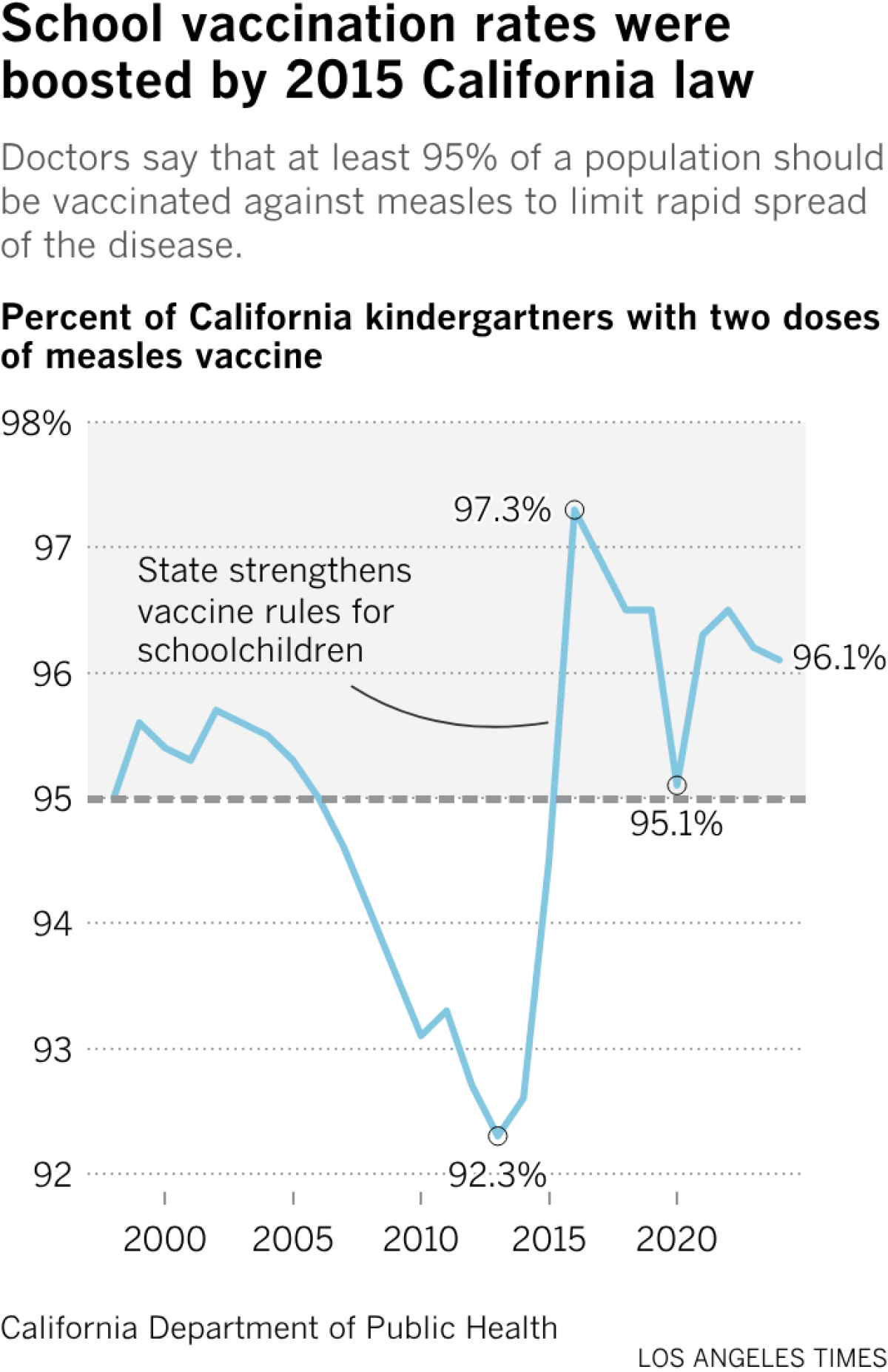
California in 2015 enacted a law that strengthened vaccine requirements for schoolchildren. The law ended the ability of parents to cite personal beliefs in seeking to exempt their children from certain vaccinations.
Children can still be exempted and attend school in California if they have a medical reason. And California law does allow parents to skip immunizations for children who are enrolled in independent study programs and do not receive classroom-based instruction.
California’s law was passed following a large measles outbreak centered at Disneyland that resulted in 131 cases in California alone, and spread to six other states, as well as Canada and Mexico. At least 12 of those infected in California were infants too young to be vaccinated.
After the law passed, California saw its measles vaccination rates improve. In 2013, the vaccination rate among California kindergartners hit a low of 92.3%, below the 95% threshold doctors say is needed to keep a lid on outbreaks. Since the law took effect, that rate has ranged between 95.1% and 97.3%.
The most recent figure was 96.1% for the 2024-25 school year.

States that have suffered large measles outbreaks have poorer vaccination rates. South Carolina, for instance, has been home to an outbreak linked to about 1,000 cases — considered one of the largest in the U.S. in more than 30 years. That state’s most recent kindergarten measles vaccination rate was 91.2%, well below the optimal 95% threshold.
There are five immunizations required as a condition of entry into kindergarten in California: polio; DTaP, which protects against diphtheria, tetanus and pertussis; hepatitis B; MMR; and varicella, or chickenpox.
California’s most severe measles epidemic in recent memory occurred between 1988 and 1990 — an era before health officials recommended children receive a second dose of the measles vaccine. That epidemic led to 75 deaths in California and more than 3,000 hospital admissions. A major problem officials identified at that time was that poor parents could not afford vaccinations for their children. One of the nation’s largest outbreaks in 1989 involved mostly preschool-aged children in Los Angeles.
There was also a national measles epidemic between 1989 and 1991, which, according to a study published by the CDC, led to 166 suspected measles deaths and more than 11,000 hospitalizations.
Recommendations to give children a second dose of the vaccine, and the introduction of the federal Vaccines for Children program in the 1990s to help parents pay for immunizations, were credited with driving measles circulation down to historic lows.
Doctors say that it has been striking to see the U.S. go from a place where ongoing domestic measles transmission was effectively eliminated in 2000 to being on the precipice of the disease regaining a foothold.
“We’re seeing in this country cases, hospitalizations and deaths higher than we’ve seen in over 30 years,” Pan said. “We did such a great job — we eliminated measles by the year 2000, and now we’re going backward.”