weaken

California defends childhood vaccination schedule against Trump efforts to weaken it

Health officials in California are defending the traditional childhood vaccination schedule against efforts by the Trump administration to weaken it.

The longstanding childhood vaccine schedule is safe, California’s top health official said, and continues to be recommended by the American Academy of Pediatrics — the nation’s leading group for pediatricians — as well as the other states in the West Coast Health Alliance: Hawaii, Oregon and Washington.

“They’re safe. They’re important for kids to be thriving and healthy in schools,” Dr. Erica Pan, director of the California Department of Public Health and the state public health officer, said of vaccines. And she credited California’s robust vaccine requirements as a condition of enrollment for schoolchildren as a reason why the state so far has kept a lid on the huge outbreaks of measles seen in other parts of the nation.

Her full-throated defense comes after President Trump issued an executive order Monday recommending that the singular measles, mumps and rubella, or MMR, vaccine should be separated into three and that all childhood immunizations should be given at separate visits “to the maximum extent feasible.”

“We want it in three separate vaccinations, given at separate times,” he said during the signing ceremony. “Together, there could be a possibility they’re quite lethal. And separately it looks like they are not at all lethal, but just very effective.”

The American Academy of Pediatrics blasted the order as “unscientific and dangerous,” and criticized comments made by administration officials suggesting a link between autism and vaccines — a claim that has been discredited by many studies.

“Dozens of studies involving millions of people show there is no link between vaccines and autism, and yet federal leaders continue to promote this outdated, disproven idea to scare families,” said the academy’s president, Dr. Andrew Racine.

The Infectious Diseases Society of America has been equally unequivocal.

“The MMR vaccine does not cause autism,” the group says on an online fact page, adding that the measles vaccine prevents thousands of deaths a year worldwide.

Pan said Trump’s executive order does not change vaccine requirements for schoolchildren in California. And insurance companies continue to cover vaccinations for schoolchildren.

When Trump was asked whether there was any evidence for his claims regarding the MMR vaccine, he answered: “No. What I’ve heard is that there are some people that say it is that way, and I say, ‘Well, let’s say there’s a 5% chance of it. Let’s split it up.’ ”

There is no evidence to back up those assertions, medical organizations and mainstream experts say. The first version of the combination MMR shot was approved in 1971, and versions of it have been given to hundreds of millions of children safely over several generations, with more than 90% of children receiving the shot nationally, experts say.

Combining protection against the three diseases has been considered a miracle of modern medicine. Before the vaccine era, hundreds of children a year in the U.S. were either killed by measles or suffered swelling of the brain as a result of the disease. Tens of thousands were also hospitalized each year.

Mumps can cause deafness and inflame the brain, pancreas, testicles, ovaries and breast tissue. And rubella risks causing severe birth defects in pregnant women.

“There is no data supporting doing this in separate shots,” Pan said. “And, in fact, it will take more visits and more pokes in the arm, literally, for children to do this.”

With vaccination rates declining in many parts of the country, measles has resurged in the U.S. in the past two years, resulting in the first child deaths from the disease in 22 years, as well as hundreds of pediatric hospitalizations.

So far this year, there have been 2,566 cases of measles nationwide, which is already more than the 2,289 reported in all of 2025, according to data from the U.S. Centers for Disease Control and Prevention. The most recent case count is also higher than any calendar year since 1991 — the final year of the nation’s last measles epidemic.

Beyond scheduling difficulties for parents, clinics and doctors’ offices, no company even makes separate immunizations for measles, mumps and rubella, Pan said. “There’s no scientific basis for it. There’s no current availability to do that.”

Trump’s executive order further recommends that children should get vaccinated against 11 diseases, a reduction from the 18 currently recommended by the CDC. The order also suggested that his administration would challenge certain states’ laws that require vaccination as a condition of entry into schools.

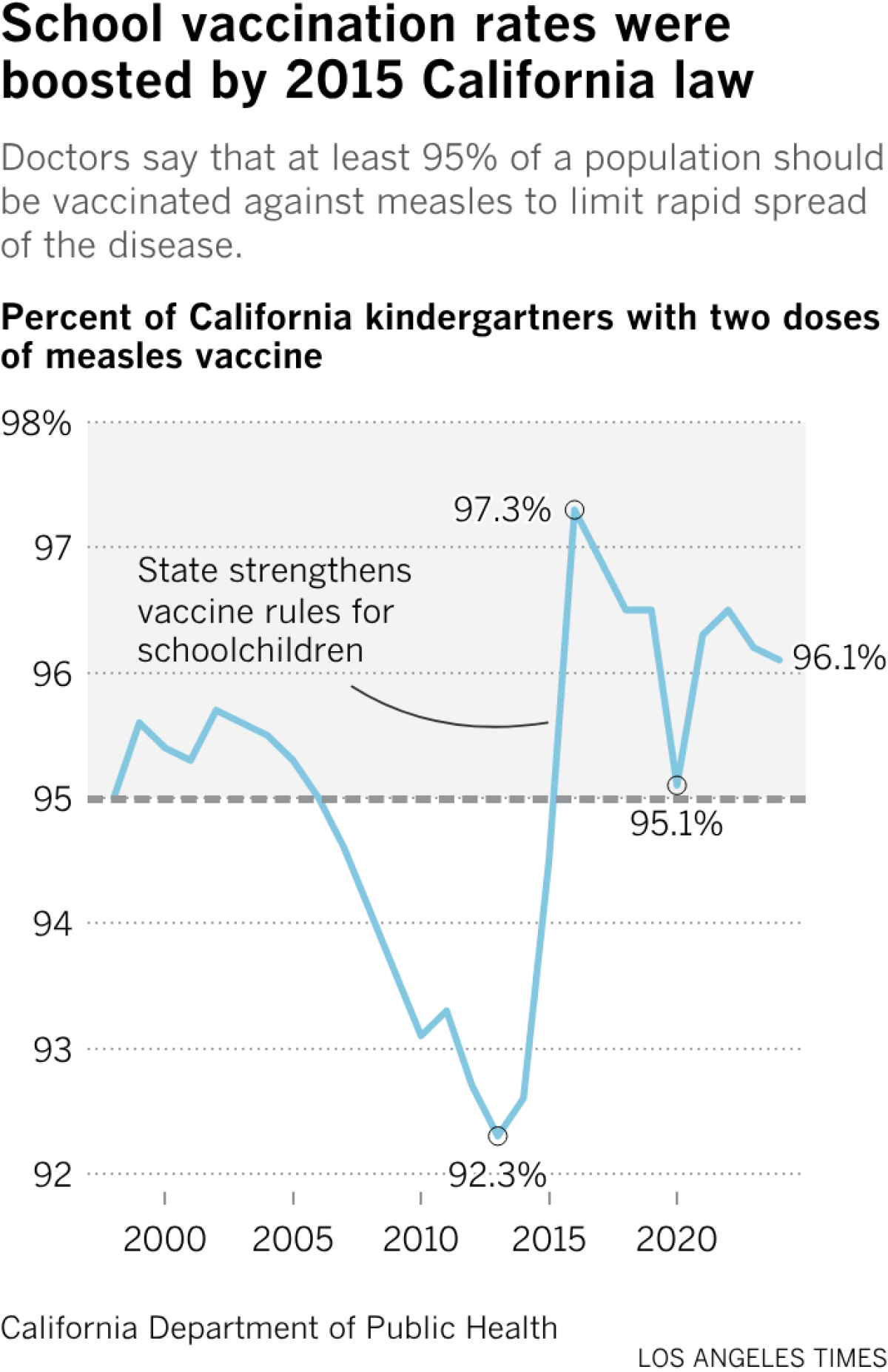
California in 2015 enacted a law that strengthened vaccine requirements for schoolchildren. The law ended the ability of parents to cite personal beliefs in seeking to exempt their children from certain vaccinations.

Children can still be exempted and attend school in California if they have a medical reason. And California law does allow parents to skip immunizations for children who are enrolled in independent study programs and do not receive classroom-based instruction.

California’s law was passed following a large measles outbreak centered at Disneyland that resulted in 131 cases in California alone, and spread to six other states, as well as Canada and Mexico. At least 12 of those infected in California were infants too young to be vaccinated.

After the law passed, California saw its measles vaccination rates improve. In 2013, the vaccination rate among California kindergartners hit a low of 92.3%, below the 95% threshold doctors say is needed to keep a lid on outbreaks. Since the law took effect, that rate has ranged between 95.1% and 97.3%.

The most recent figure was 96.1% for the 2024-25 school year.

States that have suffered large measles outbreaks have poorer vaccination rates. South Carolina, for instance, has been home to an outbreak linked to about 1,000 cases — considered one of the largest in the U.S. in more than 30 years. That state’s most recent kindergarten measles vaccination rate was 91.2%, well below the optimal 95% threshold.

There are five immunizations required as a condition of entry into kindergarten in California: polio; DTaP, which protects against diphtheria, tetanus and pertussis; hepatitis B; MMR; and varicella, or chickenpox.

California’s most severe measles epidemic in recent memory occurred between 1988 and 1990 — an era before health officials recommended children receive a second dose of the measles vaccine. That epidemic led to 75 deaths in California and more than 3,000 hospital admissions. A major problem officials identified at that time was that poor parents could not afford vaccinations for their children. One of the nation’s largest outbreaks in 1989 involved mostly preschool-aged children in Los Angeles.

There was also a national measles epidemic between 1989 and 1991, which, according to a study published by the CDC, led to 166 suspected measles deaths and more than 11,000 hospitalizations.

Recommendations to give children a second dose of the vaccine, and the introduction of the federal Vaccines for Children program in the 1990s to help parents pay for immunizations, were credited with driving measles circulation down to historic lows.

Doctors say that it has been striking to see the U.S. go from a place where ongoing domestic measles transmission was effectively eliminated in 2000 to being on the precipice of the disease regaining a foothold.

“We’re seeing in this country cases, hospitalizations and deaths higher than we’ve seen in over 30 years,” Pan said. “We did such a great job — we eliminated measles by the year 2000, and now we’re going backward.”
Source link

Brazil’s Supreme Court to weigh cases that could weaken Amazon protections | Climate News

Brazil’s Supreme Court is set to hear several cases that could reshape protections for the Amazon rainforest, after a mostly conservative Congress overrode several of leftist Brazilian President Luiz Inacio Lula da Silva’s environmental vetoes.

The court will take up the cases on Wednesday, as lawmakers and environmental groups remain divided over how Brazil should balance economic development with environmental protections.

Recommended Stories

list of 3 itemsend of list

Deforestation in the Amazon has fallen to its lowest level in a decade during the first half of 2026. The cases put some of Brazil’s most consequential environmental fights before the country’s top court.

Indigenous land rights

On Friday, Brazil’s Supreme Court began reviewing final motions seeking clarification of a 2025 ruling that rejected the “time limit” thesis. The legal theory, backed by Brazil’s agribusiness lobby, restricts Indigenous land claims to territories occupied or under legal dispute when Brazil’s 1988 Constitution took effect.

The agribusiness caucus argues that a cutoff date would provide legal certainty for landowners. Indigenous groups say it ignores decades of forced displacement and violence that pushed communities from their ancestral lands. Indigenous communities across the Amazon, including the isolated and uncontacted Kawahiva people, could be affected by the ruling.

The justices are considering motions that seek clarification of the court’s ruling, addressing questions about compensation and possible deadlines for completing Indigenous land demarcations.

The soya farming moratorium

On Wednesday, the court will consider a legal fight over the future of Brazil’s soya moratorium, an agreement that barred major traders from buying soya grown on land deforested in the Amazon after 2008.

The agreement has been credited with helping curb deforestation, even as Brazil became an agricultural powerhouse. But states that are major soya producers passed laws in January revoking tax incentives for participating companies, prompting the Brazilian Association of Vegetable Oil Industries (ABIOVE) to withdraw from the moratorium.

Brazil is the world’s largest producer and leading exporter of soya beans. The Ministry of Environment and Climate Change has defended the soya moratorium, saying it helped reduce Amazon deforestation even as Brazil expanded production.

Environmental licensing

The court will also consider on Wednesday a challenge to a new environmental licensing law that took effect in February.

The law fast-tracks approval for projects including mines, highways and industrial plants, prompting environmental groups to warn that it could weaken safeguards in one of the world’s most important ecosystems.

Suely Araujo of the Climate Observatory said the law is already having tangible consequences in the Amazon, citing the paving of a controversial highway and plans to dredge the Tapajos River without adequate prior environmental review.

Source link

Trump’s Justice Department Faces Scrutiny as Internal Watchdogs Weaken

Justice Department Watchdogs Face Sharp Decline

The U.S. Department of Justice (DOJ) is facing growing scrutiny after internal watchdog offices responsible for investigating attorney misconduct and departmental wrongdoing experienced significant staffing losses during President Donald Trump’s second term, even as complaints against the department reached record levels.

According to a Reuters review of government records and interviews with former Justice Department officials, the Office of Professional Responsibility (OPR) and the Office of Inspector General (OIG) have seen substantial reductions in personnel, raising concerns about their ability to independently oversee the country’s top law enforcement agency.

Federal judges have increasingly criticized DOJ attorneys for alleged misconduct, including accusations of making false statements, ignoring court orders and using legal processes against political opponents.

Misconduct Complaints Rise as Investigations Fall

The Office of Professional Responsibility, which investigates misconduct by Justice Department lawyers, has seen its workforce fall from 29 employees to just 16 since Trump returned to office.

Stay ahead of the geopolitical week.

MD Briefing delivers expert analysis across five global fronts — the Indo-Pacific, energy, geoeconomics, European security, and the Middle East — every Monday morning. Free.

At the same time, misconduct complaints have climbed to their highest level in two decades.

Despite receiving 1,666 complaints during the 2025 fiscal year, the office opened only seven formal investigations, the lowest number recorded in the past twenty years. Over the previous decade, the office averaged more than 18 new investigations annually.

Former Justice Department officials told Reuters that staff departures, combined with concerns about political retaliation, have significantly slowed oversight activities.

Justice Department spokesperson Kiersten Pels rejected those concerns, saying OPR remains committed to investigating attorney misconduct and ensuring accountability.

Inspector General Office Also Loses Staff

The Department’s Office of Inspector General, responsible for investigating fraud, waste and abuse across the DOJ, has also experienced notable staff reductions.

Government employment records show the office lost 99 employees since the end of former President Joe Biden’s administration, reducing its workforce to 477.

Former officials interviewed by Reuters said the office has become increasingly reluctant to pursue politically sensitive investigations, although Inspector General spokesperson John Lavinsky denied that claim, insisting the office continues to conduct independent oversight regardless of political sensitivity.

Jack Smith Investigation Remains Unresolved

Among the most prominent internal cases is the ethics investigation involving former Special Counsel Jack Smith, who led federal prosecutions related to Trump’s handling of classified documents and efforts to overturn the 2020 election.

The investigation examined allegations by Republican lawmakers that Smith’s team improperly influenced the 2024 election and pressured witnesses.

Reuters reported that Smith had already been interviewed by investigators and the inquiry was expected to conclude last year. However, the investigation remains unresolved after reportedly being paused by political appointees.

Separately, the Justice Department has since launched a criminal investigation into Smith, who has denied wrongdoing.

Federal Judges Increase Criticism of DOJ Conduct

The weakening of internal oversight coincides with an increasing number of judicial rebukes directed at the Justice Department.

Federal judges have criticized government attorneys in several high profile cases involving evidence handling, courtroom conduct and legal strategy.

Among the most notable rulings was a decision by U.S. District Judge Kathleen Williams, who accused senior Justice Department officials, including Acting Attorney General Todd Blanche, of failing to properly defend the government in litigation involving former President Trump and instead negotiating what she described as an inappropriate settlement.

DOJ officials have disputed those judicial findings, arguing that several courts have demonstrated political hostility toward the administration.

Concerns Over External Oversight

The Trump administration has also moved to limit outside scrutiny of Justice Department attorneys by challenging state level ethics investigations and seeking expanded authority to restrict oversight by legal licensing bodies.

Administration officials argue that many state investigations are politically motivated and designed to discourage government lawyers from implementing the president’s policies.

Legal ethics experts, however, warn that diminishing both internal and external oversight risks undermining public confidence in the department’s accountability mechanisms.

Analysis

The reported weakening of the Justice Department’s internal watchdog offices comes at a time when judicial scrutiny of government conduct has intensified, placing institutional accountability under renewed focus. While the administration argues that oversight mechanisms remain fully operational and that many judicial criticisms are politically motivated, the decline in staffing and investigations raises broader questions about the effectiveness and perceived independence of internal accountability structures. As politically sensitive cases continue to move through U.S. courts, the credibility of the DOJ’s oversight institutions is likely to remain central to debates over the balance between executive authority, legal ethics and public trust in federal law enforcement.

With information from Reuters.

Source link