measle

California defends childhood vaccination schedule against Trump efforts to weaken it

Health officials in California are defending the traditional childhood vaccination schedule against efforts by the Trump administration to weaken it.

The longstanding childhood vaccine schedule is safe, California’s top health official said, and continues to be recommended by the American Academy of Pediatrics — the nation’s leading group for pediatricians — as well as the other states in the West Coast Health Alliance: Hawaii, Oregon and Washington.

“They’re safe. They’re important for kids to be thriving and healthy in schools,” Dr. Erica Pan, director of the California Department of Public Health and the state public health officer, said of vaccines. And she credited California’s robust vaccine requirements as a condition of enrollment for schoolchildren as a reason why the state so far has kept a lid on the huge outbreaks of measles seen in other parts of the nation.

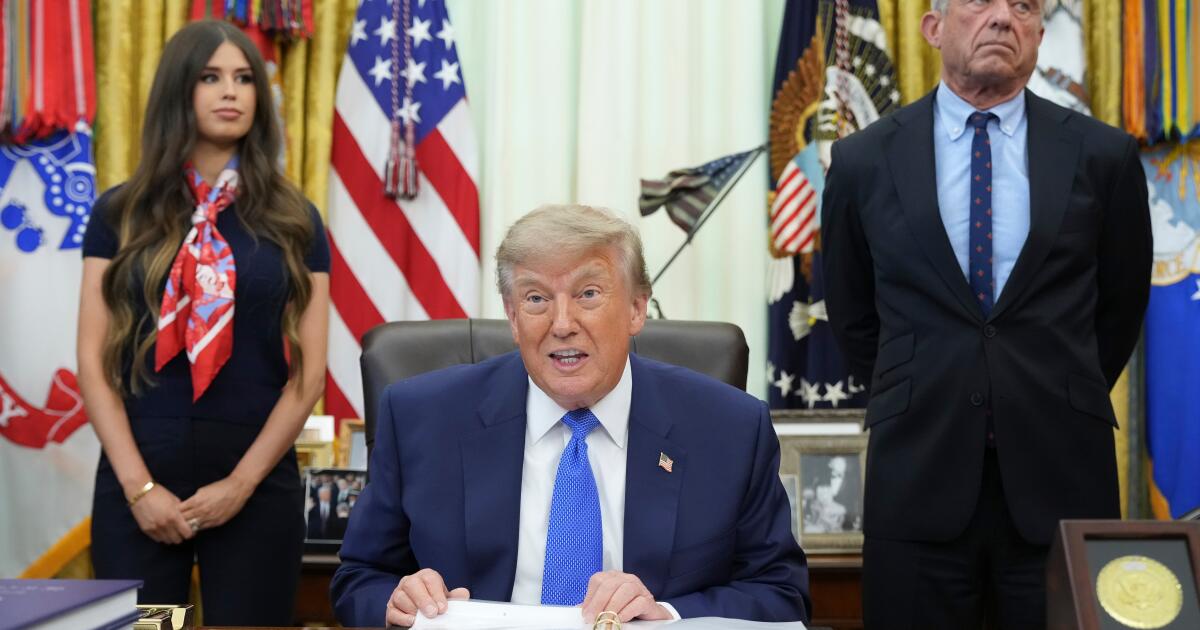
Her full-throated defense comes after President Trump issued an executive order Monday recommending that the singular measles, mumps and rubella, or MMR, vaccine should be separated into three and that all childhood immunizations should be given at separate visits “to the maximum extent feasible.”

“We want it in three separate vaccinations, given at separate times,” he said during the signing ceremony. “Together, there could be a possibility they’re quite lethal. And separately it looks like they are not at all lethal, but just very effective.”

The American Academy of Pediatrics blasted the order as “unscientific and dangerous,” and criticized comments made by administration officials suggesting a link between autism and vaccines — a claim that has been discredited by many studies.

“Dozens of studies involving millions of people show there is no link between vaccines and autism, and yet federal leaders continue to promote this outdated, disproven idea to scare families,” said the academy’s president, Dr. Andrew Racine.

The Infectious Diseases Society of America has been equally unequivocal.

“The MMR vaccine does not cause autism,” the group says on an online fact page, adding that the measles vaccine prevents thousands of deaths a year worldwide.

Pan said Trump’s executive order does not change vaccine requirements for schoolchildren in California. And insurance companies continue to cover vaccinations for schoolchildren.

When Trump was asked whether there was any evidence for his claims regarding the MMR vaccine, he answered: “No. What I’ve heard is that there are some people that say it is that way, and I say, ‘Well, let’s say there’s a 5% chance of it. Let’s split it up.’ ”

There is no evidence to back up those assertions, medical organizations and mainstream experts say. The first version of the combination MMR shot was approved in 1971, and versions of it have been given to hundreds of millions of children safely over several generations, with more than 90% of children receiving the shot nationally, experts say.

Combining protection against the three diseases has been considered a miracle of modern medicine. Before the vaccine era, hundreds of children a year in the U.S. were either killed by measles or suffered swelling of the brain as a result of the disease. Tens of thousands were also hospitalized each year.

Mumps can cause deafness and inflame the brain, pancreas, testicles, ovaries and breast tissue. And rubella risks causing severe birth defects in pregnant women.

“There is no data supporting doing this in separate shots,” Pan said. “And, in fact, it will take more visits and more pokes in the arm, literally, for children to do this.”

With vaccination rates declining in many parts of the country, measles has resurged in the U.S. in the past two years, resulting in the first child deaths from the disease in 22 years, as well as hundreds of pediatric hospitalizations.

So far this year, there have been 2,566 cases of measles nationwide, which is already more than the 2,289 reported in all of 2025, according to data from the U.S. Centers for Disease Control and Prevention. The most recent case count is also higher than any calendar year since 1991 — the final year of the nation’s last measles epidemic.

Beyond scheduling difficulties for parents, clinics and doctors’ offices, no company even makes separate immunizations for measles, mumps and rubella, Pan said. “There’s no scientific basis for it. There’s no current availability to do that.”

Trump’s executive order further recommends that children should get vaccinated against 11 diseases, a reduction from the 18 currently recommended by the CDC. The order also suggested that his administration would challenge certain states’ laws that require vaccination as a condition of entry into schools.

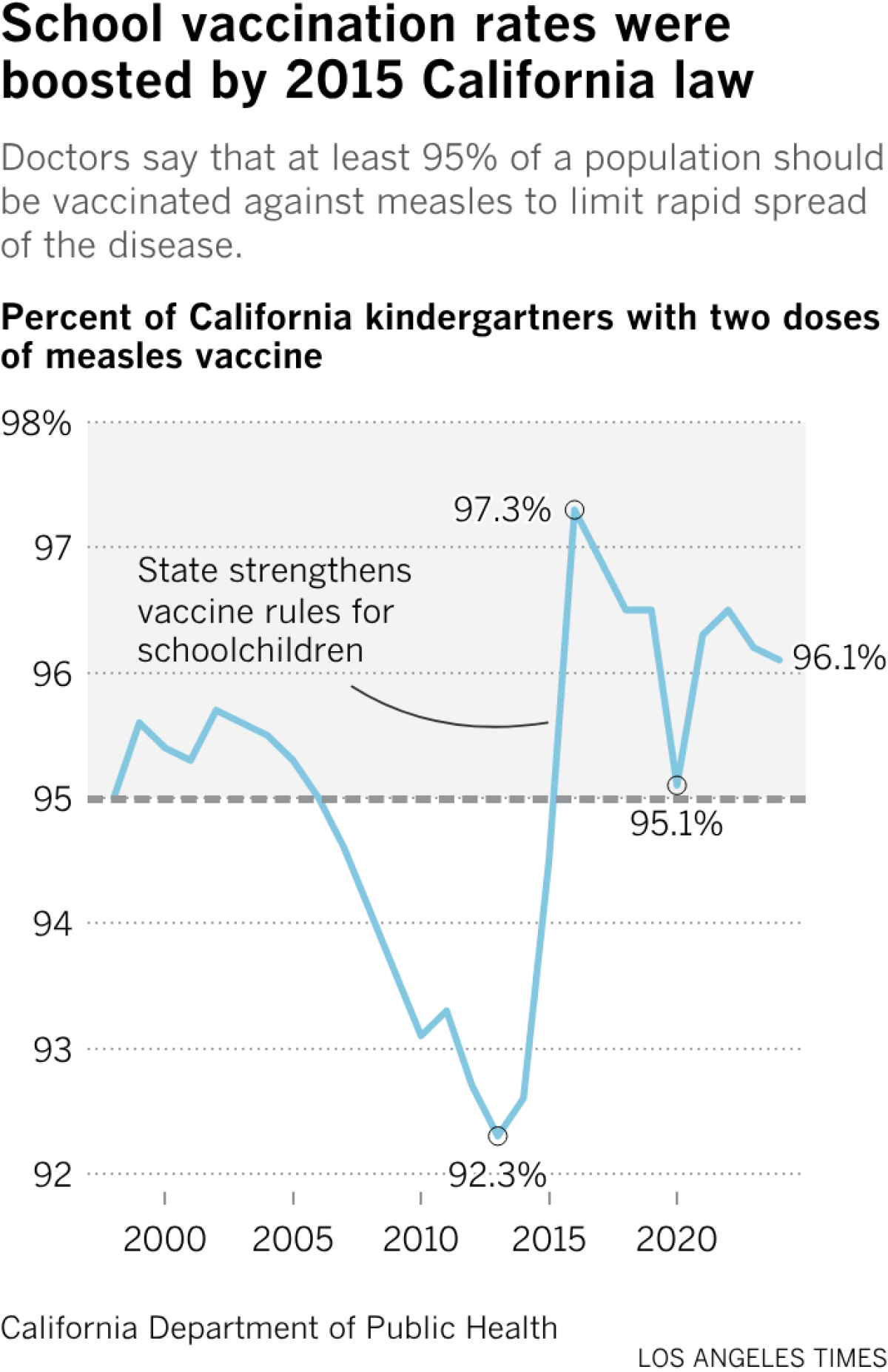
California in 2015 enacted a law that strengthened vaccine requirements for schoolchildren. The law ended the ability of parents to cite personal beliefs in seeking to exempt their children from certain vaccinations.

Children can still be exempted and attend school in California if they have a medical reason. And California law does allow parents to skip immunizations for children who are enrolled in independent study programs and do not receive classroom-based instruction.

California’s law was passed following a large measles outbreak centered at Disneyland that resulted in 131 cases in California alone, and spread to six other states, as well as Canada and Mexico. At least 12 of those infected in California were infants too young to be vaccinated.

After the law passed, California saw its measles vaccination rates improve. In 2013, the vaccination rate among California kindergartners hit a low of 92.3%, below the 95% threshold doctors say is needed to keep a lid on outbreaks. Since the law took effect, that rate has ranged between 95.1% and 97.3%.

The most recent figure was 96.1% for the 2024-25 school year.

States that have suffered large measles outbreaks have poorer vaccination rates. South Carolina, for instance, has been home to an outbreak linked to about 1,000 cases — considered one of the largest in the U.S. in more than 30 years. That state’s most recent kindergarten measles vaccination rate was 91.2%, well below the optimal 95% threshold.

There are five immunizations required as a condition of entry into kindergarten in California: polio; DTaP, which protects against diphtheria, tetanus and pertussis; hepatitis B; MMR; and varicella, or chickenpox.

California’s most severe measles epidemic in recent memory occurred between 1988 and 1990 — an era before health officials recommended children receive a second dose of the measles vaccine. That epidemic led to 75 deaths in California and more than 3,000 hospital admissions. A major problem officials identified at that time was that poor parents could not afford vaccinations for their children. One of the nation’s largest outbreaks in 1989 involved mostly preschool-aged children in Los Angeles.

There was also a national measles epidemic between 1989 and 1991, which, according to a study published by the CDC, led to 166 suspected measles deaths and more than 11,000 hospitalizations.

Recommendations to give children a second dose of the vaccine, and the introduction of the federal Vaccines for Children program in the 1990s to help parents pay for immunizations, were credited with driving measles circulation down to historic lows.

Doctors say that it has been striking to see the U.S. go from a place where ongoing domestic measles transmission was effectively eliminated in 2000 to being on the precipice of the disease regaining a foothold.

“We’re seeing in this country cases, hospitalizations and deaths higher than we’ve seen in over 30 years,” Pan said. “We did such a great job — we eliminated measles by the year 2000, and now we’re going backward.”
Source link

Trump’s vaccine plan would require millions of individual shots last used decades ago

Public health experts have been quick to condemn an executive order from President Trump aimed at upending childhood vaccinations in the U.S., but the biggest obstacles may be the unprecedented financial and logistical challenges it would impose on parents, health providers and drugmakers.

Monday’s announcement by the Republican president calls for separating combination shots — including the measles, mumps and rubella, or MMR, vaccine — into separate injections. Appointments for that and other vaccinations should be spaced out whenever possible, the order states.

To accomplish that, drugmakers would need to revive a slate of individual vaccines that have not been marketed separately in the U.S. for decades. They would also have to build new manufacturing plants capable of producing millions more vaccine doses than the nation currently uses.

For parents, unbundling the MMR vaccine and spacing out the shots would mean returning to the doctor’s office many more times than is currently needed. Those appointments could also strain pediatricians who typically administer the shots, while driving up costs tied to syringes and other medical supplies.

Studies in the U.S. and other countries have shown that combination vaccines increase the likelihood that children will be fully protected from infectious diseases before starting school.

Health experts say there is no scientific basis for changing course.

“We do things that are less convenient and more expensive if there’s a good reason to do it,” said Dr. Anna Durbin, of the Johns Hopkins Bloomberg School of Public Health. “There is no good justification for this. I think it’s very bad public health policy.”

Trump’s plan would require vaccine manufacturing overhaul

Under Trump’s executive order, federal officials are instructed to develop within 90 days plans for breaking up the MMR shot and spacing out other vaccines.

But pharmaceutical scientists and former regulators say those changes would likely take years and require drugmakers to spend tens of millions of dollars on new studies and manufacturing facilities.

Currently, there are no individual vaccines in the U.S. for measles, mumps or rubella. All the vaccines approved for those viruses by the Food and Drug Administration are combination shots. That three-in-one approach has been the standard in the U.S. since the early 1970s.

Dr. Jesse Goodman, a former FDA vaccine chief, said companies would have to conduct large studies showing new individual shots produced immune system-boosting reactions in children similar to the current versions.

Companies might also have to demonstrate the safety of new manufacturing facilities and procedures, given that individual measles shots haven’t been widely produced in the U.S. for roughly a half-century.

“The question is how much has changed since then and how comfortable will the FDA and the companies be relying on those comparisons?” said Goodman, who is now a professor at Georgetown University.

Designing, constructing and getting federal sign-off for new vaccine plants typically takes about five years, according to industry experts.

Additionally, Goodman said the FDA would have to review and license each unbundled vaccine separately, a process with no precedent.

“I don’t think there’s any comparable example of removing hugely effective public health measures that protect babies for no documented scientific reason,” he said.

Individual shots for measles and related diseases tend to be used by lower-income countries that can’t afford the MMR shot. Merck, GSK and the handful of other companies that supply U.S. childhood vaccines make only the combination shot.

In separate statements, Merck and GSK said they stand by the safety and effectiveness of their products. Neither discussed plans to unbundle their shots.

“To date, there has been no published scientific evidence that shows any benefit in separating the combination MMR vaccine into three individual shots,” Merck said in an emailed statement.

Parents would need to make many more trips to the doctor

The MMR shot is currently delivered in two doses — the first at the age of 1 and the second dose after age 4. Splitting up the shot into its three separate components would mean six office visits. Spacing out other shots for pertussis and other infectious diseases could multiply the number of visits many more times.

As the number of visits goes up, parents are more likely to miss appointments or stop making them, according to Durbin.

“It’s going to be less convenient, more expensive and you’re going to have fewer people getting vaccinated,” she said.

Since last year, Trump has repeatedly expressed concern about the number of vaccinations U.S. children are receiving and called on Health Secretary Robert F. Kennedy Jr. to reduce the number. Kennedy and other officials have pointed to smaller countries, such as Denmark, that recommended slightly fewer vaccines than the U.S.

But breaking up combination shots will result in kids receiving many more individual shots than other comparable nations, Durbin notes.

White House spokesman Kush Desai said the Trump administration’s efforts on the MMR vaccine “will give parents more options on timing and frequency for their children, which ultimately will increase vaccination rates for all three diseases.”

Vaccine order is not legally binding

Despite the precedent-breaking nature of Trump’s order, some experts are skeptical it will result in meaningful changes.

Neither the White House nor the FDA can compel drugmakers to develop and seek approval for new vaccines. And from a business perspective, companies have little incentive to develop individual versions of vaccines they already sell in combination shots.

“They’d be competing against themselves, and there’s no reason to do that,” said Dr. Paul Offit, a Children’s Hospital of Philadelphia vaccine researcher and former government adviser.

While Trump’s order calls for more federal research and recommendations, only state governments have the legal authority to require vaccinations for schoolchildren. The order simply advises states to consider updating their laws to reflect the Trump administration’s approach.

“I think states will ignore this,” Offit said. “I think that bottom line is that we don’t need to look to Donald Trump for our medical advice.”

Perrone writes for the Associated Press. AP videojournalist Mary Conlon in New York contributed to this report.

Source link

Health sleuths are watching for disease threats during the World Cup

While millions of soccer fans cheer or groan over World Cup matches spanning North America, health officials are on high alert for germs.

A heat wave may be the most obvious health threat. But infectious diseases can spread in a crowd, and experts are scrutinizing wastewater, hospital visits, even social media for any signs that an outbreak might be brewing.

Measles, one of the most contagious diseases, is among the top concerns, sparking a warning this week from the Pan American Health Organization, PAHO. With a nearly six-week stretch of packed stadiums, bars and tourist sites in 16 cities, officials are on the lookout for a long list of infections, from the stomach bug norovirus to mosquito-borne dengue fever.

“This is truly a marathon,” said Palak Raval-Nelson, Philadelphia’s health commissioner.

The mass gatherings come at a tense moment for budget-strapped health agencies in the U.S. The Centers for Disease Control and Prevention, hit hard by Trump administration staffing cuts, already was grappling with a growing Ebola outbreak in central Africa and a cruise ship hantavirus outbreak. While CDC officials have advised state and local health departments behind the scenes, it’s expected World Cup disease surveillance dashboard still was “in final development” days before games began, according to the Department of Health and Human Services.

“Our public health professionals are pretty stretched,” said global health specialist Rebecca Katz of Georgetown University, who is leading an unusual new hub to help.

At the Health Security Operations Center, a joint effort between Georgetown and MedStar Health, workers are analyzing data from around the country so they can alert health authorities, even emergency rooms, to any early signs of trouble. The center is issuing daily “situation reports” about disease trends around World Cup host cities and team base camps to several hundred local and federal public health groups, emergency management and hospital officials and others who’ve signed up.

“It’s important that we don’t become alarmist,” said MedStar emergency medicine specialist Dr. Shane Kappler. “We’re trying to be the insurance policy.”

Measles is a top concern for potential World Cup spread

Already more than 2,000 people in the U.S. have come down with measles this year, nearly as many as during all of last year, according to the CDC. Patients can spread measles before the rash appears and they realize they’re sick. Not too long ago, the U.S. seldom saw measles except from international travel by unvaccinated people.

Now with frequent U.S. outbreaks, “actually a lot of our international partners are worried about measles being exported to them after the games,” said Georgetown’s Katz.

Measles is spreading in Canada, too, and has exceeded 11,000 cases in Mexico, according to PAHO. It’s urging soccer fans to be sure they’re vaccinated, with a health campaign saying a single measles patient can spread the virus to up to 18 unprotected people.

Is Ebola a concern at the World Cup?

Brown University’s Dr. Craig Spencer, who survived Ebola while working in the West Africa outbreak over a decade ago, said he’s repeatedly asked about the risk of Ebola during the World Cup — but “for me, Ebola is not the No. 1 or No. 2 or even No. 3 threat.”

“I am concerned about importation of measles, I am much more concerned about the importation of other infectious threats that may not seem as scary to us as Ebola,” Spencer said.

Many health experts agree that the risk of Ebola spreading in the U.S. is very low. That’s partly because of government travel screenings and restrictions on people recently in outbreak-affected areas. Moreover, Ebola spreads by contact with bodily fluids from someone showing symptoms, not through the air like measles or respiratory viruses.

“One fortunate thing about this virus is you’re most contagious when you’re really quite ill. It’s not like COVID, where you could be sitting next to someone who doesn’t even know they’re infected and perhaps contract the virus,” said Jennifer Nuzzo, director of Brown’s Pandemic Center.

How to spot brewing diseases

There’s precedent for germs invading major sporting events. Canadian scientists linked a community measles outbreak to the 2010 Olympics in Vancouver, and clusters of norovirus had to be contained during the Olympics this year in Milan and in 2018 in South Korea.

One way to detect signs of trouble: People with certain viral or bacterial infections shed genetic material that sophisticated testing of wastewater can spot. For example, measles can appear in wastewater days before an emergency room sees its first patients.

A recent surveillance reports from Katz’s center note that wastewater testing recently found diarrhea-causing rotavirus, hepatitis A and norovirus in some parts of the U.S., something to watch as soccer crowds arrive.

In Dallas, officials ramped up wastewater screening including at the international airport, casting a wide net rather than looking for specific illnesses, said Dr. Phil Huang, director of Dallas County Health and Human Services.

His team also is enhancing the usual mosquito testing, checking not just for West Nile virus that regularly spreads in the U.S. but for viruses more common in other countries like dengue and chikungunya.

Public health officials have been preparing for months, said Philadelphia’s Raval-Nelson, including with mock emergency drills and communications with counterparts around the country.

“I don’t want to send a message that there’s one key thing,” she said. “We have the frameworks in place to carry out what we need to.”

Neergaard writes for the Associated Press.

Source link