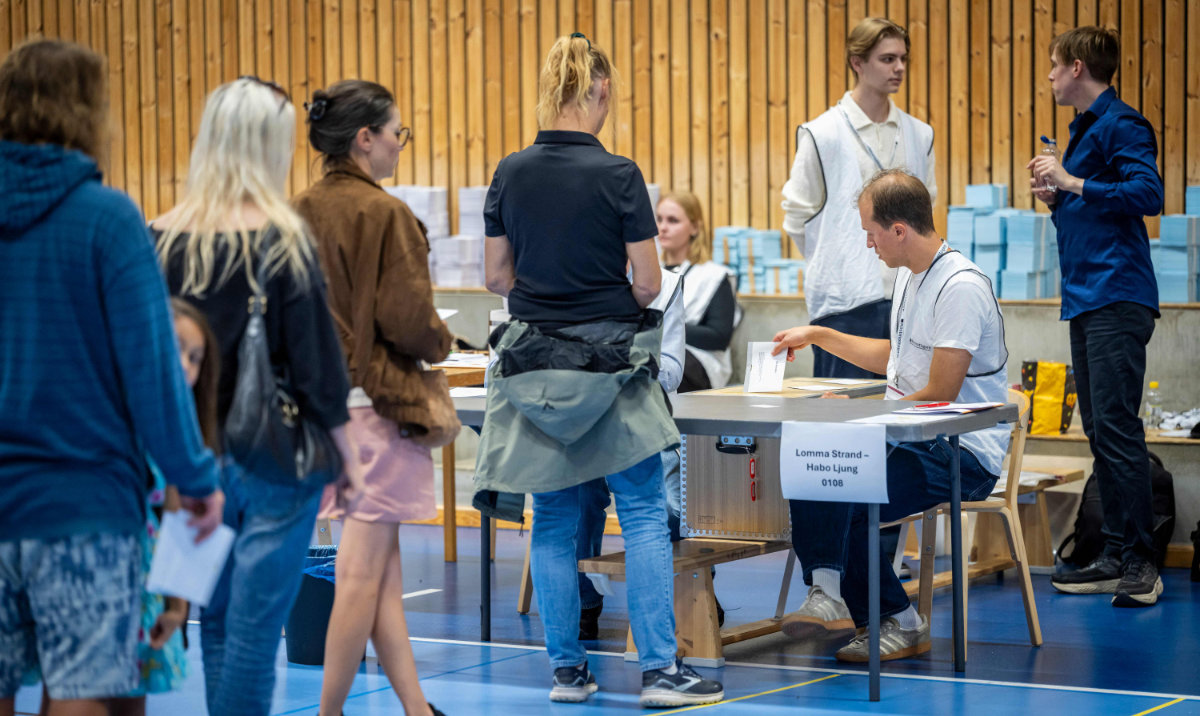

STOCKHOLM: Sweden’s national election results showed a dead heat on Sunday, with a partial count by the election authority indicating a one-seat majority for the opposition center-left bloc that could halt the Nordic nation’s drift away from its liberal heritage.
The bloc, headed by the Social Democrats’ party leader Magdalena Andersson, was expected to win 175 seats in the 349-seat parliament, the Riksdag, based on votes from 4,853 of Sweden’s 6,312 election districts, the election authority said.
The right-wing governing bloc of Prime Minister Ulf Kristersson was seen winning 174 seats, with ballot-counting continuing.
The election, while unlikely to change the course of Sweden’s pro-Western and pro-Ukraine stance, will decide whether Kristersson’s push toward a hard-right clampdown on migration continues.
Given the closeness of the race, the winner may not be known for several days, after all overseas ballots have been counted.
In a pre-election pledge, Kristersson broke a longstanding taboo and said he would bring into government the Sweden Democrats, a far-right party with roots in the Nazi fringe, as he aims to create a majority-right coalition.
Many voters on the right say a win would amount to an endorsement of policies that have helped to curb gang violence and cut immigration dramatically.
But some Swedes have expressed wariness, saying Kristersson’s invitation to the far right was a step too far.
“I think it will be a long night,” said Maria Malmer Stenergard, minister for foreign affairs and a member of Kristersson’s Moderate Party. “Maybe we won’t even have the results until Wednesday when the votes that have been cast abroad arrive.”
Kristersson, who has trailed in opinion polls throughout his four years in office, had been catching up in the final weeks of campaigning, with Andersson and her Social Democrats losing ground.
Critics say the Kristersson government’s immigration policies, whose incentives and penalties press migrants either to conform more closely to Swedish cultural norms or leave the country, are undermining civil liberties.
Electoral success for the Sweden Democrats would be welcomed by Europe’s ascendant far-right parties, which were bolstered by the anti-immigrant Alternative for Germany’s win in a German state election last week.
The far right hopes for gains in upcoming elections across Europe, with the National Rally’s bid for the French presidency next year potentially its biggest prize.
‘DOESN’T LOOK LIKE SWEDEN’
While voting on Saturday in Rinkeby, near Stockholm, the Sweden Democrats’ longstanding leader Jimmie Akesson said the suburb, home to one of the country’s biggest Swedish-Somali populations, “doesn’t look like Sweden.”
Sweden was long one of Europe’s most welcoming countries for immigrants until Kristersson came to power four years ago. His government abolished permanent residency for refugees, tightened welfare rules and stepped up expulsions of those without a right to stay.
The Sweden Democrats acknowledge that their party was founded in part by neo-Nazis and white supremacists in the 1980s, but say they have eliminated such extremists from their ranks and have apologized for their past.
Cheers broke out at the Sweden Democrats’ election party after an updated projection from Swedish broadcaster SVT showed a much narrower gap than an initial exit poll, which had put the center-left opposition ahead with 51 percent of the vote.
“You cannot imagine how nervous I am right now. It feels like my life’s work is hanging in the balance,” said Ludvig Aspling, a member of parliament and immigration spokesperson for the Sweden Democrats. “It is going to be super tight. We still have a chance,” he said.