Trump budget cuts threaten global soccer refugee program
Mohammed Annour spent much of his youth living in a flimsy shelter in a dusty, overcrowded refugee camp in east Africa, where the days were long, the food was poor and the future nonexistent.
“Go to the army and fight. That’s one option,” said Annour, who fled war in Sudan for the refugee camp in Chad when he was 9. “The other one is you stay there. But you don’t have a future.”
If he had stayed, Annour, now 33, has little doubt how his story would have ended.
“Probably,” he said, “I’m dead.”

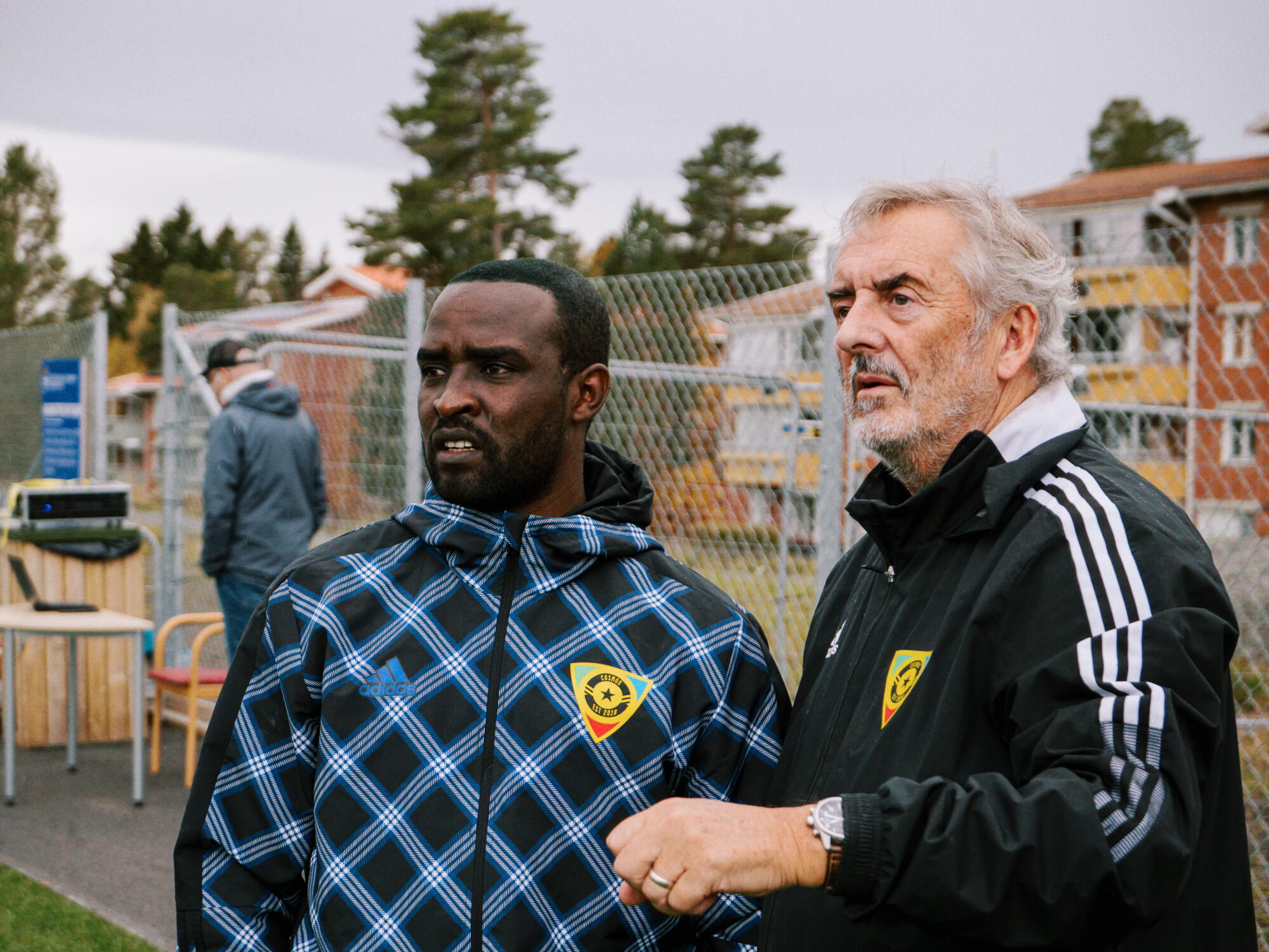
Mohammed Annour, a refugee soccer player who became a coach, and Alan Barker, chairman of the Mighty Cosmos, look across a field in Sweden.
(Courtesy of Darren Hamlin)
Instead, he’s in Sweden, raising two boys, working as a quality control inspector for a textile company and playing amateur soccer for a team in the country’s fifth division. And the only thing that separates his experience from the tens of thousands of desperate people he left behind in the camp is the fact someone believed in him enough to give him a chance.
“Everybody needs a chance,” Annour said. “Don’t throw people out. People just need a chance in life.”
“And we got that chance,” he continued, “because of Katie-Jay and Gabriel.”
That would be Katie-Jay Scott and Gabriel Stauring, a pair of South Bay activists who showed up at Annour’s camp on a blazing hot day in 2011, rolled a battered soccer ball across a barren field and transformed an untold number of lives.
Scott and Stauring founded the humanitarian group iACT largely to respond to the crisis in Darfur, a semi-desert plateau in western Sudan that has known nothing but war this century. But unlike many of the dozens of other similarly minded people and groups working in Africa, Scott and Stauring came not to preach, but to listen. They came with questions, not answers.
And what they were told was that the children in the camps needed more than food and shelter. They needed a routine, they needed recreation, they needed joy and they needed hope.

Founders of iACT Gabriel Stauring, left, and Katie-Jay Scott hold up gifts they received after a training session in the Central African Republic. Stauring and Scott were killed in a car crash in 2021, but their nonprofit continues to support refugees.
(Courtesy of iACT)
In other words, they needed soccer.
“Many organizations came into the camps. They just came around and took some pictures and then they leave,” said Annour, a slight man with a serious countenance. “I think [Scott and Stauring] understood us as humans, not just these kids or these people who need food or shelter.
“They saw another side. They saw these people that can make something in life.”
Stauring and Scott were killed in a car accident in Manhattan Beach five years ago, but their legacy lives on in the unique advocacy and aid program they created, one that uses soccer to teach skills and provide structure to refugees stranded in camps, shelters and intolerable poverty in four countries on two continents.
“They were so kind, careful,” Annour said. “Listening to everyone. It didn’t matter where you came from, which color you are. They were open and gave time to everyone they met.”
“Honestly, I didn’t know they were going to change my life or anything,” added Moubarak Abdallah, another refugee introduced to soccer by Scott and Stauring. “I saw them as other people who just come and go. But they were quite special people.

Grace Tanda, of the Mighty Cosmos, strikes the ball during a match. The soccer team in Sweden is comprised of refugees.
(Courtesy of Darren Hamlin)
“They wanted to help our ideas shine, to [give] other people hope. They were listening to what I needed.”
Today, there are more than 5,000 children participating in iACT soccer academies in Chad, the Central African Republic, Cameroon and Mexico. Another 1,800 children are enrolled in the group’s Little Ripples preschool program, which also served 475,000 meals to students and staff last year.
But the organization, like many similarly focused humanitarian groups, is fighting for its survival amid a global backlash against refugees and migrants.
The hostility has been especially strong in the U.S., where the second Trump administration has sharply restricted immigration and asylum access and drastically cut congressionally approved spending for life-sustaining programs previously funded through USAID. Many European countries have followed that lead, adopting a stauncher approach to border enforcement and deportations and slashing support for development assistance by 13.8% in 2025, the largest cut in a decade.
This summer, violent anti-immigrant protests in South Africa forced more than 178,000 people to flee to Zimbabwe, Malawi, Nigeria and other countries, reversing a trend that has seen the region’s richest country welcome migrants to work on farms, in construction and other low-paid jobs. Public sentiment toward refugees and migrants has also hardened elsewhere, creating a crisis for nonprofit aid groups.
The Office of the United Nations High Commissioner for Refugees, or UNHCR, this month warned the gap between humanitarian needs and donor contributions is widening, leading to deep cuts and forcing aid groups to fight one another for the shrinking dollars that remain — all at a time when conflicts in Syria, Gaza and Ukraine have swelled the number of refugees worldwide to nearly 42 million; another 69 million people are displaced.
That’s more than 1 out of every 70 people on Earth, according to the UNHCR.
Annour and his family were once part of that wave, fleeing their home in Sudan in 2003, stepping around dead bodies and witnessing unimaginable horror, to escape one in a series of continuing civil wars that have given way to genocide. More than 15 million people have been displaced in the 23 years of fighting, with more than 1.3 million still stranded in teeming refugee camps in eastern Chad.
Annour said he would have perished there if not for Stauring and Scott, who introduced soccer to their camp. Three years after the pair arrived, an international tournament for stateless players, the CONIFA World Football Cup, was held and iACT entered a 20-man team comprised of players from 12 camps. Annour, a left back, made the cut as did Abdallah, a physical midfielder with a perpetual smile who would become the team captain.
“No one is thinking this [is] going to be life-changing,” Abdallah remembers thinking. “You know, there was like a small chance but it became big dreams for us.”
The team, Darfur United, was outscored 39-0 in its two games in Ostersund, Sweden, but most of the players chose to stay in Ostersund rather than return to their camps and were welcomed by the Swedish government. They received asylum and eventually formed an integration team, the Mighty Cosmos, that advanced as high as the fifth division of Swedish soccer.
Abdallah is a natural leader, said Alan Barker, chairman of the Mighty Cosmos, and the kind of person who receives total respect from the other players.

Mugenyi Ngabu, left, cheers during the Mighty Cosmos’ match in Sweden. The team is comprised entirely of refugees.
(Courtesy of Darren Hamlin)
“He is a sort of guy you can rely on 100%,” Barker said. “Personally, I would trust him with my life. He is a doer, not a talker. A problem solver not a problem creator. And he always wants the best for everybody.”
Annour, he added, has been troubled by knee injuries on the field but remains “a strong and quiet yet forceful personality of the group.”
“He is a passionate believer in fair play and honesty and has no room for dishonesty or deception in any aspect of life,” Barker continued. “Maybe that’s a reflection of his childhood in the refugee camps and Chad, where there was no time for such things. He’s a sort of guy whose name would be first on the team sheet. The team sheet of football and life.”
More important is the fact that the players, teenagers or young adults when they arrived in Sweden, have married, had children of their own, become citizens and integrated into the local community, where their civic work was this year recognized with one of Sweden’s most prestigious awards.
“I never dreamed to be in this position when I was a kid. I was trying to survive, to live day by day,” said Annour, who is working three jobs to support his sons, aged 1 ½ and 4.
“I’m here. I can provide for my family. Moubarak provides for his family. It’s like saving a generation, not just me and Moubarak.”
“It’s about the chances,” agreed Abdallah, 35, who also lives in Sweden where he coaches the Mighty Cosmos while raising a 5-year-old son.
“The door has to open. That’s all.”
iACT offered a way to open those doors when it first rolled that battered soccer ball onto a dirt lot. Without that, “these guys wouldn’t be here, wouldn‘t have the lives they have,” said Darren Hamlin, a British filmmaker who has started a Kickstarter campaign to fund a documentary on the refugee players.
By focusing on single players and their game and not the vastness of the sprawling global refugee crisis, Hamlin says the film has the power to redefine these former refugees not as obscure numbers but as flesh-and-blood people with dreams and talents and aspirations. That was what inspired Scott and Stauring when they founded iACT.
“Football has this power to transcend sports. It becomes an emotional thing,” said Hamlin, who is behind on his goal of raising $66,000 by the end of the month to expand work on the documentary. “It doesn’t matter how many stats or things we put in front of people; they don’t really pay attention.
“But football kind of goes deeper sometimes. Football is kind of the vehicle that delivers the message.”
Getting that message out, however, is becoming increasingly difficult. As government funding for refugee programs around the world has dried up, groups like iACT have found themselves fighting for the same slice of a much smaller funding pie.
“Fundraising at all levels has become more difficult with the gutting of USAID, especially with the increase in larger NGOs [non-government organizations] applying for foundation grants,” said Merri Weir, a retired teacher and iACT board member since 2016. “It is becoming harder and harder because we’re competing with larger NGOs. The funding stream has become tighter.”
At the same time, the need has swelled.
“The refugee camps in Chad are still very unstable,” said Weir, who has visited the camps multiple times. “The current war has not ended and shows no sign of ending. Refugees are still coming across the border, which has more than doubled the number of Sudanese refugees.
“It is critical that we are able to sustain our current refugee-led programs.”
In response, Weir’s group, which will hold its annual fundraising event in Manhattan Beach next month, has considered everything short of a corner lemonade stand and selling chocolate door to door to make up for the lost financial backing it needs to continue what Scott and Stauring started.
“In the past, it is our uniqueness and our innovation and our refugee-led action [that] set us apart,” said Weir. “It was very appealing.”
The Trump administration complicated things even further in June 2025 when it instituted a travel ban and entry restriction list on Chad, leading the Chadian government to retaliate by revoking visas for American citizens, including aid workers. That means fewer children playing soccer and attending preschool, fewer meals being served — and fewer success stories like the ones told by Abdallah and Annour.
“I spent 12 years in a refugee camp,” Abdallah said. “People just hope to get a meal for the day. [iACT] brought the footballs and then just brought the idea. A chance to change our lives. Opportunity.
“There’s a lot of people in the refugee camps [that] could be pilots, doctors, better football players. Maybe there is the next Lionel Messi, Cristiano [Ronaldo], Lamine Yamal in the camp. But they don’t have any opportunity to get out.”
“The world is crazy. It’s just war everywhere,” added Annour, who is about to begin a college course on sports science. “Those people who don’t like refugees, who don’t want the United Nations to bring more refugees, they need to put themselves in our shoes.
“People are so naive to think they can just ignore what’s going on. It’s getting bigger every day.“
Abdallah and Annour may have left the camps, but the camps have not left them. The work they have done in Sweden includes the construction of a community sports and culture center, addressing crime prevention and mental health, refugee resettlement, and fundraising efforts that support the work of iACT and other groups working with the people they left behind.
“My mom is still in the same camp, so I’ve been back three times now with a lot of footballs, football boots and football equipment,” Abdallah said.
Scott and Stauring, who lived in Redondo Beach before the fatal car crash, thought they were bringing soccer to the camps in Africa, but what they really brought was hope and proof that if someone just opens the door, you might be surprised what you find on the other side.
