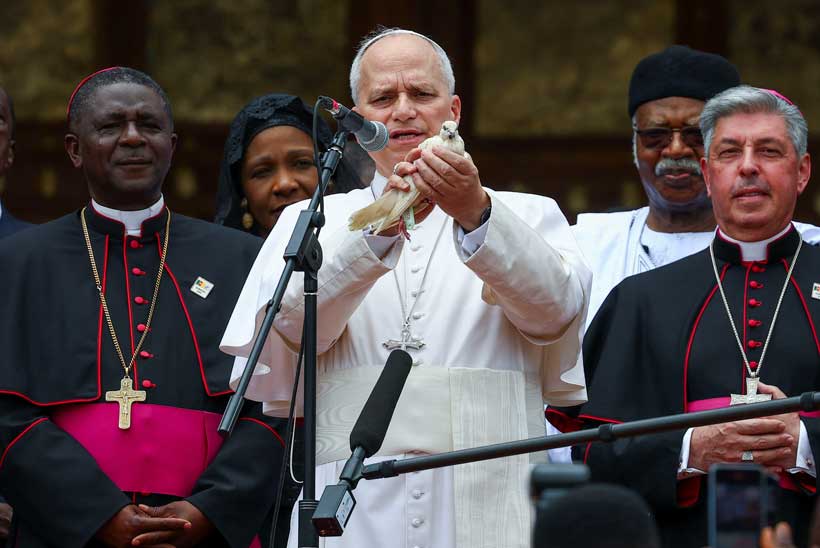
Africa has shown itself in the past week again as a continent of dramatic contrasts, in which moral leadership, political turmoil, and financial aspiration come into collision in a manner that would not only chart its own future but also that of the world. The continent is going through a time that is both precarious and radical, as the potent moral rhetoric of a papal visit gives way to an ever-worsening political persecution and systemic economic disparities.
A Moral Voice in a Fractured Continent
The visit of Pope Leo in some parts of Africa, such as Angola and Cameroon, has been one of the most intriguing this week. His message attracted crowds of more than 10,0000 people, and it was not only religious but also very political, declaring Africa a beautiful but wounded continent and demanding unity, justice, and an end to violence.
It is not only the size of the meetings but also the content of the message that is important. The Pope was outspoken in an attack on corruption, inequality, and exploitative governance systems—the problems that are at the core of most of the struggles in Africa today. His words about people being more important than corporate interests are well-received in a continent where natural resource wealth has not always translated into widespread prosperity.
This visit was, in a sense, a symbol of a greater fact: Africa is not merely economically or politically challenged; it is morally and structurally challenged. The unity cry in Angola, the nation that is yet to overcome the adverse effects of decades of civil war, is a symptom of the bigger continental necessity to mend the wounds of the past and deal with the inequalities of the present.
Political Tensions and Disappearance of Space of Dissent
As the moral pleas of unity reverberated in stadiums, political realities on the ground painted an even more disturbing scenario. The South African arrest of activist Kemi Seba is part of an increasing trend in some parts of Africa, where there is an increased crackdown on dissenting voices.
Seba, the anti-colonial and anti-Western rhetoricist and critic of Western influence, now risks extradition to Benin on charges of inciting rebellion. His detention highlights a broader conflict: the fight between state power and political activism in an area where the democratic institutions are not yet balanced.
This is not a one-time event. Governments all over the continent are striking a fine balance between ensuring stability and political expression. In other instances, this equilibrium is leaning towards control over being open, and this leaves one worrying about the future of democratic governance.
The consequences are not confined nationally. The political situation in Africa is a topic of keen interest to the rest of the world, not just due to its size and population but because it offers one of the final avenues of democratic growth in the 21st century. Political space is reduced here, causing ripples way beyond the continent.
Structural Gaps in Economic Promise
Africa is still a puzzle economically. On paper, the figures are encouraging. Recently, South Africa obtained the promise of billions of investments, which indicates a great interest of other countries in the areas of green energy, infrastructure, and digital development. But the facts speak otherwise. Of these promised investments, only around 42 percent have been translated into real economic activity—much less than world averages. This delivery gap is indicative of an ongoing problem: it is one thing to attract investment and another to implement it.
Simultaneously, the recent climate financing agreement of South Africa with Germany that provides hundreds of millions of euros of loans and green energy assistance reminds us about the increased role of the continent in the global climate plan. Africa is also being increasingly viewed not only as a beneficiary of aid but also as a prime actor in the shift to sustainable energy.
However, structural problems are quite rooted. The effectiveness of economic initiatives is still hampered by policy inconsistency, poor infrastructure, and governance issues. Even the most ambitious plans of investment have a chance of failing without these underlying problems being addressed.
The Overlooked Crisis: Environment and Illicit Economies
The other trend of importance this week has been the further increase in wildlife trafficking in Nigeria, even though the legislation has been taking measures to reduce it. A lack of complete legislation on wildlife protection has allowed the illegal trade to continue, with several seizures of endangered species over the past few months.
The problem is indicative of a larger problem: that of a nexus between environmental degradation and ineffective enforcement. Africa has one of the most biodiverse regions in the world, but it is rapidly being threatened by illegal trade, climate change, and the exploitation of resources.
The inability to adequately deal with such problems not only damages the ecosystems but also weakens the governance and the stability of the economy. In places where there is poor regulation, illegal economies flourish and, as a result, establish parallel economies that undermine state power and promote corruption.
Africa: Moment between Opportunity and Uncertainty
Collectively, what happened this last week shows a continent at a crossroads. On the one hand, there is an increasing international appreciation of the significance of Africa, be it in climate policy, economic investment, or geopolitical strategy. Conversely, internal threats persist to restrict its ability to exploit these opportunities to their full potential.
The message of unity and justice that the Pope is calling for is the spirit of this moment. Africa is not poor in resources, talent, and potential. The greater challenge it confronts is alignment itself, leadership and citizens, economic growth and social equity, and global engagement and local realities.
Conclusion: A Turning Point, Not a Passing Moment
The events of this week do not represent one-off headlines, but they are evidence of larger trends that are defining the future of Africa. The continent is not just responding to the global events—it is steadily becoming one of the main arenas where the global issues are acted out.
The doubt now arises whether Africa will be able to utilize this moment of attention to become a changed continent. Will investment be translated into development? Will politics become more open? Do ethical demands of cohesion result in practical change?
The responses are unclear. Nevertheless, there is one thing that is clear: Africa is never at the periphery of world affairs any longer. It is here in the center, and what occurs here during times of this kind will make the continent and indeed the world.