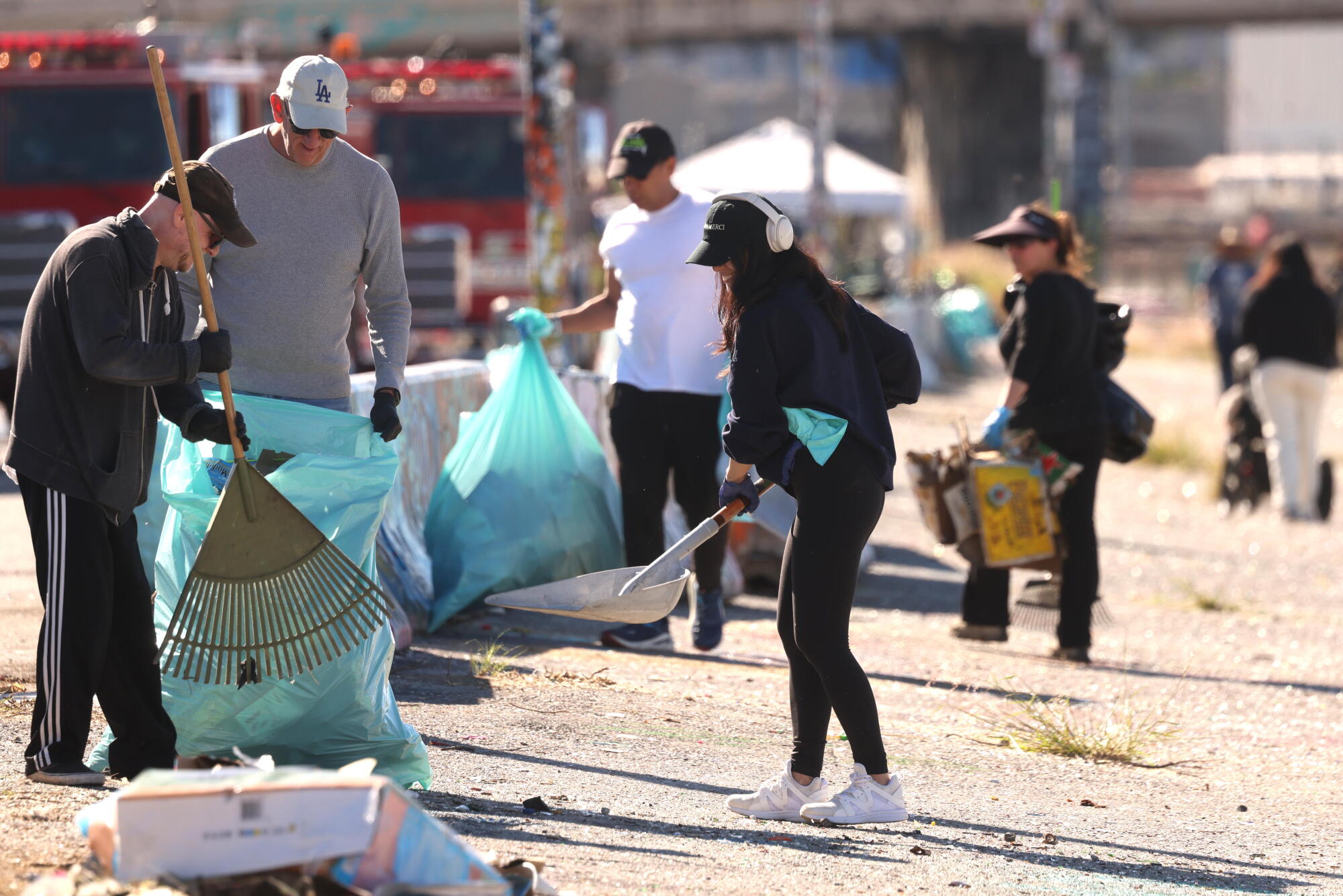
The volunteers began arriving at 9, giving up a perfectly good Saturday morning to wade through a sea of trash.
They could have slept late, or gone to brunch, or shopped for a turkey.
No. They chose to come to a quarter-mile stretch of Myers Street, between Mission Road and the L.A. River. They chose to grab brooms and rakes and shovels and clean up after an army of knuckleheads who keep using this place as a dump.
Broken beer bottles. Starbucks coffee cups. Fast-food wrappers and containers. Fireworks debris. Furniture. It was an ugly sight against a beautiful backdrop. The downtown L.A. skyline, silvery in the morning light, rose behind the railroad tracks and beyond the river.
Two hours later — transformation. The scrub club had filled 60 trash bags the size of giant beanbags, and this little section of L.A. looked respectable again. If only for a while.
With the job complete, their tireless leader grabbed a microphone.
“When I started this, I had no plan,” Juan Naula told the trash team.
That was exactly two years ago, when Naula began Clean L.A. With Me, a nonprofit he put together because he’d never seen such filthy streets in his native Ecuador, or in Virginia, where he lived before moving west to start a ride-app business that didn’t work out.
Naula, featured in a Times video more than a year ago, now has about 200,000 followers on social media, with dozens of requests for cleanups all over the city, from the northern San Fernando Valley to the southern tip of L.A. He can’t even begin to keep up.
“I never thought it was going to come this far,” Naula said. “So guys, this makes me so happy — you guys coming and showing that this is not OK. The trash is not OK.”
Naula’s team collected roughly two dozen Starbucks cups, a particular peeve of his. He takes the names on the little order tags stuck to the cups and posts them, along with store location information, on social media because the litterbugs need to be called out, if not shamed.
“You see, it has Julio right here,” Naula said. “This one, we have Medi. And we have here Melanie.”

Volunteers, from left, Tommy B., Peter Wright, Francisco Serrano, Elizabeth Lopez and Marinella Loi help clean up trash with the nonprofit Clean L.A. With Me near downtown L.A.
(Genaro Molina / Los Angeles Times)
In one of several short videos Naula posted after the cleanup last Saturday, he couldn’t restrain himself.
“You guys are sad,” he said, glaring and pointing at imaginary litterbugs. “You should do better. Shame on you guys. … Do better, man. … Why are you trashing L.A?”
There’s no good reason, but Naula — a former general contractor — knows who the culprits are after two years of Saturday group efforts along with the multiple solo cleanups he does each week, traversing the city in a white pickup truck.
Contractors unload trash all over the city, he said, chucking construction debris to avoid the cost of fees at legal dump sites. Food vendors toss their leftovers. Homeless encampments are often surrounded by trash. On Myers Street, Naula said, people hang out at sunset, set off fireworks, eat, drink and dump.
“People say it’s the culture here,” Naula said. “I mean, if this is the culture, I don’t want to be learning anything about this culture.”
It would be easy enough to complain that people pay taxes for city services that aren’t being delivered. But the volunteers I spoke to last Saturday were more focused on pitching in than pointing fingers, and some of them don’t even live in L.A. proper.

Juan Naula, center, works with volunteers during a cleanup along Myers Street in downtown Los Angeles.
(Genaro Molina / Los Angeles Times)
“I don’t have a strong faith right now in our government,” said Manuel Aguilar, an airline employee from El Segundo. “Someone has to get it done.”
Matthew Garcia, a muralist from Venice, said it feels good to do something positive. Peter Wright, a retiree, said he was thinking of starting a Clean L.B. With Me affiliate in Long Beach, where he lives.
“I think this gives me a little good karma,” said Sterling Molldrem, a young muralist from Alhambra.
Alice Vasquez of Alhambra said she volunteered after seeing Naula on TikTok. She considers him an inspiration.
“I want to help out,” said the retiree. “This is my hometown. Born and raised in Lincoln Heights.”
Marinella Loi, a child-care worker, said she wants to be an example for youngsters who don’t seem to have been taught not to litter.
The weirdest thing she’s found during a cleanup?
“A coffin,” she said.
I had to ask the obvious question.
“It was empty,” she said.

Naula displays a map on his phone showing where in Los Angeles people have told him a cleanup is needed.
(Genaro Molina / Los Angeles Times)
Chris Kim, a graphic designer from Studio City, shoots videos for Naula’s social media posts and often accompanies him on weekday cleanups. He said he thinks it’s unrealistic to expect the city to pick up after everyone.
“The city does have certain responsibilities, such as picking up trash when we take it out to the curb,” he said. “But how can the city be responsible for illegal dumping?”
It can’t. But to borrow one of Naula’s favorite phrases: “Do better!”
Across the city, dumping is so prevalent, volunteers are answering a call that City Hall doesn’t seem to always hear. I once wrote about a butler who picked up trash on his morning walks along the Orange Line before heading off to work. I also wrote about a woman in Hollywood who hired her housekeeper to clean up and report illegal dumping.
Naula estimated there are 20 or more citizen-run cleanup operations in the city, and one of the bigger ones — Volunteers Cleaning Communities — was featured last fall by my colleague Dakota Smith. That group, mostly retirees, was 250-strong as of last year and fanned out across the Valley, Brentwood and Santa Monica.
Naula said he lost some of his social media support during the mayoral campaign, first when he appeared at an event for conservative L.A. critic Spencer Pratt, and then after Mayor-elect Nithya Raman pitched in at one of Naula’s cleanups.
“I lost over 2,000 followers on my Instagram account,” Naula said.
Naula told me he wasn’t backing either candidate, although he’d be happy to work with Raman if she chooses to employ his services.
“I’m for the city,” he said, even though he lives just beyond its borders. He and his wife and young son, who is recovering from a liver transplant, have an apartment in Montebello.
After the Saturday cleanup, Naula called the city, and trucks from sanitation arrived in a couple of hours to pick up the bags. At smaller cleanups, Naula often takes trash to a dump, which costs him more than $100. He collects donations on his website but wants to figure out how to get formal sponsorships, or get hired by the city or a private company. As it is, he said, he’s selling Clean L.A. gear and working as an Instacart driver to pay his bills.
A few days after the Saturday cleanup, I met with Naula and Kim at a dump site that looked like a movie set depiction of the end of civilization. It was in the area around 16th Street and Compton Avenue, just south of the 10 Freeway, and I had written about this very spot back in 2019.

Naula said he founded Clean L.A. With Me because he was shocked at how dirty the city was. “Everybody has to do better,” he says.
(Genaro Molina / Los Angeles Times)
Furniture, tires, construction debris and other junk were strewn about on several streets, as if bombs had gone off. In what looked like a sinkhole, next to an RV, I saw a purple and white jet ski that had been ripped into several pieces. I don’t know whether it was belched up from the center of the Earth, or if Mad Max tried to get to Long Beach through the sinkhole and didn’t make it.
There was no point in Naula and Kim loading the pickup. They would have needed double or triple the volunteer crew from Saturday, and it would have taken days to clean the mess. Naula said he would schedule a big cleanup soon, and he had a message for City Hall:
“In some areas, L.A. looks worse than a Third World country,” he said. “You guys have to do something.”
The three of us agreed the city has to massively step up enforcement and levy stiff fines for illegal dumping. That it needs to respond immediately to eyesores such as this one so they don’t become more normalized than they already are. That people must stop treating the city like a giant dumpster.
In Los Angeles, Naula said, people take such pride in the Dodgers. They should take at least as much pride in the city.
“Do better,” Naula said. “Everybody has to do better.”