immigrants

Supreme Court rejects Florida’s bid to sue Western states over truck licenses for immigrants

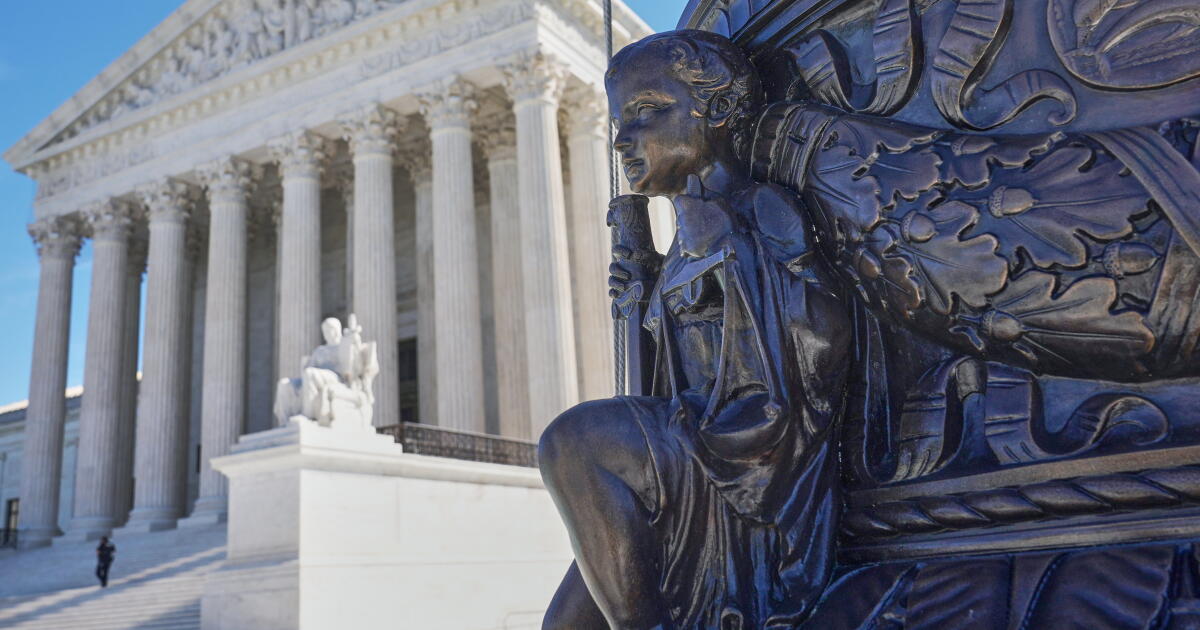
The Supreme Court on Tuesday rejected Florida’s long-shot attempt to sue California and Washington state over the issuance of commercial driver licenses to truckers who don’t speak English and are not authorized to be in the United States.

The case stems from a crash in Florida last year that killed three people. The driver, Harjinder Singh, is accused of making an illegal U-turn that caused the accident. Singh, who is from India, was carrying a valid commercial driver’s license from California and had earlier been granted one by Washington state.

Republican-led Florida has accused the Western states, led by Democrats, of openly defying immigration laws and asked the justices to rule that states lack the authority to issue CDLs to people who are not citizens or legal permanent residents.

The Supreme Court typically hears appeals of lower-court decisions, but it sometimes takes on what are known as original lawsuits in which states sue each other in the nation’s highest court.

Justices Clarence Thomas and Samuel A. Alito Jr. dissented from Tuesday’s order, as they often do when the court rejects an original lawsuit, saying that the court has no choice but to hear such cases.

Separately, a federal appeals court has blocked a Trump administration proposal to impose new restrictions that would severely limit which immigrants can get commercial driver’s licenses to drive a semitrailer truck or bus.

Source link

Supreme Court will hear Trump’s bid to end legal protection for up to 1.3 million immigrants

The Supreme Court will hear arguments this week over whether the Trump administration may revoke temporary protected status for about 350,000 Haitian and 6,100 Syrian immigrants.

TPS allows people who are already in the United States to legally reside and work here if they are unable to safely return to their home country because of a sudden emergency such as war or a natural disaster. The humanitarian program, enacted by Congress in 1990, has since been used by Republican and Democratic administrations alike.

Since President Trump returned to office last year, his administration has terminated such protections for immigrants from 13 countries. Court challenges on behalf of Haitians and Syrians have been consolidated into a single case, Mullin vs. Doe, which the justices will hear Wednesday.

The high court’s ruling could eventually have sweeping repercussions for all 1.3 million immigrants from the 17 countries that were designated for TPS at the start of this administration. That’s because the federal government is arguing that decisions regarding the program are almost entirely immune from review by courts.

“Temporary means temporary and the final word will not be from activist judges legislating from the bench,” a Department of Homeland Security spokesperson, who did not provide their name, wrote in response to a request for comment.

Lower courts have repeatedly deemed the administration’s actions improper.

“We’re seeing clear gamesmanship from government to insulate all TPS decision-making from any oversight,” said Emi MacLean, a senior staff attorney at the American Civil Liberties Union of Northern California, who is counsel in the case for Syrians and in other cases challenging five of the terminations. “They’ve created a farce of a process to justify the ends that they sought, which was to strip humanitarian protections from over a million people.”

In the Trump administration’s appeal, Solicitor Gen. D. John Sauer argued that Congress gave the Homeland Security secretary the power to grant or end the temporary protected status for troubled countries and barred judges from intervening.

He pointed to a provision that says: “There is no judicial review of any determination of the [secretary] with respect to the designation, or termination or extension of a designation, of a foreign state.”

Citing this hands-off provision, Trump’s lawyers won brief emergency orders last year that allowed the administration to strip legal protections from about 600,000 Venezuelans. In that case, then-Homeland Security Secretary Kristi Noem had quickly reversed an extension granted by the Biden administration three days before Trump was sworn in.

The circumstances surrounding the Syria and Haiti cases are different. Advocates for the immigrants argue that the administration failed to conduct the required process to properly evaluate each country’s conditions.

They point to emails in July from a Homeland Security official to a State Department official. The Homeland Security official listed TPS designations coming up for review — Syria, South Sudan, Myanmar and Ethiopia. In response, the State Department official wrote: “I confirm that State has no foreign policy concerns with ending these TPS designations.”

State Department travel advisories for both countries warn people against traveling to either because of the risk of terrorism, kidnapping and widespread violence. U.S. citizens are advised to prepare a will.

For Syria, the advisory cites active armed conflict since 2011. For Haiti, it says the country has been under a national state of emergency since March 2024.

But Federal Register notices announcing the terminations said country conditions had sufficiently improved. The notice for Syria, for example, says “the Secretary has determined that, while some sporadic and episodic violence occurs in Syria, the situation no longer meets the criteria for an ongoing armed conflict that poses a serious threat to the personal safety of returning Syrian nationals.”

If the government loses, Homeland Security officials would have to reevaluate the TPS decisions in consultation with the State Department and make a decision based entirely on the country conditions themselves.

The government could start over, in that case, and still find that TPS is no longer warranted — if the process bears that out.

In a friend-of-the-court brief led by immigration law scholars at Georgetown and Temple universities, they explained that before TPS existed, similar forms of humanitarian relief were determined by the executive branch “without reference to any statutory criteria or constraints, and with little if any explanation for why nationals of certain countries received protection while others did not.”

With TPS in 1990, Congress sought to end that “unfettered discretion,” they wrote. Instead, the statute requires the Homeland Security secretary to terminate TPS if the review finds that conditions justifying the designation no longer exist. Otherwise, the law states, it “is extended.”

“The point of the TPS statute was to depoliticize humanitarian decisions,” said MacLean, the ACLU attorney. “Secretary Noem in all of her TPS decisions has completely undermined that fundamental goal.”

Ahilan Arulanantham, who is arguing for the Syria case on Wednesday, added that if the government wins, “it also means they could probably grant TPS to countries that don’t deserve it.” Arulanantham, co-director of the Center for Immigration Law and Policy at UCLA, has represented the National TPS Alliance in separate litigation during this administration and Trump’s first.

Top Homeland Security and State Department officials from the George W. Bush, Obama, Trump and Biden administrations filed a brief arguing that the Trump administration’s terminations of TPS for Syria and Haiti were “not based on evidence and sharply departed from past inter-agency practices.”

Haiti was originally designated for TPS in 2010 after a massive earthquake devastated the country and redesignated because of subsequent natural disasters and gang violence. In November, Noem announced that she would terminate TPS for Haiti, effective Feb. 3. She wrote in the Federal Register that “there are no extraordinary and temporary conditions in Haiti” that prevent Haitians from safely returning.

But even if there were, she continued, “termination of Temporary Protected Status of Haiti is still required because it is contrary to the national interest of the United States.”

The Homeland Security spokesperson said TPS for Haiti “was never intended to be a de facto amnesty program, yet that’s how previous administrations have used it for decades.”

Syria, meanwhile, “has been a hotbed of terrorism and extremism for nearly two decades,” the spokesperson wrote, “and it is contrary to our national interest to allow Syrians to remain in our country.”

In the Federal Register notice for Syria, Noem added that maintaining its TPS designation would “complicate the administration’s broader diplomatic engagement with Syria’s transitional government” by undermining peace-building efforts.

The Supreme Court will take up the question of whether the Homeland Security secretary can use national interest as a reason to revoke TPS. Attorneys for the TPS holders believe any decision to revoke TPS must come down to the country conditions alone.

Syria and Haiti are among the countries for which the Trump administration has also paused processing all immigration benefits. If their TPS protections expire, those immigrants would become vulnerable to detention and deportation even if they are eligible for other forms of relief.

U.S. Solicitor Gen. D. John Sauer attends a press briefing at the White House.

U.S. Solicitor Gen. D. John Sauer argued that Congress gave the Homeland Security secretary the power to grant or end the temporary protected status for troubled countries and barred judges from intervening.

(Aaron Schwartz / Getty Images)

Attorneys for the TPS holders say the terminations were also driven by racial animus. They point to various statements by Trump over the years, including his false claim that Haitians were eating the pets of people in Springfield, Ohio, that they “probably have AIDS” and that Haiti is among the “shithole countries” from which he would permanently pause migration.

Among those affected is a 35-year-old Haitian woman who has lived in the U.S. since 2000 and is raising her four U.S. citizen children in a Southern state. The woman requested to be identified by her middle and last initials, B.B., out of concern for her immigration case.

After graduating high school, B.B. got into nursing school but couldn’t attend because she didn’t qualify for financial aid. She said later getting TPS allowed her to become a certified nursing assistant, and she now works as a medical coordinator while owning a nail salon and three real estate properties.

Though B.B.’s TPS remains active because of the court proceedings, her driver’s license expired Feb. 3 and she has since had to rely on friends and rideshares to get around while repeatedly requesting a renewal.

She said she worries most about her children. If she were deported back to Haiti, she said, she would leave them in the U.S. for their own safety.

“It’s like planning your death,” she said. “I’m 35 and I already have a will — not because I’m going to die but because of the situation.”

On a call with reporters, attorneys and advocates, a Syrian man said he earned his master’s degree in the U.S. and now works in the healthcare industry. The man, who was identified by a pseudonym, said he and his wife are afraid of what their future will look like.

“TPS gave us something we had not had in years: a place to settle and a moment to grieve,” he said, later adding that “telling Syrians to go back right now is not a policy — it’s abandonment.”

Among the public, there is broad support for TPS and other humanitarian programs. According to a poll conducted last month by the firm Equis Research, 68% of Latino and 65% of non-Latino voters support fighting to give back legal protection to those who have lost their temporary protected status or asylum protections as a result of the current administration’s actions.

Earlier this month, the House voted in favor of a bill that would require new Homeland Security Secretary Markwayne Mullin to redesignate Haiti for TPS. Among those who crossed the political aisle to support it were 10 Republicans and Rep. Kevin Kiley, an independent from Rocklin, Calif., who caucuses with Republicans. The measure faces an uphill battle in the Senate.

In an interview with The Times, Kiley said his vote was about common sense and being humane.

“It’s particularly dangerous for people that would be returning where the gangs that are ravaging the country are just lying in wait outside the airport in Port-au-Prince,” he said, referring to the Haitian capital.

And because most won’t return willingly, Kiley added, “really all you’d be doing is removing work authorization from 350,000-some people who are going to mostly remain in the country, who will not be able to work anymore and may end up being more reliant on public assistance in states where they’re eligible.”

At the same time, Kiley said, the TPS system hasn’t worked as intended because most so-called temporary designations drag on.

“The system needs to be reformed,” he said. “But that’s all separate and apart from what we do with the folks who were already given this designation.”

Times staff writer David G. Savage in Washington contributed to this report.

Source link

House passes a bill to protect Haitian immigrants, in slap back to the Trump administration

In a rare bipartisan moment, the House passed legislation Thursday that would extend temporary protections for Haitian immigrants, a long-shot effort fighting back against President Trump’s attempts to end the program.

The bill, pushed forward by House Democrats with a group of Republicans over the objections of the GOP leadership, would require a three-year extension of temporary protected status for Haitians by the Trump administration. That would allow hundreds of thousands of qualifying immigrants to remain in the United States without fear of deportation.

The vote was 224-204, drawing applause in the chamber. But it faces uncertainty in the Senate, and the Republican president would almost certainly seek to veto it.

“I know firsthand how important our Haitian neighbors are to our communities, to our civic life, to our culture, to our workforce, to our economy,” said Democratic Rep. Ayanna Pressley of Massachusetts, who is co-chair of the House Haiti Caucus and represents one of the largest Haitian communities in the country.

During the debate, she recounted the number of Haitian immigrants working in healthcare, housing construction and other industries. Haitians with temporary legal status “are not the problem, quite the contrary, they are part of the solution,” she said.

Pressley has said deporting Haitians back to the troubled Caribbean country would be a “death sentence,” given the effects of natural disasters and gang violence. “Congress can do the right thing,” she said.

Ten Republicans, many from districts with large numbers of Haitian residents, joined all Democrats and one independent in voting for passage.

Congress tries to act before the Supreme Court does

The effort to help 350,000 Haitians living lawfully in the United States comes as the administration is working to end the temporary legal status for several groups, exposing them to deportation.

In less than two weeks, the Supreme Court is prepared to consider a fast-track case that would end the protected status for Haitian and Syrian immigrants in a challenge widely seen as threatening the broader program. The administration filed emergency appeals after lower courts stopped the immediate end of the program.

It is part of the administration’s efforts to strip certain immigrant groups of legal status as the White House works to fulfill Trump’s campaign promise of conducting the largest mass deportation operation in history. Some 1.3 million people fleeing countries around the world have been granted temporary protected status in the U.S.

The protections for Haiti, first approved after a devastating 2010 earthquake, have been extended multiple times. The State Department warns Americans not to travel to Haiti “due to kidnapping, crime, terrorist activity, civil unrest.”

Guerline Jozef, executive director of the Haitian Bridge Alliance, an advocacy organization, fought back tears as she described the fear of deportations coursing through the community.

“We are asking, where will you be? On the right side of history?” she said at a news conference outside the Capitol. “Or continuing to cause trauma to people who are asking for nothing other than safety and protection?”

Trump has described migrants from poorer countries in vulgar terms, and he has falsely accused Haitian migrants in Ohio of eating their neighbors’ cats and dogs.

The conservative majority court has allowed the end of temporary legal status for a total of 600,000 people from Venezuela while lawsuits play out, leaving them to face potential deportation.

Lawmakers debate whether to help Haitians or stick with Trump

Rep. Laura Gillen (D-N.Y.) whose district includes Long Island’s Haitian community, said she promised constituents she would work to protect their status. She introduced the legislation with Republican Rep. Mike Lawler of New York as soon as she took office last year.

“It’s cruel to expect Haitians to be forced to return to these deadly, dangerous conditions,” she said at a news conference. “Human lives are at risk.”

Lawler said there are differences of opinion on immigration policy, but that Haitian immigrants have become vital to his community and forcing them out would be unjust and unwise.

“They are small business owners, they are nurses, they are caregivers, they participate in our economy and take care of American citizens,” he said. “Congress has a responsibility to act.”

But Rep. Jim Jordan (R-Ohio) decried the number of immigrants, including Haitians, who have entered the U.S., and cited Democratic efforts to halt funding for enforcement and deportation efforts.

“Make temporary permanent,” he said, “that’s their plan.”

Rep. Brandon Gill (R-Texas) said the program was “backdoor amnesty” for foreigners.

To Rep. Tom McClintock (R-Calif.), the temporary status first granted under the Obama administration has become “an open-ended invitation” for immigrants to enter the country, including some illegally, and remain.

“The Trump administration has heeded the cries of the American people,” he said.

Using a discharge petition to force votes

The vote was the latest effort by House Democrats to maneuver past the Republican majority using a discharge petition — once a rare tool, but now used increasingly to form bipartisan coalitions.

The discharge petition process forces the bill to the House floor for consideration, powering past House Speaker Mike Johnson (R-La.) and GOP leaders. It was used to help pass legislation that required the Justice Department to release the files of the sex trafficking investigation of Jeffrey Epstein.

Republicans hold a slim majority in the House and are typically able to swat back such efforts from Democrats. But Democrats and Republicans have formed bipartisan alliances to reach the majority needed on the discharge petitions.

Pressley’s effort to discharge the bill won support from four Republicans on the initial petition, and several more once it came to the floor vote.

Mascaro writes for the Associated Press.

Source link