guy

Herb Alpert on the question in his head and the sadness in his horn

Herb Alpert walks up a long driveway at his rambling Malibu estate, wincing slightly after having woken up around 3 a.m. with a cramp in his left calf.

“It’s still kind of seizing,” the trumpeter says as he leads me past a garden lush with moist-looking tropical plants.

This, Alpert accepts, is the reality of life at 91. Yet the only reason he’s out here racking up steps by the hundreds on a recent morning is because he was tooling around in his sculpture studio before I arrived. And the only reason the sculpture studio is so far from his music studio — there’s also a studio devoted to his painting — is because of his huge success over the last 60 or so years.

“So I can’t really complain,” he says.

A Los Angeles native who got his start writing songs like Sam Cooke’s “Wonderful World,” Alpert has lived here in Malibu since 1972, a decade after he released “The Lonely Bull,” his debut album with the Tijuana Brass. The LP’s title track, inspired by a bullfight Alpert caught in Mexico, went to No. 6 on Billboard’s Hot 100; more than a dozen finger-snapping Top 40 hits followed, including “A Taste of Honey,” “Spanish Flea” (also heard as a theme song on TV’s “The Dating Game”) and “This Guy’s in Love With You,” which took a rare Alpert vocal turn all the way to No. 1.

  • Share via

What’s more, these inescapable tunes came out on Alpert’s own label, A&M Records, which he “formed on a handshake,” as he puts it, in 1962 with his business partner Jerry Moss. The label quickly became one of the biggest independent record companies in music, with acts such as Carole King, the Carpenters, the Police, Peter Frampton and Janet Jackson, as well as a beloved recording studio complex on La Brea Avenue. (Moss, who with Alpert sold A&M in 1989 for a reported $500 million, died in 2023.)

After years working on his own and with his wife, the singer Lani Hall, Alpert revived the Tijuana Brass name in 2024 and launched a tour that will stop Sunday night at the Hollywood Bowl. We sat down in his gear-stuffed music studio to talk about it and much more.

I’m sure you heard that John Mayer and McG bought the former A&M Studios last year. I wondered what your emotional investment is in the place at this point.
I don’t have an emotional investment. Once I left the lot, I was out of there — I didn’t look back. I wanted to paint, I wanted to sculpt, I wanted to make music. I wasn’t thinking about the business.

What’s an A&M success story you took particular pride in?
Cat Stevens. I heard this kid — he was a kid at the time — at the Troubadour, just him and a guitar, and I got goosebumps. It was so beautiful and so honest.

What was Karen Carpenter like?
She was a doll. She didn’t know how great she was — didn’t think she was a great singer. One hell of a drummer too. Go onto YouTube and search Karen Carpenter’s solo on drums — it’ll knock your socks off. But she was innocent. She was lucky to have [her brother] Richard because Richard knew what to do with her in a very gentle way.

Even at the Carpenters’ smoothest, I hear deep sadness in Karen’s singing.
I think that’s a standard ingredient to great artists. Listen closely to Miles Davis and you’ll hear the same thing.

Karen struggled with her mental health, which her fame didn’t help. Did you ever feel responsible for what she went through?
I’ve gone over that question so many times in my head: If I hadn’t picked them out and signed them, would the same result have happened?

Where have you landed?
I don’t have an answer.

In a recent documentary about you, you’re talking about “Wonderful World” and you say that nobody knows what a hit record sounds like. That’s your feeling now based on years of experience. But did you think you knew when you were young?
I didn’t know then either. “Wonderful World” was a demo that Keen Records put on a shelf. When Sam started selling records on RCA Victor, they pulled it out as a lark, and it ended up one of the biggest-selling singles Sam ever had. I’ve told this story before, but at A&M a guy played a record for me — I said, “Man, this record stinks.” Well, I was turning down “Louie Louie.”

Why didn’t you understand “Louie Louie”?
It was out of tune. It was too long. I didn’t know what the hell they were saying.

That’s why it’s great.
Probably so. But did they have another hit record? Sam used to say, “Close your eyes when you listen to a new artist — don’t get swayed by whether they’re beautiful or they’re handsome or they can dance their ass off.”

OK, but you were like a heartthrob in the ’60s.
What am I now — chopped liver?

I don’t think you can say your success had nothing to do with your looks.
I don’t think it did. You know that sadness you were talking about? It’s in my horn.

I agree. But it didn’t hurt that you looked great.
It didn’t hurt once I had a hit record. It wouldn’t have given me a hit record.

Jerry Moss, left, and Herb Alpert in 1974.

Jerry Moss, left, and Herb Alpert in 1974.

(Michael Putland / Getty Images)

Let’s talk about your song “Rise.”
Got lucky with that.

In what way?
My nephew Randy, who’s one of my managers, he wanted me to take some of the Tijuana Brass records and do a little disco number with them. So we go into the studio with a bunch of great musicians, start playing “Taste of Honey” at 120 beats per minute. I got nauseous — I said, “Man, I ain’t doing this.”

Nauseous?
The record was big, and I didn’t want to tamper with it. But Randy had written this song called “Rise” with a friend of his. He wanted me to play that at 120 beats per minute too. I said, “Lookit, man — let’s slow this thing down and let people dance closer together.” We recorded it live in the studio. Julius Wechter was playing marimba — dear friend of mine. I said, “What do you think of this thing? Pretty cool, isn’t it?” He turns around and says, “I hate it. That beat — the four-on-the-floor is killing me.” I expected a different answer from him. But it didn’t matter.

What’d you make of the Notorious B.I.G.’s sampling “Rise” for his “Hypnotize”?
How could you not like that record? These guys that take your bass line and make a record by pressing a button — I think that’s cheating a bit. But there’s 70 zillion streams on that song. Can’t deny it.

“Rise” was also sampled by the rapper Nas for his song “Power, Paper & P—.”
I don’t know how to comment on that one.

A lot of musicians from your generation have been selling their catalogs lately. Have you considered it?
There’s no reason to — I don’t need the money.

I wrote about Frankie Valli a few years ago, and he and Bob Gaudio seemed eager to have this company Primary Wave out there finding ways to —
Monetize the catalog. I get it. But they don’t have to do that with us. I don’t know if you know what’s happening, but I’m in the heyday of my career right now.

Right now?
It wasn’t my idea to get the Tijuana Brass back together again. My nephew, he’s a social media guy, and he went around the world to see what songs of mine were selling the most. Turned out there were about 18 songs. I started listening to the 18, and at the end, I felt happy, I felt joyous, I felt a smile was on my face. I thought, Man, let’s try this — this might be interesting. We started doing it, and we’ve been sold out 50 concerts in a row.

It strikes me that without the Tijuana Brass, you weren’t playing the Hollywood Bowl.
Hell no, I wasn’t.

What’s that say to you?
That the music is touching people. The times we’re living in, there’s a lot of doubt with what’s going on, and I think people are getting some positive energy from it.

You’re a lifelong Angeleno. Lots of well-to-do folks say that L.A. has gone to hell in a handbasket. What’s your take?
I think it’s pretty much the same all over the country.

Which is?
Gone to hell in a handbasket. People are confused about where they’re going, whether they’re gonna be able to have enough food on the table, whether they can afford gasoline. I’m not saying it’s all bad — it’s just hard to make sense of a lot of it for a lot of people, including the guy you’re talking to.

Your music has pulled from any number of cultures. Do you think it speaks of your Jewish identity?
Most definitely. My father was born in a shtetl outside Kyiv — didn’t speak Russian, spoke Yiddish. He brought his mandolin with him when he was 16 years old on a boat by himself and landed at Ellis Island. He used to play songs for me on the mandolin. When his nostrils flared, I knew he was into it. That kind of got me.

Jewish meets Mexican feels very L.A. to me.
I think we’re all a product of our surroundings. In high school I used to go see Gerry Mulligan and Chet Baker, and I was touched by them. Of course, they were loaded.

What kind of guy was Chet Baker?
A troubled guy who was a brilliant musician. I gave him one of my horns, and he pawned it the next day. He was sweet but he didn’t have a hold on his emotions.

Not great for living, obviously. But good for music?
Well, you’re opening up a whole can of worms. I mean, why did so many great jazz musicians get hooked on drugs? Maybe guys that were hung up on being a human being, they found that getting stoned helped them through the struggle. I recorded Stan Getz the first time he ever recorded without drugs. It was at A&M — he was wearing this red silk shirt that had sweat stains under both arms. He had like 75 reeds on the ground because he couldn’t pick out the right one. He finally found the right reed, got over the anxiety and started playing — same Stan Getz you heard throughout his career. These guys were under the assumption that being stoned would change what they played. I don’t think that holds any water.

Was there a time you thought it might be true?
I did experiment with grass once. Turned on a recorder, took a puff, started playing some jazz. Took another puff, started playing some more jazz. I listened to that recording the next morning — it was terrible.

Herb Alpert

(Robert Gauthier / Los Angeles Times)

Can we do a little Herb Alpert trivia to finish?
Do I have a choice?

“A Taste of Honey” won record of the year at the Grammys in 1966.
You’re gonna ask why.

You beat the Beatles’ “Yesterday.”
No kidding?

The year after “Taste of Honey,” you were nominated for record of the year again with “What Now My Love.” That one you lost. Remember what you lost to?
Not “Louie, Louie.”

“Strangers in the Night.”
That’s a real pop song. Love the guy, but not my favorite by him.

What’s your favorite Sinatra song?
“Only the Lonely.”

“This Guy’s in Love With You” — great vocal performance. Why didn’t you do more?
I’m not a singer.

Sure you are.
I know it’s a great performance. But it was one take, man — I did that in one take.

This is what I’m saying.
Look, I had an interesting guy in the sound booth who did the arrangements named Burt Bacharach.

I read that you talked with Burt a few times a week until he died.
I did, and not about music. We talked about football, basketball, politics, you name it.

What’s your basketball team?
Lakers.

Hard to be a Lakers fan these days.
Easy to be a critic.

Source link

Dodgers great Justin Turner answers your questions, names his favorite baseball guy

Hi, and welcome to another edition of Dodgers Dugout. My name is Houston Mitchell.

Are you a true-blue fan?

Get our Dodgers Dugout newsletter for insights, news and much more.

We received more than 500 questions for Justin Turner after putting out the plea a couple of weeks ago, which is a record. (Some were the same question asked by multiple people.) I selected a few, and Turner answered them via email between games with the Tijuana Toros.

Mark Haendel in Santa Monica asks: Any ideas of staying in baseball after you actually retire? Coaching, managing, college or pro level, etc.?

Turner: I will definitely stay in the game in some capacity. I love it too much and my son loves being around it too much to step away.

Kristen Lazalier in Norman, Okla., asks: Please share three favorite memories of your years with the Dodgers. Thank you for always bringing such passion and joy to your play — both on and off the field!

Turner: It would have to be winning the World Series in 2020. Winning the Roberto Clemente Award in 2022. The walk-off homer in the NLCS and winning the fan vote for my first All-Star Game in 2017.

Chris Nayve asks: What is your go-to mindset or thought that helps you when things get challenging in baseball or just in life?

Turner: The best thing is just to simplify things and not try to do too much. Take the results out and trust the process. Live in the moment and control what is in front of me.

Robert Scott Wallace asks: First and foremost, I wanted to thank JT and his wife for all the good they do for the city of Los Angeles. A basic question: Who is the toughest pitcher you had to ever face in the big leagues and why?

Turner: Felix Hernández was the nastiest. Cliff Lee and Tyler Glasnow, after the 2020 World Series, own me. (Editor’s note: Turner was 0 for 3 with two strikeouts against Hernández, one for 20 against Lee with four strikeouts and 0 for 11 against Glasnow with 10 strikeouts.)

Paul Mihalow asks: Did anybody on your MLB teams ever complain about the “pine tar” on the back of your jersey — like clubhouse managers or laundry guys?

Turner: No. I asked the clubhouse guys and they said it was actually very easy to get out every night.

Jeff Plotkin asks: Who were some of your favorite teammates?

Turner: That’s a tough one. I get along great with just about everyone. But my favorite baseball guy of all time is, hands down, Chase Utley.

Gabriel Ortega asks: What is one lesson you’ve learned from fatherhood that has surprised you the most, and how has it changed the person you are both on and off the field?

Turner: Being a dad definitely taught me patience and understanding. That just because i know what I’m saying or asking doesn’t mean Bo or anyone else does. Sometimes you have to get creative to get your message across.

Robert Shannon asks: Where does the 2004 College World Series championship with Cal State Fullerton rank on your career highlights?

Turner: That has to be way up near the top. That’s one of the hardest tournaments to win and that was always a special group of guys.

Marshall Fong asks: What adjustments did you make as you aged to remain a competitive player?

Turner: The biggest thing is time management and learning how to get my work in that needs to be done without killing myself and my energy for the game.

Thanks again to Turner for taking the time to answer reader questions.

Andy Pages has a burden

Last week, colleague Liana Handler wrote a nice story on Andy Pages and the struggle he has as his family lives in Cuba. He is unable to see them and sometimes he can’t get reach them on the phone, which is when the fears really loom large.

A few key passages from Handler’s story:

Unlike his teammates — both American and those on visas — Pages is distinctly cut off in the United States, where he lives with his wife, Alondra, but is separated from his parents and sister in Mantua. The third-year Dodgers center fielder is making $800,000 this year but can’t spend his money on flights home or on bringing his family to the country where he plays baseball. The tense relations between the U.S. and Cuba — the Trump administration has imposed economic sanctions and made diplomatic threats — don’t allow for that.

“I haven’t found any way that gives me that tranquility and peace,” he told The Times in Spanish two weeks ago. “Because the way things are there, what’s always on your mind is that it could happen. Anything, any time. And I have all my family in Cuba. So, you have to live with that worry all the time.”

Most of Pages’ family can only listen to his baseball games on the radio or through fuzzy images on the television.

No one understands that more than Dodgers infielder Miguel Rojas. A Venezuelan immigrant, Rojas said he felt a personal responsibility for Pages, who is caught between wanting to speak more about the situation and being guarded because of his budding career and the fact that he’s not yet eligible to be a free agent.

“We need to preserve our job, because this is our only way to make an income, and a lot of us are the head of the family, so we got to continue to think about it that way,” Rojas said. “I would like to be more vocal and be a little bit more present for my community, but it’s really hard because I’m performing my job, and if I stop doing this, I don’t know how to do anything else.”

As Rojas describes, it is not easy to focus on your job when you see people you know at home suffering.

“We are here to perform and actually provide entertainment to people, and sometimes we are seen like that,” he said. “The problem is when the lights are off at night, when you have to go home, when you become a regular human being that is on the streets.”

The story is well worth your time and can be read here.

Perfect Father’s Day present

Shohei Ohtani missed Friday’s game to be present for the birth of his second child with his wife, Mamiko.

“We are again overjoyed to experience this wonderful day in our lives together,” Ohtani said on Instagram. “Thank you for being born safely. We would also like to express our heartfelt gratitude to everyone who has supported us throughout this journey.”

Injury updates

Will Smith has an inflamed disk in his neck and recently had an injection there to help reduce it. The earliest he will be back is Friday, as he is not going on the team’s trip to Minnesota.

Teoscar Hernández will begin a rehab assignment in triple-A this week and could be back before the end of the month.

—An MRI on Blake Treinen‘s elbow showed no structural damage, so he should be back as soon as he can come off the 15-day IL.

—Reliever Edwin Díaz is progressing well and remains on track to return after the All-Star break.

—Reliever Evan Phillips has pitched in six games for triple-A Oklahoma City. In 5-1/3 innings, he has given up five hits, walked four and struck out five. He should return in early July.

—Reliever Brock Stewart could be activated before today’s game against Minnesota. If not, then sometime this week.

These names seem familiar

How notable players who were with the Dodgers the last couple of seasons are doing with their new teams (through Sunday). Click on the player’s name to be taken to their full stats page:

Anthony Banda, Twins: 2-0, 4.22 ERA, 2 saves, 32 IP, 26 hits, 14 walks, 29 K’s, 104 ERA+

Cody Bellinger, Yankees: .276/.370/.473, 324 PA’s, 15 doubles, 3 triples, 11 homers, 49 RBIs, 133 OPS+

Walker Buehler, Padres: 4-3, 3.96 ERA, 72.2 IP, 73 hits, 23 walks, 65 K’s, 105 ERA+

Mike Busch, Cubs: .247/.377/.396, 337 PA’s, 13 doubles, 2 triples, 8 homers, 42 RBIs, 122 OPS+

Michael Conforto, Cubs: .222/.328/.434, 116 PA’s, 9 doubles, 4 homers, 13 RBIs, 116 OPS+

Justin Dean, Cubs: .500/.500/1.500, 2 PA’s, 1 triple, 3 RBIs, 443 OPS+

Caleb Ferguson, Reds: 0-0, 1.50 ERA, 12 IP, 10 hits, 5 walks, 12 K’s, 302 ERA+

Jack Flaherty, Tigers: 1-8, 5.35 ERA, 65.2 IP, 69 hits, 34 walks, 78 K’s, 81 ERA+, on the IL

Kenley Jansen, Tigers: 1-3, 4.00 ERA, 9 saves, 18 IP, 10 hits, 10 walks, 22 K’s, 110 ERA+

Craig Kimbrel, Rays: 0-2, 5.50 ERA, 18 IP, 19 hits, 8 walks, 18 K’s, 78 ERA+

Gavin Lux, Rays: on the IL

Dustin May, Cardinals: 5-6, 4.30 ERA, 83.2 IP, 78 hits, 22 walks, 77 K’s, 94 ERA+

Zach McKinstry, Tigers: .177/.272/.259, 171 PA’s, 4 doubles, 1 triple, 2 homers, 11 RBIs, 48 OPS+

James Outman, Tigers: .169/.238/.286, 84 PA’s, 4 doubles, 1 triple, 1 homer, 5 RBIs, 44 OPS+

Joc Pederson, Rangers: .237/.333/.419, 235 PA’s, 7 doubles, 2 triple, 9 homers, 25 RBIs, 119 OPS+

Luke Raley, Mariners: .241/.303/.503, 210 PA’s, 6 doubles, 1 triple, 14 homers, 35 RBIs, 126 OPS+

Ben Rortvedt, Mets: in the minors

Corey Seager, Rangers: .186/.284/.373, 204 PA’s, 6 doubles, 9 homers, 24 RBIs, 91 OPS+, on the IL

Justin Turner, Tijuana (Mexican League): .273/.483/.461, 196 PA’s, 14 doubles, 6 homers, 25 RBIs

Trea Turner, Phillies: .227/.280/.336, 328 PA’s, 12 doubles, 7 homers, 22 RBIs, 67 OPS+

Miguel Vargas, White Sox: .236/.353/.465, 324 PA’s, 12 doubles, 1 triple, 16 homers, 44 RBIs, 126 OPS+

Kirby Yates, Angels: 0-3, 3.68 ERA, 1 save, 14.2 IP, 9 hits, 7 walks, 19 K’s, 116 ERA+

Up next

Monday: Dodgers (*Eric Lauer, 2-5, 5.37 ERA [1-0, 3.22 ERA with Dodgers]) at Minnesota (Zebby Matthews, 3-4, 4.78 ERA), 4:40 p.m., SportsNet LA, AM 570, KTNQ 1020

Tuesday: Dodgers (*Justin Wrobleski, 8-2, 2.72 ERA) at Minnesota (Joe Ryan, 5-3, 2.99 ERA), 4:40 p.m., SportsNet LA, TBS, AM 570, KTNQ 1020

Wednesday: Dodgers (Shohei Ohtani, 7-2, 1.47 ERA) at Minnesota (*Connor Prielipp, 2-5, 5.17 ERA), 4:40 p.m., SportsNet LA, AM 570, KTNQ 1020

All times Pacific

*-left-handed

In case you missed it

Dodgers star Shohei Ohtani announces birth of second child

Shaikin: Why MLB’s Pride Night cap condemnation isn’t the anti-Christian crackdown conservatives claim

Lopez: There might be one advantage to climate change: More home runs at Dodger Stadium

Dodgers Debate: BLISTER WATCH. Should Shohei Ohtani be shut down?

Shaikin: The Dodgers are ruining baseball! Stop them! But first let me vote for all their players

And finally

Vin Scully tells us “Don’t be afraid to dream.” Watch and listen here.

Until next time …

Have a comment or something you’d like to see in a future Dodgers newsletter? Email me at houston.mitchell@latimes.com. To get this newsletter in your inbox, click here.


Source link

Contributor: ‘The Fast and the Furious’ took the Asians out of an Asian American story

For my 50th birthday, I bought a Toyota Corolla. Wait. Is my midlife crisis car really a Corolla, the best selling and most boring model of all time?

Well, yes. And no.

I have “modded” it, or in layman’s terms, modified the stock components and tuned the engine. This is not your aunt’s Corolla. When I hit the gas, the car pulls hard and the engine buzzes as if it’s powered by a hive of killer bees.

I get thumbs-ups from Mustang drivers and cool head nods from Challenger owners. My favorite is when kids at red lights ask me to rev the engine like I’m F1 driver Lewis Hamilton.

Probably a lot of my drive-by admirers are fans of the movie “The Fast and the Furious,” which was released 25 years ago this month. Fans of modified Japanese import cars, like me, have a love-hate relationship with the $7 billion “Fast and Furious” franchise. On one hand, the movies helped popularize modified Japanese cars. People all over the world fell in love with them and the import car culture they publicized.

On the other hand, the movies left out so, so much of the story.

In Southern California in the mid-1990s and early 2000s, people lived, for the most part, phone-free. The internet was nascent — a repository for flyers and ’zines — and most websites looked like Tetris.

The fashion was baggy everything for guys and short shorts, midriffs and little backpacks for girls. The hair was outrageous. And the cars, especially Japanese import cars, had reached the pinnacle of automotive engineering.

During this era, I was in college at UCLA. I saved up and bought a red 1989 Honda CRX Si. It also had a slick five-speed manual transmission, peppy engine and nimble steering. That car got me to work and through college, and from the mountains of California to the border of Oregon. It probably helped me get girlfriends. It consoled me through breakups. It helped me move to the San Francisco Bay Area for my first grown-up job.

And then, stupidly, I sold it, and all the precious memories it carried.

Now when I hit a loopy freeway interchange at night and my GR Corolla carves through the turns, it’s 1996 and I’m cruising in my CRX, getting pho in San Gabriel or rushing to a flyer party at Naga in Long Beach. That’s the magic of certain cars. A regular car takes you from place to place. A special car takes you back in time.

To be completely honest, I bought the CRX to fit in.

The ’90s import car scene was as diverse as Southern California. But there’s no doubt it started with Asian Americans (specifically Japanese Americans in the South Bay city of Gardena) who were influenced by modified car culture in Japan. Soon, Asian American kids all over the region were taking their inexpensive, underpowered four-cylinder, front-wheel-drive Honda Civics (our parents preferred Japanese reliability over American muscle) and turning them into street rockets.

Not only were they building race cars from scratch, they were also building one of my first experiences with a collective Asian American identity: one that wasn’t overtly about politics and activism, or immigration and assimilation. It was about Asian American joy. It was Chinese, Japanese, Korean, Filipino and Vietnamese Americans building cool-looking, fast cars. It was kids stereotyped as nerds going to parties where the awful stereotype of Long Duk Dong from “Sixteen Candles” was shredded into rubber and obliterated by exhaust blasts.

At the time, the Asian Americans we saw in the mainstream media were negligible or offensive, especially for Vietnamese Americans like me. But in import car culture, I saw, for maybe the first time, Asian guys and Asian girls in a centered and even glamorous light.

We made our own cars and our own car shows. We raced each other and then got fast (with turbos, superchargers and nitrous oxide) and raced others. And we won. We published our own magazines, built our own automotive businesses and, for good and bad, promoted our own outlaw street racer image and our own beauty standard. In those 1990s clubs and car shows, you could see and feel that Asian Americans weren’t assimilating culture. We were creating it.

“The Fast and the Furious” picked up on that. Based on a 1998 Vibe magazine article about street racing import cars in New York, the film was transplanted to Southern California. But it got so many details glaringly wrong. Its street races looked like street raves on major, four-wide roads packed with pedestrians. The races of our scene were clandestine, underground events in industrial, under-policed areas, where cars faced off two at a time.

But the most egregious and inexcusable Hollywood crime to me is that “The Fast and the Furious” whitewashed Asian Americans, the creators of this world, out of starring roles. The Korean American actor Rick Yune appears in the movie, sure — but he plays the villain, Johnny Tran, a guy who hates Vin Diesel’s Dominic Toretto for a crime deal gone bad (understandable) and for sleeping with his sister (ditto). Of course, in a tradition that goes back to “Madame Butterfly” and “Miss Saigon,” Tran dies at the end, shot dead by the blond-haired, blue-eyed hero, Paul Walker’s Brian O’Conner.

A few months ago, seeking a mechanic to mod my Corolla, I was referred to an auto shop in Garden Grove aka Little Saigon. The guy who sent me asked me, “Do you even know who’s working on your car?”

“No,” I replied.

He told me the name, and I Googled it.

Apparently, back in the ’90s, this Vietnamese American mechanic from Orange County had one of the fastest Honda Civics in the world. A true OG of the import car scene modified my car with his own hands. What an honor, and what a connection to the past.

This import car story ends in a full poetic justice circle. As a pioneer and legend of the real-life import car scene, my mechanic wasn’t the villain. He was the hero. He was the fastest, and his car was the most furious.

That’s the heart of my GR Corolla journey. Asian Americans created import car culture. We all deserve to be the hero of our own story.

Ky-Phong Tran is a Vietnamese American writer from Long Beach. He is a professional artist fellow with the Arts Council for Long Beach. This article was produced in partnership with Zócalo Public Square.

Source link

Jakob Nowell used to call Sublime ‘his dad’s band.’ But new album proves ‘Now it’s our band. It’s us’

There was a time in the beginning of Sublime’s recent revival when Jakob Nowell, the son of the band’s late singer Bradley Nowell, saw himself simply as a good son trying to help his adoptive uncles — drummer Bud Gaugh and bassist Eric Wilson — restart his dad’s iconic Long Beach trio. The goal wasn’t to take the place of his frontman father who died of an overdose in 1996. “I’ll never look at it as my band. Sublime is my dad’s band, and I’m helping out, that’s all,” he told The Times in 2024. Luckily, he was wrong.

The journey of finding his own voice through his father’s sly, shambolic poetry and reggae rock anthems, along with his determination on the road with Gaugh and Wilson through a barrage of festivals and tour dates helped him eventually step into his own as a songwriter and Gen Z rock star. It’s all been done with the mission to preserving his dad’s legacy and having fun while doing it. Now it feels as natural as the trio sitting together on the waterfront in LBC’s shoreline marina within earshot of the bellowing horn of the Queen Mary earlier this year as they were finishing the recording of “Until the Sun Explodes,” the first album under the Sublime moniker in 30 years.

Just like the band’s original recipe of shoving punk, dub reggae, hip-hop and ska into a blender, the new songs dutifully stick to the formula along with Jakob’s soulful caterwauls that sound scarily similar to his dad. But what emerges from the 21-song tracklist is the evolution of a trademark sound that gives a nod to the past while standing strong on its own, just like Jakob, despite coming to the interview on crutches while healing from a performance-related knee injury. The band members chatted with The Times about recapturing the effortless essence of their immortal beach-ready sound and looking forward to a second chance to chase an endless summer.

This interview was edited for length and clarity

It’s kind of a rare thing for all three of you guys to be in one place at the same time. What was it like working in the studio together to finish the new album?

Bud Gaugh: Magical. Things are just coming together. We showed up, Jake had an idea for another song, and he sent us a little demo and said “Hey, this is what I’ve been thinking about.” And then we get down to the studio [in San Pedro], and he’s like, “Oh yeah, so I had another idea,” and kind of changed it. We jumped in there [and by the end of our sessions, we had written] brand new songs to the list of songs that we already had.

The band’s revival has been a long time in the making. I remember when you guys had your first show together, a surprise gig a couple years ago as part of a benefit show for the Bad Brains frontman H.R. Do you feel you’ve come a long way since then?

Eric Wilson: I never thought the chemistry would be like it was with Bradley.

Jakob Nowell: Especially now that we’ve been playing together this long, the chemistry is very much there. We’re just comfortable and having fun. Jamming together is the best. We get in there to do a take for a song, and I’m always like “Let’s just do like three more!” It’s just that much fun, and that’s how it feels playing live too.

When did the idea for creating a new album come about?

Gaugh: It was pretty much just while we were playing shows, At first, the idea was that we were getting together to do this benefit for H.R. [at Teragram Ballroom in December 2023]. We went from “How’s this going to work?” and then [after the show] it was like, “Wow, this is something special. We should definitely go out and play some more shows, and get this music out there and get the opportunity to bring the music to the people in the purest form that we possibly could.” As we’re doing that, it’s like we’re seeing the reaction in the fans, and we were feeling it emotionally. We realized this is going to be bigger than we ever thought. That’s when we really decided where it was going to go.

 Sublime members stand in front of a palm tree

Jakob Nowell, right, once thought Sublime was only his late father’s band; now, fronting the Long Beach trio, he’s leading a new chapter that still honors Bradley Nowell’s legacy.

(Allen J. Schaben / Los Angeles Times)

Were any of the songs on the new album mined from previously unreleased material or did you start fresh?

Nowell: There was that song we did with Stick Figure [“Feel Like That”], so I think that kind of inspired us. [We realized] “Oh s—, there really is some meat on the bone.” And then I had found some old recordings of stuff that were just like jams without even like vocals or whatever. Then it became just this thing during sound check or maybe in the middle of sets, we’d just start jamming these random progressions and stuff, and it kind of just evolved from there naturally.

The new songs that I’ve heard fit right in the vein of what people love about Sublime. What was it like putting some of those new songs in the setlist as you were building them?

Nowell: It was like magic. We were joking yesterday that sometimes we’ll play a new song for the first time just randomly and I’d see people try mouthing the lyrics and stuff and I’ll say “you’ve never even heard this before! I know you haven’t. We don’t even really know what the hell we’re saying.”

Gaugh: You frontin’! [Laughs]

Nowell: But [the new material] sounded like it was supposed to be there, so it was kind of a rad little test in a lot of ways. We almost don’t even have to think about it. That’s always going to be the guiding goal of any band trying to make fun music that’s relatable.

Wilson: What if you’re Slayer? That’s not true if you’re Slayer.

Jakob, it seems like you’ve gotten a lot more comfortable in the frontman role since joining the band. What’s it like just taking the lead, not just for the sake of your dad, but for the fans?

Nowell: Oh, dude, it’s the best. I don’t even have to think about it. We really feel like this is — we’re a band, you know?

Gaugh: It’s [Jakob’s] band too. Now it’s our band. It’s us.

Nowell: It feels like that whenever we’re hanging out, just doing stuff, or at the studio or at these shows. So, this upcoming year feels like a really rad adventure. We got all these different eras [of fans] — people who were in their 50s when [Sublime’s] first stuff dropped, who are still alive, and then their kids and their grandkids and great grandkids. Everybody finds a piece of the discography they can relate to. That’s what is most exciting. It’s not just one or two songs, people sing along to everything.

I was at Warped Tour in Long Beach last year when you guys played and —

Nowell: That was my favorite set!

To me that felt like it encapsulated what you were talking about with the multigenerational groups of fans that have enjoyed you guys and associate you with Long Beach.

Gaugh: It was like a homecoming for me. I remembered playing the Chili Cook off, you know, right over there in the same area [as Warped Tour], and it was just bringing me back 30 years. It’s so meaningful to be in our backyard playing our music again, right there. This is where it all started. It’s come full circle.

Nowell: It was like playing at a local bar in a cool way. I had this huge group of people up front, they were just talking and shouting and saying stuff, like f–ing with us and joking around. I was like “Damn this is great!”

How about you, Eric? How’d you feel playing Warped?

Wilson: [Mumbles] It was f–ing awesome.

Now that you’ve played all these festival shows, from Coachella to No Values, you’ve got your own festival going on. Can you talk a little bit about Sublime Fest and your Sublime Reef Madness Cruise and how you came up with it?

Nowell: We could put on a bunch of the bands we love, and some of our boys, like Vandals, and make it our own vibe.

Gaugh: You walk around Coachella and there’s so many different elements there. Wouldn’t it be neat if we could make like all this like a Long Beach element, a Sublime element. Looking at this thing, it’s like “Oh wow. So we can actually get some of our friends and set up like a tattoo booth, and have our idea of art and everything out there, and mix it all together — food, art, music — bringing all these different elements, and friends of ours that play music. We get to decide who’s going to share the stage with us, so it’s really neat. It’s like planning a high school party or something like that.

Nowell: The biggest backyard party ever seen.

You guys always had your own sound going on, what’s it like to see that the fans still want it?

Wilson: It took a lotta years to catch on, but it did.

Nowell: Yeah, the kids really want that, like ‘90s, Y2K kind of vibe. That was the last era of like cool authenticity and stuff. You can see it when young people make stuff to look retro … when things get so high fidelity, we’re almost losing a little element, so I think these festivals kind of seek to bring some of that back in a way that everybody can get into.

Sublime members from left: guitarist Eric Wilson, drummer Bud Gaugh, and vocalist Jakob Nowell

With “Until the Sun Explodes,” Sublime’s first album in three decades, Jakob Nowell, Bud Gaugh and Eric Wilson rediscover their studio chemistry, jamming new songs that feel instantly familiar onstage.

(Allen J. Schaben / Los Angeles Times)

You guys also have the timeless iconography of the Sublime sun logo. The title of the album is “Until the Sun Explodes.” Does that title have any particular meaning to you?

Nowell: It’s almost just another way of saying “forever,” like “Oh baby I’m gonna love you till the sun blows up.” That’s gonna happen in billions of years, if at all. The fact that [Sublime’s] lasted this long and has this many fans is evidence to me that we wanna be here forever. I think that’s what everybody wants for themselves.

Jake, you’ve taken steps to advance your own aspirations and music with your label, Sunburnt Records, how does that fit into where Sublime is right now?

I was inspired by the whole Skunk Records thing [Sublime’s first label], Evan Zinger with [his lifestyle brand] SRH, and just all the local brands I grew up with when I was a kid. So just trying to do a cool, chill local thing that has that vibe of putting on small shows and kind of getting to use this new notoriety to be like, man, I have so many friends in these small bands like Strange Case and Eight Ball, and other bands up and down Southern California. Let’s put on shows and sneak them on a Sunburnt Stage at [Sublime Fest] and if people really like that Sublime sound here’s a bunch of kids who are carrying the torch like Slightly Stoopid did when they started out. Mike Watt always said “start your own band!” So the more we can inspire people to do that and be some small part of that, it’s a dream come true.

Do you feel like this version of Sublime is something Brad would be proud of?

Gaugh: We all kind of brought our own element to the music orignally. So we just kind of followed that recipe. Jake’s his own person, he’s got his own influences, and we just kind of stick with that idea. Jake brings in his feelings, and Eric brings in his and we sat there and recorded this song, and then as we were recording it, we’re coming up with ideas. It’s like, “Oh wait, we should do this here, slow that down there, stop here,” it’s all a conglomeration of ideas, everyone does their part, brings in their own spices and we mix it in a pot like gumbo.

Source link

Las Culturistas Culture Awards have awards the Oscars wouldn’t dream of

Shrek’s abs are more defined than some might expect. Or is it that the shade of his green skin makes them appear more chiseled under bright lights? Maybe it’s just disorienting because no one anticipated gawking at his torso inside the historic downtown Los Angeles venue founded by Hollywood legends Charlie Chaplin, Mary Pickford, Douglas Fairbanks and D.W. Griffith.

These are thoughts that swirl in one’s head while attending this year’s Las Culturistas Culture Awards ceremony, held on a recent Saturday night at the United Theater. An offshoot of the popular podcast that actor-comedians Matt Rogers and Bowen Yang have hosted since 2016, the award show aims to celebrate the year’s biggest pop culture moments and plays like a fever dream more dazzling and deliciously random than a late-night scroll session on TikTok.

After launching in 2022 as a live event outdoors at Lincoln Center, the guerrilla awards show reached TV screens for the first time last year. This year’s ceremony, which will air June 17 on Bravo and stream on Peacock, coincides with the podcast’s 10th anniversary and features a kaleidoscopic array of attendees, including screen veterans like Lisa Kudrow and Will Ferrell, reality TV favorites like “Summer House’s” Ciara Miller and “The Real Housewives of Dubai’s” Chanel Ayan, and anthropomorphic icons like Miss Piggy and a certain green ogre. And the prizes? It’s the only place you can find categories like “Real Housewives Award for Best Way to Start a Confrontation,” “Pornhub Category We Would Never Click On” and “Hilary Duff Award for Millennial Excellence.”

Over lunch at the NBCUniversal lot in Universal City, Rogers and Yang discussed the show’s evolution. These are edited excerpts from the conversation.

Four men — two in white tuxedo jackets, two in hockey uniforms — hold hockey sticks on a stage

Matt Rogers, left foreground, and Bowen Yang perform a musical number inspired by “Heated Rivalry” during this year’s Las Culturistas Culture Awards.

(Monty Brinton / Bravo)

I will probably regret starting our conversation this way, but we all have our blind spots and, to thoroughly prepare for this interview, I watched “Shrek” for the first time last night.

Yang: Oh great! The first one?

Rogers: How’d you feel?

I get it now.

Rogers: Get what, that he is attractive or …?

I’m not quite there yet. You guys reference the film a lot on your podcast and Shrek has also been a figure on the awards show, including this year. I was hoping you’d explain Shrek as a heartthrob to me as if we’re in a pop culture class. When did this idea really take shape?

Yang: Over at least a couple years, to my knowledge, there’s been this online meme culture around Shrek, where it’s like, “Oh my God, Shrek is like a sex king,” but now it’s even spilled over into like dating life. I don’t know if you’ve heard of this, but there’s a verb called Shreking in dating, where it has to do with women dating a guy that’s below their league because he will be nice to them; he will be a Shrek to their Fiona. That’s an interesting thing — you date someone slightly in another zone than you, so that you can be like, “Well, that’s my Shrek,” but meanwhile, there’s the tension between that and Shrek being someone that people are actually attracted to. This just speaks to the enduring power of Shrek as a pop culture icon.

Rogers: I think what it is, is he has an amazing accent. It’s a very powerful thing. He’s independent, he’s self-sufficient, he’s a movie star.

Yang: He said it at the awards. I mean, he’s a rich celebrity.

Rogers: We saw the real Shrek at the awards and he looks pretty f—ing good to me.

Yang: He looked good to me. I don’t know what these Gen Zers are talking about with this Shrek being below your league.

What are the calls with publicists like now to get their clients to participate?

Yang: Last year was a communication puzzle to solve. We were like, “OK, we have to really convey this the right way.” We thought, perhaps naively, now that we’ve done it, now that there’s a proof of concept, it’s going to be much clearer. I think it was clearer, but there was still that degree of, “oh, this is …” — not to like give ourselves too much credit, but this is a concentric circle outside of what is very established in the form of an award show. You’ve got publicists who are like, “Well, we would love for our client to win an award.” And you’re like, “No, that’s not really the point.”

Rogers: Presenting is just as good as winning, just as good as performing. But I think it’s weird that we have been so late to stumble on what the show really is, which is it’s a variety show. And, so, in wrapping your head around it that way, it’s actually pretty easy to get across. It just has the drag of an award show, and that’s our way in.

But I do understand the publicist hesitation because I will say, in a world where it’s your job to protect your client, you’re putting them in a situation that is like, “OK, they’re going to an award show — that’s something this town takes very seriously.” So, it’s an ask to be like, “Hey, can you come take the piss out of this concept that you’re then probably gonna spend eight months of the year trying to actually achieve?” I would be lying if I said that we didn’t want one day to win one of those awards. It’s an acknowledgment of your work, but in that, Bowen and I think the No. 1 thing that’s the funniest thing in the world is people who take themselves that seriously. It’s a healthy mix of appreciation for this thing that was actually a big element of the culture that made us say culture was for us, which was watching award shows when we were kids, and also the reality that we now know as people that are in the industry of what they really are, which is they’re just shows. We’re not condemning them, we’re having fun with it.

1

A man in a leather ensemble holds an award while standing next to a woman in a red costume

2

A woman in a pantless tuxedo ensemble performs on stage

1. Scenes from the 2025 Las Culturistas Culture Awards: Jeff Goldblum, left, accepting the award for Most Amazing Impact in Film for his appearance in “Jurassic Park,” alongside presenter Patti Harrison. (Griffin Nagel / Bravo) 2. Allison Janney was a guest of honor, receiving the Lifetime of Culture award. (Jordan Strauss / Bravo)

Have you been asked to tweak the name of a category or punch it up even more?

Yang: Last week was the window when our producers could be very honest with us and say if something may not be working. Back to the Shrek [bit in this year’s show], actually, that ended up being much dirtier and bluer than it was on stage.

Really? I already knew I wouldn’t be able to include the award category because of Times standards. So the actual bit was raunchier?

Yang: It was even raunchier. It went for it.

Rogers: But it’s also a testament to how much freedom they give us to make our show. If they were concerned at all about us desecrating the image of Shrek, we certainly did not feel that way. I am really shocked and grateful that we get to do something that it feels like we’re getting away with something.

Take me back in time with young Bowen and young Matt. What do you remember about your enthusiasm for award shows growing up?

Yang: It was watching Billy Crystal at the Oscars do song and dance numbers, zing these things in for a laugh that we’re referencing the year, being in these video packages where he was in the movies. That it was live television and just this pageantry of people congratulating themselves, congratulating each other. I would tune in live every single year to all the award shows and I would follow the host changes. I remember Whoopi’s first year [hosting the Oscars]; I remember Ellen’s first year. I was really obsessive. It opened the door for all these things that I currently love, and that I’ve somehow had a fortunate experience in, which is live television, song and dance numbers — everything that Billy Crystal was doing. It keyed me in on how show business works, down to production elements and how filmmaking comes together.

Rogers: I just remember, I looked at the screen and I was like, “Oh, that’s where I belong. I belong with them. I don’t belong out here.” I was one of those Gold Derby kids — I would be on the forums; I still sometimes look at the odds and rankings and stuff. It was like gay sports, particularly with the best actress and best supporting actress races. And then obviously the Grammys, and all of that. One year I was watching, I think it was the People’s Choice Awards or the American Music Awards or something, and Shania Twain lost to LeAnn Rimes, and I cried for a day. I took it so seriously and my mother turned to me and said, “You need to stop.” But you couldn’t tell me it didn’t matter at the time. [Reporter’s note: Twain lost the favorite country new artist award to Rimes at the 1997 American Music Awards.]

A man in a white and black suit outfit poses next to a man in an orange ensemble

As the profile of Bowen Yang and Matt Rogers’ variety-style award show has risen, getting stars on board is an interesting puzzle: “You’ve got publicists who are like, ‘Well, we would love for our client to win an award,’” Yang says. “And you’re like, ‘No, that’s not really the point.’”

(Jason Armond / Los Angeles Times)

What do you remember about your first experience at a major awards show?

Rogers: He was nominated as writer for “SNL” and took me as his date. We were sitting there — the “Queer Eye” guys were sitting like three rows behind us.

Yang: We watched Phoebe Waller-Bridge sweep with “Fleabag.”

Rogers: We watched Michelle Williams win for “Fosse/Verdon.” It was funny because we had gone to the bar and were double-fisting drinks back to the seats and I said to Bowen, “Oh my God, I’m like the Busy Philipps to your Michelle Williams.”

Yang: And who shows up behind us?

Rogers: Busy Philipps taps on our shoulders and goes, “You guys are killing it with those drinks.” And I’m like, she doesn’t even know I’m her. Cut to minutes later, Michelle walking up and giving a banger of a speech.

Yang: That was like our first brush with it. Even now we go to these, and we’re like, this is really something; it’s incredible. We were at the Oscars last year, front row, witnessing all of it go down, witnessing the moment where upsets would happen, feeling the vibe in the room shift. The benefit of our show is that the vibe is pretty high throughout; it does not decline as soon as there are losers in the room.

Las Culturistas Culture Awards took place in late May and is being telecast roughly two weeks later. Do you see it ever going the live route?

Yang: We don’t know. That is my not so secret dream, is to do it live one day. There’s just something about doing it live — and it occurs to me now that I’ve been very lucky and fortunate to have have my reps in. There’s just something so wonderful about it being this event where everyone is tuning in, enjoying it the same time you are. That is really something special.

Rogers: If he’s down, I’m down.

I’m sure this changes each year, but who’s your dream person to snag for an appearance?

Rogers: I would say the people that make it very apparent that they have sketch comedy and impression skills, and maybe you wouldn’t necessarily know that they do until they show that.

Yang: Ariana Grande.

Rogers: Our dream was for Ariana to come do an original character. We actually floated to her the idea — there was going to be like a Banksy reveal of MsMojo, and it was going to be revealed that it was Ariana Grande was MsMojo. But she actually was in rehearsals for the Eternal Sunshine World Tour. Little did we know she also was recording “Petal.” She was a bit too busy to play MsMojo, I guess, this time.

Yang: These two are forever paired in my head, but it’s because she’s another sketch performer: Cher. And sometimes the dream guests are not big names, it’s the people that we came up with in comedy. And actually one of the consumer research reports that we got back before we started writing this year’s show was that the thing that people loved about the Culture Awards was this crossover of reality talent, A-listers and Oscar winners, and comedy people — that mix, those three [types of] people mingling together is what the viewers want.

Rogers: I’m just so proud in every single way of the diverse array of talent that we were able to bring together. I looked out in the audience and it was just a party of so many friends and people we’ve met in the business — people that I didn’t even get to meet that night, but I was just gagged they’re there, especially in the edit, which you’ll see. This is Bowen’s first year in the edit, he had to miss it last year, but that’s what’s so cool about going through the footage, is you’re like, “Oh my God, there’s someone I’ve loved my entire life next to my cousin.” We were saying to each other that it ended up being like a weird love letter to our younger selves, having Mandy Moore and singing “Only Hope” with her and doing the “Pokémon” theme song and getting to hang out with Pikachu.

Do you worry about it ever getting too big?

Rogers: If it ever gets to a point where it couldn’t be funny, that wouldn’t work. We want it to always stay true to what it is, which is it’s our comedy special together. As long as it doesn’t feel like it’s selling out — and I can understand people watching it and being like, “Oh, they obviously had to have Nintendo characters because it’s NBCUniversal or obviously they had to include “Summer House” — none of that is true.

Yang: There’s no mandate.

Rogers: This is genuinely what we would want the show to be, and so as long as it’s that, we’re good.

So what’s your “I don’t think so, honey” on awards shows?

Rogers: I don’t think so, honey — 10 nominees for best picture at the Oscars. Why?

Yang: Totally. Tea.

Rogers: I actually think it helps things that are weirder win because it’s too many. And the way that they ranked choices. I’m a popular-vote person anyway.

Yang: I need us to really get on the same page about play-off music. Sometimes people are encouraged to go on, sometimes we turn against that. Let’s stop innovating, let’s stop trying to break the mold on them. Let’s just respect that as much as we can, unless it’s egregious.

And it’s always a bit within the show.

Yang: This is what I was about to get to. The hosts now are always trying to bitify that; it’s more of a practical thing to keep the show moving. Don’t try to put a hat on top of a hat by making it a comedic moment too. We’ve never really played with that trope, even though we could, and maybe should. For now, my attitude towards play-off music is, these people might not ever be on this stage again.

How soon do you start planning the next one?

Rogers: Hopefully, they give us the green light.

A woman in a wacky jumpsuit speaks on stage while two other women look on

Ana Gasteyer, left, Jamie Lee Curtis and Patti Harrison at the 2025 Las Culturistas Culture Awards.

(Jordan Strauss / Bravo)

How did you go about deciding which categories would return this year and which you invent along the way?

Yang: We did an audit this year of all the categories from the last few years of doing this.

Rogers: Less made it back last year.

Yang: I think maybe about 30 max previous categories [returned] — that’s a decent ratio, 70-30 is nice. From there, we just kind of molded the clay on the table a little bit. We have the benefit of making this a recursive reinvented show every year; the categories itself are the premise, it’s the micro-premise within the segment or the element. The jokes are the nominees. Why not create new opportunities at every turn.

“Las Culturistas” expanded into a video podcast last year. How do you feel about this evolution we’re seeing to the format?

Rogers: It’s not that when I’m on camera with Bowen doing the podcast, like, “Oh, I wish I could be more relaxed,” I just wish the whole industry hadn’t gone this way because I feel like when you’re on camera, you can’t help but be a little bit more self-conscious, and that is going to come through in the podcast product. If I had my druthers, none of them would be on film. I can understand that it helps a lot and I can note a marked difference in the amount of times I get recognized now that we are on social media. It absolutely “helped” our podcast get bigger. That being said, I don’t think it was a good thing for podcasting that they all became TV shows.

Yang: It changes the register and the tone by nature. You cannot help but be motivated by different things, by the appearance of it, by the presentation of it, beyond what it was, which is just radio, which is a really important American form.

As two people who grew up being connoisseurs of pop culture, what is it like to be on the other side of it, to feel the intensity of it — I’m talking about what happened with the Jasmine Crockett comments — to become part of the conversation? What lesson came from that?

Yang: We are experiencing something in an acute way that I think everyone is experiencing, which is we are seeing ourselves in the third person. Everyone is kind of modulating their behavior based on how they are appearing out of body. It’s the way we all move through the world now, which can be snapshot and projected very widely out into the world for whatever reason.

Rogers: When you’re talking candidly, you can never know what piece of what you’re saying is going to be the piece that gets scrutinized again and again and again and again by what feels like the entire internet. And if you did, you would, of course, be more specific, and you would be able to really clearly say why you are saying what you are saying. We have had learning experiences with that, and so what we can do going forward is be more clear about the things that we do believe and stand by. That is something that even 10 years in the game we are learning how to do.

Yang: And I think on a very large scale, what is going to happen is that we are all going to adjust for the fact that we have behaviorally changed because of this idea that we’re seeing ourselves in the third person constantly. For me, personally, I’ve had to wrestle with this idea after being on “SNL” for seven years and having to evaluate myself and having an audience evaluate me every week. I’ve changed behaviorally; I need to get over this fear of being seen. I need to get better about listening to my own voice.

Rogers: The internet is a very weird place and the thing is, it deliberately ignores nuance. It willfully tries to make something seem lowest common denominator, so that there can be a community based around that thing. And that is not good for the world. It’s not good for discourse. It’s not good for our politics. It’s really bad for our politics. Until we can all get on the same page about the ways in which we are willfully misunderstanding each other and calling it discourse, it won’t get better.

Yang: The misunderstandings are about people’s tones, and not necessarily about the things that people are pointing toward.

Source link

Ryan Ward becomes an unlikely star in Dodger Stadium debut

An eerie silence descended upon Dodger Stadium as the swatted ball soared toward the right field corner.

What was this? Who was this?

This wasn’t a crowd-roaring drive by a future Hall of Famer. This wasn’t a Ravine-rattling shot by a perennial All-Star.

This was rare. This was weird. This was a long fly by a long-shot outfielder ending a long minor-league journey with his first appearance at Dodger Stadium.

The ball flew and flew and, suddenly, this was a home run. A home run? Who was that again?

The stunned crowd erupted.

And Ryan Ward danced.

Yeah, the sunny 28-year-old did the Freddie Freeman Hop as he rounded second base in a wonderful show of giddy celebration by a guy who’s earned it.

“Kind of a blackout, if I’m going to be honest with you,” Ward said. “Hit it and kind of just went numb.”

Feel free to go numb with him. With his fourth-inning solo blast in Sunday’s 9-1 victory over the Philadelphia Phillies, this not-exactly-a-kid-anymore was the once-in-a-lifetime story.

After seven minor league seasons, his first major-league home run.

After 156 minor-league homers, his first big-league dinger.

After years of trudging through Great Lakes and Ogden and Tulsa and Oklahoma City, his first big fly at 1000 Vin Scully Ave.

In fact, it was his first game at Dodger Stadium, period, and he soaked in the atmosphere with the same wide-eyed wonder as all those little leaguers who marched around the field before the game.

”When I went out to left field, kind of just looking around, taking it in, just realizing how special it was, just have fun with it, enjoy it all,” he said.

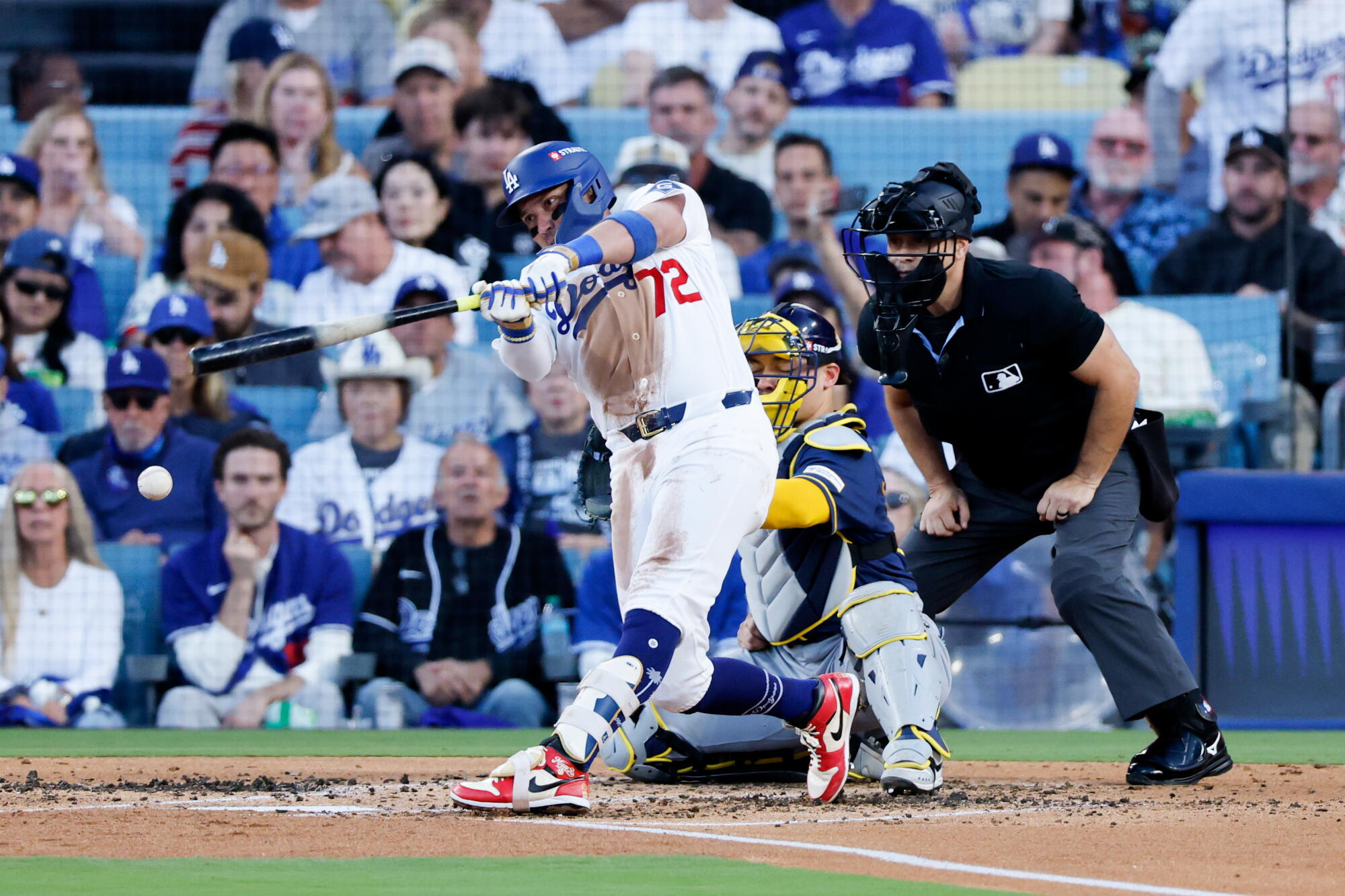
The Dodgers’ series win against a team that will challenge them in October was especially a blast for the “others,” the role players who wind up being so important, with Ward and Alex Freeland homering while Alex Call hit a two-run single.

“Everybody in this locker room is a superstar,” Freeland said. “A lot of us get overlooked just because we have guys like Shohei and Freddie. Everybody in this clubhouse can ball.”

Nobody was as excited to just be in the clubhouse as Ward, who is one of the little-known casualties of the Dodgers’ success, a decent hitter from their farm system who has never gotten a chance because the Dodgers don’t have a need for just-decent hitters.

Ryan Ward hits a solo home run for the Dodgers in the fourth inning Sunday against the Phillies.

”When I went out to left field, kind of just looking around, taking it in, just realizing how special it was, just have fun with it, enjoy it all,” Ryan Ward said after hitting a solo home run Sunday.

(Ronaldo Bolaños / Los Angeles Times)

When it comes to position players, with the exception of the former prospect Andy Pages, they buy stars, they trade for stars, they hoard stars, and they rarely give a long look to anybody who isn’t guaranteed to be a star.

It is in this environment that Ward has surely asked himself, what does he have to do?

He was drafted out of Rhode Island’s Bryant University in 2019 and by 2021 he was showing home-run power with 27 jacks at class-A Great Lakes. Every year he climbed the minor league ladder, and every year he grew stronger, with 34 homers and 104 RBIs two years ago, and 36 homers with 122 RBIs last year when he was named Pacific Coast League MVP.

How long has he been in the bush leagues? He is triple-A Oklahoma City’s career leader in home runs.

But he was prone to slumps, and oversized swings, and average defensive skills, and last season at Oklahoma City his strikeouts equaled his RBIs.

So he never got even a major-league sniff, leading him to spend his winters working a snow plow with his father to stay in shape, yet he never complained.

“Even talking to Freeland today on the bench, and he made a note that Ryan was probably the most positive guy down there in triple A, and that speaks to his character,” said manager Dave Roberts. “And if there’s anyone that has the right to be salty and frustrated, it’s him, but he was professional about it, and he was an easy one to recall and get him here.”

This finally happened late last month when Ward was recalled to briefly fill a hole when Freddie Freeman went on paternity leave. He played two games in Colorado, had a couple of hits, and was sent back down.

This weekend, he was recalled again to replace Teoscar Hernández, who was placed on the injured list with a strained left hamstring. Ward was jammed in the lineup Sunday, struck out against Phillies’ rookie Andrew Painter in the second inning, then made contact on a 1-and-0 pitch and sent it whirling into the right-field bullpen.

“Watching it go over the fence was really cool,” he said.

Ryan Ward celebrates as he runs the bases after hitting a home run in the fourth inning Sunday against the Phillies.

Ryan Ward celebrates as he runs the bases after hitting a home run in the fourth inning against the Phillies.

(Ronaldo Bolaños / Los Angeles Times)

Watching the ball returned to his locker in a glass cube was perhaps just as cool. And then celebrating afterward by getting doused with all sorts of stuff by his thrilled teammates? Off the charts.

“I’m probably gonna smell for a little bit,” he said.

Smell of what?

“You name it.”

Considering Ward hit his homer in the fourth inning, you’re probably wondering how he performed the rest of the game. Well, um, there was no rest of the game. He was almost immediately benched again for Call.

And the struggle continues.

“Keep trying to grind your game as much as you can and just kind of force the door down,” he said.

Bang. Bang. Bang.

Source link

In ‘American on Purpose,’ Craig Ferguson celebrates America’s unusualness

When Craig Ferguson left CBS’ “The Late Late Show” in December 2014, fulfilling a pledge made public the previous April, it was assumed by some that it had something to do with not being offered the chair being vacated by his illustrious lead-in, David Letterman. (Stephen Colbert, you may be aware, was named the new “Late Show” host.) Others simply couldn’t believe anyone would just walk away from such a job, which Ferguson had held for two weeks shy of 10 years, because, even in the less prestigious 12:30 time slot it seemed like a prize — but mostly because he was so good at it.

“That’s one of the odd things about that particular genre of television,” he told me in 2016. “The minute I started at 12:30, the question became when and do you want and how are you going to get 11:30? But I never wanted 12:30, never mind 11:30. Why is that a thing?”

Ferguson went on to other things. He’s hosted game shows (currently the CW’s “Scrabble,” with puckish energy); toured as a stand-up (he’s on the road into June); hosted a history-themed panel show, “Craig Ferguson: Join or Die”; launched “Joy, a Podcast,” which is as close as he’s come to the confessional freestyling of “The Late Late Show”; and published “Riding the Elephant: A Memoir of Altercations, Humiliations, Hallucinations & Observations.”

His latest show, premiering Saturday on CNN, is “American on Purpose,” which shares a title with his first memoir, a reference to the Scottish-born Ferguson becoming an American citizen. Timed generally to the 250th anniversary of the United States, it finds Ferguson in a five-episode crazy quilt of observations, interviews, inquiries, stunts, games and documentary vignettes forming a comical, but not unserious, somewhat wayward look at American ideas and ideals — freedom of speech, capitalism, patriotism, individualism and immigration. It’s a vision wide enough to include monster trucks, lowriders, underground comedy, Miami street art, Texas barbecue and haggis tacos, dreamed up by Ferguson and executed by celebrity chef Marcus Samuelsson.

A man stands behind a food cart as another man cups his hands around his mouth shouting toward the empty street.

Ferguson, a Scotsman, having haggis tacos on “American on Purpose.”

(CNN)

“You know me,” Ferguson said when we spoke over video call recently. “Less format is better for me always.”

His caveat to the producers was that he wouldn’t “make an anti-American show. I wouldn’t make a show pointing out everything that’s wrong. I feel that’s a market that’s heavily catered to. I’m not a f—ing idiot, I’m not making propaganda, I won’t make a jingoistic show. But I want to make a show which is celebratory,” Ferguson says. “And I want to be clear that the show I make for CNN will be the same as if I was making it for Fox News. It has to be my point of view, which is upbeat without being dumb — I hope. I feel like we got pretty close.” This conversation has been condensed and edited for clarity.

A good friend of mine, an Englishman, recently became an American citizen and had only wonderful things to say about the naturalization ceremony, the diversity of his fellow new Americans, and the graciousness of the people conducting it. What was your experience?

My ceremony was in Pomona fairgrounds in 2008. And I think it was 2,000 of us; I think it was 1,999 new Mexican Americans and one new Scottish American. And it was f—ing wonderful. And it is moving. I kind of wish it for my friends who are born here, American citizens, because you have to remove your everyday, “Oh my God, did you see the news today” cynicism, and remember what this place is about — freedom, second chances, third chances, escape, representation, individualism, different ideas coexisting in one country, wildly different points of view somehow managing to get along. That is f—ing beautiful. What I still feel as an immigrant American is a certain gratitude that doesn’t leave you. I’m not blind to the faults of the United States. Show me a country that doesn’t have faults. We talk about the bloody past. Show me a country that doesn’t have a bloody past. Humans have a bloody past. I’m not saying there’s nothing wrong, but I’m not looking at that in this show. I’m looking at what makes me feel great about this place, and it is a great place, an aspirational place. To my mind, we are still the big foam finger number one. I don’t think there’s anyone can touch us for … unusualness. We’re really unusual.

It’s a very optimistic show. Is that how you feel personally about the future of the country, and humanity?

Like most people, I have my moods. I got a real boost of optimism [hanging out] with very clever academics who kind of guard the Declaration of Independence in Philadelphia. And you say to them, “People say the country’s never been this divided.” They always laugh. They laugh at the idea it’s never been as bad as this, the rhetoric has never been this hateful. They’re like, “It’s always been like this. It’s always been an argument. The whole point of this place is that it is an argument.” The guys who started this country, some of them hated each other with just as much venom and outrage and indignance as political players hate each other today. I find that quite encouraging. Like I said, I’m not blind to the fact that there are issues and faults and deep things to worry about. But that’s not what this show’s about. It’s as if I was a musician, and I decided to write a happy song. People say, “Why aren’t you sad?” I’m like, “Well, I get that sometimes, but this song is a happy song, this is a rock song. I’ll do a power ballad later on.” It’s not terrible to to do something upbeat every now and again.

What did you discover in the course of making the show?

There were many things, actually. In L.A., I did a kind of run around with the guys who make the lowrider cars, and the community and the story of how that came about are really fascinating, a kind of parallel run of the rise of the automobile in America, but how it was taken on by the Mexican culture. Another that really stuck with me was in the Everglades, when I was with the Gladesman there, finding out that a large percentage of them [were descended from] displaced Scottish peasants, cleared out of the Highlands to make room for sheep for the landowners; they went to Canada, and they drifted all the way down to the southern tip of the United States. These guys there could trace their ancestry back to 100 miles from where I grew up. Americans would be kicked out of most of the countries of the world. So it makes us awesome. I mean, 40% of this country can trace themselves through Ellis Island, through that administration building in New York. That’s insane.

A man in a suit behind a desk next to two yellow chairs on a boardwalk.

Ferguson at Venice Beach in a segment on the show.

(CNN)

When did you get interested in history?

In Scotland, we’re surrounded by it all the time. There’s a lot of stuff still lying around from a long time ago. American history became interesting to me because it was so attached to Scotland. The Scottish Enlightenment is really kind of the origin story of the Declaration of Independence. Knowing that the philosophy that was coming out of Edinburgh in the 1700s was directly feeding into what these guys were doing, it felt like the continuation of a certain strain of Scottish history. It didn’t end with “Highlander” or “Shrek.”

There’s a road movie element to the series. Do you take trips around the country on your own time?

All the time. I don’t think you can know the United States unless you’ve driven across it at least a couple of times. If you can take a car from New Orleans to Northeastern Maine, Florida to Washington state, it’s worth doing. One of the things that was in the engine for me when I started this [series] was, I’ve seen over the years a lot of — probably more in Britain than in America — lazy kind of pseudo-intellectual documentaries where somebody will say, “Well, you know, the thing about America is…” Well, which America are you talking about? And they will go and get some guy that lives on his boat in Fort Lauderdale with a hat that’s got “Who Farted?” written on it and tell you that’s America. That guy’s there and he’s awesome, but it’s not the whole story. You know what I mean? It’s like saying “Well, you know, Hitler was a vegetarian.” That’s true, he was. But it’s not really the whole f—ing story, is it?

Source link

USC ace Mason Edwards brings joy to the mound entering NCAA regionals

Mason Edwards has first-round hype ahead of July’s 2026 MLB draft for a reason.

USC’s ace takes the mound like a boxer enters the ring, eager to land blow after blow. And as the Trojans (43-15) open the NCAA tournament in College Station, Texas, at 6 p.m. PDT Friday (ESPNU), the southpaw packs a serious punch. He carries a nation-leading 160 strikeouts and the second-best 1.43 ERA.

“They’re getting a competitor,” Edwards said of what people can expect when he pitches. “There have been a lot of situations where I’ve had to battle and fight adversity. So, I think you’ll see a good fight when I toe the rubber. I’m not going to shy away from any type of competition.”

If anything, the competition probably shies away from Edwards.

Named the Big Ten 2026 Pitcher of the Year after stacking a record 113 strikeouts in conference play, Edwards is integral to what has been USC’s best team since the early 2000s.

The junior enters Friday’s regional matchup against Texas State with a perfect 8-0 record through 15 starts and 88 1/3 total innings and has collected nine-plus strikeouts in all but two games during the 2026 season — earning a career-high 16 in a 9-2 home win over Iowa on April 10.

MLB.com ranks Edwards No. 36 in its latest draft prospect rankings. Despite being on his way to becoming a professional baseball player, Edwards remains focused on helping the Trojans pursue their first national title since 1998.

“It’s important to stay present,” Edwards said. “I still play at SC, so I’m still concerned with how USC’s doing and how our team is doing. At the end of the day, that’s what’s important right now. It’s a team sport, it’s not tennis or golf. Got to stay grounded with what’s important. Team winning; going to a regional, winning that; trying to take this team to Omaha. That’s the biggest thing.”

Edwards, 20, is having fun while focusing on the Trojans.

Describing himself as playful, “cool with everyone” and as an “all-around happy” person, Edwards is enjoying his third year at USC, particularly as a teammate everybody can rely on.

Underrecruited during his prep career at Palisades Charter High, Edwards was inconsistent during his first season with the Trojans. He had some promising outings but finished with a 7.88 ERA and 1-3 record through 37 2/3 frames.

Edwards improved as a sophomore, serving as a starter and reliever, finishing with a 3.86 ERA and 3-0 record over 32 2/3 innings. However, he dealt with minor arm injuries and still didn’t have a clear-cut role.

Today, though, Edwards is one of the best pitchers in the country. And his skipper couldn’t be prouder.

“His development’s been really good,” USC coach Andy Stankiewicz said of Edwards. “He’s gotten better. That’s the thing we’re proud of. He’s a guy that’s been in our program for three years. Mason was trying to figure out who he was gonna be. ‘Is he going to be a starter? Is he going to be a reliever? So, he was kind of that spot starter … When he was a youngster, sometimes his misses [were] really big, and they really weren’t competitive pitches. Now, every pitch is pretty competitive.”

Stankiewicz credited Trojans pitching coach Sean Allen for helping Edwards, known for his rising heater, improve his curveball and develop his breaking ball.

The four-year head coach also praised Edwards for being an increasingly confident leader.

“Guys like him,” Stankiewicz said. “Guys enjoy being around him. I enjoy his growth. I enjoy being around him. He’s fun. We can tease each other pretty well and have fun with it. [Edwards was] a typical young man his freshman year, doesn’t say much. And then by the junior, senior year, they just grow up.”

The ace said he appreciates Stankiewicz, noting the coach’s emphasis on making sure players leave the program as “good men.”

Edwards also shouted out Trojans director of player development Josh Goossen-Brown, for being in his corner for years.

“He’s been through it all,” Edwards said of Goossen-Brown. “Been working with him since high school — very early high school — and he works here now. So, very small world, that he was able to get a job here.”

It’s hard not to see how the stars have aligned for Edwards.

While he didn’t consider USC his dream school growing up, Edwards is achieving Trojans royalty status, with loved ones nearby to support his journey in the same threads as great Trojans he idolized such as Randy Johnson and Seth Etherton.

Already named his conference’s best pitcher, Edwards is a semifinalist for both National Pitcher of the Year and for the Golden Spikes Award — given to the best amateur baseball player in America — after becoming the first USC pitcher to surpass 140 strikeouts in a single season since Ian Kennedy in 2005.

Edwards said he has always believed in himself, especially after a particularly rocky freshman campaign when his future appeared far from clear.

“When you’re your own person, you kind of see more than something other people might see,” Edwards said. “But yeah, freshman year, I flashed stuff that I really held onto. It was definitely a roller coaster … but you just hold on to the good things. Really holding on to those positives and trying to take them into the following years has been a big part of why you see that development process.”

Source link

Dodgers bullpen extends scoreless streak, beats host Brewers

Looking back, Alex Vesia can say that when was traded from the Miami Marlins to the Dodgers with fellow pitching prospect Kyle Hurt in 2021, he had “no idea” what it actually meant to trust the process.

Sure, it’s a cliche, and one most strongly associated with the Philadelphia 76ers’ rebuild in the NBA a decade ago. But it’s had staying power in the sports lexicon for a reason.

The mantra clicked for Vesia in his first season with the Dodgers.

“When I first heard of it, it was just like, OK, I know what a process is,” he said before the Dodgers’ 5-1 win against the Milwaukee Brewers on Sunday. “But then watching it over the course of the year — where fastballs need to be placed, where sliders need to go, just trusting the information. That when a guy swings a lot at sliders and misses them, trusting that when you throw yours, he will miss it.

The Dodgers' Andy Pages celebrates his two-run home run with teammate Kyle Tucker during a win over the Brewers.

The Dodgers’ Andy Pages celebrates his two-run home run with teammate Kyle Tucker during a win over the Brewers Sunday in Milwaukee.

(Patrick McDermott / Getty Images)

“And then over the course of a few outings, when you see those results, it’s like, ‘OK, I can do this’ more and more and more.”

Vesia is now one of the veteran leaders in a Dodgers bullpen that set a franchise record Saturday with 36 consecutive scoreless innings, surpassing the mark of 33 set in 1998. The Dodgers extended the streak to 38 on Sunday.

“Last night was awesome,” Vesia said Sunday, a day after a dominant 11-3 win. “It was a really great game because it showed how versatile our bullpen can be, that we don’t need a set inning for the guy.”

Instead, manager Dave Roberts could play matchups — having left-handers Vesia and Tanner Scott face the more heavily left-handed heart of the order, and Hurt check in for the right-handers at the bottom and top — until the Dodgers’ offense made it a blowout.

On Sunday, the bullpen had only to cover two innings, thanks to a steady performance by Yoshinobu Yamamoto, who limited the Brewers to one run through seven innings. And the Dodgers relievers had a four-run cushion to work with, thanks to a fifth-inning rally that included a two-run triple from Kyle Tucker and a two-run homer from Andy Pages.

Right-hander Will Klein retired the top of the order in a clean eighth inning, and Scott set down the next three Brewers, putting the finishing touches on a series win in a rematch of last year’s National League Championship Series.

Dodgers shortstop Mookie Betts turns a double play during a win Sunday in Milwaukee.

Dodgers shortstop Mookie Betts turns a double play during a win Sunday in Milwaukee.

(Kayla Wolf / Ap Photo/kayla Wolf)

As Roberts reflected on the 7-2 road trip to Anaheim, San Diego and Milwaukee, he highlighted the bullpen’s impact: “There’s a lot of different guys that are the reason why they’ve been so successful recently.”

Entering the season, much of the chatter surrounding the bullpen centered on the addition of closer Edwin Díaz. But he’s been on the injured list (elbow surgery) since April 20, and the relief corps has been on a roll.

Without a closer, the Dodgers’ circle of trust in close games includes a good mix of veteran arms and budding talent, from Scott, Vesia and Blake Treinen to Hurt, Klein and Jack Dreyer (on the 15-day IL because of left shoulder discomfort).

“It’s a bunch of selfless guys who know that the job is to throw up a zero and give it to the next guy,” Klein said. “I think we’re all just trying to give our offense a chance to do what we know they can do. And I think that showed up last night, and it showed up a lot the last two weeks. They’ve been playing really well, and so I think we know if we just go out there, put up a zero, they’ll do it the next inning — and if they don’t, we try again.”

The bullpen’s scoreless streak stretches back through the eighth inning of a 6-2 loss to the San Francisco Giants on May 12. It covers a bullpen game, when the group filled in for Blake Snell after he was scratched from his start in Anaheim, and the series in San Diego, where the Dodgers relievers outperformed the Padres’ renowned bullpen.

“We’ve got to give credit to the starters and the hitters, and the guys playing great defense too,” Hurt said. “So, it’s not just us.”

Though good defense and some luck is involved in any scoreless streak this long — opponents entered Sunday with a .147 batting average on balls in play against Dodgers relievers since their shutout performance on May 13 — it’s no fluke either. The Dodgers bullpen still leads the majors in the Fielding Independent Pitching category (2.35) in that time.

So, what’s the secret stuff?

“The secret stuff is, there is no secret stuff,” Klein said. “Sometimes when you look for an answer, or you look for the magic to fix things, that’s when you overdo it and things start spiraling. But I think everyone knows that it’s one pitch at a time, and if you think about the result, you’re not as ingrained in the process.”

That was the moral in “Space Jam” too.

The ripple effects of that consistency have been clear.

“It frees up the offense a little bit,” Roberts said. “Regardless of who comes into a ballgame, I think they have the confidence now to go up and put up a zero. And it makes my life easier because you trust a lot more guys. And that’s what these guys have earned.”

Source link

Clave Especial talks MrBeast, summer EP ‘Afterafter’

Clave Especial is finally taking a break.

In the last two months, the corrido tumbado band from Salinas, Calif., performed at the South by Southwest music festival in Texas—and made headlines by singing a narcocorrido; spoke to Latino students at Cornell University in upstate New York; and even embarked on a impromptu 10-hour road trip to show their support for Juan, a contestant from Mexico on one of MrBeast’s latest challenges who has become a viral sensation.

In fact, the trio— lead singer Alejandro Ahumada, guitarist Leonardo Lomeli and tololoche player Rogelio Gonzalez — felt so compelled to make the pilgrimage to the North Carolina grocery store where Juan has been sequestered for months, that they ditched all press events for their latest EP “Afterafter,” released on April 30, in order to meet and serenade him. The band even awarded a $5,000 scholarship to his son, Angel.

“Why? Because it felt so right,” said Ahumada. “His story connected with us, because we also come from hardworking parents that really gave it all for us.”

As the rush of East Coast travel wore off, Clave Especial returned to Salinas to throw a huge homecoming bash. “It’s like a full-circle moment,” said Ahumada of their May 4 performance at the Salinas Sports Complex.

They joined a video call from their childhood bedrooms to discuss “Afterafter,” a five-track project set to a fiery tempo — 140 BPM to be exact — that is nostalgic for summer days and the never-ending after-parties they bring. The songs were selected from their vault, they said, which includes a long list of tracks that didn’t make the cut for “Mija No Te Asustes,” the band’s 2025 critically acclaimed debut that featured co-signs by Fuerza Regida, Edgardo Nuñez and Luis R Conquirez.

This interview has been edited and condensed for clarity.

What was it like to perform back home in Salinas?

Alex: That’s actually the second time that we come back as Clave Especial. The first show was at the Fox Theater, which was a sold-out show. People were asking us, “Hey when are you guys coming back?” We decided to do it now at the Salinas Sports Complex.

Jumping to the EP, how did “Afterafter” come to be?

Alex: It was more like a fun concept that we kind of had in mind. We were actually working towards an album at a writers camp in Ensenada. It was at the beach. Then we jumped around to Miami, Puerto Vallarta. We caught ourselves jumping around beaches, a lot of parties. We want to give people like a summer EP, something they can slap during the summer when they’re partying.

If “Mija No Te Asustes” is an album about this confident boss man calling the shots, how would you characterize “Afterafter”?

Alex: I think it’s that same guy from the first album, he’s still living it up. In “Mija No Te Asustes” there’s some songs like “Como Capo” that introduce that vibe to this EP, so we just continued that wave. It was our biggest song yet. We knew that people liked us apart from the corridos like “Rápido Soy,” “No Son Doritos,” but I think with “Como Capo” we discovered that people like other sounds and lyrics. That’s what we tried to continue in “Afterafter.”

Musically, how would you describe the sound of this EP?

Leo: One thing about us, when we get in the studio, we play a lot in the tempo 6/8s, this upbeat speed. We always hit the BPM at 140 BPM — that’s the Clave Especial essence.

One of the songs that caught my interest was “Scary Movie,” because it reminded me of a corrido-inspired “Thriller” (by Michael Jackson). It also connects the past album because there’s a phrase where you say “Mija, no te asustes.” Tell me the backstory of that spooky song.

Alex: That’s funny, because I’m going to watch the Michael Jackson movie today. That song was actually composed by someone from Street Mob from Ensenada. I think that song was already in the vault.

Leo: That song was tailored for [the past] album. The [ad lib] was an Easter egg.

I saw that you were all recently in North Carolina at the grocery store where Mr. Beast is doing a challenge. There’s one Mexican dad named Juan competing for the million-dollar prize. You guys went to see him and also gave his son a scholarship. Why was it important for you guys to show up?

Alex: Basically we were in [New York] having dinner. We had some press the next day but we had to cancel on them. We commented on Mr. Beast’s video, and the comment got a lot of likes, we’re like “oh shoot, this is dope, this has a real impact on the Mexican community.” His son had swiped up on us, thanking us for supporting his dad.

We saw that Juan told his son to leave the competition ‘cause he wanted to keep going to school. I think we’re one of the few bands in the industry that went to school. I have my bachelor’s degree from Fresno State. It was something that really resonated with us. We had also just come off a panel there at Cornell University so everything just set the tone. We saw the map. It was 10 hours away, obviously a drive, but this opportunity’s never gonna come. We’re from Cali and this is on the other side of the country and we’re here now. Let’s show that the Mexican community is very powerful, united. Let’s go show some support to Juan and his kid. Hopefully he wins!

The last time we chatted was at the Rolling Stone showcase at SXSW. I didn’t get a chance to talk to y’all afterwards, during the end of your set, you sang a cover of Los Alegres del Barranco’s “El Del Palenque” which venerates the narco leader El Mencho, who was killed by Mexican forces just weeks prior. Why was it important for Clave to sing that song specifically?

Alex:  We just like the song. At the end of the day it’s just music. It’s storytelling. It’s corridos. That’s what corridos is all about, and that’s why I got into the music scene. We just like the song. We’re from Jalisco, from Michoacán. It always turns up the crowd, so we did it for the people. People want to hear corridos. We’ve been seeing the censorship going on, but at the end of the day I don’t think that’s the problem. It’s a lot deeper than that, and music is just music, we’re just storytelling, singing music, having fun on stage.  I don’t know if we had it in our set list or not, but I think we had just played a song prior to that that had the same tones. I was like, keep it going, let’s play this one next. Nothing deep.

So it wasn’t planned?

Alex: No, it wasn’t. Afterwards I was like, “Damn, I sang that.” But, eh, who cares?

Do you guys ever get worried when you sing corridos? Or is that something that you’re able to manage being from the U.S., which provides a layer of protection?

Alex: There’s a famous dicho: El que nada debe, nada teme. Like at the end of the day we don’t owe anybody anything. We do music, we’re here by our own sacrifice. People that know our story know that.


Source link

UC Irvine proud of its NCAA tournament run despite title game loss

UC Irvine men’s volleyball coach David Kniffin has spent 14 seasons leading the Anteaters program.

He watched this year’s team surge at the right time, pulling off a string of upsets he hopes the players remember more than their loss to Hawaii in the NCAA Division I national title game Monday at Pauley Pavilion.

“These guys have a lot to be proud of this season,” Kniffin said. “I feel it is the most important thing in the world.”

The Anteaters returned to the men’s volleyball championship game on Monday for the first time since 2013, but the team came up short against Hawaii (30-5, 9-1 Big West).

The unranked Anteaters (21-9, 5-5) knocked off No. 1 UCLA in the quarterfinals, winning 4-3 (25-23, 19-25, 25-23, 19-25, 16-14).

UC Irvine then defeated No. 4 Ball State in the semifinals, winning 3-1 (25-19, 23-25, 27-25, 25-19).

Hawaii, however, tripped UC Irvine, with the Anteaters falling 3-1 (25-15, 18-25, 18-25, 20-25) in the championship match.

The Anteaters had alumni cheering them on during the title tilt at Pauley Pavilion. That support was especially meaningful to Kniffin.

“I’m watching these guys become fathers, husbands and so on,” Kniffin said of his former players. “Most of these guys didn’t get a chance to win the national championship, but they are crushing it in life right now.”

UC Irvine held a sizable lead in the first set against the Rainbow Warriors and eventually pulled away to win 25-15. The Anteaters couldn’t get anything going in the second set despite being within distance of the Rainbow Warriors. The Anteaters went on a 3-0 run to make it 15-11, but Hawaii’s front four proved to be a problem as the group sparked a 25-18 set win.

The Anteaters started the third set down 2-0 to the Rainbow Warriors, but they tied it 3-3. Hawaii and UC Irvine finished the set with nine ties and two lead changes. Hawaii pulled away to win the set 25-18.

UC Irvine started the fourth set with a 6-4 lead before Hawaii’s outside hitter Louis Sakanoko got an ace that started a Hawaii 4-0 run.

Outside hitter Andreas Brinck helped the Anteaters tie it 9-9. UC Irvine got within one, trailing 17-16, but Hawaii kept pace and eventually mounted a back-breaking 5-0 run to take a 23-18 lead.

“I just want to say congratulations to Kniffin and UCI for a fantastic season,” Hawaii coach Charlie Wade said. “We don’t get here without the support of a lot of people, and I’ve always said this, but volleyball is a big deal in our community. This matters.”

Source link

Prep sports roundup: Gavin Guy pitches Newport Harbor to 1-0 win over Huntington Beach

It was only last week when Huntington Beach was unbeaten in the Sunset League and running away with the the league title. Now Newport Harbor (13-3) is closing fast, pulling to within one game of the Oilers (14-2) after Gavin Guy threw a five-hit shutout on Tuesday to beat the Oilers 1-0.

Guy struck out eight and walked. one. Keoni Wun drove in the game’s only run in the third inning with an RBI single. The two teams close the regular season with games Wednesday at Huntington Beach and Friday at Newport Harbor.

Marina 5, Fountain Valley 1: Jaxon Vilardi threw the complete game for Marina.

Edison 16, Corona del Mar 3: Cody Kruis had three hits and five RBIs for Edison, including three doubles.

St. John Bosco 7, Mater Dei 0: Julian Garcia struck out 10 in six innings while giving up no hits and Jaden Jackson and James Clark each hit home runs to help the Braves clinch at least a share of the Trinity League championship. Jack Champlin added two RBIs.

JSerra 8, Santa Margarita 7: Blake Bowen hit a walk-off home run in the bottom of the seventh for JSerra.

Orange Lutheran 3, Servite 0: Cooper Sides gave up three hits in six innings and Marcus Greis got the save.

Sierra Canyon 11, Loyola 2: Brayden Goldstein hit a home run and double, Theo Swafford had three hits and Carl McMullen had three hits and three RBIs for the Trailblazers.

Harvard-Westlake 12, Chaminade 3: Nate Blum had three hits, Ira Rootman contributed two hits and two RBIs and James Tronstein homered for the Wolverines.

Bishop Alemany 5, Sherman Oaks Notre Dame 3: Mikey Martinez had two hits for the Warriors and also got the save.

St. Francis 4, Crespi 2: Caysen Sullivan struck out six in 6 1/3 innings.

Ganesha 2, Palos Verdes 1: Logan Schmidt gave up two hits in five innings with eight strikeouts and no walks.

Brentwood 7, Viewpoint 0: Jack Kaplan threw a perfect game with 15 strikeouts.

Santa Monica 6, Culver City 5: The Vikings scored three runs in the sixth and two in the seventh to clinch the Ocean League championship. The Vikings are 23-0 in league play the last two years.

Temecula Valley 16, Vista Murrieta 0: The Golden Bears clinched the Southwestern League title. Taden Krogsgaard threw a no-hitter with 10 strikeouts and one walk.

Newbury Park 5, Westlake 4: Jack Klein had an RBI single in the sixth for the Panthers. Jaxson Neckien and Cade Atkinson each had two hits for Westlake.

Agoura 12, Thousand Oaks 2: Tyler Starling had three hits, including a home run, and Jordan Tagawa also had three hits for Agoura.

Calabasas 10, Oaks Christian 9: With two out in the top of the seventh, Oaks Christian had a chance to tie when the pitch went to the backstop. But it was retrieved and Oaks Christian’s runner was tagged out at the plate trying to score, ending the game. Michael Morales had three hits for Calabasas. Robert Sheffer hit two home runs for Oaks Christian. Luis Puls had a home run and six RBIs.

San Clemente 6, El Toro 0: Bob Erspamer struck out seven in five scoreless innings and Dax Conrad had two hits and two RBIs.

Softball

Murrieta Mesa 13, Great Oak 0: Tatum Wolff hit a three-run home run and also threw five shutout innings with nine strikeouts and no walks.

Sherman Oaks Notre Dame 3, Sierra Canyon 1: Nadia Ledon had two hits and Aliyah Garcia gave up two hits in six innings.

JSerra 5, Santa Margarita 2: Liliana Escobar struck out 14 for JSerra.

Mater Dei 6, Orange Lutheran 5: Aly Carrillo and Tulutululelei Sale each hit home runs in the Trinity League upset for the Monarchs.

Chaminade 11, Louisville 0: Finley Suppan struck out seven with no walks in six innings. Kyriel Fletcher had three hits.

Source link

Shorthanded Lakers knock off Durant-less Rockets in Game 1

Above all else, the Lakers were committed to being resilient in Game 1 of the playoffs.

Even if they were missing their starting backcourt, the Lakers were committed to being resilient against the rugged and physical Houston Rockets, who were playing without Kevin Durant after the star suffered a bruised knee in practice.

And as a group the Lakers were resilient, following the lead of LeBron James and a career-best outing from Luke Kennard to pull out a gritty 107-98 win over the Rockets Saturday at Crypto.com Arena.

James was magnificent, collecting a near triple-double with 19 points on nine-for-15 shooting, 13 assists and eight rebounds.

Kennard was outstanding in his new role as facilitator and a main hub of the offense, scoring a playoff career-high 27 points. His three three-pointers in the fourth quarter gave the Lakers the separation they needed to take a 1-0 lead in the best-of-seven series. He was nine-for-13 shooting from the field and five for five from three-point range.

But James tied Hall of Famers Karl Malone and John Stockton by appearing in his 19th postseason, and Kennard had plenty of help from the rest of their starting mates.

Deande Ayton had a double-double with 19 points and 11 rebounds, Marcus Smart had 15 points and eight assists and Rui Hachimura scored 14.

Game 2 is Tuesday night here.

James had eight assists in the first quarter, his career-high for assists in any quarter of a playoff game.

The Lakers followed his lead.

They started the game with a purpose, making their first four shots, missing the next and then making their next four in a row to finish the first quarter shooting 15 of 19 from the field— 78.9%.

Kennard was the best in the group, shooting five for six in the first quarter and scoring 11 points to help the Lakers open a 33-29 lead by the end of the first 12 minutes.

Injured Rockets star Kevin Durant, third from left on bench, watches LeBron James inbound the basketball during Game 1.

Injured Rockets star Kevin Durant, third from left on bench, watches Lakers star LeBron James inbound the basketball during Game 1.

(Allen J. Schaben / Los Angeles Times)

But the game slowed down in the second quarter when the Lakers scored just 17 points while the Rockets could muster 19.

Forty minutes before the Lakers tipped off against the Rockets, Luka Doncic was seen walking down the hallway with his bodyguard toward L.A.’s locker room. Doncic was not playing because of a Grade 2 left hamstring strain, joining teammate Austin Reaves (Grade 2 left oblique muscle train) on the bench dressed in street clothes.

The Rockets announced that Durant was out for the first game because of a right knee contusion that occurred during practice Wednesday. Durant, the Rockets’ leading scorer (26.0 points per game), worked about before the game but was unable to play because of “soreness and tenderness.” The Rockets hope he’ll be available for Game 2.

“Bumped a knee in practice one of our days, on Wednesday,” Rockets coach Ime Udoka said. “Hopefully it’s a one-game thing, but [he] tried it out just shortly ago and didn’t feel good enough.”

For the Lakers, there was an element of shock they had to deal with when Doncic and Reaves were injured at Oklahoma City on April 2.

They eventually got past that, winning their last three games to end the regular season.

“Ten days ago, when our guys get hurt, I think it’s easy to look at adversity and the ups and downs of an NBA season as like some form of the basketball gods punishing you,” Lakers coach JJ Redick said. “The reality is it’s opportunities to build resilience. … Smart said it after our last regular-season game: ‘We’re right where we’re supposed to be.’ I think the whole season for the staff, our players, our team, our group, it’s been about building resiliency, and that’s what you need in the playoffs.”

Source link

Lakers ‘elevate’ playoffs work with Luka Doncic, Austin Reaves injured

The elephant in the room for the Lakers as they enter the playoffs has been, and will continue to be, the status of their starting backcourt, Luka Doncic and Austin Reaves.

Both are out because of injuries — Doncic with a grade 2 left hamstring strain and Reaves with a grade 2 left oblique strain — and neither is expected to play in the best-of-seven, first-round playoff series against the Houston Rockets that begins Saturday at 5:30 p.m. at Crypto.com Arena.

After practice Friday, coach JJ Redick was quick to say “there’s not” when asked about an update on Doncic and Reaves.

After Doncic and Reaves were injured on April 2 at Oklahoma City, the Lakers said both would be out until the end of the regular season. According to people not authorized to speak on the matter, both are expected to be out four to six weeks.

Doncic went to Spain to get treatment, and Reaves has been working diligently in L.A., with the hope that they can return sooner.

The Lakers miss their combined output of 56.8 points, 13.8 assists and 12.4 rebounds per game. Doncic led the NBA in scoring (33.5) and was third in assists (8.3); he was second on the Lakers in rebounding (7.7).

During the week of practice, Reaves was around his teammates and seen shooting after a few practices. He appeared to be in good spirits. Doncic was supposed to be back by Friday.

“We love having Austin here and we’re glad he is in a position to do his return-to-play [work], however long it takes with us,” Redick said. “Excited to get Luka back and be around the group. Austin and I talk just about every day about different things. So he’s … just being a part of this. …

“The mindset for our team and for those two guys, like we’re gonna try to make this season as long as possible so that we can get those guys back at some point. We don’t know what that is, and that’s just our job. And their job is to do everything they can to be in a position to come back at some point. It may not work, but that’s what we’re trying to do.”

The theme of the Lakers’ week at practice was to “elevate” their work.

Yes, they won’t have Doncic and Reaves, but that didn’t mean the Lakers couldn’t work harder.

When they worked on box-out drills in preparation for the way the Rockets attack the offensive boards, the Lakers went hard. When they watched film and had practice sessions, the Lakers worked with a purpose.

“The word we’ve used all week is ‘elevate.’ I think that’s what it is,” Redick said. “We all know the playoffs are different. They’re harder. There’s no easy matchups, and you have to be able to elevate your play. But beyond that, it’s elevating your recovery, your attention to detail, your preparation.

“I talked about that with my coaches as we started this week on Monday morning. It was an off day for the guys, but we were in there for six hours and we’ve all collectively gotta elevate. And particularly when you’re missing two of your top guys, part of elevating is elevating each other and the belief that the group as a whole can be great.”

The Rockets are a tough and rugged team that is good on defense and at rebounding.

They ranked fourth in the NBA in points given up (110.0) and tied for fifth in opponents’ field-goal percentage (46.0). They were tops in rebounding (48.1) and offensive rebounds (15.0).

That has the Lakers’ attention and is why they worked so hard during practice.

“It’s been great. The level of focus and attention to detail, the communication, everything has been elevated,” forward Jarred Vanderbilt said. “We’ve got a lot of guys that’s been to the playoffs and know what it takes.

“Like you said, everything elevates around this time and having a veteran group that’s kind of been there and had a taste of the playoffs, we all know what it takes to win games in the playoffs. It’s everybody going out and doing their job and paying attention to the game plan.”

Source link