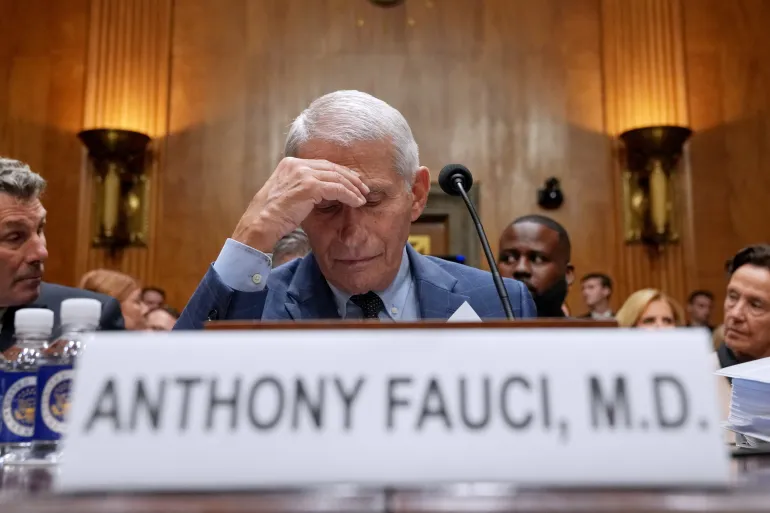
Dr Anthony Fauci, a former top United States public health official, has declined to answer questions at a Republican-led Senate committee hearing into the origins of COVID-19 and the handling of the pandemic.
The former director of the National Institute of Allergy and Infectious Diseases (NIAID) repeatedly invoked his Fifth Amendment right against self-incrimination on Wednesday.
Recommended Stories
list of 1 itemend of list
Fauci was called to testify by Republican Senator Rand Paul of Kentucky, who accuses him of misleading Congress and questions whether US-funded research in China played a role in the pandemic, allegations Fauci denies.
Although former President Joe Biden granted Fauci a preemptive pardon in 2025, Republicans claim it does not protect him from any alleged crimes committed after it was issued, such as perjuring himself at a Senate hearing.
Fauci’s lawyers advised him not to testify, arguing that anything he said under oath could expose him to new legal risks.
Here is what to know:
Who is Anthony Fauci?
Fauci, 85, is a physician and immunologist who led the US NIAID for 38 years, advising seven presidents, both Republican and Democratic.
He became the public face of the US response to the COVID-19 pandemic in 2020, after helping lead the country’s response to health crises including HIV/AIDS, Ebola and the 2001 anthrax attacks.
He became a target of conservative criticism over pandemic policies, including mask recommendations, vaccines and school closures.
During his last year in government, Fauci was also chief medical adviser to Biden until he retired in 2022.
During the pandemic, between 2019 and 2022, he kept more than 1,000 pages of diary entries documenting his work advising the White House and responding to the pandemic.
The notes chronicle his interactions with senior officials and the media.
Why is Fauci being questioned?
He was subpoenaed to testify over his handling of the pandemic and its origins before the Senate Homeland Security and Governmental Affairs Committee.
The hearing, led by Paul, focused on several issues:
- COVID-19’s origins: Paul has long argued that the coronavirus that causes COVID may have leaked from a laboratory in Wuhan, China, and questioned whether US-funded research played a role in the outbreak.
- Gain-of-function research: Republicans say Fauci misled Congress about whether the National Institutes of Health (NIH) funded gain-of-function research at the Wuhan Institute of Virology, involving modifying viruses to understand how they evolve and assess pandemic risks. Fauci says the NIH did not fund research that caused COVID-19.
- Allegations of a cover-up: Paul accused Fauci of making false statements to Congress and concealing the NIH’s involvement in research in Wuhan. Fauci denies that.
- Fauci’s diary: Before the hearing, Paul released more than 1,100 pages of Fauci’s typewritten diary. Health Secretary Robert F Kennedy Jr said the notes were government record because they were written by a federal employee on a government computer during a public health emergency and they were found on government property.
- Paul said the diary showed differences between Fauci’s private discussions and his public statements. Fauci’s supporters say the entries reflect the uncertainty scientists faced as they learned more about a new virus.

What happened at the hearing?
The tense hearing lasted about three hours.
After a brief opening statement, Fauci repeatedly invoked his Fifth Amendment right against self-incrimination and declined to answer more than 100 questions.
He accused committee chairman Paul of having an “obsession” with prosecuting him.

The hearing included several tense moments:
- Contempt vote: Paul said the committee would vote next week on whether to hold Fauci in contempt of Congress over his refusal to answer questions, threatening “consequences for refusing to answer”.
- Lawyer removed: Paul directed Capitol Police to remove Fauci’s lawyer, David Schertler, after he tried to speak without being recognised by the committee. “This testimony is from Anthony Fauci. This is not a game with his lawyers,” Paul said. Schertler later described the hearing as an “obsessive vendetta”.
- Democrats defend Fauci: Democratic senators said the hearing was politically motivated. Senator Gary Peters called it “a partisan exercise” designed to support “a predetermined conclusion” rather than offering legitimate oversight.
Closing the hearing, Paul asked rhetorically: “Did [Fauci’s] actions lead to the largest man-made plague in history?”
Why did Fauci invoke the Fifth Amendment?
Fauci said he invoked the Fifth Amendment on the advice of his lawyers because he believed his answers could expose him to new legal risks.
He argued that Paul was trying to build a criminal case against him rather than conduct legitimate congressional oversight.
Although Biden’s pardon protects Fauci from prosecution for actions before January 2025, Republicans say any false statements made under oath during this hearing could still expose him to perjury charges.
The Fifth Amendment protects people from being forced to give evidence that could incriminate them in a criminal case. Invoking it is a constitutional right and does not imply guilt.
What do scientists believe about COVID-19’s origins?
Most scientists believe COVID-19 likely spread naturally from animals to humans, known as zoonotic spillover, pointing to a wildlife market in Wuhan as the most likely place where it first spread.
Fauci has consistently said he believes that scientific evidence points to a natural origin, while remaining open to other possibilities.
Notes from his diary detail a January 2020 call with 11 top virologists and evolutionary biologists – only two were convinced the virus had a natural origin, while the rest debated whether it could have been engineered.
Today, most scientists favour a natural origin, while the US intelligence community is divided.
The FBI said in 2023 that a laboratory-related incident is the most likely origin of the pandemic. The CIA reached the same conclusion in 2025, but with low confidence. Other agencies and the National Intelligence Council continue to favour a natural origin or remain undecided.
Does Biden’s pardon protect Fauci?
Yes, but only what happened before the pardon was issued.
On January 19, 2025, Biden granted Fauci a full and unconditional pardon covering any federal offences he may have committed since 2014, saying the move aimed to protect Fauci from “politically motivated prosecutions”.
The pardon does not cover actions taken after it was issued. Fauci could face legal consequences if he were accused of committing a new crime, such as making false statements under oath during Wednesday’s Senate hearing.
Paul and other Republicans also argue that because Biden’s pardon shields Fauci from criminal liability for his past actions, he can no longer claim that his testimony about those actions would incriminate him and should not be able to invoke his Fifth Amendment.
The legal standing of this argument is not clear, and Paul has acknowledged that it is a novel “legal question that the courts may have to decide”.
Can Fauci be held in contempt or prosecuted?
Potentially, but it remains unclear whether either will happen.
Paul said the Senate committee will vote next week on whether to hold Fauci in contempt of Congress after he refused to answer more than 100 questions.
Being held in contempt means lawmakers believe a witness has refused to cooperate with a lawful investigation. It does not automatically lead to criminal charges, but can trigger further legal action.
If the committee approves the measure, it could refer the case to the Justice Department for possible criminal prosecution, ask a federal court to pursue a civil action, or, in the rarest case, ask the Senate to use its powers to detain a witness through the Senate sergeant-at-arms.
Paul has not said which option, if any, he plans to pursue.