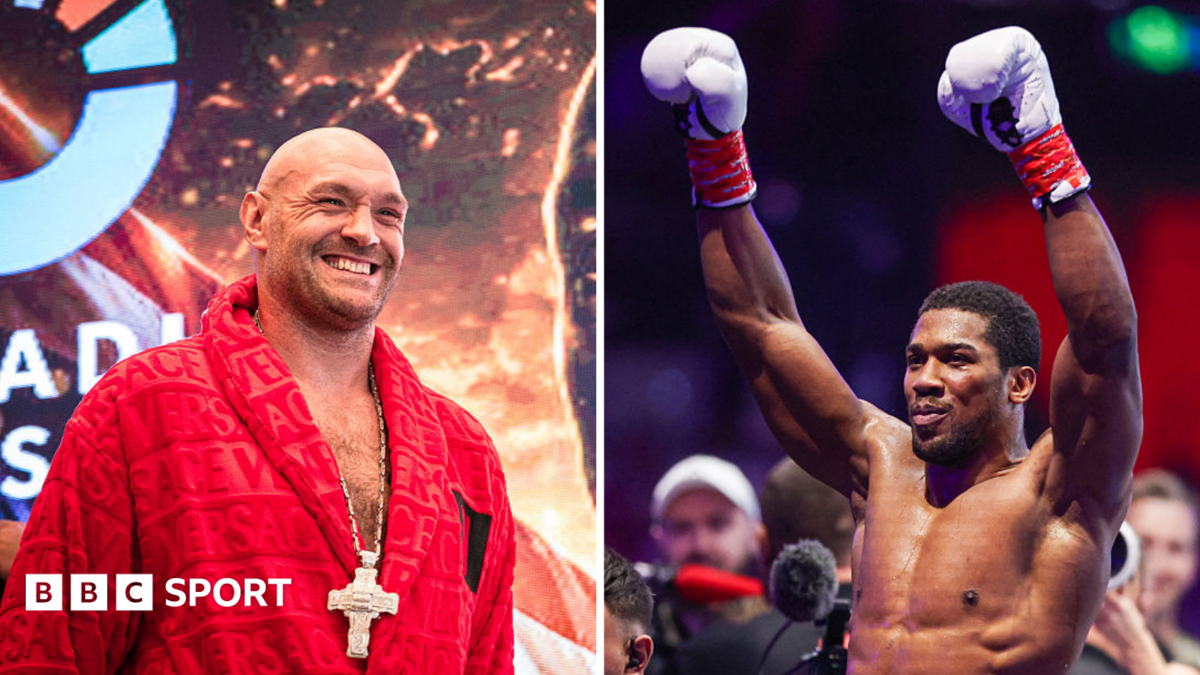
When Tyson Fury was asked whether his fight against Anthony Joshua had come too late for both boxers, the Gypsy King responded: “Is it too late?… It’s the icing on the cake of two great careers.”
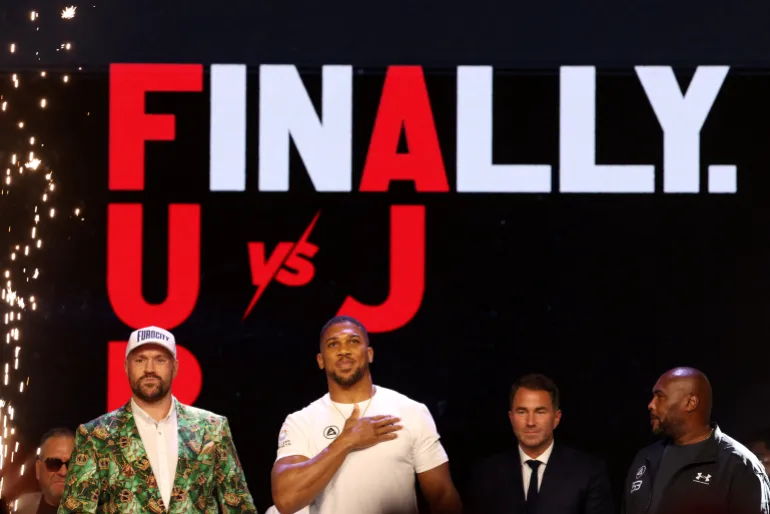
Former heavyweight world champions Fury and Joshua came face to face in London on Wednesday to allay months-long fears and rumours surrounding their long-awaited fight, which has been confirmed for December 11 in Cardiff.
The British boxing stars are 38 and 36 years old, respectively, and have kept the boxing world waiting for years.
For many fans, why it took so long to agree on a fight is almost as big a question as who will win.
Neither boxer wanted to take the hit for delaying the biggest fight in British boxing history when they appeared in front of the media in London. Fury blamed Joshua, despite reports stating Joshua insisted the fight take place in the United Kingdom for the sake of home fans.
“You’ve been crying behind the scenes to get out of this fight,” Fury said. “I’ve checkmated you. You have to fight. I’ve said I’ll fight anywhere.”
But is the Gypsy King right? Can Fury vs Joshua live up to more than 10 years of hype?
Al Jazeera Sport breaks it down:
Ten years of near misses
Joshua and Fury are prizefighters who decide their destiny in the ring, but outside of it, their promoters negotiate contracts, choose venues and make calls on top billing.
The history goes back 10 years and is full of near misses, contractual problems and other fighters entering the fray.
It all started in 2020, when the two camps agreed to a two-fight deal. A year later, contracts were signed for an undisputed heavyweight showdown. However, Deontay Wilder, an American former world heavyweight champion, won an arbitration case that forced Fury into a trilogy fight in 2021.
In 2022, Joshua reportedly accepted a 60-40 purse split in Fury’s favour, but that deal collapsed too. During this period, unbeaten Ukrainian heavyweight champion Oleksandr Usyk defeated Joshua twice and proceeded to beat Fury twice as well.
All this while, Fury vs Joshua failed to materialise.
Tyson Fury and Anthony Joshua confirmed their fight at a media event in London [Adrian Dennis/AFP]
Eddie Hearn vs Dana White
Online streaming platform Netflix, which holds global rights to the fight, has billed it as a collaboration between Saudi sports powerbroker Turki Alshikh’s The Ring magazine and Dana White, the owner of mixed martial arts promotion UFC.
Neither Joshua’s promoter, Eddie Hearn, nor Fury’s, Frank Warren, was named when talks of the fight resurfaced earlier this year.
Alshikh and White cofounded a boxing promotion, Zuffa Boxing, which was launched earlier this year and became a point of contention in the Joshua-Fury fight. Hearn was of the view that Joshua’s contract barred White and Zuffa’s parent company from any promotional role.
“Dana White cannot be involved with this fight promotion,” Hearn said recently.
However, Fury saw it differently and blamed Hearn for costing “the biggest fight in boxing history” in an Instagram post.
White was not seen at the London news conference, where fans booed his name.
A battle of egos
In boxing, the name that comes first on the poster usually signals the A-side, or the bigger fighter.
Joshua claimed he got a call asking whether he minded Fury’s name going first, because Fury was “unwilling to sign unless he does”.
Fury boasted: “I’m number one.”
There was also the issue of the fight venue and, specifically, the host country.
Joshua insisted he ensured it would happen in the UK, whereas White had pushed for it to be held at Madison Square Garden in New York.
“I know we are going to inspire this generation, and I know for a fact we are going to inspire the next generation,” Joshua said.
The niceties didn’t last long between the opponents as Fury claimed he would knock Joshua out.
“I’m going to catch him and, when I do, it’s going to be curtains,” Fury said.
Joshua welcomed the outburst and said: “This is the energy that we want.”
In the end, money got the deal over the line.
Reports in UK media say the fighters will share a $200m purse and will bag more than “any British fighter has earned in a fight ever”.
Fury and Joshua pose following the news conference in London [Adrian Dennis/AFP]
The fight had initially been discussed for November but, with negotiations over the venue dragging on, it now looks set for December.
Staging an open-air stadium fight in the UK at that time carries immense risk.
While Wembley offers unmatched prestige, exposing tens of thousands of fans and a massive international broadcast operation to potentially freezing temperatures, wind and rain was deemed unacceptable.
Moving the event indoors to an arena like London’s O2 would eliminate weather risks, but at the cost of sacrificing tens of thousands of ticket sales.
The Principality Stadium’s retractable roof allows organisers to capture the immense scale, atmosphere and gate revenue of a stadium show while offering full protection from the elements.
The venue’s official seated capacity is just under 74,000, but boxing configurations allow for even larger crowds.
Joshua has already proven he can sell out the venue, having defended his WBA and IBF titles there against Carlos Takam in front of nearly 80,000 fans in 2017 before adding the WBO belt against Joseph Parker five months later.
Born into an African American family with a grim history of enslavement, Marian Anderson was determined from an early age to master the art of singing for the concert hall. A contralto of great range and warmth, Anderson’s abundant gifts as a performer of spirituals, arias and German Leider brought her global fame even as she endured the indignities of racial discrimination at home. Her Easter Sunday performance at the Lincoln Memorial in 1939 in front of 75,000 spectators remains a touchstone of defiance in an age of racial violence.
Anthony Tommasini’s excellent biography of Anderson, “Voice of A Century,” reclaims the singer as a great artist who only embraced her power as a symbol of racial equality much later in life. I spoke with Tommasini about Anderson, Franz Schubert and Albert Einstein.
You’re reading Book Club
An exclusive look at what we’re reading, book club events and our latest author interviews.
By continuing, you agree to our Terms of Service, which include arbitration and a class action waiver. You agree that we and our third-party vendors may collect and use your information, including through cookies, pixels and similar technologies, for the purposes set forth in our Privacy Policy such as personalizing your experience and ads.
✍️ Author Chat
Anthony Tommasini’s biography reclaims Anderson as a great artist who embraced her power as a symbol of racial equality later in life.
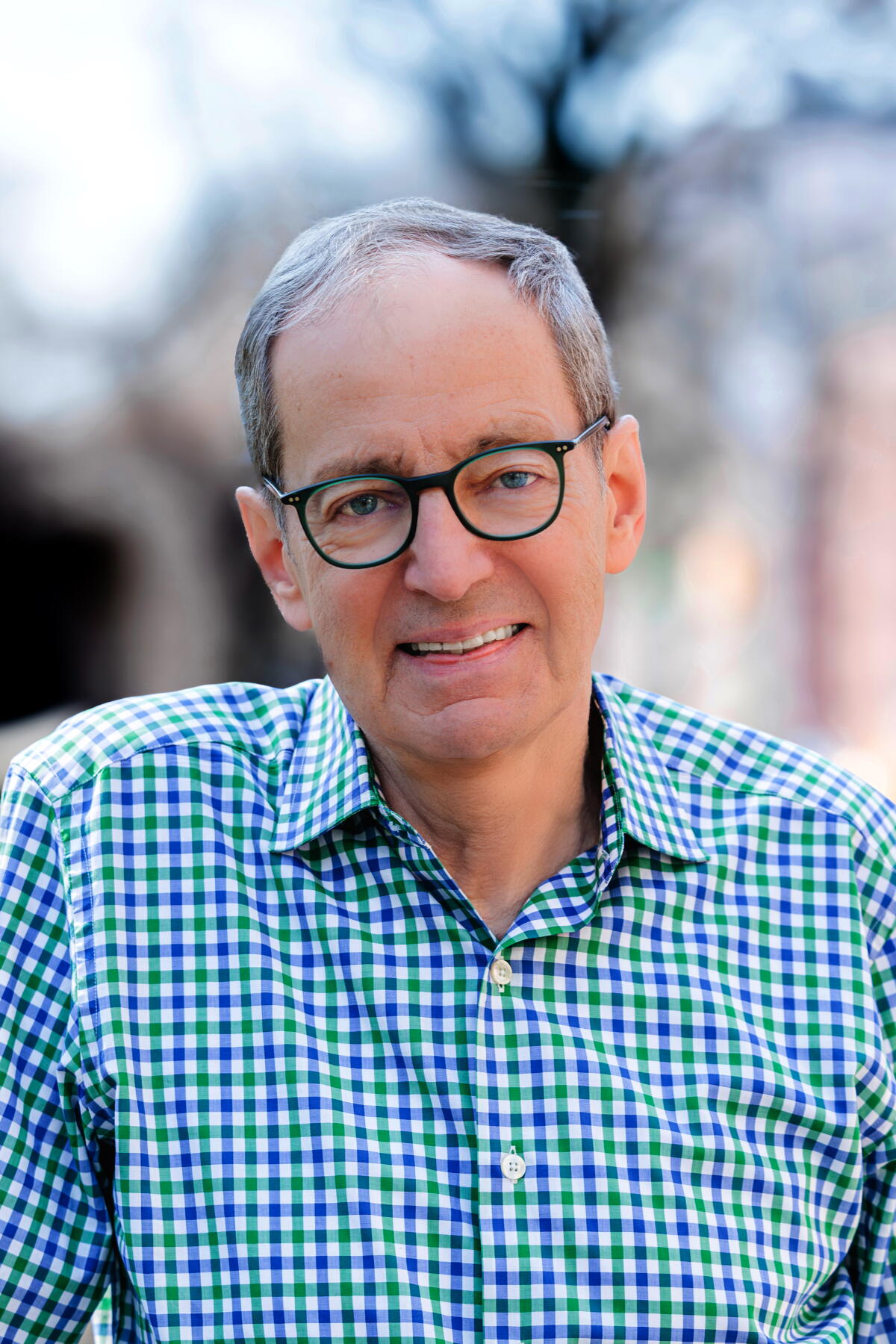
(Ahna Tessler Photography)
I feel like people know Marian Anderson in the abstract, but they regard her as a symbol rather than an artist. And among the virtues of your book is that you reestablish Anderson’s legacy as a great singer and performer.
She was a contralto, which is the lowest female vocal register. But that register had such resonance, and she had complete control over it. She also had enormous range; the uncanny, beautiful thing about Anderson’s voice is that when she started ascending even into the soprano sphere, she held those notes so beautifully. They were emanating from below, grounded in that low voice. It made for a mesmerizing sound. I’ve made a playlist to accompany the book.
She embodied this kind of fierce dignity and grace in the face of racial discrimination. But as you point out, she was reluctant to make herself a symbol of the civil rights movement, preferring to let audiences focus on her artistry.
In 1939, she was banned from performing in Washington’s Constitution Hall because of her race, and her manager, with help from Eleanor Roosevelt, arranged a performance in front of the Lincoln Memorial on Easter Sunday. Yet, the night before the performance, she was trying to get out of it. She felt the whole affair had turned into a civil rights demonstration. When it came time to write her memoirs in 1956, she wanted to excise the event from the book. She felt that what she could do is be an example of excellence and possibility for aspiring black artists.
She did play to segregated audiences, even long after she had become a national star.
[This type of segregated performance featured what] was called vertical seating. But she refused to forsake her career, which she had worked so hard to attain, and so she played these segregated shows. Eventually, there was a performance in Virginia which was boycotted, and that sort of broke the trend. She then performed in front of an integrated audience in Florida.
There is an encounter with Albert Einstein, of all people, who counsels her to take a stand against these racist booking policies.
In 1937, she showed up for a concert in Princeton, New Jersey, only to discover she was being refused a room at the Nassau Inn. As it turns out, she had a friend in Princeton who had seen her at Carnegie Hall and had meekly gone backstage to meet her. This was Albert Einstein, who was teaching at Princeton University at the time, and who offered to put Anderson up for the night at his house. He really pressed her on being more outspoken on racial equality.
Anderson played Europe multiple times in the 1930s, right before the rise of Hitler and the Third Reich. As you write, German audiences were blown away by Anderson’s mastery of their music, specifically Franz Schubert’s Lieder, or art songs, which were among Anderson’s most beloved repertoire.
So extraordinary, right? She also made two tours of the Soviet Union during that time. They went crazy for her in the Scandinavian countries, as well. But for the German audiences who are so nationalistic about their Leider, it was confusing. They couldn’t imagine how a Black American woman could sing their music so beautifully.
Anderson was the first Black soloist to perform at the Metropolitan Opera in New York, in Verdi’s opera Un ballo in maschera.
That was really a huge risk and a huge leap for her. She wasn’t a trained opera singer, and she had to dig deep into that material. She was already 58 by that time. There is a radio recording of the performance. There’s this dignity, like she’s calling upon this power. It’s exhausting and it’s draining, but it’s also exhilarating.
This Q&A was edited for length and clarity.
📰 The Week(s) in Books
Book jacket for “Body Language” by Meg Howrey
(Los Angeles Times illustration; jacket from Doubleday)
Marlon James has published his highly anticipated new novel “The Disappearers,” a sprawling story about gay culture in ’80s Jamaica, and Mark Athitakis is quite taken with it. “James is … determined to unwind the cliches of gay fiction: the tragic victim, the heartwarming gestures of solidarity, the blunt porniness,” he writes. “Mere survival will have to be enough for most of these characters; the sense of fear is pervasive, but so is a determination to work through it.”
What’s it like to be the primary dissenting liberal voice on Fox News? Stephen Battaglio found out when he talked to Jesssica Tarlov about her hybrid memoir and self-help book “I Disagree.” “I have a good amount of shyness to me,” she tells Battaglio. “I have a lot of imposter syndrome. I’m constantly in wonder that I ended up getting to do this and that hopefully, am the right person to do it.”
Finally, Emily Wilson, the classicist who has been a lightning rod of controversy over her disparaging remarks in regard to the film version of “The Odyssey,” is going to translate Homer’s epic for a second time, reports Emily St. Martin.
📖 Bookstore Faves
The Hammer Museum’s gift shop is one of the best art book shops in L.A.
(Eric Petschek)
Sure, the Hammer Museum’s gift shop stocks the requisite art-themed mugs, tea towels and tchotchkes, but it’s also one of the best art book shops in L.A. Inside the sleekly designed Hammer Store is a vast inventory of monographs, children’s books and critical texts about modern and contemporary art. In an email exchange, store managers Sara Beattie and Brooke Berlin tell us what museumgoers are buying right now.
Hammer’s store is really the best museum bookshop in L.A. How do you decide what to put on the shelves?
We’re an eclectic bunch of book nerds and love the written word. We start by looking at upcoming programming, exhibitions and the season, and we buy accordingly. And we have a great team that gives us suggestions. We’ve learned to trust our instincts. The Hammer is an experimental institution, and we approach our buying in that spirit.
Do you have patrons that are not necessarily there to check out museum exhibits?
Of course! We’re not only a museum, but a cultural center, which means there’s always something happening — like mindful meditation on Thursdays, or family programming on weekends, or people coming in just to enjoy a meal at Lulu.
What kinds of books tend to do well for you?
Art monographs, especially on contemporary or Los Angeles artists; books about living more conscientiously; and everyone loves a children’s book (even if it’s just to heal your inner child). We love finding unique books that can’t be found elsewhere. Whenever we can, we work with small presses and book distributors. They often make books that can only fully be enjoyed or understood by seeing them in person.
Is there any particular title that is presently selling well?
Why do we still enjoy art books, when we can look at millions of paintings and sculptures on the internet?
Why go outside if you can look through a window? There is a lot of talk of people returning to the analog or physical media, and that includes renewed interest in physical books. BookTok is huge. People love talking about books and showing off their special deluxe book editions on TikTok. Art books by their very nature are deluxe, image filled and thoughtfully designed. A well-produced book is an art object in itself. Nothing beats the experience of paging through a beautiful book. That experience can’t be replicated on a screen.
The Hammer Museum store is located at 10899 Wilshire Blvd., Los Angeles.