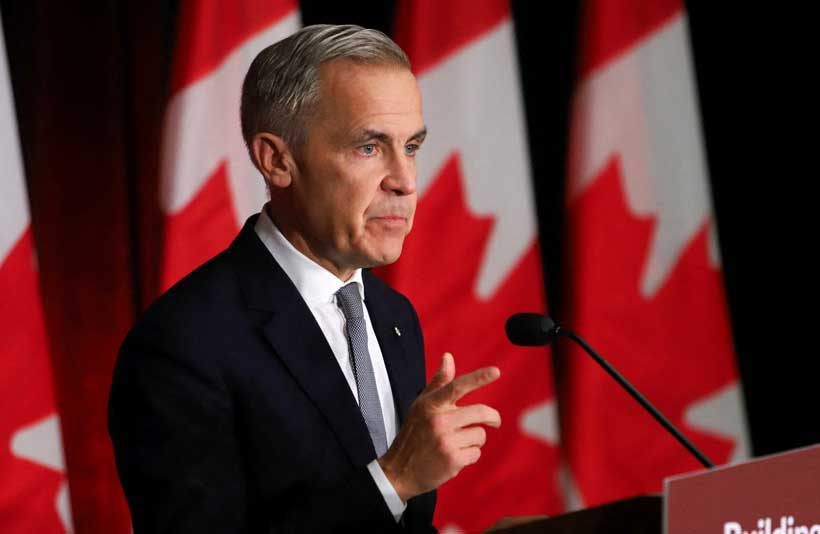
Canadian Prime Minister Mark Carney arrives in Mumbai on his first official visit to India seeking to reset strained relations and advance an ambitious trade agenda designed to reduce Canada’s dependence on the United States.
The visit marks a significant recalibration in Ottawa’s foreign policy. After years of diplomatic friction under Justin Trudeau, Carney is positioning Canada as a pragmatic middle power, intent on diversifying alliances and building new trade corridors with fast-growing economies.
From Mumbai, Carney will travel to New Delhi for talks with Indian Prime Minister Narendra Modi, with negotiations expected to accelerate toward a comprehensive trade agreement that Canadian officials hope to conclude by November.
Repairing a Fractured Relationship
Canada–India relations deteriorated sharply after Trudeau publicly alleged that Indian agents were linked to the assassination of a Canadian citizen associated with Sikh separatism. New Delhi strongly denied the accusation, and diplomatic ties cooled considerably.
Carney’s itinerary reflects a deliberate attempt to lower political temperatures. Unlike previous Canadian leaders, he will not visit Punjab, a state central to India’s Sikh population and a major source of immigration to Canada. Sikh separatist activism has long been a sensitive issue in bilateral relations, and avoiding the region signals Ottawa’s intent to keep the focus on trade and investment rather than diaspora politics.
This shift has drawn criticism from some Sikh organizations in Canada, which argue that Ottawa risks sidelining concerns about foreign interference. However, Carney’s government insists domestic security remains non-negotiable while economic engagement proceeds.
Trade as Strategic Rebalancing
The India trip forms part of a broader diplomatic tour that includes Australia and Japan — countries Carney views as fellow “middle powers” capable of shaping a more diversified global trading system.
The strategy is driven by two pressures.
First, Canada’s economic dependence on the United States leaves it exposed to protectionist policies, including tariffs and threats to trade access. Second, global supply chains are being reshaped by geopolitical rivalry, creating opportunities for countries that can act as connectors rather than competitors.
India, now the world’s most populous nation and one of its fastest-growing major economies, represents both a vast consumer market and a strategic counterweight in global trade realignments.
Reports suggest negotiations may include a long-term uranium supply agreement worth billions of Canadian dollars, alongside cooperation in oil and gas, artificial intelligence, quantum computing, education and environmental technology. Such sectoral diversification would deepen economic interdependence beyond traditional commodities.
The momentum is reinforced by the European Union’s recent trade deal with India, which has raised expectations that New Delhi is increasingly open to structured economic partnerships with Western economies.
A Style Contrast With the Trudeau Era
Carney’s approach also signals stylistic change. Trudeau’s 2018 India visit drew criticism for perceived overemphasis on symbolic gestures and cultural theatrics, which some observers argued distracted from substantive negotiations.
Carney, a former central banker, projects a more restrained and technocratic image. Business leaders describe the trip as tightly focused on capital flows, market access and long-term economic sovereignty rather than domestic political optics.
This repositioning aligns with Carney’s broader message that Canada must adapt to what he calls a reordered global economy one less dominated by a single superpower and more defined by regional blocs and mid-sized powers coordinating strategically.
The “Middle Powers” Doctrine
Carney’s Davos speech earlier this year laid out the intellectual framework for this pivot: a coalition of middle powers pursuing “principled and pragmatic” cooperation to hedge against great-power volatility.
India fits squarely into that concept. It maintains strategic autonomy, balancing relations with the United States, Europe, Russia and the Global South. Canada hopes to mirror that flexibility while leveraging its strengths in energy, natural resources, finance and advanced technology.
After India, Carney’s stops in Australia and Japan underscore the Indo-Pacific tilt of Canada’s strategy. Together, these engagements suggest Ottawa is prioritizing economic resilience over ideological alignment.
Can Trade Override Political Tensions?
The key question is whether economic pragmatism can overcome lingering distrust.
India remains sensitive about Sikh separatist activism in Canada. Canadian authorities remain concerned about allegations of foreign interference. These issues are unlikely to disappear entirely.
However, both governments appear motivated by economic incentives. Canada seeks market diversification and foreign investment. India seeks reliable energy supplies, advanced technology partnerships and expanded global trade networks.
If negotiations proceed smoothly, Carney’s visit could mark a turning point not a full reconciliation, but a reset grounded in mutual economic interest rather than political grievance.
In an era of fragmented globalization, Ottawa is betting that strategic trade partnerships with rising powers like India can secure both growth and autonomy. Whether that bet pays off will depend on how effectively Canada balances principle with pragmatism in one of its most complex bilateral relationships.
With information from Reuters.