Carney

Carney ‘strong’ in year one, now must deliver on promises in Canada | Donald Trump News

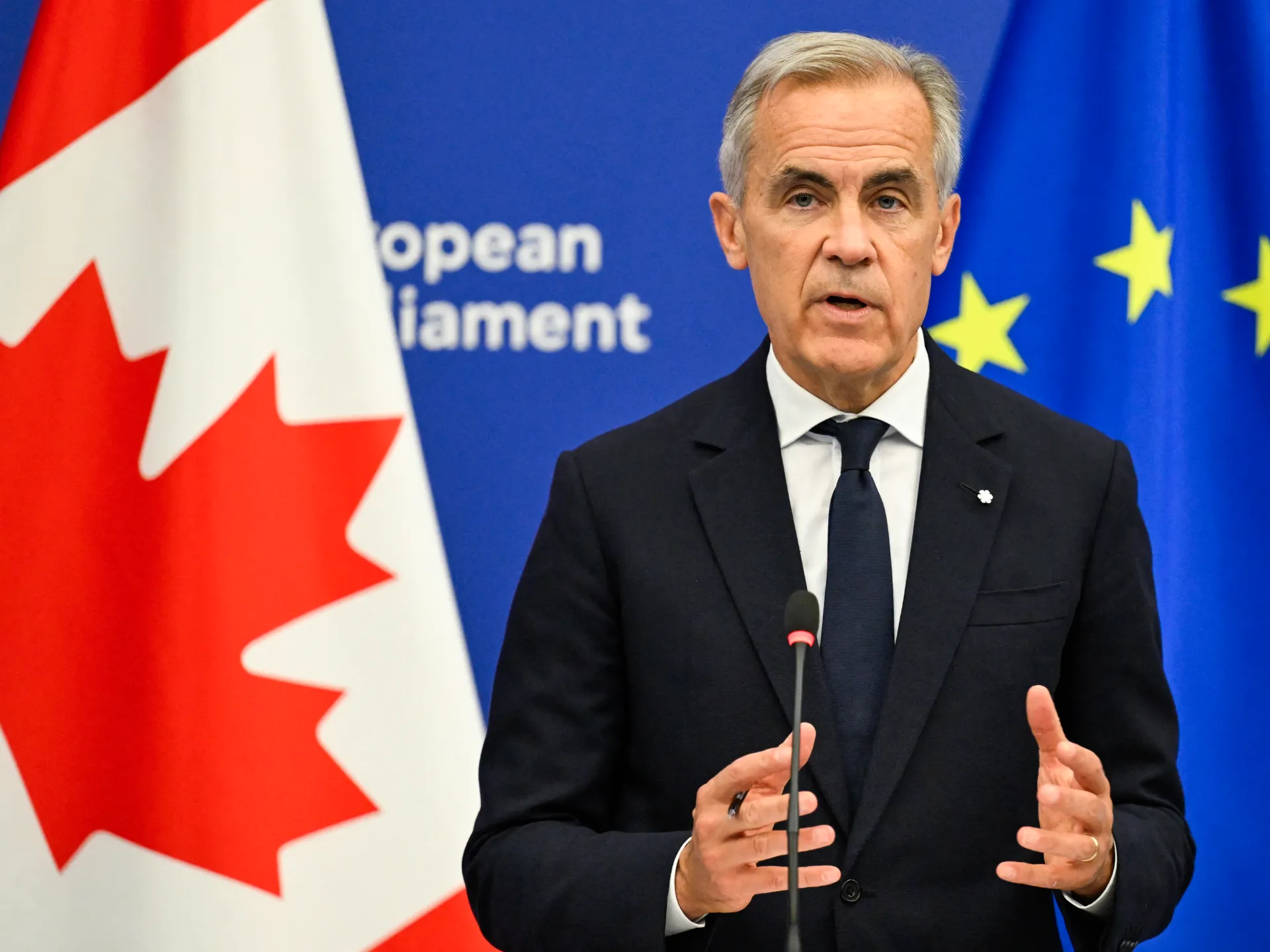
Canadian Prime Minister Mark Carney took office last year amid a flurry of aggressive actions by his country’s southern neighbour. A recently sworn-in United States president, Donald Trump, slapped tariffs on Canadian exports and threatened to make the US neighbour the 51st state.

The actions were particularly damning as Canada had deep trade and security ties with the US, not only sending nearly 80 percent of its exports to that market, but also often following lockstep on geopolitical policy and strategic moves.

Recommended Stories

list of 4 itemsend of list

All that was thrown aside when Trump took office, and Canada, under former Prime Minister Justin Trudeau, was one of the first countries he slapped with tariffs.

After a year of dealing with a mercurial and unpredictable US president, experts applaud Carney as “standing strong and resolute”, not just in the face of Trump’s threats, but also against internal critics.

“The most notable aspect of the last year was both a bullet dodged and a savvy bit of statecraft to avoid a rush to do a deal on trade and invest with the US the way many other countries did,” said Brett House, a senior fellow at the University of Toronto’s Munk School of Global Affairs & Public Policy.

“Commitments from this president are absolutely worthless, and the biggest accomplishment of the first year has been standing strong and resolute in the face of internal critics,” House told Al Jazeera.

Indeed, Carney has used Trump’s attacks on allies and others to refocus Canada’s foreign policy and place in the world.

With the US no longer the anchor of a rules-based order, and with there now being a “deep rupture” caused by changes in Washington, “Carney has aimed to build at home and diversify abroad, as Ottawa’s dependence and long ties have now become a source of weakness,” said Vina Nadjibulla, the vice president of the Asia Pacific Foundation of Canada.

“And he’s doing this at a speed, scale and ambition that we haven’t seen in recent years” in Ottawa, Nadjibulla said.

‘Rupture’ in global order

Some of that stance was evident in January, when Carney, in a speech in Davos, said there was a “rupture” in the global rules-based order and that Middle Powers like Canada and others had to rise strategically to address geopolitical tensions.

But it was visible in his actions even before Davos, when he had reached out to countries that had historically been important trade partners but where relations had been frozen due to political tensions under his predecessor, Trudeau.

For instance, Carney invited Indian Prime Minister Narendra Modi to the G7 meeting in Canada to initiate a reset of ties with New Delhi that had been in a deep freeze since Trudeau alleged in 2023 that India was involved in the killing of a Sikh separatist activist on Canadian soil.

Carney also recalibrated Canada’s relations with China, which had been tense since Canadian authorities arrested a key official of Chinese telecommunications firm Huawei as she was transitioning through the Vancouver international airport in December 2018. China retaliated against the arrest of Meng Wanzhou, which was carried out at the request of US authorities, by detaining two Canadians.

Carney has also deepened relations with Japan, South Korea, Australia, and others, making sure to align on security and economic issues, and has drawn Canada closer to Europe, Nadjibulla pointed out.

Domestic push

In the lead-up to elections last year, Carney “positioned himself as a centrist, a moderate, and went to great lengths to distance himself from the image of Justin Trudeau,” said Sanjay Jeram, the chair of the political science department at Simon Fraser University in Burnaby, Canada.

“He hasn’t shown much interest in discussing things outside the economy, international relations and trade, and even when asked, has avoided those questions and steered the conversation back to what he believes is his true purpose. Or that could be his political strategy, or a bit of both.”

SHARM EL-SHEIKH, EGYPT - OCTOBER 13: President Donald Trump greets Canada's Prime Minister Mark Carney during a world leaders' summit on ending the Gaza war on October 13, 2025 in Sharm El-Sheikh, Egypt. President Trump is in Egypt to meet with European and Middle Eastern leaders in what’s being billed as an international peace summit, following the start of a US-brokered ceasefire deal to end the war in the Gaza Strip. (Photo by Evan Vucci - Pool / Getty Images)
US President Donald Trump greets Canada’s Prime Minister Mark Carney during a world leaders’ summit on ending Israel’s war on Gaza war on October 13, 2025, in Sharm El-Sheikh, Egypt [Evan Vucci/Pool/Getty Images]


Under that pragmatist persona, “Carney takes the world and the economy as it is, rather than what we hope it to be”, which allows him to be judged on pragmatist metrics, Jeram said, referring to criticisms that Carney is overlooking concerns related to political interference or human rights in his dealings with foreign partners.

“Canadians have bought that [stance] so far,” Jeram added.

Indeed, Carney’s approval ratings are up. According to a March Ipsos poll for Global News, 58 percent of Canadians approve of him, up 10 percent from a year before, while 33 percent do not.

While there has also been significant movement on paper to remove federal barriers to facilitate business and trade within the country, there have also been concerns about certain policy pushes. A major projects bill, for instance, is meant to fast-track big infrastructure projects, but critics are concerned that it undermines the importance of consultation, especially with the Indigenous communities whose land these projects could go through.

“Carney recognises we need more of infrastructure to be able to diversify trade,” the Asia Pacific Foundation’s Nadjibulla said.

As he settles into his second year, Carney’s main challenge will be to see if he can deliver on his first-year announcements.

One of his biggest challenges this year will be a successful conclusion of the review of the trade pact between the US, Canada and Mexico, known as the USMCA, which starts on July 1 and which has helped shield Canadian exports from US tariffs.

The “US has signalled that a successful review could hinge on Canada lining its external tariffs in line with US tariffs, but that’s at cross purposes with Canada’s efforts”, said the University of Toronto’s House, especially as Canada has lined up deals with China on electric cars and agriculture.

Nadjibulla added that “2026 will be harder, because it will be about implementation and delivery, especially against the US-Canada dynamics.”

Source link

Carney says Canada’s economic ties with U.S. are a weakness that must be corrected

Canadian Prime Minister Mark Carney said in a video address released Sunday that Canada’s strong economic ties to the United States were once a strength but are now a weakness that must be corrected.

In the 10-minute address, Carney spoke about his government’s efforts to strengthen the Canadian economy by attracting new investments and signing trade deals with other countries.

“The world is more dangerous and divided,” Carney said. “The U.S. has fundamentally changed its approach to trade, raising its tariffs to levels last seen during the Great Depression.

“Many of our former strengths, based on our close ties to America, have become weaknesses. Weaknesses that we must correct.”

Carney said tariffs imposed by President Trump have affected workers in the auto and steel industries. He added that businesses are holding back investments “restrained by the pall of uncertainty that’s hanging over all of us.”

Many Canadians have also been angered by Trump’s comments suggesting Canada become the 51st state.

Carney said he plans to give Canadians regular updates on his government’s efforts to diversify away from the U.S.

“Security can’t be achieved by ignoring the obvious or downplaying the very real threats that we Canadians face,” he said. “I promise you I will never sugarcoat our challenges.”

It’s not the first time Carney, who served as a central bank governor, first at the Bank of Canada and later with the Bank of England, has spoken about a shift in world power.

During a speech in January at the World Economic Forum in Davos, Switzerland, he received widespread praise for condemning economic coercion by great powers against small countries.

His remarks brought a rebuke from Trump.

“Canada lives because of the United States,” Trump said after the speech. “Remember that, Mark, the next time you make your statements.”

There was no immediate White House reaction Sunday to the address.

Carney’s comments came days after securing a majority government following special election wins and as the opposition Conservatives push him to deliver a U.S. trade deal, which was among his promises in last year’s election.

A review of the current version of the North American Free Trade Agreement among Canada, the U.S. and Mexico is scheduled for July.

In his address, Carney said he wants to attract new investments into Canada, double the size of clean energy capacity and reduce trade barriers within the country. He also emphasized Canada’s increased defense spending, reduction in taxes and efforts to make housing more affordable.

“We have to take care of ourselves because we can’t rely on one foreign partner,” he said. “We can’t control the disruption coming from our neighbors. We can’t control our future on the hope it will suddenly stop.

“We can control what happens here. We can build a stronger country that can withstand disruptions from aboard.”

Carney said simply hoping the “United States will return to normal” is not a feasible strategy.

“Hope isn’t a plan and nostalgia is not a strategy,” he said.

Carney said Canada has “been a great neighbor,” standing with the U.S. in conflicts including Afghanistan, plus two World Wars.

“The U.S. has changed and we must respond,” he said. “It’s about taking back control of our security, our borders and our future.”

Morris writes for the Associated Press.

Source link

Canadian PM Mark Carney calls close trade ties to U.S. a ‘weakness’

April 19 (UPI) — Citing steep tariffs imposed by U.S. President Donald Trump, Canadian Prime Minister Mark Carney said Sunday his country’s historically close trade and economic ties to the United States have become a “weakness.”

In a video statement posted to YouTube, the Canadian leader asserted the United States has “fundamentally changed its approach to trade, raising its tariffs to levels last seen during the Great Depression.”

This has meant that “many of our former strengths, based on our close ties to America, have become our weaknesses — weaknesses that we must correct.”

Carney’s comments as Trump’s trade war with Canada has disrupted decades of cross border cooperation, triggered in part by a broad 10% tariff slapped by Washington onto all goods not excluded under the Canada-US-Mexico free trade agreement known as CUSMA.

Significantly higher U.S. levies have also been imposed on key strategic sectors, including a 50% tariff on Canadian products that are almost entirely made of steel, aluminum or copper, and a 25% tariff on products that are “largely” made of those metals.

Many types of Canadian heavy equipment also face a 15% tariff upon entry into the United States.

Ottawa says the effect of these measures has been profound, “displacing workers, disrupting supply chains, forcing companies to rethink where they source their materials and products, and causing uncertainty that is curbing investment.”

Although Canada still has the best deal of any U.S. trading partner in an era when Trump has used the threat of tariffs and against both allies and adversaries for strategic and political ends, “we cannot rely on our most important trade relationship as we once did. We must build our strength at home,” Carney said.

“Workers in our industries most affected by U.S. tariffs in autos and steel and lumber are under threat,” he added. “Businesses are holding back investments restrained by the pall of uncertainty that’s hanging over all of us.”

Triggered by the U.S. trade actions and Trump’s oft-repeated desire to annex Canada as the “51st state,” Carney’s Liberal Party government in January made a milestone deal with China to lower some of the tariffs imposed by one another on some of their trade goods.

Under that pact, China lowered its tariffs on Canadian agricultural products, while Canada slashed its tariffs on up to 49,000 electric vehicles that are made in China.

The deal was denounced by Trump, who threatened to impose a 100% tariff on all Canadian goods sent to the United States in response.

“China will eat Canada alive, completely devour it, including the destruction of their businesses, social fabric and general way of life,” the U.S. president asserted.

But Carney on Sunday again defended his expansion of trade away from the United States, saying, “We will attract new investment so we can build more for ourselves, striking new partnerships abroad so we can sell into new markets.

“It’s about taking back control of our security, our borders and our future.”

President Donald Trump meets with Canadian Prime Minister Mark Carney in the Oval Office of the White House in Washington on October 7, 2025. Photo by Shawn Thew/UPI | License Photo

Source link

Liberals sweep three byelections in Canada to give Carney majority

Prime Minister of Canada Mike Carney draws Canada during the 2026 FIFA World Cup Draw at the John F. Kennedy Center for Performing Arts in Washington, D.C., on Dec. 5. The Liberal Party of Canada won three byelections on Monday to give Carney a majority in the House of Commons. File Photo by Bonnie Cash/UPI | License Photo

April 14 (UPI) — The Liberal Party of Canada won three of three byelections on Monday to give Prime Minister Mark Carney a majority in the House of Commons.

Liberal candidates needed just one election win out of the three races, two in Ontario and a third in Quebec, to gain a majority. The sweep gives the Liberals 174 out of 343 seats in the House of Commons.

Doly Begum in Scarborough-Southwest, Danielle Martin in University-Rosedale and Tatiana Auguste in Terrebonne won seats in the House of Commons for the Liberal Party.

The victories will allow Carney to pass legislation without needing votes from opposition parties.

“Tonight, voters have placed their trust in our new government’s plan,” Carney said in a statement on social media. “We accept that support with humility, determination and a clear understanding of what this moment demands.

Conservative candidates drew smaller vote shares on Monday than they did in the last general election. The candidate in the Scarborough-Southwest riding, a district that has previously favored liberal candidates, received about 18% of votes. The Conservative Party of Canada received about 30% of the votes in the district last year.

Another conservative candidate, Adrienne Charles, received 3% of the vote in the Terrebonne riding in the Montreal area. She received more than 18% of the vote in last year’s federal election.

Defections from opposition parties have also bolstered the liberal majority. Four conservatives and a member of the New Democratic Party have left their parties to join the Liberal Party in the past five months.

“The Carney Liberals did not win a majority government through a general election or today’s byelections,” opposition leader Pierre Poilievre said on social media. “Instead, it was won through backroom deals with politicians who betrayed the people who voted for them.”

Children race to push colored eggs across the grass during the annual Easter Egg Roll event on the South Lawn of the White House in Washington on April 21, 2025. Easter this year takes place on April 5. Photo by Samuel Corum/UPI | License Photo

Source link

Canadians voting in federal byelections as Carney seeks majority

Voters in Ontario and Quebec, Canada are voting in byelections Monday that could give Prime Minister Mark Carney a liberal majority. File Photo by Eric Reid/EPA-EFE

April 13 (UPI) — Voters in Ontario and Quebec, Canada, are voting in byelections on Monday that could give Prime Minister Mark Carney a liberal majority.

The ballot boxes are open in two ridings, or electoral districts, in Ontario as well as one in Quebec. The Liberal Party of Canada needs to win one of three elections to establish majority control of the government.

Liberal hold 171 of 343 seats in the House of Commons.

Both Ontario districts, Scarborough Southwest and University-Rosedale, are in the Toronto area. They were previously held by liberal members of Parliament.

The district in Quebec, Terrebonne, is in the Montreal area. A liberal candidate won in that district by one vote last year. Canada’s high court nullified the result of that election in February, citing a clerical error.

The Liberals have bolstered their control of the House with four members of the Conservative Party of Canada defecting. A member of the New Democratic Party also defected to join the Liberals.

The most recent defection occurred last week when Marilyn Gladu left the Conservative Party. Gladu represents the Sarnia-Lambton-Bkejwanong riding in Ontario.

House leader Steven MacKinnon, a liberal parliament member, said that he plans to “continue that impulse of working across party lines” if his party captures a majority.

Children race to push colored eggs across the grass during the annual Easter Egg Roll event on the South Lawn of the White House in Washington on April 21, 2025. Easter this year takes place on April 5. Photo by Samuel Corum/UPI | License Photo

Source link

Canadian Prime Minister Mark Carney attracts yet another Conservative lawmaker to his Liberal Party

Canadian Prime Minister Mark Carney has attracted another opposition Conservative lawmaker to the Liberal party, further assuring that he will soon have a majority government.

Ontario Member of Parliament Marilyn Gladu alluded to President Trump’s threats to Canada’s sovereignty and economy for her decision to defect to Carney’s governing Liberals. Trump has talked about making Canada the 51st state and has applied punishing tariffs on certain key sectors.

“The past year has been like no other Canada has ever faced,” Gladu said in a statement Wednesday. “I’ve heard from constituents that you want serious leadership and a real plan to build a stronger and more independent Canadian economy.”

Gladu is the fifth Member of Parliament to defect to Carney and the fourth Conservative.

“She is going to be a great member of our team,” Carney said outside his office. “This all comes at a time when the country as a whole is uniting.”

The floor crossing puts the Liberals closer to having a majority government and being able to pass any bill without opposition party support.

With another lawmaker decamping from the Conservatives, the Liberals would have 171 Members of Parliament in the House of Commons. They need 172 to secure a majority government, which would allow them to unilaterally pass any bill.

Carney has called special elections for three districts for Monday that would give the Liberals a majority government if his party wins one of them.

The prime minister announced March 8 that votes will be cast April 13 in the Toronto-area districts of Scarborough Southwest and University-Rosedale, which are considered safe seats for the Liberals, and in the Montreal-area riding of Terrebonne, which is considered a toss-up.

The three other Conservative Members of Parliament who defected from their party to join the Liberals in recent months were Chris d’Entremont, Michael Ma and Matt Jeneroux.

Jeneroux referenced Carney’s speech at the World Economic Forum in Davos as helping his decision. In the speech, Carney condemned economic coercion by great powers against smaller countries and received widespread praise and attention for his remarks, upstaging Trump at the gathering.

Carney has moved the Liberals to the center since replacing Justin Trudeau as prime minister in 2025 and winning national elections

The defection is another blow to Conservative leader Pierre Poilievre, who lost the last national election last year and even his own seat in Parliament. He has since rejoined the House of Commons.

Poilievre won a party leadership review earlier this year but continues to have problems controlling his lawmakers.

Gillies writes for the Associated Press.

Source link