Tehran, Iran – Iran’s President Masoud Pezeshkian has called on the United States to respect his country as the two nations look ahead to another round of nuclear negotiations next week following mediated discussions in Oman.
“Our reasoning on the nuclear issue is based on rights stipulated in the Non-Proliferation Treaty,” he wrote in a post on X on Sunday. “The Iranian nation has always responded to respect with respect, but cannot withstand the language of force”.
Recommended Stories
list of 3 itemsend of list
Pezeshkian described the indirect talks held in Oman on Friday as a “step forward” and said his administration favours dialogue.
Iranian officials are highlighting sovereignty and independence and are signalling eagerness for nuclear-only negotiations, while rejecting a military build-up in the region by the US.
Speaking at a forum hosted by the Ministry of Foreign Affairs in Tehran, the country’s chief diplomat Abbas Araghchi pointed out that the Islamic Republic has always emphasised independence since overthrowing US-backed Mohammad Reza Shah Pahlavi in a 1979 revolution.
“Before the revolution, the people did not believe their establishment to have possessed true independence,” Araghchi said.
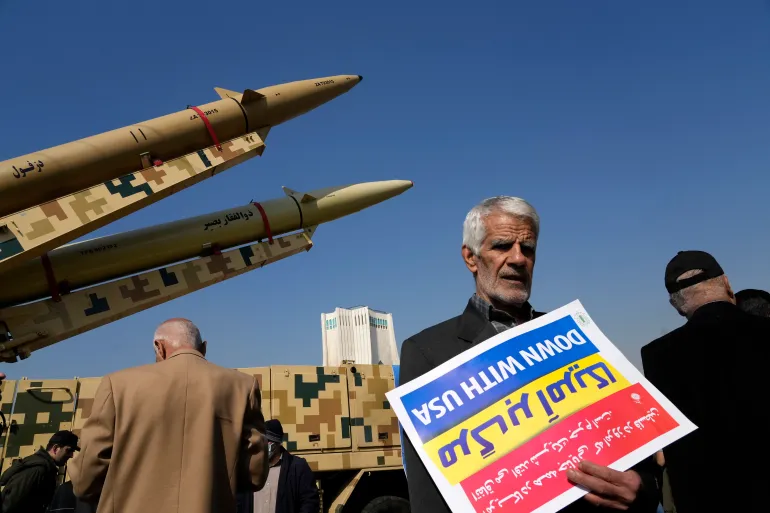
The messaging comes as the anniversary of the revolution approaches on Wednesday, when state-organised demonstrations have been planned across the country. Iranian authorities have in previous years exhibited military equipment, including ballistic missiles, during the rallies.

Araghchi said during the event in the capital that Iran is unwilling to forego nuclear enrichment for civilian use even if it leads to more military attacks by the US and Israel, “because no one has the right to tell us what we must have and must not have”.
However, the diplomat added that he told US envoys Steve Witkoff and Jared Kushner in Muscat on Friday that “there is no way but negotiations”. He said China and Russia have also been informed of the content of the talks.
“Being afraid is lethal poison in this situation,” Araghchi said about Washington amassing what US President Donald Trump has called a “beautiful armada” near Iran’s waters.
‘Push the region back years’
Iran’s top military commander on Sunday issued a new warning that the entire region will be engulfed in conflict if Iran is attacked.
“While being prepared, we genuinely have no desire to see the outbreak of a regional war,” Major General Abdolrahim Mousavi told a gathering of air force and air defence commanders and personnel.
“Even though aggressors will be the target of the flames of regional war, this will push back the advancement and development of the region by years, and its repercussions will be borne by the warmongers in the US and the Zionist regime,” he said in reference to Israel.
According to Mousavi, Iran “has the necessary power and preparedness for a long-term war with the US”.
But many average Iranians are left in limbo without much hope that the talks with the US will lead to results, including for the country’s heavily declining economy.
“I was 20 when the first negotiations with the West over Iran’s nuclear programme were held about 23 years ago,” Saman, who works at a small private investment firm in Tehran, told Al Jazeera.
“Our best years are behind us. But it’s even more sad to think that some of the youth who were born at the start of the negotiations were killed on the streets during the protests last month with many hopes and dreams.”
‘They never returned’
Iran is witnessing tense time and threats of a massive US military strike. But the Islamic Republic has not overcome anti-government protests that shook the nation, denouncing the collapse of the national currency, soaring prices and economic hardship.
State television continues to broadcast confessions of Iranians arrested during the nationwide protests, many of whom are accused by the state of working in line with the interests of foreign powers.
In a report aired late on Saturday, a woman and multiple men with blurred-out faces and in handcuffs could be seen saying they were led by a man who allegedly received weapons and money from Mossad operatives in neighbouring Iraq’s Erbil.
“He only wanted more people to die; he shot at everyone,” one of the confessing men said about what allegedly transpired during unrest in the Tehranpars district in the eastern part of the capital, backing the state’s claim that “terrorists” are responsible for all deaths.
Iranian authorities have accused the US, Israel and European countries of instigating the protests.
But international human rights organisations and foreign-based opposition groups accuse state forces of being behind the unprecedented killings during the protests, which were carried out mostly on the nights of January 8 and 9.
The Iranian government claims 3,117 people were killed, but the US-based Human Rights Activists News Agency (HRANA) says it has documented nearly 7,000 fatalities and is investigating more than 11,600 cases. The United Nations special rapporteur on Iran, Mati Sato, said more than 20,000 may have been killed as information trickles out despite heavy internet filtering.
Al Jazeera cannot independently verify these figures.
Amid numerous reports that dozens of medical staff were arrested for treating wounded protesters and remain incarcerated in harsh conditions, Iran’s judiciary issued a rejection of the allegations late Saturday. It claimed that only “a limited number of medical personnel were arrested for participating in riots and playing a role in the field”.
A large number of schoolchildren and university students were also reportedly among tens of thousands arrested during and in the aftermath of the nationwide protests. The Ministry of Education claimed last week that it did not know how many schoolchildren were arrested, but could confirm that all have since been released.
The Coordinating Council of Iranian Teachers’ Trade Associations on Sunday released the four-minute video below, titled “200 empty school desks”, which shows the schoolchildren and teenagers confirmed killed during the protests. Many were accompanied by their parents when killed.
One month after the killings, countless families are left grieving and continue to release videos commemorating their loved ones online.
A message on Instagram calling on the international community to keep talking about the people of Iran has now been shared more than 1.5 million times.
“One month ago today, thousands woke up and ate breakfast for the last time without knowing it, and kissed their mother for the last time without knowing it,” the message reads. “They lived for the last time and never returned.”