After watching Manchester City slip to a 3-2 defeat by Brighton on Saturday, Arsenal fans started to believe they had a chance.
And Slegers’ team made sure to capitalise on the opportunity with seven unanswered goals against Leicester, improving their goal difference to 33 – six behind City.
Leah Williamson’s glancing header – the Gunners’ seventh against Leicester – also took their tally to 103 goals under Slegers. No WSL team has scored more since she was appointed – initially as interim boss – in October 2024.
“Clean sheet, seven goals scored, different scorers – it was a great night for us,” Slegers said to Sky Sports.
“You saw so many players playing the Arsenal way, we played attractive football and we were very brave in everything we did.”
What will also boost Arsenal’s belief is their squad’s strength in depth.
With the second leg of their Women’s Champions League semi-final against Lyon awaiting on Saturday, Slegers rested Williamson, Lotte Wubben-Moy, Mariona Caldentey, Caitlin Foord and Alessia Russo against the Foxes.
Their replacements did the job.
On her 100th WSL appearance, Maanum scored the opening goal and assisted two more, while Smilla Holmberg bagged her first two goals in an Arsenal shirt.
Stina Blackstenius has often had to play second fiddle to Russo, but the Swede, who scored the winning goal in last season’s Champions League final, showed her quality with two goals in the space of nine minutes.
“Everyone knows their role and brings their strengths. There are such high levels of communication and trust within the team, on the pitch, off the pitch,” Slegers added.
It will be the first time that a famous trans person has competed on Channel 4’s military challenge show, which films its ninth series this summer.
Meanwhile Freddy Brazier is also in talks to compete on the show – following in the footsteps of his dad Jeff Brazier, who starred on the show in 2019.
Former Special Forces big dogsBilly Billingham, Jason Fox, Rudy Reyes, and Chris Oliver will all be on hand to push the stars to their limit.
Series eight, which went out in January, was given a Team UK v Team Australia theme and produced in conjunction with Aussie broadcaster Channel 7.
Seven stars from each country were pitted against each other to find out which of them were capable of completing the course.
Former Love Islanders Dani Dyer and Gabby Allen as well as retired Australian swimmer Emily Seebohm were crowned the winners.
Head coach Scott Bemand says Ireland are “ready” for the pressure of facing France in Clermont on Saturday after learning from a string of big-game experiences.
Ireland began their Women’s Six Nations campaign with a 33-12 loss to England in front of a record 77,120 at Twickenham’s Allianz Stadium.
Bemand’s side also faced New Zealand and France in front of near-capacity crowds at the World Cup last year – and the coach feels those days will stand to his squad as they bid for a first win on French soil.
“We’ve got the benefit now with our group having come through the World Cup piece where we had full stadiums, a lot of noise and a lot of expectation, internal expectation,” said Bemand.
“Going away to France is a class experience. We were away in England two weeks ago so we’ve had a recent opportunity of stepping into that sort of arena.
“I saw a completely different group to two years ago walking into that space, so as we continue to evolve, continue to get more confident in ourselves and our performances, I think we’re ready for this one.”
Bemand, who has made one change from last week’s nine-try win over Italy, added the team feel “excitement and anticipation rather than nerves”.
“We’re ready for this, we’ve trained well this week,” he added.
“We’re now recovering, we’ll travel, we’re going to enjoy it. The weather looks good over there and we’ll be absolutely gunning to start and get out of the blocks when the whistle goes on Saturday night.”
General Atomics is positioning the MQ-9B SeaGuardian unmanned aerial system (UAS) as an ideal partner for the U.S. Navy’s P-8 Poseidon maritime patrol aircraft. The SeaGuardian features an expanding suite of anti-surface warfare, anti-submarine warfare and situational awareness-enhancing capabilities. These can be employed to complement existing platforms or to provide a complete solution on their own for long-endurance over-water missions.
The modular payload and open architecture MQ-9B is designed to carry a huge range of systems that enable it to sense and observe things that come or go on land, sea, in the air, and even beneath the waves. The aircraft can also collect signals intelligence or take on a number of other roles by using many specialized payloads. This is in addition to the aircraft’s ability to strike targets of many kinds, with long-range weapon integration now planned.
SeaGuardian packed with sonobuoy dispensers and sensors. (General Atomics) GA-ASI
The MQ-9B has the ability to deploy sonobuoys to listen for and track submarines – a highly valuable feature considering what lurks below the surface in increasingly strategic but remote areas, like deep in the Pacific and across the the frigid Arctic. General Atomics has flight-tested sonobuoy dispensing system (SDS) pods as part of a broader demonstration of anti-submarine warfare (ASW) capabilities for the SeaGuardian.
TWZ‘s Jamie Hunter spoke with Doug Hardison of General Atomics at the Sea-Air-Space 2026 trade event to get the low-down on how the company is progressing with the huge range of capabilities that SeaGuardian intends to bring to the table, and how teaming it with the P-8 presents an especially attractive opportunity.
General Atomics Explains How U.S. Navy Could Use MQ-9B SeaGuardian To Complement P-8 Poseidons
Islamabad, Pakistan – Pakistan is gearing up to host the second round of talks between the United States and Iran aimed at ending their war, but rising tensions in recent hours have cast uncertainty over Tehran’s participation, as the deadline nears for the end of the two-week ceasefire.
Unlike the first round of talks held in Islamabad on April 11, the upcoming negotiations could last for multiple days until a temporary deal – mediators are calling it a memorandum of understanding – is signed, effectively extending the ceasefire, sources close to these efforts have told Al Jazeera. If the MoU is agreed, it would give negotiators a longer window – even up to 60 days – to secure a longer peace deal.
Recommended Stories
list of 4 itemsend of list
But all of that hinges on the participation of Iran, which – as of Monday morning – has not confirmed that it will be sending its negotiators to Islamabad. That follows a rapid escalation in tensions over the past 24 hours.
US President Donald Trump announced on Sunday that his representatives were heading to Pakistan for a second round of negotiations with Iran, as a fragile ceasefire, due to expire on Wednesday, edges towards its deadline. But Trump accompanied his announcement with a revival of earlier pre-ceasefire threats to bomb Iran’s energy and power facilities.
“My Representatives are going to Islamabad, Pakistan. They will be there tomorrow evening, for Negotiations,” Trump wrote on Truth Social. He accused Iran of a “Total Violation of our Ceasefire Agreement” after Iranian gunboats fired on vessels in the Strait of Hormuz on Saturday, hitting ships including a French vessel and a British freighter.
“We’re offering a very fair and reasonable DEAL, and I hope they take it because, if they don’t, the United States is going to knock out every single Power Plant, and every single Bridge, in Iran,” Trump wrote. “NO MORE MR. NICE GUY!”
The tensions did not ease overnight. In the early hours of Monday, Trump announced on Truth Social that the US Navy guided missile destroyer USS Spruance had intercepted an Iranian-flagged cargo ship, the Touska, nearly 900 feet (274 metres) long, in the Gulf of Oman after its crew refused to heed warnings to stop.
“Our Navy ship stopped them right in their tracks by blowing a hole in the engine room,” Trump wrote. US Marines have now taken charge of the vessel, which Trump alleged was under US Treasury sanctions for prior illegal activity.
Iran has described the seizure of the ship as “piracy”.
The Serena Hotel is scheduled to host the anticipated next round of talks between the US and Iran. [Sohail Shahzad/EPA]
Pakistan’s preparations
Amid those military and social media exchanges between Iran and the United States, Pakistan has been busy getting ready to host talks that it – as the principal mediator between Washington and Tehran – hopes will yield a deal to end the war, now into its eighth week.
Islamabad’s Marriott Hotel asked guests to vacate by Sunday afternoon. The Serena Hotel, just a few kilometres away and the venue for the first round of talks a week earlier, soon issued the same order and stopped taking reservations.
Roads into the Red Zone, the capital’s most heavily fortified area, were sealed. The district houses key government buildings, including the National Assembly, foreign embassies and both five-star hotels. Thousands of additional police and paramilitary personnel arrived from across the country.
Barbed wire and barricades lined the streets, and most access routes were shut.
But even before Trump’s latest threat to blow up Iranian energy and power facilities, and the subsequent hijacking of the Iranian ship, Tehran was unclear about whether it would join the talks.
Minutes before Trump’s Truth Social message, Iran’s ambassador to Pakistan, Reza Amiri Moghadam wrote on his social media that violations of international law, the continuation of the US naval blockade of the Strait of Hormuz, threats of further strikes, and what he described as unreasonable demands could not be reconciled with a genuine pursuit of peace.
“As long as the naval blockade remains, faultlines remain,” he added.
The negotiators: The US and Iranian teams
Trump first said on Sunday that Vice President JD Vance, who had led the US team in the first round of Islamabad talks, would not visit the Pakistani capital this time around, because of security concerns.
But White House Press Secretary Karoline Leavitt later said that Vance would join the US delegation, alongside special envoy Steve Witkoff and Trump’s son-in-law, Jared Kushner, the same team that led the first round.
Flight tracking data showed at least four US government aircraft carrying communications equipment and motorcade support landed on Sunday at PAF Base Nur Khan in Rawalpindi, the primary VIP entry point for Islamabad.
However, by late night, sources close to mediators told Al Jazeera that it was once again unclear whether Vance would travel to Islamabad on Monday. They said that the US might now send Witkoff and Kushner to Islamabad first, and if the talks actually happen, Vance might join them.
Amid Iranian hesitation over whether to join the Islamabad talks, Pakistani Prime Minister Shehbaz Sharif spoke with Iranian President Masoud Pezeshkian. The call lasted about 45 minutes, the Pakistan PM’s office said.
Sharif briefed Pezeshkian on his recent visits to Saudi Arabia, Qatar and Turkiye, where he met with their leaders, describing those engagements as helpful in “building consensus in support of a sustained process of dialogue and diplomacy”.
But by early Monday morning, Trump’s revived threats and the capture of the Iranian cargo ship have left the prospects of talks in Islamabad even more on edge than before.
Iran pushes back
Tehran pushed back sharply against Trump’s flurry of social media posts on Sunday.
Iran’s state news agency IRNA said reports of a second round of talks in Islamabad were “not correct”, and blamed the lack of progress on what it described as American “greed”, unreasonable demands, shifting positions and “continuous contradictions”.
According to IRNA, the naval blockade – imposed by Trump last Monday, two days after the first round of Islamabad talks – violated the ceasefire understanding and had “so far prevented progress in negotiations”.
It added that “no clear prospect for productive negotiations is foreseen” under current conditions and dismissed US statements on talks as “a media game”, aimed at pressuring Iran through a “blame game”.
A satellite image shows shipping movement in the Strait of Hormuz on April 17, 2026, in Space. [Handout/ European Union/Copernicus Sentinel via Reuters]
In a post on X, foreign ministry spokesman Esmaeil Baghaei went further, describing the US naval blockade as “unlawful and criminal” and saying it amounted to “war crime and crime against humanity”.
Despite the public denials, Iranian sources earlier on Sunday indicated a delegation was expected in Pakistan on Tuesday. It could include Parliamentary Speaker Mohammad Bagher Ghalibaf, who led Tehran’s team in the first round, and Foreign Minister Abbas Araghchi, who had joined him then.
Pakistan’s foreign ministry said Araghchi and his Pakistani counterpart Ishaq Dar spoke by phone on Sunday and discussed “the need for continued dialogue and engagement as essential to resolving the current issues as soon as possible”.
Analysts say the gap between Iran’s public stance and private signalling reflects a deliberate strategy.
“This gap reflects a dual-track negotiation strategy,” Seyed Mojtaba Jalalzadeh, an international relations analyst based in Tehran, told Al Jazeera. “At the public level, Iran maintains a hardline position to preserve domestic legitimacy and increase its leverage; at the non-public level, by dispatching a team to Islamabad, it signals that it has not abandoned diplomacy but is instead testing its conditions.”
Fahd Humayun, an assistant professor of political science at Tufts University, agreed.
“When warring parties come to the table to negotiate, they come with the understanding that there is occasionally a gap between public posturing and private positions,” he told Al Jazeera. “My sense is that they will pick up from where they left off, rather than getting too caught up in the rhetoric that has emerged since”.
That divergence extends to the pace of negotiations.
Washington has pushed for a rapid resolution, with Trump repeatedly declaring the war “close to over” even as fighting continues. Tehran, by contrast, has shown little inclination to be rushed.
A diplomat in Islamabad, who has followed the talks closely, described the contrast.
“The previous round of talks is a great example. It appeared as if the Americans brought a stop-watch, whereas the Iranians came armed with a calendar,” the diplomat said on condition of anonymity.
What is achievable?
Officials do not expect a final deal this week.
The immediate goal is likely to be a ceasefire extension, with both sides in Islamabad working towards a limited understanding.
Pakistani officials expressed cautious optimism, saying the process was moving in a positive direction while stressing that a final agreement would require sustained engagement and compromise.
Unlike the first round, talks could run for several days, with the aim of agreeing on a framework for broader negotiations in the coming weeks and months.
Pakistan’s Prime Minister Shehbaz Sharif with Iranian Parliament Speaker Mohammad Bagher Ghalibaf before anticipated peace talks in Islamabad, April 11, 2026. [Handout/Office of the Iranian Parliament Speaker via Reuters]
Humayun cautioned against viewing the first round as a failure.
“I wouldn’t characterise the first round as having failed, that assumes expectations of resolving the most difficult issues early on, which is unlikely in talks of this nature where the issues are so complex,” he said.
For this round, a ceasefire extension would be “a meaningful outcome in itself”, while both sides would likely be “probing for any shifts or flexibility in positions since they last spoke”.
It is that movement, he added, that would allow both sides to “politically sanction an extension of the ceasefire”.
“A ceasefire extension could represent the most minimal form of agreement achievable in this round,” Jalalzadeh said, adding that the deal Washington seeks is “far broader in scope and is rooted in a history stretching back 47 years”.
Iran’s Deputy Foreign Minister Saeed Khatibzadeh, speaking on the sidelines of the Antalya Diplomacy Forum in Turkiye over the weekend, said “significant progress” had been made in the previous round but stressed that a framework must be agreed upon before talks could advance.
He described US demands on Iran’s nuclear programme as “maximalist”.
Ghalibaf was more direct. “There are many gaps and some fundamental points remain,” he said in televised remarks on Saturday night. “We are still far from the final discussion”.
The core sticking points, Iran’s nuclear programme and control of the Strait of Hormuz, remain unresolved since the first round, held on April 11, which lasted 21 hours and ended without agreement.
A separate Israel-Lebanon ceasefire is now in place, removing one of Tehran’s stated conditions for talks.
But Jalalzadeh said the ceasefire fell well short of satisfying Iran’s demands. “The current Israel-Lebanon ceasefire is temporary, fragile, and incomplete,” he told Al Jazeera, noting that Hezbollah – Tehran’s most powerful regional ally – was absent from the agreement, which the Lebanese government negotiated with Israel.
“This ceasefire is a tactical palliative, not a substitute for Iran’s strategic demand,” he said, adding that Tehran’s insistence on Lebanon being part of any broader deal, rather than handled through a separate arrangement, remained unchanged.
Humayun said Iran would want the Israel-Lebanon truce to hold and ideally include “some form of assurance against violations”.
US Vice President JD Vance with Pakistan’s Prime Minister Shehbaz Sharif for talks about Iran in Islamabad, April 11, 2026. [Jacquelyn Martin/Pool via Reuters]
The broader question, he said, is “whether Iran can secure at least some degree of US pressure on Israel to adhere to the ceasefire and to refrain from further escalation”.
The Sharif-Pezeshkian call capped an intensive week of Pakistani diplomacy.
Field Marshal Asim Munir travelled to Tehran last Wednesday, carrying what officials described as a new message from Washington.
Iranian Ambassador Reza Amiri Moghadam said last week in Islamabad that Tehran would “do talks in Pakistan and nowhere else, because we trust Pakistan”.
Analysts say Pakistan’s value as a mediator lies in the rare credibility it holds with both sides.
Humayun said that even if this round produces no breakthrough, it would not necessarily erode trust in Islamabad.
“All parties understand how difficult these issues are and that, without Pakistan’s facilitation, they may not have reached this point at all,” he said.
Jalalzadeh offered a more cautious assessment, saying Pakistan’s role ultimately depends on results.
“If this round also fails, its standing as an effective mediator will be weakened, even if it continues to function as a minimal communication channel,” he said.
Still, he noted, Islamabad has already distinguished itself among countries that have attempted mediation, filling a gap left by others and establishing itself as a credible host.
Trump, however, insisted a deal would come regardless.
“It will happen. One way or another. The nice way or the hard way,” he told ABC News. “You can quote me.”
Unmoved by postseason pressure, superstar LeBron James said he doesn’t plan to change his preparation ahead of the Lakers’ playoff opener against the Houston Rockets on Saturday. Approaching his record-tying 19th postseason appearance, James has reason to believe in his well-established routine.
“Nothing changes for me from the regular season to the postseason,” James said, “besides just making even more heightened focus.”
The consistent approach that guided him through 23 regular seasons puts James in position to star in another high-stakes game as the Lakers (53-29) chase the franchise’s 18th NBA championship. James will command almost the entire spotlight with guards Luka Doncic and Austin Reaves still sidelined.
The 41-year-old, 22-time All-Star has never had a problem with being a leading man.
“I think a lot of the great players, the best players, what they’re addicted to is being the showman,” Lakers coach JJ Redick said, referencing Stephen Curry’s fourth-quarter heroics that pushed the Golden State Warriors over the Clippers in a thrilling play-in game Wednesday night. “And being on the stage and giving a performance. …
Get the latest on L.A.’s teams in the daily Sports Report newsletter.
By continuing, you agree to our Terms of Service, which include arbitration and a class action waiver. You agree that we and our third-party vendors may collect and use your information, including through cookies, pixels and similar technologies, for the purposes set forth in our Privacy Policy such as personalizing your experience and ads.
Lakers playoff schedule
First round All times Pacific
Saturday: Houston at Lakers, 5:30 p.m, ABC Tuesday: Houston at Lakers, 7:30 p.m., NBC Friday, April 24: Lakers at Houston, 5:30 p.m., Amazon Prime Video Sunday, April 26: Lakers at Houston, 6:30 p.m., NBC *Wed., April 29: Houston at Lakers, TBD *Friday, May 1: Lakers at Houston, TBD *Sunday, May 3: Houston at Lakers, TBD
*-if necessary
Mike Trout homers again
Mike Trout hit his fifth homer of the series and the Angels overcame a homer by Aaron Judge in their 11-4 victory over the New York Yankees on Thursday afternoon for a four-game split.
Trout, who recently made a mechanical adjustment, went six for 16 with five homers and nine RBIs in the series. Trout hit his latest homer with one out in the seventh inning when he sent a 2-2 slider from reliever Angel Chivilli about halfway up the left field bleachers for a 7-4 lead.
Trout homered in his fifth straight game at Yankee Stadium and became the fourth to hit five homers in a series against the Yankees. The others were Jimmie Foxx (1933), Darrell Evans (1985) and George Bell (1990), according to MLB researcher Sarah Langs.
From Marisa Ingemi: A surprisingly shaky semifinal evening for UCLA gymnastics has the Bruins leaving Fort Worth early after finishing in third place in the NCAA national semifinals.
An early fall from Jordan Chiles followed by some wobbly vaults in the final rotations were too much to overcome as No. 13 seed Minnesota stunned in their final rotation on bars and national favorite Oklahoma was steady throughout. The top two teams advanced to the championship on Saturday.
The No. 4 seed Bruins scored a 197.2750, 0.1875 behind Oklahoma and Minnesota and just ahead of No. 9 seed Arkansas, which was also eliminated. UCLA was the only top-four seed that didn’t advance.
Chiles took the individual floor title with a 9.9750 score, her second NCAA floor championship.
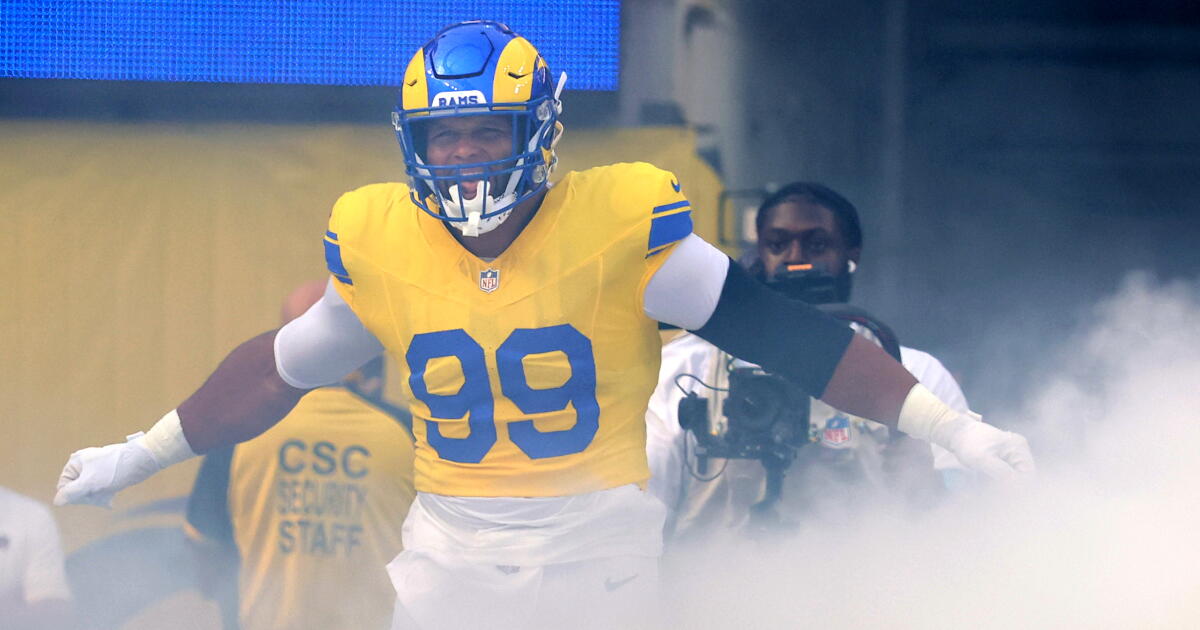
Matthew Stafford shows off the Rams’ new white uniforms.
(Brevin Townsell / Rams)
From Gary Klein: The Rams’ bone-colored uniforms have been sent to the graveyard.
In a release on Thursday, the team unveiled updated Royal Blue and white uniforms and announced subtle changes to logos as part of what the Rams described as “a refined brand and uniform refresh.”
Later this year, according to the release, the Rams will announce two alternate uniforms to go along with the revamped Royal Blue and white ensembles and the black “Midnite Mode” rivalry uniform they debuted last season in a game against the Seattle Seahawks at SoFi Stadium.
But the team “removed the ‘Bone’ uniform from the rotation,” the release said.
The Rams also made other subtle changes. The “LA” monogram no longer includes gradient coloring. The Rams head logo has been “enhanced to appear bolder and tougher for a fiercer expression, and the horn features a sharper, more defined point,” the release said.
Led by Olympic gold medalist Jordan Chiles, the Bruins’ gymnastics squad is having its best season since 2018 and will compete in Fort Worth in an NCAA national semifinal on Thursday for a spot in Saturday’s championship meet.
The Bruins haven’t won an NCAA gymnastics championship in eight years, a long gap for the seven-time champions known for developing Olympic talent.
UCLA will compete in a semifinal against Oklahoma, Arkansas and Minnesota. The Bruins will start on the bars, then go to the beam, floor and vault.
Arsenii Sergeev made 27 saves in his first NHL start, Zayne Parekh broke a third-period tie and the Calgary Flames beat the playoff-bound Kings 3-1 on Thursday night to end the season.
The Kings learned during the game that they’d be the second wild-card in the Western Conference and face NHL regular-season champion Colorado in the first round — with Game 1 on Sunday in Denver.
The Kings finished 35-27-20. Earlier Thursday, Edmonton took second place in the Pacific Division with a 6-1 home victory over Vancouver, and the Ducks won 5-4 at Nashville to finish third.
Sunday: Kings at Colorado, noon, TNT, truTV, HBO Max Tuesday: Kings at Colorado, 7 p.m., ESPN Thursday: Colorado at Kings, 7 p.m., TNT, truTV, HBO Max Sunday, April 26: Colorado at Kings, 1:30 p.m., TNT, truTV, HBO Max *Wed., April 29: Kings at Colorado, TBD *Friday, May 1: Colorado at Kings, TBD *Sunday, May 3: Kings at Colorado, TBD
*- If necessary
Ducks defeat the Predators
Troy Terry scored on a power play with 2:54 left, and the Ducks beat the Nashville Predators 5-4 Thursday night putting them close to clinching the third seed in the Pacific Division for the postseason.
The Ducks came into the regular-season finale third in the Pacific with five different scenarios still possible to lock down the final playoff slots. This win, combined with Edmonton needing only a point against visiting Vancouver, means the Ducks likely start the first round Monday at Edmonton.
The Ducks also took the season series against Nashville 2-1, though the Ducks go into the postseason 2-6-2 over their final 10.
Monday: Ducks at Edmonton, 7 p.m., ESPN2 Wednesday: Ducks at Edmonton, 7 p.m., TBS, HBO Max Friday: Edmonton at Ducks, 7 p.m., TNT, truTV, HBO Max) Sunday: Edmonton at Ducks, 6:30 p.m., ESPN *Tuesday, April 28: Ducks at Edmonton, TBD *Thursday, April 30: Edmonton at Ducks, TBD *Saturday, May 2: Ducks at Edmonton, TBD
*-if necessary
This day in sports history
1939 — Joe Louis knocks out Jack Roper at 2:20 of the first round in Los Angeles to retain the world heavyweight title.
1967 — Italian boxer Nino Benvenuti beats American Emile Griffith in a 15-round points decision to win world middleweight crown.
1976 — Australian tennis star Evonne Goolagong Cawley wins her second WTA Tour Championship at the Los Angeles Sports Arena; beats Chris Evert.
1982 — The Denver Nuggets’ Alex English, Dan Issel and Kiki Vandeweghe each average 20 points a game, the first front court to do so since Bob Pettit, Cliff Hagan and Clyde Lovellette of St. Louis in 1961.
1987 — Julius Erving of the Philadelphia 76ers becomes the third player to score 30,000 points in his pro career. Erving scores 38 points to join Wilt Chamberlain and Kareem Abdul-Jabbar.
1994 — Carl Lewis and his Santa Monica Track Club teammates rewrite their world record in the 800-meter relay at the Mt. San Antonio College Relays. Lewis, Mike Marsh, Leroy Burrell and Floyd Heard are timed at 1:18.68, breaking the record of 1:19.11 they had set on April 25, 1992.
1995 — Wayne Gretzky reaches 2,500 career points when he sets up a power-play goal by Rob Blake in the Kings’ 5-2 loss to Calgary.
1997 — The New Jersey Devils’ Martin Brodeur becomes the second NHL goalie to score in the playoffs. Brodeur’s empty net goal caps a three-goal third period that gives the Devils a 5-2 win and a 1-0 lead in a first-round series against Montreal.
1999 — Quarterbacks go 1-2-3 in the NFL Draft as Tim Couch, Donovan McNabb and Akili Smith go to Cleveland, Philadelphia and Cincinnati — the first quarterback trifecta since 1971.
2006 — Sidney Crosby, scores three assists in Pittsburgh’s 6-1 win over the New York Islanders to become the youngest player in NHL history to score 100 points in a season. The 18-year-old becomes the seventh NHL rookie to reach the 100-point mark.
2011 — Jimmie Johnson wins the Aaron’s 499, edging Clint Bowyer by about a foot. The official margin of 0.002 seconds, ties for the closest finish in NASCAR Sprint Cup history.
2018 — Brayden McNabb scores against his former team in the second period, lifting Vegas to a 1-0 victory over the Kings that makes the Golden Knights the first expansion team in NHL history to sweep its first playoff series. Marc-Andre Fleury turns in another stellar performance, stopping 31 shots as the Knights finish off their fourth one-goal victory of the series.
Compiled by the Associated Press
This day in baseball history
1932 — New York first baseman Bill Terry tied an NL record with 21 putouts as the Giants beat Boston 5-0 behind Hal Schumacher’s two-hitter.
1951 — In his first major league game, Mickey Mantle went 1-for-4 in the New York Yankees’ 5-0 victory over the Boston Red Sox.
1953 — Mickey Mantle cleared the bleachers at Griffith Stadium with a 565-foot home run off Chuck Stobbs. The shot came in the fifth inning of a 7-3 win over the Senators.
1964 — The New York Mets lost their first game at Shea Stadium, falling 4-3 to the Pirates. Pittsburgh’s Willie Stargell hit the first homer at Shea.
1969 — Bill Stoneman of Montreal pitched a 7-0 no-hitter against the Philadelphia Phillies in the 10th game of the Expos’ existence.
1976 — Mike Schmidt of the Philadelphia Phillies hit four consecutive home runs and a single in an 18-16, 10-inning victory over the Cubs in Wrigley Field. Hitting .167 going into the game, he connected twice off Rick Reuschel, once off Rick’s brother, Paul, and once off Darold Knowles. He drove in eight runs.
1983 — Nolan Ryan strikes out seven Expos in a 6-3 Houston victory to become only the second pitcher in major league history to record 3,500 career strikeouts.
2000 — Major League Baseball owners vote to approve the $96 million sale of the Kansas City Royals to team chairman David Glass.
2001 — Barry Bonds became the 17th major leaguer to hit 500 home runs. Bonds’ two-run, eighth-inning drive off Terry Adams went into San Francisco Bay to lead the Giants over the Dodgers 3-2.
2008 — Troy Tulowitzki’s RBI double with two outs in the 22nd inning scored Willy Taveras and the Colorado Rockies beat the San Diego Padres 2-1 in the longest game in the majors in nearly 15 years, a 6-hour, 16-minute marathon.
2008 — Chipper Jones, Mark Teixeira and Brian McCann hit consecutive home runs in a span of 12 pitches in the fifth inning off Florida’s Ricky Nolasco in Atlanta’s 8-0 win.
2009 — Jason Kubel completed the ninth cycle in Twins history with a go-ahead grand slam in the eighth inning that helped Minnesota to an 11-9 victory over the Angels.
2010 — Ubaldo Jimenez pitched the first no-hitter in the Colorado Rockies’ 18-year history, dominating the Atlanta Braves in a 4-0 victory. Jimenez (3-0) walked six — all in the first five innings. He was helped by Dexter Fowler’s diving backhanded catch in left-center field in the seventh inning.
2010 — Jose Reyes hit a sacrifice fly in the 20th inning and the New York Mets beat the St. Louis Cardinals 2-1 in the longest game in the majors in two years. Jeff Francoeur also had a sacrifice fly for New York in the 19th inning, snapping a scoreless tie, but Yadier Molina singled in Albert Pujols with two out in the bottom half. St. Louis left the bases loaded in the 10th, 12th and 14th and stranded 22 runners, including 14 in extra innings.
2012 — Jamie Moyer, 49, became the oldest pitcher to win a major league game. He threw seven masterful innings and Dexter Fowler hit a two-run homer, helping the Colorado Rockies hold on for a 5-3 win over the San Diego Padres. Moyer’s 268th win tied him with Hall of Famer Jim Palmer for 34th on the career list.
2014 — Major League Baseball suspended Seattle Mariners first baseman Ji-Man Choi 50 games following a positive test for a performance-enhancing substance.
Compiled by the Associated Press
Until next time…
That concludes today’s newsletter. If you have any feedback, ideas for improvement or things you’d like to see, email me at houston.mitchell@latimes.com. To get this newsletter in your inbox, click here.
United States Pentagon Chief Pete Hegseth has said the military blockade of Iran’s ports will continue “as long as it takes”, saying Washington remained “locked and loaded” to attack Iran’s energy facilities.
The US Pentagon chief spoke on Thursday as a tenuous pause in fighting agreed to last week has continued. On Monday, President Donald Trump announced the military would blockade Iran’s ports in the Strait of Hormuz and the Persian Gulf after US-Iran talks in Pakistan failed to reach a breakthrough.
Recommended Stories
list of 3 itemsend of list
Hegseth struck an aggressive tone as he maintained the US military was monitoring Iran’s military movements during the pause in fighting, which currently is meant to extend through early next week.
“We are reloading with more power than ever before…even more importantly, better intelligence than ever before,” Hegseth said.
“As you expose yourself with your movement to our watchful eye, we are locked and loaded on your critical dual-use infrastructure, on your remaining power generation and on your energy industry,” he said.
Still, the Pentagon chief said the US prefers to resolve the conflict, which began with US-Israeli attacks on Iran on February 28, through diplomacy.
“You, Iran, can choose a prosperous future, a golden bridge, and we hope that you do for the people of Iran,” he said. “In the meantime and for as long as it takes, we will maintain this blockade, successful blockade, but if Iran chooses poorly, then they will have a blockade and bombs dropping on infrastructure, power and energy.”
On Wednesday, a Pakistani delegation arrived in Tehran to coordinate a new round of talks. While both sides have indicated they remained open to further negotiations, Major-General Ali Abdollahi, the commander of the Khatam al-Anbiya Central Headquarters of the Islamic Revolutionary Guard Corps (IRGC), warned that the US blockade could end the current pause in fighting.
White House spokesperson Karoline Leavitt, meanwhile, indicated the US maintained a positive outlook on future talks.
“At this moment, we remain very much engaged in these negotiations, in these talks,” she said.
But reporting from Tehran on Thursday, Al Jazeera’s Ali Hashem says deep-seated distrust remains. The US under Trump twice attacked Iran amid ongoing indirect talks over Iran’s nuclear programme, a fact that has cast a long shadow over the most recent bout of diplomacy.
“Clearly, there have been several messages conveyed to the Iranians. But rather than consolidating a feeling of trust and optimism, it seems that it’s already shaken,” he said.
“We saw a platform closely associated with the foreign ministry tweeting today, quoting a source saying that whatever is being demonstrated or said in the media regarding the optimism is just hype, and this is used for PR and it’s for President Trump to use in the markets,” he said.
Iran’s speaker of parliament, Mohammad Bagher Ghalibaf, who led the Iranian delegation in the talks with Iran, told his Lebanese counterpart on Thursday that a ceasefire in Israel’s invasion and ongoing bombardment of Lebanon is “as important” as the pause in fighting in Iran.
A Lebanon ceasefire has emerged as one of the main sticking points in talks, which also include control of the Strait of Hormuz and the future of Iran’s nuclear programme.
‘We will use force’
Speaking during the news conference on Thursday, General Dan Caine, the chairman of the Joint Chiefs of Staff, said so far, 13 ships leaving Iranian ports have turned around in response to US military warnings.
“If you do not comply with this blockade, we will use force,” Caine said.
Admiral Brad Cooper, the head of US Central Command (CENTCOM), meanwhile, said the US is using the wear to rearm and reposition its forces.
“We’re rearming, we’re retooling, and we’re adjusting our tactics, techniques and procedures. There’s no military in the world that adjusts like we do, and that’s exactly what we’re doing right now during the ceasefire,” said.
During questions with reporters, Hegseth also shot down reports that China was planning to send weapons to Iran amid the pause in fighting. Hegseth said Washington had received assurances from Beijing that this was not the case.
Hegseth also used a large portion of the news conference to attack US press coverage of the war, which the Trump administration is receiving criticism for its shifting objectives and justifications for launching the conflict.
Hegseth called the coverage “incredibly unpatriotic”.
Israeli Prime Minister Benjamin Netanyahu says his government is ready to hold direct talks with Lebanon, a day after Israeli attacks on its northern neighbour killed hundreds of people on the deadliest day of the ongoing round of fighting.
“In light of Lebanon’s repeated requests to open direct negotiations with Israel, I instructed the cabinet yesterday to start direct negotiations with Lebanon as soon as possible,” Netanyahu’s office wrote in a statement on Thursday.
Recommended Stories
list of 3 itemsend of list
“The negotiations will focus on disarming Hezbollah and establishing peaceful relations between Israel and Lebanon.”
The statement comes a day after Israeli attacks across Lebanon killed more than 300 people in a series of devastating strikes that have threatened to undermine a United States-Iran ceasefire.
Israel and the US have said Lebanon was not included in the US-Iran two-week truce, which aims to allow for negotiations on ending their more than monthlong war. Iran and mediator Pakistan have said Lebanon was included in the ceasefire, and several international leaders have called for Lebanon to be included.
Shortly before Netanyahu’s surprise announcement about potential talks, Lebanese President Joseph Aoun said he was working on a diplomatic track on this matter that was starting to be seen “positively” by international actors.
And Lebanon’s cabinet instructed security forces to restrict weapons in Beirut exclusively to state institutions, in a warning to the armed group Hezbollah.
“The army and security forces are requested to immediately begin reinforcing the full imposition of state authority over Beirut Governorate and to monopolise weapons in the hands of legitimate authorities alone,” Prime Minister Nawaf Salam said at the end of a cabinet meeting.
Attacks on Hezbollah
Hours before opening the way for talks with Lebanon, Netanyahu said Israel would continue striking Hezbollah “with force, precision and determination”.
Lebanon’s health ministry said at least 303 people were killed and more than 1,000 wounded on Wednesday in Israeli strikes in central Beirut and other areas of Lebanon, with Salam declaring Thursday a “national day of mourning”.
But Israel continued its bombardment overnight and into Thursday, saying it killed Ali Yusuf Harshi, an aide to Hezbollah leader Naim Kassem. There was no immediate comment from the Lebanese armed group.
Meanwhile, Lebanon’s National News Agency (NNA) reported on Thursday that the Israeli army targeted the centre of Bint Jbeil city with heavy artillery shelling.
At the same time, Hezbollah has announced at least 20 operations against Israel and said it had targeted Israeli vehicles on Lebanese territory.
Reporting from Beirut, Al Jazeera’s Malcolm Webb said the Israeli army had issued new forced evacuation orders for the capital’s southern suburbs in advance of an attack.
“[This is an] area where thousands of people had initially fled, so this will force people to be on the move once again, looking yet again for somewhere safe to go to avoid the kind of destruction we can see here at one of the sites in central Beirut that was hit just over 24 hours ago in that wave of bombings across the city,” Webb said.
Since the ongoing Israel-Lebanon conflict began on March 2, Israel has issued evacuation orders for about 15 percent of Lebanese territory, displacing more than 1.2 million people, according to the United Nations. Israeli attacks have killed at least 1,888 people and wounded more than 6,000 others, according to Lebanese health authorities.
A Lebanese civil defence worker looks on as an excavator operates on the rubble of a building destroyed in an Israeli air strike a day earlier in Beirut, Lebanon [Hussein Malla/AP]
Ceasefire deal
As Israel continues its attacks on Lebanon, concerns are growing about the effect it could have on the originally fragile deal.
Since Wednesday, Iran has argued that attacks in Lebanon violate the ceasefire deal, with President Masoud Pezeshkian saying on Thursday that Israeli strikes on Lebanon would render negotiations meaningless, adding that Iran would not abandon the Lebanese people.
However, the US has said Lebanon is not covered by the truce, despite Pakistan, which acted as mediator, saying it was part of the deal.
Other countries, including the United Kingdom, France, Russia and Turkiye, have said the truce should extend to Lebanon.
Delegations from the US and Iran are expected to meet in the Pakistani capital, Islamabad, on Saturday for talks on ending the war.
This is the weekend high school track and field takes center stage in Southern California. Quincy Wilson, who won a gold medal at the age of 16 at the 2024 Olympic Games, is coming from Maryland to compete in the 400 and two relays at the Arcadia Invitational at Arcadia High on Saturday.
“I’m so fired up,” Servite coach Brandon Thomas said.
And Thomas isn’t running.
Servite’s 4×100 and 4×400 relay teams will have to deal with Bullis High and Wilson running the anchor leg in races that should have fans standing on their feet while listening to the oohs and aahs.
🚨FINALLY! Cali Sub-40!🚨 @Servite_XC_TF@ServiteSports becomes the first boys 4×100 squad in state history to crack the elusive 40-second barrier! The Friars blazed 39.82 at today’s Trabuco Hills Invit’l to cook their own record of 40.00 from last year! Oh my!! 📸:… pic.twitter.com/OKwBvpIDzW
“From a competitive standpoint, they’re excited to compete against the country’s best,” Thomas said.
Servite’s 4×100 relay team sent a message on Saturday, becoming the first to break 40 seconds in California history, winning in 39.82 at Trabuco Hills.
It’s all a perfect setup, from the atmosphere to the stiff competition, to prepare for next month’s section and state championships.
There’s two Loyola High athletes, sprinter Zion Phelps and 400 runner Ejam Yohannes, who hope to use Arcadia as a springboard to continue their early success this season.
Zion Phelps of Loyola edges Emmanuel Pullins of Sherman Oaks Notre Dame in the 100 meters on Tuesday, winning in 10.56 seconds. Pullins rans 10.59.
(Craig Weston)
Phelps is in his first year of track after being a defensive back and receiver for the football team. He and Loyola’s new coach, Sharaud Moore, were having conversions during the fall.
“He swore up and down he was the fastest kid in the school,” Moore said. “Yeah, put your money where your mouth is.”
Said Phelps: “I told him, ‘Just wait.’ I knew I had that speed and wanted to prove it.”
He ran a wind-aided 100-meter time of 10.39 seconds this spring. Last week in a Mission League dual meet against Sherman Oaks Notre Dame, he won with a time of 10.56.
Said Moore: “I was his harshest critic on the field.“We’re going back and forth and he was right. He’s s really fast.”
Showing his speed is legitimate will help with his football recruiting going into his senior year in the fall.
“Definitely this year has pushed my recruitment out there with my track times,” Phelps said. “I wanted to show the. I’m dedicated to this and being a multi-sport athlete. It will translate a lot.”
Yohannes, set to face Wilson in the 400, has an equally compelling story. He never played organized sports until joining the track team as a freshman. His parents came here from the small African country of Eritrea. His first name is Ethiopian.
He ran the 400 in 52.48 seconds as a freshman, focused more on having fun. Sophomore season he dropped to 50.75 and said to himself, “Wow, I’m fast.” He started getting serious.
“Now I wanted to be better,” he said.
An injury in January of last year didn’t let him get the foundation to run as fast as he hoped. He dropped to 47.69. Then Moore became coach, and Yohannes finally put in months of training to build a foundation.
“He comes in and kills me,” Yohannes said.
Then came the reward — 46.11 on March 21. In his final tuneup on Saturday, he ran 47.17 at the Red Rock Running Invitational.
“He’s a student and studies racing, training, race plans, athletes, programs,” Moore said.
As for facing Wilson, Yohannes’ attitude is bring him on.
“I’m excited to go out there,” he said. “It’s great competition. If I don’t believe I can win, nobody else can. If I don’t believe in myself, it’s over. I’m going to give my best. I might be crazy to saying this, but I think I have chance. He’s world class already in high school. He’s top of the line talent, It’s whoever wins on that given day. This is going to be unreal pressure knowing if I win, my name is out there. That puts me on the map. I can dream.”
A new Houthi offensive would be a major cudgel for Iran, because it would open a new front in the war and draw in military resources at a time when they are heavily involved in Epic Fury. A potential activation of the Houthis is arguably Tehran’s biggest military card left to play, but just how much control Tehran retains over the Houthis is unclear.
Operation Aspides “maintains a high level of situational awareness and conducts daily assessments of potential risks to freedom of navigation, making necessary operational adjustments where required,” an Aspides official told The War Zone. “In the event of a resumption of Houthi attacks to merchant vessels – which remains a possibility – we are present and ready to implement our mandate.”
“At the moment the missile launches from Houthi against Israel mark the first step,” the official added. “Their statement is not as clear and not a direct threat to merchant vessels passing through the Red Sea. Of course as we’ve already mentioned, a resumption of Houthi attacks to merchant vessels still remains a possibility.”
Bab el-Mandeb
Aspides was created in February 2024 during the Houthi’s 15-month campaign against warships and commercial vessels. It is a defensive operation to provide protection for ships transiting the Red Sea region and situational awareness about Houthi threats.
Operation Prosperity Guardian, a similar effort created months earlier by the U.S. Navy that we were the first to write about, was disbanded a year ago after the Houthis agreed to a ceasefire. Its responsibilities were subsumed by Destroyer Squadron (DESRON) 50, the surface warfare task force under U.S. Naval Forces Central Command (NAVCENT). U.S. Central Command (CENTCOM) on Wednesday declined to comment about what, if any, preparations DESRON 50 is making for the possible resumption of Houthi aggression in the Red Sea.
So far, the Houthis’ intentions for the Red Sea region remain publicly unknown. On Wednesday, the group’s spokesman, Yahya Saree, announced they struck southern Israel with ballistic missiles in coordination with Iran and Hezbollah. No mention was made about the Red Sea.
“The Yemeni Armed Forces, with Allah’s help and reliance upon Allah, carried out the third military operation in the ‘Holy Jihad Battle,’ targeting sensitive Israeli enemy targets…” Saree stated.
بيان القوات المسلحة اليمنية بشأن تنفيذ عملية عسكرية مشتركة مع الإخوة المجاهدين في إيران وحزب الله في لبنان استهدفت أهدافا حساسة للعدو الإسرائيلي جنوبي فلسطين المحتلة وذلك بدفعة من الصواريخ الباليستية. pic.twitter.com/pLEkUfQDev
However, as we noted yesterday, Iran is pushing the rebels “to prepare for a renewed campaign against Red Sea shipping, contingent upon any further escalation by the US in its war on the Islamic Republic,” Bloomberg News reported, citing European officials familiar with the matter.
Houthi leaders “are weighing options for more aggressive action after launching ballistic missiles at Israel,” Bloomberg added. During their previous campaign launched in late 2023, the Houthis attacked so many vessels with missiles and aerial and surface drones that shipping companies avoided the waterway, creating a spike in the price of some goods because alternative routes were much longer, resulting in increased cost of fuel, insurance and wages for crews.
At issue now are the increasing amount of oil exports flowing through the BAM in the wake of Iran’s Strait closure.
“Over the first 28 days of March, the amount of crude oil transiting the Bab-el-Mandeb Strait jumped by 21% compared with February,” CNN noted, citing the Vortexa shipping data firm.
In the past two weeks, Saudi Arabia has diverted nearly five million barrels a day of crude oil to the Red Sea port of Yanbu, the network added. While just a fraction of the 15 million barrels a day that have been cut off by the Strait closure, the Yanbu exports have helped reduce oil shortages and blunt price increases. Brent Crude, the global oil benchmark, reached a high of more than $107 per barrel on March 30 but fell to just over $101 per barrel as of Wednesday morning Eastern Standard Time, according to the latest figures from OilPrices.com.
A disruption of Saudi Arabia’s Red Sea transit option could cause oil prices to rise much higher and very quickly, creating a cascading wave of financial impacts across the globe. Even if the Strait of Hormuz were opened today, it will still take a while for the global economy to recover from the shock. Meanwhile, for Saudi Arabia, the simultaneous closure of both straits is a long-standing nightmare, a financial double-whammy that would also send energy prices around the globe skyrocketing.
Saudi Arabia, the world’s largest oil exporter, is trying to benefit from alternative export routes via Yanbu. (Photo by Omar Zaghloul/Anadolu via Getty Images) Anadolu
Beyond the purely economic impact that a resumption of Houthi attacks would bring, defending against them could require military assets at a time when the U.S. is still building up its already heavy commitment for Operation Epic Fury. During the previous Houthi Red Sea campaign that stretched into early 2025, the U.S. and allies deployed many warships, including the Eisenhower and Truman Carrier Strike Groups (CGS) to both defend against Houthi attacks and strike targets in Yemen. These operations resulted in a large expenditure of air defense munitions already under tremendous strain as Iran rains down missiles and drones across the Middle East.
You can see video from some of those encounters below.
Strikes on Iranian-backed Houthi Targets by USS Gravely, USS Carney, and USS Dwight D. Eisenhower
The future of the U.S. fight against Iran remains unclear. Monday morning, U.S. President Donald Trump claimed that Iran wanted a ceasefire, which he would only consider after they reopened the Strait of Hormuz. Iran pushed back against that, which you can read more about in our story here. We might learn more tonight during Trump’s scheduled 9 p.m. speech about the war.
What role the Houthis may play in this conflict is not fully clear. They are the most independent of Iran’s proxy groups and often act on their own accord. A weakened Iran could further imperil any obedience they have to the regime in Tehran, though there is also the question of what would happen to Houthi weapon stocks should the Islamic Republic, a key supplier, fall. There is also a long history of fighting with Saudi Arabia to consider, as that could be rekindled.
Regardless, if the conflict continues, the Houthis opening a second front in the Red Sea would have wide-ranging military and economic effects and we will continue to closely monitor the situation.
Iran says it is ready to counter any US-Israeli attacks, insisting its military capabilities remain intact despite Donald Trump’s claims they’ve been ‘decimated.’
At the start of February, South African Sports Minister Gayton McKenzie was forced to clarify remarks from his deputy that South Africa was set to step in as Wafcon hosts, adding further fuel to talk of a potential switch from Morocco.
McKenzie went on to say that “South Africa has expressed its willingness to support Caf if required, should alternative hosting arrangements for the 2026 Wafcon become necessary”.
In response, Caf president Patrice Motsepe said “many” other nations were interested in hosting Wafcon but could not because they wanted to alter the dates of the tournament.
Motsepe went on to insist “we can’t change the dates” – a comment which has aged poorly, especially as this is not the first time Wafcon has been shunted around Africa’s footballing calendar, leading to accusations that women’s football is not seen as a priority.
While the men’s Afcon was merely delayed by the coronavirus pandemic, Wafcon 2020 was cancelled entirely. The 2024 edition was finally played last July, having been postponed for a year.
This time around, with only 12 days’ notice given, teams were in the final stages of their preparations. Ghana’s players, for example, were already in a training camp in the UAE.
“It just wouldn’t happen for other tournaments in women’s football – and especially in men’s football,” Ashleigh Plumptre told Sportsworld on the BBC World Service.
The Nigeria defender, who was part of the Super Falcons side who secured a record-breaking 10th title last July, says the fact that the 2026 tournament – the first to feature 16 teams – will double up as qualifying for next year’s Fifa Women’s World Cup in Brazil makes the late postponement more distressing.
“Many teams haven’t even been in the Afcon before, never mind had the chance to qualify for a World Cup. It also helps them financially,” Plumptre added.
“All I can do, and I’ve almost probably been forced to be put in this position, is just take day by day and prepare myself in the best way that I can because there’s so many things I’ve had to get accustomed to, and many other players in African football, where you kind of just have to go with it, because you have no other choice.”
WASHINGTON — The Senate is on track to confirm Markwayne Mullin as Department of Homeland Security secretary, President Trump’s nominee to take over the embattled department after firing Kristi Noem amid a public backlash over the administration’s immigration enforcement and mass deportation operations.
Mullin, a Republican senator from Oklahoma known for his close friendship with Trump, has tried to present himself as a steady hand, saying that his goal as secretary would be to get the department off the front page of the news. But Mullin tangled with Republican Sen. Rand Paul of Kentucky, the chairman of the Homeland Security Committee, who questioned Mullin’s character and temperament during last week’s combative confirmation hearing.
Senators advanced Mullin’s nomination on Sunday during a rare weekend session on a largely party-line vote, and confirmation is expected late Monday.
He would take the helm of the department at a difficult time. The department’s routine funding has been shut down, leading to long waits at U.S. airports during the busy spring break travel season, as Democrats demand changes in immigration enforcement operations after the deaths of two U.S. citizens during protests this year in Minneapolis.
Trump announced over the weekend he’s ordering immigration officers to help Transportation Security Administration agents, which lawmakers and others warned could escalate tensions at crowded airports. Although the senator comes to the position after more than a dozen years in Congress, and with the management experience of running an expanding family plumbing business in Oklahoma, he has not been seen as a key force in immigration issues.
A former mixed martial arts fighter and collegiate wrestler who has led early-morning workout sessions in the members-only House gym, he became close with members of both parties and is often seen as a negotiator in partisan Washington.
It is his loyalty to Trump that landed him the job, and he’s not expected to sway from the president’s approach. Mullin was a strong supporter of Trump’s immigration agenda and ICE officers before being tapped for the Homeland Security job.
“I can have different opinions with everybody in this room, but as secretary of homeland I’ll be protecting everybody,” Mullin said during his confirmation hearing.
US President Trump, who cut off oil supplies to Cuba after abducting Venezuela’s President Maduro, has threatened to take over the island-nation.
Published On 22 Mar 202622 Mar 2026
The Cuban government has said it is prepared for any potential United States attacks as the island-nation begins to recover from yet another blackout under a punishing oil blockade imposed by Washington that has pushed its economy to the brink.
Deputy Foreign Minister Carlos Fernandez de Cossio responded on Sunday to US President Donald Trump’s threats this week to take over Cuba, insisting that it had “historically been ready to mobilise as a nation for military aggression”.
Recommended Stories
list of 3 itemsend of list
“We don’t believe it is something that is probable, but we would be naive if we do not prepare,” de Cossio told NBC’s Meet the Press.
His comments were aired a day after the latest collapse of the country’s ageing nationwide grid that had left millions of people in the dark. Saturday’s outage was the second in the past week and the third in March.
The state-run Electric Union and the Ministry of Energy and Mines said some 72,000 customers in the capital, Havana, including five hospitals, had electricity again early on Sunday. But the number represented only a fraction of Havana’s total population of approximately two million.
The Cuban Electric Union, which reports to the Ministry of Energy and Mines, said the total disconnection of the national system was caused by an unexpected shutdown of a generation unit at the Nuevitas thermoelectric plant in Camaguey province, without providing details on the specific cause of the failure.
People gather in the dark during a blackout in Havana, Cuba, on March 21, 2026 [Ramon Espinosa/AP Photo]
Trump, who started blocking oil from reaching the island after abducting Cuba’s ally, Venezuelan President Nicolas Maduro, early this year, has warned potential oil exporters that they could face high tariffs.
According to President Miguel Diaz-Canel, Cuba has not received oil from foreign suppliers for three months. The country produces barely 40 percent of the fuel it needs to power its economy.
On March 16, Trump escalated his rhetoric against Cuba, arguing the leadership was on the verge of collapse and saying he expected to have the “honour” of taking the country.
De Cossio denied that the nature, structure, or makeup of the Cuban government was up for negotiation in what Havana has called a “serious and responsible” dialogue with Washington launched earlier this month. He added that a change of the ruling system was “absolutely” off the table in discussions.
This week, General Francis Donovan, head of the US Southern Command overseeing armed forces in Latin America, told lawmakers at a US Senate hearing on Trump’s military action in the region that troops were not rehearsing for an invasion of Cuba or actively preparing to take over the Communist-run island.
But, he added, the US stood ready to address any threats to the US embassy, to defend its base at Guantanamo Bay, and aid US government efforts to address any mass migration from the island, if needed.
The Cuban government reportedly refused a request by the embassy in Havana to allow it to import diesel for its generators in response to the oil blockade, The Associated Press reported on Saturday, citing two US officials.
Scream queen Samara Weaving has an extraordinary yell: shrill, feral and ferocious, like a mongoose before it goes on the attack. Its vibrato fury bursts out only when she’s fighting for her life. Otherwise, her newly wed (and newly widowed) Grace MacCaullay stays quiet when being hunted, hence surviving a killer game of hide-and-go-seek in Matt Bettinelli-Olpin and Tyler Gillett’s 2019 hit “Ready or Not,” only to be forced to play again in their echoey sequel “Ready or Not 2: Here I Come.”
In the tradition of “Halloween II,” this one picks up the very second the last one ended. Grace, her white lace dress blackened with blood, is smoking a cigarette outside of an incinerated mansion that belongs to her in-laws, the Le Domas, who are all dead. On this bride’s wedding night, her groom permitted his relatives to sacrifice her to a demon, believing the lore that a wicked spirit named Le Bail gave the family its staggering fortune. They failed; she triumphed.
The first film teased the idea that the family might be superstitious crackpots only to merrily reveal at the climax that the devil is actually real — and that, when disappointed, he makes his minions explode like a shaken bottle of Dom Pérignon. That gag no longer comes as a total shock, but returning screenwriters Guy Busick and R. Christopher Murphy find that the suspense of who is going to pop, and when and why, works just as well. “It’s always surprising,” Grace says with grim humor. (Between this and “Sirāt,” human combustion is the morbid punchline of the year.)
This very silly slasher doesn’t take much seriously, although I appreciated that once Grace exhales her tobacco, passes out and comes to in a hospital bed, she’s been handcuffed to the railing by a detective (Grant Nickalls) who wants to arrest her on suspicion of arson and murder. One real-world rule holds true: Someone’s gotta take the fall when this many rich people die, even if it’s their victim.
Now, four more posh families want to get in good with Le Bail by competing to see who can kill Grace first. Did the screenwriters toss around a dozen other playground games — killer dodgeball, killer cornhole, killer freeze tag — before sticking with the same hide-and-seek set-up? The only change is that there’s more of everything, including more prey as Grace’s estranged sister Faith (Kathryn Newton) gets yoked into the action, grousing that her sibling’s “negative” energy has once again upended her life.
The host of the massacre is the powerful tycoon Chester Danforth (filmmaker David Cronenberg), a hotel and casino impresario, who entrusts the actual event planning to his adult children, twins Ursula and Titus (Sarah Michelle Gellar and Shawn Hatosy). The director of “The Fly” and “Videodrome” isn’t in the film long, but he bequeaths prestige upon these splat-hijinks that they don’t quite deserve. The paterfamilias of gut-wrenchingly emotional body horror would never make a movie like this himself, although I do think he’d be impressed when the visual-effects team makes a human face dissolve like a bath bomb.
The rest of the ensemble represents titans of some vague industry or another from around the globe: the Rajans of London, the El Caídos of Madrid and the Wans of Shanghai, each arriving with multiple family members as backup. A mobbed-up type, Wilkinson (Kevin Durand) of Atlantic City, also pursues Grace as a solo renegade. There’s not much comic zing in the idea that a handful of selfish families rule the world. Still, it’s amusing to watch these soulless ghouls refer to Grace and Faith as “things” and shrug off each other’s deaths, too. Generation by generation, this greedy lot appears to be getting lazier, intoning “Hail Satan” as offhandedly as ordering their butler to fetch them a martini.
Individual characters don’t pop (except, of course, when they quite literally do). The movie would be a bit more interesting if we knew something about each family’s backstory. The one teasing bit of historical intrigue comes when Le Bail’s lawyer (Elijah Wood) insists that the rules state each clan must attack Grace and Faith using weapons from the era in which their ancestors made their satanic pact. It never gets mentioned again, but I spun restless fictions seeing the Danforths stab the girls with railroad spikes while Olivia Cheng’s more modern Chinese heiress chased them with a drone.
There’s still an awful lot of random gunfire and not much enticement to hang onto, nor any sort of a story in this dashed-off, deadly spin on “Succession.” I’ll note that the demon is a more honest and fair negotiator than his vassals, who occasionally cheat and are punished in exactly the way you’re hoping to see.
Hatosy’s Titus is the Danforths’ disappointing fail son and the actor keeps his face in a delightfully foolish little pout. But Titus’ fever to prove that he’s his own man makes him unpredictable and dangerous — and makes him the only villain with more layers than one. Still, my favorite of the ensemble is Maia Jae’s Francesca El Caído, the jilted former lover of Grace’s late husband, who struts into the film like a hellcat, fighting for her own ego as much as Le Bail’s tempting offer of world domination. Her sloppy showdown with Grace is the action highlight.
None of this is scary. The directors, who have also dabbled in the “Scream” franchise, would rather get a laugh than a gasp. Their favorite move is a gasp-laugh, as when they flash a gruesome image on screen that’s so disgusting you can’t help but giggle.
Yet, the prankish tone keeps Grace from having much of a personality, other than a rebellious screwthis. Whenever a scene gives her a chance to catch her breath, it squanders it on a go-nowhere running joke about her desperate search for a cigarette.
At least Weaving has her scream and Newton, her impressive ability to take punishment. While new to this particular series, Newton is a skilled cartographer of comedy-horror terrain as the star of “Freaky,” “Lisa Frankenstein,” and the directors’ previous film, “Abigail.” Her kooky chipmunk moxie lets her get through any script relatively unscathed, including this one. And she has one of the best laugh lines in the movie when she bats her eyes at the baddies and tries to placate them with, “You guys seem like good people.”
The sisters’ mutual antagonism has a few clever beats, like when they bicker over who had the superior working-class restaurant job, Grace waiting tables or Faith as a hostess. But the few times they’re forced to play their hurt feelings sincerely are as forced as the moment when Grace zips her gory wedding gown back on before it’s even been washed.
Nevertheless, kudos to the costume team for a different outfit that Grace wears in the second half of the film that’s an absolute jaw-dropper of goth couture with black netting and a tiara. It pairs majestically with Weaving’s defiant chin and gleaming eyes. Despite this sequel’s thin and rote stretches, it once again closes strong with a few images that will stick in your head for at least a week or two. No spoilers, but it’s no coincidence that “Here I Come” finally gets more interesting once it tires of hide and seek. Finding a fresh plot twist is the only way it ekes out a draw.
‘Ready or Not 2: Here I Come’
Rated: R, for strong bloody violence, gore, pervasive language and brief drug use
Weekly insights and analysis on the latest developments in military technology, strategy, and foreign policy.
The U.S. Navy is not yet ready to escort oil tankers through the Strait of Hormuz, but it will happen. This is the synopsis provided by U.S. Energy Secretary Chris Wright in an interview with CNBC. The development comes as Iran continues to pummel international shipping in and around the critical channel, which the new Iranian supreme leader, Mojtaba Khamenei, vows to keep closed.
“It’ll happen relatively soon, but it can’t happen now,” Wright said, of the planned naval escort mission. “We’re simply not ready. All of our military assets right now are focused on destroying Iran’s offensive capabilities and the manufacturing industry that supplies their offensive capabilities.” Wright added that the Navy should be able to escort tankers through the strait by the end of this month.
BREAKING: Iran’s Supreme Leader Mojtaba Khamenei:
We will not forgo avenging the blood of the martyrs.
Khamenei, it appears, is also resolute in his plan to keep the strait closed to all maritime traffic, reportedly having turned down approaches from several countries that were seeking an end to the attacks.
🚨 Lebanese Al-Akhbar newspaper, which is associated with Hezbollah: Official sources from Turkey, Egypt, India, and Pakistan approached Tehran demanding to stop the attacks in the Strait of Hormuz, but were met with a firm response stating that “security will be for everyone or…
U.S. President Donald Trumpsaid on March 3 that “the United States Navy will begin escorting tankers through the Strait of Hormuz, as soon as possible.”
Putting a date of the end of this month on the escort mission is certain to trouble markets that are already feeling the pressure of the conflict. At the very least, this is an indicator that the war or its hostile aftermath will continue for weeks to come.
Equally pessimistically, there have been reports from analysts suggesting that fully reopening the strait may require some kind of ground operation to seize the Iranian coastline adjacent to it.
“Strategic priorities, like opening the Strait of Hormuz and securing what remains of Iran’s nuclear stockpile, will likely require some ground troops if no diplomatic options are pursued,” Brian Katulis, a senior fellow at the Middle East Institute, told The Wall Street Journal. “What we are looking at is potentially a very messy situation.”
Even without boots on the ground, which now seems like a remote prospect, running a tanker-escort mission, which would involve convoys protected by warships and accompanied by mine-clearing assets, is fraught with difficulty. Military unwillingness to take on missions of this kind is an issue we have explored in the past at TWZ.
The warships involved in any such endeavor would also be at extreme risk, especially from Iranian ground-mobile anti-ship missiles, which are relatively small and can be easily disguised in utility trucks. Eliminating that threat is one potential driver for a ground operation along the coast of the strait.
The U.S. military has made extensive efforts in recent days to remove the Iranian minelaying capability, but, according to the U.K. Defense Secretary, there are now increasing signs that Iran may have started mining the strait.
While tanker traffic through the strait remains at a standstill, Iran continues its campaign against commercial tankers elsewhere in the region, with another two vessels set ablaze earlier today in Iraqi waters. Iraq reportedly halted all operations at its oil ports after the attack.
There are so many VLCCs oil tankers in the Gulf of Aden right now that one could walk from Djibouti to Socrota island wihtout getting their feet wet.
(… and no, contrary to some social media posts, the Houthis have not attacked any tankers — so far…)
The Ambrey maritime security firm told us that a Malta-flagged crude oil tanker and another merchant vessel were targeted in an attack in Al Basrah Anchorage, Iraq. One fatality was reported. At least 38 individuals were rescued from both vessels according to the Iraq Port Authority, with further search and rescue operations ongoing as of this morning.
Video footage of the incident shows a vessel engulfed in fire with a large plume of smoke rising from the area of impact. Fire can also be seen in the water as a result of the oil spill.
Unverified reports state that the two tankers were struck by uncrewed surface vehicles (USVs).
Iraq’s State Organization for Marketing of Oil identified the two vessels as crude oil tanker Safesea Vishnu and the combined chemical and oil tanker Zefyros. While the Zefyros is Malta-flagged, the Safesea Vishnu is owned by a U.S. company but was sailing under the Marshall Islands flag. A dramatic video has appeared that is said to show the moment of the explosion that targeted the Safesea Vishnu.
The moment of the attack on the oil tanker Safesea Vishnu by an Iranian explosive boat tonight in the Persian Gulf near Iraq.
One crew member was killed. The tanker is owned by a U.S. company and was sailing under the Marshall Islands flag. pic.twitter.com/Xy2JKRoZt2
— Special Kherson Cat 🐈🇺🇦 (@bayraktar_1love) March 12, 2026
In a statement, the IRGC said that it considered the Safesea Vishnu as an asset of the U.S. military and claims that it was struck after ignoring repeated warnings and alerts from the IRGC Navy.
Iran’s IRGC says it struck a US-owned vessel ‘Safe Sia,’ a vessel considered as an asset of the US army, early this morning in the northern Persian Gulf.
Ambrey also reports that a container vessel was struck by an unknown projectile 38 nautical miles north-northeast of Jebel Ali, United Arab Emirates. The strike was reported to have caused a small fire on board the vessel, and the crew was reported to be safe.
Another vessel, the Japanese-flagged container ship One Majesty, was reportedly also damaged while anchored in the Persian Gulf. The damage was only discovered later, around 60 miles from the Strait of Hormuz. There were no reports of casualties.
A Japanese-flagged container ship, One Majesty, was damaged while anchored in the Persian Gulf.
The crew felt a shock near the stern and later discovered damage while the ship was about 60 miles (96 km) southwest of the Strait of Hormuz.
The vessel seen burning in the video below, from the perspective of crew members who evacuated on a liferaft, is the Thai-flagged cargo vessel, Mayuree Naree Bangkok, which was attacked near the Strait of Hormuz yesterday.
The continued attacks on energy infrastructure and shipping by Iran, and concerns over the intensifying conflict in the Middle East, have seen oil prices spike.
The international benchmark Brent crude is back above $100 per barrel.
NEW: Iran war is “creating the largest supply disruption in the history of the global oil market,” International Energy Agency says. https://t.co/bCKgzI6Mi8
In an effort to reduce concerns over global oil supplies, the International Energy Agency (IEA) has ordered the largest release of government reserves in its history.
Meanwhile, the government of Denmark is calling upon its citizens to reduce their consumption of fossil fuels.
Denmark’s Energy Minister urged people to reduce fuel use amid the oil shock from the Iran war, saying:
“Please, please, please — if you do not need to drive, do not do so.”
In a post on his Truth Social site, President Trump said he remained committed to ensuring Iran cannot develop nuclear weapons, despite the impact on the global oil trade.
“The United States is the largest Oil Producer in the World, by far, so when oil prices go up, we make a lot of money. BUT, of far greater interest and importance to me, as President, is stoping [sic] an evil Empire, Iran, from having Nuclear Weapons, and destroying the Middle East and, indeed, the World.”
Trump:
The United States is the largest Oil Producer in the World, by far, so when oil prices go up, we make a lot of money.
BUT, of far greater interest and importance to me, as President, is stoping an evil Empire, Iran, from having Nuclear Weapons, and destroying the Middle… pic.twitter.com/lp6As74W7h
The day-to-day running of the conflict also comes with a high cost to the U.S. government. According to Reuters, officials from the Donald administration estimated during a congressional briefing this week that the first six days of the war on Iran had cost the United States at least $11.3 billion.
Officials from President Donald Trump’s administration estimated during a congressional briefing this week that the first six days of the war on Iran had cost the United States at least $11.3 billion, a source familiar with the matter said on Wednesday. @ReutersZengerle
The Israeli Air Force (IAF) has struck a nuclear site in Iran, the Israel Defense Forces (IDF) announced today. The targeting of the Taleghan compound was part of a larger wave of strikes conducted over the past few days, the IDF said. Taleghan is part of the Parchin military complex, located around 20 miles southeast of Tehran.
The development comes after we reported on evidence of some kind of airstrike against the Taleghan compound, including the possibility that the hardened facility was hit by 30,000-pound GBU-57/B Massive Ordnance Penetrator (MOP) bunker buster bombs. You can read that analysis, based on satellite imagery, here.
The Israeli military said that IDF intelligence had determined that Iran had been using the Taleghan compound to develop weapons and conduct experiments as part of Amad, an Iranian scientific project aimed at developing nuclear weapons.
🎯STRUCK: The ‘Taleghan’ compound, a site used by the Iranian regime to advance nuclear weapons capabilities.
The compound was used to develop advanced explosives and conduct sensitive experiments as part of the covert ‘AMAD’ project in the 2000s.
According to a statement from the Israeli military:
“During Operation Rising Lion, the IDF has operated systematically against knowledge centers and infrastructure related to the Iranian nuclear weapon program in order to eliminate the emerging existential threat to the State of Israel. Despite the significant damage inflicted on the program, the Iranian regime has continued efforts to advance and develop the capabilities required for the development of a nuclear weapon.”
The IDF added that it had recently identified that Iran has taken steps to rehabilitate the compound after it was struck in October 2024.
The IDF says it recently struck an Iranian nuclear facility where the regime advanced “critical capabilities in the development of nuclear weapons.”
The site in Tehran, identified by the military as the Taleghan compound, was hit as part of waves of strikes carried out in the… pic.twitter.com/4bYQLAv3CJ
— Emanuel (Mannie) Fabian (@manniefabian) March 12, 2026
Israel announced last week that it had struck Minzadehei, another nuclear site in Iran where it said scientists were covertly developing a key component for nuclear weapons.
“The strike is a part of the series of operations carried out throughout Operation Rising Lion aimed at further damaging the Iranian terrorist regime’s nuclear aspirations.”
Other recent targets of the IDF include Abu Dharr Mohammadi, described as the operations commander responsible for the Islamic Revolutionary Guard Corps’ (IRGC) missile unit within Hezbollah.
A member of Iran’s Islamic Revolutionary Guard Corps who was operating as a commander in Hezbollah’s missile unit was killed in an Israeli airstrike in Lebanon this week, the IDF announces.
Abu Dharr Mohammadi, who the military says was a “central figure in the military… pic.twitter.com/StV45w6qIZ
— Emanuel (Mannie) Fabian (@manniefabian) March 12, 2026
“Earlier this week (Tuesday), the IDF struck and eliminated the terrorist Abu Dharr Mohammadi … Mohammadi was a central figure in the military coordination between Hezbollah and the Iranian terror regime, while coordinating and connecting between Hezbollah and Iranian senior officials,” the IDF said.
“Mohammadi was a key figure in Hezbollah’s military force build-up as it related to missiles, focusing on rehabilitating the program following Operation Northern Arrows,” the IDF added.
For its part, Hezbollah continues to hit back against Israel.
According to the Israeli military, Hezbollah militants launched around 200 rockets and approximately 20 drones yesterday evening from Lebanon toward Israel. After reportedly detecting signs of an unusual buildup, the IDF said it carried out a preemptive strike to disrupt the firing and thwart terrorists.
⭕️ ~70 terror targets were struck including terrorist infrastructure, weapons storage facilities, central headquarters, key terrorists, and an IRGC Air Force HQ in Beirut. pic.twitter.com/T8VBtiQmup
The IDF acknowledges that it was a mistake not to update the public ahead of Hezbollah’s large rocket and drone attack on northern Israel last night, especially once Israel’s assessments of the planned barrage were leaked on social media and published by international media.
— Emanuel (Mannie) Fabian (@manniefabian) March 12, 2026
The U.S. military has also continued airstrikes on Iran, with a recent video released by Central Command (CENTCOM) showing the destruction of a C-130 Hercules transport and a P-3F Orion maritime patrol aircraft (both of which were supplied to Iran before the 1979 Islamic Revolution) and an Ilyushin Il-76 Candid airlifter.
The Iranian regime is losing air capability day by day. U.S. forces aren’t just defending against Iranian threats, we are methodically dismantling them. pic.twitter.com/CrJj2nFtHB
Of these aircraft, the Islamic Republic of Iran Air Force (IRIAF) P-3F was especially notable, since it was reportedly the last of the type that was still airworthy in Iranian service.
IRIAF P-3F 5-8704 from 71 ASW squadron is no more.
Iran’s five P-3Fs that started the war had unique camo patterns for ID, as well as you can partially make out the 5-___4 of the tail, which in of itself is a giveaway to the airframe’s ID. https://t.co/1pPpdgJS9wpic.twitter.com/SvMBibwWdI
Following attacks on Mehrabad and Bandar Abbas Air Bases, the runways at both have now been blocked by parked buses and helicopters, according to satellite imagery. The reason for this is unclear, but it is possible that it has been driven by concerns about a potential aerial assault on either of these locations. Alternatively, the aircraft and vehicles may have been arranged as decoys. The same thing has been seen in the war in Ukraine, as well as in Venezuela, earlier this year.
🛰️ Satellite images show runways at Tehran’s Mehrabad and Bandar Abbas airports blocked with parked buses and helicopters.
The measure appears intended to prevent further strikes or aircraft use by making the runway unusable. pic.twitter.com/s5KcmcOw3G
U.S. airstrikes against Iranian missile systems have also continued. The CENTCOM video below is noteworthy since it shows (around the 0:07 mark) the destruction of a ballistic missile apparently in the process of being erected from its launch vehicle.
A U.S. strike overnight on three bases associated with the Iranian-backed Ansar Allah al-Awfiya militia reportedly killed dozens of militiamen. The bases near al-Qaim, al-Anbar, were used to fire projectiles at U.S. interests in Jordan. The following video purports to show the results of the attack on al-Qaim.
ما فعله الحشد بالعراقيين من قتل و ذبح يرتد عليه اليوم
Overnight attacks on Iraq also struck Erbil, home to an Italian military detachment in the country. According to reports, this has led to the temporary evacuation of the Italian presence from the base.
An Italian military base in Erbil, northern Iraq, was hit overnight by an airstrike, Italian defense officials said Thursday. No injuries were reported.
The strike was first thought to be a missile but was later identified as a drone that destroyed a military vehicle.
Mojtaba Khamenei has vowed to continue attacks on U.S. bases in the region, calling for American forces to leave them immediately, or face further strikes.
BREAKING: Iran’s Supreme Leader Mojtaba Khamenei:
All US bases should immediately be closed in the region, and those bases will be attacked.
While we have regularly seen Iranian ballistic missiles target Israel with cluster warheads, we now also have a view of how the separate munitions disperse, as seen from the vantage point of the cockpit of an IAF fighter jet.
In the United Arab Emirates, authorities have reportedly arrested a British tourist after they allegedly filmed missiles hitting Dubai. The 60-year-old Londoner faces two years in prison after being charged with a cybercrime, The Daily Mail reports.
He is reportedly one of 20 people to have been charged over videos and social media posts relating to recent Iranian missile strikes on the UAE.
British tourist, 60, ‘who filmed Iranian missiles’ in Dubai is facing two years in prison after being charged with cybercrime offence https://t.co/rtFMqtOiwt
The on-off deal to get Ukrainian-made counter-drone technology into U.S. hands has apparently taken another turn.
Taking to X, Ukrainian Prime Minister Volodymyr Zelensky wrote that he had hoped to “sign a big drone production deal with the United States, but we needed the approval from the White House.”
The deal, covering “different kinds of drones and air defense,” has not been signed yet, Zelensky added.
“I hope that maybe [our] American friends will be closer to this decision now, especially after such challenges as we see in the Middle East,” the Ukrainian leader wrote.
We wanted to sign a big drone production deal with the United States, but we needed the approval from the White House. It was about different kinds of drones and air defense. They operate as one system and can defend against hundreds or thousands of Iranian “shaheds“ and… pic.twitter.com/KZX7MLcCZG
— Volodymyr Zelenskyy / Володимир Зеленський (@ZelenskyyUa) March 12, 2026
A fire broke out aboard the aircraft carrier USS Gerald R. Ford.
“On March 12, USS Gerald R. Ford (CVN 78) experienced a fire that originated in the ship’s main laundry spaces,” Naval Forces Central Command said in a statement on X. “The cause of the fire was not combat-related and is contained. There is no damage to the ship’s propulsion plant, and the aircraft carrier remains fully operational. Two Sailors are currently receiving medical treatment for non-life-threatening injuries and are in stable condition. Additional information will be provided when available.”
On March 12, USS Gerald R. Ford (CVN 78) experienced a fire that originated in the ship’s main laundry spaces. The cause of the fire was not combat-related and is contained.
There is no damage to the ship’s propulsion plant, and the aircraft carrier remains fully operational.…
— U.S. Naval Forces Central Command/U.S. 5th Fleet (@US5thFleet) March 12, 2026
Earlier today, a U.S. official toldUSNI News that the initial fire had been extinguished, but the crew was still working to control the damage.
The United Arab Emirates is now using UH-60 Black Hawk series helicopters for counter-drone work, as seen in this video, which captures an engagement over Dubai.
UAE’s UH-60 Black Hawk helicopter intercepts an Iranian Shahed/Geran-type long-range strike drone over Dubai.
— Status-6 (War & Military News) (@Archer83Able) March 12, 2026
According to a report from Reuters, citing U.S. intelligence officials, most of the Iranian leadership remains intact, and the regime is not currently at risk of collapse, despite the U.S.-Israeli campaign against it.
U.S. intelligence indicates that Iran’s leadership is still largely intact and is not at risk of collapse any time soon after nearly two weeks of relentless U.S. and Israeli bombardment, according to three sources familiar with the matter. @ErinBanco@JonathanLanday
Certainly, as far as public statements are concerned, the remaining elements of the Iranian leadership remain steadfast in their refusal to give up the fight.
Iranian Parliament Speaker Ghalibaf:
Any aggression against soil of Iranian islands will shatter all restraint.
We will abandon all restraint and make the Persian Gulf run with the blood of invaders.
The United States military is “not ready” to accompany oil ships through the Strait of Hormuz, a top official in President Donald Trump’s administration says as Iran continues to block the strategic waterway.
US Energy Secretary Chris Wright told the CNBC business news channel on Thursday that the markets are experiencing a “short-term disruption”, predicting that the war would go on for “weeks, not months”.
Recommended Stories
list of 3 itemsend of list
Despite Trump’s repeated threats, Iran has largely succeeded in shutting down the strait, which links the Gulf to the Indian Ocean. The closure has sent oil prices soaring.
Wright described the effects of the crisis as “short-term pain for long-term gain”, arguing that the US is “destroying” Iran’s ability to threaten the energy market.
Last week, Trump suggested that the US Navy would escort ships through the Gulf, but Wright said on Thursday that the move “can’t happen now”.
“We’re simply not ready. All of our military assets right now are focused on destroying Iran’s offensive capabilities and the manufacturing industry that supplies their offensive capabilities,” the energy secretary said.
“We don’t want this to be a brush-off for a year or two. We want to permanently destroy their ability to build missiles, to build roads, to have a nuclear programme.”
His comments came as Iran’s new supreme leader, Mojtaba Khamenei, affirmed in his first public comment since being selected to succeed his assassinated father, Ali Khamenei, that the Strait of Hormuz should remain closed during the war.
“The will of the people is to continue effective and deterrent defence,” Khamenei said in a written statement. “The tactic of closing the Strait of Hormuz must also continue to be used.”
The Iranian military has said it would “welcome” the US Navy escorting oil ships, suggesting it is prepared to strike US forces in the narrow waterway.
On Wednesday, three commercial vessels were attacked near the strait.
Wright announced earlier this week on social media that the US Navy had escorted an oil ship through the strait, then quickly deleted the post. The White House subsequently confirmed that the claim was not true.
It is not clear why the statement was released and then retracted.
Assurances by US officials that Washington would open the strait have temporarily calmed markets, only for prices to spike again.
The price of a barrel of oil peaked at about $120 on Sunday, up from about $70 before the US and Israel launched the war on February 28. It has been yo-yoing between $80 and $100 for the past few days.
In addition to the marine blockade, Iran has targeted oil installations across the Gulf.
As one of the world’s largest oil producers, the US is largely self-sufficient. But possible shortages in Asia and Europe have put a strain on prices globally.
According to data from the American Automobile Association, the average price of one gallon (3.78 litres) of petrol in the US is now $3.60, up from $2.94 last month.
Rising energy prices could fuel inflation and affect the cost of basic goods, including food.
But Trump suggested on Thursday that the US is benefitting from skyrocketing oil prices.
“The United States is the largest Oil Producer in the World, by far, so when oil prices go up, we make a lot of money,” the US president wrote in a social media post.
“BUT, of far greater interest and importance to me, as President, is stopping an evil Empire, Iran, from having Nuclear Weapons, and destroying the Middle East and, indeed, the World.”
Iran denies seeking a nuclear weapon, and Trump reiterated for months before the current conflict that US strikes against Iranian facilities in June had “obliterated” the country’s nuclear programme.
WASHINGTON — Cuba’s top diplomat in Washington says Havana is prepared to enter diplomatic talks with the United States, reiterating the country’s willingness to engage even as tensions escalate with President Trump asserting that the island nation’s government could soon collapse.
“We are ready to engage with the U.S. on the issues that are important for the bilateral relation, and to talk about those in which we have differences,” Ambassador Lianys Torres Rivera, who leads Cuba’s mission in Washington, told The Times on Wednesday.
Any dialogue would need to respect Cuba’s sovereignty and its “right to self-determination,” the ambassador said.
“We are sure that it is possible to find a solution,” she said.
Her comments in a wide-ranging interview come at a particularly volatile moment for Cuba, which is under mounting economic pressure after the Trump administration imposed an oil blockade that has choked off the island’s energy supplies.
The measures have deepened a humanitarian crisis and prompted Cuban President Miguel Díaz-Canel to call for an “urgent” overhaul to the country’s economic model.
The situation in Cuba worsened after U.S. forces removed Venezuelan President Nicolás Maduro in January, allowing Washington to later cut off oil shipments from Venezuela to its longtime ally. The Trump administration later pressured other suppliers, including Mexico, to reduce deliveries.
“We are doing our best, and we are being very creative, but it has a serious impact,” Torres Rivera said of the blockade. “It is a collective punishment against the Cuban people.”
The White House this week framed Cuba’s worsening economic and humanitarian conditions as a potential opening to pressure Havana into negotiations.
“The country is obviously in a very weak place, economically speaking, the people are crying out for help, and the president believes and knows the Cuban regime wants a deal,” White House Press Secretary Karoline Leavitt said during a news briefing Tuesday.
Rep. Mario Diaz-Balart (R-Florida) told the Miami Herald on Wednesday that the Trump administration had been having secret, high-level conversations with several people in former President Raul Castro’s inner circle, a similar approach that was taken in Venezuela before Maduro’s capture. (The operation to seize Maduro killed 32 Cuban officers stationed in the country.)
Cuban President Miguel Díaz -Canel, fourth from right, holds up a Cuban flag during a rally in Havana on Jan. 16, 2026, to protest the killing of Cuban officers during the U.S. operation that captured Venezuelan President Nicolás Maduro.
(Ramon Espinosa / Associated Press)
Another report by the USA Today this week said the Trump administration was close to announcing an economic deal with Cuba that would ease travel restrictions, among other things. A representative with the Cuban government declined to comment on the report.
The White House has not specified what a deal may look like. But Trump has said the United States is interested in a “friendly takeover” and has suggested that the move would allow Cubans to visit the island, a place that many Cuban exiles have worried about returning to while the current regime is in place.
“It is just a question of time before a lot of unbelievable people are going back to Cuba,” Trump said at an event last week.
Several news outlets have reported that the Justice Department is examining possible federal charges against officials within Cuba’s government, a move that could prompt a change in the island’s government.
Torres Rivera said she is aware of the reports but said the “judicial accusations” are an “instrument of political coercion without any legitimacy.”
“It is not something we are losing sleep over,” she said.
As for the potential negotiations, Torres Rivera did not provide specifics but talked about restoring diplomatic ties somewhat to how they existed during the Obama administration.
“We are neighbors,” she said. “We have common challenges, common threats, and we can speak about all that, and we can speak on the basis of respect for each other’s sovereignty and each other’s right of self-determination. We are ready for that.”
President Trump has approached diplomacy with Cuba with a harsher tone.
“As we achieve a historic transformation in Venezuela, we’re also looking forward to the great change that will soon be coming to Cuba,” Trump said Saturday, one week after U.S. and Israeli forces attacked Iran and killed Supreme Leader Ayatollah Ali Khamenei.
He added: “Cuba’s at the end of the line. They’re very much at the end of the line. They have no money. They have no oil. They have a bad philosophy. They have a bad regime that has been bad for a very long time.”
Trump said that he has put Secretary of State Marco Rubio in charge of leading the talks with Cuba and that he believes a “deal would be made very easily with Cuba.”
Torres Rivera did not offer an opinion on Rubio being tapped to lead the negotiations. Rubio is the son of Cuban immigrants who came to Florida three years before Castro’s brother, revolutionary Fidel Castro, rose to power in 1959. She reiterated that Cuba is “ready to engage” in talks regardless of who is leading them.
“We are not talking about persons, we are talking about the government and we are ready to engage with the U.S. to talk about the very important issues that we have in bilateral relations,” she said.