Hello! I’m Mark Olsen. Welcome to another edition of your regular field guide to a world of Only Good Movies.
This week The Times published its rankings of the 101 best Los Angeles movies. Assembled from ballots by 17 film writers, the list would make for quite a viewing guide, running from 1924’s “Sherlock Jr.” to 2025’s “One of Them Days” and proving that there are many different versions and visions of the city. Directors including Amy Heckerling, David Lynch, Charles Burnett, Kathryn Bigelow, Michael Mann, Paul Thomas Anderson, Quentin Tarantino, Robert Altman and Billy Wilder all are represented on the list at least twice.

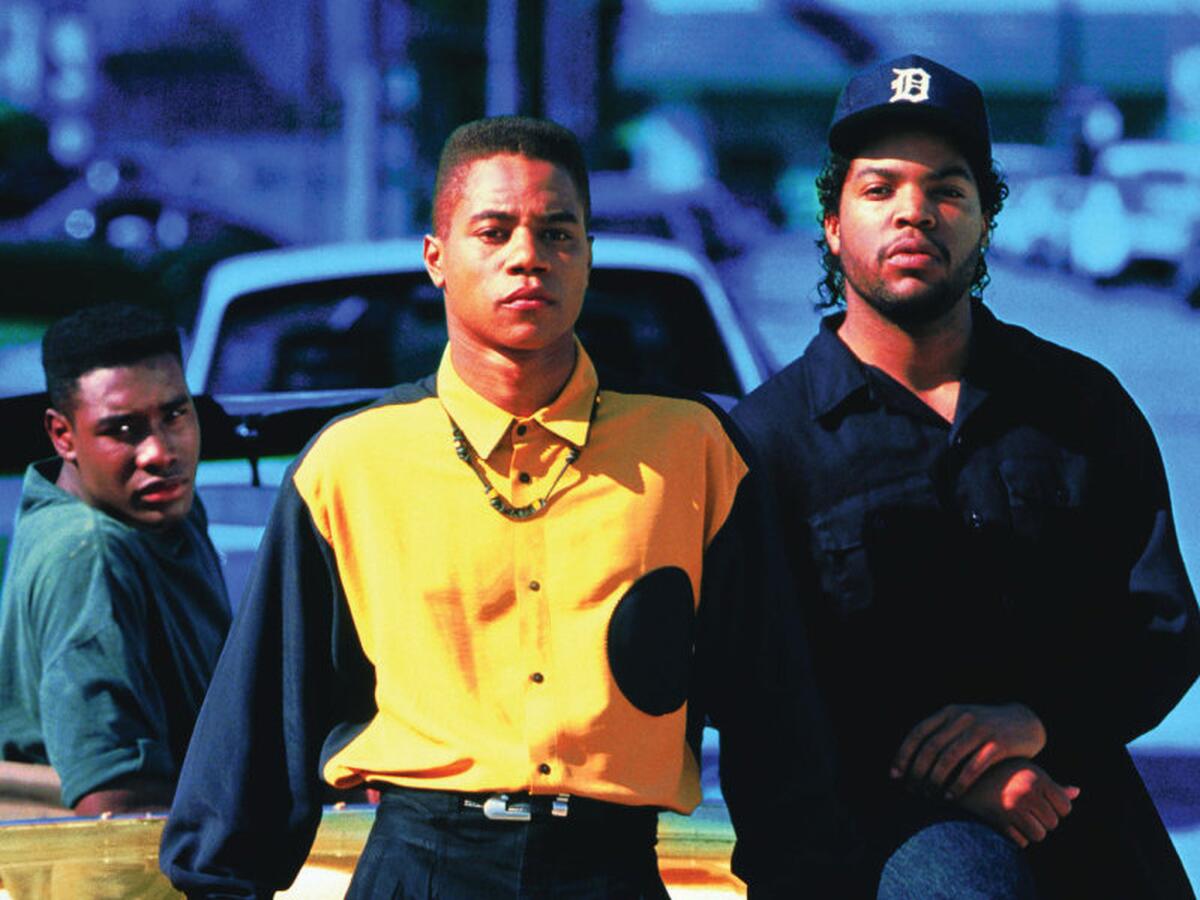
John Singleton’s 1991 drama “Boyz n the Hood,” starring Morris Chestnut, left, Cuba Gooding Jr. and Ice Cube, made our list of the 101 best Los Angeles movies.
(Columbia Pictures)
“What makes a perfect L.A. movie?” Times film editor Joshua Rothkopf asked in his introduction to the list. “Some kind of alchemy of curdled glamour, palm trees, ocean spray, conspiracies big and small — and more than a pinch of vanity. From hard-bitten ’40s noirs and vertiginous Hollywood rises (and falls) to the real-life poetry of neighborhood dreamers and nighttime drivers, Los Angeles is always ready for its close-up. The city has long occupied a cinematic place, straddling its gauzy past and a dark, rainy future. Go west, they said, and we came here, a site of fantasy, industry, possibility and obsession.”
Times critic Amy Nicholson took a crack at what makes for a definitive Los Angeles film, tying it together with her own experiences moving here as a movie-mad transplant.
“Part of what defines a Los Angeles movie is our city’s willingness to turn the camera on itself, to prioritize a riveting tale over our own reputation. We’re eager to share our saga with the world. Our glamorous and gruesome history is all there in a close-up of ‘Chinatown’s’ Jack Nicholson: a movie star with a mutilated nose.”
Let us know your own favorites — and any titles you think we may have overlooked — by clicking here.
David Lynch, one year gone

Laura Dern in director David Lynch’s 2006 movie “Inland Empire.”
(Studio Canal)
Today marks the first anniversary of the death of filmmaker David Lynch, and Tuesday would have been his 80th birthday. To commemorate the occasion, venues all over town are celebrating Lynch and his work. The Academy Museum will have five nights of screenings, beginning with “Blue Velvet” in 4K with star Kyle MacLachlan as a special guest. “Lost Highway” and “Mulholland Drive” will also both screen in 4K. Star Laura Dern will attend for “Inland Empire” in 4K and ”Wild at Heart” in 35mm.
In her original review of “Blue Velvet,” Sheila Benson captured much of what has made Lynch’s work so enduring, writing, “Secrets are at the heart of David Lynch’s ‘Blue Velvet,’ the most brilliantly disturbing film ever to have its roots in small-town American life. Shocking, visionary, rapturously controlled, its images of innocence and a dark, bruising sexuality drop straight into our unconscious where they rest like depth charges. … ‘Blue Velvet’ takes us behind the working-class American facade, beneath the Technicolor grass, literally underground to the churning turmoil of black, shiny beetles below. It’s there. It’s always there, Lynch says, if you only look and listen.”

Dennis Hopper and Isabella Rossellini in David Lynch’s “Blue Velvet.”
(Dino De Laurentiis Communications)
The American Cinematheque has launched a revisit of the entirety of the groundbreaking television series “Twin Peaks.” This week will feature Season 1, Episode 1, directed by Lynch himself.
On Tuesday, the Philosophical Research Society will present Episode 8 of the third season of “Twin Peaks,” widely hailed as the high pointof the reinvigorated return of the show. An introduction by cast members and a post-screening symposium involving experts from a wide range of fields should make for quite a night.
‘Goodfellas’ at 35

Lorraine Bracco and Ray Liotta in “Goodfellas.”
(Warner Bros. / Kobal / Shutterstock)
The American Cinematheque at the Egyptian Theatre will present a 35th anniversary screening of Martin Scorsese’s “Goodfellas” with producer Irwin Winkler and co-screenwriter Nicholas Pileggi for a Q&A moderated by Scott Foundas.
With its innovative style and indelible performances by Ray Liotta, Joe Pesci and Robert De Niro, “Goodfellas” would go on to redefine the gangster story — although it’s difficult from our vantage point to remember that the movie was once new.
In her original 1990 review, Sheila Benson wrote, “To see an artist working at the peak of his power, everything extraneous stripped away, every element there for a purpose, is an extraordinary exhilaration. Martin Scorsese gave us that pure, hot, unquestioned power last in ‘Raging Bull’ and, in virtuosity alone, ‘Goodfellas’ is ‘Raging Bull’ squared. .”
Points of interest
‘The Puffy Chair’ at 20

Katie Aselton and Mark Duplass in “The Puffy Chair.”
(Ink Films)
Some anniversaries we’re not ready for — has it really been that long? Such it is with Monday’s 20th anniversary screening at Vidiots of “The Puffy Chair,” which introduced the talents of Jay Duplass, Mark Duplass and Katie Aselton. In the years since, they have had remarkable careers together and apart, as Mark currently appears as an actor on “The Morning Show,” Jay’s latest film as director “See You When I See You” is about to premiere at Sundance and Katie’s own directing effort, “Their Town,” written by (husband) Mark and starring their daughter Ora, will premiere at SXSW. Aselton and both Duplass brothers are all scheduled to appear at the Vidiots screening.
“The Puffy Chair” was made for a reported $15,000 and was a key entry in the micro-budget movement that came to be known as mumblecore. The film tells the story of a young man and his girlfriend who go on a road trip to pick up a lounge chair that resembles one his father used to own.
In a 2006 review, Kevin Crust wrote, “The Duplass’ ability to accurately depict the rough edges that define relationships — both romantic and familial — is what elevates ‘Chair’ above the prototypical indie drama absorbed in aimlessness and twentysomething angst. What feels like meandering in the moment builds to a genuine emotional attachment to the characters. … Much of the film’s dialogue feels improvised, and there’s a casualness to the pacing that recalls early Richard Linklater. ‘Chair’ is one of those rare feature debuts that come out of Sundance (class of 2005) full of buzz and doesn’t disappoint.”
‘The Killing of a Chinese Bookie’ at 50

Ben Gazzara in “The Killing of a Chinese Bookie.”
(Criterion Collection)
On Sunday the American Cinematheque at the Egyptian Theatre will host a 50th anniversary screening of the original extended 1976 cut of John Cassavetes’ “The Killing of a Chinese Bookie.” In the film, Ben Gazzara plays an L.A. strip club owner with gambling debts who is begrudgingly enlisted by a mobster to kill a rival. With its mix of genres and tones, the movie made for a challenging follow-up to Cassavetes’ 1974 “A Woman Under the Influence,” with Gazzara’s magnetic performance colliding with the conventions of a genre thriller.
Charles Champlin’s original review of the film captures the confusion people felt on it’s initial release. As Champlin wrote, “In the earlier films, the weaving, poking, exploratory, hand-held cameras, the gargled sound, the mingling of very professional and very amateurish acting, the interminable scenes and the improvisatory sense usually combined to give a feeling of raw and painful honesty to the material. … Watching this stumbling story of a strip-joint owner forced into murder to square a gambling debt, you get the impression the filmmaker could not decide whether to make a ‘popular’ picture in something close to the gangster tradition or another of his studies of contemporary society.”
Bill Forsyth’s ‘Comfort and Joy’

An image from the movie “Comfort and Joy.”
(Mezzanine Film)
On Wednesday, Mezzanine will present Scottish filmmaker Bill Forsyth’s 1984 film “Comfort and Joy” introduced by actor Colin Burgess and filmmaker Alec Moeller. The follow-up to Forsyth’s “Local Hero,” the movie concerns a morning radio host in Glasgow (Bill Patterson) who learns that his girlfriend is leaving him on Christmas Eve. This sends him into an emotional spiral that somehow finds him caught between rival dairy vendors.
In her original review, Sheila Benson wrote, “‘Comfort and Joy’ is personal, droll, even more an inward observation than his other films. … It works on a variety of levels — one may be despair, but the others are parody, whimsy and irony. ‘Comfort and Joy’ is not broad humor but gentle civilized comedy — deftly performed — whose aftereffect is likely to be a glow of rueful recognition.”
In other news
‘28 Years Later: The Bone Temple’

Ralph Fiennes, left, and Jack O’Connell in “28 Years Later: The Bone Temple.”
(Sony Pictures)
Probably the most exciting new release this week is “28 Years Later: The Bone Temple,” directed by Nia DaCosta and written by Alex Garland. Arriving quickly after Danny Boyle’s “28 Years Later” last year, the film continues to add to the ongoing mythology of a rage-inducing virus that takes over the United Kingdom. Further following young Spike (Alfie Williams), the story finds him falling in with a psychotic gang led by the self-described Sir Lord Jimmy Crystal (Jack O’Connell) and reencountering Ralph Fiennes’ Dr. Ian Kelson.
In her review, Amy Nicholson wrote, “DaCosta shares Boyle’s tactic of attacking a theme from two flanks: a showy assault (we’re doomed!) and a subversive sneak-around (perhaps we always were). Zombie stories are either about a civilization’s collapse or its rebuilding and typically use our contemporary society as a measuring stick of success. … Having had decades to run free, the infected now resemble Neanderthals. Life has devolved to its primordial pool. This filthy and fascinating film is peering in, nose crinkled and stomach churning, to see what bubbles up.”
‘A Private Life’

Jodie Foster and Daniel Auteuil in “A Private Life.”
(Jérôme Prébois / Sony Pictures Classics)
Rebecca Zlotowski’s “A Private Life” stars Jodie Foster as an American psychiatrist who lives in Paris, a role that gives the star a chance to utilize her fluency in French. When a troubled patient dies suddenly, Foster’s Lilian begins to suspect there is more to the story than first appears, turning into an amateur sleuth. The cast also includes Virginie Efira, Mathieu Amalric, Irène Jacob, Aurore Clément, Frederick Wiseman and Daniel Auteuil as Lilian’s ex-husband Gaby.
As Robert Abele wrote in his review, “As ‘A Private Life’ moves along, with Lilian negotiating a break-in, threats and lapses in judgment, it never exactly coheres. Yet it somehow entertains, which is a testament to Zlotowski’s energy juggling her various theme-colored story balls. While the mystery plot strains to be interesting as a lesson for its protagonist about how one never can fully know another human being, Lilian’s and Gaby’s rekindled affection is a wonderfully mature strand of midlife complexity, with Auteuil and Foster giving all their scenes the kind of nuanced, lived-in humor that suggests a flinty couple who never fully believed they were done with each other.”