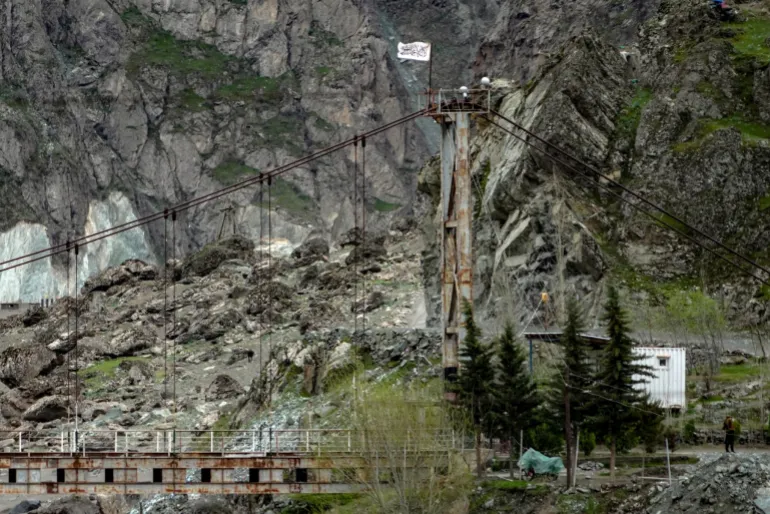
Tensions are flaring along the Tajikistan-Afghanistan border in Central Asia with the Tajik government reporting multiple armed incursions this month, straining its fragile relationship with Afghanistan’s Taliban leaders.
More than a dozen people have been killed in attacks by men whom Tajik authorities call “terrorists” and the resulting clashes with Tajik forces, officials in Dushanbe and Beijing said. Victims include Chinese nationals working in remote areas of the mountainous former Soviet republic.
In the latest fighting this week, at least five people were killed in Tajikistan‘s Shamsiddin Shokhin district, including “three terrorists”, officials said.
Tajikistan has long opposed the rise of the Taliban in Afghanistan, a country it shares a largely unsecured 1,340km (830-mile) border with.
Despite cautious diplomatic engagement between the two countries to adjust to new regional realities, analysts said, the frequency of the recent border clashes risks eroding the Taliban’s credibility and raises questions about its capacity to enforce order and security.
Here is all we know about the clashes along the Tajik-Afghan border and why they matter:

What’s happening on the Tajik-Afghan border?
The border runs along the Panj river through the remote, mountainous terrain of southern Tajikistan and northeastern Afghanistan.
On Thursday, Tajikistan’s State Committee for National Security said in a statement that “three members of a terrorist organisation” crossed into Tajik territory on Tuesday. The committee added that the men were located the following morning and exchanged fire with Tajik border guards. Five people, including the three intruders, were killed, it said.
Tajik officials did not name the armed men or specify which group they belonged to. The officials, however, said they seized three M-16 rifles, a Kalashnikov assault rifle, three foreign-made pistols with silencers, 10 hand grenades, a night-vision scope and explosives at the scene.
Dushanbe said this was the third attack originating from Afghanistan’s Badakhshan province in the past month that has resulted in the deaths of its personnel.
These attacks, Tajik officials said on Thursday, “prove that the Taliban government is demonstrating serious and repeated irresponsibility and non-commitment in fulfilling its international obligations and consistent promises to ensure security … and to combat members of terrorist organisations”.
The Tajik statement called on the Taliban to “apologise to the people of Tajikistan and take effective measures to ensure security along the shared border”.
Tajikistan has not suggested what the motive for the attacks may be, but the assaults have appeared to target Chinese companies and nationals working in the area.

How is China involved in all this?
Beijing is Tajikistan’s largest creditor and one of its most influential economic partners with a significant footprint in infrastructure, mining and other border-region projects.
China and Tajikistan also share a 477km (296-mile) border running through the high-altitude Pamir Mountains in eastern Tajikistan, adjacent to China’s Xinjiang region.
Two attacks were launched against Chinese companies and nationals in the last week of November. On November 26, a drone equipped with an explosive device attacked a compound belonging to Shohin SM, a private Chinese gold-mining company, in the remote Khatlon region on the Tajik-Afghan border, killing three Chinese citizens.
In a second attack on November 30, a group of men armed with guns opened fire on workers employed by the state-owned China Road and Bridge Corporation, killing at least two people in Tajikistan’s Darvoz district.
Tajik officials said those attacks had originated from villages in Afghanistan’s Badakhshan province but did not disclose any affiliation or motive behind the attacks.
Chinese nationals have also come under attack in Pakistan’s Balochistan province and along the Afghanistan-Pakistan border.
China’s embassy in Dushanbe advised Chinese companies and personnel to evacuate the border area. Chinese officials demanded “that Tajikistan take all necessary measures to ensure the safety of Chinese enterprises and citizens in Tajikistan”.
Who is carrying out these attacks?
While the attackers have not been identified, analysts and observers believe the attacks carry the hallmarks of the ISIL (ISIS) affiliate in Khorasan Province (ISKP), which, they said, aims to discredit Afghanistan’s Taliban leaders.
“The ISKP has attacked foreigners inside Afghanistan and carried out attacks on foreigners inside Afghanistan as a key pillar of their strategy,” said Ibraheem Bahiss, a Kabul-based analyst at the International Crisis Group think tank.
“The aim is to shatter the Taliban’s image as a security provider with whom the regional governments should engage,” Bahiss told Al Jazeera.

How has the Taliban reacted to these attacks?
Kabul expressed its “deep sorrow” over the killings of Chinese workers on November 28.
The Taliban blamed the violence on an unnamed armed group which, it said, is “striving to create chaos and instability in the region and to sow distrust among countries”, and it assured Tajikistan of its full cooperation.
After this week’s clashes, Sirajuddin Haqqani, the Taliban’s interior minister, said Kabul remains committed to the 2020 Doha Agreement, its deal with the United States for a phased foreign troop withdrawal from Afghanistan in exchange for Taliban commitments to prevent Afghanistan from being used as a base for attacking other countries.
Addressing a police cadet graduation ceremony at the National Police Academy in Kabul on Thursday, Haqqani said Afghanistan posed no threat to other countries and the door to dialogue remains open.
“We want to address problems, distrust or misunderstandings through dialogue. We have passed the test of confrontation. We may be weak in resources, but our faith and will are strong,” he said, adding that security had improved to the extent that Taliban officials now travel across the country without weapons.
The Taliban insists that no “terrorist groups” are operating from Afghanistan. However, in a recent report, the United Nations sanctions-monitoring committee cited the presence of multiple armed groups, including ISKP, Tehreek-e-Taliban Pakistan, al-Qaeda, the Turkistan Islamic Party, Jamaat Ansarullah and Ittehad-ul-Mujahideen Pakistan.
Jamaat Ansarullah is a Tajik group linked to al-Qaeda-aligned networks and active primarily in northern Afghanistan near the Tajik border.

How are relations between Tajikistan and the Taliban?
For decades, the relationship between Tajikistan and the Taliban has been defined by deep ideological hostility and ethnic mistrust with Dushanbe one of the group’s fiercest critics in Central Asia.
In the 1990s, Tajikistan aligned with the anti-Taliban Northern Alliance, led by Afghan military commander and former Defence Minister Ahmad Shah Massoud.
After the Taliban’s return to power in Afghanistan in August 2021, Tajikistan stood as the lone holdout among its neighbours in refusing to officially recognise the new government.
However, pragmatic diplomatic engagement quietly began about 2023, driven by economic necessity and shared security fears over the presence of ISKP. Stepping up the restoration of relations, a high-level Tajik delegation visited Kabul in November, the first such visit since the Taliban’s return to power.
But the two governments continue to trade accusations that the other is harbouring “terrorists”, the major thorn remaining in their bilateral relationship, and that drug smuggling is occurring across their border.
The Tajik-Afghan border has long been a major trafficking route for Afghan heroin and methamphetamine into Central Asia and onwards to Russia and Europe, exploiting the area’s rugged terrain and weak policing.
“The rising frequency [of the clashes] is new and interesting and raises a point: whether we might be seeing a new threat emerging,” Bahiss said.
Badakshan province, from which Tajik authorities said the attacks on Chinese nationals originate, presents a complex security situation for the Taliban as it has struggled to stem the threat from armed opposition groups, Bahiss added.
This security issue has been further complicated by the Taliban’s crackdown on poppy cultivation in the province, he said. The Taliban has faced resistance to this policy from farmers in the north. This is largely because the terrain of Badakshan means poppies are the only viable cash crop.

How is the Taliban faring with other neighbours?
Since the Taliban retook control of Afghanistan in 2021, some of its neighbours have maintained a pragmatic transactional relationship while others have not.
Relations with Pakistan, previously its patron, have particularly deteriorated. Islamabad accuses Kabul of harbouring fighters of Tehrik-i-Taliban Pakistan, also known as the Pakistan Taliban. Tensions over this issue boiled over in November when Pakistan launched air strikes in Kabul, Khost and other provinces, prompting retaliatory Taliban attacks on border posts.
Dozens of people were killed before a ceasefire was brokered by Qatar and Turkiye. However, both sides have engaged in fighting since, blaming each other for breaking the fragile truce.
The Taliban denies Islamabad’s allegations and has blamed Pakistan for its “own security failures”.
Meanwhile, the Taliban is now invested in developing a new relationship with Pakistan’s archrival, India, with delegations visiting Indian cities for trade and security discussions. New Delhi was earlier part of the anti-Taliban alliance. However, that approach has changed with the deteriorating ties between Pakistan and the Taliban.