Afghanistan

Afghans displaced by Pakistan conflict survive in tent camps | Pakistan Taliban

NewsFeed

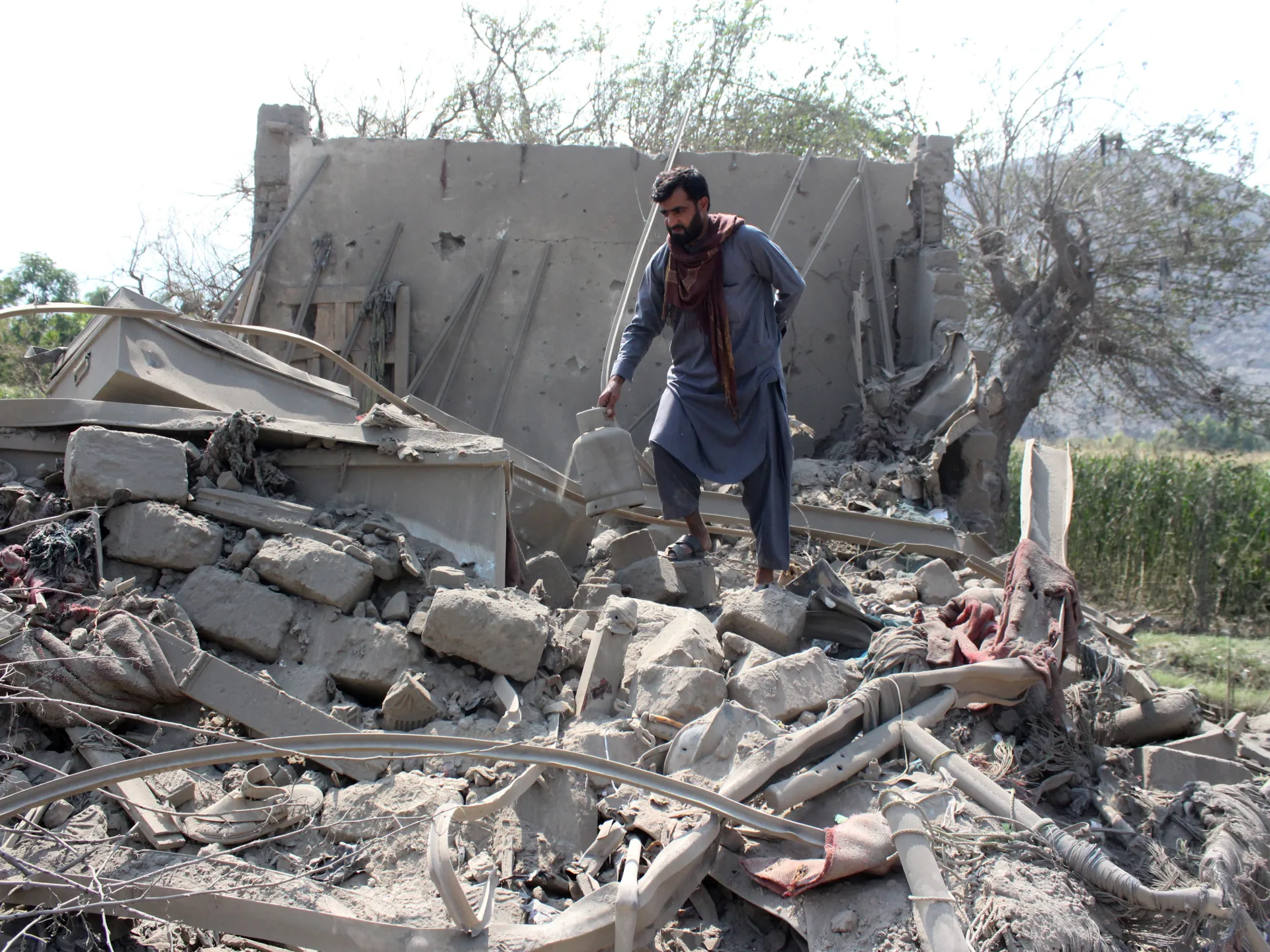
Tens of thousands of Afghans have been displaced by recent fighting along the Pakistan border, forced into tents with little access to food, healthcare, or education. Pakistan says its strikes target armed groups attacking its territory, but displaced families now fear for their safety and are uncertain if they will ever return home.

Source link

Stumbling in Afghanistan – Los Angeles Times

IT WAS HARDLY A SURPRISE that President Bush made a brief stop in Afghanistan on Wednesday, and not just because word of the “unexpected” trip leaked to the media beforehand. With Iraq ever more messy and his administration on the defensive on multiple fronts, Bush undoubtedly wanted to evoke that sweet moment of victory in November 2001 when U.S. forces ended the Taliban’s rule.

Yet Afghanistan is not such a simple story. Democratic elections brought a reasonable government into office, but it remains weak and ineffective outside of Kabul. Over the last year, the Taliban has made a strong revival, drug trafficking is up and the number of suicide bombings has steadily climbed. Bush’s advisors said his visit was so brief because it was hard to guarantee security.

Back in Washington, the director of the Defense Intelligence Agency, Michael Maples, testified before Congress on Tuesday that attacks by Taliban and other insurgents increased by 20% last year, and they are expected to intensify this spring. Aid workers report that villagers across the south of Afghanistan tell them not to visit anymore because Taliban forces punish anyone who accepts Western help.

Lest anyone forget, the Taliban was target No. 2 in the U.S. war against terrorists provoked by the 9/11 attacks. Target No. 1 was Osama bin Laden — Bush wanted him “dead or alive” — and he is still at large. Bush promised in Afghanistan that the leader of Al Qaeda would eventually be brought to justice. At this point, we are not holding our collective breath. Bin Laden is believed to be hiding in the mountainous region straddling Afghanistan’s border with Pakistan, spooning out taped messages to the West, but there has been little sign of progress in the hunt for him.

Like too many administration projects, the situation in Afghanistan appears to be the victim of a lack of follow-through. After the invasion of 2001, Bush promised to rebuild Afghanistan, ravaged by years of civil war and horrific destruction at the hands of the Taliban. There are 18,000 soldiers in the country, and in 2004 the United States and other donors pledged or spent $3.6 billion on humanitarian aid and reconstruction.

Yet once the war in Iraq was launched, Washington’s attention went there, as did most of its troops. The political will to bring security and basic services to Afghanistan clearly fizzled. Secretary of Defense Donald Rumsfeld likes to argue that the United States is capable of fighting two wars at once, but the evidence from Afghanistan and Iraq suggests that it may not be capable of fighting two wars well.

The United States is not the first world power to stumble in Afghanistan. The British and the Russians each failed to subdue the warlords who roamed the nation’s treacherous terrain. Yet the U.S. efforts that began there with great promise in 2001 remain, as yet, unfulfilled.

Source link

Rutte the ‘Trump whisperer’ faces a fresh test as Trump turns on NATO over Iran

NATO Secretary-General Mark Rutte has weathered a fresh ordeal with President Trump, this time over the U.S.-Israel war on Iran, a conflict that does not even involve the world’s biggest military alliance and one it was never consulted about.

Since launching the war, Trump has derided U.S. allies as “cowards,” slammed NATO as “a paper tiger” and compared U.K. Prime Minister Keir Starmer to Neville Chamberlain, who is probably best remembered for a policy of appeasement toward Nazi Germany.

That comes on top of Trump’s repeated threats to seize control of Greenland, which have deeply strained relations with U.S. allies in NATO and raised fears that doing by force could spell the end of the organization.

In recent days, the man who is as good as chairman of the NATO board suggested that the U.S. might leave the trans-Atlantic alliance. Trump already threatened to walk out in 2018 during his first term. His complaint now is that some allies ignored his call to help as Iran effectively shut the Strait of Hormuz, a vital trade waterway.

After talks with Rutte on Wednesday, the alliance’s most powerful leader took to social media to show his annoyance. “NATO WASN’T THERE WHEN WE NEEDED THEM, AND THEY WON’T BE THERE IF WE NEED THEM AGAIN,” Trump posted.

Peppered with questions later on CNN about whether Trump intended to take America out of NATO, Rutte said: “He is clearly disappointed with many NATO allies, and I can see his point.”

Keeping America in

Rutte has earned a reputation as a “Trump whisperer,” notably helping to draw up a plan that has seen European allies and Canada buy U.S. weapons for Ukraine, and keep the administration involved in Europe’s biggest war in decades.

Indeed, one of his most demanding tasks since taking office in 2024 has been to keep the mercurial U.S. leader engaged in NATO, particularly as America has set its sights on security challenges elsewhere, in the Indo-Pacific, Venezuela, and most recently Iran.

Rutte has used flattery, praising Trump for forcing allies to spend more on defense. He has congratulated the U.S. leader over the war and refrained from criticizing Trump’s warning that “a whole civilization will die” should Iran not reopen the strait.

“This was a very frank, very open discussion but also a discussion between two good friends,” Rutte told CNN. He declined to confirm reports that Trump is considering moving U.S. troops out of European countries that do not support the war.

Asked whether the world is safer thanks to the U.S.-Israel war, Rutte said: “Absolutely.”

War launched by a NATO member, not at one

The striking thing about the war on Iran is that NATO has no role to play there. As a defensive alliance it has protected ally Turkey when Iranian missiles were fired in retaliation at its territory, but the war was launched by a NATO member, not at one.

Rutte himself has said that NATO would not join the war, and there is no public confirmation that the U.S. had even raised the issue at the organization’s Brussels headquarters, although it cannot be ruled out that the administration made a request on Wednesday for that to happen.

NATO declined to say whether security for the strait has been officially discussed and referred questions to the United Kingdom, which is leading an effort outside the alliance to make the trade route safe for shipping once the ceasefire is working.

Estonian Foreign Minister Margus Tsahkna said Thursday that his country is always ready to consider providing support through NATO to partners who request it there.

“If the U.S. or any other NATO ally is asking (for) our support, we are always read to discuss it,” he told broadcaster CNBC. “But for that, we need of course the official ask to discuss then what is the mission, what is the goal?”

If allies “need our support, then we need to plan together,” he said.

NATO trying to stay out

Rutte himself insists that the alliance will only defend itself, and not become involved in another conflict outside of NATO territory, which is considered to be much of Europe and North America.

“This is Iran, this is the Gulf, this is outside NATO territory,” he said.

NATO has operated outside of the Euro-Atlantic area in the past, notably in Libya and Afghanistan. But there is no appetite to do so again given its chaotic U.S.-led exit from Afghanistan in 2021, which former NATO chief Jens Stoltenberg described as a “defeat.”

Trump’s ire seems most directed at Spain and France, rather than NATO itself. Spain has closed its airspace to U.S. planes involved in the Iran war and has refused U.S. forces the use of jointly operated military bases.

After the two-week ceasefire was announced, Spanish Prime Minister Pedro Sánchez posted on X that his government “will not applaud those who set the world on fire just because they show up with a bucket.”

“What’s needed now: diplomacy, international legality, and PEACE,” he added.

France has been critical, insisting that the war was launched without respecting international law and that Paris was never consulted about it. No blanket restrictions were placed on the use of joint bases or its airspace, but French authorities have said they’re making such decisions on a case by case basis.

Cook writes for the Associated Press.

Source link

Afghanistan brands China peace talks with Pakistan ‘useful’ | News

Kabul’s foreign minister expresses hope that minor interpretations will not hinder progress.

Afghanistan has said that peace talks with Pakistan being held in China have been “useful”.

The comment was issued by the foreign ministry in Kabul amid talks aimed at halting cross-border fighting between the two neighbours, which were launched last week following an invitation by China.

Recommended Stories

list of 4 itemsend of list

The peace process in the western Chinese city of Urumqi is an effort to stop the conflict that began in February, which has seen hundreds killed and perturbed Beijing, which is sensitive to the violence close to its western regions.

Pakistan, which declared it was in “open war” with its neighbour, has carried out air strikes inside Afghanistan, including in the capital, Kabul.

The United Nations’ Office for the Coordination of Humanitarian Affairs in Afghanistan posted on X on Tuesday that the conflict had displaced 94,000 people overall, while 100,000 people in two Afghan districts near the border have been completely cut off by the fighting since February.

The conflict has alarmed the international community, particularly as the area is one where other armed groups, including al-Qaeda and the ISIL (ISIS) group, still have a presence.

Foreign Ministry Deputy Spokesman Zia Ahmad Takal said Afghanistan’s acting Foreign Minister Amir Khan Muttaqi met China’s ambassador to Afghanistan on Tuesday, and thanked Beijing for arranging and hosting the talks, while also crediting Saudi Arabia, Turkiye, Qatar, and the United Arab Emirates for their mediation efforts.

“Noting that constructive discussions have taken place so far, FM Muttaqi expressed hope that minor interpretations would not hinder the progress of the negotiations,” Takal wrote.

Separately, Muttaqi said that “useful discussions have taken place”.

There have been few official statements regarding the discussions since they began on April 1 between mid-level delegations from the two sides.

Accusations

Even as the talks have been taking place, Afghanistan has accused Pakistan of carrying out shelling across its border on several occasions, killing and wounding civilians.

Pakistan has not commented. Islamabad often accuses Afghanistan of providing a safe haven to armed groups that carry out attacks, especially the Pakistan Taliban, known as Tehrik-e-Taliban Pakistan or TTP.

The group is separate from but allied with the Afghan Taliban, which took over Afghanistan in 2021 following the chaotic withdrawal of US-led troops. Kabul denies the charge.

The recent fighting, the most severe between the two neighbours, began after Pakistan carried out air strikes aimed at such groups. Afghanistan then launched cross-border attacks in response.

The clashes disrupted a ceasefire brokered by Qatar in October, after earlier fighting had killed dozens of soldiers, civilians, and suspected fighters.

On March 17, a Pakistani air strike hit a drug-treatment centre in Kabul, which Afghan officials claimed killed more than 400 people.

Pakistan denied it had targeted civilians, saying its strikes were against military facilities.

Source link

Australia arrests ex-soldier Roberts-Smith over alleged Afghan war crimes | Human Rights News

Arrest comes after Roberts-Smith lost case against journalists who said he was involved in murders of unarmed Afghan men.

Former Australian special forces soldier Ben Roberts-Smith has been arrested at Sydney airport and is expected to face charges for alleged war crimes committed in Afghanistan, according to the Australian Broadcasting Corporation (ABC).

The 47-year-old was expected to appear in a court in New South Wales later on Tuesday over five counts of the war crime of murder, related to unarmed Afghan nationals who “were not taking part in hostilities at the time of their alleged murder”, Australian Federal Police Commissioner Krissy Barrett told reporters in Sydney on Tuesday, according to the ABC.

Recommended Stories

list of 4 itemsend of list

Barrett said the charges followed a “complex” investigation by the AFP news agency and the Office of the Special Investigator (OSI) dating back to 2021.

The arrest comes after Roberts-Smith lost defamation proceedings he brought against journalists who had reported he was “complicit in and responsible for the murder” of three Afghan men.

An Australian judge found in 2023 that those journalists had not defamed Roberts-Smith, a ruling that was upheld by the Full Court of the Federal Court of Australia in May last year.

Rawan Arraf, the executive director of the Australian Centre for International Justice, said the arrest was a “significant and long-awaited step for victims and affected communities” in Afghanistan, where Roberts-Smith was deployed multiple times.

“The proper investigation and prosecution of alleged war crimes by members of the Australian special forces in Afghanistan are essential to ensuring justice for Afghan victims and to Australia meeting its obligations under international law,” Arraf said in a statement.

About 39,000 Australian soldiers were deployed to Afghanistan as part of the United States and NATO-led operations against the Taliban and other armed groups over two decades.

Roberts-Smith’s case has drawn considerable scrutiny in Australia, including because prior to the charges, he had received the Victoria Cross medal for his fifth tour of Afghanistan, and was reportedly the most-decorated living Australian war veteran.

Meanwhile, former Australian army lawyer David McBride remains imprisoned in Australia over his role in revealing information about alleged Australian war crimes in Afghanistan.

Australian Senator David Shoebridge responded to the news of Roberts-Smith’s arrest by saying “Release David McBride” in a short post on X.

Source link

Pakistan to continue with Iran-US mediation despite ‘obstacles’ | US-Israel war on Iran News

Islamabad, Pakistan – Pakistan intends to continue to nudge the United States and Iran towards negotiations aimed at ending their war, but the Ministry of Foreign Affairs acknowledges “obstacles” in its efforts.

Foreign Office spokesperson Tahir Andrabi did not specify the roadblocks on the path to peace that he was referring to. But his comments, made during a weekly media briefing in Islamabad, came hours after US President Donald Trump threatened to bomb Iran “back to the Stone Ages” if it did not accept Washington’s terms for a peace deal.

Recommended Stories

list of 4 itemsend of list

Pakistan has been leading a multination effort to facilitate negotiations between the US and Iran.

“Despite challenges and obstacles, Pakistan will continue its efforts to promote facilitation and dialogue,” Andrabi said. He added that Islamabad was working to create conditions for “meaningful negotiations among relevant stakeholders”.

He said the US and Iran had confidence in Pakistan’s role as a neutral intermediary.

In a sign of that confidence, Iran has allowed 20 Pakistani-flagged vessels to transit the Strait of Hormuz. Andrabi called it “a harbinger of peace” and a positive step for regional stability.

He did not confirm whether any Pakistani ship had so far sailed through the strait.

The Hormuz route has been largely blocked since Iran began restricting oil and gas shipments following the outbreak of the US-Israel-Iran conflict on February 28. The disruption has driven up energy prices and triggered widespread economic strain.

Andrabi also pointed to sustained high-level contact between Islamabad and Tehran. He cited a March 28 call in which Iranian President Masoud Pezeshkian spoke with Prime Minister Shehbaz Sharif, stressing the need to “build trust in order to facilitate talks and mediation” and praising Pakistan for its “supportive role for peace”.

Regional diplomacy

The briefing came just a day after Deputy Prime Minister and Foreign Minister Ishaq Dar returned from Beijing, where he met China’s Foreign Minister Wang Yi.

This handout photograph taken on March 29, 2026 and released by Pakistan's Ministry of Foreign Affairs shows Pakistan's Foreign Minister Ishaq Dar (2R) poses for a photograph with his counterparts Turkey's Hakan Fidan (R), Saudi Arabia's Faisal bin Farhan (2L) and Egypt's Badr Abdelatty before their meeting at the Foreign Ministry office in Islamabad.
The foreign ministers of Pakistan, Egypt, Turkiye and Saudi Arabia in Islamabad on March 30, 2026 [Handout/Pakistan’s Ministry of Foreign Affairs via AFP]

The visit produced a joint five-point initiative calling for an immediate ceasefire, urgent diplomatic engagement to prevent further escalation, and the restoration of normal maritime traffic through the Strait of Hormuz.

Andrabi said the Chinese-Pakistani plan had since been shared with Iran, the US and other stakeholders, receiving appreciation “across the region and beyond”.

He added that the proposals were consistent with the outcome of the four-nation ministerial meeting held in Islamabad the previous weekend — the foreign ministers of Saudi Arabia, Turkiye and Egypt joined Dar for those talks.

Dar travelled to Beijing despite medical advice to rest after sustaining a hairline fracture during the Islamabad talks, a move Andrabi said reflected the importance Pakistan places on its ties with China. “The Chinese side expressed deep appreciation, conveying that China and Pakistan are strategic cooperative partners,” he said.

The Islamabad meeting between Pakistan, Saudi Arabia, Turkiye and Egypt was the second such gathering in a coordinated regional push to de-escalate tensions. The first was held in Riyadh on March 19.

Following those talks, Dar said Pakistan was prepared to host direct US-Iran negotiations “in the coming days”.

“Pakistan will be honoured to host and facilitate meaningful talks between the two sides for a comprehensive and lasting settlement,” he said on March 30.

At Thursday’s briefing, Andrabi reiterated that offer, confirming Pakistan had formally “offered to host and facilitate negotiations as part of its broader diplomatic outreach”.

He said the next phase of efforts would focus on securing “meaningful negotiations among relevant stakeholders”.

He appeared to acknowledge that Iran — which has so far denied any direct negotiations with the US and has insisted that the mediation is limited to messages being passed between Tehran and Washington by Islamabad — was not fully on board with the efforts to push the warring nations towards talks.

“Iran, as a sovereign country, determines its own policies,” Andrabi said.

Afghanistan breakthrough?

Separately, the Pakistani Foreign Ministry confirmed sending a delegation of senior officials to the northwestern Chinese city of Urumqi for talks with Afghanistan. It is the first substantive contact since Islamabad launched cross-border strikes in late February.

The Urumqi meeting on Wednesday focused on exchanging views on the current escalation, Andrabi said.

“Our participation is a reiteration of our core concerns,” he said. “The burden of real process, however, lies with Afghanistan, which must demonstrate visible and verifiable actions against terrorist groups using Afghan soil against Pakistan.”

Pakistan launched Operation Ghazab lil-Haq on the night of February 26, targeting what it described as sanctuaries of “terrorists” in Afghanistan, following what it called unprovoked fire from across the border by Afghan Taliban forces.

After a five-day pause from March 18 to 23 for Eid-ul-Fitr, partly in response to de-escalation requests from Saudi Arabia, Qatar and Turkiye, Andrabi confirmed the operation was continuing.

“There has been no change in Operation Ghazab lil-Haq, and operations are continuing,” he said.

Islamabad has repeatedly accused the Taliban administration in Kabul of enabling groups such as Pakistan Taliban, known by the acronym TTP, which have repeatedly launched deadly attacks inside Pakistan, to operate from Afghan soil. Kabul denies those allegations.

Islamabad says its concerns remain unaddressed, and violence has surged since the Taliban’s return to power in August 2021.

China has also played a role in facilitating engagement between Pakistan and Afghanistan, including meetings in Beijing in May and in Kabul in August.

Source link

Heavy rain, floods kill at least 45 people in Afghanistan, Pakistan | Weather News

At least 28 people are killed in Afghanistan and 17 in Pakistan after heavy rainfall causes severe flooding.

Heavy rain that has caused severe flooding and landslides has killed at least 45 people in Afghanistan and Pakistan over the past five days, authorities say.

Afghanistan’s National Disaster Management Authority (ANDMA) said on Monday that 28 people have been killed in the floods and 49 injured with more than 100 homes destroyed.

Recommended Stories

list of 3 itemsend of list

Most of the deaths in Afghanistan were reported in central and eastern provinces, including Parwan, Maidan Wardak, Daikundi and Logar, according to ANDMA.

The authority added in a statement that weather conditions remained “unstable” in parts of the country and there is a continued risk of more rain and flooding in some areas.

“In total, 1,140 families have been affected,” ANDMA said.

Police spokesperson Sediqullah Seddiqi told the AFP news agency a 14-year-old boy died after being struck by lightning in the northwestern province of Badghis.

He added that in the same province, three people had drowned while trying to gather driftwood to be used for heating.

At the same time in Pakistan’s Khyber Pakhtunkhwa province, which shares a border with Afghanistan, 17 people were killed and 56 wounded, the Provincial Disaster Management Authority said.

A man clears the rubble of his damaged house, collapsed after heavy rains in Bannu, Khyber Pakhtunkhwa province, in Pakistan March 30, 2026. REUTERS/Ehsan Khattak
A man clears the rubble of his house, which collapsed after heavy rains in Bannu, Khyber Pakhtunkhwa province, in Pakistan [Ehsan Khattak/Reuters]

Extreme weather

Heavy rainfall has continued to sweep across Afghanistan since Thursday, causing floods and landslides in multiple provinces.

The weather prompted the closure of several highways, according to officials in central and eastern Afghanistan. Further rains and storms are forecast for Tuesday.

Afghanistan’s National Disaster Management Authority has warned citizens to refrain from using “rivers and flooded streams, and follow the weather forecast seriously”.

In the central province of Daikundi, the local disaster management department said a five-year-old was killed when a roof collapsed. A woman was also killed in the same circumstances in the eastern province of Nangarhar, police spokesperson Sayed Tayeb Hamad said.

Afghanistan is vulnerable to extreme weather, particularly heavy rainfall and monsoon seasons, which trigger floods and landslides in remote areas with fragile infrastructure.

In January, flash floods and snowfall caused the deaths of at least 17 people and killed livestock.

Source link

Biden’s pledge to leave Afghanistan is years in the making

This is the April 21, 2021, edition of the Essential Politics newsletter. Like what you’re reading? Sign up to get it in your inbox three times a week.

Outgoing presidents often leave decisions for their successors to take on.

Over the last two decades, and four presidents, how to end America’s longest war — in Afghanistan — has been among the largest open questions. President Biden inherited it from President Trump, who inherited it from President Obama, who took it from President George W. Bush. Unpopular, seemingly unending and unwinnable, the war is a case study in how the choices of one administration echo into the next.

Last week, Biden formally announced a deadline of Sept. 11 — the 20th anniversary of the terrorist attacks that provoked the U.S. invasion of Afghanistan — to end military involvement in the country.

“War in Afghanistan was never meant to be a multigenerational undertaking,” he said.

The prospective exit also has been years in the works. Obama promised to scale back U.S. involvement, but first he sent a surge of troops. Trump vowed several times to withdraw all troops, making chaotic progress that stopped short of a full exit. Biden is now the third president to make a similar commitment.

Whether he will follow through remains to be seen. My colleagues David S. Cloud and Tracy Wilkinson have extensively covered the American involvement in Afghanistan, from Trump’s growing tensions with the Pentagon over withdrawal to the lives of Afghanistan’s youngest generation, which was born into U.S. occupation.

Taken together, their work over the last few years reveals the deep roots of Biden’s promise, and the complicated history that will color his path forward.

Get our L.A. Times Politics newsletter

The latest news, analysis and insights from our politics team.

The long path to leaving

January 2017: A president who promised peace leaves office after eight years of war

During his first presidential campaign, Obama pledged to end the war in Afghanistan, as well as in Iraq. He ended his presidency as the first two-term president to see U.S. forces at war for all eight years.

Experts saw his legacy as mixed. He did reduce the number of troops in Afghanistan, cutting their ranks to 8,400, and his administration reduced American deaths — if not Afghanis’ — by relying on diplomacy and on drones to launch airstrikes. Yet intelligence officials said the U.S. faced more threats in more places than the country had seen since the Cold War. “We’re now wrapped up in all these different conflicts, at a low level and with no end in sight,” one expert told The Times.

August 2017: Trump presides over a stalemate and negotiated settlement

Trump the candidate ran as a tough-on-the-Taliban leader, promising a hard-fought and fast victory to end U.S. engagement. But Trump the president softened when it came time to reveal formal plans, Cloud and Wilkinson wrote with former Times reporter W.J. Hennigan. Fighting continued — to show U.S. forces could not be pushed out — while Trump promised that the 16-year war might end “some day” in a negotiated settlement. It was an acknowledgment that victory would elude a president who loved to win and refused to concede defeat.

“This entire effort is intended to put pressure on the Taliban, to have the Taliban understand you will not win a battlefield victory,” then-Secretary of State Rex Tillerson said. “We may not win one, but neither will you. So at some point, we have to come to the negotiating table and find a way to bring this to an end.”

By February 2018, the Trump administration proposed a defense budget that increased spending in Afghanistan by almost $2 billion, for a total of $48.9 billion in the next fiscal year.

December 2018: Trump presses for peace talks and announces a withdrawal of half of troops

That month, a series of announcements signaled Trump’s growing dissatisfaction with involvement in Afghanistan. Increased Taliban attacks had caused hundreds of Afghan civilian and military casualties a month, prompting Trump administration officials to press for a cease-fire agreement, but with dim prospects, Cloud wrote.

Less than two weeks later, administration officials announced a drastic plan: withdraw up to half of the 14,000 American troops serving in Afghanistan, potentially by summer. The backlash was swift from U.S. lawmakers, allies and even the Pentagon. Defense Secretary James N. Mattis was so furious that Trump would abandon allies in Syria and Afghanistan that he resigned in protest, as Cloud reported.

February-May 2020: A truce and a landmark agreement to withdraw

With 12,000 troops still in Afghanistan, the Trump administration brokered a temporary deal with the Taliban to reduce violence for a week in February, Wilkinson reported. The test was a success, and on Feb. 29, U.S. and Taliban officials signed an accord to end the war. The Taliban would prevent Al Qaeda and other terrorist groups from using Afghan territory to threaten the U.S., without renouncing its terrorist ties. In return, the U.S. would withdraw its troops within 14 months, setting a deadline of May 1, 2021.

The plan again drew backlash, from former Trump and Obama administration officials, who warned a complete withdrawal could backfire, Cloud, Wilkinson and Stefanie Glinksi reported. Even as conflict continued between the Taliban and the Afghan government into May, the Trump administration remained committed to removing troops.

November 2020: Hopes of exiting before the election dashed

Trump, hoping that a full exit in 2020 would boost his reelection prospects, made clear to advisors that he cared little about conditions in Afghanistan, Cloud and Wilkinson reported. He wanted out, period. By July, the number of troops on the ground had shrunk to 8,600.

But as the peace talks the U.S. hoped to broker struggled to get off the ground, administration officials said about 4,000 troops would have to remain into November. The Pentagon said too rapid a withdrawal would doom the talks, invite violence and cause American forces to have to abandon valuable equipment. Trump said he wanted a withdrawal by the end of his term in January, and in November — as he refused to concede his loss to Biden — he ordered troop levels reduced in Iraq and Afghanistan, to 2,500 in each country.

Trump’s relationship with Congress further deteriorated in December, in part over the bipartisan pushback to his withdrawal plans. It was among the reasons he cited in vetoing the annual National Defense Authorization Act, Cloud and Jennifer Haberkorn wrote.

April 2021: Biden says it’s “time to end the forever war.”

When Biden took the oath of office on Jan. 20, 2,500 troops remained in Afghanistan. But the new president faced the decision of whether to honor Trump’s May 1 deadline for withdrawing them — the final exit from the war, Cloud wrote. Once again, Defense Department officials pressured the president to delay a full withdrawal as the deadline the Trump administration negotiated with the Taliban approached.

On April 14, Biden made his decision public: The drawdown would proceed, but not so quickly. The U.S. would fully exit by Sept. 11, Cloud and David Lauter wrote.

“I am now the fourth United States president to preside over an American troop presence in Afghanistan. Two Republicans. Two Democrats,” Biden said. “I will not pass this responsibility onto a fifth.”

A newspaper headline reads "Second wave strikes; U.S. soldiers on the ground in Afghanistan."

The top half of the front page of the Los Angeles Times on Oct. 9, 2001.

(Los Angeles Times)

Enjoying this newsletter? Consider subscribing to the Los Angeles Times

Your support helps us deliver the news that matters most. Become a subscriber.

Policing, policy and the Minneapolis verdict

— The conviction of former Police Officer Derek Chauvin for the murder of George Floyd reenergized a push for sweeping criminal justice reform by President Biden and leading Democrats, who said Tuesday’s verdict was just the first step on the path to national healing, report Evan Halper, Eli Stokols and Sarah D. Wire.

— Anticipating an uproar, Facebook said it would crack down on violent content, hate speech and harassment ahead of the Chauvin verdict. But as Brian Contreras reports, critics are wondering why the platform doesn’t take those precautions all the time.

The latest on the environment

— China, Japan and South Korea are the world’s biggest funders of coal-fired power plants around the globe — and the Biden administration is looking to win their agreement to deep cuts in their greenhouse gas emissions by the end of the decade, write Anna M. Phillips and Wilkinson.

— Biden will convene leaders from around the world on Thursday and Friday as he marks the United States’ return to the global fight against climate change, Chris Megerian writes. Three people with knowledge of the White House plans say Biden will pledge to cut U.S. greenhouse gas emissions at least in half by 2030.

— Solar panels, wind turbines and electric cars will go far in helping California and the Biden administration meet their aggressive climate goals — but not far enough. As time runs short, scientists and government officials say the moment to break out the giant vacuums has arrived, Halper writes.

More from Washington

— Vice President Kamala Harris traveled to North Carolina on Monday to talk about economic opportunities and electric school buses as part of the Biden administration’s efforts to promote its roughly $2-trillion infrastructure, clean energy and jobs plan, Noah Bierman writes.

— The Supreme Court is weighing whether immigrants granted temporary protected status can get green cards — and if the Biden administration will make that decision, David G. Savage reports.

— The Justice Department has brought charges against hundreds of people who stormed the Capitol during the Jan. 6 riot, but one of its most pivotal potential cases involves a man who never set foot inside the building, writes Del Quentin Wilber.

— After Jan. 6, many of the nation’s largest corporations pledged that they would suspend donations to elected officials who opposed the certification of Joe Biden’s victory, hindered the peaceful transfer of power or incited violence. The vast majority kept their word, report Seema Mehta, Maloy Moore and Matt Stiles.

— What is there left to say about House Speaker Nancy Pelosi? Plenty, it turns out. In a new biography, Pelosi dishes on chiding Rep. Alexandria Ocasio-Cortez and using the nickname “Moscow Mitch,” writes Wire.

Source link

What we know about deadly strike on Kabul medical centre | Taliban

NewsFeed

Afghan officials say a suspected Pakistani air strike hit a drug rehabilitation centre in Kabul, killing hundreds of patients and staff and leaving the facility in ruins. Pakistan denies targeting civilians, as tensions escalate between Islamabad and Afghanistan’s Taliban-led government.

Source link

Families search for loved ones after deadly Pakistan strikes on Kabul rehab | Conflict News

Afghan authorities say a Pakistani attack killed hundreds of civilians; Islamabad rejects claim as ‘false’.

Families have gathered outside a drug treatment centre in the Afghan capital, Kabul, looking for their loved ones after it was hit in a Pakistani air strike, which Taliban authorities said killed 408 people.

The attack on Kabul’s Omar Addiction Treatment Hospital took place at about 9pm local time (16:30 GMT) on Monday.

Recommended Stories

list of 4 itemsend of list

Baryalai Amiri, a 38-year-old mechanic, was at the 2,000-bed facility on Tuesday to look for his brother, who was admitted about 25 days ago.

“We are not given the proper information,” Amiri told the AFP news agency, as rescuers picked through the rubble nearby. “So far, we don’t know where he is.”

Afghanistan and Pakistan have been in conflict for months, with Islamabad accusing its neighbour of harbouring armed groups that have mounted deadly cross-border attacks.

The latest round of violence that began last month⁠, two days before the world’s focus shifted sharply to the US-Israel war on Iran, is the worst ever between the neighbours.

The two nations share a 2,600km (1,600-mile) border. The conflict had ebbed amid attempts by friendly countries, including China, to mediate and end the fighting before flaring up again.

Pakistan denied Afghan claims that its latest attack targeted civilians, instead insisting that it carried out precision strikes on “military installations and terrorist support infrastructure”.

“Pakistan’s targeting is precise and carefully undertaken to ensure no collateral damage is inflicted,” the Ministry of Information and Broadcasting said. Islamabad dismissed the claim as “false and aimed at misleading public opinion”.

The health authorities said there were about 3,000 patients from across Afghanistan at the clinic at the time of the attack, which triggered panic in Kabul just after residents had broken their daily Ramadan fast.

The United Nations special rapporteur on the situation of human rights in Afghanistan, Richard Bennett, said he was “dismayed” by reports of the air raids and civilian casualties.

“I urge parties to de-escalate, exercise maximum restraint & respect international law, including the protection of civilians and civilian objects such as hospitals,” he posted on X.

‘It was like doomsday’

A spokesman for Afghanistan’s Ministry of Interior Affairs said on Tuesday that the attack killed 408 people and injured 265.

Witnesses said they heard three explosions just as people in the hospital were completing evening prayers. Two of the bombs struck rooms and patient areas, they said.

“The whole place caught fire. It was like doomsday,” 50-year-old Ahmad told the Reuters news agency.

“My friends were burning in the fire, and we could not save them all,” he said, giving only his first name as he was under treatment at the facility.

Ambulance driver Haji Fahim told Reuters that he arrived at the site shortly after the air raids.

“When I arrived [last night], I saw that everything was burning, people were burning,” Fahim said on Tuesday. “Early in the morning, they called me again and told ⁠me to come back because there are still bodies under the rubble.”

The clinic was established in 2016 and has treated hundreds of people, also providing them with vocational training, such as tailoring and carpentry, to make them employable, according to local media reports.

Source link

Pakistan strikes Afghan base after its president warns ‘red line’ crossed | Conflict News

Islamabad hits Kandahar facility after Taliban drones strike civilian areas and military sites as conflict intensifies.

Pakistan has carried out strikes on an Afghan military facility in Kandahar after Taliban drones targeted civilian areas and military installations across the country.

The strikes on Saturday came after Pakistani President Asif Ali Zardari condemned the overnight drone attacks, warning Kabul it had “crossed a red line by attempting to target our civilians”.

Recommended Stories

list of 3 itemsend of list

Pakistan’s military said the drones, described as locally produced and rudimentary, were intercepted before reaching their targets, though falling debris wounded two children in Quetta and civilians in Kohat and Rawalpindi.

A security source told the AFP news agency that airspace around the capital, Islamabad, had been temporarily closed when the drones were detected.

Islamabad said the Kandahar facility had been used both to launch the drone attacks and as a base for cross-border rebel activity.

The exchange marks the sharpest single escalation yet in a conflict that has been building since late February, when Pakistan launched military operations against what it said were Pakistan Taliban fighters sheltering on Afghan soil.

Islamabad also accuses Kabul of harbouring fighters from the ISIL (ISIS) group’s Khorasan province affiliate.

The Taliban government has denied both charges.

The drone attacks followed Pakistani strikes on Kabul and eastern border provinces in Afghanistan overnight on Thursday into Friday. The Pakistani attacks killed four people in the capital, women and children among them, and two more in the east.

In the Pul-e-Charkhi neighbourhood of Kabul, one resident described being buried under rubble after his home was hit, saying he lay there believing it was his “last breath” before neighbours pulled him free.

A local representative told AFP that those killed were “ordinary people, poor people” with no involvement in the conflict.

Pakistani aircraft also struck a fuel depot belonging to the private airline Kam Air near Kandahar airport, which an airport official said supplied aid organisations, including the United Nations and the International Committee of the Red Cross.

The official added that there were “no military installations” at the site.

Afghanistan’s Ministry of Defence claimed that its forces had captured a Pakistani border post and killed 14 soldiers.

Islamabad dismissed the assertion as baseless, with the prime minister’s spokesman accusing the Taliban of “weaving fantasies” rather than dismantling rebel networks on Afghan territory.

The UN mission in Afghanistan says at least 75 civilians have been killed and 193 injured since hostilities intensified on February 26, a toll that includes 24 children.

According to the UN refugee agency, about 115,000 people have been forced from their homes.

The crisis is unfolding as the wider region remains engulfed by the US-Israeli war with Iran, which began just two days after the Pakistan-Afghanistan clashes escalated.

Chinese Minister of Foreign Affairs Wang Yi has urged both sides to pursue dialogue, warning that further force would only deepen the crisis, though his appeal came as Pakistani jets were already in the air over Kandahar.

Source link

Afghanistan accuses Pakistan of air attacks on homes in Kabul, Kandahar | Conflict News

Women and children were among those killed in the attacks, according to the Taliban.

Afghanistan’s Taliban government has accused Pakistan of targeting civilian homes in overnight air attacks in the capital Kabul and the southern province of Kandahar, as fighting between the two neighbours entered its third week, overshadowed by the United States-Israel war on Iran igniting the middle East.

Women and children were among those killed in the attacks, according to the Taliban.

Recommended Stories

list of 3 itemsend of list

Government spokesman Zabihullah Mujahid said on X Friday that Pakistan’s aircraft also struck fuel depots belonging to the private airline Kam Air near Kandahar airport.

There was no immediate comment from Pakistan’s military or government.

Calls for restraint from the international community have gone unheeded by both sides.

On Thursday, the Taliban government said four members of the same family, including two children, were killed by Pakistani artillery and mortar fire in eastern Afghanistan.

The deaths reported on Thursday brought the toll to seven people killed in Afghanistan since Tuesday in cross-border clashes, according to authorities in Kabul. That could rise with the latest attacks on Friday.

Fighting between the two countries intensified on February 26 when Afghanistan launched an offensive along their shared border in retaliation for earlier Pakistani air attacks on the Pakistan Taliban, just two days before the US and Israel attacked Iran, starting a sprawling regional war.

Pakistan maintains that it does not target civilians, and casualty claims from both sides are difficult to verify independently.

Islamabad accuses Kabul of harbouring fighters from the Pakistan Taliban, which has claimed responsibility for a series of deadly attacks inside Pakistan, and from the ISIS (ISIL) affiliate in Khorasan province. Afghan authorities deny the charge.

The United Nations mission in Afghanistan has said 56 civilians have been killed there, including 24 children, by Pakistani military operations from February 26 to March 5.

Pakistani officials have confirmed about 12 soldiers were killed and 27 wounded in the latest bout of fighting, while the Taliban claims to have killed more than 150.

About 115,000 people have been forced to leave their homes, according to the UN.

Source link