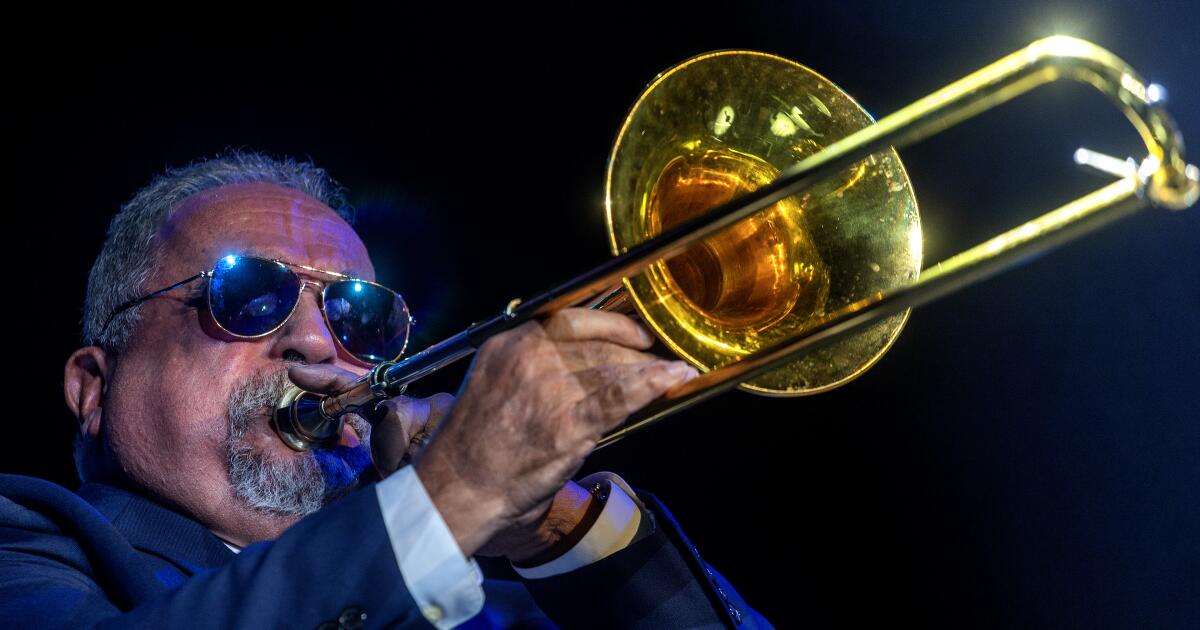
Willie Colón, a legendary trombonist and pioneer of salsa music, has died. He was 75.
His death on Saturday was confirmed in a Facebook post by his longtime manager, Pietro Carlos.
News of the singer’s condition circulated on the web in recent days. Yonkers Voice News reported Colón was admitted to NewYork-Presbyterian Westchester hospital in Bronxville, N.Y., on Tuesday with respiratory problems and he appeared fragile.
:
Born William Anthony Colón Román on April 28, 1950, to Puerto Rican parents in New York City, Colón first picked up the trumpet in school. It seemed like a natural choice for the former bugle-playing Boy Scout, who attended the youth program at the suggestion of his grandmother.
“So I could learn how to be a good boy,” said Colón in a 1988 interview with Associated Press.
By age 13, Colón had started a band and played at some weddings and in the bustling nightclubs of New York City. At one point, he forged a cabaret card, a mandated ID for musicians and entertainers between 1940 and 1967 who worked in establishments serving alcohol, which required individuals to be 18 years and older.
The thrilling 1960s Latin music scene in New York consumed Colón, who was deeply inspired by Latin jazz pioneer and bandleader Eddie Palmieri, once part of a main act at the Palladium Ballroom who went on to form La Perfecta, a Cuban conjunto that revolutionized the New York Latin music scene with its inclusion of two trombones, played by Barry Rogers and Jose Rodriguez, instead of the costly four-set trumpets.
But Colón’s instrumental preference changed once he heard the bodied timbre of Mon Rivera’s all-trombone brass lineup marching to a bomba beat. “It would knock my socks off,” said Colón in a 1988 interview with Associated Press, leading the singer to teach himself how to play the instrument.
By age 15, Colón was signed to Fania Records. Two years later at age 17, he went on to release his debut album, “El Malo,” a record that defined the fierce sounds of New York’s salsa scene, which Colón later described as the Latin equivalent of rap.
According to his former label, the name of “El Malo” was bestowed upon Colón by older musicians who sought to mock his trombone range at the time, though the young bandleader would find a way to use the label to his advantage.
On the LP, Colón’s sound moved away from the polished mambo sounds of orchestral bands decades prior, in large part due to Puerto Rican singer Héctor Lavoe, whose vocals can be heard in tracks like the gritty “El Malo” that vows to knock out any wanna-be street phony.
The pair would go on to record a total of 14 albums through 1973, with Lavoe’s talents for improvisation complementing Colón’s raw, aggressive trombone.
“Salsa came from the same kind of situation that rap does,” Colon said in a 1992 interview with The Times. “It was kind of a hybrid of a bunch of different elements. Hector had just come from Puerto Rico and didn’t speak English. I didn’t speak much Spanish, I was a little New York kid. We got together and just started with the same kind of irreverent, rebellious attitude, writing songs about the baddest guy on the block, drugs and sex. Before that, the lyrics and whole attitude of Latin music was, ‘Look at me dance, listen to those drums, I’m cutting sugar cane.’ It was a rural, folkloric emphasis; we changed it to an inner-city kind of culture.”
Colón’s impact went beyond live music. The album cover of “El Malo,” which showed two serious profiles of Colón, depicted the singer as a sly bad boy, and ultimately gave rise to his gangster persona, which would be a throughline in future projects, including his sophomore 1968 album, “The Hustler” which featured the band with fitted suits, smoking cigars and placing bets in a pool hall. His 1970 album “Cosa Nuestra” featured Colón smoking a cigar while overlooking a dead body in broad daylight in Manhattan’s East River Bikeway. Most famously, his 1971 album, “La Gran Fuga,” depicted the singer on a fake FBI “Most Wanted” poster.
These mob-like depictions occurred long before cult-favorite films like Francis Ford Coppola’s 1972 “The Godfather” and Brian De Palma 1983’s “Scarface” became the prominent gangster storylines various male acts venerate in their music.
By 1973, Colón and Lavoe split — allegedly due to Lavoe’s drug addiction leading to many missed concert performances — although the two would remain frequent collaborators until the latter’s death in 1993 due to complications of AIDS.
The Nuyorican musician would introduce Blades as the new singer of his orchestra, whom he had met years prior while visiting Panama during carnivals. They collaborated briefly on Colón’s 1975 LP “The Good, the Bad, the Ugly,” cementing their partnership in the 1977 album “Metiendo Mano,” which delved into socio-political themes, notably in their track “Pablo Pueblo,” which shares the story of a working class man with broken dreams halted by toils of daily life. Other tracks like “Plantación Adentro,” detailed the story of Camilo Manrique, a fictionalized enslaved character who died at the hands of a Spanish colonizer in 1745.
Many considered this album Colón’s first foray into intellectual salsa — in large part because of Blades, who had a knack for storytelling and political interests (he unsuccessfully ran for president of Panama in 1994) — that addressed colonialism and class disparities. Together they released three albums, including their 1978 “Siembra,” one of the bestselling salsa albums at that time; from the start, their track “Plastico” fused the popular disco music of the moment while addressing superficial beauty standards and colorism in Latin America.
According to 1996 reporting by The Times, “Siembra” delivered pulsating salsa rhythms that “carried messages of freedom at a time when most of Latin America was oppressed by military dictatorships.”
By 1982, Blades and Colón parted ways, but they collaborated again on projects like their 2005 LP “Tras La Tormenta” — which led the bandleader to sing for the first time in his career, “I had to start from zero, and it took me many years to feel comfortable,” Colón said.
This newfound independence gave rise to some of Colón’s most famous songs, including his 1995 track “Talento de Televisión,” an upbeat song with his signature trombone wailing in the backdrop as he sang about an attractive woman with a lack of talent.
Many across Latin America might be familiar with his 1989 song “El Gran Varon” — which narrated the story of a trans woman who is rejected by her father and presumably dies of AIDS — a landmark salsa song that brought awareness to LGBTQ+ themes during the AIDS crisis. Colón would later serve as a member of the Latino Commission on AIDS. “El Gran Varon” is an anthem to this day.
Colón released more than 40 albums in all.
He also acted, taking roles in films including 1982’s “Vigilante,” the 1983 sports drama “The Last Fight,” as well as one-episode stints in TV shows like “Miami Vice” and “The Cosby Show.” He was even featured in Bad Bunny’s “Nuevayol” music video, cutting a slice of cake; the 31-year-old superstar pays homage to the singer in its lyrics: “Willie Colón, me dicen el malo, ey. Porque pasan los años y sigo dando palo”/ “Willie Colón, they say I’m bad, because the years come and I’m still hitting.”
In his later years, he became more involved in politics. In 1994, he unsuccessfully went up against U.S. Rep. Eliot Engel of the Bronx in the Democratic primary. He also ran as a Democrat for Public Advocate in 2001, focusing on community issues, education and AIDS awareness, but failed to gain the popular vote. In 2008, he endorsed Hillary Rodham Clinton over Barack Obama in the primary election.
On May 26, 2014, after graduating from Westchester County Police Academy, Colón was sworn in as a deputy sheriff for the Department of Public Safety, later becoming deputy lieutenant.
As President Trump took office in his first term, Colón’s politics shifted in support of the right-wing candidate, and he said he would be open to performing at his inauguration in 2017.
Billboard magazine named him one of the most influential Latino artists of all time in 2018.
Colón is survived by his wife, Julia Colón, and his four sons and grandsons.