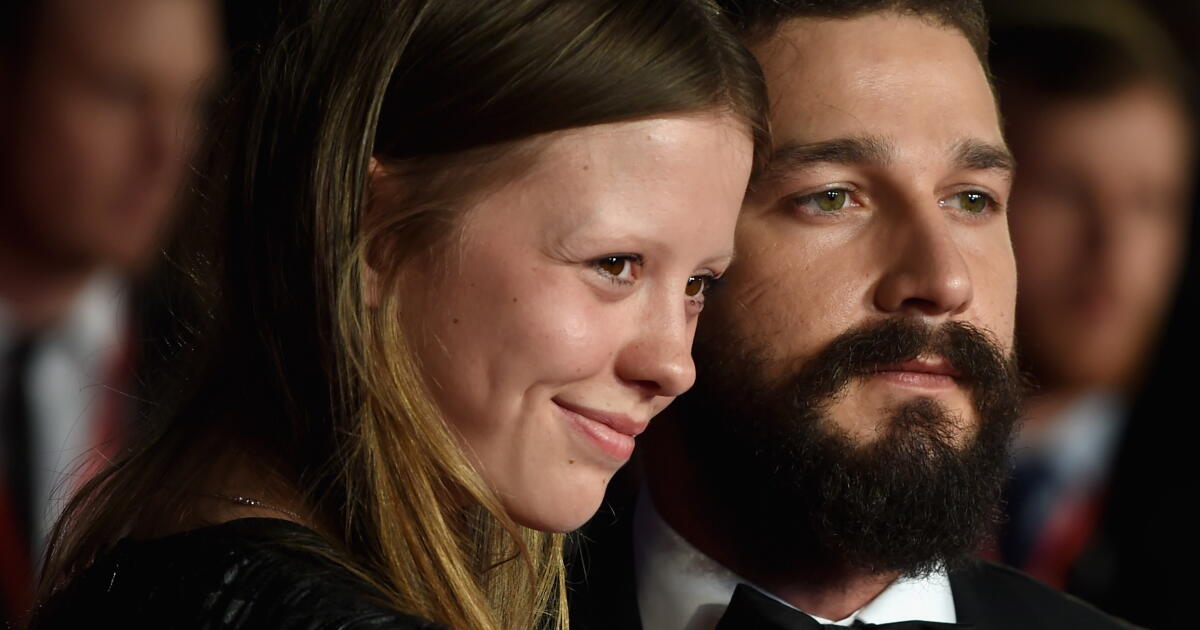
Horror star Mia Goth is ending her marriage to Shia LaBeouf just days short of their 10th wedding anniversary.
Goth, star of Ti West’s “X” trilogy, on Tuesday filed her petition to divorce “Peanut Butter Falcon” and “Honey Boy” actor LaBeouf in Los Angeles Superior Court. According to the petition, the estranged spouses married Oct. 10, 2016 but separated in July 2025. The petition confirms reports from earlier this year that the actors were on the outs.
Goth, 32, and LaBeouf, 40, share a 4-year-old daughter born March 2022, according to the petition. Neither representatives for the actors immediately responded on Wednesday to a request for comment.
The “Odyssey” actor filed her petition a day after LaBeouf’s ex-girlfriend FKA twigs brought her latest lawsuit against the former Disney Channel star to a close.
LaBeouf, who had an off-and-on relationship with Goth since their marriage, began dating FKA twigs, legal name Tahliah Barnett, in 2018. Barnett first sued LaBeouf in 2020, claiming she was subjected to frequent episodes of verbal and emotional abuse that escalated into physical assaults by the “Transformers” actor. She also accused LaBeouf of “knowingly infect[ing]” her with a sexually transmitted disease. The exes settled that case with prejudice last year but it returned to a legal spotlight in March.
The Grammy-winning “Eusexua” musician sued LaBeouf, alleging he “sought to silence her” from speaking out about his alleged abuse via an NDA which she claimed violated California law. Barnett on Monday notified the court that she and LaBeouf settled their case, noting that her ex “has agreed that the non-disclosure provisions (NDAs) contained” in the 2025 settlement “are terminated and void.”
LaBeouf faced additional legal turmoil for his arrests in February after his involvement in a Mardi Gras brawl. He pleaded guilty to three counts of simple battery in June.
Goth also faces legal issues. The British star was sued for battery in a 2024 lawsuit that accused her of “intentionally and willfully” assaulting and kicking an actor in the head while filming “Maxxxine” in 2023. Goth was sued alongside director West and movie studio A24. That case is ongoing and a jury trial is scheduled to begin April 17, 2028, according to a court order filed Monday.
A couple of years ago, in a column about Father Greg Boyle, I noted that he is quite particular and even a bit preachy about the right way to eat a steak.
It should be medium rare, never well-done, and served with a proper elixir.
Doors drummer John Densmore took note. One thing led to another, and in July, Densmore, Boyle, former Times reporter Greg Krikorian and I went to dinner at the Smoke House in Burbank.
We did not necessarily follow Boyle’s meat and beverage protocols, but we jabbered away in a red leather booth, and a good time was had by all.
Then, in August, I got an email from Boyle.
“John walks into the Homeboy Art Academy,” he wrote, “and starts jamming as the homies are playing ‘Stand By Me.’”
Boyle sent a short video, and there’s Densmore, still keeping perfect time at 81.
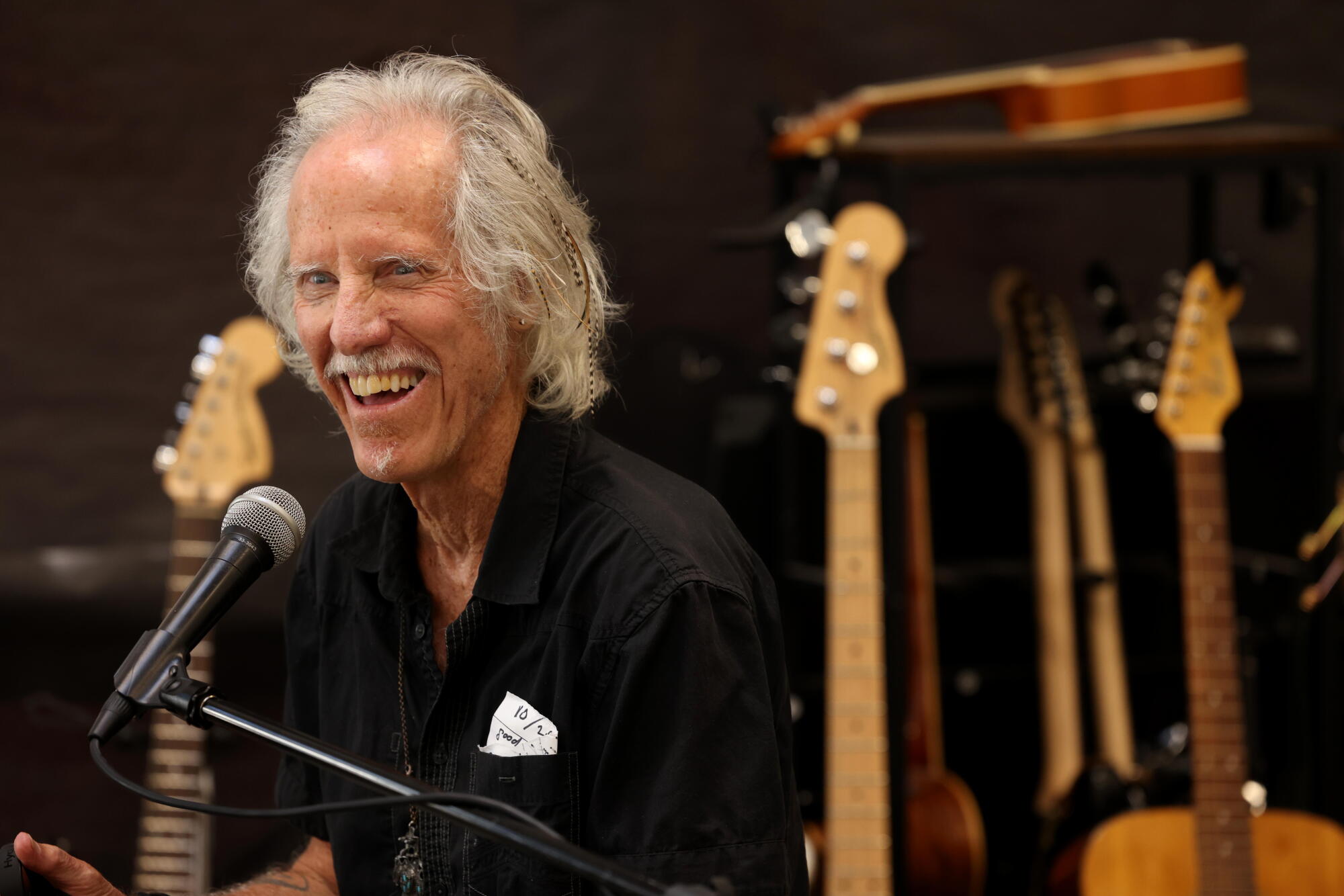
John Densmore enjoys an upbeat moment while teaching a music class at Homeboy Art Academy.
I wasn’t surprised. Densmore’s a busy guy, with various charitable causes and artistic ventures. He and former Public Enemy rapper Chuck D just fused music genres on an album called “No Country for Old Men.” But he’s an admirer of Boyle and his decades-long mission of gang intervention and rehabilitation.
“Hey,” Densmore told the musicians he played with that day, “maybe I can do something here.”
He suggested that he return and stage a music workshop or a drum circle.
They said of course.
On Wednesday, before the music began, Densmore insisted that I see the Homeboy Art Academy, whose founder is artist Fabian Debora.
“I grew up in the projects when Father Greg first came in,” Debora told me, referring to Homeboy’s early days in the 1980s, when Boyle was pastor of Dolores Mission Church in Boyle Heights. “Through the arts, I found my way to healing and transformation. Then I said, ‘How can I fulfill a need that was missing in my life?’”
The answer is the academy he now runs with Dre Comers, located near Metro’s Chinatown station, providing art instruction to tens of thousands of people. On Wednesday, teachers were busy helping students with artwork in various stages of completion, including a painting of Boyle with a halo.
Most of the participants are young adults, many of whom were born decades after the Doors’ last album was released. One student, in his 20s, welcomed us and asked Densmore what he was known for.
“I’m a drummer,” Densmore said.
He was known to far more people in the music room, including longtime musician/instructors Joe Calderon and Martin Flores. They’re part of the Young Musicians Foundation’s Music Heals program, funded in large part by legendary songwriter Mike Stoller, who co-wrote dozens of hit songs including “Jailhouse Rock,” “Hound Dog,” “Poison Ivy” and “Stand by Me.”
The latter song appears on a brand new “Music Heals” album designed by art academy participants and released Tuesday, so with Densmore’s arrival on Wednesday, it was a big week for Homeboy arts.
“When you’re playing music,” Densmore told about 30 students and instructors, you can enter a state of timelessness. “It’s kind of like a meditation … A little bit of infinity creeps in … And everybody can get into that space. If you want to be a professional musician, cool. If you wind up playing the piano in a closet and nobody hears it, you’re still getting into this space that kind of heals and feeds you.”
And then it was concert time, with Densmore on drums and instructors Calderon on guitar, Flores on percussion and Mackenzie Azela on bass. Fabian Debora Jr. (bass and vocals) and Ralph Quintero (vocals) are both in the Homeboy rehabilitation program.
The band kicked off with a blues number called “Got My Mojo Working,” then it was Ben E. King’s “Stand by Me” followed by Cream’s “Sunshine of Your Love.”
It all went off pretty smoothly for a group that hadn’t worked together except for a quick minute on Densmore’s previous visit. The musicians were smiling, the spectators tapped and clapped, and that magical sense of timelessness was real, spanning multiple generations.
In a place filled with people confronting the challenge of rebuilding their lives, the lyrics of one particular song were a reverie.
No, I won’t be afraid.
Oh, I won’t be afraid.
Just as long as you stand by me.
Doors drummer John Densmore, right, leads a jam session while teaching a music class at Homeboy Art Academy in downtown Los Angeles.
Debora Jr., 27, told me it was pretty cool to be playing with a member of the Doors, a band he knew about through his elders. Quintero, 50, who is studying psychology and wants to be a drug counselor, said he still couldn’t believe he had just performed with a member of the Doors.
“It’s an honor,” he said.
Everyone in the room grabbed either shakers or a small drum, and with Densmore instructing and conducting, the ensemble conjured what he called the heartbeat of Mother Earth. The music rose and fell, rose and fell as the players became one, followed by an orchestrated hush that served as a silent accent.
“Like sex,” Densmore said.
He moved on to a brief Q&A, and one of the first questions was about what it was like to be around Doors lead man Jim Morrison.
“I miss his artistry,” Densmore said. “I don’t miss his self-destruction. So I’m 81. He died at 27. And there’s different ways to do this. Hopefully you guys will keep on breathing like I am.”
As Densmore packed up his things, a young man named Jeremiah asked the drummer if he’d record a short video for the family of his girlfriend. She had just lost her grandfather, a longtime Doors fan.
“That was their go-to music, every car trip,” Jeremiah said.
He sent the clip to his girlfriend and asked her what the family’s favorite songs were. “Riders on the Storm” was one. Along with “Break on Through,” “Touch Me,” and “L.A. Woman.”
John Densmore, right, congratulates musicians Joe Calderon, from left, Fabian Debora Jr., with bass, and Ralph Quintero after they performed.
At Homeboy, Boyle’s mission has been twofold, in a sense. To show love to his charges while preparing them for lives unlike the ones they’ve known. And through his books and teachings, to remind us all that we belong to each other.
There was a bit of that gospel in the note that Flores, program director at Music Heals, sent Densmore after his visit. He thanked him, telling Densmore he had “provided our students with not only an incredible artistic experience, but also a deep sense of connection, inspiration and hope as they navigate their journeys.”
Densmore answered immediately.
“I think I might have gotten more out of it than I gave.”
Next year, the Los Angeles Chamber Orchestra — an intimate, 42-player group compared with the more than 100-member Los Angeles Philharmonic — will warm its new home, the highly anticipated, Frank Gehry-designed Terri and Jerry Kohl Hall. And it will do so with the help of a little light music: fanfares commissioned from half a dozen preeminent film composers — John Williams, Ludwig Göransson, Joel McNeely, Thomas Newman, James Newton Howard and John Powell — curated by none other than Seth MacFarlane (best known as the creator and star of “Family Guy”).
The buzzwords are lighting up, but this is far from a game of performing arts Mad Libs; it’s actually quite intentional. “We really thought about … ‘What statement can we make to Los Angeles and to the performing arts world that really shows who we are?’” said LACO Executive Director Ben Cadwallader. “Who is the Los Angeles Chamber Orchestra, specifically? And it really was this tie to Hollywood, to Los Angeles, to our musicians themselves.”
MacFarlane was a natural fit.
“I loved movies and I loved movie music,” MacFarlane said of his childhood in a recent interview. “I would go to the record store and buy the latest John Williams soundtrack, which was usually out before the movie was released. I remember buying the ‘Jurassic Park’ soundtrack not having seen the movie, and it didn’t matter. It was just great music. It was just great, symphonic music.”
LACO was founded by an assemblage of musicians and civic leaders in 1968, including the cellist James Arkatov. After emigrating from Russia as a child, Arkatov became the principal cellist at the Pittsburgh and San Francisco symphonies before landing in L.A. He arrived as a Hollywood studio musician, played on movie soundtracks and did backing for Ella Fitzgerald.
From the beginning, LACO served as “the artistic outlet of studio players … these incredibly gifted musicians who bring our movies and TV shows to life,” said Cadwallader, a situation that remains true to this day. LACO’s musicians know it’s “a place where they can play … Bach and Mozart, and make music at a really high level in a performance environment, not a studio environment.”
This is why the christening of LACO’s new home is also a homage to its roots: film composers. These giants of their fields will each write a spry, five- to seven-minute-long fanfare as openers for select LACO concerts throughout the season. (The works will also be performed at the Wallis Annenberg Center for the Performing Arts, with John Williams’ piece arriving first, in fall 2027.)
MacFarlane knew just what to do, thanks to his long history with music. The actor, animator, filmmaker and comedian has released 10 studio albums, received five Grammy Award nominations and performed as a vocalist at the Hollywood Bowl and Carnegie Hall. (He also just released a 14-track album called “Seth MacFarlane Sings the Muppets.”) Plus, his parents raised him steeped in music.
Nothing has changed here — throughout his career, MacFarlane has been relentlessly committed to including live music in his projects. The musical numbers on “Family Guy” simply couldn’t (and wouldn’t) exist without an orchestra.
“It would somehow feel thin and hollow, and people may not know why their attention is drifting, but it would drift,” MacFarlane said. “I really think you need the muscular sound of 60 musicians in a room, and in the case of ‘The Orville,’ sometimes 90. … Hollywood has been doing it since pictures went to sound, and I hope they continue to do it for as long as we make film and television.”
MacFarlane noted that the only time many people actually hear a live orchestra is in film or television.
“I don’t know how many people go to the symphony,” MacFarlane said. “So that’s certainly a component. When I was a kid, even the syndicated afternoon cartoon shows used a live orchestra, and when you go back and you listen to them, oftentimes it’s pretty legit composing. And I think that was important to have heard. I think it’s just good for the brain to hear complex symphonic music.”
Composer, conductor and longtime MacFarlane collaborator Joel McNeely (whose wife, Margaret Batjer, is LACO’s concertmaster) got MacFarlane involved in this commissioning initiative. Then MacFarlane selected the participating composers (and supported the initiative financially). One final Mad Lib to solve: What exactly, you may be wondering, is a fanfare?
“The perfect example … is the beginning of ‘Star Wars,’” Cadwallader said, then hummed the intro. “There’s big, loud brass. You cannot help but pay attention. … It puts a smile on your face. It maybe gets your heart racing a little bit. It’s usually very rhythmic, very bright. It’s like a big warm smile, or like a popping of a Champagne cork, to start a concert. … A bursting, effervescent moment of music to get things started. An amuse-bouche, if you like.”
Two years ago, the biggest record labels took artificial intelligence music generators to court for copyright infringement. Now several of them are licensing their catalogs to those same companies, and the deals are starting to turn into products.
The latest example came earlier this month, when Suno, an AI music company valued at $5.4 billion, released its first models built with licensed music from Warner Music Group, BMG and Believe. Rival Udio has licensing deals with Universal Music Group and Warner.
The companies are pitching AI as a new revenue stream for artists. But so far, none of them have disclosed what artists will be paid, how many artists have opted in, or how much input individual musicians have over whether their work is used. And some musicians and songwriters are fearful of how these AI deals might affect livelihoods.
“It’s sort of a creepy and ominous cloud,” said Matt Evans, a 35-year-old Pasadena resident who’s played brass instruments on shows like “The Late Late Show With James Corden” and Netflix’s “Dr. Seuss’s Red Fish, Blue Fish.” “The fact that I could do something once and then it could be reused, and if that’s not negotiated in a contract, then I never got to make a choice to receive additional compensation. It all comes down to the loss of money.”
The American Federation of Musicians sued Universal and Warner in June, alleging the labels licensed recordings its members played on to Suno and Udio without paying those musicians or telling the union which recordings were involved. The labels have moved to dismiss the case.
In 2024, Universal, Sony Music Entertainment and Warner sued Suno and Udio for copyright infringement, alleging the AI companies trained their models on copyrighted songs spanning many artists, genres and time periods. The settlements began the following year. Universal settled with Udio in October and became its partner, and Warner settled with both Udio and Suno in November, signing licensing deals with each.
“The reason why they would settle this is they think they’re going to profit more from licensing music to them rather than from the outcome of a lawsuit,” said Jane Davidson, an entertainment attorney at Nolan Heimann who specializes in copyright and trademark infringement.
More deals followed. Udio signed with Merlin, which licenses music on behalf of independent labels, and with independent publisher Kobalt. Suno signed with BMG in August and with Believe, owner of the DIY distribution platform TuneCore, this month. Spotify, which wasn’t part of the lawsuits, struck deals with Universal and Merlin.
Not everyone is settling. Sony filed a second lawsuit against Udio over more than 30,000 recordings, and it is still suing Suno alongside Universal, which is licensing its music to Udio and Spotify at the same time. Sony and Universal also filed a new lawsuit last week alleging that Suno’s latest model still infringes on their copyrighted works. In July, a Munich court ruled against Suno in a case brought by GEMA, which collects royalties for German songwriters and publishers.
The deals between labels and AI music platforms — on which consumers can create full songs from text prompts — share a basic promise. Artists signed to the participating labels can opt in and will be credited and paid.
But each company is building something different. Udio operates under a “walled garden” model favored by Universal, in which songs made on the platform can’t be downloaded or distributed elsewhere. Spotify’s tool, a planned paid add-on for Premium subscribers, has no launch date. Suno lets users download what they make and release it elsewhere, with download caps and watermarks meant to curb abuse; songs made with its new models can be distributed through Believe and TuneCore.
Whether an artist opts out depends on who owns the rights. Songs typically carry two copyrights — one for the composition, usually held by songwriters and their publishers, and one for the sound recording, usually owned by the label. Every contract is different, so it’s unclear how AI products will handle music where those rights are split.
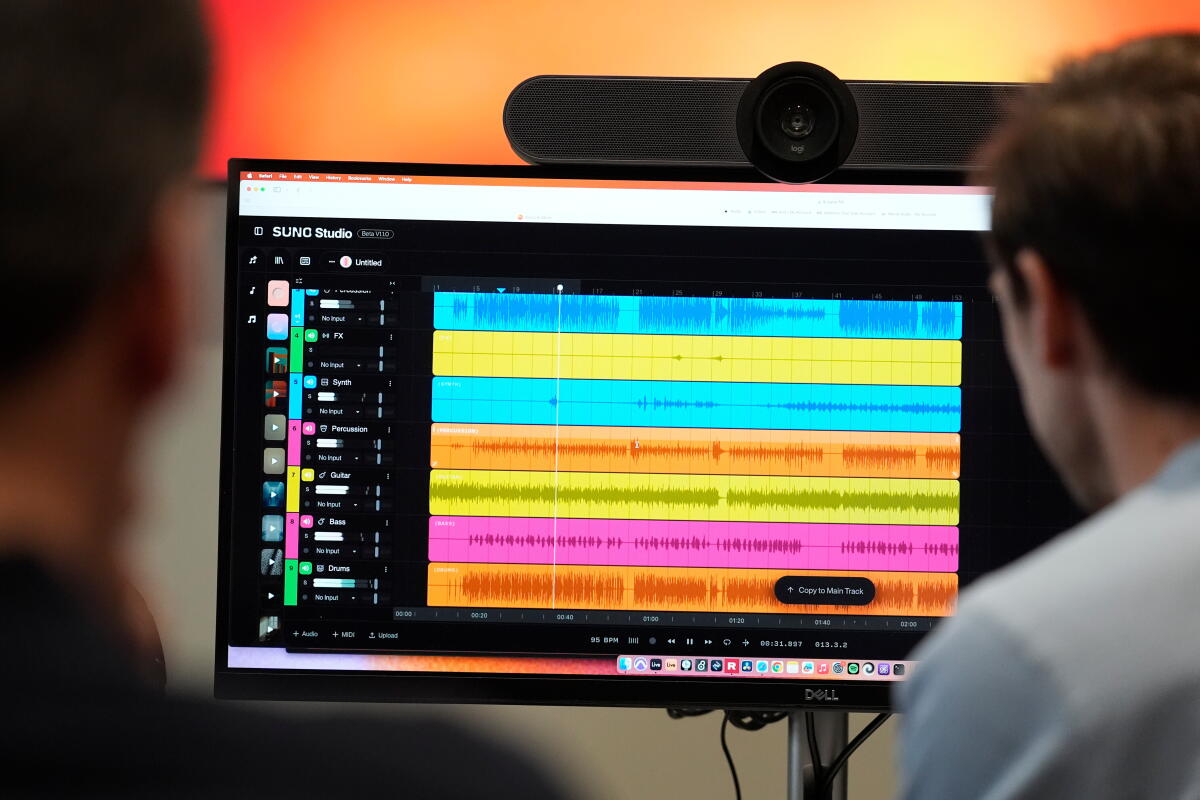
Waveforms of audio files from various instruments are displayed on a computer screen during the making of an AI musical piece at Suno.
(Robert F. Bukaty / Associated Press)
“These companies are able to make deals on behalf of their artists, and their control over their music is pretty significant based on what major label contracts typically say,” Davidson said. “But I expect that we will have some artists that push back against this and say that they didn’t authorize the use of their music for this purpose.”
Warner’s agreement with Suno, for example, lets artists opt in to having their names, likenesses, voices and compositions used in AI-generated music. But Jack Brody, Suno’s chief product officer, acknowledged that labels “ultimately have their contracts in place that will have some say in what an artist can and can’t do.” It’s also not always clear whether opting out keeps an artist’s recordings out of AI training, or only out of fan-facing features.
Michelle Lewis, a songwriter and the co-founder and chief executive of the nonprofit Songwriters of North America, said the composition side of that copyright split is often the harder one to defend.
“With AI, it’s so much easier to tell if you’ve infringed on the sound recording. You know what Beyoncé and Drake’s voices sound like,” said Lewis, who wrote Cher’s “A Different Kind of Love Song,” Little Mix’s “Wings” and the music for the Disney Jr. show “Doc McStuffins.” “But songwriting is so much more nebulous, so much harder to sue.”
“From the creator side, nobody asked for this. We like our job,” added Lewis. “The job is the process and what makes it special, interesting and artful.”
Some musicians argue the deals can’t cover rights the labels don’t control. A proposed class action filed last month by Jason Isbell and other musicians alleges Suno lets users generate songs that evoke specific artists’ identities without their consent, a right-of-publicity claim the plaintiffs say belongs to performers no matter who owns their recordings. Suno disputes the claims.
Session musicians like Evans are pushing back through their union.
“By licensing our members’ performances to AI platforms like Suno and Udio without consent, credit, or compensation, companies like Universal, Warner Records, and Atlantic are bypassing the very human creators who made their catalogs valuable in the first place,” AFM International President Tino Gagliardi said in a statement.
The labels have disputed the claims and argue that these deals advance the interests of artists and songwriters.
Jonathan Wyner, head of artistic technology initiatives at Berklee College of Music’s Emerging Artistic Technology Lab, compared the AI deals to the arrival of streaming services. Wyner has advised Suno.
“It’s a good step, and I think it was an inevitable step, especially if you want to stay engaged with musicians and the creative community,” he said.
That comparison cuts both ways. Streaming grew the industry while fueling years of complaints about artist pay.
Damon Krukowski, a musician and the legislative director at United Musicians & Allied Workers, said the deals so far don’t seem to benefit working-class musicians and could be used to cut them out entirely.
“It’s a new technology, but it’s not a new corporate story,” Krukowski said. “But the tools are even more powerful. It seems within their possible reach to destroy the labor market. The major labels are just seeing dollar signs without any regard to the long-term health or sustainability of this industry, because they’re envisioning an industry without artists who can push back.”
Brody disputed that, saying Suno is building ways for independent and unsigned artists to benefit, such as its deal with Believe and TuneCore.
With terms under wraps, it’s too early to know whether any of this will pay off for artists. The tests are still ahead — whether Sony and Universal win or settle, and what the first payouts actually look like.
“A label making a deal and an individual artist having a choice are not necessarily the same thing,” said Drew Silverstein, the senior advisor for AI at music tech company BandLab Technologies. “Our music industry has a long history of new revenue streams coming into existence that benefit certain folks, and create great financial opportunities for rights holders.”