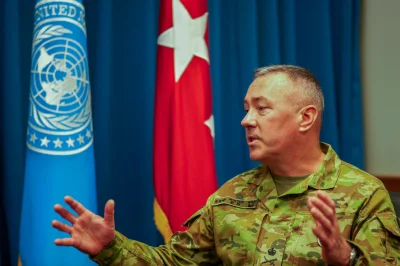

1 of 5 | Australian Army Maj.
Gen. Scott Winter, deputy commander of United Nations Command, speaks during an interview at UNC headquarters on Camp Humphreys, a U.S. military base in Pyeongtaek, on July 7. File Photo by Thomas Maresca/UPI
PYEONGTAEK, South Korea, July 28 (UPI) — Seventy-six years after the United Nations Command was established to help repel North Korea’s invasion of the South, the multinational force remains an essential pillar of stability on the Korean Peninsula, its deputy commander said.
Speaking after a July 7 ceremony marking the command’s founding anniversary, Australian Army Lt. Gen. Scott A. Winter said the command’s responsibilities have evolved far beyond its wartime origins while remaining rooted in the Korean War armistice that halted fighting in 1953.
“The United Nations Command has two key missions,” Winter told UPI at UNC headquarters on Camp Humphreys in Pyeongtaek, about 35 miles south of Seoul. “One is to enforce the armistice, which is a sacred duty that we take every day. The other is to coordinate sending-state contributions in times of crisis or conflict.”
Created by a U.N. Security Council resolution on July 7, 1950, the command brought together forces from 22 nations under U.S. leadership after North Korea invaded South Korea. More than 1.9 million service members from UNC member states served in combat, medical and logistical roles during the Korean War.
Active fighting ended with the signing of the armistice on July 27, 1953 — the anniversary of which was commemorated Monday — rather than a peace treaty, meaning the two Koreas remain technically at war. The UNC continues to oversee implementation of the agreement and maintains a rare direct communication channel with North Korea’s military.
Winter said the command still conducts routine telephone communications twice daily with the Korean People’s Army through the military hotline, also known as the “pink phone.”
“It continues to enable us to de-conflict, avoid any sort of miscalculation,” he said, citing the example of recent firefighting operations inside the Demilitarized Zone.
The milestone comes as North Korea has abandoned its longstanding policy of peaceful reunification with South Korea, accelerated development of its nuclear and missile programs and deepened military cooperation with Russia, including sending troops to support Moscow’s war in Ukraine.
Winter said North Korea’s partnership with Russia has reinforced the need for the UNC to adapt to an increasingly complex security environment and strengthen its deterrence role on the peninsula.
“The growing nexus between North Korea and Russia is a reminder for all of us of the global nature of these security threats,” he said. “It’s clear that North Korea has gained both contemporary battlefield experience and exposure to technology.”
He argued that the UNC’s multinational composition strengthens deterrence by demonstrating that security on the Korean Peninsula remains an international concern.
“The more flags that we bring together, the more we can provide multinational legitimacy during periods of peace, the more we contribute to deterrence,” Winter said.
Despite renewed efforts by South Korean President Lee Jae Myung’s administration to reduce tensions with Pyongyang and eventually pursue a formal peace regime, Winter said the command would continue to have a role even if the armistice were someday replaced.
“Having a ready-made coalition prior to a crisis is much easier than trying to pull a coalition together in crisis or conflict,” Winter said. “I absolutely believe that the best way to prevent conflict is through that multilateral working together.”
He added that the armistice itself was designed to create conditions for a political settlement rather than become a permanent arrangement.
“The armistice was put in place to ultimately create the space for a political solution,” he said. “We welcome any moves in that direction.”
Reflecting on the anniversary, Winter said the command’s history offers lessons that remain relevant as conflicts continue in Europe and the Middle East.
“Seventy-six years ago, nations came together because they understood that’s what it would take to prevent further aggression,” he said. “The importance of multilateralism, the importance of building coalitions of the willing with like-minded countries, because the alternative is unthinkable.”