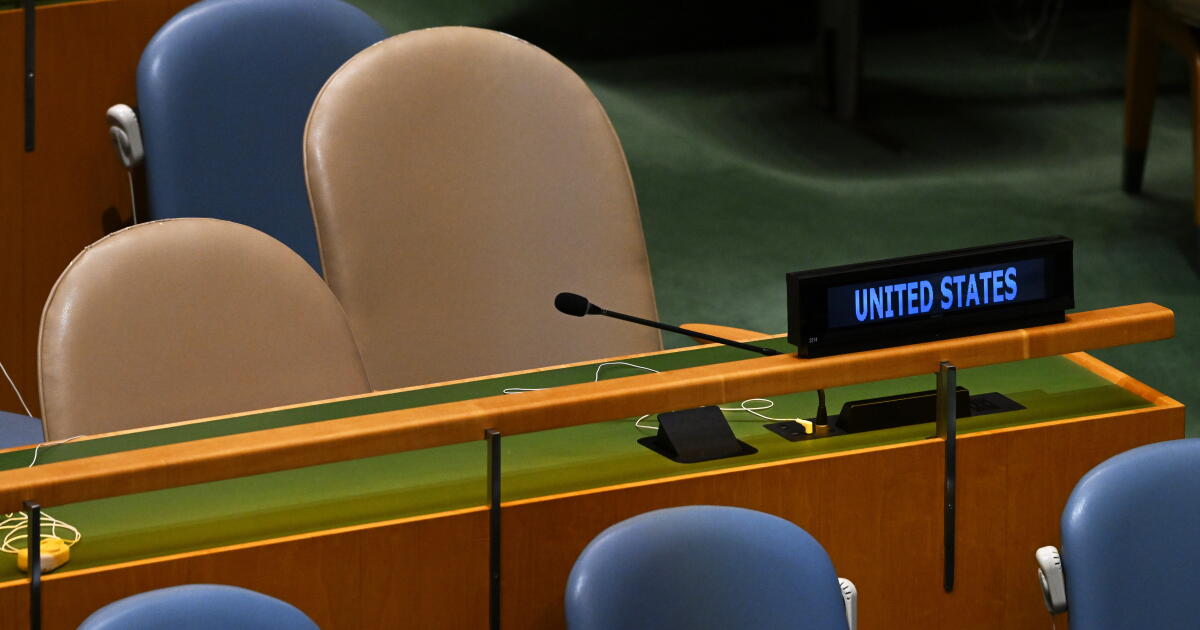
President Trump might not look smaller, but he is.
At home and abroad, among a significant majority of Americans that includes increasing numbers of Republicans, as well as in the eyes of foreign leaders, the president of the United States is shrinking by the day into a hapless peacock, a cartoon figure posting comic word balloons at all hours on the falsely labeled Truth Social network or bloviating for the (fewer and fewer) cameras by day.
Consider Trump’s losses and humiliations just over the past week:
But for the U.S. and Israeli delegations, formerly deferential diplomats at the United Nations mostly sat on their hands for Trump’s boastful and bullying annual address on Tuesday; at one apparent applause line, he seemed to pause for claps that didn’t come. The Federal Reserve raised interest rates over his objections (its hand forced by the inflation Trump’s tariffs and war have caused). The usually compliant Supreme Court killed his rule against mail ballots for the midterm elections. A federal judge blocked Trump (again) from putting his name on the Kennedy Center. Daily it seems, news stories quote once-supportive truckers and farmers breaking with him over the cost of fuel.
There’s more: A long-loyal Florida Republican, Rep. María Elvira Salazar, aired a campaign ad telling Trump that his immigration policies have gone too far and Latino supporters “feel betrayed.” Republican Senate candidates in Iowa and Michigan demanded that Trump end his stalemated war against Iran. The Republican chairman of the Senate Armed Services Committee berated Trump on the Senate floor for kowtowing to China’s President Xi Jinping with this week’s state visit. And a Republican senator from Nebraska urged an investigation of Donald Trump Jr. over his business dealings and his recent wedding that a Russian oligarch bankrolled.
Sure, Trump still has unprecedented control over his party; he only recently ended several Republican officeholders’ careers by endorsing their foes in party primaries. But the primaries are over. More Republicans by the day are trying to distance themselves from a president who’s setting records for unpopularity with just about each new poll. CNN’s latest, conducted last week, found that two-thirds of Americans disapprove of Trump’s job performance and believe, contrary to Trump’s claims, that the United States is losing the war against Iran. In another poll, from Fox News, two-thirds of voters said Trump had made the economy worse.
On the foreign stage, as evidenced by Trump’s failed applause lines at the U.N., leaders no longer compete for ways to play to his vanity. Instead, some are forming workarounds to achieve their policy ends without the conspicuously absent United States — on defense, trade, climate change and more. They’ve learned to discount his empty hyperbole, which is why there wasn’t a collective eruption at the U.N. on Tuesday when Trump suggested he might “annihilate” Iran.
To be sure, many don’t doubt he’s capable of that war crime. In fact, in the same address, Trump included among a number of false boasts one that’s all too real: about U.S. military strikes against small boats in the Caribbean and eastern Pacific that have killed numerous people — 234 to date — whom the administration claims, without evidence, to be drug-runners. These are illegal extrajudicial killings — actual war crimes.
Alas, as president, Trump might be a smaller man, but he retains a “crazy” amount of power, as he gushed himself last Thursday to an audience in the Mar-a-Lago’d Rose Garden. Why, he could even ban fishing and put Bass Pro Shops out of business, he told the billionaire founder of the chain.
That’s not true, but the wannabe autocrat has done plenty that the Constitution and federal law don’t allow a president to do, besides the Caribbean killings — like starting a war without Congress, wiping out entire federal programs authorized by law, demolishing a whole wing of the White House and banning specific news organizations because he doesn’t like their coverage.
Also, any inclination to relish Trump’s self-diminishment should be offset by the fact that he’s simultaneously diminishing the country’s stature and leadership in the world, in ways that could well outlast him. Longtime allies in Canada, Europe, Australia and Asia, in a break from the 80-year-old postwar order that the United States built, are forging new ties among themselves, separate from the newly unreliable United States and a president who is often hostile to allied leaders and openly enamored of dictators in China, Russia and elsewhere.
“To the victor belong the spoils,” Trump crowed to the U.N., in bragging about the United States’ confiscation of Venezuela’s oil and oil revenue since taking over the country in January. The U.S. president thus embraced, before a global audience, the very approach that his country and its postwar allies had rejected in building a new world order that included the U.N.
This week in celebrating China, which along with Russia provides assistance to Iran against the United States, Trump continues his abasement of himself and the nation.
After he’d visited Beijing in May, Trump actually declared China a co-superpower with the United States. “It’s the two great countries. I call it the G-2,” he told Sean Hannity on Fox News. Imagine Hannity’s conniption, and Republicans’, had Presidents Biden or Obama so forfeited America’s singular standing as the world’s superpower. And now, Trump is giddy about hosting Xi for a state visit with all the trappings. Rather than wait for Xi at the White House, as he typically greets visiting leaders, on Wednesday the eager Trump insisted on meeting Xi’s plane at Joint Base Andrews in Maryland for a red-carpet welcome.
In May, China’s Communist Party-controlled newspaper said Trump arrived in China as a “giant with a limp,” crippled by an Iran war then in its third, indecisive month.
Four months later, that war drags on, depleting U.S. stockpiles and defenses, including against an expansionist China. And Xi meets a man who’s no longer looking like a giant.
Bluesky: @jackiecalmes
Threads: @jkcalmes
X: @jackiekcalmes