Most of the victims were from the Daraj neighbourhood in Gaza City, the Health Ministry says.
Published On 18 Oct 202618 Oct 2026
A mass funeral has been held for 75 Palestinians whose remains were found recently under the rubble of homes and buildings destroyed in the months since Israel launched its genocidal war on Gaza in October 2023, the Ministry of Health announced.
Hundreds of Palestinians attended the funeral procession before the remains were buried at the Sheikh Radwan Cemetery on Sunday morning.
Recommended Stories
list of 3 itemsend of list
Most of the victims were from the Daraj neighbourhood in the northeastern part of Gaza City.
Al Jazeera correspondent Nour Khaled said the majority of the remains belonged to women and children “who were inside their homes when they were targeted”.
The remains consisted of some body parts and personal belongings and were wrapped in Palestinian flags before the burial, she said.
Abdullah al-Majdalawi, director of public relations and media for Gaza’s Civil Defence, told the Turkish state news agency Anadolu that the remains had been recovered over recent weeks from several destroyed homes in Daraj.
He said the buildings were bombed while residents were inside during the early months of the war and that the victims belonged to about 20 Palestinian families, including people who had been displaced to the homes.
Efforts to recover bodies from beneath the rubble continue to face severe difficulties due to a lack of equipment and heavy machinery, he added.
The Civil Defence launched the second phase of its recovery operations in July. It recovered 333 bodies and remains of 559 people during its first operation in November 2025.
The Civil Defence says it believes the remains of another 8,000 Palestinians are still trapped beneath the rubble across Gaza. There are about 200,000 damaged and destroyed buildings in Gaza, according to the UN agency for Palestinian refugees, UNRWA.
At least 74,475 Palestinians have been killed since Israel launched the genocidal war three years ago.
A Sibos poll found that more than half of companies lack granular visibility into their AI use.
Many financial firms struggle to measure the return on investment of their AI deployments because they lack visibility into AI resource consumption, according to a panel poll at Sibos 2026 in Miami.
At the heart of the matter are AI tokens, the basic unit of text used by large language models and the primary metric AI model providers use to measure client usage.
Nearly two-thirds (61%) of poll respondents reported having little or no visibility into AI token usage within their organization, even though they understood their overall AI spending. Only 13% of respondents reported having detailed visibility and actively managing costs at the token/model level.
“Some clients and partners that we worked with have told us horror stories where they let everyone go crazy with this stuff and build their own agents only to be left with a $100 million bill after a few months,” said Melissa Tuozzolo, global head of client services at HSBC, during a Sibos 2026 panel in Miami.
Calculating AI ROI
Understanding AI token cost and usage matters, but it’s not the only factor in calculating ROI for AI-powered projects, said co-panelist Isabel Schmidt, executive platform owner, payments enablement at BNY.
“There’s obviously still a lack of clarity in many organizations around the actual individual cost of tokens,” she said. “But we also need to be very careful to not get pulled into that rabbit hole or what a particular token costs because, in the end, AI is not a goal itself. The ultimate question is: How much does that business process cost me?”
In addition to token cost, organizations need to consider related costs associated with data governance and cleaning, upgrading existing systems, and deploying new technology, Tuozzolo added.
The industry is in an era when pretty much everything being built has an AI component, said David White, global head of product and data at LSEG and a panelist. “I encourage my product teams and others to think in terms of this as just another technology to help deliver value to the customer.”
AI Value-Add
BNY’s Schmidt sees AI’s primary value as improving an organization’s efficiency, effectiveness, and capacity
“There has been a lot of dialogue around the efficiency part of what AI can contribute to our businesses and processes since you can automate processes much, much more easily than maybe we could even a year or two ago,” she said. “It also forces us to think more clearly about some of the others.”
In terms of effectiveness, HSBC deployed an AI-powered “air traffic control” system that directs client queries to the proper expert or teams about six months ago. It reduced first-response time for clients in certain markets by 10 hours. Prior to that, “we had used people that manually take in queries from clients and triage them,” said Tuozzolo.
Other AI deployments within the bank have freed up processing capacity and allowed it to be reallocated.
“Historically it’s always been that when our transaction volumes go up, our costs go up from an investigation and service standpoint,” she said. “As our volume goes up, the number of queries also goes up. This is the first year in a few years that we’re actually seeing it go the other way.”
Tuozzolo attributed these gains not only to AI, but also to HSBC’s investment in a cleaner data layer.
Meanwhile, Sumitomo Mitsui Banking Corp. (SMBC) is deploying an AI-powered call center that will process calls at 70% of the older model’s cost.
“We are seeing most of this cost for the IT project consisting of the AI tokens, but we are seeing a positive ROI,” said panelist Kazuya Ikeda, senior executive manager at SMBC.
Nonetheless, he cautioned that not all value-add for clients leads to economic value. “If other peers are doing the same thing, then it’s not necessarily creating relative value for clients,” he said.
The emperor is a symbol of Bulgarian national identity whose repatriation stoked tensions with Greece.
Published On 3 Oct 20263 Oct 2026
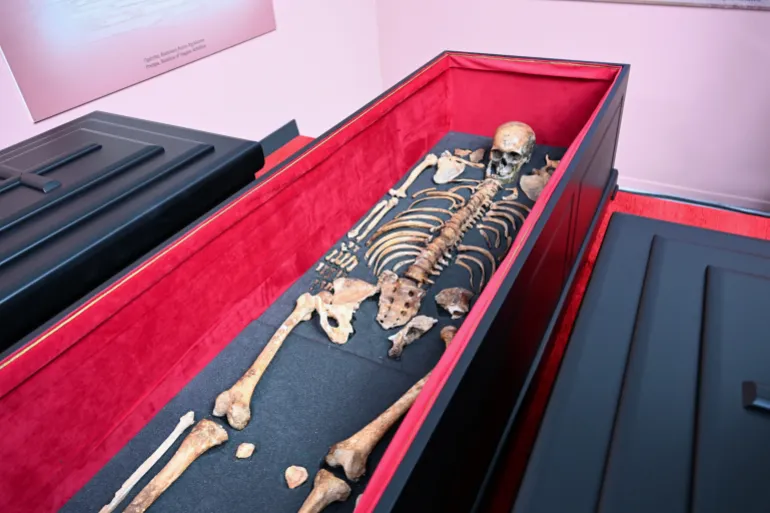
More than 1,000 years after his death, the remains of medieval ruler Czar Samuel have arrived in Bulgaria.
A symbol of Bulgarian national identity, Samuel was a warrior emperor who battled the Byzantine Empire to expand his kingdom before suffering defeat and dying soon after in 1014. His supposed remains were discovered in a Greek border area in the 1960s.
Recommended Stories
list of 4 itemsend of list
The coffin and remains were flown on Saturday to the Bulgarian capital, Sofia, on board a military aircraft that was surrounded by air force fighter jets.
Thousands of people poured into a public square to honour the czar’s arrival, which capped years of fraught negotiations between Bulgaria and Greece until an accord was reached this week.
Bulgarian politicians across the spectrum paid tribute to the medieval ruler, listening to the national anthem and a 21-gun salute.
“Today, we Europeans are learning to read history with a desire to belong not only to our homeland, but also to the culture that unites us across the entire European continent,” Bulgarian Prime Minister Rumen Radev said.
“That is why Europe must not reopen old wounds but must work for peace as the supreme good,” Radev continued, referring to the centuries-old rivalry between neighbouring Greece and Bulgaria.
Crowds cheered as fighter jets performed a flypast.
Martin Nestorov, a 42-year-old software engineer, told the AFP news agency he attended the ceremony “to welcome Czar Samuel back to Bulgaria, where he belongs”.
“I am here because I am Bulgarian, and a Bulgarian is returning to his homeland,” added Tsanka Zlatkova, 65, a retired art historian.
A procession brought the remains to be laid in the Church of Saint Sofia, a sixth-century basilica that is the capital’s namesake and where church officials say Samuel was baptised.
The remains of medieval ruler Czar Samuel inside a coffin Saturday, October 3, 2026 [Giannis Papanikos/AP]
Competing claims
The handover of Samuel’s remains is part of a broader accord between the Greek and Bulgarian culture ministers.
In exchange, Greece is slated to receive 48 objects that Bulgarian troops pillaged from churches and monasteries in Greece during World War I.
Speaking before the handover, Greek Prime Minister Kyriakos Mitsotakis said he hoped the ceremony would boost Greece’s campaign to repatriate the Parthenon Marbles, a collection of 2,500-year-old marble sculptures taken from the Acropolis in Athens and later displayed in the British Museum.
“The global community is essentially re-evaluating its longstanding stance on protecting cultural heritage,” Mitsotakis said, adding that historical heirlooms “cannot be treated as the spoils of war”.
Bulgaria is not the only country to have claims on Samuel. A huge statue of the czar stands in the North Macedonian capital of Skopje, with Macedonians claiming him as “their” ruler.
In 2022, a bilateral commission recommended presenting Samuel as the head of a state that “most contemporary historiographers consider to be the Bulgarian Empire”, based in what is currently North Macedonia.
Coffins containing the remains of those killed will be carried in a funeral procession involving family members.
Published On 1 Oct 20261 Oct 2026
Palestinians are preparing to bury the remains of 105 people killed in a devastating Israeli attack on Gaza City in October 2023.
The victims were killed in a series of Israeli air strikes involving at least 20 bombs that levelled the seven-storey Al Taj 3 building and destroyed several other residential buildings in the Yarmouk Square neighbourhood on the afternoon of October 25, 2023.
Recommended Stories
list of 3 itemsend of list
Coffins containing the remains of those killed will be carried in a funeral procession involving family members on Thursday, the General Directorate of Civil Defence said.
The remains will be buried in the Sheikh Radwan cemetery, northwest of Gaza City.
Gaza’s civil defence said the recovery operation was carried out in coordination with an Egyptian committee.
Al Jazeera correspondent Ibrahim Khalili, reporting from Gaza City, said the recovery operation was the fifth largest of its kind since Israel launched its genocidal war against Palestinians in Gaza in October 2023, in terms of the number of bodies recovered.
Civil defence operations director Abdul al-Majdalawi said it had been “impossible” to reach the bodies at the time of the attack.
“Bulldozers, excavators and other heavy machinery used by civil defence teams in Gaza were directly and deliberately targeted,” he said.
Osama Sharaf said 37 members of his family were killed in the attack.
“We recovered some of them at the beginning of the war, and today [Wednesday] 16 more were recovered, including my father, my mother, and all of my siblings. My sister’s son was also there with them,” he said.
A Black police officer asked whether a monkey was named “Tyrone,” to the laughter of a roomful of Latino and Asian colleagues.
A Latina cop described how to inflict maximum pain: “You hit Black people in the liver — I heard they got weak livers,” she said, according to an LAPD internal affairs report.
The report said their boss, an Asian sergeant, stood by as his employees used terms like “midnight” and “chocolate, chocolate” to describe people’s skin tones.
Those were among the comments that came to light last year after an LAPD whistleblower secretly recorded his colleagues in a unit that screens police recruits.
The scandal, which has seen new developments in recent weeks, is forcing department officials to reckon with a harsh reality: Years of efforts to make the LAPD more diverse have seemingly done little to stamp out prejudice in the ranks.
For much of its history, the LAPD was a white man’s department. Aggressive tactics in communities of color fueled racial uprisings in the 1960s and early 1990s, when the beating of motorist Rodney King led to the discovery of messages similar to those in the recruitment unit tapes, with officers referring to Black men as “Buckwheat” and bragging about “busting heads.”
Under pressure from lawsuits and consent decrees, police leaders pushed to recruit more Black, Latino and Asian officers, seeking to build up trust in minority communities.
1
2
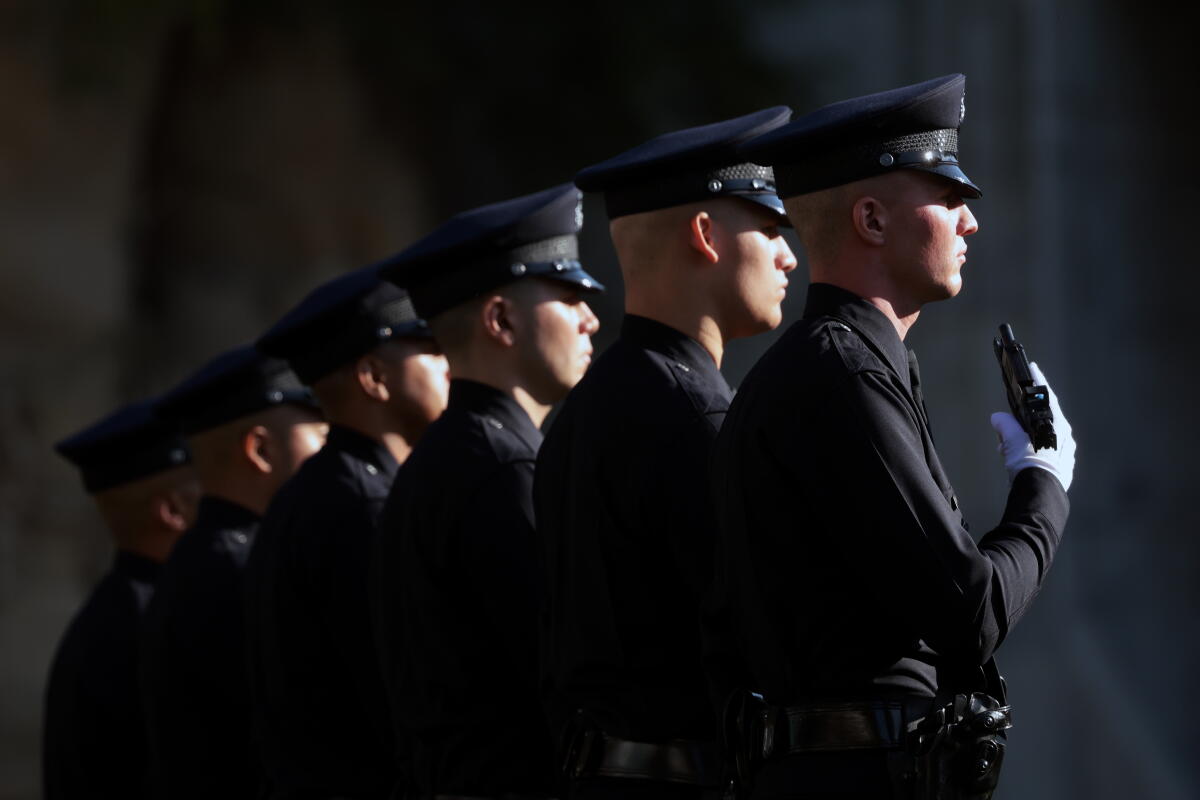
1.Los Angeles Police Department graduates a total of 22 recruits at the Los Angeles Police Academy in Elysian Park on Friday, September 18, 2026.2.(Christina House/Los Angeles Times)
Latinos now make up more than half of the 8,500-officer department. Black officers constitute less than 9% of the force, coinciding with a decline in the city’s Black population.
The officer who made the recruitment unit recordings, Daniel Flores, is Latino.
He recorded dozens of conversations over a six-month span in 2024, eventually handing them over to the department’s inspector general for investigation.
Last week, Flores filed a new lawsuit against the city, adding to a previous claim that alleged he faced retaliation from his bosses for documenting the offensive comments he heard while on the job.
According to his latest claim, department officials recommended that he be suspended for 22 days without pay. After initially seeking to keep his job with the LAPD, the 13-year department veteran said in the lawsuit that he recently decided to retire rather than endure an increasingly hostile work environment.
Flores also alleged LAPD officials were responsible for pushing a criminal case against him for violating a state eavesdropping law that prohibits recording conversations without consent. Initially alleging 16 felonies, Dist. Atty. Nathan Hochman has since reduced the charges to misdemeanors, likely allowing Flores to avoid jail time.
An LAPD spokesperson declined to answer questions about Flores’ case.
“The Department takes these allegations seriously,” Lt. Elpidio Orozco said in a statement. “Because the case and related personnel proceedings remain ongoing, we cannot discuss individual disciplinary actions or make comparisons to unrelated past incidents.”
The department’s defenders maintain that progress has been made toward rooting out bigotry.
Officers are required to undergo psychological screening and training aimed at teasing out unconscious biases. New recruits and seasoned officers alike take field trips to the Museum of Tolerance, where trainers extol the virtues of multiculturalism. The department has sent recruiters to historically Black colleges in the South and the East Coast.
But others, including civil rights attorney Connie Rice, say the latest scandal proves that the LAPD’s problems run deeper than the hateful actions of a few individuals.
The beating of Rodney King in 1991 forced a reckoning for the LAPD.
(George Holliday / Associated Press)
“Racism is like the herpes virus in the body of the LAPD: You can suppress it with a good chief, but as soon as they leave, it breaks out again,” Rice said.
A 2024 study by British researchers examined racial attitudes among members of the department’s vaunted Metropolitan Division.
The researchers found that LAPD officers were “shockingly defensive” when asked about systemic racism, taking a negative view of diversity hiring programs and insisting that left-leaning activists, elected officials and media outlets were stoking public outrage over racial profiling.
“The dismissive reactions … to a question on such an important issue highlight an unhealthy antagonism which prevents any organization from learning or developing its practice,” the researchers concluded. “It is a fundamental barrier that must be overcome.”
While hiring more officers from historically marginalized groups has long been pushed as a way to improve police practices and build trust in minority neighborhoods, studies have not necessarily borne that out, said Daniel Gascon, a sociology and criminology professor at the University of Massachusetts Boston.
“Just because there’s more numbers of a given sort in a department doesn’t mean it’s going to change automatically,” said Gascon, who has studied the LAPD’s relationship with Latino communities.
Since the start of the year, a review of recruit graduation announcements shows the department has hired just seven new Black officers. By contrast, roughly 80% of the 241 officers to graduate from the police academy over the last nine months have been Latino.
The growing Latino presence in the LAPD has been reflected in police use-of-force numbers.
A Times analysis of police shootings since 2016 found that of the roughly 150 people who have been shot dead by the LAPD across the city, at least 94 were Latino men. In 3 out of every 4 of those shootings, at least one of the officers who fired was also Latino, the analysis showed.
LAPD Officer Daniel Flores, left, listens as his attorney Alan Jackson speaks to reporters at the Superior Court building.
(Libor Jany / Los Angeles Times)
Despite the increased diversity, interviews with current and former LAPD members indicate deep divisions are reflected in the way that Black and Latino officers see the department’s racial issues. Most agreed to speak on the condition of anonymity due to fear of retaliation.
Several Black officers told The Times they still experience workplace hostility and racial dog whistles, such as fretting about the lowering of police recruit standards. The comments, they said, came from Black and Latino colleagues alike.
Too often, the Black officers said, Latinos who wear the uniform see themselves only as victims of discrimination, and not perpetrators.
Some Black officers said they avoid conversations about race entirely for fear of upsetting conservative colleagues — who feel emboldened by the divisive rhetoric coming from the White House.
The Latino officers who spoke to The Times said the department has for too long prioritized the promotion of Black members of the force to leadership roles while the representation of Latinos in the highest ranks has slipped.
Others argue that because society tends to lump Latinos of different backgrounds together, workplace discrimination against and within the community is often missed.
Officers from both groups said their race has been used against them when it comes to promotions. But both sides also say racism is a problem in society writ large, and not limited to the LAPD.
In a recent interview with The Times, Mayor Karen Bass said that although she is pleased that the department has increased the number of Latino officers to reflect the city’s demographics, its percentage of Black officers continues to dwindle as older African Americans are on the brink of retirement with very few young Black officers coming onto the job.
Bass, who was a young community organizer in South L.A. when the King beating happened, said it was foolhardy to believe that merely because the LAPD is more diverse, old problems cannot be repeated.
“Just because this happened 30 years ago and there are new policies that were put in place, that’s not enough,” she said in an interview with The Times. “You’ve gotta make sure that those policies are constantly updated.”
Times staff writers Andrea Flores and Richard Winton contributed to this report.
Dozens of mourners in Gaza grieve the loss of their loved ones as they bury the fragmented remains of relatives killed in an Israeli strike in October 2023.
Leicestershire have had eight points of their 27-point County Championship deduction reinstated but their Division One status remains in limbo.
The original penalty for breaching pitch regulations, relating to their win against Glamorgan in August, was announced on 16 September.
Leicestershire took 19 points from the match against Glamorgan – 16 for winning and three bonus points – which were removed but remain the subject of appeal.
The Cricket Discipline Panel (CDP) had applied an additional eight-point deduction, a further eight-point penalty suspended for a year, plus a £5,000 fine.
The latter two sanctions remain part of the amended decision but the eight-point deduction for this season has been waived because the docking of the 19 points for winning the game in question is considered punishment enough.
Without the 27 points being docked, Leicestershire would have finished two points above the relegation zone.
With the 19-point penalty currently in place, the Foxes are 17 points behind Essex and will be relegated if their appeal is unsuccessful.
The amended punishment comes after the Cricket Regulator raised with the CDP whether the 19-point penalty imposed, after its initial hearing, under the County Championship’s playing conditions had been taken into account when making its original decision.
A section of the County Championship’s playing conditions state that teams charged with producing a pitch rated as poor or below average, and the Cricket Discipline Panel (CDP) upholding the charge, would receive zero points from the fixture in question.
Leicestershire had already stated their intention to appeal against the panel’s decision and a statement by chief executive Emma White said the club’s position is “unchanged” by the amended decision.
SACRAMENTO — As Californians prepare to elect a new governor in November, the concern they want to be his top priority is reducing the state’s entrenched high cost of living, according to a poll by the UC Berkeley Institute of Governmental Studies and co-sponsored by the Los Angeles Times.
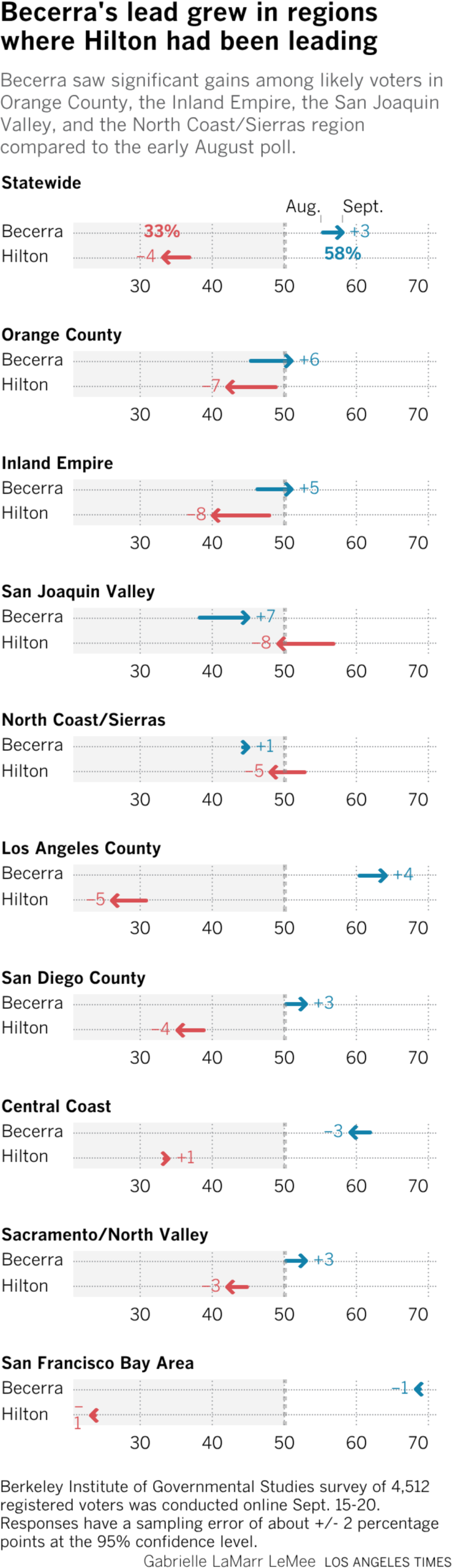
Not too far behind that is strong voter support for fighting the policies of the Trump administration. That may be among the many reasons 58% of likely voters surveyed support Democrat Xavier Becerra in the governor’s race compared to the 33% who back Republican Steve Hilton, whom the president endorsed.
“These results suggest that Becerra is in a commanding position heading to November,” said IGS co-director Eric Schickler. “With 2026 shaping up to be a strong Democratic year nationally, the headwinds facing Hilton in Democratic-leaning California are even stronger than usual.”
The poll found that Becerra’s lead over Hilton had increased slightly since an August IGS poll, and the Democrat now holds a 25-percentage-point advantage.
Despite an effort to reach out to Democrats and independent voters and making California’s high housing costs, top-in-the-nation gasoline prices and other increasing daily living expenses a central focus of his campaign, Hilton is struggling to gain ground in the race to replace Gov. Gavin Newsom, the poll found.
“The difficult thing is that Steve Hilton’s a Republican in California,” said Tim Rosales, a Republican strategist who previously advised GOP gubernatorial candidate John Cox in the 2018 race against Newsom. “On the scale of what’s more important to voters, the cost of living certainly is there, but those Democrats really aren’t willing to cast a vote or cross party lines to vote for a Republican.”
Asked to name one or two of their top concerns heading into the Nov. 3 election, 44% of likely voters cited the cost of living, 37% said it was important to push back against policies from the Trump administration and 30% said they wanted to help their political party win or maintain control of Congress.
“The November elections are being held at a time when the economic backdrop is worsening not only in California but across the nation, as prices are rising on most major household purchases, including groceries, gasoline, electricity and healthcare,” said IGS poll director Mark DiCamillo. “Pocketbook issues have traditionally played a big role in election politics and this year is no exception.”
“Independent voters are a little bit different. They aren’t partisan but they are ideological and there is some opportunity there.” But Hilton would “need a whole lot of them in California in order to have a chance on a statewide level,” he said.
More than half of likely voters not registered with either the Democratic or Republican parties — most of whom declare themselves as “no party preference” — said they supported Becerra in the governor’s race, while 30% favored Hilton. The remaining 14% were undecided.
Hilton has made a slew of campaign promises to lower the cost of living, including $3 gasoline, no taxes on income below $150,000 and lowering energy bills by slashing climate-friendly regulations imposed by Democrats.
Both Rosales and DiCamillo agreed that while voters list affordability as a top issue, Democrats in particular are more motivated by the opportunity to push back on President Trump in the midterm elections.
“When you look at the Becerra voters on the issues or concerns that are important to them, it’s really framed by fighting Trump administration policies. I think that’s an indication of what’s happening in this election cycle,” DiCamillo said. “You’re seeing it across the country as well.”
The poll showed that 59% of Becerra supporters said fighting the Trump administration was a top priority, while 62% of Hilton supporters said reducing taxes was their main concern. More than 60% of undecided voters listed the cost of living as a top item.
Trump, who remains extremely unpopular among most Californians, endorsed Hilton for governor in April. Though the president’s backing helped the former Fox News host consolidate enough Republican support to finish second in the June primary, allowing him to advance to the November election, it may hurt his chance in the general election. A recent Public Policy Institute of California poll showed Trump with a 27% approval rating in the state, a record low across both of his terms.
Hilton has tried to court voters, especially Latinos and independents, who dislike Trump but are also dissatisfied with California’s Democratic leadership and its failure to alleviate some of California’s most incessant problems. The British-born Republican has also declined to criticize the president on issues including immigration enforcement or the Iran war.
Becerra’s wide lead is also boosted by his favorability rating — 48% of likely voters have a favorable opinion of him while 40% view him unfavorably and 11% have no opinion. Hilton’s rating is underwater; 51% of likely voters have an unfavorable opinion compared to 35% favorable and 13% with no opinion.
The Republican has criticized his opponent for doing few public events since the primary election and challenged Becerra to accept debate invitations from roughly a half-dozen news outlets around the state.
The poll was conducted online in English and Spanish from Sept. 15 to 20. Responses for the governor’s race poll came from a weighted sample of 4,512 respondents considered likely to vote in the November election, from a larger group of 6,989 registered voters throughout California. It has a margin of error of 2 percentage points in either direction.