
deputy

U.S. Not Prepared To Handle Drone Attack From Inside Homeland: NORTHCOM Deputy Commander

The deputy commander of United States Northern Command (NORTHCOM) was asked on Thursday if he could defend against an attack by a swarm of drones in the homeland. His reply was blunt and chilling: “No.”

“We don’t have the sensors, and depending on where that swarm is going to attack, it depends on whether we have any sensors at all, and also on whether we’ve got any effectors to go after that problem,” stated Army Lt. Gen. Joseph Jarrard, who also serves as the Vice Commander, United States Element, North American Aerospace Defense Command (NORAD). He was addressing an audience at the Space and Missile Defense Symposium (SMD) in Huntsville, Alabama, attended by TWZ.

“So we are ill-equipped right now to handle something like that, and obviously we’ve seen it used,” the general added. “We’re seeing it used on a daily basis around the world, and we’ve got to figure out how to mitigate that threat, but we’re not there yet.”

2026 SMD Symposium Day 3 thumbnail

2026 SMD Symposium Day 3


Jarrard’s statements were a sharp admission by a U.S. military leader of a number of interconnected gaps, including the lack of domain awareness over the homeland. It is a topic TWZ has frequently raised over the years, but one that U.S. officials would not admit to or address until after the Chinese spy balloon floated over much of the country in 2023 before being shot down off the Carolinas. He was also raising other concerns we have often highlighted, like having the right systems in place to take drones down once they are detected and the proper authority to use them when needed.

Though Jarrard didn’t offer any specific examples of potential threat scenarios, the most glaring is Ukraine’s Operation Spiderweb attack on Russian air bases. Drones stored in pre-positioned trucks were launched nearby remotely and destroyed a large number of Russian bombers and other critical aviation assets.

You can see a video of one of those attacks below.

Another example of a similar near-field attack was the first-person view (FPV) drone strike on a U.S. Army helicopter in Iraq earlier this year, which you can read more about here.

The following video captures that incident.

These incidents underscore the very real risk faced by military infrastructure, other critical assets and VIPs in the United States, a point that TWZ has repeatedly raised for a decade. In particular, near-field attacks like Operation Spiderweb pose a huge threat and one that would be hard to stop once it began. Compared to a combat theater, there are fewer defenses and far less surveillance, let alone similar alert levels, at sensitive installations all over the U.S. With advances in drone technology and accessibility, attacks coming from within the U.S. could be executed by longer-range drones, as well, which presents additional challenges for preparing defenses.

Speaking at SMD, Jarrard acknowledged many of these concerns and offered some insights into the challenges the command faces and how it is working to address them.

While the authority to use counter-drone systems is still catching up with the technology, Jarrard noted that his commands are working to apply lessons from Operation Noble Eagle (ONE) on the counter-drone effort. ONE, which came into being following the September 11th attacks, changed America’s air defense posture. It included putting fighters on higher readiness and upping the surveillance over the United States with regular air patrols and flights by AWACS surveillance aircraft. In addition, new rules of engagement were put in place and trained for.

“We are integrating some of the TTPs [tactics, techniques and procedures] that we use in that mission to also incorporate with the counter-UAS mission, so some of that is just a natural flow from the ONE mission,” the general proffered at SMD without offering further details. “But the other problem is detection. That is obviously the biggest issue, and so how we are able to detect is one of our biggest concerns right now.”

“We’re using the assets that we have, radars, et cetera, but it’s going to be also involving local law enforcement because it’s not just installations, Army or military installations, but it’s also things like we did [by] interacting with the federal authorities and local law enforcement with respect to the FIFA World Cup,” Jarrard suggested. “We’ve got to be interoperable with the systems that they’re procuring, using, utilizing, and they’ve all got to talk together, and so that’s where we’ve got to get to with respect to the interoperability between not just military systems, but also those that are protecting our cities, critical infrastructure, et cetera, that are off our installations.”

Inside Look at US Drone Security During FIFA World Cup 2026 thumbnail

Inside Look at US Drone Security During FIFA World Cup 2026


As we have previously noted, NORTHCOM has taken measures to help base commanders protect against drones once they arrive. One example came earlier this year, after incursions over two installations, including Barksdale Air Force Base in Louisiana, home of B-52 Stratofortress bombers and nuclear weapons storage facilities, and a key part of the airborne leg of America’s nuclear triad. NORTHCOM deployed its new counter-drone fly-away kit, designed to give installation commanders the ability to detect, quantify, and defeat small drones that they cannot defend against on their own.

The NORTHCOM fly-away kit. (U.S. military)

However, given that these systems have to be requested and then delivered, there is a limit to just how much protection they can provide, especially against an attack like Spiderweb that popped up with no warning. The fly-away kits would not arrive until after such an attack occurred, unless there was intelligence that gave some kind of warning. Meanwhile, there is a huge lack of capacity when it comes to installing these systems on a more permanent basis at installations that really need them, let alone critical civilian infrastructure and other high-value targets.

Moreover, for years now, U.S. military officials have often pushed back on the utility and cost-effectiveness of investing more in the physical hardening of bases and other critical facilities, especially shelters to shield aircraft from drones and other threats. However, that is starting to change. In a notable shift in department policy, the Pentagon in February issued new guidance for defending critical infrastructure against drone attacks through the increased use of netting, cables, and other kinds of passive physical defenses.

Jarrard’s comments at SMD, while troubling, were also a refreshing acknowledgment by someone in charge of protecting the U.S. that we remain woefully vulnerable to the kind of attack Ukraine launched against Russia last year, and admitting the problem will hopefully help with putting real solutions in place in the not-so-distant future.

Contact the author: howard@twz.com
Howard is a Senior Staff Writer for TWZ. He writes frequently about conflict, focusing heavily on the Middle East and Ukraine, and interviews with military and intelligence officials and industry leaders from around the globe. He lives near Tampa, Florida, home of U.S. Central Command, U.S. Special Operations Command.


Source link

U.S. Not Prepared To Handle Drone Attack From Inside Homeland: NORTHCOM Deputy Commander

The deputy commander of United States Northern Command (NORTHCOM) was asked on Thursday if he could defend against an attack by a swarm of drones in the homeland. His reply was blunt and chilling: “No.”

“We don’t have the sensors, and depending on where that swarm is going to attack, it depends on whether we have any sensors at all, and also on whether we’ve got any effectors to go after that problem,” stated Army Lt. Gen. Joseph Jarrard, who also serves as the Vice Commander, United States Element, North American Aerospace Defense Command (NORAD). He was addressing an audience at the Space and Missile Defense Symposium (SMD) in Huntsville, Alabama, attended by TWZ.

“So we are ill-equipped right now to handle something like that, and obviously we’ve seen it used,” the general added. “We’re seeing it used on a daily basis around the world, and we’ve got to figure out how to mitigate that threat, but we’re not there yet.”

2026 SMD Symposium Day 3 thumbnail

2026 SMD Symposium Day 3


Jarrard’s statements were a sharp admission by a U.S. military leader of a number of interconnected gaps, including the lack of domain awareness over the homeland. It is a topic TWZ has frequently raised over the years, but one that U.S. officials would not admit to or address until after the Chinese spy balloon floated over much of the country in 2023 before being shot down off the Carolinas. He was also raising other concerns we have often highlighted, like having the right systems in place to take drones down once they are detected and the proper authority to use them when needed.

Though Jarrard didn’t offer any specific examples of potential threat scenarios, the most glaring is Ukraine’s Operation Spiderweb attack on Russian air bases. Drones stored in pre-positioned trucks were launched nearby remotely and destroyed a large number of Russian bombers and other critical aviation assets.

You can see a video of one of those attacks below.

Another example of a similar near-field attack was the first-person view (FPV) drone strike on a U.S. Army helicopter in Iraq earlier this year, which you can read more about here.

The following video captures that incident.

These incidents underscore the very real risk faced by military infrastructure, other critical assets and VIPs in the United States, a point that TWZ has repeatedly raised for a decade. In particular, near-field attacks like Operation Spiderweb pose a huge threat and one that would be hard to stop once it began. Compared to a combat theater, there are fewer defenses and far less surveillance, let alone similar alert levels, at sensitive installations all over the U.S. With advances in drone technology and accessibility, attacks coming from within the U.S. could be executed by longer-range drones, as well, which presents additional challenges for preparing defenses.

Speaking at SMD, Jarrard acknowledged many of these concerns and offered some insights into the challenges the command faces and how it is working to address them.

While the authority to use counter-drone systems is still catching up with the technology, Jarrard noted that his commands are working to apply lessons from Operation Noble Eagle (ONE) on the counter-drone effort. ONE, which came into being following the September 11th attacks, changed America’s air defense posture. It included putting fighters on higher readiness and upping the surveillance over the United States with regular air patrols and flights by AWACS surveillance aircraft. In addition, new rules of engagement were put in place and trained for.

“We are integrating some of the TTPs [tactics, techniques and procedures] that we use in that mission to also incorporate with the counter-UAS mission, so some of that is just a natural flow from the ONE mission,” the general proffered at SMD without offering further details. “But the other problem is detection. That is obviously the biggest issue, and so how we are able to detect is one of our biggest concerns right now.”

“We’re using the assets that we have, radars, et cetera, but it’s going to be also involving local law enforcement because it’s not just installations, Army or military installations, but it’s also things like we did [by] interacting with the federal authorities and local law enforcement with respect to the FIFA World Cup,” Jarrard suggested. “We’ve got to be interoperable with the systems that they’re procuring, using, utilizing, and they’ve all got to talk together, and so that’s where we’ve got to get to with respect to the interoperability between not just military systems, but also those that are protecting our cities, critical infrastructure, et cetera, that are off our installations.”

Inside Look at US Drone Security During FIFA World Cup 2026 thumbnail

Inside Look at US Drone Security During FIFA World Cup 2026


As we have previously noted, NORTHCOM has taken measures to help base commanders protect against drones once they arrive. One example came earlier this year, after incursions over two installations, including Barksdale Air Force Base in Louisiana, home of B-52 Stratofortress bombers and nuclear weapons storage facilities, and a key part of the airborne leg of America’s nuclear triad. NORTHCOM deployed its new counter-drone fly-away kit, designed to give installation commanders the ability to detect, quantify, and defeat small drones that they cannot defend against on their own.

The NORTHCOM fly-away kit. (U.S. military)

However, given that these systems have to be requested and then delivered, there is a limit to just how much protection they can provide, especially against an attack like Spiderweb that popped up with no warning. The fly-away kits would not arrive until after such an attack occurred, unless there was intelligence that gave some kind of warning. Meanwhile, there is a huge lack of capacity when it comes to installing these systems on a more permanent basis at installations that really need them, let alone critical civilian infrastructure and other high-value targets.

Moreover, for years now, U.S. military officials have often pushed back on the utility and cost-effectiveness of investing more in the physical hardening of bases and other critical facilities, especially shelters to shield aircraft from drones and other threats. However, that is starting to change. In a notable shift in department policy, the Pentagon in February issued new guidance for defending critical infrastructure against drone attacks through the increased use of netting, cables, and other kinds of passive physical defenses.

Jarrard’s comments at SMD, while troubling, were also a refreshing acknowledgment by someone in charge of protecting the U.S. that we remain woefully vulnerable to the kind of attack Ukraine launched against Russia last year, and admitting the problem will hopefully help with putting real solutions in place in the not-so-distant future.

Contact the author: howard@twz.com

Howard is a Senior Staff Writer for TWZ. He writes frequently about conflict, focusing heavily on the Middle East and Ukraine, and interviews with military and intelligence officials and industry leaders from around the globe. He lives near Tampa, Florida, home of U.S. Central Command, U.S. Special Operations Command.


Source link

U.S. Must Fuse Missile Warning And Defense To Defeat Future Threats: SPACECOM Deputy Commander

The U.S. needs to change the way it tracks and defends against future missile threats, the deputy commander of U.S. Space Command (SPACECOM) said on Tuesday. The need to do so comes as changes in missile technology are moving faster than the current defeat system can keep up with.

“Historically, if you start from the high end here, missile defense and missile warning were operating on separate and distinct stovepipe networks,” Lt. Gen. Rick Zellman said during a panel at the Space and Missile Defense Symposium (SMD) in Huntsville, Alabama, attended by TWZ. “Missile warning, of course, was going to detect a launch and let people know something’s coming inbound and see a duck and cover and whatnot, and missile defenders were looking to get a little bit more fidelity in their track and be able to shoot down an incoming missile,” he continued. “But today we don’t really have any ballistic missiles. Everything is maneuvering. Everything is complex, and so we can’t provide warning without providing a lot more observations on these missiles.”

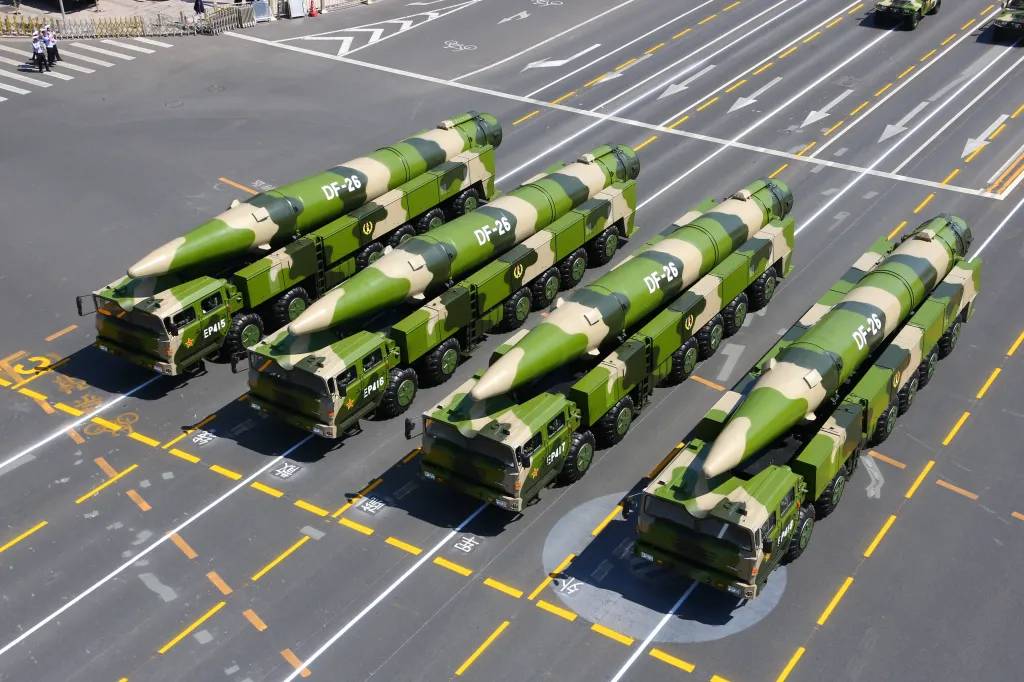
BEIJING, Sept. 3, 2015 : DF-26 missiles attend the military parade in Beijing, capital of China, Sept. 3, 2015. China on Thursday held commemoration activities, including a grand military parade, to mark the 70th anniversary of the victory of the Chinese People's War of Resistance against Japanese Aggression and the World Anti-Fascist War. (Xinhua/Cha Chunming via Getty Images)
DF-26 missiles on display at the military parade in Beijing, China, Sept. 3, 2015. (Xinhua/Cha Chunming) Xinhua News Agency

As a result of the evolution in missile technology, “the lexicon that we’re starting to see is missile tracking, right?” the general proffered. “And so missile warning and missile defense are really coming together in that realm. Missile warning was a space legacy mission area, and of course missile defense is missile defense. And you can see how these things are coming together. So really, the distinction between missile warning is almost obsolete at this point.”

The U.S. military has space-based early warning sensors that are integrated into its existing sensing, and has been for decades. But these warn of launches, they generally don’t track a weapon throughout its flight cycle. For some years now, work has been underway to substantially expand on space-based missile defense capabilities, to include the start of the fielding of new satellite constellations to help track ballistic missiles, as well as hypersonic boost-glide vehicles and other threats, during the mid-course portion of their flights. This is on top of a major push to move other kinds of terrestrial sensing to orbital layers, some of which could potentially have a secondary missile defense role.

To achieve the objective of fusing missile warning and tracking functions together, “we have to leverage a couple of really good partners,” Zellman stated, pointing to two in particular. One is the Space Development Agency (SDA), tasked with quickly delivering needed space-based capabilities to the U.S. military. The other is the Missile Defense Agency (MDA), charged with developing, deploying, and sustaining layered and integrated missile defense capabilities.

The SDA, noted the general, “is developing a number of missile-tracking satellites as part of their tranches that they’re launching.” The MDA, meanwhile, has “a long history of integrating battle management,” Zellman discussed.

“So those two together are really helping Space Command take separate disparate stovepipe information and bring it together,” he stated.

Tranche 1 Tracking Layer
The Space Development Agency is launching small satellites into space to help track advanced weapons like hypersonic glide vehicles. (SDA render) Space Defense Agency

“It also has to talk about decision speed, and this really is going to require us to look at more than man-in-the-loop [MITL], and maybe a man on the loop [MOTL] situation,” he noted. MITL is when a human is fully engaged in assessing and controlling the operation compared to MOTL, which usually relies on more heavily automated systems where the human approves critical decisions, usually based on distilled data presented by the system. AI is becoming a large part of making that possible in an increasingly successful way.

The reason to make this change, Zellman explained, is that “we have to make these decisions faster, and that data flow has to be able to enable our layered defenses – whether that’s coming from a THAAD [Terminal High Altitude Area Defense], or a Patriot, or directed energy, or SM-3, or space-based interceptors in the future – all that is going to be dependent on our decision speed.”

Ukraine, short on Patriot interceptors, can't down Russian ballistic missiles.
A Patriot interceptor launch. (Lockheed Martin) (Lockheed Martin)

“At the heart of all this for the United States Space Command is one of our unified command plan responsibilities, and that is as a global sensor manager,” the general said. 

“We don’t use sensors dedicated to a single mission,” he explained. “They may have originally been conceived to do space domain awareness or missile warning, or in some cases, missile defense, but we try to take the goodness of all those sensors and use them for all three of those mission areas.”

Under SPACECOM, “we take those sensors and we dynamically task them and prioritize accordingly, so we can support multiple commands around the globe. And that really, once again, gets to the theme about defending at home and abroad is being able to support these multiple commands simultaneously.”

The Space Based Space Surveillance (SBSS) operates around the clock collecting metric and Space Object Identification data for man-made orbiting objects without the disruption of weather, time of day and atmosphere that can limit ground-based systems. SBSS has a clear and unobstructed view of resident space objects orbiting earth from its 390-mile altitude orbit. (Image courtesy of Boeing)

The command’s “modern systems, whether it’s a long-range discrimination radar or some of our systems that have been around a little bit longer – like an upgraded early warning radar – they’re all inherently multi-mission,” Zellman put forth. “A single radar can see an object in space and give me space domain awareness information, and a little bit later it can see a missile launch and provide warning, and then hopefully down the road a bit more… provide essentially a track so that we can shoot an interceptor at it and kill it.”

“All these three things can be done in the same duty cycle with that same system, and so we have to be able to dynamically task these systems to ensure that whichever is the priority mission at that time is the one that is being serviced,” the general cautioned. “Historically, space domain awareness information went to space operators, and I would argue missile warning information probably went to both space operators and the missile defense community. But today, that information has to all be put in one data location, and we pull the information we need for the mission we have at hand.”

Long Range Discrimination Radar Capabilities thumbnail

Long Range Discrimination Radar Capabilities


“We recognize that what we do in space at Space Command is really fundamental to what the missile defense community has to do for missile defense,” Zellman vocalized. “So that really talks about the high end. Let’s talk about the low end.”

Lt. Gen. John Rafferty, commander of the U.S. Army Space and Missile Defense Command, Joint Functional Component Command for Integrated Missile Defense, and Joint Task Force-Gold “mentioned some of this today,” Zellman noted, referring to an earlier SMD panel. “We see, I think, the low end on Epic Fury. Sure, the missiles are more high end, but we’ve seen our adversary employ a number of one-way attack systems that are coupled with these ballistic missile volleys, and we are really at this point in the history of warfare because of the democratization of space.”

The commander of U.S. Central Command dismissed reports Iran retains most of its missiles and launchers.
Iranian missiles in an underground facility. (Iranian media) (Iranian media)

“Space isn’t a sanctuary,” the general shared. “It’s no longer just the playground of nations with a lot of money. The commercialization of space has created what many call essentially a transparent battlefield. And because I can see everything all the time with commercial ISR, it’s given our adversaries capabilities that they haven’t had in the past.” 

“That ISR [intelligence, surveillance, reconnaissance], if you couple it with a platform that has access to GPS or some other PNT [position, navigation and timing] system, and then you add in another layer of over-the-horizon comms, like say from an Iridium or a Starlink, and you have a pretty lethal asymmetric weapon system that our adversaries can get a hold of.”

Regardless of how much integration and automation occurs, it’s still a people business in Zellman’s eyes.

“So whether it’s a combination volley of attack drones or hypersonic glide vehicles, the mission at SPACECOM remains the same, and that’s to synchronize global missile defense and space domain awareness using a common set of information,” Zellman said. “But that synchronization doesn’t just happen in a vacuum; it happens with the joint warfighters that are standing on watch.”

Contact the author: howard@twz.com

Howard is a Senior Staff Writer for TWZ. He writes frequently about conflict, focusing heavily on the Middle East and Ukraine, and interviews with military and intelligence officials and industry leaders from around the globe. He lives near Tampa, Florida, home of U.S. Central Command, U.S. Special Operations Command.


Source link

Amid concerns about Perez Hilton, police surround a Miami home, say man is ‘safely recovered’

Miami authorities on Tuesday night responded to a residence after a disturbing video was posted on social media that appeared to involve celebrity blogger Perez Hilton.

The Times has not confirmed the authenticity of the video. But the Miami-Dade Sheriff’s Office said in an emailed statement that authorities had received an influx of calls on Tuesday reporting that an individual was livestreaming acts of self-harm on social media.

After surrounding the Miami residence of a man who was not named, the Sheriff’s Office said around 9 p.m. that he had been “safely recovered and transported by Miami-Dade Fire Rescue to a local hospital, where he is receiving medical attention.”

Deputies had arrived earlier and said they spoke with family members at the scene and confirmed that the man was alone inside the home.

“In many incidents involving a person experiencing a mental health crisis or actively harming themselves, deputies prioritize de-escalation by creating time, distance and opportunities for communication,” the statement read. “Unless there is an immediate threat to others, slowing the situation and utilizing crisis intervention techniques can reduce the likelihood of a suicide-by-cop encounter and minimize the risk of injury to the individual, deputies and the public.”

Authorities said they had “tactically disengaged while continuing to monitor the situation.” In their later update, the Sheriff’s Office said that after the man had been transported to a hospital, mental health professionals were at the scene “providing support and resources to the individual’s family.”

A representative for Hilton did not immediately respond to The Times’ request for comment.

In the TikTok live video, a person who seems to be in distress harms himself. The video has since been removed from the platform.

Police and fire personnel converged on the Miami home Tuesday night. NBC6 News reported that some neighbors said Hilton lived at the home, but police would not confirm that.

Hilton, born Mario Lavandeira Jr., has been a pop culture personality since the early aughts when he launched his eponymous celebrity gossip rag. The venture garnered the columnist social status but also made him persona non grata among many celebrities who weren’t fans of his controversial coverage, which was often deemed disparaging, especially toward women.

Suicide prevention and crisis counseling resources

If you or someone you know is struggling with suicidal thoughts, seek help from a professional or call 988. The nationwide three-digit mental health crisis hotline will connect callers with trained mental health counselors. Or text “HOME” to 741741 in the U.S. and Canada to reach the Crisis Text Line.

Source link

U.N. Command remains vital on Korean Peninsula, deputy commander says

1 of 5 | Australian Army Maj.
Gen. Scott Winter, deputy commander of United Nations Command, speaks during an interview at UNC headquarters on Camp Humphreys, a U.S. military base in Pyeongtaek, on July 7. File Photo by Thomas Maresca/UPI

PYEONGTAEK, South Korea, July 28 (UPI) — Seventy-six years after the United Nations Command was established to help repel North Korea’s invasion of the South, the multinational force remains an essential pillar of stability on the Korean Peninsula, its deputy commander said.

Speaking after a July 7 ceremony marking the command’s founding anniversary, Australian Army Lt. Gen. Scott A. Winter said the command’s responsibilities have evolved far beyond its wartime origins while remaining rooted in the Korean War armistice that halted fighting in 1953.

“The United Nations Command has two key missions,” Winter told UPI at UNC headquarters on Camp Humphreys in Pyeongtaek, about 35 miles south of Seoul. “One is to enforce the armistice, which is a sacred duty that we take every day. The other is to coordinate sending-state contributions in times of crisis or conflict.”

Created by a U.N. Security Council resolution on July 7, 1950, the command brought together forces from 22 nations under U.S. leadership after North Korea invaded South Korea. More than 1.9 million service members from UNC member states served in combat, medical and logistical roles during the Korean War.

Active fighting ended with the signing of the armistice on July 27, 1953 — the anniversary of which was commemorated Monday — rather than a peace treaty, meaning the two Koreas remain technically at war. The UNC continues to oversee implementation of the agreement and maintains a rare direct communication channel with North Korea’s military.

Winter said the command still conducts routine telephone communications twice daily with the Korean People’s Army through the military hotline, also known as the “pink phone.”

“It continues to enable us to de-conflict, avoid any sort of miscalculation,” he said, citing the example of recent firefighting operations inside the Demilitarized Zone.

The milestone comes as North Korea has abandoned its longstanding policy of peaceful reunification with South Korea, accelerated development of its nuclear and missile programs and deepened military cooperation with Russia, including sending troops to support Moscow’s war in Ukraine.

Winter said North Korea’s partnership with Russia has reinforced the need for the UNC to adapt to an increasingly complex security environment and strengthen its deterrence role on the peninsula.

“The growing nexus between North Korea and Russia is a reminder for all of us of the global nature of these security threats,” he said. “It’s clear that North Korea has gained both contemporary battlefield experience and exposure to technology.”

He argued that the UNC’s multinational composition strengthens deterrence by demonstrating that security on the Korean Peninsula remains an international concern.

“The more flags that we bring together, the more we can provide multinational legitimacy during periods of peace, the more we contribute to deterrence,” Winter said.

Despite renewed efforts by South Korean President Lee Jae Myung’s administration to reduce tensions with Pyongyang and eventually pursue a formal peace regime, Winter said the command would continue to have a role even if the armistice were someday replaced.

“Having a ready-made coalition prior to a crisis is much easier than trying to pull a coalition together in crisis or conflict,” Winter said. “I absolutely believe that the best way to prevent conflict is through that multilateral working together.”

He added that the armistice itself was designed to create conditions for a political settlement rather than become a permanent arrangement.

“The armistice was put in place to ultimately create the space for a political solution,” he said. “We welcome any moves in that direction.”

Reflecting on the anniversary, Winter said the command’s history offers lessons that remain relevant as conflicts continue in Europe and the Middle East.

“Seventy-six years ago, nations came together because they understood that’s what it would take to prevent further aggression,” he said. “The importance of multilateralism, the importance of building coalitions of the willing with like-minded countries, because the alternative is unthinkable.”

Source link

Marcellus Wiley arrested after allegedly threatening to kill his wife

Former NFL defensive end and Los Angeles sports radio personality Marcellus Wiley was arrested Saturday in Florida after allegedly threatening to kill his wife and poking her in the face with his finger.

Wiley faces a possible charge of misdemeanor domestic battery. According to the Orange County (Fla.) Corrections Department, he was released on a $1,000 cash bond Sunday at 8:43 p.m. An arraignment hearing has been scheduled for Aug. 4.

“I completely and unequivocally deny these allegations, and I’m certain the truth will prevail,” Wiley wrote Monday on X. “As you know, I’m usually the first to break down the truth and separate facts from fiction. But because this is now a legal matter — and because my greatest responsibility is protecting my babies, who have already been impacted — I have to handle this differently.

“When I can speak freely, I absolutely will. Until then, thank you for your patience, your prayers, and for continuing to stand with me.”

The former Pro Bowl player is married to Annemarie Wiley, a former cast member of “The Real Housewives of Beverly Hills” and the mother of three of his children. The name of the alleged victim is redacted from the arrest affidavit viewed by The Times, but she is identified as a woman who said she has been married to Wiley “for approximately 14 years” and shares three children with him.

A sheriff’s deputy responded to a call at the World Marriott in Orlando around 4:47 p.m., according to the arrest report, and the accuser said she wanted Wiley removed from their hotel room.

“She stated Marcellus told [her] he was going to kill her and she was afraid of his behavior,” the report states. “When asked to elaborate, she stated on the previous morning Marcellus had put his hands on her.”

The report states that the woman told the deputy that on the morning of July 3, Wiley “used one finger to sternly and intentionally poke her in the cheek. [She] stated he did not have permission to do this, and she stated she believed he did this to cause her harm.”

She did not request medical attention after the alleged incident, according to the affidavit, and the deputy said he did not see any visible injury. The woman also told the deputy that Wiley “had an unreported history of violence toward her and she was planning to divorce him when they returned home to California.”

Their 7-year-old daughter, who the woman said had witnessed the incident, told the deputy she did not see her father touch her mother but had heard them arguing that morning.

According to the affidavit, Wiley told the deputy in an oral statement that “he and his wife had not had any physical altercation while at the hotel, and he also stated they have never had any physical violence between them.”

In addition, the report said, “Marcellus stated he believed his wife had called deputies to make a report due to her intention to divorce him. Marcellus stated he had been taking care of the children and no violence had occurred between them.”

The deputy determined probable cause existed for Wiley’s arrest, and he took the 10-year NFL player to the correctional facility “without incident.”

According to court records, Wiley has been appointed a public defender. He is allowed to return to California but must obey a no-contact order that prohibits him from “having any type of contact with the victim(s), either directly or indirectly.”

He can return home one time with law enforcement to collect his belongings.

A Compton native, Wiley played four years at Columbia before a 10-year NFL career from 1997 to 2006. He spent three seasons with the San Diego Chargers, including his only Pro Bowl year in 2001, and also played for the Buffalo Bills, Dallas Cowboys and Jacksonville Jaguars. His post-football broadcast career included several years as a host on KSPN-AM (710) in Los Angeles.

Multiple women accused Wiley in civil lawsuits of sexually assaulting them in the past. One Jane Doe filed in April to turn her lawsuit into a class-action suit against Wiley and Columbia University. The filing included four new accusers and stated that “at this time, without the benefit of discovery, there appears to be at least 10-12 victims. It is anticipated that discovery will reveal more.”

Wiley has denied all the allegations against him in court documents and publicly.

Source link

Iran deputy FM says ‘ready to move forward’ in deal with US | Donald Trump News

Khatibzadeh tells Al Jazeera diplomacy is way forward, but US must ensure that Israel stops its attacks on Lebanon.

Iran’s deputy foreign minister says Tehran wants to continue the diplomatic process with Washington, if the United States is serious about respecting their agreement and ensures Israel abides by the terms of the memorandum of understanding (MoU).

“We are ready to move forward step by step, if the other party demonstrates the same seriousness,” Saeed Khatibzadeh told Al Jazeera Arabic in an interview on Friday.

Recommended Stories

list of 4 itemsend of list

His comments came after talks between the US and Iran that were due in Switzerland on Friday were called off, and US Vice President JD Vance cancelled his planned trip there.

Earlier, officials including mediators Pakistan and Qatar said the two sides would meet in Burgenstock to begin negotiations on a host of issues as outlined in the MoU signed between the US and Iran this week.

Reports said the talks may have been called off after intense fighting between Israel and Hezbollah in southern Lebanon on Friday. Lebanon’s health ministry said Israeli attacks killed at least 47 people since midnight.

Speaking to Al Jazeera, Khatibzadeh denounced the latest Israeli attacks in Lebanon, saying Israel’s “continued war-making” would have “serious and immediate consequences”.

He said Iran was seeking “peace on all fronts, including Gaza”, and explained that Lebanon had been included in the MoU because of its direct connection to the conflict.

Article 1 of the MoU explicitly states that ending the war in Lebanon is an integral part of the broader ceasefire arrangement across all fronts.

“There will be no peace or stability in Lebanon and the region without ending the occupation and Israel’s commitment to international law,” Khatibzadeh added.

On the Strait of Hormuz, he said Iran would continue to provide navigation services in coordination with Oman and in accordance with international law.

He added that Tehran would not impose passage fees during the 60-day period outlined by the agreement, but said a new mechanism for managing the waterway would be introduced afterwards and presented to regional countries.

Khatibzadeh also said that any future agreement must include the release of all frozen Iranian funds.

Esmaeil Baghaei, spokesperson for Iran’s ministry of foreign affairs, said on Friday that the necessary consultations involving the US deal are being carried out through mediators, and that if the conditions for starting negotiations are met an official announcement will be made.

Regarding the Lebanon ceasefire required for talks between the US and Iran to continue, a Hezbollah official told Al Jazeera that the ceasefire would hold if Israel abided by it.

Israel’s ambassador to the US Yechiel Leiter said on X: “Israel remains firmly committed to an immediate ceasefire. If Hezbollah honours the agreement and ceases its hostilities, they will be met with quiet”.

Source link

Lindsie Chrisley arrested on suspicion of DUI in Georgia

Lindsie Chrisley, one of reality star Todd Chrisley’s two children with his first wife, was arrested Saturday night on suspicion of driving under the influence in Concord, Ga.

The podcaster was booked on charges including DUI less safe — a DUI charge for those whose blood alcohol is less than 0.08% — attempting to elude police, improper passing, reckless driving and speeding, according to a police report obtained by The Times. Her bail on the five counts totaled $5,961, according to the Cherokee County Sheriff’s Office.

“I got pulled over speeding past a car on a two-lane road because they almost hit an animal,” Chrisley told TMZ, which first reported the arrest. She said she was trying to miss that car and “whatever the animal was.” She said she planned to fight the charges.

Law enforcement had a different story to tell in its report, alleging that she was pulled over for traveling 86 mph on a surface street. After the deputy activated the lights on his car and initiated the traffic stop, Chrisley allegedly passed “multiple suitable stopping locations” before finally pulling over at a Chevron station, the report said.

The sheriff’s deputy who spoke with Chrisley said in his report that her stories weren’t making sense, her speech was slurred and her breath smelled of alcohol. After she was asked to step out of the Ford Bronco, she told the officer she didn’t know why she had been pulled over, then said it was because she had swerved around another vehicle that had “almost hit a deer,” the report said. The officer asked her if that was why she was speeding and she said “that is exactly why,” according to the report, then talked about the car in front of her brake-checking her as she drove home and said she hadn’t been traveling at nearly 90 mph.

The report said she refused to participate in field sobriety tests when the deputy asked her to and she also declined a blood test. No contraband was found in the car, according to the report.

Chrisley, 36, was released from custody around 4:15 a.m. Sunday morning.

Her encounter with law enforcement comes after her then-boyfriend, David Landsman, was arrested in Cherokee County in mid-April on a felony charge of aggravated assault/strangulation and a misdemeanor charge of battery after he allegedly placed his hand around a person’s neck and told them they were “not going anywhere,” People reported.

Lindsie Chrisley, the host of “The Southern Tea” podcast, appeared in 20 episodes of “Chrisley Knows Best” from 2014 into 2017. She and brother Kyle Chrisley are the children of Teresa Terry, Todd Chrisley’s first wife.

Todd and second wife Julie Chrisley were convicted of bank fraud and tax evasion in 2022 and imprisoned at separate facilities. Todd was serving a 12-year sentence in Florida and Julie was serving seven years at a facility in Kentucky when President Trump pardoned them in 2025, clearing the convictions from their records and ending their sentences.

Lindsie was estranged from her family for years over their suspicion that she had squealed to state and federal officials. Todd and Julie sued the state of Georgia in 2019, alleging that a tax official had targeted the couple’s estranged daughter and improperly shared confidential tax information to try to elicit compromising information on the family. As a result of the official’s efforts, the Chrisleys were forced to “incur substantial personal and financial hardship,” the suit said.

Sources who said they were close to Lindsie told TMZ in October 2019 that she spoke with the state official only to get updates about when her father might be arrested, so that she could shield her young son from any drama. In 2022, she said on her podcast that she and her father got back in touch after her second filing to divorce husband Will Campbell went public in summer 2021. The family members did crossover appearances on their various podcasts.

However, the reconciliation appeared to be short-lived, with Lindsie saying on her podcast in March 2025 that she hadn’t had any contact with her dad in a year.

The state of Georgia settled with the elder Chrisleys in January 2024, agreeing to pay them $1 million.

Source link