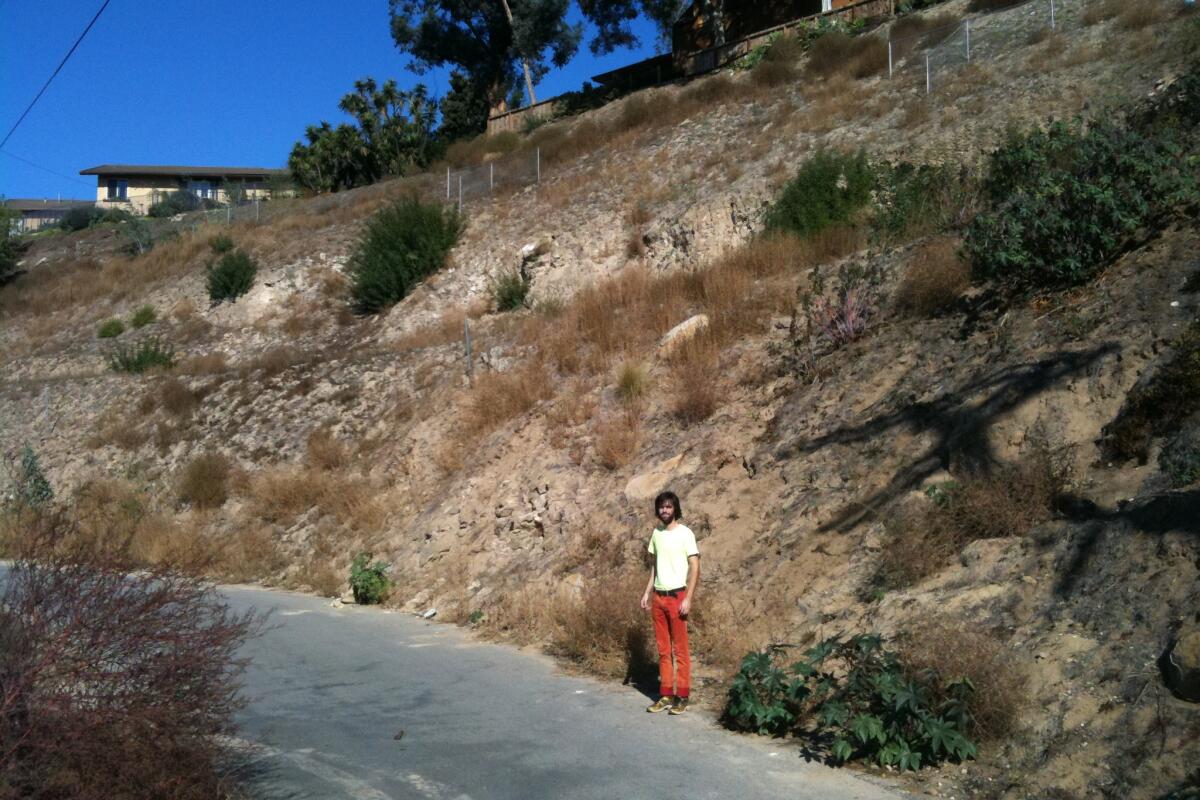
Diego Cano-Lasso had been looking for an architectural project when he found two hillside lots with spectacular views for sale in Mt. Washington. With work scarce in 2012, the SCI-Arc graduate persuaded his family to invest in the property, and together they bought the two plots for $95,000.
“We are not developers,” he says, “but sometimes you have to jump.”
He didn’t realize the Mt. Washington project would take 12 years to complete, including a shutdown during the COVID-19 pandemic, or that he, his family and friends would end up doing much of the work themselves.


Diego Cano-Lasso stands in front of the hillside lots in 2012. (Hassan Ismail) The lots today. (Myung J. Chun / Los Angeles Times)
As a fan of Los Angeles’ Midcentury Modern architecture, he imagined designing and building a post-and-beam dream home next-door to a similar home by his aunt Lucia Cano and her husband, José Selgas, of the Madrid architecture firm SelgasCano, stretching over the hillside and connecting to the city below.
Growing up in Madrid, the 41-year-old Cano-Lasso first discovered modernist architecture as a child while visiting his grandfather Julio Cano Lasso’s architecture office. There, he saw architectural photographer Julius Shulman’s famous photo of Pierre Koenig’s glass and steel Case Study House No. 22 in West Hollywood, one of L.A.’s most iconic homes and a lasting symbol of midcentury L.A.
“It’s why I moved here,” Cano-Lasso says. “Midcentury design was like a dream to me, because it’s not just an architectural style; it’s a lifestyle.”
But his dream quickly hit a snag when the geotechnical engineer arrived in Mt. Washington to assess the site.
“He said the plots were unbuildable,” Cano-Lasso recalls. “He told me, ‘It is impossible. We cannot even do the soils report, because a big machine can’t fit up here on these narrow streets.’”
Eventually, Cano-Lasso found someone who visited the site and said, “No problem.”

La Canaria House by José Selgas and Lucia Cano features canary yellow aluminum tubes.

Cano-Lasso and his wife, Belén Rodero, in the open kitchen and living area of La Canaria House.
Then the city told him that he didn’t have the right to build on the property. To get permission, Cano-Lasso and his family would need to widen the narrow street, put in a sewer system and add a power pole.
Permits were just as difficult. According to Cano-Lasso, neighbors complained about the project, and the city bureaucracy dragged out the process for three years.
Eventually, he and his crew began digging into the hillside and moved more than 120 truckloads of soil through the steep, narrow streets of Mt. Washington. Without a general contractor, they managed construction themselves and hired different crews for each job.
When COVID-19 hit, construction on the project stopped, and Cano-Lasso returned to Spain. Construction did not restart until 2022, by which time the construction industry had changed and the project felt even more challenging to complete.
“Everything cost more, and there weren’t enough skilled workers,” Cano-Lasso says. As a result, Juan de Santiago, the master builder Cano-Lasso hired and calls “paramount to the project,” was too busy to finish the houses, which had windows and drywall but still needed finishing.
“The only way we could do it was by doing most of the work ourselves and with friends,” Cano-Lasso says.
With help from his brother Alejandro Cano, who is also known as Cato, and his wife, Belén Rodero, they handled everything from carpentry and metal work to lighting, wall finishes, flooring, painting, furniture, custom garage doors and landscaping.
“What I didn’t realize at the time — not even when hundreds of boxes of Moroccan tiles showed up at our door in Madrid — was that I was signing up for both a crash course and a career in tiling,” Cato says of designing murals for three of the Cano Home’s four walls. “I wasn’t expecting to lay a single tile, let alone take on the filing, sanding, rearrangement and all the care and attention required when most tiles come in odd sizes.”
Seven years and plenty of mishaps later, including the time a truck got stuck on the narrow, winding streets of Mt. Washington hauling 42-foot wooden beams, Cano-Lasso finally has a finished home that feels peaceful and warm.
With eye-catching details everywhere, the 2,250-square-foot homes feel relaxed and reflect the style of a Spanish designer inspired by Frank Lloyd Wright and Rudolph Schindler. (Cano-Lasso once lived in Schindler’s Sachs apartment in Silver Lake.) The open floor plan, designed by his father, Spanish architect Diego Cano Pintos, features warm oak floors, inexpensive radiata pine walls and ribbed wood ceilings.

“I am enjoying witnessing the house being lived in,” Cano-Lasso says of renting his house to music producer Jennifer Jimenez and interior designer Hanna Li, pictured right.
The rooms of the Cano House are filled with colorful art, accessories and custom furniture by Andrew Riiska and Cato. “Although we were working toward a deadline on a project that had already been under construction for several years, most pieces of furniture were designed and fabricated on site, with the conviction that we were building something special,” Cato says of setting up a furniture workshop in the garage.
Ceramic rain gutters from Ceramiques Est in Spain have been repurposed as wall-mounted light fixtures for indoor use. Door handles are made from stones found on the beach, and glass light fixtures by Luz Mixtura in Spain echo Robert Irwin’s disc installations. Large boulders from the excavation were brought inside to serve as furniture. Built-ins were made in Spain and shipped to Los Angeles in three containers. Outside, the house is covered in shou sugi ban charred-wood siding, which they installed themselves.
Both homes have similar structures and layouts with four bedrooms and four bathrooms, but La Canaria House features canary yellow powder-coated aluminum tubes inspired by California sunsets, while the Cano House is minimal and warm. “The homes are all about the beams,” Cano-Lasso says, which makes them look like they are floating above the city.
The neutral rooms feel warm and simple, with striking pops of yellow that reflect Southern California’s sunshine and decks that allow a smooth flow from indoors to outdoors.

Li, left, and Jimenez in their music room. The custom DJ workstation, designed by Li, is clad in ceramic tiles designed to look like plywood.
Behind the Cano House, Cano-Lasso created a narrow outdoor space with built-in banquette seating, a raised-bed herb garden and a water fountain. Now the house opens up to the outdoors, making it easy to entertain. “The garden is the coolest feature,” he says. “It really makes the house feel special.”
In some ways, the modern design has revived the midcentury ideal by using post-and-beam construction, an open floor plan, simple materials and easy indoor-outdoor access, all with Cano Lasso’s artistic touch.
But finishing the project also left Cano-Lasso with the large debt he took on — he estimates the project cost about $1 million, although he saved around 40% by acting as his own contractor.
Cano-Lasso and his wife divide their time between La Canaria House and a project in Venice, so he is renting out his dream house to interior designer Hannah Li and music producer Jennifer Jimenez, who grew up together in Pasadena.

Li descends the spiral staircase to the music room on the first floor.
Renting such a personal project might seem overwhelming for the tenants, since the rental included some of Cano-Lasso’s custom furnishings, but the two have made the house their own. They added a striking listening room on the first floor, with a turntable lined with ceramic tiles designed by Li to resemble plywood.
“We’re all artists in this house,” Jimenez says. “We’re always creating here, and other music producers often come over to make music and jam with us. It’s such an inspiring, creative space.”
“It’s a very comfortable house,” adds Li, who enjoys practicing archery on the terrace deck.
The friends’ rental is filled with treasures from their travels, along with pieces Li designed specifically for the home. Li turned one of the first-floor bedrooms into a cozy study by paneling the walls with wood and adding textiles she collected on her trips.
Recently, they hosted a birthday party with art-making stations, candle-making and even goats and they invited their landlord. “Mt. Washington has so many artists, so it’s wonderful to bring everyone together,” Li says.

Cano-Lasso, greets Jimenez, center, and Li on their side-by-side terraces.
When asked if he might consider tackling another hillside project, Cano-Lasso laughs.
“When I finished, I said, ‘I will never do that again,’” he says. “Now I’m starting to think there’s a plot of land for sale nearby. We installed a sewer line, so why not take advantage of it?”
Despite his debt, he isn’t planning to sell the house. “In a way, the project doesn’t finish with construction; I am enjoying witnessing the house being lived in,” he says. Even if he’s not the one living in it.