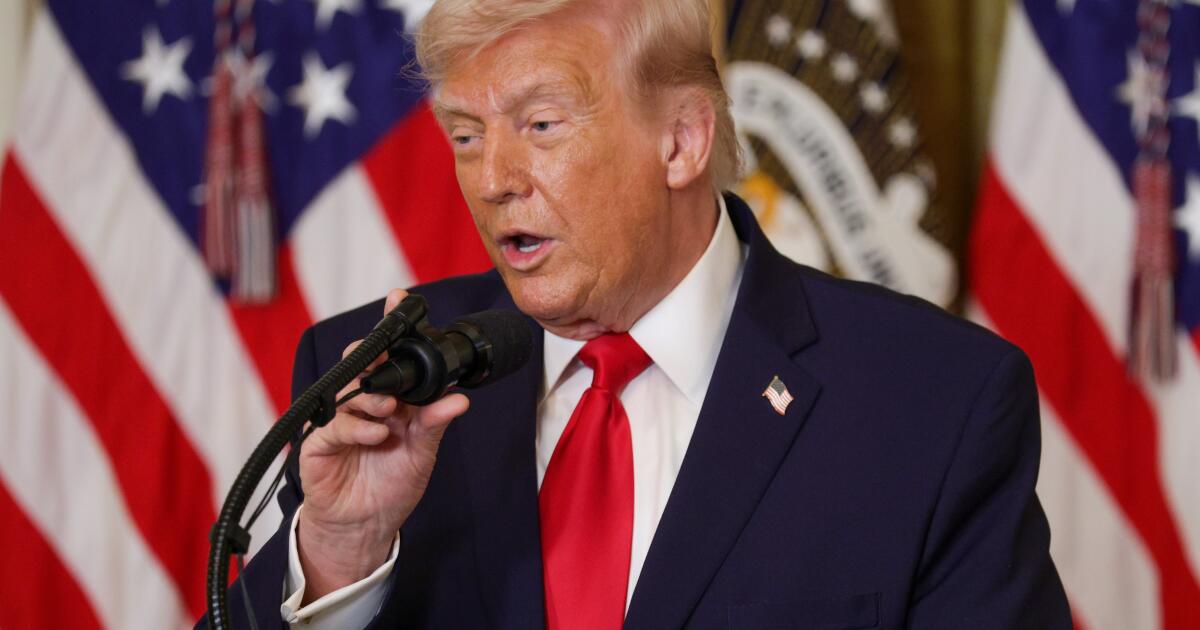
In one of his latest missives on social media, President Trump complained that he wasn’t getting enough credit for “totally destroying the terrorist regime of Iran, militarily, economically, and otherwise.”
“We have unparalleled firepower, unlimited ammunition, and plenty of time,” he wrote of a war that has crippled the global supply of oil, sharply increased gas prices, cost U.S. taxpayers billions, left thousands dead and wounded, and so far defied Trump’s own “short term” timetable.
“Watch what happens to these deranged scumbags today,” Trump added. “They’ve been killing innocent people all over the world for 47 years, and now I, as the 47th President of the United States of America, am killing them. What a great honor it is to do so!”
Again and again in recent days, Trump and other top officials in his administration — notably Secretary of Defense Pete Hegseth — have projected confidence and power in Iran in a coarse and triumphant tone that is unprecedented for U.S. wartime presidents and their Cabinet members, according to experts in presidential rhetoric and propaganda.
They have consistently described the war in terms of how hard the U.S. is hitting Iran, rather than why it must do so. They’ve talked of destroying the Iranian navy and air force, wiping out its leadership and making the U.S. “more respected” globally than it has ever been, including by showing no mercy.
“This was never meant to be a fair fight, and it is not a fair fight. We are punching them while they’re down, which is exactly how it should be,” Hegseth said.
Missing is the solemnity of past wartime leaders facing dead U.S. soldiers, a recalcitrant enemy and a precarious tactical position, replaced by a message of U.S. mercilessness — of contempt for Iran rather than concern for its civilians or a focus on the American ideals that U.S. presidents have long tried to rally the world around, especially in times of war.
“At a time when people can see the effects of the war when they fill up their gas tank, and when there have been American casualties, the triumphalist tone is just not something a president normally does,” said Robert C. Rowland, a professor of rhetoric at the University of Kansas and author of the book “The Rhetoric of Donald Trump: Nationalist Populism and American Democracy.”
“Many presidents wouldn’t have that tone for personal moral reasons,” Rowland said, “but they also know that it can backfire when things don’t go well.”
James J. Kimble, a communication professor and propaganda historian at Seton Hall University, said U.S. presidents have “by and large” struck a respectful tone in wartime, though there are some exceptions. President Truman, justifying dropping atomic bombs on Japan, wrote that “when you have to deal with a beast, you have to treat him as a beast,” while the U.S. produced World War II posters designed to “demonize and dehumanize the German enemy,” he noted.
Still, Trump’s messaging — including his “expressing glee at the death of foreign combatants” — has been “much coarser,” Kimble said.
“It’s moving beyond the idea of defeating the enemy on the field of battle, and more into a kind of defeat as humiliation — intentional humiliation,” he said. “It’s schoolyard bullying, along with the physical violence.”
Asked about Trump’s rhetoric, Anna Kelly, a White House spokeswoman, said Trump “will always be proud to recognize the incredible accomplishments of our brave service members.”
“Under the decisive leadership of President Trump, America’s heroic war fighters are meeting or surpassing all of their goals under Operation Epic Fury,” she said. “The legacy media wants us to apologize for highlighting the United States military’s incredible success, but the White House will continue showcasing the many examples of Iran’s ballistic missiles, production facilities, and dreams of owning a nuclear weapon being destroyed in real time.”
Trump has built his political career around blunt rhetoric, and his messaging on Iran has drawn applause from his supporters. Polling has shown the public is heavily divided on the war — drawing far less public support than past wars, but broad support from Republicans.
White House Press Secretary Karoline Leavitt has accused the media of ignoring “clear” objectives that the president and others have set for the war effort, including wiping out Iran’s missile systems, preventing it from developing a nuclear weapon and stopping what Trump had a “feeling” was a coming attack on the U.S.
However, Trump and Hegseth have themselves strayed from that framework with their brash rhetoric, and their focus on the killing of Supreme Leader Ayatollah Ali Khamenei and other Iranian leaders.
Trump has dismissed reports that the U.S. bombed an Iranian school full of children by suggesting that Iran may actually have been responsible, despite reported findings by U.S. intelligence that it was an American attack.
Hegseth has added to concerns about careless U.S. bombing by expressing disdain for wartime rules designed to limit civilian casualties, calling them “stupid rules of engagement.”
“Our war fighters have maximum authorities granted personally by the president and yours truly,” Hegseth said. “Our rules of engagement are bold, precise and designed to unleash American power, not shackle it.”
The White House has also pushed out a wave of wartime propaganda on social media, often striking the same irreverent, bullish tone, experts noted.
One video interspersed movie clips of superheroes and soldiers with real footage of Iranian targets getting blown up, under the words, “JUSTICE THE AMERICAN WAY.” The clip drew condemnation, including from the actor Ben Stiller, who objected to the inclusion of footage from his film “Tropic Thunder,” saying, “War is not a movie.”
Hegseth’s bravado has also been caricatured on “Saturday Night Live,” which opened two weeks in a row with a satirical portrayal of him as angry, dimwitted and hyped up on the violence of war.
All of it has come against a backdrop of Islamophobic remarks from members of Congress on X, with Rep. Andy Ogles (R-Tenn.) writing that “Muslims don’t belong in American society” and Sen. Tommy Tuberville (R-Ala.) posting a picture of the 9/11 terrorist attack next to an image of New York City Mayor Zohran Mamdani, who is Muslim, and writing “the enemy is inside the gates.”
Certainly Iranian leaders have expressed similar contempt for the U.S. for years. Khamenei, killed at the start of the war, was known for stoking anti-American sentiment, speaking to crowds amid chants of “death to America.”
However, U.S. presidents have traditionally spoken with more reserve. They have slammed U.S. enemies, but often by drawing a contrast between them, the U.S. and the values the U.S. purports to defend globally. They have expressed confidence in past U.S. missions, but been wary of taking a celebratory or triumphant tone — especially at the start of a war, amid intense fighting, as American troops are still dying.
Not so with Trump, who on Wednesday said, “You never like to say too early you won. We won. We won … . In the first hour, it was over.”
He also said, “Over the past 11 days, our military has virtually destroyed Iran,” and “they don’t have anything.”
On Thursday, six U.S. service members were killed when a refueling aircraft crashed in Iraq. On Friday, the U.S. military announced it was sending 2,500 Marines and an additional U.S. warship to the conflict.
Kimble said there are several ways to view Trump’s war rhetoric. One is “through the lens of PSYOPS, or psychological operations” — or intentional messaging aimed at discouraging the enemy, akin to the U.S. dropping leaflets in World War II telling foreign combatants that they must surrender or die. In that view, Trump is speaking directly to the Iranians, trying to get them to “perceive victory as impossible.”
Another is to view Trump and Hegseth as projecting a tough image for their MAGA base, their Democratic rivals and any other nations they might be preparing to challenge, such as Cuba.
Rowland said Trump “always has to be the big dog in the room,” and his war messaging should be viewed in that context.
“A lot of the rhetoric is performative cruelty,” Rowland said. “It’s more about him coming across as dominant than it is about making a case that the war has been good for the U.S. and the region and the West and the world.”