rhetoric

Ethiopia, Eritrea ramp up rhetoric: Are they inching towards war? | Explainer News

Ethiopia and Eritrea have exchanged accusations of aggression at the United Nations, raising fears of a new conflict in the Horn of Africa region as fighting intensifies in Ethiopia’s northern Tigray region.

The diplomatic spat comes as Ethiopian troops and allied armed groups advanced across Tigray, where forces from Asmara have allegedly crossed the border to support rebels fighting the government forces.

The two neighbours, which fought a deadly border war between 1998 and 2000, were allies during Ethiopia’s devastating 2020-2022 Tigray war.

However, they have since been at loggerheads over the 2022 peace agreement that ended a two-year civil war between the government in Addis Ababa and Tigray rebels, and over Ethiopia’s demands for access to the Red Sea.

So, what did Eritrea and Ethiopia accuse each other of, and are they inching towards war?

What did Eritrea and Ethiopia say at the UN?

Eritrean troops had advanced as far as 60km (37 miles) into Tigray, Ethiopia told the UN Security Council on Friday, accusing its neighbour of violating its sovereignty.

In a letter, Ethiopian Foreign Minister Gedion Timothewos described the alleged incursion as “a blatant act of aggression that engages Ethiopia’s inherent right to self-defence”.

He invoked Article 51 of the UN Charter, which recognises a country’s right to self-defence, but did not specify what measures Ethiopia was taking.

Eritrea, which won independence from Ethiopia in 1993, rejected the accusations of incursions into Ethiopia, calling them a pretext for an Addis Ababa offensive.

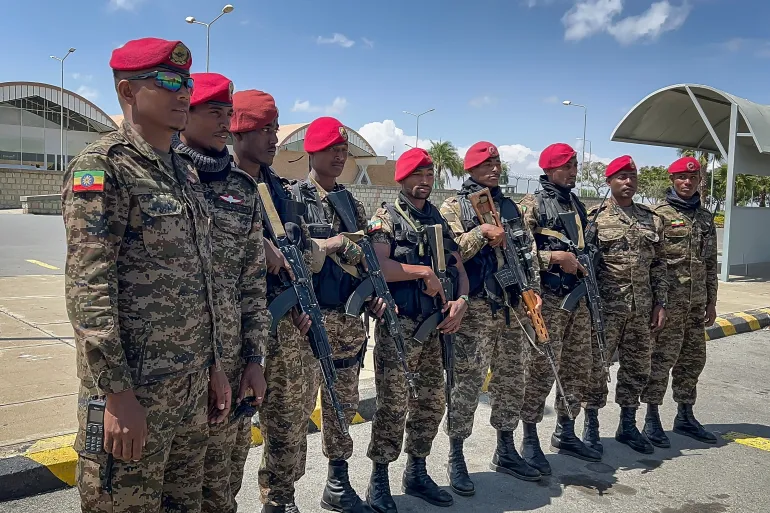
Members of the Ethiopian National Defense Force (ENDF) gather in front of Mekelle Alula Aba Nega International Airport after federal forces retook control of the facility in Mekelle, Ethiopia, October 6, 2026 [AFP]

Eritrean Foreign Minister Osman Saleh, in his own letter to the UN Security Council on Saturday, urged the body to condemn Ethiopia’s “deplorable declaration of war” and take “deterrent measures”.

He warned that an Ethiopian offensive would cause “huge devastation to the peoples of both countries and destabilise the whole region”.

The accusations come amid a broader dispute over access to the Red Sea.

Landlocked Ethiopia has repeatedly argued that securing direct sea access is essential, while Eritrea fears Addis Ababa intends to seize its port of Assab.

Ethiopian Prime Minister Abiy Ahmed reiterated on Monday that Ethiopia must have access to the Red Sea.

Hossamaldeen Ibrahim, an analyst at Bloomsbury Intelligence and Security Institute (BISI), said the narratives of both countries contain “verifiable elements”.

“The danger lies in the fact that each side now treats the other’s narrative as existential,” he told Al Jazeera.

Eritrea and Ethiopia fought a deadly border war from 1998 to 2000. Relations improved after Abiy came to power in 2018, but have soured again in recent years.

Professor Matthias Rompel from the Institute of Sociology at the Justus-Liebig-University Giessen in Germany, said that both sides have legitimate security concerns, but their accusations need to be distinguished from independently verified facts.

“Ethiopia’s allegations of Eritrean military incursions into Tigray… and …the scale of Eritrean involvement, and particularly allegations that Asmara is orchestrating the rebellion against Addis Ababa, remain difficult to substantiate independently,” he told Al Jazeera.

He added that the latest developments suggest that the confrontation is no longer merely about Tigray. “Ethiopia’s quest for Red Sea access, Eritrea’s concerns about sovereignty, and Egypt’s strategic rivalry with Ethiopia over the Nile are interconnected,” he said.

“The conflict, therefore, has the potential to destabilise the wider Horn of Africa, with repercussions for Sudan, Somalia and Red Sea security.”

What is the latest fighting about, and how is Eritrea allegedly involved?

Fighting escalated on September 23 when a rebel alliance, including the Tigray People’s Liberation Front (TPLF), launched attacks against Ethiopian government forces across Tigray, Amhara and Afar regions.

The rebels captured Tigray’s capital, Mekelle, and its airport before announcing their withdrawal on October 3. Government-allied forces subsequently entered the city.

In the latest on the battlefront, government and allied forces took Idaga Hamus early Friday and Abiy-Adi, in the Tembien area, on Thursday afternoon, according to Ermiyas Ababu, a commander of the government-allied Tigray Peace Force.

Residents, according to Reuters news agency, also reported the takeover of Idaga Hamus. Gebremedhin Kihishen, a business owner in Tembien, said government-allied forces controlled Abiy-Adi.

It was unclear from those accounts who held the towns immediately before the reported government advance or whether Eritrean troops were involved in the fighting.

Ermiyas previously reported Eritrean personnel entering Adigrat on Tuesday and Idaga Hamus on Wednesday, citing reports from his personnel. Al Jazeera was unable to independently verify the claims.

The Armed Conflict Location and Event Data Project (ACLED), a United States-based conflict monitor, reported that Eritrean troops crossed into Ethiopia near Zalambessa and came under Ethiopian drone attack while advancing towards Idaga Hamus. Eritrea has yet to comment on the development.

Addis Ababa accuses Asmara of financing, arming and directing armed groups, as well as deploying troops inside Tigray. Eritrea denies the allegations, which have not been independently verified.

The renewed fighting threatens to unravel the 2022 peace agreement.

That conflict began in November 2020 after months of tensions between Prime Minister Abiy Ahmed’s government and the TPLF, which had dominated Ethiopian politics for nearly three decades before Abiy took office in 2018.

Eritrea fought alongside Ethiopian federal forces against the TPLF, its longtime adversary. The war killed hundreds of thousands of people and was marked by allegations of massacres, sexual violence and widespread hunger.

The November 2022 Pretoria agreement ended major hostilities, but Eritrea was not a party to the deal. Relations between Addis Ababa and Asmara subsequently deteriorated.

Has Ethiopia sent troops north towards Eritrea?

Multiple media reports say Ethiopian government troops and allied militias entered Adigrat, a strategic city roughly 30km (19 miles) from the Eritrean border, on Saturday.

Three residents confirmed their presence to Reuters, while verified footage showed government-allied militia members walking through the city.

Associated Press news agency footage also showed Ethiopian military vehicles entering Adigrat as some residents welcomed the troops.

Government-allied forces have reported capturing Idaga Hamus and Abiy-Adi, while explosions and alleged drone strikes have been reported near Adigrat.

Are Ethiopia and Eritrea inching towards war?

Analysts warn that Ethiopia and Eritrea may already have moved beyond threats and into a dangerous phase of possible military confrontation.

BISI’s Ibrahim said the two countries have moved beyond “inching” towards war, noting that “The situation has entered a high-risk phase of limited but direct military confrontation with a real possibility of rapid escalation into interstate war.”


He warned that the severing of diplomatic ties removed the “last formal mechanism for crisis management”, while Ethiopian military advances towards the Eritrean border increased the risk of “miscalculation”.

Tom Gardner, a correspondent for The Economist, said the current tensions should be understood in the context of decades of hostility between the neighbours.

Their brief alliance during the 2020-2022 Tigray war was an exception and was driven by a shared hostility towards the TPLF, Gardner told Al Jazeera.

“The Ethiopian government’s strategic goal number one is access to the Red Sea, but also removing Eritrea’s government from the picture,” he noted.

“It’s very much looking like the most dangerous moment for the region since that 1998 to 2000 war.”

Rompel from Justus-Liebig-University Giessen said that the current situation is evolving. “The danger of a wider interstate conflict is real, and the situation has already moved beyond a purely diplomatic confrontation,” he said.

“The central danger is not necessarily that either government has decided to launch a full-scale war, but that military miscalculations, mutual distrust and domestic political pressures could trigger a further escalation neither side can easily control.

“A wider conflict is not inevitable, but the space for diplomatic de-escalation is rapidly narrowing,” he said.
Source link

Dodik declared Bosnia ‘dead’. Irrelevant rhetoric or serious threat? | Politics News

Speaking at the final rally of his right-wing alliance ahead of Bosnia’s October 4 election, Bosnian Serb leader Milorad Dodik delivered a predictably controversial statement.

“Bosnia-Herzegovina is dead. It is an impossible country, it makes no sense,” Dodik told supporters of the Alliance of Independent Social Democrats (SNSD) party in Banja Luka on Friday.

Recommended Stories

list of 3 itemsend of list

“It is now nothing more than an empty shell … for those who are trying to keep it alive, so they can prove themselves right about something,” said the former president of Republika Srpska, who is known for frequent separatist threats and for challenging the country’s constitution.

Dodik’s comments came as Bosnia remains deeply divided over its political future more than three decades since the 1995 Dayton peace agreement. It split the country into two semi-autonomous parts – the Serb-majority Republika Srpska entity and the Federation entity, where most Bosniaks and Croats live.

The agreement ended the 1992–95 Bosnian War and established a political framework for power-sharing among Muslim Bosniaks, Orthodox Serbs and Catholic Croats.

On Sunday, voters across the country cast ballots to elect the three members of Bosnia and Herzegovina’s multiethnic presidency, representatives to the national parliament and leaders of institutions in the country’s two entities.

Dodik himself is not on the ballot after being stripped of his post last year, following his conviction for refusing to carry out decisions issued by Christian Schmidt, the international peace envoy who oversees the implementation of the Dayton peace agreement.

‘No political relevance’

Elvis Fejzic, a professor at the Faculty of Political Science in Sarajevo, said attempts by figures such as Dodik to dismantle Bosnia and Herzegovina amount to “populist rhetoric”.

“Politicians and political parties that act unconstitutionally do not determine the fate of Bosnia and Herzegovina,” Fejzic told Al Jazeera, arguing that Bosnia and Herzegovina’s status as a UN member and internationally recognised state is secure.

“Bosnia and Herzegovina … will outlive all those who, through inflammatory statements, seek to obstruct its path towards integration and development,” he said. “Their statements have no political relevance whatsoever.”

Political analyst Tanja Topic said that while Dodik was not officially a candidate, he remained a central figure in the campaign and sought to present himself as a “senior official in international relations”.

Topic told Al Jazeera that the election result could produce several political scenarios in Bosnia and Herzegovina, from “cohabitation in Republika Srpska”, through the formation of a grand coalition, to a “blockage at the state level and the Council of Ministers continuing to operate in a caretaker capacity”.

Dodik’s rhetoric marks ‘long escalation’

Expert Adnan Cerimagic said Dodik’s rhetoric should be taken “seriously” and viewed as part of a “long escalation” rather than a reflection of the country’s current reality.

“For the past four years, his moves against the Dayton order and against Bosnia’s EU and NATO path have reached a new and dangerous level: in March 2025 the country came close to an armed standoff between Republika Srpska and state police,” Cerimagic, a senior analyst at the European Stability Initiative, told Al Jazeera.

“Casting Bosnia as a front-line in a supposed war between Christianity and Islam, and himself as a defender of Christian Europe, is aimed at the one people in Europe against whom a genocide has been committed since the Second World War and recognised as such by two international courts,” he added.

Cerimagic added that Dodik’s rhetoric may reflect uncertainty over the electoral prospects of his preferred candidate, as well as a belief that the European Union has less leverage over Bosnia than it once did.

Initial results are customarily released by the Central Election Commission late on election night and then refreshed every few hours.

In the days that follow, the commission progressively inputs votes from polling stations that remain outstanding, mobile voting teams, as well as ballots sent by mail and those cast at diplomatic and consular missions.

The final, official results must be published by November 20 at the latest.

Source link

Muslim Americans push back as Republican politicians stoke anti-Sharia rhetoric ahead of election

Some of the loudest cheers for Sen. Ted Cruz at the Republicans’ recent midterm convention in Dallas came after the Texas politician targeted Muslim Americans and their faith’s religious code.

“Sharia law has no place in America,” said Cruz. “We need to stand together and stop it now.”

Texas Gov. Greg Abbott chimed in moments later, vowing to “fully ban Sharia law in Texas.”

Muslim American civic leaders and scholars — in Texas and other states — are responding forcefully to this latest surge in anti-Sharia rhetoric that dates back more than 15 years.

They passionately defend Sharia — the way it’s practiced in the United States — as positive guidance that has elements in common with the codes of other faiths, such as the Ten Commandments and the collective body of Jewish law derived from the Torah. They rebut the claims of GOP critics that Sharia is a coercive code that threatens the U.S. Constitution and judicial system.

Though there are multiple interpretations of Sharia, its essence is to serve as a code for how Muslims should live and worship — covering such matters as prayer, pilgrimages, fasting, charitable donations and personal virtue.

Among the most energetic of Sharia’s defenders is Illinois-based Sabeel Ahmed, director of an outreach project called GainPeace. He travels widely around the U.S., with a recent focus on Texas, speaking at mosque-sponsored workshops and open houses.

“Sharia is often misunderstood,” Ahmed posted on Instagram after a midsummer visit to Plano, Texas. “Many people think Sharia is only about punishments, but in Islam it is Allah’s guidance for living with faith, justice, mercy, and responsibility.”

Ahmed attributes the durability of anti-Sharia vitriol to politicians and social-media influencers who want to rile up their voting base or their followers.

“They gain popularity by saying it,” he told The Associated Press. “It’s the job of the Muslims to educate what is the proper meaning of the word Sharia. We cannot be angry or hateful.”

Sharia’s role varies significantly among Muslim nations

Among those appalled by the anti-Sharia surge in the U.S. is Abdullahi Ahmed An-Na’im, a Sudanese-born Islamic scholar who taught for many years at Emory University School of Law in Atlanta. He is a longtime critic of the relatively small number of governments in Muslim nations that coercively enforce Sharia, saying Muslims are better off in secular states where their religious observance is a matter of free choice.

An-Na’im says he and other Muslim Americans embrace Sharia willingly as a core part of their identity, even as they also embrace American values.

The demonization of their beliefs displays “a shocking ignorance of what Sharia means,” An-Na’im said. “It’s a total dehumanization of the other, the rejection of their right to be human.”

The rhetoric is similarly dramatic among Sharia’s opponents — epitomized by the two U.S. representatives from Texas, Republicans Keith Self and Chip Roy — who co-founded the Sharia-Free America Caucus in Congress.

“Sharia is a direct threat to our Constitution and Western values and seeks to replace our legal system and erode our basic freedoms,” Roy said earlier this year. “Our immigration system must be prepared to confront this challenge and defend our Judeo-Christian values.”

By last count, the caucus had more than 60 members. All of them are Republicans, and its members have introduced several anti-Sharia bills since the caucus was formed last December. None of those measures have been successful.

The Council on American-Islamic Relations, or CAIR, has designated the caucus as an anti-Muslim hate group.

“The bigoted rhetoric used by this caucus resembles the hatred that anti-Catholic politicians once unleashed against Irish Americans,” said CAIR research and advocacy director Corey Saylor.

“Islam is an American faith, present for over 250 years,” he added. “No one who wrote the Constitution or enforced it since has empowered these legislators to pick which religions get to exist in America.”

Texas has been a battleground for Sharia disputes

There has been substantive anti-Sharia action in Texas. In August, Attorney General Ken Paxton demanded documents from the Dallas-based Islamic Tribunal, which provides religious guidance to Muslims.

Paxton said in a news release that the investigation by his office sought to determine if the tribunal was engaged in illegal activity, such as acting as a court, applying foreign laws that conflict with Texas or federal law, or issuing rulings that imply government authority.

“This is America, and we will not be governed by sharia law,” Paxton said.

The Islamic Tribunal subsequently updated its website with a “ Clarification of Mission and Activities,” stressing that its guidance “complements, and never replaces, the legal, social, and professional services available in American society.”

“The Tribunal does not function as a court of law and does not issue legally binding judgments,” it said. “Our role is limited to mediation and religious arbitration requested by members of the Muslim community in matters related to faith, family guidance, and internal religious affairs.”

Any matters requiring legal enforcement are referred directly to the Texas judicial system, said the tribunal, which likened its work to the services provided by Jewish Beth Din courts and Catholic ecclesiastical tribunals.

Sharia defenders seek to broaden understanding of its essence

Asma Uddin, a professor at Michigan State University’s College of Law, has argued in her writings that many American politicians are depicting ordinary Muslim religious practices — such as prayer, choice of apparel, family counseling and mosque attendance — as evidence of a political danger.

In an interview with the AP, Uddin depicted the current wave of anti-Sharia rhetoric as fearmongering by politicians who view the issue as advantageous for them.

“When politicians use this, it’s giving them exactly what they’re looking for,” she said. “They’re looking for a scapegoat … and this gets people riled up.”

Sabeel Ahmed, who has made three outreach trips to Texas so far this year, plans a trip to Houston in a few weeks for another mosque open-house. He’s also working on a book to be mailed to Christian clergy across the U.S., seeking to broaden their understanding of Sharia and other Islamic practices.

“Islam is not to be feared,” Ahmed said. “People should meet a Muslim, go to the mosque, reach out to us. Let’s emphasize the commonalities we have.”

Crary writes for the Associated Press.

Source link