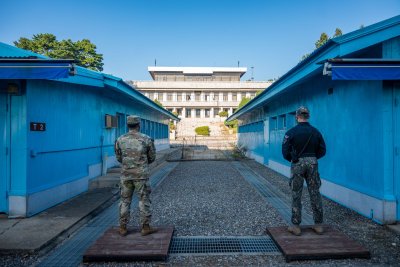

SEOUL, March 6 (UPI) — South Korea’s Unification Ministry called Friday for pursuing a declaration formally ending the Korean War, describing it as a step toward restarting dialogue with North Korea and easing tensions on the Korean Peninsula.
The ministry outlined the proposal in a policy report presented to the National Assembly’s foreign affairs and unification committee and shared with reporters, as part of President Lee Jae Myung’s broader effort to stabilize inter-Korean relations after years of heightened tensions.
Seoul “will promote a ‘peace declaration’ reflecting the political will to end the Korean War and initiate discussions on establishing a peace regime, including the signing of a peace treaty,” the report said.
North and South Korea remain technically at war because the 1950-53 Korean War ended with an armistice rather than a peace agreement.
The ministry said the declaration could serve as an initial step toward transforming the armistice system into a lasting peace framework and helping institutionalize what it described as a policy of “peaceful coexistence” between the two Koreas.
The report comes amid mixed signals from North Korea following its recent Workers’ Party congress, where leader Kim Jong Un said there was “no reason” Pyongyang could not improve relations with the United States if Washington abandons what he called its hostile policy.
Kim maintained his dismissive stance toward South Korea, however, calling it “the most hostile entity.” The Lee administration has pursued a series of confidence-building steps aimed at lowering tensions — efforts Kim described as “a clumsy deceptive farce.”
Lee has said South Korea aims to act as a “pacemaker” for renewed diplomacy between Washington and Pyongyang, working with regional partners to create conditions for dialogue between the United States and North Korea.
The ministry’s report noted that U.S. President Donald Trump has expressed willingness to address the unresolved wartime status of the Korean Peninsula and said Washington has reaffirmed its openness to talks with Pyongyang without preconditions.
Seoul said it will also seek the appointment of a U.S. special envoy for North Korea and expand coordination with neighboring countries to encourage the North to return to negotiations.
Despite those efforts, tensions could rise again soon.
South Korea and the United States are scheduled to begin their large-scale springtime military exercise, Freedom Shield, on Monday. Pyongyang routinely condemns the allies’ joint drills as rehearsals for an invasion, and the report noted that North Korea may respond with statements or military provocations.