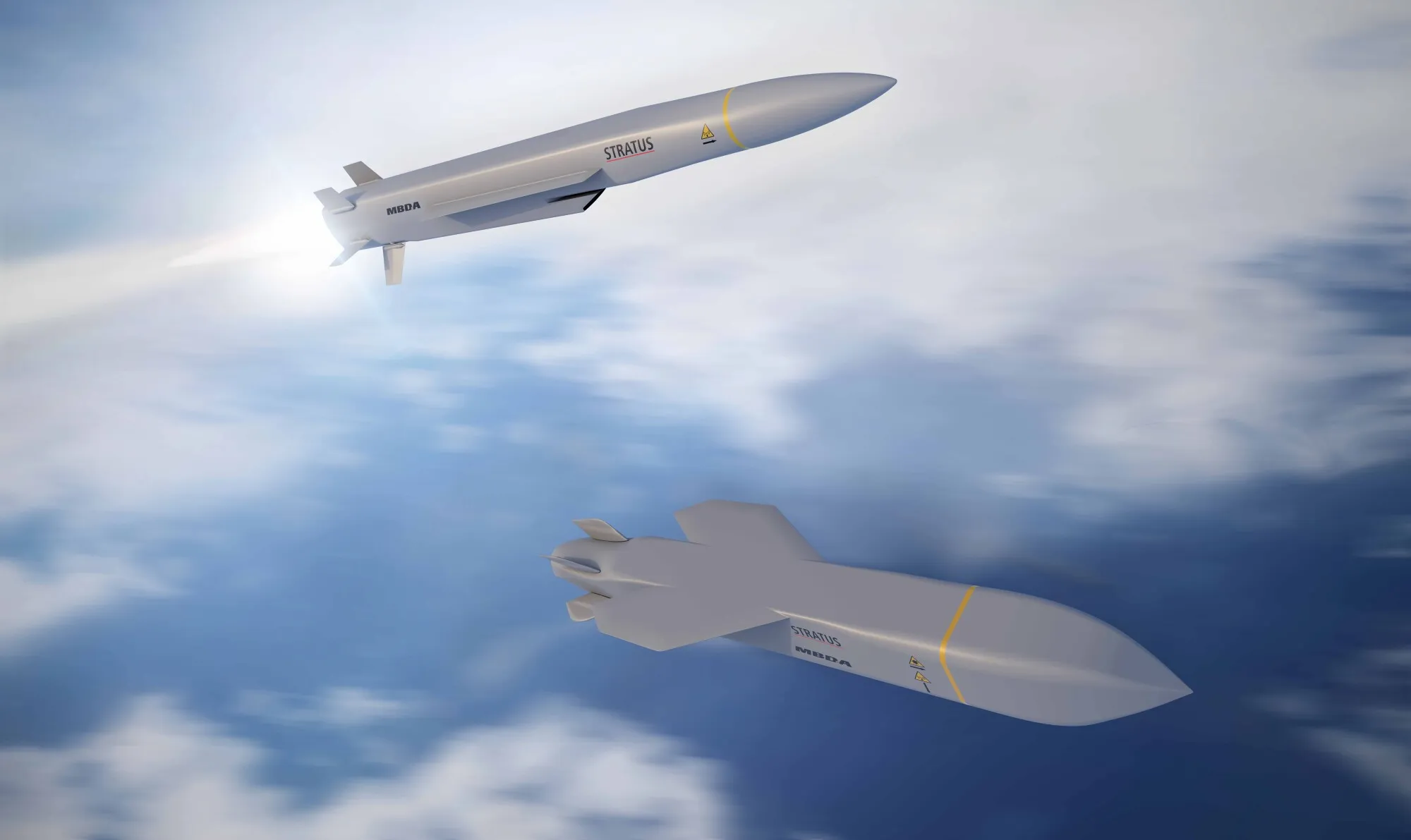
The U.K. Ministry of Defense has confirmed that the Royal Navy’s forthcoming Type 26 City class frigates will be armed with the Stratus missile, two discrete versions of which are being developed under the Future Cruise/Anti-Ship Weapon (FC/ASW) program. The missile will provide an important boost to the Royal Navy’s standoff land-attack and anti-surface warfare capabilities from the early 2030s. However, for the time being, the Royal Navy frigates are set to use only the low-observable (stealthy) subsonic version of the missile, rather than the supersonic one.
Luke Pollard, the defense procurement minister, told parliament that the Royal Navy has “a requirement called the Future Offensive Surface Weapon (FoSUW) which will provide a long-range anti-ship strike weapon with land attack capabilities, compatible with the Mk 41 Vertical Launch System.”
Pollard added that the Type 26 frigate was the designated launch platform for FoSUW, and the specific missile would be the Stratus LO (Low Observable), one of two being developed in the FC/ASW initiative, originally an Anglo-French project, since joined by Italy. The other missile is the Stratus RS (Rapid Strike), of which we will talk about more later.
Earlier this year, we got our first indication of what the Stratus LO that will arm the Type 26 will look like.
At that point still known as the TP15, the finalized shape of the low-observable cruise missile was revealed in a rendering and a model at the Defense and Security Equipment International (DSEI) exhibition in London in September.
In its final configuration, the TP15/Stratus LO has a notably stealthy airframe, with the overall arrangement of the body and four angular tailfins being very similar in appearance to the existing Storm Shadow cruise missile — one of the weapons it’s planned to replace. The wings are different from those on the Storm Shadow, being significantly broader, and it’s unclear if they are fixed, or if they ‘pop out’ as on the earlier missile.
Reportedly, the Stratus LO will have a range of around 621 miles (1,000 kilometers) when ship-launched and will fly at high subsonic speed.
The real shape of the missile was unveiled at that point to underscore the “maturity of the program,” according to MBDA, and came soon after the FC/ASW program successfully concluded its assessment phase.

Other milestones in the development of the Stratus LO to date include completion of the concept phase in 2022, trials of prototype missiles, and tests of the missile’s seekers, warheads, and fuzing systems. The missiles have undergone extensive testing to examine their radio-frequency (RF) signature, key to their low-observable characteristics.
The broader FC/ASW program was launched back in 2017 as a twin-pillar effort to develop next-generation deep-strike capabilities.
As well as the Stratus LO, the program includes the Stratus RS, a high-speed precision cruise missile. The original design for this was known as RJ10, in which the prefix signifies its ramjet powerplant, which ensures supersonic capability.
The Stratus RS is expected to have a range of around 311 miles (500 kilometers) when ship-launched and will fly at a speed of around Mach 3.5.
While both the Stratus LO and Stratus RS are initially intended to be launched from aircraft and ships, there is the potential for ground-launched applications in the future, according to the manufacturer.

While the missiles have few major components in common, a degree of interoperability was planned from the outset, which should make it easier for the same platform to launch the Stratus LO and Stratus RS as a complementary weapons system.
However, the U.K. Ministry of Defense has chosen, for the time being, to rely on the low-observable characteristics of the Stratus LO.
As such, it will replace the interim capability currently provided by the Naval Strike Missile aboard the 11 Royal Navy warships, a mix of Type 23 frigates and Type 45 destroyers, that are now receiving these Norwegian-made weapons as a replacement for their aging Harpoon anti-ship missiles.

The low-observable (stealth) characteristics of the Stratus LO should make it more survivable, even against the latest air defense systems.
On the other hand, the Stratus RS is designed to use a combination of velocity and a maneuvering flight profile to defeat the same air defenses, with its speed leaving very little reaction time. The faster missile would also be suited to destruction of enemy air defenses (DEAD) mission.
Obviously, using both types of missiles in a complex, combined attack, especially with decoys and other weapons, would offer the greatest chance of success.
Ultimately, the Royal Navy might still get to field the fast-moving Stratus RS missile on its Type 26s, too, but once the Stratus LO is deployed, it will provide a powerful component of the frigates’ already-impressive weapons arsenals. You can read more about the warships here.

The Type 26 has a single 24-cell multi-purpose Mk 41 VLS that will accommodate the Stratus LO, but which can potentially also be loaded with Tomahawk land-attack cruise missiles, already used by Royal Navy attack submarines. The possibility of combining the Tomahawk with the Stratus could create a very formidable pairing, especially if the Stratus RS version were included, with the ability to prosecute targets at speed and over great distances.
Additionally, the Type 26 has 12 VLS cells for Sea Ceptor surface-to-air missiles, a navalized variant of the active radar homing Common Anti-Air Modular Missile (CAMM). Like the U.S. Navy’s RIM-162 Evolved Sea Sparrow Missile (ESSM), each VLS cell can hold four Sea Ceptors, giving each ship a total of 48 missiles in a relatively compact space.
Gun armament comprises one five-inch Mk 45 main gun, two Phalanx close-in weapon systems, two 30mm cannons, plus machine guns. The warship can also embark a Wildcat or a Merlin helicopter.
It is worth noting that the Royal Navy is also looking at deploying undisclosed long-range missiles that would be launched from the decks of its two Queen Elizabeth class aircraft carriers. A container-based or rail-launched version of the Stratus could be an option here, too.
As well as arming the Type 26 frigates, eight of which have been ordered, the U.K. Ministry of Defense has, in the past, stated that it plans to replace the Storm Shadow air-launched cruise missile on Royal Air Force Typhoons under the FC/ASW program. It is unclear whether the Stratus LO and/or the Stratus RS would be used to arm the Typhoon, but the Stratus LO would seem more likely, as a more direct Storm Shadow replacement and a weapon already chosen for the Royal Navy.

As it stands, the Stratus missiles look set to become some of Western Europe’s most significant next-generation standoff weapons. While the Royal Navy will have to wait for the supersonic Stratus RS, if it gets it at all, the stealthy Stratus LO cruise missile should provide a capable successor to legacy subsonic land-attack and anti-surface warfare missiles in the next decade.
Contact the author: thomas@thewarzone.com