Armed

Three police officers killed in car bomb attack in northwest Pakistan | Armed Groups News

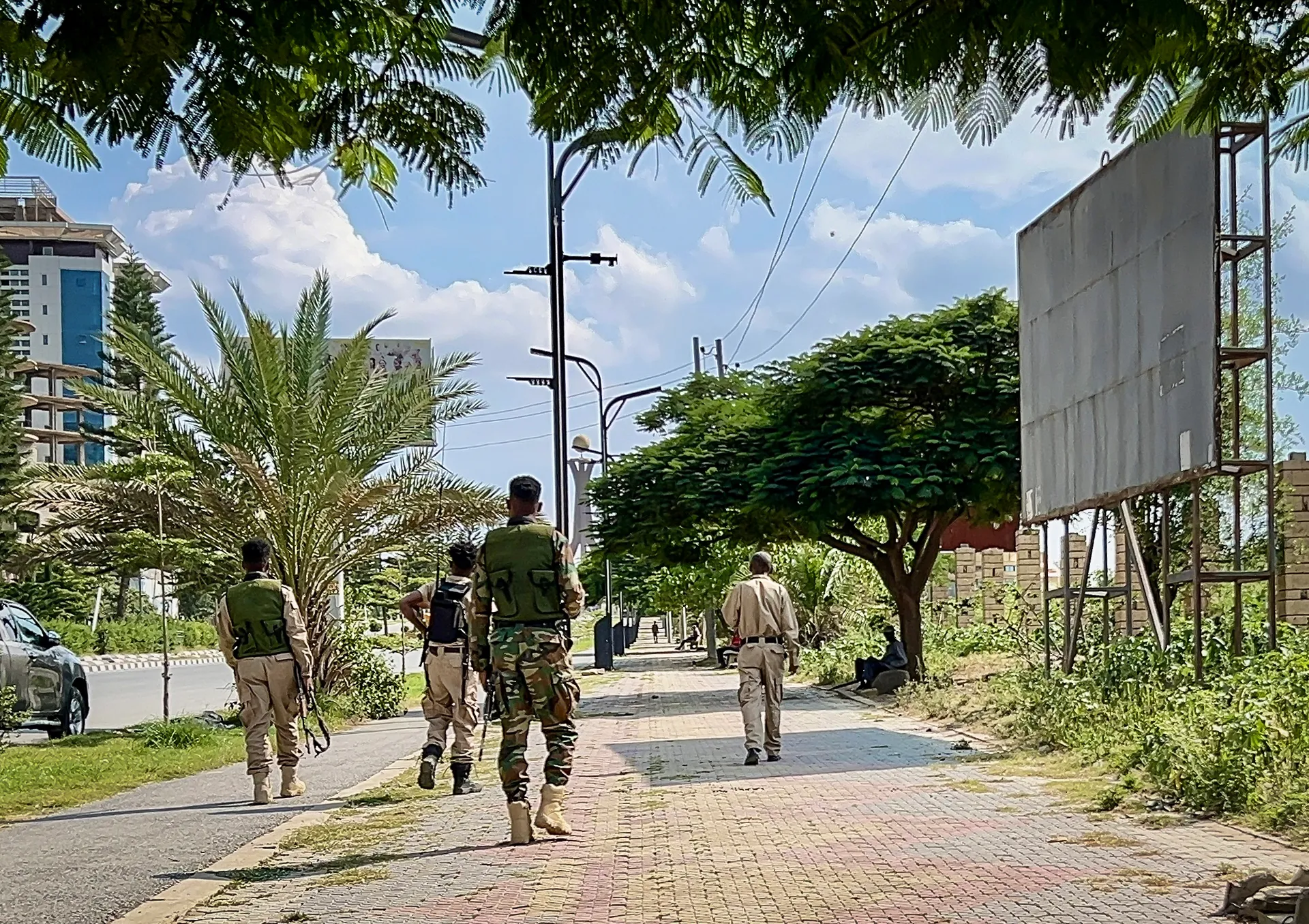
Bomber and several fighters detonate explosives-laden vehicle near security post in Bannu, Khyber Pakhtunkhwa, near Afghanistan.

A car bombing at ⁠a police post followed by an intense firefight has killed at least three officers ⁠in northwestern Pakistan, according to police and security sources.

The attack took place in Bannu, a district in Khyber Pakhtunkhwa province bordering Afghanistan, late on Saturday.

Recommended Stories

list of 3 itemsend of list

Police official Zahid Khan told The Associated Press that a suicide bomber and several fighters detonated an explosives-laden vehicle near a security post. Shortly after, multiple explosions were heard and the security post collapsed from the impact of the blast, he said.

Pakistan’s Dawn reported that nearby civilian areas also suffered severe damage due to the blasts, and two civilians were injured.

The Reuters news agency, citing security officials, reported that after the bombing, there was an ambush on police personnel rushing ⁠to the scene to provide backup.

Police official Sajjad Khan told Reuters that more casualties were feared. He added that fighting was ongoing and the extent of the damage would only be known once ‌the operation was over.

Police sources told Reuters ⁠the aggressors also used drones in the attack.

Ambulances from ⁠rescue agencies and civil hospitals were dispatched to the scene, with officials saying a state of emergency has been declared in government hospitals in Bannu.

No group immediately claimed responsibility. However, such attacks have the potential to reignite fighting along Pakistan’s border ⁠with Afghanistan.

The worst fighting in years erupted ⁠between the allies-turned-foes in February, with Pakistani air strikes inside Afghanistan that Islamabad said targeted fighters’ strongholds.

Fighting has since eased, with occasional skirmishes breaking out along the border, but no official ceasefire ‌has been brokered.

Islamabad blames Kabul for harbouring armed groups who use Afghan soil to plot attacks in Pakistan. The Taliban has denied the allegations and ‌said ‌militancy in Pakistan is an internal problem.

The Pakistan Taliban, known as Tehrik-e-Taliban Pakistan (TTP), and allied fighter groups have carried out similar attacks in the past. The Pakistan Taliban is a separate group but is often aligned with the Afghan Taliban, who seized power in Afghanistan in 2021.

Source link

UFC 328: Khamzat Chimaev kicks Sean Strickland despite armed police presence after ugly exchange

Khamzat Chimaev kicked Sean Strickland – despite the presence of armed police on stage – as the pair faced off following an ugly news conference before UFC 328 on Saturday.

A bitter and personal exchange escalated even further when Chimaev, despite being held back by UFC security, beckoned Strickland towards him as the pair traded insults, before launching a kick at the American.

As the crowd roared, security and armed police escorted each fighter off stage in separate directions as they continued to hurl expletives at each other.

Tensions have threatened to boil over throughout fight week, with Russian-Emirati middleweight champion Chimaev set to defend his belt against American Strickland in Newark, New Jersey on Saturday.

It is not uncommon for UFC fighters to insult each other in the hope of building hype around a fight, but Strickland has been particularly volatile while addressing Chimaev – launching derogatory and racist comments which have attacked his religion and heritage.

Last week, Strickland threatened to shoot Chimaev if the 32-year-old and his team-mates confronted him in the build-up to the fight.

In response, the UFC has hired extra security to protect each fighter and reportedly kept the pair in separate hotels.

Chimaev has been calm and reserved during fight week, despite Strickland’s derogatory comments, but was animated during the news conference.

Before the pair had even taken their seats, security had to intervene and, as Strickland continued to goad Chimaev, he responded with ugly comments about childhood trauma which the American has spoken about in the past.

“You’re making fun of child abuse,” replied Strickland, who followed up with further expletives.

When asked if he enjoyed the bitter rivalry between Chimaev and Strickland, UFC president Dana White – who was stood between the pair – responded “it is what it is”.

He previously described it as a “top-three” heated rivalry of all time in the UFC.

Despite the offensive comments from Strickland and Chimaev, it is unlikely the UFC will take any disciplinary action with White a vocal supporter of free speech.

“I think probably the most important free speech to protect is hate speech,” White said last year.

“Because when a government or a certain person can come out and determine saying ‘this is hate speech’, it’s a very slippery slope and it’s dangerous, in my opinion.”

Strickland did not appear to be hurt by Chimaev’s kick and afterwards wrote “exactly what I expected a coward to do”, on social media.

It is unclear whether the New Jersey Athletic Control Board will punish Chimaev for the altercation.

Source link

Mali rattled by ongoing armed attacks: What to know | Politics News

Mali has been rattled by coordinated attacks carried out by several unidentified ⁠armed groups beginning on Saturday, escalating the political and security crisis in the country, which has been under military rule for most of the past 14 years.

On Sunday, a military source told Al Jazeera that Mali’s Defence Minister Sadio Camara had been killed amid coordinated attacks on military sites across the country, including the capital, Bamako. His residence in Kati was attacked on Saturday.

Recommended Stories

list of 3 itemsend of list

“The General Staff of the Armed Forces informs the public that unidentified armed terrorist groups targeted certain locations and barracks in the capital and the interior early this morning, April 25, 2026. Fighting is ongoing,” Mali’s military said in a statement on Saturday.

Al-Qaeda-linked group Jama’at Nusrat al-Islam wal-Muslimin (JNIM) has claimed responsibility for attacks in Kati, near the capital, as well as the Bamako airport and other locations further north, including Mopti, Sevare and Gao. Tuareg rebels also claimed participation in the latest assaults.

The current military ruler, Assimi Goita, came to power in the 2021 coup on the promise to boost security amid the growing influence of armed groups in one of the most impoverished nations in the world. Goita has yet to make a public statement.

So, what is the latest situation in the country and have the armed attacks been contained?

Here’s what we know:

What happened?

On Saturday morning, Mali’s army said unidentified ⁠“terrorist” groups ⁠had attacked several military positions in ‌Bamako and the country’s interior.

Two loud explosions and sustained gunfire were heard shortly before 6am (06:00 GMT) near Mali’s main military base, Kati, just north of the capital. Soldiers were deployed to block roads, witnesses said.

There was similar unrest at around the same time in the central town of Sevare, and Kidal and Gao in the north.

Gunfire ⁠could be heard near a military camp close ⁠to the Bamako airport, where Russian mercenary forces are based, a resident told the Reuters news agency.

Heavy gunfire was also reported in Kati, where Goita also has his residence, witnesses told the AFP news agency.

AFP reported that Kati residents uploaded images on social media showing their homes destroyed. “We are holed up in Kati,” one resident said.

The military said in a statement it had killed “several hundred” assailants and repelled the assault, which hit multiple sites in or near Bamako. It is unclear how many assailants were killed.

It said the situation was under control, adding that a large-scale sweep operation was also under way in Bamako, the nearby barracks town of Kati and elsewhere in the gold-producing country.

Reporting from Dakar, Senegal, on Saturday, Al Jazeera’s Nicolas Haque said the scale and coordination of the attack appeared to be unprecedented.

He said, despite the situation having come under control, “there’s an unprecedented level of panic in the military ranks”.

The African Union, the secretary-general of the Organisation of Islamic Cooperation and the United States Bureau of African Affairs have condemned the attacks.

Indications that different armed groups launched a coordinated attack in Mali signal a “very dangerous development”, according to Ulf Laessing, Sahel analyst at the German think tank Konrad Adenauer Stiftung.

He told Al Jazeera on Saturday that since the crisis began in 2012, security has been “degrading” every year, and the government has little control over large areas of the country.

Mali’s democratically elected President Amadou Toumani Toure was deposed in a coup led by soldiers in May 2012. His government was accused of failing to handle a Tuareg-led rebellion in the north.

Since then, the country has been experiencing a severe security and political crisis, armed rebellions and two military coups.

Mali is “a vast territory, twice the size of France. Most people live in the south, the north is desert and mountains … it’s impossible to control it, not even the French could do it, let alone the Russians”, Laessing said.

“There’s no military solution”, and armed groups are “entrenched” in the countryside.

“The only good news is, so far, they [armed groups] haven’t been able to control … larger cities,” he added.

Who is behind Saturday’s attack?

The JNIM and Tuareg rebels have claimed responsibility for the attacks.

In a statement published by SITE ‌Intelligence Group, JNIM claimed attacks in Kati, Bamako and in localities further north, including Mopti, Sevare and Gao.

JNIM is the Sahel affiliate of al-Qaeda and the most active armed group in the region, according to conflict monitor ACLED. Since September, JNIM fighters have been attacking fuel tankers, bringing Bamako to a standstill in October 2025.

It also imposed an economic and fuel blockade by sealing off major highways used by tankers transporting fuel from neighbouring Senegal and the Ivory Coast to the landlocked Sahel country.

For weeks, most of Bamako’s residents were unable to buy any fuel for cars or motorcycles as supplies dried up, bringing the normally bustling capital to a standstill.

Despite several months of calm, Bamako residents faced a diesel shortage in March, with fuel prioritised for use in the energy sector.

On Saturday, the JNIM said the city of Kidal was “captured” in an operation coordinated with the Azawad Liberation Front (FLA), a Tuareg-dominated rebel group.

Mohamed Elmaouloud Ramadane, a spokesperson for FLA, said on social media ⁠that the group had taken control of multiple positions in Kidal and Gao. Al Jazeera could not independently verify the claim.

Videos posted online and verified by Al Jazeera showed armed men entering the National Youth Camp of Kidal on Saturday.

Al Jazeera’s Haque noted that it seems the FLA is gaining ground in the north of the country.

“There’s video footage circulating on social media showing some of these fighters entering the residence of the governor of Kidal,”  he said.

“Kidal is not the biggest town in the north, but it’s high in symbolism because whoever holds the town of Kidal controls the north,” he added.

Ibrahim Yahaya Ibrahim, deputy director for the Sahel at the International Crisis Group, says Malian authorities appear to have been caught off-guard by the latest wave of attacks.

Speaking to Al Jazeera from Dakar on Saturday, Ibrahim said the offensive fits into a broader pattern of escalating violence.

“Even though it is hard to say that it is totally a surprise, I think it is just another dramatic episode in a series of spectacular attacks that we have witnessed in recent years by JNIM attacking the government,” he said.

What role did Russian mercenaries play during the attacks?

Witnesses told Al Jazeera’s Haque that Russian mercenaries were involved in fighting in Bamako, around the airport, where they have one of their headquarters.

“But because there’s been so much pressure on the Russia-Ukraine front, some of these Russian mercenaries are being pulled out from Mali, which is affecting the security situation in Mali now,” Haque said.

Al Jazeera’s Haque said that “the Russian mercenaries seem to have surrendered the town of Kidal or at least the military camp where they were with the Malian forces”.

“The Tuareg fighters had asked them to surrender weapons. It is unclear whether they did that or not but what’s clear is that the Russians are stepping out of the town of Kidal,” he said, adding that “Russian mercenaries not fighting against armed fighters “is something significant”.

In June last year, Russia’s Wagner group said it would withdraw from Mali after more than three and a half years on the ground. The paramilitary force said it had completed its mission against armed groups in the country.

But Wagner’s withdrawal from Mali did not mean the departure of Russian fighters. Russian mercenaries have remained under the banner of the Africa Corps, a separate Kremlin-backed paramilitary group created after Wagner founder Yevgeny Prigozhin led a failed mutiny against the Russian military in June 2023.

Besides Mali, Africa Corps is also active in other African countries, including Equatorial Guinea ⁠and the Central African Republic.

What does all this mean for Mali’s and the Sahel’s security?

Since gaining independence in 1960, the West African country has experienced alternating cycles of political stability and instability, punctuated by rebellions, financial woes and military coups.

In 2012, ethnic Tuareg separatists, allied with fighters from an al-Qaeda offshoot, launched a rebellion that took control of the country’s north.

But fighters from the armed group Ansar Dine swiftly pushed out the Tuareg rebels and seized key northern cities, triggering French military intervention in early 2013 at the request of the government. Ansar Dine and several other groups later merged to form the JNIM.

In September 2013, Ibrahim Boubacar Keita was elected as president. His fragile democratic rule ended in 2020. Under his government, the United Nations brokered a peace deal between the government and northern Tuareg groups fighting for an independent Azawad in 2015.

President Keita was deposed in a military coup in August 2020 following months of mass protests over severe economic woes in the country and the advance of armed groups in the north. In September that year, Bah Ndaw, a retired colonel, was sworn in as interim president, with Goita as vice president, to lead a transitional government.

In May 2021, Goita, the leader of the previous year’s power grab and vice president of the interim government, seized power in a second coup. Mali is currently being run by Goita’s military government. Initially, the military government pledged to return to civilian rule in March 2024, but it has not kept the promise.

Goita invited Russian mercenaries to support the military administration in its fight against armed groups in December 2021 after asking the French troops to leave the country. This created a security vacuum. In January 2024, Mali’s rulers also terminated the 2015 peace deal with Tuareg rebels, accusing them of not complying with the agreement. This led to a breakdown in the country’s security situation once again.

In September 2025, the JNIM began a fuel import blockade, crippling life in Bamako.

Mali, along with Niger and Burkina Faso, formally split last year from the West African regional bloc ECOWAS to form the Alliance of Sahel States (AES).

However, earlier this week, Malian Foreign Minister Abdoulaye Diop attended a security forum in Senegal where he said the withdrawal was “final”, but added that the AES could maintain a constructive dialogue with ECOWAS on freedom of movement and preserving a common market.

“Even for the Malian minister to come to this conference signals that they are afraid for themselves and they need to open up,” Adama Gaye, political commentator on the Sahel and West Africa, told Al Jazeera. “It is also an indication that they want to reach out to ECOWAS.”

Gaye added that the Goita-led military government “cannot have legitimacy in their own country”.

“They have been terrible in economic progress, peace and stability,” he added, describing the ongoing situation in Mali as “very dire”.

“These attacks will be another negative aspect to their claims that they can control Mali,” he said.

Source link

What is really happening in northern Nigeria | Armed Groups

In recent months, the frequency and intensity of attacks in northern Nigeria have shattered the comforting illusion that the region’s long insurgency has receded into the background of national life. As violent incidents have proliferated, many Nigerians have refused to confront this uncomfortable reality and have opted instead to embrace conspiracy theories suggesting that the resurgence is somehow tied to renewed American involvement in Nigeria’s  counterterrorism efforts.

It is not difficult to see why the theory of foreign collusion with terrorist groups resonates in Nigeria. In February 2025, United States Congressman Scott Perry claimed that the US Agency for International Development (USAID) had funded Boko Haram, but offered no evidence for the allegation. Richard Mills, then the US ambassador to Nigeria, rejected Perry’s statement, but by then the claim had already acquired a life of its own in the public space and on social media.

Then, American officials like Congressmen Ted Cruz and Chris Smith made statements that fuelled the “Christian genocide” narrative, which falsely claims that the killings in Nigeria exclusively target Christians.

Attacks on Christians have happened, including most recently on a church in Kaduna state on Easter Sunday, but Muslim communities have also been regularly targeted. The truth is that terrorist groups have long operated indiscriminately.

What this moment demands, therefore, is to go beyond the seduction of easy explanation, and embark on serious analysis of what is really happening in northern Nigeria.

That diagnosis must begin with clarity about what the attacks reveal. First, they reveal that the insurgency has adapted in both form and method. Second, northern Nigeria’s insecurity can no longer be understood in isolation from the rest of the region; it is part of the wider regional disorder across the Lake Chad basin and the Sahel. And third, the violence continues to feed on deeper domestic vulnerabilities that extend far beyond the battlefield: chronic poverty, educational exclusion, weak local governance, and the long erosion of the social contract in parts of the North.

Let us begin with the first point. Recent attacks demonstrate that the insurgent ecosystem has learned, adapted, and expanded beyond the old image of a crudely armed rebellion fighting in predictable ways. The ISIL affiliate in West Africa Province (ISWAP), in particular, has become more adaptive in structure and tactics, while its conflict with Boko Haram has weakened the latter and left ISWAP as the more organised and deeply entrenched threat in the Lake Chad region. It has consolidated its presence in parts of the Lake Chad basin and expanded into Sambisa Forest, widening the space from which it can threaten civilians and military formations alike.

This matters because insurgencies are sustained not by ideology alone, but by terrain, supply routes, local economies, and the ability to move men and materiel through spaces where the state is weak or absent. In that sense, the insurgency is no longer merely surviving in familiar hideouts; it is entrenching itself in a broader and more fluid battlespace, with ISWAP’s control of trade in and around Lake Chad now a major pillar of its resilience.

ISWAP has also refined the way it fights, demonstrating a growing capacity for coordinated assaults, night raids, ambushes, and operations designed not merely to inflict casualties, but to isolate military positions and slow the movement of reinforcements. This challenge is magnified by the sheer scale of the theatre itself.

Borno, Yobe, and Adamawa states are each comparable in size to entire European countries: Borno is slightly larger than the Republic of Ireland; Yobe is roughly the size of Switzerland; and Adamawa is slightly larger than Belgium. Policing territories of that scale would test any state, all the more so when they border a fragile regional neighbourhood.

The terrain has also shaped the rhythm of the conflict, with the dry season, particularly the first quarter of the year, ushering in an intensification of attacks.

At the heart of this adaptation is the evolution of technology. What once seemed unthinkable in this theatre has now entered the insurgent repertoire. Drones, including commercially available models modified for combat, are now part of the operational environment. The significance of this shift is not merely technical; it is also psychological and strategic.

Beyond technology, the insurgency’s growing mobility has sharpened the threat further. Rapid assaults by motorcycle-mounted units demonstrate the extent to which insurgent violence now depends on speed, concentration, and dispersal. Fighters can assemble quickly, strike vulnerable locations, and disappear into difficult terrain before an effective response can take shape.

The advantage here lies not in holding territory in the conventional sense, but in imposing uncertainty, stretching the state’s defensive attentions, and proving that the insurgents can still choose where and when to shock the system.

Perhaps the most dangerous dimension of this adaptation is the infiltration of foreign fighters. Their significance lies not only in their numbers, but in what they bring with them: technical knowledge, battlefield experience, tactical imagination, and links to wider militant networks.

Their presence points to a deeper cross-fertilisation between local insurgency and global terrorist currents. More troubling still, they are now playing a more active role in the conflict, not only refining tactics and skills but also participating directly in combat.

That is why the regional dimension must be central to any serious analysis. The weakening of regional cooperation has come at the worst time, creating openings that insurgents are only too ready to exploit. A threat that has always been transnational becomes harder to confront when neighbouring states no longer act with sufficient cohesion.

Niger’s withdrawal from the Multinational Joint Task Force after the reaction of the Economic Community of West African States (ECOWAS) to the military coup there has sharpened that challenge and weakened the perimeter defences of the north-east theatre. The force, comprising troops from Nigeria, Niger, Cameroon, and Chad, with a smaller Beninese contingent at its headquarters in N’Djamena, was instrumental in earlier gains and remains vital for reinforcing positions, conducting operations in difficult terrain, denying insurgents safe havens, and intercepting the movement of foreign fighters.

Yet even regional analysis, necessary as it is, does not fully explain the problem. Insurgencies endure not only because they move across borders, but because they can recruit, regroup, and exploit social weakness at home.

Violence in northern Nigeria is sustained by a combination of doctrinal extremism, chronic poverty, educational exclusion, and a state whose presence is often too limited to command confidence in the communities where armed groups seek recruits. The argument, therefore, cannot remain confined to the military sphere.

Poverty and lack of education do not directly produce terrorism, but they increase vulnerability, especially where alienation, weak institutions, and manipulative ideological narratives are already present. This is why the educational crisis in northern Nigeria should be seen not only as a developmental challenge, but as part of the wider security landscape. Education does more than impart literacy and numeracy; it provides structure, routine, and pathways to self-actualisation and social belonging.

It is important to note that the government is not without a response. In 2024, President Bola Ahmed Tinubu signed the Student Loans (Access to Higher Education) Act into law, and the rollout of the Nigerian Education Loan Fund has since opened a wider path to post-secondary education and skills development. But the more decisive educational challenge lies earlier, at the basic level, where literacy begins, habits are formed, and attachment to institutions is either built or lost. By the time a young person reaches the threshold of higher education, the foundational work has already been done or neglected.

This is why local governance matters more to security than is often recognised. In Nigeria’s federal structure, primary education sits closest to the weakest and most politically distorted tier of government. If local government remains fiscally weak, administratively paralysed, or politically captured, one of the country’s most important long-term defences against radicalisation will remain fragile.

That is why local government autonomy, though often framed in dry constitutional terms, has direct implications for security. President Tinubu, an ardent champion of local autonomy, welcomed the Supreme Court’s July 2024 judgement affirming the constitutional and financial rights of local governments and has pressed governors to respect it. Resistance, however, is unsurprising: many governors have long treated local governments as subordinate extensions of their authority.

So what does the present moment demand from Nigeria? It demands, certainly, continued military pressure on insurgent sanctuaries. It demands stronger force protection, sharper intelligence, surveillance and reconnaissance, improved rural and urban security, and a more serious approach to trans-border diplomacy. It demands that regional diplomacy be treated not as a luxury of peacetime statecraft, but as part of the operational infrastructure of security.

But the crisis cannot be addressed by military action alone. It also calls for social, institutional, and educational measures across all tiers of government. The state must confront extremism not only through force, but through education and functioning local institutions. It must rebuild governance, restore trust, and close the social and institutional fractures through which violence renews itself.

The views expressed in this article are the author’s own and do not necessarily reflect Al Jazeera’s editorial stance.

Source link

Hamas armed wing says disarmament demands not acceptable | Israel-Palestine conflict News

Abu Obeida says calling for the group’s disarmament amounts to an attempt to continue Israel’s genocide against the Palestinian people in Gaza.

Hamas spokesman Abu Obeida has said that calling for the group’s disarmament amounted to an attempt to continue Israel’s genocide.

Hamas’s armed wing has rejected calls for the Palestinian group to disarm, saying that discussing the issue before Israel fully implements the first phase of the United States-brokered “ceasefire” in Israel’s war on Gaza amounts to an attempt to continue the genocide against the Palestinian people.

Recommended Stories

list of 4 itemsend of list

In a televised statement on Sunday, Obeida, who is Hamas’s armed wing spokesperson, said that raising the issue of weapons “in a crude manner” would not be accepted.

The issue of Hamas relinquishing its weapons is a major obstacle in talks to implement US President Donald Trump’s 20-point plan for Gaza, aimed at ending Israel’s war on the besieged territory.

Since the US- and Qatar-brokered “ceasefire” took effect in October, more than 705 Palestinians have been killed in Israeli attacks, according to the Palestinian news agency Wafa.

Hamas has told mediators it will not discuss disarmament without guarantees that Israel will completely withdraw from Gaza, three sources told the Reuters news agency last week.

“What the enemy is trying to push through today against the Palestinian resistance, via our brotherly mediators, is extremely dangerous,” Obeida said.

He said the disarmament demands were “nothing but an overt attempt to continue the genocide against our people, something we will not accept under any circumstances”.

It was not immediately clear whether the comments amounted to a formal rejection of the US-backed plan, which includes a demand that Hamas lay down its arms.

Israel’s genocidal war on Gaza, which began after the Hamas-led attacks on southern Israel in October 2023, has killed more than 72,000 Palestinians and injured at least 172,000 others.

Obeida urged mediators to pressure Israel to fulfil its commitments under the first phase of the Trump plan before any discussion of the second phase can take place.

“The enemy is the one who undermines the agreement,” he said.

There was no immediate comment from Israel on his remarks.

Obeida also addressed Israel’s role in the US-Israel war on Iran, condemning it for launching strikes on Iran “in the midst of the deception of negotiations, with full collusion and conspiracy with the United States”.

The US had been involved in talks with Iran over its nuclear programme in the weeks before the US and Israel launched the war on February 28.

In Iran, more than 2,000 people have been killed and at least 26,500 others injured since the war began.

Obeida also condemned Israel’s renewed offensive “against sisterly Lebanon”, which it launched on March 2 after the Lebanese armed group Hezbollah fired rockets into Israel.

Israel’s assault on Lebanon has killed more than 1,400 people and displaced over 1.2 million, according to Lebanese authorities.

Obeida commended Iran, Hezbollah and Yemen’s Houthis for their continued strikes against Israel.

Hamas’s spokesman also condemned the Israeli parliament’s passage of a new death penalty law that only applies to Palestinians, urging people in the West Bank “to seek, by every possible means, to liberate the [Palestinian] prisoners” held in Israeli jails.

Source link

Why have the US and Israel bombed more than 75 Iranian police facilities? | Armed Groups News

In the densely populated neighbourhoods of southern Tehran, the 11th Criminal Investigation Base once stood as a mundane symbol of local law enforcement. Its detectives investigated economic crimes, fraud and petty thefts.

The building housed no ballistic missiles, no uranium centrifuges and no military command centres. Today, it is a crater. In the opening wave of the United States-Israel war on Iran, warplanes wiped the local police station off the map.

Satellite imagery provided by Planet Labs shows the complete destruction of the 11th Criminal Investigation Base in southern Tehran between February 26 and March 6, 2026.
Satellite imagery provided by Planet Labs shows the destruction of the 11th Criminal Investigation Base in southern Tehran on February 26 and March 6, 2026. [Al Jazeera/Planet]

It was not an isolated incident. An investigation by Al Jazeera’s Digital Investigations unit has verified that at least 75 internal security sites were destroyed or damaged in bombardments by Israel and the US from February 28 to March 10. The targeted facilities included local police stations, criminal investigation headquarters, public security offices and checkpoints operated by the Basij paramilitary force.

Al Jazeera mapped the strikes using open-source data, cross-referencing field reports with satellite imagery to confirm the destruction. However, conducting independent verification has grown increasingly difficult. On March 6, commercial satellite providers Planet Labs and Vantor restricted imagery over the Middle East, later expanding the blackout to impose a 14-day delay on all images of Iran.

While the companies said the blackout prevents hostile actors from endangering civilians, independent journalist Ken Klippenstein recently revealed a leaked US Space Force directive dictating how commercial satellite firms describe damage. The leak exposed a deliberate US effort to control the flow of information and obscure the reality of the battlefield.

Targeting population centres

The spatial distribution of the 75 verified strikes revealed a clear and deliberate strategy. Warplanes bypassed isolated military installations to hit the infrastructure Tehran uses to police its citizens.

An Al Jazeera map detailing the geographic distribution of the 75 internal security sites targeted by US and Israeli strikes, showing a heavy concentration in Tehran and the western provinces.
An Al Jazeera map details the geographic distribution of the 75 internal security sites targeted by US-Israeli strikes, showing a heavy concentration in Tehran and western provinces. [Al Jazeera]

The capital alone absorbed 31 strikes, more than 40 percent of the total targets. Sanandaj, the capital of Kurdistan province, suffered eight strikes. The remaining targets were clustered tightly in major western and central cities, including Isfahan, Kermanshah and Hamedan. Meanwhile, Iran’s sprawling eastern and southeastern provinces remained largely untouched by this campaign.

By overlaying the strike coordinates with demographic maps, the investigation shows a near-perfect alignment with urban density. More than 70 percent of Iran’s population lives in these targeted western urban areas.

INTERACTIVE - Iran population density - FEB26, 2026-1772104770
A population density map of Iran demonstrates how the strike locations closely align with the country’s most heavily populated urban centres. [Al Jazeera]

The strikes systematically targeted the Law Enforcement Command, known as FARAJA, and the Basij network. FARAJA, elevated in 2021 by late Supreme Leader Ali Khamenei to operate alongside the military, is currently led by Ahmad-Reza Radan. It manages daily urban law enforcement and riot control. The Basij, an immense volunteer paramilitary force deeply embedded in Iranian neighbourhoods, acts as the state’s ultimate tool for social control.

Engineering state collapse

The pattern of the US-Israeli air strikes points to an objective far removed from dismantling nuclear facilities or degrading military infrastructure. It reveals a calculated attempt to engineer the collapse of the Iranian state.

On February 28, US President Donald Trump launched the war and in a video address urged Iranians to take over their government once the bombs stopped falling. Israeli Prime Minister Benjamin Netanyahu echoed this sentiment in Farsi, calling on millions of Iranians to take to the streets and describing the military strategy as breaking the Iranian government’s bones.

The military planning, however, preceded events on the ground that Trump and Netanyahu pointed to for justification for their war. Israeli Defence Minister Israel Katz revealed in early March that Israel had been planning to strike Iran in mid-2026, long before January’s deadly government crackdown across Iran against economic protests.

Satellite imagery captures the extensive damage inflicted on the Beheshti Basij headquarters in Tehran's District 8 following the initial wave of strikes. (Al Jazeera/Planet).
Satellite imagery captures extensive damage to the Beheshti Basij headquarters in Tehran’s District 8 after the initial wave of strikes. [Al Jazeera/Planet]

This approach aligns with a broader Israeli doctrine. Daniel Levy, a former Israeli government adviser, previously told Al Jazeera that Israel has no interest in a smooth political transition in Tehran. What Israel wants is the collapse of the government and the state, Levy said, adding that if the repercussions spread to Iraq, the Gulf and the entire region, that is better from Israel’s point of view.

A failing strategy

Still, a month into the war, the US-Israeli strategy to spark an internal revolution through the systematic destruction of Iran’s internal security apparatus appears to be failing.

Iranians are living under daily bombardments. As missiles destroy civilian infrastructure and oil refineries burn, daily survival has eclipsed any coordinated political uprising. The United Nations special rapporteur on human rights in Iran has warned that civilians are facing a simultaneous military and human rights crisis.

Rather than collapsing, Iran’s internal security apparatus has adapted. During Ramadan, FARAJA deployed 24-hour patrols across Tehran, and riot police shut down public gatherings before the Persian New Year holiday. After the March 17 assassination of Basij commander Gholamreza Soleimani, Israeli forces released footage of strikes on mobile Basij checkpoints, indicating that Iranian security forces are still controlling the streets.

The US attempt to dismantle state security from the air mirrors its disastrous 2003 de-Baathification policy in neighbouring Iraq, which barred members of the former ruling Baath Party from holding government jobs, dismantled local policing and birthed a devastating sectarian war. Unlike in Iraq, Washington today has no troops on the ground in Iran to fill a security void it is trying to create.

Beneath the rubble of the 11th Criminal Investigation Base and dozens of stations like it, the US and Israel are aiming to bury the Iranian state and spark a popular revolt. Instead, they have trapped millions of civilians in a burning country.

Source link

Serbian MiG-29 Appears Armed With Chinese Supersonic Standoff Missiles

In a surprising development, Serbia has emerged as an operator of the Chinese-made CM-400 air-launched supersonic standoff missile. The weapon has been integrated into Serbia’s Soviet-era MiG-29 Fulcrums, which have undergone various upgrades. As it stands, the Balkan state, which has had a turbulent recent history, likely fields a missile capability otherwise unmatched in Europe (outside of Russia, at least).

A photo recently emerged showing a Serbian Air Force and Air Defense MiG-29 carrying a pair of CM-400 missiles on its inboard underwing hardpoints.

As we reported yesterday, Serbian Air Force showcased, for the first time, that they are in possession of Chinese made CM-400 supersonic air-ground missiles, with a reported range of up to 400 km.

This makes Serbia the second foreign customer, after Pakistan.

Pair of missiles… pic.twitter.com/Yo2Utzf8DV

— Peter Voinovich (@PeterVoinovich) March 10, 2026

There had also been previous clues that Serbia might be poised to introduce a powerful new weapon of some kind.

According to Belgrade-based defense journalist Petar Vojinović, the chief of the General Staff of the Serbian Armed Forces, Gen. Milan Mojsilović, stated last month that “in the air component, we have weapons of a similar maximum range and lethality [to the PULS rocket artillery system].”

Mojsilović was referencing the Israeli-made PULS (Precise and Universal Launching System) since this has been recently introduced by the Serbian Army. You can read more about this ground-launched artillery rocket here.

Serbia’s Acquisition of PULS Systems and Hermes 900 UAVs from Israel

Serbia ordered 1,000 kamikaze drones from Iran in 2023. In 2025, it made significant purchases from Israel’s Elbit Systems: a $335 million rocket and drone deal in January, and a $1.6 billion PULS (Precise and… pic.twitter.com/IiHPqyo5BZ

— Clash Report (@clashreport) October 8, 2025

Furthermore, Serbian President Aleksandar Vučić recently alluded to recently introduced military capabilities, stating: “…people couldn’t dream about everything we have, everything we are acquiring, they couldn’t dream.”

As for the CM-400, this weapon was developed and is manufactured by the China Aerospace Science and Industry Corporation (CASIC), apparently primarily for export. So far, it is not known to be in Chinese military service.

Unveiled in 2012, the CM-400 has a length of around 17 feet, a diameter of 16 inches, and weighs roughly 2,000 pounds. This includes one of two types of warheads, either a high-explosive charge weighing 330 pounds or an armor-piercing warhead weighing 440 pounds.

The CM-400 is a supersonic weapon, and CASIC claims it can reach a speed of Mach 4.5 in the terminal phase of flight. It has often been described as a hypersonic missile, but this is likely not the case: Mach 5 is typically considered to be the boundary between high-supersonic and hypersonic speed.

Nevertheless, it is clearly a very fast missile.

The missile’s range remains unclear, with varying accounts of this aspect of its performance.

At the very least, it is reported to have a range of 155 miles, while some sources claim it can hit targets at a range of 186 miles or even 250 miles.

ZHUHAI, CHINA - NOVEMBER 12: CM-400AKG Air-to-Ground Missile (Anti-Radiation Type) is on static display during the 15th China International Aviation and Aerospace Exhibition, or Airshow China 2024, on November 12, 2024 in Zhuhai, Guangdong Province of China. The Airshow China kicks off on November 12 in Zhuhai. (Photo by Shen Ling/VCG via Getty Images)
The CM-400AKG anti-radiation missile on display during Airshow China 2024. Photo by Shen Ling/VCG via Getty Images VCG

The CM-400 has also been described as a quasi-ballistic missile, though this is also probably not entirely accurate.

Generally speaking, a quasi-ballistic missile is capable of being used on a depressed trajectory. This makes the missile more capable of significant maneuvering in flight, presenting greater challenges even for opponents with more robust missile defense capabilities.

In the case of the CM-400, the missile reportedly flies on a relatively high ballistic trajectory, powered by its solid rocket motor. It then careens toward its target at a steep angle of descent. While it may also be able to maneuver dynamically during its terminal attack phase, to attack moving ships, it doesn’t fly on a depressed trajectory, as far as we know.

In terms of target sets, the missile has been widely described as an anti-ship missile, specifically even as a ‘carrier-killer’. In fact, the basic weapon can also be configured as an anti-radiation missile, and it is presumed to also have the capability to attack non-emitting ground targets.

Depending on the different targets, the CM-400 can have different seeker heads fitted. All of the versions have an inertial guidance system with Global Navigation Satellite System (GNSS) correction. For the terminal phase, it relies on an infrared/optoelectronic seeker for attacking naval targets, or a passive radar seeker to take out electromagnetic emitters. The circular error probable (CEP) for the anti-radiation version is claimed to be 16-33, reduced to 16 feet or less for the anti-ship version.

Previously, the only confirmed export operator of the CM-400 was Pakistan, which uses it on its JF-17 Thunder multirole fighters. Pakistani officials claimed that the missile saw successful combat use against Indian S-400 air defense systems during the conflict between the countries in May last year. However, this remains unconfirmed.

A JF-17 Thunder of the Pakistan Air Force armed with CM-400 missiles. via Chinese internet

Pakistan shows footage of its JF-17 Thunder jet taking off to hit Indian S-400 air defence system with Chinese-origin CM-400AKG hypersonic missiles in anti-radiation variant.

The missile features a passive radar guidance mode, allowing it to home in on radar emissions, making it… pic.twitter.com/DUQTOQciDk

— Clash Report (@clashreport) May 10, 2025

In Serbian service, the CM-400 is carried by the MiG-29 fighter. These aircraft were first acquired by the then Yugoslavia in the 1980s. Survivors of Operation Allied Force in 1999 were later supplemented by secondhand MiG-29s from Russian and Belarusian stocks. The aircraft have also been moderately upgraded and are now known as MiG-29SM+. Fourteen examples are currently in active Serbian service.

19 July 2024, Serbia, Belgrad: A MIG-29 jet of the Serbian Air Force accompanies the Airbus of Federal Chancellor Scholz (SPD) after a visit to the President of Serbia Vucic and a summit meeting on critical raw materials. Photo: Michael Kappeler/dpa (Photo by Michael Kappeler/picture alliance via Getty Images)
A Serbian MiG-29 accompanies the Airbus of the German chancellor after a visit to Serbia in 2024. Photo by Michael Kappeler/picture alliance via Getty Images picture alliance

The long-term plan for the Serbian MiG-29s is somewhat unclear, since the country ordered 12 Dassault Rafale multirole fighters, in a deal that you can read more about here.

For the time being, however, in the CM-400, Serbia looks to have secured a capability that is very likely unique in the wider region.

With its combination of very high speed, long range, and ‘fire and forget’ guidance, the missile is ideal for deep standoff strikes. It is optimized for striking hardened strategic targets, day and night, and in all weather.

Thanks to CATIC’s Standalone Weapon Fire Control System (SWFCS), also designated as WZHK-1 by China, the CM-400 (and other Chinese missiles) areis designed to allow foreign models of aircraft to operate Chinese missiles and bombs.

Speaking to Janes during the exhibition, a CATIC official said that the system is designed to equip a range of Chinese air-launched weapons and can be installed on existing weapon hardpoints.

“The system gives air forces around the world the ability to easily integrate Chinese-made weapons with their aircraft without requiring them to make software or hardware changes to the host aircraft,” a CATIC official told Janes about the SWFCS back in 2024.

CATIC’s Standalone Weapon Fire Control System (SWFCS). Petar Vojinović

“The [SWFCS] uses a wireless data system that connects to a tablet in the cockpit that can be worn by the pilot. The tablet acts as a portable wireless controller that the pilot can use to launch the missiles,” the official added. Similar tablet-based soluiions have also been used by Ukraine to rapidly integrate Western weapons on Soviet-era jets, as you can read about here.

Ukrainian Air Force Su-27 Flanker Wild Weasel operations, seen here conducting multiple low level standoff strikes against Russian radars with US-supplied AGM-88 HARMs. pic.twitter.com/7CosjXFNkO

— OSINTtechnical (@Osinttechnical) April 21, 2024

The same SWFCS interface is also being used to carry another Chinese air-to-ground weapon, the LS-6 precision-guided munition. This is a 1,100-pound-class weapon that combines a general-purpose bomb with a strap-on upgrade package to provide range extension and precision strike capabilities.

Meanwhile, weapons in the CM-400 class are a response to the growing threat posed by ground-based air defense systems, which are pushing combat aircraft ever further from the targets they are assigned to destroy.

With its very high maximum speed, the CM-400 is also well suited to attacking time-sensitive targets, which could also include mobile air defense systems or mobile ballistic missiles, provided their coordinates can be established in the required timeframe.

For Serbia, the new missile would appear to offer a relatively easy way to expand its air-launched, precision standoff strike capability. With a high degree of flexibility, fast reaction time, and the ability to penetrate most enemy air defenses, it is a notably hard-hitting weapon for what is otherwise a fairly modest air force.

It is also interesting that Serbia is looking to China to fulfil its missile needs, rather than Russia.

A pilot of the standby unit of the fighter aviation gets ready for take-off aboard a Mikoyan MiG-29 twin-engine fighter aircraft during a military excercise at the "Colonel-Pilot Milenko Pavlovic" military airport in Batajnica on March 31, 2024. The President of the Republic and the Supreme Commander of the Serbian Armed Forces, Aleksandar Vucic, visited on March 31, 2024 the standby unit of the fighter aviation for the control and protection of the airspace of the Republic of Serbia, at the "Colonel-Pilot Milenko Pavlovic" military airport in Batajnica. (Photo by Andrej ISAKOVIC / AFP) (Photo by ANDREJ ISAKOVIC/AFP via Getty Images)
A Serbian pilot gets ready for takeoff aboard a MiG-29 at Batajnica Air Base in 2024. Photo by Andrej ISAKOVIC / AFP ANDREJ ISAKOVIC

While Belgrade and Moscow have traditionally had good relations, acquiring Russian arms has become far harder since the West imposed sanctions in response to the full-scale invasion of Ukraine.

Even before this, however, there were signs that Serbia was looking to move away from Russia as its main arms supplier. As such, it has increasingly moved into a more Western-oriented orbit, with acquisitions from Airbus, for example, but it is also buying weapons from China and Israel.

A U.S. Air Force HH-60G Pave Hawk and a Serbian Mi-17 Hip during CSAR maneuvers conducted over Serbia in 2023. U.S. Air Force photo by Airman 1st Class Edgar Grimaldo

At the same time, the Serbian military is increasingly switching to more NATO-style doctrine, as well as equipment, including exercises alongside the U.S. Air Force, as you can read about here.

Bearing in mind the fact that it can be integrated on non-Chinese platforms, it will be interesting to see if other nations also adopt the CM-400.

Contact the author: thomas@thewarzone.com

Thomas is a defense writer and editor with over 20 years of experience covering military aerospace topics and conflicts. He’s written a number of books, edited many more, and has contributed to many of the world’s leading aviation publications. Before joining The War Zone in 2020, he was the editor of AirForces Monthly.


Source link
