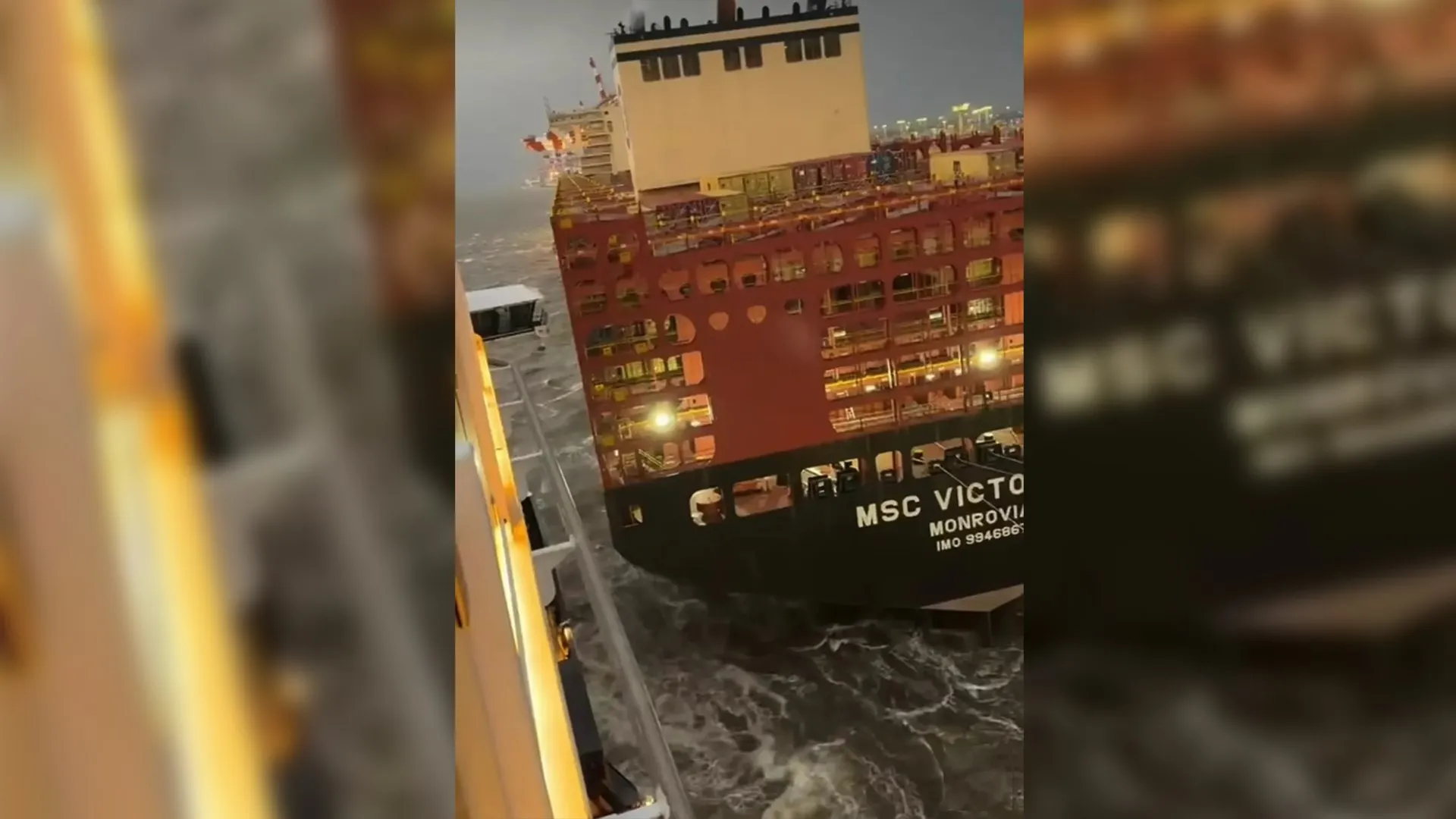
A captain whose cruise ship collided with two docked container vessels in strong winds is being investigated by German police over a possible breach of duty of care. No one was injured, but damage forced the operator to cancel its planned Canary Islands voyage.
THIS is easily the best way to ray-se your holiday game.
Swimming with stingrays on a sandbar in the Caribbean, a 25-minute boat trip from Grand Cayman.
There really is no better escape from our miserable weather than a Caribbean cruise, gleefully ticking the sun, sand and sea boxesCredit: Roger Paperno 404.723.3300The Holland America cruise ship Nieuw Statendam took us on a week-long voyage stopping in the Bahamas, Jamaica, Grand Cayman and CozumelCredit: Holland America
Standing in the warm, waist-deep water amid dozens of these exotic animals is about as close to the ultimate relaxation as you can imagine.
They are totally conditioned to visitors, there’s very little danger of a Steve Irwin moment — and I found it hard to resist the chance to pose while kissing one, though it’s probably not the most ecologically sound thing to do.
Sign up for the Travel newsletter
Thank you!
The kiss was a bit sloppy and rubbery, but the stingray said she’d had worse.
There really is no better escape from our miserable weather than a Caribbean cruise, gleefully ticking the sun, sand and sea boxes.
Your only questions are which ship, which ports and what to do when you’re not chilling with the fishes.
We were delighted to be on board Holland America’s Nieuw Statendam, which we joined in Fort Lauderdale, for a week-long voyage stopping in the Bahamas, Jamaica, Grand Cayman and Cozumel, an island just off the Mexican coast.
It’s a lovely ship, a nice size with just over 2,500 passengers, and all the bells and whistles you would expect in such a luxury floating hotel.
We loved the Crow’s Nest, the top-deck bar which is the place to be on a sea day, sampling cocktails and deciding which of the many restaurants to eat in that evening, while wondering who those people are who actually spend time in the admittedly well-equipped gym.
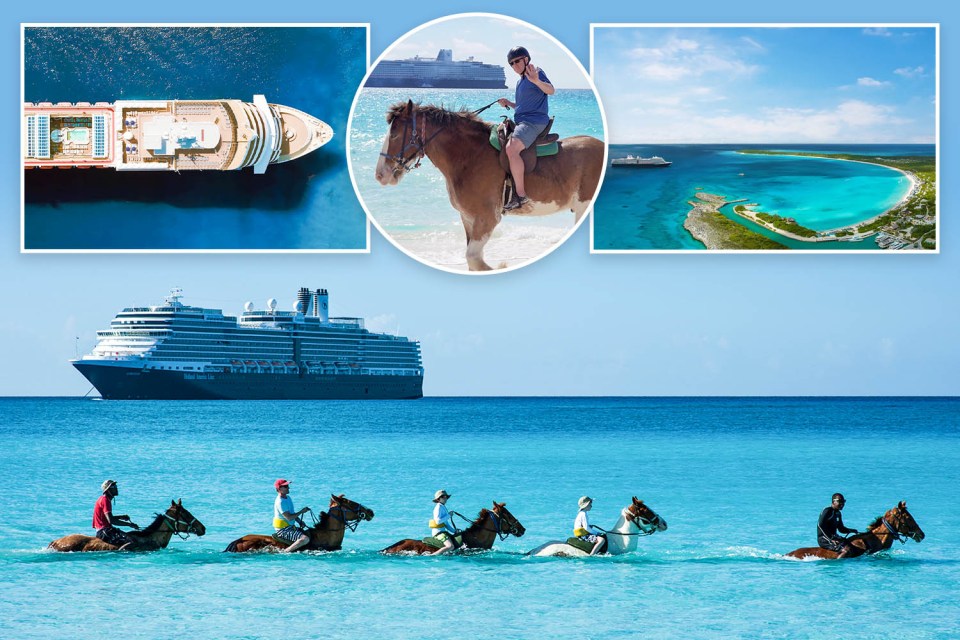
Half Moon Cay in the Bahamas is one of the many picture perfect stopsCredit: Holland AmericaIt was truly exhilarating riding into the water on horseback galloping through the wavesCredit: Supplied
We could see people sweating away in there while we went for a stroll around the open decks, stepping carefully over the jogging track and gently bickering over how much to spend playing roulette in the casino.
That is the key point of cruising. It is not normal. Normal life doesn’t have free food at every turn (and free drinks if you invest in the Have It All package) — and if you’re not cruising you don’t pitch up at a private island in the Bahamas very often.
Holland America’s Half Moon Cay featured gorgeous, white-sand beaches to sunbathe on or snorkel off, a friendly bar, a tasty BBQ and, best of all . . . sea horses.
Sorry, not sea horses, but horses that go in the sea. It was truly exhilarating, riding around the paddock and beach first before heading into the water on horseback — and galloping, then swimming through the waves, with no fear of falling off as you’re guaranteed a soft landing.
One fellow rider asked how well the horses were looked after, and got the reassuring response from an animal welfare point of view: “Better than the staff!”
From Half Moon Cay, it was next stop Jamaica, making port in Ocho Rios on the north of the island.
There really are lots of options and excursions for you to pick over and plan for here before you board, including ziplining for the adventurous, river rafting — and the classic, climbing Dunn’s River Falls.
We opted for the waterfalls and it was a lot of fun, going up the river in small groups with everyone buzzing, laughing, splashing and helping each other over the tougher bits (they’re not that tough, I’m an unfit sixty-something and coped).
A kiss from a stingray was an unexpected highlight for Peter ThorntonCredit: SuppliedThe stingrays are conditioned to visitors and there is no dangerCredit: Getty
Reward yourself with a tasty ice-cream at the end before making the short trip back to the ship.
And the options for amusement on board are just as varied. Sit back and enjoy more laughter with a top comedian, take in a bit of live music or a show — and dance the night away.
Or pit your wits in a quiz, challenge your partner to a game of chess, watch a movie or simply sit back and relax with a good book.
Nieuw Amsterdam also offers a host of options for both live and recorded entertainment, and a packed programme of talks and activities.
We had great nights enjoying the live shows in B.B. King’s Blues Club, with the talented All-Stars house band making music and memories, though I do need to find a better quiz team as our pre-show performance in the general-knowledge tester was sadly lacking.
We also enjoyed treat meals and wines in The Pinnacle Grill, Tamarind and Morimoto by Sea, all well worth the supplement — though the standard of cuisine is excellent throughout the vessel, from the buffet to the main dining rooms, and not forgetting the essential late-night pizza availability after watching movies by moonlight on the open deck.
Our last port of call before sailing back to Florida was Cozumel, a charming if tourist-centric island a short ferry ride from the Mexican mainland.
Again, build up your anticipation of your cruise by selecting activities before you go.
We had tough decisions to make, I was well up for going to watch a Lucha Libre show — you know, the Mexican wrestling where they wear masks and get all acrobatic.
Passengers who did go to that loved it, but we decided to stick with what we do best — swimming with things.
Having already snogged a stingray and gone galloping through the waves on horseback, this time we were off to get up close and personal with manatees.
They were terrific, crunching down on heads of lettuce — and a real highlight of this corker of a Caribbean cruise.
Wife Lucy loved them — but has a soft spot for a leathery-skinned, rotund, slow-moving mammal.
GO: Caribbean Cruise
SAILING THERE: A seven-night full-board Western Caribbean cruise on Nieuw Statendam, departing Fort Lauderdale and calling at Half Moon Cay; Ocho Rios, Grand Cayman and Cozumel is from £1,194pp, based on a December 20 departure.
Add the Have It All package including, alcoholic drinks package, wifi, crew gratuities and $100 per guest for excursions from £1,649pp.
Like the rest of the sector and other industries heavily dependent on fuel, Norwegian Cruise Line Holdings (NCLH) faces pressure on its bottom line that will be only partially offset by higher passenger spending.
Zone 5 has not disclosed where or when the pictures were taken, or which programs, specifically, the ground-based launches were conducted under. The images do not offer a clear view of the trailer-mounted launcher, either. A spokesperson for the company did stress to TWZ that versions of Rusty Dagger have now been selected for separate U.S. Army and Navy programs, in addition to its initial development through the U.S. Air Force.
One of the first images showing the surface-launched version of the Rusty Dagger in action. Zone 5 Technologies
In May, Zone 5, as well as Anduril, CoAspire, and Leidos, received framework agreements from the Pentagon under the Low-Cost Containerized Missile (LCCM) program. The U.S. Army’s Portfolio Acquisition Executive Fires (PAE Fires) is running LCCM in cooperation with the Office of the Under Secretary of War for Research and Engineering (OUSW R&E). The aim of this program is to procure more than 10,000 low-cost cruise missiles, in total, over three years, beginning in 2027.
“We designed a surface-launch Rusty Dagger to be the foundation of U.S. and allied mass-produced affordable precision deep strike weapons,” Tom Kanewske, chief strategy officer at Zone 5, told TWZ in a statement.
“Our team went from design to demonstration in less than three months, bringing Rusty Dagger from pylons and pallets to ground launcher and shipping containers,” added Kyle Maxhimer, Zone 5’s president.
Another picture of a Block 40 Rusty Dagger being fired from a launcher on the ground. Zone 5 Technologies
Zone 5 says the Block 40 version of Rusty Dagger can accommodate warheads in the 100-to-250-pound classes. It can still be configured for air-launch, either from pylons under the wings of aircraft or via palletized munitions systems. In order to be fired from launchers on the ground or at sea, the new version of the missile is fitted with a solid-fuel booster rocket at the tail end.
More specific details about the Block 40’s capabilities compared to the preceding air-launch-only version, also referred to as the Block 20, remain limited. From what we can see now, the two variations appear outwardly similar in many respects, at least broadly speaking. Earlier variations had a distinctive tail configuration with four squared-off fins, two facing upward and two more angled to either side. The shaping of the fins on the Block 40 does look to be more rounded. It’s also possible the missile may have a new cruciform tail fin arrangement, but this could also be a trick of the angle from which the missile is being viewed, coupled with the low resolution of the available images.
A side-by-side comparison of the Block 40 Rusty Dagger configured for surface launch, at top, and an earlier air-launched version, at bottom. Zone 5 Technologies/USAF
Previous reports have said that Rusty Dagger has a range of 300 nautical miles when delivered at low altitude, which is increased to 500 nautical miles when launched by aircraft at medium altitudes and flying at higher speeds. In general, surface-launched versions of missiles typically have shorter maximum ranges compared to their air-launched counterparts.
Regardless, the Block 40 version is an important further evolution of the Rusty Dagger design. The initial air-launched version of the missile, now designated the AGM-188A, has already been in development for several years, in part now under the U.S. Air Force’s Extended Range Attack Munition (ERAM) program. This has included live-fire tests conducted at Eglin Air Force Base in Florida in January 2025. We now know that Rusty Dagger has been cleared for use on four different types of fighters, including the F-16. Development of CoAspire’s Rapidly Adaptable Affordable Cruise Missile (RAACM) was also conducted as part of the ERAM effort.
Three views of a Rusty Dagger live-fire test on January 22, 2025, at Eglin Air Force Base, Florida. The service did not identify the weapon by name at the time. via U.S. Air Force
Like the Navy’s CHAOS effort, ERAM has been focused primarily on supporting allies and partners, starting first with Ukraine. A Zone 5 spokesperson told TWZ that, as things stand, Rusty Dagger remains the only publicly reported operational missile in its class fielded by the Ukrainian military.
It appears that the AGM-188A “Rusty Dagger” cruise missile has undergone field testing in Ukraine.
Russian sources are publishing photos of an unknown 8-element CRPA antenna. On the back side of the unit there is a circuit board with a large heatsink, which carries the CAGE code… pic.twitter.com/phZeOJfHJ0
— 𝔗𝔥𝔢 𝕯𝔢𝔞𝔡 𝕯𝔦𝔰𝔱𝔯𝔦𝔠𝔱🎻🇬🇪🇺🇦🇺🇲🇬🇷 (@TheDeadDistrict) June 7, 2026
ERAM has also been feeding into the Air Force’s own Family of Affordable Mass Missiles (FAMM) plans. The service wants to acquire 28,000 FAMM munitions in pylon-launched and palletized configurations over the next five years.
A U.S. Air Force F-16 carrying a pair of Rusty Dagger missiles, as well as other stores, under its wings. U.S. Air Force photo by Staff Sgt. Blake Wiles
As we reported earlier this year, Rusty Dagger is now part of a broader portfolio under Norwegian defense company Kongsberg, which acquired a 90 percent stake in Zone 5. Kongsberg has positioned the missile alongside its stealthy Joint Strike Missile (JSM), with the two weapons serving different, complementary roles.
Rusty Dagger is designed around affordability and volume, while JSM offers a sophisticated, low-observable strike capability. The concept gives customers a mix of weapons suited to different targets and mission requirements, rather than relying exclusively on expensive, high-end missiles.
Zone 5 says it is now expanding manufacturing in the United States. Production is established in San Luis Obispo, California, with production beginning in the Dallas-Fort Worth area of Texas. A franchised facility is also being developed in Miamisburg, Ohio, with Hawthorn Aero, a company that describes itself as specializing “in high-rate airframe manufacturing, offering scalable solutions from design to full vehicle integration for aerospace industries.”
The company says each site is designed to reach a capacity of more than 2,500 missiles annually by the end of 2027. If all three reach that level, combined annual capacity would exceed 7,500 missiles.
The expansion reflects the growing emphasis on affordable weapons that can be manufactured in large quantities and replenished quickly, something that is considered especially critical if the United States is to face China in a future high-end conflict in the Indo-Pacific region.
The ground-launched Rusty Dagger shown in the photos underscores how far the missile family is moving beyond its original air-launched role. With production expanding and multiple U.S. military programs in the picture, the surface-launched variant adds another potential route to getting the weapon into service.
An ‘overpowering sewage smell’ was reported on board, along with flies seen around uncovered food. Passengers have been complaining about various stomach issues
08:33, 21 Oct 2026Updated 08:34, 21 Oct 2026
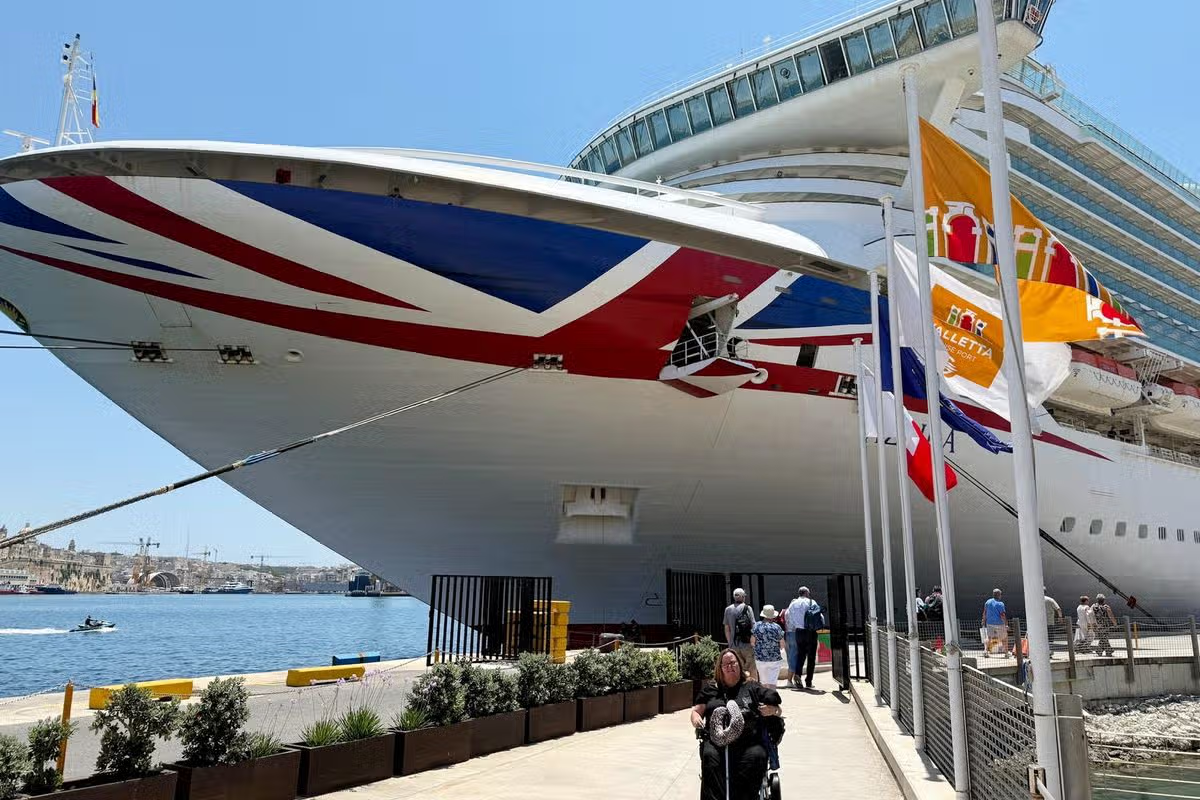
Passengers on the P&O Azura fell ill(Image: SWNS)
A group of 12 passengers who fell seriously ill onboard a P&O ship are taking legal action after their dream Mediterranean cruise turned into a “nightmare” holiday from hell. The British passengers were struck down with gastric illness and flu-like symptoms while travelling around the Greek islands on the P&O Azura.
The holidaymakers, who paid up to £3,000 each, claim they encountered an “overpowering sewage smell” on board and raised concerns about hygiene in buffet restaurants where flies could reportedly be seen around uncovered food. Many were confined to their cabins during the eight-night voyage between May 28 and June 4 this year, while others were left hospitalised upon returning to the UK and some say they are still feeling the effects now.
The group, who had been celebrating a 60th birthday, have now instructed international injury lawyers to investigate their illnesses. Julie Stones, 53, from Bolton, was among those who says the cruise left her battling a catalogue of health problems.
She first became ill on June 2 with a sore throat and diarrhoea before her condition spiralled. She suffered vomiting, severe stomach pain, fever, headaches, dizziness, exhaustion, a persistent cough, and pain in her back and legs.
After returning home, she attended A&E, was diagnosed with a chest infection and later required further GP and hospital treatment. Julie, who has several underlying health conditions and uses a powered wheelchair, said she spent weeks largely confined to bed and relied on help from her husband and daughter.
Julie said: “This holiday was supposed to be a special celebration with friends and something I’d been looking forward to for months. Instead, it turned into a complete nightmare. It felt as though one thing after another kept going wrong and, as the holiday went on, I just got worse and worse.
“One thing that really stood out was the overpowering sewage smell near the Manhattan Bar. It was so noticeable that other passengers were commenting on it. I also had concerns about hygiene in the buffet areas. I remember seeing food left uncovered with flies around it and people entering the restaurant without sanitising their hands.
“Even after returning home, the symptoms didn’t go away. I’ve needed hospital treatment, GP appointments, and medication, but I’m still not back to normal. More than two months later, I’m still dealing with fatigue and headaches. I just want to understand what happened.”
Linda Chapman, from Bury, who was celebrating her 60th, also became seriously ill after developing symptoms on the final evening of the cruise. The mum and grandmother suffered chills, vomiting, breathlessness, wheezing, a sore throat, and a persistent cough.
Her condition worsened so badly after landing back in Manchester that she contacted NHS 111 and was taken to A&E, where she was prescribed antibiotics. Linda, who works as a housekeeper on an NHS stroke ward, was forced to take two weeks off work.
Linda said: “I remember being on the plane. The flight was only a few hours, but it felt like forever. People kept asking if I was okay and I must have looked as awful as I felt. I just kept telling myself that I’d be home soon and could finally go to bed.
“What I didn’t realise was that I’d end up spending weeks like that. In my view, hygiene onboard wasn’t up to scratch and the food often didn’t seem fresh at all, despite the cruise being very expensive. What did surprise me was just how ill I became. I was struggling to breathe and, combined with the stomach problems, I just couldn’t work out what was wrong with me. It was a very frightening and disorientating experience.”
Sharon Robinson, 51, from Wigan, was the first member of the group to fall ill. She initially believed she had a chest infection but later suffered stomach pain, nausea, diarrhoea, headaches, fever-like symptoms, and extreme fatigue.
Despite feeling unwell, Sharon tried to continue with the group’s planned celebrations but says she spent the rest of the cruise exhausted. Sharon said: “I’m unbelievably disappointed.
“Even though I felt awful, I kept trying to take part in as much as I could because I’d been looking forward to this cruise for a year. I was the first in our group to become ill, but after the first few days it felt as though everyone was dropping like flies.
“One thing that’s burned into my memory is the strong sewage smell onboard. It still makes me feel sick when I think about it. So many people in our group became unwell that it’s difficult not to have concerns about what caused it. I still feel very sad about the whole experience and I’m still suffering because of it.”
Jatinder Paul, the lawyer at Irwin Mitchell representing the passengers, said: “Cruise holidays should provide passengers with an opportunity to relax and enjoy their time away. However, they also involve large numbers of passengers sharing restaurants, bars and other facilities in confined space so robust hygiene measures are vital in helping to prevent illnesses from spreading.
“What’s particularly concerning for our clients is that so many from the same party became unwell, with several still having their lives affected by symptoms. Our clients understandably have questions about their illnesses and whether more should have been done to protect them.
“Nothing will make up for what they’ve been through, but we’re determined to provide them with the answers they deserve.”
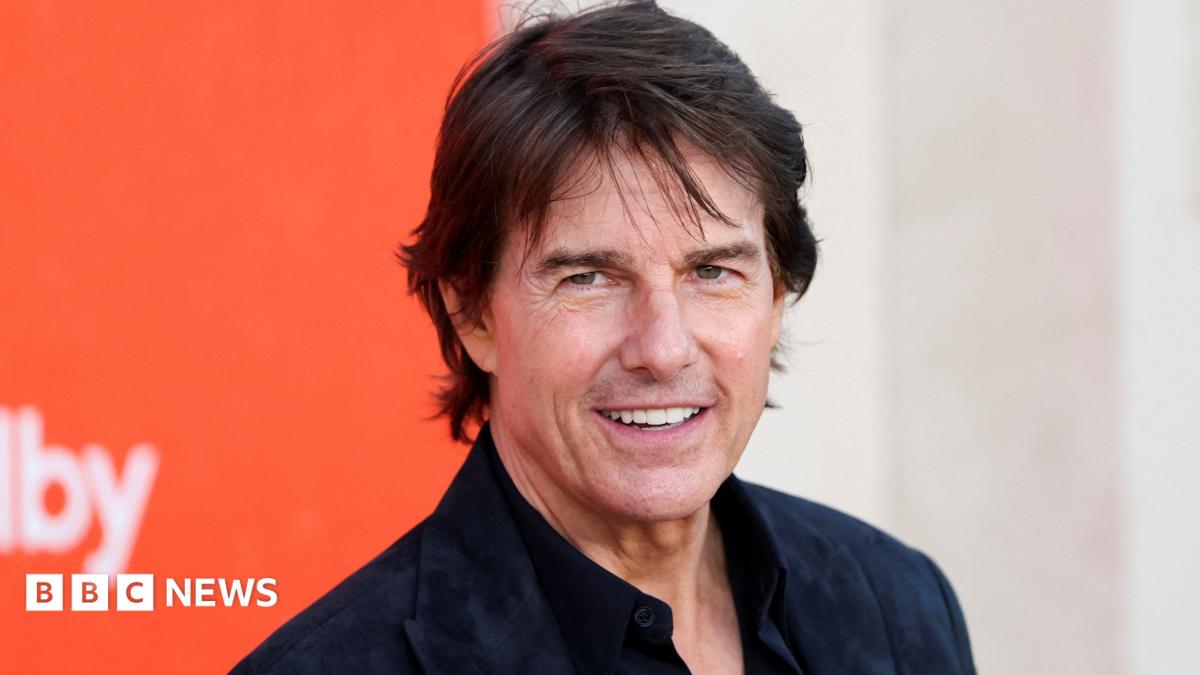
The Tom Cruise-led “Digger” is poised for a massive loss after ticket sales for the political satire fell 60% in its second weekend in theaters in the U.S. and Canada.
The Warner Bros. film made just $3.2 million in those theaters over the weekend, according to a studio estimate. Its opening weekend brought in $8 million, Cruise’s lowest opening as a leading man since 2007’s “Lions for Lambs.” Global ticket sales for “Digger” were only $35.3 million.
The tepid box-office returns mean the studio is now expected to lose at least $150 million on the film, including ancillary revenue streams such as premium video-on-demand and streaming, industry sources said. Historically, a film has typically needed to make 2½ to three times its budget to recoup its costs.
A Warner Bros. spokesperson did not respond to a request for comment.
It’s a tough result for the film, which stars Cruise as an aging oil tycoon whose company sets off an environmental catastrophe. Analysts have said that the film was challenging to market, given a major twist in the plot, and that Cruise’s nearly unrecognizable appearance could have dissuaded his fan base from coming out to support the film.
The film suffered from polarizing critical reviews, notching a 53% on aggregator Rotten Tomatoes. Opening-night audiences gave it a C+ on CinemaScore, a grade that typically points to weak word of mouth and steep drops in the weeks that follow.
The budget for “Digger” raised the stakes. Warner Bros. has said the film cost $125 million to produce, though some industry experts and trade reports have estimated the cost was at least $160 million, citing production delays.
That figure also doesn’t include marketing costs, which sources said could have increased in the days after the film’s opening since Warner Bros. began using the divided reviews in social media and TV ads to encourage people to see the film for themselves.
The film will have value to Warner Bros. — and Skydance, the newly combined company that now owns it — beyond its theatrical reception. “Digger” probably will make money through downstream revenue sources such as streaming. If Cruise wins his first competitive Oscar, that also would be a plus for the film.
But a film’s domestic reception, and to some extent, its international box office revenue, does play a role in the value of those downstream revenue opportunities, experts said.
“Even with respectable ancillary income based on the film’s pedigree, the movie is going to lose a lot of money,” David A. Gross wrote in his FranchiseRe movie industry newsletter shortly after the film’s opening.
The reception for “Digger” comes during a tough time for Warner Bros.
The studio has had a string of disappointments this year, including Maggie Gyllenhaal’s “The Bride!” and DC Studios’ “Supergirl.” None of its 2026 releases has crossed $100 million at the domestic box office.
But the prospects for Warner Bros. should improve next year, according to the research and brokerage firm Bernstein. Skydance has said it will keep the Warner Bros. and Paramount studios distinct, though Paramount Pictures chiefs Dana Goldberg and Josh Greenstein are expected to oversee both. Bernstein expects the Warner Bros. film and TV studios to amass $11.7 billion in revenue, driven by strong titles that include the sequel to “Minecraft” and a new “Lord of the Rings” movie.
Tom Cruise’s latest film Digger is expected to lose around $245m (£185m), Hollywood analysts have said, after the film’s continuing poor performance in cinemas.
Ticket sales for the satirical black comedy, which stars Cruise as oil magnate Digger Rockwell, dropped by around 60% in the movie’s second weekend.
It brings Digger’s total box office takings to around $35m (£26m) globally so far. The film is estimated to have cost its studio Warner Bros around $280m (£211m) to make and market.
But Cruise said last week, external that he “never thought of movies when I’m making them [in terms of] opening weekend,” adding he was instead focused on making films that “hopefully will translate, last and evolve”.
The film’s takings relative to its budget mean it could become one of the biggest film flops in Hollywood history.
Digger’s performance is in sharp contrast to the success of IP-driven hits starring Cruise in recent years, such as new instalments of the Top Gun and Mission: Impossible franchises.
Digger is directed by Alejandro G Iñárritu, best known for films such as Birdman, Babel and The Revenant.
Hollywood trade publication Variety said Digger was expected to end its box office run with around $50m (£38m) worldwide.
The film would need around $350m (£264m) to break even, due to its budget, marketing costs, the portion of ticket sales that go to theatres and the likely spend on an awards season campaign.
However, a Warner Bros spokesman pushed back slightly on the figure, telling Variety the film’s break even point was $300m (£227m).
WHAT luck! We admire the northern royal albatross – his jet-black wings spanning more than three metres as he circles above our little tour boat.
“They love gliding on this south-westerly breeze,” says Rachel, captain of the Sootychaser.
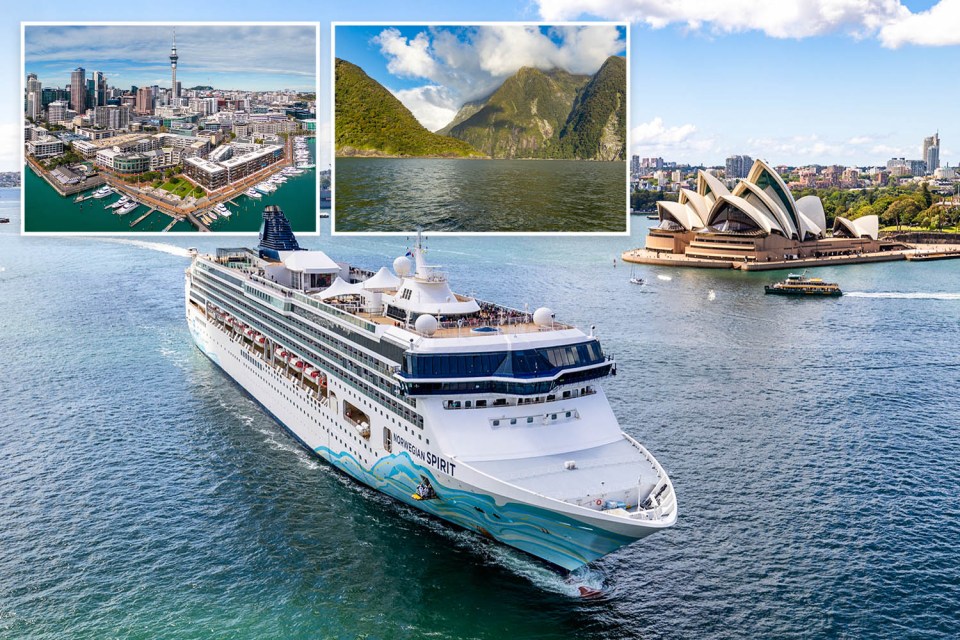
Norwegian Cruise Line offers an 11-day journey setting sail from Sydney, Australia and ending up in New ZealandCredit: SuppliedNew Zealand’s capital city of Auckland is the final stop on a truly epic cruise down underCredit: Getty
But within seconds our attention switches as Rachel spots some adorable blue penguins — the smallest in the world — on the other side of the boat.
With fur seals, oyster catchers, black swans and sooty shearwaters also ticked, this boat trip around Port Chalmers harbour in New Zealand’s South Island has turned into a wildlife adventure that keeps on giving.
Sign up for the Travel newsletter
Thank you!
Lady luck has been with me since I set out on a 12-night cruise from Sydney.
It was a bucket-list departure as we sailed past the Opera House on our way to Auckland on Norwegian Cruise Line’s ship, Norwegian Spirit.
The Tasman Sea was unusually calm as Captain Nordin navigated Spirit into Milford Sound, a deep fjord with steep cliffs and gushing waterfalls, the low mist clearing to reveal a cloudless blue sky.
Cruising New Zealand’s scenic fiordlands, a vast, wild area at the bottom of the South Island, always promised to be a highlight of the trip and didn’t disappoint.
It was spectacular. From Milford we sailed past the softer scenery in Doubtful Sound — so-named because when Captain Cook was passing in 1770 he didn’t think his ship would get into it.
Last up was Dusky Sound, named by Cook as he first saw it as the sun set. Port Chalmers is the nearest that most cruise ships can get to Dunedin, the Gaelic word for Edinburgh. “Scottish settlers travelled thousands of miles to this unknown land, but at least the weather was very familiar,” our guide Robert says with a laugh.
UNESCO world heritage site Milford Sound in Fjordland national park, New ZealandCredit: GettyA little blue penguin – the smallest in the world – are among the unique wildlife you can spot on the cruiseCredit: AFP
He’s not joking. We’re here in New Zealand’s summer, but the sky is grey and it is drizzling.
Things didn’t improve next day, when strong winds prevented Spirit getting into Lyttelton, the port for Christchurch.
Instead there was a day at sea with fabulous views as we sailed past snowy peaks.
I also worked up a sweat in Spirit’s thermal suite and followed up with an altogether different spirit — a margarita in Magnum’s, my favourite bar.
Built in 1998 and with room for just under 2,000 passengers, Spirit is NCL’s oldest and smallest ship, but looking very spruce after a £89million refurb in 2020.
They doubled the size of the spa, updated cabins, turned a waterpark at the back of Deck 10 into an adults-only area and added so many more places to eat and drink that it took me a week to try them all.
As NCL is the king of cruising casual, I booked whichever restaurant I fancied instead of being told when or where to eat, or what to wear. Jeans in the restaurant at dinner? No problem.
Steaks in Cagney’s, noodles in Silk, pasta in Onda by Scarpetta, stir-fry straight off the griddle in the fun Teppanyaki, and a superb Coq au Vin in the Bistro — I munched my way through the lot of them.
They were all really good (top marks went to the Bistro) and usually cost extra, but I paid nothing, thanks to NCL’s generous Free At Sea package.
It includes free meals in up to four speciality restaurants on cruises over nine nights (fewer nights nets fewer restaurants) as well as covering drinks and wifi and giving USD$50 (around £38) off the cost of shore excursions.
There were plenty of included places to eat as well.
Taste, one of two main dining rooms, was good, and I liked the outdoor seating at the Garden Cafe (a posh name for the buffet), but The Local was my favourite, for its salads, burgers, fish and chips and chicken wings.
Outside, the weather was getting better and better, with sunshine and blue skies as we explored New Zealand’s North Island. Wellington, the capital, stole my heart with its relaxed feel, clean streets and waterfront bars.
I rode a cable car to the top of the botanic gardens and wandered back to town, admiring the exotic plants and trees along the way.
In Napier the next day, I joined a hike and wine tour up the lofty Te Mata Peak with guides Helen and Anne.
“We’ve learned from experience it’s good to do the wine after the walk,” says Helen.
Wise words. What started as an easy path from the car park got steeper as we climbed — one foot wrong and you would be tumbling down the grassy bank.
Panting with exertion, it was a joy to finally dive into four tipples, including a cheery sweet rosé aptly named Fleurty.
Tauranga was different again — a beautiful beach resort, with miles of soft sand and stylish apartments that would look right at home on the French Riviera (but were a lot cheaper).
The next day, in Auckland, it was time to say goodbye to Spirit and New Zealand — but I’m not dis-Spirited because, with Lady Luck on my side, I’ll be back.
GO: NEW ZEALAND CRUISE
SAILING THERE: Norwegian Cruise Line offers an 11-day Melbourne, Milford Sound and Eden cruise from Sydney to Auckland departing on February 16, 2027, from £2,030pp for an ocean-view cabin.
Price includes Free At Sea package of drinks, four speciality restaurants, 150 minutes of wifi for one device at a time and USD$50 off shore excursions.
DISNEY has revealed what to expect onboard its huge new ship, Disney Believe from new restaurants to one-of-a-kind performances.
Launching in late 2027, it will be the ninth ship, and the fourth in the Wish class alongside Disney Wish, Disney Treasure and Disney Destiny.
Disney to launch its new cruise ship in 2027 – with all family-favourite characters onboardCredit: Disney Cruise LineIt will have its usual top deck swimming pools along with world-first performancesCredit: Disney
Onboard will be 7 swimming pools, splash areas, food outlets and restaurants, character meet-and-greets as well as Disney-first experiences.
Something that guests won’t be able to see anywhere is the Encanto musical which will debut exclusively on Disney Believe – and it’s a world first.
Sign up for the Travel newsletter
Thank you!
Other performances joining the line-up for onboard entertainment are Broadway-style shows, Tangled: The Musical and Disney Seas the Adventure.
Returning will be the fan-favourite Pirate’s Rockin’ Parlay Party which is a nighttime spectacular with a live rock band and fireworks at sea.
There will also be a Zootropolis-inspired entertainment hub called Gazelle where during the day it will hold trivia, games, and a family show alongside Judy Hopps and Nick Wilde.
In the evening, Gazelle will be open for adult-only entertainment which includes silent discos and variety acts.
There are some other strictly adult zones including Sea Notes, a piano lounge inspired by Ariel’s grotto.
The relaxed Wishing Well lounge is centered around its own castle courtyard where adults can relax and enjoy mocktails, cocktails, spirits, and coffees while musical performances take place.
Skygazers is a new observatory-themed pub serving up custom-made craft brews, cocktails and snacks.
Returning venues will include the Haunted Mansion Parlour, Arnaud Lallement, Quiet Cove as well as the Senses Spa, Untangled Salon, and Hook’s Barbery.
Sea Notes will be an adults-only piano lounge inspired by The Little MermaidCredit: Disney Believe
When it comes to dining, there will be a brand-new restaurant onboard the Disney believe called Oaken’s Table: A Frozen Family Feast.
While guests are eating, characters like Oaken, Anna and Kristoff will perform renditions of songs from the soundtrack.
Another option is 1923 which is onboard the sister ships which celebrates Disney animation and Worlds of Marvel.
Sweet treats can be bought from Inside Out: Joyful Sweets which has nearly 20 flavors of gelato and ice cream.
Two new cafes will be onboard, the first is Big Hero Sips which is inspired by San Fransokyo from Disney Big Hero 6.
Meanwhile, Café Kakamora is focused on Moana – and both will serve up coffee, tea and other specialty drinks.
Moana will take centre stage in the Grand Hall of the new shipCredit: Disney BelieveOaken’s Table: A Frozen Family Feast will have musical breaks with songs from the soundtrackCredit: Disney Believe
On the upper deck will be an open-air food court called Mickey and Friends Festival of Dining where guests can choose from barbeque, cantina bowls and salads, pizza, burgers and ice cream.
Pluto’s Pita Platters is one of the new stalls serving up Mediterranean-inspired foods from kebabs to pittas.
Like on Disney’s other ships, there will be clubs for kids, tweens and teens called 2319 with dedicated space for children between 3-17.
At “it’s a Small World” Nursery families can use babysitting services for little ones between six months to three years old.
The ship will have classic staterooms with most having ocean views and 450 are interconnecting which is suitable for larger families.
There will be four royal suites on Believe where guests can step into the world of fairytales – some inspired by The Little Mermaid, and Beauty and the Beast.
The Royal Reef Suite is inspired by The Little Mermaid and has floor to ceiling windowsCredit: Disney BelieveThe first sailing will be on December 18,2027Credit: Disney Believe
The Believe Tower Suite is exclusive to the ship and has been called a ‘one-of-a-kind suite for dreamers’.
It’s two-storeys, nearly 2,000-square-foot and sleeps up to eight people – it has two main bedrooms and four and a half bathrooms.
The views will be unbeatable thanks to its floor-to-ceiling windows.
The Disney Believe will offer four and five-night sailings from south Florida to the Caribbean and The Bahamas.
During its journey it will make stops at one or both of Disney Cruise Line’s island destinations, Disney Castaway Cay and Disney Lookout Cay at Lighthouse Point.
Like its sister ships, Believe will have a top deck with cinema and entertainmentCredit: Disney BelieveDon’t forget the swimming pools and and watercoasterCredit: Disney
And the new Disney Believe is just one of many new additions coming to the Disney attractions.
Disneyland Paris is getting a new Lion King log flume as well as the Up-themed Wilderness Explores Sky Swings.
An entire Villains Land will open at Magic Kingdom at Disney World, with a Maleficent rollercoaster and Magic Mirror dark ride.
Two new Cars rides, as well as an Indiana Jones and Encanto ride will be part of the expansion too.
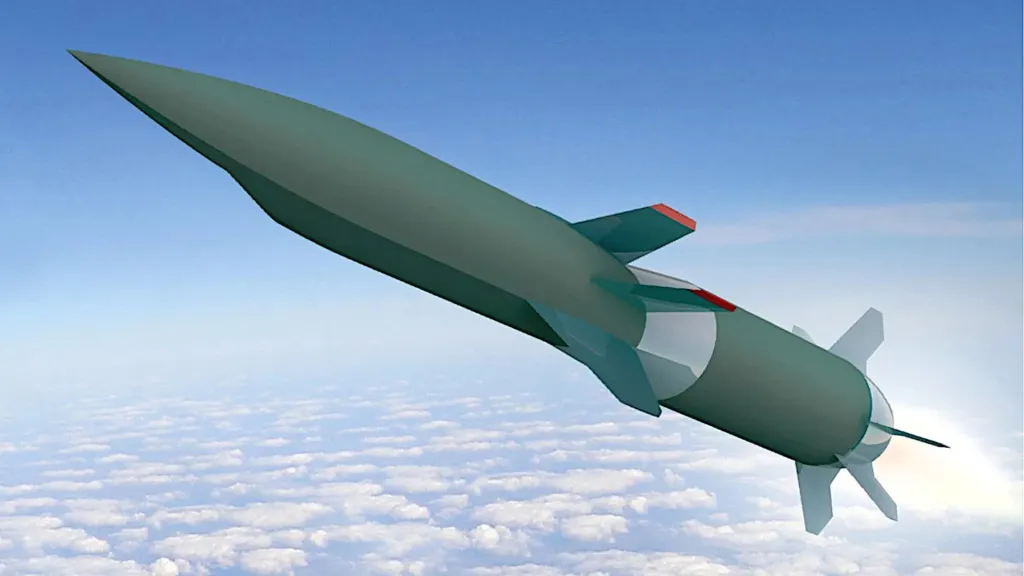
The U.S. Air Force’s scramjet-powered Hypersonic Attack Cruise Missile (HACM) has finally reached the flight test phase, with at least one “release” having been carried out so far over a range in Australia. HACM has suffered significant delays, and the Air Force has taken the risky step of scaling back overall testing plans to try to keep the program on schedule. The stated goal is to be able to make a decision to start rapidly acquiring HACMs in 2027.
A rendering DARPA put out during the preceding Hypersonic Air-breathing Weapon Concept (HAWC) effort. DARPA
“The U.S. Air Force, in partnership with Australia, has conducted a flight test of the Hypersonic Attack Cruise Missile (HACM) as part of our continuous work to advance long-range strike capabilities,” an Air Force spokesperson confirmed to TWZ today. “This effort is part of the Southern Cross Integrated Flight Research Experiment (SCIFiRE), a collaborative agreement built on more than 15 years of partnership between our two nations.”
“Leveraging this enduring alliance, the Royal Australian Air Force executed the release of a HACM flight test unit over a designated Australian test range, gathering crucial data to advance the program’s objectives,” the spokesperson added. “The flight was the culmination of an extensive series of tests designed to measure the missile’s performance under realistic flight conditions.”
The spokesperson did not name the test range where the “release” was conducted or say when that occurred. Whether the missile flew under its own power for any amount of time after release is unknown. What aircraft was used to carry the missile aloft is also not known. TWZ has reached out for more information.
The Air Force did say previously that it planned to conduct HACM launches in Australia. The expectation has long been that this would be done at the country’s sprawling Woomera Test Range, which provides an ideal location for extended-range flight testing activities in general. The U.S. and Australia have partnered on other hypersonic testing at Woomera in the past, as seen in the video below. The remote inland location of the range complex makes it well suited for conducting more sensitive tests away from prying eyes, as well.
HiFiRE 5B rocket reached Mach 7.5
The Government Accountability Office (GAO), a Congressional watchdog, has also reported in the past that RAAF F/A-18F Super Hornets would be used to conduct at least some of the HACM test launches. This would fit with today’s statement from the U.S. Air Force saying that it was the RAAF that “executed the release.” The Air Force’s initial launch platform is the F-15E Strike Eagle, though others are expected to follow.
A pair of RAAF F/A-18F Super Hornets. RAAF
To date, neither the Air Force nor Raytheon has released a confirmed picture or rendering of HACM. In 2023, the Air Force did release a picture, seen below, showing an air-breathing hypersonic cruise missile test article related to either HACM or the preceding HAWC effort.
USAF
“The missile consists of two stages, a rocket booster and a scramjet cruiser, which separates from the booster and eventually dives toward its target,” according to GAO. Scramjets do not function effectively at lower speeds, and designs powered by them require some form of initial boost to a high Mach velocity. Hypersonic speed is generally defined as anything above Mach 5, but what HACM’s peak speed might be is unknown.
Two-stage air-breathing missile-like hypersonic vehicle designs have been tested on several occasions in the past. This includes Boeing’s scramjet-powered X-51 Waverider and HyFly 2 hypersonic test vehicles, among others. The X-51 (as its name indicates) and HyFly 2 also notably had so-called ‘waverider’ configurations designed to ‘skip’ on the shockwaves generated during high-speed flight to help provide additional lift. Whether HACM might also use this principle is not known.
X-51A WaveRider Scramjet Second Hypersonic Flight Test
It’s also worth noting here that Castelion’s Blackbeard hypersonic missile also has a two-stage configuration. It remains unconfirmed whether or not the second stage of that weapon is powered, but it does not appear to be an air-breathing design either way. Castelion is currently developing an air-launched version of Blackbeard for the U.S. Navy, which is also in flight testing now, as well as a ground-launched type for the U.S. Army. You can read more about that missile here.
Scramjet-powered air vehicle designs, including aircraft and missiles, have historically proven challenging. As noted, HACM has suffered delays over the years. The original goal had been to begin flight testing in 2024, which slipped first to 2025 and then 2026.
“The HACM program is on track to conduct its first flight test in the second quarter of fiscal year 2026, but officials said there is effectively zero margin left in the schedule for the rapid prototyping effort. The program has already descoped the rapid prototyping effort from seven to five planned flight tests,” GAO said bluntly in a report published in July. “The Air Force plans to produce 13 missiles during the rapid prototyping effort, including test assets, test spares, and operational rounds.”
“If a significant flight test failure occurs, it is likely that the program will not be able to complete all five tests within the 5-year rapid prototyping timeframe,” the report continued. “According to the program, completing at least the first three flight tests is critical for informing the Air Force’s decision to initiate a rapid fielding effort and procure HACM in fiscal year 2027.”
GAO’s July report, which had a January cutoff date, noted later on that the Air Force’s target date for initiating the rapid fielding effort, more specifically, was the first quarter of Fiscal Year 2027. This fiscal period began last Thursday and runs through the end of the year. Whether the service is still aiming to keep to that part of the schedule is unclear, but it would seem extremely difficult to do so.
Another rendering of a notional hypersonic missile that has been used to illustrate discussions about HACM in the past. Raytheon via GAO
“The HACM program has taken on risk to maintain its current schedule. According to program officials, maintaining the schedule has required aggressively resequencing activities to focus almost exclusively on those necessary to support the first flight test date,” GAO’s report added. “In some cases, officials said this has involved risky strategies, such as concurrently performing parts validation testing while completing the system’s design, which could require the redesign of key parts if they fail validation testing.”
Lockheed Martin, which previously put out this rendering of a hypersonic cruise missile, had been working on HALO for the Navy before that program was cancelled. Lockheed Martin
Regardless, the U.S. military, as well as its Australian counterparts, have made it clear in the past that they view hypersonic weapons as critical for success in future conflicts, especially high-end fights, such as one in the Pacific against China. In general, air-breathing hypersonic cruise missiles offer a valuable and highly flexible way to strike targets, especially time-sensitive ones, quickly and over extended ranges. The weapon’s high speed and maneuverability drastically increase its ability to penetrate through enemy air defenses and reduce the total time an opponent has to react.
Whether or not the Air Force will be able to avoid any more major delays with HACM remains to be seen. The service’s goal to start at least limited production of HACM before the end of 2027, if not sooner, is even more ambitious now after years of schedule slips. As mentioned, officials have already acknowledged there was no more margin for error at the start of the year. There are many questions still about what form any initial fielding will take, and how that might be further impacted by the truncated testing plan.
The HACM program has at least now hit the important milestone of beginning flight testing.
ANTIGUA, Florida and the Caribbean… what do they all have in common? Obviously they’re all beautiful, exotic destinations that typically cost thousands to visit.
They’re also some of the amazing locations currently being offered as prizes in some incredible competitions. We’ve rounded up all of the best ones to enter right now…
There are tonnes of competitions open at the moment where you could win a once-in-a-lifetime opportunityCredit: supplied
There’s something for everyone, from luxury staycations to five-star escapes abroad – plus all are free to enter.
So whatever your ideal holiday is, here are some of the best competitions currently taking entries offering a wide range of prizes…
Europe
Live like royalty on a family trip to Versailles
Le Shuttle is giving away a trip to Versailles for a family of four, with access to the Palace of Versailles, the Trianon Estate, Queen’s Hamlet and Gardens, plus a guided tour of the special Marie-Antoinette by Sofia Coppola exhibition.
You’d stay at the Le Louis Versailles Château MGallery and get a VIP shopping experience with One Nation Paris.
There are some competitions for trips to Europe as well including to VersaillesCredit: GettyAlternatively, you could enter to win a short break to Croatia and get a £250 Ellis Brigham voucher as wellCredit: Getty
Travel in style on aCroatia long weekend
Win a short break on the Dubrovnik Riviera in Croatia, plus an Osprey backpack and a £250 Ellis Brigham voucher.
The winner gets a four-night trip and can choose between either a men’s Farpoint 55 or women’s Fairview 55 pack.
Just answer the question ‘what is the capital city of Croatia?’ along with your details by December 15 – click to enter.
Live in luxury on a French Alps family ski trip
Family Ski is offering a seven-night family ski holiday for four to the French Alps.
Included in the prize is £500 of Roarsome Ski Wear for Kids, accommodation in a luxury catered chalet at either Ardent, Portes du Soleil or Reberty, Les Trois Vallées (depending on availability), childcare and airport transfers.
You’ll need to book your own travel from the UK to Geneva, plus lift passes, ski hire and travel insurance.
To enter, fill out the entry form and follow Roarsome and Family Ski Company on Instagram by October 31 – click to enter.
Take the family to the alternative Lapland
Win a family trip to Swedish Lapland worth £4,648.
On Instagram, Letsgofaraway is offering a round-trip (flights up to a maximum of £1,033.09) to Grand Lodge at Blueberry Lodge Lapland for up to eight people.
One activity at the lodge for all guests in included, plus a private session in the relaxation area, which has a sauna, Nordic hot tub and a homemade fika.
To enter, follow @letsgofaraway_, @hospitality.guide, @danieltravl and @blueberry_lodge_lapland on Instagram, then like the competition post, tag two friends and repost/share.
Ever heard of Swedish Lapland? Well, there’s a competition to win a trip thereCredit: AlamyOr you could explore Austria more with a trip to InnsbruckCredit: Getty
Snowy holiday to Innsbruck
Monster energy drinks is offering a snow trip for two people to Innsbruck in Austria.
If you don’t have a card, that’s fine, you can sign up for free.
There’s competitions with long-haul prizes as well such as a trip to AntiguaCredit: GettyOr you could be in with a chance of heading to Saint LuciaCredit: Getty
Luxury Saint Lucia holiday and Arsenal tickets
Windjammer Landing Resort & Residences is offering a seven-night round-trip to Saint Lucia from London.
You’ll also get two tickets to an Arsenal game hosted by the Saint Lucia Tourism Authority and two Arsenal t-shirts.
Answer the questions ‘what is the name of Saint Lucia’s famous national landmark?’ and ‘which Arsenal legend has just visited Saint Lucia?’ by December 15 – click to enter.
Fabulous, personalised holiday toOrlando
Tripadvisor and Visit Orlando are offering an eight-night holiday to Orlando, Florida for two people, plus a free holiday planning session.
Tripadvisor and Visit Orlando have also teamed up to give away an eight-night holiday to Orlando in FloridaCredit: GettyOr perhaps you’ll win a trip to Grand Cayman in the Cayman Islands…Credit: Getty
Cruise
14-night all-inclusive cruise to the Canaries
Saga is giving away a 14-night all-inclusive cruise to the Canaries and Casablanca.
You’d set sail from Portsmouth on January 6, 2027 in a Twin Standard Balcony cabin, stopping at La Palma, Tenerife, Madeira and Gran Canaria.
If you have always dreamt on going on a cruise, there are plenty of cruise competitions as wellCredit: AlamyIncluding ones sailing to the Canaries and to GreeceCredit: Supplied
14-night Caribbean cruise with food and drink included
Win a river cruise through Europe on the Danube or Rhine with Scenic worth £7,000.
The prize includes suite accommodation, excursions, five dining venues, premium drinks, butler service, return flights and transfers and complimentary e-bikes to explore the destinations you stop at.
Five star trip for two at Old Course Hotel, St Andrews
Old Course Hotel in Scotland is a five-star spot boasting views of the Fife coastline and a large golf course.
Win a one-night stay at the hotel for two people with a two-course dinner and a full Scottish breakfast – worth £700.
You’ll get a full day to spend at Kohler Waters Spa, with a spa pool, hydrotherapy suite with a thermal pool, steam room, sauna and plunge pool and the UK’s first Espuro Foam Steam Rooms.
Each guest will get a 50-minute treatment, from a custom massage, hot stone massage, classic prescription facial, reflexology session or a 25-minute facial and 25-minute massage combo.
You need to have a Muddy Stilettos account to enter (free to sign up) and click here to answer ‘what town is Old Course Hotel in?’ by October 14.
You could win a hotel stay and tickets to see Wicked on the West End in LondonCredit: PAOr you could win a stay at a Harbour Hotel and a Salcombe Gin experienceCredit: Alamy
West End show and a 4-star London hotel stay
The Royal Mint recently launched a coin dedicated to the musical Wicked to celebrate 20 years of the West End show.
To celebrate they are giving away a one-night stay at The Clermont Hotel, a silver Proof Colour edition of the Wicked UK coin and two tickets to the London show.
Five-star countryside retreat and year’s supply of popcorn
Popcorn brand Jo & Sephs are offering a luxury trip to Devon, to celebrate the release of the new Sense and Sensibility movie.
The prize includes a three-night stay in a five-star hotel, a private horse-drawn carriage ride and afternoon tea, plus a year’s supply of popcorn.
Click here to answer the question: ‘in Sense and Sensibility, what are the names of the two Dashwood sisters at the heart of the story?’ by November 30.
In another competition, you could be lucky enough to win a stay at Andy Murray’s hotel in ScotlandCredit: Verena SplettOr you could win a luxury trip to Devon with Jo & Sephs
A luxury stay at Andy Murray’s Scottish country house hotel
Discover Britain is running a competition to win a luxury stay at ‘Cromlix’ – Sir Andy Murray‘s country hotel in Scotland.
It includes dinner in the hotel’s new restaurant – The Garden Room.
SACRAMENTO — Look, Xavier Becerra could cruise to a South Pacific island and bask on the beach until election day and Californians would still choose him as their next governor.
Who won the debate? Becerra, because he came across as calm, collected and capable of governing this troubled state — certainly very few voters’ ideal candidate, but the only real choice for most Californians.
Moreover, Hilton’s only previous political experience was as an advisor to a British prime minister and his sole claim to U.S. notoriety was as a Fox News TV host–not exactly resume boosters in California.
He’s a shoo-in simply because he has a “D” beside his name in this state where Democrats outnumber Republicans nearly 2-to-1 and despise the GOP president.
Expert columnists cover the insights, legislation, players and politics you need to know.
By continuing, you agree to our Terms of Service, which include arbitration and a class action waiver. You agree that we and our third-party vendors may collect and use your information, including through cookies, pixels and similar technologies, for the purposes set forth in our Privacy Policy such as personalizing your experience and ads.
“You’re the candidate who is supported by the machine in Sacramento — the unions, big business, all these people that for 16 years have given us the highest cost of living in the country, made it impossible to build anything, given us the highest unemployment rate, the highest poverty rate….
“And that’s why we’ve got to try something different this time instead of voting for more of the same.”
OK, fair point. But try what exactly? That’s where Hilton stalls or veers erratically.
He’d build “10 new cities.” Build them where exactly? He doesn’t say.
He definitely doesn’t want to construct new apartment buildings in the suburbs “when we have got so much space that we could be building on in California.”
Like out in Southern California deserts or Central Valley farm fields — requiring two-hour commutes to urban jobs?
And where does the water come from for these 10 new cities as the West scrambles for what’s left of diminishing supplies? But unfortunately there was no discussion of that during the debate.
One debate exchange that caught my attention was about vaccines. Hilton seemed to be carrying the torch for whacko anti-vaxxer Robert F. Kennedy Jr., Becerra’s successor as U.S. health secretary in the Trump administration.
Debate co-moderator Dana Bash recalled what Hilton said previously about children’s vaccinations: “The government should have nothing to do with these fundamental and vital decisions.” And she asked whether he’d push to eliminate California’s vaccine requirements.
“No,” Hilton replied. “I’m pro vaccine.” But then he seemed to wander all over the stage looking to have it both ways.
It’s a “very, very emotional issue for a lot of parents,” he said, adding there’s “data around the world” showing that where vaccine “mandates are lower… you actually have higher [vaccination] compliance, where parents don’t feel that they’re being bullied into doing something that they don’t want to do. And that’s what I want to see here.”
But he ultimately said,“I’d follow the law.”
In California, the law requires all children without medical exemptions to be vaccinated for several diseases — including polio, measles, mumps, chickenpox, hepatitis B and whooping cough — before they’re admitted to school.
That’s a blessing. When I grew up, practically every kid at some point was bedridden with one or more of those dangerous ailments. Then some saviors invented vaccines.
“We had nearly eradicated measles,” Becerra said, responding to Hilton. “When I left HHS, you rarely heard of a case of measles…. Today, children are dying of measles. Today, the spread of measles has reached a proportion we haven’t seen since the 1960s.
“That’s what happens when vaccine deniers take over.”
Becerra achieved all he needed to in the debate. He didn’t screw up. He kept cool and actually was fairly quick on his feet in replying to Hilton’s attacks, while planting a MAGA hat firmly on the Republican’s head.
He missed an opportunity to accomplish more, however — like making Californians feel really good about voting for him, rather than merely because he’s the only Democrat left standing in the contest to replace the termed out Gov. Gavin Newsom.
Voters might like to hear what Becerra’s vision is — if he has one — for the California he wants to build.
What does he have in mind besides just defending California against Trump? That’s a given. How’s he going to lower our living costs? Upgrade public education? Prevent wildfires? Details, not platitudes.
Rather than relaxing on his lead, Becerra should be constantly moving around the state, introducing himself to Californians and — more importantly — listening to their problems and ideas. To his credit, he’s doing that this week.
“The debate was boring and uneventful, but Becerra won it,” says Republican consultant Rob Stutzman. “He is perfectly vanilla and that makes it really hard to pin him down in an attack.”
“We got the genuine Xavier Becerra. That’s exactly who he is,” says veteran Democratic strategist Garry Sragow, a longtime political ally. “Thoughtful, committed and very decent, but does not go very high on the charisma meter.”
In California right now, a candidate’s charisma rates much lower than a simple “D.”
Academy Award-winning filmmaker Alejandro González Iñárritu and Pop artist Ed Ruscha have a long history of admiring each other’s work. Twenty-four years ago, a nervous Iñárritu visited Ruscha’s Venice studio to offer him the role of the gynecologist in “21 Grams.” They needed a doctor with noble features and blue, believable eyes. That plan didn’t pan out, schedule-wise, but the filmmaker and the artist finally found a way to collaborate.
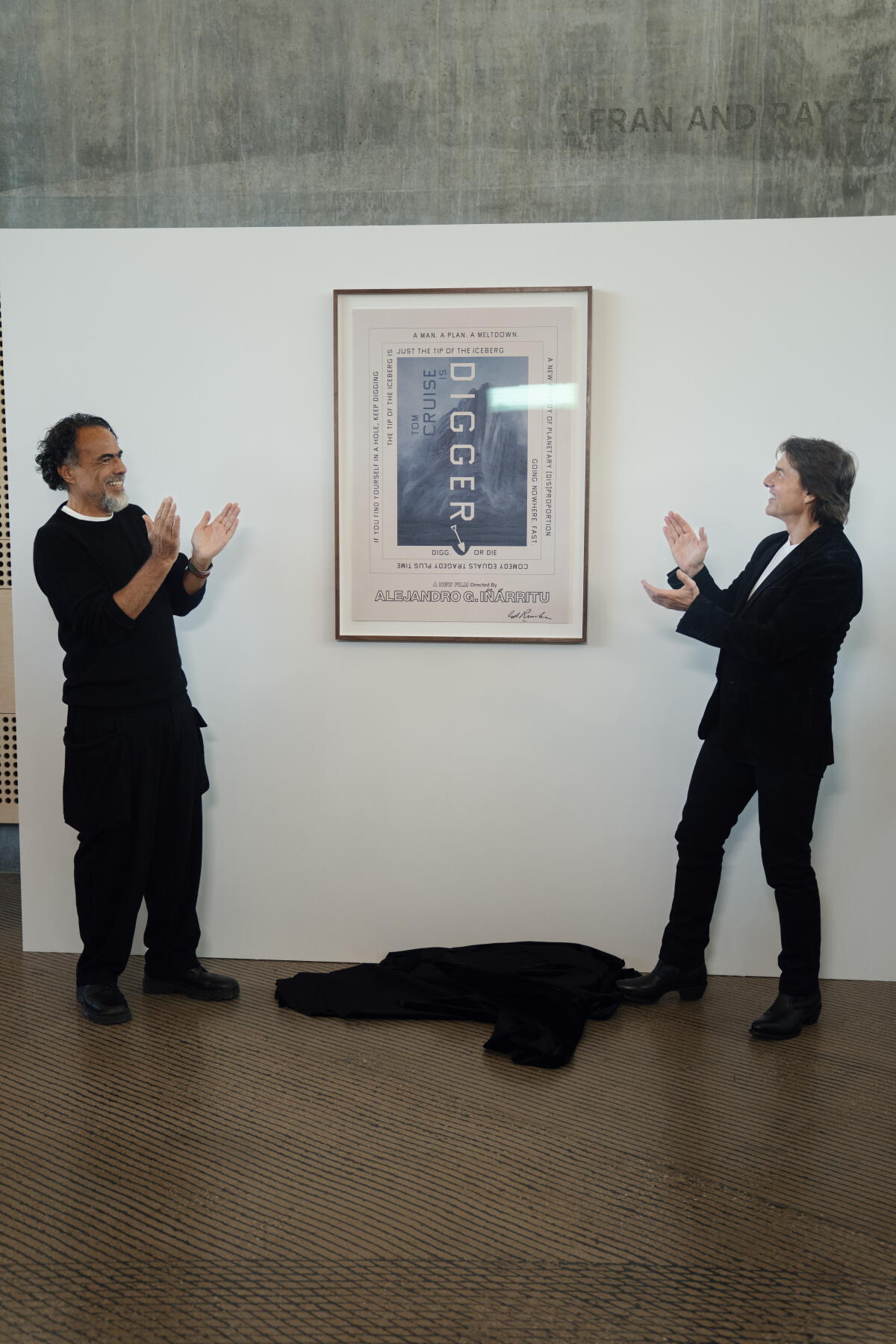
The result — a Ruscha-designed poster for Iñárritu’s new film “Digger,” starring Tom Cruise — was unveiled Sunday at an intimate brunch at the Los Angeles County Museum of Art, attended by Iñárritu, Ruscha and Cruise, as well as “Digger” actors John Goodman, Jesse Plemons, Michael Stuhlbarg and Ross Hatt.
Iñárritu and Cruise laughed as they made a clumsy attempt at a countdown before whipping aside a black velvet curtain to reveal the poster for the first time: a very Ruscha, text-heavy work on a slate gray background with a beige border. A looming ice shelf in the background is surrounded by phrases including, “A Man. A Plan. A Meltdown,” and “Comedy equals tragedy plus time.”
Filmmaker Alejandro Iñárritu and “Digger” star Tom Cruise unveil Ed Ruscha’s new poster for the film. (They just pulled off the black velvet curtain on the floor below.)
(Kevin Garrison)
“Well, the movie blew my hair back,” Ruscha said at the unveiling brunch inside LACMA’s new (still unopened) restaurant, with LACMA Director and Chief Executive Michael Govan by his side. “And not only that, it parted it down the middle. It has since grown back.”
The crowd laughed knowingly. “Digger,” which opens Friday, is a satirical black comedy that follows oil tycoon Digger Rockwell as one of his drilling rigs in Greenland explodes, dislodging an ice shelf that floats away to cause a global disaster. As a dark parable for the dangers of climate change, the film has already proved polarizing, with early reviews coming in mixed.
Ruscha noted that he first saw “Digger” at a screening about six months ago, alongside Govan. “I knew I had seen an epic production, an epic product from an epic producer,” Ruscha said. “So I jumped at the idea of doing the poster. And I thought about it, and I think about this movie, and it reminded me of a kaleidoscope. It’s got so many running-around ideas. It was kaleidoscopic in its message, and its content and its humor.”
Ruscha turned his attention to Iñárritu, “It’s got something to offer to the world, and I thank you for that.”
The filmmaker loved the poster, and the fact that the ice shelf sat front and center.
From left to right — “Digger” actors John Goodman and Jesse Plemons, filmmaker Alejandro G. Iñárritu, artist Ed Ruscha, actor Tom Cruise, LACMA director Michael Govan and actors Ross Hatt and Michael Stuhlbarg — pose with Ruscha’s new poster for the film.
(David Jon)
“The billing is nature: We are human beings, we are in a war against nature,” Iñárritu said — describing what he feels the poster relays — in a phone interview from Mexico City a day before the event. “We think that we are different from nature. So nature, in a way, becomes our enemy. We are fighting a fight against nature, and the enemy is an ice shelf going to Europe. And he just put [that] in the center of it, [like] a disaster movie, which is very clever, as he always is.”
“Those decisions that he made with a very prominent element in a simple way, with one or two words, it just says so much with so little,” Iñárritu continued. “And then he [put] some lines around [it], very Ruscha, that in a way convey the spine or the character itself.”
The director had the same feelings two years ago, at LACMA’s Ruscha retrospective. He said so much with so little, Iñárritu thought, and that “less is more” thinking could hold so much power in a film poster.
Iñárritu, too, has been exhibited at LACMA: earlier this year, with the film installation “Sueño Perro,” a resurrection of lost footage from “Amores Perros;” and in 2017-2018, with the virtual reality installation “CARNE y ARENA,” which explored the human condition of immigrants and refugees.
The director’s collaboration with Ruscha is proof of concept for LACMA’s annual Art + Film gala, entering its 15th year, which seeks to highlight and strengthen the connections between film and visual art by bringing the two communities together at a splashy party — often creating lasting connections between the two groups.
Both Ruscha and Iñárritu have been honored at the gala, the former in 2012 (with Stanley Kubrick) and the latter in 2015 (with James Turrell). “This is a beautiful encounter of art and film,” Govan said at the unveiling.
“Digger” has evolved over nine years, Iñárritu said. It’s been a long journey of taking note of current events, including where the world is going, as well as people’s obsessions and fears.
“The film is a love letter for the young generation,” Iñárritu said. “I think it’s kind of a warning, or a wake-up call. But you can have fun about it, because it’s the only way to — humor allows us to have space and recognize ourselves in that absurdity. So I feel that it’s a human, urgent, now film.”