She, along with hosts Sean Fennessey and Amanda Dobbins discussed Aaron Pierre earlier in the episode.
Aaron, 32, plays John Stewart in the DC Comics show LanternsSource: AlamySlow Horses star Jack Lowden is said to be one of the frontrunnersSource: Getty
Sean then wondered out loud whether Aaron Pierre was the unidentified James Bond auditionee.
Joanna revealed she knew the mystery actor’s identity, but couldn’t disclose it while on air.
Sean said: “We also heard some rumours. I don’t believe [Aaron Pierre] is in the mix.”
As the others remarked Aaron should be, Sean continued: “That’s what I’m saying. It’s like, obvious.
“The one thing I would say would be a strike against that is that [Daniel] Craig was also kind of a bruiser Bond.
“I think Pierre because of his physique and strength as a performer, he would also be kind of a bruiser bond.
“The sense I’m getting is that they’re going to go back to kind of a lithe boy.
“That’s the energy they want instead of a “I will choke you out” Bond.”
One of the frontrunners, Jack Lowden, has received backing from one of his Hollywood co-stars.
Jack, who plays River Cartwright in Apple TV’s Slow Horses, stars alongside Kristin Scott Thomas.
The actress confessed he would be “very, very good” if he was to land the role.
Speaking to The Times, the 66-year-old star said: “Oh god, I wish I knew.
“He’s got that twinkle, he’s cheeky and he’s a very, very good actor.”
A GJ-21 stealthy flying-wing uncrewed combat air vehicle (UCAV) has successfully launched from and recovered aboard the Type 076 amphibious assault ship Sichuan, according to China’s People’s Liberation Army (PLA). Visual confirmation of this milestone has yet to emerge, but there have been steady signs of preparations for flight trials from the Sichuan, which features an electromagnetic catapult. GJ-21s have already been spotted flying from airfields on land.
A picture of a GJ-21 drone that previously emerged online. Chinese internet
The GJ-21 and the land-based GJ-11 Mysterious Dragon it is based on are prime examples of China’s major investments in UCAVs and other flying-wing-type drones. These developments stand in particular contrast to the U.S. military’s eschewing of such designs, at least publicly. This is despite significant past U.S. achievements in this arena, including in the development of carrier-based UCAVs. The PLA Navy (PLAN) now looks to be on track to be the first country to field an operational capability of this kind.
A stock picture of the Type 076 amphibious assault ship Sichuan. PLA
“China’s first ship-borne stealth reconnaissance and attack drone ‘GJ-21’ recently made its first successful take-off and landing on [the Type] 076 amphibious assault ship, the ‘Sichuan’ (Hull 51),” according to a post today from the China Military Bugle account on X, an official PLA mouthpiece. “This is another significant breakthrough in the development of China’s amphibious assault ship, indicating that the Chinese Navy now has the capability to operate fixed-wing stealth drones from large maritime combat platforms.”
At the time of writing, neither the PLA nor Chinese state media have shared where or when these trials occurred or provided any other additional details, including how many total launches and recoveries were conducted. No official pictures or videos from the testing have been released so far.
A graphic that accompanied the post on the China Military Bugle’s account on X regarding the GJ-21 and the Type 076. PLA/China Military Bugle
Unconfirmed claims that a GJ-21 had been launched from Sichuan had already begun circulating on social media earlier this month. As an aside, the GJ-21 is readily discernible from the land-based GJ-11 by the catapult bar on its nose landing gear strut.
Two interesting Type 076 News:
2. Via Temstar/SDF:
“Yankee confirmed on tonight’s Chahuahui that 076 has launched a GJ-21. He said it in a very straight forward way too, basically “you guys can stop guessing, I can tell you straight: yes they launched a GJ-21″.” pic.twitter.com/ODkl6Kki9A
A review of satellite imagery from Planet Labs does show Sichuan was at its usual berth at Hudong-Zhonghua in Shanghai as of October 13, but absent four days later. When exactly it left port is unclear. The one-of-a-kind Type 076 does not appear to have returned until October 26. TWZ has also obtained a satellite image of Hudong-Zhonghua taken just today from Vantor, with the ship still seen sitting at the pier, as seen at the top of this story and below. GJ-21 drones, or more likely mockups thereof, have also been present on the pier for some time.
A pair of apparent GJ-11 mockups at a test and/or training site on Changxing Island in Shanghai in May 2024, near where the Type 076 was under construction at the time. Google Earth
As mentioned, there have been further signs that the PLA has been preparing Sichuan for real launches and recoveries, especially of GJ-21s, since last year. Pictures emerged online in October 2025 showing a red-colored test ‘truck’ on the ship’s flight deck, indicating the start of catapult testing. Video from those tests has since been released. Weighted trucks like this have long been used to test catapults on aircraft carriers during construction or following maintenance. The Type 076 left port for the first time in November 2025.
Weighted carts catapult test on Type 076 LHD
three lines marked directly under and outside the wheels of the Red cart to ensure it is centered
“Two GJ-21 aircraft were displayed at the victory parade in September 2025, reportedly having entered PLAN service in mid-2025,” according to Andreas Rupprecht, an expert on Chinese aviation and contributor to TWZ. “By late 2025, several GJ-21 aircraft were reportedly undergoing simulated EMALS launches and arrested landings at the PLAN’s land-based facility at Huangdicun.”
In February of this year, GJ-21 mockups were spotted on Sichuan’s flight deck and riding on the ship’s port-side elevator to the hangar deck as part of what appeared to be deck-handling trials.
After the first Type 076 LHD/LAH “Sichuan” was seen yesterday with a GJ-21 UCAV mock-up on deck, the GJ-21 was seen for the first time with its wings folded and later lowered to the hangar deck on one of the elevators.
More recent satellite imagery had shown that the Type 076’s flight deck had received additional markings in line with progress toward real flight operations. Fittings for three arresting cables also became plainly visible. Those cables are also notably depicted in the graphic that the China Military Bugle shared online today.
The GJ-21 will of course not be the only aircraft in the Type 076’s future air wing. The ship is also expected to carry a variety of other uncrewed aircraft, as well as crewed helicopters. China has shown a range of other combat drone designs in recent years. Navalized versions could well be developed for deployment on Sichuan, as well as PLAN’s growing fleet of traditional carriers and other suitable configured vessels.
Loading the Type 076 with operational UCAVs would only underscore the significance of this particular ship. As we have previously written:
“The potential value to the PLAN of having a fleet of very large deck amphibious assault ships that are highly capable of large-scale drone operations as well as traditional amphibious assaults is clear. These ships could be used to launch and recover UCAVs like the GJ-11 and other types of drones to perform a host of missions from maritime strike to intelligence, surveillance, and reconnaissance (ISR). They could be used to provide additional ‘mass’ in support of the operations of larger carrier strike groups and help to free the air wings of flattops like Fujian up for tasks they might be better suited for. In addition, they could provide a lower tier of naval aviation support that could be employed independently.”
“The Type 076 could help provide support during humanitarian assistance and disaster relief operations. Big deck amphibious warfare ships, in general, provide their operators with immensely valuable platforms for projecting both hard and soft power.”
Chinese PLA Navy’s First Type 076 Amphibious Assault Ship “Sichuan” Conducts First Sea Trial
New video out from the People’s Liberation Army Air Force (PLAAF) of China shows the new GJ-11 stealth drone (UCAV), and also the J-20 stealth fighter firing a live PL-15 air-to-air missile: pic.twitter.com/wraDqyMOht
It is still to be seen how quickly the PLA’s official statement today will be followed by real confirmation of the launching and recovery of a GJ-21 from the Sichuan.
British defense contractor Babcock has confirmed that it is putting itself forward for the U.S. Navy’s future frigate program, with its Arrowhead 140 general-purpose frigate, the design behind the Royal Navy’s Type 31 class, expected to form the basis of its proposal. The move adds another foreign-designed warship to Washington’s search for a relatively mature frigate that can be built quickly and in significant numbers.
Babcock has held preliminary discussions with Pentagon officials and is expected to submit an expression of interest before the end of October, according to recent reporting by The Telegraph and Navy Lookout. The proposal is understood to potentially involve Huntington Ingalls Industries (HII), America’s largest military shipbuilder, with the two companies exploring an arrangement that could see the Arrowhead 140 built in the United States under license.
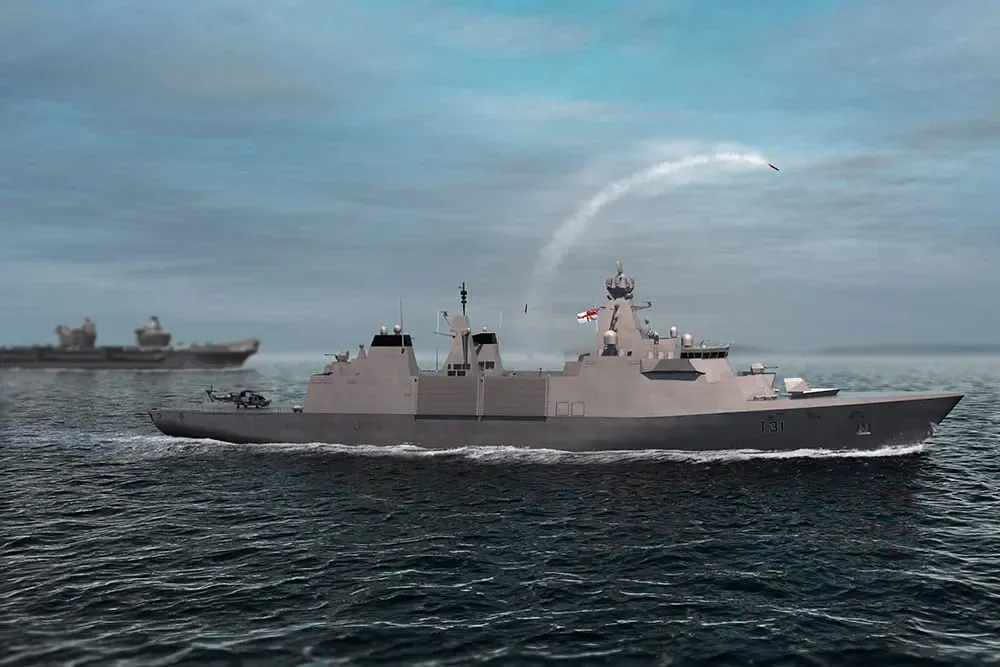
An artist’s impression of the U.K. Royal Navy Type 31 general-purpose frigate. Royal Navy
“Of course we’re interested. We have a world-class frigate, close links to the U.S. and U.S. industry. It would be insane for us not to respond,” Sir Nick Hine, head of Babcock’s marine business and a former Second Sea Lord, toldThe Telegraph.
The initiative comes as the U.S. Navy seeks to accelerate the acquisition of smaller surface combatants after the troubled Constellation class frigate program was axed. Japan’s upgraded Mogami class, South Korea’s Chungnam class, and Turkey’s Istanbul class have also been reported as candidates for the Navy’s international frigate effort. You can read more about all three designs here.
The Japan Maritime Self-Defense Force’s (JMSDF) first-in-class JS Mogami. JMSDFThe South Korean Navy’s ROKS Chungnam seen during sea trials before its delivery in 2024. HD Hyundai Heavy IndustriesThe future TCG Izmir from Turkey’s Istanbul class. Anadolu Shipyard
Meanwhile, German defense contractor Rheinmetall, a newcomer to the surface combatant market, recently unveiled its GMF 140 frigate, which it has said it plans to offer “initially as part of a procurement project in North America” before pursuing opportunities with other allied navies.
For Babcock, the opportunity would be a major expansion of its relationship with the U.S. defense industry. If successful, the company would likely provide the design, engineering expertise, and potentially the intellectual property needed for American shipyards to manufacture the frigates.
This would mirror the process for the Polish Navy’s Project 106 Miecznik (Swordfish) class, which is building three new multirole frigates in Poland, rather than using the company’s own facilities in Britain.
The future Polish Navy frigate Wicher under construction in Gdynia, Poland. Photo by Mateusz Wlodarczyk/NurPhoto
The Navy’s assessment of potential options is due by November 12. No contract has been awarded, and the details of any Babcock-HII proposal remain unconfirmed.
The Arrowhead 140 is the foundation of the Royal Navy’s five-ship Type 31 program, which is being built at Babcock’s Rosyth shipyard in Scotland. The design is derived from the Danish Iver Huitfeldt class frigate. As well as Poland, the warship has also been selected for Indonesia.
The Type 31 Frigate in action
The Arrowhead 140 has a baseline length of approximately 455 feet, a beam of 65 feet, and a displacement of around 5,700 tonnes, although national variants may be considerably heavier. The vessel uses a conventional combined diesel-and-diesel (CODAD) propulsion system and can achieve speeds exceeding 28 knots. Its design emphasises long endurance, with a baseline endurance of approximately one to two months. The AH140 incorporates a flight deck and hangar for naval helicopter operations, accommodation for embarked personnel, boat-handling facilities, and adaptable mission spaces. Its modular architecture allows customers to integrate different sensors, combat management systems, electronic warfare equipment, and weapons according to national requirements.
Taking the Polish Navy’s Project 106 class as an example of an Arrowhead 140 iteration, this is a notably heavily armed adaptation, featuring a 76mm Leonardo Strales main gun, a 32-cell Mk 41 vertical launch system for surface-to-air missiles, eight Naval Strike Missiles for anti-ship strike, and lightweight torpedo launchers. The Polish variant is reported to have a maximum displacement of approximately 7,700 tonnes.
Wicher, the first of the Polish Navy’s Project 106 Miecznik (Swordfish) class. PGZ SW
The Type 31 is a general-purpose warship capable of undertaking maritime security, escort, and surface warfare missions. Its relatively large hull offers considerable internal volume for weapons, sensors, aviation facilities, and future upgrades.
That could make it attractive to a U.S. Navy looking for a ship able to protect convoys, operate independently, and supplement its larger destroyers. A frigate with a significantly lower operating cost than an Arleigh Burke class destroyer could still take on a range of missions, freeing more capable combatants for broad area air and missile air defense, sustained strike operations, and other more demanding tasks.
The Arleigh Burke class destroyer USS James E. Williams underway. U.S. Navy courtesy photo The USS James E. Williams. USN
The Arrowhead 140’s size could also provide flexibility in accommodating American weapons and combat systems. However, a U.S. version would require a defined configuration, and there is no publicly established weapons fit for a potential American variant.
At the same time, the Royal Navy’s Type 31 frigate has not yet entered operational service, and its baseline configuration is not optimized for every mission the U.S. Navy may require. In particular, the integration of the sonar and other systems needed for sustained anti-submarine warfare would be a significant undertaking.
The Navy will also have to wrestle with how much of the existing design can be retained while meeting its own requirements. One of the major lessons from the Constellation program was that extensive modifications to an existing foreign design can create huge cost and schedule risks. With so little left of the original design after it was adapted to Navy specifications, this eventually doomed the program.
A rendering of a now-cancelled Constellation class frigate. U.S. Navy
For Babcock, it will be essential to keep the Arrowhead 140 as close as possible to its established configuration, while integrating essential American equipment, to keep the proposal competitive.
Babcock does not operate a shipyard in the United States, making an American industrial partner central to its approach.
HII, which operates major shipbuilding facilities at Newport News and Ingalls, would offer substantial experience constructing warships for the U.S. Navy. Babcock and HII already have an established relationship in the submarine sector, including work supporting the Virginia class attack submarine program.
Babcock’s facilities in Rosyth and Bristol manufacture tactical missile-tube assemblies for General Dynamics Electric Boat, supporting the Common Missile Compartment used by the U.S. Navy’s Columbia class and the Royal Navy’s Dreadnought class ballistic missile submarines. HII has also expanded its relationship with Babcock through work involving Virginia class submarine components.
An artist’s conception of one of the Royal Navy’s future Dreadnought class submarines. BAE Systems
Those existing industrial relationships could provide a foundation for a surface-ship partnership. Under a potential arrangement, Babcock could transfer the necessary design rights and provide technical support while an American yard undertakes construction.
Such an arrangement would fit the Trump administration’s stated goal of using allied expertise to accelerate warship production while rebuilding domestic shipbuilding capacity. It would also allow Babcock to pursue a potentially significant U.S. order without requiring Rosyth to absorb a large new construction program alongside its Royal Navy commitments.
The prospect of HII supporting more than one design raises questions about production capacity, program priorities, and how the company would manage competing demands on its shipyards.
More generally, the administration’s interest in foreign frigates reflects growing concern about the time and expense involved in developing new American warships.
The Constellation class program was supposed to provide a modern replacement for the Navy’s retired Oliver Hazard Perry class frigates. Based on the European FREMM design, it underwent extensive modifications for American service before suffering serious schedule and cost problems. The Navy subsequently abandoned the program.
Oliver Hazard Perry class USS Carr is seen in 2006. The last of the type was retired from U.S. service in 2015. U.S. Navy
The service is now pursuing FF(X), a patrol frigate intended to be easier to build and field. Its initial configuration, however, is not expected to include a vertical launch system, limiting its ability to provide some of the capabilities associated with a more heavily armed multi-mission combatant.
A rendering of the FF(X) frigate. U.S. Navy
HII is building the FF(X) frigate, based on the Coast Guard’s Legend class National Security Cutter. It is somewhat telling that they would partner with Babcock on the foreign frigate offering considering they already have the FF(X) contract.
The Coast Guard’s Legend class cutter USCGC Hamilton. U.S. Coast Guard
The international frigate effort is intended to examine whether a ship based on an existing allied design could provide a different balance of capability, cost, and delivery speed.
An August presidential memorandum opened a route for the Navy to consider allied designs and, under limited circumstances, overseas construction through a national security waiver. The approach has been compared with a model in which an initial small number of ships could be constructed abroad before production moves to U.S. yards.
The reported framework limits overseas construction to no more than two ships and ties it to investment in American shipbuilding. Any eventual Babcock proposal would therefore need to demonstrate how the design could be transferred and produced domestically at the required pace.
That could be a big challenge. Babcock’s own Type 31 production line is already committed to the five ships ordered by the Royal Navy, while setting up an American production line would require workforce training, supply-chain development, and the transfer of manufacturing knowledge.
HMS Bulldog has officially entered build.
The ceremonial Steel Cut for our fourth Type 31 frigate marks another major step forward for our programme, joining a production line that is gathering real speed.
The Navy will also need to establish whether a foreign design can meet its minimum operational requirements without undergoing the kind of extensive redesign that dogged the Constellation program.
Babcock enters a field that already includes several established frigate designs from Japan, South Korea, and Turkey — and potentially more.
Each offers a different combination of design maturity, combat systems, production capacity, and potential industrial arrangements. The Mogami and Chungnam programs have operational ships in service, while the Arrowhead 140 has been selected for multiple export programs but is yet to enter operational service.
Introducing the Babcock Arrowhead 140
Babcock’s selling point is likely to be the Arrowhead 140’s size, adaptability, and established design pedigree, combined with the prospect of American production through HII.
With the Arrowhead 140 adopted by multiple navies, this brings potential cost savings through economies of scale, shared design evolution, and collaborative upgrades across the fleet. A wider international user base also brings the possibility of overseas industrial partnerships, including training and logistical support around the globe.
At the same time, U.S. Navy selection would represent a major endorsement of the platform and would further strengthen its position in other export markets.
For now, Babcock’s confirmation that it intends to pursue the opportunity adds another contender to the Navy’s search for a new frigate. Whether the Arrowhead 140 advances beyond the initial expression of interest will depend on how its capabilities and production prospects compare with the other candidates. And critically, Babcock and its U.S. partners will need to convince the Pentagon that they deliver a ship that meets the Navy’s requirements without repeating the delays and redesign challenges of the Constellation program.
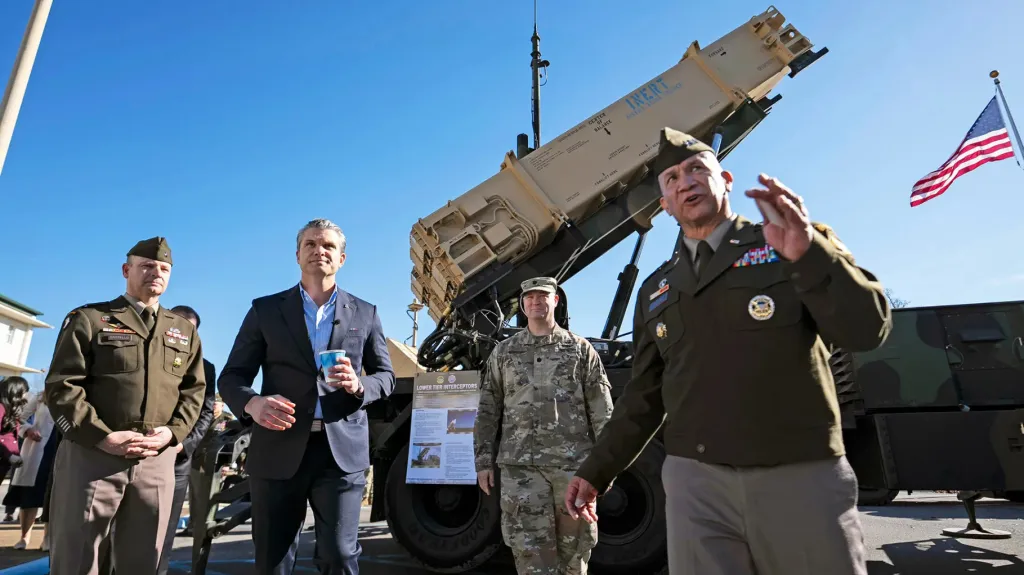
Army Lt. Gen. Frank Lozano, the service’s Portfolio Acquisition Executive for Fires, highlighted this growing trend yesterday during a panel discussion at the Association of the U.S. Army’s (AUSA) main annual convention, at which TWZ has been in attendance.
Secretary Hegseth, second from the left, seen in front of a launcher for the Patriot surface-to-air missile system during a tour of Redstone Arsenal in Alabama earlier this year. Army Lt. Gen. Frank Lozano is seen at far right. DoW/USN Petty Officer 1st Class Alexander Kubitza
To provide some immediate context, with the exception of Patriot, the main ground-based air defense systems in Army inventory today are fielded with just one type of interceptor. In the case of Patriot, the service’s procurement of new interceptors had also been increasingly limited to just one type, the PAC-3 Missile Segment Enhancement (MSE). Production of the preceding PAC-3 Cost Reduction Initiative (CRI) missile ended in 2023. Just earlier this year, the Army placed its first order in decades for new PAC-2 Guidance Enhanced Missile-Tactical (GEM-T) missiles, an older interceptor design for Patriot that has remained in production primarily for U.S. allies and partners.
A graphic showing different interceptor load options for existing trailer-based Patriot launchers. Lockheed Martin
Separately, the Army is in the process of fielding Enduring Shield, a new middle-tier air defense system designed to handle multiple interceptor types. However, the service is currently only acquiring AIM-9X Sidewinders to load into them. We will come back to this later on.
An Enduring Shield launcher. USAF Pfc. Sang Woo Choi
“We have the capabilities we need to have to fight and win, but it’s our job to ensure that victory is achievable in the future inside of any dynamic environment scenario fight we might find ourselves in,” Lt. Gen. Lozano said yesterday. “So, it’s incumbent upon Mr. Ingraham [Assistant Secretary of the Army for Acquisition, Logistics and Technology Brent Ingraham] and I to continue to be creative and looking at, well, should we buy GEM-Ts because they’re being produced?”
“GEM-Ts are a really good missile in the battlespace within they operate. I mean, they’re being employed today by air defense brigades around the world,” he continued. “So if we have the opportunity, it’s probably something we should take advantage of, and we’re looking at doing that.
“We’ve had a lot of discussions about even more interceptors. From a PAC-3 MSE perspective, our goal has always been to get to 2,000 [per year],” he added. “Why we’re running programs like LCI [Low Cost Interceptor], and NGSRI [Next-Generation Short-Range Interceptor], and NGCM [Next-Generation C-UAS Missile], and Second Interceptor, is because I think the easy button answer is just buy more of a great missile. We’re going to buy more [PAC-3 MSEs], but when we start talking about overall missile output, we start looking at numbers like is it 4,000, is it 6,000, is it 8,000, we’re looking at a diverse set of capabilities.”
The LCI program is seeking a lower-cost and lower-tier interceptor for Patriot with a unit price of no more than $1 million. PAC-3 MSE’s average unit cost has been around $4 million in recent years.
A PAC-3 MSE interceptor seen being launched. US military A Patriot launcher fires a newer PAC-3-series missile during a test. DoD
NGSRI is the Army’s program to find a replacement for the venerable Stinger. The new missiles have to be compatible with existing vehicle-based and man-portable launchers.
A US Army soldier fires a Stinger from a man-portable launcher during training. US Army
The Army is working to field a new counter-drone interceptor through NGCM. Those missiles will be integrated into launchers the service has now for the Coyote interceptor.
Raytheon Missiles & Defense proves counter-UAS effectiveness against enemy drones
The Second Interceptor effort is for Enduring Shield, which is also known as the Indirect Fire Protection Capability Increment 2 (IFPC Inc 2). The main goal there is to provide increased capability against incoming cruise missiles compared to the AIM-9X.
There is also the Army’s Future Interceptor effort, which also came up separately at the panel yesterday, and is also for Patriot. Unlike LCI, the aim here is to acquire a new interceptor with improved capabilities against hypersonic missiles and other upper-tier threats.
Historically, Army programs like these would eventually result in the selection of a single winning missile design. Lozano’s remarks yesterday point to the service increasingly taking a very different approach.
On “second interceptor, obviously, we just moved into phase two of that program. We’ve got Lockheed Martin competing with Boeing, who was teamed with Anduril,” Lozano said. “But we wanted to turn up the heat on that program. I constantly get frustrated when a funding profile emerges over the FYDP [the Future Years Defense Program], and then magically we lay in a five-year program.”
At left, a model of the Boeing/Anduril offering for the Second Interceptor effort. At right, a rendering of Lockheed Martin’s proposed Second Interceptor. Jamie Hunter/Lockheed Martin
“I’m like, no, I actually need that capability now,” he continued. “So, have we thought maybe what if we ran a 24-month program or a 36-month program, right? And so, in that vein, what we have decided to do is, while those two companies continue to compete, we’re going to create a shoot-off opportunity in [the] fourth quarter [of Fiscal Year 20]27, and I want to run an in-parallel, what I call an in-stride competition.”
“We just held an industry day, and we basically just said, hey, if there’s any other company who didn’t make the first cut in the phase one, but, oh, by the way, who continued to invest in the IFPC Second Interceptor capability, we’d love for you to come out to the range,” he added. “We’ll give you range time, we’ll present targets, and we’ll allow you to recompete with an opportunity to get back into the program folder.”
The Army is doing the exact same thing with NGSRI, where Lockheed Martin and Raytheon have been competing face-to-face. That program is also now planning to hold a new shoot-off that will be open to other vendors in the fourth quarter of Fiscal Year 2027.
A picture showing a test of Lockheed Martin’s NGSRI entrant, called QuadStar. Lockheed MartinRaytheon, which is also the prime contractor for Stinger, has previously released this image in relation to work on its NGSRI design. Raytheon
To reiterate, on top of all this, the Army is also now pursuing at least two new interceptor options for Patriot.
“We have to address the threat, and we need to address the threat in a complementary way, meaning we need to fight on a cost curve that’s affordable for the U.S. Army to maintain and sustain that warfighting capability abroad,” Lozano stressed yesterday.
This gets to the crux of the matter. It is not at all a new observation that just having a stockpile of any particular munition on day one of a conflict is not enough, especially if the fight becomes drawn out. There needs to be sufficient depth to those stocks at the start and the ability to readily replenish them in line with expenditures. The war with Iran, compounded by other crises in the Middle East and the ongoing conflict in Ukraine, has made clear that these core truths apply to all armed forces, even the U.S. military.
Lower-cost munitions are part of the solution, but they also need to be producible at scale on reasonable timelines. The lead time for higher-end munitions today is often measured in months, if not years. Furthermore, being locked into a single vendor has been shown to not just be undesirable, but a potential national security risk in an actual conflict. Lozano’s remarks yesterday, and how the Army is now pursuing new anti-air interceptors, reflect larger trends, not just in the acquisition of larger volumes of munitions overall, but also from a broader array of total suppliers.
The @DeptofWar has reached new framework agreements with a slate of disruptive new entrants to aggressively expand the United States military’s lethal cruise missile and hypersonic missile strike capabilities.
With regard to the LCI program, specifically, Lozano highlighted an additional aspect of all of this yesterday.
LCI has “a unique twist to it because we’re looking for companies who have all-up rounds, but I’m also asking for companies to come in at the component level,” he explained. “We typically don’t do that, right? There’s a lot of risk in managing components and generating all-up round systems. But we’re also looking for weapon system integrators, because I want to be able to create two or three teams who can compete with the all-up round guys to see if we can generate some momentum behind the fact that we need to thicken our inventory with low-cost, affordable munitions.”
The U.S. Navy is now pursuing a roughly similar approach with its Naval Modular Missile (NMM) program. NMM envisions an entirely new family of sea-launched surface-to-air missiles that offer very different capabilities, but that all feature certain common components, as you can read more about here.
A graphic laying out the Navy’s vision for the different members of the NMM family, and shared components between them. USN
It is also important to note here that the underlying aim is not to eliminate more exquisite munitions, or the capabilities that they offer, but to create a more affordable, complementary mix of options.
“What I would say is we’re solely focused on delivering on the programs we are executing now,” Lozano said in closing at the end of the panel yesterday. “We have to deliver, and if we deliver on that wide variety of capability, then we can increase and ramp that capacity. And that would be my wish list, that we have enough resources and we achieve programmatic success in the way that we’re planning to, so we can deliver in mass.”
All signs point to the diversity in munitions that Lozano is talking about here being particularly pronounced in future Army air defense capabilities full of systems firing multiple types of interceptors.