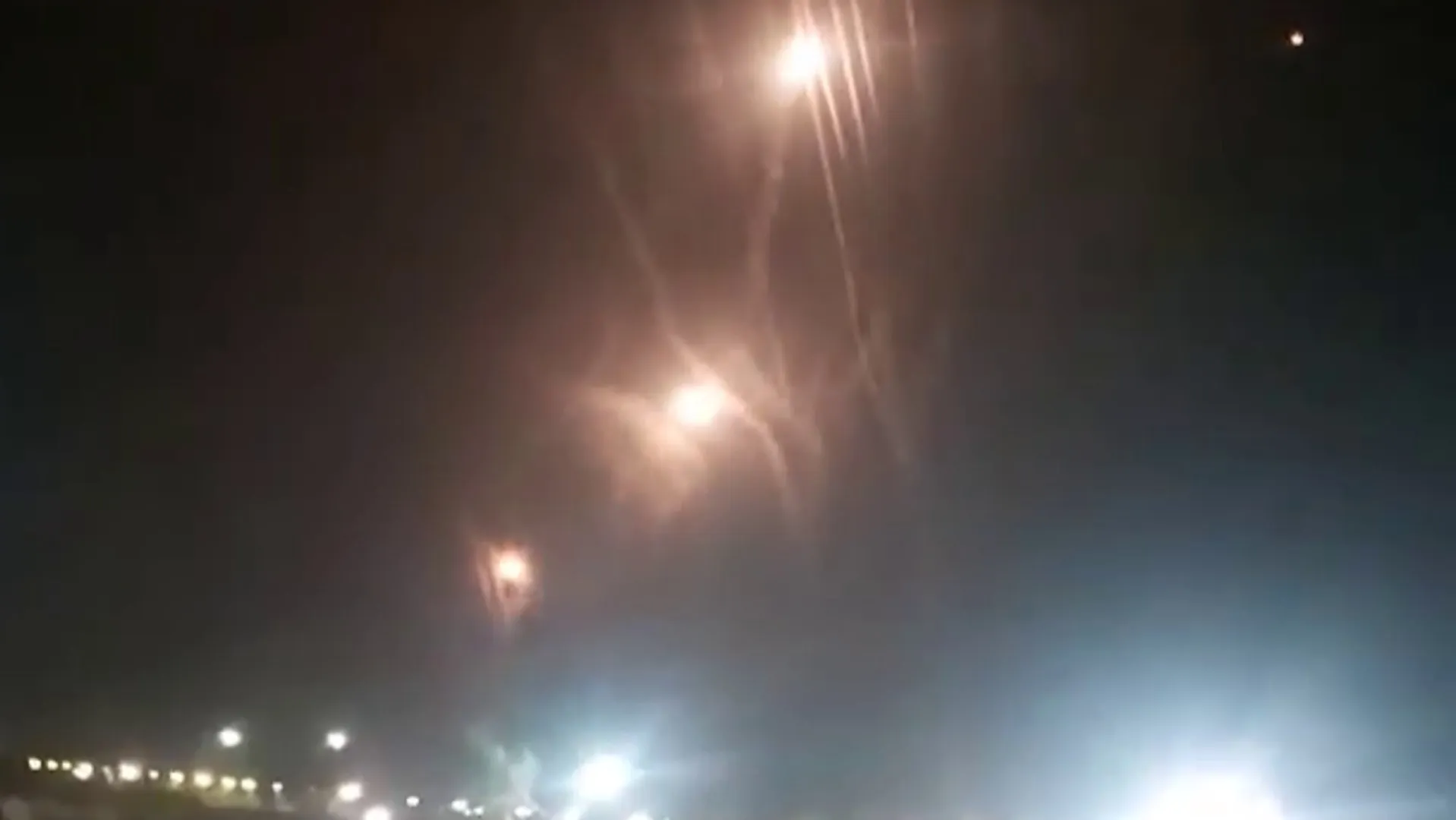
Yemeni government says one of the missiles hit Aden airport’s runway minutes before a flight from Cairo was due to land.
Published On 7 Oct 20267 Oct 2026
Yemen’s internationally recognised government has accused the Houthis of firing ballistic missiles and drones at the main international airport under its control, as Saudi Arabia said it had intercepted another missile north of its capital, Riyadh.
In a statement on Wednesday, the Ministry of Transport said the Houthis targeted the runway and passenger terminal at the airport with at least two ballistic missiles and several drones.
Recommended Stories
list of 3 itemsend of list
“One of the missiles landed near the runway minutes before the Yemeni flight from Cairo was to land,” it said. “We cancelled the landing of the incoming flight from Cairo [in Egypt] and diverted its route to Jeddah [in Saudi Arabia] to protect the passengers.”
The ministry also said it evacuated the airport terminal and removed two planes from the tarmac during the attacks.
It added, “This incident could easily have turned a civilian flight into a horrific humanitarian disaster, claiming the lives of dozens of innocent people in an instant.”
Aden airport is the main international gateway for parts of Yemen outside Houthi control in the city that has been the seat of the government since the takeover of the capital, Sanaa, by the Iran-supported group in 2014.
The Houthis said in a statement they targeted “Saudi military supplies” arriving at the Badr camp near the airport with ballistic missiles. Saudi Arabia backs Yemen’s government.
Separately, the Saudi-led military coalition fighting in Yemen said it intercepted and destroyed a ballistic missile, launched by the Houthis, north of Riyadh.
In a social media post, Major-General Turki al-Maliki, the spokesperson for the Saudi-led coalition, said it was tracking the launch platform used in the attack via an intelligence system over Sanaa, and promised to destroy it.
The Houthis said in statements on Tuesday and overnight into Wednesday that they had targeted Saudi international airports in Riyadh and Abha.
The intensified fighting in Yemen comes amid mounting regional tensions set off by the US-Israel war on Iran. The Saudi-backed government forces launched a counteroffensive against the Houthis to retake the Red Sea port of Mocha and areas around the Bab al-Mandeb strait.
Fighting has concentrated in the southwestern province of Taiz.
Al Jazeera’s Yousef Mawry, reporting from Sanaa, described “all-out battles to take over the ground, the highlands and the mountains east of Bab al-Mandeb”.
“It’s a battle to take over the strategic western part of Taiz, and whoever controls the wider vicinity will overlook the region and have dominant military control,” he said.
“For the Yemeni government to take control of Mocha and the strategic bases and locations along the Red Sea coast, it first has to drive the Houthis off the mountains east of Mocha.”
Pakistan and Turkiye on Monday agreed to activate “deterrence measures” under their mutual defence pact with Saudi Arabia and rapidly deploy forces to the Gulf kingdom to counter Houthi attacks.
The U.S. Air Force’s scramjet-powered Hypersonic Attack Cruise Missile (HACM) has finally reached the flight test phase, with at least one “release” having been carried out so far over a range in Australia. HACM has suffered significant delays, and the Air Force has taken the risky step of scaling back overall testing plans to try to keep the program on schedule. The stated goal is to be able to make a decision to start rapidly acquiring HACMs in 2027.
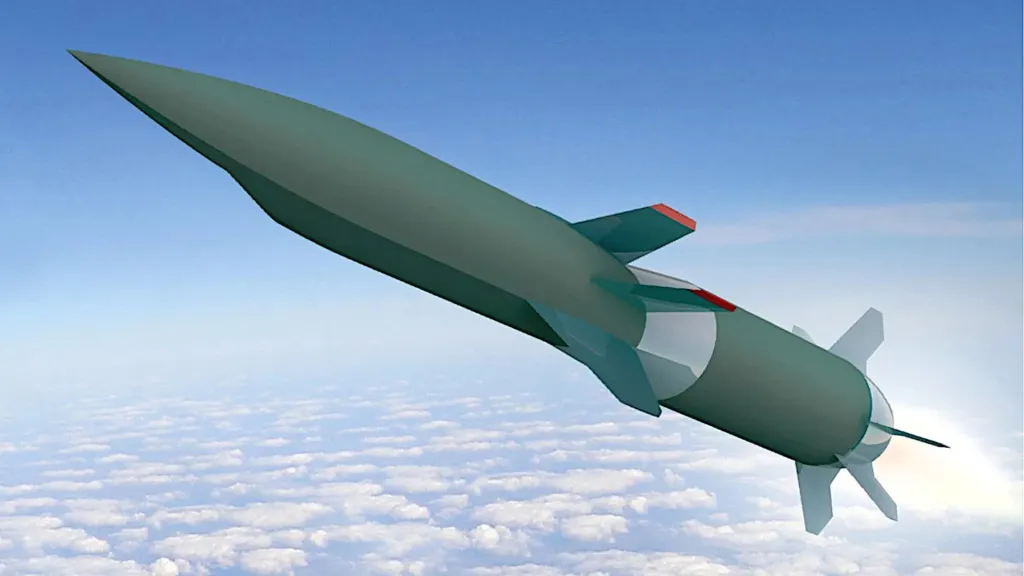
A rendering DARPA put out during the preceding Hypersonic Air-breathing Weapon Concept (HAWC) effort. DARPA
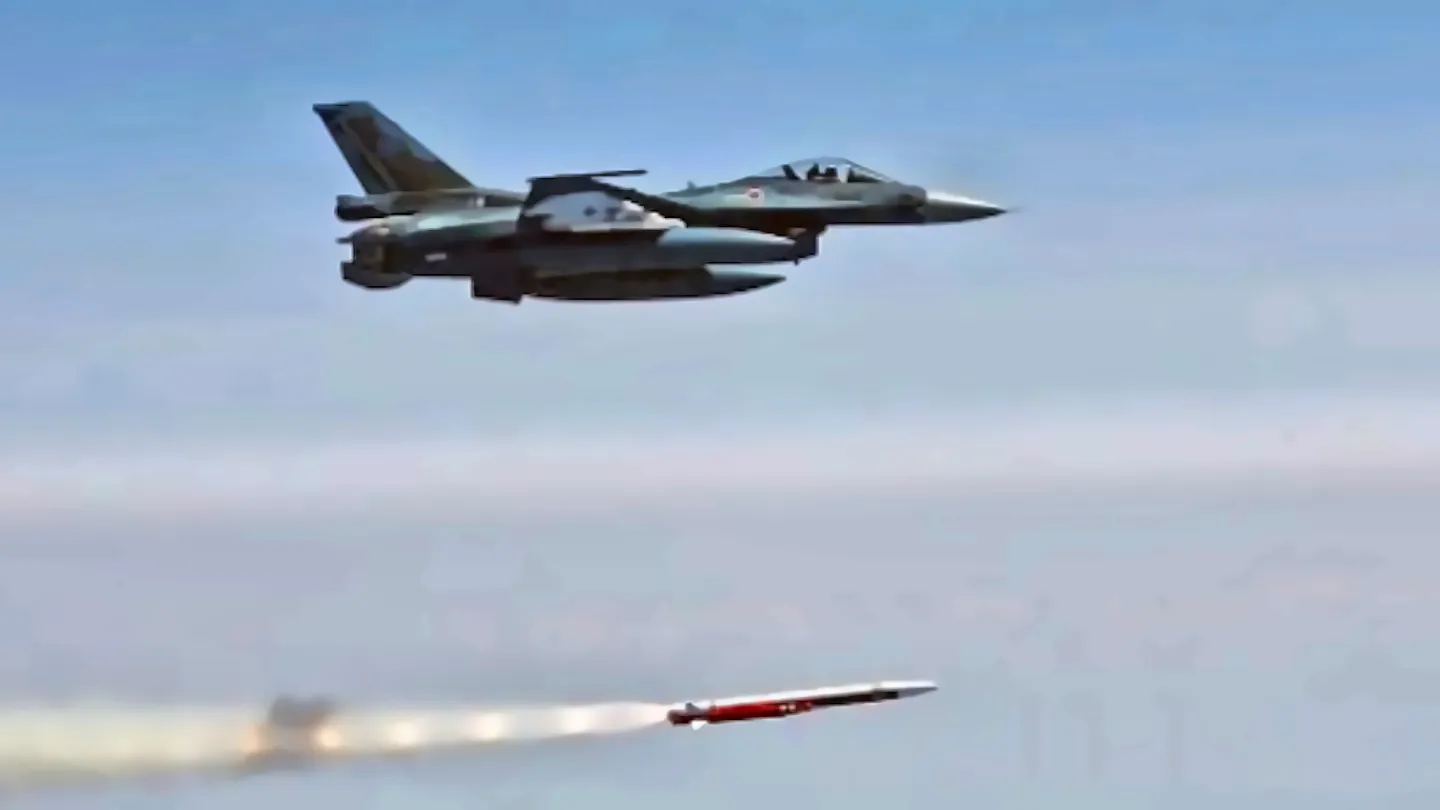
“The U.S. Air Force, in partnership with Australia, has conducted a flight test of the Hypersonic Attack Cruise Missile (HACM) as part of our continuous work to advance long-range strike capabilities,” an Air Force spokesperson confirmed to TWZ today. “This effort is part of the Southern Cross Integrated Flight Research Experiment (SCIFiRE), a collaborative agreement built on more than 15 years of partnership between our two nations.”
“Leveraging this enduring alliance, the Royal Australian Air Force executed the release of a HACM flight test unit over a designated Australian test range, gathering crucial data to advance the program’s objectives,” the spokesperson added. “The flight was the culmination of an extensive series of tests designed to measure the missile’s performance under realistic flight conditions.”
The spokesperson did not name the test range where the “release” was conducted or say when that occurred. Whether the missile flew under its own power for any amount of time after release is unknown. What aircraft was used to carry the missile aloft is also not known. TWZ has reached out for more information.
The Air Force did say previously that it planned to conduct HACM launches in Australia. The expectation has long been that this would be done at the country’s sprawling Woomera Test Range, which provides an ideal location for extended-range flight testing activities in general. The U.S. and Australia have partnered on other hypersonic testing at Woomera in the past, as seen in the video below. The remote inland location of the range complex makes it well suited for conducting more sensitive tests away from prying eyes, as well.
HiFiRE 5B rocket reached Mach 7.5
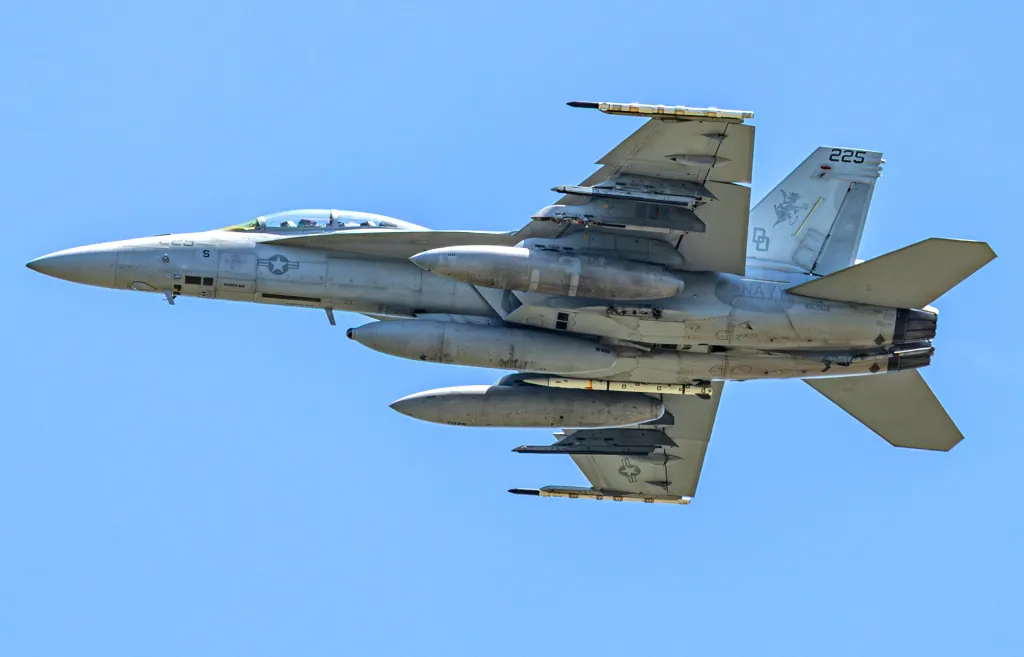
The Government Accountability Office (GAO), a Congressional watchdog, has also reported in the past that RAAF F/A-18F Super Hornets would be used to conduct at least some of the HACM test launches. This would fit with today’s statement from the U.S. Air Force saying that it was the RAAF that “executed the release.” The Air Force’s initial launch platform is the F-15E Strike Eagle, though others are expected to follow.
A pair of RAAF F/A-18F Super Hornets. RAAF
To date, neither the Air Force nor Raytheon has released a confirmed picture or rendering of HACM. In 2023, the Air Force did release a picture, seen below, showing an air-breathing hypersonic cruise missile test article related to either HACM or the preceding HAWC effort.
USAF
“The missile consists of two stages, a rocket booster and a scramjet cruiser, which separates from the booster and eventually dives toward its target,” according to GAO. Scramjets do not function effectively at lower speeds, and designs powered by them require some form of initial boost to a high Mach velocity. Hypersonic speed is generally defined as anything above Mach 5, but what HACM’s peak speed might be is unknown.
Two-stage air-breathing missile-like hypersonic vehicle designs have been tested on several occasions in the past. This includes Boeing’s scramjet-powered X-51 Waverider and HyFly 2 hypersonic test vehicles, among others. The X-51 (as its name indicates) and HyFly 2 also notably had so-called ‘waverider’ configurations designed to ‘skip’ on the shockwaves generated during high-speed flight to help provide additional lift. Whether HACM might also use this principle is not known.
X-51A WaveRider Scramjet Second Hypersonic Flight Test
It’s also worth noting here that Castelion’s Blackbeard hypersonic missile also has a two-stage configuration. It remains unconfirmed whether or not the second stage of that weapon is powered, but it does not appear to be an air-breathing design either way. Castelion is currently developing an air-launched version of Blackbeard for the U.S. Navy, which is also in flight testing now, as well as a ground-launched type for the U.S. Army. You can read more about that missile here.
Scramjet-powered air vehicle designs, including aircraft and missiles, have historically proven challenging. As noted, HACM has suffered delays over the years. The original goal had been to begin flight testing in 2024, which slipped first to 2025 and then 2026.
“The HACM program is on track to conduct its first flight test in the second quarter of fiscal year 2026, but officials said there is effectively zero margin left in the schedule for the rapid prototyping effort. The program has already descoped the rapid prototyping effort from seven to five planned flight tests,” GAO said bluntly in a report published in July. “The Air Force plans to produce 13 missiles during the rapid prototyping effort, including test assets, test spares, and operational rounds.”
“If a significant flight test failure occurs, it is likely that the program will not be able to complete all five tests within the 5-year rapid prototyping timeframe,” the report continued. “According to the program, completing at least the first three flight tests is critical for informing the Air Force’s decision to initiate a rapid fielding effort and procure HACM in fiscal year 2027.”
GAO’s July report, which had a January cutoff date, noted later on that the Air Force’s target date for initiating the rapid fielding effort, more specifically, was the first quarter of Fiscal Year 2027. This fiscal period began last Thursday and runs through the end of the year. Whether the service is still aiming to keep to that part of the schedule is unclear, but it would seem extremely difficult to do so.
Another rendering of a notional hypersonic missile that has been used to illustrate discussions about HACM in the past. Raytheon via GAO
“The HACM program has taken on risk to maintain its current schedule. According to program officials, maintaining the schedule has required aggressively resequencing activities to focus almost exclusively on those necessary to support the first flight test date,” GAO’s report added. “In some cases, officials said this has involved risky strategies, such as concurrently performing parts validation testing while completing the system’s design, which could require the redesign of key parts if they fail validation testing.”
Lockheed Martin, which previously put out this rendering of a hypersonic cruise missile, had been working on HALO for the Navy before that program was cancelled. Lockheed Martin
Regardless, the U.S. military, as well as its Australian counterparts, have made it clear in the past that they view hypersonic weapons as critical for success in future conflicts, especially high-end fights, such as one in the Pacific against China. In general, air-breathing hypersonic cruise missiles offer a valuable and highly flexible way to strike targets, especially time-sensitive ones, quickly and over extended ranges. The weapon’s high speed and maneuverability drastically increase its ability to penetrate through enemy air defenses and reduce the total time an opponent has to react.
Whether or not the Air Force will be able to avoid any more major delays with HACM remains to be seen. The service’s goal to start at least limited production of HACM before the end of 2027, if not sooner, is even more ambitious now after years of schedule slips. As mentioned, officials have already acknowledged there was no more margin for error at the start of the year. There are many questions still about what form any initial fielding will take, and how that might be further impacted by the truncated testing plan.
The HACM program has at least now hit the important milestone of beginning flight testing.
A ballistic missile is fired from the North Korean port city of Wonsan, South Korean military says.
Published On 2 Oct 20262 Oct 2026
South Korea’s military says North Korea has fired at least one ballistic missile towards the sea off its east coast.
South Korea’s Joint Chiefs of Staff said on Saturday morning that its northern neighbour fired a ballistic missile from the port city of Wonsan on the eastern shore of the Korean Peninsula.
Recommended Stories
list of 3 itemsend of list
The South Korean military raised an alert for further launches.
Japan issued an emergency alert on Saturday, saying: “North Korea has launched a suspected ballistic missile.”
The launch came a day after Kim Yo Jong, the powerful sister of North Korean leader Kim Jong Un, ridiculed South Korean demands for the North to apologise over landmine blasts that South Korea and the US-led United Nations Command said were caused by North Korean mines planted south of the Military Demarcation Line.
The blasts seriously injured three South Korean soldiers on a reconnaissance mission inside the 4km-wide (2.5-mile) border zone that stretches across the Korean Peninsula.
South Korea has also called on the North to halt recent efforts to fortify its border, including the installation of mines and anti-tank barriers.
Kim Yo Jong dismissed Seoul’s demands as “utterly pathetic”, saying the North intends to permanently cut ties with the South.
Saturday’s launch was the latest in a series of North Korean military displays in recent weeks, including tests of a purported hypersonic missile system, live-fire exercises and the commissioning of a new warship.
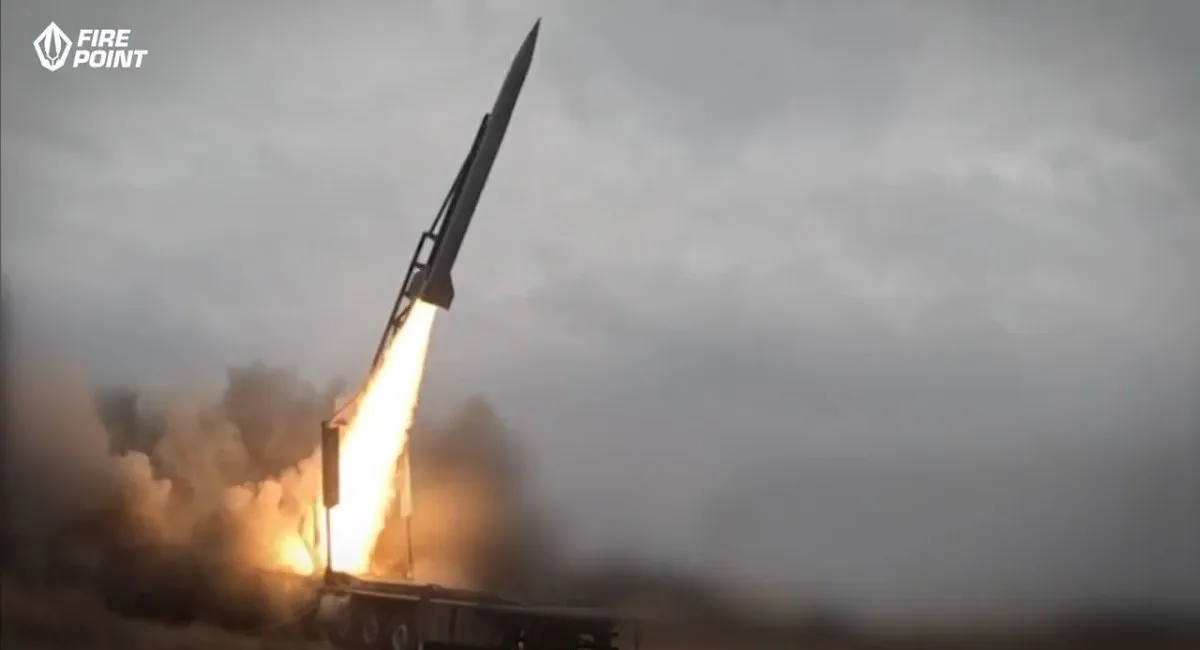
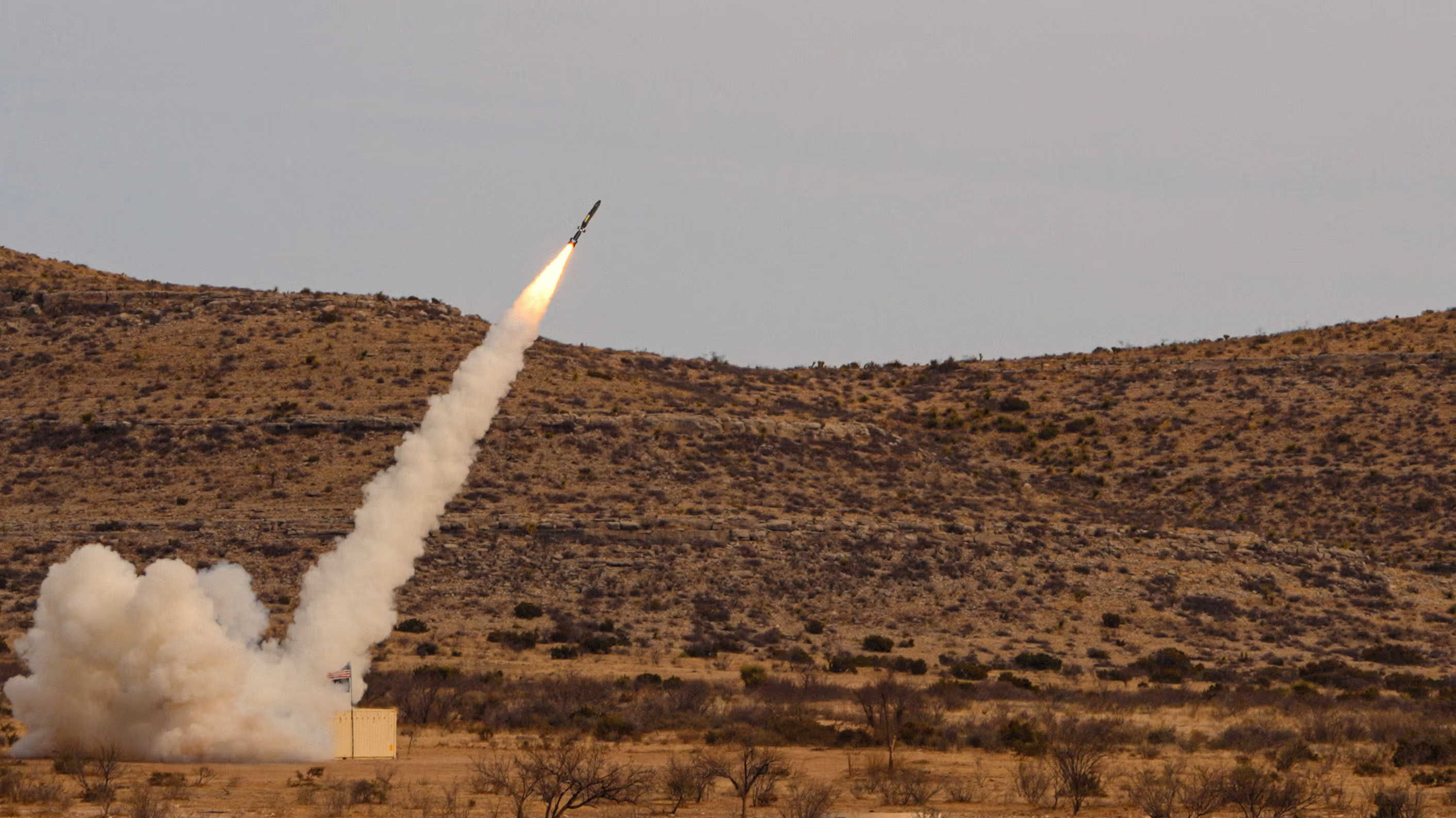
Ukraine says it has used its domestically developed FP-7 tactical ballistic missile in combat for the first time, in what would mark another significant milestone in the country’s rapidly expanding indigenous long-range strike program.
President Volodymyr Zelensky announced today that Ukraine had conducted the first combat use of the FP-7, a ground-launched ballistic missile developed by Ukrainian defense company Fire Point. He also said production of the weapon would follow.
Ukrainian tactical ballistic missile. FP-7. First combat use. Thank you for the result. Next up: production. Glory to Ukraine! pic.twitter.com/IxdjVg51c1
— Volodymyr Zelenskyy / Володимир Зеленський (@ZelenskyyUa) October 1, 2026
The claim has not been independently verified, and Ukrainian authorities have not disclosed the target, location, number of missiles involved, or other details surrounding the reported strike. A video has been published showing what’s said to be a nighttime launch of the missile.
The FP-7 is one of several increasingly ambitious weapons being developed by Fire Point, a Ukrainian defense company that has expanded rapidly since Russia’s full-scale invasion. The company began with drones and has subsequently moved into long-range strike missiles and ballistic missile technology.
Test launch of the FP-7 surface-to-surface ballistic missile. Fire Point
Fire Point CEO Iryna Terekh previously described the company’s development and manufacturing model in an interview with TWZ, detailing an effort to rapidly scale production while maintaining a dispersed industrial base inside Ukraine. The company’s better-known systems include the FP-1 and FP-2 long-range strike drones and the FP-5 Flamingo cruise missile.
According to Ukrainian and company-released information, the FP-7 has a range of approximately 250 kilometers (155 miles) and a warhead weighing around 150 kilograms (331 pounds). Other published figures have put its velocity at approximately 1,500 meters per second (around 3,350 miles per hour). Rather than striking targets deep in the Russian rear areas, the missile is optimized for use against objectives such as logistics hubs, air defense sites, and drone bases. This makes it more of a shorter-range complement to the U.S.-supplied Army Tactical Missile System (ATACMS) ballistic missile, rather than a direct replacement, although it comes without any restrictions on the kinds of targets that it can be used against.
Details from missile debris shown by Russia confirm Ukraine launched ATACMS at Voronezh region on November 18, marking the first use of U.S.-made missiles on Russian territory during Trump’s presidency. According to the Russian MoD, S-400 and Pantsir-S1 systems helped repel the… pic.twitter.com/8SeQCo9OEO
At the same time, those specifications should likewise be treated as reported figures rather than independently verified performance data. Actual range, payload and accuracy can vary according to missile configuration and mission profile.
The FP-7’s development is particularly notable because Fire Point is also using the basic missile architecture as the foundation for a very different weapon.
Fire Point has developed the FP-7.X, an anti-ballistic missile interceptor derived from the surface-to-surface FP-7.
A video showing a test launch of an FP-7.X surface-to-air missile:
Держави програють війни на полі бою значно рідше, ніж вони програють їх у інститутах, лабораторіях та на виробництві за десять років до їх початку.
Коли країна роками недофінансовує інженерну освіту, скорочує дослідження, втрачає виробничі компетенції або звикає покладатися на… pic.twitter.com/Ti1Ayn4INf
Fire Point’s expectation is that commonality between the two systems can shorten development and provide manufacturing efficiencies by allowing the company to draw upon work already conducted on the FP-7’s propulsion, airframe, guidance, and production processes.
The FP-7.X forms part of Project Freyja, a European effort to develop a comparatively inexpensive and potentially more numerous ballistic-missile-defense interceptor. Fire Point has also discussed an eventual production rate of thousands of interceptors annually, although such targets represent company ambitions rather than demonstrated production capacity.
Fire Point has said it is working with European and Ukrainian partners on the system, including work on the interceptor’s seeker. The company has described an initial interceptor using a blast-fragmentation approach, with more sophisticated hit-to-kill capability envisioned for later versions.
Earlier this year, Diehl Defense confirmed that it plans to launch production of the Flamingo cruise missile in Germany. Previously, Diehl had signed a technology agreement with Fire Point but had not disclosed any details. Potentially, that could open a path to Fire Point’s ballistic and cruise missiles helping to meet the growing demand for long-range fires capabilities among NATO’s European members.
A video of the Flamingo cruise missile in action:
Випробувальний пуск ракети “Фламінго”
As it stands, the baseline FP-7 is only one element of Fire Point’s ballistic missile ambitions.
A rendering of the FP-7 surface-to-surface ballistic missile. Fire Point
The company is also developing the larger FP-9, which Fire Point has described as having a planned range of approximately 850 kilometers (528 miles). The larger missile requires substantially more solid propellant and has driven the company to establish new industrial capabilities for manufacturing large solid-rocket motors.
As with the FP-7, the available FP-9 performance figures are based primarily on statements from Fire Point and Ukrainian sources and should not be treated as independently established specifications.
Ukrainian FP-9 ballistics ready to strike! 800 km range – MOSCOW is now within reach!
The development of these weapons reflects Ukraine’s broader effort to expand domestic production of long-range strike systems. Kyiv has relied heavily on Western-supplied weapons during the war while simultaneously attempting to establish an indigenous capacity for drones, cruise missiles, and ballistic missiles.
For Fire Point, that effort has produced an unusually broad portfolio in a relatively short period: long-range attack drones, cruise missiles, ballistic missiles and, potentially, interceptors designed to defeat ballistic missiles.
The claimed combat debut would give Ukraine a fast, hard-to-intercept strike option for targets within the FP-7’s reported range, with its combination of kinetic energy and relatively heavy warhead making it particularly useful against hardened targets. If targeting and launch procedures can keep pace, its short flight time can also enable rapid-response strikes against more time-sensitive targets. More broadly, the FP-7 represents the culmination of years of Ukrainian efforts to close a major ballistic-missile gap with Russia and establish an indigenous capability.
FP-7 surface-to-surface ballistic missile. Fire Point
The reported combat debut of the FP-7 also comes as the long-range strike campaign between Russia and Ukraine continues to intensify, with both sides increasingly seeking to hold targets deep behind the other’s front lines at risk. That dynamic will become particularly important as the two countries head into another winter, when strikes against energy, industrial, and military infrastructure ramp up significantly. At the same time, the FP-7’s reported range gives it a considerably more limited target set than Ukraine’s longer-range cruise missiles and drones, constraining where it can be employed and distinguishing it from systems designed for deep strikes hundreds of miles beyond the front.
The significance of Zelensky’s announcement will ultimately depend heavily on whether the FP-7 can move from a claimed combat debut into sustained production and operational service.
Ukraine has not publicly disclosed the number of FP-7 missiles produced, current production rates, or when significant quantities could become available.
Using theFP-7 in combat for the first time would mark an important transition for Fire Point’s ballistic missile program, from development and testing toward operational employment. The company’s ability to manufacture the weapon at scale will become the next critical question.
The U.S. Air Force is looking at adding a missile warning system (MWS) to its new F-15EX Eagle II fighters. This will give the aircraft a way to optically detect incoming missile threats, especially passively guided ones like heat-seeking infrared-guided missiles, which they currently lack. The continued absence of an MWS has become more pronounced in light of recent combat experiences over Iran.
The F-15EX is derived from earlier F-15 variants that all have MWSs, and it had seemed logical to expect the Eagle II would feature this capability. So it was puzzling when the first examples rolled out without such a system, and no apparent plans to install one on a jet already costing upwards of $100 million. The omission has been glaring for years now, especially given that the aircraft has all the provisions for such a system, including blanked-over spots for the sensors.
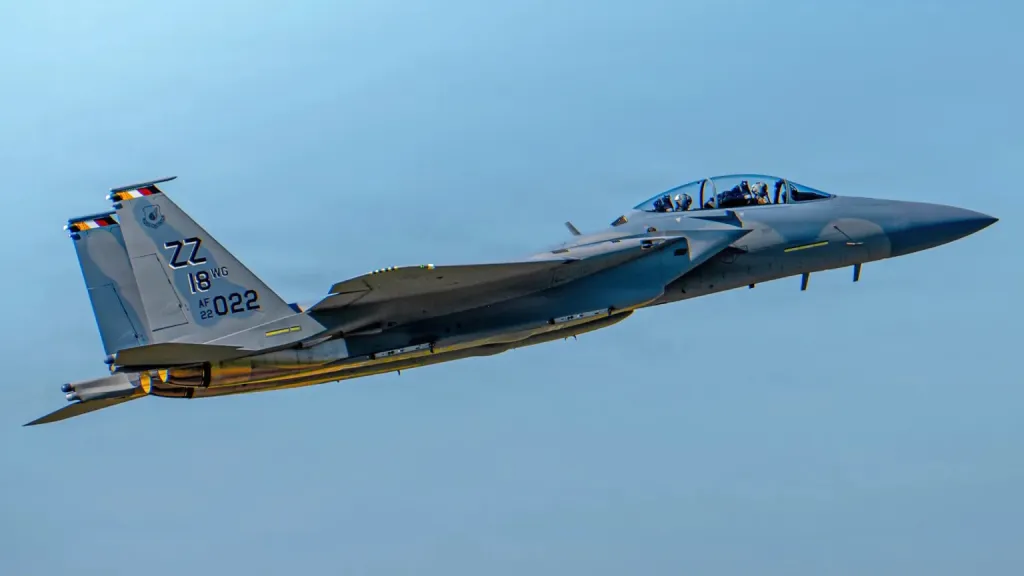
The 22nd F-15EX for the US Air Force seen departing Boeing’s plant in St. Louis, Missouri, in August 2026. USAF/Senior Airman Melany Bermudez
Now, the Air Force Life Cycle Management Center’s (AFLCMC) Fighters & Advanced Aircraft Directorate “is seeking sources for the procurement of an operationally qualified threat missile launch and approach warning system for rapid integration into the United States Air Force (USAF) F-15EX Eagle II fighter aircraft,” per a contracting notice put out yesterday. “The MWS must alert the F-15EX aircrew to the presence of missiles that may threaten the aircraft without unreasonably distracting the aircrew with false alarms.”
As mentioned, the F-15EX is already configured to accommodate an MWS, inside and out, something AFLCMC’s notice emphasizes. This is a result of the Eagle II having been directly derived from the F-15QA variant for Qatar, which itself was an outgrowth of the F-15SA for Saudi Arabia. While many of the F-15EX’s advances come from these aircraft, the first F-15 variant to get an MWS was actually Singapore’s F-15SG. The Advanced Eagle line and the F-15SG are part of Boeing’s extended F-15E Strike Eagle family.
A pair of Qatari F-15QA Advanced Eagles. USAF
“The MWS must use the six (6) pre-existing F-15EX sensor locations, data cables, power cables, and cooling,” the contracting notice says. “It must be easily, safely, rapidly, and organically installable and removable in the field by USAF military aircraft maintenance personnel without requiring any change to aircraft configuration beyond installation of MWS line replaceable units (LRUs) in the six (6) pre-existing locations in the aircraft dedicated for missile warning.”
Those most visually prominent of those pre-existing sensor locations are two horn-like sponsons, one on each side of the forward fuselage right below the cockpit canopy. There are two more locations at the ends of the jet’s tail booms. The last two locations are situated so additional sensors can face straight up and down to provide total 360-degree coverage.
A closer look at the nose end of an F-15EX, with the right-side horn-like sponson under the cockpit plainly visible. USAF/Master Sgt. Steph SawyerThe F-15EX also has pre-existing locations for MWS sensors at the ends of its tailplanes, as can be seen in this picture. USAF
The sources sought notice does not mention any specific MWS and invites prospective vendors to submit proposals. It also stresses that the Air Force is still in the “market research” phase of the contracting process and that it “does not constitute [a] solicitation and shall not be construed as a commitment” to buy such a system.
The F-15SA uses the AN/AAR-57 Common Missile Warning System (CMWS), and this system is understood to also be found on the F-15QA. Beyond F-15 variants, versions of the AN/AAR-57, for which BAE Systems is currently the prime contractor, are fielded today on a wide variety of other fixed-wing aircraft and helicopters, including various types in U.S. military service. CMWS variants are notably found across the U.S. Army’s AH-64, UH-60, and CH-47 helicopter fleets.
A picture of a Saudi Arabian F-15SA Advanced Eagle. Jamie HunterAnother close-up look at a Saudi F-15SA, offering a particularly good view of one of the aircraft’s missile warning sensors. USAF/Staff Sgt. Isaiah Soliz
All versions of the CMWS consist of several electro-optic missile sensors (EOMS), the number of which varies from platform to platform, linked to a central electronic control unit (ECU). The system is also designed to be integrated into larger defensive suites.
A picture showing five of the electro-optic missile sensors (EOMS) used in the AN/AAR-57, as well as the electronic control unit. BAE Systems
While the AN/AAR-57 is a proven system with years of successful integration on the F-15 and other platforms, it is just one option of the open market today. The Air Force could choose to take another route, possibly with a new system that offers added functionality.
The addition of any MWS will give the F-15EX a valuable, if not increasingly critical, boost in defensive capability. The Eagle II does already have an extremely powerful self-protection suite, including the Eagle Passive/Active Warning Survivability System (EPAWSS). However, it is heavily geared toward defending against radar-based threats that pump out signals that can be detected and jammed. Infrared-homing anti-air missiles zero in on their targets passively.
Eagle Passive Active Warning Survivability System (EPAWSS) l BAE Systems
In general, MWSs also typically make use of passive infrared sensors to spot the heat plumes of missile launches and the thermal signatures of those threats as they continue their approach. BAE Systems says current-generation versions of the AN/AAR-57 are sensitive enough to detect infantry anti-armor rockets being launched, as well as small arms fire from the ground, under the right circumstances. Though an MWS is not an active countermeasure unto itself, the early warning it provides gives critical time to deploy flares or employ other defensive capabilities, or just take evasive action.
TWZ touched on all of this last month after The New York Times reported new details about the shootdown of an F-15E Strike Eagle over Iran in April. A shoulder-fired, heat-seeking surface-to-air missile, also known as a man-portable air defense system (MANPADS), is said to have been responsible, thought his remains unconfirmed. The Strike Eagle also lacks an MWS. The Times‘ story said that the F-15E’s defensive suite provided the crew with only half a second of warning. As we noted at the time, it would actually have provided no warning given that the Strike Eagle also lacks an MWS.
A picture showing one of the tailfins of the F-15E shot down over Iran in April 2026. Iranian state media
Even before the current conflict with Iran broke out, TWZ had questioned the F-15EX’s lack of this capability given the general focus on increased survivability to match expanding threat ecosystems globally. EPAWSS is already a reflection of that reality, and could be made even more capable when tied together with an MWS. In May, we had reached out to the Air Force about any plans to integrate an MWS onto the F-15EX in light of observations from the ongoing conflict with Iran. The service told us then that it had no details to share. Whether the service now has any plans to add MWSs to the Strike Eagle fleet, which would require more significant integration work, is also unknown.
Buying F-15EX and not springing for the missile approach warning system is absolutely the dumbest thing. $100M fighter, but let’s save a few bucks on a key defensive advantage. You are not always going to get a radar spike from a threat, even at altitude.
Infrared homing anti-air missiles, as well as air defense systems that use passive infrared sensors for target detection and cueing, are certainly not threats limited to Iran. In Yemen, Iranian-backed Houthi militants have been making good use of these capabilities for years now, something else we have explored in great detail in the past. The Houthis claimed to have downed a Saudi Arabian F-15 just earlier this month and, per a now-long standing modus operandi, subsequently released video captured through a ground-based forward-looking infrared (FLIR) system as evidence. The group also shared images of the wreckage of what looked to be an F-15SA Advanced Eagle, underscoring the dangers posed even to aircraft equipped MWSs.
These threats are not limited to the Middle East more broadly, either, and are only increasingly likely to be encountered in future conflicts globally. The emergence of ever-more capable and longer-range anti-air missiles with infrared or dual-mode guidance systems is a significant factor in all this. Expanding use of passive infrared search and track (IRST) systems on aircraft and infrared sensors on ground-based air defense systems are part of this larger equation, as well.
How the Air Force ultimately decided to proceed with the integration of an MWS onto the F-15EX fleet remains to be seen. However, the Eagle II’s lack of this capability is only becoming more striking, especially in light of the conflict with Iran.
An unusual shoulder-fired air defense missile seen in Russian use may be of Chinese or Iranian origin, raising questions about the movement of foreign weapons through the increasingly interconnected military supply networks linking Moscow, Beijing, and Tehran.
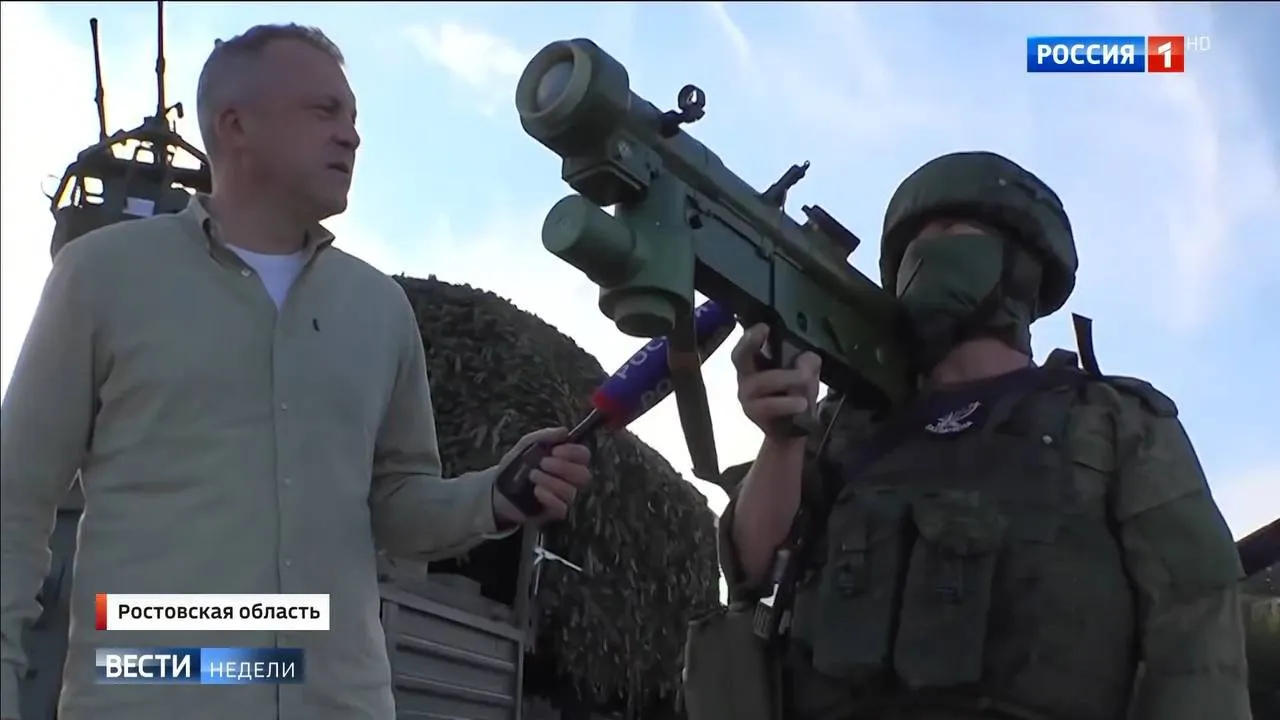
The man-portable air defense system (MANPADS) appeared in Russian television footage showing a mobile air defense group operating in the Rostov region, which borders Ukraine. The weapon was shown during an exercise said to have involved one of the elements of Russia’s 51st Air Defense Division. The footage was subsequently highlighted by the X account TheDeadDistrict.
ruSSian’s have developed a new “Iva” MANPADS. In the footage, it is in service with one of the mobile fire groups of the 51st Air Defense Division in Rostov Oblast.
Although, no—it is most likely the Iranian Misagh-2 MANPADS.
The system does not closely resemble any of the Russian-made MANPADS families otherwise used by the country’s armed forces. Russian personnel seen with the weapon reportedly referred to it as “Iva,” although that designation by itself does not establish the weapon’s origin or model. The word Iva is Russian for willow (a type of tree), of which one particular species is named Verba — also the name of the Russian-made 9K333 MANPADS. This weapon looks very different to the example shown, but the connection is unlikely to be a coincidence.
An operator of the mystery MANPADS is interviewed by the Russia-1 TV channel. Russian State Media
A visual analysis of the newly observed launcher reveals comparisons with both the Iranian Misagh-3 and Chinese QW-series systems, particularly the QW-18/QW-18A and QW-19. In particular, a closer examination of the imagery highlights an additional box-like component toward the front of the launcher. That feature appears more consistent with photographs of Chinese QW-series systems rather than the Misagh.
The front part of the MANPADS launcher, with the distinctive box-like component below the tub. Russian State Media
There is also a scarcity of publicly available imagery of later Iranian variants to completely exclude an Iranian system. At the same time, the Misagh series itself is understood to be derived, or at least heavily influenced by Chinese designs.
An Iranian Misagh-3 MANPADS with its missile. Tasnim News Agency
Another possibility is that the weapon is a Russian-produced version or derivative of a Chinese or Iranian design, rather than an imported system.
The possibility of foreign-made or foreign-designed equipment appearing in Russian service has to be viewed against the much broader transformation of Moscow’s military relationships since the full-scale invasion of Ukraine in February 2022.
Russia’s relationship with China has deepened substantially since the invasion, with Beijing becoming a critical source of machinery, electronics, and other components that Russia’s defense industry can no longer obtain as readily from Western suppliers. Moscow and Beijing had already declared a “no limits” partnership shortly before the invasion, and their military relationship has subsequently included exercises and expanding military-technical cooperation. U.S. officials have accused China of supplying Russia with components used in weapons production, including microelectronics. Beijing has rejected accusations that it is providing lethal military assistance to Russia.
A close-up of the front end of the MANPADS. Russian State Media
Iran has also become an important military partner. Russia has used Iranian-designed Shahed-series attack drones extensively in Ukraine and has worked with Tehran on local production and adaptation of those systems. Moscow and Tehran formalized their relationship further with a comprehensive strategic partnership treaty in January 2025, which includes provisions for military-technical cooperation and joint exercises.
In return, Russia has supplied Iran with military technology and has cooperated with Tehran on sensitive weapons programs.
The possible Chinese connection takes on additional significance in light of a major reported procurement deal between China and Iran.
In July, Reutersreported that Iran was expected to receive the first shipment of a deal covering 300 to 400 Chinese-made MANPADS, with a reported value of $60 million to $70 million. The weapons identified by sources included the Chinese QW-12 and FN-16 systems.
Chinese missiles the United States fears… an unsleeping eye against drones and low‑flying aircraft
China’s QW‑12 and FN‑16 air‑defense systems intercept low‑altitude targets — including drones — forming a rapid defensive line against close‑range aerial threats. pic.twitter.com/kJZ6mnqmHg
The reported contract was signed with a Hong Kong-based company that sources described as an intermediary between the Iranian side and the Chinese supplier. Reuters said the initial deliveries were planned from Urumqi in western China, with the weapons then transiting through Pakistan before reaching Iran. Pakistan’s military publicly denied any involvement in such transfers, while China’s Foreign Ministry called the report “groundless.”
Reuters also reported that delivery schedules and quantities could still change.
More significantly for the Russian sighting, a European security source told Reuters that authorities were aware of several contracts under discussion involving the potential sale of QW-12, QW-18, and QW-19 MANPADS to Iran. A Middle Eastern security source separately claimed that Iran had been seeking QW-18 systems.
There is currently no evidence tying the launcher seen in Russian hands to the Iranian procurement from China.
At the same time, the possibility of an Iranian connection should not be ruled out, especially since Chinese-designed MANPADS have a documented history of appearing outside conventional state inventories.
Earlier TWZreporting, drawing on research by the Small Arms Survey monitoring group, examined the illicit proliferation of Chinese-designed MANPADS and identified dozens of cases involving armed groups in multiple countries. That research included QW-series weapons and documented cases in which investigators linked Chinese-designed MANPADS to Iranian supply networks.
Countries with reports of illicit possession of advanced MANPADS by armed groups, 2011-21. Small Arms Survey
One particularly notable case involved the Jihan, a vessel intercepted in 2013 carrying weapons that investigators identified as including QW-18-pattern MANPADS. UN investigators, the U.S. government, and Conflict Armament Research assessed Iran as the likely source of those weapons.
It is also worth noting that Chinese MANPADS have already appeared on the Ukrainian side of the war. In late 2025 and 2026, Ukrainian units were photographed with Chinese-made FN-6 and FN-16 systems, including an FN-6 associated with an air defense team reportedly engaging a Russian cruise missile. Exactly how the weapons reached Ukraine remains unclear, with possible third-party transfers or diverted shipments among the possible explanations.
A Chinese FN-6 MANPADS in service with the MFG of the 143rd JTC “Podillia.” It is reported that this MANPADS was used this morning to shoot down a ruSSian Kh-101 CM. The FN-6 was developed in 2000 and supplied, among others, to Sudan, from where it likely found its way to Ukraine pic.twitter.com/9zA012ue3j
Reported as the downing of an Kh-101 cruise missile this morning using a Chinese FN-6 MANPADS. There is no public information confirming that this system has been supplied to or used by Ukraine, making this a notable development. pic.twitter.com/pUujFB81aH
Incidents like these demonstrate that Chinese MANPADS can move through indirect supply networks, including networks associated with Tehran.
Regardless of how it arrived in Russia, the appearance of a foreign or foreign-derived MANPADS there is notable.
Mobile fire groups have become an increasingly visible component of Russia’s layered air defense effort, particularly as the war in Ukraine has placed enormous emphasis on countering low-altitude drones and other threats, including deep inside Russia.
MANPADS are well suited to this mission because they can be dispersed among small teams, rapidly repositioned, and deployed without the larger radar and vehicle infrastructure associated with conventional surface-to-air missile batteries. In particular, they can be deployed around military installations and other sensitive infrastructure.
A foreign system appearing in a Russian mobile fire group might be an imported weapon, an Iranian-produced derivative, a Chinese system acquired for evaluation, a captured weapon, or even a previously unidentified Russian configuration.
model, or even that it is a brand new Chinese-made variant (its possible that I just hadn’t seen it, or seen it from these angles) but it is a notable new addition to Russia’s MANPADS inventory.
Another possibility is that the MANPADS is North Korean in origin. Russia’s military relationship with Pyongyang has expanded significantly, including the provision of increasingly advanced military equipment and technology. There is no known North Korean MANPADS matching the configuration seen here, however, and the possibility remains speculative. North Korean weapons have also frequently incorporated or closely followed Chinese designs, meaning a Chinese-looking configuration would not necessarily rule out a North Korean origin.
Russia has dramatically expanded defense production since 2022, but its industry remains under heavy wartime demand and sanctions-related constraints. Western restrictions have complicated access to advanced electronics, machine tools and other components, while Russia has increasingly relied on domestic substitutes and foreign suppliers.
The mystery MANPADS launchers disassembled and in a container for transport. Russian State Media
At the same time, Russia must replenish weapons consumed in Ukraine, meaning foreign supplies could supplement domestic production, fill specific gaps, or allow scarce industrial capacity to be directed elsewhere.
For Russia, even a limited number of additional shoulder-fired systems could therefore have practical value as Ukrainian long-range strike capabilities continue to expand.
For now, the exact model and provenance of the MANPADS in question remain unconfirmed, but the apparent Chinese or Iranian design characteristics are highly noteworthy. Further appearances of the system could provide the clues needed to determine what it is, where it came from, and whether this represents an isolated example or a more significant acquisition effort.
NATO member Latvia is moving toward acquiring Anduril Industries’ Barracuda family of long-range strike missiles, with Latvian President Edgars Rinkēvičs highlighting the effort during a visit to the U.S. defense technology company and a series of new defense-industry cooperation agreements involving Latvia. If the acquisition goes through, Latvia would be the first of the Baltic states to field a strike weapon in this category.
“It was great to visit Anduril to meet with Palmer Luckey and to witness signing of memoranda of cooperation with MOD of Latvia and Origin Robotics,” Rinkēvičs said in a post on X. “Looking forward to complete acquisition of Barracuda long-range missiles and [Latvian-U.S.] defense industry cooperation.”
The statement does not specify the precise Barracuda variant involved, the number of missiles Latvia intends to acquire, the expected delivery schedule, or the value of the prospective purchase. We have reached out to Anduril for more details.
A likely candidate weapon is the Barracuda-500M, one member of Anduril’s family of autonomous, jet-powered cruise missiles, alongside the Barracuda-100M and -250M variants. Official descriptions put its range at more than 500 nautical miles, with a stated speed range of approximately 190 to 500 knots. The missile can be air-launched, for which it has received the official U.S. military designation AGM-189A. But with only a handful of utility biplanes and helicopters in its inventory, Latvia would acquire the surface-launched version, designated SLB-500M.
Introducing: Barracuda-M Family of Cruise Missiles
The announcement points to a potentially significant expansion of Latvia’s precision-strike capabilities as NATO’s eastern flank continues to build out longer-range conventional fires.
Latvia has already ordered the U.S.-made Army Tactical Missile System, or ATACMS, which will be fired from M142 HIMARS launchers. The system is expected to enter Latvian service in 2027 and has a maximum range of about 186 miles.
A U.S. Army M142 HIMARS launcher involved in an exercise at at Spilve Airfield and Liepāja Airport in Latvia. Latvian Armed Forces Eriks Kukutis
Latvia’s ATACMS capability will give the country a foundation for ground-launched precision fires, but the broader European trend is toward significantly greater reach.
Ground- and sea-launched cruise and ballistic missile systems capable of hitting targets at between 1,000 and 2,000 kilometers (620 and 1,242 miles) or more are an emerging target for several European NATO members. France, Germany, Poland, Italy, Sweden and the United Kingdom are pursuing combinations of indigenous development and foreign procurement to address this requirement.
Latvia’s neighbor Poland, for example, has been building a layered long-range strike architecture combining JASSM/JASSM-ER air-launched cruise missiles with HIMARS and ATACMS. Warsaw’s ambitions are extending toward ground-launched weapons with ranges potentially reaching 3,000 kilometers (1,864 miles) and the country has previously expressed openness to hosting U.S.-owned nuclear weapons on its territory, too.
A M142 HIMARS launcher is seen during Poland’s Armed Forces Day parade in 2025. Photo by Artur Widak/NurPhoto/Getty Artur Widak
Latvian interest in Barracuda fits into the same larger transformation in European conventional strike capabilities.
For NATO’s Baltic members, the logic is particularly straightforward, with mobile, ground-launched weapons providing an additional means of striking military targets at depth without requiring control of the air over the launch area.
Dragon’s teeth obstacles are among the anti-mobility measures on Latvia’s eastern border with Russia. Latvian Armed Forces
The potential Barracuda acquisition would represent another step in a broader European shift toward deep precision strike, a term increasingly used to describe conventional weapons capable of holding targets hundreds or thousands of miles away at risk.
Deep precision strike is widely acknowledged as an increasingly important European capability gap. European NATO members have historically relied heavily on air-launched cruise missiles and other aircraft-delivered weapons, while ground-launched long-range systems have been comparatively scarce.
The deterioration of the European security environment following Russia’s full-scale invasion of Ukraine, together with the 2019 collapse of the Intermediate-Range Nuclear Forces Treaty, are important factors behind renewed European interest in long-range conventional strike.
A key driver behind Europe’s push for longer-range conventional strike is the desire to build a credible deterrent capable of holding targets deep inside Russia at risk, potentially including Moscow. Ukraine’s long-range strike campaign has demonstrated the strategic value of being able to impose costs at significant distances, while also underscoring the importance of having sufficient stocks of precision weapons. For NATO’s eastern flank, systems such as the ground-launched Barracuda could therefore provide not just another fires capability, but an additional means of imposing costs on an adversary without relying exclusively on airpower.
Importantly for Latvia, the emerging European approach is not limited to large air forces. NATO’s prospective deep-strike requirements are likely to place significant emphasis on mobile ground-launched systems because they can be dispersed and offer survivability advantages while avoiding the cost and vulnerability associated with relying exclusively on aircraft or ships as launch platforms.
An Anduril Barracuda 500, top, and a Barracuda 100, displayed during Modern Day Marine 2026 in Washington, D.C. U.S. Marine Corps photo by Cpl. Abigail Hutcheson Cpl. Abigail Hutcheson
That makes systems such as the surface-launched Barracuda particularly relevant to countries on NATO’s eastern flank.
Anduril has positioned Barracuda as part of an effort to address what it describes as a shortfall in affordable, producible long-range precision weapons. A prototype surface-launched Barracuda-500 successfully demonstrated its launcher, missile, and booster concept in testing in 2025. Anduril has emphasized that the family is intended to be more producible and affordable than many existing “exquisite” long-range weapons.
European governments are increasingly wrestling with the same issue. However, there is a fundamental tension between rapidly filling capability gaps through off-the-shelf purchases and developing indigenous European weapons that can strengthen the continent’s defense-industrial base, which is also a critical political consideration.
Latvia’s emerging relationship with Anduril appears to combine elements of both approaches, by acquiring an American-developed strike capability while simultaneously pursuing industrial cooperation with U.S. defense companies.
Ground launch of Anduril’s Barracuda-500M. Anduril
There is also a recent European precedent for combining Barracuda procurement with local industrial participation.
In July 2026, Anduril signed a strategic agreement with Polish national maintenance, repair and overhaul provider Wojskowe Zakłady Lotnicze Nr 2 (WZL-2) to establish production of the Barracuda-500M at WZL-2 facilities in Bydgoszcz, Poland. Polish state-owned defence group Polska Grupa Zbrojeniowa said Poland was the first European country to sign such an agreement with Anduril.
Bezpieczeństwo zaczyna się od silnych sojuszy.
💥🖊️ Dziś została podpisana umowa o współpracy @PGZ_pl i WZL-2 z firmą Anduril Industries, która umożliwi utworzenie w Polsce miejsc montażu i produkcji autonomicznych rakietowych pocisków manewrujących dalekiego zasięgu… pic.twitter.com/JnmM6lQZ7L
— Ministerstwo Aktywów Państwowych 🇵🇱 (@MAPGOVPL) July 6, 2026
Polish officials have also emphasized the missile’s intended low production cost relative to higher-end U.S. cruise missiles. The planned Polish program is expected to progressively increase Polish content and eventually incorporate broader European elements, including software solutions from Anduril.
Latvia has not publicly detailed whether any Barracuda-related production, assembly, or other industrial work would be conducted in the country.
However, Latvia’s Investment and Development Agency says the country’s defense-technology delegation in the United States is seeking opportunities involving joint development, testing, manufacturing, system integration and supply chains. Origin Robotics is among the Latvian companies participating in that effort.
The broader Latvian delegation includes companies working across unmanned and counter-unmanned systems, communications, electronics, sensors, software, artificial intelligence, cybersecurity, and manufacturing.
A Latvian Army soldier shows drone video footage to U.S. Marines during a HIMARS live-fire exercise at Adazi Training Area, Latvia. U.S. Marine Corps photo by Cpl. Niles Lee Sgt. Niles Lee
Exactly how Latvia intends to employ Barracuda, how many missiles it plans to acquire, and whether any portion of the system will eventually be produced or integrated in Latvia remain unclear from the president’s announcement.
For now, the development marks another indication that long-range precision fires are moving from a capability concentrated among Europe’s largest military powers toward a broader requirement across NATO’s highly strategic eastern flank.
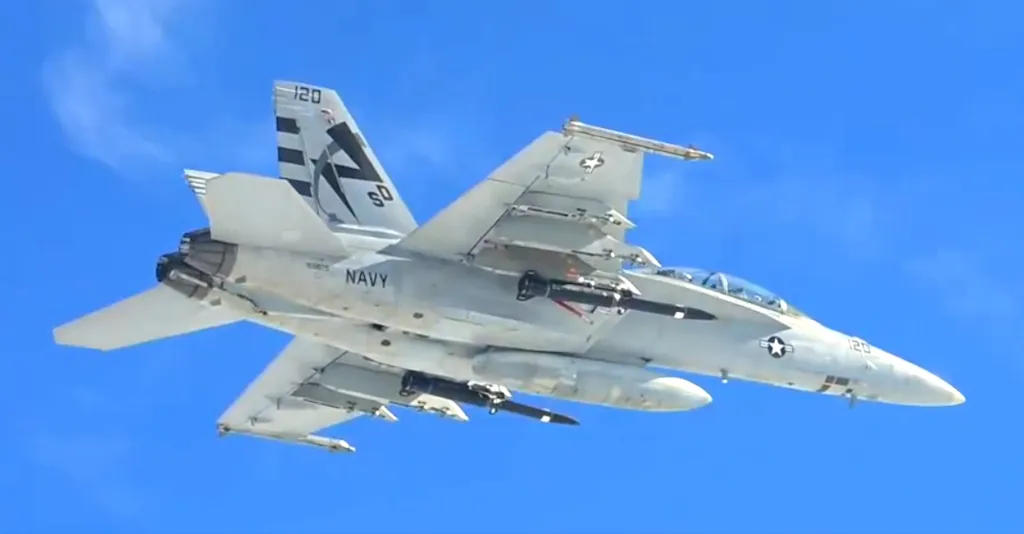
The U.S. Navy has given us the first look at Blackbeard hypersonic strike missiles under the wings of F/A-18E/F Super Hornets during actual flight testing. The Navy is hoping to have Blackbeard in at least limited service no later than 2028, giving its carrier air wings an all-new fast-flying standoff weapon, particularly for engaging enemy ships. The missile is also being designed to be relatively cheap and quick to manufacture.
The Navy’s Office of the Portfolio Acquisition Executive for Aviation (PAE-A) has released a video montage of Blackbeard undergoing flight testing, seen in the social media post below. The service confirmed that it had at least begun test-loading the missiles onto F/A-18E/F Super Hornets in a presentation at the Tailhook Association’s annual convention last month. Now we know the program has moved ahead substantially from that point.
The company behind Blackbeard, defense start-up Castelion, has received several multi-million-dollar contracts from the Navy just this year explicitly to support integration of the weapon onto the Super Hornet, as well as otherwise accelerating its development. In its daily contracting on September 14, the Pentagon announced the Navy had struck yet another deal with Castelion, valued at $43.65 million, “for the manufacturing, assembly, testing, and delivery of the first production lot of 444 All-Up Rounds (AURs), defined as fully functional tactical missiles packaged within specialized shipping and storage containers.”
A screen capture from the Blackbeard flight testing video montage the Navy released today. USN capture
In terms of what we know today about Blackbeard’s design and capabilities, as we have previously written:
“A profile photo [seen below] at the company’s headquarters reveals a weapon with a ballistic missile-like booster, on top of which is mounted what could be an unpowered hypersonic glide vehicle (HGV). A booster brings an HGV to the desired velocity and altitude before releasing it toward its target. The concept is in contrast to air-breathing cruise missiles capable of traveling at hypersonic speeds. Hypersonic speed is generally defined as anything above Mach 5, which larger ballistic missiles also reach in the course of their flights. More precise performance figures for Blackbeard are lacking, but Castelion has previously hinted it could hit targets out to just under 500 miles. Alternatively, the second stage may also have its own motor, allowing it to continue accelerating or sustain high-speed flight. A similar arrangement has been suggested as the propulsion system for the Russian Zircon missile.”
Castelion
“Both stages of the weapon have cruciform fins, while the upper one features a prominent ‘chine’ line along the length of its body, and a slightly beaklike nose. The trolley on which the weapon is mounted provides some idea of its overall size. The blue stripes seen on each stage normally signify that a munition is an inert, non-explosive round utilized for training or tracking purposes. This would indicate a real (unarmed) missile rather than a dummy or mockup.”
A picture shown at Tailhook had also offered a new look at the front of the missile, exposing what looked to be an aperture on one side of the design’s wedge-shaped nose. As we wrote after that image emerged:
“The apparent apertures are also seen pointed up, but many air-launched munitions do flip down after release.”
“How exactly Blackbeard is guided remains unknown, but a downward-angled aperture at the nose end for a seeker system would make sense for this weapon, which the Navy is pursuing primarily as a new way to target enemy ships. In particular, a wide array of existing anti-ship and land attack missiles, as well as certain anti-air types, have variously shaped apertures in their noses for imaging infrared seekers. Imaging infrared has the benefit of being immune to radio frequency electronic warfare jamming. In addition, it is a passive capability that does not send out signals that can give an opponent advance notice of an incoming attack. Blackbeard’s full guidance package very likely also includes some means of navigating to a target area first, and it could have multiple modes of operation.”
The new flight testing footage released today also underscores the relatively small size of Blackbeard overall. While the Super Hornet is set to be the first operational launch platform, it is very likely to be integrated on other aircraft quickly thereafter. The Navy is acquiring Blackbeard under a program called the Multi-mission Affordable Capacity Effector (MACE).
Another screen capture from the new Navy video offering a different of Blackbeards under the wings of a Super Hornet, underscoring their relatively small size. USN capture
Requirements for MACE that the Navy put out previously explicitly called for a design compact enough for carrier-based F-35C (and land-based F-35A) Joint Strike Fighters to carry four of them internally. Whether that remains a goal in any way is unclear. Still, being able to carry some number of Blackbeards internally would not only give those jets a hypersonic strike weapon, but one that they could carry in the most stealthy configuration. The Navy also notably does operate the F-35A outside of the test and evaluation community, which might point to air-launched Blackbeards entering service elsewhere in the future. As an aside, the U.S. Army is pursuing a ground-launched version of this missile, as well.
As mentioned, the Navy’s stated goal now is to reach an early operational capability with Blackbeard by 2028, if not sooner. What the exact fielding plan for those missiles might be is unclear. PAE-A did write “Coming soon to a theater near you” in its post on X containing the video montage, and tagged the official accounts for U.S. Central Command (CENTCOM) and U.S. Pacific Command (PACOM). CENTCOM oversees U.S. military activities in and around the Middle East, including ongoing operations against Iran. U.S. military officials have also long touted hypersonic weapons, in general, as key to success in any future conflict in the Pacific, especially a high-end fight against China.
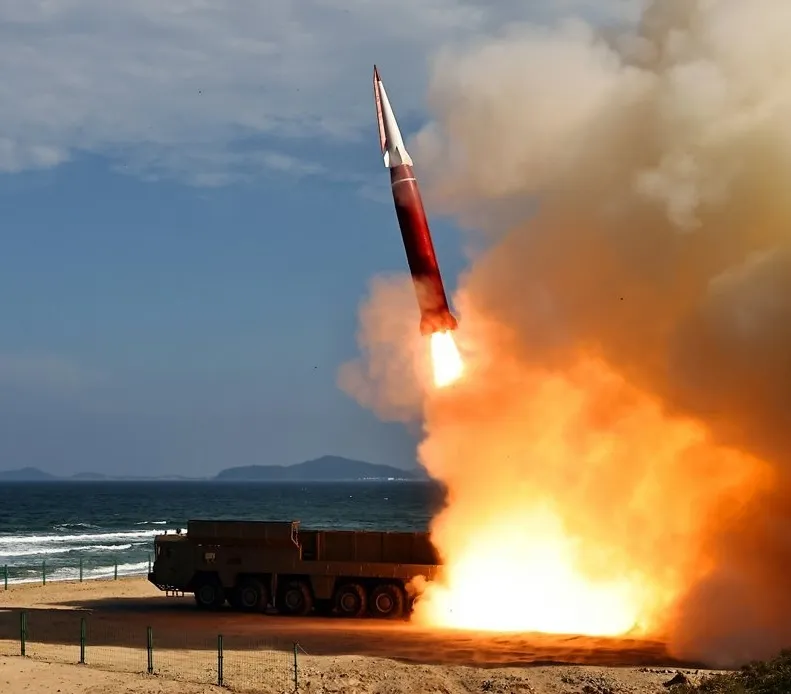
North Korea has released imagery of what appears to be a flight test of an updated version of its Hwasong-11Ma hypersonic missile, nearly a year after the weapon first appeared publicly at a military technology exhibition in Pyongyang.
Launch of a Hwasong-11Ma-1 missile from the test facility in Anbyon County, south of Wonsan. North Korean State Media
The September 20 test involved a short-range ballistic missile (SRBM) booster fitted with a hypersonic glide vehicle, according to photographs released by North Korean state media. A display screen visible in the imagery identifies the weapon as the Hwasongpho-11Ma-1, or Hwasong-11E-1 in the equivalent English-language designation.
The test was conducted from the east coast near Anbyon County, south of Wonsan, an area North Korea has repeatedly used for missile testing. The launch site allows missiles to be fired eastward over the Sea of Japan, providing a relatively controlled area for testing short- and medium-range systems.
Another two views of the launch of the Hwasong-11Ma-1 missile. North Korean State Media
South Korean and Japanese authorities say they detected two launches on September 20, with the first occurring at approximately 3:00 p.m. local time and the second several hours later.
North Korean photographs show the missile being launched from a coastal location, with Kim Jong Un and senior missile officials observing the test. Kim’s daughter, Kim Ju Ae, also appears in the imagery.
Kim Jong Un and Kim Ju Ae monitor the progress of the Hwasong-11Ma-1 test. North Korean State Media
North Korea displayed a mock-up of what it called the Hwasong-11Ma at its Defense Development-2025 exhibition in October 2025. The design uses the basic architecture of the Hwasong-11 family, known in the West as the KN-23 family, but substitutes a distinctive glide wedge-shaped vehicle for the conventional warhead arrangement.
The Hwasong-11Ma, among other weapons, on display at the weapons exhibition in Pyongyang in October 202. North Korean State Media
North Korea claimed another hypersonic missile test that same month, but did not release launch imagery clearly connecting that test to the Hwasong-11Ma. The missile was subsequently shown again during a military parade in Pyongyang.
Hwasong-11Ma missiles on five-axle TELs at last October’s military parade in Pyongyang. North Korean State Media
The latest “-1” designation suggests an iterative evolution of the Hwasong-11Ma, although Pyongyang has not explained what modifications it represents.
Based on the imagery, the new configuration also includes a modified launcher, with the missile carried on a six-axle transporter-erector-launcher (TEL). When the Hwasong-11Ma was first shown, it was mounted on a five-axle TEL. The latest vehicle also appears to incorporate modified retractable covers around the missile.
It remains unclear whether the new TEL represents a standardized operational vehicle or a test configuration.
As with previous North Korean weapons announcements, the country’s state media claims need to be treated very cautiously. Pyongyang has a long record of publicizing weapons systems and test results that cannot be independently verified, while some of its purported hypersonic tests have left outside analysts unable to determine whether the advertised maneuvering performance was actually demonstrated.
Perhaps the most revealing test-related imagery comes from a display screen photographed at the launch site.
Kim Jong Un and his daughter can be seen watching the screen, which shows the apparent flight trajectory of the Hwasong-11Ma-1. The displayed path initially follows a ballistic trajectory before descending and then performing a pull-up maneuver, regaining altitude before continuing toward the target area.
That type of trajectory is consistent with the basic concept behind a hypersonic glide vehicle. The booster provides the initial velocity and altitude, after which the unpowered glide body follows a relatively shallow, atmospheric flight path at hypersonic speeds, while maneuvering rather than following a simple ballistic path.
The graphic is useful for understanding what Pyongyang says the weapon is designed to do, but it does not independently demonstrate that the missile actually followed the depicted trajectory.
The flight data visible on the display provides some unusually specific figures.
Enhancing the original image released by North Korea allows for an excellent view of the HS-11Ma hypersonic glide missile trajectory, providing altitude and speed data. Note: Slight inaccuracies in the numbers may occur due to the use of AI tools. pic.twitter.com/M4LkfF5VYu
According to the North Korean imagery, the missile traveled 908.2 kilometers (564.3 miles), reached an altitude of 35.8 kilometers (22.2 miles), and remained in flight for approximately 445 seconds, or 7.4 minutes.
The display gives a velocity of 2,146 meters per second, equivalent to roughly 4,800 mph. That is hypersonic velocity in the aerodynamic sense, but speed alone is not what makes a hypersonic glide weapon particularly challenging to defend against. More consequential parameters include sustained controlled flight, maneuverability, guidance, and accuracy.
Other portions of the display appear to show additional points along the flight, including different times, altitudes, and speeds. None of these figures have been independently verified.
The TEL raises one of its two Hwasong-11Ma-1 missiles into the launch position. North Korean State Media
The claimed range is particularly noteworthy because it does not match the publicly reported tracking data from South Korea and Japan.
South Korea’s Joint Chiefs of Staff said North Korea launched two SRBMs from the Wonsan area on September 20. The missiles were assessed to have traveled approximately 450 and 600 kilometers, respectively.
Japan similarly reported two launches, assessing the first at approximately 440 kilometers and the second at approximately 590 kilometers, with maximum altitudes of roughly 60 and 70 kilometers.
Those figures are substantially different from the 908.2-kilometer distance shown on North Korea’s display.
The Hwasong-11Ma-1 climbs after launch. North Korean State Media
The discrepancy does not necessarily establish that either side’s data are incorrect. The North Korean figure could represent a different measurement of the flight path, or could correspond to a portion of the test that was not reflected in the public South Korean and Japanese assessments. It is also possible, if not highly probable, that Pyongyang selectively presented or altered the data.
South Korean analysts have already raised questions about the unusually long distance displayed by North Korea. Yonhap reported that experts suggested Pyongyang may have altered the figure to portray the test as more successful.
Regardless of the range actually achieved in this test, the Hwasong-11Ma/Ma-1 is significant because it represents an attempt to combine a relatively compact SRBM with a maneuvering hypersonic glide vehicle.
The underlying Hwasong-11 family is a well-established North Korean missile design. In its KN-23 configuration, members of the family have also been used by Russia against Ukraine. By placing a glide vehicle on this type of booster, Pyongyang could potentially give a regional strike weapon a flight profile substantially different from that of a conventional ballistic missile. The Hwasong-11Ma/Ma-1 also uses a solid-fuel booster, allowing for faster launches than earlier liquid-fuel designs.
The original North Korean Hwasong-11 short-range ballistic missile. North Korean State Media
In principle, the Hwasong-11Ma/Ma-1 could give North Korea an additional hypersonic strike option against more heavily defended targets in South Korea. Having road-mobile TELs would also provide greater operational flexibility despite their relatively limited range, while making it more difficult for adversaries to locate and track the launchers.
A genuine boost-glide weapon creates significant challenges for defending forces since the sheer speed of the weapon bypasses most air defenses. Its trajectory can also become less predictable after the boost phase. Maneuvering at lower altitudes could also reduce the time available to detect, track, and engage the weapon.
A close-up look at the Hwasong-11Ma’s boost-glide-vehicle. North Korean State Media
However, the available imagery does not establish the extent of the vehicle’s maneuverability, its ability to maintain controlled flight, its accuracy, or the reliability of the complete missile system.
North Korea has made similar claims about its hypersonic weapons in the past.
The challenge is not simply reaching hypersonic speed. A weapon has to sustain controlled flight and maneuverability under extreme thermal loads, while also overcoming demanding materials-science, guidance, and navigation requirements. The terminal phase is harder still. Accurately finding and striking a moving target, particularly a ship, requires a highly capable seeker and guidance system. Integrating a nuclear warhead introduces another layer of engineering and weapons-design challenges.
Those demands have made hypersonic weapons a major technological challenge for the United States and other major powers. China is currently widely regarded as the leading country in deploying and developing operational hypersonic systems, although important questions remain about the capabilities and maturity of individual weapons.
Pyongyang said it first flight-tested a wedge-shaped hypersonic glide vehicle in 2021 aboard the liquid-fuel Hwasong-8, before pairing a similar-looking vehicle with the solid-fueled Hwasong-16B intermediate-range ballistic missile (IRBM) in 2024.
VIDEO: Korean Central Television (KCTV) broadcasted footage of North Korea successfully testing the new “Hwasong-16B” hypersonic intermediate-range ballistic missile (IRBM) on Tuesday. pic.twitter.com/VNdhLAeyyK
In its coverage of the latest test, North Korean state media initially avoided identifying the weapon, describing the event as a successful trial of a “new-type weapon” that it said was significant for the rapid development of weapons technology.
Kim said the development would give adversaries an “incurable headache” and deliver what he described as a “cruel and unavoidable blow.”
Tal Inbar, the head of the Space and UAV Research Center at Israel’s Fisher Institute for Air and Space Strategic Studies identifies the Hwasong-11Ma/Ma-1 as a “very significant weapon, bringing hypersonics to the operational/tactical arena and [posing] a challenge to … air and missile defense systems.”
Whatever the exact achievements of the test, the imagery points to continued development of a weapon North Korea first publicly displayed nearly a year ago. The appearance of a new, six-axle TEL, a potentially modified missile, combined with the apparent flight test, suggests that the Hwasong-11Ma/Ma-1 program has progressed since its initial public unveiling.
What remains uncertain is how much of that progress represents a genuine improvement in operational capability.
The latest test therefore provides another indication of the resources and attention Pyongyang is devoting to hypersonic weapons, but the available evidence is still insufficient to determine how closely the Hwasong-11Ma-1’s actual performance matches the capabilities depicted by North Korean state media.
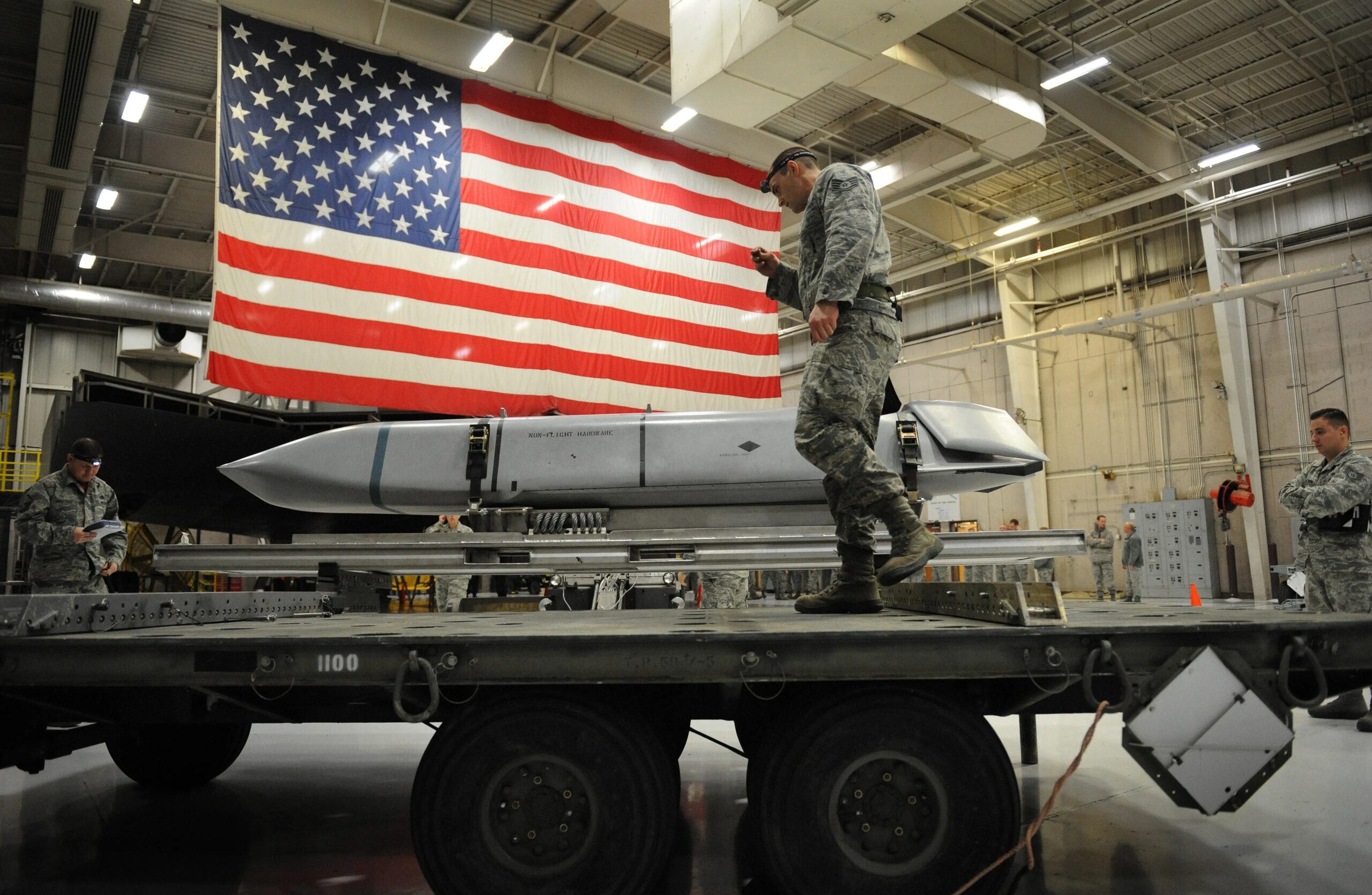
Lockheed Martin has unveiled a modular airframe concept for its stealthy and combat-proven AGM-158 Joint Air-to-Surface Standoff Missile (JASSM) family that could support multiple configurations, launch methods, and sensor packages while making use of the existing JASSM and Long-Range Anti-Ship Missile (LRASM) production infrastructure. Highly survivable, the missiles are an incredibly important and staple weapon for the U.S. military, and for select export customers.
Called AGM-158 FLEX, the new concept is centered on a common airframe with interchangeable components. Lockheed Martin says it has invested more than $35 million of its funds in the effort so far, including airframe design, testing, prototype production, subsystem qualification, and work with suppliers.
An Air Force load crew member prepares to load an AGM-158 Joint Air-to-Surface Standoff Missile onto the B-2 Spirit weapons load trainer during a weapons load competition at Whiteman Air Force Base, Missouri. U.S. Air Force photo by Airman 1st Class Joel Pfiester/Released Tech. Sgt. Joel Pfiester
The company says the FLEX design will use removable nose sections that can accommodate sensor suites associated with the AGM-158 family. A removable boat tail would allow the same basic airframe to be configured for different launch methods, including air, surface, and subsurface launch. That would open the AGM-158 architecture up to ground-, ship-, and submarine-launched applications, although Lockheed Martin has not provided details on the specific launchers, platforms, or configurations envisioned. It’s worth noting the LRASM has been tested in vertical launch configuration for vessels equipped with the Mk 41 launch system.
A 2016 test of LRASM from a Mk 41 launcher on the Navy’s Self Defense Test Ship. Lockheed Martin
In addition to the Navy vertical launch tests, the idea of moving the JASSM family beyond its traditional combat aircraft launch platforms is not new. The Air Force’s Palletized JASSM concept, better known as Rapid Dragon, has demonstrated the ability to deploy JASSM-ER from palletized launchers carried inside cargo aircraft, using an expendable airdrop system. FLEX takes a different approach by building those kinds of launch options into the airframe architecture itself, with modularity supporting various launch configurations for the same basic weapon.
Rapid Dragon Flight Test
For aircraft-launched weapons, Lockheed Martin says FLEX will retain compatibility with current and future JASSM and LRASM launch platforms.
An F-35B carrying the AGM-158C Long-Range Anti-Ship Missile (LRASM). U.S. Marine Corps Kyra Helwick
The company is also proposing multiple airframe lengths. A 206-inch configuration is associated with the supersized JASSM-XR, while a 168-inch version is consistent with the dimensions of JASSM-ER. Lockheed Martin says JASSM-XR will be the first configuration of the FLEX airframe.
The Brand New AGM-158 Extended Range
The AGM-158 family has already grown well beyond the original JASSM. The AGM-158A is the baseline stealthy air-launched land-attack missile, with a publicly reported range of roughly 230-330 miles, while the AGM-158B JASSM-ER uses a more efficient engine and additional fuel to roughly double that reach, to around 575 miles or more.
Alongside the land-attack variants is the AGM-158C LRASM, which uses the JASSM airframe but substitutes a sophisticated imaging infrared anti-ship seeker, electronic support measures, datalink, and other capabilities, for operations against heavily defended surface combatants.
A B-2 deploys an AGM-158C Long Range Anti-Ship Missile to support a live-fire sinking exercise as part of Valiant Shield 2026 over the Philippine Sea, June 27, 2026. U.S. Air Force photo by Tech Sgt. Thomas Barley Tech. Sgt. Thomas Barley
Finally, the much larger JASSM-XR is being developed with a substantially stretched fuselage to carry more fuel and a larger 1,000-pound-class warhead, with a range expected to approach or exceed 1,000 miles. This would give it a similar striking capability as the Tomahawk cruise missile, although in a stealthier package.
Beyond range and launch options, the company is pitching its new FLEX concept as a way to simplify future upgrades. Components could be replaced as they become obsolete or new capabilities become available without necessarily requiring a completely new missile design.
That approach could have an industrial-base advantage, particularly as the United States seeks to increase production of long-range weapons. Lockheed Martin says FLEX would use the existing JASSM/LRASM production line, supply chain, mission-planning infrastructure, and software ecosystem rather than establishing an entirely new manufacturing and support architecture.
The company says its JASSM/LRASM production infrastructure includes a 225,000-square-foot facility opened in 2022 with increased automation and a robotic paint line.
For example, as part of a slew of low-cost cruise missile offerings, the service has been moving ahead with the Extended Range Attack Munition, or ERAM, a new air-launched missile explicitly intended to provide a relatively low-cost, rapidly producible standoff weapon. The Air Force conducted a live-warhead ERAM test in January of last year, less than 16 months after the program received its initial contract, and described the weapon as a means of generating mass against fixed targets. ERAM is understood to have a range of between 150 and 280 miles, putting it below the reach of the baseline JASSM, let alone the JASSM-ER or XR.
The Extended Range Attack Munition live-fire test on Jan. 22, 2025, at Eglin Air Force Base, Florida. via U.S. Air Force
However, the emerging class of lower-cost weapons are intended very much more to complement than compete with JASSM. While the Air Force plans to buy thousands of the cheaper missile, the JASSM will still be needed to take up the higher end of the cost and capability list.
Lockheed Martin mentions that FLEX should “unlock future cost savings,” but this sounds more about giving customers the ability to swap out components and upgrade capabilities on existing missile rounds, to avoid obsolescence, rather than facilitate mass production.
As it stands, JASSM has evolved into a family of increasingly capable and longer-range weapons, but those capabilities necessarily come with a different set of cost and production considerations than a weapon designed from the outset around large-scale production. Lockheed Martin’s announcement does not disclose a target unit cost for FLEX, nor does it explain how the eventual cost of a FLEX-derived weapon would compare with a baseline JASSM or LRASM. The unit price of the latest subvariants of the JASSM-ER is around $1.2 and $1.5 million, according to official budget documents.
The new weapon is a way of getting more variants and launch options out of the established JASSM/LRASM architecture, potentially with less development work than creating entirely new weapons. Whether that translates into enough savings or production capacity to satisfy the military’s growing demand for large numbers of standoff weapons remains to be seen.
For Lockheed Martin, the proposal also offers a way to extend the relevance of the AGM-158 family as the company and the Pentagon pursue additional range, new launch platforms, and potentially new launch methods.
The flexibility of the missile could be particularly relevant to the Agile Combat Employment concept, and the wider U.S. military in the Indo-Pacific, where forces are expected to operate from a larger number of dispersed and potentially austere locations. A common missile architecture that can be adapted to different launch platforms and different target sets could allow weapons to be positioned and employed across a distributed force rather than tying particular missile variants to particular launchers.
The original JASSM/LRASM has also become a significant export weapon, with Australia, Finland, Poland and several other U.S. allies cleared to acquire variants of the missile. While the advanced capabilities of the weapon have seen its export opportunities carefully controlled, FLEX could potentially open up the market to more customers, including less-advanced, ‘sanitized’ versions.
Pilot and Weapon Systems Officer conduct a pre-flight check on the JASSM-ER loaded to a Royal Australian Air Force F/A-18F Super Hornet at RAAF Base Amberley, Queensland. Australian Department of Defense LAC Campbell Latch
Lockheed Martin’s announcement provides few details on FLEX’s eventual cost, production rate, schedule, or specific performance beyond the stated airframe dimensions. For now, the concept demonstrates that the company is seeking to create a more adaptable architecture around an established missile family, one that has played a critical role in numerous operations since its introduction.
The Pentagon has reached an agreement with Lockheed Martin to lay the groundwork for stepped-up production and delivery of new AIM-260 Joint Advanced Tactical Missiles (JATM) to the U.S. military and allied air arms in the coming years. The AIM-260 is still in development, but the head of the Air Force Test Center also touted efforts to further accelerate that work just earlier this week. From the start, the U.S. military has presented JATM as especially critical for ensuring China, with its own growing array of longer-range air-to-air missiles, does not gain an edge in future air combat.
The new framework agreement announced today “is critical to ensuring long-term demand signals flow to key suppliers, allowing Lockheed Martin and the munitions supply chain to invest in manufacturing capacity, workforce, and production efficiencies,” according to a Pentagon press release. “It establishes a framework for future Multi-Year Procurement (MYP) of JATM, executing congressional authority to secure the nation’s highest-priority missile systems.”
“This agreement forms the foundational agreement for a multiyear procurement contract, pending Congressional approval, that provides long-term demand to strengthen and expand the defense industrial base for the program,” according to a separate release from Lockheed Martin.
A US Navy F/A-18F Super Hornet seen carrying an AIM-260 Joint Advanced Tactical Missile (JATM). Jonathan Tweedy/ @flightline_visuals
In response to questions from TWZ, the Pentagon declined to comment on the projected number of JATMs covered under this agreement, as well as estimated costs and delivery schedules.
A rendering depicting an F-22 Raptor firing an AIM-260 JATM. USAF
The releases today from the Pentagon and Lockheed Martin confirm that the new framework deal also includes planned foreign military sales of AIM-260s. Australia, one of America’s top allies, is the first confirmed international customer for the JATM, and plans to integrate the missiles on its F/A-18Fs, F-35As, and EA-18G Growler electronic warfare jets. The Royal Australian Air Force’s MQ-28 Ghost Bat CCA-type drones, initial versions of which are already capable of firing AIM-120s, might be another AIM-260 launch platform in the future.
Uncrewed MQ-28 Ghost Bat showcases its combat capability
The AIM-260 remains in development, with the Navy and Air Force test communities supporting that work.
“We are accelerating weapons development from high-end air dominance weapons like the JATM to hypersonic strike systems like the Hypersonic Attack Cruise Missile,” Air Force Brig. Gen. Mark Massaro, head of the Air Force Test Center (AFTC) at Edwards Air Force Base in California, told TWZ and other outlets at a media roundtable yesterday. The roundtable took place at the Air & Space Forces Association’s (AFA) 2026 Air, Space & Cyber Conference.
“We’re actively testing JATM, and it’s progressing along its program path. In test, we are working through the development stages there,” Massaro added. “So, we’re testing it in [sic] the ground with models, like I mentioned. We’re testing it in the air on aircraft. So, from a performance standpoint, I’ll hold on to that from an operational security perspective. But we’re happy seeing where it’s going, and we expect that to be a key piece of capability for our warfighters to have.”
“Just from a testing perspective, we’re always looking at making sure that we’ve got the throughput,” he added when asked if he could talk about challenges or other issues AFTC has run up against in work on the AIM-260. “So, from a test perspective only, infrastructure and throughput to make sure that we can get things out … and make the testing happen. But I’m not, from a capabilities perspective, worried about the system.”
Another look at the AIM-260 loaded on the Navy Super Hornet. Jonathan Tweedy/ @flightline_visuals
It is unclear when the first operational AIM-260s may begin entering the U.S. inventory. When the program was first disclosed to the public in 2019, the stated goal was to start fielding the missiles in 2022. There were also reports in late 2025 that funding issues had caused a three-month delay, based on a fact sheet distributed to some members of the U.S. House Committee on Armed Services. The committee later said that the information was incorrect.
Work to date on JATM has been conducted under a heavy veil of secrecy, with the existence of the program only being announced in 2019. The first public glimpse of the missile only emerged in May of this year. Beyond the aforementioned size requirement and that the new missile will offer significantly greater engagement range over the AIM-120, details remain limited. Readers can learn more about what we do know so far here.
The AIM-260 is not the only longer-ranged air-to-air missile known to be in development in the United States, either. In 2024, the Navy revealed it had begun fielding an air-launched version of the surface-launched Standard Missile-6 (SM-6), called the AIM-174B Gunslinger, at least on a limited level. Just in August of this year, the service disclosed the existence of another very long-range air-to-air missile, the AIM-424 Malice, which has already reached the flight testing phase of development.
A US Navy F/A-18F Super Hornet test jet with four AIM-174B missiles under its wings. point_mugu_skiesA US Navy Super Hornet test jet carrying a load of AIM-424 Malice missiles. USN
An Air Force spokesperson told Air & Space Forces Magazine last month that the service was “closely following” the Navy’s work on the AIM-424. In June, the Air Force itself shared details about another potential future air-to-air missile, dubbed the Air Force Long Range Weapon (AFLRW), including a target requirement for a maximum range of at least 1,000 nautical miles.
Based on past experiences with public disclosures about the AIM-260, AIM-174B, and AIM-424 programs, additional work on advanced longer-range air-to-air missiles is certainly ongoing in the classified realm.
Today’s announcement about the new framework agreement, together with Brig. Gen. Massaro’s brief update yesterday, makes clear there is a continued commitment to JATM amid a still-growing field of new, longer-range air-to-air missiles.
This was the first time an alert was sounded in Riyadh since an escalation between the Houthis in Yemen and the Saudis.
Published On 19 Sep 202619 Sep 2026
Saudi-led coalition forces fighting Yemen’s Houthis have said that the Iran-backed group fired a ballistic missile at Riyadh at dawn before it was intercepted and destroyed.
“The Houthis also attempted to target civilians and civilian infrastructure in Bisha, Taif, Farasan and Yanbu,” coalition forces spokesman Major-General Turki al-Maliki wrote on X on Saturday, adding that the attacks were thwarted by the Gulf monarchy’s air defences.
Recommended Stories
list of 4 itemsend of list
Saudi Arabia warned of a “hostile aerial threat” and issued a string of emergency alerts across the kingdom overnight on Friday.
On Saturday, at least one explosion was heard in Riyadh, with residents near the airport saying they saw a large plume of black smoke later in the morning. Saudi authorities reported no casualties or damage.
The Saudi spokesman said that the Houthis are escalating their attempts to target civilians and civilian infrastructure in the capital. He also affirmed the coalition command’s right to take “appropriate” action to deter the Houthis, in accordance with international humanitarian law.
Earlier on Saturday, Houthi fighters in Yemen said they attacked “sensitive” sites in Riyadh as well as an Aramco oil facility in the western coastal city of Yanbu, according to a statement shared by Houthi military spokesman Yahya Saree.
Saree said the Houthis attacked Saudi Arabia with cruise and ballistic missiles as well as drones.
“You could see that the Houthis are determining the timelines and the levels of the escalation,” Yasmeen al-Eryani, executive director for knowledge production at the Sana’a Center think tank, told Al Jazeera. “So, depending on the current situation, it seems that the Houthis are the ones in control,” she added.
Meanwhile, on the ground in Yemen, the armed forces of the Saudi-backed internationally recognised government said their fighters thwarted a Houthi infiltration attempt in the al-Fuliahan sector in southern Marib on Saturday, killing 12 Houthi fighters and injuring others.
The army also said 13 Yemeni soldiers were killed in two days of clashes with Houthi forces in the southwestern provinces of Taiz and Lahj.
Renewed clashes are taking place in Yemen’s Marib, Taiz, Lahj, al-Jawf and al-Bayda as part of a military escalation that began in early July – the most intense since the relative calm following an April 2022 truce.
Al-Eryani told Al Jazeera that military options against the Houthis are currently limited because much of the fighting is taking place in mountainous terrain that is difficult for opposing forces to access and hold.
For now, she said, containing the group may be a more realistic option than defeating it militarily. “Without controlling the peaks that are parallel to the coast, you will not be able to control the coast,” said al-Eryani.
Iran’s missiles and drones have downed dozens of US aircraft, damaged or destroyed hundreds of the United States’ buildings at its bases in the Middle East, and drained its inventories of military equipment worth billions of dollars, the Pentagon conceded earlier this week.
On Wednesday, Tehran unleashed another unlikely weapon in its war against the US: a maths equation.
Recommended Stories
list of 4 itemsend of list
Iranian Parliament Speaker Mohammad Bagher Ghalibaf, who has also been a lead negotiator during talks between Tehran and Washington at different stages during the past six months, typed out a version of the Taylor equation, a formula used by central banks to determine interest rates, in a post on X loaded with a wartime message.
“Let’s see if a hike could open SOH or produce a single barrel,” he wrote, referring to interest rate hikes and the Strait of Hormuz, a crucial waterway Iran has effectively blocked for global shipping.
“You can’t 25bp [basis points] a chokepoint,” he added, seemingly again referring to the strait. “It’s SOH risk premium, and We set it.”
Hours after Ghalibaf’s post, the US Federal Reserve did raise the benchmark interest rate by 25 basis points.
Early in the war, which was launched by the US and Israel against Iran on February 28, Ghalibaf frequently used financial arguments to mock how the conflict was being conducted by the administration of US President Donald Trump, to point to Iran’s ability to hurt Washington economically unless it changed its approach.
Now he’s turned to maths.
“This is a spectacular bit of agitprop from Iran, a country which, if nothing else in 2026, has demonstrated an impressive ability to needle its US opponent,” Chris Beauchamp, chief market analyst at IG Group, told Al Jazeera.
But what exactly is Ghalibaf trying to say? What is the Taylor equation, has the Iran war influenced the US interest rate, and does Tehran “set it”, as the parliament speaker has suggested?
What is the Taylor equation that Ghalibaf cited?
The rule is a formula economists use to estimate where a central bank should set interest rates based on inflation and the strength of the economy.
Developed by economist John Taylor in the early 1990s, the rule links the US federal funds rate to inflation and the “output gap” – the difference between actual economic output and its potential.
This means the recommended interest rate rises when inflation moves above the 2 percent target or when economic output exceeds its potential. It falls when inflation weakens or the economy operates below potential.
However, the equation is a benchmark, not a set rule that is strictly followed. Policymakers at the US Federal Reserve weigh other economic factors when setting interest rates.
Is the Iran war a factor in the US interest rate hike?
Trump’s tariffs, the energy shock following the US-Israeli war with Iran, and heavy investment associated with the artificial intelligence boom, taken together, have kept inflationary pressures strong, experts say.
On Wednesday, when the US Federal Reserve raised interest rates by 25bp, it was the first increase in three years.
Fed Chairman Kevin Warsh, in his speech following the rate hike, said renewed fighting between the US and Iran, which has pushed up petrol prices, helped convince Fed officials to support higher rates.
“There’s no hiding from hot spots around the world,” Warsh said.
IG Group’s Beauchamp said, “The Iran war, indirectly, is a huge driver of last night’s hike, though no one wants to admit it.”
“The energy spike has combined with the rise in yields to drive the Fed into a corner with no way out,” he said.
Susannah Streeter, chief investment strategist at the Wealth Club, said there is “no denying” that Iran’s retaliatory action against the US and its allies across the Gulf region has “intensified concerns about energy supplies and led to hotter inflation forecasts”.
“The ongoing geopolitical turmoil and elevated crude prices certainly were key issues behind the Fed’s decision to hike rates,” she said.
Is Iran ‘setting’ the US interest rate?
In short, no.
Wealth Club’s Streeter cautioned that while the war in the Middle East and rising oil prices were certainly an element in the Fed’s decision, they weren’t the “only factors at play”.
“The spending might of AI hyperscalers has also pulsed through the veins of the economy, with strong capital investment and resilient domestic demand adding to inflationary pressures, so policymakers will have been looking at the whole picture,” she noted.
“So, while Tehran has arguably had an influence on some of the forces feeding into US monetary policy, particularly through the impact of the conflict on oil supplies and prices, it is not ‘setting’ US interest rates.”
Streeter said the US Federal Reserve was responding to a much broader set of economic conditions.
“Iran’s actions have affected the inflation outlook, but the decision on where to set interest rates ultimately rests with the Federal Reserve, and there are plenty of other data points policymakers use,” she noted.
What’s behind Ghalibaf’s maths mocking?
In March, Iran’s parliamentary speaker had repeatedly used social media to comment on markets and energy prices, including mocking efforts by the Trump administration to influence oil futures and arguing that financial manoeuvring could not create “actual fuel” at petrol stations.
Last month, Ghalibaf posted a graphic bearing the phrase “Make America Hungry Again” – a play on Trump’s slogan “Make America Great Again” – together with statistics on food insecurity and hunger in the US.
“You can’t cover up defeats with false claims,” he said.
Witnesses have captured the moment Jordanian air defence systems intercepted a barrage of ballistic missiles fired from Iran. Jordan says it intercepted 18 of 20 missiles, with no injuries reported. The interceptions could be seen from across the border in Syria’s Daraa.
Bodycam video has captured the moment a Russian missile struck near police in Ukraine’s capital during Monday’s overnight attack. The strikes came as the US renewed efforts to bring Moscow and Kyiv back to direct talks.
Japan’s Ministry of Defense has included an intriguing description of the ASM-3 Kai missile in its record fiscal year 2027 defense budget request, referring to the weapon as an “air-to-surface/anti-air missile.” Until now, the ASM-3 family has been publicly associated with the air-launched anti-ship (anti-surface) mission, and the wording potentially hints at an additional capability or intended role for the upgraded weapon.
The reference appears under a sub-section entitled Durability and Resilience, which calls for funds to “secure ammunition and fuel, increase the number of operational units (by addressing parts shortages, etc.), enhance the resilience of facilities (through facility upgrades associated with the formation of new units and the introduction of new equipment, etc.), and strengthen the operational infrastructure (by enhancing manufacturing capabilities, etc.).”
— 因幡のよっちゃん(稲葉義泰 Yoshihiro Inaba) (@japanesepatrio6) August 31, 2026
In terms of securing ammunition, the document highlights the breadth of weapons systems involved, ranging from 5.56mm small arms ammunition and 30mm cannon rounds, via 155mm precision artillery rounds, up to advanced missiles including the Type 23 ship-launched air defense missile and the ASM-3 Kai.
The Mitsubishi Heavy Industries (MHI) ASM-3 is Japan’s domestically developed supersonic air-launched anti-ship missile, originally intended to arm the Mitsubishi F-2 fighter. The improved ASM-3 Kai (“Kai” meaning modified or revised) represents a significant evolution of the weapon, although the full nature of its capabilities and performance have not been officially revealed. The missile has already been observed undergoing testing on F-2s.
The ASM-3 program has also gone through a number of different configurations over its development history, with at least five distinct external configurations identified in previous reporting. The existence of multiple iterations leaves open the possibility that the newly identified “anti-air” designation could ultimately correspond to a dedicated air-to-air variant or derivative of the ASM-3 family, rather than simply a secondary capability of the baseline ASM-3 Kai.
Reportedly, the ASM-3 Kai is capable of flying more than 400 kilometers (about 250 miles), although the exact range of the operational weapon remains classified. It is powered by a ramjet engine, giving it sustained high-speed performance — reportedly around Mach 3. If it indeed has an air-to-air capability, this would be an advantage in some scenarios, compared to relying solely on a brief but very powerful rocket boost as many air-to-air missiles do.
A Mitsubishi F-2 launches an ASM-3 anti-ship missile. (JASDF)
The weapon is also understood to employ an active/passive radar seeker, providing it with both an active radar mode for detecting and engaging targets and a passive mode that can home in on their electromagnetic emissions. While an active radar seeker is common on long-range air-to-air missiles, the latter passive capability could also be of extreme value in an air-to-air application.
The ASM-3 is also a substantially larger missile than typical fighter-launched air-to-air weapons. While that imposes obvious carriage and aerodynamic penalties, it also allows for a larger propulsion system, seeker, and warhead than would be practical in a smaller missile.
A weapon capable of traveling hundreds of miles at high speed, while carrying an active/passive radar seeker, could potentially be especially useful against high-value airborne assets such as airborne early warning and control (AEW&C) aircraft. These platforms provide vital wide-area surveillance, battle management, and targeting capabilities. At the same time, their powerful radars are necessarily emitting, potentially making them detectable and trackable by a missile employing a passive seeker.
China’s rapidly expanding AEW&C fleet is an increasingly important part of its ability to generate situational awareness, coordinate fighters, and extend its sensor coverage well beyond its immediate borders. The force, which already numbers dozens of increasingly capable fixed-wing aircraft, is a growing operational challenge for Japan and other regional air forces.
The second example of the Chinese KJ-3000 AEW&C aircraft, still painted in primer. via X
The ability to threaten such aircraft from well beyond the range of conventional air-to-air engagements could force an opponent to operate its AEW&C fleet even further from contested airspace, reducing the effectiveness of its sensors and command-and-control architecture. Although a passive seeker could also offer an avenue for homing in on relevant radar emissions, exactly how the ASM-3 Kai’s seeker would operate against airborne targets is not publicly known. Equally, a different variant of the missile, optimized for anti-air missions, could incorporate both passive and active seekers specially adapted for that mission set, although it is very possible a single configuration can accomplish both missions. As well as AEW&C aircraft, such a missile would be just as relevant for other high-value, non-maneuvering targets at long ranges, including intelligence-gathering platforms, tankers, and other support aircraft.
The budget language by itself falls short of establishing whether the ASM-3 Kai has been tested or validated against aircraft. The designation could reflect a broader classification within the budget documents, or it could point toward a genuine expansion of the weapon’s intended target set.
XASM-3 Supersonic anti-ship missile test launch
Such a weapon would not necessarily be a replacement for Japan’s existing air-to-air missile arsenal. Instead, an “anti-air” ASM-3 Kai could occupy a specialized niche focused on high-value or otherwise particularly important airborne targets at extended ranges.
The possibility is consistent with Japan’s broader effort to expand the flexibility and reach of its air-launched weapons. Tokyo is pursuing a growing family of standoff weapons as part of a major expansion of its counterstrike and deterrence capabilities, including longer-range missiles capable of striking targets well beyond the immediate vicinity of Japan.
Other air-to-air missiles mentioned in the same section of the document comprise the U.S.-made AIM-120 Advanced Medium-Range Air-to-Air Missile (AMRAAM) and the domestically developed AAM-4B, another medium-range weapon, thought to be the first of its kind to be fitted with an active electronically scanned array (AESA) antenna.
Between the exclusive AESA radar and Japan’s labour cost, Mitsubishi’s AAM-4B might be the most expensive air-to-air missile on the planet pic.twitter.com/rfBnXB8RzS
The FY2027 defense budget request also mentions another apparently new air-launched weapon for Japan, the AGM-88G Advanced Anti-Radiation Guided Missile-Extended Range (AARGM-ER). Japan has not previously been publicly documented as an international AARGM-ER customer, but the weapon would be an obvious candidate for integration with its F-35 fighters if it wishes to bolster their suppression/destruction of enemy air defenses (SEAD/DEAD) capabilities.
An AARGM-ER seen under the wing of an F/A-18F Super Hornet during a test. U.S. Navy
In terms of F-2-related developments, the document calls for the upgrade of an initial 10 of these aircraft to make them compatible with the air-launched version of the Upgraded Type 12 anti-ship guided missile, a significant new weapon that you can read more about here.
A pair of new missiles slung beneath the wings of an F-2, understood to be the air-launched version of Japan’s Upgraded Type 12/Type 25 anti-ship missile. @bibabibabibary @bibabibabibary
TWZ has contacted Japan’s Ministry of Defense seeking clarification on the “air-to-surface/anti-air” designation and what it means for the ASM-3 Kai’s intended capabilities and target set. It could also be the case that the description is an error in the budget document.
However, the emergence of such a capability would also come at a time when very-long-range air-to-air weapons are becoming increasingly important as anti-access/area-denial challenges make it harder for fighters to get close to enemy aircraft and the high-value assets supporting them. China has fielded weapons such as the PL-15 and the much larger PL-17, while the United States is developing the AIM-260 and has just revealed the AIM-424 Malice, a U.S. Navy missile reportedly capable of reaching more than 250 nautical miles. The U.S. Navy is also fielding the AIM-174B, a very-long-range weapon developed very much with the Chinese threat in mind, and which we discuss in the video below.
How The Navy’s New Very Long-Range AIM-174 Will Pierce China’s Anti-Access Bubble
For now, exactly what prompted the “air-to-surface/anti-air” designation for the missile is unclear, but if it reflects a genuine expansion of the ASM-3 Kai’s mission set, it would represent a particularly interesting development in Japan’s rapidly evolving air-launched weapons portfolio.
Hat-tip to Yoshihiro Inaba for bringing this development to our attention.