


Coronation Street crisis as flashforward episode with killing accidentally leaks
Corrie fans joked ‘someone is getting fired’ after the groundbreaking flashforward episode was uploaded to YouTube on Friday, giving away vital details ahead of tonight’s show

Will groomer Megan be the one to meet her maker? (Image: ITV)
Bosses at Coronation Street were left reeling after accidentally leaking tonight’s flashforward episode days before the top secret show was due to air.
Fans were stunned after finding out which five characters are in the firing line early, with one set to be murdered in April. This morning, Corrie put out the names of those at risk of a grisly death as the identities of the ITV soap’s stars who could meet their end were announced.
Groomer Megan Walsh, manipulative Theo Silverton and family-wrecker Carl Webster could soon be getting their comeuppance with quirky landlady Maggie Driscoll and suspicious newcomer Jodie Ramsey also picked as possible murder victims. But some viewers found out days ago.
The programme, which is set to air tonight, was briefly uploaded on the YouTube on Friday before being hauled offline. It didn’t go unnoticed as one fan took to X to write: “Someone at Corrie leaking Mondays episode on a Friday afternoon oh dear someone’s getting fired.”
The groundbreaking episode begins with a police interview taking place on April 23. A a shocked and Betsy Swain is seen telling detectives about finding the dead body of someone she knows.
Dressed in wedding clothes, the cop’s daughter explains that she had been at the marriage of her mum Lisa Swain to Carla Connor, but was heading into town when she made the shocking discovery. As the episode returns to the present day we begin to see how the behaviour of the five characters could lead to their possible death two months later.
Twisted teacher Megan is caught up in a web of lies as she continues to groom impressionable teen Will Driscoll. Doing anything to protect her family, Maggie gives a fake alibi for Will to stop him being charged with the Christmas Day attack on Daniel Osbourne.
Carl has burnt all his bridges when he let Debbie take the blame for the Corriedale accident which saw Billy Mayhew perish. Since finding out Debbie is actually his mum and not his sister, Carl has pressed the self-destruct button and as he continues to goad both family and neighbours – he would have no shortage of people looking to settle a score.
Theo’s coercive control over Todd has reached new lows and with their wedding looming, will Todd finally confide in his friends about what has been going on before it is too late?
Despite initial reservations, the Platts have welcomed Shona’s estranged sister Jodie Ramsey into their home. But Jodie has been keeping secrets from them, and it seems she has got mixed up with some pretty shady characters in her past. Will trouble follow Jodie to Weatherfield, or could she upset people closer to home with her behaviour?
As the episode comes to a close we flash forward again to April 23 and the five characters are on the cobbles as Lisa and Carla’s wedding fireworks light up the night sky.
As the lights flicker a battered and bruised Carl, frantic Jodie, a menacing Maggie, a bloody-nosed Megan and a furtive Theo stare into the darkness. In the final moments the terrified scream of Betsy Swain fills the air – but which Weatherfield resident will be the murder victim?
Coronation Street airs weeknights at 8:30pm on ITV1 and ITV X.

New bargain pod hotels set to open in the UK with cocktail walls and £20 beds
A BUDGET hotel chain with self-serve bars and private pod rooms is looking to open in the UK.
There’s talk of the brand, LyLo, opening several sites across the country, and it has its sights set on Southwark in London.
Hotels in the city, and across most of the UK can be expensive – but if it opens in the UK LyLo is set to be very affordable.
Its ethos is ‘lower prices and higher comfort at the centre of everything’.
If priced like they are in Australia and New Zealand, a stay in a pod could cost as little as £20.24 (AUD$39).
LyLo promises fuss-free check-in, on-site drinks and eats, WiFi, workspaces, and spaces to play encouraging guests to socialise with various events.


Some of current pod hotels even have rooftop spots where guests are welcome to relax and play games.
LyLo also holds events like welcome drinks, pop-up dinners, local tours, surprise gigs, wellness activities and film screenings.
Some of the LyLo hotels like the ones in New Zealand’s Queenstown and Australia’s Brisbane, even have their own self-pour cocktail and beer wall.
Guests have to show ID to the bar manager, load up their hotel card, then tap and pour – when the balance runs low, just top up and carry on.
Visitors can help themselves to lager, beer, cider and even cocktails like espresso martinis on tap.
For those who need some peace and quiet for work, the hotel also offers a range of ‘quiet spaces’.
Each hotel has a kitchen fully kitted out with ovens, microwaves, fridges, freezers and plenty of cutlery.
At the current sites, guests can either stay in self-contained pods or private rooms.
Visitors can rent out a self-contained pod with a king size mattress, USB charging port and WiFi.
These pods are within a shared room which can sleep up to 10 guests – so each cabin comes with its own privacy screen.
There’s also the option for a female-only space.
Guests can also opt for a private room, or an ensuite room which comes with private bathroom facilities.
If travelling with a number of travellers, there’s also an option to book out a full room of pods for one large group.
LyLo managing director Tim Alpe said: “We are thrilled to introduce LyLo to Europe, with London as the perfect city to launch our first property.
“Our innovative pod hotel concept has already proven successful in New Zealand and Australia, and we are confident that the European market will embrace our unique blend of affordability and community-focused design.
“London’s dynamic and diverse traveller base makes it an ideal location to begin this exciting new chapter, and we look forward to bringing LyLo’s fresh approach to hospitality to the city.”
The brand currently operates 608 pods across New Zealand and Australia.
Here’s another cheap pod hotel that’s already opened in London…

Travel Writer Helen Wright recently spent the night in London’s newest pod hotel – Zedwell – here’s how it went…
“Zedwell is one of the city’s newest hotels to open, right in the middle of Piccadilly Circus. Being so central, you can normally expect hotels to have high prices – the nearby Ritz and the W Hotel can command nightly rates of £500 or more.
“Not Zedwell – the new hotel claims to be the world’s biggest capsule hotel, and with that, comes the small price of just £30 a night. That definitely makes it the cheapest hotel room in the city (unless you want to bunk up in an 18-bed dorm).
“Inside, decked out with a modern concrete and timber design, there are nearly 1,000 individual sleep capsules over five floors. Guests use an iPad to self-check in, before being directed to one of the correct floor and room.
“Each dorm needs a key card to access, too, so you can only enter the dorm you are assigned, which definitely makes it feel secure. It’s a twist on the traditional ‘dorm style’ hostel set up as each guest gets privacy and security of being tucked up in your capsule, with the ability to lock it from the inside.
“Inside, I was surprised to find a cute little space, with mood lighting and welcoming interiors. Each capsule is made from oak and come with a single Hypnos mattress, Egyptian cotton bedding, individual mini aircon or heat, smart climate control, noise reduction, and ambient lighting.
“There is also a plug socket inside, two USB plugs and a mirror. Make sure to bring your own padlock too, so you can lock your pod if you plan on going out (although reception let you buy them on-site as well).
“There are clean common areas, which felt more adult then teen-backpacker, which includes a lounge and co-working space. I was impressed with how clean the communal bathroom and toilet area as well, with light jazz music playing overhead.”
For more budget hotels that are currently open in the UK, check out the new 532-room that’s just opened in one of the priciest tourist destinations.
And one writer reveals how she takes her family on city breaks all over the UK – and stays at this budget accommodation for just £6 each night.

Monday 16 February Family Day in Canada
The provided text is a digital excerpt from the Occasional Digest that focuses on the significance of Family Day, a Canadian provincial holiday observed in February. It explains that this day allows the majority of the Canadian population a break from work to prioritize personal relationships. The source highlights that Alberta pioneered the holiday in 1990 under Premier Don Getty, who reportedly introduced it following a private family crisis. Beyond this local history, the page serves as a broader news aggregator, displaying headlines regarding international politics, religious events like Ramadan, and entertainment updates. Collectively, the document functions as a current events snapshot from …

Voter trust in U.S. elections drops amid Trump critiques, redistricting, fear of ICE
President Trump and his allies are questioning ballot security. Democrats are warning of unconstitutional federal intervention. Experts and others are raising concerns about partisan redistricting and federal immigration agents intimidating people at the polls.
Voter trust in the upcoming midterm elections, meanwhile, has dropped off sharply, and across party lines, according to new research by the UC San Diego Center for Transparent and Trusted Elections.
Out of 11,406 eligible voters surveyed between mid-December and mid-January, just 60% said they were confident that midterm votes will be counted fairly — down from 77% who held such confidence in vote counting shortly after the 2024 presidential election.
Shifts in voter confidence are common after elections, with voters in winning parties generally expressing more confidence and voters in losing parties expressing less, said Thad Kousser, one of the center’s co-directors. However, the new survey found double-digit, across-the-board declines in confidence in the last year, he said.
According to voting experts, such drops in confidence and fears about voter intimidation are alarming — and raise serious questions about voter turnout in a pivotal midterm election that could radically reshape American politics.
While 82% of Republicans expressed at least some confidence in vote counting after Trump’s 2024 win, just 65% said they felt that way in the latest survey. Among Democrats, confidence dropped from 77% to 64%, and among independents from 73% to 57%, the survey found.
“Everyone — Democrats, Republicans, independents alike — have become less trusting of elections over the last year,” Kousser said, calling it a “parallel movement in this polarized era.”
Of course, what is causing those declines differs greatly by party, said Kousser’s co-director Lauren Prather, with distrust of mail ballots and noncitizens voting cited by half of Republicans, and concerns about eligible voters being unable to cast ballots because of fear or intimidation cited by nearly a quarter of Democrats.
Trump and other Republicans have repeatedly alleged that mail ballots contribute to widespread fraud and that noncitizen voting is a major problem in U.S. elections, despite neither claim being supported by evidence.

Dean C. Logan, Registrar-Recorder/County Clerk, oversees the registering of voters, maintaining voter files, administering federal, state, local and special elections and verifying initiatives, referenda and recall petitions.
(Gary Coronado / For The Times)
Many Democratic leaders and voting experts have raised concerns about disenfranchisement and intimidation of eligible voters, in part based on Republican efforts to enforce stricter voter ID and proof of citizenship requirements, and Trump suggesting his party should “take over” elections nationwide.
Others in Trump’s orbit have suggested Immigration and Customs Enforcement agents will be deployed to polling stations, and the FBI recently raided and seized ballots from Fulton County, Ga., long a target of Trump’s baseless claims of 2020 election fraud.
Prather said that research has long showed that “elite cues” — or messaging from political leaders — matter in shaping public perception of election security and integrity, so it is no surprise that the concerns being raised by Trump and other party elites are being echoed by voters.
But the survey also identified more bipartisan concerns, she said.
Voters of all backgrounds — including 51% of Democrats, 48% of independents and 34% of Republicans — said they do not trust that congressional districts are drawn to fairly reflect what voters want. They primarily blamed the opposing party for the problem, but nearly a quarter of both Democrats and Republicans also expressed dissatisfaction with their own party leaders, the survey found.
Various states have engaged in unprecedented mid-decade redistricting to win more congressional seats for their party, with Republicans seizing advantage in states such as Texas and Democrats seizing it in states such as California.
Voters of all backgrounds — including 44% of Democrats, 34% of independents and 30% of Republicans — also said they believe it is likely that ICE agents will be present at voting locations in their area, though they did not all agree on the implications.
Half of Democrats said such a presence would make them feel less confident that votes in their area would be counted accurately, compared with fewer than 14% who said it would make them more confident. Among Republicans, 48% said it would make them more confident, and about 8% less confident. Among independents, 19% said more confident, 32% less confident.
Perceptions of ICE at polling locations also varied by race, with 42% of Asian American voters, 38% of Hispanic voters, 29% of white voters and 28% of Black voters saying it would make them feel less confident, while 18% of Asian American voters, 24% of Hispanic voters, 27% of white voters and 21% of Black voters said it would make them feel more confident.
Among both Black and Hispanic voters, 46% said they expect to face intimidation while voting, compared with 35% of Asian American voters and just 10% of white voters. Meanwhile, 31% of Hispanic and Asian American voters, 21% of Black voters and 8% of white voters said they are specifically worried about being questioned by ICE agents at the polls.

A man waits in line to vote at Compton College in November.
(Michael Blackshire / Los Angeles Times)
Kousser said voters’ lack of confidence this cycle reflects a remarkable moment in American politics, when political rhetoric has caused widespread distrust not just in the outcome of elections, but in the basic structure and fairness of how votes are collected and counted — despite those structures being tested and proven.
“We’re at this moment now where there are people on both sides who are questioning what the objective conditions will be of the election — whether people will be able to freely make it to the polls, what the vote counting mechanisms will be — and that’s true sort of left, right, and center in American politics today,” he said.
Prather said research in other countries has shown that distrust in elections over time can cause voters to stop voting, particularly if they think their vote won’t be fairly counted. She does not think the U.S. has reached that point, as high turnout in recent elections has shown, but it is a longer-term risk.
What could have a more immediate effect are ICE deployments, “especially among groups that have worries about what turning out could mean for them if they expect ICE or federal agents to be there,” Prather said.
Election experts said voters with concerns should take steps to ensure their vote counts, including by double-checking they are registered and making a plan to vote early, by mail or with family and friends if they are worried about intimidation.
What voters should not do if they are worried about election integrity is decide to not vote, they said.
“The No. 1 thing on my list is and always will be: Vote,” said Sean Morales-Doyle, director of the Voting Rights and Elections Program at the Brennan Center for Justice at New York University Law. “That sounds maybe trite or simple, but the only way we hold on to our democracy is if people continue to participate and continue to trust it and put their faith in it.”

Registrar voter staff members process ballots at the Orange County Registrar of Voters in Santa Ana in November.
(Christina House / Los Angeles Times)
“Now is the time to buckle down and figure out how to fortify our protections for fair elections, and not to give into the chaos and believe it’s somehow overwhelming,” said Rick Hasen, an election law expert and director of the Safeguarding Democracy Project at UCLA Law.
“I don’t want people to feel like nothing is working, it’s all overwhelming and they are just being paralyzed by all the news of these attacks, these threats,” said Sophia Lin Lakin, director of the Voting Rights Project at the ACLU. “There are a huge range of folks who are working to ensure that these elections go as smoothly as possible, and that if anything comes up, we are ready to respond.”
Mike Madrid, a Republican political consultant in California, said the erosion of confidence in U.S. elections was “a deliberate strategy” pushed by Trump for years to explain away legitimate election losses that embarrassed him, and facilitated by Republicans in Congress unwilling to check Trump’s lies to defend U.S. election integrity.
However, Democrats have added to the problem and become “the monster they are fighting” by gerrymandering blue states through redistricting measures such as California’s Proposition 50, which have further eroded American trust in elections, Madrid said.
Madrid said that he nonetheless expects high turnout in the midterms, because many voters have “the sense that the crisis is existential for the future, that literally everything is on the line,” but that the loss of trust is a serious issue.
“Without that trust, a form of government like democracy — at least the American form of democracy — doesn’t work,” he said.
Trump — who in a post Friday called Democrats “horrible, disingenuous CHEATERS” for opposing voter ID laws that most Americans support — has long called on his supporters to turn out and vote in massive numbers to give him the largest possible margin of victory, as a buffer against any election cheating against him. One of his 2024 campaign slogans was “Too Big to Rig.”
In recent days, some of Trump’s fiercest critics — including Sen. Adam Schiff (D-Calif.) — have made a similar pitch to Democrats.
In an interview with The Times, Schiff said that he is “deeply concerned” about the midterms given all of Trump’s threats, but that voters should understand that “the remedy here is to become more involved, not less.”
“The very best protection we’ll have is the most massive voter turnout we’ve ever had,” he said. “It’s going to be those with the most important title in our system — the voters — who end up saving this country.”

Winter Olympics TV schedule: Tuesday’s listings
Tuesday’s live TV and streaming broadcasts for the Milan-Cortina Olympics unless noted (subject to change). All events stream live on Peacock or NBCOlympics.com with a streaming or cable login. All times Pacific. 🏅 — medal event for live broadcasts.
MULTIPLE SPORTS
8 p.m. — “Primetime in Milan” (delay): Figure skating, freestyle skiing, snowboarding, short track speedskating and more. | NBC
CURLING
Men (round robin)
12:05 a.m. — U.S. vs. China | Peacock
12:05 a.m. — Switzerland vs. Sweden | Peacock
12:05 a.m. — Czechia vs. Germany | Peacock
3 a.m. — U.S. vs. China (delay) | USA
Women (round robin)
5:05 a.m. — Denmark vs. U.S. | Peacock
5:05 a.m. — Italy vs. Japan | Peacock
5:05 a.m. — South Korea vs. Switzerland | Peacock
5:05 a.m. — Sweden vs. Canada | Peacock
Men (round robin)
10:05 a.m. — U.S. vs. Italy | Peacock
10:05 a.m. — Canada vs. Britain | Peacock
10:05 a.m. — Germany vs. Switzerland | Peacock
10:05 a.m. — Sweden vs. Norway | Peacock
Men (round robin)
6:30 p.m. — U.S. vs. Italy (delay) | USA
BIATHLON
5:30 a.m. — 🏅Men’s 4×7.5-kilometer relay | Peacock
6:05 a.m. — 🏅Men’s 4×7.5-kilometer relay (in progress) | USA
BOBSLED
10 a.m. — Two-man bobsled, Run 3 | Peacock
12:05 p.m. — 🏅Two-man bobsled, final run | Peacock
2:30 p.m. — Two-man bobsled, runs 3-4 (delay) | USA
FIGURE SKATING
7:20 a.m. — Women’s short program, warm-up | Peacock
9:30 a.m. — Women’s short program, Part 1 | USA
11:40 a.m. — Women’s short program, Part 2 | NBC
FREESTYLE SKIING
1:45 a.m. — Women’s aerials, qualifying | USA
4:30 a.m. — Men’s aerials, qualifying | Peacock
8 a.m. — Men’s aerials, qualifying (delay) | USA
9 a.m. — Men’s and women’s aerials (re-air) | NBC
10:30 a.m. — 🏅Men’s big air, final | NBC
HOCKEY
Men (qualification playoff)
3:10 a.m. — Germany vs. France| Peacock
3:10 a.m. — Switzerland vs. Italy | Peacock
7:40 a.m. — Czechia vs. Denmark | Peacock
12:10 p.m. — Sweden vs. Latvia | USA
NORDIC COMBINED
12:10 a.m. — Men’s ski jump, large hill | Peacock
1 a.m. — Men’s ski jump, large hill (delay) | USA
4:45 a.m. — 🏅Cross-country, 10 kilometers | Peacock
6:50 a.m. — Cross-country, 10 kilometers (delay) | USA
SHORT TRACK SPEEDSKATING
5:30 a.m. — Men’s and women’s team pursuit, semifinals | USA
7:20 a.m. — 🏅Men’s and women’s team pursuit, finals | USA
SNOWBOARDING
4 a.m. — 🏅Women’s slopestyle, final | USA
9:45 a.m. — Women’s slopestyle, final (re-air) | NBC
I booked a mystery holiday for £79 and thought things couldn’t get worse — they did
It’s a cheap holiday but is it worth it?

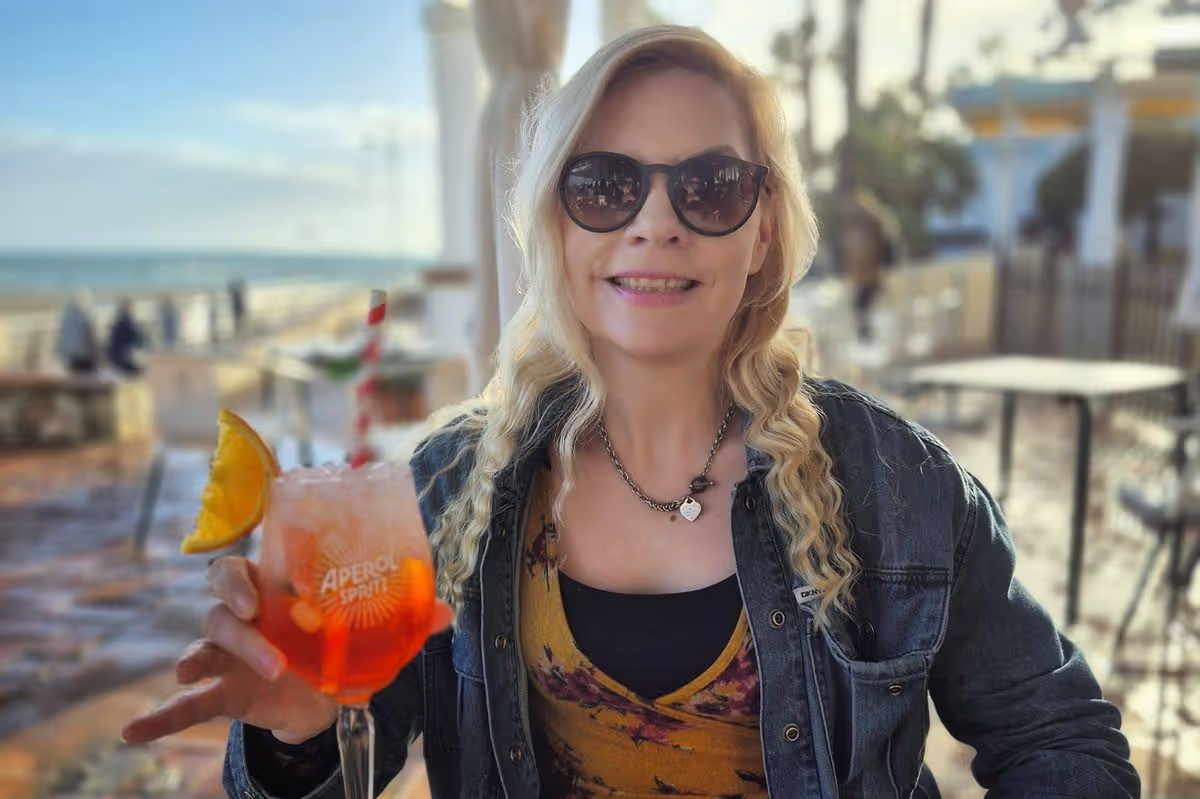
I booked a mystery holiday for £79 and thought things couldn’t get worse — they did(Image: Portia Jones )
While doom scrolling and sipping a large glass of cava, I came across a deal that stopped me mid gulp: a mystery holiday for just £79. As a travel writer and podcaster, I’m constantly planning work trip itineraries, so I rather fancied the thought of letting someone else decide where I’m going. What could possibly go wrong?
If, like my husband, you are wondering what a mystery holiday is, allow me to explain. The popular Wowcher deal promises return flights and two nights in a hotel somewhere abroad for a low price. It was £79 per person when I booked it on a deal, but it’s normally £99 per person. It could be Dubai, New York, the Maldives, Las Vegas or Mexico, or European destinations such as Paris, Monaco, Sicily, and Lake Como.
Your destination is allocated via a randomised draw and is subject to availability. Every booking is randomly assigned to one of three tiers. Six holidays sit in Tier 1. Twelve in Tier 2. And a whopping 1,982 in Tier 3. That is 2,000 packages in total, enough for 4,000 travellers, all distributed by draw.
Tier 1 means the headline, long-haul, brag-on-Instagram trips, but the vast majority are European weekend breaks. You just have to make peace with the fact that you may end up posting sunset shots from Tier 1 Barbados or in an adequate three-star hotel in a European city. You have to decide if it’s worth the risk.
Darling husband was not wildly enthusiastic about paying to be surprised, but I deployed my usual negotiation technique: talking until he loses the will to live. We bagged the deal at £79 each in a special offer, and we were in the game.
Obviously, the odds of us swanning off to Dubai were, frankly, casino-level, but I chose optimism. I was determined we would escape the British drizzle and emerge somewhere glamorous.
Credit card in hand, I effectively gambled our annual leave on Wowcher and waited for the universe to reward my impulsiveness.
Shortly after paying, a code and redemption link arrived in my inbox, which felt very exciting. I entered our details into the site, selected our preferred departure airport, and discovered that flying from anywhere other than London costs extra, and if you want to take more than a t-shirt and a pack of fem wipes, you’ll have to pay for a bag. Of course.
Then came the grand reveal. I was mentally picturing us in the Caribbean, toes in turquoise waters, sipping piña coladas. Then I clicked. It was the Costa del Sol. I screamed the F word. And it wasn’t “fantastic!”
After my minor meltdown, I regrouped. Spain in February would be great, a chance of blue skies, tapas and cocktails by the sea. Given that it has rained every single damn day in Britain for weeks, this trip was destined to be the sunny salvation my vitamin-D-deficient heart deserved.
I pictured balmy afternoons in a cute seaside resort with an ocean view where I could watch epic sunsets. This is what I told myself as I boarded our delayed Ryanair flight in the freezing cold.
I stayed positive through the turbulence. Nothing could ruin my holiday. Then the captain spoke: “Good afternoon, ladies and gentlemen, this is your captain speaking from the flight deck. As we begin our descent, I’d like to give you an update on the weather conditions. The area is currently experiencing adverse weather, including heavy rain and strong winds.”
And that was it. Right there. Right there, that was the moment I officially abandoned all hope. I was landing in the middle of Storm Leonardo rather than in lovely Spanish sunshine. Things could not possibly get worse, until they absolutely did.
It turns out that Wowcher’s concept of a ‘minimum three-star hotel stay’ differs from mine. While I had imagined a cutesy hotel with an ocean-view terrace, what we got was a tired-looking budget apartment block in Benalmadena town that clearly hadn’t been updated since the 90s. To be fair, our apartment was fairly clean and of a decent size, but it was extremely basic.
No balcony, toiletries or even coffee. There was also the threat of “fines” if you left the light on when you went out, and you had to check out before 10 a.m. This was a bare bones stay for the budget traveller, not the mid-tier relaxing break I had hoped for.
I’m not sure what I was expecting for £79, but I was now fully in a negative spiral as Storm Leonardo raged outside, rain lashing and wind howling.
Husband, after living with my particular brand of travel chaos for 12 years now, seemed surprisingly calm about the whole thing, almost as if it had fully met his expectations for a holiday for less than £100. It’s always irritating when he’s completely right.
Undeterred, I confidently announced we would visit the aquarium, the perfect place for a wet and windy Wednesday. Surely penguins would cheer me up.
“Due to Storm Leonardo, the aquarium is closed”, the sign taped to the door read. Rightio. Of course. To the pub then. “Sorry love, we don’t do Sauvignon blanc.” Must. Not. Scream.
So why, you might reasonably ask, didn’t we admit defeat, check out, and head home? To take a short break from being a negative Nancy, the answer is that when the sun made appearances in between downpours, Benalmadena town really isn’t that bad.
The town is divided into three main areas: the traditional hilltop Pueblo, the central Arroyo de la Miel, and the seaside Costa, and there’s plenty to do here.
Sure, like most places in the Costa del Sol, you have bars for boozed-up Brits with blaring music, souvenir stores hawking tat, and vape shops, but there’s also a gorgeous seafront, swish marina and tasty tapas.
When the weather is behaving, plod along the 10-kilometre stretch of sandy beaches, including Blue Flag options like Santa Ana Beach. The palm tree-lined promenade is also dotted with ocean-view restaurants and bars where you can buy an Aperol Spritz and watch the waves.
Puerto Marina is also worth a visit. The major, uniquely designed marina features shopping, dining, and the Sea Life aquarium (when it’s not closed due to rain, despite the marine life living in tanks).
Attractions in the area include the 33-metre-tall Buddhist Stupa, Colomares Castle, and the Teleférico (cable car) to Mount Calamorro for panoramic views.
If you want a slice of more ‘authentic Spain’, wander away from the seafront, and you’ll soon stumble across tapas bars and restaurants like Asador Casa Miguel serving Andalusian dishes. The Iberian pork medallions were exceptional.
If you’re feeling adventurous, you can always hop on a cheap, 30-minute train to Málaga, a historic port city packed with culture and excellent eats.
Explore the palm-dotted city, and you’ll find astonishing historical sites, such as Alcazaba (Moorish fortress), a Roman Theatre, and a 16th-century cathedral. There are also over 30 museums here, including the Picasso Museum and the Carmen Thyssen Museum.
As the weather alternated between rain and sunshine, we found that a trip to Málaga was an excellent way to escape the rain, and the sun also came out.
We spent a delightful few hours visiting cultural heavyweights like the Picasso birthplace and the Roman Theatre and eating our way around the buzzing Mercado de Atarazanas (Malaga food market).
Here you’ll find stalls brimming with local produce where you can slurp fresh oysters on the shell for €3 and sip cava for under €4 a glass. Lush.
Despite the stormy weather, our time in Costa del Sol felt all too brief, and it was soon time to head back to the airport. I suppose that’s the issue with this particular Wowcher mystery deal: you’re given a narrow window in which to experience your destination. If the weather is glorious, you’re smug. If it’s biblical, you’re essentially on a layover with sangria.
But here’s the real lesson the Wowcher mystery holiday taught me. In travel, as in life, you get exactly what you pay for.
During my 20s, while backpacking on the cheap, I stayed in three-dollar-a-night hostels with sanitary conditions so questionable the Red Cross would have intervened.
I am older now. Wiser. More aware of thread counts. I like comfort and hotels with fluffy towels and working air conditioning.
I have learned, repeatedly, that if you book a budget break, you must be prepared for budget realities: inconvenient flight times, accommodation with “character,” and dire customer service.
So, is it worth booking? That depends entirely on your expectations. If you’re dreaming of ticking off a bucket-list long-haul destination, swanning into a five-star resort with seamless transfers and a welcome Bellini, perhaps do not gamble £99 on a surprise getaway.
Especially when the “extras” (baggage, seat selection, breathing near the aircraft) begin adding up. For money-saving tips, sign up to our Money newsletter here
However. If you’re game for a laugh, can persuade your partner or a few pals to embrace chaos, and, importantly, you enjoy a story more than a sun lounger, then it’s worth a punt for under £100.
Sure, you might end up with awful flight times, a dingy hotel and landing during a storm, but at least you’re not at work, right?
Book the deal. Surrender to the travel gods, pack lightly and manage expectations heavily. Who knows, you might get Thailand, or you could be jetting off to Benidorm. May the odds ever be in your favour.
Get your Wowcher Mystery Holiday Deal here.

Best Venezuelan and Colombian spots for arepas in Los Angeles
In the streets of Cartagena, Colombia, cumbia musicians beat tambora drums and blow into flautas, women in red, yellow and blue ruffled dresses whisk by, and sweating food vendors push carts, their arepas sizzling.
Among the music and striking color of Cartagena, my dad handed me my first arepa. Arepas are the most essential dish of Colombia and neighboring Venezuela, centered around South America’s most treasured crop: corn.
To prepare an arepa, corn kernels are ground into flour or pre-ground corn flour is used (often the iconic yellow bag of Venezuelan brand P.A.N.), and mixed with water and salt. The soft dough is then fried, grilled or baked into a pancake-like shape. The result is delightfully simple yet endlessly customizable.
“My memory of arepas is eating them morning, afternoon and night,” said Yesika Baker, owner of Chamo’s Venezuelan Cuisine in Pasadena. “In Venezuela, the areperas are open 24/7.”
The arepa has deep roots. Before Colombia and Venezuela came to be known as separate territories, they were unified by Indigenous groups with similar culinary traditions. When the Spanish first arrived in South America, Indigenous women were cooking corn cakes similar to the modern arepa, meaning the tradition likely goes back thousands of years, according to University of Venezuela anthropology professor Ocarina Castillo.
Today, the arepa is popular in both countries. In Colombia, an arepa tends to be simple: topped with cheese by street vendors, filled with egg for a tasty breakfast or, most often, served as a side to a hearty meal. Some say the masa of a Colombian arepa tends on the thinner side as well.
“Growing up in Colombia, the arepa is like the Mexican’s tortilla. Everything comes with an arepita,” said Santiago Restrepo, owner of Sus Arepas in East L.A. “Venezuelans, on the other hand, use it like a pita — stuffed. With Venezuelan-style arepas, you can really have fun with the fillings.”
The Venezuelan arepa “rellena” or stuffed style, is one that you’ll see dominate this list, with an experimental appeal that makes them a favorite for Angelenos. One of Venezuela’s most popular arepas is the Reina Pepiada, which translates to “curvy queen” and is typically filled with shredded chicken, avocado, cilantro and mayonnaise. According to Castillo, the name is in honor of a real beauty queen, Susana Duijm, the first Venezuelan to win Miss World in 1955.
In Colombia and Venezuela, it’s common to eat arepas at least once a day, especially at breakfast. But for a dish so essential to millions of people, for a long time, arepas were underrepresented in L.A.’s food scene.
“When I first moved to L.A. [in the ‘80s], you couldn’t find arepas anywhere,” Restrepo said. “Up until 2020, I wouldn’t have considered them a popular dish here. But just in the past few years, they’ve exploded.”
Restrepo credits their meteoric rise to a photogenic appeal. If you’re an avid consumer of food content online, then you’ve likely seen the arepa rellena — after a typical wait time of 20 minutes, they come layered and overflowing with ingredients like shredded beef, stewed beans, melted cheese or plantains.
“A good arepa rellena is all in the fillings,” said Mercedes Rojas, chef of the Arepa Stand, which pops up at local farmers markets on the weekends.
From creative picks stuffed with mango and cheese to a Koreatown-inspired arepa with bulgogi and plenty of traditional options, this guide features nine standouts in L.A.’s growing arepa scene.
Although, for your sake, don’t try to ask which country created the arepa, or who does it best. “It’s a long fight, amiga,” Baker said. “From Venezuela or Colombia, we defend our arepas.”

Overseas online sales of S. Korean products reach record high in 2025

Online sales of South Korean products in overseas markets rose to a record high in 2025, government data showed Monday. In this December photo, foreign tourists shop at an Olive Young outlet in Incheon International Airport. File Photo by Yonhap
Online sales of South Korean products in overseas markets rose for the third consecutive year to a record high in 2025, government data showed Monday.
Outbound online sales by South Korean businesses reached 3.02 trillion won (US$2.09 billion) last year, up 16.4 percent from a year earlier, according to the data from the Ministry of Data and Statistics. The figure has been on a steady increase since 2023.
By region, sales increased by 26.3 percent on-year in the United States and 10.9 percent in China, while sales to the 10 member countries of the Association of Southeast Asian Nations (ASEAN) fell 4.4 percent.
By product category, food and beverage sales surged 49.2 percent to 112.9 billion won, the highest level since the statistical standards were revised in 2017.
Sales of cosmetics rose 20.4 percent, while those of albums, videos and musical instruments increased 7 percent.
Copyright (c) Yonhap News Agency prohibits its content from being redistributed or reprinted without consent, and forbids the content from being learned and used by artificial intelligence systems.

North Korea’s Kim unveils homes for families of fallen soldiers | Kim Jong Un News
Published On 16 Feb 2026
North Korean leader Kim Jong Un has showcased a newly constructed residential street for families of soldiers who have died fighting in Russia’s war in Ukraine, according to state media.
Intelligence agencies from South Korea and Western nations have reported that North Korea has dispatched thousands of soldiers to fight for Russia, and Seoul estimated they have suffered 2,000 casualties.
Experts suggested North Korea receives financial aid, military technology and essential supplies from Russia in exchange for this support.
Its official Korean Central News Agency (KCNA) released photographs showing Kim touring the new homes on Saeppyol Street in Pyongyang with his daughter, Ju Ae, widely regarded as his heir apparent.
South Korea’s intelligence agency recently claimed she has been “designated as a successor”, citing her involvement in high-profile events with her father.
One image depicted families inspecting utilities in their new apartments.
“The new street has been built thanks to the ardent desire of our motherland, which wishes that … its excellent sons who defended the most sacred things by sacrificing their most valuable things will live forever,” Kim said in a speech released by KCNA.
Although Monday’s report did not mention Russia, Kim recently pledged to “unconditionally support” all policies and decisions made by Russian President Vladimir Putin.
“Before their death, the heroic martyrs must have pictured in their mind’s eye their dear families living in the ever-prospering country,” he added.
The unveiling preceded the ruling Workers’ Party congress in Pyongyang, the nation’s most significant political event, scheduled this month. Observers are closely monitoring Kim’s announcements on foreign and domestic policy directions as well as whether Ju Ae will be granted any official party titles.
Hong Min, an analyst at the Korea Institute for National Unification, told the AFP news agency that the timing of the street inauguration represents a “highly calculated political move to justify its soldier deployment” before the party congress.
“It visualises the state providing tangible compensation to the families of fallen soldiers … as a symbolic showcase,” he said.

SAG vs. Oscars: Are the Actor Awards global enough to be predictive?
The Super Bowl is over. Going to Disneyland? Do you have a spare $1,000 to spend?
I’m Glenn Whipp, columnist for the Los Angeles Times, host of The Envelope newsletter and the guy wondering about the profit margin on a $6 churro.
In the meantime, welcome back to the newsletter as we push through to the Oscars on March 15. Have you been catching up on the nominated movies? “Sentimental Value” is a delight … though just how delightful has been the subject of some debate.
Are the Actor Awards global enough?
Joachim Trier’s richly rewarding family drama “Sentimental Value” hauled in nine Oscar nominations last month, setting a record for most acting nods for a non-English-language movie.
Its primary quartet of actors — Stellan Skarsgård as a legendary director angling for a comeback, Renate Reinsve and Inga Ibsdotter Lilleaas as his daughters and Elle Fanning as an A-list actor who becomes entangled in the family drama — all received nods. Fanning’s name was the first called when nominations were announced, signaling that Scandinavian melancholy would be notably absent that morning. Never mind the hour: Champagne glasses were raised.
The celebratory scene stood in stark contrast to the vibe just two weeks earlier when “Sentimental Value” was blanked at the Actor Awards (formerly known as the Screen Actors Guild Awards). And it wasn’t the only international film ignored. The 2,500 SAG-AFTRA nomination committee voters also shunned Wagner Moura, the lead of celebrated Brazilian drama “The Secret Agent.” Moura went on to nab an Oscar nomination, one of four noms, including best picture, that Kleber Mendonça Filho’s drama earned.
The disparity between the choices of the motion picture academy and SAG-AFTRA could be an anomaly. Or it might be the latest evidence of an Oscar trend this decade. As the academy’s membership has become more global — 24% of Oscar voters live outside the United States — the Academy Awards have become increasingly an international affair, leading to a widening divide with the Hollywood guilds.
Is this a bad thing? It depends who you ask. If you queried the actors that SAG-AFTRA nominated who ended up being Oscar also-rans, the answer would be no. Those who believe that cinema is global, particularly now that American studios have largely abandoned making movies geared toward grown-ups, would have a different response.
“The fact that not one international film got in says a lot,” says a veteran awards consultant, who, like others interviewed, requested anonymity in order to speak freely about the industry. Indeed, one journalist tabbed SAG’s Actor Awards nominations the “‘America First’ List,” which, while technically accurate, might have taken the perceived xenophobia a bit far.
“The SAG Awards or Actor Awards — whatever they’re called now — are in danger of looking like a middlebrow affair,” another awards campaigner notes. “I know this is going to sound elitist, but it’s true. There’s a big difference between an organization where you have to be invited or apply to join versus one where, if you’re a disc jockey in Kansas City, you have voting rights.”
To be fair, DJs, Kansas City-based or otherwise, probably don’t vote for the Actor Awards’ nominations — just for the final awards. In the nominations round, 2,500 randomly selected active SAG-AFTRA members make the choices. To serve on the committee, members must be categorized as an actor/performer, dancer, singer or stuntperson in the SAG-AFTRA database. Could a DJ be classified as a performer? Probably not. In the guild’s view, actor and performer are synonymous, encompassing both principal and background players.
And sure, since only 7% of SAG-AFTRA actors and performers earn $80,000 or more a year, that means there are going to be a few full-time waiters on those nomination committees. But as the speeches at the Actor Awards remind us annually, it’s a profession where you’re just one job away from making it. Think of Connor Storrie, who worked at restaurants for eight years before getting his break on “Heated Rivalry.”
There’s still the question of why, say, SAG-AFTRA dancers and singers are voting on the merits of an acting performance, however. In contrast to the Actor Awards, nominations for the Oscars are decided by the academy’s various branches. Actors vote for actors, writers for screenplays and so on, with the general membership voting for best picture.
“Peer groups are deciding what’s worthy, and that’s the way it should be,” says an academy member from the public relations branch. “I’m not voting for visual effects.”
Not initially, at least. Academy members vote for all 24 categories in the final round, provided, per a rule change that went into effect this year, they attest to watching all the nominated work in the category.
SAG-AFTRA voters have rewarded non-English-language work over the years, but usually when a particular film or TV show — Bong Joon Ho’s 2019 masterpiece “Parasite” or Netflix’s “Squid Game” — is undeniable. Voters ignored recent lead turns from Fernanda Torres (“I’m Still Here”), Yalitza Aparicio (“Roma”) and Sandra Hüller (“Anatomy of a Fall”). All three went on to earn lead actress Oscar nominations.
This year’s snubbing of “Sentimental Value” is particularly puzzling as the movie featured well-known actors like Fanning and Skarsgård, an institution from roles in blockbuster franchises like “Pirates of the Caribbean” and most recently the TV series “Andor.” It’s also a film about, among other things, the blurring of art and reality and the challenges of acting. And, in the scenes featuring Fanning, it’s in English.
What gives? Like every other contender, “Sentimental Value” screened four times for voters and was available for streaming.
“I just think people are less inclined to watch a movie with subtitles at home,” says one awards consultant, alluding to the ways that passive, multiscreen viewing has encroached upon our multitasking lives. Maybe that’s why Skarsgård, when he accepted the Golden Globe award for his work in the movie, preached that “cinema should be seen in cinemas” in his speech.
Does that sound elitist? It shouldn’t. But it does seem to be a belief from a time that’s slipping away. One certainty: With the academy nominating two international features for best picture for the third straight year, global cinema is now entrenched at the Oscars. Whether SAG-AFTRA voters decide to join the party is now a question for next year.

This country has the lowest rainfall in the world
PARTS of the UK have seen rain every day of 2026 so far.
But there is a popular country in Africa where you can find sunshine as it has the least amount of rainfall in the world.
Egypt is constantly ranked the country with the lowest average annual rainfall in the world.
In one year, it only gets about 0.7 inches of rain – in comparison, the UK sees on average 47 inches.
This week, while the UK shivers in freezing temperatures and possible snow, Egypt is basking in highs of 30C.
The good news for Brits is that Egypt is incredibly accessible with the flight time being as little as five hours – and there are very cheap holiday offers throughout the year.


The most popular resort towns for Brits are scattered along the Red Sea – these are Sharm El Sheikh, Hurghada, El Gouna, and Marsa Alam.
You can pick the destination depending on what kind of break you’re after.
Sharm El Sheikh, on the southern tip of Egypt’s Sinai Peninsula, is a premier Red Sea resort city with world-class diving and snorkelling thanks to its stunning coral reefs.
Hurghada is also a Red Sea city and is known for having incredible beaches along with great nightlife in Sakalla.
Just up the coast from Hurghada is El Gouna – a secure and gated resort town with high-end hotels, golf courses and marinas.
Meanwhile, Marsa Alam is further south – its U-shaped Abu Dabab Bay is known for its sea turtles and sea cows.
You can spend 10 nights at in Giza for as little as £249 each with loveholidays.
The hotel has spacious bedrooms – some even have bathtubs in the rooms.
The rooftop is the perfect place to gaze at the ancient pyramids, and guests can hire out BBQ equipment for some outdoor cooking.
The price is room only and includes flights from London Stansted.
Staying in Giza, a city on the west bank of the Nile is the perfect stop for anyone wanting to explore Egypt’s history.
It is home to the last remaining Wonder of the Ancient World—the Great Pyramid of Giza and the Sphinx.
Over in Hurghada, you can stay at the 4-star Elysees Dream Beach Hotel which has its own beach, and lots of children’s facilities.
A 10 night stay at Elysees Dream Beach Hotel (starting on February 26) starts from £339pp this includes breakfast – and flights from London Stansted.
Hurghada is the perfect spot for a ‘fly and flop’ break – and February sees more mild temperatures as in peak summer season it can get as hot as 38C.
For a different kind of holiday, why not check out an Egyptian river cruise?
TUI offers package cruises from £1459pp with the Legends of the Nile.
This package is across seven nights, it’s all inclusive with a superior cabin which comes with air conditioning and shower as well as other room amenities.
Guests can explore spots like Aswan, Edfu and Kom Ombo seeing ancient cities and ruins.
One Travel Writer hopped onboard a TUI river cruise when it first launched.
She said: “I got to explore the ancient lands of Egypt in possibly the best way a tourist can — a cruise along the River Nile on board Al Horeya, TUI’s first river cruise ship to sail outside of the European waterways.
“Luxor was the first stop on my seven-night bucket list adventure.
“And I was desperate to explore the Valley Of The Kings where some of Egypt’s most illustrious — and notorious — Pharaohs are buried.
“After a busy day of exploring this fascinating city on the Nile’s east bank, the double bed in my Superior French Balcony Cabin seemed all too inviting.
“From the first night, the Egyptian rosé wine Shahrazade became my tipple of choice – luckily, stays aboard the TUI Al Horeya are all-inclusive which meant I could swig back as many wines as I fancied.”
For more on Egypt, here’s the perfect destination for families seeking adventure from scaling pyramids to snorkelling and desert safari.
Plus, Jet2 is restarting flights to one much-loved winter sun destination for the first time in 16 years.

The greedy hordes of Black Friday are now plundering Thanksgiving
Admittedly, I am a guy who generally dreads the thought of plodding through a shopping mall on any day of the year, but to me the encroachment of Black Friday into Thanksgiving evening seems not only insane but also disturbingly unpatriotic.
It was bad enough when it became the norm for people to show up in the middle of the night in order to be near the front of the line when store doors swung open early on the morn after Thanksgiving. Every time I heard about the herd of shoppers being culled as someone got trampled or sent to the hospital after a fight over a Tickle Me Elmo, I felt justified in my smugness and disdain of this retail frenzy. If that is how the rabble wanted to spend their time and money, so be it. The manic rush to save a hundred bucks on a 50-inch flat-screen TV or finish Christmas shopping by 9 a.m. on Black Friday could go on without me.
Over the years, though, retailers have pushed the starting time for this mad dash earlier and earlier until now it is bumping up against the slicing of the pumpkin pie at the Thanksgiving dinner table. This does not seem right.
PHOTOS: Top of the Ticket cartoons
I pity the poor retail workers who have to leave home and hearth and turkey dinner on the most venerable national holiday of the year. Instead of giving thanks for the opportunity to be confronted by a greedy horde of bargain hunters, I suspect most of those workers are cursing the store owners who decided to ruin the day with their own lust for a dollar. I think it is safe to assume the guys who own Target or Best Buy or the other big retailers will not be manning the cash registers. No, they will be sharing a leisurely Thanksgiving repast with their heirs in the peace and safety of their gated communities.
In 2013, it will be exactly 150 years since Abraham Lincoln set aside the fourth Thursday in November as a national day of “Thanksgiving and Praise to our beneficent Father who dwelleth in the Heavens.” Obviously, traditions shift over time, but let us hope that by next year those who put making money and spending money above all other values will not have totally desecrated what was once an all-American day like no other.
For anyone who feels as disgusted as I am with the plundering of Thanksgiving, go to Change.org and sign the petition urging Target to stop being the Grinch who stole Thanksgiving from employees. Maybe if one retailer is shamed into doing business more thoughtfully, others can be, as well.
How Lakers star LeBron James has maintained peak performance
Slowly, LeBron James put on a pair of ice bath toe booties and dipped his left foot and then his right foot into a bucket that had been prepared for him following a Lakers game at Crypto.com Arena. His longtime personal trainer and athletic performance coach, Mike Mancias, next wrapped both of James’ knees and his back in ice.
James closed his eyes for a few seconds and leaned back in his chair as the media gathered around him for his postgame interview.
This was just another step James has taken to care for his body, a step that shows the lengths he takes in the maintenance of his 6-foot-9 frame that has helped him have an illustrious 23-year career, longer than any player before him.
“Obviously I didn’t know it would be 23 years. I didn’t know that, but I know I didn’t want to have no six- or seven-year career. I can’t become legendary in six or seven years,” James told The Times. “I always had a mission. When I knew I could play this game at a high level, like, going to Chicago and playing with MJ [Michael Jordan] and all those guys when I was a sophomore [in high school]. And then when I went up to Cleveland and played against the Cavs when I was a junior and I was like, ‘Oh … I belong. I belong.’ I knew I still had to learn and I still had to continue to get my body right, continue to learn the game and nuances.
“But I was playing against NBA guys for a long time and I was like, ‘If I get the opportunity to crack the league, if I get the opportunity to showcase what I’m able to do, the only thing that can stop me is if I don’t take care of my body. The only thing that can stop me from being the greatest or one of the greatest to ever play this game is if I do not take care of myself.’ I did take care of my body. That’s it.”
James’ dedication to self care has become legendary in the sporting world. He is known to invest moire than $1.5 million annually for a comprehensive approach to keeping his body fine-tuned.
James considers himself a biohacker: someone who uses science and technology to make their body function better and more efficiently.
He talked about using Normatec leg compression boots, hyperbaric chambers to restore oxygen, cryotherapy, red-light therapy and other cutting-edge technologies to maintain elite performances and longevity at the age of 41.
He talked about prioritizing sleep and nutrition, avoiding artificial sugars and fried foods.
When he missed the first 14 games this season because of sciatica, James cut back on drinking wine, one of his passions, in order to get his body back to full health.
“Obviously it’s gotten even more detailed as me and Mike have built a program,” James said. “It’s been 22 years of our program.”

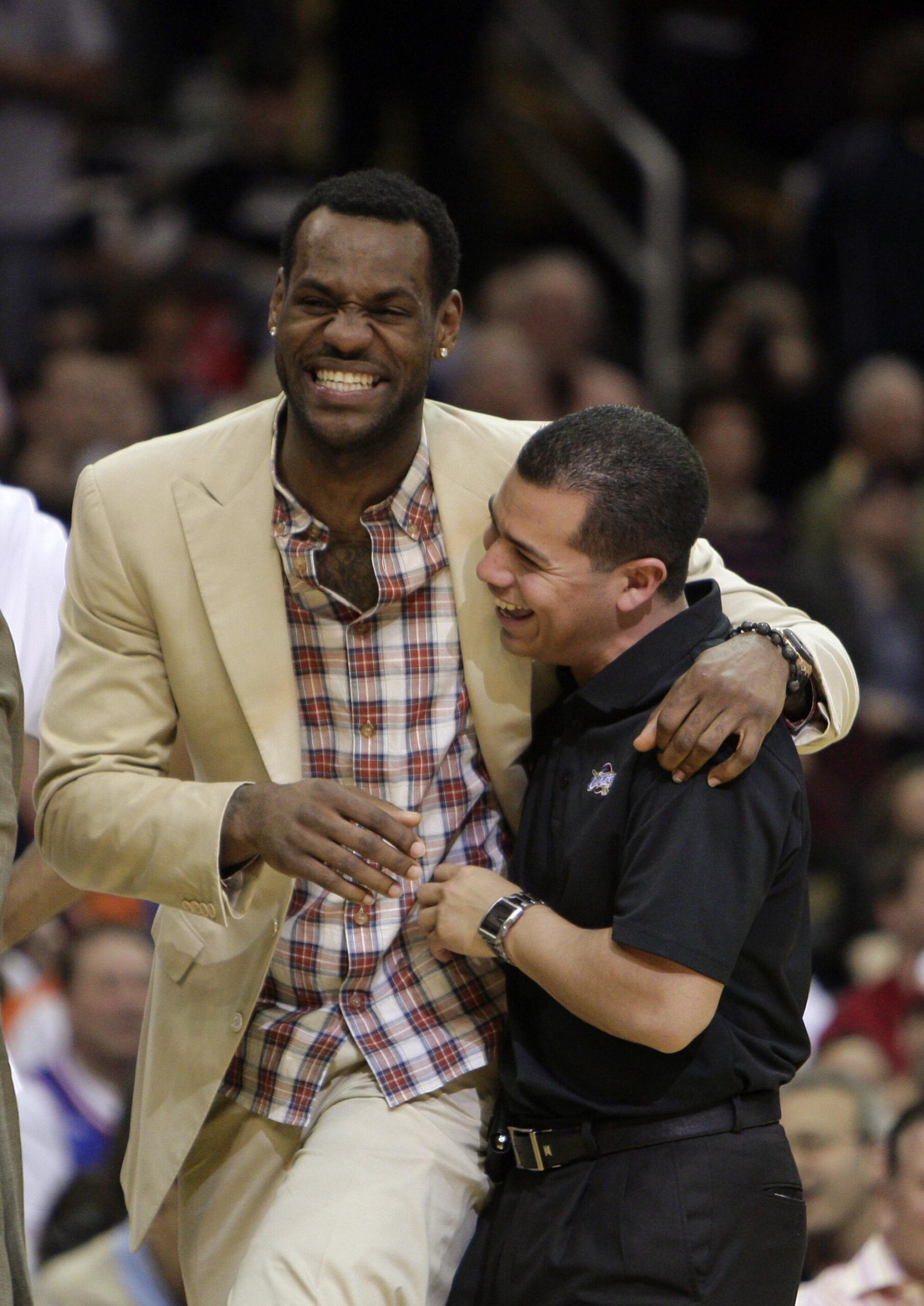
LeBron James jokes with trainer Mike Mancias while sitting out a game with the Cavaliers in 2010 to rest for playoffs.
(Mark Duncan / Associated Press)
It has worked for James to the highest order, as he has become the leading scorer in NBA history with 42,975 points.
Though his streak of being voted as a starter to the All-Star team was snapped at 21 years in a row, James still extended his NBA record to 22 selections when the coaches voted him in as a reserve for the tournament that will be played Sunday at Intuit Dome.
Over his career, James said, he’s received plenty of offers to try new ways to do his physical therapy. For the most part, he has said no.
“It’s all type of … that is presented to you,” James said, smiling. “[People] are always trying to get you to do s—. But once we got the connection, it wasn’t really many people that we allowed to come and be in what we do. We had a couple of guys obviously throughout the process that helped along the way. But, nah, we knew what we wanted to do.”
When James was growing up in Akron, Ohio, and it became obvious he was athletic, he said his uncle, Curt, encouraged him to start taking care of his body immediately. His mother, Gloria, advised him to listen.
“I used to stretch before I went to bed and when I woke up, when I was like 10 or 11 years old,” James said. “My uncle Curt, my mom’s younger brother, used to make me do 100 calf raises a day and he used to make me do 50 pushups and 50 situps a day.”
James shook his head and laughed recalling those moments.

LeBron James glides past Kings forward DeMar DeRozan for a reverse dunk during a game in December.
(Eric Thayer / Los Angeles Times)
“He told me I had to get my calves stronger if I wanted to be great,” James said, smiling. “I never knew what that meant, whatever. But yeah, my uncle used to tell me to do that, and then a good friend of mine used to always tell me to stretch before I got in the bed and after I got out of the bed when I woke up the next morning. I don’t know, man. I’ve been doing this for a long time.”
At no time during all this did James know what that advice would mean for his future.
“No, but I had people that I trusted,” James said. “I was icing after every game my rookie year. I was 18 years old. I was icing after games when I was a high school senior, a high school junior. Like, I was lifting [weights] my senior year.”
James told a story about playing in an AAU tournament with Kendrick Perkins when he was 14 and how some players were sitting in the stands eating fast food.
“They were eating McDonald’s,” James said, smiling, “and I was eating fruits.”
Jason Kidd, the Hall of Fame point guard who’s now coach of the Dallas Mavericks, was an assistant with the Lakers when James led them to the 2020 championship, and the two were teammates on the 2008 USA Olympic team that won the gold medal in Beijing.
Kidd has watched how James is averaging 22 points on 50.2% shooting, 7.1 assists and 5.8 rebounds this season and can’t help but marvel at how he continues to be a highly effective player with so many miles on his body.
“He’s had some injuries, but he’s taken care of his body, he’s always prepared himself for the marathon,” Kidd said. “But I think it’s the mental side. I think that’s the hardest part is to wake up and say, ‘Do I need to go play against a 20-year-old or a 19-year-old?’ He’s won championships, he’s been MVP, he’s been the face of the league. He’s a billion-dollar company.
“So, it’s the mental side. Understanding that he loves competition and he loves the game of basketball. So I think for him to do it at 41 is incredible.”
When the Lakers faced Kidd’s Mavericks on Thursday night, James was back in the lab early getting his body ready about six hours before tipoff.

LeBron James talks with assistant coach Jason Kidd during a 2020 playoff game.
(Associated Press)
It didn’t matter that it was the last game before the weeklong All-Star break. In James’ eyes, if you take care of your body, it will take care of you.
“I woke up this morning, went straight downstairs, got a stretch, did a little activation, like a little small lil’ lift” of weights, James said after the game. “Then I iced after that. Then I used the Normatec to pump my legs for an hour. Then I took a nap in the hyperbaric chamber for an hour and a half. Then I got in the cold tub, again, before I came here. So, I started my process here when I got here at 1:15 and prepared for a 7 o’clock game. It’s just around the clock.”
And as it turned out, all his work led to yet another record for James.
His triple-double of 28 points, 12 assists and 10 rebounds made him the oldest player to accomplish the feat, pushing him past Karl Malone, who was 40 when he did it in November 2003.
And now comes another record with the All-Star Game.
Marco Rubio wants to build a ‘new Western century’. Will Europe join? | Politics News
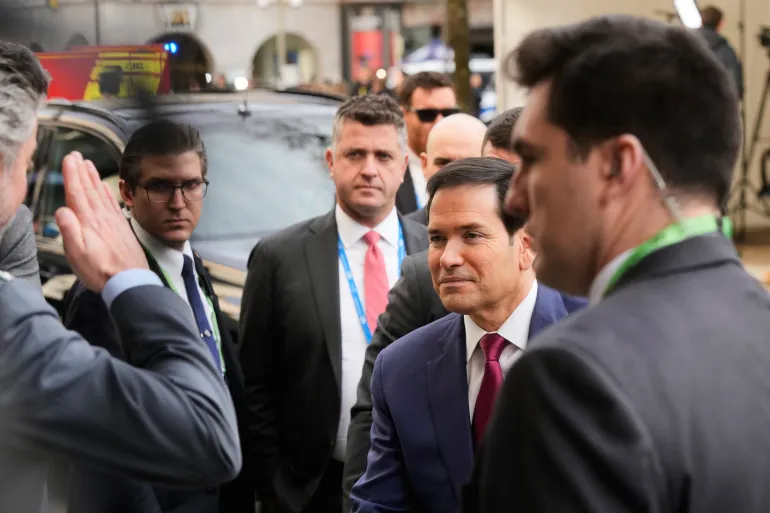
Speaking at the annual Munich Security Conference on Saturday, United States Secretary of State Marco Rubio urged European countries to collaborate with the US to build a “new Western century”, describing US-Europe ties as “civilisational”.
“We are part of one civilisation – Western civilisation,” he said.
Recommended Stories
list of 4 itemsend of list
His rallying speech comes after more than a year of President Donald Trump’s rhetoric about mass immigration in Europe and his administration’s latest National Security Strategy, which warns of “civilisational erasure” in Europe.
Last year, US Vice President JD Vance also lambasted European “liberal values” in his first address at the security conference.
As European leaders grapple with the rise of far-right political parties, how will they respond to this new demand from the US, and what does it mean for the future of transatlantic relations?

What did Rubio say?
The top US diplomat focused on several key areas he views as imperative for Europe to address, which included ending “liberalist” policies the Trump administration views as responsible for Europe’s “post-war decline”, creating new supply chains to reduce reliance on countries such as China, and ending mass migration, which he said is leading to the erasure of Western “civilisation”.
“The work of this new alliance,” Rubio said, “should not be focused just on military cooperation and reclaiming the industries of the past. It should also be focused on, together, advancing our mutual interests and new frontiers, unshackling our ingenuity, our creativity, and the dynamic spirit to build a new Western century.”
Liberalism and mass migration
Rubio argued that the “euphoria” of the Western victory in the Cold War had led to a “dangerous delusion that we had entered ‘the end of history’”, where every nation would be a liberal democracy and “live in a world without borders, where everyone became a citizen of the world”.
He used this as a plank to lash out against opening “doors to an unprecedented wave of mass migration that threatens the cohesion of our societies, the continuity of our culture, and the future of our people”.
“Mass migration is not, was not, isn’t some fringe concern of little consequence. It was and continues to be a crisis which is transforming and destabilising societies all across the West,” he said.
Taking aim at liberalist policies, he added that, to “appease a climate cult, we have imposed energy policies on ourselves that are impoverishing our people”.
New supply chains
Rubio said the US and its allies should bring more industry and jobs back home, not just to build weapons but to lead in new, high‑tech fields.
He added that the West should control key minerals and supply chains, invest in space travel and artificial intelligence, and work together to win markets in the Global South.
In particular, he said, is the need for a “Western supply chain for critical minerals not vulnerable to extortion from other powers”.
Earlier this month, Trump hosted ministers from dozens of countries for a critical minerals conference in Washington. The meeting was the first of a new Critical Minerals Ministerial, a US initiative to build alliances aimed at countering China’s control over critical mineral supply chains around the world.
What does a ‘new Western century’ mean?
While the overarching message of Rubio’s speech was that the US still seeks a partnership with Europe, said Trita Parsi, executive vice president of think tank Quincy Institute for Responsible Statecraft, his remarks revealed, “The US will entirely set the parameters of that partnership and that it will be based on ideas Europe long has abandoned: An embrace of empire and colonisation.”
Rubio’s remarks at the conference suggest that the US under Trump wants Europe to accept “a civilisational divide of the world in which the ‘West’ must restore its dominance over other civilisations”, Parsi told Al Jazeera.
“In essence, Rubio listed the criteria for how Europe can become well-behaved vassals of the United States,” he said.
How did European leaders react to Rubio’s speech?
European leaders appeared to welcome Rubio’s speech at the conference; it was followed by a standing ovation. However, while lauding his call for stronger ties with the US, they notably did not address his comments about migration and liberal values.
European Commission President Ursula von der Leyen told reporters on the sidelines of the Munich Security Conference: “We know that in the [Trump] administration, some have a harsher tone on these topics. But the secretary of state was very clear. He said, ‘We want [a] strong Europe in the alliance’, and this is what we are working for intensively in the European Union.”
French Foreign Minister Jean-Noel Barrot responded to Rubio’s speech: “Referring to [our] common legacy can only be welcomed with applause in Europe.”
“We will deliver a strong and independent Europe,” he said. “Independent, of course, irrespective of the speeches that we hear at the Munich Security Conference, however right they may be.”
Calling Rubio a “true partner”, German Foreign Minister John Wadephul said: “[It was] a very clear message from Secretary Rubio that we have … to stay and stick to our international rules-based order, which is, of course, in [the] first line the United Nations. This is our Board of Peace. We have to make it more effective, as Rubio said this morning.”
Finnish Foreign Minister Elina Valtonen said she was “very satisfied with the tone” and the content of Rubio’s speech.
What does this mean for Europe?
European leaders have been facing a dilemma – particularly over migration and defence – for some time, for a number of reasons. The mass migration crisis prompted by unrest in other parts of the world has already caused far-right parties to surge in popularity. Now, the Trump administration has voiced support for many of these parties and is also urging Europe to take stronger action on migration and defence.
Therefore, many European leaders have already started taking action in these areas.
For instance, most European countries are already working on boosting their defences and cracking down on migration.
Last year, the United Kingdom announced plans for a big boost in defence spending in advance of Prime Minister Keir Starmer’s meeting with Trump early last year amid fears the US would withdraw support for Ukraine in its war with Russia. Notably, Rubio skipped a meeting about Ukraine with European leaders at the Munich conference.
Many countries have also tightened controls over immigration. Denmark has led the way in implementing increasingly restrictive policies in its immigration and asylum system, with top leaders aiming for “zero asylum seekers” arriving in the country. Recently, the UK said it was studying the Danish model as well.
Europe is also working to make its energy and technology supply chains more sovereign, reducing dependence on foreign suppliers, particularly in the face of Trump’s trade war, which has seen him impose reciprocal trade tariffs on many countries around the world.
Many European leaders have come under increasing pressure from the rise in popularity of far-right parties calling for greater restrictions on immigration, as well.
In recent years, far-right, anti-immigration sentiment has been increasing in countries like the United Kingdom, the Netherlands, and France. In 2023, the far-right Party for Freedom (PVV), led by Geert Wilders, won the election in the Netherlands. France’s National Rally (RN), led by Marine Le Pen, won the snap election in 2024. The same year, Nigel Farage’s right-wing Reform UK party made significant inroads in the general elections and, last year, a YouGov poll placed Reform as the UK’s most popular political party.
Besides this, ideas which were once far-right fringe notions, such as remigration – the notion of forcibly expelling non-white European citizens – are gaining traction among far-right conservatives in Europe. The idea has been promoted by Herbert Kickl, the leader of Austria’s far-right anti-immigration Freedom Party (FPO) and Alice Weidel, the leader of the AfD in Germany.
While some European leaders have geared up to resist the rise of far-right politics – partly by appeasing them with new, more restrictive migration policies – Trump has, however, embraced it.
What does this mean for US-Europe relations?
All this ultimately means that “Europe has a choice to make”, said Trita Parsi, executive vice president at the think tank Quincy Institute for Responsible Statecraft. “It can pursue strategic autonomy and seek to find a balance between the great powers, and within that seek a dignified partnership with America in which it is not subjugated into vassalage.”
“[Or] Europe can continue on its current path in which it subordinates itself slowly but surely fully to Washington’s interests, priorities, impulses, and ideas about civilisational empire,” he told Al Jazeera.
Parsi pointed to the standing ovation at the conference that followed Rubio’s speech, simply for offering to remain partners with Europe.
“Whether they disregarded Rubio’s parameters, did not understand them, or simply found it unimportant because Europe desires to be a junior partner to the United States regardless of the parameters, remains to be seen,” he said.
For their part, European leaders appeared to place the greatest importance on repairing US-Europe relations above all else at the Munich Security Conference.
During his address at the conference on Friday, German Chancellor Friedrich Merz called on the US and Europe to “repair and revive transatlantic trust together”. “Let me begin with the uncomfortable truth: A rift, a deep divide has opened between Europe and the United States,” he said.
“Vice President JD Vance said this a year ago here in Munich. He was right in his description,” Merz said, as he called for a “new transatlantic partnership”.

Iran’s Araghchi meets IAEA chief in Geneva ahead of nuclear talks with US | Nuclear Energy News
Iran’s top diplomat says he hopes to ‘achieve a fair and equitable deal’ before high-stakes talks are held on Tuesday.
Iranian Foreign Minister Abbas Araghchi has arrived in Geneva for high-stakes second round of nuclear talks with the United States aimed at reducing tensions and avert a new military confrontation that Iran’s Supreme Leader Ayatollah Ali Khamenei has warned could turn into a regional conflict.
“I am in Geneva with real ideas to achieve a fair and equitable deal,” Araghchi wrote on X on Monday. “What is not on the table: submission before threats.”
Recommended Stories
list of 4 itemsend of list
Iran and the US renewed negotiations earlier this month to tackle their decades-long dispute over Tehran’s nuclear programme as US deploys warships, including a second aircraft carrier, to the region as mediators work to prevent a war.
Araghchi met with Rafael Grossi, the head of the International Atomic Energy Agency (IAEA), on Monday, after saying his team nuclear experts for a “deep technical discussion”.
The United Nations nuclear watchdog has been calling for access to Iran’s main nuclear facilities that were bombed by the US and Israel during the 12-day war in June. Tehran has said there might be a risk of radiation, so an official protocol is required to carry out the unprecedented task of inspecting highly enriched uranium ostensibly buried under the rubble.
Speaking to state-run IRNA news agency on Monday, foreign ministry spokesman Esmail Baghaei said the IAEA will play “an important role” in upcoming mediated talks between Iran and the US. But he also renewed Tehran’s criticism of Grossi for the director’s refusal to condemn military strikes on Iranian nuclear sites that are protected under agency safeguards as part of the Non-Proliferation Treaty (NPT).
Araghchi also said he would meet his Omani counterpart, Badr bin Hamad al-Busaidi, who mediated the first round of talks between Iran and the US since the war earlier this month.
Iran has repeatedly emphasised that it will not agree to Washington’s demand for zero nuclear enrichment, and considers its missile programme a “red line” that cannot be negotiated.
Meanwhile, the US continues to build up its military presence in the region, with President Donald Trump saying a change of power in Iran “would be the best thing that could happen” and sending in a second aircraft carrier.
Trump is again likely to send his special envoy Steve Witkoff and his son-in-law Jared Kushner to represent the White House in the Geneva talks. Brad Cooper, the most senior US military commander in the region, had unexpectedly joined the US delegation during the Muscat talks on February 6.
The talks also come over a month after Iran’s deadly crackdown against nationwide protests, with Iranian officials claiming “terrorists” and “rioters” armed and funded by the US and Israel were behind the unrest.
The UN and international human rights organisations have blamed Iranian authorities for the widespread use of lethal force against peaceful protesters, which killed thousands, mainly on the nights of January 8 and 9.
But the hardliners in Tehran are more concerned about any potential concessions that could be given during upcoming talks with the US.
Addressing an open session on Monday, one of the most hardline lawmakers in Iran’s parliament cautioned security chief Ali Larijani against giving inspection access to the IAEA befire ensuring Iran’s territorial integrity, the security of nuclear sites and scientists, and use of peaceful nuclear energy for civilian purposes under the NPT.
“When US warships have opened their arms to embrace Iranian missiles, US bases have opened arms to take our missiles, and the homes of Zionist military personnel are anticipating the sound of the air raid sirens, it is obvious that such conditions cannot be met at the moment,” said Hamid Rasaei, a cleric close to the hardline Paydari (Steadfastness) faction.
In the other diplomatic track pursued in Switzerland on Tuesday, officials will be discussing ways of ending the Ukraine war, which is approaching the end of its fourth year after Russia’s full-scale invasion in 2022.
But no immediate breakthrough appears in sight, with Ukrainian President Volodymyr Zelenskyy telling the annual Munich Security Conference on Saturday that Kyiv has “too often” been asked to make concessions.
Stranger Things star Maya Hawke marries boyfriend on Valentine’s Day watched by Netflix co-stars and famous parents

STRANGER Things star Maya Hawke has married her long-term boyfriend in a surprise wedding on Valentine’s Day.
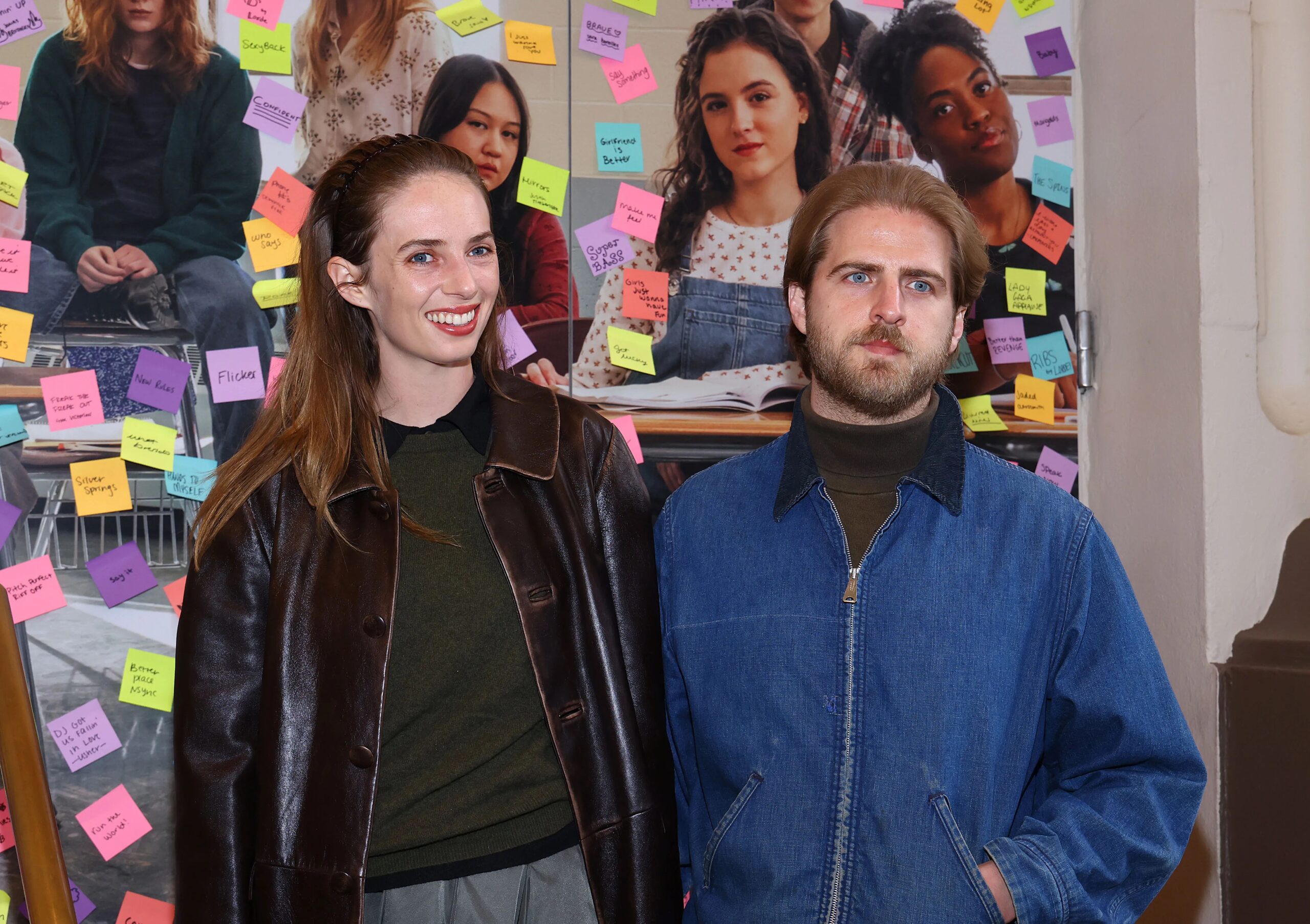
The actress, 27, tied the knot with musician Christian Lee Hutson in New York City on Saturday.
Maya’s famous Hollywood star parents, Ethan Hawke and Uma Thurman were among the famous faces in attendance.
Her Stranger Things co-stars Finn Wolfhard, Natalia Dyer, Joe Keery, Sadie Sink, Caleb McLaughlin, Gaten Matarazzo, Gaten Matarazzo and Charlie Heaton attended the big day.
Photos showed Maya looking stunning in a classic sleeveless white gown paired with a veil over her head and a long trail.
Maya wore her hair in a chic updo and completed her look with subtle makeup.
Her father appeared full of pride as he walked alongside his daughter on the streets of New York while holding her bouquet of flowers.
Other snaps showed the happy couple taking photos outside the venue, while Maya’s bridal team helped rearrange her dress.
Maya and singer Christian were first romantically linked in 2023.
The pair frequently worked together on music projects. and even collaborated on Maya’s second studio album Chaos Angel in 2024.
Most read in Entertainment
Maya also appeared on Christian’s album Paradise Pop. 10 and joined him for a few stops on tour early 2025.
“Christian has been so encouraging to me as a musician, helping me to make the transition from a being a poet in a band to sort of being a musician,” Maya told Variety in June 2024.
In 2023, Maya and Christian were first spotted sharing a kiss in New York City.
They were seen strolling through the city and stopped at a jewellery store.
The couple went on to make their relationship red carpet official on April 2025, at the opening night of Broadway’s John Proctor Is the Villain.
Maya attended the event in support of her co-star Sadie Sink, who was starring in the play.
The pair were good friends for four years before they took things to the next level.
Maya previously said she ‘cannot recommend dating a friend enough’.
“It’s the best,” she said.
“They know you, they understand that you are a person and a human being who has dated other people … not just a piece of paper for them to project their image of a perfect girlfriend onto.”

Turf-roofed burrows to cosy waterside cabins… unique holiday homes for UK escapes

Turf-roofed burrows to cosy waterside cabins… unique holiday homes for UK escapes
Source link
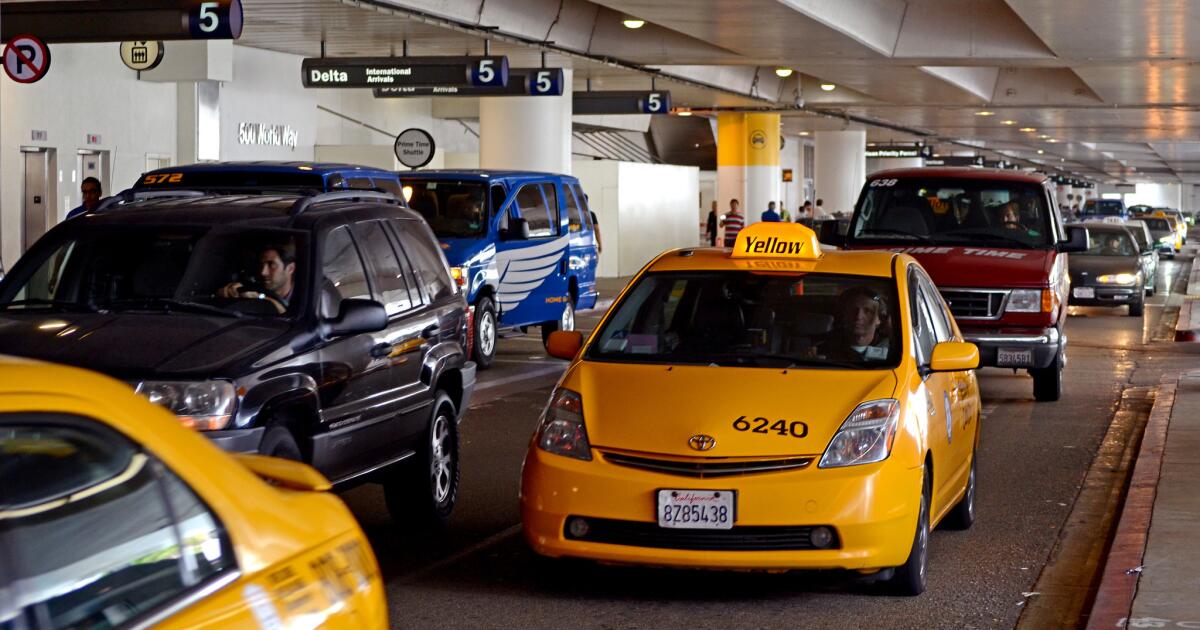
A California lawmaker wants to make it easier for taxis to compete with Uber. But is it too little, too late?
Reporting from Sacramento — Uber and Lyft continue to expand their dominance in California, and taxi companies are looking to the state Legislature for some relief.
“If communities value taxicabs, then we’re going to have to have a regulatory environment that allows cab companies to thrive,” said William Rouse, general manager of Yellow Cab of Los Angeles. “Right now, that’s just not the case.”
Rouse and others in the taxi industry have turned to Assemblyman Evan Low (D-Campbell) for help. Low has introduced AB 1069, which aims to ease taxi regulations to make the companies more competitive with their ride-hailing rivals.
Under Low’s legislation, which overwhelmingly passed the Assembly last month, taxi regulation would occur regionally rather than city by city. This means, for instance, cabs could pick up passengers in Los Angeles, drop them off in Santa Monica and vice versa without needing multiple permits.
Taxis also could lower or raise their prices — similar to Uber and Lyft’s surge-pricing models — in response to demand, with a maximum price set by each region.
“If we don’t do anything now, they will completely be annihilated,” Low said.
In California, numbers show the extent of the taxi industry’s decline and the ride-hailing boom. Taxi trips dropped nearly 30% in Los Angeles from 2012, right before Uber and Lyft began operating, to 2015. New research from the Brookings Institution shows that the number of ride-hailing drivers doubled in Los Angeles, Sacramento, San Diego and San Jose in 2015.
Uber and Lyft’s business models rely on using public pressure and lobbying to shape and change laws and regulations, said Elizabeth Pollman, a professor at Loyola Law School who has written about how Uber and Lyft have challenged existing state and local rules.
“Their business model wasn’t just to replicate the world we had, but rather to create a new model,” Pollman said.
Uber and Lyft have succeeded at the state Capitol in getting regulations and laws passed to benefit their industry and shooting down those that don’t. Even if Low’s bill passes, major regulatory disparities between ride-hailing companies and taxis will remain.
Taxi drivers still will have to pass fingerprint-based background checks, while Uber and Lyft drivers face less onerous rules. After years of delays, the California Public Utilities Commission, which regulates ride-hailing statewide, is scheduled in the fall to decide whether ride-hailing drivers will need to pass fingerprint checks as well. Neither Uber nor Lyft has taken a position on Low’s bill, but each company has been generally supportive of loosening taxi regulations.
Still, cab companies and transportation experts said the legislation could have clear benefits for the taxi industry. Currently, it costs more than $3,000 a year for taxi permits to operate in four cities — Torrance, Redondo Beach, Hermosa Beach and Manhattan Beach — that stretch roughly six miles along the Los Angeles County coast. In Silicon Valley, similar annual city-by-city fees can run $13,000. Low’s bill aims to wipe away such charges and replace them with a single payment.
The measure would promote greater competition by allowing taxis to grow their own on-demand apps and other dispatch services with fewer restrictions, said Bruce Schaller, a New York-based consultant who monitors both industries.
Schaller said the taxi industry’s problems go beyond regulation, and cabs will need to dramatically improve their service and reduce their fares.
“Why do people use Uber and Lyft?” Schaller said. “It’s because they’re cheap and they show up. That’s it.”
Low’s bill faces many obstacles. Last year, he wrote legislation that would have turned over taxi regulation to the state, but Gov. Jerry Brown vetoed it. The governor’s veto message said he didn’t believe such a major change was warranted. Low’s current bill shifts the burden from cities to counties, but counties don’t want the responsibility.
In a May letter opposing the bill, a representative of the California State Assn. of Counties wrote that counties were ill-equipped to handle taxi regulations without help from cities.
“AB 1069 confuses the relationship between counties and cities by arbitrarily placing the entire burden on the county for taxicab licensure,” the letter said.
Low said he’s open to another entity, such as regional agencies including the Southern California Assn. of Governments in the Los Angeles area, to regulate taxis instead of counties handling them. But he warned that local governments shouldn’t be shortsighted in maintaining strict regulations and high fees that could continue driving taxis out of business.
In that case, Low said, cities “won’t get any of their revenues whatsoever.”
ALSO
An overhaul of California’s taxi regulations passes the Legislature
With Uber battle raging, one state lawmaker wants to deregulate the taxi industry
IOC moves closer to reinstating Russia by LA28, but backlash may put its return on ice
The support for Ukrainian athletes at the Milan-Cortina Games suggests there may be challenges with reinstating Russia and Belarus for the LA28 Olympics.
Source link
ByteDance pledges fixes to Seedance 2.0 after Hollywood copyright claims | Science and Technology News
Hollywood groups say the AI video tool uses the likeness of actors and others without permission.

Published On 16 Feb 2026
China’s ByteDance has pledged to address concerns over its new artificial intelligence video generator, after Hollywood groups claimed Seedance 2.0 “blatantly” violates copyright and uses the likenesses of actors and others without permission.
The company, which owns TikTok, told The Associated Press news agency on Sunday that it respects intellectual property rights and pledged action to strengthen safeguards.
Recommended Stories
list of 3 itemsend of list
The tool, called Seedance 2.0, is available only in China for now and lets users generate high-quality AI videos using simple text prompts.
The Motion Picture Association (MPA) said last week that Seedance 2.0 “has engaged in unauthorized use of US copyrighted works on a massive scale”.
“By launching a service that operates without meaningful safeguards against infringement, ByteDance is disregarding well-established copyright law that protects the rights of creators and underpins millions of American jobs. ByteDance should immediately cease its infringing activity,” Charles Rivkin, chairman and CEO of the MPA, said in a statement on February 10.
Screenwriter Rhett Reese, who wrote the Deadpool movies, said on X last week, “I hate to say it. It’s likely over for us.”
His post was in response to Irish director Ruairi Robinson’s post of a Seedance 2.0 video that went viral and shows AI versions of Tom Cruise and Brad Pitt fighting in a post-apocalyptic wasteland.
Actors union SAG-AFTRA said on Friday it “stands with the studios in condemning the blatant infringement” enabled by Seedance 2.0.
“The infringement includes the unauthorized use of our members’ voices and likenesses. This is unacceptable and undercuts the ability of human talent to earn a livelihood,” SAG-AFTRA said in a statement.
“Seedance 2.0 disregards law, ethics, industry standards and basic principles of consent. Responsible AI development demands responsibility, and that is nonexistent here.”
ByteDance said in response that it has heard the concerns regarding Seedance 2.0.
“We are taking steps to strengthen current safeguards as we work to prevent the unauthorised use of intellectual property and likeness by users,” it told the AP.
Jonathan Handel, an entertainment journalist and lawyer, told Al Jazeera the developments mark “the beginning of a difficult road” for the film industry.
Until courts make a significant ruling, AI-generated videos will have major implications on the film industry,” he said.
“Digital technology moves a lot quicker, and we are going to see in several years full-length movies that are AI-generated,” he said.
These tools are trained primarily on unlicensed data, Handel said, and the output could resemble faces and scenes from famous movies, “and so you’ve got copyrights, trademarks, all of those rights are implicated here”.

India hosts AI Impact Summit, drawing world leaders, tech giants | Technology News
French President Macron and Brazilian leader Lula expected to attend summit aimed to outline global AI governance and collaboration.
India is hosting an artificial intelligence summit this week, bringing together heads of state and tech executives with hot-button issues on the agenda, including job disruption and child safety.
Prime Minister Narendra Modi will on Monday afternoon inaugurate the five-day AI Impact Summit in New Delhi, which aims to declare a “shared roadmap for global AI governance and collaboration”.
Recommended Stories
list of 4 itemsend of list
“This occasion is further proof that our country is progressing rapidly in the field of science and technology,” and it “shows the capability of our country’s youth”, he said in an X post on Monday.
Touted as the biggest edition yet, the Indian government is expecting 250,000 visitors from across the sector, including 20 national leaders and 45 ministerial-level delegations.
It comes at a pivotal moment as AI rapidly transforms economies, reshapes labour markets and raises questions around regulations, security and ethics.
From generative AI tools that can produce text and images to advanced systems used in defence, healthcare and climate modelling, AI has become a central focus for governments and corporations across the world.
The summit, previously held in France, the United Kingdom and South Korea, has evolved far beyond its modest beginnings as a meeting tightly focused on the safety of cutting-edge AI systems into an all-purpose jamboree trade fair in which safety is just one aspect.
‘AI should be used for shaping humanity’
India – the world’s most populous nation and one of the fastest-growing digital markets – sees the summit as an opportunity to project itself as a bridge between advanced economies and the Global South.
Officials said the country’s experience in building large-scale digital public infrastructure, including digital identity and payment platforms, offers a model for deploying AI at scale while keeping costs low.
“The goal is clear: AI should be used for shaping humanity, inclusive growth and a sustainable future,” India’s Minister for Electronics and Information Technology Ashwini Vaishnaw said.
French President Emmanuel Macron and Brazilian President Luiz Inacio Lula da Silva are among the world leaders who are attending the summit.
Google Chief Executive Sundar Pichai, Qualcomm CEO Cristiano Amon, OpenAI CEO Sam Altman, Microsoft President Brad Smith and AMI Labs Executive Chairman Yann LeCun are also expected to attend.
New Delhi declaration
The summit has the loose themes of “people, progress, planet” – dubbed the “three sutras”.
Like previous editions, the India AI Impact Summit is not expected to result in a joint binding political agreement. It is more likely that the event could end with a nonbinding pledge or declaration on goals for AI development.
Last year’s edition, the Paris AI Action Summit, was dominated by United States Vice President JD Vance’s speech in which he rebuked European efforts to curb AI’s risks by warning global leaders and tech industry executives against “excessive regulation” that could hobble the rapidly growing AI industry.
AI summits have evolved since the first meeting in November 2023, barely a year after the launch of ChatGPT, which stoked excitement and fear about the capabilities of generative artificial intelligence.
That meeting at a former code-breaking base north of London was attended only by official delegations from 28 countries and the European Union, along with a small number of AI executives and researchers, and was focused on keeping AI safe and reining in its potentially catastrophic risks.
Seth Hays, author of the Asia AI Policy Monitor newsletter, said talk at the summit would likely centre around “ensuring that governments put up some guardrails, but don’t throttle AI development”.
“There may be some announcements for more state investment in AI, but it may not move the needle much, as India needs partnerships to integrate on the international scene for AI,” Hays told the AFP news agency.

Dani Dyer shares loved-up snaps from £1,400-a-night luxury Valentine’s weekend with husband Jarrod Bowen
DANI Dyer looked blissfully in love as she celebrated her first Valentine’s Day since marrying her footballer husband Jarrod Bowen.
The Love Island alum flashed a smile as she glammed up in a LBD for the pair’s date night at the lavish Estelle Manor, loved by celebs including Molly-Mae, Tommy Fury and Kim Kardashian.
Rooms at the rural Oxfordshire venue cost a whopping £1,400 a night but meant the parents, who married last May, could spend their special February 14 in luxury.
Dani, 29, uploaded a series of images from their getaway, kicking off with a snap showing her posing in her stylish long-sleeve attire with a colourful cocktail.
She styled her brunette locks into loose waves and kept her make up natural.
Another image saw her posing in the stunning estate’s stone-arch entrance before the pair took a walk outside.


Dani then shared a selfie showing her and Jarrod enjoying a stroll before she captured a bunch of roses.
In her caption, the podcast anchor wrote the word: “Valentine’s” and two red Emoji love hearts,
Her Instagram followers were quick to comment and one wrote: “You are stunningggg”.
A second posted: “Beaut!!! deserved weekend xx”
A third then put: “Such a classy vibe. You look absolutely radiant! Happy Valentine’s Day!”
One then put: “Gorgeous couple”.
Her high-end surroundings were a far cry from the Celeb SAS camp during Dani’s recent stint on the E4 programme.
She told how the show was “the hardest experience of my life” ahead of passing the brutal test.
Recently, we told how Kim Kardashian had enjoyed a date with Lewis Hamilton at the celeb hotspot.
And Molly-Mae and Tommy are fans of the picture perfect estate, with the couple visiting numerous times.
TRUE LOVE
Dani often opens up on her relationship and family life on her podcast.
She recently opened up about what she does to cheer up her spouse should his West Ham team lose.
She said the Hammers captain, 28, is a fan of luxury bath soak from beauty brand Neom.
Asked how she cheers Jarrod up, she said: “He loves a bath.
“He loves a Neom bubble bath so I always make sure I run that for when he gets home.”
Speaking to The Sun on Sunday on the Elf the Musical red carpet at London’s Aldwych Theatre, Dani added: “But he’s very chill.
“He’s very good at leaving his work when he gets home.
“He loves his family so when he gets home it’s really nice.”