


From £27 per night
Sykes Cottages




Fascinating village often ‘overlooked by tourists’ is surrounded by breathtaking views(Image: PeteStuart via Getty Images)
Perched atop a hill in the British countryside just beyond Hebden Bridge, with a population barely exceeding 1,500 souls, Heptonstall demonstrates that when it comes to allure, size is irrelevant. This “beautiful little village” ranks amongst Yorkshire’s most historic settlements, “beguiling the visitor with its quiet charm,” according to Visit Calderdale.
Those who’ve visited recently describe it as an enchanting spot, comparable to “stepping back in time”. They’ve also praised its cobblestone lanes, handful of pubs, a tea room, and a pair of churches – one featuring the remains of St Thomas à Becket.
Visit Calderdale stated: “Surrounded by breathtaking countryside, Hebden Bridge has been voted as the ‘fourth funkiest town in the world’, best small market town in the UK and ‘the greatest town in Europe’. Heptonstall is one of the most historic villages in Yorkshire, beguiling the visitor with its quiet charm.”
Heptonstall has built a following thanks to its appearances in the BAFTA-winning BBC thriller series Happy Valley, The Gallows Pole on the BBC, and Peterloo.
Key filming locations within the village featured The White Lion, Heptonstall Museum, the Church of St Thomas à Becket, and St Thomas the Apostle, reports the Express.
Heptonstall is also recognised as the final resting place of celebrated American poet Sylvia Plath. She lies buried in the newer St Thomas à Becket churchyard.
Famous for her novel The Bell Jar, Sylvia died on 11 February 1963, aged just 30. Visitors to Heptonstall have been left captivated by the charming village, insisting it’s a destination that won’t disappoint.
Howlo shared: “A truly quaint and beautiful village, it’s like going back in time, and I am told it’s used for many period television series. I can see why. I loved it and would certainly visit again.”
Ted S concurred: “Hebden Bridge and Heptonstall are both lovely places to visit. Heptonstall is like stepping back in time.”
Hazwel R said: “There are not enough stars to rate this place. It is so much more than excellent. The most beautiful, tranquil village. Amazing scenery, the locals are so friendly and welcoming, Heptonstall is truly an amazing place to visit. Come just for the views alone, you will never be disappointed.”
Julian140 commented: “Nice bracing walk up there whichever way you go [to the village]. Rewarded with a virtually unspoilt old-world village.”
Joetravels2014 noted: “A village that is often overlooked by tourists. It’s a place to see if you have time, lovely and charming.”
Lynne M added: “The historic village is like turning back time. It is situated high up on a hill overlooking the old industrial town of Hebden Bridge. We parked on the outskirts and wandered around the very quiet streets, marvelling at the historic buildings and the narrow cobbled streets. We came across historic church ruins and old graveyards with masses of stone headstones embedded in the ground. It was fascinating.”
Susan Olivia L penned: “This place is amazing! Feels like you’re on the set of a Harry Potter movie – spectacular old ruin, really worth the hike up the (very steep and long) hill!”
User Gypfin said: “The best village in Yorkshire due to the fact it’s still quiet and unspoilt. It’s a tranquil, hidden gem with two good pubs, fantastic views, architecture and people. I highly recommend you visit; there is always a warm welcome.”

Connor Cipolla, an Eaton wildfire survivor, last year praised Southern California Edison’s plan of burying more than 60 miles of electric lines in Altadena as it rebuilds to reduce the risk of fire.
Then he learned he would have to pay $20,000 to $40,000 to connect his home, which was damaged by smoke and ash, to Edison’s new underground line. A nearby neighbor received an estimate for $30,000, he said.
“Residents are so angry,” Cipolla said. “We were completely blindsided.”
Other residents have tracked the wooden stakes Edison workers put up, showing where crews will dig. They’ve found dozens of places where deep trenches are planned under oak and pine trees that survived the fire. In addition to the added costs they face, they fear many trees will die as crews cut their roots.
“The damage is being done now and it’s irreversible,” homeowner Robert Steller said, pointing Maiden Lane to where an Edison crew was working.
For a week, Steller, who lost his home in the fire, parked his Toyota 4Runner over a recently dug trench. He said he was trying to block Edison’s crew from burying a large transformer between two towering deodar cedar trees. The work would “be downright fatal” to the decades-old trees, he said.

Altadena resident Robert Steller stands in front of his Toyota 4Runner that he parked strategically to prevent a Southern California Edison crew from digging too close to two towering cedar trees.
(Ronaldo Bolaños / Los Angeles Times)
The buried lines are an upgrade that will make Altadena’s electrical grid safer and more reliable, Edison says, and it also will lower the risk that the company would have to black out Altadena neighborhoods during dangerous Santa Ana winds to prevent fires.
Brandon Tolentino, an Edison vice president, said the company was trying to find government or charity funding to help homeowners pay to connect to the buried lines. In the meantime, he said, Edison decided to allow owners of homes that survived the fire to keep their overhead connections until financial help was available.
Tolentino added that the company planned meetings to listen to residents’ concerns, including about the trees. He said crews were trained to stop work when they find tree roots and switch from using a backhoe to digging by hand to protect them.
“We’re minimizing the impact on the trees as we [put lines] underground or do any work in Altadena,” he said.
Although placing cables underground is a fire prevention measure, consumer advocates point out it’s not the most cost-effective step Edison can take to reduce the risk.
Undergrounding electric wires can cost more than $6 million per mile, according to the state Public Utilities Commission, far more than building overhead wires.
Because utility shareholders put up part of the money needed to pay for burying the lines, the expensive work means they will earn more profit. Last year, the commission agreed Edison investors could earn an annual return of 10.03% on that money.
Edison said in April it would spend as much as $925 million to underground and rebuild its grid in Altadena and Malibu, where the Palisades fire caused devastation. That amount of construction spending will earn Edison and its shareholders more than $70 million in profit before taxes — an amount billed to electric customers — in the first year, according to calculations by Mark Ellis, the former chief economist for Sempra, the parent company of Southern California Gas and San Diego Gas & Electric.
That annual return will continue over the decades while slowly decreasing each year as the assets are depreciated, Ellis said.
“They’re making a nice profit on this,” he said.
Tolentino said the company wasn’t doing the work to profit.
“The primary reason for undergrounding is the wildfire mitigation,” he said. “Our focus is supporting the community as they rebuild.”
It’s unclear if the Eaton fire would have been less disastrous if Altadena’s neighborhood power lines had been buried. The blaze ignited under Edison’s towering transmission lines that run down the mountainside in Eaton Canyon. Those lines carry bulk power through Edison’s territory. The power lines being put underground are the smaller distribution lines, which carry power to homes.

A power line outside the home of Altadena resident Connor Cipolla.
(Ronaldo Bolanos/Los Angeles Times)
The investigation into the fire’s cause has not yet been released. Edison says a leading theory is that one of the Eaton Canyon transmission lines, which hadn’t carried power for 50 years, might have briefly reenergized, sparking the blaze. The fire killed 19 people and destroyed more than 9,000 homes, businesses and other structures.
Edison said it has no plans to bury those transmission lines.
The high cost of undergrounding has become a contentious issue in Sacramento because, under state rules, most or all of it is billed to all customers of the utility.
Before the Eaton fire, Edison won praise from consumer advocates by installing insulated overhead wires that sharply cut the risk of the lines sparking a fire for a fraction of the cost. Since 2019, the company has installed more than 6,800 miles of the insulated wires.
“A dollar spent reconductoring with covered conductor provides … over four times as much value in wildfire risk mitigation as a dollar spent on underground conversion,” Edison said in testimony before the utilities commission in 2018.
By comparison, Pacific Gas & Electric has relied more on undergrounding its lines to reduce the risk of fire, pushing up customer utility bills. Now Edison has shifted to follow PG&E’s example.
Mark Toney, executive director of the the Utility Reform Network, a consumer group in San Francisco, said his staff estimates Edison spends $4 million per mile to underground wires compared with $800,000 per mile for installing insulated lines.
By burying more lines, customer bills and Edison’s profits could soar, Toney said.
“Five times the cost is equal to five times the profit,” he said.
Last spring, Pedro Pizarro, chief executive of Edison International, told Gov. Gavin Newsom about the company’s undergrounding plans in a letter. Pizarro wrote that rules at the utility commission would require Altadena and Malibu homeowners to pay to underground the electric wire from their property line to the panel on their house. He estimated it would cost $8,000 to $10,000 for each home.
Residents who need to dig long trenches may pay far more than that, said Cipolla, who is a member of the Altadena Town Council.

An oak tree stands tall in an area impacted by the Eaton fires. Homeowners worry such trees could be at risk in the undergrounding work.
(Ronaldo Bolanos/Los Angeles Times)
Last week, Cipolla showed a reporter the electrical panel on the back of his house, which is many yards away from where he needs to connect to Edison’s line. The company also initially wanted him to dig up the driveway he poured seven years ago, he said. Edison later agreed to a location that avoids the driveway.
Tolentino said Edison’s crews were working with homeowners concerned about the company’s planned locations for the buried lines.
“We understand it is a big cost and we’re looking at different sources to help them,” he said.
At the same time, some residents are fuming that, despite the undergrounding work, most of the town’s neighborhoods still will have overhead telecommunications lines. In other areas of the state, the telecommunications companies have worked with the electric utilities to bury all the lines, eliminating the visual clutter.
So far, the telecom companies have agreed to underground only a fraction of their lines in Altadena, Tolentino said.
Cipolla said Edison executives told him they eventually plan to chop off the top of new utility poles the company installed after the fire, leaving the lower portion that holds the telecom lines.
“There is no beautification aspect to it whatsoever,” Cipolla said.
As for the trees, Steller and other residents are asking Edison to adjust its construction map to avoid digging near those that remain after the fire. Altadena lost more than half of its tree cover in the blaze and as crews cleared lots of debris.
1

2

3

1. A pedestrian walks past Christmas Tree lane in Altadena. Christmas Tree Lane was officially listed in the National Register of Historic Places in 1990. 2. A “We Love Altadena” sign hangs from a shrub on Christmas Tree Lane. 3. Parts of a chopped down tree rest on a street curb in Altadena.
Wynne Wilson, a fire survivor and co-founder of Altadena Green, pointed out that the lot across the street from the giant cedar trees on Maiden Lane has no vegetation, making it a better place for Edison’s transformer.
“This is needless,” Wilson said. “People are dealing with so much. Is Edison thinking we won’t fight over this?”
Carolyn Hove, raising her voice to be heard over the crew operating a jackhammer in front of her home, asked: “How much more are we supposed to go through?”
Hove said she doesn’t blame the crews of subcontractors the utility hired, but Edison’s management.
“It’s bad enough our community was decimated by a fire Edison started,” she said. “We’re still very traumatized, and then to have this happen.”

From Jack Vita: Position players reported to spring training at Camelback Ranch for the Dodgers on Monday, but manager Dave Roberts revealed that the team will be without its versatile second baseman and utilityman Tommy Edman when it opens the season against the Arizona Diamondbacks at home on March 26.
The 30-year-old Edman underwent ankle surgery during the offseason after being limited to 97 games in 2025 in his first full season with the Dodgers.
“I think just looking at where his ankle is at, trying to play the long view that you don’t want to have any regression or setbacks,” Roberts said. “So, how can we be methodical with it? Just for me, knowing that he’s just taking swings is enough. We’re not going to rush it. We want to put him in the best position, so I think it just kind of became [clearer] very recently.”
Edman will open the season on the injured list, something he is at peace with. He felt that a return before opening day was a bit ambitious, and that it would be better to err on the side of caution.
Photos: Shohei Ohtani and other Dodgers stars work out at spring training
Mike Trout says he would prefer to return to center field for the Angels, and the star slugger says he will skip the World Baseball Classic because of insurance issues.
The 11-time All-Star who been plagued by injuries since 2021 says his familiar position isn’t as physically demanding as the corner outfield spots, contrary to traditional thinking.
Trout played his most games since 2019 last season, finishing at 130. The three-time American League MVP started 22 of his first 29 games in right field before a knee injury sidelined him for a month. The 34-year-old was exclusively a designated hitter when he returned in late May.
“I feel like I’m at my best when I’m in center,” Trout told reporters at the club’s spring training facility Monday. “If I have to go to the corner, I’ll go to the corner.
“When I was in center, it was less on my body than the corners. To be honest, in right field I felt I was running a lot. Talking to some other outfielders and they’re saying that they feel the same way sometimes, center is less on your legs. I just feel … confident in center.”
1923 — Cy Denneny of the Ottawa Senators becomes the NHL’s career scoring leader. He scores his 143rd goal to surpass Joe Malone in a 2-0 win over the Montreal Canadiens.
1924 — Johnny Weissmuller sets a world record in the 100-yard freestyle swim with a time of 52.4 seconds.
1926 — Suzanne Lenglen beats Helen Wills 6-3, 8-6 in Cannes, France, in their only tennis match against each other.
1928 — Sweden’s Gillis Grafstrom successfully defends his 1920 and 1924 Olympic figure skating title, with Austrian Willy Bockl finishing in second place as he did four years earlier.
1941 — Joe Louis knocks out Gus Dorazio in the second round in Philadelphia to defend his world heavyweight title.
1955 — Mike Souchak establishes the PGA 72-hole scoring record with a 257 at the Texas Open. Souchak starts with a record-tying 60 at San Antonio’s Brackenridge Park course and ends with a 27-under-par, beating the previous low for a 72-hole event by two shots.
1968 — The Basketball Hall of Fame opens in Springfield, Mass.
1974 — Richard Petty wins his second straight Daytona 500. It’s the fifth Daytona 500 title for Petty, who also won in 1964, 1966, 1971 and 1973.
1992 — Raisa Smetanina wins a gold medal with the Unified Team in the 20-kilometer cross-country relay to set the career Winter Olympics medal record with 10. Smetanina, 39, also becomes the oldest champion and the first to win a medal in five straight Winter Games.
1994 — San Antonio’s David Robinson records the fourth quadruple-double in NBA history with 34 points, 10 rebounds, 10 assists and 10 blocks in the Spurs’ 115-96 win over Detroit.
1998 — The U.S. women’s hockey team wins the sport’s first Olympic gold medal. Sandra Whyte scores on an empty-netter with eight seconds left to give the United States a 3-1 victory over Canada.
2010 — Americans Lindsey Vonn and Julia Mancuso finish 1-2 in the downhill at the Vancouver Olympics. It’s the first time since 1984 that the U.S won gold and silver in a women’s Alpine event.
2013 — Danica Patrick wins the Daytona 500 pole, becoming the first woman to secure the top spot for any Sprint Cup race.
2014 — Meryl Davis and Charlie White win the gold medal in ice dance, the first Olympic title in the event for the U.S..
2018 — Japan’s Yuzuru Hanyu becomes the first man to successfully defend his Olympic figure skating title since Dick Button in 1952.
2020 — 62nd Daytona 500: Denny Hamlin wins second straight title by 0.014 seconds over Ryan Blaney on the second restart in overtime; his third Daytona victory
Compiled by the Associated Press
That concludes today’s newsletter. If you have any feedback, ideas for improvement or things you’d like to see, email me at houston.mitchell@latimes.com. To get this newsletter in your inbox, click here.


Save money by being aware of the best – and worst – days to fly (Image: Getty Images)
New figures from travel agency Expedia have uncovered how holidaymakers can knock hundreds of pounds off their flight costs, with Friday now officially crowned the most budget-friendly day to jet off. Expedia has put together a comprehensive guide of “Air Hacks” to help travellers secure the best bargains throughout the year.
The latest Air Hacks Report shows that travellers can pocket an average saving of 18% by departing on a Friday rather than a Saturday. Despite being the busiest travel day of the week, Friday delivers the strongest value for money. Meanwhile, Tuesday emerges as the quietest day for flying but most expensive to book.
According to the report, the best day to book is Sunday, as this gets you the best deal and June is the most affordable month to fly, with flights 68% cheaper on average than December, which represents a potential saving of £250 per ticket.
For optimal booking, the most affordable window for domestic economy flights is between 31 and 45 days before departure, which will save people around £38 compared to booking six months out.
For international travel, adults can save an average of £93 by booking between 15 and 30 days ahead of time instead of six months, though purchasing tickets 31 to 45 days before can still yield a saving of £85.
Regarding UK airports, the cheapest to fly from, on average, are Belfast (£170), Liverpool (£171), and Bournemouth (£171). Conversely, the most expensive airports to fly from are London Heathrow (£533), Humberside (£420), and Manchester (£404).
Melanie Fish, a spokesperson from Expedia, said: “We are very excited to release these new findings and share our top air hacks for 2026 to ensure holidaymakers get the best value for money, as well as an enjoyable travelling experience.
The report also uncovered emerging travel trends. Twenty percent of travellers have booked an “extreme day trip,” which involves a roundtrip flight within 24 hours to visit a new destination.
Over half (51%) of international flyers now opt for morning departures, with only 15% choosing an evening flight. Furthermore, a third of travellers now fly with only a carry-on bag, and 29% admit they wear extra layers to avoid baggage fees.
The company, which launched a ‘Flight Deals’ feature to help users find flights 20% below the norm, hopes these insights will help holidaymakers navigate the overwhelming and expensive process of planning a trip.

Feb. 17 (UPI) — U.S. President Donald Trump said he would participate “indirectly” in U.S.-Iran nuclear talks due to resume in Geneva on Tuesday.
Speaking aboard Air Force One on Monday night, Trump said the negotiations were very important and he believed Tehran wanted to reach a deal, saying the fallout of not doing so would be very bad news, referencing U.S. air and missile strikes on the country’s nuclear facilities in June, following failed negotiations.
“I don’t think they want the consequences of not making a deal. We could have had a deal instead of sending the B-2s [stealth bomber aircraft] in to knock out their nuclear potential. And we had to send the B-2s. I hope they’re going to be more reasonable,” said Trump, who acknowledged that they were tough to negotiate with.
Similar optimism for its own prospects emanated from the Iranian side on Monday with the foreign ministry in Tehran saying it believed the United States’ position had shifted to “a more realistic one,” regarding Iran’s nuclear program.
Following a meeting in Geneva on Monday with International Atomic Energy Agency director general Rafael Grossi on “technical matters,” Iranian Foreign Minister Abbas Araghchi said he was heading into the talks with “real ideas” to achieve a fair and just agreement, vowing Iran would not be coerced.
“What is not on the table: submission before threats,” he wrote in a post on X.
On Friday, Trump announced he was dispatching a second carrier strike group, the USS Gerald Ford, to the region to join an already substantial U.S. naval armada in the Arabian to ratchet up pressure on Tehran over its nuclear and ballistic missile programs and a deadly crackdown on protesters that began in late December.
Trump said he was deploying the world’s largest carrier to join the USS Abraham Lincoln strike group sent last month because if Iran didn’t “make a deal, we’ll need it.”
The Gerald Ford and its battleships and associated vessels, currently deployed in the Caribbean, are expected to arrive in the Arabian Sea in three to four weeks.
Tuesday’s negotiations pick up from talks in Oman on Feb. 6 where a U.S. team led by Trump’s special envoy Steve Witkoff and Jared Kushner, Trump’s son-in-law, met with the Iranian’s led by Araghchi, although proceedings were mediated by Omani officials and the two sides did not talk face-to-face.
As well as agreement on curtailing Iran’s enrichment of uranium, the Trump administration wants the talks to include its ballistic missile arsenal, a recent brutal crackdown on public protests and backing of regional proxies Hamas and Hezbollah.
Tehran has been pushing back, insisting it is only willing to discuss reining in its nuclear program — in exchange for sanctions relief.


Leader Nigel Farage says Reform is “the voice of opposition” to Labour, as he unveils his new top team.
Source link

Artist Ako Castuera is best known for her work on the award-winning animated series “Adventure Time.” As a writer and storyboard artist, she helped intrepid heroes Jake the Dog and Finn the Human become iconic toon characters.
Though she brought flying rainbow unicorns and a platoon of plotting penguins to life on screen, there’s more to Castuera’s resume than hyper-imaginative animation.

Ceramist, writer and storyboard artist Ako Castuera in her studio.
(Kayla Bartkowski / Los Angeles Times)
The Echo Park-based creative is also a professional ceramicist whose hand-built vessels and sculptures have been on display at the Japanese American National Museum of Art, Oxy Arts and the Oakland Museum of Art.

In this series, we highlight independent makers and artists, from glassblowers to fiber artists, who are creating original products in and around Los Angeles.
While Castuera’s studio is filled with its fair share of playful “Pee-wee’s Playhouse”-themed ceramic charms and anthropomorphic banana figurines, her craft is just as much devoted to highlighting Southern California’s natural resources and Indigenous people, as well as her own Mexican-Japanese heritage.
“‘Whimsy’ is a word that’s been applied to my work a lot. This is not my word,” she said during a recent tour of the Monrovia workspace she shares with her husband, artist Rob Sato, and fellow ceramicist Rosie Brand.


Ako Castuera’s work is anthropological and at times unusual, like her foot box sculptures. She also feels a special connection to her tools. (Kayla Bartkowski / Los Angeles Times)
“Not that whimsy is negative, but I do feel like it doesn’t really get a handle on the substance of what I feel I’m working with, as far as the depth of the clay, the depth of the experience, of the land.”
She sat perched on a stool at her workbench, using a smooth stone to grind soil clumps into fine dust as she talked. She collects the red earth during nature walks around the San Gabriel Mountains area — whether the riverbed of the Arroyo Seco, or the foothills of Claremont, her hometown.
“This is special dirt,” she explained.
To her, it has a presence, a life of its own and a cherished history. She uses it to make anything from trinket boxes to ornate geometric vases to statuettes of quizzical creatures.
Some of her most recent creations stand on a nearby wooden shelf. They’re ceramic depictions of Pacific tree frogs and great herons, both denizens of the L.A. River. The waterway has long been a source of inspiration for Castuera.

Ako Castuera’s work ranges from massive pieces to the miniature, like these figurines.
(Kayla Bartkowski / Los Angeles Times)
“I love the L.A. River,” she said. “It’s my neighbor. It’s my teacher. It’s a place where I walk and bike.”
She regards the river as a muse and wants to inspire Angelenos of all ages to appreciate it. To that end, she teaches youth workshops at the riverside arts hubs Clockshop and Sooki Studio. What’s more, the river was a “main character” on “City of Ghosts,” the L.A.-celebrating, Emmy-winning Netflix animated series she directed. She’s even been known to use some of its water to transform soil into moldable clay.
“The more people who are brought into a sense of kinship with the river, the better,” she said. “Because then, they really feel like ‘The river takes care of me; I want to take care of the river.’”
Castuera’s work has an anthropological bent, as well as an ecological one. For example, her research into Southern California’s Kumeyaay and Cahuilla Indigenous tribes inspired a series of large jars patterned after ollas, traditional pots used for water and seed storage. She plans to incorporate these jars into an immersive installation that will be on view at the Candlewood Arts Festival in Borrego Springs in March and April. And last fall, she hosted a community event with Los Angeles Nomadic Division in which she discussed how soil played a vital role in the societies of both the Gabrielino-Tongva tribes of L.A. and the Ryukyuan people of her mother’s native Okinawa.
Finding the sweet spot where cultures combine is a constant source of motivation for Castuera. She’s created her own twist on shisa, lion-dog statues that are common sights all around Okinawa. And she’s currently working on a collection of small sculptures honoring her patrilineal ties to Puebla, Mexico. Her “taco babies” were inspired by one of the region’s best-known dishes, tacos árabes, which combine flavors from Mexico and the Middle East.
“I was thinking about the beauty of being in a living mix and what that would look like personified,” she said of the wee figures wrapped in colorful tortilla-like blankets.

Ako Castuera makes ceramics for the love of the process, not the final product.
(Kayla Bartkowski / Los Angeles Times)
Some of Castuera’s work makes it into gallery shows and some she sells. But just as often, she smashes it and takes the soil back to where she originally found it. It’s a habit of creating and destroying that she formed as a student at Claremont High School, where she studied the craft for two semesters, yet fired zero pieces.
“I don’t think I could’ve articulated this at 15, but it’s about the process of building, not the process of creating a product. It’s about working with the material — just making the space and the time for that practice,” she said.
“The excitement and the magic is really about the discovery of the unexpected. It’s so engrossing and it really just gets me engaged with life.”

Warner Bros. Discovery is cracking open the door to allow spurned bidder, Paramount Skydance, to make its case — but Warner’s board still maintains its preference for Netflix’s competing proposal.
Warner’s move to reopen talks comes after weeks of pressure from Paramount, which submitted an enhanced offer to buy Warner last week. Paramount’s willingness to increase its offer late in the auction attracted the attention of some Warner investors.
On Tuesday, Warner Bros. Discovery responded with a letter to Paramount Chairman David Ellison and others on Paramount’s board, giving the group seven days to “clarify your proposal.”
“We seek your best and final proposal,” Warner board members wrote. Warner set a Feb. 23 deadline for Paramount to comply.
The closely watched sale of the century-old Warner Bros., known for “Batman,” “The Big Bang Theory,” “Casablanca,” and HBO, the home of “Game of Thrones” and “Succession,” is expected to reshape Hollywood.
The flurry of activity comes as Warner Bros. Discovery and Netflix are seeking to enter the home stretch of the auction. Warner separately issued its proxy and set a special March 20 meeting of its shareholders to decide the company’s fate.
Warner Bros. Discovery is recommending that its stockholders approve the $82.7-billion Netflix deal.
“We continue to believe the Netflix merger is in the best interests of WBD shareholders due to the tremendous value it provides, our clear path to achieve regulatory approval and the transaction’s protections for shareholders against downside risk,” Warner Chairman Samuel A. Di Piazza, Jr., said in a Tuesday statement.
Still, the maneuver essentially reopens the talks.
Warner Bros. is creating an opportunity for Paramount to sway Warner board members, which could perhaps prompt Netflix to raise its $27.75 a share offer for Warner’s Burbank-based studios, vast library of programming, HBO and streaming service HBO Max.
Netflix is not interested in buying Warner Bros. Discovery’s basic cable channels, including CNN, TBS, HGTV and Animal Planet, which are set to be spun off to a stand-alone company later this year.
In contrast, Paramount wants to buy the entire company and has offered more than $30 a share.
Last week, Paramount sweetened its bid for Warner, adding a $2.8-billion “break fee” that Warner would have to pay Netflix if the company pulled the plug on that deal. Paramount also said it would pay Warner investors a “ticking fee” of 25 cents a share for every quarter after Jan. 1 that the deal does not close.
“While we have tried to be as constructive as possible in formulating these solutions, several of these items would benefit from collaborative discussion to finalize,” Paramount said last week as it angled for a chance to make its case. “We will work with you to refine these solutions to ensure they address any and all of your concerns.”
Netflix agreed to give Warner Bros. Discovery a temporary waiver from its merger agreement to allow Warner Bros. Discovery to reengage with Paramount, which lost the bidding war on Dec. 4.
“We granted WBD a narrow seven-day waiver of certain obligations under our merger agreement to allow them to engage with PSKY to fully and finally resolve this matter,” Netflix said Tuesday in a statement. “This does not change the fact that we have the only signed, board-recommended
agreement with WBD, and ours is the only certain path to delivering value to WBD’s stockholders.”
Netflix has matching rights for any improved Paramount offer. The company renewed its confidence in its deal and its prospect to win regulatory approval.
“PSKY has repeatedly mischaracterized the regulatory review process by suggesting its proposal will sail through, misleading WBD stockholders about the real risk of their regulatory challenges around the world,” Netflix said in its statement. “WBD stockholders should not be misled into thinking that PSKY has an easier or faster path to regulatory approval – it does not.”
Warner Bros. Discovery acknowledged that Paramount’s recent modification “addresses some of the concerns that WBD had identified several months ago,” according to the letter to Paramount.
But Warner Bros. Discovery added Paramount’s offer “still contains many of the unfavorable terms and conditions that were in the draft agreements … and twice unanimously rejected by our Board,” Warner Bros. Discovery said.
Warner’s board told Paramount it will “welcome the opportunity to engage” during the seven-day negotiation period.
Paramount has been pursuing the prized assets since last September.
“Every step of the way, we have provided PSKY with clear direction on the deficiencies in their offers and opportunities to address them,” Warner Chief Executive David Zaslav said in a statement. “We are engaging with PSKY now to determine whether they can deliver an actionable, binding proposal that provides superior value and certainty for WBD shareholders.”

Courtney Brosnan, Megan Connolly and Leanne Kiernan return to the Republic of Ireland squad for next month’s 2027 Women’s World Cup qualifiers against France and the Netherlands.
Source link

A CHANGE to how you board the Eurostar is about to make it much easier to head over to Europe.
The international train operator has said they will cut boarding times by 30 minutes in an attempt to ease crowding at St Pancras station.

Currently, Eurostar passengers must check in an hour before boarding their train, where they they have to wait in departures.
According to The Telegraph, there are plans to allow passengers to board Eurostar trains as soon as they arrive at the station.
This would mean that passengers would be able to board up to half an hour before their train departs.
The hope is that this will allow people to arrive at St Pancras much closer to the time that their train is due to leave, as well as ease crowds.
Read more on travel inspo
Wendy Spinks, chief commercial officer at London St Pancras High Speed, said that the process of boarding Eurostar had become too much like flying, when in reality it should be easier than an airport.
She added: “It has become too close to the airport experience, where you check in, go to security, wait in the lounge and then rush to the gate.
“You will always want some people to turn up a bit earlier so that you can process them and get them on board but at least 50 per cent of passengers should go straight to the train.”
Not only should train travel be less stressful, but it also allows passengers to go directly into the city centre, rather than an airport further out.
But she warned: “The more you go beyond two hours and start getting out to Germany or Geneva, say, then your time differential is harder against flying. If we shrink the time that you hang around in the station it cuts the end-to-end journey.”
The changes come amid the major renovation of St Pancras, ahead of the launch of new travel rivals Richard Branson‘s Virgin Trains and Trenitalia of Italy by 2030.
Ms Spinks also warned that the busy departures area is preventing any further growth of Eurostar, especially ahead of the new kiosks ahead of the new EU Entry/Exit System.
The St Pancras renovation – which is expected to cost around £100million – will hopefully free up space and could even cut waiting times to just 15 minutes.
Not only that, but a new ground floor layout would double the station’s current capacity to 5,000 passengers an hour.
The full renovation is set to be complete by the 2030s, which is also when the new additions of destinations such as Germany and Switzerland could be rolled out.
In other train news, UK’s busiest train station with 100million passengers finally gets go ahead for controversial £1.2billion expansion.
Plus, major UK train station shuts for nine days for ‘once in generation’ overhaul worth £8million.


A group of legendary former international cricketers has appealed to Pakistan’s government to provide “immediate and adequate medical attention” for Imran Khan, the country’s former cricket captain and prime minister, who has reportedly been denied appropriate medical treatment during his incarceration.
The 14 former captains, many of whom played against Khan, raised concerns over his deteriorating health and the alleged mistreatment during his imprisonment in a letter published by Australian media outlets on Tuesday.
list of 3 itemsend of list
“We write with deep concern regarding the reported treatment and incarceration conditions of Imran Khan, the distinguished former captain of Pakistan and a legendary figure in world cricket,” the letter read.
The signatories include Khan’s contemporaries and cricket’s Hall of Famers Sunil Gavaskar, Kapil Dev, Clive Lloyd, Allan Border, Greg Chappell, Ian Chappell, John Wright and David Gower.
Khan, a popular figure, represented Pakistan from 1971 to 1992 in 88 Test matches and 175 one-day internationals, leading the nation to its first World Cup win in 1992.
He is widely regarded as one of the greatest all-round players and arguably Pakistan’s greatest cricketer.

The petition signed by the cricketers was drafted by Greg Chappell and delivered to Pakistan’s Prime Minister Shehbaz Sharif on Tuesday afternoon, a report in The Age newspaper said.
“Recent reports concerning his health – particularly the alarming deterioration of his vision while in custody – and the conditions of his imprisonment over the past two and a half years have caused us profound concern,” the former cricketers wrote.
Last week, a court-appointed lawyer claimed that Khan had been left with just 15 percent vision in his right eye after authorities allegedly ignored his complaints for three months.
The lawyer’s report painted a troubling picture of the 73-year-old’s deteriorating health and prolonged isolation, since he was imprisoned in August 2023 on dozens of charges. It said Khan suffered rapid and substantial vision loss over the past three months while in custody.
“He [Khan] stated that he subsequently suffered a sudden and complete loss of vision in his right eye,” the report said.
A government-appointed medical board examining the jailed ex-leader reported a significant improvement in his eyesight, a claim rejected by Khan’s family.
“Without the physical presence of both his personal doctor and family representative, we categorically reject any claims made by the government regarding his examination, treatment or medical condition,” Aleema Khan, the former prime minister’s sister, told Al Jazeera.
Khan became prime minister in 2018 in elections that opponents alleged were rigged in his favour by the powerful military. Four years later, he was removed through a no-confidence vote that he claimed was orchestrated by the military, after their relationship soured, in collusion with Washington and Khan’s political rivals in Pakistan.
These allegations were denied by both the Pakistani military and the United States.
The letter of appeal, which was also signed by former captains Michael Atherton, Michael Brearley, Belinda Clark, Kim Hughes, Nasser Hussain and Steve Waugh, stated that a person of Imran Khan’s stature deserved to be treated with the “dignity and basic human consideration befitting a former national leader and a global sporting icon”.
The former cricketers urged Pakistan’s government to ensure that Khan receives:
Khan’s supporters, members of his political party Pakistan Tehreek-e-Insaf (PTI) and allies have held protests and sit-ins outside the Pakistani parliament in recent days, deploring the denial of access to his family and physicians recommended by them.
“Imran’s sons have been trying to visit Pakistan since last year and have applied several times, but their visa has not been processed. It is in limbo; they do not get a denial, nor an approval,” Khan’s sister said, referring to Kasim and Suleman, Khan’s two sons, who are nationals of the United Kingdom.
In their letter, the former captains said they were appealing to Sharif’s government to honour and uphold “the principles of decency and justice”.
“This appeal is made in the spirit of sportsmanship and common humanity, without prejudice to any legal proceedings,” the letter concluded.

A general view of the completely collapsed building belonging to the Abdulhadi family after an airstrike carried out by the Israeli military as residents examine the rubble of the building and search for usable items in the southern Gaza Strip city of Khan Yunis, on April 06, 2025 [Abed Rahim Khatib – Anadolu Agency]
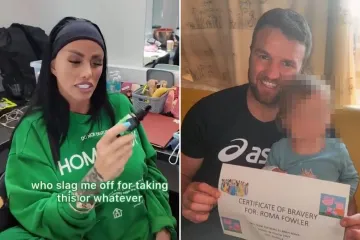
MYSTERY continues to surround Katie Price and new husband Lee Andrews after the pair STILL haven’t returned to the UK.
It came after speculation the businessman, who is now based in Dubai, was banned from touching down on home turf after “taking out a £200K loan in his ex’s name”.
Lee, 41, married the mum-of-five in Dubai last month, with the former glamour model returning back to the UK on her own just days later – as her husband explained she needed to return for her children.
After Katie returned to the UK to face her “horrified” family following her shock nuptials, Lee vowed he would soon be on a flight from the UAE to join her.
Sadly, her new spouse was a no-show in the UK and last week, we exclusively reported how Katie appeared to confirm her move to the UAE after splashing cash on luxury resorts.
In her latest Instagram video, Katie was seen wearing a grey vest as she stretched out on a bed.
She propped herself on her headboard for the clip and told fans: “Hey guys, so I’m still in Dubai”.
She told how she was “really missing” her CBD products which assist with her sleep.
At the end of her clip, she zoomed in on her face as she demanded: “Get me back to the UK for CBD”.
In her caption, she added further detail and wrote: “I miss my sleeping pattern.
“I couldn’t bring my products over to Dubai due to the laws but wow… this is when you realise it most, I miss taking my oil before bed and sleeping through the night”.
The Sun exclusively revealed the former glamour model said I Do with businessman Lee Andrews in a plush ceremony in Dubai last month.
The shock engagement news came only a matter of weeks after Katie and former partner JJ, 32, called time on their two year romance.
In another video, which saw Lee brand Katie his “sweet little wife” and the TV star reply: “So we are still in Dubai but we are coming to England very soon”.
Lee then replied: “Within a day”.

We take a look back at the highs and lows of Katie Price’s relationship history.
1996-1998: Katie got engaged to Gladiators star Warren Furman – aka Ace – with a £3,000 ring. But their relationship didn’t make it as far as ‘I do’.
1998-2000: Katie described Dane Bowers as ‘the love of her life’ but she broke up with the singer after he allegedly cheated on her.
2001: Footballer Dwight Yorke is the father of Katie’s eldest child Harvey. He has had very little to do with his son throughout his life.
2002: Rebounding from Dwight, Katie famously had one night of passion with Pop Idol star Gareth Gates, allegedly taking his virginity.
2002-2004: Katie was dating Scott Sullivan when she entered the jungle for I’m A Celebrity…Get Me Out Of Here!. He threatened to “punch Peter’s lights out” when chemistry blossomed between her and Peter Andre.
2004-2009: The jungle romance resulted in Katie marrying Aussie pop star Peter. They had two kids, Junior and Princess, before their bitter split in 2009.
2010-2011: Fresh from her break-up with Peter, Katie enjoyed a whirlwind relationship and marriage with cage fighter Alex Reid. They split 20 months after their Las Vegas wedding.
2011: Katie briefly dated model Danny Cipriani… but it ended as quickly as it begun.
2011-2012: They didn’t speak the same language, but Katie got engaged to Argentinian model Leandro Penna in 2011. He later fled home to South America.
2012-2018: Wedding bells rang once more after Katie met Kieran Hayler in 2013. They eventually called it quits after a rocky marriage.
2018-2019: Katie moved on quickly with Kris Boyson. They had an on-off romance for one year and even got engaged. They split for good in 2019.
2019: Katie was linked to Charles Drury during her on-off relationship with Kris. Charles, who also dated Lauren Goodger, has always denied being in “official relationship” with her.
2020-2023: Car salesman Carl Woods took a shine to Katie in 2020. Their relationship was up and down for three years. They broke up for a final time last year.
2024-2026: After weeks of rumours, Katie confirmed her relationship with Married At First Sight star JJ Slater in February 2024. The pair split in January 2026 after two years together.
2026: Katie shocked fans when she revealed she had married Dubai-based businessman Lee Andrews after a 48-hour engagement and only knowing him a week.
It remains to be seen if the pair will touch down on home turf any time soon.
After the pair became man and wife, reports – which Lee has denied – suggested he had been banned from leaving the country after he forged his ex’s signature for a £200,000 loan.
Lee allegedly applied for a mortgage in personal trainer Dina Taji’s name last year without her knowledge.
When she received a call from the bank about the application, she took legal action.
He spent three weeks inside the notorious Al-Awir central prison shortly before meeting Katie. It is unclear at what stage the investigation is at.
The city’s law prevents people involved in active criminal and civil cases from leaving the country, though Lee told the Mail it was “complete b******s” that he couldn’t leave.

KATIE Price tied the knot with Lee Andrews in January 2026. Yet who is he?
He went on to say: “First of all, I’ve been travelling all over Christmas, prior to January, and I’m actually travelling tonight to the UK so no, I don’t have a travel ban.
“And the Dina Taji issue was something else, but I don’t have a mortgage either for £200,000, that’s completely not right.”
He added that he has been house-hunting for a new home for him and Katie.
We revealed over the weekend how Lee was arrested at his home in the emirate over allegations of obtaining money by deception.
The Mail also reports that Andrews “begged” other inmates for £5,966 to help secure his release, before turning to one of his ex-wives.
The Sun contacted Lee for comment at the time.
During his three weeks in the overcrowded prison – where violence and infections are rife – Lee shared a huge cell with 65 other inmates.
Lee, whose fantasist online claims were exposed by The Sun, was finally freed after apparently paying court fines.
Just weeks after his release last November, he struck up an online romance with Katie – before the pair stunned relatives by tying the knot in Dubai.

12:09, 17 Feb 2026Updated 12:45, 17 Feb 2026

The coast is the sunniest part of the UK (Image: Oscarhill via Getty Images)
A breathtaking sandy beach in one of Britain’s sunniest corners has earned a spot on a prestigious list of the world’s finest coastal destinations.
Yaverland Beach at Sandown on the Isle of Wight has secured its place on Tripadvisor’s Best of the Best list, unveiled this morning. Claiming the No. 15 position in its first appearance, it outranks beaches in Turkey, Indonesia and Greece. Celebrated as a jewel in Britain’s coastal crown, Yaverland Beach features an expansive, golden, dog-friendly stretch with crystal-clear, shallow waters and striking multi-coloured cliffs.
With top-notch facilities on site and the award-winning The Beach Cafe nearby, it makes for an ideal day out throughout the year.
There’s solid reasoning behind why Yaverland deserves a visit. The Met Office has recently named the Isle of Wight Britain’s sunniest location, with inhabitants of this southern haven enjoying an average of five hours of sunshine daily, reports the Express.
This stands in stark contrast to the UK’s gloomiest spot, Lowther Hill in Scotland, which manages just shy of 2 hours and 45 minutes of daily sun.
Since last May, the brightest spot in the nation’s brightest region has officially been Shanklin, a beloved seaside destination on the island’s eastern shore that’s witnessed a surge in visitor numbers lately. Sandown lies merely 2.5 miles along the coast from Shanklin, meaning it’s clearly absorbing plenty of sunshine too.
The picturesque Sandown Bay earned the title of Britain’s favourite beach from Countryfile Magazine readers back in 2019. The stunning stretch spans eight miles of coastline linking Sandown and Shanklin.
Capitalising on this glorious setting and beautiful shoreline, a local community group is currently constructing a new tidal sea pool at Yaverland. Billed as “Olympic-sized and accessible”, it would mark the first development of its kind in the UK for a hundred years, according to the organisation.
Best UK holiday cottage deals
From £27 per night
Sykes Cottages
Sykes Cottages offers a wide range of handpicked holiday homes across the UK and Ireland, from cosy countryside retreats to stunning coastal escapes. Prices start from £27 per night
Another remarkable local attraction is Shanklin Chine – a striking, largely concealed tourist destination that carves through the clifftops overlooking the Shanklin stretch of beach before descending onto the sand. A chine refers to a stream eroding into soft cliff faces, with Shanklin’s example formed over the past 10,000 years, extending 400m with an impressive 32m vertical drop. This wooded coastal gorge features waterfalls, woodland, and abundant greenery, with pathways and walkways offering paid entry for tourists.
This coastal location has welcomed numerous distinguished guests, including Charles Dickens, poet John Keats, American poet Longfellow, Lewis Carroll, and Charles Darwin, who penned portions of his work Origin of the Species there.
1. Isla Pasion – Cozumel, Mexico
Good for Private island oasis, crystal-clear waters, marine life encounters, and snorkeling, which travelers can book through this Catamaran Snorkel Adventure to El Cielo and The Money Bar Beach experience.
Best time to go: November-April
Unique features: Protected coral reefs, sea turtle nesting sites, exclusive day-trip destination
2. Elafonissi Beach – Crete, Greece
Good for: Pink sand phenomenon, shallow lagoons, protected nature reserve, and can be easily accessed from Chania through the Elafonissi Beach Trip from Chania tour.
Best time to go: May & September
Unique features: Rare pink sand created by crushed shells
3. Balos Lagoon – Kissamos, Greece
Good for: Turquoise lagoon waters, dramatic landscapes, and Instagram-worthy vistas like this Balos & Gramvousa Luxury Catamaran Sailing Cruise from Kissamos experience.
Best time to go: April-June, September-October
Unique features: Former pirate hideout, protected Natura 2000 site
4. Eagle Beach – Eagle Beach, Aruba
Good for: Pristine white sand, watersports paradise, activities like this 3-Hour Electric Scooter Island Tour in Arubadivi.
Best time to go: April-August
Unique features: Sea turtle nesting ground, iconic Ffofoti trees
5. Praia da Falésia – Algarve, Portugal
Good for: Ochre cliffs with spectacular views that can be experienced during this Benagil And Dolphins Tour.
Best time to go: April-October
Unique features: Dramatic red cliff formations
6. Banana Beach – Ko He, Thailand
Good for: Crystal-clear waters and vibrant coral reefs with amazing snorkeling that travelers can book through this Banana Beach Snorkeling Adventure.
Best time to go: November-March
Unique features: Part of Racha Islands, premier diving destination
7. La Jolla Cove – California, USA
Good for: Sea lion colonies, underwater park, kayaking adventures like this Sea Caves Kayak Tour.
Best time to go: March-May, September-November
Unique features: Protected marine reserve, year-round wildlife viewing
8. La Pelosa Beach – Sardinia, Italy
Good for: Caribbean-like waters, ancient watchtower views that can be experienced through this Half Day Catamaran Tour to La Pelosa with Aperitif tour.
Best time to go: June-September
Unique features: 16th-century Torre della Pelosa
9. Manly Beach – Sydney, Australia
Good for: Surf culture, beachside promenade, a scenic Sydney Harbour Ferry Ride.
Best time to go: September-May
Unique features: Historic surfing beach, pine tree-lined Corso
10. Boulders Beach Penguin Colony – Simon’s Town, South Africa
Good for: African penguin sanctuary, granite boulders that travelers can experience during this Table Mountain, Boulders Penguins and Cape point Day Tour.
Best time to go: September-April
Unique features: One of few mainland penguin colonies globally


Emergency medical and repatriation claims in the US average close to £20,000(Image: GETTY)
Thousands of holidaymakers will be heading across the Atlantic this year, many driven by the 2026 FIFA World Cup, but they could be risking £20,000 on average if they don’t arrange vital protection before jetting abroad. While most are trying to sort flights, accommodation and match tickets, experts have urged people to double check their travel insurance too.
Dr Asimah Hanif, an NHS GP working with travel insurance provider Staysure, explained that medical care abroad can often leave travellers out of pocket. However, in the United States this can be an even bigger problem as there is no universal healthcare and medical costs are known to run into the thousands for standard hospital treatment.
She said: “Many people assume they will only need medical care abroad in the event of a serious emergency. However, this overlooks more common health issues such as heat exhaustion or infectious illnesses like flu, which can easily spread in crowded, hot environments.
“For older travellers, or those with pre-existing medical conditions, these seemingly minor issues can quickly lead to the need for medical treatment and result in significant costs, particularly in the United States.”
The FIFA World Cup will be taking place across Mexico, Canada and the United States this summer, with ticket demand breaking records and thousands planning to attend. For many, this will be a once-in-a-lifetime experience.
However, common football ailments like slips and trips can spell financial disaster for some. The summer heat and long journey is also expected to increase the likelihood of injuries and illness among the crowds.
Staysure data from 2025 showed biggest claims in these countries were for hospital treatment, emergency care and medical repatriation. The average claim had a cost of close to £20,000 with some extreme cases even exceeding £1million.
Dr Asimah added: “These are not unusual scenarios, things like chest pain, dehydration, infections or a fall can mean scans, overnight hospital stays or specialist treatment. In North America, those costs escalate very quickly.”
She warned that one of the biggest mistakes travellers and football fans can make this year is leaving their travel insurance for the last minute or assuming they won’t need it at all.
She added: “Travel insurance is not just about lost luggage or delays. It is about making sure you are protected financially and medically if something unexpected happens. With the right cover, you can focus on enjoying the experience rather than worrying about worst case scenarios.”
The doctor encouraged people to try arrange medical travel insurance as soon as their trip is booked.

A POPULAR lido that opened in the 1930s with its own sunbathing solarium could be demolished to make way for new homes.
The building was used as a bingo hall in recent years but has been vacant since 2023.

Opened to the public on July 10, 1935, Sale Lido also boasted shops and restaurants.
Its main feature was a 130-ft long swimming pool, which could be covered over to form a dancefloor during the winter months.
Now, plans have been submitted jointly by McCarthy Stone and Built Development Ltd which, if approved, would see most of the building in Trafford, Greater Manchester, torn down.
The developers claimed Mecca, which recently operated a bingo hall on the site, had pulled out due to its “state of disrepair”.
Developers said this has led to water leaking into the building and has affected its structure, reported the Manchester Evening News.
Just the lido’s facade would remain under the scheme proposed by the two companies, with two new blocks of flats constructed on adjacent land.
In a Facebook post, residents urged Trafford Council to refuse planning permission.
One wrote: “The Lido’s a Sale landmark, knocking it down would be a stupid decision – even if the facade is kept!
“Is there any kind of form to sign that’s against this happening?”
Another person posted: “More lovely architecture replaced by grey boxes. Why can’t they keep the building?”
A third person said: “Please keep this iconic building. It’s part of Sale.”
A spokesperson for Trafford Council said: “An application has been submitted at the site of the former Sale Lido for a housing development of 40 retirement apartments and 39 affordable homes.
“The application is under consideration by the Council and will be determined in due course.”


The Rev. Jesse Jackson, a child of Southern segregation who rose to national prominence as a powerful voice for Black economic and racial equality, has died.
Jackson, who had battled the neurodegenerative condition progressive supranuclear palsy for more than a decade, died at home surrounded by family. His daughter, Santita Jackson, confirmed his death with the Associated Press. He was 84. Jackson was originally diagnosed with Parkinson’s disease in 2017 before the PSP diagnosis was confirmed in April.
Handsome and dynamic, an orator with a flair for memorable rhyme, Jackson was the first Black candidate for president to attract a major following, declaring in 1984 that “our time has come” and drawing about 3.5 million votes in Democratic primaries — roughly 1 in 5 of those cast.
Four years later, using the slogan “Keep hope alive,” he ran again, winning 7 million votes, second only to the eventual nominee, Massachusetts Gov. Michael S. Dukakis. His hourlong speech at the 1988 Democratic National Convention brought many delegates to tears and provided the gathering’s emotional high point.

Rev. Jesse Jackson and his wife, Jacqueline, acknowledge the cheers of delegates and supporters before his emotional speech to the Democratic National Convention in Atlanta on July 20, 1988.
(John Duricka / Associated Press)
“Every one of these funny labels they put on you, those of you who are watching this broadcast tonight in the projects, on the corners — I understand,” he said. “Call you outcast, low down, you can’t make it, you’re nothing, you’re from nobody, subclass, underclass; when you see Jesse Jackson, when my name goes in nomination, your name goes in nomination.”
For nearly a generation, from the 1970s into the 1990s, that ability to absorb the insults and rejection suffered by Black Americans and transmute them into a defiant rhetoric of success made Jackson the most prominent Black figure in the country. Both beneficiary and victim of white America’s longstanding insistence on having one media-anointed leader serve as the spokesman for tens of millions of Black citizens, he drew adulation and jeers but consistently held the spotlight.
Supporters greeted his speeches with chants of “Run, Jesse, run.” Opponents tracked every misstep, from audits of his grants in the 1970s to his use of the anti-Jewish slur “Hymietown” to refer to New York City during the 1984 campaign, to the disclosure, in 2001, that he had fathered a daughter in an extramarital affair.
As he dominated center stage, the thundering chorus of his speeches — “I am … somebody” — inspired his followers even as it sometimes sounded like a painful plea.
Jackson’s thirst for attention began in childhood. Born out of wedlock on Oct. 8, 1941, he often stood at the gate of his father’s home in Greenville, S.C., watching with envy as his half-brothers played, before returning to the home he shared with his mother, Helen Burns, and grandmother, Mathilda.
During high school, his father, Noah Robinson, a former professional boxer, would sometimes go to the football field to watch Jesse play. If he played well, Noah would sometimes tell others, “That’s one of mine.” For the most part, however, until Jesse was famous, he shunned his son, who was later adopted by the man his mother married, Charles Jackson.
It was his grandmother, known as Tibby, who encouraged Jackson’s ambition. A domestic in stringently segregated Greenville, Tibby brought home books and magazines, such as National Geographic, that her white employers’ children had discarded.
“Couldn’t read a word herself but she’d bring them back for me, you know, these cultural things used by the wealthy and refined,” Jackson once said. “All she knew was, their sons read those books. So I ought to read them too. She never stopped dreaming for me.”
Her dreams propelled Jackson toward college — as did a need to avenge the childhood taunts that echoed in his head. An honors student, he turned down a contract to pitch for the Chicago White Sox to accept a football scholarship to the University of Illinois.
At Christmas break, he came home with a list of books. A librarian at the McBee Avenue Colored Branch referred him to the white library downtown and called ahead to clear the way. When he entered the main library, two police officers stood at the loan desk. A librarian told him it would take at least six days to get the books from the shelves. When he offered to get them himself, the officers told him to leave.
“I just stared up at that ‘Greenville Public Library’ and tears came to my eyes,” Jackson told a biographer, Marshall Frady.
That summer, 1960, Jackson came home and led a sit-in at the library, his arrest a first taste of civil disobedience. In the fall, he transferred to North Carolina A&T State University in Greensboro. There he became the star quarterback and participated in the beginnings of the sit-ins that became a signature part of the civil rights movement led by the Rev. Martin Luther King Jr.
“It wasn’t a matter of Gandhi or Dr. King then,” he said of the library sit-in, “it was just my own private pride and self-respect.”
With his height and his oratorical flourishes, Jackson was a charismatic figure who led protests in Greensboro. Once, during a demonstration outside a cafeteria, as police were about to arrest the demonstrators, Jackson suggested they kneel and recite the Lord’s Prayer.
“Police all took off their caps and bowed their heads,” he said. “Can’t arrest folks prayin’.”
Then he led the demonstrators in “The Star-Spangled Banner.”
“They stopped, put their hands over their heart,” Jackson said. “Can’t arrest folks singing the national anthem.”
After half an hour, he recalled, “we got tired and let ’em arrest us.”
Elected student body president, Jackson graduated in 1963. A grant from the Rockefeller Fund for Theological Education brought him to the Chicago Theological Seminary, where he hoped to find a venue for social activism.
That summer, Jackson traveled to Washington, where he heard King deliver his famous “I Have a Dream” speech. Two years later, he and a group of college buddies piled into vans to drive south for King’s Selma-to-Montgomery march. He met King there, and early the next year, King asked Jackson to head his Southern Christian Leadership Conference’s Operation Breadbasket in Chicago. The goal was to win economic gains for Black people with a combination of consumer boycotts and negotiated settlements.
At 24, Jackson was the youngest of King’s aides. Operating out of a hole-in-the-wall office at SCLC’s South Side headquarters, he began by organizing preachers, arranging for them to urge their congregations on Easter to boycott products made by a local dairy that employed no Black workers.
During the following week, Country Delight lost more than half a million dollars in revenue. Within days, the company offered a deal: 44 jobs for Black workers. Without waiting for a boycott, other dairy companies called with offers, too.
King soon asked Jackson to be the national director of Operation Breadbasket. Jackson hesitated — the job required him to leave the seminary six months short of graduation. Jackson recounted in his autobiography that King told him, “Come with me full time and you’ll learn more theology in six months than you would in six years at the seminary.” He earned his ordination several years later.

In 1968, Jesse Jackson stands to the left of the Rev. Martin Luther King Jr. on the balcony of the Lorraine Motel in Memphis, Tenn., where King was assassinated the next day.
(Charles Kelly / Associated Press )
In April 1968, Jackson joined King in Memphis, where the civil rights leader had decided to stand with striking Black sanitation workers. Few of King’s staff supported the effort, worrying that the strike — and the planned Poor People’s Campaign in Washington — distracted from the main goal of attaining voting and political rights for Black Americans.
During a planning meeting, King blew up at his aides, including Jackson. “If you’re so interested in doing your own thing, that you can’t do what this organization is structured to do, if you want to carve out your own niche in society, go ahead,” King yelled at Jackson, according to the latter’s account. “But for God’s sake, don’t bother me!”
The next day, standing below the balcony of the Lorraine Motel where the team was staying in Memphis, King yelled down at Jackson in joviality, as if to mitigate the outburst, inviting him to dinner.
Within moments, shots rang out. Jackson later said he ran upstairs and caught King’s head as he lay dying. Andrew Young, a King aide who later became U.S. ambassador to the United Nations, told Frady that he doubted Jackson had cradled King’s head, but that they all had rushed to the scene and all had gotten blood on their clothes.
But if all of them were touched by King’s blood, only Jackson wore his gore-stained olive turtleneck for days, sleeping and grieving in it, wearing it on NBC’s “Today Show” and before the Chicago City Council. In dramatizing the moment to his own benefit, Jackson provoked hostility from King’s widow and others in the movement’s leadership that lasted decades.
Richard Hatcher, the first Black mayor of Gary, Ind., and a Jackson supporter, recalled that once Jackson decided to run for president, the campaign thought it had the backing of the Black leadership.
“Big mistake. Big mistake,” Hatcher said. “Over the following months, every time things seemed to get going, here would come a statement from Atlanta, from Andy [Young] or Joe Lowery or Mrs. King, ‘We don’t think this is a good idea at all.’“
As Jackson’s media prominence grew — including a cover photo on Time magazine in 1970 — tensions erupted between Jackson and SCLC, in part because of the sloppy bookkeeping that became a Jackson characteristic. In late 1971, SCLC’s board suspended Jackson for “administrative impropriety” and “repeated violation of organization discipline.” Jackson resigned, saying, “I need air. I must have room to grow.”

Rev. Jesse Jackson raises a clenched fist from a police van after he and 11 others from Operation Breadbasket were arrested during a sit-in at the Atlantic and Pacific Tea Co., offices in New York City on Feb. 2, 1971. The organization, part of the Southern Christian Leadership Conference, has been protesting A&P’s alleged discrimination against blacks.
(MARTY LEDERHANDLER / Associated Press)
Calling a dozen Black celebrities to New York’s Commodore Hotel, Jackson formed his own organization. Originally called People United to Save Humanity — the presumptuous title was soon changed to People United to Serve Humanity — PUSH became his pulpit. Like Operation Breadbasket, its goal was to boost minority employment and ownership.
Jackson traveled the country preaching self-esteem and self-discipline. Thousands of youngsters took pledges to say no to drugs, turn off their television sets, study. They became the core of his voter registration drives, the inspiration for the “I am somebody” chant that would define his public ministry.
As with Operation Breadbasket, Jackson used PUSH to hold corporate America to account. In 1982, for example, he launched a boycott of Anheuser-Busch with the slogan “this Bud’s a dud.”
“We spend approximately $800 million with them [annually]. Yet, out of 950 wholesale distributorships, only one is Black-owned,” Jackson said.
Shortly thereafter, Anheuser-Busch contributed $10,000 to Jackson’s Citizenship Education Fund, contributed more than $500,000 to the Rainbow PUSH coalition, and established a $10-million fund to help minorities buy distributorships.
In 1998, 16 years later, the River North beer distributorship in Chicago was purchased by two of Jackson’s sons, Yusef and Jonathan. (Jackson’s eldest son, Jesse Jackson Jr., won election to Congress from Chicago in 1995, but resigned and was convicted of fraud in 2013 for misuse of campaign funds. Jackson and his wife, Jacqueline, also had two daughters, Jacqueline and Santita. A third daughter, Ashley Laverne Jackson, was the child of his relationship with a PUSH staff member, Karin Stanford.)
Critics called the PUSH campaigns elaborate shakedowns. Others, like Jeffrey Campbell, president of Burger King when Jackson opened negotiations in 1983, found the encounter with Jackson and his rhetoric of economic empowerment inspiring.
“Before they came in, my view was that we ought to fight them, that this guy Jackson was a monster, and I had the backing of my bosses to walk out if necessary,” Campbell told the Los Angeles Times in 1987. But Campbell said he quickly changed his mind.
“He got to me very quickly, without me realizing it, when he started talking about fairness. He would say: What is fair? Blacks give you 15% of your business — isn’t it fair that you give 15% of your business, your jobs, your purchases back to the Black community, the Black businesses?
“That little seed began to grow in the back of my mind,” Campbell said. “It was the right question to ask me.”
How Jackson handled money gave critics additional openings. Between 1972 and 1988, PUSH and its affiliates attracted more than $17 million in federal grants and private contributions. After many audits, the Justice Department sought $1.2 million in repayments, citing poor recordkeeping and a lack of documentation.
Jackson gave little thought to such issues. “I am a tree-shaker, not a jelly-maker,” he would often say.
Management held little interest for him. But politics was a different matter.
From the moment he began urging and registering Black Americans to vote, Jackson found his milieu. He used PUSH resources to staff get-out-the-vote drives that helped elect Hatcher in Gary, Kenneth Gibson in Newark, N.J., and Carl Stokes in Cleveland.
In those days, he also advocated participating in both parties, what he called “a balance of power.” In 1972, he claimed he had registered 40,000 Black voters to support Illinois’ white Republican senator, Charles Percy.
That same year, at the Democratic convention in Miami, Jackson unseated Chicago Mayor Richard Daley’s 58-member Illinois delegation and replaced it with a “rainbow” of his own, even though he had never voted in a Democratic primary. Liberal Democrats who despised Daley as a corrupt big-city boss hailed Jackson as a hero.
In the decade to come, Jackson basked in celebrity and international travel, including a controversial meeting with Yasser Arafat. Jackson met the then-leader of the Palestine Liberation Organization in 1979 when he traveled to Syria to free U.S. pilot Robert Goodman, who’d been shot down while on a bombing mission. By the time Jackson declared his 1984 presidential campaign, he had burnished his foreign policy credentials.
At the convention that year in San Francisco, he predicted that in an era of Reaganomics, a Rainbow Coalition of ethnic and religious identities could retake the White House.
“We must leave the racial battleground and come to economic common ground and moral higher ground,” he said in a memorable speech.
“America, our time has come. We come from disgrace to amazing grace. Our time has come,” he said. “Give me your tired, give me your poor, your huddled masses who yearn to breathe free and come November, there will be a change, because our time has come.” Delegates roared to their feet.

The Rev. Jesse Jackson, a candidate for the democratic nomination for President, works the crowd from onstage following a speech at the Cincinnati Convention center, Friday, April 13, 1984.
(Al Behrman / Associated Press)
But they did not nominate him. Nor did the convention of 1988. Addressing Black ministers in Los Angeles in 1995, the hurt still showed as Jackson railed at the injustice of beating Al Gore in the presidential primaries, only to watch as he was tapped by Bill Clinton to be his running mate in 1992.
“In 1988, I beat him in Iowa, a state 98% white; he said it was ’cause of liberals and farmers. So I beat him in New Hampshire; he said it was ’cause he was off campaigning in the South. So I beat him in the South on Super Tuesday; he said Dukakis had split his support. I beat him then in Illinois, in Michigan; he said he wasn’t really trying. I beat him then in New York; said he ran out of money. But now, here I am this afternoon, talking to y’all in this church in South Central L.A. — and he’s vice president of the United States.”
To many of his Democratic opponents, however, Jackson’s “rainbow coalition” symbolized not common ground, but the party’s devolution into a collection of identity caucuses whose narrow causes doomed them to defeat. In 1992, many of those critics gathered around Clinton as he formulated his “New Democrat” campaign. Clinton soon used Jackson as a foil.
The occasion came when Jackson invited rap singer and activist Sister Souljah to a political event featuring the Arkansas governor. In an interview, Souljah had wondered why after all the animus of white people toward Black people, it was unacceptable for Black people to kill whites. Clinton, instead of delivering the usual liberal-candidate-seeks-Black-votes hominy, lashed out at her words.
The moment bought Clinton a priceless image of willingness to speak truth to the party’s interest groups but came at the price of Jackson’s rage.
“I can maybe work with him, but I know now who he is, what he is. There’s nothin’ he won’t do,” Jackson said to Frady. “He’s immune to shame.”
By then, however, Jackson’s prominence had already begun to wane. Indeed, the role of race leader, itself, had started to disappear. The civil rights revolution in which Jackson had figured so prominently had allowed a new and more diverse generation of Black elected officials, corporate executives and public figures to flourish. Their success eroded his singular platform.

Democratic presidential hopeful Sen. Barack Obama, D-Ill., right, laughs after saying goodbye to Rev. Jesse Jackson, reflected left, after Obama addressed the Rainbow PUSH Coalition’s annual conference breakfast in Rosemont, Ill. on June 4, 2007
(harles Rex Arbogast / Associated Press)
Jackson continued to travel, agitate, protest, but the spotlight had moved on. He dreamed that Jesse Jr. might one day win the office he had pursued. When, instead, another Black Democrat from Chicago, Barack Obama, headed toward the Democratic nomination in 2008, Jackson’s frustration spilled into public with a vulgar criticism of Obama caught on microphone.
In Obama’s White House, he suffered what for him might have been the severest penalty — being ignored.
Yet to those who had seen him in his prime, his image remained indelible.
“When they write the history of this campaign,” then-New York Gov. Mario Cuomo said after the 1984 contest, “the longest chapter will be on Jackson. The man didn’t have two cents. He didn’t have one television or radio ad. And look what he did.”
Jackson is survived by his wife, Jacqueline, and six children, Jesse Jr., Yusef, Jonathan, Jacqueline, Santita and Ashley.

the Rev. Jesse Jackson speaks at the League of United Latin American Citizens convention Friday, June 30, 2006, in Milwaukee. (AP Photo/Morry Gash)
(Morry Gash / Associated Press)
Lauter and Neuman are former Times staff writers.

Watch the best goals from across the FA Cup fourth-round weekend, including a stunning free kick from Mansfield’s Louis Reed and a strike from outside the box by Newcastle’s Sandro Tonali.
Source link

11:37, 17 Feb 2026Updated 11:40, 17 Feb 2026

A few Drayton Manor rides were open along with Thomas Land(Image: Matthew King)
If you have a child of primary school age, the soundtrack to your life is likely to be the cheery sounds of K-Pop. K-Pop, which stands for Korean Pop, has been on many music fans’ radar for years now, but 2026 is likely to be a big year for the genre.
Not only has K-Pop Demon Hunters become the most-watched original title in Netflix history with 500 million views – quite a few of which have come from my house – but K-Pop bands have been all over the charts. In August 2025, a record seven K-Pop tracks made the top 40 singles chart, including BLACKPINK and Stray Kids. A recent tour announcement by BTS saw a Taylor Swift-style clamber for tickets and UK dates sold out in 30 minutes.
So, it wasn’t a huge surprise to see that Drayton Manor, a theme park in the West Midlands, would be hosting a K-Pop Takeover for February half term. My daughter was thrilled to be going to a K-Pop themed day and wore her favourite HUNTR/X hoodie for the occasion. And of course, Spotify was cued up with an appropriate playlist on the way.
While the park isn’t fully open during February half term, in addition to the K-POP activities the ticket price includes Thomas Land, a handful of rides, plus the zoo. With tickets starting at £19.90, the price reflects that you won’t get the full theme park experience.
We arrived just in time for ‘K-Pop games’ on the park’s main stage, and a very enthusiastic entertainer was leading some kids in a game of red light, green light, followed by some singing along to the tune of Golden. There was also a K-Pop themed dance workshop later on, with excited kids dancing in front of the sparkly stage.
Other than some Korean fried chicken being served in the burger bar, and some Korean souvenirs in the gift shop, there wasn’t a huge amount of K-Pop theming throughout the park. However, the end of day K-Pop concert definitely brought in the crowds and seemed to be widely enjoyed.
Three entertainers, dressed as a K-Pop girl group, sang songs by HUNTR/X, Saja Boys, and Rosé, bringing the day to a close with a water show in the park’s lake. Kids and adults were bopping along to the tunes, and I was impressed that the group’s lead singer managed to tackle the high notes in Golden.
But the real draw at Drayton Manor is Thomas Land. While it took the silver award for Best Theme Park for Toddlers in 2025, people of all ages seem delighted when wandering around the Sodor-themed attraction. Even grown adults were posing for photos with Thomas, showing the nostalgia around the show never went away.
It seemed to be a good time to visit. Queues were pretty minimal on most of the rides, although we did unfortunately wait half an hour to get on Winston’s Whistle-Stop Tours only for the ride to break down. However, quite a few of the smaller rides had no queue at all, and it meant we got a couple of turns on Toby’s Tram Express and some other favourites.
Thomas Land also had regular shows, and we got the chance to meet Sir Topham Hatt, or depending on your age, the Fat Controller. The performer was great, and I noticed he could communicate in Makaton – a type of sign language often used for children with learning or communication difficulties. It would be great to see more theme parks train staff in this way to make the entertainment more inclusive.
READ MORE: Ibiza and Majorca could end up restricting tourist numbers under radical plansREAD MORE: Wizz Air becomes third airline to offer Brits bag drop hack for early morning flights
So, is this review Golden or is it a Takedown? Overall, I’d say it’s worth visiting the park for the K-Pop Takeover. Outside of the main stage, there’s not a whole lot of K-Pop theming, but enough to keep fans happy. The end of day concert was definitely a highlight for my youngest and she hasn’t stopped talking about it, and concert only tickets are available if you just want to visit later on. But Thomas Land is always worth a day out. Just make sure you bring your big coat.
You can find out more on draytonmanor.co.uk.
Have a story you want to share? Email us at webtravel@reachplc.com

This article from the Occasional Digest examines the cultural significance and traditional customs associated with the Chinese New Year, often referred to as the Spring Festival. Although the holiday occurs during the winter months, it aligns with the ancient solar calendar’s definition of spring’s arrival. The author describes an extensive preparation process that involves purchasing gifts and performing a thorough cleaning of the home to eliminate misfortune. Throughout the festivities, the color red is featured prominently on dwellings to invite positive energy for the coming year. Beyond the cultural focus, the source also highlights current global eventsfrom early 2026, including political negotiations and s …

Hundreds of millions of people around the world are celebrating the Lunar New Year. They’re welcoming in the Year of the Horse. Rob McBride reports from the Temple of Earth in Beijing, on the first day of the Chinese New Year.
Published On 17 Feb 202617 Feb 2026
Share

This week, the Israeli government approved a plan to designate large areas of the occupied West Bank as “state property”, shifting the burden of proof to Palestinians to establish ownership of their land.
The decision, which undermines the Palestinian people’s right to self-determination, has prompted regional condemnation, with many describing it as a de facto annexation which is illegal under international law.
In recent years, Israel has intensified its military incursions, expanded illegal settlements, and demolished Palestinian homes, all as part of a series of aggressive actions to steal more Palestinian land.
In total, at least 37,135 Palestinians were displaced across the occupied West Bank in 2025, a record high amid Israeli military incursions and settler attacks, according to figures compiled by the United Nations Office for the Coordination of Humanitarian Affairs (OCHA).

According to UNRWA, Israeli military incursions have forcibly displaced at least 33,362 Palestinians from three northern refugee camps: Jenin (12,557), Tulkarem(11,862) and Nur Shams (8,943).
In addition to those displaced during Israeli operations, at least 3,773 have been forced from their homes due to Israeli home demolitions, settler violence, and access restrictions.
The West Bank governorates with the largest number of forced displacements include:
As part of the 1993 Oslo Accords, signed by the Palestine Liberation Organization (PLO) and Israel, the occupied West Bank was divided into three areas – A, B and C.
This led to the formation of the Palestinian Authority (PA) – an administrative body that would govern Palestinian internal security, administration and civilian affairs in areas of self-rule, for a five-year interim period.
Area A initially comprised 3 percent of the West Bank and grew to 18 percent by 1999. In Area A, the PA controls most affairs.
Area B represents about 22 percent of the West Bank. In both areas, while the PA is in charge of education, health and the economy, the Israelis have full control of external security, meaning they retain the right to enter at any time.
Area C represents 60 percent of the West Bank. Under the Oslo Accords, control of this area was supposed to be handed over to the PA. Instead, Israel retains total control over all matters, including security, planning and construction. The transfer of control to the PA never happened.
Although Area C is the least populated part of the West Bank, with about 300,000 Palestinians compared with about 3 million in Areas A and B, the vast majority of home demolitions and settler attacks occur there, due to it being under full Israeli military and administrative control.
The Israeli Civil Administration rarely grants building permits to Palestinians in this area, so nearly all construction is considered illegal and subject to demolition.

Since Israel’s genocidal war on Gaza began in October 2023, violence by Israeli settlers in the occupied West Bank has steadily risen.
According to data from OCHA, settlers have attacked Palestinians more than 3,700 times in the occupied West Bank over the past 28 months.
The number of settler attacks has risen sharply since 2016, with 852 recorded in 2022, 1,291 in 2023, 1,449 in 2024 and 1,828 in 2025 – an average of five attacks per day, according to data from OCHA.
Every West Bank governorate has faced settler attacks over the past year.
Data from OCHA shows that between January 1, 2025 and December 31, 2025, the Ramallah and el-Bireh governorate recorded the highest number of settler attacks with 523 incidents, followed by Nablus with 349 and Hebron with 309.

Settlers are Israeli citizens living in illegal, Jewish-only communities, known as Israeli settlements, built on Palestinian-owned land that Israel occupied in 1967.
Benjamin Netanyahu – Israel’s longest-serving prime minister – has bolstered settlement expansions since he first came to power in 1996, undermining the 1993 Oslo Accords, which called for the freezing of settlements and a mutually negotiated two-state solution.
Today, roughly 10 percent of Israel’s Jewish population, totalling between 600,000 and 750,000 people, live in about 250 settlements and outposts dispersed throughout the occupied West Bank and East Jerusalem.
Many of these settlements are located near Palestinian population centres, often leading to increased tensions and restrictions on movement for Palestinians.


