


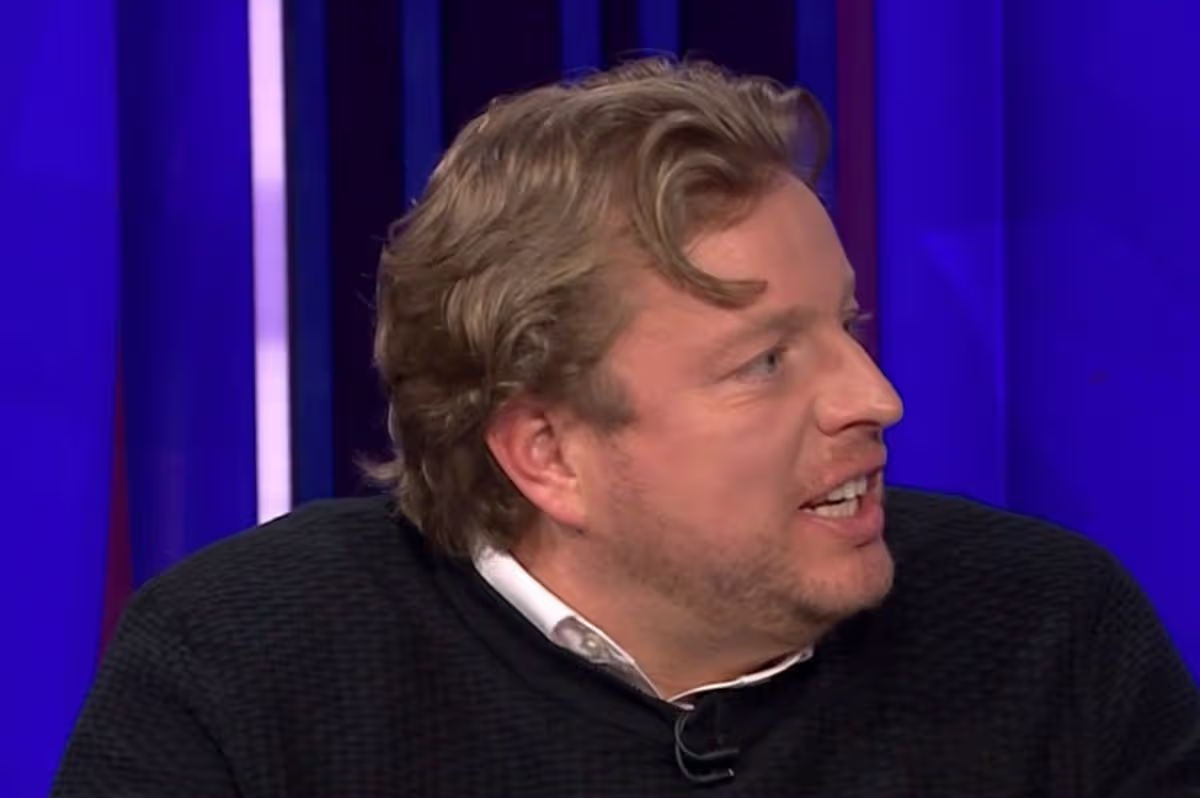
BBC Question Time’s Fiona Bruce stumps Tom Skinner amid social media showdown
Tom Skinner, an entrepreneur who was on The Apprentice in 2019, appeared on Question Time in Clacton-on-Sea, Essex, which featured a debate about social media giants

Tom Skinner came under fire on Question Time(Image: BBC)
TV personality Tom Skinner squirmed under interrogation from Fiona Bruce during a showdown about social media on Question Time.
The presenter of the topical debate programme accused Mr Skinner, 35, of being “part of the problem” amid the debate around the pros and cons of apps, such as TikTok and Instagram. The entrepreneur regularly posts videos to his 536,000 TikTok followers, including clips of him eating full English breakfasts at his favourite café. He told Question Time he also makes money by promoting products on Instagram, TikTok and other apps.
But Ms Bruce fronted him on his use of the platforms, suggesting he himself was actually playing into the challenges young people and their parents face with social media. Meta and Google were this week found liable for causing addiction in users in a landmark £2.2million legal case, which led to last night’s debate around how they government should help protect children from such addiction.
Addressing Mr Skinner, the host said: “As you said, you are benefiting from social media, you make part of your living that way and, part of the reason you are able to do so is because of the addictive algorithms that will push people towards yours (social media content)… It is giving you a platform, and job opportunities come your way because of it. In the nicest possible way, you are part of the problem.”
The remark led to a wry smile from Justice Minister Jake Richards, also on the panel in Clacton-on-Sea, Essex. Dad-of-three Mr Skinner hesitated as he answered, eventually insisting his videos are harmless.
READ MORE: Calls mount for UK social media ban as Meta hit with ruling over ‘addictive’ appsREAD MORE: Parents across UK to get new powers to limit teenagers’ social media use under trial
Ms Bruce, presenter of the programme since 2019, said: “How can you on the one hand say ‘people shouldn’t be doing it so much’ but, on the other hand, you are benefiting from it?” It left the entrepreneur stuttering again, before he went on to stress the importance of the roles parents should play in protecting children.
“It’s bad. It’s bad when people sit on their phone all day. I’ve seen it myself. I’ve done it myself, I sometimes know I’ve got to be up in four hours and I’ve sat there and I’ve scrolled my brains through, watching absolute nonsense,” Mr Skinner, from Romford, east London, said.
Other panellists defended Mr Skinner, arguing his clips are innocent and “do not drive the worst of the algorithms”. The case this week heard Meta and Google both were negligent in the design or operation of their platforms — including the “infinite scroll” feature that was claimed to trigger addiction in users.
The jury also decided each company’s negligence was a major factor in causing harm to a 20-year-old woman, who says her use of social media as a child addicted her to the technology and worsened her mental health struggles.
Both firms have strongly rejected the verdict and plan to appeal. Meta said: “We respectfully disagree with the verdict and are evaluating our legal options”. A spokesperson for Google added: “This case misunderstands YouTube, which is a responsibly built streaming platform, not a social media site.”
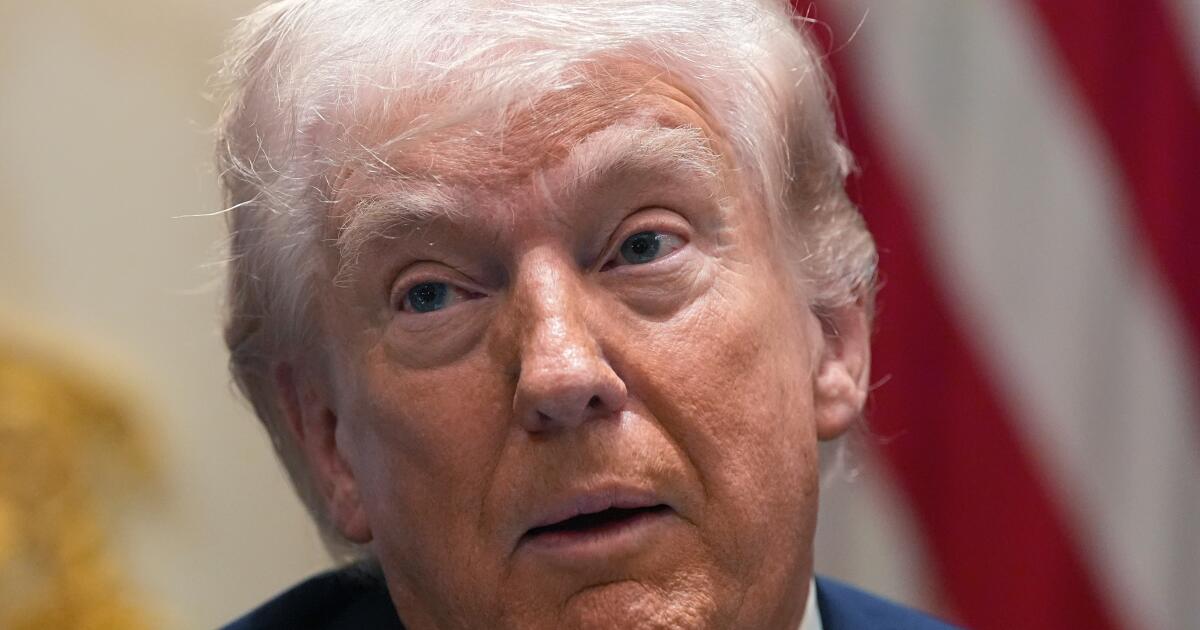
Treasury plans to put Trump’s signature on U.S. bills in first for sitting president
WASHINGTON — The U.S. Treasury Department is working on plans to put President Trump’s signature on all new U.S. paper currency, the agency announced Thursday.
The move would be a first for a sitting president. The news was first reported by Vanity Fair.
It’s the latest instance of Trump putting his name and likeness on American cultural institutions, following his renaming of the U.S. Institute of Peace, the Kennedy Center performing arts venue and a new class of battleships, among other tributes.
The plans come in tandem with an effort to get Trump’s face on a coin.
This month, a federal arts commission approved the final design for a 24-karat gold commemorative coin bearing Trump’s image to help celebrate America’s 250th birthday on July 4.
Treasury Secretary Scott Bessent’s signature would also appear on the currency, according to a Treasury news release.
Bessent said in a statement that “there is no more powerful way to recognize the historic achievements of our great country” than with U.S. dollar bills bearing Trump’s name.
U.S. Treasurer Brandon Beach said in a statement that printing Trump’s signature on the American currency “is not only appropriate, but also well deserved.”
The Mint, which is part of the Treasury Department, manufactures and distributes the currency.
Hussein writes for the Associated Press.

Edin Dzeko: Bosnia-Herzegovina veteran could join oldest players in World Cup history
Dzeko has been a crucial player for his country since his international debut in 2007, and has 73 goals in 147 appearances – scoring every year for the past two decades.
Until as recently as last year he was still reaching double figures for goals at club level.
Last summer, he returned to Serie A to sign for Fiorentina and, at the time, dismissed suggestions he was slowing down with age.
“Age doesn’t matter, I’m not a write-off yet,” he said.
“Behind all this is the work that a 39-year-old has to do, even more than others. I feel good, we’re working hard, and this will bring us satisfaction later.”
That move did not quite work out and Dzeko soon found himself out of favour at the club, having failed to score in 11 Serie A games.
But a switch to Schalke in Bundesliga 2 in January has reinvigorated him – possibly at just the right time as the World Cup approaches – and he has scored six goals in eight games for the German side.
On what the future holds for him, Dzeko said recently: “I’ll listen to my body in the summer but at the moment, I still feel very good, and I still score goals.”
But if he does help his country qualify for the World Cup, it is very likely that conversation with his body will be delayed a little longer.
South Dakota election integrity bills signed into law
South Dakota Gov. Larry Rhoden on Thursday signed a bill into law requiring people registering in the state for the first time to prove their citizenship. File Photo by Graeme Sloan/EPA
March 26 (UPI) — South Dakota Gov. Larry Rhoden on Thursday signed six election-related bills, including one that requires newly registered voters to prove their citizenship.
The bills, which Rhoden, his administration and the state legislature said are meant to protect the integrity of the state’s elections, also affect campaign finance disclosures, publication of election results, processing of absentee ballots, publication of statewide voter registration files and the submission of nomination petitions.
The voter registration law, called the South Dakota SAVE Act, is one of several that states across the country have been considering as similar legislation has been the subject of heated debate in both the U.S. House and U.S. Senate.
“In South Dakota, we do things right, especially when running out state elections,” Rhoden said in a press release.
“This bill ensures only citizens vote in state elections, keeping our elections safe and secure,” he said.
All six bills that Rhoden signed were named emergencies, which allows them to go into effect immediately, as opposed to July 1, when laws in South Dakota usually go into effect.
This will allow for the requirements to apply to the state’s June 2 primary elections, registration for which has a May 18 deadline, the South Dakota Searchlight reported.
The governor’s office said the state’s SAVE Act applies only to state elections and only to people who are registering to vote in South Dakota for the first time, and will need to show a passport, birth certificate or other document that proves they are a U.S. citizen.
South Dakota residents who are already registered do not need to take any action, and those who need to update their name, address or other information are not required to prove their U.S. citizenship.
“Noncitizens cannot vote in South Dakota — this bill is wholly unnecessary,” South Dakota Democratic state Rep. Erik Muckey said during debate of the bill, The New York Times reported.
Earlier this year, Rhoden also signed into law a bill that would allow voters to challenge the citizenship of other registered voters with a sign, sworn statement and some type of documented evidence.
That law will not take effect before the primary, but it will be effective during the general election in November.

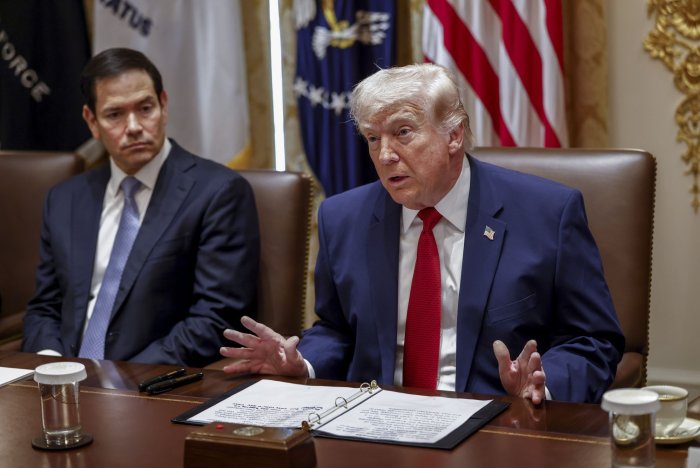
President Donald Trump speaks as Secretary of State Marco Rubio listens during a cabinet meeting at the White House on Thursday. Photo by Will Oliver/UPI | License Photo
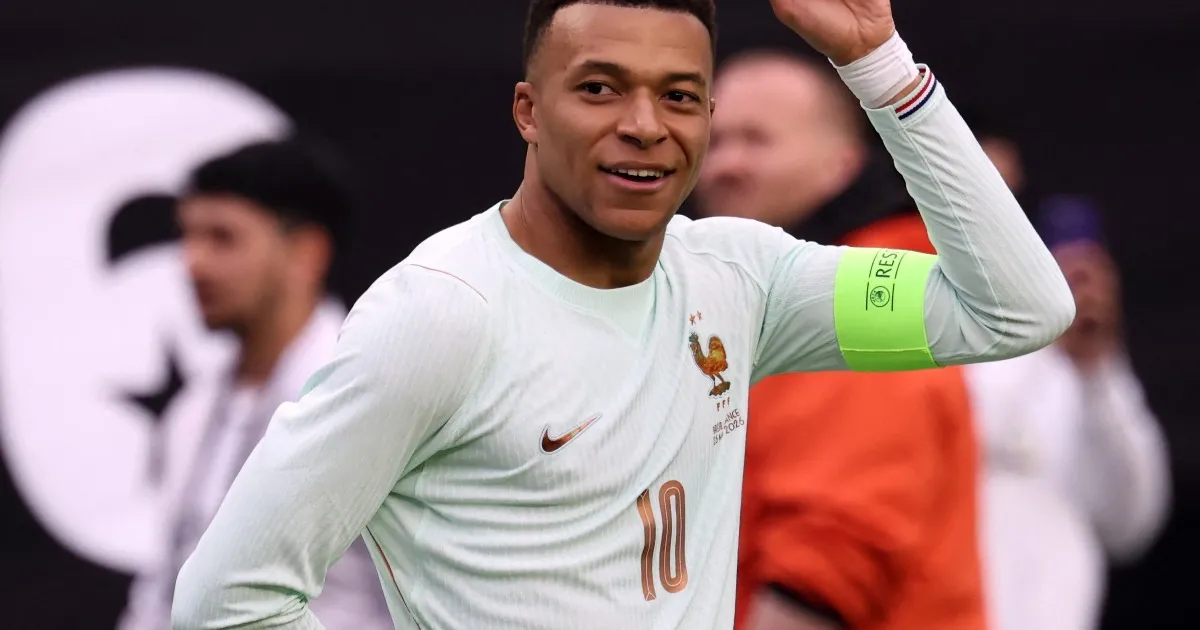
Mbappe nets for 10-man France in win against Brazil in World Cup warm-up | World Cup 2026 News
France beat Brazil 2-1 in a friendly in the United States, in what was a potential dress rehearsal for World Cup 2026 final.
Published On 26 Mar 2026
France forward Kylian Mbappe showed no ill effects of his left knee injury when he broke free for a goal to give France an early lead on its way to a 2-1 victory over Brazil in a World Cup tuneup between two of the world’s top teams.
With a crowd of 66,215 heavily favouring Brazil, Mbappe and Hugo Ekitike gave France a 2-0 lead on Thursday on the same pitch where they will play their final group stage game of this summer’s World Cup, against Norway and Erling Haaland. Bremer cut the deficit to 2-1 in the 78th minute.
Recommended Stories
list of 4 itemsend of list
The friendly went off without any evident hiccups despite the simmering feud between the town of Foxborough and World Cup organisers over almost $8m in security costs. The sides reached an agreement two weeks ago in which the organising committee promised to make the payment in advance, and the town approved the necessary entertainment licence.
That was expected to be the last remaining obstacle to the world’s biggest sporting event arriving in this 20,000-person suburb tucked between Boston and Providence, Rhode Island, that swells to three times its size for New England Patriots games. To accommodate FIFA requirements, a grass field has replaced the artificial turf that had been used for the NFL’s Patriots and the New England Revolution of Major League Soccer.
The crowd was the second-largest to watch a football match at Gillette Stadium, behind only a 2007 friendly between Brazil and Mexico. It was speckled with fans in Brazilian yellow kits, with just a few French flags waving to celebrate Mbappe’s goal. (The media dining room was more neutral, with madeleines, macarons and eclairs alongside Brazilian brigadeiro, pudim and mousse de maracuja.)
Also in the house were Coach Joe Mazzulla and players from the NBA’s Boston Celtics, with forward Jayson Tatum taking part in the pregame coin toss alongside Massachusetts Governor Maura Healey.
A former Paris Saint-Germain and current Real Madrid star, Mbappe sprained his left knee in December but played through January before missing almost a month. He was used as a substitute in Real Madrid’s last two matches but started on Thursday.
Mbappe said on Monday that his injury was “truly behind me”. (Reports that said the team examined the wrong knee were false, Mbappe said at a news conference in Foxborough on Wednesday.)
And he showed it in the 32nd minute when Ousmane Dembele delivered a through ball that left no one between Mbappe and the goalkeeper. The 2018 World Cup champion and 2022 Golden Boot winner tapped it ahead once before chipping it over the keeper to make it 1-0.
France took a 2-0 lead in the 65th minute when Ekitike, Liverpool’s top scorer this season, converted on a pass from Michael Olise in the penalty area. Mbappe left for a substitute immediately afterwards.
After France’s Dayot Upamecano was sent off in the 55th minute for taking down a player with a clear path to the goal, a card that was upgraded from yellow to red on video review, Brazil cut the deficit to 2-1 when Bremer redirected a cross from Luiz Henrique past France keeper Mike Maignan.
The game also featured a mid-half “cooling break” that enabled players to rest and hydrate – even though the temperature in early spring New England was in the mid-60s (15 degrees Celsius).
After a heatwave during last year’s Club World Cup, FIFA announced that all games in the 2026 World Cup would include the break, regardless of the temperature on the pitch.
Should France and Brazil both win their groups at the World Cup, then the first time they can meet at the tournament will be in the final itself.

Olivia Dean dominates MOBO Awards as iconic Noughties singer makes shock return to the stage
OLIVIA DEAN proved she’s unstoppable after sweeping the MOBO Awards – just weeks after dominating the Brits.
The singer scooped Best Female Act, Album Of The Year for The Art Of Loving and Song Of The Year for Man I Need, cementing her reign at the top.
It means Olivia has now cleaned up at two of the biggest nights in British music in a matter of weeks – a seriously impressive streak.
Fresh from her chart-topping success, she also wowed with a stunning performance of A Couple Minutes, marking the song’s first televised outing.
There was another huge moment when Alesha Dixon made a surprise appearance to present Album of the Year to Olivia.
Elsewhere, Jim Legxacy took Best Male Act, Central Cee won Best Hip Hop Act and Raye picked up Video Of The Year, while Flo continued their rise with Best R&B/Soul Act.


Special honours went to Pharrell Williams and Slick Rick, with the latter also taking to the stage.
Performances were just as big, with Flo debuting new music, Aitch bringing out schoolkids to join him on stage, and a huge Grime 25 medley featuring Chip and Wiley.
The star-studded night drew a huge crowd, with Leigh-Anne Pinnock, Emeli Sande, Tinie Tempah and Love Island stars Indiyah Polack and Ella Thomas all spotted on the carpet.
Earlier in the day, I caught up with some of them on the VIP train from London, where DJ Davda had kicked the party off.
In an exclusive chat, Keisha Buchanan – who later presented an award alongside Little Mix‘s Leigh Anne – told me: “It’s always a vibe – they have the best parties.”
Teasing new Sugababes music, she added: “We have new music coming this year, sooner than people think.”
Indiyah and Ella were dancing through the aisles, with Ella even bringing her dog along for the ride as the carriage turned into a rave.
Meanwhile, Tobi Brown kept it real, saying: “I don’t function this early.”
- The bash airs on BBC One at 11.25pm tomorrow night

Bill Maher to get Mark Twain Prize: ‘It’s like an Emmy, except I win’
It’s like that time Pinocchio became a real boy: News that was labeled “fake” last week is real today, per the Kennedy Center, and Bill Maher will indeed be the 27th person to receive the Mark Twain Prize for American Humor.
The White House strongly dissed the Atlantic’s reporting (followed by unreporting) last week that Maher was the next in line for the 2026 prize that Conan O’Brien got last year and Kevin Hart picked up the year before that. The Twain honor has been bestowed on comics almost annually since 1998 by the Kennedy Center, a “tired, broken, and dilapidated” building that President Trump slapped his own name on in December and plans to close for two years’ worth of renovations starting July 4 — hence the response from White House flacks.
“Literally FAKE NEWS,” said Steven Cheung, White House director of communications, on his official X account reacting Friday to the Atlantic story. Karoline Leavitt, White House press secretary, said in a statement to the publication, “This is fake news. Bill Maher will NOT be getting this award.”
But People reported Thursday that although the Atlantic’s news was deemed “fake” at the time, according to word from a White House official, the situation had “evolved” in the six days since then.
You say tomato, I say to-mah-to? At any rate, Bill’s getting the Twain, given previously to comedic luminaries including Richard Pryor, Whoopi Goldberg, George Carlin, Lily Tomlin, Steve Martin, Lorne Michaels, Tina Fey and Dave Chappelle.
Maher had no response on social media, perhaps reserving his reaction for the upcoming “Real Time With Bill Maher” episode due out Friday on HBO or his next “Club Random” podcast. But he did issue a dryly amusing statement Thursday in a Kennedy Center news release, saying, “Thank you to the Mark Twain people: I just had the award explained to me, and apparently it’s like an Emmy, except I win.”
(Maher’s show has been nominated for Emmy Awards 22 times, from 2004 through 2024, including 13 nods for variety series and the rest for writing, directing and personal performance. It has won exactly zero of those times. Even Susan Lucci only had to wait through 18 Daytime Emmy nominations before she finally won on the 19th — and proceeded to lose out on two more.)
The comic’s statement continued: “I’d just like to say that it is indeed humbling to get anything named for a man who’s been thrown out of as many school libraries as Mark Twain.”
“For nearly three decades, the Mark Twain Prize has celebrated some of the greatest minds in comedy,” Roma Daravi, vice president of public relations for the Kennedy Center, said in a statement of her own. “For even longer, Bill has been influencing American discourse — one politically incorrect joke at a time.”
Maher, a self-described liberal who has no love for the Republican Party, found himself in strange-new-respect territory among conservatives in recent years after he started slamming far-left ideology as ruthlessly as he slammed the far right. Then last spring he accepted an invitation for dinner with Trump at the White House, and many heads exploded.
“OK, as you know, 12 days ago, I had dinner with President Trump, a dinner that was set up by my friend Kid Rock because we share a belief that there’s got to be something better than hurling insults from 3,000 miles away,” said Maher, who lives on the West Coast, on the April 11, 2025, episode of “Real Time.”
“And let me first say that to all the people who treated this like it was some kind of summit meeting, you’re ridiculous. Like I was going to sign a treaty or something. I have — I have no power. I’m a f— comedian, and he’s the most powerful leader in the world. I’m not the leader of anything except maybe a contingent of centrist-minded people who think there’s got to be a better way of running this country than hating each other every minute.”
Maher said he brought with him to the dinner a list of almost five dozen epithets the president had hurled his way over the years, intending to ask Trump to sign it for him. Which the president did. And after sharing some anecdotes from the visit, including some snappy retorts, Maher told his audience that Trump was “much more self-aware than he lets on in public.”
“I never felt I had to walk on eggshells around him. And honestly, I voted for Clinton and Obama, but I would never feel comfortable talking to them the way I was able to talk with Donald Trump. That’s just how it went down. Make of it what you will.”
The Mark Twain Prize will be given to Maher at a gala set for June 28, with Netflix streaming the event at a later date, yet to be determined.
UCLA confident it can beat Minnesota in the NCAA tournament test
SACRAMENTO — The UCLA women’s basketball team hasn’t lost a game in 120 days. In that time, the Bruins have outscored opponents by a total of 806 points and just one other school — UConn — has gone without a loss during the same stretch.
Yet somehow, the No. 1 seed in the Sacramento 2 region of the NCAA tournament hasn’t captured the same momentum and praise as the other three top seeds who have muscled their way into the Sweet 16.
UCLA (33-1) will play No. 4 Minnesota (24-8) at 4:30 p.m. PDT Friday in Sacramento. The game will air on ESPN. Entering the matchup, is UCLA’s less dominant NCAA tournament run a cause for concern? Or is a win a win when it comes to March?
“Each game is going to present different adversity points,” UCLA coach Cori Close said. “And I think that we don’t look at it as getting back to something. We look at it as everything is a learning opportunity. ‘What does that teach us? How does that make us better? What kinds of things do we need to tighten up?’”

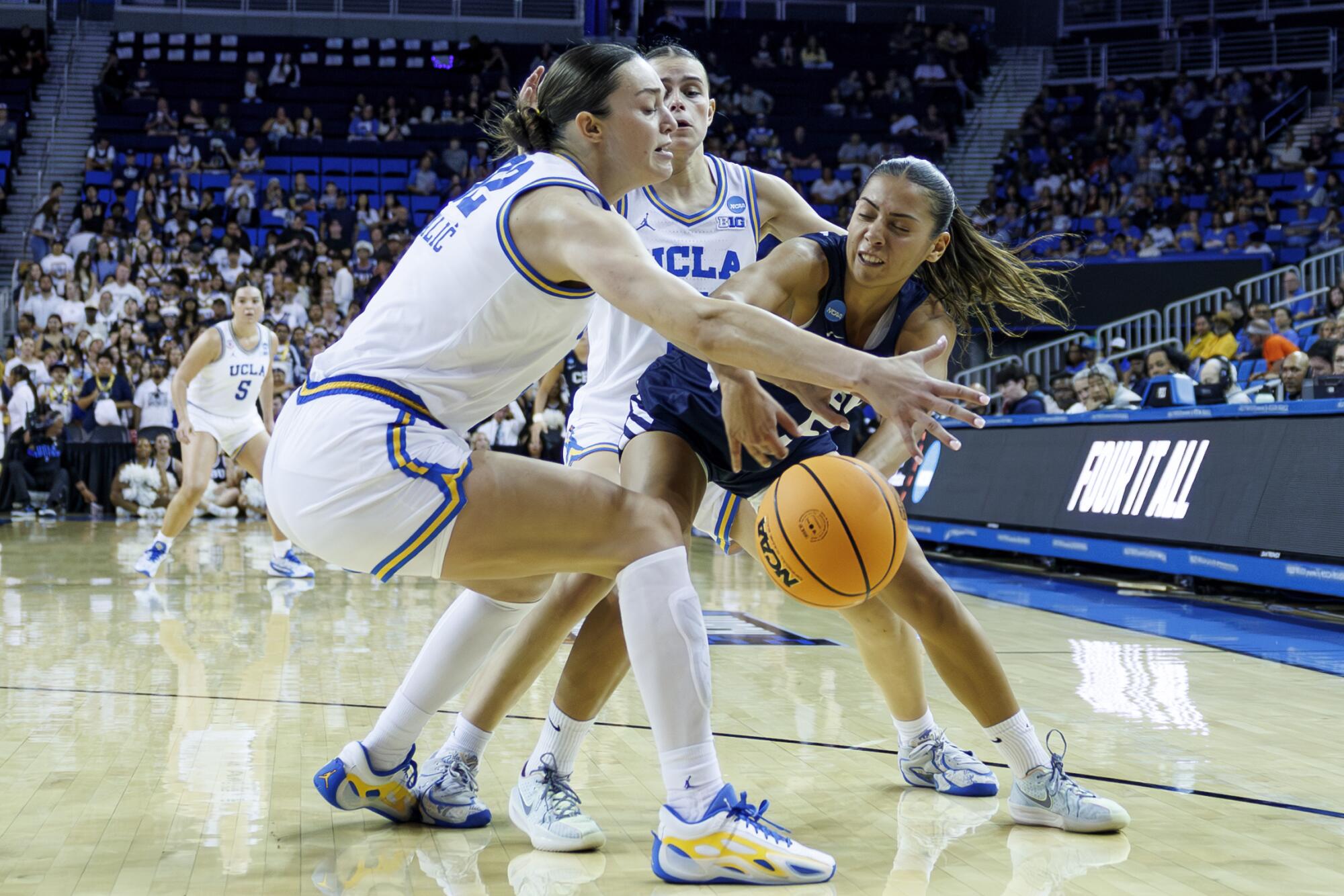
UCLA forwards Angela Dugalic and Gabriela Jaquez double team California Baptist guard Filipa Barros during the first round of the NCAA tournament at Pauley Pavilion on March 21.
(Gina Ferazzi/Los Angeles Times)
As the No. 2 overall seed in the tournament, UCLA is on a projected collision course with the top overall seed, undefeated UConn, on the other side of the bracket.
But the Bruins, who have lost just once this year, also might have to hit another gear to get to to beat formidable teams still in the tournament field.
UCLA punched its ticket to the NCAA tournament with a Big Ten title game win over Iowa by 51 points. Since then, the Bruins haven’t achieved that kind of dominance even against lesser opponents.
Iowa, which flamed out to No. 10 seed Virginia in the second round last week, could have simply been less prepared than other NCAA tournament teams. But the Bruins do acknowledge they also have room to improve.
“I think we’re a really steady team, and obviously we’re gonna do whatever we can to win, and it changes every game, because of different teams,” said graduate forward Angela Dugalic. “But at the same time, I do feel like I have more to give, and that’s not a bad thing.”
UCLA defeated No. 16 seed California Baptist 96-43 before an 87-68 win against No. 8 seed Oklahoma State, leading the Cowgirls wire-to-wire but getitng outscored in the second half. The Bruins led the Lancers by just 10 points at the half of the first-round contest.
A 19-point win is a dominant showing for any team, but with the rest of the No. 1 seeds winning by at least 40 points, has UCLA shown that it is at the same level?
“I don’t really look at it that way from those two games,” Close said. “I just think everything is measuring ourselves against the championship standards that we’ve set, and those are process standards. And so if we fall short in an area, it’s how we get back to what we know how to do and what’s under our control.”

UCLA guard Kiki Rice points across the court while talking with coach Cori Close during an NCAA tournament game against California Baptist on March 21 at Pauley Pavilion.
(Gina Ferazzi/Los Angeles Times)
UCLA has the second-largest spread among the No. 1 seeds entering the Sweet 16 round, with oddsmakers favoring the Bruins to beat Minnesota by 18.5 points. UConn leads all teams as a 27.5-point favorite to beat No. 4 seed North Carolina. The Bruins haven’t won a game by fewer than 10 points since a 69-66 overtime victory over Ohio State on Feb. 8.
Minnesota has the ninth-best NET of remaining teams, which is better than the other teams matched up against No. 1 seeds (North Carolina is 19th, Oklahoma is 13th and Kentucky is 16th).
During UCLA’s 76-58 win over Minnesota in January, Kiki Rice scored a season-high 25 points. Since then, the Gophers have gone 12-4 while winning games by an average just under nine points while UCLA has gone 17-0 with an average margin of victory of 26.9.
“No team is perfect ever,” UCLA guard Gianna Kneepkens said. “So I think [we’re] just making sure that we know what to do, and we know what it takes to be our best. So just making sure we can do that 40 minutes every game is going to be the thing we take away [from the first and second rounds.]”
Since UCLA beat Minnesota, the Gophers took down No. 5 seed Ole Miss, a team that many picked as a tournament sleeper and shot 46.2% from the field during the season.
“They’ve gotten better, but so have we and once the postseason comes, the best teams, the most successful teams, they find ways to just continue to get better,” Rice said. “To stay true to that process, but to take it up to a next level. Because at this time of the year, it’s do or die, and you gotta compete really hard.”
UCLA’s 28.6 average margin of victory is fifth in the country behind the tournament’s other No. 1 seeds and No. 2 seed LSU, a team the Bruins might face Sunday in the Elite Eight.
LSU, the highest-scoring team in the nation, faces No. 3 Duke on Friday night. If UCLA and LSU win, it would set up the third consecutive season they have met in the NCAA tournament. UCLA won the matchup last season 72-65 to get to the Final Four, while the Tigers upset the Bruins in the 2024 Sweet 16 en route to a national title.
The Bruins dominated Duke back in November, earning an 89-59 win immediately after their sole loss of the season to Texas. Gabriela Jaquez took over that game with 23 points.
But March tests are far more challenging that anything the Bruins have faced to date. The veteran UCLA team is confident it can keep evolving as it chases a national title.
“I think [improving] just requires us to take things to a different place and be more aggressive and dictate in all aspects,” Dugalic said. “That’s the beauty of it, we can get there.”
Effort to repeal Utah anti-gerrymandering law fails
March 26 (UPI) — A petition effort to put a repeal of Utah’s anti-gerrymandering law approved by voters eight years ago on the November ballot failed to meet state requirements, an updated tally indicated Thursday.
The Utah state Republican Party has spent months gathering signatures to put Proposition 4 to a vote this fall, and while organizers had enough signatures to qualify, they did not get enough of them from enough parts of the state.
In order to place an amendment on Utah’s ballot, at least 8% of registered voters in the entire state must sign the petition and 8% of registered voters in at least 26 of the state’s 29 Senate districts must sign the petition.
The group pushing for the new amendment, Utahns for Representative Government, initially surpassed the required 141,000 signatures statewide — they’d collected 162,974 — and met the 8% in 26 districts requirement, but an effort to remove signatures deemed inadmissable in Utah’s District 15 nixed the effort, KUTV-TV in Salt Lake City reported.
“We have significant concerns about the practices utilized by the opposition and continue to review the signature validation and removal process,” Rob Axson, chair of the Utah Republican Party, said in a statement to KTVX-TV in Salt Lake City.
“Whether now or in the future, by litigation or initiative, we will Repeal Prop 4,” he said. “This fight is not over but just beginning.”
The 2018 law that was passed by Utah voters created an independent redistricting commission and banned partisan gerrymandering.
For the past year, Republican-controlled state legislatures have looked to redraw congressional districts to make it easier for GOP candidates to win seats in the U.S. House of Representatives and retain control of the chamber in this year’s election.
Generally, congressional districts are redrawn by states once a decade, using data from the latest census.
Utah’s legislature last year approved redrawn districts alleged to favor Republicans, but they were later invalidated by a federal court for violating Prop 4 — leading to the effort to repeal the voter-approved law.
Over the past several months, the groups Better Boundaries and Brave Utahns Rapid Response Network have challenged signatures and the methods used to collect them, successfully dropping the petition effort below the numbers it needed to make the ballot.
“A well-informed voting population leads to better outcomes for everyone,” said Elizabeth Rasmussen, executive director of Better Boundaries. “A majority of Utah voters approved Prop 4 in 2018, and we look forward to the day when Utah voters can finally pick their politicians, not the other way around.”
President Donald Trump speaks as Secretary of State Marco Rubio listens during a cabinet meeting at the White House on Thursday. Photo by Will Oliver/UPI | License Photo

US Sanctions on Venezuela Continue: Corporate Beneficiaries and a Targeted Society
The Trump administration has issued sanctions waivers while mandating that royalty and tax payments be made to US Treasury-run accounts. (Archive)
In the wake of Washington’s January 3 military attack and then problematic détente with Caracas, corporate media suggest a meaningful shift in Venezuela policy, implying relief for a country long subjected to economic coercion. However, far from dismantling the sanctions regime, the US has merely adjusted its application through licensing mechanisms, leaving the core structure of coercive measures fully intact.
Reuters reported “US lifts some Venezuela sanctions,” followed by news of sanctions being further “eased.” Both NBC News and ABC News likewise reported sanctions “eased,” while the Financial Times wrote that Washington “relaxes sanctions.” Reuters later found that “US waives many of the sanctions,” and the Los Angeles Times noted “targeted relief from sanctions.” The Washington Office on Latin America (WOLA) described a “huge easing of sanctions.”
Not a single sanction has been rescinded
In fact, there is no evidence of any revocation of executive orders, removal of Venezuela-related sanctions authorities, and certainly no formal termination or suspension of Washington’s sanctions regime.
At a February 21 meeting I attended in Venezuela, Anti-Blockade Vice Minister William Castillo described sanctions as a “policy of extermination.” These measures, “the most cruel aggression against our people,” had been renewed the day before by Trump. To do so, he had to certify the original mistruth first fabricated by Barack Obama in 2015: that Venezuela poses an “extraordinary threat” to US national security.
Castillo cited 1,087 measures imposed by the US and another 916 by its echo, the European Union. These unilateral coercive measures have a corrosive effect on popular support for the government, which is precisely the purpose of this form of collective punishment, illegal under international law.
In 2023, Castillo described Washington’s economic aggression as a means to destroy Venezuela without having to invade. The Bolivarian Revolution’s successful resistance, including positive GDP growth while under siege, suggests why the US felt compelled to escalate with a military incursion on January 3, killing over 100 and kidnapping the country’s lawful head of state and his wife.
In Castillo’s words, the US escalated from “a war without gunpowder…against the civilian population” to an actual one. As grave as the direct US military aggression has been – including 157 fatalities since last September in alleged drug interdictions of small craft in the Caribbean and eastern Pacific – the body count from the coercive economic measures has been far higher. Former UN Special Rapporteur Alfred de Zayas estimated that sanctions have caused over 100,000 excess deaths.
There is even a literal playbook on how to apply sanctions to inflict “pain” on civilians for “maximum effectiveness.” The author of The Art of Sanctions is Richard Nephew, a former US State Department senior official in the Biden administration who was responsible for implementing such policies.
Licenses vs. sanctions
What has happened in practice is a much more limited form of relief under the sanctions regime. The Treasury’s Office of Foreign Asset Control (OFAC) has issued broad licenses allowing certain dealings primarily with Venezuela’s state oil (PDVSA) and gold (Minerven) sectors.
OFAC licenses carve out limited exceptions principally benefitting US and other foreign corporations, not necessarily the Venezuelan people. Activities are authorized that would otherwise be illegal under US law, even though such activities are lawful under international law. They come with conditions, limits, and reporting requirements and can be revoked at any time.
In practical terms, sanctions remain in place, although certain transactions are temporarily allowed under strict licensing rules. “The result is a hybrid scheme in which formal sanctions and operational licenses coexist, enabling limited flows of economic activity,” according to Misión Verdad.
This flexible arrangement of sanctions combined with licenses allows US and other foreign corporations to make a profit off of the coercive system. Under sanctions alone, the targeted people overwhelmingly suffer but, secondarily, US and other corporations are shut out. Under this hybrid system, control is maintained and money is made.
However, most foreign investors are reluctant to make important investment decisions when there is uncertainty, especially given Mr. Trump’s mercurial reputation. A temporary license does not provide the security that corporations normally require. Recuperating the Venezuelan oil industry would necessitate “a gigantic investment.” Such investments will be unlikely if Venezuela is sanctioned, the licenses notwithstanding.
Media framing and blaming
Meanwhile, Venezuelan President Nicolás Maduro and “First Combatant” Cilia Flores remain in a New York City jail, reportedly in solitary confinement.
Regarding what happened on January 3, corporate media sources overwhelmingly use relatively anodyne terms such as “downfall,” “removal,” or “ouster,” rather than the more pointed “kidnapping” or “abduction.” When the legality of this clearly illegal act of war is questioned by either the media or by the Democrats, it is mainly confined to whether President Trump required congressional approval.
Likewise, application of international law regarding the illegality of unilateral coercive measures is largely absent from media coverage. Where legal issues appear, they tend to address mechanics (e.g., the US-controlled fund arrangement), rather than whether sanctions themselves violate international law.
When media outlets express concern about Washington’s restrictions, it is often that easing them would “reward Maduro loyalists.” While the plight of the Venezuelan people may be acknowledged, the blame is mainly attributed to corruption and economic mismanagement, with little if any opprobrium for sanctions.
As former political science professor at the Universidad de Oriente Steve Ellner (pers. comm.), notes, corruption and mismanagement do exist. But the overwhelming factor has been the sanctions regime. The blockade targeted Venezuela’s oil industry – at one point accounting for 99% of foreign-exchange earnings – forcing the country out of normal dollar-denominated markets and into black markets to survive.
What Alfred de Zayas dubs the “human rights industry” similarly exhibits a convenient blind spot regarding sanctions. WOLA, for example, advocates “addressing the complex humanitarian emergency.” Yet the NGO strongly opposes sanctions relief for the people, because the coercive measures are such an effective “pressure” tool on the leadership.
Former WOLA staffer David Smilde is preoccupied with “restoring” American-style democracy by imposing pressure on the “regime.” He argues: “The democratic transition in Venezuela…requires the support of international organizations.”
In contrast, acting President Delcy Rodríguez views ending interference by foreign actors in Venezuela’s internal affairs as a precondition for credible elections. In particular, she calls for the US “blockade and sanctions against Venezuela [to] cease.” With sanctions still in place, the US remains the biggest obstacle to free and fair elections in Venezuela.
Roger D. Harris is with the Venezuela Solidarity Network, Task Force on the Americas, and the US Peace Council. He recently visited Venezuela.
The views expressed in this article are the author’s own and do not necessarily reflect those of the Venezuelanalysis editorial staff.
FKA twigs sues ex-boyfriend Shia LaBeouf over ‘unlawful’ NDA
Singer-songwriter FKA twigs is suing her ex-boyfriend, actor Shia LaBeouf, claiming that he is trying to “silence” her from speaking out against sexual abuse through the use of an “unlawful” nondisclosure agreement.
The complaint, filed in Los Angeles Superior Court on Wednesday, seeks a court order to prohibit LeBeouf from enforcing sections of an NDA which Tahliah Barnett — the Grammy Award-winning singer’s legal name — says violates California law.
“Shia LaBeouf has tried to control Tahliah Barnett for the better part of a decade,” the filing states.
“This action was taken in response to Mr. LaBeouf’s attempt to bully and intimidate twigs through a frivolous and unlawful secret arbitration he filed against her in December in which he sought to extract money from her,” said the singer’s attorney Mathew Rosengart, national co-chair of media & entertainment litigation at Greenberg Traurig in Century City, in a statement.
Rosengart added that twigs “refuses to be bullied anymore. She is instead standing up for herself and other survivors of sexual abuse who have improperly been silenced. This is the unusual case that is not about money but about justice and upholding and enforcing California law and policy designed to protect survivors by nullifying illegal NDAs.”
LaBeouf’s attorney Shawn Holley of Kinsella Holley Iser Kump Steinsapir denied the claims.
“When Ms. Barnett and Mr. LaBeouf both decided to resolve their differences and move on with their lives, no one forced her or ‘bullied’ her to stay silent,” Holley said in a statement.
“As a woman with agency, she decided to settle the case and accepted money to dismiss her lawsuit.”
The suit arises out of litigation that Barnett brought against LaBeouf in 2020, when she accused the actor of “physical, sexual, and mental abuse” during their relationship,” as well as “knowingly infect[ing]” Barnett with a sexually transmitted disease.” That case was settled last year.
In a response to the suit, the actor told the New York Times that “many of these allegations are not true.”
But he added, “I am not in the position to defend any of my actions. I owe these women the opportunity to air their statements publicly and accept accountability for those things I have done.”
In the statement Thursday, Holley added that the claim of sexual battery “was disputed, as were the other claims made in Ms. Barnett’s lawsuit.”

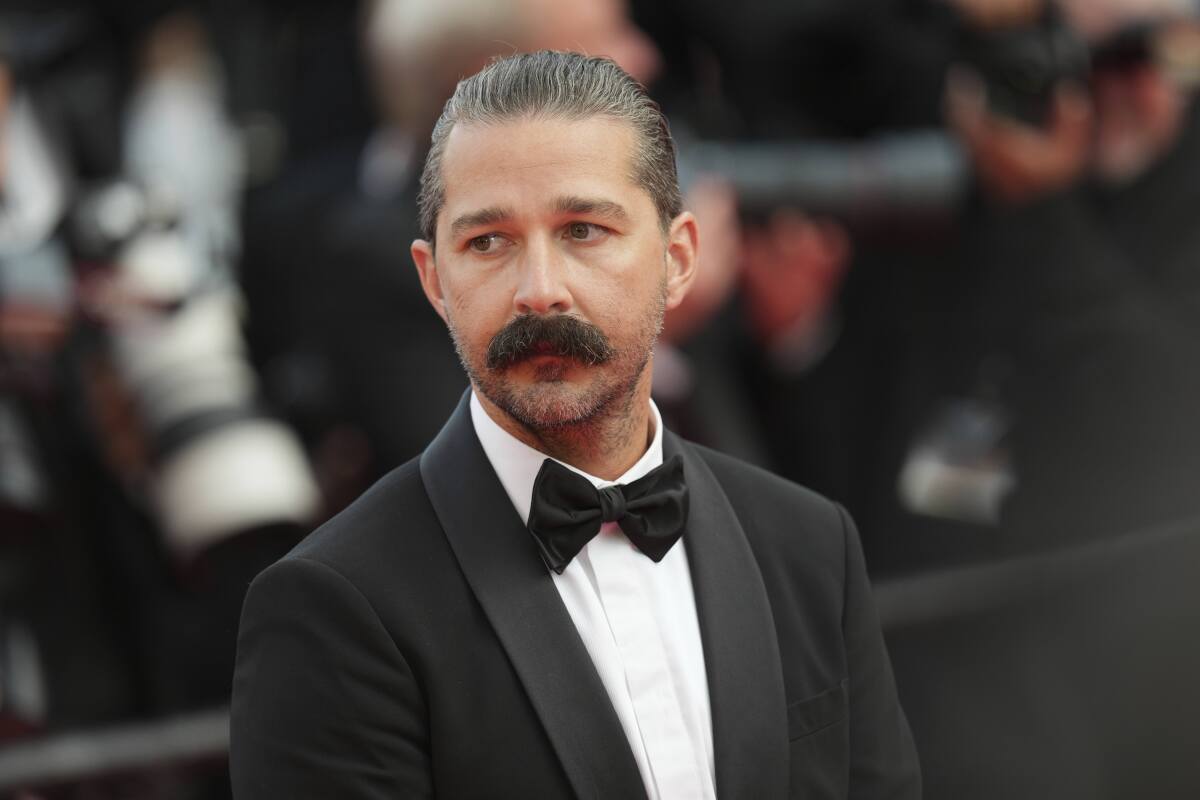
Shia LaBeouf poses for photographers upon arrival at the premiere of the film “The Phoenician Scheme” at the 78th annual Cannes Film Festival May 18, 2025.
(Lewis Joly / Invision / AP)
According to the new lawsuit, LaBeouf filed a secret arbitration complaint and “improperly sought exorbitant monies” from Barnett last December, claiming she had breached their agreement by violating its nondisclosure provisions after she gave an interview to the Hollywood Reporter in October.
In the interview, Barnett was asked if she felt safe and answered that as a woman of color in the entertainment industry, she “wouldn’t feel safe” and discussed her involvement with organizations that support survivors, saying, “I think it’s less about me at this point and more about looking forward. Just, you know, moving on with my life.”
The agreement Barnett reached with LaBeouf “contained a deficient and unlawful NDA that is unenforceable,” under California’s Stand Together Against Non-Disclosure Act, according to the complaint. The law forbids NDAs from being used to silence victims of sexual misconduct.
“As the California Legislature has made clear, survivors should have the right to tell their stories without fear or coercion, and California law does not and must not allow abusers and bullies to silence them through secret agreements containing unconscionable, unlawful gag orders,” the complaint states.
The lawsuit further alleges that while LaBeouf has sought to prohibit Barnett from talking about her abuse, he has “repeatedly brought up his relationship with Ms. Barnett—on his own and without being directly asked about her—materially breaching the very confidentiality provisions that he had just contended were fully enforceable against Ms. Barnett.”
While the actor agreed to drop the arbitration in February, he has “refused to acknowledge, however, that the NDA provisions are illegal and unenforceable,” the filing states.
The latest round in LaBeouf’s legal battle with Barnett comes just weeks after a New Orleans judge ordered the actor to begin substance abuse treatment and undergo weekly drug testing after he was arrested on suspicion of assaulting two men in the city’s French Quarter. LaBeouf was also required to post $100,000 bond as part of the conditions of his release. He was charged with two counts of simple battery, the Associated Press reported.

Here are the major earnings before the open Friday
Here are the major earnings before the open Friday
Source link

Trump says he wants to send federalized troops to L.A., San Francisco
WASHINGTON — When President Trump ordered immigration raids in Los Angeles last June, only a handful of those arrested were violent criminals. The sweeps split families, cost businesses millions of dollars and drove many undocumented residents into hiding.
Activists protested the Immigration and Customs Enforcement actions, prompting the president to deploy thousands of federal troops in what he called a security operation. A federal judge called it unlawful and said the deployment caused “greater harm” to the city.
Now, Trump wants a redo.
At a Cabinet meeting Thursday, he called on the mayors and governors of several blue cities and states to allow troops to “come in and stop the crime,” pointing to purported successes in Washington, Memphis and New Orleans.
“Crime is down 75% in a short period of time,” Trump told his top advisors. “We could do that for L.A. and we could do that for, frankly, San Francisco.”
The president framed the deployments as both a crime-fighting and immigration enforcement tool, saying that federal authorities can remove people from cities in ways local officials cannot.
“We can do it much more effectively, because [local leaders] can’t do what we do,” Trump said. “All the time, people come up to me … and they say ‘thank you so much.’ I know immediately what they’re talking about. They’re able to walk to work.”
Trump also said this week that he would consider deploying the National Guard at airports to assist with mounting security delays amid a 40-day partial government shutdown.
The renewed call comes after a series of controversial federal interventions in cities across the country. In Washington, Trump has repeatedly touted a visible security presence near federal buildings, crediting it with improving public safety, though local officials and analysts have debated how much of any decline in crime can be attributed to his order.

U.S. Marines stationed outside the federal detention center in downtown Los Angeles in June.
(Allen J. Schaben / Los Angeles Times)
In January, Trump threatened to invoke the Insurrection Act to deploy troops to Minneapolis during the civil unrest that followed the fatal shooting of Renee Good by a federal immigration agent. The Pentagon prepared active-duty troops for a possible deployment, but they were ordered to stand down following the shooting of a second Minneapolis civilian, Alex Pretti, the same month.
Immigration sweeps in Los Angeles targeted workplaces, neighborhoods and churches, stirring widespread panic and forcing many undocumented residents — including those with long-term residency and native-born children — into hiding. As a result, businesses reported sharp declines in revenue and customer traffic. A county analysis found that 82% of surveyed businesses experienced negative impacts, with some losing more than half their income amid workforce shortages and traffic reductions.
During the fallout, Mayor Karen Bass condemned Trump’s deployment of some 4,000 California National Guardsmen and 700 U.S. Marines.
“Deploying federalized troops on the heels of these raids is a chaotic escalation,” she said. “The fear people are feeling in our city right now is very real — it’s felt in our communities and within our families, and it puts our neighborhoods at risk. This is the last thing that our city needs.”
The president called the occupation off after U.S. District Judge Charles Breyer ruled that control of the California National Guard should be returned to the governor, rejecting the federal government’s authority to maintain control indefinitely. A similar Supreme Court ruling effectively ended federalized deployments throughout the country.
“The judges are really hurting this country,” Trump said Thursday. “Frankly, the justices — the Supreme Court — has really hurt our country, too.”
At the meeting, Trump also narrowed his comments on San Francisco and its mayor, Daniel Lurie.
“San Francisco was a great city, could quickly become a great city again,” Trump said. “But we can do it much more effectively.”
Last year, Trump considered carrying out similar federal law enforcement operations in the city. He backed off after a somewhat conciliatory phone call with Lurie, in which Trump said the mayor asked him “very nicely” to call off the deployment. Afterward, he agreed to give the newly elected mayor “a chance” to address crime in the city.
“In San Francisco, crime is down 30%, encampments are at record lows, and our city is on the rise,” Lurie said in a statement Thursday. “Public safety is my number one priority, and we are going to stay laser focused on keeping our streets safe and clean.”
A spokesperson for Lurie’s office said the two have not spoken since that October conversation, indicating Trump’s latest remarks do not reflect any new request or ongoing negotiations. Even so, the president struck a measured tone toward the San Francisco mayor on Thursday. He said Lurie is “trying very hard” but insisted federal intervention would get the job done faster.
Whether any Democrat-led city will take Trump up on that offer remains to be seen. City leaders have previously resisted federal deployments, arguing they undermine local control and risk inflaming already tense situations.
The White House did not respond to questions about whether any current plans exist to redeploy federalized troops to California cities.
Times staff writer Melissa Gomez in Los Angeles contributed to this report.

'Stunning, breathtaking, glorious!' James gives Wales lead against Bosnia
Dan James scores a stunning long-range effort to give Wales a crucial lead in their World Cup Play-off semi-final against Bosnia-Herzegovina in Cardiff.
Source link
Argentina names Jalisco New Generation Cartel terrorist organization

Inclusion in the terrorism registry enables the government to impose “financial sanctions and operational restrictions” aimed at limiting the capacity of criminal organizations and their members, according to the statement from President Javier Milei’s administration.
March 26 (UPI) — Argentina’s government on Thursday formally designated the Jalisco New Generation Cartel, known as CJNG, as a terrorist organization and ordered its inclusion in the country’s public registry of individuals and entities linked to terrorism and its financing.
In an official statement, Argentina’s presidential office said the decision is based on reports documenting the group’s transnational criminal activities and links to other terrorist entities.
The move aligns Argentina with U.S. security policy, which designated the cartel as a terrorist organization in 2025.
Inclusion in the registry enables the government to impose “financial sanctions and operational restrictions aimed at limiting the capacity of these criminal organizations and their members,” according to the statement from President Javier Milei’s administration.
It also “protects Argentina’s financial system from being used for illicit purposes” and strengthens international cooperation in security and justice matters “in close coordination with countries that have already designated the Jalisco Cartel as a terrorist organization.”
The government said CJNG has become one of the world’s most powerful drug trafficking organizations over the past decade, with a presence in Mexico, operations in the United States and expansion into at least 40 countries, including Argentina.
The statement also highlighted the measure’s impact on international cooperation, saying it reinforces security and judicial coordination with countries that have already classified the cartel as a terrorist group.
The Jalisco New Generation Cartel emerged in Mexico in the early 2010s amid the fragmentation of major drug cartels. Its leader and founder, Nemesio Rubén Oseguera Cervantes, known as “El Mencho,” died in February during an operation in Mexico supported by U.S. intelligence. The United States had offered a $15 million reward for information leading to his capture.
Milei’s government has previously designated as terrorist organizations groups already classified as such by the United States, including branches of the Muslim Brotherhood in Egypt, Lebanon and Jordan, the Palestinian militant group Hamas and Iran’s Quds Force.
Pilning NHS doctor charged with inciting support for Hamas
She was also charged with publishing or distributing written material, and using words that were threatening, abusive or insulting intending thereby to stir up racial hatred or having regard to all the circumstances was reckless as to whether racial hatred would be stirred up, in breach of the Public Order Act 1986.
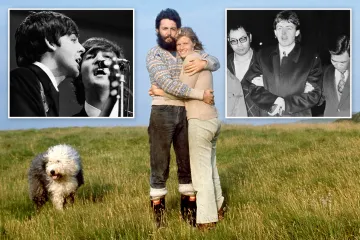
Inside story of Paul McCartney’s new album as UK’s greatest living songwriter, 83, reflects on life BEFORE The Beatles
GO to Dungeon Lane today and it’s strange to think it occupies a special place in Paul McCartney’s heart.
Yet it will go down in pop history alongside other street names associated with him, joining Penny Lane and Abbey Road.
Situated in the Speke neighbourhood of Liverpool, the L24 postal district, a faded road sign sets the tone for its desolate air.
It is bordered on one side by a solar farm business and, on the other, by a fenced-off area of scrubland which separates it from the city’s John Lennon Airport.
Before you get very far, a bright yellow “emergency access gate” bars further exploration.
But, as a child, Dungeon Lane was McCartney’s gateway to a stunning rural idyll where he could escape the hustle and bustle of urban life.
Read more on Paul McCartney

In the Fifties, the lane took him past a daffodil farm to the Oglet Shore on the widest stretch of the River Mersey.
I wonder if young Paul, a keen birdwatcher, ventured into this wilderness clutching his trusty The Observer’s Book Of Birds.
There, he may have spotted any number of waders — curlew, snipe, dunlin, black-tailed godwits.
What we do know is that his lifelong love of our feathered friends began in those days.
This helps explain the compositions dotted through his career such as Blackbird with The Beatles, Single Pigeon with Wings, Two Magpies with The Fireman and solo efforts Jenny Wren and Long Tailed Winter Bird.
To McCartney, his early rambles into the countryside represent humbler, simpler times before The Fab Four exploded on to the scene, before his storied life in the dazzling glare of publicity.
Sir Paul, 83, has called his 19th solo album The Boys Of Dungeon Lane . . . which is, as he suggests, a trip down memory lane.
He got the title from the lyrics of its first single, Days We Left Behind, released yesterday, a nostalgia-filled acceptance that he has a far longer past than future.
Intimate, beautifully sung with Macca playing acoustic guitar, bass, piano and harmonium himself (how does he do that!?), it is the first taste of a project that has been five years in the making.
“This is very much a memory song for me,” he says. “I was thinking about just that . . . the days I left behind.
“And I do often wonder if I’m just writing about the past — but then I think, how can you write about anything else?”
For McCartney, the song conjures up “a lot of memories of Liverpool. It involves a bit in the middle about John [Lennon] and Forthlin Road which is the street I used to live in. Dungeon Lane is near there.”
Paul was born on June 18, 1942, to his midwife mother Mary and salesman father Jim, and they moved with younger brother Mike to 20, Forthlin Road, Allerton, in the mid-Fifties from Speke, where they had lived since 1947.
We also know that Paul first bumped into John on July 6, 1957, at roughly 4pm, at a garden fete behind St Peter’s Church, Woolton.
In Days We Left Behind, he sings of the bond he formed with the lanky lad 20 months older than him: “We met at Forthlin Road/And wrote a secret code/To never be spoken.”
Continuing his reflection on the song, he says: “I used to live in a place called Speke which is quite working class.
“We didn’t have much at all but it didn’t matter because all the people were great and you didn’t notice you didn’t have much.”
As already mentioned, birdwatching was a hobby, one that required little cash and gave him a lot of pleasure “in the nearby woods and fields”.
A recent entry in Macca’s Spotify playlists, under the banner Sticking Out Of My Back Pocket, came accompanied by these musings . . .
“My mum had the midwife’s house on the edge of Liverpool, where we lived,” he says.
“It was where Liverpool just stopped and became deep countryside, so that was when I had the opportunity to do quite a bit of birdwatching.”
He particularly cherishes the moment he saw a “skylark rising into the sky, singing its sweet song”.
That unforgettable sight has found its way into Days We Left Behind, with its lines, “In the skies the skylarks rise/Above the sounds of war/Since that day I knew they’d stay/With me for evermore.”
All these decades later, he reflects: “And now because I live part-time on a farm [in Sussex], I’m able to see a lot of birds and I don’t need The Observer’s Book Of Birds quite so much as I did back then.”
McCartney’s new album promises to be one of the most personal, most autobiographical song cycles he’s ever recorded, while also finding room for up-to-date love songs dedicated to third wife Nancy.
Yesterday’s announcement states that it finds him in a “candid, vulnerable and deeply reflective mood, writing with rare openness about his childhood in post-war Liverpool, the resilience of his parents, and early adventures shared with George Harrison and John Lennon”.
I’m guessing here but songs yet to be heard, Momma Gets By and Salesman Saint, appear to be affectionate remembrances of mum Mary, who died when Paul was just 14, and dad Jim.
This is not the first time Macca has delved into his early years for songwriting inspiration.
I talked to him about the playful On My Way To Work, which appeared on his 2013 album, New.
He called it a “collection of memories all morphed together”, providing a fascinating glimpse into his life before Beatlemania.
“It’s about me going to my first job, before The Beatles took off, which was working on a lorry for a delivery company called Speedy Prompt Deliveries — SPD.”
McCartney described going to work on the council-run green and cream buses which led to him looking at risqué magazines like Parade.
“I’d go on the bus at some unearthly hour of the morning,” he said. “I might buy a magazine and look at the nudies. I was too young to be interested in the news!”
He remembered how hard-up kids like him ripped the fronts off cigarette packets and traded duplicates with their mates, instead of collecting “football cards or, like in America, baseball cards”.
“It was like, ‘I’ll swap you two Craven A for a Woodbine’. Then there were the posh brands because this bus route went from the centre of Liverpool to the outskirts.
“Posh people would be smoking Passing Clouds or Sobranies and packets of those were very prized.”
Another song, Queenie Eye, referenced a childhood street game from “1940s Britain”.
“It’s what we used to get up to before video games and that whole home entertainment thing,” he said.
“Someone would be elected to be ‘the one’ or the ‘queenie eye’. We’d all stand behind that person and he would throw a ball over his head and one of us would catch it and hide.
“Then we would all chant, ‘Queenie eye, queenie eye, who’s got the ball? I haven’t got it. It isn’t in my pocket!’ It was simple entertainment for simple minds but great fun.”
Now it is time to return to the 2020s and the creation of The Boys Of Dungeon Lane, the follow-up to his captivating lockdown album, McCartney III.
This time, we’re told we can expect “Wings-style rock, Beatles- style harmonies and McCartney-style grooves”.
TRACK LIST
- As You Lie There
- Lost Horizon
- Days We Left Behind
- Ripples in a Pond
- Mountain Top
- Down South
- We Two
- Come Inside
- Never Know
- Home to Us
- Life Can Be Hard
- First Star of the Night
- Salesman Saint
- Momma Gets By
The process began around five years ago when Macca met American live-wire producer Andrew Watt, known for his work with Ozzy Osbourne, Lady Gaga, Post Malone and The Beatles’ greatest Sixties chart rivals, the Rolling Stones.
Watt, I gather, “pulled a guitar” on his latest rock icon, who instantly happened upon a chord he didn’t recognise.
As the story goes, the ever- experimental McCartney changed one note, then another, until he had a three-chord sequence.
That led to his new record’s opening track, As You Lie There, which in turn set the ball rolling for the other 13 songs.
It’s remarkable that, as with McCartney III, he is credited with playing all the instruments himself across the whole thing.
It brings to mind how at ease this enduring music obsessive seemed as he suggested specific drum beats and fills to Ringo Starr in The Beatles’ Get Back documentary.
With Macca still touring and playing momentous shows like his 2022 Glastonbury epic, Days We Left Behind has been honed over half a decade when time permitted.
During that period, he even managed to introduce the Stones to producer Watt, who helmed their 2023 comeback album, Hackney Diamonds.
When McCartney was in Los Angeles working with Watt, he was brought in to play bass on Mick Jagger and Co’s punk blast, Bite My Head Off.
Upon its release, I spoke to Keith Richards who was made up over their special guest.
“Yeah, Macca just strolled in with his bass,” the guitar legend drawled. “I think the song reminded him of those times [in the Sixties]. Beatlemania was equally as bizarre as Stones mania.”
There’s a moment towards the end of Bite My Head Off where you can hear someone saying, “Come on Paul, play something”.
“That might have been me,” smiled Richards.
But this is all about Britain’s greatest living songwriter, Paul McCartney, and his new album The Boys Of Dungeon Lane.
Time is precious but when it comes to music and life, he’s still facing forward at 83 — even if he’s remembering a youth long ago when “in the skies, the skylarks rise”.
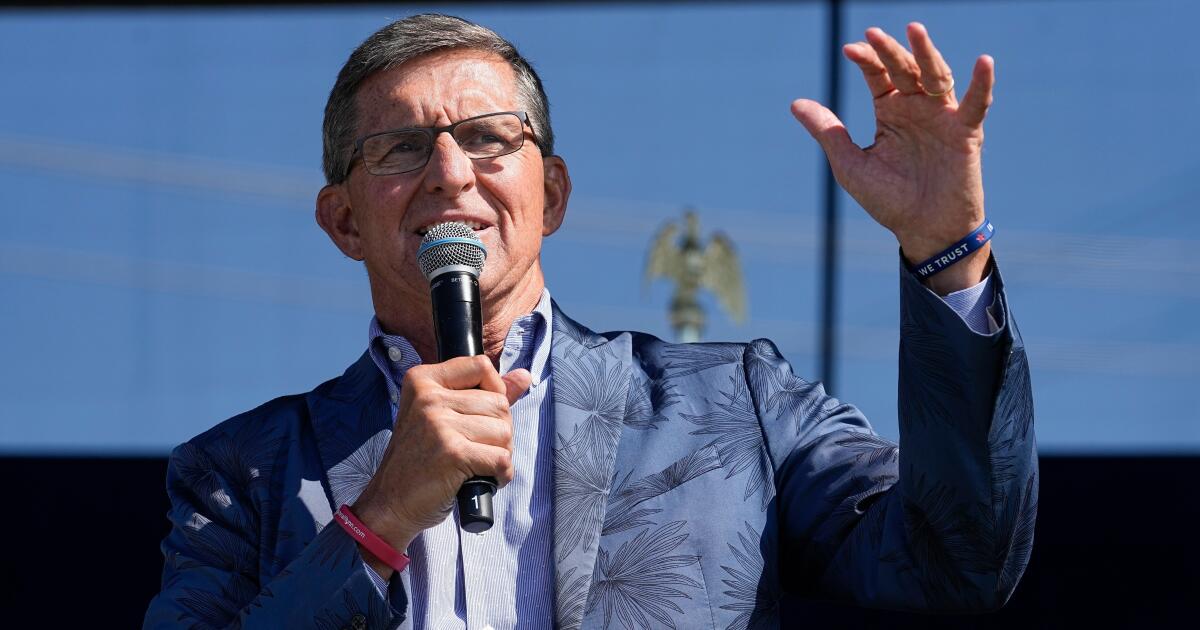
Justice Department settles lawsuit from Trump ally Michael Flynn for $1.2 million, AP source says
WASHINGTON — The Justice Department has settled for roughly $1.2 million a lawsuit from Michael Flynn, the former national security advisor to President Trump who pleaded guilty during the Republican’s first term to lying to the FBI about his conversations with a top Russian diplomat and was later pardoned.
Court papers filed Wednesday do not reveal the settlement amount, but a person familiar with the matter, who spoke to the Associated Press on condition of anonymity to disclose nonpublic information, confirmed the total as about $1.2 million.
The settlement resolves a 2023 lawsuit in which Flynn sought at least $50 million and asserted that the criminal case against him amounted to a malicious prosecution. It also represents a stark turnabout in position for a Justice Department that during the Biden administration had pressed a judge to dismiss Flynn’s complaint. Atty. Gen. Pam Bondi, a former personal lawyer for the president, has openly criticized the Russia investigation in which Flynn was charged and the Justice Department in the last year has opened investigations into former officials who participated in that inquiry.
The Justice Department cast the settlement as an “important step in redressing” what it says was a “historic injustice” of the Russia investigation that shadowed Trump for much of his first term.
“This Department of Justice will continue to pursue accountability at all levels for this wrongdoing. Such weaponization of the federal government must never be allowed to happen again,” a spokesperson said.
In a separate statement, Flynn said: “Nothing can fully compensate for the hell that my family and I have endured over these many years — the relentless attacks, the destruction of reputations, the financial ruin, and the profound personal toll inflicted upon us all. No amount of money or formal resolution can erase the pain caused by a prosecution that should never have been brought.”
The settlement is the latest turn in the long-running legal saga involving Flynn, one of six Trump associates charged as part of special counsel Robert Mueller’s investigation into potential ties between Russia and Trump’s 2016 presidential campaign. That investigation found Russia interfered in the election on Trump’s behalf and that the Trump campaign eagerly welcomed the help, but it ultimately found insufficient evidence of a criminal conspiracy.
Flynn, a retired Army lieutenant general who vigorously campaigned at Trump’s side, served for weeks as his first national security advisor before being pushed out of his position. He remained a Trump ally even after agreeing to cooperate with Mueller’s team. He was pardoned in the final weeks of the president’s first term.
Flynn pleaded guilty in December 2017 to lying to the FBI when he said he had not discussed with the Russian envoy, Sergey Kislyak, sanctions that the outgoing Obama administration had just imposed on Russia for election interference. During that conversation, Flynn advised that Russia be “even-keeled” in response to the punitive measures, and assured him “we can have a better conversation” about relations between the countries after Trump became president.
The conversation alarmed the FBI, which at the time was investigating whether the Trump campaign and Russia had coordinated to sway the election. In addition, White House officials were stating publicly that Flynn and Kislyak had not discussed sanctions, which the FBI knew was untrue.
Flynn was ousted from his position in February 2017 after news broke that Obama administration officials had warned the White House that Flynn had indeed discussed sanctions with Kislyak and was vulnerable to blackmail. He pleaded guilty months later to a false statement charge.
But Flynn later sought to withdraw his guilty plea, saying federal prosecutors had acted in “bad faith” and broken their end of the bargain when they sought prison time for him.
The Justice Department in 2020 moved to dismiss the case, asserting that the FBI had no basis to interview Flynn about Kislyak and that any statements he made during the interview were not material to the FBI’s broader counterintelligence probe.
Flynn was pardoned by Trump in November 2020, ending the court case and the legal wrangling.
In his lawsuit, Flynn maintained his innocence and said he was targeted by the “virulently anti-Trump leadership” of the FBI’s Russia investigation. He contended that investigators pursued him despite knowing there was no evidence of a crime and coerced his guilty plea.
“He was falsely branded as a traitor to his country, lost at least tens of millions of dollars of business opportunities and future lifetime earning potential, was maliciously prosecuted and spent substantial monies in his own defense,” says the lawsuit, adding that Flynn will continue to suffer “mental and emotional pain.”
Tucker and Richer write for the Associated Press.

Lapland UK announces major update for families as tickets go on sale today
Christmas is still quite some way away, but one attraction is already putting tickets on sale for its magical experiences, and if previous years are anything to go by it could sell out quickly

This immersive experience takes kids on a magical journey to meet Father Christmas(Image: LaplandUK)
It doesn’t feel that long since the Christmas decorations were packed away, but one festive attraction is already putting its tickets on sale today (March 27) for the Christmas 2026 season.
Tickets for LaplandUK, which has locations in Ascot and Cheshire, will go on sale tomorrow at 10AM with over a million people expected to join the queue. The experience is often likened to booking Glastonbury tickets, as hopeful parents will need to wait in a virtual queue and have ten minutes to complete their order once they reach the front.
Ticket prices for 2026 have been confirmed, starting at £60 for midweek dates in November, up to £155 per person for peak weekends in December. Both venues will also host a ‘Superstar Day’ on November 25 which is “adapted for families and guests with access requirements to create a quieter, more relaxed and accessible environment.”
While the tickets are costly, the cost does include a range of experiences that set it apart from the average Santa’s grotto. Families receive a special gift boxed invitation ahead of their day out to build the excitement, and this message from Father Christmas personally invites little ones to visit LaplandUK to help the elves with toy-making.
On arrival, visitors step into a magical world, walking through several different interactive experiences from the Elven Bazaar, where guests have to work out how to enter the door to Lapland, to the Lapland Bakery where kids can help make some Christmas treats before enjoying storytime with Mother Christmas.
The experience lasts around four-and-a-half hours, according to the LaplandUK website, and also includes ice skating, a soft toy for every child, a small toy to give to kids on Christmas Day, and of course, a special visit with the man in red himself, deep in a snowy forest.
Husband-and-wife founders of LaplandUK, Mike and Alison Battle, took to Facebook to update fans of the attraction about changes that are being made for 2026. Alison said: “Every year, we challenge ourselves to make the experience more special, more magical, more believable. And this year, we’ve got some very exciting things in store for you.”
The pair announced that invites would be sent earlier this year, towards the end of the summer, to build anticipation of the event. They added that the return experience will be upgraded, so that “coming home will be just as magical”, and that visitors to Little Rudy’s Stables will now be able to make reindeer food to take home with them.
One of the major changes will be in the Elven Village, which the pair said has expanded over the years to be more immersive and include more characters. Guests will now get more time in the village to listen to stories at Fable’s Library, skate on the ice rink, and meet characters along the way.
READ MORE: Latest Middle East flights updates including Wizz Air, TUI, British Airways and EmiratesREAD MORE: Latest Portugal travel advice for Brits after Foreign Office update
Those hoping to grab tickets for LaplandUK can either register on the official site to get a ticket booking link ahead of the sale, or visit the website from 9am to join the queue.
LaplandUK’s Facebook page confirmed that both sites will have their own booking queues accessed through a unique link. It said: “Upon entering a queue, you will be randomly assigned a place before bookings open. When the queue begins moving at 10 AM, you’ll gradually make your way forward.
“Once you reach the front, you will have 10 minutes to complete your booking for your chosen location.. We truly cannot wait to welcome you to Lapland to make treasured memories together this Christmas.”
Have a story you want to share? Email us at webtravel@reachplc.com

Prem Rugby: Salary floor to be introduced from next season
Prem clubs have agreed to introduce a ‘salary floor’ – a minimum amount each team must spend on players’ wages – from next season in an attempt to keep the top flight as closely fought as possible.
Each club will be obliged to spend £5.4m a season on talent.
The salary cap – a £6.4m limit on squad spending, albeit with ‘credits’ on offer for home-grown talent and other factors which stretch the restriction to £7.8m – will remain the same.
Failure to spend up to the salary floor will be punished by a fine equivalent to the difference between a club’s squad spend and the lower limit, incentivising clubs to invest in their squads.
Several clubs are likely to need to pay more to meet the new lower figure.
Last season, Bristol boss Pat Lam estimated that eventual champions and the Bears’ semi-final conquerors Bath spent “close to £3m more than we have on our squad”., external
While bottom side Newcastle have brought in a raft of new players since energy drink giant Red Bull took over in August, they are still thought to be well short of a £5.4m wage bill.
While such prescriptions over squad spending are rare in UK sport, they are more common overseas.
The NRL, Australia’s elite rugby league competition, requires its clubs to spend at least 95% of its salary cap figure. In American Football’s NFL, it is set at 90%.
Prem Rugby hopes that, with relegation to be formally scrapped next season, greater payroll parity will improve the competitive balance of the top flight.
A divide has opened up in the table this season with four teams – Newcastle Red Bulls, Harlequins, Gloucester and Sale – cut adrift of the play-off race with seven rounds of the season to go.
Sixth-placed Saracens, who are eight points off the top four, could have their hopes of extending their campaign all but ended this weekend if they lose to leaders Northampton.
Introducing a salary floor is reflective of renewed confidence in the league’s future, with billionaire industrialist James Dyson having become co-owner of Bath this month and further investment in Prem clubs believed to be in the pipeline.
The league intends to add two teams to its current 10 in the 2029-30 season if a wrangle with the second-tier Champ can be smoothed out.
While it has been agreed that any new entrants to the Prem must complete a campaign in the Champ first, it is yet to be agreed how high a team would have to finish to demonstrate their on-field credentials, with Prem Rugby chief executive Simon Massie-Taylor believing a top-six finish and qualification for the Champ play-offs “would be the natural thing”.
Massie-Taylor is keen to build on this weekend’s ‘big game’ concept, with Everton’s new Hill Dickinson Stadium earmarked as a possible host for neutral-venue Prem semi-finals from 2029.
Saracens are staging Saturday’s match against Saints at the 63,000-capacity Tottenham Hotspur Stadium, while Gloucester are hosting Leicester at Villa Park and Bristol will take their match against Harlequins to Cardiff’s Principality Stadium on the same day.
Harlequins put on two of their regular-season fixtures at Twickenham’s Allianz Stadium, which also hosts June’s Prem final.
US judge weighs Trump decision to bar Venezuelan funds for Maduro’s defence | Nicolas Maduro News
A United States judge has said that he will not dismiss the drug-trafficking and weapons possession charges brought against former Venezuelan President Nicolas Maduro and his wife Cilia Flores.
But in a Thursday court hearing, Judge Alvin Hellerstein questioned whether the US government has the right to bar Venezuela from funding Maduro’s legal expenses.
Recommended Stories
list of 3 itemsend of list
The hearing was the first for Maduro and his wife since a brief January arraignment, where they pleaded not guilty.
Maduro and Flores have sought to have the charges against them thrown out. Hellerstein declined to do so, but he pressed the prosecution on some of the issues Maduro’s legal team raised in its petition to dismiss the case.
Among them was a decision by the administration of US President Donald Trump to prevent the Venezuelan government from financing Maduro’s defence.
Federal prosecutors argued that national security reasons prevented the US from allowing such payments. They also pointed to ongoing sanctions against the Venezuelan government.
But Hellerstein pushed back against that argument, noting that Trump had eased sanctions against Venezuela since Maduro’s abduction on January 3. He also questioned how Maduro might pose a security threat while imprisoned in New York.
“The defendant is here. Flores is here. They present no further national security threat,” said Hellerstein. “I see no abiding interest of national security on the right to defend themselves.”
Hellerstein emphasised that, in the US, all criminal defendants have the right to a vigorous defence, as part of the Constitution’s Sixth Amendment.
“The right that’s implicated, paramount over other rights, is the right to constitutional counsel,” he said.
Maduro, who led Venezuela from 2013 to 2026, has been charged with four criminal counts, including narco-terrorism conspiracy, conspiracy to import cocaine, the possession of machine guns and the conspiracy to possess machine guns and other destructive devices.
He and his wife were taken into US custody on January 3, after Trump launched an attack on Venezuela.
The Trump administration has framed the military operation as a “law enforcement function”, but experts say it was widely considered illegal under international law, which protects local sovereignty.
Maduro has cited his status as the leader of a foreign country as part of his push to see the case dismissed.
When he last appeared in court, on January 5, he told the judge, “I’m still the president of my country.”
In a February hearing, his defence team sought to dismiss the charges on the basis that preventing Venezuela from paying his legal fees was “interfering with Mr Maduro’s ability to retain counsel and, therefore, his right under the Sixth Amendment to counsel of his choice”.
In an interview with the news agency AFP on Thursday, Maduro’s son, Venezuelan lawmaker Nicolas Maduro Guerra, said that he trusts the US legal system but believes that his father’s trial has been mishandled.
“This trial has vestiges of illegitimacy from the start, because of the capture, the kidnapping, of an elected president in a military operation,” Maduro Guerra said in Caracas.
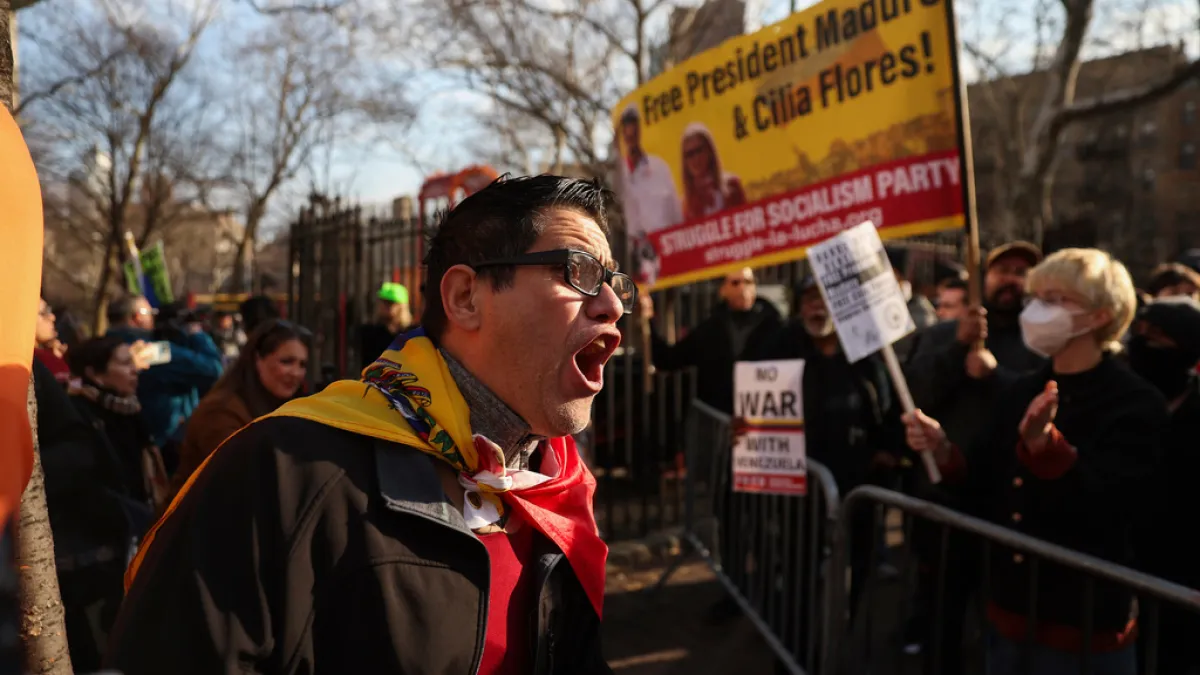
Protests and counter-protests took place in front of the New York City courthouse on Thursday, with some condemning the US’s actions and others holding signs in support of the trial with slogans like, “Maduro rot in prison.”
Trump himself weighed in on the proceedings during a Thursday cabinet meeting, hinting that further charges could be brought against Maduro.
“He emptied his prisons in Venezuela, emptied his prisons into our country,” Trump said of Maduro, reiterating an unsubstantiated claim.
“And I hope that charge will be brought at some point. Because that was a big charge that hasn’t been brought yet. It should be brought.”
Trump has had an adversarial relationship with Maduro since his first term in office, when he issued a bounty for the Venezuelan leader’s arrest. He has frequently repeated baseless claims that Maduro intentionally sent immigrants and drugs to the US in a bid to destabilise the country.
Those claims have served as a pretext for Trump claiming emergency powers in realms such as immigration and national security. On Thursday, Trump emphasised that, while he expected a “fair trial”, he expected more legal action to be taken against Maduro.
“I would imagine there are other trials coming because they’ve really sued him just at a fraction of the kind of things that he’s done,” Trump said. “Other cases are going to be brought, as you probably know.”

Dutch court bans xAI’s Grok from generating nonconsensual nude images | Technology News
Court dismissed xAI claim that measures were taken after plaintiff produced video of nude person shortly before hearing.
Published On 26 Mar 2026
A Dutch court has ordered Elon Musk’s xAI to stop generating and distributing nude images of people without their consent in the Netherlands, warning it would impose fines of 100,000 euros ($115,350) per day for noncompliance.
The Amsterdam District Court ruled Thursday that xAI’s Grok artificial intelligence tool and the X platform that hosts it were barred from “generating and/or distributing sexual imagery” featuring people “partially or wholly stripped naked without having given their explicit permission”.
Recommended Stories
list of 3 itemsend of list
The decision in a civil suit was one of the first times a judge has weighed in on xAI’s responsibility for creating tools that can be used to create sexualised images, amid a flood of complaints and investigations over Grok in the Americas, Europe, Asia and Australia.
Grok was launched by Musk in 2023 and distributed through his social media platform X, which is now part of his rocket and space exploration company SpaceX.
Offlimits, a Dutch centre monitoring online violence, took legal action in cooperation with the non-profit Victims Support Fund over a Grok feature allowing users to ask it to create hyper-realistic deepfake montages of naked women and children using real photos.
At a hearing this month, xAI lawyers had argued it was impossible to guarantee that abuse on its platform could be prevented, and the company should not be punished for the actions of malicious users.
They said the company had taken measures in January to prevent Grok from editing images of real people in revealing clothing, including restricting its image creation features to paid subscribers.
The court website said the judge had decided that Offlimits had shown there was reasonable doubt over the effectiveness of the measures taken to date. “For example, Offlimits managed to produce a video of a nude person using Grok shortly before the hearing,” it stated.
Offlimits director Robbert Hoving said the “burden is on the company” to make sure its tools are not used to create and distribute nonconsensual sexual images, including of children.
Earlier on Thursday, the European Parliament approved a ban on artificial intelligence systems generating sexualised deepfakes, after global outrage over non-consensual Grok-produced nudes.