



How important are the Gulf economies to the world? | US-Israel war on Iran News
Impact of US-Israeli war on Iran poses serious risks beyond energy sector.
The US-Israeli war on Iran is hitting Gulf Arab nations hard – but with a wider impact in today’s interlinked world.
As well as global oil and gas supplies, Gulf states play a critical role in many economies.
So how are they connected – and what could be at risk?
Presenter: James Bays
Guests:
Nikolay Kozjharnov – Research associate professor in energy security at the Gulf Studies Center at Qatar University
Cornelia Meyer – Macroeconomist and oil and gas specialist
Torbjorn Soltvedt – Associate director at global risk intelligence company Verisk Maplecroft
Published On 27 Mar 2026

‘Dead Lover’ review: A wildly creative feminist plunge into goth territory
p]:text-cms-story-body-color-text clearfix”>
“I want to lick your stink … I want to taste your foulness … I want to shower in your rot … I want to feast in your fetid funk.”
Have more romantic sweet nothings ever graced the screen? Scripted by Grace Glowicki and Ben Petrie (partners in life and in filmmaking), these words of seduction are music to the ears of a lonely Gravedigger (Glowicki), who has been formulating a perfume to cover up her corpse-like stench. What she discovers is that the right one will love her exactly the way she smells, learning that she’s not so pheromonally challenged after all.
Glowicki’s sophomore feature “Dead Lover,” sometimes presented in “Stink-O-Vision,” is one of those entirely singular freakouts that we can thank Telefilm Canada for subsidizing (see also: the Cronenberg family oeuvre, Matt Johnson’s current “Nirvanna the Band the Show the Movie” and many more).
She co-writes, directs and stars in this highly stylized, wonderfully DIY handmade project, beautifully designed with gruesomely gothic sets by production designer Becca Morrin and art director Ashley Devereux. The blend of intentional artifice paired with deep emotion calls to mind other Canadian auteurs like Guy Maddin and Matthew Rankin (“The Twentieth Century”), but Glowicki’s film also exists within another lineage: the feminist Frankenstein film.
The film opens with a quote from Mary Shelley: “There is something at work in my soul which I do not understand.” Her 1818 novel “Frankenstein: or, the Modern Prometheus” has always been a feminist text (despite Guillermo del Toro’s more bro-ey adaptation), grappling with the terrifying power of creating life — and how close that is to death. Feminist filmmakers have drawn out these inherent themes from the book, the most recent and loudest example being Maggie Gyllenhaal’s “The Bride!” But “Dead Lover” hews closer to Laura Moss’ modern medical take, “birth/rebirth,” and even more closely to Zelda Williams’ cute, poppy “Lisa Frankenstein,” in which a young seamstress stitches up a reanimated boyfriend.
Our Gravedigger speaks to us, and to the moon, about her heart’s desire in charming cockney rhyming slang. Her hopes are rather simple and conventional: one true lifelong love and a family. After much rejection, she finally finds her Lover (Petrie) in the cemetery, saving him from a ferocious beast while he mourns his late opera-singer sister (Leah Doz). After the pair consummate their fragrant lust, the Gravedigger is ready to settle down right away.
In order to make her dreams come true, Lover travels to Europe for fertility treatments, where he drowns on a ship, the only thing left of him a finger, delivered to her by fishermen. Our enterprising Gravedigger, a true woman of science, engineers a lizard elixir and regenerates the finger into a long tentacle that eventually demands a body. What better choice than his own sister? But when her wild new Creature (Doz) comes to life, all hell breaks loose, summoning the sister’s jealous, grief-stricken Widower (Lowen Morrow) into an unfortunate love triangle (or square?).
Glowicki is a terrific filmmaker, marshaling her tiny troupe to execute this unique project. Petrie, Doz and Morrow play multiple roles, including a gossipy Greek chorus and the band of merry fisherman (truly an astonishing array of Canadian accent work on display). Her commitment to her singular vision never wavers, but as an actor, Glowicki is truly astonishing. Caked in Halloween makeup and lit with an array of colored gels, Glowicki summons something primal, pure and deeply moving about the lengths one will go to for love, a screech from the depths of her gut.
With a dream-pop soundtrack by U.S. Girls that would be at home in an episode of “Twin Peaks,” “Dead Lover,” in all its stinky, sexy, queer and grotesque glory, is one of the grossest and loveliest films about love I’ve ever seen. This one’s for the horny, hopeless goth inside all of us.
‘Dead Lover’
Not rated
Running time: 1 hour, 25 minutes
Playing: Opens Friday, March 27 at Laemmle Glendale
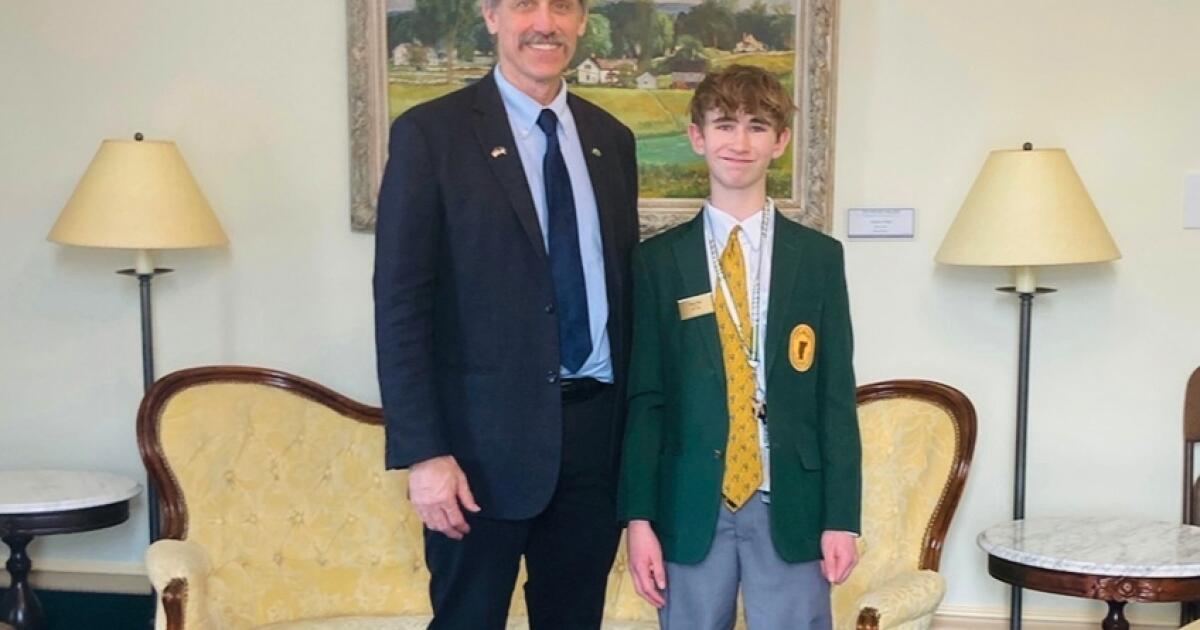
A 14-year-old running for governor is the first teen to get on Vermont’s general election ballot
STOWE, Vt. — Looking back, gubernatorial candidate Dean Roy says his political ambitions started in the eighth grade. And by that he means last year.
After working as a legislative page at the Vermont Statehouse, the 14-year-old freshman at Stowe High School now has his sights set on the corner office. In November, he’ll be the first candidate for governor under age 18 to appear on the state’s general election ballot.
“I don’t expect necessarily to win,” he said. “What I do expect is to start the movement, and get more young people to come in behind me and say, ‘Yeah, we also want to make change.’”
Another eighth-grader, Ethan Sonneborn, sought the Democratic nomination for governor in 2018 but finished last in a four-way primary. Roy secured his spot in the general election by creating his own third party, the Freedom and Unity party. Both were able to run because the state constitution sets no minimum age for gubernatorial candidates, requiring only that candidates have resided in the state for four years.
“I know it sounds crazy, a 14-year-old running for governor, but honestly, look at the people in charge right now,” Roy said in a post on his campaign’s Instagram page. “They’ve been doing this forever and things still aren’t working.”
Nearly all other states set minimum age requirements for governor, often 30 years old. In Kansas, lawmakers added a requirement that gubernatorial candidates be at least 25 years old in 2018 after six teenagers ran for office.
Peter Teachout, a professor at Vermont Law and Graduate School, has a different take than Roy on Vermont’s constitution. He points to a section in the document referring to what qualifies someone to be “entitled to the privileges of a voter,” and that is that they must be 18 years of age. Even under Roy’s interpretation, Teachout doesn’t predict a win for the teenager.
“In theory, a 4-year-old could run for governor. Should we be worried about it? No,” he said. “Vermonters can be a little cantankerous and provocative just for the fun of it, but it is not something they are likely to support in this context.”
But Roy’s former history teacher, James Carpenter, said he thinks it’s great that Roy is giving it his all. Though most 14-year-olds aren’t concerned with property taxes or healthcare, Carpenter describes Roy as an “old soul” with endless curiosity.
“It just really shows what type of kid Dean is. He’s very earnest in what he’s doing. There’s no gimmick behind this,” he said. “I think he blends that youthful optimism with some pragmatism that few kids have.”
Roy, who said he doesn’t identify with either major party, said housing is the most important issue facing the state. He’s also thought about how he’d juggle school with a full-time job as governor, saying he’d consider online classes and would do his homework at night after work.
The current governor, Republican Phil Scott, applauds Roy’s interest in politics and public service but questions whether someone so young is ready for the responsibilities that come with running a state.
“He believes it’s important for our youth to get involved,” said Press Secretary Amanda Wheeler. “But the governor also believes that a teenager may not be best suited to serve in that role given the lack of experience and lived perspectives youth have at that point in their lives.”
Roy disagrees that age has anything to do with whether a candidate is fit to run for office.
“What I’m aiming for is that these career politicians look at me and they say, ‘Oh my God, he actually has a chance to disrupt things,’” he said. “If I can get people to think that I am a threat to them, then I know that’s been a success. Because what I want is to show them that the youth have a voice. We’re gonna make change. The future is now.”
Swinhart writes for the Associated Press. AP reporter Holly Ramer contributed to this report from Concord, N.H.
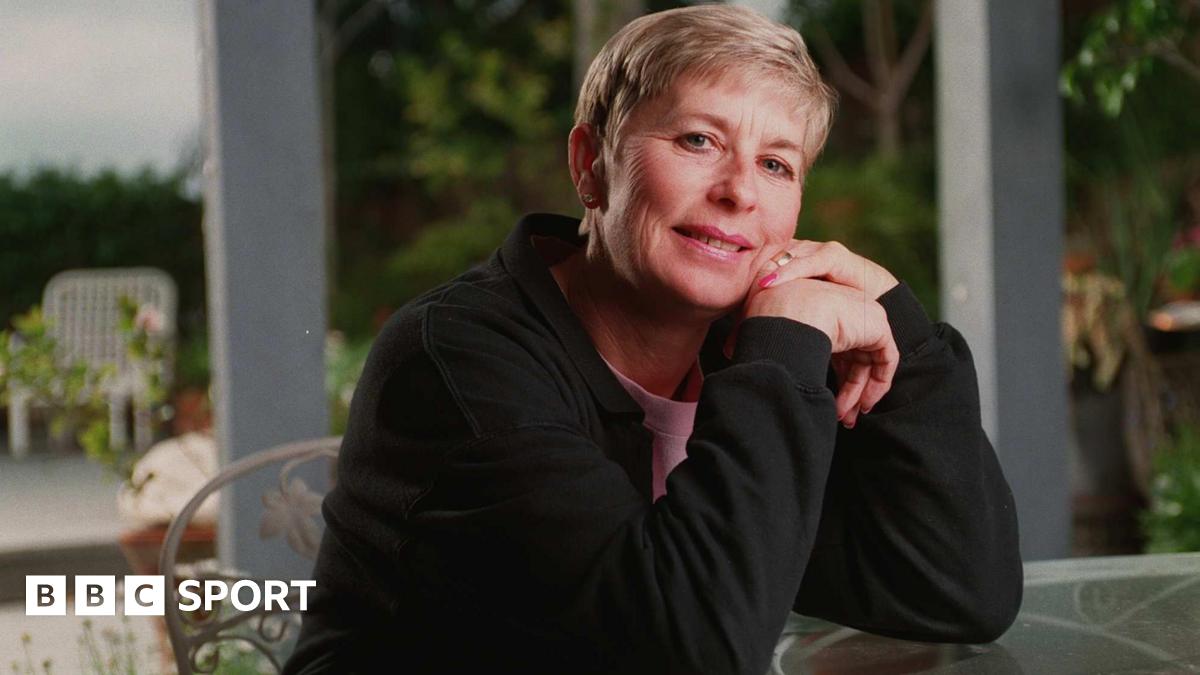
Mary Rand: 1964 Olympic gold winner dies at age of 86
Mary Rand, the first British woman to win an Olympic gold medal in athletics, has died at the age of 86.
Rand secured the long jump title at the Tokyo Games in 1964, also winning silver in the inaugural women’s pentathlon and bronze in the 4x100m relay.
That meant she also became the first British woman to win gold, silver and bronze at a single Olympic Games.
In the long jump, Rand broke the British and Olympic records with her first leap of 6.59m and then smashed the world record on her fifth attempt with an effort of 6.76m.
“Mary was the most gifted athlete I ever saw,” said Ann Packer, who won 800m gold at the 1964 Olympics days after Rand’s triumph and was her room-mate in Tokyo.
“She was as good as athletes get. There has never been anything like her since – and I don’t believe there ever will.”
Rand, whose first husband was British rower Sydney Rand, also won long jump gold at the 1966 Commonwealth Games in Jamaica.
However, injury denied her the chance to defend her Olympic title in 1968 and she retired at the age of 28 the same year.
Born in Wells, Somerset, she was only 17 when she set her first British record in the pentathlon, and she won 12 national titles across long jump, high jump, sprint hurdles and pentathlon during her illustrious career.
Rand was voted the BBC Sports Personality of the Year in 1964 and was awarded an MBE in the 1965 New Year Honours List.

JD Vance takes aim at Minnesota, Somalis ahead of anti-fraud task force meeting
March 27 (UPI) — U.S. Vice President JD Vance took aim at Minnesota and Somali immigrants on Friday ahead of the first meeting of the Trump administration’s anti-fraud task force.
While the meeting itself was behind closed doors, Vance gave brief remarks to reporters, touting the aims of the task force. He specifically took to task a scam in Minnesota involving a Medicaid program meant to aid children on the autism spectrum.
In September, the Trump administration announced charges against one person in a $14 million fraud scheme involving the autism program, and six additional defendants were charged in December.
“I think that the autism scam that we’ve seen in the Somalian parts of Minnesota really illustrates well what’s been going on across whole layers of our government,” Vance said.
“Now, what we’ve seen is Somali fraudsters at an industrial scale taking advantage of that program to the tune of millions and millions of dollars.”
In February, the Trump administration announced it was pausing more than $250 million in Medicaid payments to Minnesota over the alleged fraud.
President Donald Trump announced the formation of the panel during his State of the Union address earlier this year. He, too, took aim at at Minnesota and immigration in his announcement of the task force, which he said will help balance the federal judge “overnight.”
“The Somali pirates who ransacked Minnesota remind us that there are large parts of the world where bribery, corruption and lawlessness are the norm, not the exception,” Trump said.
“Importing these cultures through unrestricted immigration and open borders brings us problems right here to the USA. And it is the American people who pay the price in higher medical bills, car insurance rates, rent, taxes and, perhaps most importantly, crime.”
Gov. Tim Walz has lashed out at the Trump administration for targeting Minnesota, saying the withholding of funds “has nothing to do with fraud.”
“This is a campaign of retribution. Trump is weaponizing the entirety of the federal government to punish blue states like Minnesota,” he said in a statement.
Federal Trade Commission Chairman Andrew Ferguson, White House deputy chief of staff Stephen Miller and other officials from the executive branch joined Vance for the inaugural meeting of the White House Task Force on Eliminating Fraud.

President Donald Trump and U.S. Ambassador to Greece Kimberly Ann Guilfoyle attend a Greek Independence Day celebration event in the East Room of the White House on Thursday. Photo by Will Oliver/UPI | License Photo
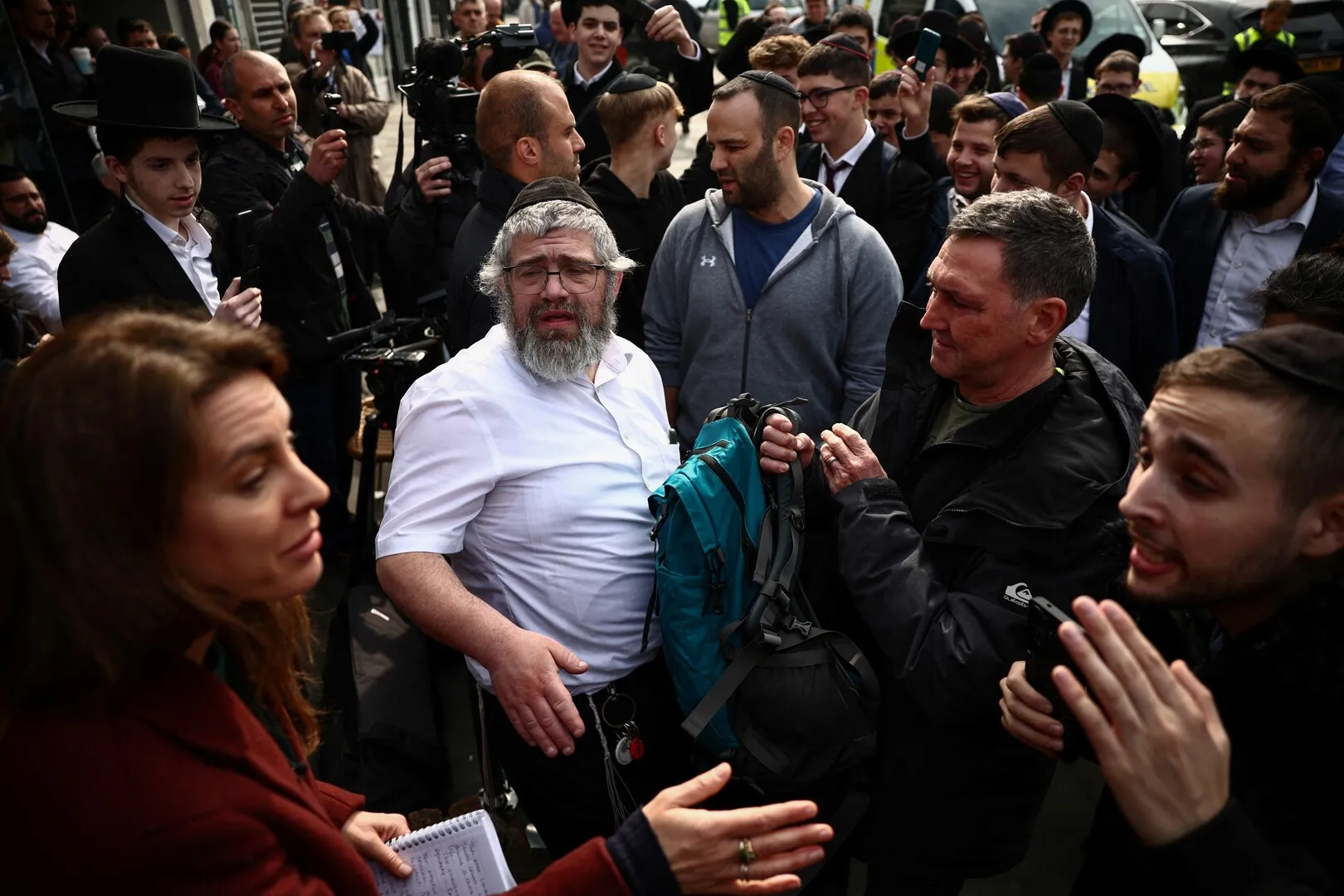
Off-duty London police officer filmed ‘intimidating’ Al Jazeera journalists | Freedom of the Press
An off-duty Metropolitan Police officer was among a group filmed confronting Al Jazeera journalists reporting on a suspected arson attack in north London, the force has confirmed. The incident is raising questions about press freedom.
Published On 27 Mar 2026

Who is in the cast of Jo Nesbo’s Detective Hole?
Need to know
Netflix’s gripping new crime drama Jo Nesbo’s Detective Hole follows troubled detective Harry Hole hunting a serial killer in Oslo.

Jo Nesbø’s Detective Hole is now streaming on Netflix(Image: Netflix)
Everything you need to know about the cast of Jo Nesbo’s Detective Hole on Netflix
- Netflix has released new crime thriller Jo Nesbo’s Detective Hole this week. The nine-episode series follows troubled detective Harry Hole as he hunts a serial killer in Oslo. The show draws inspiration from bestselling Norwegian author Jo Nesbo’s novels, particularly The Devil’s Star.
- The Netflix cast is led by Norwegian star Tobias Santelmann, who portrays protagonist Harry Hole. The actor is best known for his roles in The Last Kingdom, Kon-Tiki, and Exit. Meanwhile, Swedish-American actor Joel Kinnaman stars as detective Tom Waaler after appearing in Apple TV+’s For All Mankind, Hanna, Altered Carbon The Killing and Suicide Squad.
- Norwegian star Pia Tjelta portrays Harry’s girlfriend Rakel Fauke and counts credits in State of Happiness, Cold Lunch, Blindsone, Cold Lunch, Next Summer and Norsemen. Swedish actress Ellen Helinder also stars as officer Beate Lønn and has appeared in Exit alongside her co-star Santelmann, as well as Beck, Studenternas undergång and Veronika.
- Other cast members include Anders Baasmo, Maxime Baune Bochud, Kåre Conradi, Simon J. Berger, Prison Break’s Peter Stormare, Fridtjov Såheim, Eili Harboe, Atle Antonsen, Manish Sharma, Jesper Christensen, Kristoffer Joner, Ingrid Bolsø Berdal, Linn Skåber, Jonas Strand Gravli, Sonny Lindberg, Agnes Kittelsen, Nader Khademi, Agot Sendstad, Maja Christiansen, Frank Kjosås, Kelly Gale, Oddgeir Thune, Ravdeep Singh Bajwa, Henrik Mestad, Ingar Helge Gimle, Henriette Steenstrup, Helge Jordal, Eirik Hallert, Anders Danielsen Lie, Ane Dahl Torp and Dagny.
- Netflix describes Jo Nesbo’s Detective Hole as “a whodunnit serial killer mystery led by famed anti-hero Harry Hole” that operates as “a nuanced character drama about two police officers operating on opposite sides of the law.” The drama sees Harry clash with corrupt colleague Tom Waaler (Joel Kinnaman) whilst trying to solve murders. The streaming giant promises viewers will see how “Harry must do all he can to catch a serial killer and bring Waaler to justice before it is too late.”
READ THE FULL STORY: Jo Nesbo’s Detective Hole release date, cast, trailer and plot as it lands on Netflix

Georgia’s Fulton County and Trump administration square off in court over seized 2020 ballots
ATLANTA — Attorneys for Georgia’s Fulton County and President Trump’s administration squared off in court Friday over the county’s demand that the FBI return seized ballots and other materials from the 2020 election.
Abbe Lowell, an attorney representing Fulton County, noted that the January raid was “unusual” because it involved an old election and allegations that have already been investigated in the years since Trump, a Republican, lost the county and the state to Joe Biden, a Democrat.
Lowell contended that the Trump administration seized the materials because it grew impatient with litigation the Justice Department filed to obtain them last year. “There’s abundant law that the left hand of the department needs to know what the right hand is doing,” Lowell told U.S. District Judge J.P. Boulee.
Michael Weisbuch, representing the federal government, replied that the separate civil litigation wasn’t “relevant in any respect.” He said the administration has already provided Fulton County with digital copies of everything taken and needs to retain physical copies to carry out its own investigation.
Boulee wrote in a scheduling order that the hearing was needed after the two sides failed to reach an agreement in court-ordered mediation.
Trump’s actions alarm Democrats and election officials
The Jan. 28 seizure from a warehouse near Atlanta targeted the elections hub in Georgia’s most populous county, which is heavily Democratic and includes most of Atlanta. Fulton County has been at the center of unfounded claims by Trump and his allies that widespread election fraud cost him reelection.
The FBI’s move was among several actions by the Trump administration that have alarmed Democrats and many election officials who are concerned it’s using law enforcement to pursue the president’s personal grievances and is planning ways to interfere in this year’s midterm elections. The FBI also used a subpoena earlier this month to obtain records related to an audit of the 2020 presidential election in Maricopa County in Arizona, another battleground state Trump lost that year.
At the same time, the Justice Department is fighting numerous states in court for access to voter data that includes sensitive personal information. Election officials, including some Republicans, have said handing over the information would violate state and federal privacy laws.
Justice Department says it’s investigating 2020 ‘irregularities’
Lawyers for Fulton County argued in a court filing that the seizure of its documents was “improper and unjustified” and demonstrates “callous disregard” for the Fourth Amendment protection against unreasonable search and seizure. The Justice Department seeks to “set a precedent that would grant the federal government unchecked power to interfere with the local administration of elections,” it wrote.
Justice Department attorneys argued that preparing a detailed affidavit and presenting it to a judge “is the exact opposite of ‘callous disregard’” for those constitutional rights. “Their goal to disrupt an ongoing federal criminal investigation is clear,” they wrote of Fulton County officials.
The Justice Department said it is investigating “irregularities that occurred during the 2020 presidential election in the County” and identified two laws that might have been violated. One requires election records to be maintained for 22 months, while the other prohibits procuring, casting or tabulating false, fictitious or fraudulent ballots.
The filing said the FBI is looking into whether Fulton County properly retained ballot images; whether some ballots were scanned and counted multiple times; whether unfolded, unmailed ballots were counted as mail-in absentee ballots; and potential irregularities concerning tabulator tapes from the scanners used to count ballots.
Fulton County’s lawyers wrote that the “deficiencies” or “defects” in the county’s handling of the 2020 election cited in the affidavit are the kinds of human errors that commonly occur without any intentional wrongdoing and cannot establish probable cause.
Election tech expert cites problems in the affidavit
To support their claims, Fulton County officials submitted a sworn declaration from Ryan Macias, an election technology and security expert who advised the county during the 2020 election. He said the affidavit contains “a multitude of false or misleading statements and omissions” and offered explanations for the alleged “deficiencies.”
Investigations by the Georgia secretary of state and independent reviews contradict the core allegations of the affidavit, which is “rife with statements from witnesses lacking credibility, with extraordinary and undisclosed biases,” Fulton’s lawyers argued.
Georgia’s votes in the 2020 presidential race were counted three times, including once by hand, and each count affirmed Biden’s win.
Federal government lawyers rejected the idea that the FBI agent who wrote the affidavit “intentionally or recklessly misled” the judge, writing that “the supposed misrepresentations and omissions flagged by Petitioners are illusory and/or immaterial.” They also asserted that a lapse of the statute of limitations on the potential crimes does not negate probable cause.
The Justice Department also noted that a federal magistrate judge reviewed the FBI affidavit and signed off on the search warrant. Fulton County sought to have the FBI agent who wrote the affidavit testify at Friday’s hearing, but the Justice Department objected and the judge sided with the federal government.
Brumback writes for the Associated Press. AP writer Nicholas Riccardi in Denver contributed to this report.

High school softball top 20 rankings for the Southland
A look at the top 20 high school softball teams in the Southland; as ranked by CalHiSports.com for The Times.
Rk. School; Record; Last ranking
1. Murrieta Mesa; 16-0; 1
2. Fullerton; 11-1; 4
3. Norco; 9-2; 3
4. JSerra 14-2; 2
5. La Mirada 12-2; 6
6. Oaks Christian; 12-1; 5
7. Orange Lutheran 5-3; 7
8. Etiwanda; 14-1; 11
9. Riverside King; 10-2; 20
10. Chino Hills; 13-4; NR
11. Chaminade; 10-1; NR
12. Sherman Oaks Notre Dame; 11-3; 8
13. El Modena; 7-4; 19
14. La Habra; 12-3; 18
15. Temescal Canyon; 8-4; 12
16. Long Beach Poly; 5-0; 16
17. Los Altos; 7-5; NR
18. Garden Grove Pacifica; 10-5; 9
19. Westlake; 10-2; NR
20. Anaheim Canyon; 8-4,10

I stayed at the family-focused hotel right by one of England’s most famous grand homes
NEWLY reopened in the UK last year, The Hide Hotel is one for the families who love the great outdoors.
Here is everything you need to know
Where is The Hide Hotel?
Right up in the hills on the edge of Chatsworth Estate in Chesterfield lies this The Hide Hotel.
You’ll most likely need a car to get there although there is a bus stop outside that connects to Chatsworth and Bakewell.
What is the hotel like?
The thick stone-walled hotel is complete with dog and boot washing facilities, a roaring log fire in its restaurant and a tasty local pint for walkers to reward themselves with after a ramble in the Peaks.
The views across the moorland are breathtaking, and while the building is 200 years old, it was given a complete refurb last year, so all the furnishings look shiny and new.


What are the rooms like?
All neutral tones with cosy throws strewn over the beds, rooms at The Hide Hotel are comfortable and inviting.
You can choose from double, triple, quad, or like us a bunk room, where a family of four could happily stay in the king size beds and very cute cabins.
Rooms cost from £79 per night including breakfast. See here.
What is there to eat and drink at the hotel?
There’s a great restaurant focusing on big plates of ribs, brisket, burgers and more.
They also offer a terrific range of stone baked pizzas and the cooked breakfasts are worth waking up for.
For something more refined, The Beeley Inn, also owned by the Chatsworth Estate, is well worth a visit.
Here we enjoyed whipped goats cheese with balsamic beetroot, and local lamb saddle with hispi cabbage.
What else is there to do there?
There’s a footpath out of the back door that leads directly to Chatsworth House (albeit via a 9km walk), where guests can book multi-entry tickets for their stay.
The Hide is also right at the entrance to The Peak District National Park which has amazing rambles for all abilities.
You’ll find a handy walking guide in every bedroom, and the staff are super knowledgeable and inspired us to climb the nearby snow topped Mam Tor, an unforgettable experience.
Is the hotel family friendly?
Yes, there are four-person rooms with bunk beds and king beds, so perfect for families, although kids re an extra £15 a night.
They also have everything else from high chairs to cots, and a play area in the restaurant with toys and games.
The hotel team are also on hand to recommend family-friendly activities.
is it accessible?
The hotel has accessible rooms, with wide entry bathrooms as well.

Russian oil tanker skips Cuba, docks in Venezuela; 2nd tanker in limbo

People walk past rubbish accumulating in the streets of Havana on Wednesday. The Caribbean nation has been experiencing a severe energy crisis with the island nation virtually out of fuel. Photo by Ernesto Mastrascusa/EPA
March 27 (UPI) — A tanker carrying Russian fuel initially headed to Cuba ended up docking in Venezuela after weeks of deviations, while a second oil-carrying vessel remains without a clear destination in the Caribbean amid the island nation’s energy crisis.
The vessel Sea Horse, sailing under the Hong Kong flag, had been closely tracked by maritime analysts since it departed from the eastern Mediterranean carrying between 190,000 and 200,000 barrels of Russian diesel initially destined for Cuba.
During its voyage, the tanker repeatedly changed its declared destination. It went from being listed as en route to Havana to indicating “Caribbean Sea” and later Trinidad and Tobago in a pattern that reflected growing uncertainty about its final destination.
Ultimately, the Sea Horse arrived at Puerto Cabello, in Venezuela, on Wednesday morning after nearly 50 days in transit.
The diversion occurred in a context of increasing pressure from the United States to restrict fuel supplies to Cuba, which is facing a severe energy crisis with recurring blackouts and oil shortages.
The case of the Sea Horse is not isolated. Maritime tracking data show that other vessels have altered their routes or avoided declaring final destinations in recent weeks, amid sanctions that explicitly exclude Cuba from relaxed sanctions for Russian oil trade.
The second vessel, the Russian tanker Anatoly Kolodkin, maintains its uncertainty.
The ship, which is carrying roughly 730,000 barrels of crude, continues in the Caribbean Atlantic without a publicly confirmed final destination.
The maritime tracking website VesselFinder shows the destination of the Anatoly Kolodkin as “Atlantic for order,” a designation used in the industry to indicate that the vessel is sailing without a publicly confirmed final destination.
On Tuesday, maritime intelligence analyst Michelle Wiese Bockmann told Politico that the vessel could arrive in Cuba in “two or three days,” although its trajectory remains without clear confirmation.
The most recent AIS tracking data indicate that the vessel is about 487 miles from Turks and Caicos, with an estimated arrival Monday. However, its current vectors do not point directly toward Cuba, reinforcing uncertainty about true destination.
The behavior of the Kolodkin raises questions in a highly monitored environment.
“There are details that just don’t add up,” said Evan Ellis, a professor at the U.S. Army War College Strategic Studies Institute.
“Given the U.S. naval and air assets in the area, the Russian tanker has to know it won’t get in undetected. The question is whether this is some kind of cat-and-mouse game, or if shifting expectations, possibly tied to developments in Cuba, have changed whether it believes it can enter unopposed,” he said.
“Maybe the deliberate attempt was meant to apply pressure, and then once it got a reaction, it was backing off,” he added.
For Ellis, the key point remains outside the public radar.
“The biggest story is what’s going on behind the scenes that we don’t know about,” he said.
The eventual arrival of the Kolodkin also could force a decision from Washington. Analysts cited by the Miami Herald say the options range from diplomatic pressure to a possible interception by the U.S. Navy or U.S. Coast Guard.
“At the end of the day, what we really have to watch for is what actually happens,” said Jorge Piñón, a senior research collaborator at the University of Texas Energy Institute.
Cuba imports about 60% of its energy and depends on external supplies to sustain its electrical system, making each shipment a critical factor within a scenario of growing geopolitical tension.
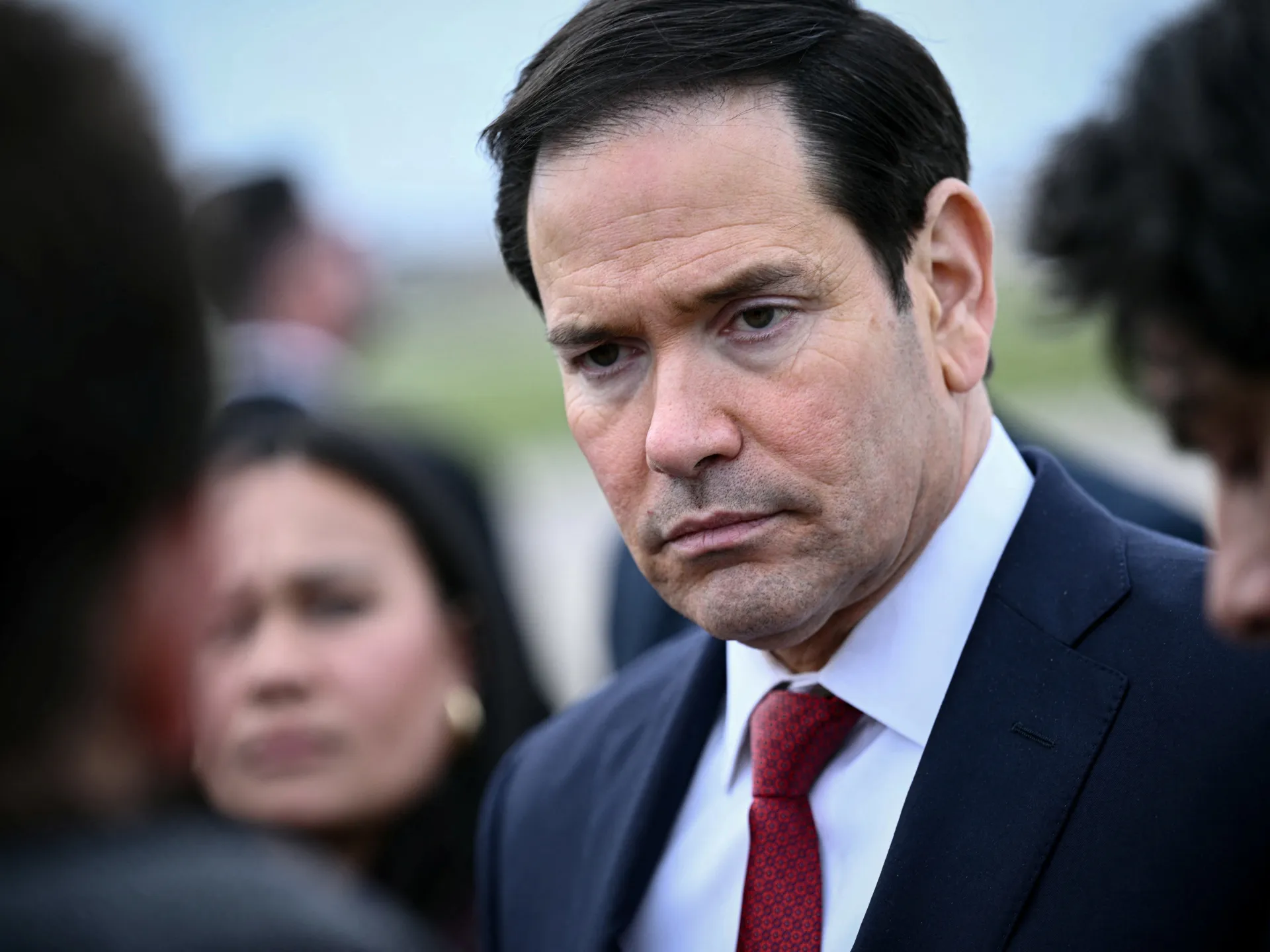
US diplomat Marco Rubio denounces settler violence, tolls in Hormuz strait | Donald Trump News
United States Secretary of State Marco Rubio has offered wide-ranging remarks upon his departure from the latest Group of Seven (G7) ministers’ meeting in France, denouncing Iran’s continued chokehold on the Strait of Hormuz as well as settler violence in the occupied West Bank.
Standing on an airport tarmac on Friday, Rubio fielded questions from journalists about reports that Iran plans to implement a tolling system in the strait, a vital waterway for the world’s oil supply.
Recommended Stories
list of 3 itemsend of list
Rubio used the topic to double down on pressure for countries to participate in securing the Strait of Hormuz, a demand US President Donald Trump has repeatedly made.
“One of the immediate challenges we’re going to face is in Iran, when they decide that they want to set up a tolling system in the Strait of Hormuz,” Rubio said.
“Not only is this illegal, it’s unacceptable. It’s dangerous for the world, and it’s important that the world have a plan to confront it. The United States is prepared to be a part of that plan. We don’t have to lead that plan, but we are happy to be a part of it.”
He called on the G7 members — among them, Japan, Canada, France, the United Kingdom, Italy, Germany and the European Union — as well as countries in Asia to “contribute greatly to that effort”.
Rubio calls toll plan ‘unacceptable’
The Strait of Hormuz is a key artery for the global transport of oil and natural gas, and prior to the start of the US and Israel’s war against Iran on February 28, an average of 20 million barrels of oil per day passed through the waterway.
That amounted to roughly 20 percent of the world’s liquid petroleum supply.
But since the outbreak of war, Iran has pledged to close the Strait of Hormuz, which borders its shores. The threat of attacks has ground most of the local tanker traffic to a standstill, though a few vessels, some linked to Iran or China, have been allowed to pass through.
Media reports suggest that Iran is setting up a “tollbooth system” that would require passing ships to put in a request through Iran’s armed forces, the Islamic Revolutionary Guard Corps (IRGC). There would also be a fee to secure passage.
“ They want to make it permanent. That’s unacceptable. The whole world should be outraged by it,” Rubio said on Friday.
He added that he conveyed a warning about the polling scheme to his colleagues at the G7.
“All we’ve said is, ‘You guys need to do something about it. We’ll help you, but you guys are going to need to be ready to do something about it,’” Rubio said.
“Because when this conflict and when this operation ends, if the Iranians decide, ‘Well, now we control the Strait of Hormuz and you can only go through here if you pay us and if we allow you to, that’s not only is it illegal under international law and maritime law. It’s unacceptable, and that can’t be allowed to exist.”
The Trump administration, however, has struggled to rally allies and world powers to join the US in its offensive against Iran.
Legal experts have criticised the initial strikes against Iran as an unprovoked act of aggression, though the Trump administration has cited a range of rationales for launching the attack, including the prospect that Iran may develop a nuclear weapon.
Many of the US allies in Europe have maintained that they would limit their involvement to defensive actions. Trump, meanwhile, has accused members of the NATO alliance of being “cowards”, adding in a social media post, “We will REMEMBER.”
In a statement following the G7 meeting, member countries reiterated their stance that there should be an “immediate cessation of attacks against civilians and civilian infrastructure”.
They also underscored the “absolute necessity to permanently restore safe and toll-free freedom of navigation in the Strait of Hormuz”. But the statement fell short of pledging any resources or aid to the US and Israeli war effort.
Achieving goals ‘without any ground troops’?
It is unclear when the war might end. On Saturday, it reaches its one-month anniversary, having stretched for four weeks.
Rubio on Friday echoed Trump’s assessment that the war was going as planned and that the US was achieving its objectives, including to destroy Iran’s navy, missile stockpiles and uranium enrichment programme.
“ We are ahead of schedule on most of them, and we can achieve them without any ground troops, without any,” he said, addressing an oft-raised concern about the prospect of US troops being deployed to Iran.
Rubio also briefly addressed the increasing levels of Israeli settler violence against Palestinians in the occupied West Bank.
Footage has shown settlers this month torching Palestinian homes and vehicles, as well as assaulting residents.
On March 19, the United Nations estimated that more than 1,000 Palestinians have been killed in the West Bank since Israel began its genocidal war in Gaza in October 2023. The international body underscored that a quarter of the victims were youths.
“ Well, we’re concerned about that, and we’ve expressed it. And I think there’s concern in the Israeli government about it, as well,” Rubio responded, adding that it was a “topic we follow very closely”.
He suggested that the Israeli government may take action to stop the violence, though critics argue that Israel has largely turned a blind eye to settler violence.
“Maybe they’re settlers, maybe they’re just street thugs, but they’ve attacked security forces, Israelis, as well. So, I think you’ll see the government going to do something about it,” Rubio said.
Upon taking office for a second term in January 2025, President Trump also moved to cancel sanctions against Israeli settlers accused of grave abuses in the West Bank.

A ‘holy grail for movie nerds’ revived, plus the best movies in L.A.
Hello! I’m Mark Olsen. Welcome to another edition of your regular field guide to a world of Only Good Movies.
In another busy week for new releases, the horror-comedy “Forbidden Fruits” is among the standouts. Having just premiered at SXSW, it is the feature debut for director Meredith Alloway, who co-wrote the screenplay with Lily Houghton, adapting Houghton’s play. Diablo Cody is a producer on the film, and the movie shares a sensibility with her beloved “Jennifer’s Body.”
Set at a Texas shopping mall, the plot follows a group of female employees at a boutique who are secretly a coven of witches after hours. They bring a new employee into their fold. Lili Reinhart, Lola Tung, Victoria Pedretti and Alexandra Shipp star.

Alexandra Shipp, from left, Victoria Pedretti, Lili Reinhart and Lola Tung in the movie “Forbidden Fruits.”
(Sabrina Lantos / Independent Film Co. / Shudder)
Though Katie Walsh gave the film a mixed review, declaring it “essentially the fast fashion of girly pop horror,” the film casts a spell when it is working.
Pedretti in particular is a standout, and Malia Mendez spoke to her about the role. “It asks a lot of people to try to step into a world like this one,” Pedretti said of the film’s knowing, campy style. “And as nerve-racking as it may be to take that big swing, you gotta take the big swing.”
Also opening in L.A. this week is Sofia Coppola’s “Marc by Sofia.” The director’s first documentary, it’s more a snapshot than a definitive portrait of the life and career of her longtime friend, fashion designer Marc Jacobs, as he prepares for his spring 2024 collection. While not as in-depth or revealing as one would hope, the film has a warmth and charm all its own. And anyone feeling nostalgic for ’90s New York after watching the recent TV series “Love Story” will get a buzz from this too.
Larry Karaszewski on ‘Last Summer’

Richard Thomas, left, Barbara Hershey and Bruce Davison in the movie “Last Summer.”
(Warner Archive)
The American Cinematheque at the Aero Theatre on Sunday will host the world premiere of a new restoration of the theatrical version of 1969’s “Last Summer,” directed by Frank Perry from a screenplay by Eleanor Perry. Actors Barbara Hershey and Bruce Davison will be there for a Q&A moderated by screenwriter Larry Karaszewski.
“This is one of the holy grails for movie nerds,” says Karaszewski in a recent phone interview. The restoration happened in no small part thanks to his persistent and vocal fandom of the film. Best known for his work with writing partner Scott Alexander (including “Dolemite Is My Name” and “Ed Wood”) and currently a governor in the academy’s writer’s branch, Karaszewski is also a pillar of the repertory scene around Los Angeles, frequently moderating Q&As and an avid moviegoer.

Richard Thomas, left, Barbara Hershey and Bruce Davison in the movie “Last Summer.”
(Warner Archive)
“Last Summer” follows three teenagers (Hershey, Davison and Richard Thomas) whiling away the summer at the beach on New York’s Fire Island. As a certain psychosexual energy escalates among them, winding each other up, they turn their attention to a younger girl (Catherine Burns) and torment her in increasingly sadistic ways.
For her performance, Burns was nominated for an Oscar for supporting actress, while Hershey briefly changed her last name to Seagull after a bird was accidentally injured on set.
In his original July 1969 review, The Times’ Charles Champlin called “Last Summer” “a compelling and disturbing movie, with moments of quite extraordinary power and poignance.”
“This was a movie that people who saw it were just fascinated by,” says Karaszewski. “Even though it came out in ’69, it feels like an important ’70s-style movie, a really rough youth film that used the new freedom that cinema had at that time. But you couldn’t see it.”

Director Frank Perry and screenwriter Eleanor Perry during production of “Last Summer.”
(Warner Archive)
Over time, the rights to the movie changed hands, elements went missing and it became a rarity. Due to an intense rape scene, the movie was also briefly released to some theaters with an X-rating, though Karaszewski says the differences to the R-rated version are minimal — a matter of a few frames and a single word. Released on VHS, “Last Summer” has never been on DVD or Blu-ray. (The Warner Archive label will release a disc of the new restoration later this year.) An edited TV version of the film has circulated, and the last few times “Last Summer” has shown in Los Angeles, it has been from a print discovered at an archive in Australia.
Karaszewski has long had a fascination with the film, one that was only fueled by its inaccessibility.
“It became famous as just, ‘Oh, that’s the movie Larry champions, that’s the movie that Larry won’t stop talking about,’ ” he says. Karaszewski jokes that he won’t know what to do with himself now that his longtime obsession with seeing the film revived has been fulfilled.
“I’ve been championing it so long,” he says. “It could have been just like, ‘Oh, Larry’s a little crazy. He loves this movie.’ And that would’ve been fine too. I’m a person that feels like every movie should have its day in the spotlight.”
The complete Akira Kurosawa in 35mm

An image from Akira Kurosawa’s “Ran.”
(Rialto Pictures)
On Saturday, the Academy Museum launches “Darkness and Humanity: The Complete Akira Kurosawa,” a comprehensive retrospective of the Japanese filmmaker’s 30 existing features, all of which will screen in 35mm. The series opens with two of Kurosawa’s best-known films, “Seven Samurai” and “Rashomon.” Other highlights include “Throne of Blood,” “Ikiru,” “Hidden Fortress,” “Stray Dog,” “High and Low,” “Dreams” and “Ran.” This is a rare opportunity to take in the true breadth of Kurosawa’s work.
Writing about the filmmaker in 2009 to commemorate the centennial of his birth, Dennis Lim said, “The wonder of Akira Kurosawa’s 50-year career is that it was at once remarkably varied and satisfyingly coherent …. But the constant in his films was the principle of heroism, not as a vaporous ideal but a way of life, an awareness of individual agency and personal responsibility in a world that does not always reward or even allow heroic behavior.”

Toshiro Mifune in Akira Kurosawa’s “Yojimbo.”
(Janus Films)
Kurosawa’s influence on other filmmakers around the world has been widely acknowledged. Upon the news of Kurosawa’s death, Steven Spielberg proclaimed him “the visual Shakespeare of our time” and added, “I am deeply saddened by Kurosawa’s death. But what encourages me is that he … is the only director who right until the end of his life continued to make films that were recognized as, or will be recognized as, classics.”
In 1985, while in Los Angeles for a screening of his film “Ran,” Kurosawa described his own work by saying, “I just make up stories and film them. When I am lucky, the stories have a lifelike quality that makes them appealing to people and the film is successful.”
Points of interest
‘To Sleep With Anger’ in 35mm

Actor Danny Glover and director Charles Burnett during production of “To Sleep With Anger.”
(Samuel Goldwyn Company / Photofest)
To celebrate the release of Ashley Clark’s new book “The World of Black Film: A Journey Through Cinematic Blackness in 100 Films,” the UCLA Film and Television Archive will screen Charles Burnett’s 1990 drama “To Sleep With Anger” in 35mm at the Billy Wilder Theater on Sunday. Clark will be there for a book signing, and Burnett will join him for a Q&A.
Recently included as part of The Times’ ranked list of the 101 best Los Angeles movies, “Anger” stars Danny Glover in a galvanizing performance as Harry, an old friend from the South who arrives for an unexpected visit to a family in South Central L.A., upending their lives.
In his book, Clark describes the film as “a singular work with a distinct yet tantalizingly hard-to-pin-down performance from Danny Glover, who, as the inscrutable Harry, flickers between menace and charm, using all of his six-foot-four-inch stature to dominate the frame.”
In a 1990 Times story by David Wallace, Burnett spoke about how the film was meant to evoke a sense of Black cultural history, saying, “I didn’t appreciate the [storytelling] tradition until it disappeared. I had a sense of who I was because of that experience. … This film was an attempt to go back and deal with the past. To tell a story about a story.”
Added Glover: “I think there is a little of Harry in all of us. We’re constantly in conflict between the good side and the other. Harry’s involvement with the dark side is not that uncommon.”
Clark will also appear at the Academy Museum on Monday for the world premiere of Ngozi Onwurah’s restored 1995 film “Welcome II the Terrordome.”
‘Thank You for Smoking’

Aaron Eckhart in the movie “Thank You for Smoking.”
(Dale Robinette / Fox Searchlight Pictures)
On Saturday, Vidiots will host a 20th anniversary screening of Jason Reitman’s debut feature “Thank You for Smoking” in 35mm, with the filmmaker in attendance for a Q&A. Adapted by Reitman from a novel by Christopher Buckley, the film is media satire that follows the misadventures of a lobbyist (Aaron Eckhart) for Big Tobacco. The cast also includes Katie Holmes, Robert Duvall, William H. Macy and Sam Elliott.
In his original review, Kenneth Turan called the movie “that rare film that actually has a sense of humor,” before adding, “Reitman’s script and direction retain the novel’s rhythms and black comic sensibility while at the same time eliminating and/or rearranging large chunks of its plot. He’s also figured out a way to make the story more conventionally audience-friendly without losing the extraordinary bite that made the book so successful.”
I recall an afternoon spent on the Fox lot talking to Reitman and Buckley together for a piece I wrote in 2006. The political climate that the film examines, one of extreme partisanship, has only heightened in the years since.
“The compliment the book always got,” said Reitman at the time, “which I thought was wonderful, was Democrats always thought it was theirs and Republicans always thought it was theirs. Like all good satire, the book was a mirror. … It doesn’t feel like it’s coming from one way or the other. It’s ridiculing both, and hopefully the film does the same thing.”

Clashing with Chavismo’s Prêt-à-Porter Protesters Outside Maduro’s NYC Hearing
Nicolás Maduro and his wife Cilia Flores appeared this Thursday at the US Southern District Court in lower Manhattan for the second hearing since their extraction in January, this time to argue that the US government’s refusal to let Venezuela foot their legal bill amounts to a constitutional violation. Judge Alvin Hellerstein said he wouldn’t dismiss the case, but no decision was taken over the issue of Maduro’s lawyer fees.
Outside, in the street, New York was doing what New York does, moving fast and with indifference, while dozens of people brought twenty-five years worth of receipts to show to a multitude of pro-Maduro advocates and those leaving the courthouse. This is what I saw.
On the way to 500 Pearl Street, I passed two men wearing matching grey Nike tech sets, the now infamous outfit that Maduro was wearing in the first image after his extraction. They weren’t there for the protest, surprisingly, but your brain does what it does.
I got there around 10 am with a Venezuelan flag, a phone and a jacket that I quickly regretted bringing. Even the maracuchos were struggling with the heat after a while. By the time I arrived, the scene outside the courthouse had long organized itself into two blocs. On one side: baseball jerseys, suits, delivery backpacks, seven and eight-starred flags, and handmade signs. Hanging from a tree like a piñata that had made bad life choices, a Maduro life-size figure in a prison uniform courtesy of artist Jorge Torrealba. A Spanish man held up a sign with the faces of Maduro, José Luis Rodríguez Zapatero and Pedro Sánchez below the word Criminales. A woman from Catatumbo, Zulia held a sign that read Libertad para Fernando Loaiza, the democratically elected mayor of her local government who was detained last March by Maduro security forces and still remains in prison without trial.
On the other side of the barricade, mass produced laminated signs asking for the release of Maduro and Flores and chants delivered with little conviction. The early birds reported that the crowd arrived around 8 am. Although I found no public call from the expected culprits (The People’s Forum, Codepink, and other usual suspects) they assembled around 20 people from different socialist groups, holding our flag with the slightly uncertain grip of someone who had picked it up that morning. Their chants were about US imperialism, sovereignty, and international law. All real things. All also, somehow, beside the point.
The pro-Maduro crowd chanted back: “Free them all.” For a second I thought we were agreeing on the immediate and unconditional release of Venezuelan political prisoners.
When Venezuelan citizens addressed the crowd in Spanish, there was mostly no reaction. Some of them got out a word or two, with the confidence of a born-and-raised Venezuelan yet the persuasiveness of a no sabo kid. When we spoke their language, American English, they either ignored us, flipped us off, or played dumb.
The Venezuelan ensemble erupted into “A mí no me pagaron, yo vine porque quise” (I didn’t get paid, I came because I wanted to) with the exasperated tone of a people who have been chanting this phrase for decades. In the background, a t-shirt with an all caps text stood out: I’M VENEZUELAN. NO PROPAGANDA.
Our Gloria al Bravo Pueblo was sung at least six times, drowning out the chants of the US protesters without fail every single time. Tambores weren’t lacking, either. The chant that carried the morning was ¿Quiénes somos? Venezuela. ¿Qué queremos? Libertad. ¿Qué queremos? Justicia. Over and over.
Ironically, the pro-Maduro crowd chanted back: “Free them all.” For a second I thought we were agreeing on the immediate and unconditional release of the 503 political prisoners that Delcy Rodríguez and Diosdado Cabello still refuse to let out. There’s a particular kind of cognitive dissonance that works like a splinter. I started drifting toward the ones within hearing range.
There was a pride flag next to a Free Maduro sign. I asked about Yendri Velázquez, LGBTQ+ activist shot alongside Luis Peche in a targeted attack in Colombia, both of them driven into exile by the regime they exposed. They too await justice to be served. I asked them about the socialist Gran Polo Patriótico bloc that has spent years with the government’s full blessing refusing to address abortion rights or same-sex marriage in the National Assembly. By 2025, Pride in Caracas had been stripped of its activist organizations, and groups that chose to march did so “as discreetly as possible” because of Maduro & Co.’s post-28J crackdown.
Almost everyone was wearing a Palestinian keffiyeh, which made the next question unavoidable. In 2017, then-Foreign Minister Delcy Rodríguez expressed Venezuela’s desire to restore full ties with Israel. The following year, Maduro welcomed Jerusalem’s Sephardic chief rabbi to Miraflores tweeting about it warmly and awarding him with the Libertadoras y Libertadores medal. Venezuela never stopped trading with Israel either, not even after Chávez cut diplomatic relations. Anti-Zionism is a costume worn for the cameras and removed at Miraflores. A useful one the international left has used to dismiss criticisms against Maduro in the name of anti-imperialism.
The man who spent decades making sure others couldn’t speak now needs a translator to follow the room.
The international left has a type when it comes to diasporas: the refugee, the grieving exile, the cautionary tale of imperialism. Step out of those lines and you become brainwashed, biased, or on somebody’s payroll. We’re victims or foe. Noble savages or CIA plants. The crowd outside the courthouse on Thursday didn’t fit any of those categories, and didn’t try to. They are the people who have spent years being told their grief is too close to be credible and their knowledge too lived-in to count as such.
Around noon, the pro-Maduro contingent quickly cleared out. Clocked out, if you will. The hearing ended at one, giving me just enough time to gather some impressions before heading uptown for my afternoon class.
Those who had been inside began filtering out into the streets and the gathering. Among them was Jorge Torrealba, wearing a colorful outfit and holding a stack of papers. A crowd formed around him immediately. He shuffled through his sketches of the hearing as questions came from every direction: What did he look like? ¿Cómo lo viste? When is the next hearing? Did he say anything?
He looked skinnier, Torrealba said. And quiet. That tracked. Unlike the January arraignment, when Maduro delivered a several-minutes-long speech professing his innocence from the defense table, he said nothing in court on Thursday. Neither did anyone in the audience. He sat in his grey prison uniform with headphones on, jotting notes, occasionally leaning over to whisper to his lawyer through an interpreter.
The man who spent decades making sure others couldn’t speak now needs a translator to follow the room. We didn’t need one to tell each other—and the world—what it costs to have been right for twenty-five years and to finally not have to whisper it.
UCLA star Lauren Betts rewards fans who helped change her life
Lauren Betts arrived at UCLA unsure she could continue playing college basketball.
After a turbulent freshman season at Stanford almost took her out of the game entirely, she joined rising stars Gabriela Jaquez and Kiki Rice in Westwood.
Betts blossomed in three seasons as a Bruin, but none of her games were as special as the final one she played at Pauley Pavilion. During a second-round NCAA tournament win over Oklahoma State on Monday that at times was closer than many expected, Betts dropped a career-high 35 points and nine rebounds to lead UCLA to the Sweet 16.
“This community, the minute that I transferred over here, has just welcomed me with open arms,” Betts said. “The fans have just been so supportive of me through my entire journey, through my mental challenges, through just basketball, everything. I feel like I’ve grown so much, and they have really taken care of me here.
“It’s not even about basketball to me at this point. Like the people, like Coach Cori [Close] said, that we’ve been able to affect and just the difference that we’ve made, I think has been huge. And so for me, like, just to see all the people waving at us at the end of the game was really special.”
Suicide prevention and crisis counseling resources
If you or someone you know is struggling with suicidal thoughts, seek help from a professional and call 9-8-8. The United States’ first nationwide three-digit mental health crisis hotline 988 will connect callers with trained mental health counselors. Text “HOME” to 741741 in the U.S. and Canada to reach the Crisis Text Line.
Betts wrote about her journey to joy on March 9 in The Players Tribune, the second time she has spoken or written in detail about her battle with depression and thoughts of taking her own life. She has become well known for not being afraid to be honest about her mental health challenges and being an advocate for those in need of support. It has endeared her to the UCLA community that’s embraced her, along with her teammates.
She wrote that her transparency about suicidal thoughts and an ensuing hospital stay midway through her sophomore season, first with her UCLA teammates, felt like a release from all the anxiety and self doubt that hounded her as she tried to live up to expectations at Stanford and UCLA.
“I want people to know that I’m doing better,” Betts wrote. “But I also want to be very realistic. My mental health isn’t perfect. It’s an ongoing project.”

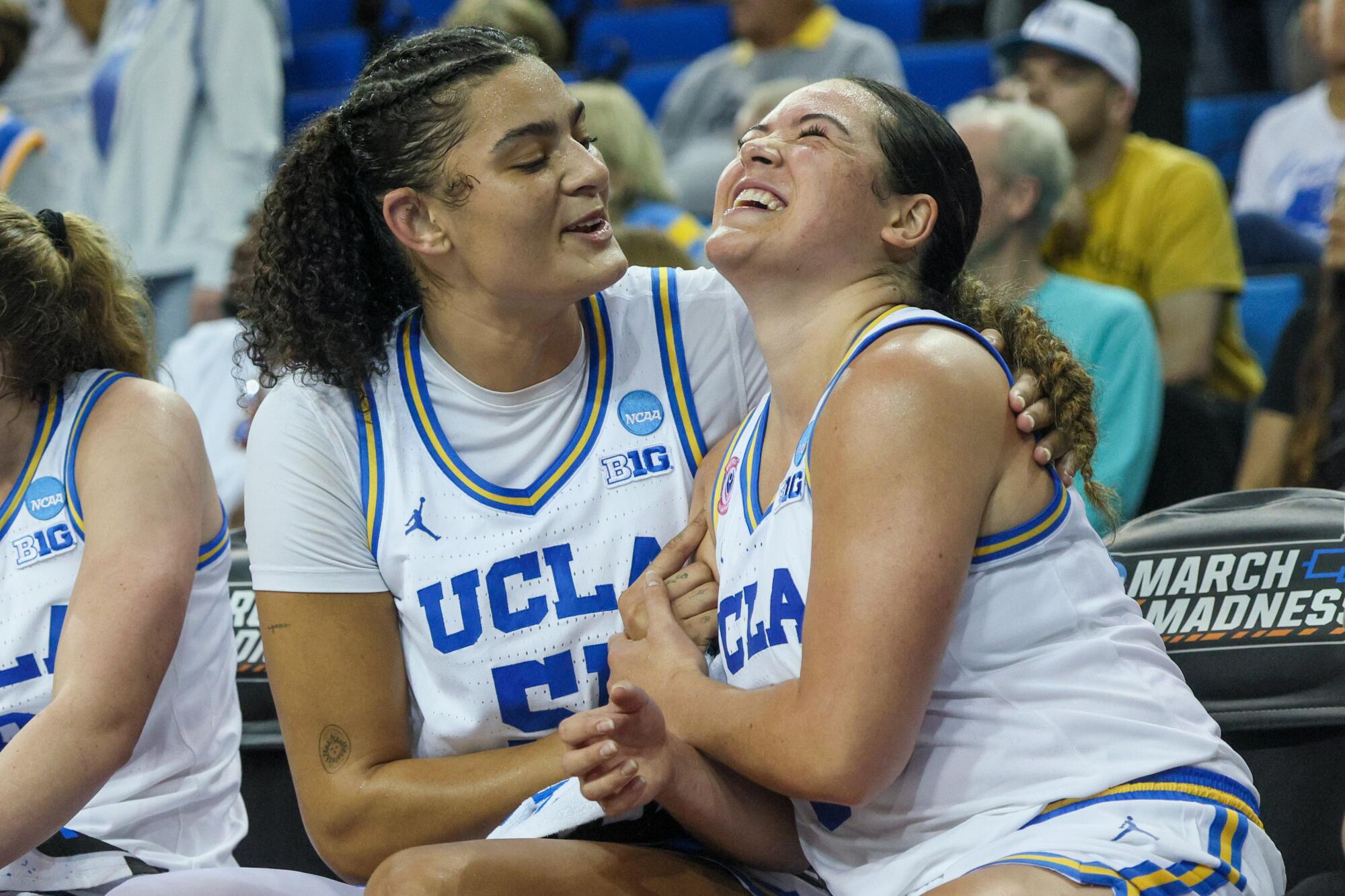
UCLA center Lauren Betts, left, and teammate Charlisse Leger-Walker laugh together on the bench during Monday’s NCAA tournament game against Oklahoma State.
(Ronaldo Bolanos/Los Angeles Times)
Her teammates are in awe of her efforts to be the best person she can on and off the floor.
“She makes everyone better not just because of the basketball player she is, but the leader she is,” said Gianna Kneepkens, a graduate student who transferred from Utah to UCLA. “She challenges us, she pushes us, she just wants what’s best for the team. When people are getting tripled, she’s not worried about, ‘Oh, like, can I get the points?’ She’s seeing who is open so that we can score. So I just have had such a great time playing with Lauren and she’s one of the biggest reasons I came here.”
During the Oklahoma State win, UCLA led from wire to wire. But the Cowgirls outscored the Bruins in the second half and the Bruins’ shooting fizzled out during a tense third quarter. Betts, however, didn’t falter.
Her 35 points came in just 34 minutes. She was 15 of 19 from the field and nearly reached a double-double with nine rebounds.
Betts had long established herself as one of the best players in the country, but she doesn’t lead the nation in scoring, in part, because UCLA is a balanced team with many scoring options. Her performance against Oklahoma State was a reminder that she is still the Bruins’ most formidable player and remains the heart of the program’s push to win a national championship.
“That [scoring is] always in her bag,” Jaquez said. “Maybe some nights she passes more, but that’s just what makes her so special. She’s going to win 99% of her matchups.”
UCLA’s offense runs through its star center even with some of the best shooters in the country. Their starting lineup spaces the floor, with former Washington State leading scorer Charlisse Leger-Walker as a fifth option.
“She puts a lot of pressure on herself a lot of the time and always blames herself when she shouldn’t be and no one else is thinking that way,” Leger-Walker said of Betts. “And I think over this past year, she’s really been working on trying to not do that so she can be the best she can for this team. We obviously need her to be confident, just being able to trust herself, because that is what is going to make our team so much better.”

UCLA center Lauren Betts shoots the ball during the Bruins’ NCAA tournament win over Oklahoma State at Pauley Pavilion on Monday.
(Ronaldo Bolanos/Los Angeles Times)
There are games that often belong to someone else. Jaquez has turned in big games this season and Rice was the Big Ten tournament most outstanding player. The Bruins have featured six different leading scorers across all games this season.
But it still always comes back to Betts, who has been UCLA’s top scorer a team high 14 times.
“Lauren is one of those players that is always so dominant,” Leger-Walker said after the win over Oklahoma State. “I didn’t even know until she came out that she had 30-something [points.] I was like, ‘Yeah, what the heck?’ That’s just her, you know, she’s a bucket. And she’s gonna always be dominant in that fashion and she is just such an impact player for this team.”
Betts’ 27 minutes, 17.1 points and 8.7 rebounds per game are slightly down from last season. Her 3.2 assists per game are slightly up. Her role, like many other UCLA players, has evolved to fit the star-studded lineup.
In the same way Leger-Walker went from a three-point sniper to a point guard or Rice went from a distributor to a shooter and Jaquez from a hoop driver to a three-level scorer, Betts transformed from a post-up only scorer to the conductor of the Bruins’ office in the middle of the floor.
“She anchors us on both ends, down in the paint, especially defensively,” Rice said. “Her ability to switch out on guards and play on the perimeter and help us out is really, really big. And obviously offensively, she’s such a big offensive player.”
If the Bruins do win a national title, it’ll be on the back of their star. Sure, UCLA is a team full of them, but Betts is still, as Jaquez describes her, “that girl.”
For one last run, Betts can be that for a community and team where she’s found not just acceptance, but true celebration.
“I think she’s found a really deep purpose,” Close said. “And when you can use your pain for great purpose and other centeredness to have an incredible legacy in the lives of others, that’s an incredible gift. But it’s a gift that she’s worked really, really hard for.”

Israelis question Lebanon war as opposition grows | Newsfeed
Growing opposition within Israel is raising questions about the government’s military strategy in southern Lebanon. As Al Jazeera’s Nida Ibrahim reports, many warn of an open-ended conflict as Hezbollah remains a strong force on the ground.
Published On 27 Mar 2026

Iran’s football team honours children killed in Minab school airstrike | Football
Iranian football players laid backpacks on a football pitch in Turkey to pay tribute to the children killed in a US-Israeli strike on Minab elementary school last month. The tribute came ahead of a friendly match against Nigeria.
Published On 27 Mar 2026

BBC Airport star Jeremy Spake unrecognisable 3 decades later after ‘bullying’ horror
Jeremy Spake became a firm favourite on the BBC series Airport, which first aired in 1996, and has since gone on to enjoy a successful media and aviation career before alleging workplace issues

Jeremy Spake first catapulted to fame an astonishing 30 years ago on the BBC series Airport(Image: BBC)
Jeremy Spake, who was first catapulted into the limelight an astonishing 30 years ago on the BBC series Airport, is now almost unrecognisable. The programme, similar to ITV’s own successful Airline, gave viewers a behind-the-scenes look at the daily workings of Heathrow Airport and the aircraft departing from there. Now 56, Jeremy was featured on the show in 1996 during his stint as a ground services manager for Russian airline Aeroflot.
He swiftly became a viewer favourite during his time on the show, which subsequently paved the way for additional television opportunities. He went on to host Toughest Jobs in Britain, a documentary series that followed workers in some of the UK’s most challenging and physically demanding roles, as well as the medical programme City Hospital.
He also authored two books, titled Jeremy’s Airport and The Toughest Job in Britain. Jeremy’s Airport drew from his experiences working at Heathrow, guiding readers through a typical week on the job, while The Toughest Job in Britain saw him reflect on some of the incredibly tough jobs he tackled while presenting the show.
READ MORE: Emmerdale Gennie Walker star looks so different 14 years after exitREAD MORE: Noughties child star unrecognisable 14 years after disappearing from spotlight
While pursuing his media career, Jeremy was also steadily ascending the corporate ranks in his day job. Proficient in Russian, Jeremy eventually climbed to the position of services manager for Aeroflot before being promoted to Deputy Director of Isle of Man Airport.
Nevertheless, Jeremy chose to resign from his position at the Isle of Man airport, describing ‘bullying, harassment and mobbing on an almost industrial scale’ via his LinkedIn profile. Reports emerged in 2023 that he was pursuing legal action against the Isle of Man government for personal injuries, alleging damage to his mental wellbeing.
He subsequently fronted a six-episode documentary series aired on the BBC, The Airport: Back In The Skies. The fresh series witnessed Jeremy returning to his roots, reuniting with former colleagues, and examining closely how the sector was recovering following the coronavirus crisis.
Production for The Airport: Back In The Skies kicked off in October 2021, after approximately eighteen months of lockdown measures, travel restrictions, and vaccine passport requirements, while the airport was working to rebuild operations and restore full capacity.
Thankfully, Jeremy has never been one to stand on the sidelines and pitched in by helping to prepare a Boeing 737 for departure and lending a hand to holidaymakers stranded during the turmoil.
The television personality has also released his own audio book, Jeremy’s Airport Audio Book, which recounts the Airport narrative with extra commentary and fresh anecdotes that didn’t feature in the original BBC television programme. Adding another dimension to Jeremy’s repertoire, he now presents daily aviation updates on Instagram, for Air News Daily.
However, Jeremy now has a dramatically different look. His brown hair has disappeared as the star is now completely bald and he has swapped his smart goatee for a clean-shaven look. The website for the channel says: “Jeremy is a seasoned broadcaster and aviation professional with 40 years experience of working with some of the largest airlines and airports around the world and brings his unique insight to every show.”
READ MORE: Women swap Easter eggs for ‘better’ beauty box with items cheaper than Lindt bunny

EU Parliament unblocks key political hurdle in digital euro negotiations
Published on
EU lawmakers have overcome a key political hurdle in the negotiations of digital euro, making the project closer to approval, according to a draft text seen by Euronews.

ADVERTISEMENT
ADVERTISEMENT
The Parliamentary rapporteurs involved in the legislation have found an agreement on the design of the digital euro, which will be able to function both online and offline.
The digital euro would be an electronic form of cash issued by the European Central Bank, designed to sit alongside banknotes and the payments services offered by commercial banks.
It has taken on new political weight as economic tensions between the EU and the US sharpen the debate over Europe’s reliance on American payment giants, such as Visa and Mastercard.
Under the European Commission’s proposal, digital euro users would have a wallet for both online and offline payments, with transactions designed so they are not trackable.
The situation in Parliament changed on Wednesday evening, when the centre-right politician Fernando Navarrete, who is the leading rapporteur on the file, announced the withdrawal of his position to reduce the scope of the digital euro to offline use only.
His position blocked the advancement of negotiations for months, jeopardising the whole legislative process, according to three sources familiar with the negotiations.
The political deadlock has pushed EU leaders to accelerate progress on the digital euro. At the European Council meeting on 19 March, they set a goal to have the digital euro legislation approved by the end of 2026.
With the Council, representing EU countries, having already adopted its position, the European Parliament is now the only institution left to advance the law.
“Thanks to our amendments and firm stance, we have finally broken the political deadlock on the digital euro. The distinction between online and offline has been removed, and it is now established as a single payment system,” Pasquale Tridico, the rapporteur for The Left, told Euronews.
However, lawmakers still need to agree on two key aspects: the “hold limits” and the “compensation.”
The hold limits determine the maximum amount a user can store in a digital euro wallet, while compensation sets out a model for reimbursing commercial banks that provide digital euro services.
Although negotiations are not yet complete, the text is expected to be voted on in the Parliament’s economy committee before the summer, according to a source familiar with the matter.
Martin Lewis issues ‘check now’ passport warning ahead of April 8
Money Saving Expert Martin Lewis urged Brits to check if they need to renew passports now

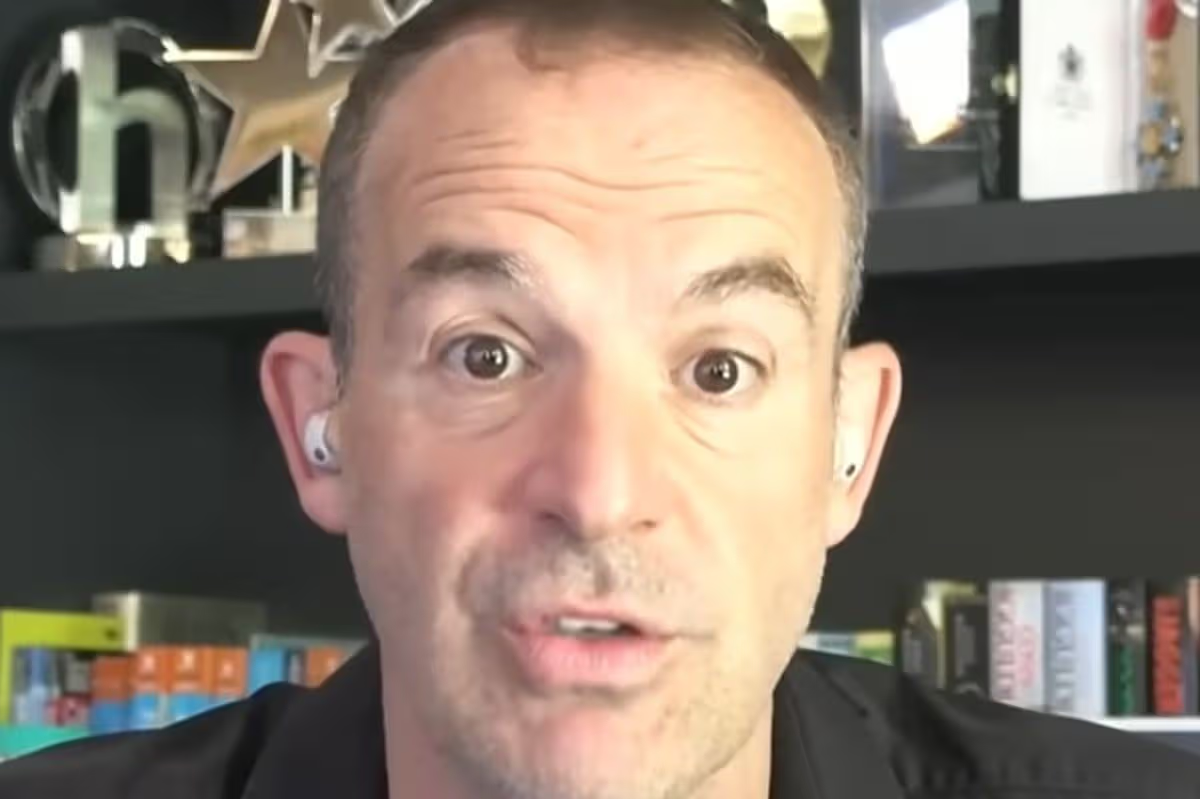
Martin Lewis has issued advice to UK travellers over their passports(Image: ITV screengrab)
Brits have been urged to “check now” or face being hit by costly passport fees come April. Next month is set to bring a hike in passport charges.
At present, a standard adult passport costs £94.50 when applying online. However, this is due to increase to £102 from 8th April. The price of a child’s passport will also climb from £61.50 to £66.50.
In an update on his Money Saving Expert (MSE) website, Martin Lewis implored people to check whether they require a new passport now, in order to sidestep the forthcoming fee increases. He said: “Rising by up to £17.50. 8 April.
“Check NOW if yours is due for renewal, there’s still time to get the lower rate.” Additional guidance on securing the best deal was also published elsewhere on MSE.
“If you need a new passport, it’s cheapest to apply online,” MSE said. “The only site you’ll ever need to go to is the GOV.UK website.
“It has options for getting your first passport, renewing an old one or getting one for your child. You can apply online, which is the cheapest option, or by paper at the Post Office.
“Last year, over seven million Brits saved by applying online.”
READ MORE: I used new EU airport entry system and it left me worried for summer travellersREAD MORE: HM Passport office warns Brits ‘you may not be able to travel’
How much are passport fees rising?
- Adult: takes up to three weeks to arrive – online cost now – £94.50, online cost from April 8 – £102, postal cost now – £107, postal cost from April 8 – £115.50
- Adult fast-track – arrives one week after appointment – online cost now – £178, online cost after April 8 – £178
- Adult ‘Premium’ – given at the appointment – online cost now – £222, online cost after April 8 – £239.50 Child – takes up to three weeks to arrive – online cost now – £61.50, online cost after April 8 – £66.50, postal cost now – £74, postal cost after April 8 – £80
- Child fast-track – arrives one week after appointment – online cost now – £145, online cost after April 8 – £145
It’s worth noting that there’s no child equivalent one-day service. Also, for all these types, you can pay £12 extra for a 54-page passport, which is “useful” for frequent travellers.
The Government website also cautions that no refund will be issued should you cancel your application or if you’re not entitled to a passport.
Burgundy passport
If you’re still in possession of a burgundy passport, there’s no need to panic – you won’t be required to renew it until closer to its expiry date, as they remain perfectly valid. MSE added: “Got a burgundy passport? Newly-issued UK passports have a blue cover, but you DON’T need to get a new passport straightaway – you can keep using your burgundy passport until it’s due for renewal. The blue passports will only be issued when you renew or apply for a new passport.
“Passports can take up to three weeks to be processed, so apply early. The Passport Office warns that renewing can take three weeks for both online and postal applications, so don’t leave it too late if you’re planning a trip.
“If you need a passport urgently, you’ll need to book an appointment at a passport office and pay online. Alternatively, call HM Passport Office (HMPO) on 0300 222 0000 to book an appointment and pay.” Responding to the price increase, the Home Office released a statement saying: “The new fees will help the Home Office to continue to move towards a system that meets its costs through those who use it, reducing reliance on funding from general taxation. The Government does not make any profit from the cost of passport applications.
“The fees contribute to the cost of processing passport applications, consular support overseas, including for lost or stolen passports, and the cost of processing British citizens at UK borders.”

Trump jokes, rants, talks price of pens as Iran war enters fifth week
During his first Cabinet meeting since launching the U.S. war on Iran, President Trump spent 10 minutes talking about the price of ceremonial White House pens — which he claimed to have brought down, from $1,000 to $5, by switching to his favored Sharpie brand.
Trump was trying to make the point during the Thursday meeting that he’s a great money saver. He seemed chipper, joking with the other leaders of his administration at the table.
Late Thursday, when asked on “The Five” on Fox News about whether Iranian people have access to basic necessities such as drinking water and food, Trump complimented the looks of Dana Perino, the Fox host who’d asked the question, compared to when he’d met her years before.
“Now I’m not allowed to say this, it’s the end of my political career, but you may be even better looking, OK?” Trump said. “You’re not allowed to say a woman’s beautiful anymore.”
He then talked about Iranian authorities killing protesters, but said he’d been pleased with them more recently because they had given him a “present” by allowing oil ships through the Strait of Hormuz.
Through both discussions, Trump maintained a flippant, casual tone — the same he has maintained since the war began a month ago, and a vast departure from that of past wartime presidents.
For weeks, Trump has batted away criticisms of the war campaign and questions about why it was justified and how long it will last. He has derided reporters for asking questions about tactics and whether he’ll deploy boots on the ground as inappropriate and foolish, and repeatedly met concerns about the human toll of the war by shrugging them off or changing the subject.
Meanwhile, his war has cost the U.S. billions of dollars and depleted its global reserves of critical weapons systems such as Tomahawk missiles, which cost millions of dollars each and are needed to maintain U.S. security around the world, according to the Washington Post.
Entering its fifth week, the war has badly disrupted markets, with U.S. stocks falling Friday as Wall Street approached the end of its fifth straight losing week — the longest such streak in nearly four years — and oil prices rising again.
Markets have fluctuated based on Trump’s changing messages on an end to the war, planned and then postponed strikes on Iran’s power plants, strikes on oil and gas infrastructure across the Middle East and Iran’s stranglehold on the Strait of Hormuz, through which a quarter of global oil usually passes.
Trump has talked in recent days about an impending deal to end the war, but so far it has not materialized, with Iran downplaying the seriousness of the negotiations. Iran instead appeared to be formalizing its hold on the strait, including by creating what amounts to a toll on ships seeking passage through the channel from its Islamic Revolutionary Guard Corps.
The number of U.S. deaths in the conflict has held steady for days — at 13 — but the war continues to exact a daily, devastating toll in the Middle East. In Iran, thousands of targets continued being hit, with the death toll ticking toward 2,000.
Speaking by video during a Human Rights Council meeting in Geneva on Friday, Iranian Foreign Minister Abbas Araghchi accused the United States and Israel of harboring a “clear intent to commit genocide” in Iran, claiming that more than 600 schools had been damaged or demolished and more than 1,000 students and teachers “martyred or wounded.”
The discussion related in part to a Feb. 28 strike on an elementary school in Minab that killed more than 165 people, most of them children, which evidence reportedly suggests was the work of the U.S. and which the U.S. says is under investigation.
Casualties also continued in Gulf nations allied with the U.S., where Iran continues to strike U.S. military installations and other infrastructure, and in Lebanon, which Israel has invaded and bombed relentlessly in its own war with the Iranian-aligned Hezbollah force.
And yet, Trump has bounced between speaking engagements and more formal meetings with an apparent lightness — seeming unbothered by the weight of the conflict and acting as if U.S. victory were already at hand.
“We’ve already won the war. Militarily we’ve totally won the war,” he told “The Five” on Thursday.
After Trump’s exchange with Perino, fellow host Greg Gutfeld began to change the topic, saying, “I’m debating whether to be serious or not serious.”
“Do you think Biden would do this interview? Can you imagine? You think Biden — Sleepy Joe — he would do it?” Trump said.
He called the war a “little bit of a detour” from what he said were his otherwise winning economic policies, and asserted again — without providing evidence — that Iran was on the cusp of having a nuclear weapon and would have used it to cause devastation across the Middle East and to the U.S. if the U.S. hadn’t struck first, including when it bombed Iran’s nuclear sites last summer.
“You can’t let a madman or you can’t let a mad ideology have a nuclear weapon,” Trump said.
He repeated his long-pushed lie that he won the 2020 election, and suggested his support among his MAGA base remains at 100%.
An AP-NORC poll this week found that most Americans believe that the U.S. military campaign in Iran has gone too far — including about a quarter of Republicans — and that many are worried about gas prices.
During his Cabinet meeting Thursday, Trump seemed supremely confident, but also aware that the conflict was far from settled.
He said that the U.S. was “extremely — really a lot — ahead of schedule” in its war effort, and that “the Iranian regime is now admitting to itself that they have been decisively defeated.” But he also said that “even now, we don’t know if there are any mines” in the Strait of Hormuz, despite the U.S. having wiped out Iran’s “mine droppers,” and acknowledged that “if you think there may be a mine, that’s a bad thought and it stops things up.”
He said the U.S. has “decimated” about 99% of Iranian capabilities, but “the problem with the strait” is that the remaining 1% threat “is unacceptable, because 1% is a missile going into the hull of a ship that cost $1 billion.”
“If we do a 99% decimation, that’s no good,” he said.
During “The Five” interview, Trump was also asked if the CIA had told him that Supreme Leader Ayatollah Mojtaba Khamenei — who took on the Iranian leadership role after his father, Supreme Leader Ayatollah Ali Khamenei, was killed in initial strikes — is gay, which would be a crime under Iranian law.
“Well they did say that, but I don’t know if it was only them. I think a lot of people are saying that. Which puts him off to a bad start in that particular country, you know?” Trump said, in a stunning acknowledgment of a previously rumored intelligence briefing.

Seeing double: Dodgers celebrate titles on a sparkling opening day
There were fireworks, there was a flyover, there was Will Ferrell screaming and Keith Williams Jr. crooning and four months of cheers unleashed by fans wearing championship belts and howling grins.
But the real stars of Thursday’s Dodger opening day show never made a sound.
They arrived silently at the end of the pregame ceremony, carefully held by two of the men who helped win them, lifted high for all those who so passionately longed for them.
They were the last two Commissioner’s Trophies, the back-to-back World Series championship trophies, the two symbols of the Dodgers domination held side by side in the afternoon sun.
Man, it was beautiful. Goodness, how they sparkled. Incredible, how they glowed.
It was almost as if they were powered by some electrical force, some sort of championship current running between them, lighting them up with a blinding power curated by the battered fingers of the two veterans who touched them.
Freddie Freeman, whose grand slam doomed the New York Yankees, held the 2024 trophy. Miguel Rojas, whose home run stunned the Toronto Blue Jays, held the 2025 trophy.
Together they brought the trophies to the dugout from center field while riding in the back of a blue convertible driven by Ferrell as part of an elaborate video skit.
It was the first time many had seen the hardware side by side, and, amid audible gasps, their power was unmistakable. The greatness of the Dodgers accomplishment came to life on a day when their new task became equally clear.
“Three-peat!” screamed one of the pregame musicians.
Welcome, Dodgers, to 2026.

While manager Dave Roberts downplayed the three-peat talk before the opening 8-2 victory over the Arizona Diamondbacks, you know it’s here, it’s there, it’s everywhere.
“At this moment, very minimal,” said Roberts when asked about the pressure. “…So yeah, hopefully we can keep that to a minimum throughout the season. But yeah, there’s obviously going to be a lot of talk about it.”
Thursday did nothing to dampen that talk. It was as if last season’s Game 7 against the Toronto Blue Jays was still being played. The Dodgers behaved like the exact same team with some of the same heroes.
The winning pitcher? Once again, it was Yoshinobu Yamamoto, who threw six solid innings with six strikeouts and no walks.
The game-changing play? Once again, it was Andy Pages, whose three-run home run in the fifth inning gave the Dodgers a lead they never lost.
The final big blow? Yep, Will Smith, whose two-run homer in the seventh inning clinched it.

Dodgers unveil the plaque for the 2025 World Series win.
(Ronaldo Bolanos / Los Angeles Times)
There was even a World Series star coming out of the bullpen, new cult hero Will Klein entering the game to the night’s loudest ovation and throwing a scoreless inning.
It’s as if the Dodgers have been on the same roll for four months…with no signs of slowing. This could be crazy. This already is crazy.
Other than the cool trophies and the Diamondbacks trampling, the most notable show Thursday was unwittingly staged by Dodger Stadium itself.
Your dutiful correspondent’s first impression of his favorite place on earth upon returning here for his 37th home opener wasn’t about the deep green or brilliant blue or enduring mountainscape.
It was, when did this place become Las Vegas?

-
Share via
Illuminated by the new grotesquely red Uniqlo Field billboard hanging high above center field, the stadium appears to have been transformed into something straight from NASCAR, advertisements filling every nook and cranny of the pavilion and beyond. There are giant billboards above the bullpens. There are scribbled ads on the bullpen walls. There are screaming displays for beer, soda and healthcare, the latter of which you will need if you heed too many of these ads.
The incessant sales pitches are buffeted by the usual deafening pounding music, which makes Vin Scully Avenue seem like Las Vegas Boulevard.
Was it always like this? It doesn’t seem like it. The Dodgers have always been relentless billboard salesmen, but since the arrival of Shohei Ohtani, they’ve become a global attraction with seemingly every major company on earth willing to pay for a piece of their success.
Fans will probably notice that the biggest difference this year is the $125-million sponsorship deal with Uniqlo, a Japanese apparel company that bought center field. Chavez Ravine is now officially known as Uniqlo Field at Dodger Stadium and, yeah, on Thursday it was awful hearing public address announcer Todd Leitz introduce it like that.
Not to worry, nobody in their right mind is ever going to call it that. Nonetheless, the whole atmosphere was weird and unsettling.
Still, it’s hard to blame the Dodgers. They’ve spent gobs of money building a two-time defending champion, and those bucks have got to come from somewhere.
You want Kyle Tucker? Live with the beer ad. You want a $1 billion rotation? Deal with the bank ad.

Dodgers Blake Snell, Kiké Hernandez, Roki Sasaki and Alex Call during player introductions before the game.
(Gina Ferazzi / Los Angeles Times)
Unlike many other teams that have made baseball a haven for cheapskates, the Dodgers invest much of their revenue back into the roster.
It’s not always pretty. It can be loud and distracting and obnoxious. But it works.
As night fell on a blessed blue Thursday, the Dodgers had won their eighth straight home opener. They did it with pitching, hitting, depth, and two of the prettiest pieces of jewelry you’ve ever seen.
It was a day to celebrate the completion of the most incredible two-year journey in franchise history.
It was also a day to realize that the journey has just begun.