



Intense US-Israeli attacks on Iranian city of Isfahan cause column of fire | Conflict
Witnesses have captured intense US-Israeli attacks on Isfahan, a city in Iran with a population of 2.3M, and home to the Badr military airbase. Huge explosions and fires have lit up the night sky.
Published On 31 Mar 2026

Russell Brand’s rape trial delayed by four months due to ‘numerous’ allegations he faces
COMIC Russell Brand’s rape trial has been delayed by four months and is expected to last eight weeks — up from five — due to “numerous” and expanded charges.
The screen star, 50, faces three counts of rape, three of sexual assault and one indecent assault against six women from 1999 to 2009.

Brand — who denies all the charges in full — was facing trial at Southwark crown court on June 12.
But Mr Justice Joel Bennathan KC put it back until October 12.
He noted an eight-week trial in June would run into August — with potential summer holiday and travel interruptions.
Brand, of Hambleden, Bucks, didn’t attend court today.
read more on russell brand


Brand had appeared in court last month and denied charges of rape and sexual assault against two women in 2009.
Before the hearing, Brand took out a copy of the bible and began reading it but it was confiscated by the dock officer until the case was done.
The Met Police launched a probe into the TV presenter in September 2023 after The Sunday Times and Channel 4’s Dispatches published an investigation into allegations over his treatment of women.
Following the charge, Brand told his 11.3million X followers that he was “never a rapist”.
He added: “I’ve always told you guys that when I was young and single, before I had a wife and family… I was a fool, man.
“I was a fool before I lived in the light of the Lord… I have never engaged in non consensual activity, I pray you can see that by looking in my eyes.”
Brand, who was previously married to pop star Katy Perry, shares three children with his wife, Laura Gallacher, 37.

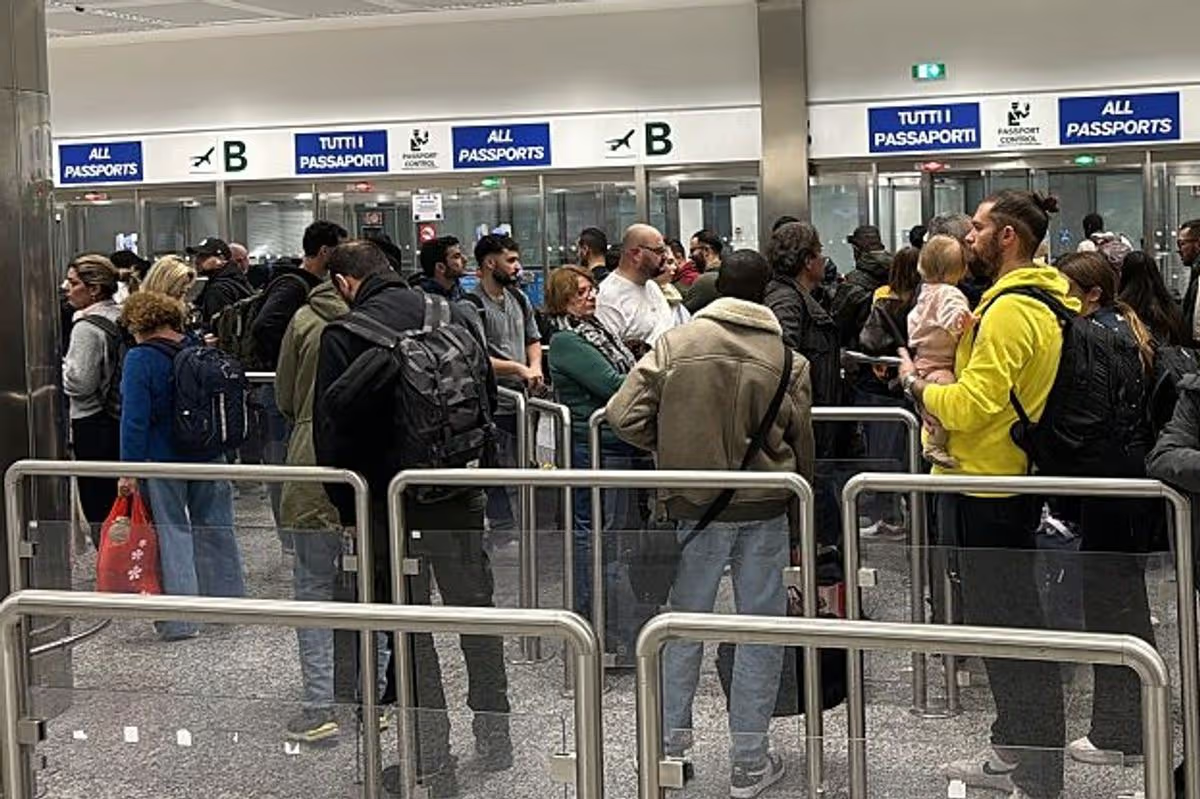
EES system: Warning Brits face two-hour queues at European airports this Easter
All passengers without EU passports will be required to have their fingerprints registered and their pictures taken under new rules, and this is likely to cause bottlenecks

People queue at passport control in Milan, Italy (file image)(Image: NurPhoto via Getty Images)
Brits travelling to Europe over Easter face long delays — up to two hours at times — at border control as strict new entry rules come into effect.
Bottlenecks are expected due to the EU’s new entry/exit system (EES), airports and airlines are warning. Under the rules, all passengers without EU passports will be required to have their fingerprints registered and their pictures taken. These will be captured on first entry into the Schengen zone and then checked at every subsequent entry and exit.
The system, which comes into effect today, requires all non-EU arrivals to undergo the checks. Until now, only 50 per cent of passengers had to be processed at each border point.
Airports Council International (ACI), a trade body, said the latest data from across Europe “shows a continued deterioration in waiting times at border crossing points”. It said waiting times were “regularly reaching up to two hours at peak traffic times, with some airports reporting even longer queues”.
READ MORE: Spain airport strikes update as first action set to begin in less than 24 hoursREAD MORE: Holidaymakers ‘cancelling Tenerife breaks’ amid wild weather and ‘airport chaos’
Data released last week showed at least 4,000 holidaymakers have been caught out by the new rule since it was soft-launched in October, after successive delays. During this six-month period, the number of passengers required to undergo checks increased in stages and EU members were able to suspend the system in the event of “operational pressures”.
But now the transition period is ending and passenger processing times is set to increase at border crossings. At larger airports, passengers are directed to kiosks to have their picture and fingerprints taken, although at smaller airports the process is done by an officer.
Speaking to The Times, Olivier Jankovec, the directorgeneral of ACI, and Ourania Georgoutsakou, the managing director of Airlines for Europe, said: “Passengers entering the Schengen area are likely to wait even longer at border control during Easter due to the persisting operational challenges around the EES rollout.
“We reiterate our call on the European Commission and member states to extend the possibility to fully or partially suspend EES —where operationally necessary — during the entirety of the 2026 summer season.
“This flexibility has proven vital in preventing catastrophic operational disruptions during the progressive rollout of the system. If the technical and operational issues with EES are not resolved, this flexibility should remain available during future peak travel periods, such as winter 2026-27.”
EasyJet, the UK’s biggest airline, is planning for its busiest Easter on record, handling more than a quarter more travellers than last year’s Easter weekend. It expects to operate 16,000 flights from the UK over the school holidays, with 5,000 departing during the Easter weekend.
Last week ministers warned that the introduction of EES would present a “significant change for Brits travelling this Easter”. Alex Norris, the minister for border security, said “extra time may be needed, both for your return to the UK and travelling to the EU” and advised passengers to check with their carrier.

Tuesday 31 March Freedom Day in Malta
In 1814, Malta had become a crown colony of the British Empire after the British had help expel occupying French forces.
Following the heroic defense of the island during World War II, King George VI had promised the Maltese people self government which they gained in 1947. This eventually led to independence from Britain in 1964 and Malta becoming a republic later that year.
British forces remained on the island until 31 March 1979, when the Defence Treaty with Britain came to an end.
The removal of British was partly financial. When the Labour government came to power in Malta in 1971, it renegotiated the the lease agreement that allowed British forces to stay on the island until 1979 at an increased rent.
This withdrawal meant that for the first time in over a thousand years, Malta had no foreign military presence on its land.
The main events of the activities commemorating this date take place at the Freedom Day Monument at Vittoriosa and at the War Memorial in Floriana. In the afternoon the Grand Harbour hosts a competitive regatta.

Charming seaside town with vibrant beach huts and independent high street just 1 hour from London
A UK seaside town is brimming with charm, with vibrant beach huts lining the golden beach and a high street packed with independent businesses that serves up its famed oysters

This picturesque seaside town is just a short train journey from London (Image: Getty Images)
A charming coastal town, just a short train ride from London, offers an idyllic day out, adorned with colourful beach huts and an independent high street.
The seaside town of Whitstable in Kent is perhaps one of the best ways to make the most of the warmer weather, with its sprawling beach, thriving harbour and high street brimming with independent businesses. Nestled between Herne Bay and Seasalter, the Kentish town is just over an hour’s train journey from London, making it a favourite among those who want to escape the smoke for a break by the picturesque coast.
The shingle beach is at the heart of this town, with its picturesque pastel-hued beach huts lining the promenade for a quintessential British seaside. While it may lack the pier or rides you might find at other seaside towns, its stretches of golden beach have previously earned it the recognition of the ‘best of the traditional British seaside’ by Beach Guide, thanks to its ‘quirkiness and charm’.
READ MORE: Beautiful European beach has been named one of the best in the world — not in Spain or ItalyREAD MORE: Italy will pay people £13k to live in village with ‘best beach on the planet’
It’s a place where families can spend hours playing along the shore, taking a refreshing dip in the seawaters, or simply walking along its stretching promenade, admiring the colourful beach huts. If you fancy a pint in the sun, there’s the famed Old Neptune pub, with outdoor seating offering views across the coast, and where fishermen take in their daily catch.
Whitstable also has a bustling harbour and is renowned for its oysters. Its heritage of seafood dates back to around 80AD, when the Romans reportedly sent oysters back to Rome because they loved them so much, and the town built a thriving industry based on mollusc business that remains in place today.
A trip to Whitstable wouldn’t be complete without sampling its famed oysters with the acclaimed Whitstable Oyster Company and Wheelers Oyster Bar, providing the perfect spot. But with an array of restaurants nestled around the town, you’ll never be far from fresh seafood, and the town even holds its very own Whitstable Rocks Oyster Festival to celebrate its historic connection.
Away from oysters, the town, which has been dubbed the ‘jewel of the Kent coast’, is also known for its thriving high street. Whitstable has hundreds of independent businesses, from vintage shops and art galleries to cafés, bakeries, hardware stores, and family-run eateries, with just a few chain stores surviving.
A stroll along Harbour Street and the High Street will reveal shopfronts bursting with character, including George’s Whitstable, an authentic Aladdin’s cave that has been a fixture for around 50 years. Some of its other notable highlights include the elegant jewellery shop Pearl Shop, the independent toy shop Buttercup, and Harbour Books.
Whether you’re looking to spend time on the beach, browse around the extensive selection of independent shops or simply stroll around the charming town, a day trip to this ‘oyster paradise’ is well worth it. And with a direct train from London Victoria to Whitstable taking just over an hour, it couldn’t be easier to experience the seaside charm along the Kent coast.
Do you have a travel story to share? Email webtravel@reachplc.com

In L.A. mayor’s race, controversial poll shows Nithya Raman ahead of Karen Bass
City Councilmember Nithya Raman came out ahead of incumbent Karen Bass in a new poll on the Los Angeles mayor’s race, though the poll’s director cautioned that it did not give the whole picture.
Raman had a commanding lead in a field of five major candidates, with 33% of voters supporting her, while Bass trailed at 17%, according to the poll by the Loyola Marymount University Center for the Study of Los Angeles.
Leftist Rae Huang came in just behind Bass at nearly 17%, while tech executive Adam Miller had 13% and conservative reality TV star Spencer Pratt had 12%.
Other polls have shown Bass in first place.
She was at 20% in an Emerson College Polling/Inside California Politics poll, with Raman at just over 9%. In a UC Berkeley Institute of Governmental Studies poll, co-sponsored by The Times, Bass was at 25% and Raman at 17%.
In the Loyola Marymount poll, unlike the other polls, respondents were given brief descriptions of the candidates, including their occupations and political priorities.
Raman was labeled a “progressive LA City Councilmember focused on housing affordability, homelessness and systemic reform,” while Bass was “incumbent mayor of Los Angeles, veteran legislator, focused on homelessness.”
One of Raman’s challenges, as a councilmember representing Los Feliz and Silver Lake as well as parts of the San Fernando Valley, is to spread her name recognition citywide, with the June 2 primary election about two months away. She entered the race to challenge Bass, her one-time ally, at the last minute, hours before the early February filing deadline.
The Loyola Marymount poll of 370 registered Los Angeles voters was conducted from Feb. 11 to March 16. It did not include a choice for “undecided,” while the other two polls showed that significant percentages of voters hadn’t made up their minds.
“This poll shows if only positive descriptors are used and context is provided, Raman is ahead,” said Fernando Guerra, director of Loyola Marymount’s Center for the Study of Los Angeles, who directed the poll.
Guerra said he believes Bass is the front-runner, taking the previous polls into account.
Bass’ campaign took issue with the Loyola Marymount poll.
“In 2022, this same LMU poll had Karen Bass at 16% — she ended up winning the primary with 43%. The only thing more ridiculous than this poll is Spencer Pratt’s performance on The Hills,” said Alex Stack, a spokesperson for the Bass campaign, referencing Pratt’s reality show.
Raman’s campaign did not immediately respond to a request for comment. In a post on X citing the poll, Raman wrote, “OUR CAMPAIGN IS SURGING … Angelenos are ready for a city that actually works.”
Paul Mitchell, vice president of the bipartisan voter data firm Political Data Inc., said the poll’s sample size was too small to draw conclusions and that the poll was less reliable because it was conducted over the course of more than a month.
He also noted that with many of the candidates relatively unknown, including the descriptors could have a major effect.
“I’m sure Nithya Raman doesn’t have citywide name recognition, but that description is really great,” Mitchell said.
Guerra said he didn’t include an “undecided” option because he wanted to “force” respondents to give an answer, similar to when they actually vote.
In the Emerson poll, more than 50% of voters were undecided on who to support for mayor. The Berkeley IGS poll showed about a quarter of voters were undecided.
In LMU’s mayoral poll from 2022, released in early March of that year, 42% of respondents chose “undecided/someone else” for mayor.
After Bass, who had 16% support, then-City Councilmember Kevin de Léon was second at 12% in the 2022 poll. Rick Caruso, the billionaire developer, who ended up making the runoff election against Bass, received 6% support.
In that year’s June primary, Bass got 43% of the vote, Caruso nearly 36% and De Léon about 8%.
This year’s LMU poll also asked L.A. voters what kind of candidate they would prefer for mayor.
Nearly 50% said they prefer a Democratic Socialist, while 25% said they want a moderate Democrat, 19% said a conservative and just 8% said an establishment Democrat.
“Los Angeles is much more progressive than its elected leadership. This poll captures that,” Guerra said.
Some disagreed.
Mike Trujillo, a consultant for moderate Democrats who is not representing anyone in the mayoral race, said polling he has done across the city shows that the Democratic Socialists of America’s popularity is much lower.
Raman is a dues-paying member of the Los Angeles chapter of DSA, which endorsed her in her two successful City Council campaigns.
“If you believe this poll, I have bridges to sell you on 1st Street, 6th Street, and Alameda Street — and there’s no bridge on Alameda,” he said. “The poll was basically A to Z in Nithya Raman’s contact list.”
This year’s LMU poll also asked L.A. County voters about the governor’s race. Former U.S. Rep. Katie Porter led at about 16%, followed by Republican Steve Hilton at 13% and billionaire Tom Steyer at 12%.
The Berkeley IGS poll showed two Republicans — Riverside County Sheriff Chad Bianco and Hilton — leading the crowded field of gubernatorial candidates by slim margins among voters statewide, with Democratic support split among multiple candidates in a left-leaning state.

World Cup 2026 risks becoming a ‘stage for repression’ – Amnesty report
In its 36-page report titled ‘Humanity Must Win: Defending rights, tackling repression at the 2026 FIFA World Cup’,, external Amnesty calls on the host countries’ governments to “meet their obligations under international human rights law, while Fifa, national FAs and sponsors all have clear responsibilities to respect human rights…”
“The US government has deported more than 500,000 people from the USA in 2025, more than six times as many people than will watch the World Cup final in the MetLife Stadium”, said Amnesty’s head of economic and social justice Steve Cockburn.
“…It’s a deeply troubling time in the US, which will certainly extend to fans who want to take part in World Cup celebrations.”
Last month, the acting head of US Immigration and Customs Enforcement (ICE) said that the agency is “a key part of the overall security apparatus for the World Cup”, vowing it was “dedicated to ensuring that everyone that visits the facilities will have a safe and secure event”.
Earlier this year, ICE agents shot and killed two American citizens as part of US president Donald Trump’s immigration crackdown in Minneapolis.
Trump has sent federal agents, as well as the National Guard, to major US cities over the past year to make good on his campaign promise to crack down on illegal immigration. They have been met with protests and legal challenges in Democrat-led cities like Portland, Los Angeles and Chicago.
“Despite the astounding numbers of arrests and deportations, neither Fifa nor the US authorities have provided any guarantees that fans and local communities will be safe from ethnic and racial profiling, indiscriminate raids, or unlawful detention and deportation,” said Cockburn.
“Only four of the 16 host cities have so far published their human rights plans, and none of those that have done so to date say anything about protection from abusive immigration enforcement.
“This World Cup is no longer the ‘medium risk’ tournament that Fifa once judged it to be – whether it is to protect people from ICE, guarantee the right to protest or prevent homelessness, urgent action is needed to make sure the reality of this World Cup matches its original promise.”
Amnesty says that ICE and other agencies “pose a chilling threat to people living in the US, those traveling to see a game, and players themselves”.
It added: “Fans face intrusive surveillance, with proposals to force visitors to make their social media accounts available for vetting, and screening for “anti-Americanism”.
In January, fan group Football Supporters Europe (FSE) told BBC Sport it was “extremely concerned by the ongoing militarisation of police forces in the US” before the World Cup”.
At the time, Fifa said the safety and security of fans and participants was its “top priority”, adding it works closely with local authorities “to plan, co-ordinate and deliver comprehensive security measures for the tournament”.
The White House’s World Cup Task Force said that the tournament will be “the largest, safest, and most welcoming sporting event in history” and that it was working to deliver an event “that highlights America’s hospitality, commitment to security, and spirit of excellence”. It promised that fans “can look forward to a smooth, secure, and truly unforgettable tournament”.
Amnesty highlights Mexico’s response to high levels of drug cartel violence, which it says is “raising risks for people protesting”. Earlier this month the World Cup co-host announced plans to deploy nearly 100,000 security personnel to protect fans at this summer’s tournament.
And the campaign group also claims that in Canada, a growing housing crisis has “raised fears that people experiencing homelessness will again be displaced and pushed further to the margins”.
Fifa has been approached for comment.

NASA starts countdown clock for Artemis II launch
March 30 (UPI) — NASA officials on Monday started the two-day countdown to the Artemis II mission launch, which will send a crew of four around the moon as they test the Space Launch System rocket and Orion spacecraft.
After canceling a launch attempt in February because of a helium valve concern, officials said that the only thing they are worried about ahead of Wednesday’s launch is the weather — and the forecast offers an 80% chance for the right conditions.
The 10-day mission, which will take the crew farther from Earth than any human before, is the next step in the agency’s goal of returning humans to the surface of the moon and establishing a permanent presence there.
With mission engineers starting the clock, the crew — Mission Specialist Jeremy Hansen, Mission Specialist Christina Koch, Commander Reid Wiseman and Pilot Victor Glover — are getting some rest and spending time with their families before starting their own pre-launch activities, officials said.
“The team concluded that everything continues to look good and there are no issues preventing us from pressing ahead,” NASA’s Associate Administrator Amit Kshatriya said during a media briefing from Kennedy Space Center in Florida.
“At this point, as we enter the pre-launch phase, we are in a strong posture and the mission remains on track,” he said.
Countdown to launch
The Artemis II launch window starts at 6:24 p.m. EDT on Wednesday, giving NASA two hours if the cumulus cloud cover is too heavy, which mission engineers said is the only thing about the weather forecast they are worried about.
The SLS and Orion was initially rolled out to the launch pad in February but engineers discovered an issue with a helium valve during a wet dress rehearsal and decided to bring the rock back to the Vehicle Assembly Building to check it out.
After replacing the valve, and checking on other systems, the rocket was rolled back out on March 19.
Monday’s mission management team meeting is similar to the flight readiness review but is a faster rundown than that comprehensive effort as each group updates others on their pre-launch progress.
Charlie Blackwell-Thompson, launch director for the mission, said the launch countdown officially started at 4:44 p.m. EDT on Monday, which corresponds with NASA starting to configure ground facilities at the launch pad.
She noted that, while most people are familiar with a 30-minute or 10-minute countdown, launch countdowns are generally linked to the preparation needed for launch — shuttle countdowns started three days before launch, while commercial launches may often need a countdown of one day or less.
Crew awaits launch
The Artemis crew arrived in Cape Canaveral “on Friday, getting an opportunity for some rest before we work them very hard,” Emily Nelson, the mission’s chief flight director, said of the foursome, which has been in quarantine already for a couple of weeks.
Like many crews of astronauts before them, the Artemis crew has been staying at The Astronaut Beach House, which NASA has owned since 1963 and where space mission crews have spent time ahead of launches for decades.
Before the start of their final meetings and prep for launch, the crew was expected to eat dinner and spend time with their families, all of whom also have been required to comply with some sort of quarantine before getting there.
On launch day, after fuel tanking and last-minute items by a closeout crew around 1:00 p.m. EDT, the crew will board the Orion at 2:00 p.m. EDT to conduct communication system checks, configure the crew module and run the countdown to a 10-minute hold for about 30 minutes, Blackwell-Thompson said.
During that 30-minute hold, mission engineers will run through one more system-by-system before starting the final countdown to NASA’s first crewed mission to the moon in more than 50 years.

NASA’s Space Launch System rocket emerges on Saturday morning from the Vehicle Assembly Building to start its journey to Launch Complex 39B at the Kennedy Space Center in Florida. Photo by Joe Marino/UPI | License Photo

Ukraine Using Private Air Defense Teams To Protect Industry Against Russian Drones
At a time when Ukraine’s air defense expertise is being sought by Arab nations under fire from Iranian missiles and drones, Kyiv announced its new experimental concept for battling Russian drones is having some positive results. The system relies on the private sector to provide its own air defenses by using Ukrainian interceptor drones and other short-range air defense weapons, under the command and control of the military.
Whether this would be applicable beyond Ukraine is debatable, but officials in Kyiv see private sector air defense as an important move to help spread its burden of defending the skies against ceaseless Russian barrages. Russia has been taking particular aim at Ukraine’s remaining industrial capacity, especially defense-related firms that make drones, missiles and other weapons systems. The constant attacks are a large reason why the country has tried to decentralize production, but not everything can be built in a distributed fashion.
The goal of the program is to take advantage of Ukraine’s large production of counter-Shahed interceptor drones as well as its indigenous automated anti-drone machine gun turrets. By having volunteers operate these systems, it reduces the need to pull troops from the frontlines, officials say.

“The experimental project launched by the Government to involve the private sector in the air defense system is already being implemented and yielding initial results,” Ukrainian Defense Minister Mykhailo Fedorov stated on Telegram Monday morning. “One of the companies participating in the project has already prepared its own air defense group. As of today, several enemy drones have been shot down in the Kharkiv region, including Shahed and Zala models.”
Fedorov did not identify the company, but said another 13 are in various states of gearing up to take part.
“As of now, all groups are at different stages of preparation,” Fedorov wrote. “Some are already performing combat tasks, others are undergoing training, and the rest are completing their preparations and will soon strengthen the country’s air defense.”
Private air defense systems “are integrated into a single management system of the Armed Forces Air Force and are already operating within it – protecting objects and participating in the interception of Shaheds,” Fedorov explained. “This is a systemic solution that allows for quickly scaling air defense capabilities without additional burden on frontline units.”
Fedorov did not say which weapons are being used by the private companies, but a video he posted on X of claimed successful engagements shows the use of the Sky Sentinel automated air-defense turrets, equipped with a heavy machine gun and capable of 360° rotation. An official contacted by The War Zone said the Wild Hornet Sting interceptors are being used as well.
The creation of the private sector air defense program was announced earlier this month by Ukrainian Prime Minister Yulia Svyrydenko. In a media release, she explained that critical infrastructure enterprises, regardless of whether publicly or privately owned, can create air defense groups.
These groups must undergo training and certification by the MoD and will use weapons and ammunition temporarily transferred from the ministry.
“This concerns weapons that are not currently used by combat units,” Svyrydenko noted. “In the event of the use of ammunition, replenishment will be carried out according to a simplified procedure based on an act of actual expenses.”
Ukraine has been developing these weapons and programs because Russia’s launching of thousands of Shaheds and other drones and missiles has depleted its stocks of high-end interceptors like those fired by Patriot and other systems. This has not been lost on leaders of nations now under fire by Iranian drones and missiles.
Fedorov’s announcement about the private sector air defense program comes as Ukrainian President Volodymyr Zelensky wrapped up a tour of the Middle East. While there, the Ukrainian leader said he inked defense cooperation agreements with Saudi Arabia, UAE and Qatar, and had discussions with Jordan.
Zelensky did not announce specific commercial drone sales, “but said talks touched on financial support from Gulf nations that could help Ukraine bridge a delay in European funding after Hungary blocked a 90 billion euro loan package,” The New York Times noted. In addition, Zelensky told reporters that he had also discussed future Ukrainian purchases of energy from the Middle East as Ukraine’s own natural gas industry had been battered by Russian strikes.
“The agreement includes collaboration in technological fields, development of joint investments and the exchange of expertise in countering missiles and unmanned aerial systems,” Qatar’s defense ministry said in a statement during Zelensky’s visit.
When it comes to interceptor drones like Sting, Ukraine has enough to spare should its government sign off on providing them.
Ukraine could export about $2 billion worth of weapons as a whole this year, excluding joint production ventures with allies, suggested Ihor Fedirko, CEO of the Ukrainian Council of Defence Industry, a manufacturers’ association.
Ukraine produced 40,000 interceptor drones in January, according to the government, which has made it clear the country will not export any weapons it needs to defend itself, as we noted in a story on Ukrainian laws preventing direct exports of interceptors and other weapons.
“Zelensky says that provided enough financing, Ukraine has the capacity to up its production to 2,000 interceptor drones a day and would only need 1,000 for itself, leaving plenty for export,” Reuters noted.

Відео 100 збиттів шахедів перехоплювачем #STING #wildhornets #дикішершні #fpv
It is unknown whether the concept of private sector air defenses came up in Zelensky’s talks in the Middle East. However, countries in that region are facing threats similar to Ukraine, with energy infrastructure, data centers and other non-military facilities that likely have limited, if any air defenses, protecting them.
“The Ukrainian model does not surprise me,” retired Army Col. David Shank, who served as Commandant of the Air Defense Artillery School at Fort Sill, Oklahoma, told us. “Other countries have private security forces, some which possess hand-held [counter-drone] capabilities. The U.S. State Department has private security that also possesses capability (up to Stinger I am told).”
The challenge, said Shank, “is system management and command and control of all sensors and shooters.
It is possible the Gulf states could execute a system where companies provide their own air defenses, however, “it would still require strict adherence to authorities.”
Still, Shank sees several downsides, including fratricide, wasted ammunition and a lack of unity of effort from decentralized execution.
Retired Army Gen. Joseph Votel, who commanded U.S. Central Command, raised another concern.
“While it would be up to Arab nations to decide for themselves if this is a good idea, I do think it will complicate integration with partners, including the U.S,” he told us.
Regardless, the Ukrainian program is in its infancy. There is still a long way to go before it establishes its value as a valid means of protecting factories, electric generation plants and refineries against Russian drones. It could turn out to be more destructive than helpful.
However, given Ukraine’s history of battlefield innovation, there will likely be many parties looking to see how it all works out.
Contact the author: howard@thewarzone.com

Jack Whitehall parties at racy club on boozy stag do with James Corden, Jamie Redknapp and Lawrence Dallaglio
JACK Whitehall partied the night away as he enjoyed a star-studded stag do.
He was joined by plenty of famous faces for a very boozy night out.
The comedian and actor is preparing to tie the knot to model Roxy Horner but made sure to make the most of life pre-marriage on his big night out – which included visiting an X-rated nightclub.
Among his fellow celebs with Jamie Redknapp and James Corden as well as ex-rugby star, Lawrence Dagglio.
Jack and his pals partied for more than six hours on the London pub crawl.
Things got underway around 3pm when Jack and the lads sank pints at The Devonshire pub.


Spirits seemed merry within moments of things kicking off for Jack and his friends.
By 5pm, they had moved onto racy London nightclub, The Box.
The ominous venue, a favourite amongst celebrities, is traditionally only open late into the night and the early hours.
It is believed the venue put on a private show for Jack as part of his stag-do.
The Box has a reputation for its outrageous, raucous, and highly sexualized late-night performances.
By 8:30pm, Jack and his pals had moved onto mini-golf hotspot, Swingers.
The group then ended the night with drinks at the Soho Hotel bar – with speculation that Jack could have been staying at the high-end hotel overnight.
James Corden went missing for a few hours during the evening before eventually making his way back to the group for the final moments.
Jack became engaged to model Roxy at the end of 2024 and is due to marry in a matter of weeks.
The couple met while Jack was on a trip to Australia in 2020 and they ended up isolating together in London during the coronavirus pandemic.
They welcomed their first child Elsie in September last year.
At the time, Jack announced the news online and said: “In awe of my partner who has been amazing throughout this journey and is going to be the greatest mum ever.”
At the time of The Sun revealing Jack and Roxy’s engagement, a pal said: “Jack and Roxy are going into Christmas as an engaged couple.
“He asked Roxy to marry him earlier this month and she said yes straight away.
“They could not be happier together and are looking forward to planning their wedding.”
Roxy, who was diagnosed with Type 1 diabetes in 2021, has previously praised Jack for his support.



NFL: Las Vegas to host Super Bowl LXIII in 2029
LAS VEGAS — The Super Bowl will return to Las Vegas in 2029 for the second time after NFL owners voted Monday to award the nation’s gambling and entertainment capital the big game.
Las Vegas getting the Super Bowl back seemed only like a matter of time after Kansas City defeated San Francisco 25-22 in overtime at Allegiant Stadium in February 2024.
Commissioner Roger Goodell all but gave the return his blessing after the first Super Bowl in a city the league long shunned because of concerns about legalized sports betting.
“We’re excited to bring the Super Bowl back to Las Vegas and provide our fans another incredible experience in one of America’s greatest sport and entertainment destinations,” Goodell said in a statement.
“Super Bowl LVIII demonstrated the scale, energy and hospitality the city brings to global events, and we look forward to working alongside the Las Vegas Convention and Visitors Authority, the Raiders and the community to deliver an even greater experience this time around.”
The game will be broadcast by Fox.
Next year’s Super Bowl will be played at SoFi Stadium in Inglewood. Santa Clara was the site of this year’s game in which Seattle beat New England 29-13.
Atlanta will host the 2028 game.

South Korea to import eggs to curb chicken price surge

The Ministry of Agriculture, Food and Rural Affairs building. Photo by Asia Today
March 30 (Asia Today) — South Korea’s agriculture ministry said Monday it will urgently import 15 million broiler hatching eggs in an effort to curb rising chicken prices.
The Ministry of Agriculture, Food and Rural Affairs said retail prices for broiler chicken have climbed sharply in recent days, increasing by about 300 won (about $0.22) per kilogram over the past 10 days.
According to the Korea Agro-Fisheries and Food Trade Corporation’s price system, the average price rose from 6,252 won ($4.60) per kilogram on March 19 to 6,534 won ($4.80) on March 28. Peak prices rose from 7,182 won ($5.30) to 7,980 won ($5.90) over the same period.
Officials warned that rising chicken costs could lead to higher prices for fried chicken, a widely consumed food in South Korea, potentially pushing up overall dining-out inflation.
The ministry said it is in talks with the Netherlands over quarantine procedures for importing the eggs and is also considering Belgium as an alternative supplier if negotiations stall.
If talks are successful, imports could begin as early as early April. Combined with 778,000 eggs already imported from Spain in March, total imports would reach about 23 million eggs.
However, officials acknowledged that the measure may not provide immediate relief. It is expected to take about two months for the imported eggs to be hatched, raised and processed into chicken products available in stores.
The ministry is also reviewing measures to ask major poultry producers to refrain from raising prices during the period.
— Reported by Asia Today; translated by UPI
© Asia Today. Unauthorized reproduction or redistribution prohibited.
Original Korean report: https://www.asiatoday.co.kr/kn/view.php?key=20260330010009113

What We Know About the March 29 Terror Attack in Jos
Sunday evenings are usually a beehive of commercial activity at Angwan Rukuba Junction, but it turned deadly on March 29, at around 7:45 p.m., when assailants opened fire on people at random in the area, located in Jos North Local Government Area (LGA), Plateau State, in North Central Nigeria.
Eyewitnesses gave differing accounts of the attackers’ arrival, with some saying they came in a red Sharon van, while others reported they arrived on motorcycles. They were described as dressed in black camouflage, with their faces covered, and armed with guns and cutlasses. The motive and identity of the assailants remain unknown, and no group has claimed responsibility.
At least 27 people were killed, including a pregnant woman, while others were injured, according to Dalyop Mwantiri, President of the Berom Youth Moulders Association.
Sunday Akintola, a resident, said the high number of casualties was due to people being caught unawares, as residents initially assumed the gunshots were stray bullets from officers of the National Drug Enforcement Agency, which “usually come to harass young men in the area”. “Once people stepped in, they were shot at close range, while others were chased and struck with machetes,” he noted.
Although there is a police station at the junction where the incident occurred, residents said the response was slow, alleging that some officers on duty fled when the attack began, before reinforcements later arrived from the state headquarters.

Alfred Alabo, the spokesperson of the Plateau Police Command, says they “are currently combing the nearby bushes to ensure that the suspects are arrested or dislodged”.
Angwan Rukuba is located just 10 minutes from both the Jos Main Market and University of Jos facilities, including the Senior Staff Quarters, Main Campus, and Permanent Site, as well as private housing for university staff and students. It also borders a large stretch of hills, including the popular Gog and Magog.
Notably, it is not a rural farming settlement or a mining community, but a densely populated, urban residential area with a diverse mix of residents, including students, civil servants, and traders. As such, the incident does not fit the typical pattern of farmer–herder clashes often reported in Plateau State.

“This is right inside Jos. It is a mixed community; it is really a melting pot because everybody is here, and an injury to one is an injury to all,” said Julie Sanda, Director General of the Plateau Peace Building Agency (PPBA). “It was an unprovoked attack.”
Violence in Plateau State is multidimensional, involving terror attacks, conflict between farmers and herders in rural communities, and ethno-religious tensions that have rocked the city since 2001. However, one thing is common about these incidents in the Jos–Bukuru metropolis: they often lead to revenge attacks among ethno-religious groups, driven by deep-seated mistrust, which has in turn contributed to polarised settlements.
“If you know anything about Jos, if this incident had happened ten years ago, I don’t think we would be here today. It shows the resilience of the people and their courage,” Julie said.
Shortly after the attack on Sunday, the Plateau State Government imposed a dusk-to-dawn curfew in Jos North LGA until Wednesday, April 1. However, residents took to the streets in protest, displaying the bodies of the deceased. Additionally, the University of Jos has rescheduled its ongoing semester examinations. Caleb Mutfwang, the state governor, also visited the community on Monday, March 30.

“I assure you that those responsible for this evil act will not go unpunished,” he said.
The state government has also reiterated its ban on commercial motorcycles in the Jos–Bukuru metropolis, which covers Jos North and Jos South LGAs. “Meanwhile, the hours of operation for tricycle riders (keke) still remain 6:00 a.m. to 7 p.m.,” according to Davou Gyang Jatua, the state Commissioner of Transport.
Residents who spoke to HumAngle said that, in recent months, unfamiliar motorcyclists — some of whom do not know locations within the metropolis — have been moving around. “Whenever I see keke and okada (motorcycles) out very late, I know there’s a risk of evil acts being perpetrated using them,” said Zoe Machunga, a Jos resident.
In the weeks leading up to the attack, some social media accounts had posted videos inciting violence in Jos, although it remains unclear whether such messaging contributed to the incident. The governor said the social media users responsible for the posts have been apprehended, a claim confirmed by Alfred, the police spokesperson, during a radio interview on Monday.
“Injustice has made healing difficult in Plateau State,” said Joseph Lengmang, a peace and security expert and former Director General of PPBA. “Peacebuilding efforts remain incomplete, and some underlying issues still need to be addressed.”
A sudden armed attack occurred on March 29 at Angwan Rukuba Junction in Jos North, Plateau State, Nigeria, resulting in the death of at least 27 people, including a pregnant woman.
Assailants, dressed in black camouflage, attacked the area with guns and machetes, and despite being near a police station, the initial response was slow.
The local community, comprising a mix of students, civil servants, and traders, organized protests following the incident, which was described as an unprovoked attack, distinct from the farmer-herder clashes common in the region.
In response, the Plateau State Government imposed a curfew and affirmed the ban on commercial motorcycles. It also took steps against violence incited by social media, with some arrests made. The attack reflects the ongoing ethnic and religious tensions in Plateau State, with peacebuilding efforts criticized for being incomplete. The incident underscores the broader challenges in achieving lasting peace and addressing deep-seated mistrust among various groups in the region.

When does the new Euphoria season come out?
Need to know
Euphoria fans have been waiting for Season 3 since February 2022

Cassie is getting married this season (Image: HBO )
Euphoria Season 3 release date explained as fans begin countdown
- Euphoria fans can finally breathe a sigh of relief as HBO is set to release Season 3 in a matter of days. The hit drama starring Zendaya has been off screens since February 2022, leaving millions of viewers desperate for the return of Rue Bennett and her troubled world.
- A new trailer for the series dropped today (March 30), showing the characters five years after the events of Season 2. This time around, viewers will see Rue in Mexico, owing money to dangerous drug dealer Laurie (Martha Kelly). Meanwhile, Cassie (Sydney Sweeney) and Nate (Jacob Elordi) are engaged, with Cassie exploring a new career on OnlyFans.
- Season 3 will be available to watch on HBO Max, Sky Atlantic and NOW on Monday, April 13th for UK fans, after airing on Sunday April 12th in America. It features major cast shake-ups as Hollywood legends Sharon Stone, Natasha Lyonne and Rosalía have join the ensemble.
- Creator Sam Levinson previously teased major plot points, promising: “I will say that Cassie and Nate do in fact get married. I’m confirming it. And I promise that it will be an unforgettable night.” Jules will be struggling in art school, while Maddy (Alexa Demie) works at a Hollywood talent agency and Lexi (Maude Apatow) has landed a job as assistant to a showrunner played by Sharon Stone.
- The forthcoming series marks Eric Dane’s final role before his death, following a devastating battle with ALS. As the new trailer dropped, fans have rushed to share heartfelt tributes for the TV legend. One YouTube comment said: “Rest in peace to Eric Dane,” while a second added: “So nice seeing him <3.”
READ THE FULL STORY: Euphoria season 3 finally gets release date after four-year wait

Sherritt Announces Non‑Brokered Private Placement for up to $50 Million
Article content
NOT FOR DISTRIBUTION TO UNITED STATES NEWSWIRE

Article content
SERVICES OR FOR DISSEMINATION IN THE UNITED STATES
Article content
Article content
TORONTO — Sherritt International Corporation (“Sherritt” or the “Corporation”) (TSX:S) today announced that it has agreed with certain new and existing shareholders of the Corporation to complete a non‑brokered private placement of common shares of Sherritt (“Common Shares”) for aggregate gross proceeds of up to $50 million (collectively, the “Private Placement“). As part of the Private Placement, Seymour Schulich, through a corporation controlled by him, has agreed to subscribe for up to 68,600,000 Common Shares for aggregate gross proceeds of up to $14,406,000.
Article content
Article content
Pursuant to the Private Placement, the Corporation will issue up to 238,095,238 Common Shares from treasury at a price of $0.21 per Common Share. The Private Placement is expected to close on or about April 7, 2026, subject to customary closing conditions and the receipt of required regulatory approvals, including approval of the Toronto Stock Exchange.
Article content

Top Stories
Article content
The net proceeds from the Private Placement are expected to be used for general corporate purposes and to support the Corporation’s operations and strategic initiatives.
Article content
An existing shareholder of the Corporation holding approximately 13.5% of the outstanding Common Shares is expected to participate in the Private Placement. Such participation constitutes a “related party transaction” within the meaning of Multilateral Instrument 61‑101 – Protection of Minority Security Holders in Special Transactions (“MI 61‑101”). The Corporation expects to rely on exemptions from the formal valuation and minority shareholder approval requirements of MI 61‑101 on the basis that the fair market value of the securities issued to the related party does not exceed 25% of the Corporation’s market capitalization. The Private Placement will not result in a change of control of the Corporation.
Article content
The securities offered have not been, and will not be, registered under the United States Securities Act of 1933, as amended, or any U.S. state securities laws, and may not be offered or sold in the United States absent registration or an applicable exemption from the registration requirements. This news release shall not constitute an offer to sell or the solicitation of an offer to buy nor shall there be any sale of the securities in any jurisdiction in which such offer, solicitation or sale would be unlawful.
Article content
Commenting on the Private Placement, Brian Imrie, Chair of Sherritt’s board of directors (the “Board”) said, “This private placement marks a significant development for Sherritt as we continue to navigate through a challenging operating environment. We appreciate the strong support shown by both new and existing shareholders, which reflects their confidence in Sherritt’s future prospects.”
Article content
Board of Directors Update
Article content
In addition, Sherritt announces that Louise Blais has stepped down from its Board effective today, to focus on her commitments at her strategic advisory firm Blais Global.
Article content
“On behalf of the Board, I would like to thank Louise for her invaluable contributions and dedication during her tenure,” said Mr. Imrie. “Her insights and leadership have helped guide Sherritt through an important period, and we wish her continued success in her future endeavors.”
Article content
Article content
About Sherritt
Article content
Sherritt is a world leader in using hydrometallurgical processes to mine and refine nickel and cobalt – metals deemed critical for the energy transition. Leveraging its technical expertise and decades of experience in critical minerals processing, Sherritt is committed to expanding domestic refining capacity and reducing reliance on foreign sources. The Corporation operates a strategically important refinery in Alberta, Canada, recognized as the only significant cobalt refinery and one of just three nickel refineries in North America. Sherritt’s Moa Joint Venture produces cost competitive critical minerals while maintaining high sustainability standards and has an estimated mine life of approximately 25 years.
Article content
The Corporation’s Power division, through its ownership in Energas, is the largest independent energy producer in Cuba, processing domestically sourced raw natural gas to generate electricity for sale to the Cuban national electrical grid. Sherritt’s common shares are listed on the Toronto Stock Exchange under the symbol “S”.
Article content
Forward-Looking Statements
Article content
This press release contains certain forward-looking statements. Forward-looking statements can generally be identified by the use of statements that include such words as “believe”, “expect”, “anticipate”, “intend”, “plan”, “forecast”, “likely”, “may”, “will”, “could”, “should”, “suspect”, “outlook”, “potential”, “projected”, “continue” or other similar words or phrases. Specifically, forward-looking statements in this press release include, but are not limited to, statements regarding the Private Placement, including the intended use of proceeds therefrom.
Article content
Forward-looking statements are not based on historical facts, but rather on current expectations, assumptions and projections about future events, including commodity and product prices and demand; the level of liquidity and access to funding; share price volatility; production results; realized prices for production; earnings and revenues; global demand for electric vehicles and the anticipated corresponding demand for cobalt and nickel; the commercialization of certain proprietary technologies and services; advancements in environmental and greenhouse gas (GHG) reduction technology; GHG emissions reduction goals and the anticipated timing of achieving such goals, if at all; statistics and metrics relating to Environmental, Social and Governance (ESG) matters which are based on assumptions or developing standards; environmental rehabilitation provisions; environmental risks and liabilities; compliance with applicable environmental laws and regulations; risks related to the U.S. government policy toward Cuba; and certain corporate objectives, goals and plans for 2026. By their nature, forward-looking statements require the Corporation to make assumptions and are subject to inherent risks and uncertainties. There is significant risk that predictions, forecasts, conclusions or projections will not prove to be accurate, that the assumptions may not be correct and that actual results may differ materially from such predictions, forecasts, conclusions or projections.

Tour Championship: Judd Trump beats Mark Allen in first round
Judd Trump beat Mark Allen in a back-and-forth contest to progress in the first round of the Tour Championship in Manchester.
World number one Trump made a slow start as Allen won the opening four frames, but breaks of 71, 104 and 88 helped the Englishman level the match.
Northern Ireland’s Allen made a break of 121 to move ahead again, before Trump took the next two frames to lead for the first time.
Allen made another 121 break to level at 6-6, but from there Trump kept his nose in front, securing breaks of 114 and 100 as he wrapped up the contest 10-8.
World number one Trump, 36, set up a quarter-final against England’s Shaun Murphy, who received a bye to the last eight.
The match was the only one to reach a conclusion on the opening day of the tournament, with England’s Barry Hawkins leading Thailand’s Thepchaiya Un-Nooh 5-3 when play ended.
The other first-round tie saw China’s Wu Yize end the day 6-2 up against England’s Chris Wakelin.
Both matches are set to conclude on Tuesday.

South Korea birth rate nears 1, but structural issues persist

Two mothers stand with their children in downtown Seoul, South Korea, 25 February 2026. According to data released by the Ministry of Data and Statistics, the number of births in South Korea in December 2025 reached 20,003, an increase of 1,747, or 9.6 percent, compared to the same month a year earlier. Photo by JEON HEON-KYUN / EPA
March 30 (Asia Today) — South Korea’s fertility rate rose to 0.99 in January, nearing the symbolic threshold of 1.0, but experts warn the increase does not signal a sustained recovery.
Statistics Korea reported 26,916 births in January, the highest monthly figure in nearly seven years, while marriages also reached their highest level since 2018. The rise in marriages, a leading indicator of births, has raised expectations that birth numbers could continue to increase over the next two to three years.
Despite the uptick, analysts say the improvement reflects a temporary demographic effect rather than a fundamental shift. The increase is largely attributed to people born in the early 1990s entering peak childbearing years, boosting birth numbers in what is often referred to as an “echo boom.”
Experts caution that broader structural challenges – including population decline, rapid aging and regional depopulation – continue to worsen.
The government is planning to restructure its population policy framework in response. Officials aim to expand the Presidential Committee on Low Birthrate and Aging Society into a “population strategy committee” with broader authority covering labor supply, immigration and regional demographics.
The proposed body would also coordinate policies across ministries and be granted authority to review budgets in advance, signaling a shift toward more centralized management of population-related policies.
The policy approach itself is also expected to change. Rather than focusing solely on raising the birth rate, the government is moving toward strategies that assume continued population decline and aim to adapt to long-term demographic changes.
However, progress has been slow. The vice chair position of the presidential committee has remained vacant for about three months, and plans to expand and strengthen the organization have yet to gain momentum.
Experts say policy must focus less on short-term birth rate figures and more on underlying structural issues.
Ha Hye-young, a senior researcher at the National Assembly Research Service, pointed to Japan’s experience with regional revitalization policies, saying South Korea should adopt models that account for a shrinking population rather than attempting to reverse it.
Kim Jong-hoon, head of a population research institute, said South Korea faces a growing imbalance as the working-age population declines while the burden of supporting older generations increases. He added that many current policies amount to a “zero-sum” effort to attract residents from other regions rather than expanding the overall population base.
— Reported by Asia Today; translated by UPI
© Asia Today. Unauthorized reproduction or redistribution prohibited.
Original Korean report: https://www.asiatoday.co.kr/kn/view.php?key=20260330010009243

Charlotte Edwards: England women’s head coach says players have ‘100%’ addressed issues over fitness
England head coach Charlotte Edwards says her players have categorically addressed the issues surrounding their fitness.
The physical condition of England’s players was a hot topic of debate before Edwards’ appointment.
England’s early exit from the Women’s T20 World Cup just under 18 months ago prompted former spinner Alex Hartley to say some players were “letting the team down” in terms of fitness.
Athleticism again came into focus during the Ashes in January 2025, and former coach Jon Lewis attributed it to a cultural difference between the UK and Australia.
Edwards introduced minimum fitness standards for England players when she replaced Lewis in charge last year.
When asked on a BBC Test Match Special debate show if the fitness issue had been put to bed, Edwards responded that it “100%” had.
“We’re in a really good place. The results are all so high. I couldn’t be more chuffed – we’ve made real progress,” Edwards said.
“It’s not just all about whether you can run round a track. It’s all the other elements to it that we’ve tried to make just as important.”
Edwards will celebrate a year in charge of England, who host the T20 World Cup this summer, on Wednesday.
The 46-year-old said the introduction of specific benchmarks relating to fitness have had the desired impact.
“I think once you set out the expectation, the players know what they need to do. And we’ve added in sort of benchmarks over the winter,” Edwards added.
“We’ve got to keep raising the standard. The players have fully bought into that, which, that was, I guess what I set out to do and am really pleased with the buy-in.
“I don’t know if anyone watched the fielding from the recent [intra-squad] series, but it’s some of the best fielding I’ve seen, certainly from our group, the improvements we’ve made.”
Watch the full debate about England’s women’s team on BBC iPlayer or listen to it as a podcast on BBC Sounds.

Celine Dion announces comeback concerts September-October in Paris
Céline Dion is officially coming back to the stage.
The singer announced on Instagram that she will return to the stage this fall, performing 10 shows at the Paris La Défense Arena. In 2022, Dion canceled her North America tour due to muscle spasms. She was later diagnosed with stiff-person syndrome, an autoimmune neurological disorder, which prevented her from performing.
The concert announcement comes after speculation last week by fans in Paris who spotted posters around the city referencing Dion’s songs, including “Power of Love” and “Pour Que tu M’aimes Encore.”
Dion, who turned 58 on Monday, called this news “the best gift” of her life.
“I’m so happy. I’m so ready to do this. I’m feeling good. I’m strong,” Dion said. “I’m feeling excited, obviously. Of course, a little nervous, but most of all, I am grateful to all of you. I can’t wait to see you again.”
While Dion performed at the opening ceremony of the 2024 Olympics in Paris and at an Elie Saab fashion show in Saudi Arabia, she has not headlined her own concert since her Courage World Tour in 2020. In her video, Dion thanked her fans, who supported her in the “most difficult times.”
“Over these last few years, every day that’s gone by, I felt your prayers and support, your kindness and love,” Dion said. “You’ve helped me in ways that I can’t even describe, and I’m truly so fortunate to have your support. I’ve missed you so much.”
Dion will perform twice a week — on Wednesdays and Saturdays — from Sept. 12 to Oct. 14. In a press statement, Frédéric Longuépée, president of La Défense Arena, called Dion’s residency a major milestone for the venue, which opened in 2017.
Fans can register for presale tickets until April 2, and general ticket sales will go on sale April 10.
Dion discussed her battle with stiff-person syndrome in her 2024 documentary, “I Am: Celine Dion.” In the film, the singer explained how SPS causes a vocal strain that makes it difficult for her to perform. Before her 2022 diagnosis, she had already experienced symptoms for 17 years.
While SPS has no known cure, Dion did not lose motivation to continue performing.
“If I can’t run, I’ll walk. If I can’t walk, I’ll crawl, but I won’t stop,” Dion said.

Peabody Energy plunges after slashing Centurion mine Q1 sales outlook
Peabody Energy plunges after slashing Centurion mine Q1 sales outlook
Source link

Dodgers Dugout: Random thoughts after the opening sweep; meet our new Dodgers reporter
Hi, and welcome to another edition of Dodgers Dugout. My name is Houston Mitchell. The Dodgers are on pace to finish 162-0! That might be a record.
Some random thoughts after an opening three-game sweep of the Arizona Diamondbacks.
—It is apparent that the Dodgers will never be out of almost any game. They’re 3-0, and they trailed in all three games.
—Opening day is always fun, filled with pomp and circumstance.
—However, having the starting lineup on opening day come in from center field, walk up a stage and back down it, was a bit much. Even the players seemed somewhat embarrassed, and I was just waiting for someone to turn an ankle on the stairs.
—Shohei Ohtani is hitting only .125. He is so overpaid.
—Clayton Kershaw did really well as an analyst. He seemed to know a lot about the Dodgers. I wonder how?
—Bob Costas told Kershaw he had permission to leave in a few minutes for the ring ceremony. Way to do your homework there, Bob. The ring ceremony was the next day.
—Kershaw sat in the stands next to the dugout during the game. Sitting across the aisle from him was Magic Johnson. Two of the greatest sports legends in L.A. history. We have an embarrassment of riches here.
—Alex Freeland certainly showed why he belongs on the roster. Meanwhile, in Oklahoma City, Hyeseong Kim went five for five on Saturday.
—It took all the way until the second inning of the second game of the season to get an email from a reader concerned about the team. “They don’t look ready!”
—Will Smith comes through on Will Smith bobblehead night. You can’t write it any better than that.
—OK, the Timmy Trumpet entrance by Edwin Díaz is really cool. If you haven’t seen it, you can here.
—That brings me a to quick poll. Which Dodgers closer had the best entrance?
—Eric Gagne, “Welcome to the Jungle” by Guns N’ Roses
—Kenley Jansen, “California Love” by Tupac Shakur
—Edwin Díaz, “Narco” by Blasterjaxx and Timmy Trumpet
Click here to vote in our poll.
—Remember in the last newsletter when we talked about Will Klein perhaps reaching a new level after his Game 3 performance last season? Well, he has pitched two scoreless innings and has a win.
—The first three batters in the lineup are hitting below .200, but the Dodgers are 3-0. A good sign.
—If you believe social media, there were apparently a lot of fights in the stands in the opening homestand. I can’t speak as to this season yet, but in the past it has always been ridiculously easy to get around their beer limitation policies. And alcohol has been a prime factor in every fight I’ve ever seen there.
—What a bizarre schedule. Games on Thursday, Friday and Saturday, but no game on Sunday.
—Take a look at the very, very early NL West standings. Maybe the experts were right about everyone except the Dodgers finishing with a losing record.
Dodgers, 3-0
San Diego, 1-2
Arizona, 0-3
Colorado, 0-3
San Francisco, 0-3
—The Dodgers’ magic number is 158. Too soon?
—There are only 159 games left to go in the season.
Meet Maddie Lee
Jack Harris, our former Dodgers beat writer, has left us to become a Tibetan monk (at least, that’s what I’ve heard). We have a new Dodgers beat writer this season: Maddie Lee, who spent the last few years covering the Chicago Cubs. Here’s a Q&A with her:
Q. Welcome to The Times. What was the road that led you here?
Lee: Thank you. It was a pretty winding road, to be honest. I grew up in Seattle, played Division III softball in Portland, and have covered everything from high school football, to MLS, to the NBA. But the last six years I’ve been a Cubs beat writer, first for NBC Sports Chicago and then for the Chicago Sun-Times.
Q. We will just jump right into the fire: Roki Sasaki. He looks lost at times. Is he really the best pick for the rotation?
Lee: Sasaki’s spring performance rightfully made him a controversial pick. And if his first regular-season start goes the same way, we could very well see Justin Wrobleski coming in to pitch multiple innings behind him. But with Sasaki’s record in Japan, and even last year, the Dodgers are hoping that pitching in games that matter will help him snap into compete mode and pull out a better version than we’ve seen so far. And if that doesn’t happen, they may have to reevaluate.
Q. You covered the Cubs for a bit. Have you detected any big differences in the way the teams do things? Which team has the best press box?
Lee: I haven’t been around the Dodgers enough yet to give a fair comparison between the organizations. But I’ve spent plenty of time in both press boxes. The Wrigley Field press box is roomier, but this time of year it’s also usually freezing.
Q. Why Alex Freeland and not Hyeseong Kim?
Lee: This was another decision that wasn’t rooted in spring performance. The Dodgers thought Kim could get value going to triple A, where he could get his swing and plate discipline back on track with regular at-bats, while also playing multiple positions. On the other hand, they saw a greater development opportunity for Freeland in the majors, where he’d be tested against a higher caliber of pitching. And it’s not a long-term decision. Kim is expected to make an impact on the major-league roster this year. And when Tommy Edman is ready to return from the IL, the Dodgers will have to clear a spot on the active roster for him.
Q. For many of our readers, covering the Dodgers sounds like a dream job. But there’s travel, little free time, not to mention the fact you have to try and find somewhere to live and move all your belongings. What do you do in your little free time to stay sane?
Lee: Let me be clear, it’s definitely a dream job. That will never be lost on me.
Also, what’s this free time you speak of?
Just kidding, most of my time away from the ballpark is spent with my dog, who loves beach walks and hikes.
Q. I understand you once had Tommy John surgery! What was that recovery like, and can you still touch 100 on the radar?
Lee: I had TJ between my freshman and sophomore year in college. I also got nerve damage from the operation, which added a bit of a wrinkle to the recovery, but I played all four years. I was a catcher and luckily my biggest strength was my softball IQ, not any physical gifts. What a shock that I would end up in the press box rather than on the field.
Q. Lastly, some Dodger fans aren’t satisfied unless the Dodgers build a 20-game lead in April and then slowly pull away. Do you have a prediction for how many games they will win this season?
Lee: I like using PECOTA projections as a jumping off point. They have the Dodgers at 103 wins, which would be a big improvement from their 93-win season last year. But the Dodgers obviously dealt with the injury bug last year and underperformed in the regular season. And, of course, Kyle Tucker and Edwin Díaz were big offseason additions. So, 103 wins feels attainable. I’ll go with 100.
The new rings are here

A detailed look at the inside of the Dodgers’ 2025 World Series championship ring.
(The Champions Collective)
The Dodgers gave out World Series rings on Friday. The diamond- and sapphire-encrusted rings include engravings of the 2024 and 2025 trophies on both the outside and inside of the ring.
The L.A. logo is made up of 17 custom-cut blue sapphires, one for every postseason game the Dodgers played last year.
On the underside side of the ring, the four playoff series are listed, along with “11.01.25,” the date of Game 7 of the World Series.

A detailed look at the inside of the Dodgers’ 2025 World Series championship ring.
(The Champions Collective)
The ring top holds dirt collected from home plate during Game 7, visible through a glass window when the ring is opened. Inside the ring sits a band that’s also set with sapphires and a diamond.
The total attendance figure for the 2025 season (4,012,470) gleams in blue on the bottom of the ring. Each player’s ring is also personalized with his signature, last name and number.
Up next
Monday: Cleveland (*-Parker Messick) at Dodgers (Roki Sasaki), 7:10 p.m., Sportsnet LA, AM 570, KTNQ 1020
Tuesday: Cleveland (TBA) at Dodgers (Shohei Ohtani), 7:10 p.m., Sportsnet LA, AM 570, KTNQ 1020
Wednesday: Cleveland (Gavin Williams) at Dodgers (Yoshinobu Yamamoto), 5:20 p.m., Sportsnet LA, AM 570, KTNQ 1020
*-left-handed
In case you missed it
Will Smith’s big birthday blast powers Dodgers to season-opening sweep of Arizona
Alex Freeland shows why he made Dodgers’ roster in victory over Diamondbacks
The Dodgers received their 2025 World Series rings. What do they look like?
Swanson: Dodgers’ Andy Pages proves he’s primed for a potential breakout season
Plaschke: Seeing double: Dodgers celebrate titles on a sparkling opening day
Miguel Rojas cherishes final opening day as ‘Uncle Miggy’ in Dodgers’ win over Arizona
Shaikin: Dodgers owner Mark Walter: ‘We’ve got to have some parity’
The Sights and Sounds of 2026 Dodgers Opening Day
The Dodgers are boring. And that is good.
Dodgers Debate: The road to a three-peat
Dodgers’ opening week will celebrate 2025 World Series, but also set the tone for 2026
Shaikin: The signs say Uniqlo Field. You will continue to say Dodger Stadium
And finally
Edwin Díaz comes in from the bullpen for a save. Watch and listen here.
Until next time….
Have a comment or something you’d like to see in a future Dodgers newsletter? Email me at houston.mitchell@latimes.com. To get this newsletter in your inbox, click here.