


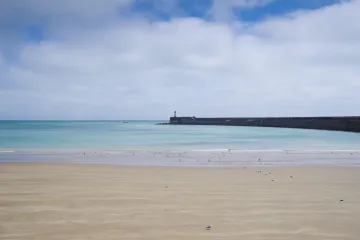
Eight of the best alternative beaches that are much quieter than their busy neighbours as UK set to hit 25C next week
THE UK is set to hit highs of 25C next week, according to the BBC – so you can expect the beaches to be busy at the weekend.
So we’ve rounded up some of the best alternative bays and coves that are quieter than their busy neighbours – and some local top tips.
Swap Margate for…. Kingsgate Bay
The golden sands of Margate’s Main Beach can be pretty crowded come summer – but just down the road is the much quieter Kingsgate Bay.
The tiny patch of sand is overlooked by Kingsgate Castle and the Captain Digby pub, and it known for it’s rocky arch formation which you can walk through when the tide is out.
“It’s on the King Charles III England Coast Path so you’ll likely only be joined by hikers and dogwalkers.
“But the steep steps down also keep it nice and secluded – I often take a book for some peace and quiet there.” Kara Godfrey, Deputy Travel Editor.


Swap Hunstanton for… Thornham Beach
Hunstanton in north west Norfolk gets pretty rammed with tourists in the summer – where the roads get clogged with holidaymakers rushing to its promenade, and it’s easy to waste half of your day sitting in traffic to get there,.
If you head just 10 minutes east along the coast, you’ll find Thornham Beach.
“Park up in a quiet spot on the side of the road and walk through the pretty pinewoods to reach a massive beach that is much less chaotic.
“You’ll find dog-walkers and the odd family with a picnic, but no flashy amusement lights and blaring music – just a gorgeous stretch of sand.” Jenna Stevens, Travel Reporter.
Swap Paignton for… Fairy Cove
Paignton is one of Devon‘s busiest seaside towns, especially in the summer.
But just behind the harbour is Fairy Cove, and is a much quieter alternative.
“With a mix of sand and pebbles, this beach is ideal for getting away from crowds of people for either a quiet swim or gently walk.
“The cove is only accessible via steps at the corner of the harbour, but it does mean there are range of facilities nearby as well as the town within walking distance.” Cyann Fielding, Travel Reporter
Swap Clacton-on-Sea for… Frinton-on-Sea
When heading to the Essex coast, you’re likely to be drawn in by the big names like Clacton-on-Sea – but it’s so busy, it’s usually hard to even find a spot to lay your towel on the beach.
But if you want a trip to Essex without the frills and thrills, try driving 20-minutes north to Frinton-on-Sea.
“It has a sweeping golden beach with multi-coloured beach huts and is generally much less busy than its neighbout to the south.
“And there’s usually much more breathing space to explore its independent shops, not to mention the town’s only pub, The Lock and Barrel.” Alice Penwill, Travel Reporter
Swap Folkestone for…. Sandgate
There is so much to do on the main Folkestone beach, so that means you can expect crowds too.
But walk along the promenade and you’ll find Sandgate, a similar pebble beach but filled with locals rather than tourists.
“It still has all the pubs, wine bars and cafes you want after a day at the beach, but has a much more peaceful vibe.
“I recommend getting an ice cream at the beach hut and watching the rowers and paddle boardings practising.” Kara Godfrey, Deputy Travel Editor
Swap Newquay for… Mawgan Porth
Newquay’s Fistral Beach is popular for a reason – it’s home to next level waves that surfers continuously rave about and it’s got everything from cute shops, board rental shops and cafes. So when the sun shines it tends to get extremely busy.
At the opposite end of Newquay, however, and less than seven miles away is Mawgan Porth.
“This beach is just as impressive visually – sparse softs sands backed by craggy cliffs – but tends to be far emptier thanks to its wide expanse of sand that stretches very far back, meaning you’ll always find a spot for your picnic blanket or lounger.
“It’s dog-friendly year round and my Frenchie Dora loves the vast space just as much as I do – chasing frothing waves along the shoreline.” Sophie Swietochowsi, Assistant Travel Editor
Swap Polzeath for… Hawkers Cove
Cornwall’s Polzeath is often referred to as the St Tropez of Britain because of the high-end crowd it attracts and the rather lavish dining spots on its doorstep. It is, however, crowded from dawn until dusk on a hot day, with some of its bars open ’til very late.
Almost opposite this beach, across the mouth of the Camel river, you’ll find Hawker’s Cove which is far enough away from the main bay that many visitors can’t be bothered to venture here.
“If you do manage to make the walk from the main car parks, however, you’ll be rewarded with a small(ish) patch of sand and pretty much complete isolation.
“There’s not much nearby, but that’s why I love it: just you, sweeping dunes and one teeny tea shop selling scones, light bites and smoothies.” Sophie Swietochowsi, Assistant Travel Editor
Swap Durdle Door for… Man O’ War Bay
The unique geological gem Durdle Door is a magnet for tourists heading to the Jurassic Coast in Dorset.
But for those who can make it, Man O’ War Bay, immediately to the east of Durdle Door, offers a quieter alternative and is less crowded.
“There are a set of steep steps to navigate to get to the semi-circular cove so getting to it isn’t for the faint-hearted.
“But make it, and you’ll be rewarded with the same views and less people.” Lisa Minot, Head of Travel.

Column: Trump surrendered to China before he even landed there
Ahead of President Trump’s arrival in Beijing on Wednesday for his summit with Chinese President Xi Jinping, longtime China expert Kurt M. Campbell offered a novel way of watching the two leaders’ high-stakes faceoff. Think of it not as nation-versus-nation or army-versus-army, but as the sort of “single combat” celebrated in ancient literature, along the lines of David and Goliath in the Bible or Achilles and Hector in “The Iliad.”
“This one has the feel of a geopolitical heavyweight matchup,” Campbell, chairman of the Asia Group strategic consulting firm, wrote in Foreign Affairs this week.
Unlike in their initial get-together early in Trump’s first term, both men now are seasoned leaders in their separate ways — Xi an unchallenged dictator, and an envious Trump seeking to be. Both act with few immediate checks on their power, though Xi acts strategically and Trump impulsively and transactionally. And both, as leaders of super-powers, have the capability to shape the economic and security fates of a wary world.
That world, Campbell concluded in his essay, is “eager to see whether the two leaders emerge driving together in the chariot, or with one dragging the other behind,” as Achilles did the vanquished Hector.
However the Trump-Xi meeting ends, Trump is no Achilles going into this match. In fact, in the six decades of U.S.-China relations, perhaps no American president has entered the summit arena in a weaker position than Trump, the would-be strongman and artiste of the deal. Worse, his weakness — and by extension his country’s — is mostly self-inflicted.
Trump had postponed what was intended as an early April meeting in hopes of striding triumphantly into Beijing as the conqueror of Iran, a China ally. Instead China is receiving him as a “giant with a limp,” in the phrase of its Communist Party-controlled Global Times newspaper.
Trump’s Mideast war, the sort he’d promised never to start, lingers for a third month in a costly stalemate — $29 billion and counting — that has humiliated the president in the public words of Germany’s chancellor and the private thoughts of many more global leaders, Xi likely among them. Trump can’t “project the same arrogance” as he did visiting China in 2017, a former Chinese army officer, Yue Gang, told the New York Times.
At home, the conflict has caused gasoline prices and inflation to spike while tanking Trump’s already depressed polls. A newly released CNN poll conducted April 30 to May 4 had 65% of Americans disapproving of his overall job performance and a whopping 70% against his handling of the economy — the issue that arguably got him elected. With experience, American consumers and soybean farmers now know that they, not the Chinese, have paid for Trump’s beloved tariffs.
The president’s standing at home could hardly have been helped by his parting words to reporters at the White House. Asked “to what extent are Americans’ financial situation motivating you to make a deal” with Iran, Trump blithely replied, “Not even a little bit.” He added, in the sort of political gaffe that journalist Michael Kinsley defined as telling the truth: “I don’t think about Americans’ financial situation. I don’t think about anybody.”
He’s already a loser in the negotiations with Xi. For weeks the Trump administration has unsuccessfully urged China to use its leverage to goad Iran to accept a peace on Americans’ terms or, at a minimum, to reopen the Strait of Hormuz, given China’s self-interest as Iran’s biggest oil customer by far. As China scholar Henrietta Levin of the Center for Strategic and International Studies told the Associated Press, “I don’t think China has any interest in solving the problems the U.S. has created for itself in the Middle East.”
Not least, perhaps, because China has seen that, by the Pentagon’s own reckoning, the war has depleted U.S. stockpiles of weaponry after thousands upon thousands of strikes against Iran. And that has further raised questions in China and beyond about whether Trump would have the United States come to the defense of Taiwan, the self-governing, U.S.-armed island that China claims as its own.
After all, the thinking goes, if the United States can’t bring a lesser power like Iran quickly to heel, how might it fare against a near-peer such as China, especially with a diminished U.S. arsenal and Mideast distractions?
It’s mostly a mystery what the leaders’ talks might yield. In a break with diplomatic tradition, though not with Trump’s seat-of-the-pants style, apparently little planning went into this super-power summit — another reflection of a distracted U.S. side. Still, with a number of tech, agribusiness, finance and aerospace chieftains in tow, Trump and his team are hoping for a few politically appealing deliverables, such as sales of U.S. soybeans and Boeing aircraft, to give the president a lift back home.
But don’t look for progress on the longstanding issues dividing the United States and China over trade and military dominance in the Pacific region. And as for another of those perennial issues — climate change and clean-energy technology — the U.S. under Trump has willfully surrendered global preeminence to China, ceding markets for solar, wind energy, electric vehicles, grid storage and more in his backward-looking, ostrich-like obsession with drilling oil and mining coal.
Whatever hyperbolic claims Trump makes for his China trip, the outcome of the summit (on top of his quagmire in Iran) should at least be this: retiring the myth of Trump the deal-maker and savvy businessman.
If he were such a visionary, Trump would be prodding the nation to global leadership in technology and clean-energy investments, not reversing past progress and paying companies billions of taxpayers’ dollars to stop clean-energy projects. In markets worldwide, the future is now and America is forfeiting the game to China.
In this contest, Trump is letting Xi drive the chariot. Unfortunately, average Americans are the ones being dragged through the dust as China rides into the 21st century.
Bluesky: @jackiecalmes
Threads: @jkcalmes
X: @jackiekcalmes

LAFC suffers its first loss to St. Louis City in franchise history
ST. LOUIS — Tomas Totland scored four minutes into the match and fellow defender Rafael Santos added a second-half goal to help St. Louis City beat LAFC for the first time, earning a 2-1 victory on Wednesday night.
Totland used assists from Eduard Löwen and Marcel Hartel to find the net for the first time this season and the third time in 55 career appearances. It was the first assist of the campaign for Löwen and the second for Hartel.
Santos added an unassisted goal in the 64th minute. It was his first score this season and his fourth in 92 career matches. Santos entered the match in the 10th minute for an injured Jaziel Orozco.
David Martínez entered the match in the 70th minute and scored in the 73rd to cut it to 2-1. Nkosi Tafari and defender Aaron Long set up Martínez’s fourth goal this season and his 11th in 58 appearances.
Roman Bürki finished with three saves for St. Louis City (3-6-3), which entered the match 0-5-2 all time against LAFC.
Hugo Lloris did not have a save for LAFC (6-4-3). He leads the league with eight clean sheets in 11 starts.
Mathieu Choinière scored his only two goals of the season — both from long range — to lead LAFC to a 2-0 victory over St. Louis City on March 14.
St. Louis City had scored just 10 goals in its first 11 matches under coach Yoann Damet, second fewest in the league.
Up next
St. Louis: Visits D.C. United on Saturday.
LAFC: Visits Nashville SC on Sunday.
World Cup train and shuttle bus ticket prices cut in New York, New Jersey | World Cup 2026 News
Round-trip train tickets brought down to $98 from $150, and bus fares to cost $20 instead of $80, state officials say.

Published On 14 May 2026
Local governments in New Jersey and New York have reduced the cost of train and bus tickets for commuters travelling to the states’ joint World Cup venue during the tournament.
New Jersey Transit train tickets to the MetLife Stadium, renamed New Jersey New York Stadium for the FIFA World Cup, will now cost $98 as opposed to the earlier price set at $150 for a return fare, New Jersey Governor Mikie Sherrill announced on Wednesday.
“Ahead of NJ Transit World Cup train tickets going on sale tonight, NJTRANSIT is lowering ticket prices to $98 without New Jersey taxpayer money,” Sherrill wrote in a social media post.
The move followed intense backlash from local and international football fans planning to attend World Cup games at the stadium in East Rutherford, New Jersey, where the tournament’s final will be held on July 19.
The $98 fare, which will be charged during the World Cup matches hosted in New Jersey, is still significantly higher than the regular fare of $13 for the 29km (18-mile) round trip from New York City’s Penn Station.
When the $150 fare was announced, Sherrill defended it by suggesting the upcharge was necessary to ensure that her state’s commuters were not stuck with a “tab for years to come” for hosting the World Cup on its return to the United States for the first time since 1994.
NJ Transit officials said it would cost $62m to transport fans to and from the stadium over the duration of the tournament and outside grants had defrayed only $14m of those anticipated expenses.
“This isn’t price gouging,” NJ Transit President and CEO Kris Kolluri said last month. “We’re literally trying to recoup our costs.”
Meanwhile, the cost of taking a shuttle bus from New York City to the World Cup venue has also been reduced.
“The cost of shuttle bus tickets to and from matches will be reduced from the initial $80 round-trip price to $20,” New York Governor Kathy Hochul announced on the same Wednesday.
The move from the NYNJ Host Committee offers some respite for fans who would have already spent thousands of dollars on attending a World Cup game, largely due to the exorbitant match ticket prices, international and local airfares, and visa costs.
The host city officials said 20 percent of bus tickets for each match will be reserved exclusively for New York state residents. The remaining tickets will be available for all match-going fans.
The US is cohosting the tournament with Mexico and Canada. It begins on June 11.
Russia launches hundreds more drones at Ukraine, killing three people | Russia-Ukraine war News
President Zelenskyy says rescue operations continue after Russia used ‘more than 1,560 drones’ during its overnight attacks.
Published On 14 May 2026
Russia launched a barrage of missiles and drones targeting Ukraine’s capital Kyiv, killing at least three people and wounding 40 others, Ukrainian authorities have said.
The Ukrainian military said on Thursday that the overnight strikes hit six districts of Kyiv and another six in the surrounding areas. Deputy Prime Minister Oleksii Kuleba said attacks had targeted ports in the southern Odesa region and railways.
Recommended Stories
list of 3 itemsend of list
In a post on X, President Volodymyr Zelenskyy said rescue operations were continuing following an attack on a nine-storey building in Kyiv after Russia launched “more than 670 attack drones and 56 missiles against Ukraine”.
“In total, since midnight yesterday, Russia has used more than 1,560 drones against our cities and communities. These are definitely not the actions of those who believe the war is coming to an end,” he wrote on Thursday.
“It is important that partners do not remain silent about this strike. And it is equally important to continue supporting the protection of our skies,” Zelenskyy added.
The mayor of Kyiv, Vitali Klitschko, said 40 people were wounded in the attacks, including two children, while Ukrainian emergency services said three people had been killed.
Reporting from Kyiv, Al Jazeera’s Audrey Macalpine said people are still feared trapped under the rubble of the building.
Macalpine said it was one of Russia’s largest attacks of the war, “in a single 36-hour period just by sheer number of drones”.
The attack comes as a setback for efforts to end the war after United States President Donald Trump raised faint hopes for peace by brokering a three-day ceasefire between Kyiv and Moscow last week, and Russian leader Vladimir Putin suggested the war could be winding down.

The truce – put in place as Putin presided over a scaled-down military parade in Red Square to mark the anniversary of World War II victory – was marred by allegations of violations by both sides.
Ukraine and Russia launched long-range drone attacks immediately after it ended on Tuesday.
The Kremlin has poured cold water on the idea that Putin’s vague comments, issued Saturday, about the war “heading to an end” could mean a softening in Moscow’s position.
On Wednesday, it repeated its demand that Ukraine fully withdraw from the eastern Donbas region before a ceasefire and full-scale peace talks can take place.
Kyiv has rejected such a move as tantamount to capitulation.

90s popstar, 57, looks unrecognisable as he goes shopping in leather jacket and massive chain after becoming a grandad
A 90s heartthrob looked worlds away from his West End heyday as he was snapped in Essex this weekend.
Donning a leather jacket over an all-black ensemble, the star, 57, added a heavy chain around his neck during a shopping trip, but would you recognise him?
It’s Darren Day behind the brand new look, with the singer and actor snapped visiting a jewellery store near his home.
The star is best known for his bright blonde locks and clean-shaven look, but is now sporting a beard and moustache.
He was spotted enjoying an energy drink during the solo outing whilst popping into several shops, holding a tote bag and small cactus.
It comes after Darren became a grandfather earlier this year, with his 21-year-old son Corey welcoming his first child, a son named Colton, with girlfriend Erin Mitchell.


Darren shares Corey with former Hear’Say singer Suzanne Shaw, whom he split from in 2005 following a whirlwind romance.
Suzanne and Darren had a short-lived romance in the early noughties, with the latter leaving soap star Suzanne when Corey was just seven weeks old.
Darren began a romance with Suzanne in 2003, while he was still engaged to fellow actress Adele Vellacot.
He then split from Adele and began a relationship with Suzanne, with the pair staying together for 18 months and even getting engaged.
But in 2005, on Mother’s Day, Darren famously walked out on Suzanne and Corey.
They became grandparents for the first time in March following Colton’s birth, and shared snaps together from hospital to show they were friendly exes – despite the historic drama.
Darren has had a famously tumultuous love life which has included six engagements – with the actor hailed as one of showbiz’s most notorious womanisers.
However, he has been with other half Sophie Ladds since 2017, getting engaged back in 2020.
Darren is also still performing on stage and recently appeared in a pantomime production of Mother Goose for Easter.

The 250-mile Wetherspoons pub crawl where you travel the country by coach
PUB crawls are a favourite pastime of Brits – and there is a unique one in the UK called the ‘Spoons Safari’.
Lloyds Coaches has launched a new tour travelling 250-miles across Wales stopping in at seven Wetherspoons along the way and it’s so popular that it’s quickly selling out.
Follow The Sun’s award-winning travel team on Instagram and Tiktok for top holiday tips and inspiration @thesuntravel.
Those who are keen to hop onboard the Wetherspoons will be pleased to know that tickets are just £20 – sadly, drinks are not included.
Teasing more about its Spoons special, Lloyds Coaches said: “Ready for a legendary day out without the ‘who’s driving?’ debate. Grab your mates and hop aboard for the Lloyds Coaches Wetherspoons Tour.
“We’re hitting some of the most iconic pubs across North Wales and the border. Whether you’re in it for the affordable ales, the legendary breakfasts, or just to check the carpet patterns, this is the trip for you!”


The tour is so popular that the first coach has already sold-out, and spaces are filling up on the second.
Here’s how it plays out for those keen to book a seat.
On June 27 at 10:15am, the coach sets off from Dolgellau in Wales and with multiple pick-ups along the way, stops at the first Wetherspoons under four hours later at the Wilfred Owen in Oswestry.
The second Spoons stop on the list is The Castle Hotel in Ruthin.
Then onto The Picture House in Colwyn Bay which has been considered one of the most beautiful pubs by its punters.
The pub can be found inside the former Princess Cinema, which was built in 1914 and originally called the Princess Picture House.
It still has original Art Deco design features from stained glass windows and lighting fixtures, as well as artwork on the walls.
The next stop is The Palladium in Llandudno which is arguably the most impressive on the tour.
Formerly a cinema, the building first opened to the public in the 1920s, it has eye-catching decor with a ceiling with gold detailing and red carpet.
There’s seating on three floors, including stalls, dress circle and balcony, before being used as a theatre and music hall.
It opened as a Wetherspoons in 2001.
After sinking another pint or two, the tour heads to the penultimate pub; Tafarn y Porth in Caernarfon.
The pub is in the middle of the city that’s well-known for its royal 13th century castle.
Finally, the tour comes to a close at Pen Cob in Pwllheli which is just minutes from the seafront and at 9:15 PM, the tour comes to a close.
It’s not the first time there has been Wetherspoons special tours around the country.
Last year, one tour operator offered a £699 six-day outing around some of the chain’s top pubs – and it included £50 to spend on booze.
The trip took keen punters to boozers like the Standing Order in Derby, The Chief Justice and the Common Pleas in Keswick and Penrith’s The Dog Beck.
It also includes The North Western in Liverpool and The Winter Gardens in Harrogate, plus Blackpool‘s Velvet Coaster.
Trump builds momentum with at least 3 more wins; Rubio drops out, Kasich takes Ohio
Reporting from Columbus, Ohio — Donald Trump romped to victory Tuesday in Florida, chasing Marco Rubio from the race, but Ohio Gov. John Kasich won his home state, raising hopes for those seeking to stop Trump and settle the presidential contest on the floor of the Republican National Convention.
Trump also won North Carolina and Illinois and was locked in a close fight with Sen. Ted Cruz in Missouri.
“I’m getting ready to rent a covered wagon, we’re going to have a big sail and have the wind blow us to the Rocky Mountains and over the mountains to California,” Kasich said at a jubilant rally outside Cleveland.
That is just the sort of extended nominating fight the GOP establishment sought to avoid by stacking the political calendar with big early contests, capped by Tuesday night’s winner-take-all primaries in Florida and Ohio. California votes on June 7, near the close of the primary season.
Now, many of those same party types see an inconclusive nominating contest as the best and perhaps only chance of thwarting Trump, even if it threatens to shred the GOP in the process.
The setback in Ohio, where Trump campaigned hard, was his most disappointing performance since he finished second to Cruz in February’s Iowa caucuses.
His unhappiness was evident as he addressed reporters at his posh Mar-a-Lago private club in Palm Beach, Fla., and complained about the miseries of running for president.
“Lies, deceit, viciousness. Disgusting reporters. Horrible people,” the Manhattan businessman and reality TV star said. “Some are nice.”
Cruz, speaking with 99% of the Missouri votes counted, once more insisted he was the only candidate who could defeat Trump.
“Starting tomorrow morning, every Republican has a clear choice. Only two campaigns have a plausible path to the nomination — ours and Donald Trump’s,” the Texas senator told supporters in Houston. “Nobody else has any mathematical possibility whatsoever. Only one campaign has beaten Donald Trump over and over again.”
With Trump’s unmatched string of victories, no other candidate is nearly as well positioned to win the nomination ahead of the July convention in Cleveland. He padded his overall delegate lead with Tuesday’s victories, putting him ahead of Cruz and Kasich, who had not won a state before Ohio.
But there were signs Tuesday that not just the establishment but rank-and-file Republicans have yet to rally around the party’s polarizing front-runner.
Nearly 3 in 10 Republican voters across the five states said they would not vote for Trump if he wins the party’s nomination, according to exit poll interviews. Four in 10 said they would consider voting for a third-party candidate if the choice came down to Trump or the Democratic front-runner, Hillary Clinton.
Defections of that magnitude could badly undermine Trump in the general election, and that prospect will probably be stressed by his opponents going forward into next week’s contests in Arizona and Utah.
Rubio spoke to the controversy surrounding the GOP front-runner as he departed the race.
In a Miami concession speech delivered less than half an hour after the polls closed in Florida, the freshman senator congratulated Trump, wagging a finger and shushing members of the audience who booed his kind words.

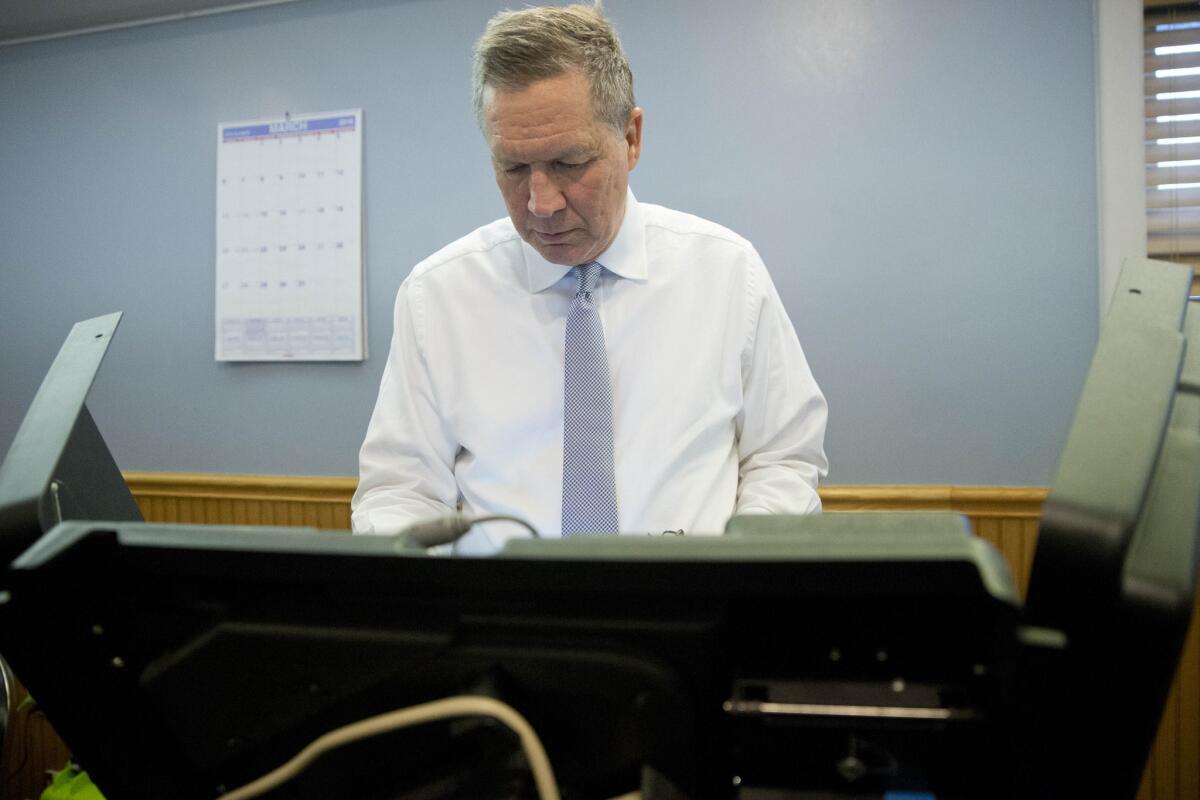
Ohio Gov. John Kasich votes Tuesday in Westerville, Ohio.
(Matt Rourke / Associated Press)
Rubio then devoted the bulk of his lengthy remarks to warn against succumbing to the anger and frustration that have fueled Trump’s improbable rise.
“The politics of resentment against other people will not just leave us a fractured party,” Rubio said, as disconsolate family members stood by onstage. “They’re going to leave us a fractured nation” where people hate each other for their political views.
“Do not give in to the fear,” Rubio said. “Do not give in to the frustration.”
The son of Cuban immigrants and, at age 44, the youngest candidate in the field, Rubio was seen as one of the GOP’s rising stars, with a capacity to broaden the party’s support among millennial voters and the nation’s fast-growing Latino population.
But he failed to win more than a few contests and was never seriously competitive in his home state. Trump captured 99 delegates in Florida’s winner take-all-primary, more than a quarter of those at stake in Tuesday’s balloting.
The victory in winner-take-all Ohio gave Kasich 66 delegates, more than doubling his total but still leaving him well behind Trump. His goal is to build momentum with a series of wins positioning him as the strongest candidate heading into the Cleveland convention even if, as seems inevitable, Kasich is shy of the 1,237 delegates needed to win the nomination outright.
Pennsylvania, where Kasich was born, is the next big target on April 26.
The results Tuesday followed one of the oddest, most contentious weeks in a campaign that has been filled with strange and surreal moments.
The precipitating event was a racially charged near-riot at a Trump rally Friday night in Chicago, which was canceled out of security concerns.
Trump’s opponents quickly seized on the moment and the violent imagery that played around the world to once more challenge his temperament and fitness to be president. They accused him of fomenting the unrest through belligerent remarks that seemed to egg on his audiences into physically confronting dissenters.
Trump denied any responsibility, blaming the violence on what he called professional agitators linked to Democratic hopeful Bernie Sanders. He said the protesters provoked his supporters and were stifling their rights to free speech and assembly.
“I don’t condone violence,” Trump said repeatedly, though he sympathized with backers who chose to “be effective” with protesters in the audience. (Previously he used more pugilistic language.)
Trump said he might even pay the legal fees for a supporter who sucker-punched a demonstrator at a North Carolina rally, drawing widespread condemnation. He won the state anyway.
Indeed, for weeks increasingly desperate Republican opponents have mounted an effort to stop Trump, to seemingly little effect.
More than $10 million in negative ads blazed across the Florida airwaves in just the last week alone, attacking Trump for his ethics, the failings of his business empire and his all-over-the-map political ideology.
Those meant nothing to Mark Owens, who stepped into the Miami Beach sunshine Tuesday and lighted a cigar after casting a ballot for the political neophyte.
“We’ve trusted politicians for 200 years to run our country,” Owens said. “It’s time to give someone else a shot.”
With polls suggesting Florida was firmly in Trump’s grasp, much of the campaign focused on Ohio, another traditional fall battleground.
Trump laid on extra events, including an election-eve rally outside Youngstown in place of a planned Florida appearance, and he turned his attention to attacking Kasich after long ignoring the Ohio governor.
He assailed him for his support as a congressman for the North American Free Trade Agreement, a pact with Canada and Mexico that, Trump said, devastated the state’s economy. He also laid on personal insults in a bid to snatch a victory in Kasich’s home state and clear the governor from the race.
Kasich, whose strategy centered on staying above the salvos flying among other candidates, accused Trump of creating a “toxic” political atmosphere and, wrapping himself in the establishment mantle, spent Monday stumping alongside Mitt Romney, the party’s 2012 nominee.
With Kasich suddenly a factor in the GOP contest, the skirmishing here in Ohio seems a likely preview of what is to come.
While he pledged to take the high road at his victory party Tuesday night, Kasich sent a different message speaking to reporters earlier in the day.
He said, “I will be … forced going forward to talk about some of the deep concerns I have about the way this campaign has been run by some others — by one other in particular.”
There is no doubting who he had in mind.
mark.barabak@latimes.com
Twitter: @markzbarabak
Times staff writers Michael Finnegan, Kurtis Lee and Seema Mehta in Los Angeles and Kate Linthicum in Miami contributed to this report.

My trip to Yorkshire led me to James Herriot, Dracula and the Brontës
I have always longed to go to Yorkshire.
I was 10 when I first read “All Creatures Great and Small,” devouring each subsequent book that Alf Wight, under the pen name James Herriot, wrote about life as a veterinarian in his beloved Yorkshire Dales. I was a bit older when I encountered Bram Stoker’s “Dracula,” which opens in the seaside town of Whitby, where cliffs overlook the sea in which the ill-fated ship Demeter meets its end. In my teens, I discovered the wild moors and ancient halls of “Jane Eyre” and “Wuthering Heights.” More recently, I have been entranced by the work of Sally Wainwright, whose string of critically acclaimed series — ”Last Tango in Halifax,” “Happy Valley,” “Gentleman Jack” and “Riot Women” — have made her the modern bard of Yorkshire, England.
So when a friend, planning a visit to her daughter at Durham University, proposed I join her for a side trip of our own, I jumped at the chance to travel to a land I knew only through the eyes of others.
The Dales of James Herriot
In mid-April, I joined my friend Nancy in York, a city often mentioned in Yorkshire-based literature. On a sunny Saturday, we took a train to Thirsk, where Herriot, alongside Donald and Brian Sinclair (known in the books as Siegfried and Tristan Farnon) lived and worked in “Skeldale House,” now the World of James Herriot museum.

Lambing season in North Yorkshire.
(Mary McNamara / Los Angeles Times)
The city sprawl quickly gave way to stone-walled fields full of dazzling yellow rape and spring-green grass dotted with sheep and frolicking lambs. April is lambing season, the perfect time to visit Herriot Country. “All young animals are appealing,” he wrote, “but the lamb has been given an unfair share of charm.”
Situated between the North York Moors and Yorkshire Dales national parks, Thirsk (known as Darrowby in the Herriot books) is a market town, organized around a great open plaza in which stands a clock tower that on this day was decorated with rather splendid floral creations by the Thirsk Yarnbombers, in celebration of its 10th anniversary.
Even so, it looks much as it must have when Herriot lived here — modern businesses housed in medieval and Georgian buildings. Surely the Ritz Cinema is the theater Herriot describes as he begins his courtship of Helen Alderson; a blue circle marker proudly declares its date of establishment as a picture house, 1912.

The entrance to the World of James Herriot in Thirsk, North Yorkshire.
(Mary McNamara / Los Angeles Times)
The World of James Herriot museum is a sudden splash of crimson and white signage on an otherwise ordinary, albeit charming, street; at the far end stands St. Mary’s Church, where Herriot married his actual wife, Joan Anderson. When we visited the church later that afternoon, they were cleaning up from a community tea and I spoke with a woman who remembered Herriot and especially his son Jim and daughter Rosie, who were the town vet and doctor, respectively, for many years.
The museum, on the first floor, is a re-creation of “Skeldale House,” down to the pint pot in which Siegfried kept the petty cash and the old central telephone. There’s a display documenting the evolution of the books — originally printed in the UK, beginning in 1972, under different names, until a struggling St. Martin’s Press published two of them with the title “All Creatures Great and Small” and helped turn Herriot into a franchise.

The old central telephone at the World of James Herriot museum in Thirsk.
(Mary McNamara / Los Angeles Times)
Various outbuildings now house a small screening room, where clips from a documentary on Herriot’s life play, as well as a re-creation of the TV studio and set on which the 1978 television series was filmed. The set from the current PBS series, which began in 2020, is in another part of the museum, which also includes an extensive exhibit of historic veterinarian instruments.
As we wandered through the town and the museum, Herriot the man came to life as lyrically as his fiction. A country vet, whose career began before the age of antibiotics and many now-commonplace vaccines, wrote, beginning at age 50, a series of semi-autobiographical novels that would become international bestsellers and launch several films and two series, one of which was filming 35 miles away in Grassington.
He never left the Dales, or stopped being a vet; during his lifetime, fans would line the street outside his practice, waiting for autographs and photos. Twenty years after his death, Thirsk remains both an ordinary Yorkshire town (the only Herriot memorabilia advertised is in the museum gift shop) and an enduring tourist destination. (If you go, may I recommend lunch/tea at Upstairs, Downstairs, where I got a life-changing Yorkshire rarebit with bacon and fried egg as well as a sack of the local sweet, cinder toffee.)

Grassington, North Yorkshire, becomes a film set for “All Creatures Great and Small.”
(Mary McNamara / Los Angeles Times)
Deeper in the Dales, Nancy and I rented a “glamping pod” in Malhamdale. On our way, we stopped in Grassington, where the town was being transformed into Darrowby with period-and-place-appropriate signs, advertisements and community announcements. “Open as usual but dressed for filming” read a sign in the window of the Stripey Badger Bookshop, Coffee Shop and Kitchen.
Filming would take place in two days’ time, so we returned then to see the square come alive with extras in period clothing. Within the crowd of fellow onlookers, controlled by lovely but firm crew members, we watched as a scene between Siegfried (Samuel West) and Tristan (Callum Woodhouse) was filmed outside the Drovers Arms.

A breathtaking view and unique fractured “pavement” at Malham Cove.
(Mary McNamara / Los Angeles Times)
We had chosen Malhamdale because its limestone topography is considered the most stunning of the Dales. And that it most certainly is.
From the village of Malham we hiked to Malham Cove, which rose in near miraculous silver splendor among the sylvan greenery, and then ascended the nearly 500 steps to its top. There, a breathtaking view and unique fractured “pavement” has been used in countless films, including “Harry Potter and the Deathly Hallows” and the 1992 “Wuthering Heights.” We followed the trail to the Gordale Scar, a glorious gorge and waterfall that is also a favorite filming spot, and thence to Janet’s Foss, a woodland waterfall and pool, beside a cave where the queen of the fairies is said to live.

Janet’s Foss, a woodland waterfall and pool.
(Mary McNamara / Los Angeles Times)
After just three days in the Dales, I clearly understood why no amount of money or fame had convinced Herriot and his family to leave.
Dracula town
Windswept Whitby sits on the east coast of Yorkshire, with its back to the North York Moors National Park and its face to the North Sea. It climbs either side of a valley created by the River Esk, as it joins the port where whalers once launched and Captain Cook first commandeered the HMS Endeavour.
On the west side, the street along the harbor is chockablock with venues catering to tourists and daytrippers come to enjoy the pier and small beaches. Families rent crab pots and put their catch in plastic buckets held by delighted children. Atop the cliffs behind, Georgian homes, hotels and guest houses stand in gracious testament to Whitby’s Victorian history as a popular spa town, as it was when Stoker visited in 1890. He stayed in a West Cliff guest house, gazing, as everyone must do, across the harbor where the remains of the 13th century Whitby Abbey dominate the East Cliff.

The harbor at Whitby, North Yorkshire.
(Mary McNamara / Los Angeles Times)
Even under a beaming sun, the ruins, aproned by the graveyard of the nearby Norman church of St. Mary’s, carve a formidable black silhouette against the sky. Beneath are the roofs and cobbled streets of the medieval Old Town, where ancient pubs stand among jewelers specializing in local jet. To reach the abbey, visitors must climb the town’s famous 199 steps that rise along the cliff.
“It is a most noble ruin,” Mina Harker writes in her journal in early chapters of “Dracula.” “Between it and the town there is another church, the parish one, round which is a big graveyard, all full of tombstones. This is to my mind the nicest spot in Whitby, for it lies right over the town, and has a full view of the harbor.”
Here Mina and her friend Lucy Westenra sit among the graves, sketching and talking, later, watching clouds gather for the storm that would bring the Demeter, and Count Dracula, to Whitby. Here too Mina would see, from the West Cliff, her sleepwalking friend half reclining on “our favorite seat” and for a moment “it seemed to me as though something dark stood behind the seat where the white figure shone, and bent over it.”

The remains of Whitby Abbey.
(Mary McNamara / Los Angeles Times)
We visited on a sunny day, and the wind blew hard as we traced Mina and Lucy’s steps through the tombs and along the path past the Abbey toward Robin Hood’s Bay. With its glorious views and picturesque harbor, Whitby is the antithesis of gothic horror. Still, it was here that Stoker, researching another novel, first read of Vlad the Impaler, otherwise known as Dracula, and no doubt heard of the wreck of the Russian ship Dmitry, which had run aground beneath East Cliff five years before his visit.
And so the godfather of modern horror was born.
Brontë Country
It is difficult to imagine a fictional tale more gothic, inspirational and remarkable than that of three brilliant sisters who lived in relative isolation on the edge of the Yorkshire Moors, secretly battling their socially conscripted futures by writing poems and novels that they dared not publish under their own names.

The Brontë Parsonage Museum in Haworth, North Yorkshire.
(Mary McNamara / Los Angeles Times)
Two of those novels — ”Jane Eyre” by Charlotte Brontë and “Wuthering Heights” by Emily Brontë, are still considered masterworks, influencing subsequent generations and endlessly adapted for film and television. (In the ultimate Yorkshire crossover, Wainwright wrote the breathtaking two-part Brontë biopic “To Walk Invisible,” which everyone should see.)
The Brontë Parsonage Museum, and the town of Haworth which it overlooks, is very much a tourist attraction. An information annex, gift shop and public restroom have been added behind it, but once you enter the small garden that stands between the parsonage’s front door and St. Michael and All Angels’ Church, you are in another world.
In 1820, Patrick Brontë, recently appointed incumbent of St. Michael, moved his wife, Maria, and their six children into the parsonage where they all lived for the rest of their natural (albeit in most cases, short) lives. Maria died in 1821; the two older children, Maria and Elizabeth, died four years later after being sent to a typhoid-plagued school Charlotte would pillory as Lowood in “Jane Eyre.”
The museum is meticulously restored to reflect the years that the surviving children — Charlotte, Emily, Anne and Branwell, the only son — were young adults. The dining room table, where the sisters wrote, is strewn with manuscripts, quill pens and tea cups; a bonnet and shawl bedeck a chair in the small kitchen. Patrick had his own study but it is difficult to imagine three women being able to write separate works, never mind classics, in such close quarters. Ironically, only Branwell’s room, papered with sketches and poems, looks like an artist’s refuge.

St. Michael and All Angels’ Church in the town of Haworth.
(Mary McNamara / Los Angeles Times)
Unlike his three sisters, Branwell, his artistic career stunted by alcoholism and an opium addiction, never published. He died of tuberculosis in 1848 at 31.
If any place should be haunted, it is the Brontë parsonage. Shortly after Branwell’s funeral (and just a year after “Wuthering Heights” was published), 30-year-old Emily also died of tuberculosis, expiring on the sofa that stands beside the dining room table. A few months later, after the publication of her second novel, “The Tenant of Wildfell Hall,” Anne, 29, succumbed to the disease in nearby Scarborough, just south of Whitby.
Charlotte, who wrote two more novels after “Jane Eyre,” was the only sister to be celebrated during her lifetime. She married and then died at the parsonage in 1855 at 38 of complications from her first pregnancy. Only Patrick lived to old age — 84 — dying in 1861 in the home where he had served for 41 years.

The Brontë Parsonage Museum in Haworth, North Yorkshire.
(Mary McNamara / Los Angeles Times)
But it is not a sad house; instead visitors are left to wonder at the genius, resolution and audacity that roiled the quiet rooms and halls where the sisters secretly wrote and sent out their manuscripts, all initially under the the names of Currer (Charlotte), Ellis (Emily) and Acton (Anne) Bell.
The steeply descending main street of Haworth is filled with tea shops, pubs and stores clearly dedicated to pleasing Brontë pilgrims, but its basic form, including the original stationery store where the sisters once bought their paper, remains the same.
As do the moors that stretch behind the parsonage. On a walk to the Brontë Waterfall (more like a small but still lovely rill) and Top Withens, the ruin of a 16th century farmhouse believed to have inspired “Wuthering Heights,” the wild silence and sweeping vistas are even more transporting than the parsonage. One imagines not the ghost of Cathy or Heathcliff, but a trio of women, very much alive and striding through the heather, their minds alight with the stories they would tell, set among similar terrain.
Wainwright’s Way
Our final accommodation on this literary sojourn was Holdsworth House, a manor hotel near Halifax where screenwriter Wainwright and her casts often stay during filming, and where Alan (Derek Jacobi) and Celia (Anne Reid) were married in “Last Tango in Halifax.”

Holdsworth House, a manor hotel near Halifax.
(Mary McNamara / Los Angeles Times)
With creaking floors, fireplaces, a first-class restaurant, mullioned windows and a lovely garden, Holdsworth House would be glorious even without its famous connections (including a 1964 stay by the Beatles). Plans for at least two weddings were being discussed by staff during our sojourn.
On our way there, we stopped in Heptonstall, a tiny town above Hebden Bridge, where Sylvia Plath is buried in the St. Thomas A’ Becket churchyard. Her husband, Ted Hughes, was born in the nearby town of Mytholmroyd and though they were estranged at the time of her death, he was her next of kin and chose the site, and the stone, on which the poet is identified as Sylvia Plath Hughes above an epitaph that reads: “Even amidst fierce flames, the golden lotus can be planted.”

Heptonstall, a tiny town above Hebden Bridge, where Sylvia Plath is buried in the St. Thomas A’ Becket churchyard.
(Mary McNamara / Los Angeles Times)
There are no signs directing visitors to Plath’s resting place; we relied on Apple Maps and my memory of a brief glimpse of it in Wainwright’s “Happy Valley” (Becky, the daughter of main character Catherine Cawood [Sarah Lancashire], is buried nearby). Looking for the piles of pens that once adorned Plath’s grave didn’t help; it is now blanketed in planted flowers. A few pens have been left on the headstone, which has been replaced at least once; generations of fans have attempted to obliterate “Hughes.”
Down the hill in Hebden Bridge, Wainwright’s world comes miraculously to life — the canals with their longboats, on which Catherine battled Tommy Lee Royce (James Norton); the Albert pub which proudly announces on a placard that it is the Duke of Wellington in “Riot Women”; even the public car park where Alan had his car stolen while meeting Celia for the first time in “Last Tango.”

The canal at Hebden Bridge.
(Mary McNamara / Los Angeles Times)
While driving around Hebden Bridge and towns surrounding nearby Halifax, I more than once imagined I was Catherine Cawood and marveled at Wainwright’s loyalty to this land, its cities, towns, farms and moors. Her series are inevitably female-centric and like the Brontës, who wrote 200 years and a few miles away, her work excavates the drama of daily life and the tension between good and evil that sings below any surface.
The sisters, I believe, would be very proud.
Guide to the best grilled cheese sandwiches in Los Angeles
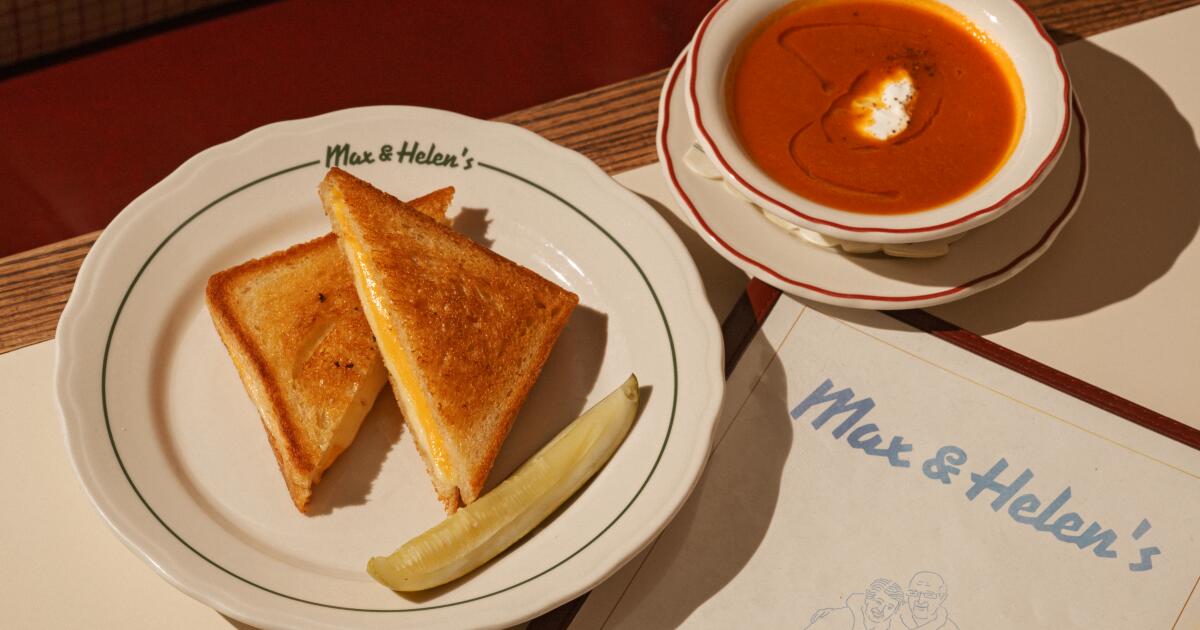
It’s all too easy to overlook the grilled cheese sandwich when ordering at a restaurant. It can feel like something that is best reserved for picky eaters and the kids menu. But a great version is so much more than bread sealed together with a generous layer of cheese — everything must work harmoniously together. When something is this simple in construction, each ingredient really matters, from the type of bread to the selection of cheese to any additional toppings.
Luckily, restaurants around Los Angeles are taking the grilled cheese seriously, whether leaning into nostalgic versions with American cheese and sourdough bread or experimenting with unexpected ingredients like spicy labneh and caramelized onions. The results are delicious and comforting. Here are nine of the best grilled cheese sandwiches to try in L.A.:

Your guide to L.A.’s best outdoor movie events for summer 2026
Tucked inside the downtown skyline, four floors and 50 feet above Olive Street, the Rooftop Cinema Club is hosting daily summer showings of cult classics, blockbusters and an occasional art-house piece. Each ticket holder is provided a pair of wireless headphones, and sunglasses are recommended for earlier showtimes.
Cost: $21 to $27 for patio chairs. $32 to $36 for cushioned loveseat. Parking rates below the building range from $10 to $12.
Next film: “Saved!” on May 14, 8:15 p.m.
Other films: “Twilight,” “Josie and the Pussycats,” “Past Lives,” “10 Things I Hate About You.”
Food options: Outside food and drinks are not allowed. Concession stands carry popcorn, nachos, pretzels and other snacks. Full bar with cocktails, beer and wine.
Dog-friendly? Pets not allowed.
Things to note: Bring-your-own-blanket policy for cold nights. Age requirements vary; most showings are 16+, but select films are 18+ and 21+. If weather conditions become too extreme, showings may be canceled.
‘Harry Potter’ soars at Cosm with fantastical, theme-park-like effects
A pivotal moment early in “Harry Potter and the Sorcerer’s Stone” arrives when Harry’s suburban house is swarmed and flooded with letters of acceptance for the Hogwarts School of Witchcraft and Wizardry. Harry’s aunt and uncle have been preventing such dispatches from reaching the young wizard-to-be, but the boarding school’s messenger owls are having none of it.
Letters flood in from the fireplace, windows and nearly seem to cause the house to burst. And while watching the film recently at Inglewood’s Cosm, home to an all-encompassing high-definition spherical screen, I half expected a letter to fall upon my lap. Cosm specializes in sports, but has released three collaborations with Warner Bros. for what it deems “experiential film.” A framed screen displaying the original 2001 work from director Chris Columbus is untouched, but surrounding it are newly added digital animations designed to envelop guests.
And in this early “Sorcerer’s Stone” scene, letters were a-flying any which way I looked. Up, down, left and right — mail missives were rocketing toward the center screen. As the world closed in on Daniel Radcliffe’s Potter and family, it did so, too, at Cosm. I’ve seen Cosm’s take on “The Matrix” and “Willy Wonka and the Chocolate Factory,” so I knew a letter wouldn’t come zapping my way, but one could be forgiven for protecting their cocktail — themed, of course — from being knocked over.

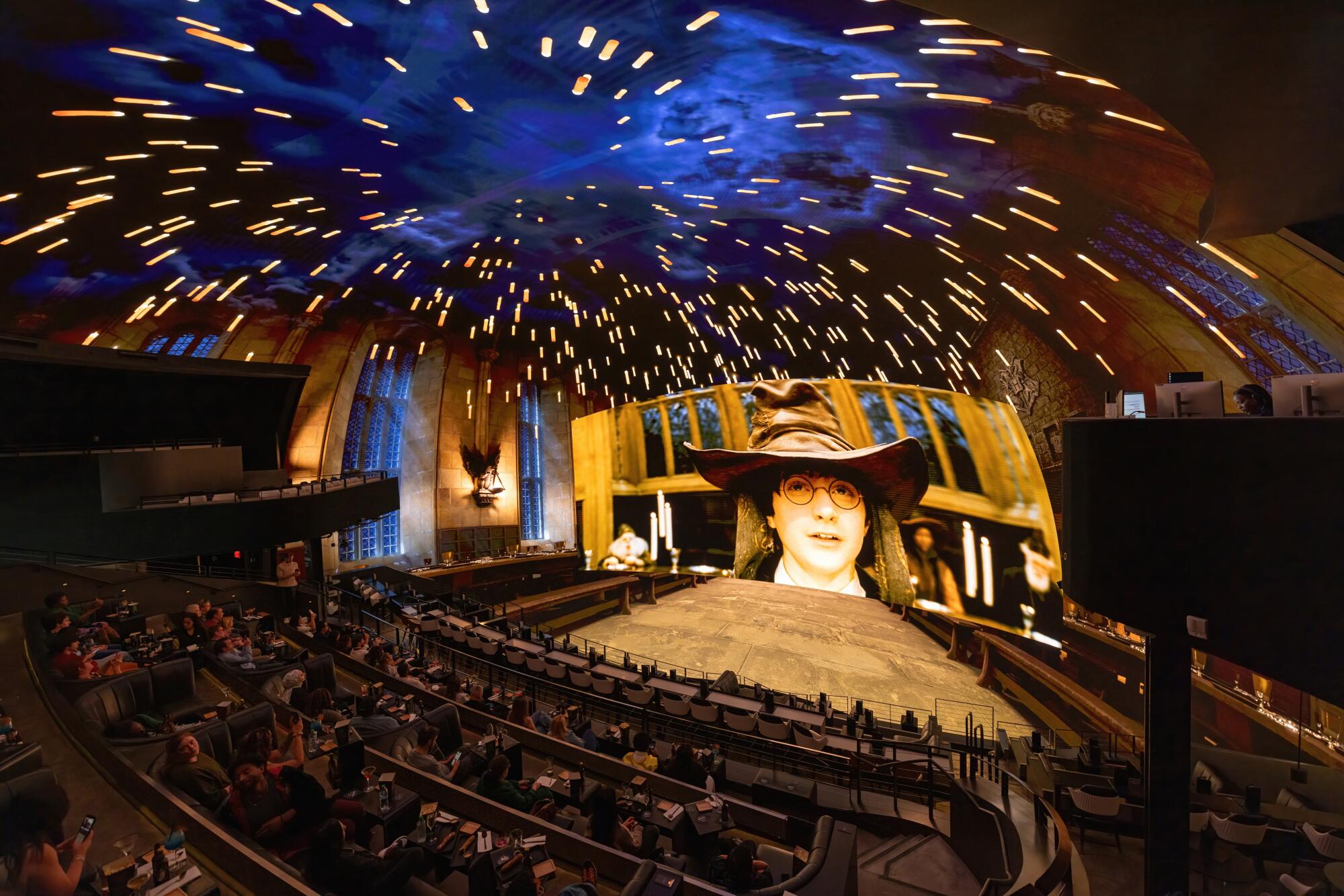
The famed “sorting hat” scene at Cosm’s interpretation of “Harry Potter and the Sorcerer’s Stone.”
(Cosm)
Such is the power of Cosm’s curved screen, which brings a sense of dimension, and even at times movement, to the film. Think of Cosm, perhaps, as a mini version of Las Vegas’ Sphere, but smaller doesn’t mean any less sweeping. No, “Harry Potter and the Sorcerer’s Stone” in Cosm’s hands is often quite grand, as the first glimpse of Hogwarts Castle inspired cheers from the opening night audience, its cliffside towers, a romanticized spin on medieval architecture, towering above us in such a way that we will crane our necks. Only in Universal’s theme parks does the palace seem more real and welcoming.
“Harry Potter and the Sorcerer’s Stone” arrives at Cosm during what is a big year for the franchise. It’s the 25th anniversary, of course, of the first film in the series, and later this year on Christmas Day a new television series based on author J.K. Rowling’s popular book series is set to premiere on HBO Max. This summer, Harry Potter: A Hogwarts Express Adventure will open at the Southern California Railway Museum for guests to experience the Wizarding World rite of passage aboard a real moving train in the Inland Empire.
All of this activity is happening as Rowling has become the center of heated debate for her controversial views on trans women. None of it, however, has seemed to curtail fan interest in the series. The 2023 video game “Hogwarts Legacy” became a massive hit despite calls for a boycott, and Universal Studios last year opened in Florida a brand new theme park land based upon the franchise at its Epic Universe park, with its centerpiece ride, Harry Potter and the Battle at the Ministry, often commanding some of the longest waits at the park.
At the film’s early May premiere at Cosm, Rowling was mentioned little, and wasn’t among the massive list of names being thanked by studio and Cosm execs. “Harry Potter” in 2026 is perhaps best viewed as a franchise that has outgrown its creator to take on a life of its own, and Cosm’s approach is that of a love letter to its many fans, recognizing that this is a magical, enchanting world that generations have long wished to find themselves immersed in.

A climatic scene in “Harry Potter and the Sorcerer’s Stone” is outfitted with additional effects at Cosm.
(Cosm)
To that end, I’d rank “Harry Potter and the Sorcerer’s Stone” as the most successful of Cosm’s three cinematic interpretations. Certainly the subject matter plays a role, and while Cosm has been successful in matching the high-energy of “The Matrix” or the trippiness of “Willy Wonka,” here Cosm and its partners — experiential firm Little Cinema and effects house MakeMake — can simply luxuriate in atmosphere. The train to Hogwarts, for instance, is especially well done, seemingly stretched to infinity. The famed “sorting hat” scene, too, as Cosm’s wizards contrast the internal anxiety of being assigned a role with the external one of doing so in front of an audience, bringing to exaggerated life the cavernous Hogwarts assembly hall.
‘Harry Potter and the Sorcerer’s Stone’
Cosm works best when it’s able to use its venue to create the illusion of no longer being a spectator, when the space itself starts to feel like a living theater. Feel this, for instance, when Harry and pals traverse the moving staircase. The frame of the screen may move, creating a slight sense of disorientation as the stairs themselves shift. The portraits on the wall, whose characters occasionally come alive, start to envelop us. Cosm used some restraint here, keeping us guessing as to which framed pictures may seek to speak or nod our way.
If there’s any qualm in Cosm’s work it’s that at times there could be a tinge more self-control in order to let the film do its work. Stepping into the hidden magic nook of London’s Diagon Alley is a showcase moment in Columbus’ film, and at times it is in Cosm’s interpretation as well. Out on the street, the shops circle around us, further conveying the cramped nature of the neighborhood. It feels, more than ever, like a real-life space. Inside an intimate pub, however, filling out the scene with empty tables could distract from the hurried, nervous nature of the filmmaker’s original intent.
But we live in an immersive age. Art, increasingly, is maximized to encompass us, and Cosm understands this moment well. Once again, the venue has made the argument that cinema can feel like communal, live entertainment.

High school boys volleyball: City Section playoff scores, pairings
HIGH SCHOOL BOYS VOLLEYBALL
CITY SECTION
WEDNESDAY’S RESULTS
SEMIFINALS
DIVISION II
#4 Marquez d. #1 LA Hamilton, 30-28, 22-25, 25-23, 25-21
#6 Narbonne d. #7 Panorama, 25-21, 25-21, 19-25, 25-23
DIVISON III
#13 Birmingham d. #1 New West Charter, 25-17, 25-11, 25-21
#2 Legacy d. #3 South East, 21-25, 25-22, 22-25, 25-19, 15-11
DIVISION IV
#4 Math & Science College Prep d. #8 Annenberg, 26-24, 25-7, 23-25, 25-21
#7 Maywood CES d. #3 Manual Arts, 18-25, 32-30, 25-16, 25-19
DIVISION V
#13 Rancho Dominguez d. #1 WISH Academy, 25-21, 25-19, 17-25, 25-21
#14 Franklin d. #10 Animo De La Hoya, 25-14, 25-17, 25-17
FRIDAY’S SCHEDULE
FINALS
At Birmingham
DIVISION I
#3 Cleveland at #1 Taft, 7:30 p.m.
DIVISION V
#13 Rancho Dominguez vs. #14 Franklin, 5 p.m.
At Venice
DIVISION II
#6 Narbonne vs. #4 Marquez, 7:30 p.m.
DIVISION III
#13 Birmingham vs. #2 Legacy, 5 p.m.
SATURDAY’S SCHEDULE
FINALS
At Birmingham
OPEN DIVISION
#3 Chatsworth vs. #1 Granada Hills, 4 p.m.
Federal judge blocks US sanctions against UN rapporteur Francesca Albanese | Israel-Palestine conflict News
US sanctions imposed on UN expert Francesca Albanese by the Trump administration have been temporarily blocked by a judge.

Published On 14 May 2026
A federal judge has temporarily blocked United States sanctions against Francesca Albanese, a United Nations expert on the occupied Palestinian territory.
UN Human Rights Council Special Rapporteur Francesca Albanese was sanctioned in July 2025 after she publicly criticised Washington’s policy on Israel’s genocidal war against Palestinians in Gaza.
Recommended Stories
list of 3 itemsend of list
Albanese’s husband and daughter filed a lawsuit in February against the Trump administration over the sanctions. It argued that the sanctions were an effort to punish Albanese for bringing attention to Israel’s rights abuses against Palestinians.
In his court order on Wednesday, US District Judge Richard Leon granted a preliminary injunction against the sanctions.
He found that the Trump administration sought to regulate her speech because of the “idea or message expressed”.
“Albanese has done nothing more than speak,” judge Leon wrote in his memorandum opinion. “It is undisputed that her recommendations have no binding effect on the ICC’s actions – they are nothing more than her opinion.”
Albanese, who said the US sanctions were “calculated to weaken my mission” when they were first imposed, celebrated the ruling on social media.
“Thanks to my daughter and my husband for stepping up to defend me, and everyone who has helped so far,” Albanese said in a statement on X.
“Together we are One.”
Since 2022, Albanese, a legal scholar, has served as the special rapporteur for the West Bank and Gaza, where she monitors human rights abuses against Palestinians. The UN Human Rights Council selected her for the position.
The Trump administration sanctioned her last July, calling her “unfit” for her role and accusing her of “biased and malicious activities” against the US and its ally, Israel. Albanese had also recommended that the International Criminal Court (ICC) pursue war crimes prosecutions against Israeli and US nationals.
The sanctions barred the Italian lawyer and human rights expert from entering the US, using US banks and payment systems, and prevented anyone else in the US from doing business with her.
Albanese’s husband and her daughter, a US citizen, claimed in the lawsuit that the US sanctions were “effectively debanking her and making it nearly impossible to meet the needs of her daily life”.

Could Iran war trigger a hunger crisis? | US-Israel war on Iran
The UN warns disruptions in the Strait of Hormuz could drive up food and fertiliser costs, and worsen global hunger.
The next global food crisis is unfolding in a narrow stretch of water.
The United Nations warns that if fertilisers cannot pass through the Strait of Hormuz within just a few weeks, the world could face mass starvation.
It says the consequences could be severe if shipping disruptions linked to the Iran conflict drag on.
Food prices are already at a three-year high, while fertiliser costs critical for agriculture have rocketed.
Aid agencies fear a prolonged disruption could push tens of millions more people into hunger.
For vulnerable economies already struggling with debt and high import costs, the risks are growing fast.
Published On 14 May 2026

The full running order of songs for the Eurovision 2026 semi-finals
EUROVISION fans have picked their first ten finalists after the 70th edition of the iconic song contest kicked off in Vienna.
The BBC aired the first semi-final of the 2026 Eurovision Song Contest at 8pm on Tuesday, May 12, 2026.
Austria is hosting the world’s biggest music competition for the third time after JJ stormed to victory in Basel last year with Wasted Love.
Victoria Swarovski and Michael Ostrowski are hosting the show, with Emily Busvine looking after the Green Room.
Rylan and Angela Scanlon are providing commentary from the Wiener Stadthalle.
What happened in the first Eurovision semi-final?
A total of 15 countries competed for 10 Grand Final spots on Tuesday night.
read more on eurovision 2026


Pre-qualified Italy and Germany were slotted in after the sixth and 10th songs respectively.
Both nations were performing and voting, but not competing for a place in the final.
After all acts had performed, it was down to Eurovision fans to vote for who they want to see in Saturday’s final.
Just ten countries were picked and they were:
- Moldova – Satoshi, Viva, Moldova!
- Sweden – Felicia, My System
- Croatia – Lelek, Andromeda
- Greece – Akylas, Ferto
- Finland – Linda Lampenius and Pete Parkkonen, Liekinheitin
- Israel – Noam Bettan, Michelle
- Belgium – Essyla, Dancing on the Ice
- Lithuania – Lion Ceccah, Sólo quiero más
- Poland – Alicja, Pray
- Serbia – Lavina, Kraj mene
Viewers in the UK were not able to vote during the first semi-final, but things are going to change tonight.
What is the Eurovision semi-final 2 running order?
The second Eurovision semi-final follows at 8pm on Thursday, May 14, live on BBC One and iPlayer.
Another 15 countries will battle it out for the remaining 10 places.
Pre-qualified France, Austria and the UK will slot in after the fifth, eighth and 12th songs respectively.
These countries are performing and voting, but not competing for a place in the final.
The order for the second semi is as follows:
- Bulgaria – Dara, Bangaranga
- Azerbaijan – JIVA, Just Go
- Romania – Alexandra Căpitănescu, Choke Me
- Luxembourg – Eva Marija, Mother Nature
- Czechia – Daniel Žižka, Crossroads
- France (non-competing) – Monroe, Regarde !
- Armenia – Simón, Paloma Rumba
- Switzerland – Veronica Fusaro, Alice
- Cyprus – Antigoni, Jalla
- Austria (non-competing) – Cosmó, Tanzschein
- Latvia – Atvara, Ēnā
- Denmark – Søren Torpegaard Lund, Før vi går hjem
- Australia – Delta Goodrem, Eclipse
- Ukraine – Leléka, Ridnym
- United Kingdom (non-competing) – Look Mum No Computer, Eins, Zwei, Drei
- Albania – Alis, Nân
- Malta – Aidan, Bella
- Norway – Jonas Lovv, Ya Ya Ya
This is the show where UK fans can pick up the phone and vote.
When is the Eurovision Grand Final?
The Eurovision 2026 Grand Final takes place on Saturday, May 16, with the show getting underway at 8pm on BBC One, iPlayer, BBC Radio 2 and BBC Sounds.
A whopping 25 acts will perform – the top 10 countries from each semi-final, alongside hosts Austria and the Big Four of Germany, France, Italy and the UK.
The full Grand Final running order won’t be locked in until after the second semi-final.
A draw will decide if each of the qualifying nations is slotted into the first or second half of the show.
Another draw has already determined that Austria are the closing act, meaning the host country is set to be the 25th and final performance of the night.
Graham Norton is back behind the mic for the BBC’s live coverage, with former Drag Race winner Tia Kofi heading up the broadcaster’s backstage and digital coverage.

Britain’s biggest dinosaur theme park reveals its ‘longest ride to date’ opening just in time for summer holidays
THE UK’s largest dinosaur themed adventure park is set to open its longest ride yet – and it’s just in time for summer.
Families will be able to enjoy the new attraction from July onwards.


ROARR! theme park in Norfolk has revealed a new 105-metre long attraction, dubbed the site’s “longest ride to date.”
The Fossil Falls experience will allow visitors to soar down a winding slope, set inside the park’s 85 acres of natural woodland.
The course also features a launch platform, brake ramp and 12-metre tunnel, which riders will be able to glide down inside of an inflatable ring.
The £250,000 investment marks the latest addition to the adventure park’s 25 other attractions.


Other rides include the Swing-o-saurus and Dippy’s Raceway, with an off-peak day pass priced at around £60 for a family of four.
Ben Francis, park director at ROARR!, told Eastern Daily Press: “Fossil Falls is a fantastic new addition to ROARR! and one we’re really excited to open this summer.
“At 105 metres, it’s our longest ride to date, and we think it’s going to be a real highlight for families visiting the park.
“We’re always looking at ways to invest in and improve the ROARR! experience for our visitors, and Fossil Falls is a brilliant example of that – adding real value for the families who choose to spend their day making memories with us.”
The Dino adventure park is located in just off the A47 and A1067 near Lenwade, and can be reached in just 25 minutes from Norwich by car.
It also holds a variety of activities suitable for children aged zero to 12 years old.
The park will be open from 10am to 5pm, seven days a week, in July and August.

Historic UK city to turn abandoned leisure centre into ‘stunning’ new lido with splash pad & food stalls
A BRAND new lido could be coming to one of the UK’s most beautiful cities under new plans.
A formal bid has been made to transform an old leisure centre into a prime swim spot in the city of Winchester.
Follow The Sun’s award-winning travel team on Instagram and Tiktok for top holiday tips and inspiration @thesuntravel.
Winchester’s River Park Leisure Centre, which closed in 2021, would instead have an outdoor swimming pool, as well as lido a splash pad and food and drink stands.
The lido designs have been created by Design Engine Architects, with previous projects including university campuses and private homes across the UK.
The bid has been put to Winchester City Council by Sea Lanes which runs the lido in nearby Brighton and Hilsea Lido in Portsmouth.


Harry Smith, director of Sea Lanes, said: “We submitted our bid as part of the consultation for the site. We worked with the (Winchester Lido) community group, which really supported the bid.
“We’re really excited to bring a lido to Winchester. I think the decision will be soon, if it’s still on track, and then we will be working with the city if we get the opportunity to pursue the project.
“There’s huge community support for the lido. We have worked with the community group, which contacted us about the site. It is something that has been bubbling around for a while.”
The plan has been met with positivity from locals.
On a Facebook post announcing the news, one said: “Absolutely stunning! Can’t wait to hear more about it!”
Another wrote: “Hard to imagine how this would not be good for everyone in Winchester. Wonderful first visual.”
A third added: “I swam in Hilsea Lido the other day – fantastic. This would be great.”
There was previously an open-air swimming lido in Winchester on Worthy Lane, which opened in the 1930s and closed in the late 1970s – since then, Winchester hasn’t had a lido.
Nearby Hilsea Lido had been closed since 2022 but reopened on May 2 after a £7.6million revamp.
New showers and toilets, including a Changing Places toilet, and a sauna were added as part of the upgrades.
Formerly a saltwater pool, the 220-foot lido now uses unheated chlorinated fresh water.
The lido served as a training centre for the Team GB diving team ahead of the 1936 and 1952 Olympics, and it also featured as a filming location for The Who’s 1975 film Tommy.

Bashing Obama on both coasts
SAN DIEGO — Republican presidential candidates renewed their criticism of President Obama’s healthcare program Monday in a double-barreled assault from both coasts.
Standing before a “Repeal and Replace Obamacare” banner at a medical device manufacturer in San Diego as he opened a campaign swing in the state, Mitt Romney called the president’s policies “an attack on free enterprise, an attack on economic freedom unlike anything we have ever seen before.”
“We’ve got to make sure that we replace President Obama with someone who truly understands what it is that makes America’s economy work,” Romney said.
Decrying a tax on medical devices that is a component of the healthcare law, he argued that the Obama administration was thwarting the endeavors of entrepreneurs like NuVasive’s chief executive “tax by tax, regulator by regulator, regulation by regulation.”
“Washington is crushing the dreams, and crushing the dreamers. We can’t let it happen,” he said.
Rick Santorum, who has doggedly criticized the healthcare program his rival Romney pushed as Massachusetts governor as “the blueprint” for Obama’s law, made an unannounced stop outside the Supreme Court, where the first day of arguments were being held in a challenge to the law.
He called for its repeal and underscored what he says is a key argument for his candidacy — that he would be a stronger adversary against Obama in November.
“There’s only one candidate who has a chance of winning the Republican nomination, who can make this [Obama’s healthcare law] the central issue, a winning issue for winning the presidency back, and that’s Rick Santorum,” the former senator from Pennsylvania said. “The worst person to make that case is Mitt Romney.”
Later, in an interview on CNN, Santorum chided Romney for campaigning in California. “The whole world is watching what’s going on here in Washington,” he said. “Mitt Romney is 3,000 miles away. He should be here.”
Romney, who has defended his Massachusetts healthcare mandate as an appropriate statewide approach, brushed aside Santorum’s criticism by asserting that he was “not going to worry too much about what Rick is saying these days.”
Romney’s speech at NuVasive, whose chief executive, Alexis V. Lukianov, is an avowed critic of the Obama healthcare law, was a brief diversion from his main objective in California: raising money.
Over two days, he plans to hold five fundraisers headlined by leading figures in the state Republican establishment: 2010 gubernatorial nominee Meg Whitman, former Los Angeles Mayor Richard Riordan, real estate mogul Donald Bren and former Gov. Pete Wilson.
Alex Spanos, owner of the San Diego Chargers, is hosting one of the fundraisers at his Villa Angelica mansion in Stockton. Dean Spanos, Alex’s son and president of the Chargers, is leading another fundraiser at the U.S. Grant hotel in San Diego.
His star-studded political events stood in contrast to those of Santorum, who will visit California later this week. While donors were asked to contribute as much as $25,000 at Romney’s events, Santorum supporters were asked for a maximum of $2,500. Santorum’s admirers may gain entree for as little as $125 at a dessert reception Thursday at the Alamo home of Ubokia.com Chief Executive Mark Pine. Hosts include former Rep. Bill Baker and tea party activist Bridget Melson.
Though Romney has built what his campaign views as an insurmountable lead in the Republican delegate count, his rivals have refused to step aside — lending greater importance to California’s June 5 primary, when 172 delegates will be at stake.
“I need you guys to get ready, to organize your effort, to get your friends to vote, to collect some money, to get campaign contributions,” Romney said in San Diego on Monday. “We’ve got a ways to go.”
A new USC Dornsife/Los Angeles Times poll showed Romney drawing the support of 42% of registered Republican voters. Santorum trailed him by 19 percentage points, with Newt Gingrich and Ron Paul a distant third and fourth.
Gingrich and Santorum acknowledged Monday that they were unlikely to pass Romney in delegates through the remaining primaries, but they said the race for the nomination would go to the party convention in August.
“If he can get to 1,144, he’s the nominee. But if he can’t get to 1,144 on the 26th of June, the last primary, then it is going to be a wide-open electronic convention for 60 days of talking among the American people,” Gingrich said on CNN.
Santorum, speaking on the same program, said the likelihood was that no candidate would accumulate enough delegates by the time the voting contests concluded.
“This race is going to — is [in] all likelihood going to go to the convention,” he said.
—
seema.mehta@latimes.com
Reston reported from San Diego and Mehta from Los Angeles. Ian Duncan in the Washington bureau contributed to this report.
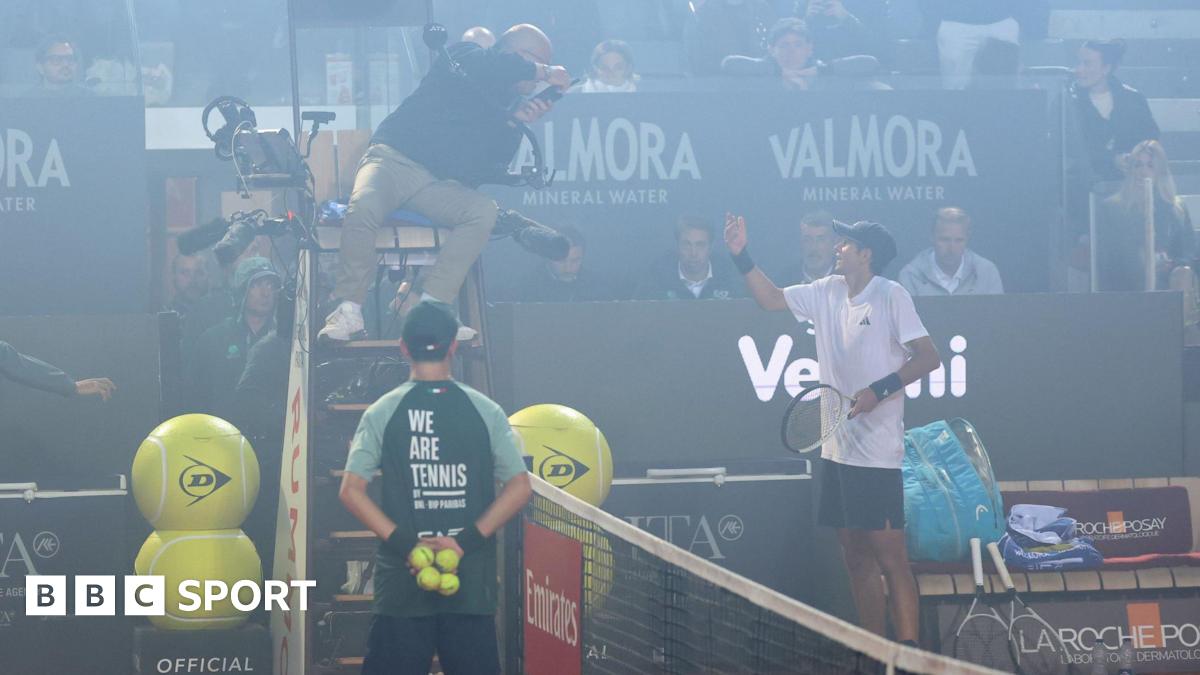
Italian Open match delayed by cup final fireworks
A match at the Italian Open is halted for almost 20 minutes by smoke from fireworks after the Coppa Italia final at the neighbouring Stadio Olimpico.
Source link
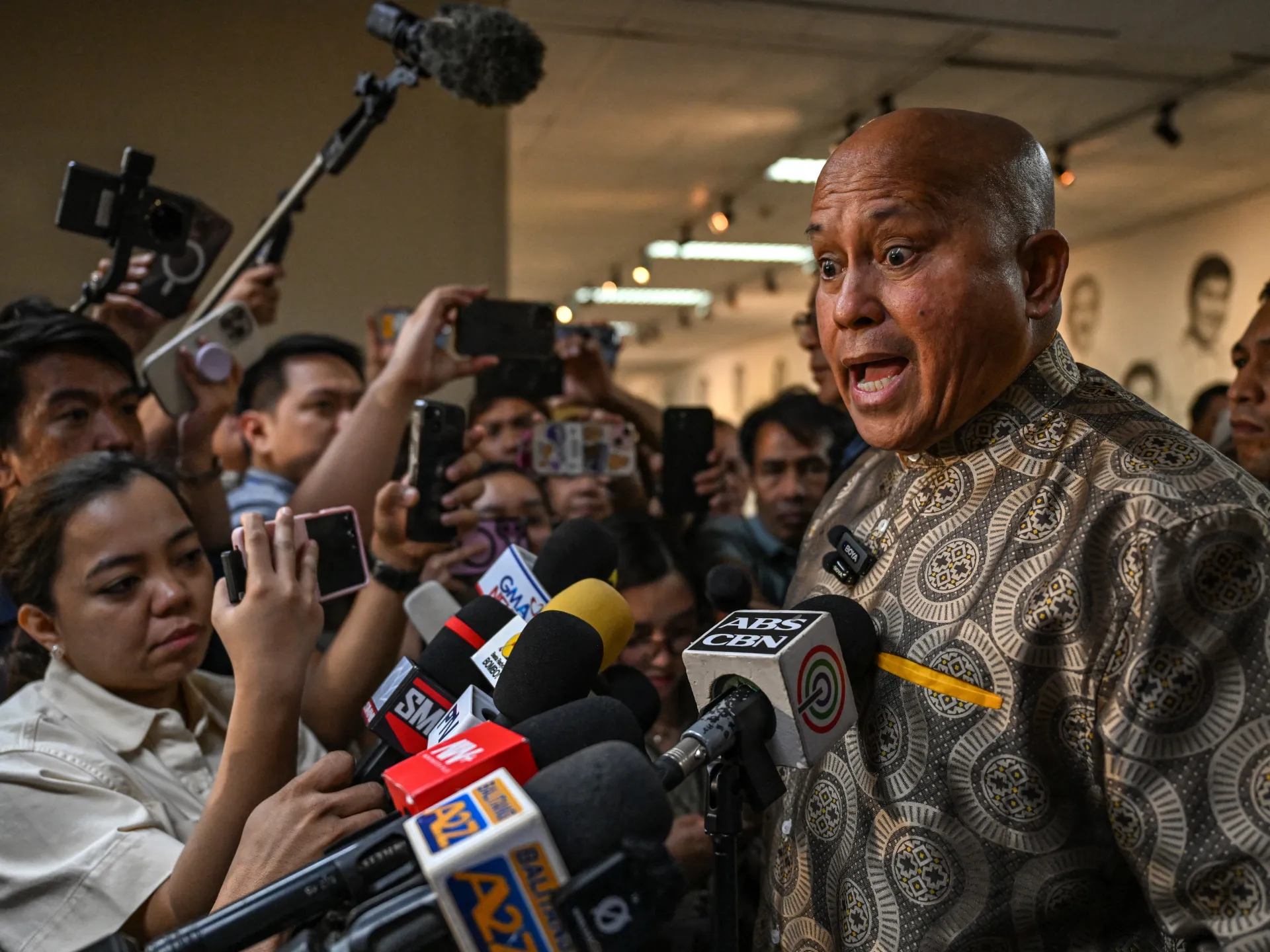
Philippine politician wanted by ICC flees Senate | ICC News
Police spokesperson Randulf Tuano says one person has been arrested after gunshots rang out in Senate.
Published On 14 May 2026
The Philippine Senate President says that a politician wanted by the International Court (ICC) was no longer in the Senate building where he had been taking refuge, fearing his arrest.
Senator Ronald “Bato” dela Rosa, the former national police chief and top enforcer of former President Rodrigo Duterte’s bloody “war on drugs”, has been under Senate protection and is wanted for crimes against humanity, the same charges Duterte is accused of.
“The sergeant-at-arms has confirmed that he is no longer in the building,” Senate President Alan Peter Cayetano told reporters on Thursday.
The announcement comes a day after gunfire rang out at the Senate, where dela Rosa had been holed up. Confusion and chaos filled the legislature as people inside scrambled for cover on Wednesday, hours after dela Rosa, had appealed to his supporters on social media to mobilise and said law enforcement agents were planning on arresting him.
The incident caused chaos, with a heavy police presence and armed guards at the Senate. Protests were also held outside, and more than a dozen shots were fired after the Marines were called in to help the situation.
Philippine President Ferdinand Marcos Jr held an emergency meeting with government and security chiefs on Thursday, as police spokesperson Randulf Tuano told DZBB radio that one person had been arrested following the shooting and investigations were under way.
“The person has provided names, but these still need confirmation,” Tuano told the radio station.
Dela Rosa has denied involvement in the illegal killings, but on Monday, the ICC unsealed an arrest warrant for him.
Duterte is also accused of crimes against humanity and has been held in ICC custody in The Hague since March 2025. The ICC estimates that between 12,000 and 30,000 people were killed from 2016 to 2019 in the former president’s “war on drugs”.
Reporting from Manila, Al Jazeera’s Jamela Alindogan said two independent, credible sources confirmed that dela Rosa had fled the building.
“He was able to escape at around 2 or 3 this morning,” she said.
Lawyer Jimmy Bondoc, who represents dela Rosa, also told reporters that he spoke to the lawmaker late at night and believed he was inside the Senate after the incident.
“As his lawyer, I asked him if you have plans to leave, he said none,” Bondoc told reporters.
In an interview that aired on DZBB radio on Thursday morning, dela Rosa said he would “exhaust all available remedies” to block his transfer to the ICC, and after learning about the conditions Duterte was being held under, he was no longer willing to fight his case at The Hague.
It remains unclear when the interview was initially conducted.

United States China Tech Rivalry Delays Nvidia AI Chip Exports
The latest developments surrounding Nvidia’s H200 chip sales to China highlight the growing complexity of the technological rivalry between the United States and China. Although Washington has reportedly approved several major Chinese firms to purchase Nvidia’s advanced artificial intelligence chips, no deliveries have taken place so far.
The situation reflects how geopolitical competition is increasingly disrupting even officially approved commercial agreements in the semiconductor sector.
Nvidia, the world’s leading artificial intelligence chip manufacturer, now finds itself caught between United States export control policies and China’s push for technological self reliance.
What Is the H200 Chip?
The H200 is Nvidia’s second most powerful artificial intelligence chip and is designed for advanced AI model training and data center operations.
The chip is particularly valuable for companies developing large language models, cloud computing systems, and next generation AI applications.
Before export restrictions tightened, Nvidia dominated China’s advanced AI chip market with an estimated market share of around 95 percent.
China also represented a major source of revenue for Nvidia, making access to the Chinese market strategically important for the company’s long term growth.
Which Chinese Companies Were Approved?
According to reports, the United States Commerce Department approved around ten Chinese firms to purchase H200 chips.
These reportedly include major Chinese technology companies such as:
- Alibaba
- Tencent
- ByteDance
- JD.com
Several distributors were also reportedly approved, including:
Under the licensing terms, each approved customer could reportedly purchase up to 75,000 chips.
However, despite these approvals, no actual sales or deliveries have yet been completed.
Why Have the Sales Stalled?
The delays appear to stem from concerns on both the United States and Chinese sides.
Chinese Concerns
Chinese authorities reportedly fear that reliance on Nvidia chips could undermine Beijing’s efforts to strengthen its domestic semiconductor industry.
China has invested heavily in local AI chip development, particularly through companies such as Huawei.
Beijing increasingly sees semiconductor self sufficiency as a national security priority amid escalating technological competition with Washington.
There are also concerns within China regarding supply chain security and possible vulnerabilities linked to imported American technology.
Recent Chinese regulations aimed at reducing foreign dependence in critical technology sectors have reportedly intensified scrutiny of these chip purchases.
United States Restrictions
The United States has simultaneously imposed strict export control requirements on advanced semiconductor sales to China.
Chinese buyers must reportedly prove that the chips will not be used for military purposes and that adequate security procedures are in place.
Nvidia must also satisfy inventory and compliance conditions under American export laws.
Additionally, reports suggest the Trump administration negotiated an unusual arrangement in which the United States would receive a portion of revenue generated from the chip sales. This reportedly requires the chips to pass through American territory before shipment to China.
Such conditions have further complicated the transaction process.
Jensen Huang’s Diplomatic Push
Nvidia Chief Executive Officer Jensen Huang has emerged as a key figure in efforts to preserve Nvidia’s access to the Chinese market.
Huang reportedly joined President Donald Trump during a diplomatic visit linked to talks with Chinese President Xi Jinping.
His participation underscores the economic significance of the semiconductor dispute and the importance of China to Nvidia’s business strategy.
Huang has repeatedly warned that export controls risk permanently weakening Nvidia’s position in China while encouraging Chinese firms to accelerate domestic alternatives.
The Larger Strategic Battle
The Nvidia dispute reflects a broader struggle between the United States and China over technological dominance in artificial intelligence.
Washington increasingly views advanced semiconductor technology as a strategic national security asset. American policymakers fear that unrestricted access to advanced AI chips could strengthen China’s military and technological capabilities.
China, meanwhile, sees semiconductor independence as essential to reducing vulnerability to foreign pressure and sanctions.
As a result, both sides are attempting to balance economic interests with long term strategic competition.
Implications for the Global AI Industry
The uncertainty surrounding Nvidia’s China business could have major implications for the global artificial intelligence industry.
If Chinese companies lose access to Nvidia chips, they may accelerate investment in domestic alternatives, potentially reshaping the global semiconductor market over time.
At the same time, restrictions on AI chip trade risk fragmenting the global technology ecosystem into competing American and Chinese spheres.
This could reduce international collaboration, disrupt supply chains, and intensify geopolitical competition over emerging technologies.
Future Outlook
Despite current delays, neither the United States nor China appears willing to completely sever technological and commercial ties.
However, the Nvidia case demonstrates that semiconductor trade between the two powers is becoming increasingly politicized and strategically sensitive.
The future of AI competition may ultimately depend not only on innovation, but also on which country can build the most resilient and independent technology ecosystem.
For Nvidia, maintaining its position between the world’s two largest economies will likely remain one of its greatest strategic challenges.
Conclusion
The stalled Nvidia H200 deal illustrates how deeply geopolitical tensions now shape the global technology industry.
Although the United States has approved limited chip exports to China, political distrust, national security concerns, and strategic competition continue to obstruct implementation.
As artificial intelligence becomes central to economic and military power, semiconductor trade is no longer simply a commercial issue. It has become a defining arena in the broader contest between Washington and Beijing for technological leadership in the twenty first century.
With information from Reuters,