







‘Best drama’ airs on BBC tonight after fans call festive film ‘iconic’
BBC One’s new Christmas drama Stuffed has been branded “iconic” by fans
A hidden treasure of a comedy on the BBC, hailed as “brilliant” by viewers, is set to air tonight.
Stuffed, starring Guz Khan and Morgana Robinson, is a comedy-drama that follows a family embarking on a once-in-a-lifetime trip to Lapland.
Khan portrays Arslan Farooqi, who, after receiving an unexpected £8,000 Christmas bonus at work, decides to take his multi-faith family on this festive adventure.
Joined by his wife Hannah (played by Robinson), his two daughters, and brother-in-law Jamie, they trade Coventry for the enchantment of Christmas in Lapland.
However, their holiday soon descends into chaos when Arslan discovers that his bonus was given in error and needs to be returned, reports Wales Online.
The BBC’s synopsis teases: “Things go downhill fast when Arslan finds out the bonus was a mistake, and to make matters worse, they have already spent every penny of it.
“What ensues is one man’s quest to salvage a Christmas he doesn’t believe in, while ideally not losing his job, his family, and everything he has ever worked for. And surprise, surprise, it doesn’t go too smoothly.”
For the latest showbiz, TV, movie and streaming news, go to the new **Everything Gossip** website
The film can be streamed on BBC iPlayer and will also be broadcast on BBC One tonight at 9pm.
One enthusiastic fan recommended: “If you’ve not watched it yet, try Stuffed on the iPlayer. Brilliant new addition to the Christmas film list. Guz Khan is brilliant.”
Another viewer gushed: “Absolutely loved Stuffed on BBC iPlayer with my fav man @GuzKhanOfficial, him and Morgana are a dream team working together.”
Another viewer chimed in: “Loved it, hope some more will follow!” while a fourth echoed: “We need a regular series for this! Loved it made me laugh throughout.”
One enthusiastic fan declared: “This is iconic on tv I didn’t know what to watch during the Christmas holidays, same old home alone and polar express but this… is perhaps the best drama I’ve seen.”
Guz had previously shared his apprehensions about Stuffed’s release with The Guardian, saying: “You never know when you make something. I never thought we’d ever be in this kind of slot. There’s lots of things that come along with doing a Christmas special.”
He continued: “A lot of the work I get asked to do is like: ‘Come in and do your thing.’ I just did season two of The Gentlemen, and it was such a fun week. There’s no rules. You can go absolutely crazy.
“But this was a little bit different. You have to follow some guidelines. And so it was a really good challenge for me. Where I’d usually express myself with dialogue, I had to try and get the same feeling with an expression.”
Stuffed airs on BBC One tonight at 9pm and is available to watch on iPlayer.

Akbank VP Gökhan Gökçay On Driving Engagement And Financial Wellness
Gökhan Gökçay, executive VP of Technology at Akbank, explains how his bank—named the World’s Best Consumer AI Bank—uses AI and partnerships to tailor service and secure data.
Global Finance: What impact has Akbank’s AI-powered digital assistant had on customer loyalty, and how does it contribute to your 96% digital migration rate for sales?
Gökhan Gökçay: Akbank Assistant has become a cornerstone of our customer engagement strategy by delivering fast, personalized, and seamless banking experiences across all channels. By enabling customers to complete more than 200 types of transactions autonomously and resolving 250,000 monthly support sessions through the “Help Me” module, it has significantly enhanced convenience and satisfaction.
The Assistant’s proactive and context-aware guidance, combined with human-like voice interaction, has fostered stronger emotional connections and loyalty. This trust and ease of use have been key drivers in Akbank’s remarkable 96% migration rate of transactions, including sales and inquiries, to digital channels.
Moreover, the Assistant’s recommendation engine, powered by advanced analytics and large language models, has increased product conversion rates from 2% to 18%, demonstrating that intelligent personalization directly translates into customer engagement and business growth. Customers now engage with our digital platforms over 700 million times daily, reflecting a deep behavioral shift toward mobile-first, AI-supported banking.
GF: Akbank uses AI to provide “Banking IQ” insights to customers, such as cash flow analysis and spending patterns. How do these insights directly translate into better financial habits for your customers, and what is your approach to turning these insights into proactive, personalized product recommendations?
Gökçay: Through AI-powered “Banking IQ” insights, Akbank analyzes customer cash flow, spending patterns, and savings behavior to provide meaningful, actionable financial guidance. These insights empower customers to make smarter financial decisions, such as optimizing savings, avoiding overdrafts, or rebalancing investments, based on real-time data.
The same infrastructure supports our agentic recommendation engine, enabling customers to better understand their financial habits, stay in control of their goals, and develop long-term financial wellness, turning data into trusted everyday advice that drives healthier financial behavior.
GF: Given your use of AI to create hyper-personalized customer experiences, how do you balance the drive for personalization with customer data privacy concerns, and what specific measures are in place to ensure compliance and maintain customer trust?
Gökçay: At Akbank, personalization is built on trust, transparency, and ethical responsibility. All AI systems are designed in full compliance with Turkey’s banking and data protection regulations. In 2025, we introduced the Akbank Responsible AI Manifesto, publicly affirming our commitment to ethical and responsible AI. The manifesto defines a set of nonnegotiable principles—fairness, transparency, accountability, inclusiveness, and data privacy—that guide every stage of our AI lifecycle, from model design to deployment.
Our dedicated AI governance framework continuously monitors model behavior, bias, and data use, while regular audits ensure compliance with both regulatory and ethical standards. By embedding these principles into our technology, we ensure that personalization always empowers customers, strengthens trust, and reinforces our long-term human-centered AI vision.
GF: Can you describe how Akbank LAB collaborations with fintechs and tech companies accelerate AI innovation, and what role these external partnerships play in Akbank’s overall long-term AI strategy?
Gökçay: Akbank LAB acts as the innovation bridge connecting our bank’s internal R&D ecosystem with fintechs, startups and global technology pioneers. Established in 2016, Akbank LAB has become one of the world’s leading financial innovation centers, recognized as part of Global Finance’s Innovators 2025 list.
Collaborations with companies like Personetics and Jasper accelerate the development of advanced personalization, conversational intelligence, and generative AI capabilities. However, Akbank’s open innovation approach goes beyond specific partnerships. We value every collaboration that enhances or personalizes our customers’ experience. We believe in the power of the ecosystem where shared innovation drives transformation and progress across the financial landscape.
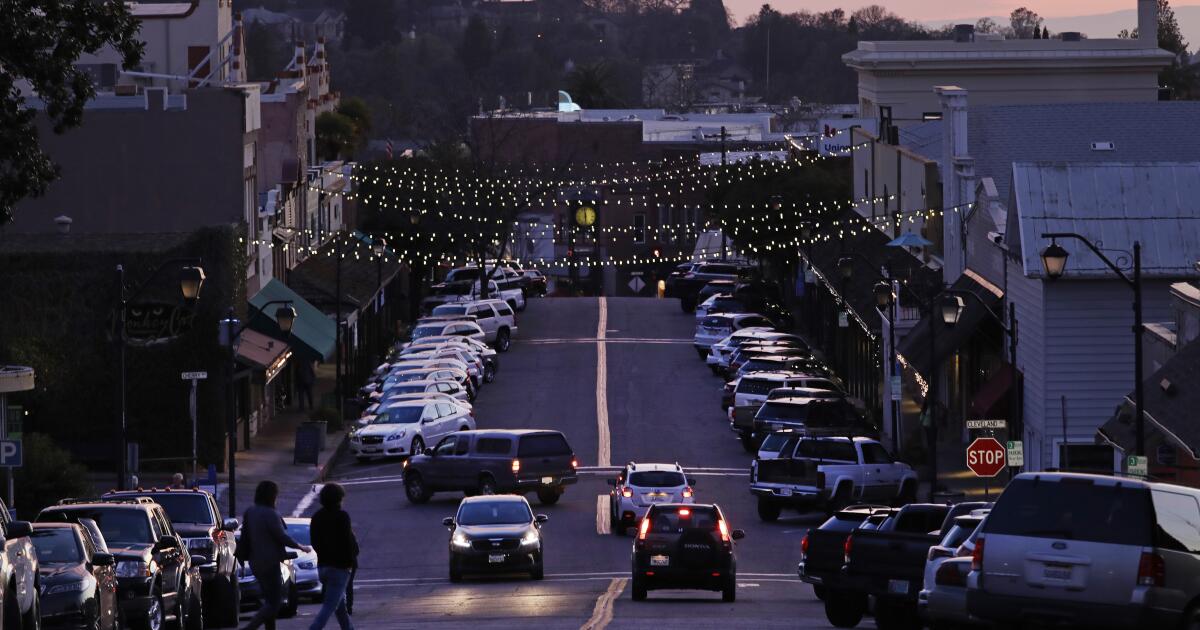
California counties unsure how how they’ll pay for uninsured
In 2013, before the Affordable Care Act helped millions get health insurance, California’s Placer County provided limited healthcare to some 3,400 uninsured residents who couldn’t afford to see a doctor.
For several years, that number has been zero in the predominantly white, largely rural county stretching from Sacramento’s eastern suburbs to the shores of Lake Tahoe.
The trend could be short-lived.
County health officials there and across the country are bracing for an estimated 10 million newly uninsured patients over the next decade in the wake of Republicans’ One Big Beautiful Bill Act. The act, which President Trump signed into law this summer, is expected to reduce Medicaid spending by more than $900 billion over that period.
“This is the moment where a lot of hard decisions have to be made about who gets care and who doesn’t,” said Nadereh Pourat, director of the Health Economics and Evaluation Research Program at UCLA. “The number of people who are going to lose coverage is large, and a lot of the systems that were in place to provide care to those individuals have either gone away or diminished.”
It’s an especially thorny challenge for states such as California and New Mexico where counties are legally required to help their poorest residents through what are known as indigent care programs. Under Obamacare, both states were able to expand Medicaid to include more low-income residents, alleviating counties of patient loads and redirecting much of their funding for the patchwork of local programs that provided bare-bones services.
Placer County, which estimates that 16,000 residents could lose healthcare coverage by 2028, quit operating its own clinics nearly a decade ago.
“Most of the infrastructure that we had to meet those needs is gone,” said Rob Oldham, Placer County’s director of health and human services. “This is a much bigger problem than it was a decade ago and much more costly.”
In December, county officials asked to join a statewide association that provides care to mostly small, rural counties, citing an expected rise in the number of uninsured residents.
New Mexico’s second-most populous county, Doña Ana, added dental care for seniors and behavioral health benefits after many of its poorest residents qualified for Medicaid. Now, federal cuts could force the county to reconsider, said Jamie Michael, Doña Ana’s health and human services director.
“At some point we’re going to have to look at either allocating more money or reducing the benefits,” Michael said.
Straining state budgets
Some states, such as Idaho and Colorado, abandoned laws that required counties to be providers of last resort for their residents. In other states, uninsured patients often delay care or receive it at hospital emergency rooms or community clinics. Those clinics are often supported by a mix of federal, state and local funds, according to the National Assn. of Community Health Centers.
Even in states like Texas, which opted not to expand its Medicaid program and continued to rely on counties to care for many of its uninsured, rising healthcare costs are straining local budgets.
“As we have more growth, more people coming in, it’s harder and harder to fund things that are required by the state Legislature, and this isn’t one we can decrease,” said Windy Johnson, program manager with the Texas Indigent Health Care Assn. “It is a fiscal issue.”
California lawmakers face a nearly $18-billion budget deficit in the 2026-27 fiscal year, according to the latest estimates by the state’s nonpartisan Legislative Analyst’s Office. Gov. Gavin Newsom, who recently acknowledged he’s mulling over a White House run, has rebuffed several efforts to significantly raise taxes on the ultrawealthy. Despite blasting the bill passed by Republicans in Congress as a “complete moral failure” that guts healthcare programs, the Democrat this year rolled back state Medi-Cal benefits for seniors and for immigrants without legal status after rising costs forced the program to borrow $4.4 billion from the state’s general fund.
H.D. Palmer, a spokesperson for the state’s Department of Finance, said that the Newsom administration is still refining its fiscal projections and that it would be premature to discuss potential budget solutions.
Newsom will unveil his initial budget proposal in January. State officials have said California could lose $30 billion a year in federal funding for Medi-Cal under the new law, as much as 15% of the state program’s entire budget.
“Local governments don’t really have much capacity to raise revenue,” said Scott Graves, a director at the independent California Budget & Policy Center with a focus on state budgets. “State leaders, if they choose to prioritize it, need to decide where they’re going to find the funding that would be needed to help those who are going to lose healthcare as a result of these federal funding and policy cuts.”
Reviving county-based programs in the near term would require “considerable fiscal restructuring” through the state budget, the Legislative Analyst’s Office said in an October report.
No easy fixes
It’s unclear how many people are enrolled in California’s county indigent programs, because the state doesn’t track enrollment and utilization. But enrollment in county health safety net programs dropped dramatically in the first full year of Affordable Care Act implementation, going from about 858,000 people statewide in 2013 to roughly 176,000 by the end of 2014, according to a survey at the time by Health Access California.
“We’re going to need state investment,” said Michelle Gibbons, executive director of the County Health Executives Assn. of California. “After the Affordable Care Act and as folks got coverage, we didn’t imagine a moment like this where potentially that progress would be unwound and folks would be falling back into indigent care.”
In November, voters in affluent Santa Clara County approved a sales tax increase, in part to backfill the loss of federal funds. But even in the home of Silicon Valley, where the median household income is about 1.7 times the statewide average, that is expected to cover only a third of the $1 billion a year the county stands to lose.
Health advocates fear that, absent major state investments, Californians could see a return to the previous patchwork of county-run programs, with local governments choosing whom and what they cover and for how long.
In many cases, indigent programs didn’t include specialty care, behavioral health or regular access to primary care. Counties can also exclude people based on immigration status or income. Before the ACA, many uninsured people who needed care didn’t get it, which could lead to them winding up in emergency rooms with untreated health conditions or even dying, said Kiran Savage-Sangwan, executive director of the California Pan-Ethnic Health Network.
Rachel Linn Gish, interim deputy director of Health Access California, a consumer advocacy group, said that “it created a very unequal, maldistributed program throughout the state.”
“Many of us,” she said. “including counties, are reeling trying to figure out: What are those downstream impacts?”
KFF Health News is a national newsroom that produces in-depth journalism about health issues and is one of the core operating programs at KFF, the independent source for health policy research, polling and journalism.
Nearly a century ago, the first World Cup went off with many hitches
Next summer’s World Cup will be the largest, most complex and most lucrative sporting event in history, with 48 teams playing 104 games in three countries. The tournament is expected to draw a global TV audience of nearly 5 billion and FIFA, the event’s organizer, is hoping for revenues of between $10 billion-$14 billion — which is why lower-bowl tickets for Iran-New Zealand at SoFi Stadium cost nearly $700.
All that seemed unlikely after the first tournament in 1930, when the idea of a soccer World Cup was nearly killed in the cradle, the victim from lack of planning, lack of money and lack of interest. That the competition survived, much less thrived, is nothing short of a miracle, says English writer and podcaster Jonathan Wilson, author of the deeply researched “The Power and Glory: The History of the World Cup.”
“1930, it’s incredibly amateurish in many ways,” Wilson said. “It’s got that sort of almost like a school sports day feel to it.”
Only 13 countries took part in the first tournament; it was supposed to be 16 but the Egyptian team missed its boat to Uruguay while Japan and Siam (now Thailand) couldn’t afford the travel costs and pulled out. England, meanwhile, not only refused to play, but the British press ignored the event, as did much of Europe.
That seemed like a wise decision at the time since the first two matches of the inaugural tournament were affected by snow, with one of the opening games drawing just 4,444 fans. The smallest crowd in World Cup history, estimated at about 300, showed up for another first-round game between Romania and Peru and the TV audience … well, there was none since TV had yet to be invented.
The officiating was beyond suspect — Romania’s manager, Constantin Radulescu, also worked two games as a linesman — and the U.S. trainer, Jack Coll, had to be stretchered off the field during his team’s semifinal — yes, the U.S. made the semifinals! — with Argentina when he lost consciousness after inhaling the fumes from a bottle of chloroform that shattered in his pocket.
In another game, the penalty spots were mistakenly marked 16 yards from goal instead of the regulation 12 — and nobody noticed.
“Some of the details don’t make sense,” Wilson said. “The whole thing is so sort of low grade compared to today.”
When Argentine captain Nolo Ferreira left the tournament and returned home to take his law exams his replacement, Guillermo Stábile, scored a tournament-high eight goals in four games — then never played for the national team again (although he did coach it, leading the La Albiceleste to six South American titles and the 1958 World Cup).
Given the farcical nature of the 1930 World Cup, the tournament probably should have ended right there. Instead, 1930 has become the foundation on which next year’s competition was built.
The origins of the tournament, however, actually make sense. Before 1930, FIFA recognized the winner of the Olympic competition as the world champion. But that event was for amateurs, a point on which the International Olympic Committee would not budge.
With professional soccer growing in popularity, FIFA decided to stage its own breakaway event and play it in Uruguay, the country that had won the last two Olympic titles.
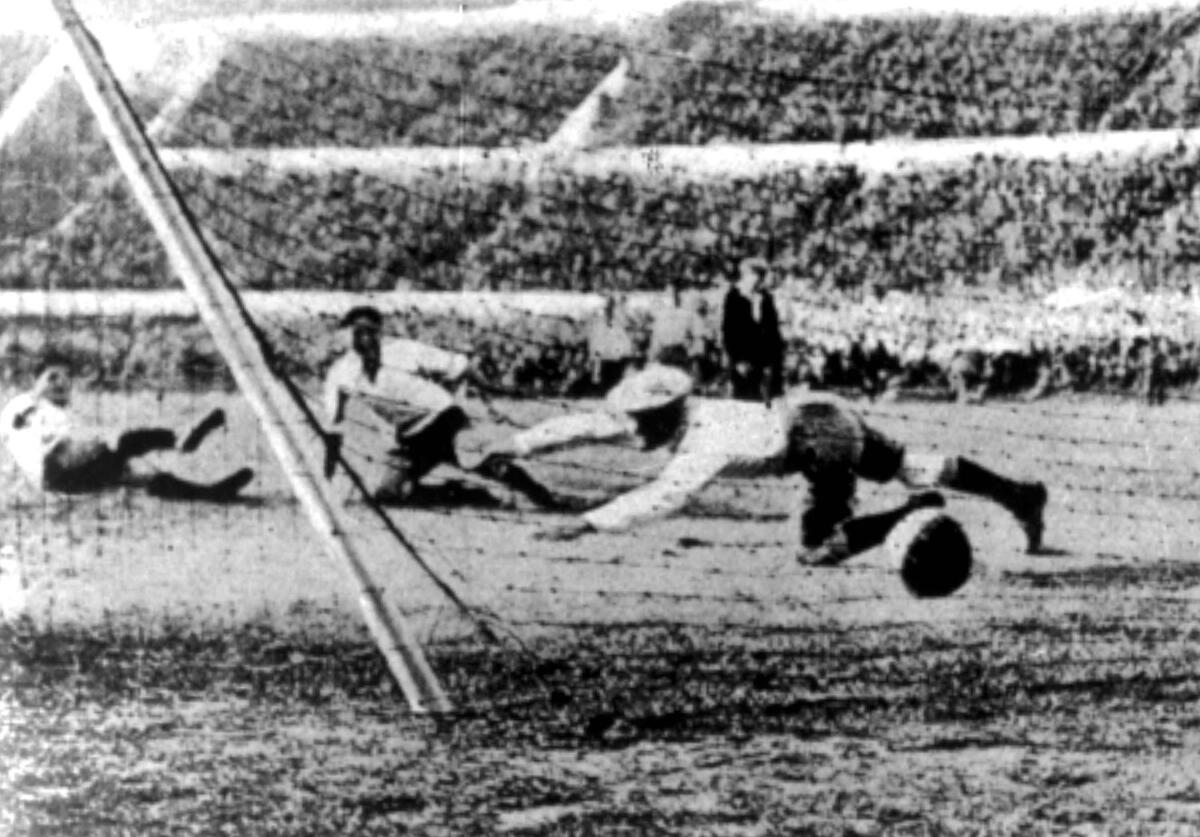
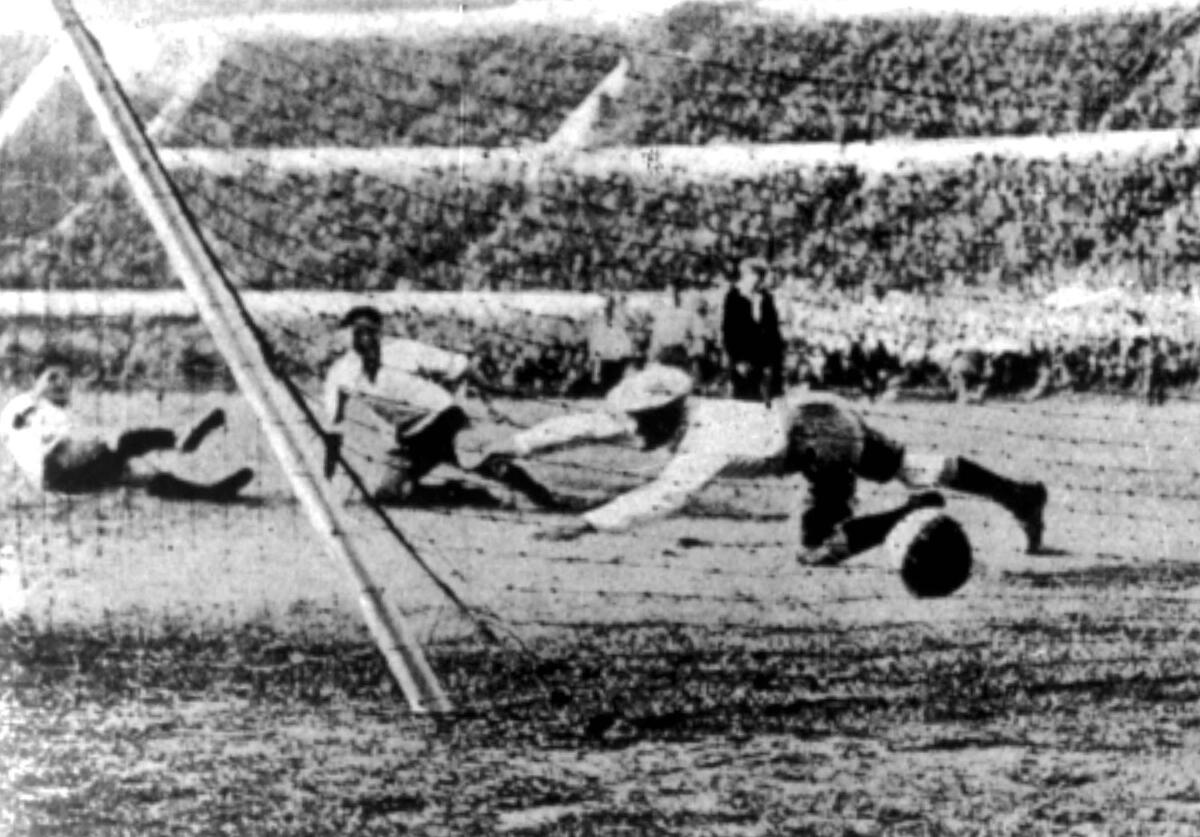
Argentina’s goalkeeper can’t stop a shot by Uruguay during the 1930 World Cup final against Argentina in Montevideo, Uruguay.
(Associated Press)
That quickly proved to be a big mistake. The growing effects of the Great Depression left many countries unable to afford the long, slow steamship trip to South America. The first tournament was open to any country that wanted to play, yet two months before the first game no European teams had agreed to come.
“It was taken very seriously by Uruguay and Argentina,” Wilson said, but not by many others.
That changed shortly after Romania’s King Carol II, who ascended to the throne in a coup that deposed his son, personally selected his country’s World Cup roster and sent it on its way. France quickly agreed to go too, entering a makeshift team under pressure from FIFA president Jules Rimet, a Frenchman. Belgium also buckled under FIFA pressure and all three teams boarded the same ship for the trip to Uruguay, working out together on the 15-day voyage aboard the SS Conte Verde, an Italian ocean liner.
“Even the four European nations who go it’s not entirely clear how seriously they took it,” Wilson said. “The French and Romanians, they kept diaries. They seem to have regarded this as a laugh. We’ll try to win but it doesn’t really matter.”
Things didn’t really get loony until the tournament began. The Bolivian team, for example, played in berets, as did an Argentine midfielder, while the 15 referees who worked the games, some of whom had traveled and socialized with the players on the long boat ride from Europe, dressed formally in knickers, long-sleeve shirts, blazers and ties.
The well-dressed officials spent much of the tournament working with police to break up fights; play was so violent at least two players sustained broken legs and the U.S.-Argentina semifinal descended into a full-out brawl, with one American having four teeth knocked out and another hospitalized with injuries to his stomach.
The tournament finally finished with the hosts beating Argentina 4-2, after which the Argentines broke off diplomatic relations with their neighbor and an angry mob in Buenos Aires stoned the Uruguayan embassy.
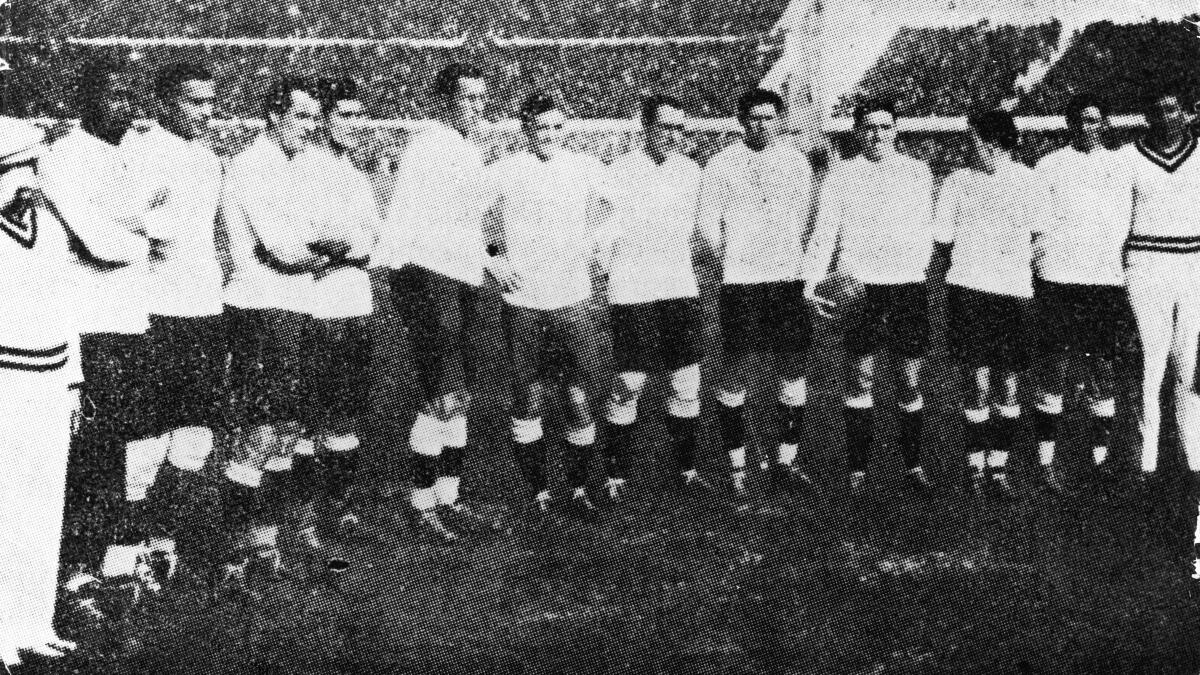
Uraguay’s team before the 1930 World Cup final against Argentina.
(Keystone / Getty Images)

Argentina’s soccer team before preparing for the 1930 World Cup final.
(Associated Press)
“It ended,” Wilson said of the tournament, “with everybody sort of fighting each other.”
Few disagreed with the Argentine magazine El Gráfico, which seemed to predict there was little future for the fledgling event. “The World Cup is over,” it wrote. “The development of this competition brought not only an unpleasant atmosphere, but also an ungrateful one.”
Yet nearly a century later, the World Cup is still here. And that, too, was foretold in 1930 in the story of Romanian midfielder Alfred Eisenbeisser (who was also known as Fredi Fieraru because, why not?).
On the journey home from the first World Cup, Eisenbeisser contracted pneumonia and a priest was called to administer the last rites. The ship eventually docked in Genoa and he was taken to a sanatorium while the rest of the team continued on to Romania.
Assuming her son had perished in Italy, Eisenbeisser’s mother arranged a wake — only to have her son stroll into the ceremony very much alive, causing the woman to faint. Eisenbeisser would play 12 more years of professional soccer and compete in figure skating in the 1936 Winter Olympics, where he finished 13th in the pairs competition.
Turns out the reports of Eisenbeisser’s demise, like those of the World Cup, were greatly exaggerated.
⚽ You have read the latest installment of On Soccer with Kevin Baxter. The weekly column takes you behind the scenes and shines a spotlight on unique stories. Listen to Baxter on this week’s episode of the “Corner of the Galaxy” podcast.

AFCON, more than just football | Africa Cup of Nations
The Africa Cup of Nations is more than a football tournament.
Hosted this year in Morocco, it brings together a global African audience. AFCON offers a rare glimpse of how nations connect with each other and the diaspora through football.
Published On 23 Dec 2025
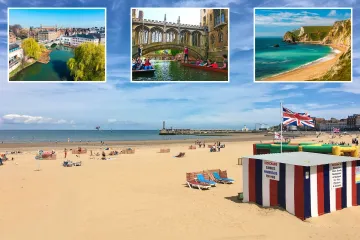
Five pretty English villages that will make you feel like you’re in The Holiday with cosy pubs and cottages
THE Holiday is one of the UK’s favourite Christmas watches – and who hasn’t wanted to step into the magic of the film?
From the Cotswolds to Yorkshire, here are five of the best villages that will make you feel like you’re Cameron Diaz exploring England for the very first time.
Shere, Surrey
Of course first up is Shere in Surrey which fans of The Holiday will know that it was actually used as a filming location.
Found in the Guildford district, the pretty village is considered to be most photographed of all Surrey towns.
You can actually have a pint in the pub where Amanda (played by Cameron Diaz) and Graham (Jude Law) have their first date.
The couple visit The White Horse, a cosy pub that serves up hearty breakfasts, Sunday Roasts and lunches.

You can also pop into The Dabbling Duck cafe, or take a hike around the nearby Surrey Hills.
The Holiday isn’t the only film to have set scenes in Shere – it’s also been the backdrop of Four Weddings and a Funeral, Bridget Jones: The Edge of Reason, and The Wedding Date.
Kettlewell, Yorkshire Dales
The Yorkshire village of Kettlewell is filled with classic stone cottages – just like Iris’.
But there’s also traditional tea rooms, and a quaint High Street and incredible views of the countryside – perfect for a weekend walk.
Most read in Best of British
The village has three pubs, The Blue Bell Inn – a homely spot which serves up tasty home-cooked food by its crackling fire.
Or check out The King’s Head and The Falcon Inn.
Elterwater
Elterwater is a village in the Lake District, Cumbria.
The village lies half a mile north-west of the lake of Elter Water – where it gets its name.
It’s tiny with around 100 residents, some of whom live in its charming slate or stone cottages along the narrow roads.
The local pub is The Britannia Inn which serves seasonal food by its log fire – and during the summer has a pretty beer garden.
The village has incredible views of the Langdale Pikes which are famous mountains in the Great Langdale Valley.
You can also go for a stroll along the River Brathay or go further afield and you might even spot a waterfall or two.
Burford, Oxfordshire
The Cotswolds is an obvious choice when it comes to pretty English villages – and Burford is a very charming spot.
It has the classic pretty stone cottages and a very traditional feel to it.
Along the High Street are antique shops, tea rooms and pubs like The Angel at Burford, The Prince Of Burford and The Lamb Inn.
The oldest pharmacy in England can be found here, and there’s a medieval bridge that crosses over the River Windrush as well as a Grade I listed church.
And for even more magic from The Holiday, actress Kate Winslet used to live very nearby.
Stanton, Gloucestershire
Another very English-looking Cotswolds village is Stanton.
40 minutes up the road from Burford is Stanton, which looks very ‘The Holiday’ with its limestone and half-timbered cottages.
The village is on the smaller side so there isn’t too much to do, but it makes for a charming trip – and there will be great photo opportunities.
Nearby you can hike the Cotswold Way or visit Snowshill Manor, and if you fancy it, you can even book to go horse-riding through Stanton.
The Mount Inn pub is the only pub in the village and has incredible views of the Malvern Hills.
For more, here are 10 UK locations featured in iconic Christmas movies that you can visit this festive season.
And even more filming locations in the UK that you can visit with movie tours.
The five abandoned UK railway stations set to reopen with new train routes
FIVE train stations in the UK left deserted for decades have undergone major renovation projects and will soon have new routes to a major city.
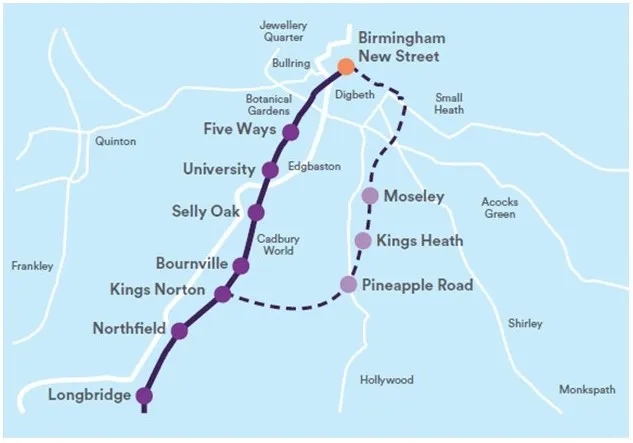
The five stations include three on the Camp Hill Line and two between Wolverhampton and Walsall.
All five of the stations will welcome new West Midlands Railway services in early 2026.
On the Camp Hill Line, £120million has been spent on three stations at Moseley Village, Kings Heath and Pineapple Road to reopen them.
Moseley Village, Kings Heath and Pineapple Road train stations all closed in 1941 during the Second World War and never reopened.
Ahead of services starting early next year, construction work at each of the stations has been completed.
Read more on travel inspo


Each station will have two platforms for six-carriage trains, bike parking, ticket machines, information screens and lifts.
There will also be pick up and drop off zones at Moseley Village and Pineapple Road stations.
This also means that the stations will gain services for the first time since World War II.
The services will call at each of the stations every 30 minutes, with destinations including Birmingham New Street and Kings Norton.
It is estimated that the reopened stations will cut journey times to Birmingham New Street by between nine and 31 minutes.
As for the two stations between Wolverhampton and Walsall – Darlaston and Willenhall – there will be train services for the first time since 1965 when the stations were both closed.
To begin with, there will be two services an hour between Wolverhampton and Birmingham.
A direct service to Walsall town centre, known as the ‘leather capital of the world’ due to its leatherworking history, is also being discussed with the Department for Transport and Walsall Council.
In total, the two stations have cost £85million to reopen.
Walsall Council hopes that the stations will better connect local residents to the wider region, as well as create more opportunities for people to travel, whether that be for holidays or for work.
Richard Parker, Mayor of the West Midlands, said: “For some communities, this is the first time in more than 80 years they’ve had their own train service.
“That changes everyday life. Getting to work, college or seeing family becomes simpler and quicker.
“It also means more people coming into town centres. More footfall for shops and cafés. More confidence for local businesses to invest and grow.
“This is what delivery looks like – backing places that have waited far too long for decent connections.”
In other train news, here’s the first look at the new Virgin Trains that will take Brits from UK to France, Belgium and Netherlands.
Plus, the low-cost train launching more routes between two popular UK cities – and tickets are £33.

Ukraine “to create fear” with Russian General’s killing | Russia-Ukraine war
“This [killing in Moscow] is a mode of warfare which would be referred to as, quote-unquote, irregular.”
The killing of a top Russian general is a “direct message” to senior Russian military leaders from Ukraine, says Marina Miron, of King’s College London.
Published On 23 Dec 2025

Major girl group reunion ‘confirmed’ after member’s cryptic comeback comment
THE Pussycat Dolls have seemingly “confirmed” their reunion by signing with a new talent agent.
The news comes despite feuds and legal battles in the band, formed of Nicole Scherzinger, Kimberly Wyatt, Ashley Roberts, Jessica Sutta, Carmit Bachar and Melody Thornton.
CAA music division head Rob Light and Paul Franklin – a specialist in reunion tours – are now set to manage the band in a telling move.
While Nicole teased the reunion this week by talking about “what’s to come” for the band.
Sharing a clip from their hit song Buttons, Nicole wrote: “From then to now… seeing this video hit 1 billion views on YouTube fills my heart with so much gratitude.
“For the PCD fans. For the memories. For what’s to come.”

Last month, The Sun revealed that the band were “in talks” for a reunion, with the idea spearheaded by Kimberly.
At the time, a source said: “Kimberly has been open about the fact the girls have sorted out their issues.
“She also told pals they’ve been discussing a tour.
“The Pussycat Dolls certainly had their differences over the years, but a comeback would send fans wild.”
The Dolls started off as a burlesque troupe but in 2003 Nicole , Melody and Kaya joined Carmit, Ashley , Jessica and Kimberly to form the group.
They split in 2010.
This is not the first time a reunion has been on the cards, with multiple members of the band reuniting in 2019 before planning a 2020 tour, which was halted due to Covid-19.
It was later cancelled due to the pandemic and legal issues.
Nicole had a bitter row with the band’s founder, Robin Antin, 60, who sued singer for “extortion”.
Robin claimed that Nicole was refusing to take part in the tour unless she received a larger share of the group’s joint firm.
She allegedly demanded her 49 per cent holding in the firm is increased to 75 per cent, giving her creative control of the group and “final decision-making authority”.
According to the lawsuit filed by Robin, Nicole said the “growth of her personal brand” and the “opportunities she would have to forego to engage in the partnership” was why she deserved an increased share.
However, in a fiery retaliation, former X Factor judge Nicole issued a statement through her lawyer, Howard King, in which she branded Robin’s claims as “ludicrous and false”.
Melody wasn’t involved in the last planned reunion after clashing with Nicole over singing the band’s lead vocals.

‘It’s a Wonderful ICE?’ Trumpworld tries to hijack a holiday classic
For decades, American families have gathered to watch “It’s a Wonderful Life” on Christmas Eve.
The 1946 Frank Capra movie, about a man who on one of the worst days of his life discovers how he has positively impacted his hometown of Bedford Falls, is beloved for extolling selflessness, community and the little guy taking on rapacious capitalists. Take those values, add in powerful acting and the promise of light in the darkest of hours, and it’s the only movie that makes me cry.
No less a figure of goodwill than Pope Leo XIV revealed last month that it’s one of his favorite movies. But as with anything holy in this nation, President Trump and his followers are trying to hijack the holiday classic.
Last weekend, the Department of Homeland Security posted two videos celebrating its mass deportation campaign. One, titled “It’s a Wonderful Flight,” re-creates the scene where George Bailey (Jimmy Stewart in one of his best performances) contemplates taking his own life by jumping off a snowy bridge. But the protagonist is a Latino man crying over the film’s despairing score that he’ll “do anything” to return to his wife and kids and “live again.”
Cut to the same man now mugging for the camera on a plane ride out of the United States. The scene ends with a plug for an app that allows undocumented immigrants to take up Homeland Security’s offer of a free self-deportation flight and a $1,000 bonus — $3,000 if they take the one-way trip during the holidays.
The other DHS clip is a montage of Yuletide cheer — Santa, elves, stockings, dancing — over a sped-up electro-trash remake of Mariah Carey’s “All I Want for Christmas is You.” In one split-second image, Bedford Falls residents sing “Auld Lang Syne,” just after they’ve saved George Bailey from financial ruin and an arrest warrant.
“This Christmas,” the caption reads, “our hearts grow as our illegal population shrinks.”
“It’s a Wonderful Life” has long served as a political Rorschach test. Conservatives once thought Capra’s masterpiece was so anti-American for its vilification of big-time bankers that they accused him of sneaking in pro-Communist propaganda. In fact, the director was a Republican who paused his career during World War II to make short documentaries for the Department of War. Progressives tend to loathe the film’s patriotism, its sappiness, its relegation of Black people to the background and its depiction of urban life as downright demonic.
Then came Trump’s rise to power. His similarity to the film’s villain, Mr. Potter — a wealthy, nasty slumlord who names everything he takes control of after himself — was easier to point out than spots on a cheetah. Left-leaning essayists quickly made the facile comparison, and a 2018 “Saturday Night Live” parody imagining a country without Trump as president so infuriated him that he threatened to sue.
But in recent years, Trumpworld has claimed that the film is actually a parable about their dear leader.
Trump is a modern day George Bailey, the argument goes, a secular saint walking away from sure riches to try to save the “rabble” that Mr. Potter — who in their minds somehow represents the liberal elite — sneers at. A speaker at the 2020 Republican National Convention explicitly made the comparison, and the recent Homeland Security videos warping “It’s a Wonderful Life” imply it too — except now, it’s unchecked immigration that threatens Bedford Falls.
The Trump administration’s take on “It’s a Wonderful Life” is that it reflects a simpler, better, whiter time. But that’s a conscious misinterpretation of this most American of movies, whose foundation is strengthened by immigrant dreams.

Director Frank Capra
(Handout)
In his 1971 autobiography “The Name Above the Title,” Capra revealed that his “dirty, hollowed-out immigrant family” left Sicily for Los Angeles in the 1900s to reunite with an older brother who “jumped the ship” to enter the U.S. years before. Young Frank grew up in the “sleazy Sicilian ghetto” of Lincoln Heights, finding kinship at Manual Arts High with the “riff-raff” of immigrant and working-class white kids “other schools discarded” and earning U.S. citizenship only after serving in the first World War. Hard times wouldn’t stop Capra and his peers from achieving success.
The director captured that sentiment in “It’s a Wonderful Life” through the character of Giuseppe Martini, an Italian immigrant who runs a bar. His heavily accented English is heard early in the film as one of many Bedford Falls residents praying for Bailey. In a flashback, Martini is seen leaving his shabby Potter-owned apartment with a goat and a troop of kids for a suburban tract home that Bailey developed and sold to him.
Today, Trumpworld would cast the Martinis as swarthy invaders destroying the American way of life. In “It’s a Wonderful Life,” they’re America itself.
When an angry husband punches Bailey at Martini’s bar for insulting his wife, the immigrant kicks out the man for assaulting his “best friend.” And when Bedford Falls gathers at the end of the film to raise funds and save Bailey, it’s Martini who arrives with the night’s profits from his business, as well as wine for everyone to celebrate.
Immigrants are so key to the good life in this country, the film argues, that in the alternate reality if George Bailey had never lived, Martini is nowhere to be heard.
Capra long stated that “It’s a Wonderful Life” was his favorite of his own movies, adding in his memoir that it was a love letter “for the Magdalenes stoned by hypocrites and the afflicted Lazaruses with only dogs to lick their sores.”
I’ve tried to catch at least the ending every Christmas Eve to warm my spirits, no matter how bad things may be. But after Homeland Security’s hijacking of Capra’s message, I made time to watch the entire film, which I’ve seen at least 10 times, before its customary airing on NBC.
I shook my head, feeling the deja vu, as Bailey’s father sighed, “In this town, there’s no place for any man unless they crawl to Potter.”
I cheered as Bailey told Potter years later, “You think the whole world revolves around you and your money. Well, it doesn’t.” I wondered why more people haven’t said that to Trump.
When Potter ridiculed Bailey as someone “trapped into frittering his life away playing nursemaid to a lot of garlic eaters,” I was reminded of the right-wingers who portray those of us who stand up to Trump’s cruelty as stupid and even treasonous.
And as the famous conclusion came, all I thought about was immigrants.
People giving Bailey whatever money they could spare reminded me of how regular folks have done a far better job standing up to Trump’s deportation Leviathan than the rich and mighty have.
As the film ends, with Bailey and his family looking on in awe at how many people came to help out, I remembered my own immigrant elders, who also forsook dreams and careers so their children could achieve their own — the only reward to a lifetime of silent sacrifice.
The tears flowed as always, this time prompted by a new takeaway that was always there — “Solo el pueblo salva el pueblo,” or “Only we can save ourselves,” a phrase adopted by pro-immigrant activists in Southern California this year as a mantra of comfort and resistance.
It’s the heart of “It’s a Wonderful Life” and the opposite of Trump’s push to make us all dependent on his mercy. He and his fellow Potters can’t do anything to change that truth.

Newcastle seek ‘clarification’ over Anthony Gordon penalty incident against Chelsea
The PGMOL, the body responsible for refereeing all Premier League matches, has been approached for comment.
Newcastle were 2-1 up at the time, but Chelsea forward Joao Pedro equalised midway through the second half after a slip by Malick Thiaw.
No team have thrown away more points – 13 – from winning positions in the Premier League this season than Newcastle.
They are 11th in the table, have won only once away from home and travel to Manchester United on 26 December.
“My glass is very much half full,” said Howe. “I know everyone else might have a different opinion, but I feel we’re improving.
“We have been moving in the right direction, but we have got lots of work to do to be the team that we ultimately want to be and that’s consistently winning.
“That’s what’s eluded us this season – the ability to put winning runs together, which is the defining thing we need to do.”

Most affordable restaurants from 2025 101 Best Restaurants guide
The line at Holbox during the midweek lunch hour has become a cultural sensation, a queue of locals and visitors trailing past the automatic doors and around the parking lot like devotees angling for the latest iPhone series or limited-release sneakers. Believe the lauds, including ours when we named Holbox as The Times’ 2023 Restaurant of the Year. Gilberto Cetina’s command of mariscos is unmatched in Southern California – his ceviches, aguachiles and tostadas revolutionary in their freshness and jigsaw-intricate flavors. The smoked kanpachi taco alone — clinched with queso Chihuahua and finished with salsa cruda, avocado and drizzles of peanut salsa macha — is one of the most sophisticated things to eat in Los Angeles.
Holbox could be considered for the top ranking on its own strength. But in a year when disasters tore at our city, honoring the power of community feels more urgent than ever. Cetina’s seafood counter doesn’t thrive in a vacuum. Holbox resides inside the Mercado La Paloma in South L.A. The mercado is the economic-development arm of the Esperanza Community Housing Corp., a nonprofit organization founded in 1989 that counts affordable housing and equitable healthcare among its core missions. When the mercado was in the incubation stage, Esperanza’s executive director Nancy Ibrahim interviewed would-be restaurateurs about their challenges and hopes in starting a business. Among the candidates was Cetina’s father, Gilberto Sr., who proposed a stall serving his family’s regionally specific dishes from the Yucatán. Their venture, Chichén Itzá, was among the eight startups when the mercado opened in a former garment factory nearly 25 years ago, in February 2001.
Step into the 35,000-square-foot market today, and the smell of corn warms the senses. Fátima Juárez chose masa as her medium when she began working with Cetina at Holbox in 2017. Komal, the venue she opened last year with her husband, Conrado Rivera, is the only molino in L.A. grinding and nixtamalizing heirloom corn varieties daily. Among her deceptively spare menu of mostly quesadillas and tacos, start with the extraordinary quesadilla de flor de calabaza, a creased blue corn tortilla, bound by melted quesillo, arrayed with squash blossoms radiating like sunbeams.
Wander farther, past the communal sea of tiled tables between Holbox and Komal, to find jewels that first-timers or even regular visitors might overlook.
Taqueria Vista Hermosa, run by Raul Morales and his family, is the other remaining original tenant. Order an al pastor taco, or Morales’ specialty of Michoacan-style fish empapelado smothered in vegetables and wrapped in banana leaf. The lush, orange-scented cochinita pibil is the obvious choice next door at still-flourishing Chichén Itzá, but don’t overlook crackling kibi and the brunchy huevos motuleños over ham and black bean puree. The weekends-only tacos de barbacoa de chivo are our favorites at the stand called Oaxacalifornia, though we swing through any time for the piloncillo-sweetened café de olla and a scoop of smoked milk ice cream from its sibling juice and snack bar in the market’s center. Looking for the comfort of noodles? Try the pad see ew at Thai Corner Food Express in the far back.
The everyday and the exquisite; the fast and the formal (just try to score a reservation for Holbox’s twice-a-week tasting menu); a food hall and sanctuary for us all. Mercado La Paloma embodies the Los Angeles we love.
L.A.’s latest viral party spot is … Seafood City. Yes, you read that right

Under the glow of fluorescent lights at Seafood City market in North Hills, packages of pre-made adobo, salted shrimp fry and and dried anchovies glisten in meat coolers.
A DJ, dressed in a traditional barong, blasts a dance remix of Whitney Houston’s “I Wanna Dance with Somebody” as a crowd gathers to take a shot of fish sauce together.
“That was disgusting!” a man shouts into the mic, flashing a grimacing expression.

At Seafood City, DJs 1OAK, left, EVER ED-E and AYMO spin in barongs, the Philippines’ national formal shirt.
The smells of lechon and lumpia float through the air. Smiling children munch on halo-halo (a Philippine dessert made with ube ice cream, leche flan and shaved ice). Flags of the Philippines wave in the air as a man in UCLA Health scrubs hops into the center of an energetic dance circle. Employees shoot store coupons out of a money gun and toss bags of Leslie’s Clover Chips into the crowd. Fathers hold their children on their shoulders as a group of college students perform a Tinikling routine, a traditional Philippine dance in which performers step and hop over and between bamboo poles.
“This is so Filipino,” a woman says, in awe of the scene.

Sabria Joaquin, 26, of Los Angeles, left, and Kayla Covington, 19, of Rancho Cucamonga hit the dance floor at “Late Night Madness” in North Hills.
“I came here for groceries,” explains an elderly man, adding that he decided to stay for the party.
Seafood City, the largest Philippine grocery store chain in North America, typically closes at 9 p.m. But on certain Friday and Saturday nights, its produce or seafood aisle turns into a lively dance floor for “Late Night Madness.” On social media, where the gathering has exploded, it looks like a multigenerational nightclub that could use dimmer lighting. But for attendees who frequent the store, it’s more than that. It’s a space for them to celebrate their Filipino heritage through food, music and dance in a familiar setting.
“This is something that you would never expect to happen — it’s a grocery store,” says Renson Blanco, one of five DJs spinning that night. He grew up going to the store with his family. “My mom would [put] us all in the minivan and come here, and she’d let us run free,” he adds. “It’s comfortable here. It’s safe here.”



1. Rhianne Alimboyoguen, 23, of Los Angeles follows an employee through the produce section. 2. Allison Dove, 29, left, and Andrea Edoria, 33, both of Pasadena, enjoy Philippine street food. 3. Katie Nacino, 20, left, Daniel Adrayan, 21, and Sean Espiritu, 21, of the Filipino American Student Assn. at Cal State Northridge, practice tinikling, a traditional Philippine folk dance, in an aisle.
The first Seafood City location opened in 1989 in National City, a suburb of San Diego, which has a nearly 20% Asian population including a rich Filipino community. For its founders, the Go family, the mission was simple: to provide a market where Filipinos and people within the diaspora could comfortably speak their native language and buy familiar products. It’s since become a community anchor. Of the nearly 40 locations in Northern America, at least half of them are based in California, which has the highest population of Asian Americans in the United States.

-
Share via
The first “Late Night Madness” event happened in September in Daly City, Seafood City’s newest location. The company wanted to launch a street food program at the store’s food hall in a fun and creative way.
The DJ played a selection of hip-hop, pop, soul and classic Pinoy records like VST & Company’s “Awitin Mo, Isasayaw Ko.” Hundreds of people showed up, and videos of people of all ages turning up in the popular supermarket spread like wildfire. So the company decided to continue hosting the event in October during Filipino American History Month and for the rest of the year. It’s since expanded to more locations around the country and in L.A., including Eagle Rock.
By 10 p.m. at the Seafood City in North Hills, at least 500 people are dancing in the produce section, next to rows of saba bananas, fresh taro leaves and bok choy. The lively crowd forms dance circles throughout the night, taking turns jumping in the center to show off their moves to songs like Earth, Wind & Fire’s “Let’s Groove,” “Nokia” by Drake and Justin Bieber’s “I Just Need Somebody to Love.” At one point, TikToker and artist Adamn Killa hops on the mic and says “If you a Filipino baddie, this is for you,” before doing his viral dance.
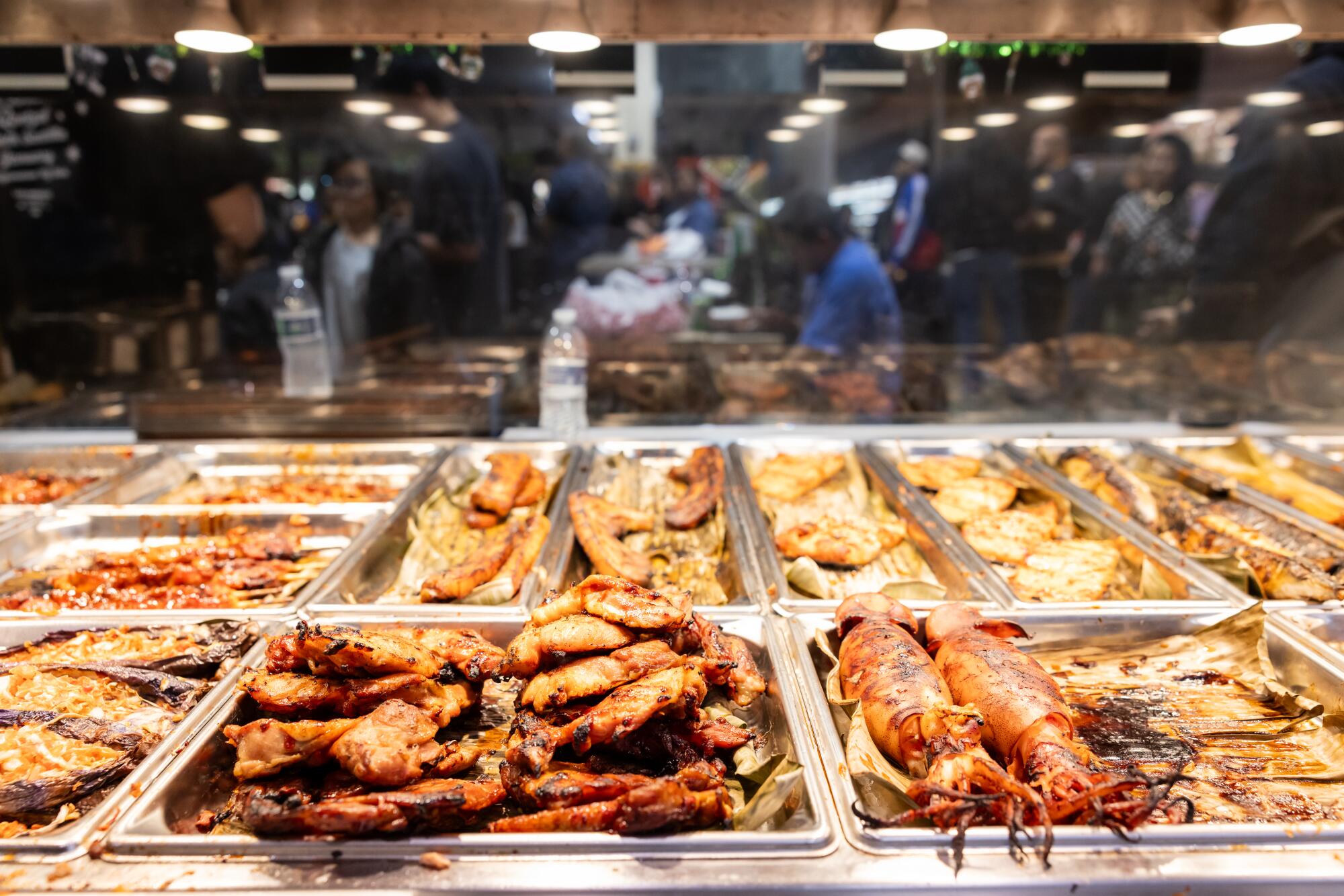
Among the Philippine street food offerings were pandesal sliders, lumpia-style nachos, lobster balls and various skewers.
A group of employees dance behind the counter as they serve hungry patrons who fill their trays with various Filipino street food including pandesal sliders (soft Philippine bread filled with adobo, lechon or longganisa) and Lumpia Overload (think nachos, but a bed of lumpia instead of tortilla chips), lobster balls and barbecue chicken skewers. (No alcohol is served.) Meanwhile, a few lone shoppers sprinkle into the store to get their weekly groceries as music blasts through the speakers.
First-generation Filipino American Andrea Edoria of Pasadena says “Late Night Madness” reminded her of the family parties she attended as a child in L.A. and in Manila, where her parents are from.
“Growing up as a child of immigrants, I was kind of self conscious about displaying too much of my culture,” she says between bites of spiral fried potato. She went to the Eagle Rock event with her mother last month as well. “So it kind of fed my inner child to see so many people celebrating this shared culture and experience that we each grew up [with].”

A multi-generational crowd is drawn to the dance floor. At center is Jade Cavan, 44, of Chatsworth.

Members of the Filipino American Student Assn. at Cal State Northridge perform a tinikling performance.
She adds, “I think it’s so important especially now at a time where our country is so divisive and culture is kind of being weaponized, I think it’s a beautiful reminder that we can come together and find something that unites us.”
About 10 minutes before midnight, the grocery store is still bustling with activity. A dance battle breaks out and people begin hyping up the young women. The DJ transitions into slower tracks like Beyoncé’s “Love on Top” and Mariah Carey’s “All I Want for Christmas is You.” The remaining folks sing along loudly as they walk toward the exit, smiles imprinted on their faces. Staff rush to clean up, then huddle together for group photos to memorialize the evening.
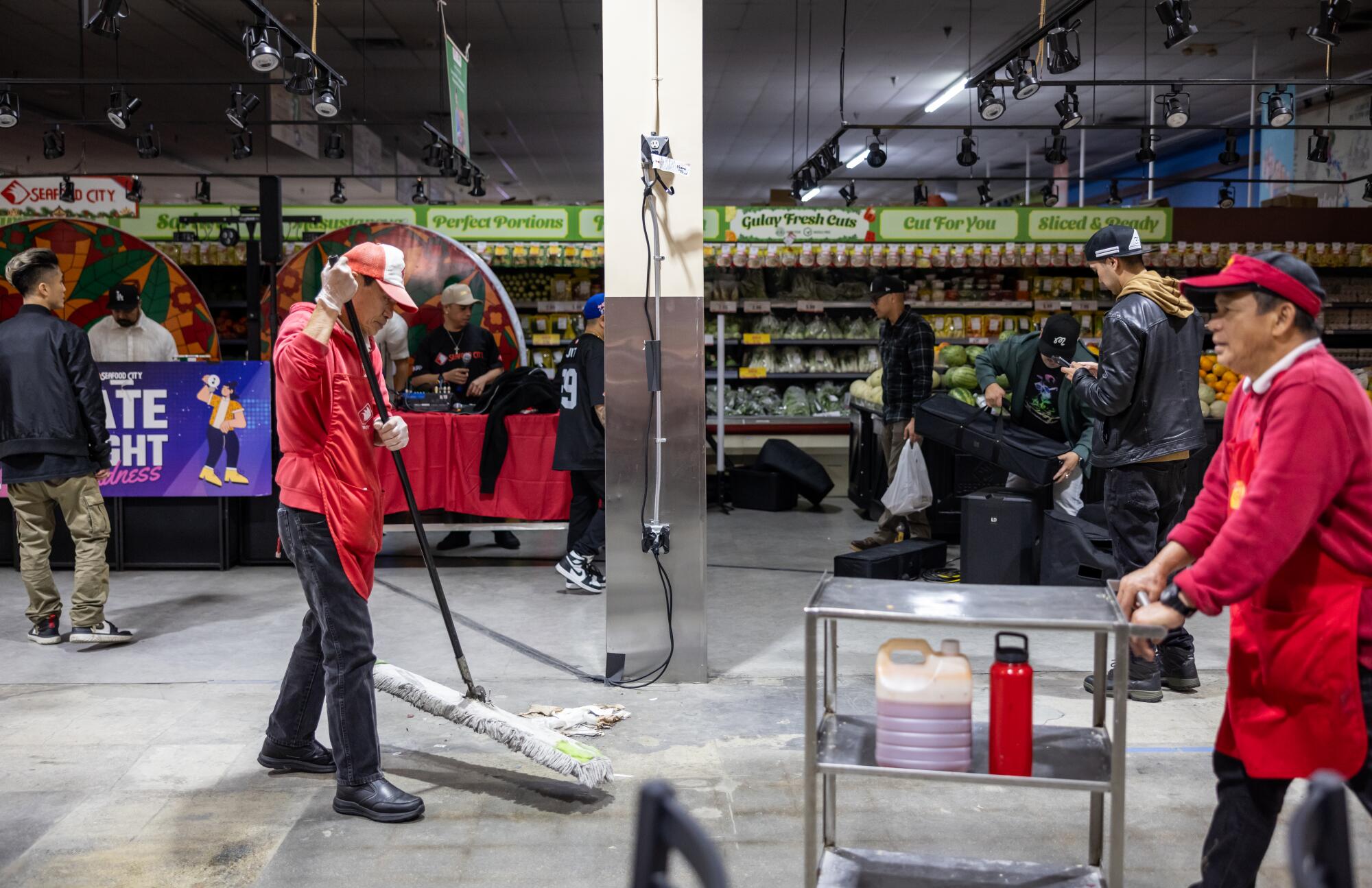
After the final song is played, employees rush to clean up the supermarket.
Patrick Bernardo, 34, of Van Nuys looks at the counter, where a man had been chopping lechon, before stepping outside.
“There’s barely anything left on that pig,” he says, pointing to it as proof that the night was a success.
Where to eat dinner on New Year’s Eve and New Year’s Day brunch
Chef Zachary Pollack is ringing in the New Year right with a variety of dinner options at his new Santa Monica spot, Cosetta. Choose from three seatings, including an early, all-ages a la carte option; a low-key, four-course menu from 6 to 7:30 p.m. for $75; and a five-course Capodanno feast with Champagne and caviar from 8-11 p.m. for $120 per person. On New Year’s Day, the restaurant will transform into “Aloha, Cosetta,” an all-day Hawaiian BBQ celebration from 12 to 7 p.m., featuring dishes such as coconut shrimp, risotto Spam musubi, macadamia-chile pork ribs and tiki-style cocktails. With three price tiers, the top CHIEFTAIN tickets ($100) include tomahawk steaks, lobsters and a 24-ounce mai tai in a keepsake mug. Book New Year’s Eve on the website, and New Year’s Day via Resy.

Isak faces two months out with injury after ‘reckless’ tackle: Slot | Football News
Liverpool manager Arne Slot says star forward Alexander Isak will be on the sidelines until at least late February.
Published On 23 Dec 2025
Alexander Isak is expected to be out of action for two months after fracturing his leg against Tottenham, with Liverpool manager Arne Slot accusing Tottenham’s Micky van de Ven of making a “reckless challenge”.
The Sweden striker was injured in a tackle from the defender in the act of scoring the opening goal in Saturday’s 2-1 victory and limped off the pitch.
Recommended Stories
list of 3 itemsend of list
Liverpool said in a statement on Monday that the forward had had an operation on an ankle injury that included a fibula fracture.
“It’s going to be a long injury, for a couple of months,” Slot told reporters on Tuesday, “So, yeah, that’s a big, big, big disappointment for him. And as a result, also of course for us.”
Slot described Van de Ven’s tackle as “reckless”.
“I think I said a lot about the tackle of Xavi Simons [sent off earlier in the game for Spurs], which for me was completely unintentional, and I don’t think you will ever get an injury out of a tackle like that.
“The tackle of Van de Ven, if you make that tackle 10 times, I think 10 times there’s a serious chance that a player gets a serious injury.”
Isak’s challenging year continues
Isak’s injury is the latest setback for the forward after he signed from Newcastle for a British record 125 million pounds ($168m) in September.
A dispute with Newcastle meant he did not have a proper preseason programme and arrived at Liverpool well behind his teammates in terms of fitness.
His season was then interrupted by a groin injury.
The 26-year-old has scored just three goals in 16 appearances since completing his protracted move to Anfield.
Isak’s absence will be a major blow for Reds boss Slot, with Mohamed Salah at the Africa Cup of Nations and Cody Gakpo not ready to return from a muscle injury until early in the new year.
It leaves Slot with Hugo Ekitike, who has five goals in his past four games, and the little-used Federico Chiesa as his only senior forwards.
Liverpool, whose Premier League title defence collapsed after a shocking run of results, have climbed to fifth in the table after extending their unbeaten league run to five games.
Isak’s injury raises the prospect of Liverpool moving to boost their attack in the January transfer window, with Bournemouth winger Antoine Semenyo linked with a move to Anfield.
It may also change the conversation around Salah, who had been linked with a move to Saudi Arabia following his recent claim that he had been thrown under the bus by the club and no longer had a relationship with Slot.
Salah’s rant, which came after he was left on the bench for three successive matches, prompted Liverpool to leave him out of the squad for a Champions League match at Inter Milan.
But he returned to action as a substitute against Brighton before leaving for international duty.
Liverpool host bottom side Wolves on Saturday.

The ultimate staycation destination has two beach-fringed coasts, stargazing parks and picturesque seaside villages
With two glorious beach-fringed coasts, a pair of national parks, plus quaint villages and vibrant cities, Devon is the ultimate staycation destination.
This picturesque county – sandwiched between Cornwall to the west and Somerset and Dorset to the east – has everything you need for a fantastic holiday.
Fill your days by building sandcastles, walking the coastal path, trying various watersports, diving into fascinating history or simply embracing nature.
So the hardest question on your upcoming £9.50 Holiday will be: where to visit first?
If there are keen surfers in your group, you’re in the right place.
North Devon boasts some of the country’s best surf spots, such as Croyde, Woolacombe and Saunton Sands, with companies like Surfing Croyde Bay and Woolacombe Surf Centre offering lessons and equipment hire.
The more sheltered south coast also has a handful of spots to ride perfect waves, including Bantham, Bigbury-on-Sea and Challaborough Bay, and you can book classes with a provider such as Bantham Surfing Academy.
If you still want in-water action but prefer something gentler, both North and South Devon are ideal for other water sports, such as bodyboarding, kayaking and canoeing.
You can even add a splash of history, by hiring a paddleboard with an operator like Discovery Surf and then paddleboarding amidst the shipwrecks of Hope Cove in the south.
Or maybe you’re up for leaping into swirling seas near Baggy Point, a significant World War II site in Croyde, with a coasteering session from the likes of Coastline Sports.
With over 500 miles of jaw-dropping coastline, you’re sure to find a sandy bay, hidden cove or private pebbly beach during your visit.
Those looking to escape the crowds could head to Barricane Beach, which is more hidden than its more famous neighbour, Woolacombe.
In South Devon, you’ll get Ayrmer Cove and Wyscombe Beach almost to yourself, so long as you’re prepared to walk to get there.
Families with prams, and wheelchair users, are able to roll straight onto Challaborough Beach, Bigbury-on-Sea and Saunton Sands – where bucket-and-spade perfection awaits.
Meanwhile, dog walkers will never have to tread the same path twice, with miles of dog-friendly beaches, coastal paths and country trails to explore.
The Tarka Trail, a 180-mile traffic-free loop in North Devon, is a good place to start – and also works well for a family-friendly cycle ride with staggering sea views.
When it’s time to refuel, Devon’s mainly rural cuisine will satisfy your taste buds.
Think hot pasties, fresh fish and cheeses like Curworthy, Sharpham and Vulscombe – yum!
Harbour Light in Paignton, The Blue Hut in Teignmouth and Brixham Fish Restaurant & Takeaway are some of Devon’s best-rated fish and chips providers, while the award-winning Country Cottage Bakery in Bideford specialises in Devon-style pasties.
No Devon holiday experience would be complete without a traditional cream tea.
Unlike in neighbouring Cornwall, here locals spread cream before jam on their scones, which are known as “Devonshire Splits” – with Someday Something in Sidmouth, Chandlers Cafe in Paignton and Ullacombe Farm in Newton Abbot all rated highly for theirs.
When it comes to natural and historic attractions, Devon is bursting to the seams.
You could begin a deep dive into history at the 600-year-old Dartmouth Castle, or by meandering through the grounds of Saltram, a Georgian house and gardens in Plympton.
There are also museums and galleries located near Devon’s holiday parks.
Family-friendly options in Plymouth include the top-rated National Marine Aquarium and The Box, an engaging art gallery that is free to enter.
And you’ll never be too far from a natural attraction in Devon, with five Areas of Outstanding Natural Beauty (AONB) and two national parks (Dartmoor and Exmoor) to explore.
Bordering the coast, Exmoor is the UK’s first dark skies conservation area and offers everything from wildlife spotting to stunning walks, like the four-miler through rugged moorland to Speke’s Mill Mouth waterfall.
Families may prefer to swap hiking for a relaxed steam train ride, with the Dartmouth Steam Railway a sure bet to keep kids happy while adults take in sweeping views of the South Devon coastline.
To keep costs down, dads can head to free toddler play sessions, or you can simply build sandcastles on the beach.
Another wallet-friendly day out for families is the top-rated Donkey Sanctuary in Sidmouth, where entry and parking are both free.

I found Travelodge booking trick that can get you a bigger and better room
A traveller discovered that paying a small fee to choose your specific room at Travelodge can get you a noticeably larger space in the same category – without upgrading
When booking a hotel, aside from selecting your room category, you’re often left in the dark about what room you’ll end up with. But I’ve stumbled upon a nifty trick that could land you a larger hotel room for just £3.50.
Securing a hotel for any occasion, be it a city break with mates or a romantic weekend getaway, can be a bit of a headache, given the vast array of options available. And even after you’ve picked your preferred hotel, you then have to decide on your room category, which is usually dictated by price (let’s face it, we’d all opt for the premium suites if our wallets allowed).
But what if I told you there’s a way to bag a bigger room when booking through Travelodge, without having to rely on the whims of the booking system? This little gem came to light during a trip to London with my pals earlier this year.
We were staying overnight after catching an evening show, so I booked us into a Travelodge on Central City Road in London. As there were three of us, I opted for a triple family room – the most budget-friendly choice for a Saturday night in the capital.
READ MORE: ‘We’ve ditched the UK for Thailand by selling everything we owned’
A few days prior to our stay, I noticed an option in my booking that let me ‘choose my room’ before checking in. Initially, I was a tad sceptical, but I’m chuffed I decided to delve a bit deeper.
For a mere additional £3.50, I discovered that I could handpick the exact room my mates and I would bunk in during our getaway. In the spirit of investigation and intrigue, I coughed up the trifling £3.50 and was directed to a site map showcasing all the available rooms within my category, enabling me to select our quarters.
What took me aback was that, despite all the rooms displayed falling within the specific category I’d booked, a handful were markedly larger as per the floor plan. So naturally, I opted for the most spacious room on offer.
READ MORE: Brits can currently get up to £500 off all-inclusive holidays to the Canary IslandsREAD MORE: You can currently book Spain and Portugal holidays for less than £150pp in 2026
Even at this juncture, I was sceptical about whether we’d actually be allocated this room upon check-in, given that I’d shelled out less than a fiver and it was significantly roomier than the rest. So you can imagine my delight when I checked in on Saturday afternoon and they handed over the keys to the exact room I’d chosen – it was absolutely worth the extra £3.50.
We found ourselves in a sprawling room equipped with a double bed and two single beds, despite never altering the room category. Plus, it afforded us crucial additional space for prepping for a night on the town without having to splurge on an expensive upgrade.
This nifty trick can be employed at over 575 Travelodge hotels, and it’s not just for securing extra room. You can opt to ‘choose your room’ to ensure you’re lodged near family or friends, secure a particular view, guarantee a top or ground floor room, or ensure you’re close to a lift.
Not only does this trick potentially offer the bonus of a larger room, as I discovered, but it also eliminates any check-in uncertainty. However, it’s crucial to bear in mind that this hack depends on the hotel’s availability and layout.
Some Travelodge hotels may not have a bigger room available in the category you’ve booked, but it’s definitely worth enquiring. Furthermore, the cost can fluctuate depending on the hotel, room type and duration of stay, but it’s applicable for a range of Travelodge room categories.
Got a travel story you want to share with us? Email us at webtravel@reachplc.com
Sun readers reveal their favourite Sussex attractions
IF you have a thirst for history and nature, Sussex is the place for you.
This county, which boasts around 140 miles of coastline, has sunny seaside resorts, the rolling chalk hills of the South Downs, country parks and wildlife-packed nature reserves.
It’s also loaded with history. The name Sussex is from the Saxon period, but its history goes back even further – just take a look at the Iron Age hillfort at Cissbury Ring or Boxgrove where the oldest human remains in Britain were discovered.
To find out which natural and historic attractions are worth visiting on your upcoming £9.50 Holiday, we spoke to Sun readers and local experts, and have suggested some of our own.
Here’s our pick of the best…
Explore ancient forests
Daniel Start, author of Wild Guide London and South England, recommends Kingley Vale, just north of Chichester in West Sussex.
It’s a nature reserve that’s home to one of Europe’s most ancient yew forests, with twisted trunks that have stood here for more than 500 years.
Daniel says: “These majestic, gnarled trees create an almost mythical atmosphere, their branches twisting skyward like ancient sentinels.
“Strolling through the groves is a journey through history, with some yews as old as the Norman conquest, sheltering a wealth of wildlife beneath their shade.”
As you explore, look out for various types of orchids on the ground and red kites and buzzards overhead.
Pedal to Rye Harbour Nature Reserve
Home to more than 4,355 species of plants and animals, Rye Harbour Nature Reserve is one of the country’s most important wildlife sites.
Spend the day watching them from one of five bird hides, before learning more in the Discovery Centre (or sipping a cuppa at the Lime Kiln Cafe).
You can reach it by public transport or car, but Georgie Radford-Brown, Assistant Guest Experience Manager at Camber Sands Holiday Park, reckons the best way to get there is by electric bike.
She said: “It’s a more unusual way to get there. There’s e-bike hire at Rye Harbour and you can cycle all the way through the nature reserve to the beach. It’s a beautiful ride.”
Seal spotting
Wildlife lovers can jump in a boat for a seal-watching adventure. Harbour seals are commonly spotted along the East Sussex coastline, while some large colonies of grey seals live off the West Sussex coast.
Chichester Harbour has a colony of more than 40 mixed seals, and you can cruise around the harbour in search of them on an organised trip with Chichester Harbour Water Tours (90 minutes from £25 per adult, £20 per child).
Meanwhile, in East Sussex, a one-hour seal safari boat trip from Rye Harbour costs £37pp.
Castles and cathedrals
History lovers can get their fill on a whole host of historic attractions within easy reach of coastal holiday parks, including a number of famous castles.
East Sussex is home to Hastings Castle (Britain’s first Norman castle, built by William the Conqueror in 1067) and Camber Castle, a coastal fort built by Henry VIII (tip: it’s only accessible via a one-mile walk from Rye).
In West Sussex, you have Arundel Castle with its Norman Keep, medieval gatehouse and award-winning grounds that have plenty of space for kids to run off steam.
Sun reader Clare Johnson, 52, from Brighton, recommends Chichester for “a mooch about”.
She said: “It’s got good shops, a theatre and an incredible cathedral.”
The 900-year-old Cathedral is free to enter (although donations are welcome) and should also be top of your list.
Admire its stunning stained glass windows and look out for the Roman mosaic floor, uncovered during renovations 50 years ago.
Tip: to discover more, book a guided tour (£6pp, free for under-12s) – they run at 11.30am and 2.30pm Monday to Saturday and take around 45 minutes.
Step inside Anne of Cleves’ house
Get a glimpse of Tudor and Elizabethan life by stepping inside the Anne of Cleves House in Lewes, not far from the coast in East Sussex.
The 15th-century timber-framed pad was given to Anne of Cleves at the end of her short marriage to Henry VIII – but she never lived there.
Still, there’s plenty to explore here from its Tudor kitchen to the garden with herbs and fruit trees that would have been grown at the time.
Kids will love rifling through the dressing-up box that will bring their surroundings to life.
Hike along the white cliffs
You can’t miss the South Downs National Park when you’re visiting Sussex – it spans 86 miles through Hampshire and Sussex (both West Sussex and East Sussex).
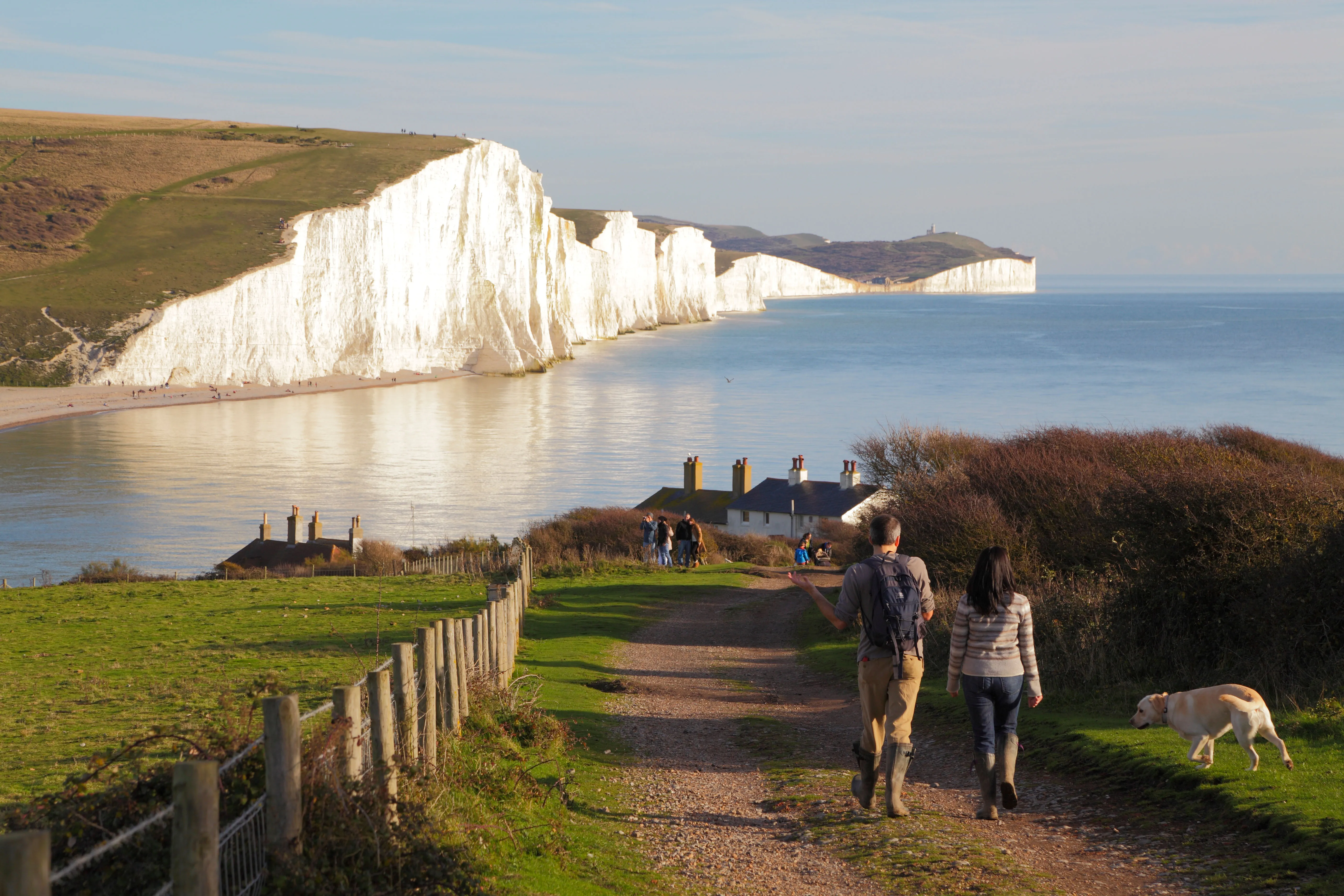
The park’s crowning glory is arguably the coastal section, particularly the white cliffs of the Seven Sisters and Beachy Head.
You could explore it on foot by picking up the South Downs Way National Trail, taking in epic views of Cuckmere Haven, Belle Tout and Beachy Head lighthouses.
Tip: the views are better if you start the walk from Seaford Esplanade, potentially finishing with a pint at the Tiger Inn at East Dean.
The pub is a short walk away from a bus stop (with routes to Eastbourne, Brighton or back to Seaford).
The huge waterfalls, natural lidos and mystical castles that holidaymakers love about Cornwall
WITH its staggeringly beautiful beaches, scenic woodlands and hidden waterfalls, Cornwall has natural attractions galore.
There’s also fascinating history to discover, from legendary King Arthur’s roots, the tin mining heyday and the infamous pirates that terrorised the coastline for hundreds of years.
We’ve spoken to Sun readers who have visited Cornwall on £9.50 Holidays to get their recommendations of the best local natural and historic attractions to visit.
We’ve also asked local experts and holiday park staff for their top tips, with options that are all within easy reach of your £9.50 Holiday. Here’s what they said…
Waterfall magic
Dani Fillery, Owner and Guest Experience Manager at White Acres Holiday Park, near Newquay, recommends the beautiful St Nectan’s Glen, on Cornwall’s north coast.
A scenic woodland walk leads you to a spectacular 60ft waterfall with a cafe at the top (tip: wear decent footwear as it can be wet and uneven underfoot).
Kids will be amazed by the sight and sound of the waterfall.
Admission costs £9 per adult and £5 per child (free for under fives), but you can see some of the smaller rapids for free, which are also lovely. Don’t forget to take £3 cash for the car park.
Castle legends
You could pair St Nectan’s Glen with a trip to Tintagel Castle, just a couple of miles away.
Said to be the birthplace of King Arthur, it has medieval ruins to explore, accessed by a jaw-dropping footbridge.
At low tide, don’t miss Merlin’s Cave – located below the castle, which is believed to be where Merlin lived.
If you’re staying further south, Pendennis Castle offers a glimpse into Tudor Cornwall.
One of Henry VIII’s finest seaside fortresses, it’s ideal for a family day out, with kid-friendly tours, an events programme and even a soft play for little ones.
Tin mining legacy
For Sun reader Anne Walton, 71, from Newport in Wales, there are lots of historic attractions in Cornwall worth visiting.
She said: “You’ve got the Poldark area and Jamaica Inn, which they filmed near Holywell Bay. We’ve been down on the beach when they’ve been filming it.”
Another highlight that Anne recommends, and which features in Poldark, are the tin mines.
You can walk right next to well-preserved engine houses on the coastal path near St Agnes Head, one of the filming locations for the BBC drama.
Or, delve deeper into the history of Cornish mining and more at the Royal Cornwall Museum in Truro, which is a wallet-friendly option for families (free for under-18s, £7.50 for adults).
It houses over 300,000 artefacts, with hands-on exhibits to capture kids’ imaginations.
Escape to an island fortress
Carol Harris, 72, from Clacton-on-Sea, Essex, stayed at Parkdean Resorts Lizard Point.
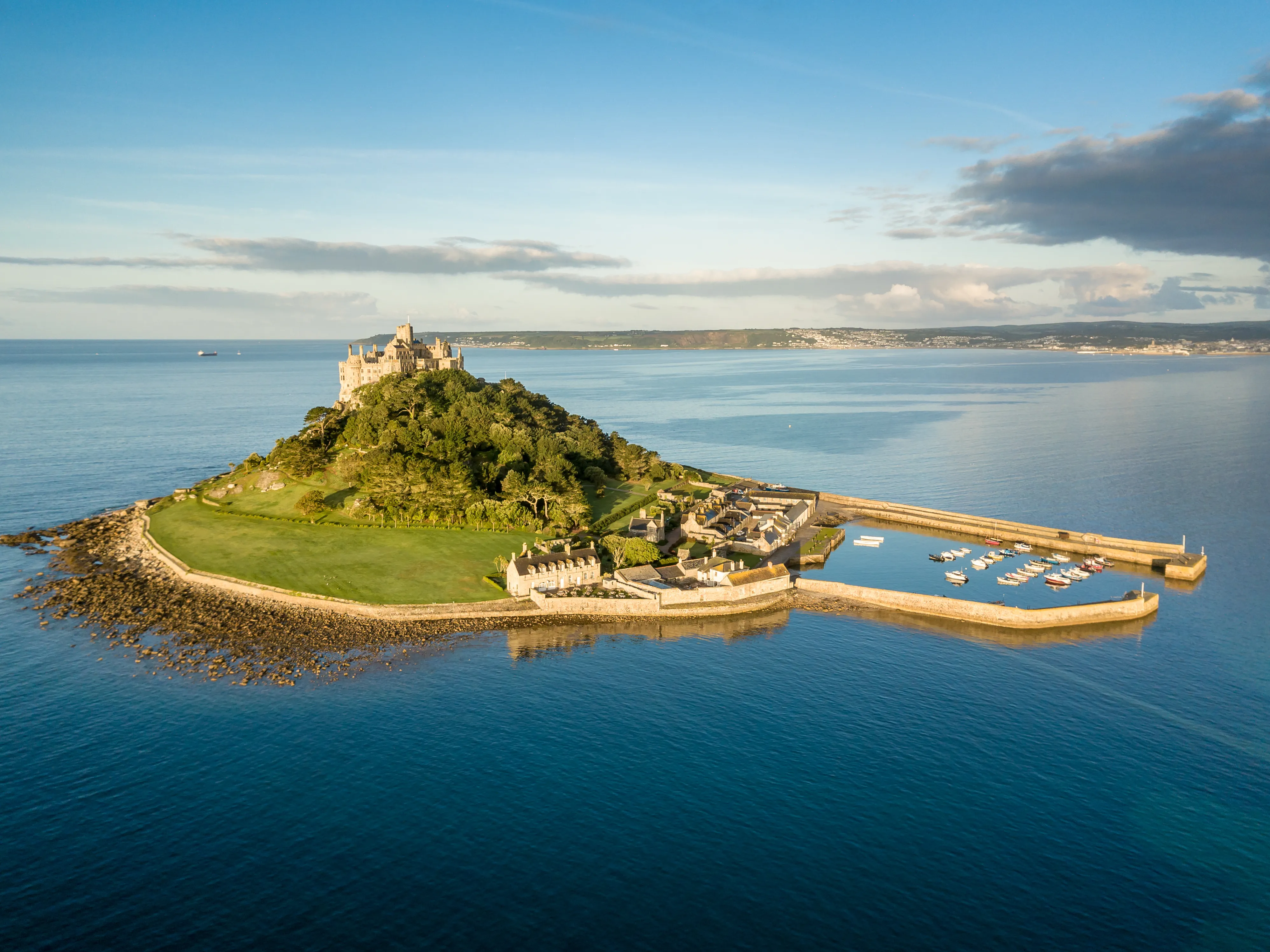
She recommends taking the hop on, hop off bus from outside the holiday park to Marazion, to visit St Michael’s Mount, an island fortress that she says is “beautiful”.
And it might look a tad familiar – it has a French counterpart across the Channel, in Normandy.
Located on a tidal island, you need to take a boat to reach the castle and its subtropical gardens at high tide (£2.80 one way for adults, £1.50 for children).
But at low tide, you can get there for free by walking across the granite causeway (it’s open for about four hours each day).
Tip: there is a great cafe on the island, but you can keep costs down by packing a picnic and finding a grassy spot.
Swim in a natural sea pool
Cornwall is blessed with more than 400 beaches – so you’re never short of sea swimming locations.
But for something more sheltered and a little more unique, head to a natural sea pool.
Cornwall expert and Sun travel writer Ellie Ross recommends Trevone Natural Sea Pool, which you can walk to from Trevone Bay car park in under ten minutes.
She says: “You have to time it for low tide, and clamber across some rocks, but it’s well worth it for the experience of swimming in a sea pool – which is completely free.
“There is also a shallow end nearest the path so supervised children can play here, too.”
Other tidal pools include a man-made rock pool, which is relatively unknown, hidden out of sight at Porthtowan Beach.

Foreign Office says ‘don’t travel’ to these 55 countries in 2026 for UK holidaymakers
Anyone travelling to these destinations could invalidate their holiday insurance
There are certain spots around the globe that are considered quite risky, and travellers heading there receive guidance on safety precautions they should adopt to avoid mishaps.
However, only 55 locations feature on the ‘do not travel’ list, which has been flagged with a warning by the Foreign Office.
Anyone journeying to these places will be voiding their holiday insurance, meaning if things go pear-shaped, they’ll be left without support. Officials also caution that they could be jeopardising their safety. If you require consular assistance locally, it will likely be difficult to obtain.
For specific countries, the Foreign Office also advises against all but essential travel, implying you should reconsider any holiday plans The Foreign Office cautions: “Get advice and warnings about travel abroad, including entry requirements, safety and security, health risks and legal differences.”
It explained: “No foreign travel can be guaranteed safe. FCDO publishes travel advice to help you decide if it’s safe enough for you to travel to a particular destination. In some instances we also give information about how to reduce the risks you may face there. All environments contain some level of risk and you should consider what precautions you should take.
“You must take personal responsibility for your own travel. Only you can decide whether you should travel to a country or stay there, and what activities to take part in.”
People may face different risks due to their:
- gender
- ethnic background
- sexuality
- health
The Foreign Office has general guidance for specific types of traveller to help you understand some of these risks.
The FCDO sometimes formally advises British people against ‘all but essential travel’ or ‘all travel’ to a particular country. It said:
“Your travel insurance could be invalidated if you travel against advice from FCDO. We only advise against travel if we think the risk to British nationals is unacceptably high. For example, this could be due to:
- armed conflict
- military coups
- civil unrest
- disease outbreaks
- natural disasters
“For terrorist threats, we only advise against travel:
- in situations of extreme and imminent danger
- where the threat is sufficiently specific, large-scale or widespread to affect British nationals severely
“We may advise against travel to:
- a whole country
- parts of a country
“The ‘Warnings and insurance’ section of each travel advice page lists all the areas where we advise against travel. If you want to know about changes to travel advice for a specific country, you can sign up to receive email alerts about updates.”
FCDO advises against all travel
- Afghanistan – “The security situation is volatile”
- Belarus – “You face a significant risk of arrest”
- Burkina Faso – “Due to the threat of terrorist attacks and terrorist kidnap”
- Haiti – “Due to the volatile security situation”
- Iran – “British nationals are at significant risk of arrest”
- Mali – “Due to unpredictable security conditions”
- Niger – “Due to the rise of reported terrorist and criminal kidnappings”
- Russia – “Due to the risks and threats from its continuing invasion of Ukraine”
- South Sudan – “Due to the risk of armed violence and criminality”
- Syria – “Ongoing conflict and unpredictable security conditions”
- Yemen – “Unpredictable security conditions”
FCDO advises against all travel to parts
- Algeria – all travel to within 30km of Algeria’s borders with Libya, Mauritania, Mali, Niger, Tunisia
- Armenia – within 5km of the full eastern border between Armenia and Azerbaijan, the M16/H26 road between the towns of Ijevan and Noyemberyan
- Azerbaijan – within 5km of the Azerbaijan-Armenia border
- Benin – northern border regions
- Burundi – Cibitoke and Bubanza provinces, former Kayanza province, former Bujumbura Rural province and the RN5 road north of Melchior Ndadaye airport
- Cambodia – within 50km from the border with Thailand
- Cameroon – Bakassi Peninsula, parts of the Far-North Region, North-West Region and South-West Region and within 40km of the Central African Republic, Chad and Nigeria borders
- Central African Republic – against all travel except to the capital, Bangui
- Chad – Borkou, Ennedi Ouest, Ennedi Est and Tibesti provinces, Kanem Province, including Nokou, Lake Chad region and within 30km of all Chad’s other borders
- Congo – within 50km of the Republic of Congo-Central African Republic border in Likouala Region
- Côte d’Ivoire – within 40km of borders with Burkina Faso and Mali
- Democratic Republic of the Congo – within 50km of the border with the Central African Republic, the province of Kasaï Oriental, the Kwamouth territory of Mai-Ndombe Province and provinces in Eastern DRC
- Djibouti – Djibouti-Eritrea border
- Egypt – within 20km of the Egypt-Libya border and the North Sinai Governorate
- Eritrea – within 25km of Eritrea’s land borders
- Ethiopia – international border areas, parts of the Tigray region, Amhara region, Afar region, Gambela region, Oromia region, Somali region, Central, Southern, Sidama and South West regions and Benishangul-Gumuz region
- Georgia – South Ossetia and Abkhazia
- India – within 10km of the India-Pakistan border and Jammu and Kashmir
- Indonesia – Mount Lewotobi Laki-Laki, Mount Sinabung, Mount Marapi, Mount Semeru, Mount Ruang, Mount Ibu
- Iraq – advises against all travel to parts of Anbar province, Basra province, Diyala province, Kirkuk province, Ninawa province, Salah al-Din province, Sadr City and within 30km of federal Iraq’s borders with Iran, Syria, Saudi Arabia and Kuwait
- Israel – against all travel to Gaza, parts of the West Bank and Northern Israel
- Jordan – within 3km of the border with Syria
- Kenya – Kenya-Somalia border and northern parts of the east coast
- Lebanon – areas in Beirut and Mount Lebanon Governorate, the South and Nabatiyeh Governorates, the Beqaa Governorate, the Baalbek-Hermel Governorate, the Akkar Governorate, the city of Tripoli and Palestinian refugee camps
- Libya – advises against all travel to Libya except for the cities of Benghazi and Misrata
- Mauritania – Eastern Mauritania and within 25km of the Malian border
- Moldova –Transnistria
- Mozambique – Cabo Delgado Province
- Myanmar (Burma) – Chin State, Kachin State, Kayah State, Kayin State, Mon State, Rakhine State, Sagaing and Magway regions, Tanintharyi Region, Shan State North, North Mandalay Region
- Nigeria – Borno State, Yobe State, Adamawa State, Gombe State, Kaduna State, Katsina State, Zamfara State and the riverine areas of Delta, Bayelsa, Rivers, Akwa Ibom and Cross River states
- Pakistan – within 10 miles of the border with Afghanistan, areas in Khyber Pakhtunkhwa Province and the Balochistan Province
- Philippines – western and central Mindanao and the Sulu archipelago
- Saudi Arabia – within 10km of the border with Yemen
- Somalia – advises against all travel except the western regions Awdal, Maroodijeh and Sahil
- Sudan – against all travel except to the Hala’ib Triangle and the Bir Tawil Trapezoid
- Palestine – against all travel to Gaza, parts of The West Bank and Northern Israel
- Thailand –parts of the south, near the Thailand-Malaysia border, the Hat Yai to Padang Besar train line and within 50km of the whole border with Cambodia
- Togo – within 30km of the border with Burkina Faso
- Tunisia – parts of Western Tunisia, including the Tunisia-Algeria border and Southern Tunisia, including the Tunisia-Libya border
- Turkey – within 10km of the Turkey-Syria border
- Ukraine – all regions of Ukraine with the exception of some western regions
- Venezuela – within 80km of the Venezuela-Colombia border, within 40km of the Venezuela-Brazil border, Zulia State
- Western Sahara – within 30km of ‘the Berm’ boundary line and areas south and east of the Berm boundary line
FCDO advises against all but essential travel
With regard to the definition of ‘essential travel’, the FCDO says: “Whether travel is essential or not is your own decision. You may have urgent family or business commitments which you need to attend to. Only you can make an informed decision based on your own individual circumstances and the risks.”
- North Korea – “The security situation can change quickly with no advance warning”
A Ukraine reporter’s guide to managing wartime blackouts caused by Russia | Russia-Ukraine war News
Kyiv, Ukraine – Have you been on a plane during severe turbulence, fearing that the shaking aircraft is about to fall apart and tumble down? Brief moments of weightlessness stop your breath, perhaps you whisper prayers and remember everyone you love.
That’s the feeling you get during a Russian air raid in Kyiv, Ukraine, and there have been more than 1,800 of them since Russia’s full-scale invasion began in 2022.
Recommended Stories
list of 4 itemsend of list
These days, they are bigger, scarier and longer than ever, because each one involves hundreds of drones and dozens of missiles.
They begin after dark and sometimes last in waves until dawn. Whooshing missiles tear up the night sky in two. Drones buzz like horror movie chainsaws or giant mosquitoes out of childhood flu nightmares.
What’s really harrowing is to hear two or three drones at once – I sardonically call it “stereo” and “Dolby surround” – while the arrhythmia of bass drum-like air defence explosions coincides with your heartbeat.
Each boom and thud chokes your body with adrenaline, and some shake your house, but after a couple of hours, your brain gives up, and you fall asleep processing the booms into nightmares.
And in the morning, you fall awake – feeling hungover and disoriented – and read about the consequences. You’re glad when no one is killed, and still sad because several people are usually wounded, and several apartment buildings are damaged.

Sometimes, I think about the people who operate the drones and launch the missiles. How they come back to their families after the night shift, what they tell their children and, most importantly, themselves.
But I prefer the memory of a crowd of high school graduates who walked past my house in June, at dawn, after their prom night that coincided with an especially long and loud air raid.
Their laughter and happiness about the sunrise, the clouds of blossoming trees around them, the rugs of flowers and grass under their feet, and the future ahead of them made them sound immortal. It was a sound that defied Russian President Vladimir Putin.
In recent months, blackouts have been the most inevitable part of each air raid. It feels as though keeping millions awake and horrified during the raids is only part of Moscow’s strategy of terrorising Ukraine.
Moscow’s logic appears simple: if you do not want to surrender, you will freeze. It methodically destroys power stations, transmission and central heating lines to keep millions without electricity, light and heat.
And then there are “planned outages”. There are usually three a day, lasting between two and eight hours.
You can hear an outage because even the sounds in your ears barely register, such as the fridge’s purring or the flow of hot water in the heating system, are gone. You can see an outage because the neighbourhood lights go out, making the stars in the night sky closer and brighter.
How to survive darkness
What saves you from darkness and disconnection is gadgets.
Apart from smartphones with energy-saving modes, wi-fi hotspots and flashlights, there are laptops, tablets, wireless speakers and vacuum cleaners running on batteries.
There are also inexpensive rechargeable lamps – I have 10 of them. Three are pint-sized and bright enough for my mother to read. Three more are motion-activated, which means she can safely use the bathroom any time, and the cat is perpetually amazed.
There is a cap lamp that makes me look like a miner and helps me cook or find something in the basement, and two tiny lamps that can be stuck into a power bank and just glow in a corner.
And there is a Christmas garland in the kitchen that makes each outage feel festive.
But the most important device, the symbolic hearth of my powerless house, is a $1,200, 20kg (40lbs) battery that can keep us warm and energised for up to 12 hours.
I live on the outskirts of Kyiv in a remodelled summer house that has its own pump and a natural gas-powered heating system. Both need electricity, along with the two 50-litre (13-gallon) water heaters.
But boiling water and microwaving meals is too energy-consuming, so we stick to frying pans and an old-fashioned whistling kettle that scares the cat.
And when the power is back on, there is no room for procrastination.
You need to recharge all the lamps and devices, start a washing machine, wash dishes, and go out for groceries without risking your life while crossing the road with the traffic lights off.
The electricity’s comeback may be deceptive – sometimes, it’s too weak. I recently tried to microwave a bowl of soup, twice, but it remained cold.
And for extreme emergencies, I have a gasoline-fuelled generator. It’s loud, shaky and stinky, and you need an entire canister of gas worth $30 for it to keep it going all night.
But such generators keep Ukraine running.
You can see them next to shops, offices and apartment buildings. Some are chained to trees or walls to prevent theft, and some are too huge and heavy to be carried away.
During a recent music festival celebrating Ukrainian composers, a giant diesel generator powered the concert hall.
My internet provider turns them on seconds after an outage begins, so I am online no matter what.
You also need to be prepared when you go out.
After covering the 2008 Russian war in Georgia, I used to drive everyone around me mad with my I-have-to-be-ready-for-any-emergency obsession.
Now, all of Ukraine feels the same obsession.
The phone has to be fully charged. There has to be a power bank in my backpack – along with a basic first aid kit, a lighter (I don’t smoke), extra batteries for the Dictaphone, pens and a pencil to take notes in subzero temperatures, when ballpen ink freezes.
A couple of months ago, I used the lighter at Kyiv’s Independence Square, dotted with hundreds of tiny Ukrainian flags next to photos of fallen soldiers.
I helped a man with a toddler light a tiny candle that he wanted to place next to the photo of his younger brother.
“He’s the toddler’s father,” the man said, and all I could utter was “God rest his soul” as I walked away, hiding tears and putting the lighter back.

Brooklyn Beckham’s wife Nicola Peltz shares post about ‘family’ after he blocked his famous parents and siblings
BROOKLYN Beckham’s wife Nicola Peltz has taken to social media to celebrate her family in a new post – just days after her husband’s decision to block his entire family online.
Brooklyn, 26, allegedly made the decision after Victoria Beckham “liked” one of his Instagram posts about cooking a roast chicken, which caused a frenzy in the comments section.
But it appears Nicola has now broken her silence on the matter, sharing a post of her own about family.
The actress, 30, posted a snap of herself and her father beaming, celebrating Hanukah.
Her billionaire dad, Nelson Peltz, is standing behind the candles placed in their menorah.
Captioning the post: “Happy Hanukah from our family to yours,” Nicola appeared to gloss over ongoing tension with her parents-in-law, who she has also blocked online.
Read more Brooklyn Beckham

Nicola has reportedly blocked the rest of the Beckham clan as well, including Brooklyn’s 14-year-old sister, Harper.
Sources confirmed to The Sun that Nicola stands by Brooklyn’s decision wholeheartedly and as such followed his lead in blocking all of the family too.
One insider said to The Sun: “Brooklyn and Nicola have been and will always be a united front.”
Another source close to the couple says: “She will always back him so that’s why she’s done the same and blocked his family.”
After Victoria “liked” her son’s most recent cooking post, it led to a sea of comments from fans who noticed the potential olive branch, urging Brooklyn to make amends with his family.
It’s understood that this annoyed Brooklyn and created pressure, so he responded by cutting contact with all of the Beckham’s online.
Friends of the influencer have deemed Brooklyn’s family’s behaviour as “unacceptable”.
Meanwhile, a source told the Daily Mail: “David and Victoria will never stop loving Brooklyn.
“They will always be here for him and they always want him to know that, they are devastated at this fall out.
“So far from this being them, it appears that Brooklyn has blocked them to show them that’s it, this is final.
“It is very clear that this is a sign of his complete estrangement from his family.
“For David and Victoria it was their last connection to Brooklyn as he has made it very clear he doesn’t want to talk to them anymore, they haven’t spoken for months and months now.
“By following him it was a message to him that they still love him and still want to follow his life. Now they can’t do that, but it’s not their doing.”
Brooklyn’s younger brother Cruz, 20, refuted reports that his parents had unfollowed Brooklyn in an Instagram story post on Saturday, claiming David and Victoria had been ‘blocked’ by Brooklyn instead.
The feud between Brooklyn and Nicola and the Beckham’s first began in 2022 when there were reports that Nicola had refused to wear a wedding gown designed by Victoria.
Rumblings escalated as rumours began to swirl that Brooklyn had dated Romeo Beckham’s ex Kim Turnbull, despite denying ever getting together.
Increasingly distancing himself from his family, Brooklyn has attended less family gatherings including David’s 50th birthday, mum Victoria’s Netflix docuseries premiere and his dad’s knighthood ceremony.