



Gabby Williams powers to Valkyries to victory in Game 1 of WNBA Finals
SAN FRANCISCO — Gabby Williams converted two free throws with 1:18 left to put Golden State ahead, two more with 4.1 seconds to go and finished with 26 points facing constant pressure from Atlanta’s stingy defense, and the Valkyries held off the Dream 68-64 in Game 1 of the WNBA Finals on Saturday.
Williams scored 16 of her points in the second quarter and no other Valkyries reached double figures as they shot 32.1% and seven of 33 from three-point range.
“We always knew we were going to find a way somehow,” Williams said on the microphone postgame as fans chanted “Gabby! Gabby!”
Rhyne Howard missed a three-point try with 1:09 left but Angel Reese made a steal moments later. Naz Hillmon missed from deep. Kiah Stokes missed the first of two free throws with 23.8 seconds left. Then Allisha Gray missed a three with nine seconds left.
Williams then hit the free throws a few seconds later to seal the victory.
Game 2 in the best-of-seven series is Monday night back at Chase Center, where the ear-piercing noise from a raucous “Ballhalla” crowd made for the exact hostile environment Valkyries coach Natalie Nakase requested from the home fans.
One of these two franchises will capture its first championship, and if the first game is any indication it’s going to be an all-out defensive fight.
Gray returned from injury to score 19 points, Reese added 14 points and 12 rebounds.
Jordin Canada contributed eight points, seven assists and five rebounds for the Dream, hitting a timely 13-foot jumper with 4:23 remaining.
Williams’ driving layup with 3:22 to play pulled Golden State within 62-61. Canada banged awkwardly into Williams’ knee on a box out during her late free throws and the Valkyries’ star was being cared for by an athletic trainer on the bench in the waning moments.
Gray was in the starting lineup and had gone through a light practice Friday after missing the last two games of Atlanta’s sweep of the New York Liberty in the best-of-three semifinal series with an injured left ring finger — on her shooting hand.
Golden State guard Tiffany Hayes hit her face hard on the floor trying to make a steal in the closing minutes and was down with 2:38 remaining before walking off the court on her own to the locker room.
McCauley writes for the Associated Press.
Iran war live: Tankers hit in Hormuz; Israeli settlers attack EU diplomats | US-Israel war on Iran News
Live updatesLive updates,
Fires reported on three tankers in Strait of Hormuz and Sea of Oman, as masked settlers attack European politicians in occupied West Bank.


Published On 18 Oct 2026
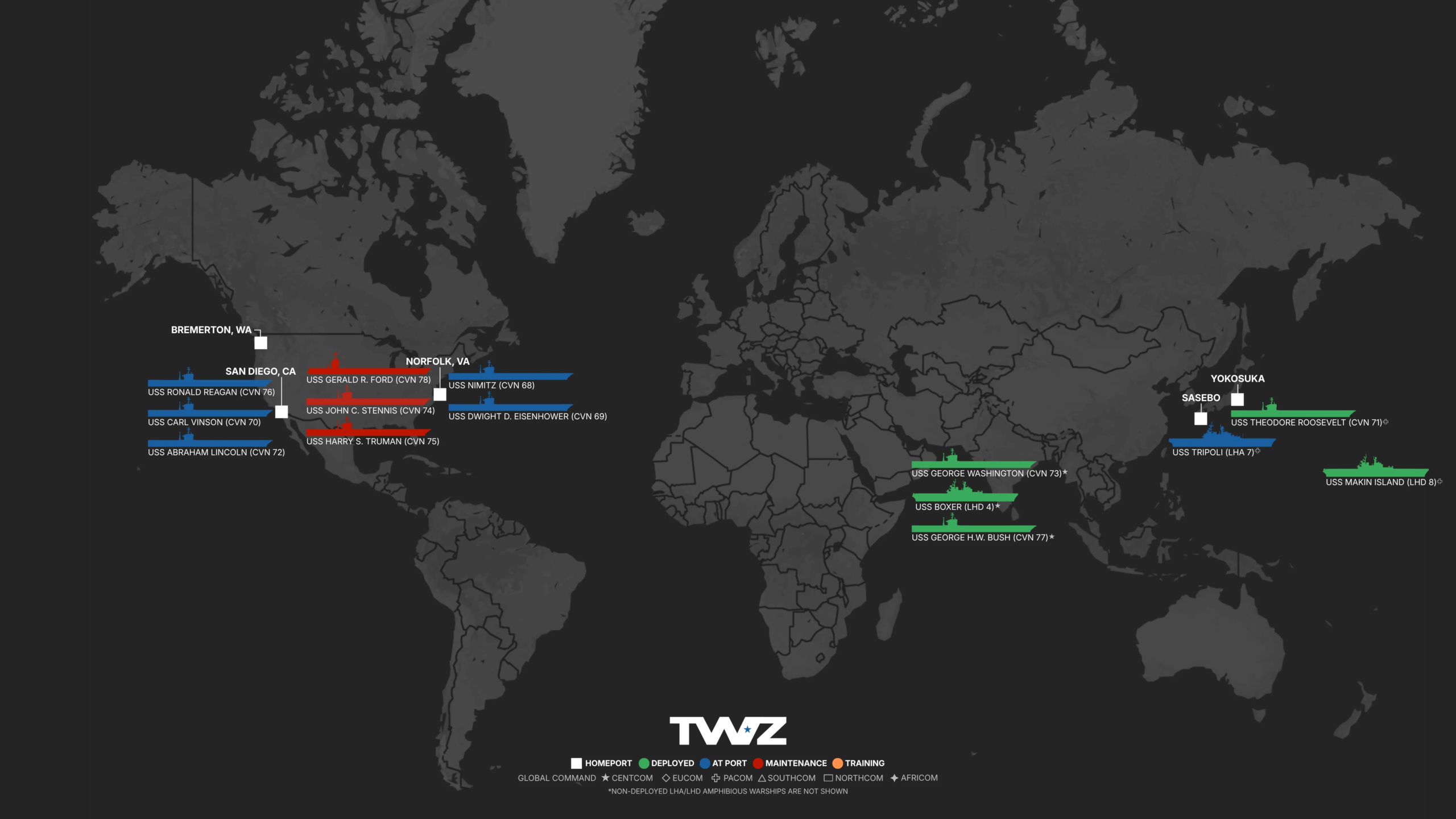
Where Are The Aircraft Carriers?: October 17, 2026
With a flight deck packed with carrier-based aircraft, including stealthy fifth-generation F-35Cs, the USS Theodore Roosevelt pulled into Yokosuka, Japan, on Friday. Roosevelt is the first non-resident U.S. carrier to visit the key naval port, strategically located on the east side of Japan, in more than four years. Yokosuka is home to the USS George Washington and America’s only forward-based Carrier Strike Group (CSG).
The Roosevelt, which serves as the flagship of CSG 9, escorted by guided-missile cruiser USS Chosin and destroyer USS Decatur, completed the journey from San Diego in 19 days − maneuvering around a typhoon in the Western Pacific − and will participate in the upcoming combined exercise Keen Sword 27. Meanwhile, the USS George H.W. Bush departed Thailand after a five-day port call and returned to the Middle East, and the USS Abraham Lincoln arrived home after a nearly eleven-month combat deployment.
Here’s TWZ’s weekly carrier tracker monitoring America’s flattop fleet, including deployed CSGs and Amphibious Ready Groups (ARGs), using publicly available open-source information. Check out last week’s report here.

Theodore Roosevelt Docks In Yokosuka, Japan; First Visiting Carrier In Four Years
Roosevelt and Chosin chopped into the U.S. 7th Fleet-Pacific Command (PACOM) area of responsibility (AOR) and arrived at Commander, Fleet Activities Yokosuka on the morning of October 16. The CSG will spend a few days in port before beginning participation in exercise Keen Sword, a “premier joint-bilateral field training exercise designed to increase readiness and interoperability between the Japan Self-Defense Forces and U.S. military forces,” according to the 7th Fleet press release. The brief visit allows the crew to complete maintenance, resupply, and disembark for liberty before resuming routine operations.
“Our crew is honored to visit Yokosuka and experience the rich culture and hospitality of Japan,” the commanding officer of Roosevelt, Capt. Will Mathis, said in the release. “Port visits like this are vital for crew morale and mission readiness, allowing our Sailors to rest, recharge, and prepare to operate seamlessly alongside our allies during exercise Keen Sword.”


The five-ship CSG, the composition of which a Navy official confirmed to TWZ, is currently operating on a disaggregated basis − a common practice employed by strike groups with multiple ongoing missions. The duo that departed the U.S. at the end of September linked up with another element of the group, Pearl Harbor-based guided missile destroyer USS Decatur, as they were steaming westbound past the Hawaiian Islands, based on public Automatic Identification System (AIS) data. Decatur arrived in Yokosuka the day after Roosevelt but was not mentioned in the press release.
USS Carl M. Levin, also stationed in Hawaii, was the first ship from the group to deploy, according to DVIDS, the military’s content-sharing platform. Levin departed on September 9 and is operating at an undisclosed location. USS Paul Hamilton, the final ship assigned to CSG 9 to deploy, left San Diego on October 10 after onloading ammo at Bravo Pier and moored at Joint Base Pearl Harbor-Hickam on October 15, AIS data shows. Henry J. Kaiser class fleet replenishment oiler USNS Tippecanoe supported the group’s transit across the Pacific, conducting multiple replenishments-at-sea (RAS), and recently entered the East Sea/Sea of Japan via the Tsugaru Strait before going dark on AIS.


Multiple reports indicated that medium unmanned surface vessel (MUSV) Seahawk (2) deployed with the group, which would represent a significant operational achievement and the first time a drone boat was assigned to a CSG, but the MUSV quietly slipped out of Point Loma on October 8, more than ten days after Roosevelt. Seahawk reappeared on AIS and docked in Hawaii for a couple days before continuing its journey westbound in the Pacific on October 16. If Seahawk is assigned to CSG 9, it is currently disaggregated, and whether it will join Roosevelt to participate in exercise Keen Sword 27 is unknown.
Acting Secretary of the Navy Hung Cao seemingly confirmed the deployment, saying during a panel at the Association of the United States Army (AUSA) convention that “the Teddy Roosevelt carrier strike group just deployed on October 8 with a medium sized unmanned surface vessel. This is the first carrier strike group to ever deploy with a large size unmanned surface vessel.” However, Roosevelt was more than halfway to Japan on the date referenced. “This is a force multiplier, imagine having more guns out there,” he added.


TWZ reached out to the Secretary’s office for clarification and to confirm the deployment but did not receive a response. “Seahawk’s operations represent continued progress in the Navy’s efforts to integrate unmanned systems into Fleet operations. As with any emerging capability, we continue to learn, adapt, and refine how these systems are employed,” a Navy official told us.
Abraham Lincoln’s Homecoming
Surrounded by small boats, with hundreds of spectators lining the channel in San Diego Bay and thousands more watching online, the USS Abraham Lincoln arrived home from a historic ten-and-a-half-month combat deployment. The flagship of CSG 3 and her crew of more than 5,000 Sailors and Marines served as the tip of the spear in the war against the Iranian regime, first during Operation Epic Fury and then the subsequent blockades, and set a new record for the most consecutive days at sea without a port call.

Lincoln pulled into Naval Air Station North Island and moored at Berth Lima on October 8, 321 days after casting off on November 21, 2025. Sailors in dress whites manned the rails as the carrier transited the bay, escorted on both sides by small boats and jet skis flying American flags, while family and friends eagerly waited pierside for their return. The video below, shared by the Pentagon, captures the moment.
Lincoln now lays claim to the second-longest deployment in the modern carrier era, falling just five days short of the 326-day post-Vietnam record held by the USS Gerald R. Ford. The flattop traveled over 93,000 nautical miles during the cruise − more than four trips around the Earth, a post by the public affairs officer highlighted − and conducted 72 replenishments-at-sea, received 20-plus million gallons of aviation fuel, and flew more than 14,000 sorties that totaled 28,500 flight hours, a press release from the Navy highlighted.
The release confirmed for the first time that Lincoln broke the previous record of 206 days set by USS Dwight D. Eisenhower during the COVID pandemic for days spent underway between port visits, as TWZ first reported. “The ship’s 208 uninterrupted days at sea between Guam and Oman, and its 286 consecutive days at sea between departing San Diego and arriving in Thailand, are record-breaking marks for modern aircraft carriers.”
Lincoln’s cruise took her through both U.S. 7th Fleet and U.S. 5th Fleet AORs. During Operation Epic Fury, which began on February 28 and lasted almost 40 days, Lincoln took up station in the northern Arabian Sea as Commander, Task Force (CTF) 50 and pressured Iran’s southern flank. When major combat operations wound down, the carrier and her air wing patrolled and enforced the blockade line during both rounds that followed.
Carrier Air Wing (CVW) 9, the “Navy’s premier next-generation air wing that served as the primary offensive power” for CSG 3, flew 14,037 sorties − including 4,000 combat missions − and dropped more than 1.37 million pounds of ordnance on thousands of targets while employing 1,499 precision weapons. “This concentrated firepower significantly degraded Iranian Navy capabilities,” a separate statement noted.
“The rapid mobilization and combat execution of CVW-9 during Operation Epic Fury demonstrated the unmatched flexibility of a U.S. Navy carrier strike group,” Capt. J.W. Stigi, commander of CVW-9, said in the statement. “Pairing fifth-generation F-35C stealth and sensor fusion with fourth-generation workhorse strike and electronic attack platforms, Team Shogun destroyed Iran’s conventional Navy and secured vital maritime chokepoints in support of our commander’s objectives.”

Kill marks painted on the island superstructure show CSG 3 destroyed 106 one-way attack drones fired by the Islamic Revolutionary Guard Corps (IRGC), 34 Iranian Navy and IRGC ships, 23 inbound cruise missiles, and 10 enemy submarines. The strike group dropped 1,463 air-to-ground munitions in total, a Sailor explaining the marks said in a video on social media.
George H.W. Bush Leaves Thailand And Returns To The Middle East
The USS George H.W. Bush and her destroyer escort, USS Delbert D. Black, departed Phuket, Thailand, on October 9 after a five-day liberty visit. “Nearly 5,000 Sailors from across the strike group experienced the sights and sounds Thailand has to offer, deepening their understanding of the Thai people and strengthening interpersonal bonds,” according to a press release.

“The Sailors and I had an amazing time in this beautiful country, and I sincerely thank the people of Thailand for their incredible welcome,” Capt. Justin T. Issler, the commanding officer of George H.W. Bush, said about the stop. “This port visit to Phuket was a tremendous opportunity for the crew. We are grateful to our Thai allies for hosting us, and we look forward to continuing our mission here in 7th Fleet, alongside Thailand and our other regional allies and partners.”


Bush dropped anchor approximately two nautical miles south of Ao Makham Deep Sea Port on October 4 after 187 consecutive days at sea. After leaving Phuket, the carrier stopped broadcasting AIS while steaming due south at 10 knots. Imagery on DVIDS confirms that the CSG returned to the Middle East and operating in the U.S. 5th Fleet AOR to “support maritime security and stability,” joining the George Washington CSG once again as the second strike group in the region.
Destroyer USS Mason, which deployed as the integrated air and missile defense (IAMD) commander for the CSG but has disaggregated at times, arrived in Singapore on October 5, likely for a port call. The Arleigh Burke class destroyer departed on October 9 and was last tracked heading northwestbound in the Malacca Strait, likely to rejoin the CSG. The other two destroyers assigned to the CSG, USS Ross and USS Donald Cook, remained in 5th Fleet during the visit.
F-35C Lightning II Operates from A Ford Class Carrier For The First Time
Marking a major milestone, an F-35C Lightning II Joint Strike Fighter made the first arrested landing aboard a Gerald R. Ford class carrier, the Navy’s newest and most advanced class of aircraft carriers that are being built to replace the aging Nimitz fleet. The trap was made by Lt. Cmdr. Robert Mason with the “Salty Dogs” of Air Test and Evaluation Squadron (VX) 23 aboard the future USS John F. Kennedy in the Western Atlantic on October 13. The first catapult launch followed the next day, pictures on DVIDS showed.
VX-23, based out of Naval Air Station Patuxent River in Maryland, is part of the Naval Air Warfare Center Aircraft Division and was putting Kennedy through the ongoing Aircraft Compatibility Testing to assess the “operational capabilities of the ship’s aircraft launch and recovery equipment.” A team from the Patuxent River-based F-35 Integrated Test Force, detached to the ship, conducted the evaluation using a specially instrumented example of the jet. One of the two pictured was externally equipped with an inert Joint Direct Attack Munition (JDAM) bomb.


The Navy took preliminary acceptance of Kennedy, which is still considered a Pre-Commissioning Unit, on September 29. This process allows the service to conduct at-sea testing and build underway proficiency while the shipbuilder, Huntington Ingalls Industries, completes final system checks ahead of expected delivery in spring 2027. Kennedy got underway on October 13 and returned to her homeport of Naval Station Norfolk three days later.
The lead ship of the class, the USS Gerald R. Ford, does not currently embark F-35Cs and will need upgrades to field the Navy’s most advanced jet. Back in 2019, TWZ warned that the stealth jet wouldn’t fly from the troubled class for years. Because of this, Congress required that Kennedy be equipped to embark F-35Cs, which led to additional delays for the Navy’s next carrier.
Big Deck Fleet At A Glance
Overall, three U.S. carriers are deployed, three are working up in various states of readiness, three are in maintenance availabilities, one is post-deployment, one is being used primarily for training before deactivation next year, and another will be delivered in 2027. Two amphibious ready groups are deployed, one is forward-deployed, three are working up or in port, and three are in maintenance.
Note: Positions are general approximations. Non-deployed LHA/LHD amphibious warships are not shown.
Contact the author: ian@twz.com or @ianellisjones
‘The Devils’ review: Scandalous 1971 movie soars like never before
For over five decades, there have existed two types of movie lover: those who have been at least a little corrupted by Ken Russell’s 1971 iconoclasterpiece “The Devils” and those who haven’t seen it. With the release of a newly restored director’s cut, which premiered in Cannes this year to a reception that begs to be described as orgiastic, ejaculatory, lubricious or orgasmic — take your pick — the unjustly deprived inhabitants of the latter category get to be inducted into the former.
Some are going to hate it. Some may affect a “can’t see what all the fuss is about” attitude — that is their right, as it is mine to simply not believe them. But some, witnessing what critic Judith Crist once referred to as a “grand fiesta for sadists and perverts” will find that abandoning themselves to its wantonly grotesque, profane imagery will feel like the giddiest liberation. From what, exactly? The tyranny of tastefulness? The despotism of decency? Whatever it is, blasphemy loves company, so welcome, sickos!
Several honey-roastings beyond hammy and a hundred rows of tents beyond camp, “The Devils” tells the story of a real event: the 1634 heresy trial and execution of Urbain Grandier (Oliver Reed), a libertine Catholic priest, who fell afoul of the religious and political establishments when defending the independence of the Protestant-friendly fortified city of Loudon in western France. The torrid tale involves an order of Ursuline nuns led by hunchbacked Sister Jeanne (Vanessa Redgrave) who accuse Grandier of witchcraft, which provides wily Cardinal Richelieu (Christopher Logue) and peevish Louis XIII (Graham Armitage) with the pretext for suppressing dissent.
Aldous Huxley’s 1952 nonfiction account “The Devils of Loudon,” and John Whiting’s 1960 play “The Devils” both formed the source material for Russell’s screenplay, in the sense that he clearly read them, then flung them, along with the Latin bible, the Kama Sutra, a bit of Looney Tunes, a dose of swinging ’60s psychedelia and some of the more stomach-turning passages from the Marquis de Sade onto the pyre of his own unholy, lapsed-Catholic imagination.
The resulting film became infamous almost as soon as it was released and has never been readily available in the U.S, at least not in its full form. The 2026 cut (technically the first release from Clockwork, a distribution arm of the newly merged megacorp Skydance, which is hilarious) reinstates several minutes, including the full “Rape of Christ” sequence, in which a bevy of uninhibited and un-habited nuns writhe atop a statue of the crucified Christ, as well as the scene where Redgrave’s deranged, scoliotic Sister Jeanne apparently begins to masturbate on Grandier’s charred femur bone.
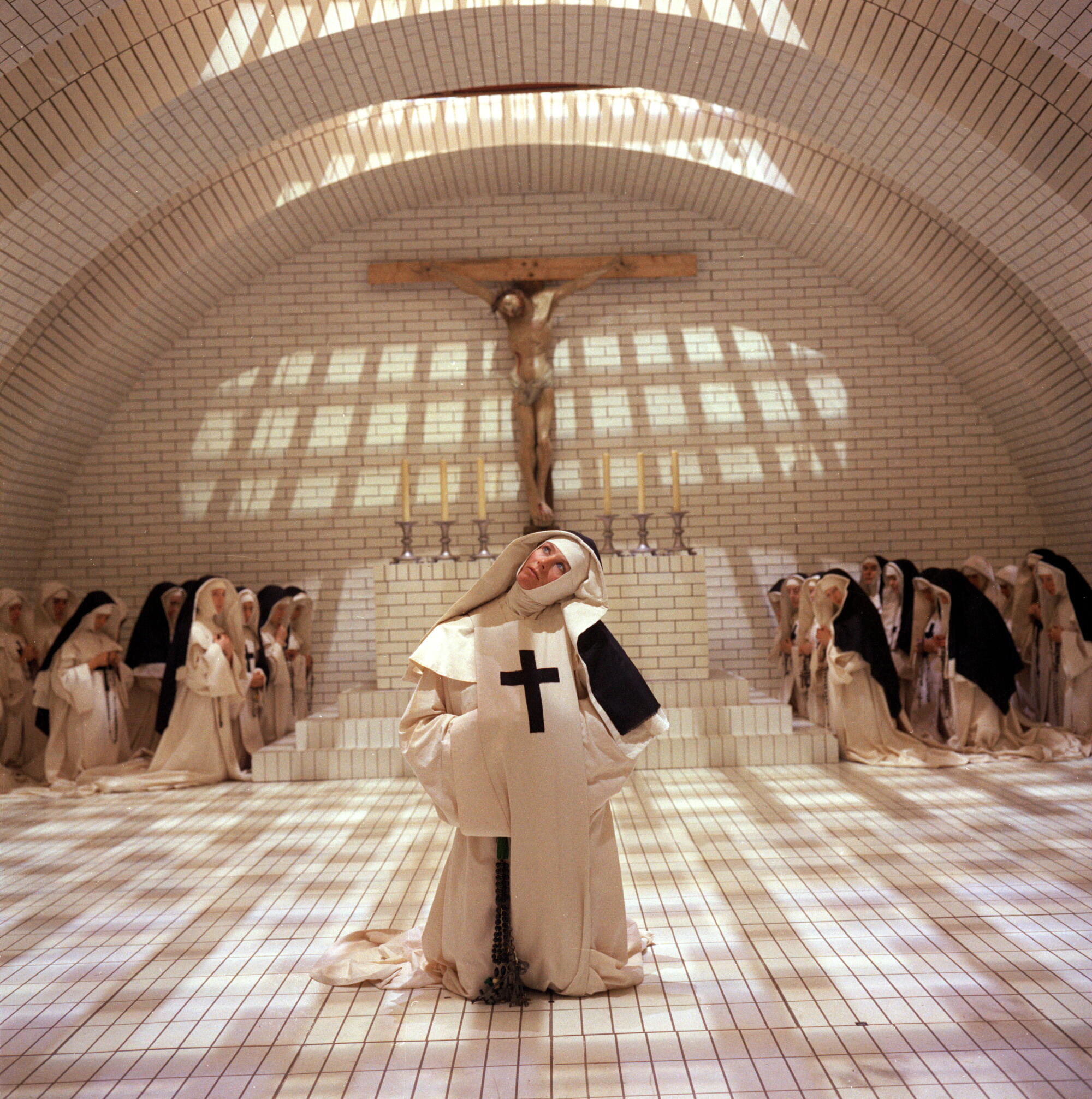
Both of these sequences have long been the Holy Grail for aficionados, but they are not the most impressive thing about this new version: That would be the immaculate re-conception of its visual splendor, which makes the movie dazzlingly sharp and new. The edges of Derek Jarman’s severe, anachronistically abstract sets are crisp and white again, the blood so very bloody and Oliver Reed’s eyes, which in the older, muddier versions look gray-brown, are suddenly so vivid they remind you that the hottest flames — hotter than the screaming orange conflagration that eventually consumes him — actually burn blue.
Hotness defines Reed’s Grandier beyond just his eyes and the smoky baritone in which he delivers his proclamations, prohibitions and occasional jokes. “Do you love the church?” asks Baron de Laubardemont (Dudley Sutton) as mad-eyed hipster Witchfinder Father Barre (Michael Gothard) drives another wedge between his mangled legs. “Not today,” grunts Grandier.
It’s hard to imagine any other actor being convincingly witty under torture and at other times quite silly (as when he fends off an attack using a stuffed crocodile that he happens to have just thrown out of a nearby window) while still radiating such charismatic cocksmanship that the local womenfolk invent sins just to confess to him. The mere mention of his name can send an entire hysteria of nuns into roiling spasms of sexual frenzy.

Vanessa Redgrave, center, in the restored “Ken Russell’s The Devils.”
(Warner Bros. Clockwork)
But to glimpse Reed here, at his most beautiful, is to think: yup, plausible. And yet his towering performance is characterized by restraint, even more so as the ghastly climax arrives, and we realize that all of Reed’s brutish sensuality, all of Russell’s sensationalism and all of “The Devils’” chicanery, buffoonery and primping, preening vanity have been in service of a furious message that is as deadly serious as its presentation is garish.
That message — a howl of righteous anger at state corruption and the perversion of religion to serve the nefarious agendas of cruel, power-mad men — is what makes “The Devils” sacrilegious yet not apostate. It does not scorn God or faith, but the misuse of both by petty manipulators. Sure, Russell has a little dirty fun in doing so — OK, a lot of dirty fun. However, charges of “The Devils” therefore being an inherently sexist piece of work also don’t really stand up, and not only because of Redgrave’s fearlessly creepy, giggly performance of outré erotic obsession.
In fact, there’s a whole feminine tragedy written in one single monologue: “Most of the nuns here are noblewomen who have embraced monastic life because there was not enough money at home to provide them with dowries,” crows Jeanne crookedly, “Or they were unmarriageable because ugly and a burden to the family.” Remembering that the naked nuns are not cloistered because of some vocational dedication to Christ but because of their troublesome uselessness to the patriarchal order, they become that much more sympathetic. These women are just doing what they must to survive another day as the most expendable members of a grossly unequal society; who among us should begrudge them an orgasm or two while they’re at it?
The debauchery is the point. Just as Grandier’s ultimate sacrifice is only made meaningful by his history of repeated, lascivious indulgence in the fleshier sins, so can “The Devils” be an unapologetically maximalist exhibition of carnal depravity that is also quite profoundly moral. And that its morality involves speaking truth to power and resisting authoritarian control makes it shockingly relevant right now. Writing in the Los Angeles Times in 1971, critic Charles Champlin ended his elegant pan with the observation that “you weep not for the evils and the ignorance of the past, but the cleverness and the sickness of the day.” To that, as to many of the negative responses, especially in our peculiarly sickly times, it is possible simply to respond, “Yes, isn’t that great?”
Imagining the movie lying dormant all these years just waiting for the right moment to be reborn, it becomes irresistible to conflate that small section of the public who have been avidly anticipating its return with Sister Jeanne, clamoring for the elusive object of her lust through a barred window. And to once more conflate Grandier — the repentant sinner immolated on the pyre of mass delusion, political machination and religious intolerance only to be rehabilitated as a charismatic martyr for liberty — with “The Devils” itself, as it finally rises from the bone-ash of its contemporary reception to shock, titillate, corrupt and invigorate anew. What you choose to do with its charred femur is between you and your God.
‘Ken Russell’s The Devils’
Rated: NC-17, for sexual content/graphic nudity
Running time: 1 hour, 54 minutes
Playing: Opens Friday, Oct. 16 in limited release