



Newspaper headlines: ‘Stop sharing data with China’ and ‘Shoot and kill’



Música mexicana songsmith Armenta is writing his own destiny
With more than 60 song credits, Armenta’s songwriting prowess can be heard across some of the most popular música mexicana albums to date, whether by Fuerza Regida, Tito Double P, Peso Pluma or Dareyes de la Sierra.
“I consider myself a tailor,” said Armenta, 25. “[I’ll create] a sound that will be good with your vocal timbre, with your tones, with the vocal intention you need.”
The singer-songwriter wrote Fuerza Regida’s gritty hit “Marlboro Rojo” in 45 minutes, ensuring that the song’s aggressive, battle-ready lyrics also captured a romantic spirit. (“The devil’s bullets and I only think of your eyes,” sang Jesús Ortiz Paz, a.k.a. JOP.) And he wrote “Dos Días” for Tito Double P and Peso Pluma one early morning after a wild night out with friends; you can hear the emotional hangover in the way the vocalists’ rugged voices flail in desperation.
“The most important thing is always to convey something where people can immerse themselves in a feeling,” said Armenta, whose full name is Miguel Armenta.
He dialed into our interview from a tour bus departing from Austin, Texas, en route to the next concert venue on the Dinastía Tour by Peso Pluma, Tito Double P and friends. Armenta was instrumental in writing and producing Tito Double P’s 2024 debut “Incómodo,” a 21-track project that helped distinguish the Mexican corrido singer from his already famous cousin, Peso Pluma.
“I feel that it’s a project that has solidified the responsibility we have as composers and as artists, [it’s] an album full of hits,” said Armenta, who later wrote tracks on Tito Double P and Peso Pluma’s joint 2025 LP “Dinastía.”

Since the beginning of March, Armenta has joined the pair of cousins on stage for their acoustic- and brass-powered song “London,” a track on the deluxe edition of “Dinastía” that indulges in fantasies of living like kings. The song was cut from Armenta’s own 2025 debut, “Portate Bien,” a blend of corridos tumbados with melodic touches of reggaeton and pop.
“I had just bought my own house and I wrote [‘London’] feeling like king of the world in my own studio,” Armenta said. “I thought that song was dead, but I got a call from Double P [Records] asking if I was interested in releasing it with them.”
Armenta’s entry into the música mexicana realm was not as calculated as his lyricism; at least not at first. Coming from a family full of industrial engineers, the Sinaloa-born, Tijuana-raised composer initially set his sights on a degree in biomedical engineering. “I liked the idea of being able to use technology to create advancements that benefit humanity,” he explained.
His passion for music, however, lingered persistently in the background. Starting from when he was 11 years old, Armenta would write lyrics in journals and strum along to the guitar his brother bought him. “He didn’t like that I used his guitar, so he bought me one,” he recalled.
He also gravitated toward independent YouTube artists who uploaded their raw compositions online. By age 18, he would compose one of his first R&B songs, titled “Dame” — though the tenderly sung track wouldn’t be published until two years later.

“It was the first song that I bet on as an artist, and I spent the very little money that I had on it,” Armenta said. “A literal sacrifice. I knew that the song had something, but I didn’t know what until later.”
In about 2020, Armenta helped compose some songs for Angel Ureta, a friend who signed with Street Mob Records, founded by Fuerza Regida’s JOP. Armenta eventually developed a working partnership with the indie label, which continued sign popular música mexicana acts like Calle 24, Chino Pacas and Clave Especial.
One of Armenta’s earliest hits with Fuerza Regida came in late 2022 as “Bebe Dame.” The band recorded the song alongside Grupo Frontera, who earlier that year had reached TikTok popularity for the cumbia nortena spin on “No Se Va,” a 2018 pop song by the Colombian band Morat.
Armenta proposed the adoption of his own track from the vault, “Dame,” which by that point had fewer than 1,000 views online. With some lyrical tweaking by Edgar Barrera — a 29-time Latin Grammy-winning songwriter, who Armenta later befriended — the revamped version, “Bebe Dame,” became an immediate sensation.

It helped score Fuerza Regida their first career entry into the Billboard Hot 100 at the start of 2023, later peaking at No. 25. By 2024, Fuerza Regida became one of the biggest streaming Latin acts in the U.S., alongside Junior H, Peso Pluma and Bad Bunny.
In 2024, Armenta and Barrera reunited again in secret to hash out what would be Grupo Frontera and Fuerza Regida’s joint EP, “Mala Mía” — “without either group knowing,” Armenta said. Their viral corrido-cumbia single, titled “Me Jalo,” secured Fuerza Regida’s first Latin Grammy nomination, and Grupo Frontera’s fourth, under the category of regional song at the 26th Annual Latin Grammy Awards.
“Edgar and I focus a lot on how to evolve sounds,” Armenta said. “We are in the process of recognizing [the value of] música mexicana, that we can’t let this die.”
Between 2024 and 2026, 12 of Armenta’s songs have been recognized by the BMI Latin Awards — which honors songwriters, composers and publishers — including Fuerza Regida and Grupo Frontera’s joint collaborations “Bebe Dame” and “Me Jalo,” as well as Fuerza Regida’s “TQM,” “Nel” and “Por Esos Ojos.” Tito Double P’s “Dos Dias” and “Escapate” (feat. Chino Pacas) also received accolades.
For now, the songwriter shows no signs of stopping his lyrical magic, though he figures he might part ways with the music world 10 years from now — but not before winning a couple of Grammy Awards, he said, or even starting his own publishing label for songwriters and composers. (“My mom says I’m going to get gray hairs,” he added.)
“I think that life put me here to have fun,” Armenta said. “I had another destiny, but life accommodated itself to place me in this valuable situation.”
How Autonomous Treasury Fixes Slow Cash Checks
The advent of autonomous treasury has ignited a competitive push, complete with aggressive industry targets. Not all companies will want to proceed at the same speed.
The shift to an autonomous treasury is reshaping the world of corporate finance, driven by new strategies and technologies—from self-healing cash forecasts to AI-driven liquidity engines—that are replacing legacy systems and maximizing yield.
To fully realize the potential, corporate finance leaders are strategically investing in the key areas that will accelerate the transition. The next phase of autonomous treasury will be defined by three investment-focus areas, says Sayantan Chakraborty, head of Digital Payments at Fiserv. “Treasurers don’t lack visibility anymore; they lack widgets that can act on that visibility in real time,” he says. “The gap isn’t analytics. It’s execution.”
Although agentic AI can forecast cash positions and draft funding instructions, Chakraborty notes, current corporate infrastructure often runs in batch mode. The first essential missing link is comprehensive, real-time cash positioning, second, it’s combined with rule-based, just-in-time money movement across multiple payment rails—including instant and traditional—and third, integration of new features like tokenized deposits and programmable payments.
The technological journey still requires human expertise, however. And Chakraborty advises building around legacy ERP systems rather than waiting for a complete modernization.
“Think of it as an AI-powered autopilot added to an older cockpit,” he says. “Policies are enforced, actions are executed, and audit trails are preserved without forcing a full-core replacement on day one, under the watchful eyes of a trained cockpit and cabin crew.”
The era of multi-year, big-bang upgrades is over, Chakraborty argues. Instead, the best course is to implement a lightweight, 24/7 automation layer to handle real-time balances, rules, and payments.
As instant payment rails and real-time reporting become more widespread, Chakraborty predicts the current practice of pre-funding accounts before cut-offs will become obsolete. Instead, “agentic AI will push treasury from once-a-day instructions to continuous, just-in-time funding: as soon as execution matches intent across all rails.”
This shift will impact float, causing idle-balance float to decrease and driving banks to focus their earnings on 24/7 clearing services, intraday credit, and real-time liquidity.
Siemens, a leader in autonomous treasury, adopted J.P. Morgan’s programmable payment feature (formerly Onyx, now Kinexys) in late 2023. Siemens shifted to advanced programmable payments using the blockchain-based ledger, JPM Coin. This allows their bank accounts to autonomously manage cash and execute transactions based on pre-defined rules. Addressing the inefficiency of idle pre-funded balances, Siemens implemented a just-in-time mechanism. Funds are only moved into a specific account the moment a payment is due. If a balance drops below a set threshold, the system autonomously sweeps funds from a central cash pool, enabling Siemens to operate with near-zero balances in local accounts.
“In my experience, the biggest challenge is not technology, but the mindset shift in finance and treasury,” states Heiko Nix, global head of Cash Management and Payments, Siemens. “For almost every technical problem, there is a solution. But simplifying entrenched processes and changing how people think about treasury and its role takes significantly more time and effort. In practice, you do not need to convince everyone at once, what matters is building sufficient momentum across the organization to enable real transformation.”

A ‘Forward-Looking Control Tower’
AI creates a strategic opportunity, argues John Stevens, senior vice president, global head of Capital Markets, Financial Institutions & Working Capital at Kyriba.
“AI can transform working capital management from a retrospective reporting function into a forward-looking control tower,” he says. “Instead of focusing on past events, you can optimize for the future in real time. This is because tasks that previously required manual, analog effort, or demanded analysts to spend long hours consolidating reports, can now occur instantaneously. This real-time capability allows for significantly more sensible and timely decision-making.”
Companies still need to work closely with vendors to build AI safely, he cautions: “We don’t see a single out-of-the-box ‘autonomous’ product replacing the diversity of treasury needs.” The future will be “composable,” he predicts, although it is important to be precise about what this means.
While Kyriba App Studio serves as an extensibility layer for building bespoke integrations and workflows on the Kyriba platform, Stevens stresses that it is not an agent-building toolkit. The agentic AI layer is TAI, which provides Kyriba-developed agents with “a clear human in the loop posture.”
Using a third-party model doesn’t automatically make an AI tool less intelligent and using only in house-models doesn’t automatically make it more intelligent, he argues.
“In treasury, the deciding factor is whether the AI can be used safely and consistently in a regulated environment,” Stevens says. TAI isn’t positioned to avoid external LLMs. “We use a leading external model [Anthropic’s Claude] within a controlled, governed deployment. The difference is the wrapper around the model: strict limits on what data it can access, clear rules on what it’s allowed to do, and a full audit trail of activity.”
Practically, that means the AI can help generate insights—summaries, explanations, flag anomalies, scenario narratives—while anything that could affect payments, liquidity, or risk stays under platform controls, approvals, and policy-driven workflows.
“So it’s not a binary choice between open and sovereign,” he notes. “Some organizations will require sovereign options for policy or jurisdiction reasons, but most regulated treasuries are looking for governed AI: strong models, used in a way that is secure, auditable, and designed for real operational control.”
Redefining Corporate Finance
The potential benefits to treasury have ignited a competitive push for autonomy, complete with aggressive industry targets and a race for “fully autonomous” platforms.
HighRadius recently updated its agentic AI platform with the goal of achieving over 90% automation for the Office of the CFO by 2027. The initiative involves deploying AI agents across six product suites and 20 products within accounts receivable, payables, treasury, close, and consolidation. The release of 186 agentic AI agents, announced last February, moves HighRadius closer to the “fully autonomous platform vision” it first announced in 2019, with cash application and cash forecasting already demonstrating 90% touchless automation.
HighRadius prioritizes “measurable value creation,” which it validates with clients through mutually agreed success criteria (MASC). This value is delivered via automated agents, aiming for 90%-plus automation, and assisted agents, designed to triple user effectiveness.
CEO Sashi Narahari views agentic AI as an interim step toward HighRadius’s goal of ensuring that all its products are “fully autonomous”—defined as 90%-plus touchless end-to-end process—by 2027. Narahari stresses the critical nature of this goal, to the point that failing to achieve it would lead to the company’s demise.
What about mid-tier banks that may not want to jump to a comprehensive transformation? For them, Chakraborty advises that a single, reliable orchestration endpoint is better than many disparate APIs.
“Essential to this is a real time balance plus payment execution API,” he says “exposing positions, limits, and instant movement through a single, resilient interface. That’s what lets AI driven treasury systems act as agents, not just analysts.” Integrating such a process with tokenized deposit movement is also beneficial where possible, he adds.
That said, the journey toward the autonomous treasury, spearheaded by pioneering companies like Siemens and driven by the rapid evolution of agentic AI, is fundamentally redefining corporate finance.
The shift is not merely about incremental efficiency gains but is coming to be seen as a strategic imperative for maximizing yield, securing real-time liquidity, and moving beyond the constraints of legacy systems. Corporate treasurers who are embracing the transition are attracted by a promised tactical roadmap to a future-proofed role. For the financial institutions that serve them, autonomous treasury is an urgent call to align their offerings with a new era of continuous, intelligent, and just-in-time financial control.

U.S. weighs plan to send Afghans who helped with war effort from Qatar to a third country
WASHINGTON — The Trump administration is in discussions to potentially send more than 1,000 Afghans who assisted America’s war effort and relatives of U.S. service members stuck in Qatar to a third country, the U.S. government and some advocates said. Congo is an option, the advocates said.
Shawn VanDiver, a Navy veteran who heads a coalition that supports Afghan resettlement efforts called #AfghanEvac, said Wednesday that U.S. officials informed him and other groups of discussions between the United States and Congo about taking the Afghan refugees who have been in limbo at a U.S. base in Doha for the last year.
The 1,100 refugees at Camp As-Sayliyah include Afghans who served as interpreters and with Special Operations Forces as well as the immediate families of more than 150 active-duty U.S. military members.
The State Department said Wednesday that it is working to identify options to “voluntarily” resettle the refugees in a third country, but it did not confirm which nations were being discussed.
An alternative provided to the refugees, VanDiver said, is to return to Afghanistan, where they face likely reprisal or even death at the hands of the Taliban for working alongside the U.S. during the two-decade war.
“You cannot call a choice voluntary when the two options are Congo and the Taliban, civil war or an oppressor who wants to kill you,” VanDiver said at a virtual news conference. “That is not a choice. That is a confession extracted under duress.”
The discussions — which were reported earlier by the New York Times — come more than a year after President Trump paused his predecessor’s Afghan resettlement program as part of a series of executive orders cracking down on immigration.
That policy left thousands of refugees who fled war and persecution, and had gone through a sometimes years-long vetting process to start new lives in America, stranded at places worldwide, including the base in Qatar.
From one war-torn country to another
Negotiations between the U.S. and several other countries, including Botswana and Malaysia, started months ago, according to an executive at a refugee resettlement agency who was briefed by U.S. officials. The executive, who spoke on condition of anonymity to share private negotiations, said that Botswana was seen by many refugee advocates as the most promising option but that talks between senior U.S. officials and the country’s leadership fell through. In early April, the executive was briefed that Congo was now the main option being discussed.
A person familiar with the matter who was not authorized to comment publicly and spoke on condition of anonymity said they had heard from State Department personnel that the U.S. was looking at sending the Afghans at the base in Qatar to countries in sub-Saharan Africa. The person said the Afghans were told Wednesday that there was no final deal on where to send them.
The base in Doha “was always intended as a transit platform. It was never designed to hold families for months or years, which is the situation that people are currently in,” said Jon Finer, who was deputy national security advisor to then-President Biden. “What I want to emphasize is that this was intended to honor a wartime commitment.”
Finer and other former U.S. officials and refugee advocates warned of the risk of resettling Afghans in Congo, a country that U.N. officials say is facing “one of the most acute humanitarian emergencies in the world.”
The African country has been battered by decades-long fighting between government forces and Rwanda-backed rebels in its eastern region.
Congolese authorities did not immediately respond to AP’s request for comment on the discussions, which did not come as a surprise to some there. Congo is one of at least eight African nations that were paid millions in controversial deals with the Trump administration to receive migrants deported from the U.S. to countries other than their own.
Like most other African nations involved in the deportation program, Congo is also among the worst-hit by the Trump administration’s policies on aid and trade. At least 70% of the country’s humanitarian aid came from the U.S. before Trump’s second term, and aid workers say American aid cuts have led to avoidable deaths in the conflict-hit region.
Sean Jamshidi — an Afghan American who served in the U.S. military, including a stint in Congo — said he was deeply concerned about his brother possibly being sent from the Doha base to the war-torn country.
“I saw the security situation and what it looked like there. I saw the displacement camps. … I stood in places where the United Nations has counted the dead,” Jamshidi said. “I’m telling you, as someone who has been in uniform, the Democratic Republic of the Congo is not a place you send vetted Afghan allies and their children to live.”
Refugees are in the dark as they await their fate
Negina Khalili, a former prosecutor in Afghanistan who fled during the 2021 U.S. withdrawal, has been waiting to hear about the resettlement status of her father, brother and stepmother since they arrived at the Doha base in January 2025. That was just days before Trump suspended the refugee program soon after he returned to the White House.
Khalili told the Associated Press on Wednesday that she spoke to her family about reports that they could be sent to Congo.
“They are not giving them any information or updates regarding which countries they will go to,” she said. “They were so stressed and worried about it and said that Congo is not a safe place either. They don’t know if it’s a temporary location for them there or a permanent location. They are worried.”
She said U.S. officials at the camp have been suggesting to refugees that they go back to Afghanistan and offering them money to do so.
Amiri, Santana and Asadu write for the Associated Press. Amiri reported from New York and Asadu from Abuja, Nigeria. AP writer Matthew Lee contributed to this report.

Rams draft Ty Simpson as Matthew Stafford heir apparent at QB
The Rams have a roster that is Super Bowl ready.
So on Thursday, with the 13th pick in the NFL draft, the Rams looked beyond the Matthew Stafford era to the future.
The Rams selected Alabama quarterback Ty Simpson, making him the heir apparent to the reigning NFL most valuable player.
Simpson started only 15 games at Alabama, but that was enough for coach Sean McVay and general manager Les Snead to determine that he could be developed into an eventual starter.
Stafford, 38, and the Rams are expected to work out an adjustment to his contract for this season, but whether Stafford intends to play beyond 2026 is unknown.
Last season, as a fourth-year junior, Simpson passed for 3,567 yards and 28 touchdowns while leading the Crimson Tide to an 11-4 record.
He is the first quarterback drafted in the first round by the Rams since 2016, when they traded up a record 14 spots to pick Jared Goff with the No. 1 pick.
Fourth-year pro Stetson Bennett is the only other quarterback on the Rams roster. Free agent Jimmy Garoppolo, Stafford’s backup the last two seasons, is mulling retirement, according to McVay and Snead.
After advancing to the NFC championship game last season, and then fortifying the roster by trading for All-Pro cornerback Trent McDuffie, the Rams are expected to be a favorite to play in Super Bowl LXI at SoFi Stadium.

US soldier charged with using Polymarket to bet on Nicolas Maduro abduction | Government News
The United States Department of Justice has filed criminal charges against an active-duty soldier for placing a bet on the abduction of Venezuelan President Nicolas Maduro, using classified military information for personal profit.
On Thursday, prosecutors accused Gannon Ken Van Dyke, 38, of cashing in on the operation against Maduro, to the tune of more than $400,000.
Recommended Stories
list of 3 itemsend of list
They say he used the prediction market platform Polymarket 13 times to bet on topics including whether US forces would “invade” Venezuela and when Maduro would be removed from office. Officials framed his actions as a dire breach of public trust.
“Gannon Ken Van Dyke allegedly betrayed his fellow soldiers by utilizing classified information for his own financial gain,” said James C Barnacle Jr, an assistant director at the Federal Bureau of Investigation (FBI).
Van Dyke has been charged with three counts of violating the Commodity Exchange Act, one count of wire fraud and one count of carrying out an unlawful monetary transaction.
Each commodities fraud and unlawful transaction charge carries a maximum sentence of 10 years in prison. The wire fraud charge could result in up to 20 years.
The availability of prediction markets — online betting platforms where users can gamble on real-world events — has expanded under the second presidency of Republican leader Donald Trump.
Administration officials and close advisers to Trump, including his son Donald Trump Jr, maintain ties to the prediction market industry.
Trump Jr, for example, was named a “strategic adviser” to the prediction market Kalshi in January 2025, shortly before his father was sworn in.
In May 2025, less than five months into Trump’s second term, the Commodity Futures Trading Commission dropped its legal fight against Kalshi, paving the way for bets to be placed on political events like elections.
Since then, prediction markets have proliferated in the US, with some bets raising questions about the prospect of insider trading.
Critics fear government officials and other politicians could use the platforms to bet on actions they themselves control.
The sizeable bets made ahead of the US attack on Venezuela on January 3, 2026, were among the instances that raised red flags, with media outlets reporting on the “mystery trader” who scored big.
Thursday’s unsealed indictment (PDF) makes the Justice Department’s case for why Van Dyke was the trader in question.
According to the criminal complaint, the soldier — who was based at Fort Bragg in Fayetteville, North Carolina — created a Polymarket account around December 26, 2025, using a virtual private network (VPN) to place his location abroad.
Within days, he was making bets related to Venezuela that prosecutors say leveraged the classified intelligence he was privy to.
Around December 27, he bought $96 worth of bets on the prospect that US forces would be in Venezuela by January 31. A few days later, on December 30, he placed roughly $1,323 in bets on Maduro being out of office before the end of January.
His gambling continued as the military operation ticked closer. On January 1, he gambled $6,100 on a range of different scenarios, including Maduro being ousted, the US invading Venezuela, and Trump invoking war powers against Venezuela.
The following day, he placed even more bets, worth $6,150, $6,000, $7,050 and $7,215 a piece.
Then, in the early hours of January 3, the US launched its military operation against Venezuela, culminating in the abduction and imprisonment of Maduro and his wife, Cilia Flores.
Dozens of Venezuelans and Cubans died in the attack, which was confirmed to the public at 4:21am US Eastern Time (08:21 GMT).
The indictment explains that Van Dyke “was involved in the planning and execution of Operation Absolute Resolve”, as the military attack was called.
“He possessed material nonpublic information about that operation at the time of each and every trade he placed in Maduro and Venezuela-related markets,” the indictment alleges.
Shortly after his $400,000 windfall, prosecutors say Van Dyke transferred much of his proceeds to a foreign cryptocurrency vault. By January 6, he contacted Polymarket to delete his account.
Thursday’s indictment comes one day after Kalshi revealed it had fined and suspended three users who were allegedly candidates in the 2026 midterm elections. All three had placed bets on the outcomes of their own races.

Iran war live: Lebanon truce extended; Trump says time not on Tehran’s side
Death toll from Israel's ongoing genocidal war on Gaza has reached 72,568 with 172,338 injured: Gaza's Health Ministry.
Source link

‘Harry Styles and Zoe Kravitz are engaged’ after eight-month romance
HARRY Styles and Zoe Kravitz are engaged after an eight-month romance, a report in US outlet Page Six claims.
A source told the site that the former One Direction star, 32, “is completely smitten” and the Batman actress, 37, “is on cloud nine” with the pair now set to tie the knot.
They added: “No one in their circle is surprised.”
Rumours of their engagement had swirled since Zoe was recently spotted wearing a large diamond ring on her finger while kissing her pop-star boyfriend outside a hotel in London.
One onlooker said of the rock: “You couldn’t miss the ring on her finger. It is absolutely huge.”
There had been months of whispers the couple had already taken the next step in their romance.


The Sun first confirmed the pair were dating last August after insiders spotted them snogging inside Rita’s bistro in Soho.
They were also then caught enjoying some downtime by a fan in Rome, who filmed the couple walking arm-in-arm down a cobbled street in the Italian capital.
The pair later spent Christmas together at Harry’s family home in Cheshire before jetting to the Bahamas for New Year, where locals claimed a proposal may have taken place.
One insider had said at the time: “Harry and Zoe saw in the New Year together in the Bahamas.
“This one is said to have been extra special and there has been talk amongst locals that a proposal did take place.”
By January sources said that the Watermelon Sugar singer was Zoe’s “soulmate”.
They were also photographed last month holding hands when arriving at a Saturday Night Live afterparty in New York City.
Harry, whose new album Kiss All The Time. Disco, Occasionally, went straight to No1 last month, is set to head out on tour soon.
He will play a string of shows in Amsterdam before taking over Wembley Stadium in London for a record-breaking 12 concerts.
From there Harry will head to South America before a 30-date residency at Madison Square Garden.

The Wallis Annenberg Wildlife Crossing to open this December
Right-wing pundits and politicos recently attacked the gargantuan wildlife crossing being constructed over the 101 Freeway in Agoura Hills over ballooning costs and delays.
A March 18 post in an outlet published by a conservative think tank set the outrage in motion, calling the now $114-million project a “bridge to nowhere” and “jobs program for environmentalists.” The Murdoch-owned California Post republished it and social media lit up. In an X post, U.S. Transportation Secretary Sean Duffy compared it with the state’s long-delayed, budget-busting high-speed train.
In short, they painted it as a boondoggle. One that might never get done.
But now the Wallis Annenberg Wildlife Crossing has a completion date: Dec. 2, announced at an Earth Day news conference held on the structure rising over a 10-lane stretch of the freeway. Cars whizzed by below.
That’s when the ribbon will be cut and mountain lions suffering from a lack of genetic diversity are expected to get their ticket out of the freeway-locked Santa Monica Mountains to seek mates elsewhere. Lions there have already shown alarming signs of inbreeding, including kinked tails and deformed testicles. The population could go extinct without intervention, and state wildlife officials listed the pumas as threatened earlier this year.
“This is a visionary project that was the impossible dream,” said Beth Pratt, California regional executive director with the National Wildlife Federation and the public face of the crossing. “This is something that’s captured the imagination of Angelenos, captured the imagination of the world.”
Driving under the crossing feels unremarkable; just another concrete behemoth. But it’s another world on top. Under a blue sky and puffy clouds, a gentle wind blew through a sea of about 6,000 native plants — Santa Barbara milk vetch, golden yarrow and purple sage.
It melts into the surroundings — and that’s the point. Soil that was hauled in was inoculated with the same microbes and mycorrhizal fungi that thrive in the nearby hills. The plants were grown just for the crossing, with another 40,000 on the way.
Miguel Ordeñana, senior manager of community science at L.A. County’s Natural History Museum, who discovered the late, great mountain lion P-22 in Griffith Park, saw the whole thing unfold.
Standing atop the suspended habitat, he envisioned bobcats hiding behind the bushes and ambushing ground squirrels: “I can see it now as this thing is coming to life.”
The event drew representatives from Caltrans, National Park Service, Santa Monica Mountains Conservancy, Agoura Hills City Council and other partners.

The plight of P-22, a celebrity mountain lion that once inhabited Griffith Park, helped inspire the wildlife crossing being built over the 101 Freeway in Agoura Hills
(Miguel Ordeñana)
There’s still significant work to be done before bobcats can come aboard.
Crews are currently building a second overpass over Agoura Road.
Once that’s completed over the summer, they’ll haul in 3 million cubic feet of soil — enough to fill half of SoFi Stadium — to bridge the gap between the two structures. Berms will be constructed to block out noise and light.
Like many dreams in California, the project didn’t come cheap. When it broke ground in 2022, it was expected to cost nearly $93 million. That held until last spring, when bids for the second stage of the project went out and “came back through-the-roof high,” Pratt told The Times earlier this year. The current estimate is $114 million but could potentially top out several million higher.
The surge came amid inflation and tariff-driven price increases. The National Highway Construction Cost Index, a figure calculated by the Federal Highway Administration, has increased by 67% since 2021. Torrential rains in 2022 and 2023 delayed the completion by a year.
There’s also the scale: It’s the largest wildlife crossing in the world, with two structures that together span roughly 320 by 175 feet.
The effort appears to be paying off. Driving down to L.A. earlier this month, Pratt was distressed because she was hitting painted lady butterflies in the midst of their long-distance migration. When she ascended the crossing the following day, she saw the dainty orange, black and white insects fluttering about. It moved her to tears.
They weren’t the only lepidoptera. American lady butterflies were laying eggs and white-lined sphinx moth caterpillars were inching along plants.
Then there’s Bob, a western fence lizard that’s taken up residence at the top of stairs that lead to the crossing. A rattlesnake has claimed the bottom. Birds like yellow-rumped warblers and California scrub jays round out the initial cast.
“I can say with some certainty that this is going to be the most popular reality show that L.A. produces,” Pratt said. Cameras will capture the action, though it won’t be broadcast live because “this is L.A. and someone will go try to pet the mountain lions.”
L.A. deserves a good show. The region is reeling from devastating wildfires, immigration raids and the upending of the state governor’s race. County residents reported record-low quality of life in a UCLA survey this year, with the high cost of living looming large.
Much is uncertain, uneasy. The soon-to-open crossing offers one non-abstract finish line.
More recent wildlife news
California lawmakers are considering a bill to create a statewide program to promote coexistence between people and wildlife, an issue reinvigorated by the euthanization of a beloved black bear with two cubs in Monrovia, writes Times reporter Katie King. The state’s wildlife agency operated a similar program until two years ago, when funding ran dry.

Blondie the bear wanders across a porch in Monrovia. The mama bear was euthanized by the California Department of Fish and Wildlife following two incidents where she swiped at residents.
(Brian Gordon)
The Golden State expanded the area in which boats are asked to slow down in an effort to avoid hitting and killing whales, reports the San Francisco Chronicle’s Brooke Park. Ship strikes are a leading cause of death for several whale species off California, where some of the world’s largest cargo ships pass through key feeding and migration routes.
Nutria, a hefty rodent with the tail of a rat, reappeared in California in 2017 — close to 40 years after it was deemed eradicated. As my colleague Samantha Lee explains, California wildlife officials recently published a study indicating the animal — considered a pest — was deliberately brought back to the state.
A few last things in climate news
California is in the midst of a powerful late-season storm, bringing significant rain to northern regions of the state. However, as fellow Times writer Ian James broke down, the state experienced the hottest March on record — a phenomenon that prematurely melted snow in the Sierra Nevada. The heat and early melt is expected to dry out forests earlier than normal, increasing the risk of wildfires.
After years of debate between fire officials arguing for the removal of anything that can burn within the first five feet of homes and ecologists backing selective landscaping, California proposed a compromise, reports my colleague Noah Haggerty. New regulations create a strict one-foot “Safety Zone” around homes where nothing burnable is allowed, while permitting some spaced-out plants beyond it.
Some who lost their homes in the Eaton and Palisades fires are rebuilding all-electric due to health and climate concerns. Per Times staffer Blanca Begert, burning gas and propane for cooking, as well as water and space heating, in California homes and businesses creates 10% of the state’s greenhouse gas emissions.
One last thing

BEY03F, the wolf pictured, briefly visited L.A. County before making her way to the Eastern Sierra.
(California Department of Fish and Wildlife)
Remember the wolf that stunned everyone by visiting Los Angeles County? She made history again by venturing into Inyo County earlier this month and remains in the Eastern Sierra. Experts believe she’s probably still looking for a mate.
This is the latest edition of Boiling Point, a newsletter about climate change and the environment in the American West. Sign up here to get it in your inbox. And listen to our Boiling Point podcast here.
For more wildlife and outdoors news, follow Lila Seidman at @lila_seidman on X and @lilaseidman.bsky.social on Bluesky.

Tyler Glasnow throws eight shutout innings as Dodgers salvage finale
SAN FRANCISCO — The Dodgers tout Yoshinobu Yamamoto as a Cy Young award contender, and every one of his starts has been a quality start, including the one he made here Tuesday.
The Dodgers talk up Shohei Ohtani as a Cy Young award contender, and Ohtani has given up one run all season. He pitched six shutout innings here Wednesday.
But the pitcher who delivered the best start of this series against the San Francisco Giants, and the one that stood tall between the Giants and what would have been a humiliating sweep, was Tyler Glasnow.
That was one storyline from an eventful afternoon at the ballpark and, for the Dodgers, a sorely needed 3-0 victory on a day they found themselves a new cleanup hitter, a new closer — and on a day a Giants player blasted a Dodgers player for making a “dirty” play.
Nothing like a little bad blood to breathe a little life into a languishing rivalry.
The cleanup hitter: Kyle Tucker, dropped from second to fourth in the lineup after his average had fallen to .233, ignited a two-run rally in the fourth inning with a double and delivered his first two-hit game in 17 days.
The closer: Tanner Scott, just as the Dodgers planned last year. After Glasnow pitched eight shutout innings and gave up one hit, Scott got the first save situation since the Dodgers lost closer Edwin Díaz to elbow surgery. Scott has a 0.84 ERA this season, including the perfect ninth inning he worked Thursday for the first of what might be quite a few saves this season.
The Dodgers (17-8), remember, signed him for $72 million as their closer last season, but he lost his job and did not pitch in the playoffs.
“It was terrible,” he said. “But I washed it away.”
The “dirty” play was the second of two acts in a sixth-inning drama.
On Tuesday, cameras caught Dodgers catcher Dalton Rushing muttering something after looking back at the Giants’ Jung Hoo Lee, who was in discomfort after an awkward slide at home plate. Rushing had tagged out Lee and was headed back to the dugout when he turned back to see Lee on the ground, then kept going.
Rushing did not play Wednesday. On Thursday, in his third plate appearance, Rushing was hit by a pitch from San Francisco starter Logan Webb.
Webb dodged a question about whether the pitch was a response to the thing that happened with Rushing and Lee.
“What thing with Jung Hoo?” Webb said. He simply described the pitch as “fastball, inside.”
Said Rushing: “I like getting on base. Whatever works. If it was intentional, I’ll take it. I’ll take what I deserve. I’ve cleared the air with all of that. I’ve made sure Jung Hoo is good and healthy.”
When the following batter, Hyeseong Kim, grounded to second baseman Luis Arraez, Rushing threw up his hands and slid away from the base to try and prevent shortstop Willy Adames from completing the double play.

The second-base umpire pointed at Rushing and awarded the Giants with the double play. The first-base umpire ruled the Giants had completed the double play anyway, since Adames’ throw beat Kim to first base.
“For me, that’s not good baseball,” Arraez said. “It’s dirty.”
Rushing said the slide was not his response to getting hit.
“I was taught that in college,” he said. “That’s kind of the way you go in, especially when you have a speedster like that with Hyeseong behind me. You’re not going four or five feet outside the bag. You stay within the body length and try to break up a double play. Nothing against any of those guys right there.”
Did Dodgers manager Dave Roberts believe Webb’s pitch was intentional?
“It probably was,” Roberts said. “For me, he [Rushing] said what he said. I don’t think he meant it too personally. But they see it, social media catches it, Webb is an old-school guy. He’s protecting his teammates. I’ve got no problem with it.”
Roberts said he saw nothing wrong with Rushing’s slide.
“I like that too,” Roberts said. “That’s baseball. They’re going to hit you. You know, Webb has got really good command. I get it. They’ll deny it. I like the way he went in hard. No problem. That’s nothing against Adames, but he went in hard and they turned a double play. That’s good baseball — good, hard-nosed baseball.”
And winning baseball, for a happy flight after a mediocre trip. The Dodgers concluded a 3-4 trip to Colorado and San Francisco, the teams projected to finish in the bottom two spots in the National League West. Up next: the Chicago Cubs, winners of nine consecutive games.
Glasnow faced one batter over the minimum over his eight innings. The one hit he allowed was a single. He struck out nine. His ERA is 2.45, with Yamamoto at 2.48.
Roberts said the combination of Glasnow’s evolving maturity — his ability to respond to setbacks and challenges — makes him a legitimate Cy Young candidate.
“Now, for me, he’s going to be in that conversation,” Roberts said. “And I think for me, that was the missing piece. You know you’re not going to feel great every outing. There’s going to be stress, there’s going to be things that you can’t control, and you got to be able to manage it. And I think now he’s equipped mentally to do that.”
There is one thing Glasnow has yet to accomplish. The Dodgers decided a season-high 105 pitches from an oft-injured pitcher was enough this early in the year.
However, this could have been his big chance: In 133 major league starts and 130 minor league starts, he never has pitched a complete game.
“That,” Glasnow said, “would be sick.”

Ex-Samsung manager gets 6 years, 4 months in chip leak case

Seoul Central District Court and Seoul High Court buildings in Seoul. Photo by Asia Today
April 23 (Asia Today) — A former Samsung Electronics manager was sentenced to 6 years and 4 months in prison on Thursday in a retrial over charges that he leaked key semiconductor technology to a Chinese competitor.
The Seoul High Court also fined the former manager, identified by his surname Kim, 200 million won ($145,000).
The ruling came after South Korea’s Supreme Court sent the case back for a new trial, saying lower courts had wrongly treated some acts involving trade secret disclosure as part of a single offense rather than separate crimes.
Kim was accused of illegally leaking Samsung Electronics’ 18-nanometer DRAM process technology, classified as a national core technology, to Chinese memory chipmaker ChangXin Memory Technologies, also known as CXMT. He was indicted and detained in 2024. He was also accused of leaking technical data belonging to another company.
The appeals court said Kim had illegally acquired Samsung trade secrets and used them in China, calling the offense extremely serious.
The court said violations involving industrial technology, trade secrets and national core technologies waste the massive time and money invested in developing DRAM technology, severely undermine fair business order and could damage national competitiveness.
Two other defendants tried in the same case also received sentences after parts of the earlier acquittals were overturned. A former executive at a partner company was sentenced to three months in prison, while a company employee received a two-month prison term suspended for one year.
In the first trial, Kim was sentenced to seven years in prison after the court found him guilty on most charges related to trade secret leaks. The second trial upheld much of that reasoning but reduced the sentence to six years, citing findings that he had not directly participated in leaking some of Samsung’s core technology.
The Supreme Court later reversed that judgment and ordered a retrial. It said obtaining or disclosing trade secrets among accomplices during the process of leaking technology overseas should be treated as distinct crimes.
The court said South Korea’s unfair competition law defines the acquisition, use and disclosure of trade secrets to third parties as independent offenses, and separately punishes the knowing use of such secrets.
On Tuesday, another former Samsung employee charged in a related case was sentenced to seven years in prison. Authorities said that case was uncovered during an additional investigation into Kim.
— Reported by Asia Today; translated by UPI
© Asia Today. Unauthorized reproduction or redistribution prohibited.
Original Korean report: https://www.asiatoday.co.kr/kn/view.php?key=20260423010007596

Friday 24 April Concord Day in Niger
The advent of the 1990s saw big political changes in Niger. The decade brought multi-party democracy for the first time, but also saw rebellions by the Tuareg and Toubou people, leading to conflict in the northern part of the country. The rebels formed two umbrella organisations called the Organisation of Armed Resistance (Organisation de Résistance Armée, ORA), and the Coordinated Armed resistance (Coordination de Résistance Armée, CRA).
A truce was agreed in 1994, which led to talks between the government and rebels. This eventually led to the signing of the April 24th 1995 Peace Accord, negotiated in Ouagadougou, the capital of Burkina Faso.
While it wasn’t until 1998 that the last armed group signed up to the accord and sporadic fighting continued until 1999, the accord was seen as marking the end of the fighting and the end of the rebellion.
The final peace agreement was celebrated with a “Flame of Peace” in which weapons were burned in Agadez on September 25th 2000.
It has been a public holiday since 1995. Businesses and government offices will be closed.

The Venezuelanalysis Podcast Episode 44: Venezuela’s Natural Resources, Oil Reform, and Sovereignty
Venezuela’s January 2026 hydrocarbons law reform marks a major shift in the country’s oil sector. It establishes a more flexible fiscal regime in the name of “international competitiveness,” while expanding the private sector role in extraction, operations, and dispute resolution mechanisms.
The reform follows years of US sanctions on Venezuela’s oil industry and coincides with new US licenses allowing Western conglomerates to move into Venezuela’s energy sector.
Join Blas Regnault, energy policy analyst and consultant focused on oil geopolitics, alongside Venezuelanalysis editors Ricardo Vaz and Lucas Koerner, as they break down the reform, its economic and political context, and what it means for control over strategic resources and national sovereignty.
Powered by RedCircle

Jane Fallon gives fans health update after having second surgery following breast cancer diagnosis
JANE Fallon has given her fans a health update after having her second surgery following her cancer diagnosis.
The author, 65, who is the partner of Ricky Gervais, told fans earlier this month that she was suffering with breast cancer, despite having no symptoms before the diagnosis.
Posting a sweet pic alongside her cat Pickles on Instagram, Jane wrote: “Little update. So, my 2nd surgery went well.
“They got the clear margin they need on the original excision, which is great.
“They did hit a new little patch of precancerous cells on the other side of the new bit they took out but, thankfully, everyone agrees more surgery would be overkill.
“A huge % of pre cancer doesn’t develop into cancer.


“I saw the oncologist today & we’ve agreed the risks of radiation outweigh the benefits in my case.
“Which leaves Tamoxifen (or similar) or wait and see (my preferred option).
“I’m very nervous about going the drug route, because I know the side effects can be hideous, but I’m taking all the info on board & luckily there’s no pressure to make a quick decision.
“So, all good & I’m just looking forward to getting back to normal.”
Jane’s followers flocked to support her, including author Jojo Moyes who wrote: “Well done for getting through another surgery.
“Wishing you some reassuring news very soon x”
A fan added: “Happy to hear the update and it sounds very positive … yes take your time to decide , & so all the research … as of course you will x”
Another said: “That’s such uplifting news , so pleased your doing well. onwards and upwards x And cats will always upstage.”
This comes just days after Jane slammed a fake obituary that was published online after she was revealed she had cancer.
She said: “I’ve taken the post about the obituary down, because I don’t want people to think I’m upset by it. I’m not. P***ed off yes.
Breast Cancer Screening
Most women will have been told to check their own breasts for signs of lumps and bumps, but after a certain age you’ll be invited for a free NHS breast cancer screening.
You’ll automatically get your first invite for up to three years after you hit 50, as long as you’re registered to a GP surgery.
After that, you’ll be invited every three years until you turn 71.
If you’re a trans man, trans woman or are non-binary, you may be invited automatically, or you may need to talk to your GP surgery or call the local breast screening service to ask for an appointment.
If you have not been invited for breast screening by the time you are 53 and think you should have been, contact your local breast screening service.
But if you’re experiencing symptoms of breast cancer before you reach screening age, don’t wait to be invited – see a GP.
Do this even if you’ve recently had a breast screening.
Read more about screening here.
“But more, I just want people to know that any photos you see of me in hospital, looking sad or with tubes sticking out of me are 100% fake – AI generated.”
Following her recent procedure, Jane told her followers she was feeling “remarkably fine” and in good spirits.
She assured people she wold update them once she had the medical all clear.
“Then 8-10 days wait for confirmation that they’ve got it all & the margins are clear (small % chance of more surgery if not),” Jane wrote.
She has been resting up at home with the support of cat Pickles.
When Jane announced her diagnosis, Jane asked fans not to “panic” and said her prognosis was “excellent”.
She has been with comedian Ricky for more than 40 years after meeting back in 1982.
Jane is the author of 14 bestselling books and has penned titles such as Getting Rid of Matthew, Got You Back, Queen Bee, Worst Idea Ever, and Faking Friends.

Millions of Americans may now also be considered Canadian under new law
SIOUX FALLS, S.D. — Millions more Americans might qualify for dual Canadian citizenship under a recent change to Canada’s requirements that has led to a surge in applications from its southern neighbor.
For people like Zack Loud of Farmington, Minn., it was a surprise to learn that under a new law, Canada already considered him and his siblings citizens because their grandmother is Canadian.
“My wife and I were already talking about potentially looking at jobs outside the country, but citizenship pushed Canada way up on our list,” he said.
Since the new law took effect Dec. 15, immigration lawyers in the United States and Canada say they have been overwhelmed by clients seeking help submitting proof of citizenship applications. Driven by politics, family heritage, job opportunities and other factors, thousands of Americans are exploring whether the easier process makes now the right time to gain dual citizenship.
Nicholas Berning, an immigration attorney at Boundary Bay Law in Bellingham, Wash., said his practice is “pretty much flooded with this.”
“We’ve kind of shifted a lot of other work away in order to push these cases through,” he said.
Immigration attorney Amandeep Hayer said his Vancouver, British Columbia-area practice went from about 200 citizenship cases a year to more than 20 consultations per day.
How the new law works
Canada has been changing its citizenship laws for decades, whether to update historic interpretations of law or to address discrimination issues.
Previously, Canadian citizenship by descent could only be passed down to one generation, from a parent to a child. But the new law opened up citizenship to anyone born before that date who could prove they have a direct Canadian ancestor — a grandparent, great-grandparent or even more distant ancestor.
Those born on or after Dec. 15 need to show that their Canadian parent lived in Canada for 1,095 days.
Under the new law, descendants of Canadians are already considered citizens but must provide proof to obtain a certificate of citizenship. Hayer estimated that there are millions of Americans who are Canadian descendants.
“You are Canadian, and you’re considered to be one your whole life,” said Hayer, who advocated for the new law in parliament. “That’s really what you’re applying for, the recognition of a right you already have vested.”
“The best way I can put it is like, if a baby’s born tomorrow in Canada, the baby’s Canadian even though they don’t have the birth certificate,” he said.
Americans interested in dual citizenship
American applicants have different motivations, but many say President Donald Trump’s immigration crackdown and other topics have led them to seek dual citizenship.
Michelle Cunha, of Bedford, Mass., said she decided to move to Canada after reflecting on decades of political activism and deciding she had “nothing left to give.”
“I put in my best effort for 30 years. I have done everything that I possibly can to make the United States what it promises the world to be, a place of freedom, a place of equality,” Cunha said. “But clearly we’re not there and we’re not going to get there anytime soon.”
Troy Hicks, who had a great-grandfather born in Canada, said he was spurred by an international trip.
“I recently went to Australia and you know, first words out of the first person I talked to in Australia was basically an expletive about Trump and the U.S.,” said Hicks, of Pahrump, Nev. “It was just like, whoa, I walked off a 20-hour flight and literally the first words of somebody’s mouth to me were that. … So the idea of doing that with a Canadian passport just seemed easier, better, more palatable.”
Maureen Sullivan, of Naples, Fla., said she was motivated by the immigration crackdown in Minnesota, which hit home when her teenage nephew encountered federal officers near his high school in St. Paul. Sullivan, whose grandmother was Canadian, said she sees citizenship in Canada as an option in case things in the U.S. “really go south.”
“When I first heard about the bill, I couldn’t believe it. It was like this little gift that fell in my lap,” Sullivan said. “There was kind of this collective excitement amongst the (family) who just felt like, we wanted to feel like we were doing something to take care of our security in the future if needed.”
How much will Canadian citizenship cost?
For those with documentation ready at hand, the proof of citizenship application fee is a relatively inexpensive 75 Canadian dollars ($55).
But costs will climb for those seeking help from an attorney or genealogist to locate records like birth, death and marriage certificates that can establish the lineage to a Canadian ancestor.
Cunha said she used an attorney and estimates the cost will be about $6,500.
However, Mary Mangan, of Somerville, Mass., filed her application in January using advice from online forums.
“There are some situations where a lawyer might be the right thing, but for many people, I would guess 90% of people can probably do this on their own,” Mangan said.
The website for the Immigration, Refugees and Citizenship Canada office, which processes applications, says processing times for a certificate is around 10 months, with more 56,000 people awaiting a decision.
The agency said that from Dec. 15 to Jan. 31, it confirmed citizenship by descent for 1,480 people, though not all were Americans. Last year, 24,500 Americans gained dual U.S.-Canada citizenship.
What’s the reaction in Canada?
Fen Hampson, professor of international affairs at Carleton University in Ottawa, said Canadians are generally a “welcoming people.”
Hampson said some also worry a surge of interest from Americans could delay efforts by refugees and asylum-seekers fleeing vulnerable situations.
“I think where people start looking askance is someone who’s never been to Canada, who has very thin ties. They can get a passport, becoming Canadians of convenience. People don’t like that,” he said.
Raza writes for the Associated Press.

Defending champion UCLA women’s basketball lands top transfer
UCLA women’s basketball team has added some star power as its revamped roster begins to take shape.
Former Iowa State forward Addy Brown announced Thursday she is committing to UCLA, giving the Bruins one of the top players in the portal.
Brown averaged 11.9 points, 8.8 rebounds and 5.3 assists per game while shooting 43.1% from the floor and 33.8% from three-point distance with the Cyclones last season. She played just 21 games due to injury, but she is one of the better two-way players in the nation on the transfer market.
The 6-foot-2 forward co-starred with Audi Crooks for Iowa State the past few seasons and was a part of the mass exodus from the Cyclones’ program.
The Bruins reeled in former North Carolina junior guard Elina Aarnisalo and former Texas Christian senior guard Donovyn Hunter a few weeks ago, adding two more experienced players to the depleted starting lineup after a record six UCLA players were selected in the WNBA draft.
UCLA also signed Arkansas sophomore guard Bonnie Deas earlier this month. She is likely to start at point guard for the Bruins and is one of the best rebounding guards in the nation.
Along with returner Timea Gardiner, the Bruins are starting to form somewhat of a core to defend their national championship. Gardiner was a starter during UCLA’s 2024-25 Final Four run, but missed all of this past season with injury and has one season of eligibility left.
A lineup with Deas and Aarnisalo in the backcourt, Hunter at the three and Gardiner or Brown at the four and adding another big or Sienna Betts at the five would be a competitive lineup in the Big Ten.
Before going to TCU, Hunter played two seasons at Oregon State where she earned All-Pac-12 Defensive Team honorable mention and All-Pac-12 Freshman team honors. This past season with a Horned Frogs team that went to the Sweet 16, she was third in scoring with 10.2 points per game and averaged 3.2 rebounds per contest. She also shot 45.7% from the field and was 33.7% from beyond the arc.
Aarnisalo played her freshman year in Westwood after she originally committed to UCLA in 2025. Due to injuries from point guard Kiki Rice at the start of the 2024-25 season, she was forced into action early her freshman season and finished the year averaging 5.1 points per game.
The Helsinki, Finland, native averaged 10.2 points per game for the Tar Heels as a sophomore last season while shooting 47.3% from the field and 40.3% from the arc. The Bruins will desperately need to replace the three-point production lost with the departure of Rice, Gianna Kneepkens and Charlisse Leger-Walker.
UCLA coach Cori Close said she wanted to sign five players from the portal. She probably needs one more guard and a little more forward depth coming off the bench following the departures of Gabriela Jaquez and Angela Dugalic.
Lena Bilic and Amanda Muse are returners coming off the bench who got a little bit of playing time in the tournament and should have much larger roles, but they are still relatively unproven in late-game situations. They will get a chance to develop as backups with some more Power Four experienced starters now in the fold.
US professors sue university over arrest during pro-Palestine protest | Israel-Palestine conflict News
Published On 23 Apr 2026
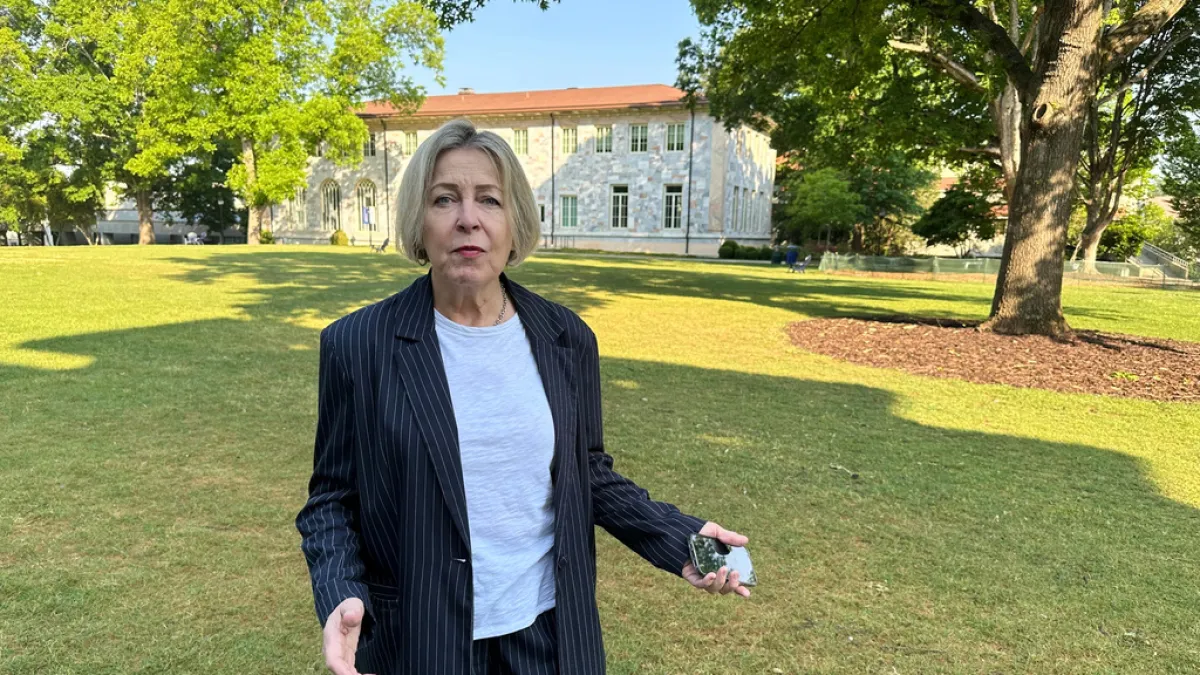
Three professors at Atlanta’s Emory University in the United States have filed a lawsuit over their arrests during a 2024 campus protest over Israel’s genocidal war on Gaza.
Their lawsuit on Thursday argued that the university broke its own free-speech policies when it called in police and state troopers to aggressively disband the protest, making 28 arrests.
Recommended Stories
list of 3 itemsend of list
“The judicial system would find that Emory failed to protect its students, to protect its staff, to protect the educational mission of the university,” said philosophy professor Noelle McAfee, one of the plaintiffs.
“So this isn’t just about people’s individual rights. It’s our educational mission to train people in free and critical inquiry, to be able to learn how to engage with others, to be fearless.”
Laura Diamond, a spokesperson for Emory, responded that the university believes “this lawsuit is without merit”.
“Emory acts appropriately and responsibly to keep our community safe from threats of harm,” Diamond said in a statement. “We regret this issue is being litigated, but we have confidence in the legal process.”
The suit is just one example of how the nationwide wave of protests from 2023 and 2024 continues to reverberate on elite campuses.
There have been multiple instances where students and faculty have filed lawsuits against universities, arguing they were discriminated against because of the protests.
But the Emory suit is unusual. McAfee and her fellow plaintiffs — English and Indigenous studies professor Emilio Del Valle-Escalante and economics professor Caroline Fohlin — all remain tenured faculty members. None were convicted of any charges.
The civil lawsuit in DeKalb County State Court demands that the private university repay money the three spent defending themselves against misdemeanour charges that were later dismissed, along with punitive damages.
McAfee said she’s suing her employer “to try to get them to be accountable and to change”.
All three say they were observers on April 25, 2024, when some students and others set up tents on the university’s main quad to protest the war. They say Emory broke its own policies by calling in Atlanta police and Georgia state troopers without seeking alternatives.
McAfee was charged with disorderly conduct after she said she yelled “Stop!” at an officer roughly arresting a protester. Del Valle-Escalante said he was trying to help an older woman when he was arrested and charged with disorderly conduct.
Fohlin said that, when she protested against officers pinning a protester to the ground, she herself was thrown face-first to the ground and arrested, suffering a concussion and a spine injury. Fohlin was charged with misdemeanour battery of an officer.
Emory claimed that those arrested that day were outsiders who trespassed on school property. But 20 of the 28 people arrested were affiliated with the university.
The professors said that, after their arrests, they were targeted by threats and harassment, part of a pushback by conservatives who said universities were failing to protect Jewish students from anti-Semitism and allowing lawlessness.
Nationwide, however, advocates say there is a “Palestine exception” in which universities are willing to curb pro-Palestine speech and protest. Palestine Legal, a legal aid group supporting such speech, said Tuesday that it received 300 percent more legal requests in 2025 than its annual average before 2023, mostly from college students and faculty.
McAfee served as president of the Emory University Senate after her arrest. The body makes policy recommendations and has helped draft the university’s open expression policy.
She said she asked then-President Gregory Fenves in fall 2024 why Emory police weren’t dropping the charges against her and others. McAfee said Fenves told her that he wanted “to see justice”.
The open expression policy was revised after 2024 to clearly prohibit tents, camping, the occupation of university buildings and demonstrations between midnight and 7am.
Whatever the policy, McAfee said students are afraid to protest at Emory, saying the university has turned its back on what Atlanta civil rights icon John Lewis called “good trouble”.
“Students know right now that any trouble is not going to be good trouble at Emory, that they could get arrested,” she said. “So students are afraid.”

Meta says it will cut 8,000 jobs as AI spending soars
The cuts, which employees had been expecting for weeks, will be Meta’s largest layoff since 2023.
Source link

Former Live Nation executive says he was fired after raising ‘financial misconduct’ concerns
A former executive at Live Nation, the world’s largest live entertainment company, is suing the company, alleging that he was wrongfully terminated after he raised concerns about alleged financial misconduct and improper accounting practices.
Nicholas Rumanes alleges he was “fraudulently induced” in 2022 to leave a lucrative position as head of strategic development at a real estate investment trust to create a new role as executive vice president of development and business practice at Beverly Hills-based Live Nation.
In his new position, Rumanes said, he raised “serious and legitimate alarm” over the the company’s business practices.
As a result, he says, he was “unlawfully terminated,” according to the lawsuit filed Thursday in Los Angeles County Superior Court.
“Rumanes was, simply put, promised one job and forced to accept another. And then he was cut loose for insisting on doing that lesser job with integrity and honesty,” according to the lawsuit.
He is seeking $35 million in damages.
Representatives for Live Nation were not immediately available for comment.
The lawsuit comes a week after a federal jury in Manhattan found that Live Nation and its Ticketmaster subsidiary had operated a monopoly over major concert venues, controlling 86% of the concert market.
Rumanes’ lawsuit describes a “culture of deception” at Live Nation, saying its “basic business model was to misstate and exaggerate financial figures in efforts to solicit and secure business.”
Such practices “spanned a wide spectrum of projects in what appeared to be a company-wide pattern of financial misrepresentation and misleading disclosures,” the lawsuit states.
Rumanes says he received materials and documents that showed that the company inflated projected revenues across multiple venue development projects.
Additionally, Rumanes contends that the company violated a federal law that requires independent financial auditing and transparency and instead ran Live Nation “through a centralized, opaque structure” that enables it to “bypass oversight and internal checks and balances.”
In 2010, as a condition of the Live Nation-Ticketmaster merger, the newly formed company agreed to a consent decree with the government that prohibited the firm from threatening venues to use Ticketmaster. In 2019 the Justice Department found that the company had repeatedly breached the agreement, and it extended the decree.
Rumanes contends that he brought his concerns to the attention of the company’s management, but his warnings were “repeatedly ignored.”

Trump reclassifies state-licensed medical marijuana as a less-dangerous drug
WASHINGTON — President Trump’s acting attorney general on Thursday signed an order reclassifying state-licensed medical marijuana as a less-dangerous drug, a major policy shift long sought by advocates who said cannabis should never have been treated like heroin by the federal government.
The order signed by Todd Blanche does not legalize marijuana for medical or recreational use under federal law. But it does change the way it’s regulated, shifting licensed medical marijuana from Schedule I — reserved for drugs without medical use and with high potential for abuse — to the less strictly regulated Schedule III. It also gives licensed medical marijuana operators a major tax break and eases some barriers to researching cannabis.
The Trump administration also said it was jump-starting the process for reclassifying marijuana more broadly, setting a hearing to begin in late June.
Trump told his administration in December to work as quickly as possible to reclassify marijuana. On Saturday, as the Republican president signed an unrelated executive order about psychedelics, he seemed to express frustration that it was taking so long.
Blanche said Thursday that the Department of Justice was “delivering on President Trump’s promise” to expand Americans’ access to medical treatment options. “This rescheduling action allows for research on the safety and efficacy of this substance, ultimately providing patients with better care and doctors with more reliable information,” he said in a statement.
What the marijuana reclassification order does
Blanche’s action largely legitimizes medical marijuana programs in the 40 states that have adopted them. It sets up an expedited system for state-licensed medical marijuana producers and distributors to register with the U.S. Drug Enforcement Administration.
It makes clear that cannabis researchers won’t be penalized for obtaining state-licensed marijuana or marijuana-derived products for use in their work, and it grants state-licensed medical marijuana companies a windfall by allowing them, for the first time, to deduct business expenses on their federal taxes.
Any marijuana-derived medicine approved by the Food and Drug Administration is similarly listed in Schedule III, it said.
Since 2015, Congress has prohibited the Justice Department from using its resources to shut down state-licensed medical marijuana systems. But the order nevertheless represents a major policy shift for the U.S. government, which has continued its long-standing marijuana prohibition — dating to the Marihuana Tax Act of 1937 — even as nearly all the states have approved cannabis use in some form.
Two dozen states plus Washington, D.C., have authorized adult recreational use of marijuana, 40 have medical marijuana systems, and eight others allow low-THC cannabis or CBD oil for medical use. Only Idaho and Kansas ban marijuana outright.
The regulation of medical marijuana has come a long way since California became the first state to adopt it in 1996, Blanche wrote.
“Today the vast majority of States maintain comprehensive licensing frameworks governing cultivation, processing, distribution, and dispensing of marijuana for medical purposes,” Blanche wrote. “Taken as a whole, they demonstrate a sustained capacity to achieve the public-interest objectives … including protecting public health and safety and preventing the diversion of controlled substances into illicit channels.”
The president of the American Trade Assn. for Cannabis and Hemp, Michael Bronstein, called it “the most significant federal advancement in cannabis policy in over 50 years.”
“This action recognizes what Americans have long known, cannabis is medicine,” he said in a written statement.
Critic calls the order ‘a tax break to Big Weed’
The Trump administration’s decision drew derision from marijuana legalization opponent Kevin Sabet, the chief executive of Smart Approaches to Marijuana. Sabet said that while marijuana research is necessary, “there are many ways to increase our knowledge without giving a tax break to Big Weed and sending a confusing message about marijuana’s harms to the American public.”
“With this move, we are now confronted with the most pro-drug administration in our history,” Sabet said in a text message. “Policy is now being dictated by marijuana CEOs, psychedelics investors, and podcasters in active addiction.”
Marijuana or marijuana-derived products that are not distributed through a state medical marijuana program will continue to be classified in Schedule I.
Schedule III drugs are defined as having moderate to low potential for physical and psychological dependence. Some critics of the industry have suggested that legalization in the states has led to stronger and stronger cannabis products, which need to be researched rather than categorized less strictly than before.
The efforts to reclassify marijuana
The Justice Department under President Biden had proposed to reclassify marijuana, eliciting nearly 43,000 formal public comments. The DEA was still in the review process when Trump succeeded Biden, and Trump ordered that process to move along as quickly as legally possible.
Blanche’s order sidestepped the review process by relying on a provision of federal law that allows the attorney general to determine the appropriate classification for drugs that the U.S. must regulate pursuant to an international treaty.
It was unclear how the order might affect operations in states where licensed recreational marijuana shops also sell to medical patients. In Washington state, which in 2012 became one of the first states to legalize the adult use of marijuana, 302 of 460 licensed stores have endorsements allowing them to sell tax-free cannabis products to registered patients.
Many Republicans oppose loosening marijuana restrictions. More than 20 Republican senators, several of them staunch Trump allies, signed a letter last year urging the president to keep the current standards.
Trump has made his crusade against other drugs, especially fentanyl, a feature of his second term, ordering U.S. military attacks on Venezuelan and other boats the administration insists are ferrying drugs. He signed another executive order declaring fentanyl a weapon of mass destruction.
Richer and Johnson write for the Associated Press. Johnson reported from Seattle.

2026 World Snooker Championship: Neil Robertson victory equals Crucible seeds record
In the first of the last-16 matches, 2005 winner Shaun Murphy moved into a dominant 6-2 lead over China’s Xiao Guodong.
Murphy scraped through 10-9 against Fan Zhengyi in the first round, calling his match-winning break of 50 in the decider the best break he had ever made at the Crucible after he had trailed 53-17.
But the 43-year-old Englishman found this session to be calmer as he made breaks of 79, 103, 63 and 64 to go 5-0 ahead.
World number nine Xiao took the next two frames, but Murphy ended the session well and took the last with a run of 61 to have a four-frame lead in the first-to-13 match.
That match resumes on Friday at 10:00 BST and Murphy could win it with a session to spare if he wins seven of the eight frames in that session. The third session, if needed, will take place from 19:00.
Northern Ireland’s Mark Allen holds a 5-3 lead against England’s Kyren Wilson, the 2024 champion.
Two-time semi-finalist Allen made breaks of 50 and 78 to race into a 5-0 lead, but Wilson won the last three frames of the session, helped by runs of 75 and 50.
The second session is on Friday from 14:30, before it is played to a finish on Saturday morning.
South Korea youth drawn into crime disguised as part-time work

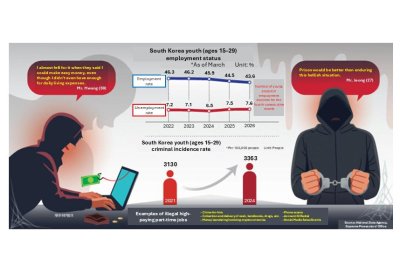
An infographic illustrates declining employment rates and rising crime involvement among South Korean youth, highlighting how economic hardship and online platforms are fueling participation in high-profit illegal activities disguised as part-time jobs. Graphic by Asia Today and translated by UPI
April 23 (Asia Today) — Economic hardship among young people in South Korea is reshaping crime patterns, with more youths turning to high-profit illegal activities disguised as part-time jobs, experts warn.
The shift marks a departure from traditional survival-driven crimes such as theft toward organized fraud, digital financial crime and so-called “crime-for-hire” schemes promising quick cash.
Economists have long noted the link between opportunity and crime. Gary Becker argued that individuals weigh expected criminal gains against legal income opportunities when deciding whether to commit offenses.
Recent data suggest that calculation is changing for young Koreans.
According to government employment data, the youth employment rate for those ages 15 to 29 fell to 43.6% in March, well below the overall rate of 69.7%. Youth employment declined for 41 consecutive months, with 147,000 fewer young workers compared with a year earlier.
In contrast, employment among older age groups increased, deepening what analysts describe as a “K-shaped” divide in the labor market.
At the same time, youth crime is rising. Prosecutors’ data show the number of young offenders per 100,000 people increased from 3,130 in 2021 to 3,363 in 2024. Fraud is particularly prevalent, with people in their 20s accounting for 23.7% of cases – the highest share among all age groups.
Researchers say unemployment and crime are closely linked. A 2023 study found that a 1 percentage point increase in unemployment leads to a 1.5% rise in theft-related crime.
Experts argue the issue is not just an increase in crime, but a structural shift.
“Young people are no longer committing crimes out of necessity alone, but increasingly pursuing one-time, high-reward opportunities,” one analyst said.
The appeal is stark. While unstable jobs may pay about 2 million won (about $1,480) a month, illegal activities can promise hourly earnings exceeding 500,000 won (about $370), widening the perceived gap between legal and illegal income.
Underlying the trend is growing relative poverty – a sense of falling behind others despite overall economic development. Rising real estate and financial asset values have deepened wealth disparities, reinforcing frustration among young people who see limited chances for upward mobility.
Some openly acknowledge the temptation.
“Sometimes it feels better to go to prison than live in this kind of hardship,” a 27-year-old job seeker said. “I know it’s wrong, but it’s hard just to get by.”
Digital platforms are accelerating the problem.
Recruitment for illegal work now spreads through social media and messaging apps, lowering barriers to entry. Schemes such as “yamibaito,” which advertise high-paying short-term jobs, often involve tasks like money transfers, account lending or acting as intermediaries in voice phishing scams.
Many participants are first-time offenders in their early 20s.
Authorities say similar “crime outsourcing” operations are increasingly coordinated through encrypted platforms such as Telegram, making them difficult to trace due to their decentralized structure.
Young people’s familiarity with online tools, cryptocurrencies and non-face-to-face transactions makes them especially suited to the technical roles required in such operations, further concentrating recruitment within the demographic.
Experts caution that the consequences can be lasting.
“Some young people treat these illegal jobs as simple labor and underestimate the risks,” said criminal profiler Bae Sang-hoon. “Even minor involvement can lead to a criminal record that affects the rest of their lives.”
Analysts stress that the problem cannot be addressed through policing alone.
“Poverty is the mother of crime,” said Kim Yoon-tae, a professor of public sociology at Korea University. “We need to examine structural factors such as employment, education and housing, rather than framing this purely as an issue of personal responsibility.”
He added that stable jobs, fair access to education and stronger housing support are essential to reducing the appeal of illegal income opportunities.
Without such changes, experts warn, more young people could be drawn into a cycle where economic hardship leads to crime – and a criminal record further limits future opportunities.
— Reported by Asia Today; translated by UPI
© Asia Today. Unauthorized reproduction or redistribution prohibited.
Original Korean report: https://www.asiatoday.co.kr/kn/view.php?key=20260422010007027