



Winter Olympics 2026: GB medal hopes still alive after double win over US
Great Britain’s women’s team are in a similarly precarious position.
The inexperienced rink – with only Jen Dodds surviving from the 2022 gold-medal winning team – finished sixth in last year’s World Championships and were some way short of their best against the US, with opportunities missed and mistakes made.
It looked for all the world like their chances were gone, trailing 7-6 going into the final end, and without the hammer.
However, Rebecca Morrison executed a sensational double takeout with her final throw and the Americans faltered under pressure, botching their effort to hand the British rink an implausible 8-7 triumph.
The Scottish quartet still need to win their final two games and hope for favours elsewhere if they are to salvage a place in the medal matches.
The next hurdle is a meeting with bottom-of-the-table Japan later on Wednesday (18:05 GMT) before they face second-bottom Italy on Thursday (13:05).
“There was a lot at stake but we just need to keep believing,” Morrison told BBC Sport. “We were up against it but we’re here to fight and that’s what we did.”
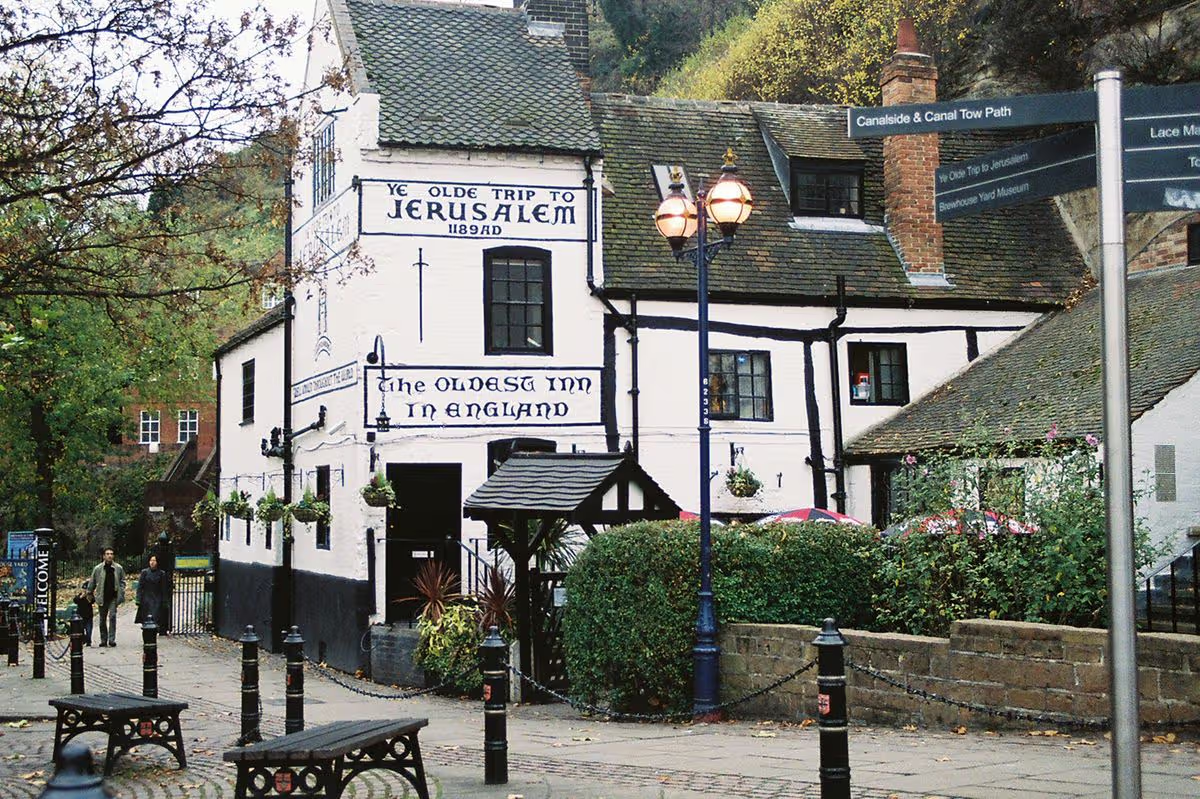
One of UK’s best pubs with hidden tunnels that was ‘hideout for Robin Hood’
A group of pub reviewers ‘one of the oldest pubs in England’ and they were blown away by its history – the Grade II-listed building claims to date back to 1189

The pub has been described as one of the oldest and best pubs in the UK (Image: Tribune News Service via Getty Images)
Pub fans have shared their verdict on “one of the best pubs in England“, and were absolutely staggered by its history. Known under the handle @thosepubguys on social media, the group travel the country , sampling pubs and rating them online.
In a latest clip, they descended upon Ye Olde Trip to Jerusalem in Nottingham, prompting them to wonder: “Is this the oldest pub in England?” Their Instagram caption declared: “This pub ranks 2nd in our list of best pubs in the country, and you can see why! There is so so so much history. It is literally built into the side of a cliff with secret tunnels to Nottingham Castle above it!”
During the footage, they guide viewers through the establishment and its passageways, recounting legends and historical tales.
The Grade II-listed premises is believed to trace back to 1189, though certain records indicate it might have been founded several centuries afterwards.
According to History Hit: “The pub’s name derives from King Richard the Lionheart and his men gathering there before journeying to Jerusalem in 1189 AD.”
“It was also said to be a local hideout for the legendary outlaw, Robin Hood. Indeed, the word ‘trip’ in the name is thought to refer to a stop in a journey, rather than the journey itself, marking out the pub as somewhere people would stop at on a long pilgrimage, for instance.”
This distinctive watering hole features a compact cave network within, hewn from the sandstone rock. Connected to Nottingham Castle, the tunnel network has served as a clandestine route in and out of the fortress for hundreds of years.
The statement continues: “In one of the pub’s upstairs buildings is a small model of a wooden ship, known as the cursed galleon.
“It is said that a number of people who cleaned the ship all met untimely and unexplained deaths, so landlords have since refused to let anyone clean it, and have instead put the ship into a glass cabinet.
“Elsewhere, the pub houses the ‘pregnancy chair’, an old chair which was said to increase a woman’s chances of becoming pregnant when she sat in it.”
Reacting to their video, one viewer commented: “Always wanted to visit this pub.”
Someone else added: “My favourite city pub until I moved away.”
A third person said: “I’ve only just realised I’ve never been to Nottingham! Need to fix that, looks amazing.”
Another viewer added: “That’s really interesting, steeped in history.”

Russia-Ukraine talks: All the mediation efforts, and where they stand | Explainer News
One week ahead of the fourth anniversary of Moscow’s full-scale invasion of Ukraine, United States-led peace talks in Geneva ended for the day earlier than scheduled on Wednesday.
The talks, which are being mediated by Steve Witkoff, US President Donald Trump’s special envoy, and Jared Kushner, Trump’s son-in-law, are just the latest of a number of attempts to end the deadliest fighting in Europe since World War II – and none have reached a breakthrough.
During his presidential campaign in 2024, Trump claimed repeatedly that he would broker a ceasefire in Ukraine within “24 hours”. However, he has been unable to fulfil this promise.
Here is a timeline of the mediation efforts to end the Russia-Ukraine war, which has killed more than a million people, as it heads towards its fifth year.

February 28, 2022 – direct talks
The first ceasefire talks between Russia and Ukraine took place just four days after Moscow’s full-scale invasion in February 2022.
The meeting lasted about five hours, and featured high-level officials, but with diametrically opposing goals. Nothing came of their talks.
Then, the two sides held three rounds of direct talks in Belarus, ending on March 7, but, again, nothing was agreed.
March-April 2022 – regional talks in Antalya
On March 10, the foreign ministers of Ukraine and Russia, Dmytro Kuleba and Sergey Lavrov, met for the first time since the war started, on the sidelines of the Antalya Diplomacy Forum in Turkiye.
A second meeting between senior leaders in Istanbul towards the end of the month failed to secure a ceasefire.
Then, the withdrawal of Russian forces in early April from parts of Ukraine revealed evidence of massacres committed against the Ukrainian civilian population in Bucha and Irpin near Kyiv, in northern Ukraine.
Ukraine’s President Volodymyr Zelenskyy said this would make negotiations much more difficult, but that it was necessary to persist with the dialogue. Russian President Vladimir Putin later declared the negotiations were at a “dead end” as a result of Ukraine’s allegations of war crimes.

July 2022 – Black Sea Grain Initiative, Istanbul
In July 2022, the Black Sea Grain Initiative was signed by Ukraine and Russia with Turkiye and the United Nations in Istanbul. It was the most significant diplomatic breakthrough for the first year of the war.
The agreement aimed to prevent a global food crisis by designating a safe maritime humanitarian corridor through the Black Sea for cargoes of millions of tons of grain stuck in Ukrainian ports.
November 2022 – Ukraine’s peace plan
Ukraine’s Zelenskyy presented a 10-point peace proposal at the Group of 20 (G20) summit in Indonesia, within which he called for Russia’s withdrawal from all Ukrainian territory as well as measures to ensure radiation and nuclear safety, food security, and protection for Ukraine’s grain exports.
He also demanded energy security and the release of all Ukrainian prisoners and deportees, including war prisoners and children deported to Russia.
Russia rejected Zelenskyy’s peace proposal, reiterating that it would not give up any territory it had taken by force, which stood at about one-fifth of Ukraine by then.
February 2023 – China’s peace plan
China proposed a 12-point peace plan calling for a ceasefire and the end of “unilateral sanctions” that had been imposed by Western nations on Russia. Beijing urged both sides to resume talks on the basis that “the sovereignty, independence and territorial integrity of all countries must be effectively upheld”.
The proposal was criticised by Western allies of Kyiv for not acknowledging “Russia’s violation of Ukrainian sovereignty”.

June 2023 – Africa’s peace plan
In June 2023, a high-level delegation of African leaders, led by South African President Cyril Ramaphosa and including the presidents of Senegal and Zambia, visited both Kyiv and St Petersburg to present a 10-point plan focusing on de-escalation and grain exports.
Analysts said it was driven largely by the war’s impact on African food security and fertiliser prices.
But Ukrainian President Zelenskyy rejected the call for “de-escalation”, arguing that a ceasefire without a Russian withdrawal would simply “freeze” the war.
The following month, President Putin pulled Russia out of the Black Sea Grain Initiative.
August 2023 – Jeddah summit
Saudi Arabia hosted representatives from 40 countries to discuss Zelenskyy’s “Peace Formula”, but no final agreement or joint statement was reached.
In a major surprise, Beijing sent its special envoy, Li Hui, to the talks. But Russia was not invited, and the Kremlin said the efforts would fail.

June 2024 – Switzerland peace summit
The June 2024 Summit on Peace in Ukraine, held at Switzerland’s Burgenstock resort, brought together more than 90 nations to discuss a framework for ending the conflict in Ukraine. The summit focused on nuclear safety, food security and prisoner exchanges, though Russia was not invited, and several nations, including India and Saudi Arabia, did not sign the final joint communique.
February 2025 – Trump-Putin call
A month after beginning his second term as US president, Trump posted on his Truth Social platform that he held a long phone call with his Russian counterpart, Putin, in a bid to restart direct negotiations aimed at ending the war.
On February 18, delegations from Washington and the Kremlin, including US Secretary of State Marco Rubio and Russian Foreign Minister Lavrov, met in Saudi Arabia.
They laid the groundwork for future negotiations, but the talks raised significant concerns in Kyiv and Brussels, as both Ukraine and the European Union had been sidelined from the meeting.
February 2025 – Zelenskyy goes to the White House
Ten days later, on February 28, there came a saturation point at the White House.
In one of the most confrontational moments in modern diplomacy, President Trump and Vice President JD Vance berated President Zelenskyy in a televised meeting in the Oval Office.
Zelenskyy – called out for not wearing a suit and not expressing enough gratitude to the US – found himself cornered.

August 2025 – Witkoff goes to Moscow
Trump envoy Steve Witkoff travelled to Moscow to meet Putin on August 6. It was his third trip to Moscow and came amid renewed Western threats of sanctions on Russian oil exports and US threats of “secondary” trade tariffs.
Trump said afterwards that the meeting was “highly productive” and that “everyone agrees this war must come to a close”. Nothing more concrete came out of this meeting, however.
August 15, 2025 – Alaska summit
Trump dropped his sanctions threat and met Putin in person on August 15, 2025, at Joint Base Elmendorf-Richardson in Alaska.
But no deal was reached.

August 18, 2025
Trump hosted Zelenskyy and other European leaders in Washington and said he would ask Putin to agree to a trilateral summit.
But nothing came out of this visit, either.
November 2025 – Geneva talks
In November 2025, the Geneva talks became a flashpoint for Western unity, as the Trump administration’s controversial 28-point plan leaked to the press, reportedly involving a cap on Ukraine’s military and a freeze on NATO membership. It also suggested that Ukraine should cede territory to Russia.
Reportedly authored by US envoy Witkoff along with Russian envoy Kirill Dmitriev, the draft sparked accusations that the US was drafting a “capitulation” for Ukraine.
No deal was reached after revisions were made to the draft proposal.

December 2025 – Berlin and Miami talks
On December 14 and 15 last year, President Zelenskyy travelled to Berlin to meet US envoys Witkoff and Kushner, alongside a powerful group of European leaders, including Germany’s Chancellor Friedrich Merz, the United Kingdom’s Prime Minister Keir Starmer, and France’s President Emmanuel Macron.
Following this, US negotiators optimistically claimed that 90 percent of the issues between the two sides had been resolved.
Then, later in the month, Witkoff and Kushner hosted another session of talks in Miami, Florida in the US. But the issues around sovereignty over Ukraine’s Donbas region and the exact line of demarcation proved impossible to bridge.
And no deal was reached.
January 2026 – Abu Dhabi talks
On January 23, high-level delegations from the US, Ukraine and Russia sat face to face to hold trilateral talks for the first time since the 2022 invasion.
Hosted at the Al Shati Palace in Abu Dhabi, talks were mediated by the United Arab Emirates.
Another round of talks was held on February 4, reaching an agreement on a major prisoner exchange but leaving key political and security issues unresolved.
The delegations agreed to exchange 314 prisoners of war – 157 each – the first such swap in five months.

February 17-18, 2026: Geneva talks
Talks in Geneva are currently under way.
Senior military figures from both Ukraine and Russia have attended the second three-way effort, along with the US, to end the war in Ukraine. These have largely stalled so far due to Russia’s insistence on keeping territory it has seized from Ukraine.

Easy flight hack could help you save money on holidays with little effort
Choosing this option when you book your flights could help you save hundreds of pounds, and it’s especially useful during peak seasons such as half-term or the summer holidays

These tips can help savvy holidaymakers save money(Image: Getty Images)
When it comes to booking a flight, we all want to save money, especially when we need to travel during peak times such as the dreaded school summer holidays.
Luckily, there are still some hacks that can help you cut the cost of flights, and Laura Lindsay who works at SkyScanner has offered up some of her expert travel tips. She said: “Last-minute doesn’t have to mean bad value. Whether you’re staying at home or going abroad, the travellers who take the time to shop around and compare deals will get the best prices. Being a little bit flexible could make a big difference in cost, as well as opening up options for destinations and accommodation you may not have considered.”
One of her clever tricks? Look at the school holiday dates for the counties and regions on the border of your own; these dates can differ, which means you might be travelling in your county’s own peak season, but your neighbouring towns might be ‘off peak’, causing a price difference.
For example bargain hunters who live in the north of England can often bag a cheap flight by flying from a Scottish airport. This is because school holidays in Scotland tend to be slightly different, for example, the six-week summer holiday begins early-July and ends around mid-August.
That means if you have a Scottish airport within reasonable travelling distance, you can save a lot of money by flying from Scotland in the last two weeks of August. And on the flipside, Scots can pick up cheaper flights by jetting off in early July from English airports.
In the meantime, check out more of Laura’s money-saving hacks below…
Search ‘everywhere’ for the best prices
Not fussy about where you want to go? On sites such as Skyscanner you can select ‘everywhere’ as your destination and will be able to find the cheapest destination for your dates. This will give you a number of options from city breaks to beach destinations, and you may be able to find an inexpensive hidden gem.
Skyscanner also have a cheapest destinations tool, where you simply choose the month you want to travel and get a list of the ten cheapest destinations for that period. For example, in March the cheapest flights can be found to Milan and Tirana in Albania for city breaks, while those seeking sunshine could find deals for Lanzarote and Marrakech.
Search nearby airports
Another feature on flight comparison sites that’s worth trying is including nearby airports in your search. On Skyscanner you simply tick the box under your destination or departure airport.
If you live close to London, for example, don’t just look at your nearest airport. Searching for nearby airports looks up the cheapest options around the capital, so a short tube journey could save you a lot of money. This works in any area where there are airports nearby, for example, comparing flights from Birmingham and East Midlands, which are just 45-minutes apart.
You can also choose to search nearby airports at your destination. Just make sure you work out how far away the airport will be from your accommodation before you book. Some airports with city names can still be miles away from the destination. For example, Paris Beauvais Airport is actually about 90-minutes from the French capital, so best avoided for a short break.
Have a story you want to share? Email us at webtravel@reachplc.com
Ensure our latest lifestyle and travel stories always appear at the top of your Google Search by making us a Preferred Source. Click here to activate or add us as your Preferred Source in your Google search settings.

'Difficult' Russia-Ukraine peace talks end without breakthrough
The second day of negotiations between Ukraine and Russia ended after just two hours.
Source link

Spin-off of ‘one of best shows ever made’ lands UK streaming release
The original series was a huge hit with viewers and spanned 12 seasons

The sitcom is getting a UK release(Image: TLC/Discovery+)
Comedy fans in the UK will finally be able to stream a spin-off of a long-running series dubbed “intelligent”, “literally brilliant” and “one of the best ever made” by viewers.
The Big Bang Theory spanned 12 seasons and introduced viewers to the loveable genius Sheldon Cooper. His popularity on the show spawned spin-off Young Sheldon, which explored the character’s upbringing, family and childhood adventures.
Another spin-off, which is a direct sequel to the events of Young Sheldon, was later unveiled titled Georgie & Mandy’s First Marriage. This focusses instead on Sheldon’s oldest brother, Georgie Cooper (Montana Jordan), as he grapples with marriage and parenthood alongside partner Mandy McAllister (Emily Osment).
As viewers saw in Young Sheldon, Georgie and Mandy both lied about their ages when they met. Georgie, then aged 17, said he was 21, while a 29-year-old Mandy insisted she was 24. Now they have a baby, a marriage and a 12-year age gap to contend with all while living under the same roof as Mandy’s parents, Audrey and Jim.
It became the third TV sitcom in The Big Bang Theory franchise – and notably the only one not featuring the character of Sheldon – and two seasons have been released so far. That latest season is now being made available to viewers in the UK.
The series has an impressive Rotten Tomatoes score so far, earning a respectable 89 per cent from critics. Audiences awarded the series a lesser 68 per cent on average.
One viewer penned: “While I agree that it doesn’t quite live up to Young Sheldon or The Big Bang Theory, this show has its own redeeming qualities which make it a worthwhile watch.” A second added: “I think it’s a wonderful addition to The Big Bang universe.”
A third called it their “comfort show,” adding: “I binged it the whole day so it did something right.”
The show will be airing exclusively on TLC in the UK, and be available for streaming on Discovery+ from April this year, though an exact release date is yet to be announced.
For the latest showbiz, TV, movie and streaming news, go to the new **Everything Gossip** website.Ensure our latest headlines always appear at the top of your Google Search by making us a Preferred Source. Click here to activate or add us as your Preferred Source in your Google search settings.

More power bank bans are being introduced on airlines
AN ENTIRE country is placing a blanket ban on the use of power banks on flights.
Japan‘s transport ministry has told airlines that the use of the popular travel item onboard flights will be banned from April.
It comes as a number of incidents have occurred where mobile batteries and power banks have caught fire on flights.
Under the new ban, passengers will not be allowed to use power banks to charge their phone onboard a flight from Japan.
They will also not be able to charge power banks using the onboard power outlets.
However, they will still be able to take power banks on in hand luggage.
Read more on travel inspo


Back in July, the Ministry of Land, Infrastructure, Transport and Tourism banned passengers from storing any power banks in the overhead lockers on domestic and international flights.
And batteries of this kind are already not allowed in checked baggage.
Despite the new rules, passengers will still be able to carry up to two power banks with them onto a flight – it is just that they cannot be used at all throughout the flight and must be out of the overhead locker.
It comes as a number of other airlines have banned power banks over the past couple of years due to a number of incidents.
The handy and popular travel item is thought to catch fire when there is damage, a manufacturing defect or overcharging has caused it to overheat.
When a power bank does overheat, it can be made worse on a plane due to the high-altitude and low-pressure conditions.
Last January, a flight operated by Air Busan, experienced a fire on board which they believe was as a result of a defective power bank.
Even though passengers weren’t harmed, the plane was badly damaged.
Following the incident, Air Busan was the first airline to ban the use of power banks onboard.
And since, a number of other airlines have followed in its footsteps.
For example, both Cathay Pacific and Singapore Airlines have banned the use of power banks on board.
And back in November, Qantas and Virgin Australia announced that they would ban onboard use of power banks after one caught fire in an overhead locker onboard a Virgin Australia flight.
The changes for Virgin Australia flights came into force on December 1.
Qantas, QantasLink and Jetstar then followed on December 15.
In January, Lufthansa then became the latest airline to introduce new rules on power banks.
It came into force on January 15 and means that passengers on Lufthansa flights are no longer allowed to use their power banks onboard either.
UK airlines such as British Airways and Ryanair are yet to introduce any similar rules.
What the rules mean for your holiday
The Sun’s Head of Travel Lisa Minot explains:
AS staying connected becomes ever-more important, a ban on the handy gadget that can keep our devices topped up could be seen as a pain.
But the catastrophic consequences of a fire on a plane are an obvious reason to make rules stricter.
After countless incidents – and with so many counterfeit and faulty goods out there – it makes sense they are cracking down.
But airlines do need to understand the need for us to be able to top up our devices in the air. With plans afoot to get rid of physical boarding passes in the coming years, making sure we are able to use our devices will become ever more essential.
Adapting plane interiors to include USB ports will alleviate the need to top up on the go.
And more needs to be done to highlight the new rules – and the dangers these devices can pose.
In other aviation news, a major airline has axed more than 130 flights from the UK.
Plus, a UK airport is launching its biggest ever flight schedule with 19 new routes in a major £60million expansion.

DICK TUCK’S WASHINGTON ‘PROJECT’ – Los Angeles Times
Because of his, er, attentions to the various campaigns of Richard M. Nixon, Dick Tuck always was considered a merry prankster of Democratic persuasion. A re-evaluation may be in order. Tuck says he voted not once but twice for President Ronald Reagan.
“I rather like him,” Tuck adds. He says he voted against the Democratic contenders–Jimmy Carter in 1980 and Walter Mondale in 1984–because “I didn’t like them.”
He doesn’t think his votes distressed those on high in the Democratic Party. “Most just didn’t believe it,” he says. But in his opinion, “they don’t recognize the real world when they see it. The Democratic Party has lost touch with Americans.”
Tuck, who resembles a Gaelic Father Christmas without beard and who gives the impression that he sends his clothes to the cleaners for rumpling, has recently embarked upon a new career–but not in the GOP, or even as a free-lance anarchist.
“I’m leaving politics and going into entertainment,” he says. “Maybe I’m not changing–maybe politics is changing. It’s not the entertainment that it once was.”
Specifically, he has written an outline for what he hopes will become a film entitled “Capitol Hill Blues.” It’s about a group of young folks employed as summer interns in Congress. Their goal is to carry on in Washington as they would during Easter vacation in Fort Lauderdale–a bit of drinking, sex and even loose behavior.
“It’s kind of ‘Animal House’ in Washington,” he says, but emphasizes that its tone is somewhat loftier. The interns succumb to idealism in the course of their summer tour.
He nodded when advised that, since he’s serious about his new venture, he should start talking Hollywood, starting with calling his proposal a “project.”
“A project it is,” he says. “I have some money people–is that what you call ‘em?–who are putting together this package. They’re old friends, but they’re in this to make money. They aren’t philanthropists.”
Tuck was in town last month, making the rounds with his outline/project/package. Among those who saw it was Thomas Baer, his attorney when the Watergate Committee sought–but didn’t get–Tuck’s testimony on the political pranks he pulled against Nixon.
“I saw it and he discussed it with me, but I have made no decision yet,” says Baer, now an independent producer at Orion. And, he adds, “Anything he shows me I’ll look at carefully from every aspect, including whether he really owns it.”
(An affectionate jest. But Baer seriously wishes that his friend–regardless of what happens with “Blues”–could find employment of some sort in Hollywood. It would enliven the hamlet no end, he says, and “what he could do boggles the mind.”)
Tuck’s fame as a leg-puller on the Democratic side is chiefly due to his history of capers against Nixon, whose mind first was boggled by Tuck during Nixon’s 1950 Senate race against Rep. Helen Gahagan Douglas–for whom Tuck worked while a student at UC Santa Barbara.
Nixon’s campaigners, unaware of Tuck’s ties to Douglas, asked him to do advance work for a campus visit by Nixon. Tuck happily agreed. He booked a huge hall but only invited a handful of people. It is said that Nixon was so displeased at the tiny turnout that he fired Tuck, who was to continue bedeviling Nixon for years.
The prankster, whose dossier also includes a stint as political affairs editor of National Lampoon magazine, has himself run for public office. Just once, though.
The year was 1966, the office the state Senate district encompassing downtown Los Angeles. His allies put up billboard signs that said: “The job needs Tuck and Tuck needs the job.” For some reason, he did not win.
In a now-classic concession speech, the candidate had this to say: “The people have spoken, the bastards.”
Tuck, 61, concedes that it won’t be easy to persuade the titans of Tinseltown that his proposed film is no prank: “I would have trouble convincing anybody that anything I’ve ever done is serious–except Richard Nixon.”
But his movie is the real McCoy, he says, and “if it has any message at all, it is that Washington should not be taken too seriously.” He deplores life as it now exists there, says its current crop of inmates are a pretty drab, humorless lot indeed.
He attributes this to the fact that government now has become a full-time career, that the day of the citizen-participant is no more, that politicians, once ensconced in Washington, rarely leave because they think they are engaged in Serious Business.
He wishes everyone there would heed the advice that a friend of his, former Sen. Clair Engle (D-Calif.), once gave him. “He told me, ‘When you go to Washington, take two clean shirts. When they’re dirty, go home.’
“I think air conditioning ruined Washington,” Tuck mused. “Before it, during those muggy summers, everybody went home.”

Mikaela Shiffrin breezes to Winter Olympic slalom gold in emphatic fashion
American star Mikaela Shiffrin cemented her status as the greatest alpine skier of all time as she won Olympic slalom gold in emphatic fashion.
Twelve years on from winning the title in Sochi aged 18, Shiffrin stormed to victory with an overall time of 1:39:10, a significant 1.50 seconds ahead of second place to become a three-time Olympic champion.
The 30-year-old put herself in pole position with a time of 47.13 seconds in the first run, a gap of 0.82 seconds to second-place Lena Duerr.
The German was the only skier to finish within one second of Shiffrin but she straddled the first gate on her second run to put herself out of medal contention.
That left Shiffrin with what was ultimately an exhibition run to take gold and she completed the run in 51.97 seconds.
Switzerland’s Camille Rast won silver while Sweden’s Anna Swenn Larsson took bronze.
More to follow.

Mark Zuckerberg to testify in social media addiction trial

Feb. 18 (UPI) — Meta CEO Mark Zuckerberg is expected to testify Wednesday in a trial that will decide if his social media platforms and YouTube intentionally harmed children and teens.
The lawsuit in Los Angeles was filed by a 20-year-old woman called KGM in the suit and her mother, Karen Glenn, who claim the platforms damaged her mental health as a child. It’s the first in a group of lawsuits brought by 1,600 parents, teens and school districts who allege that when teens are addicted to the platforms, they suffer from depression, self-harm, eating disorders and more.
KGM, also known as Kaley in the suit, began using YouTube at age 6 and Instagram at 9, said her lawyer, Mark Lanier. Despite her mother’s efforts to mitigate her social media use, Kaley sometimes used Instagram for “several hours a day.” The app’s addictive features led her to develop anxiety, body dysmorphia and suicidal thoughts, she alleges. She was also the victim of bullying and sextortion.
A Meta spokesperson said the company strongly disagrees with the allegations.
“The question for the jury in Los Angeles is whether Instagram was a substantial factor in the plaintiff’s mental health struggles,” CNN reported a Meta spokesperson said in a statement. “The evidence will show she faced many significant, difficult challenges well before she ever used social media.”
The company said it is “confident the evidence will show our longstanding commitment to supporting young people.”
Plaintiffs’ lawyers in the cases say internal documents at the companies stress the goal of making apps difficult to put down like infinite scroll, auto-play, likes, beauty filters and push notifications.
“These companies built machines designed to addict the brains of children,” lawyer Mark Lanier said in his opening statements, NPR reported. “And they did it on purpose.”
The trial is in state court, which means there only needs to be nine of the 12 jurors in agreement. If Kaley and her mother win, it could lead to settlements in the other cases.
Israel kills two in Gaza, blocks thousands from medical exit through Rafah | Israel-Palestine conflict News
The latest deaths come as just 260 people, out of 18,500 in urgent need, have been allowed to seek medical care via the crossing to Egypt, the United Nations says.

Published On 18 Feb 2026
Israeli fire has killed at least two Palestinians in separate incidents across the Gaza Strip on Wednesday, as Israel continues to block thousands of Palestinians from seeking urgent medical attention through the partially-reopened Rafah crossing in its ongoing, more than two-year genocidal war on the enclave.
Al Jazeera’s correspondent on the ground reported that one child was killed in the northern Strip when an Israeli drone targeted children on their way to check their destroyed homes in the area.
Recommended Stories
list of 4 itemsend of list
Meanwhile, soldiers opened fire on and killed Muhand Jamal al-Najjar, 20, near the Bani Suheila roundabout east of the city of Khan Younis, Palestinian news agency Wafa reported.
Gaza hospital sources told Al Jazeera that Israeli fire also wounded three Palestinians in al-Mughraqa in the central Strip and the al-Mawasi area of Rafah to the south.
Since the “ceasefire”, which Israel has violated on a near-daily basis, took effect in mid-October, more than 600 Palestinians have been killed and more than 1,600 wounded, according to the latest figures released by the Palestinian Ministry of Health earlier this week.
Limited reopening
The latest deaths come as the Israeli military maintains its blockade on Palestinians looking to exit Gaza via the Rafah crossing to Egypt for medical care.
The United Nations Office for the Coordination of Humanitarian Affairs (OCHA) has tallied a total of 260 patients leaving Gaza since the first day of reopening two and a half weeks ago, the office told Al Jazeera on Wednesday – a small fraction of the roughly 18,500 people who desperately require evacuation.
The figure even falls short of an earlier promise from an Egyptian border official that at least 50 Palestinians would cross in each direction starting from the first day. Instead, just five patients were permitted to leave.
Human rights and medical groups, including the World Health Organization (WHO), have repeatedly called for Palestinians to be able to access critical care outside Gaza.
WHO chief Tedros Adhanom Ghebreyesus wrote on social media earlier this month that the body wanted to see an “immediate reopening of the medical referral route to the West Bank, including East Jerusalem”, and for more countries to accept patients for specialised care not available in the Strip.
But Gaza’s health system – which Israel has largely decimated since starting its war on the embattled enclave in October 2023 – must look to “reduce reliance on medical evacuations”, he added.
“This is now the top priority,” Tedros said, ticking off necessities including scaling up health services inside Gaza, stocking fresh medical supplies, and repairing damaged facilities.
The rate of return to Gaza through the checkpoint has also been slow: 269 people had passed into Gaza as of February 11, OCHA said in its latest report.
One recent batch – made up of 41 people who were transported to Nasser Medical Complex – said Israeli soldiers subjected them to humiliating physical searches and intense interrogations, an Al Jazeera team reported.
Returnees have previously recounted being blindfolded during hours of political interrogations and psychological pressure before being allowed to re-enter Gaza.

The top 15 boozers according to locals including one on an island
A TRIP to Devon isn’t complete without visiting a pub and luckily, the county has plenty.
Whether you prefer a pub garden or being by a cosy fireplace or have a dog with you, Devon is full of great pubs.
Though, it can be overwhelming to choose a spot, so here are some of the best pubs in the county from someone who has tried and tested them as a local…
Church House Inn, Marldon
The Church House Inn in the village of Marldon, South Devon is a gem not many stumble across.
The pub is out of the way from the main tourist spots in the area, but if you have a car it is well-worth the drive too.
Inside you will find traditional beams and exposed stone walls, as well as a large open roaring fire.
Read more on travel inspo


In the summer, the garden is a tranquil spot to enjoy a spritz, with nothing but the hum of birds nearby and the church watching over the garden.
The Drum Inn, Cockington
Nestled in the unique village of Cockington, you will find The Drum Inn.
I have been caught in here on both scorching hot days and snowy winter storms, making it the ideal pub for all seasons.
It is a large pub but still has a cosy vibe and it is the perfect retreat after exploring the thatched cottages and fields of Cockington.
The Old Rydon Inn, Kingsteignton
Run by a couple of 20 years, The Old Rydon Inn in Kingsteignton is a very pretty pub.
It’s a Grade-II listed farmhouse, which used to be part of Lord Clifford’s Manor way back during the reign of Henry II.
The pub even still has the original elm screens dating to the early 16th century.
In the sunny weather, try and sit outside – plants crawl all over the building and it is very peaceful.
Court Farm Inn, Abbotskerswell
The Court Farm Inn used to be a farmhouse and was built in the 16th century.
Today, beams still feature inside and so do exposed stone walls.
The ciders served here are always cold and crisp and don’t forget to try desert if eating, they are unfussy but the ultimate comfort.
Steam Packet Inn, Kingswear
Just before you get the ferry across to Dartmouth town, make sure to stop off in the Steam Packet Inn.
Inside, this spot has a more modern feel with chic striped benches and blue tones throughout.
Perhaps though, the best thing about this pub is that it overlooks Darthaven Marina and the railway, where you will often see the steam train chugging past.
Masons Arms, Branscombe
The Masons Arms in Branscombe dates back to the 14th century and sits in a picturesque village.
The pub itself has a thatched roof, and then on the inside the decor includes pine cladding, low ceiling beams and of course, a roaring log fireplace.
During the day, this spot is ideal for coffee but of course, the ales are great too.
The St Austell Burger for £18 is a delicious feat, with Mena Dhu stout onion marmalade, Monterey Jack cheese, beef tomato, gherkin, pickled red slaw, and skin-on fries.
The Thatch, Croyde
There’s a reason why The Thatch has over 2,000 four and five-star reviews…
Though the food isn’t cheap, it is super flavoursome and a lot of the dishes put a sophisticated twist on pub classics.
Croyde Bay is right on the pub’s doorstep as well, making it the ideal spot post beach walks or surfing sessions.
Fairway Buoy, Bideford
Sat on the promenade in Bideford, Fairway Buoy overlooks the sprawling, golden sands beach.
It’s pet friendly and has a large outdoor seating area which is the ideal spot for watching the sunset.
The food is more modern too, with pizzas often on the menu.
Definitely try their hot chocolate as well on cold beach days – it was bigger than my head.
Samuel Jones, Exeter
Sat on the edge of Exeter Quay, you will find the stylish pub Samuel Jones.
Inside, the decor features a more industrial style fitting in with the rest of the Quay.
In addition to serving their award-winning ales, the venue also broadcasts live sports.
Victoria Inn, Salcombe
Salcombe is loved for many reasons, drawing in hoards of tourists each year, but the Victoria Inn is another reason to love it.
Just a short walk from the banks of the Kingsbridge Estuary, the Victoria Inn is full of cosy corners and a log fire.
On Sundays the pub hosts bingo, which is always a laugh.
And when it comes to the menu, sharing boards are a great option for a lunchtime sit down after exploring the town.
The Waterman’s Arms, Totnes
The Waterman’s Arms in Totnes feels like being in a fairytale storybook.
The pub sits right at the riverside, by Bow Bridge.
In the evenings, the 17th century watering hole often hosts candlelit dinners but if you are there in the day and it happens to be sunny, do not miss the garden terrace.
Kids also eat free during half-term!
Old Fire House, Exeter
The Old Fire House in Exeter is a super popular spot and with good reason.
The boozer is inside an old 19th century firehouse with a vaulted wooden-beamed ceiling and exposed stone walls.
This spot is especially loved for its late-night events with a good atmosphere and oversized 14-inch square pizzas.
You dog is allowed to come too…
Tinpickle And Rhum, Dartmoor
Tinpickle and Rhum is a gastropub located at the The Moorland Hotel by Haytor, on Dartmoor.
Inside the interiors feel a little luxury with rustic wooden cladding on the walls which match the tables and giant modern chandeliers hanging from the ceiling.
Don’t miss their All Three Roasts for £23.95 with Yorkshire pudding, roast potatoes, cheddar cauliflower cheese, season’s best vegetables and red wine gravy.
Head to the pub after a walk up to Haytor Rock, which is one of the most popular spots on the Moors for its breathtaking views and unique rock formations.
The Highwayman Inn, Sourton
Despite not having visited yet, I couldn’t miss out the quirky Highwayman Inn near Sourton.
Often dubbed Britain’s most unusual pub, The Highwayman Inn features its own minotaur and has a layout that is more like a maze.
The boozer dates back to the 13th century and inside it is full of unusual objects to feast your eyes on.
The Pilchard Inn, Burgh Island
Dating back to the 14th century, The Pilchard Inn offers amazing views of the sea and crashing waves.
It is actually one of England‘s oldest pubs, according to its website.
And to get to the pub you can either walk across at low tide, taking around 10 minutes or at high tide, hop on the sea tractor costing between £2 and £3 a way.
In other pub news, here are 10 of the UK’s cosiest pubs with bed and breakfast from £99.
Plus, Britain’s smallest town named one of the coolest spots in the country with cosy pubs and coastal walks.

Rich House, Poor House star in tears after exploring Poundland founder’s £10m mansion
Steve Smith and his son Joe are leaving their lives of luxury behind as they take part in the Channel 5 show.

Kelly was overcome with emotion during the Channel 5 show(Image: Channel 5)
In a new episode of Channel 5’s Rich House, Poor House, one family get to live in the luxurious Ludstone Hall, owned by Poundland founder, Steve Smith.
Steve and his son Joe are swapping lives with Kelly, John and their five children who live 29 miles away in Stafford.
For seven days, they get to live in each other’s homes and survive on their budgets and lifestyle.
In a clip shown on Instagram, Steve highlighted the spacious mansion he lives in, boasting 11 bedrooms and six bedrooms.
However, Kelly, John and their family live in a four-bedroom semi and live hand to mouth.
As the pair swap homes, the couple are blown away to see the mansion they’d be living in for a week.
When inside, John sent his children on a mission to find the swimming pool, although they had trouble locating it, unaware that the ballroom floor lowered to create a pool.
One of their daughters commented: “We were walking over it and everything! No one even knew that it was there. That was the shock. It was very magical, very hidden even though it’s right in front of your eyes.”
For the latest showbiz, TV, movie and streaming news, go to the new **Everything Gossip** website.
As the family got acquainted with their new life of luxury, they were speechless to discover their budget for the week was a staggering £2,040.
Overcome with emotion, Kelly replied: “That’s a lot. Are we too late in life to achieve, to even get even half of this a week? Are we too far in life to get this?”
Whereas Steve and his son were tasked with living off the family’s budget of £39.80. Commenting on the price, he said: “I never expected to have such a little budget.”
Viewers were quick to comment on the clip shared on Instagram, as one person said: “I watched this episode last night!!! One of there best ones, Both families are so nice and genuine.. happy with the outcome at the end.”
Another added: “This programme is a genuine reality eye opener.”
Someone else wrote: “I love this programme. It’s almost always has got such lovely people both sides.”
Rich House, Poor House is available to watch on Channel 5.
Ensure our latest headlines always appear at the top of your Google Search by making us a Preferred Source.** Click here to activate**** or add us as your Preferred Source in your Google search settings.**
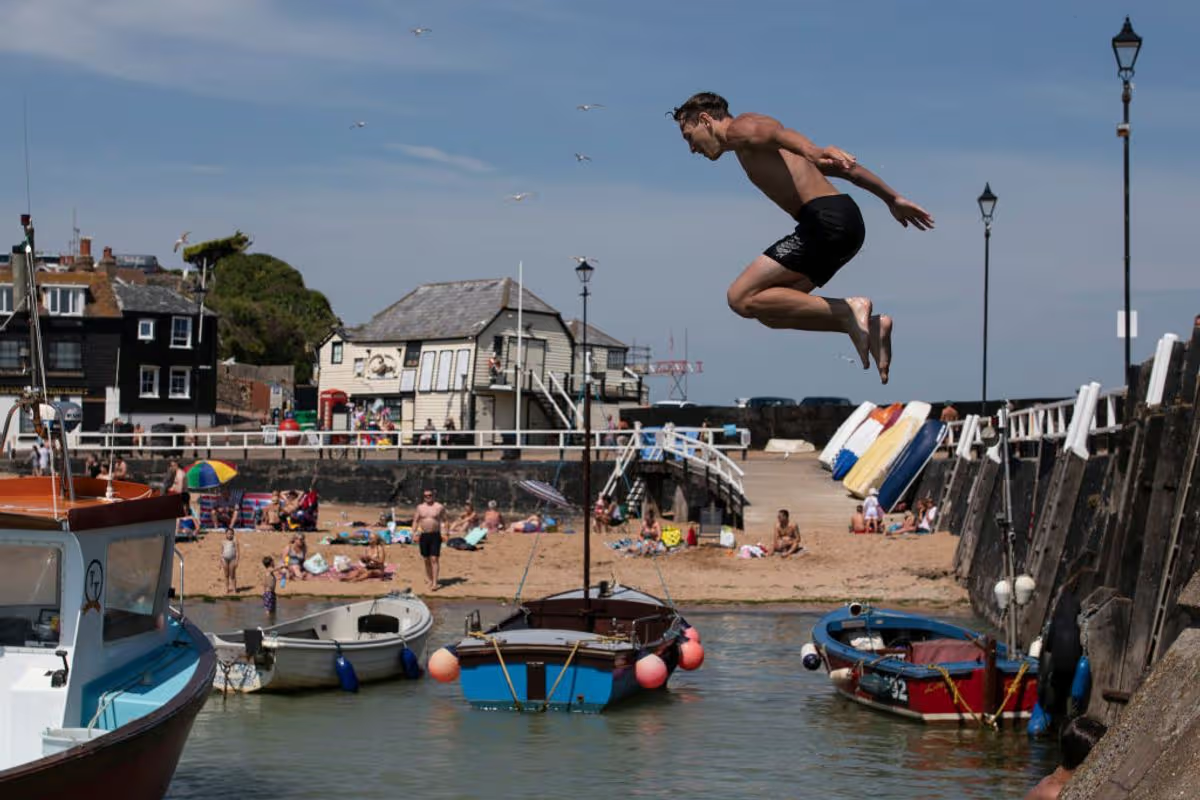
Seaside town that feels like the Med is cheap £14 train from London
Just under two hours away from London with Mediterranean-style beaches, this getaway won’t break the bank

A summer day in Broadstairs
Britain is approaching the final stretch of winter, with warmer weather hopefully just around the corner.
Whilst you might assume a lovely getaway requires jetting off overseas, the UK boasts plenty of stunning destinations perfect for a weekend retreat – and this seaside gem stands out as the finest of them all.
This picturesque town sits less than two hours from London, with train tickets starting at just £14, making it wonderfully budget-friendly. It offers Mediterranean-style beauty featuring sandy shores, clifftop rambles and mouth-watering cuisine, yet retains quintessential British character through its Victorian promenades and harbour.
The beautiful spot in question is Broadstairs in Kent, is dubbed the jewel of Thanet.
Ensure our latest stories always appear at the top of your Google Search by making us a Preferred Source. Click here to activate or add us as your Preferred Source in your Google search settings.
This sheltered coastal resort brims with sandy beaches, clifftop trails, independent cafés and seafood establishments, all conveniently accessible from its Victorian promenades and harbour.
For those who enjoy exploring on foot, there’s Viking Bay – a stunning horseshoe-shaped beach bordered by pastel-coloured huts.
Visitors can catch waves at Joss Bay, or traverse clifftop paths across Botany Bay for breathtaking vistas over the Channel.
If you’re after a more urban-style escape, there’s an abundance of independent retailers and dining spots to discover.
Independent cafés and seasonal eateries nestle alongside traditional fish-and-chip shops and family-owned institutions like Morelli’s Gelato, which dates back to the 1950s.
The town also boasts renowned literary connections. Charles Dickens spent his summers here at Bleak House.
This delightful coastal town brims with character, and the beauty of it is you won’t need to shell out hundreds of pounds or mess about with passports to experience it — eimply jump on a train and discover what’s on offer.
Pete Walls, Co-Founder of Split My Fare, remarked: “Broadstairs shows that you don’t need to go abroad for that coastal escape because clean beaches, local culture and atmospheric streets are right on our doorstep, and the train makes it easy to get there.”

Balearic Islands could be hit by anti-tourism protests this summer
The island has seen a number of anti-tourism protests in recent years, with locals demanding caps on visitor numbers, and summer 2026 could potentially see more people taking to the streets

Anti-tourism protests were seen in 2024 and 2025 in Majorca(Image: Phil Harris The Daily Mirror)
Visitors to a Spanish island that welcomes millions of British tourists each year could be facing disruption over the summer with fresh waves of protests planned.
Menys Turisme Més Vida (Less Tourism, More Life), a group behind protests across the popular island of Majorca, are set to hold an assembly on Friday (February 20) to potentially plan further actions such as protests.
The meeting is planned due to the perceived failure of the Balearic Government’s sustainability pact, and inability to control overcrowding on the islands. A press release stated: “the constant increase in overtourism in Mallorca can only be confronted through grassroots organisation”.
Speaking to Majorca Daily News , Margalida Ramis of environmental group GOB (Grup Balear d’Ornitologia i Defensa de la Naturalesa), claimed that the government “has not done anything and will not do anything” to tackle overtourism.
Visitor numbers to the Balearic Islands have been steadily rising, and are expected to follow the same pattern in 2026. 2024 saw the number of visitors hit 18.7 million, then rising to over 19 million in 2025. In total, the Balearic Islands has a population of just 1.2 million, which includes around 18,000 British expats.
Opposition party PSOE recently took to the Balearic parliament to present a motion arguing that tourist numbers should be capped at 17.8 million a year. However, in a relief for UK travellers, the motion was rejected this week.
Groups such as Menys Turisme Més Vida have been involved in a number of protests in Majorca in recent years, alongside protests against overtourism across Spain. In May 2024, around 10,000 protestors took to the streets of Palma, while in July 2025, numbers reported as high as 50,000 people joined the protests. The 2025 protest was timed to coincide with the start of the school holidays in England and Wales, when many families would be arriving on the island.
Menys Turisme Més Vida’s Instagram account sets out a manifesto with their demands including a ban on tourist rentals across Majorca, a 50% reduction in rental prices for locals, and more stable jobs in what has become a precarious labour market.
However, in recent weeks there has been concern across the hospitality industry over a reduction in customer numbers, with a discount voucher scheme being considered to get more people to eat at local restaurants.
READ MORE: Spain’s ‘ghost islands’ deliberately cut off from the mainland to keep tourists outREAD MORE: TUI launches new route to gorgeous city that looks like nowhere else in Spain
In 2025, Jet2 CEO Steve Heapy warned that “anti-tourism protests and derogatory comments from local administrations make tourists feel unwelcome” amidst rising tensions in the Canary Islands, which included a number of protests, and signs appearing in some hotspots asking tourists to stay away.
At the time he added: “People don’t come to the Canaries to be mistreated or to witness protests. Such incidents tarnish the region’s image, pushing tourists toward destinations like Turkey and Morocco, where they feel valued.”
Have a story you want to share? Email us at webtravel@reachplc.com
Ensure our latest lifestyle and travel stories always appear at the top of your Google Search by making us a Preferred Source. Click here to activate or add us as your Preferred Source in your Google search settings.
A Clash Within : The Mixed Blessings of Rev. Jackson
Jesse L. Jackson glanced out the tinted windows and saw the future overtaking the past.
It was a gray Saturday afternoon in November and he was bound for Montgomery, the capital of Alabama, in a chauffeured limousine as big and luxurious as the President’s.
He settled his 6-foot-3 frame into the plush wine-red rear seat, stretched his legs across to the jump seat and talked quietly of another time, another trip into Montgomery escorted by fear and a pursuing car full of angry white men.
Twenty-two years earlier he had come down this same highway with other young disciples of Dr. Martin Luther King Jr., one anxious eye on the rear-view mirror and another watching for road signs to Selma. They were rushing through the Dixie night to join demonstrations demanding equal rights for blacks. The car behind them was a menacing reminder of how far they still had to go.
‘Long, Dark Night’
“We had been driving all night and they had been following us all the way to Montgomery,” Jackson said, his gaze drifting out to the blur of the passing landscape. “All night. A long, dark night. The fear made it darker.”
But in 1987 Jackson was returning to Montgomery as a candidate for President, leading five white candidates in many national polls for the Democratic nomination. His limousine rolled toward Montgomery and a waiting Civic Center audience half black and half white.
The limousine sped past a golf course with green fairways stretching through trees ablaze with the oranges of autumn. Suddenly, Jackson sat forward, pointing:
“Look there–you see that? See that black guy and white lady out there playing golf together?” He sat back, silent for a moment.
“We’ve come a long way . . . and now politics is catching up.”
It was clear on this gray afternoon on the road to Montgomery that few in modern America have come further faster than Jesse Louis Jackson.
A Powerful Force
From the back roads of a South Carolina mill town, he has emerged as a powerful political force, America’s preeminent black leader.
But for Jesse Jackson, politics probably isn’t catching up fast enough. He may be the front-runner now, but few people–even few of his supporters–realistically believe he has a chance of winning the Democratic presidential nomination.
His supporters say latent racism is the problem. To a degree, that may be reflected in Jackson’s high negative rating in opinion polls. In a Los Angeles Times poll this fall, 68% said they would not consider voting for him.
But there is something more: This 46-year-old minister makes people uncomfortable.
A four-month study of Jackson, including dozens of interviews with friends and foes and travels with him through a dozen states and five foreign countries, yields a bundle of contradictions.
“There is a good Jesse, and a bad Jesse,” said one friend who has known Jackson since his college days. “The two sides of him are often in conflict.”
The good Jesse is the brilliant and courageous man willing to take personal and political risks in pursuit of lofty goals, a man of boundless energy and broad intellect whose political instincts are matched by awe-inspiring oratory, a man who remembers his roots even as he projects a bold vision for a better America.
The bad Jesse is the schemer, the man always looking for the angle to win personal or political advantage, the man who has invented stories or shaded the truth to meet his immediate needs, the man whose actions sometimes seem to say: “Your rules don’t apply to me.”
For all his strengths, for all his successes, Jackson’s future is clouded by the clash within.
For most politicians, such lack of abundant trust by the public would spell their ruination. That is what makes Jackson so remarkable. By most accounts, he is at the height of his powers, broadening his appeal, likely to march to the Democratic National Convention with enough delegates to be a major player in deciding the future of his party and its candidate for President.
Sometimes, Jackson talks about his campaign as if attaining the presidency is secondary to a life mission of peace, prosperity and justice for all. But at the same time, he dismisses talk that he can’t realistically expect to win the office.
“They say, ‘Well you’re leading but you can’t win.’ That’s irrational.”
With a flicker of annoyance in his eyes, he sighs: “You learn to live with being under-counted, under-estimated, under-respected. But you don’t let it break your spirit. Just because it rains you don’t have to drown.”
Jesse Jackson, said Dr. Alvin F. Poissaint, a Harvard psychiatrist and long-time friend, is “fascinated by his own success and by the possibilities of accomplishing more and more, to prove that he can go to the mountaintop, as Dr. King used to say.
“It’s more than ‘I am somebody,’ ” Poissaint said, quoting a phrase that became a familiar litany in Jackson’s speeches through the past decade.
“It’s more than ‘respect me,’ ” he added, quoting another phrase used in those speeches–a phrase many journalists have seized upon in an effort to explain Jackson’s boundless drive.
“It’s more like, ‘I am going to show you what I can do, even against all odds,’ ” Poissaint continued. “And that has always been his case. Some of it, and I think Jesse himself recognizes it, has a lot to do with his feelings about being a child born out of wedlock to a teen-age mother, that he was poor, that he was disgusted by the segregation he saw.
“That is very much in his psyche.”
And yet it is in searching for Jackson’s psyche in the crucible of his childhood that the contradictions begin.
The truth in the broadest sense is simple enough. He grew up in the segregated South, neither poor nor rich, neither firebrand nor Philistine.
But over the years, that truth was not enough for Jesse Jackson. He later made up events to suit the needs of the moment and to enhance his mystique.
To demonstrate his radical credentials in 1969, he said he showed his contempt for white customers he served as a teen-ager in a hotel coffee shop by spitting in their food in the kitchen. “I did not do that, and I really shouldn’t have said it,” he says now.
To enhance his bona fides as a victim of poverty, he told a Chicago television interviewer that “I used to run bootleg liquor and buy hot clothes. I had to steal to survive.” But his stepfather Charles Jackson remembered it differently. As a Post Office employee in the 1950s he earned a salary equivalent to a teacher’s, and told Jackson biographer Barbara Reynolds: “We were never poor. We’ve never been on welfare. My family never went hungry a day in their lives.”
To demonstrate the personal hurt of racial discrimination, Jackson has allowed to stand uncorrected an account in three biographies and numerous profiles that he left the University of Illinois in 1960 because coaches told him he could not play quarterback–only whites could call the signals.
But university records show that the quarterback for Illinois that year was Mel Meyers, a black. Jackson left after being placed on academic probation during his second semester, according to the late Ray Eliot, then head football coach.
Other Jackson recollections that bolster his credentials as one who knows first-hand the horror of society’s boot on his neck cannot be independently verified.
One such scene in his hometown of Greenville, S.C., about 1950, he would say many years later, was “my own most frightening experience . . . a traumatic experience I’ve never recovered from.”
As an 8-year-old, he said, he hurried into a neighborhood grocery store operated by a a white man named Jack. Other customers were crowded around the counter. “I was in a hurry. I said, ‘Jack, I’m late. Take care of me.’ He didn’t hear me so I whistled at him. He wheeled around and snatched a .45 pistol from a shelf with one hand and kneeled down to grab my arm in his other fist.
“Then he put the pistol against my head and, kneading my black arm in his white fingers, said, ‘Goddamn it! Don’t you ever whistle at me again, you hear?’ ”
The other black customers in the store did nothing, Jackson said. “That was the nature of life in the occupied zone.”
Is it real or a respinning of history? Jackson didn’t tell his parents at the time, he said, for fear his father “would kill Jack or be killed.” None of the grocers who were around then and could still be located can remember a white grocer named Jack who kept a .45 on a shelf.
In one sense, the veracity of the stories may not matter. Jackson recounts them emotionally, conveying the real fear and degradation of the time. As a spokesman for the underprivileged, few can doubt his credentials.
It was a boyhood with “a lot of pain,” Jackson said a few months ago. “Bitterness for awhile. I grew out of the bitterness, and I attribute a lot of that in some sense to Dr. King, who argued that we should get better not bitter.”
Some of the pain and bitterness revolved around the fact he was born out of wedlock–feelings he says he came to grips with years ago.
His mother, Helen, was a high school student living with her mother, Matilda Burns, in 1941 when she became pregnant by Noah Robinson, a married man who lived next door. Robinson had three stepchildren but “wanted a man-child of his own,” Jackson has said many times. “His wife would not give him any children. So he went next door.”
It was a neighborhood scandal that brought schoolyard taunts: “Jes-se ain’t got no dad-dy, Jes-se ain’t got no dad-dy.” And it was an experience that Jackson would cite many years later in inspirational, you-are-somebody speeches to young black audiences:
“You are God’s child. When I was in my mother’s belly, I had no father to give me a name . . . . They called me a bastard and rejected me. You are somebody! You are God’s child!”
Reynolds, in her 1975 book, “Jesse Jackson: The Man, The Movement, The Myth,” recounted a poignant scene in Jackson’s childhood: A young Jesse standing for hours in the backyard of Noah Robinson’s house, looking in the window. When Robinson came to the window, Jesse would run away.
Now, on Father’s Day, Jackson calls Robinson on the telephone. And when the candidate gave CBS’ Mike Wallace and a crew from “60 Minutes” a tour of Greenville several months ago, he took them to visit Robinson. “Two fathers,” Jackson said. “I was blessed. I was blessed.”
Stepfather Charles Jackson was a quiet, hard-working, church-going man whom his mother married when the candidate was a toddler and “who adopted me and gave me his name, his love, his encouragement, discipline, and a high sense of self-respect,” Jackson wrote in the dedication of a recently published collection of his speeches and writings, “Straight from the Heart.”
When he was a teen-ager, the family moved to Fieldcrest Village, which the city directories of the 1950s called “a housing project for colored located at the end of Greenacre Road.”
It was a community, Jackson recalled, where people cared for one another:
“There were two or three people in the neighborhood who just kept big pots of vegetable soup on. When folks didn’t have any food, they couldn’t go to the Salvation Army because they were black. They couldn’t get Social Security; they couldn’t get welfare. But folks had a tradition of being kind to one another, because that was our roots.
“We didn’t have a neighborhood, we had a community. There’s a difference between a bunch of neighbors . . . and a community that’s made out of common unity where there’s a foundation.”
And often from the pulpit or political lectern he speaks of the strength brought to his childhood by the church and by his grandmother, Matilda Burns, now 80 and living with his mother in a comfortable house on Greenville’s tree-shaded Anderson Street–a house Jackson purchased several years ago.
“My grandmother doesn’t have any education,” he says. “She can’t read or write, but she’s never lost. She knows the worth of prayer . . . . To the world she has no name, and she has no face, but she feels like she has cosmic importance because there’s a God she communicates with in the heavens who is eternal. And so she knows that every boss is temporary, that every rainy day is temporary, that every hardship is temporary. She used to tell me, ‘Son, every goodby ain’t gone. Just hold on; there’s joy coming in the morning.’ ”
And so, despite the pain, Jackson grew, and succeeded.
At all-black Sterling High School in the late 1950s he was elected class president, Student Council president, Honor Society president, state president of the Future Teachers of America. He also was the star quarterback on the school’s football team–big, aggressive and smart, his coach recalls.
His athletic ability landed him a scholarship to the University of Illinois. After his first year he transferred to North Carolina A&T;, a predominately black school in Greensboro. There not only was he the starting quarterback but also the student body president. And there he got his first taste of the civil rights movement and a whiff of Democratic Party national politics.
Lunch counter sit-ins had begun in Greensboro months before Jackson arrived in 1960, but he soon emerged as a leader of student civil rights protests there. In June, 1963, he led a column of students to block a busy street in front of City Hall and was arrested for inciting a riot. He was recorded as telling his followers: “I know I am going to jail. I’m going without fear . . . I’ll go to the chain gang if necessary.”
There were no chain gangs in North Carolina at the time, biographer Reynolds said, noting that even in college Jackson “was developing his proclivity for overstatement.”
At A&T;, Jackson noticed a pretty, slender coed from Florida who would march in Greensboro’s civil rights demonstrations. She was Jaqueline Lavinia Davis and, years later, she recalled that she first thought Jesse Jackson was a bit too fast, a bit too full of himself for her taste. But he sought her out for advice on a term paper–”Should Red China be Admitted to the U.N.?”–and a serious romance blossomed.
Their first child was born six months after their marriage in 1962–a fact they never concealed.
With a wife and daughter, Jackson found himself at a career crossroads when he graduated from A&T; with a degree in sociology in 1963: He could go on to law school at Duke University in North Carolina or he could accept a Rockefeller Foundation grant to attend Chicago Theological Seminary.
He chose the seminary–”I thought I might flunk out at Duke,” he later admitted to Reynolds in a comment uncharacteristic of his usually bountiful self confidence. At the seminary, he thought “it would be quiet and peaceful and I could reflect.”
But with peace and quiet at the seminary came network television scenes of the racial violence in the South–blacks were being tear-gassed by police, beaten with night sticks, poked with electric cattle prods. Jackson decided he had to head South.
Betty Washington, then a reporter for the Chicago Daily Defender, recalls the scene outside Brown’s Chapel Church in Selma. Hundreds of marchers were camped on the grounds and members of King’s Southern Christian Leadership Conference staff were taking turns making speeches to bolster their spirits. “Up popped Jesse,” she says. “I thought it was strange that he would be making a speech, when he was not on the SCLC staff and had not been included in any of the strategy meetings. He just seemed to come from nowhere . . . but he spoke so well.”
Other SCLC staffers thought this seminary student was too pushy, but when Jackson volunteered to work as an organizer in Chicago, King accepted. Jackson soon impressed King with the way he rallied Chicago’s black ministers behind SCLC’s Operation Breadbasket, a campaign to get more jobs for blacks in bakeries, milk companies and other firms with heavy minority patronage of their products.
Within months King named Jackson to head Operation Breadbasket and doubled his salary–from $3,000 to $6,000 a year. And in the spring of 1967, when King reorganized the SCLC staff, he appointed Jackson to head the new labor and economic affairs department with instructions to expand Operation Breadbasket into a national program.
But as Jackson moved into SCLC’s hierarchy, tension began developing. David J. Garrow, a professor who has written three books about King and the SCLC, said some on the SCLC staff wondered aloud about Jackson’s motives: “Is it for Jesse or for the movement?” The professor said King himself expressed concern about Jackson’s ambitions and his spirituality. King “used to tell Jesse: ‘Jesse, you have no love,’ ” Garrow quoted a former SCLC executive as saying.
At one SCLC staff meeting, Jackson raised questions and objections to a planned march on Washington and suggested instead that SCLC do more to expand his Operation Breadbasket, Garrow said:
“King railed at the staff’s disunity and finally announced he was going to leave . . . . As King headed for the door, Jackson started to follow, but King turned and delivered a personal blast: ‘If you are so interested in doing your own thing that you can’t do what the organization is structured to do, go ahead. If you want to carve out your own niche in society, go ahead, but for God’s sake don’t bother me.’ ”
And the spring evening before King’s assassination in Memphis in 1968, Garrow said, the civil rights leader was openly expressing frustration and annoyance with Jackson. Citing interviews with SCLC staffers, the professor reported that “King again berated Jackson . . . he said, ‘Jesse, just leave me alone’ . . . Jackson responded, ‘Don’t send me away, Doc. Don’t send me away.’ ”
The next day, King was felled by a sniper as he stood on the balcony of the Lorraine Motel. Jackson’s actions in the minutes and hours following the assassination have remained in dispute ever since.
Scores of media accounts of the assassination described–generally without attribution–how Jackson was the last person to whom King spoke and how Jackson cradled the mortally wounded civil rights leader in his arms before an ambulance arrived.
Others who were at the scene say Jackson was the source of the stories, and they are insistent that it didn’t happen that way–that King spoke his last words to another assistant on the balcony, and that the Rev. Ralph David Abernathy, not Jackson, held King’s head before the ambulance came.
Twenty years later, it is virtually impossible to pin down exactly what Jackson said in that heated period. Television film of his appearances then was not stored.
Some facts are not in dispute: Jackson was in the courtyard below at about 6 p.m. when King was shot. In the hours after King was pronounced dead, Jackson flew back to Chicago, was interviewed the next morning by NBC’s “Today” show and later that day spoke at a meeting of the Chicago City Council, wearing a sweater he said was stained with King’s blood.
Jackson now says he rushed from the courtyard to the balcony after King was shot. “When I got there blood was everywhere . . . I reached down, as did a couple of other people . . . I tried to console him, you know, ‘Doc, we’re with you. Hang on . . . ‘ I remember hearing somebody say an ambulance had been called. I stood up and wiped my hands off and went to the phone and called Mrs. King.”
That night, Jackson recalled, “I decided to go back to Chicago . . . the body was gone . . . the arrangements had obviously been made by the family. There wasn’t anything for the staff people to do. I caught an 11 o’clock plane that went through St. Louis, made a stop, got to Chicago at three in the morning . . . .
“I went home and laid across my bed. The “Today” show was calling. I got up and kept on what I had on . . . then the city council meeting . . . they put on a big memorial service . . . and I had on those same clothes.”
With King’s death, the SCLC became fragmented and ripped by conflict. Abernathy took over as president at the Atlanta headquarters but soon found himself eclipsed by Jackson, then in his late 20s, a striking figure with an Afro hair style and a penchant both for African garb and for publicity.
Jackson dropped out of the seminary with six months left in his studies to devote full time to civil rights work. He was ordained a Baptist minister in 1968 but has never held a full-time pulpit.
Within a year of King’s assassination, the New York Times called Jackson “probably the most persuasive black leader on the national scene.” Playboy hailed Jackson as “the fiery heir apparent” to King and spread an interview with him across 19 pages. Time, in a special issue on Black America in April, 1970, put Jackson on the cover and published a lengthy profile on the young man who, it said, modestly insisted he was but “one leader among many.”
Some within SCLC saw the surge of publicity as part of a deliberate attempt by Jackson to take control of the organization.
Tensions reached a breaking point when Jackson, without consulting SCLC’s headquarters, helped organize widely publicized trade fairs in Chicago for black businessmen. The SCLC’s board in December, 1971, suspended him for 60 days for “administrative impropriety” and for “repeated violation of organizational discipline.”
Jackson quickly resigned from SCLC, declaring, “I need air. I must have room to grow.” And he quickly gained the backing of a score of nationally known blacks–from singers Roberta Flack and Aretha Franklin to politicians Carl Stokes and Richard Hatcher–who gathered at New York’s Commodore Hotel to endorse Jackson’s plan to form his own organization.
“That was the politician in him, coming out back then,” said one participant in the New York meeting. “He knew he had to have some national support if he struck out on his own.”
On Christmas morning of 1971, Jackson unfurled the banner of a new civil rights operation: People United to Save Humanity, or PUSH. (The “save humanity” in the name was later changed to a less grandiose “serve humanity.”)
Like Operation Breadbasket, PUSH would concentrate on improving minority employment and bolstering minority businesses. One of its affiliates, PUSH for Excellence, would concentrate on improving ghetto schools.
Over the next dozen years, PUSH and its affiliates collected at least $17 million in government grants and private and corporate donations, according to public records. And Jackson collected a reputation as a man strong on inspirational oratory and ideas but weak on follow-through, a man with expensive tastes and a large ego but with little management skill and scant administrative discipline.
In city after city, from Los Angeles to Boston and Seattle to Miami, Jackson carried to ghetto school auditoriums a rousing message on the importance of self esteem, self confidence and self discipline. He invariably exhorted his audiences to respond in unison to his rhythmic chant:
“I am somebody . . . I may be poor . . . but I am somebody . . . respect me . . . I am somebody . . . “My mind . . . is a pearl . . . I can learn anything . . . in the world . . .
“Down with dope . . . up with hope . . .
“Nobody will save us . . . for us . . . but us.”
By the thousands, students signed pledges to turn off the television and do their homework, to avoid drugs and teen-age sex, to work hard, to excel.
Since Jackson has never held public office, journalists often have examined PUSH’s operations in search of a yardstick of Jackson’s management skills. Usually, they found those operations to be chaotic. So did the government when, five years after PUSH-Excel was launched, it hired experts to review the program. The experts also declared it short on documented accomplishments.
The program “turned out to be mainly paper,” said a report prepared by the American Institute for Research under government contract.
More criticism came from Department of Education auditors, who contended PUSH-Excel failed to account for how it spent $1.2 million of $4.9 million in federal grants. PUSH-Excel’s managers disputed the claim and Jackson himself dismissed it as an argument between accountants.
One former PUSH official said the criticism of the content and accountability of the program came as no surprise. “While Jesse was flying around the country,” said this former official, who asked to remain anonymous, “things in Chicago were in absolute chaos. We stumbled from one crisis to another.”
Part of the problem, this former official said, was, “Jesse didn’t always have the best and brightest people running things. The key staff people were put there on the basis of their loyalty to him, not on their ability. Loyalty, absolute loyalty, was always the most important thing to him, not whether you could do the job.”
In the early 1980s, with PUSH-Excel’s sloppiness and weakness coming under increasing scrutiny and criticism, Jackson shifted his focus from education programs to negotiating promises of increased minority hiring, promotions and contracts with major corporations. In a three-year period, PUSH signed agreements–called “covenants”–with such firms as 7-Up; Coca-Cola Co.; Heublein Corp.; Southland Corp., which operates 7-Eleven stores; Burger King Corp. and Adolph Coors Co.–often after threatening boycotts by blacks unless agreements were reached.
Corporate executives reacted to Jackson in dramatically different ways.
Jeffrey Campbell, now chairman of the Pillsbury Co.’s restaurant division, was president of Burger King when Jackson and PUSH opened negotiations with the fast-food chain in 1983. “Before they came in, my view was that we ought to fight them, that this guy Jackson was a monster, and I had the backing of my bosses to walk out if necessary,” Campbell said from his skyscraper offices in Minneapolis.
But Campbell said he quickly changed his mind about the “very impressive man” on the other side of the negotiating table. “He handled himself very professionally, and he got to me very quickly, without me realizing it, when he started talking about fairness. He would say: ‘What is fair? Blacks give you 15% of your business–isn’t it fair that you give 15% of your business, your jobs, your purchases back to the black community, the black businesses? You tell me, isn’t that fair?’ ”
“That little seed began to grow in the back of my mind,” Campbell said. “It was the right question to ask me.”
Before long, Burger King signed a $460-million minority opportunity program with PUSH. “It has turned out to be a very positive experience for me,” Campbell said. “Twenty years from now, when I sit back and think of the things I’m proudest of at Burger King, one of them will be the impact we were able to make through this covenant.”
But, in another executive suite in another city, a starkly different picture of Jackson’s operations is painted by a corporate official who declined to be identified.
“We had been doing a very good job of hiring and promoting blacks and giving our business to minorities, and they marched in and ignored all that we had done and began demanding we do this or we do that,” this executive said.
“It seemed like a shakedown to me. They had lists of people they wanted us to do business with, lists of things they wanted us to do, donations and things like that.”
When Jackson carried PUSH’s campaign to St. Louis in 1982 and sought contributions from black businesses to finance an investigation and possible boycott of Anheuser-Busch Co., he ran into opposition from local black organizations and a black-owned newspaper, the St. Louis Sentinel. The newspaper said that when Jackson demanded $500 from each businessmen by saying “you must pay to play” he was taking a “kickback approach.”
In an editorial headlined “Minister or Charlatan?” the newspaper accused Jackson of defrauding the black community and having a “million-dollar commitment to himself.” Jackson promptly filed a $3-million libel suit against the newspaper but later dropped the case when a judge granted the newspaper’s request to inspect PUSH’s financial records.
Part of those records came to light in early 1984 and caused problems for Jackson’s first presidential bid, a campaign which had received a boost a short time earlier when he flew to the Middle East and dramatically negotiated the release of a downed Navy pilot held by the Syrians.
After newspaper disclosures, Jackson and his lawyer acknowledged that in 1981 and 1982, PUSH affiliates received $200,000 in contributions from the Arab League, a confederation of 21 Arab states and the Palestine Liberation Organization. They also confirmed the organizations got an anonymous $350,000 donation but said they did not know who the donor was.
The contributions from the Arab League upset some Jewish leaders, but Jackson said a “double standard” was being applied: “If the Arab League can contribute to Harvard and Georgetown and other institutions of higher learning, can they not contribute to the PUSH Foundation?”
It was not the first chapter in the saga of uneasy relations between Jackson and Jews. Nor would it be the last.
Jews had been concerned earlier by the disclosure that PUSH had received a $10,000 check in 1979 from a Libyan diplomat. This donation led to a four-year-long Justice Department investigation of whether Jackson should have registered as a foreign agent for Libya. The department eventually concluded he did not have to.
And Jews were privately outraged in 1979 when, during a trip to the Middle East, Jackson was photographed embracing PLO leader Yasser Arafat.
Their anger exploded into public view with the “Hymie” incident.
What would become the greatest crisis of Jackson’s first presidential campaign began quietly. While waiting for his airplane at Washington’s National Airport in January of 1984, Jackson paused in the cafeteria to chat with Milton Coleman, a black reporter for the Washington Post who was covering his campaign.
“Let’s talk black talk,” the candidate is reported to have remarked. By this, his friends later said, Jackson meant that his comments were not for publication.
Three weeks later, the Post reported: “In private conversations with reporters, Jackson has referred to Jews as ‘Hymie’ and to New York as ‘Hymietown.’ ”
Suddenly, Jackson was facing a political firestorm. On national television interview programs and everywhere else he appeared, reporters were asking him to explain the remarks. He first denied making them–”It simply isn’t true”–and then began talking about a “conspiracy” to poison his relations with an important bloc of voters just before the crucial New Hampshire primary.
The crisis worsened when Black Muslim minister Louis Farrakhan warned Jews “if you harm this brother, it will be the last one you harm.” Jackson, standing a few feet away, said nothing.
More headlines, more shouted questions from reporters, more turmoil in the campaign.
Finally, three weeks after the original Post article appeared, a grim-faced candidate stood before an audience of national Jewish leaders at a synagogue in Manchester, N.H., and apologized. “In private talks we sometimes let our guard down and we become thoughtless,” he said. “It was not a spirit of meanness, an off-color remark having no bearing on religion or politics . . . . However innocent and unintended, it was wrong.”
Looking back several years later, one friend said Jackson failed to handle the “Hymie” crisis correctly. “He felt he was being attacked unjustly, unfairly,” this friend said. “He should have apologized right away, but his stubborn streak got in the way. He can be very stubborn sometimes, particularly when he feels he is being wronged.”
Another friend insisted that the “Hymie” controversy showed another side of Jackson. “He spent the rest of the campaign, in fact he is still doing it, reaching out to the Jewish community,” this friend said. “He has always done that. He has always tried to reach out. That’s the minister in him, the conciliator.”
Jackson finished third in the 1984 race for the Democratic nomination. Listening to him now, his first national campaign was a smashing success, a model of cost efficiency that carried him through to the convention while five other candidates dropped out.
Others remember the 1984 campaign differently. Veteran reporters called it the most chaotic, mismanaged campaign they had ever covered.
The candidate paid little attention “to the work that needs to be done in the trenches,” said one top official of the 1984 campaign. Another said Jackson regularly would berate in public his overworked aides and was “always telling you what you had done wrong, not what you had done right.”
Willie Brown, the California Assembly Speaker who has been involved in state and national politics for a quarter-century and now is Jackson’s campaign chairman, says it will be different in the 1988 campaign.
“We’re building an infrastructure to relieve him of the day-to-day responsibility of running his campaign,” Brown said from his Sacramento office.
“He has literally been a one-man operation, and if anyone would ever really report the story, they would see that Jesse Jackson is a phenomenon,” Brown added. “There is just no single national candidate who has ever done, or could do, what he has done.”
Jackson’s physical and mental stamina is indeed impressive.
He says he arises about 5:30 most mornings “for a quiet time of study and prayer.” His friends say he does more than study and pray during those early morning hours. “When the phone rings at 5 o’clock on Sunday morning and wakes us up, I look at my wife and we both say, ‘Jesse’s calling,’ ” laughs Harvard’s Poissaint. “And it is always him. He doesn’t say who it is, he’ll just start talking, ‘Poissaint, I have this idea . . . ‘ He never wastes a minute.”
Eighteen- or 20-hour work days are common for Jackson. On Labor Day, for example, he was up before dawn in Pittsburgh’s Hyatt Regency Hotel, preparing for an appearance on ABC’s “Good Morning America” show.
Then it was on to a Catholic church for a special Mass, news conference and rally. On to downtown for a Labor Day parade, a flight to Cleveland for a motorcade through the city’s slums, and an address to a black-sponsored picnic at a crowded park.
Back to the airport for a flight to New York, a parade sponsored by Brooklyn’s Caribbean community, a speech from the steps of a museum and walking the picket line with striking union members outside NBC’s headquarters at Manhattan’s Rockefeller Plaza.
It was nearly midnight before he reached his $250-a-night room at Manhattan’s Grand Hyatt Hotel. At dawn the next morning, he was striding down a concourse at La Guardia Airport, on to the next stop.
Jackson has been hospitalized at least six times in the past 20 years, usually for what is described as exhaustion.
Asked about this, the candidate said, “Those are not all exhaustion. Bronchitis sometimes, or I was simply run down . . . I’ve gone in on occasion just to get a full checkup and all that stuff you do to get your body worked back up.
“When you travel in as many climates as I have, and you have sickle cell traits, not anemia but traits, sometimes it catches up with you.”
According to medical authorities, sickle cell trait is an abnormal gene carried by about 2 million black Americans, or about 8% of the black population. Sickle cell anemia afflicts about 50,000 black Americans who have inherited two copies of the abnormal sickle-cell gene.
Sickle cell trait was identified in one medical study as a common denominator in the sudden deaths of black Army recruits who collapsed during strenuous exercise. But one expert, Dr. Louis W. Sullivan of Morehouse School of Medicine in Atlanta, wrote in the New England Journal of Medicine earlier this year that “all available evidence suggests that sickle cell trait is a benign condition that, with rare exceptions in special circumstances, has no adverse effect on health.”
Few questions ever are asked about Jackson’s health–he’s gained a few inches around the middle but he still projects an athlete’s vigor.
More questions are asked about his personal finances, prompted by his apparently comfortable life style.
Since his first campaign for the presidency, Jackson’s reported annual income has more than doubled. Then, he released his 1983 tax return showing an annual income of $115,000. Now, according to a financial disclosure statement he filed in October with the Federal Election Commission, his annual income exceeds $250,000.
This included a salary of $192,090 from Personalities International Inc., a Chicago speaker’s bureau formed in 1984 by Jackson’s family; $18,750 in payments from his National Rainbow Coalition, and more than $33,000 in honorariums for speeches at colleges, conventions and churches.
The October report showed he had deposits or investments of between $97,000 and $235,000 in various banks and more than $250,000 in ICBC Inc., described as a New York-based inner city broadcasting company.
Jackson has told reporters this year he is receiving a $350,000 advance for an autobiography to be published next year, but it was unclear whether any of this advance was reflected in his most recent financial statement.
Other records disclosed that Jackson owns three homes–one in Chicago valued at more than $100,000, one in Washington purchased for $100,000 in 1985 and the house in Greenville where his mother lives, purchased in 1984 for $40,000.
In the past, Jackson has sounded a bit defensive when questioned about his income. “It’s hard to help hungry people when you are hungry,” he told reporters in his last campaign. “I have a wife and five children. My income, according to my talents and abilities, is modest.”
Even though he doesn’t like to talk about his personal finances, Jackson usually is far more open on that subject than he is on one other question: What he will do, what he will accept, what does he want if his bid for the Democratic presidential nomination falls short? Does he seek the vice presidential nomination?
Jackson usually brushes off the question with a non-answer. But on a spring evening this year, James P. Gannon, editor of the Des Moines (Iowa) Register, sat with the candidate on the deck of Jackson’s mother’s home in Greenville and coaxed an answer from him.
“I do not have a longing ambition for a certain position,” Jackson said when asked specifically about the vice presidency. “My sense of public service is much broader than that. I have an interest, for example, in ending the war in Central America, which I could do without an official position, as a special envoy . . . the right working relationship with the President would allow me to serve our nation in many ways, without having a certain position.”
It is an an answer that characterizes Jesse Jackson, the candidate whose ambition exceeds public office, and whose campaign seemingly knows no end.

Loyola’s volleyball team wants to return to championship ways
It’s 6 a.m. at Loyola High. Students are supposed to be asleep unless they’re on the swim team doing early morning laps at the pool. So why in the name of beach, surf and sunshine is the volleyball team practicing in the gym?
Welcome to February’s gym crunch time, when winter sports teams such as basketball are busy with playoffs and spring sports teams such as volleyball are gearing up for the start of their season.
“It’s pretty brutal,” said 6-foot-8 volleyball standout Blake Fahlbusch, who would prefer surfing in the morning and practicing volleyball in the afternoon.
Veteran coach Michael Boehle, sipping coffee, understands the routine is only temporary and does his best to get his players focused on their early morning routine.
The Cubs begin their season next week with the motivation that they have “unfinished business.”
Last year at one point they were the best team in Southern California, but there were too many distractions and too many obstacles to overcome. Players lost their home in the Palisades fire. Boehle found out he had prostate cancer. A well-known classmate, Braun Levi, was killed by a suspected drunken driver.
Boehle, feeling refreshed and excited after surgery removed the cancer, thinks the chemistry is better. Fahlbusch, a USC commit, is a candidate for best in the Southland because of his size and athleticism.
JP Wardy, a 6-4 Pepperdine commit, arrived from Newport Harbor to play his final year at Loyola, the school he was set to attend as a freshman until he moved to San Diego for family reasons.

It’s rise and shine for Loyola volleyball players during a 6 a.m. practice session.
(Eric Sondheimer / Los Angeles Times)
“It feels great to be back,” Wardy said. “I missed being at Loyola. I feel growing up, this was supposed to be the school I would go to.”
Loyola’s libero, Matt Kelly, is the brother of UCLA standout Sean Kelly. He’s committed to Loyola Chicago and considering how well his big brother serves, practicing against him has gotten Matt ready for anything. There’s also 6-6 Lucas Posell, a Princeton commit with a 4.7 grade-point average.
The usual title contenders should be the teams to watch with Loyola — Mira Costa, Redondo Union, Huntington Beach, Corona del Mar and Newport Harbor.

Mateo Fuerbringer of Mira Costa is a UCLA commit.
(Mira Costa)
There’s lots of top players, from juniors Teddy Mandelbaum and Mateo Fuerbringer of Mira Costa, both UCLA commits, to Taylor Boice of Redondo Union, a UC Irvine commit. Mira Costa has also added Jake Newman, a transfer from Mater Dei.
Boehle will be coaching in his 28th year, having won seven Southern Section championships. The Cubs have won every Mission League title since sharing the crown with Harvard-Westlake in 2007 and haven’t lost a league match since that season.

Loyola students cheer on the Loyola boys volleyball team during a match against Mira Costa on March 21, 2025.
(Steve Galluzzo / For The Times)
The annual Loyola-Mira Costa nonleague match that brings out fans en masse is set for March 20 at Mira Costa.
The Cubs open their season on Feb. 24 at home against Newport Harbor, so Wardy will be waving across the net to his former teammates.
As for his early impressions of his new team, Wardy said, “We’re good. I’m excited. Practices are competitive, which I really like because it helps us getting better.”
Witkoff hails ‘progress’ in peace negotiations with Russia, Ukraine
Feb. 18 (UPI) — U.S. Special Envoy Steve Witkoff early Wednesday reported “meaningful progress” in tri-lateral U.S.-Russian-Ukraine talks in Switzerland on ending the war.
Crediting U.S. President Donald Trump‘s “success in bringing both sides of this war together” to enable the progress to be made in the U.S.-moderated talks in Geneva, Witkoff provided no details of what had been achieved.
“Both parties agreed to update their respective leaders and continue working towards a deal,” he wrote X.
The accounts of Russia and Ukraine of Tuesday’s talks, which lasted six hours, were less positive with Russia’s state-run TASS news agency reporting they were “very tense” while Ukrainian President Volodymyr Zelensky said they were “difficult” and accused Moscow of playing for time.
“Yesterday’s meetings were indeed difficult, and we can state that Russia is trying to drag out the negotiations, which could already have moved to the final stage. We are grateful to the American side for their attention to detail and patience in talks with the current Russian representatives,” said Zelensky in a post on X.
A source in the Russian delegation told TASS that all sides had, however, agreed to continue the talks on Wednesday.
The negotiations are being held against the backdrop of the fourth anniversary of Russia’s full-scale invasion of Ukraine on Feb. 24, with no sign of any let up in hostilities.
At least two people were killed and 25 injured in strikes across five eastern, southern and central Ukrainian provinces overnight after Russian forces launched 126 drones and one ballistic missile, according to a Ukrainian Air Force update on social media.
Russia’s Defense Ministry said one person was injured in the city of Cheboksary, 440 miles east of Moscow, after Ukraine launched a large-scale airborne assault into Russian territory overnight using attack drones. The defense ministry said air defenses downed 43 of the drones.
Two previous rounds of talks, in Abu Dhabi in January and earlier this month, were unable to gain traction in overcoming the main stumbling blocks of Russia’s demand that Ukraine cede territory and Ukraine’s insistence on cast-iron Western security guarantees.
The negotiations are based on a heavily revised version of a 28-point plan, first drawn up by Witkoff’s team and Russian officials in November, under which Ukraine would give up Luhansk and Donetsk, including areas its forces still control, in exchange for security guarantees.
Kyiv has ruled out giving up territory it still occupies but the Americans are pushing a compromise solution that would see those areas become a demilitarized “special economic” buffer zone.
However, the security guarantees remain the potentially most intractable issue with Moscow adamant they cannot involve Western boots on the ground — something Ukraine believes must be permissable for any guarantee to be credible.

Former South African president Nelson Mandela speaks to reporters outside of the White House in Washington on October 21, 1999. Mandela was famously released from prison in South Africa on February 11, 1990. Photo by Joel Rennich/UPI | License Photo

Man’s faithfulness assured by his sheer awfulness
A GIRLFRIEND is confident her boyfriend will never cheat on her thanks to no woman finding him in any way attractive.
Hannah 28, not her real name or age, feels her relationship with Guido 30, not his real age, is rock solid due to what she calls his ‘complete and utter lack of appeal to every other woman on the planet’.
She said: “I’m not saying Guido never would try to cheat, I’m saying he never could.
“I feel safe in the knowledge that he could try it on with hundreds of women and still remain true to me. How many men are as involuntarily loyal as that?
“Attractive, charismatic partners might stray because they get tempting offers. But a weird-looking guy like Guido whose hobbies are moaning about things and watching YouTube compilation videos of people failing to park? That’s lifelong fidelity right there, baby.
“What self-respecting woman is going to fancy a man who takes her to Pizza Express on her birthday and makes her pay for herself? Well, me, but I’m paranoid about being nearly 30.
“When we first started dating I’d lie awake in a state of panic about him falling for someone else. Then he’d fart so loudly it’d set off the car alarm and I’d go back to sleep.
“People say to trust your partner and I do. But I trust women more.”

Palestine Action activists to face retrial
Deanna Heer KC says a retrial will be pursued on all charges which did not end in verdicts.
Source link

US rock star quits iconic emo band after nine years leaving fans devastated
AN AMERICAN rock star has quit an iconic emo band after nine years with the group.
It has been confirmed that rockers Dashboard Confessional will be losing a group member – nine years after he was first drafted into the band.
Drummer Chris Kamrada took to Instagram to confirm that he would be parting ways with his group in an emotional online message.
Writing his statement, the star penned: “After an incredible run together, Dashboard Confessional and I are parting ways.
“I’m incredibly grateful for the eight years spent travelling the world, playing and creating music together, and contributing to moments that I believe fans will never forget.
“After 20 years of doing this professionally, this chapter of a musician’s career will forever be bittersweet.


“With that said, I simply want to say thank you to Chris, everyone in the band, family and close friends in our circle, our touring crew, and everyone involved behind the scenes.
“I’ll see you out there.”
Reacting to the news, he had a slew of fans replying to him in the comments to wish him luck in his next ventures.
One fan said: “I feel honored I was able to see you twice and then meet and hang out with you.”
Another added: “Absolute legend.”
With a third penning: “Amazing run. Cant wait to hear what’s next, friend.”
Before a fourth went on to write: “An incredible drummer in my favourite band.
“Still remember being handed a drumstick by you after a gig in London!”
The band were first formed in 1999 and have been performing ever since with various different members coming and going over the years.
Frontman Chris Carrabba had led the band since it’s inception.
The band achieved most of their success Stateside with their third and fourth albums both charting at number two on the US Billboard 200.
Chris previously played the drums for band There For Tomorrow for over a decade.

One of the world’s cheapest holiday destinations with new Wizz Air flights has scrapped expensive entry rules
ONE country in Asia with incredible mountain scenery, Alpine lakes and a vibrant capital city is now so much cheaper for Brits to explore.
To encourage more holidaymakers to visit, Armenia has dropped visa fees, ahead of a budget airline beginning direct flights in just a few months.
Armenia isn’t a popular holiday destination for Brits yet, but this could soon change as it has scrapped visa entry requirements for the first half of 2026.
Travellers can stay in Armenia for up to 180 days within a one year period.
The rules are less strict to encourage tourism, particularly longer holidays as well as short city breaks.
Previously, the visa system meant travellers had to apply and pay a fee to enter the country – which at its most expensive cost around £30 and for a stay of up to 120 days.


Lusine Gevorgyan, chairman of the tourism committee of Armenia, said: “This decision is a clear invitation to travellers around the world. Armenia is open and welcoming, and we look forward to sharing our culture, landscapes and hospitality with more visitors throughout 2026.
“With its ancient monasteries, dramatic mountain scenery, vibrant food scene and rich traditions, Armenia offers travellers a unique blend of history and modern life.
“From exploring Yerevan’s cafe culture and museums to discovering hiking trails and Unesco World Heritage sites, the country provides diverse experiences year-round.”
In a few months, Brits will be able to visit Armenia very easily as one budget airline will begin direct routes.
Wizz Air has gained new slot at London Luton Airport and will fly to Yerevan, the capital of Armenia.
The flights will start on June 8, 2026 – these will be the only direct flight routes from the UK.
In August, one-way flights are as little as £38 and will take just over five hours.
The direct flights from Wizz Air will stop on October 23, 2026.
Armenia is incredibly affordable too.
Last year, travel insurance company HelloSafe studied the average daily budget required by travellers in 131 countries.
Taking into account expenses like accommodation, food, and transport, Armenia came out as being the sixth cheapest destination.
According to Wise, a meal at an inexpensive restaurant is on average £8.85 with a local beer costing as little as £1.57 and a coffee is under £3.
The country shares borders with Turkey, Georgia, Azerbaijan and Iran.
In the capital of Yerevan there’s lots to see like Yerevan Cascade which is a giant, art-filled stairway which has incredible views of the Mount Ararat mountain which sits across the border in Turkey.
Also in Yerevan is Republic Square, the central town square in the city which is a symbol of Armenia.
The buildings in the square include the Government House, the History Museum, the National Gallery and Armenia Marriott Hotel.
It also has huge fountains that are lit up and in the summer there’s even an evening show.
For those wanting to pick up a souvenir, head to Vernissage Market which sells handmade crafts, artwork, and jewellery.
An hour outside of is the popular spot of Lake Sevan which is one of the world’s highest freshwater alpine lakes.
It’s popular in the summertime with swimmers and those wanting to bask on its sandy banks.
The best time to visit Armenia is between May and June as well as autumn between September and October due to the mild temperatures up to 25C.
The 15 cheapest countries in the world to travel…

For more on cheap holiday destinations, one in Asia is getting a new £168million airport.
And one man who left the UK to travel on £35 a day loved this unheard of destination with fairytale canyons.