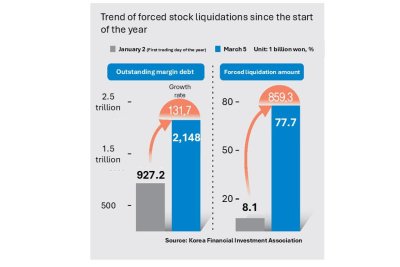
Trend of forced stock liquidations since the start of the year. Data from Korea Financial Investment Association. Graphic by Asia Today and translated by UPI
March 8 (Asia Today) — Forced stock sales in South Korea surged this week as rising market volatility triggered margin calls for investors who borrowed money to buy shares.
According to the Korea Financial Investment Association, forced liquidations totaled 77.7 billion won ($58 million) as of Wednesday, the eighth-largest amount recorded since the data began in 2006.
Outstanding margin balances also climbed to 2.15 trillion won ($1.6 billion), the highest level on record.
The sharp increase follows a strong rally in South Korean stocks earlier this year, driven largely by optimism surrounding artificial intelligence and semiconductor demand. However, geopolitical tensions in the Middle East have increased market volatility and halted the rally, prompting forced selling by heavily leveraged investors.
Margin balances occur when investors purchase stocks through brokerage accounts but fail to fully pay for the shares by the settlement deadline. If the funds are not repaid within two business days, brokerage firms may liquidate the holdings to recover the debt.
Analysts say the surge in forced sales highlights structural vulnerabilities in the South Korean stock market.
After tensions escalated in the Middle East, major East Asian markets including Japan, China, Taiwan and Hong Kong fell about 1% to 5% on the first trading day. South Korea’s market, however, dropped more than 12%, reflecting its heavier concentration in semiconductor stocks that had previously surged during the AI-driven rally.
The scale of outstanding margin balances has more than doubled since the start of the year. On the first trading day of 2026, unpaid balances totaled about 927.3 billion won ($690 million).
Because forced liquidations typically follow unpaid margin balances from the previous trading day, analysts warn that additional selling pressure could emerge if the outstanding balances remain elevated.
Yang Jun-seok said investors relying on borrowed funds should adopt a more cautious strategy.
“While the AI rally could continue supporting the broader market, volatility may increase due to developments related to Iran,” Yang said. “Investors using leverage are particularly vulnerable to market shocks and should consider exit strategies.”
When Catherine Bello received a text message from the World Food Programme (WFP) in August 2025, she was excited. She had been anticipating it ever since she applied for the Anticipatory Action Response (AAR), a WFP programme that provides “multipurpose cash assistance” to reduce the humanitarian impact of flooding in vulnerable communities.
Catherine lives in the Jimeta-Yola metropolis, an area in Adamawa State, northeastern Nigeria, that has experienced repeated flooding. A mother of four, she is a retired public-school teacher who now sells kunun zaki (Hausa for corn juice) to make ends meet.
She had hoped that the ₦208,184 AAR support would help her expand her business and save more to support her family.
However, that excitement faded when she arrived in Yola for data capture.
Officials asked Catherine to provide her National Identification Number (NIN) for verification. To her shock, the system flagged a mismatch. The name on the beneficiary list appeared as “Bello O. Catherine”, while her NIN record read “Catherine Bello”.
“It was the same NIN I gave them while filling the form,” she says. “They told me the name they saw didn’t match, so I couldn’t be captured.”
A missing middle-name initial was enough to exclude her from receiving assistance. Instead, she was advised to reconcile her records with the National Identity Management Commission (NIMC).
Across Nigeria, thousands of people, like Catherine, are locked out of essential services because of missing initials, misspelt names, and minor inconsistencies that trigger verification failures.
Nigeria’s digital identity system was built to include and connect millions of citizens to welfare, banking, education, and other opportunities. But for a growing number of Nigerians, the same system is becoming a barrier to accessing those services.
Identity as the backbone
Nigeria’s emerging digital public infrastructure (DPI) rests on three foundational pillars: digital identity (NIN); digital payments and financial inclusion (Bank Verification Number (BVN) and the Nigeria Inter-Bank Settlement System (NIBSS)); data exchange; and verification infrastructure.
At the centre of this system is the NIN, managed by NIMC. By late 2025, Nigeria had issued about 127 million NINs, roughly 60 per cent of the population, but millions remain unregistered or mismatched. Under the World Bank–supported Identification for Development programme, Nigeria aims to scale capacity to 250 million records and reach 85 per cent population coverage by 2027.
Digital identity is no longer optional. It is now increasingly required for SIM card registration, bank account linkage (NIN–BVN integration), social protection enrolment, scholarship applications, and access to tax and government services.
In theory, this integration promises efficiency, transparency, and inclusion. In practice, data inconsistencies, limited interoperability, and infrastructure gaps expose citizens to the risk of exclusion.
Experts warn that when people lack a valid digital ID, they can literally be locked out of basic services. Dennis Amachree, a national security analyst and former Assistant Director at the Department of State Security, notes that the rural-urban divide and the lack of enrolment infrastructure leave many, especially the elderly and rural populations, without the documentation they need to fully participate in banking, travel, and government services.
Meanwhile, the World Bank notes that Nigeria still has “a considerable gap” in identity coverage, especially among women, persons with disabilities, and other vulnerable groups. The global financial body observed that the lack of any recognised ID “prevents individuals from accessing critical government services, participating in the digital economy, and financial inclusion”.
For instance, Catherine’s hope of benefiting from the welfare package was dashed; a tiny database error translated into lost hopes.
SIM-NIN linkage – Security births exclusion
Alpha Daniel, a trader in Jimeta Modern Market, faced a different but related problem.
In 2024, the Nigerian Communications Commission, the country’s telecom regulator, demanded that all mobile phones be linked to NIN or risk being shut off. In September of the same year, millions of Nigerians woke up to find their SIM cards blocked. Alpha was one of them.
“I did everything right,” he says. “I went to the MTN shop, gave them my NIN, but after two tries, my line was still blocked.”
This was a familiar pattern. By mid-2024, telecoms reported that 13.5 million lines were barred for NIN non-compliance (8.6 million on MTN, 4.8 million on Airtel). By August 2024, Nigeria had linked 153 million SIMs to NIN (96 per cent of active lines). But that last 4 per cent represented some 6–7 million SIM connections that could no longer send or receive calls. Many complained that even after they finally registered or re-registered, their lines remained locked.
Get our in-depth, creative coverage of conflict and development delivered to you every weekend.
Subscribe now to our newsletter!
As one subscriber with Airtel put it, “Painfully, I have done this linkage at least twice, but still the line was barred”.
The government’s goal was to reduce phone-based fraud and make the digital economy safer, but for many Nigerians, losing a phone line means losing opportunities and even contact with relatives.
Signpost of SIM services outpost in Jimeta-Yola. Photo: Obidah Habila Albert/HumAngle
Ruth James, a graduate of Modibbo Adama University, Yola, had a scholarship application derailed when Nigeria’s ID system struck again. In early 2024, Ruth logged onto the Petroleum Technology Development Trust Fund (PTDF) scholarship portal and entered her details. The portal displayed a “NIN validation failed” message and locked her out.
“I filled out the form perfectly,” she says. “Then it said my NIN verification failed. I kept trying different browsers, but nothing worked. There was a help icon for failed verification on the portal. I clicked and sent several emails, but there was no response.” In the end, Ruth missed the deadline and lost a chance at much-needed financial aid.
Many federal programmes, from scholarship funds to youth training schemes, now require NIN verification. Online forums are filled with frustrated applicants: Jobs Inform noted dozens of “Not eligible” errors from a NIN mismatch or “verification failed” during registration.
These stories show how minor technical issues in Nigeria’s ID system can translate to a lack of access to education, banking, and social support, all of which are increasingly tied to digital identity.
Government policies and infrastructure gaps
The Nigerian government is aware of these issues. In 2024 and 2025, it rolled out several projects to strengthen Nigeria’s DPI, the foundational systems that underpin services. For example, the revised National Digital Identity Policy for SIM Card Registration explicitly ties SIM-NIN linkage to curb fraud.
The authorities also launched a NINAuth smartphone app in late 2025, which President Bola Tinubu hailed as “a milestone in our nation’s digital public infrastructure journey”. Tinubu has repeatedly emphasised that a “credible and inclusive National Identity Management System is fundamental to our national development goals”. In practice, the NINAuth app is meant to simplify identity checks for banks, hospitals, and government agencies, thereby reducing the need to manually look up each person’s NIN. However, the platform has not seen widespread adoption.
On the data side, Nigeria enacted a new Data Protection Act in June 2023, replacing the previous regulation. The new law imposes stricter rules (including special protections for children and a “duty of care” on data controllers). It was also a condition for the World Bank–supported Digital ID4D project.
These efforts are already yielding results: linking NIN with financial systems (NIN/BVN linkage) coincided with a jump in financial inclusion from 56 per cent in 2020 to 65 per cent by 2023. However, digital experts note that Nigeria’s DPI remains fragmented. Many government platforms and private services do not fully share data, forcing citizens to repeatedly verify their identity. Network outages and limited registration centres (especially in rural areas) still slow down NIN enrollment.
Worse, some Nigerians distrust the system after reports of lax data security. Khadijah El-Usman, a Senior Programme Officer for Anglophone West Africa at Paradigm Initiative, a digital rights group, warn that “the NIMC’s role is to secure this data. They have failed to do so”, referring to recent incidents where NIN data were allegedly sold on private websites.
Turning challenges into opportunities
Experts in digital governance say Nigeria must turn these challenges into opportunities for reform. Vincent Olatunji, National Commissioner and CEO of the Nigeria Data Protection Commission (NDPC), stresses that effective identity management must be built on harmonised policies, secure technologies, and inclusive systems to strengthen national digital trust. “Effective identity management requires harmonised policies, secure technologies, and inclusive systems,” he noted, linking strong governance with citizens’ confidence in digital IDs.
Likewise, Iremise Fidel-Anyanna, Head of Application Security, Governance, and Security Operations at the Nigeria Inter-Bank Settlement System (NIBSS), warns that “data privacy is the foundation of digital trust,” noting that privacy and security are essential to citizens’ willingness and ability to participate in digital services.
Chy Ameh, a digital identity expert based in Abuja, stresses the need for stronger privacy and trust protections, arguing that “to ensure the privacy and security of individual personal information, implement robust data protection measures such as strong encryption, secure authentication, consent and control over personal data, compliance with regulations, and regular audits” to distribute responsibility between both government and private actors.
Several other experts also highlight infrastructure bottlenecks and low public awareness: “Network glitches, poor connectivity, and limited registration centres impede effective ID rollout,” they note. In addressing this, experts urge large-scale outreach and education programmes to help people understand how and why to register for a NIN.
In simple terms, these experts say Nigeria needs to make digital ID registration easier by opening more NIMC centres in underserved areas and reducing unnecessary bureaucracy. There should also be clear public information campaigns, in local languages, to explain what the NIN is and why it matters. To build trust, the government must fully enforce data protection laws and ensure people’s personal information is safe.
Finally, better coordination among the government, banks, and telecom companies is needed so that systems work together smoothly and people do not have to repeat the same processes.
Best practices and cautionary tales
Globally, there are lessons for Nigeria. India’s Aadhaar programme, the world’s largest biometric ID system, now covers about 95 per cent of India’s population. Aadhaar made government transfers and SIM registration much smoother, but not without controversy; it has faced numerous legal challenges over data privacy and mandatory linking. Nigeria can learn from India’s experience by building strong privacy safeguards before demanding universal linkage.
In Kenya, the Huduma Namba initiative aimed to create a single ID for all services, but was suspended by the courts in 2020. Privacy advocates there won a ruling saying that collecting biometric data (even GPS or DNA) without adequate legal protection was unconstitutional. Kenya’s case shows that inclusion programmes can backfire if citizens fear their data will be mishandled. Nigeria’s reforms, such as the new Data Protection Act and the planned changes to the NIMC Act, seem aimed at avoiding such mistakes.
In Estonia, nearly 100 per cent of adults have a government-issued electronic ID card, and all state services are accessible online. This allows citizens to vote, pay taxes, and use healthcare portals seamlessly. Achieving this took decades of investment in both technology and public trust. For Nigeria, such a level of integration is a distant goal, but it shows what’s possible if the digital ID becomes reliable and user-friendly.
Bridging the divide
Catherine, Alpha, and Ruth all share a sense of being stranded by a system that was supposed to help them. Their stories reveal that digital infrastructure failures can be as damaging as physical ones. As President Tinubu himself put it, Nigeria must “eliminate unnecessary bottlenecks and ensure that every Nigerian has access to essential services without the frustration of bureaucratic delays”.
To avoid leaving people like Catherine on the sidelines, experts say the government needs to act on multiple fronts: fix the glitches, protect people’s data, and make the system easy to use. Only then can Nigeria’s grand digital ID ambitions translate into real help for its people.
This report is produced under the DPI Africa Journalism Fellowship Programme of the Media Foundation for West Africa and Co-Develop.
REALITY TV star Paul Preece Jr who won the Netflix survival show Outlast has been charged with raping a child.
The 51-year-old was arrested in Tennessee on Friday and booked into Knox County Jail.
Sign up for the Showbiz newsletter
Thank you!
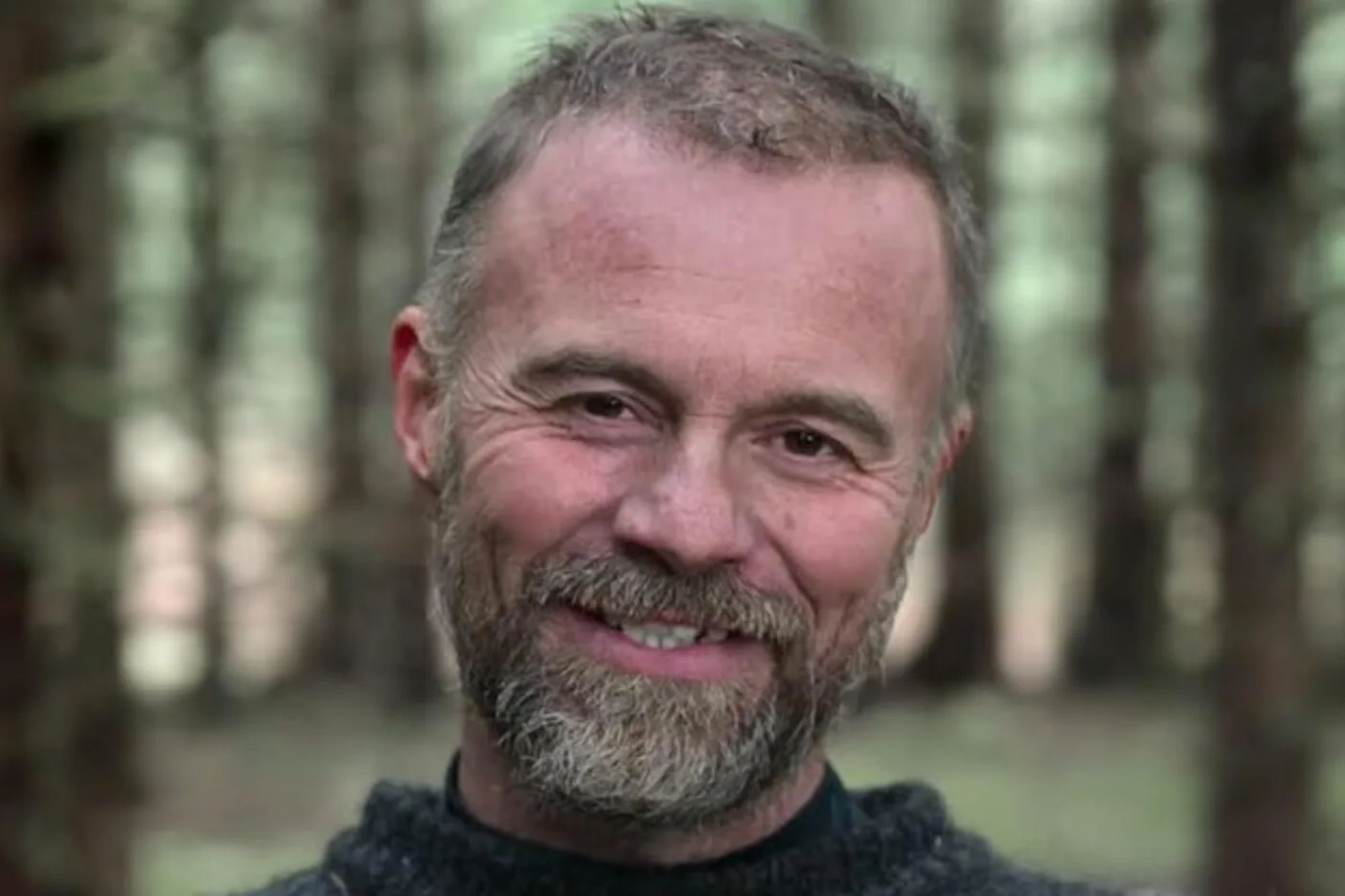
Paul Preece Jr, winner of Netflix show Outlast, has been charged with child rapeCredit: NetflixJail records show Preece is being held on a $150,000 bondCredit: JIMS
Jail records show Preece has also been charged with aggravated sexual battery and attempted rape of a child, The Daily Mail reports.
The age of the victim has not yet been released.
Preece is currently being held on a $150,000 bond and will be required to wear a GPS tracker upon release.
His arrest comes after a capias warrant was issued, according to TMZ.
The court-ordered warrant is typically used when a person fails to appear in court, violates bond conditions, or neglects to pay court-ordered fines or child support.
Preece rose to prominence after competing on the first season of Outlast in 2023.
The gruelling reality show sees a group of contestants trying to survive remote Alaskan terrain in punishing conditions for a chance at a $1 million prize.
Sixteen participants are dropped by parachute into the wilderness before being divided into teams.
Most read in Entertainment
Season one was filmed on the Neka River on Chichagof Island, while series two moved south of Petersburg to Little Duncan Bay.
Unlike many competition shows, contestants cannot compete alone.
Participants are allowed to switch teams throughout the competition.
The only way to leave the game is to quit.
Preece won the inaugural season alongside teammates Seth Lueker and Nick Radner.
Season two landed in the Global Top 10 in 22 countries.
Two Texas men, Drake Vliem II and Drew Haas, won the million-dollar pay-out in the second series.
The series was renewed for a third season in February 2025.
Preece won the first series of Outlast – bagging $1 million with his teammatesCredit: Netflix
Juho Maalahti, head of Sustainable Finance Advisory at Nordea—this year’s Best Bank for Sustainability Transparency in Western Europe—discusses the next phase of sustainable finance and the impact of regulatory uncertainty.
Global Finance: What do you expect will be the biggest challenge for the sustainability market in 2026?
Juho Maalahti: While global ESG headwinds created some volatility in the sustainability market during 2025, we found that these were mostly reflected in headlines rather than in underlying market sentiment. What was particularly encouraging was seeing Nordic companies and institutions maintain their approach to sustainability despite the regulatory uncertainty that characterized much of the last year.
The fundamental need for a transition to a more resilient and sustainable economy has not disappeared. Looking ahead in 2026, we see a market where the real-economy transition continues to advance on multiple fronts, from critical infrastructure to industrial decarbonization investments. Rather than focusing on just one challenge, the key will be addressing all these areas while maintaining momentum.
GF: What are you seeing as the next “evolution” of KPIs?
Maalahti: Transparency and simplification are important factors for scaling the market further, and we’ve seen consolidation in KPI-linked facilities over the past few years. Companies are increasingly moving toward harmonization between their public non-financial reporting and financing arrangements.
We see sustainability as a natural part of Nordic DNA, and many Nordic companies—especially the large ones—have a long history in sustainability, coupled with targets to reduce climate emissions. Consistency in reporting—whether to financiers, investors, or the public—is important for transparency and market growth. We see companies wanting to ensure their sustainability metrics are aligned across different use cases.
GF: How resilient is investor demand for sustainable assets if rates stay high or politics turn? And what does that mean for issuance timing and terms?
Maalahti: Despite market volatility and uncertainty in 2025, we continued to see green bonds attracting slightly higher order books compared to conventional bonds, especially in the euro market. This demonstrates that investor appetite for sustainable assets has remained resilient even in challenging conditions.
We continue to provide financing and solutions that support our clients’ investment goals. While political and economic headwinds may create short-term volatility, the underlying demand for sustainable investments appears to be holding firm.
GF: Which risks related to sustainability will most affect company balance sheets over the near term? And what should CFOs tackle first in response?
Maalahti: While there has been uncertainty around the regulatory landscape recently, climate risks have not disappeared and continue to pose real threats to company balance sheets. We have developed our own maturity ladder concept to evaluate our customers’ climate transition plans, which helps us better understand how our customers are adapting their business models and strategies to the shift toward a low-carbon economy.
Rather than waiting for regulatory clarity, companies should focus on developing robust transition plans that address both physical and transition risks. One of our 2025 KPIs was to have 90% of our lending exposure in climate-vulnerable sectors covered by transition plans, reflecting the importance we place on proactive risk management in this area.
GF: What’s your bar for calling financing sustainable, and how do you prevent label inflation as the market grows?
Maalahti: Much of market growth, especially during the pre-Covid period, was attributable to new labels being introduced. Since then, we’ve seen harmonization and increased scalability as the market has matured. As a European bank, we adhere to global standards and European regulations. We set ourselves a target to facilitate more than €200 billion of sustainable finance by 2025, and we well exceeded that target. This achievement reflects our commitment to maintaining rigorous standards while scaling our sustainable finance offerings.
SACRAMENTO — California Gov. Gavin Newsom has positioned himself as a national public health leader by staking out science-backed policies in contrast with the Trump administration.
After Health and Human Services Secretary Robert F. Kennedy Jr. fired Centers for Disease Control and Prevention Director Susan Monarez for refusing what her lawyers called “the dangerous politicization of science,” Newsom hired her to help modernize California’s public health system. He also gave a job to Debra Houry, the agency’s former chief science and medical officer, who had resigned in protest hours after Monarez’s firing.
Newsom also teamed up with fellow Democratic governors Tina Kotek of Oregon, Bob Ferguson of Washington and Josh Green of Hawaii to form the West Coast Health Alliance, a regional public health agency, whose guidance the governors said would “uphold scientific integrity in public health as Trump destroys” the CDC’s credibility. Newsom argued establishing the independent alliance was vital as Kennedy leads the Trump administration’s rollback of national vaccine recommendations.
More recently, California became the first state to join a global outbreak response network coordinated by the World Health Organization, followed by Illinois and New York. Colorado and Wisconsin signaled they plan to join. They did so after President Trump officially withdrew the United States from the agency on the grounds that it had “strayed from its core mission and has acted contrary to the U.S. interests in protecting the U.S. public on multiple occasions.” Newsom said joining the WHO-led consortium would enable California to respond faster to communicable disease outbreaks and other public health threats.
Although other Democratic governors and public health leaders have openly criticized the federal government, few have been as outspoken as Newsom, who is considering a run for president in 2028 and is in his second and final term as governor. Members of the scientific community have praised his effort to build a public health bulwark against the Trump administration’s slashing of funding and scaling back of vaccine recommendations.
What Newsom is doing “is a great idea,” said Paul Offit, an outspoken critic of Kennedy and a vaccine expert who formerly served on the Food and Drug Administration’s vaccine advisory committee but was removed under Trump in 2025.
“Public health has been turned on its head,” Offit said. “We have an anti-vaccine activist and science denialist as the head of U.S. Health and Human Services. It’s dangerous.”
The White House did not respond to questions about Newsom’s stance and Health and Human Services declined requests to interview Kennedy. Instead, federal health officials criticized Democrats broadly, arguing that blue states are participating in fraud and mismanagement of federal funds in public health programs.
Health and Human Services spokesperson Emily Hilliard said the administration is going after “Democrat-run states that pushed unscientific lockdowns, toddler mask mandates, and draconian vaccine passports during the COVID era.” She said those moves have “completely eroded the American people’s trust in public health agencies.”
Public health guided by science
Since Trump returned to office, Newsom has criticized the president and his administration for engineering policies that he sees as an affront to public health and safety, labeling federal leaders as “extremists” trying to “weaponize the CDC and spread misinformation.” He has excoriated federal officials for erroneously linking vaccines to autism, warning that the administration is endangering the lives of infants and young children in scaling back childhood vaccine recommendations. And he argued that the White House is unleashing “chaos” on America’s public health system in backing out of the WHO.
The governor declined an interview request, but Newsom spokesperson Marissa Saldivar said it’s a priority of the governor “to protect public health and provide communities with guidance rooted in science and evidence, not politics and conspiracies.”
The Trump administration’s moves have triggered financial uncertainty that local officials said has reduced morale within public health departments and left states unprepared for disease outbreaks and prevention efforts. The White House last year proposed cutting Health and Human Services spending by $33 billion, including $3.6 billion from the CDC. Congress largely rejected those cuts last month, although funding for programs focusing on social drivers of health, such as access to food, housing and education, were axed.
The Trump administration announced that it would claw back more than $600 million in public health funds from California, Colorado, Illinois and Minnesota, arguing that the Democratic-led states were funding “woke” initiatives that didn’t reflect White House priorities. Within days, the states sued and a judge temporarily blocked the cut.
“They keep suddenly canceling grants and then it gets overturned in court,” said Kat DeBurgh, executive director of the Health Officers Assn. of California. “A lot of the damage is already done because counties already stopped doing the work.”
Federal funding has accounted for more than half of state and local health department budgets nationwide, with money going toward fighting HIV and other sexually transmitted infections, preventing chronic diseases, and boosting public health preparedness and communicable disease response, according to a 2025 analysis by KFF, a health information nonprofit that includes KFF Health News.
Federal funds account for $2.4 billion of California’s $5.3-billion public health budget, making it difficult for Newsom and state lawmakers to backfill potential cuts. That money helps fund state operations and is vital for local health departments.
Funding cuts hurt all
Los Angeles County public health director Barbara Ferrer said if the federal government is allowed to cut that $600 million, the county of nearly 10 million residents would lose an estimated $84 million over the next two years, in addition to other grants for prevention of HIV and other sexually transmitted infections. Ferrer said the county depends on nearly $1 billion in federal funding annually to track and prevent communicable diseases and combat chronic health conditions, including diabetes and high blood pressure. Already, the county has announced the closure of seven public health clinics that provided vaccinations and disease testing, largely because of funding losses tied to federal grant cuts.
“It’s an ill-informed strategy,” Ferrer said. “Public health doesn’t care whether your political affiliation is Republican or Democrat. It doesn’t care about your immigration status or sexual orientation. Public health has to be available for everyone.”
A single case of measles requires public health workers to track down 200 potential contacts, Ferrer said.
The U.S. eliminated measles in 2000 but is close to losing that status as a result of vaccine skepticism and misinformation spread by vaccine critics. The U.S. had 2,281 confirmed cases last year, the most since 1991, with 93% in people who were unvaccinated or whose vaccination status was unknown. This year, the highly contagious disease has been reported at schools,airports and Disneyland.
Public health officials hope the West Coast Health Alliance can help counteract Trump by building trust through evidence-based public health guidance.
“What we’re seeing from the federal government is partisan politics at its worst and retaliation for policy differences, and it puts at extraordinary risk the health and well-being of the American people,” said Georges Benjamin, executive director of the American Public Health Assn., a coalition of public health professionals.
Robust vaccine schedule
Erica Pan, California’s top public health officer and director of the state Department of Public Health, said the West Coast Health Alliance is defending science by recommending a more robust vaccine schedule than the federal government. California is part of a coalition suing the Trump administration over its decision to rescind recommendations for seven childhood vaccines, including for hepatitis A, hepatitis B, influenza and COVID-19.
Pan expressed deep concern about the state of public health, particularly the uptick in measles. “We’re sliding backwards,” Pan said of immunizations.
Sarah Kemble, Hawaii’s state epidemiologist, said Hawaii joined the alliance after hearing from pro-vaccine residents who wanted assurance that they would have access to vaccines.
“We were getting a lot of questions and anxiety from people who did understand science-based recommendations but were wondering, ‘Am I still going to be able to go get my shot?’” Kemble said.
Other states led mostly by Democrats have also formed alliances, with Pennsylvania, New York, New Jersey, Massachusetts and several other East Coast states banding together to create the Northeast Public Health Collaborative.
Hilliard, of Health and Human Services, said that even as Democratic governors establish vaccine advisory coalitions, the federal Advisory Committee on Immunization Practices “remains the scientific body guiding immunization recommendations in this country, and HHS will ensure policy is based on rigorous evidence and gold standard science, not the failed politics of the pandemic.”
Influencing red states
Newsom, for his part, has approved a recurring annual infusion of nearly $300 million to support the state Department of Public Health, as well as the 61 local public health agencies across California, and last year signed a bill authorizing the state to issue its own immunization guidance. It requires health insurers in California to provide patient coverage for vaccinations the state recommends even if the federal government doesn’t.
Jeffrey Singer, a doctor and senior fellow at the libertarian Cato Institute, said decentralization can be beneficial. That’s because local media campaigns that reflect different political ideologies and community priorities may have a better chance of influencing the public.
A KFF analysis found some red states are joining blue states in decoupling their vaccine recommendations from the federal government’s. Singer said some doctors in his home state of Arizona are looking to more liberal California for vaccine recommendations.
“Science is never settled, and there are a lot of areas of this country where there are differences of opinion,” Singer said. “This can help us challenge our assumptions and learn.”
KFF Health News is a national newsroom that produces in-depth journalism about health issues and is one of the core operating programs at KFF — the independent source for health policy research, polling and journalism.
RYANAIR is scrapping more flights to Spain and it will affect one of the country’s popular airports.
The budget airline has already axed millions of seats in recent months, citing expensive airport fees and charges.
Sign up for the Travel newsletter
Thank you!
Ryanair is scrapping more seats to SpainCredit: GettyGirona Airport connects Brits to both Barcelona and Costa BravaCredit: Alamy
And Ryanair has since confirmed that Girona Airport will be the latest victim, with 11 per cent fewer seats nextsummer.
The airline cited the “failed fee system” for the removals of seats, according to local media.
Alejandra Ruiz, the airline’s spokesperson in Spain, said: “Ryanair had ambitious growth plans for Catalonia’s regional airports, where it could have allocated a fifth aircraft to Girona, a new base in Reus, and unprecedented growth at both airports under competitive and beneficial conditions for all airlines.
“However, we are still waiting for a response from the Spanish government, which has no plans to fix these regional airports.”
This photo, taken Monday, shows the trading room of Hana Bank in central Seoul as the South Korean won fell to a 17-year low against the U.S. dollar. The won was quoted at 1,495.5 won per dollar at the close of trading hours at the Korean Stock Exchange. Photo by Yonhap
The South Korean won fell to a 17-year low against the U.S. dollar Monday amid heightened market volatility as oil prices spiked following the expanding conflict in the Middle East.
The won was quoted at 1,495.5 won per dollar at 3:30 p.m., down 19.1 won from the previous session, marking the weakest level since March 12, 2009, when the won-dollar rate hit 1,496.5 won during the global financial crisis.
After opening at 1,493 won, the won-dollar rate touched 1,499.2 won at 10:22 a.m., the lowest intraday level since that day, when the rate reached 1,500 won.
Investor sentiment was dampened by instability in global energy prices. The U.S. benchmark West Texas Intermediate (WTI) crude surpassed US$100 per barrel for the first time since July 2022 on Sunday (U.S. time).
The recent decline in the won has also been driven by a broad dollar rally amid concerns that the U.S.-Israeli operation could escalate into a prolonged regional war.
Copyright (c) Yonhap News Agency prohibits its content from being redistributed or reprinted without consent, and forbids the content from being learned and used by artificial intelligence systems.
President Volodymyr Zelensky has said Ukrainian drone experts will arrive in the Middle East this week to help Gulf states under attack from Iran.
In recent days, Iran has fired a number of Shahed drones across the Middle East – and some air defences in the region have struggled to cope.
Ukraine has spent the last four years inventing cheap but effective ways of defending their skies from similar Russian strikes, and now some countries have come knocking on their door to ask for help.
The BBC’s Diplomatic Correspondent, James Landale, is in Ukraine and has been to see the latest anti-drone technology the country has to offer.
Fans of Harry Styles were convinced the star gave his girlfriend Zoe Kravitz a sweet nod during his One Night Only show last weekCredit: PAZoe and Harry have been dating since last yearCredit: TheImageDirect.comFans are convinced they noticed a nod from Harry to someone backstage following his Manchester performanceCredit: Netflix
And since tuning in on the streaming platform, some fans are convinced they noticed a moment between Harry and his girlfriend Zoe, 37.
Now, some are convinced that the look was towards Zoe.
“THAT LOOK? I THINK I KNOW WHO WAS THERE,” wrote one viewer alongside the clip from the show.
Zooming in on the clip and seemingly making out someone’s arm, another fan replied: “there’s definitely someone there”.
During the performance, Harry revealed that among the audience were his family — and friends including James Corden and Apple Music’s Zane Lowe.
And he even revealed that the “very special person” behind his track Carla’s Song was in the audience.
However, Zoe is thought to have been in Paris while Harry took to the stage in Manchester – debunking fan’s theories.
The American actress and singer was spotted taking in some couture culture during the French city’s fashion week just two days before her boyfriend’s gig.
As war in Iran rages, to add to other troubles, Harry said: “In a world like we have today that feels so chaotic it’s easy to feel so hopeless.
“But seeing this room, where there is so much hope, I encourage you to keep being the change in the world that you want to see.
“There are so many dangerous things that feel so powerful but love and kindness are powerful — go out and spread it.
“The world could use a little extra peace right now.”
Harry performed at Manchester’s Co-Op Live to showcase his fourth studio albumCredit: GettyHowever, Zoe is thought to have been in Paris for the city’s fashion week while her boyfriend was performingCredit: Getty
European stock markets were all in negative territory on Monday morning after weak sentiment in Asian markets, where Japan’s benchmark Nikkei 225 index plunged more than 5% and Taiwan’s benchmark fell 4.4%.
ADVERTISEMENT
ADVERTISEMENT
Other Asian markets also tumbled after oil prices soared to nearly $120 a barrel, casting a shadow over economies heavily dependent on imported crude and gas from the region.
In Europe, London’s FTSE 100 was down 1.6%, while Frankfurt’s DAX, Paris’s CAC 40 and Milan’s FTSE MIB were all down more than 2.4%, as of 09:30 CET. Madrid’s IBEX 35 fell nearly 2.7%, and the pan-European Stoxx 600 lost about 2%.
While rising oil and gas prices are threatening Europe’s economic outlook this year, trading sentiment was further impacted on Monday by worse-than-expected data from Germany.
German industrial production and factory orders both fell at the start of the year. Output decreased by 0.5% in January following a revised 1% decline the previous month, the statistics office said on Monday.
Meanwhile, investor expectations are rising that the European Central Bank could raise benchmark interest rates this year, as soaring energy prices fuel fears that inflation may surge.
The panic in the stock market unfolded as oil prices became the main focus for investors.
Oil prices soaring
Oil prices rocketed higher as both sides in the Iran conflict struck new targets over the weekend, including civilian infrastructure. The war, now in its second week, involves regions critical to the production and transport of oil and gas from the Persian Gulf.
Prices moderated after the Financial Times reported that some members of the Group of Seven (G7) were considering releasing strategic oil reserves to ease pressure on markets. The unconfirmed report cited unnamed sources familiar with the discussions.
Oil prices spiked near $120 per barrel before falling back on Monday as the conflict intensified, threatening production and shipping in the Middle East and rattling global financial markets.
The price for a barrel of Brent crude, the international benchmark, surged to $119.50 early in the day but later traded around $107.80.
West Texas Intermediate (WTI), the US benchmark, spiked to $119.48 per barrel but fell back to around $103 by the European market open.
Strikes on Iranian oil facilities risk increasing pressure on an already tight global energy market, analysts warned. Lindsay James, investment strategist at Quilter, said “Iran accounts for roughly 4% of global oil supply, and around 90% of its exports are directed to China.”
The world’s second-largest economy has vast reserves, but analysts say any prolonged damage to Iran’s export capacity could weigh on its economic recovery and eventually affect global markets.
James also warned that attacks on shipping and energy infrastructure in the Gulf risk escalating tensions and unsettling markets that had initially expected the conflict to be resolved quickly.
After disruptions in the Strait of Hormuz linked to the conflict, the European gas market is also under pressure. Natural gas futures jumped more than 14% on Monday to above €61 per megawatt-hour, nearing their highest level in three years and extending last week’s 67% surge.
Several major producers in the region have cut back output, and Qatar’s Ras Laffan facility — the world’s largest liquefied natural gas (LNG) plant — was shut down last week.
Russia has also warned it could halt natural gas exports to Europe, adding to market anxiety.
At the same time, Europe’s gas reserves remain low, with EU storage levels below 30% and requiring refilling.
Early Monday, the US dollar, which retains its status as a safe-haven asset, gained against other major currencies. It was trading at 158.46 Japanese yen, up from 158.09 late Friday. The euro rose slightly to $1.1558 from $1.1556.
In other trading, gold prices were down more than 1% on Monday morning in Europe, trading around $5,100, while cryptocurrencies were mostly higher. One bitcoin traded at $67,774, up 0.7%.
IMF: ‘Think of the unthinkable and prepare for it’
As fears grow over how long the war could last — and with Asian markets, often seen as engines of global growth, under heavy pressure — International Monetary Fund Managing Director Kristalina Georgieva warned that policymakers must prepare for the “unthinkable.”
“If the new conflict proves prolonged, it has clear and obvious potential to affect market sentiment, growth, and inflation, placing new demands on policymakers,” Georgieva said in a keynote speech at a symposium in Tokyo on Monday.
She reminded her audience that, as a rule of thumb, every 10% increase in oil prices — if sustained through most of the year — could raise global headline inflation by about 40 basis points and reduce global output by 0.1–0.2%.
“And if, as we all hope, the conflict ends soon, then be sure that, before long, some new shock will come. My advice to policymakers everywhere in this new global environment? Think of the unthinkable and prepare for it,” she added.
Two years after Huntington Beach residents voted to effectively ban Pride flags from being displayed on city property, the conservative coastal city could be represented by a gay member of Congress and outspoken critic of President Trump — Rep. Robert Garcia.
That twist of fate came after last year’s unprecedented mid-decade rejiggering of California’s congressional districts.
Voters in November overwhelmingly approved Proposition 50 — Gov. Gavin Newsom’s plan to neutralize Republican gerrymandering in Texas — to help Democrats win control of the House this November and put a meaningful check on the Trump administration.
The political tremors triggered by the ballot measure already have reshaped California’s political landscape.
Veteran Republican Rep. Darrell Issa of northern San Diego County, an incessant thorn in the backside of President Obama, has called it quits. Northern California Rep. Kevin Kiley has shed his GOP label to run as a political independent. And two Republican congressional incumbents find themselves in a political death match in a newly crafted district straddling Orange, Riverside and San Bernardino counties.
The new 42nd District remains anchored in Garcia’s home base of Long Beach. But under the new lines, it has swapped out Southeast L.A. communities such as Downey and Bell Gardens for the more MAGA-friendly cities of Huntington Beach and Newport Beach.
“I say that every time a district crosses the L.A.-Orange County border, a Democrat gets its wings,” said Paul Mitchell, the redistricting expert who drew the new lines for Democrats. “Drawing the Long Beach district to go down to Huntington Beach meant that you’re giving Robert Garcia a community that, in its elected City Council, has been real anathema to who he is as a person, being an out gay member of Congress.”
The change means Garcia’s district shifts rightward with a lot more Republican voters, but still has a Democratic majority. Former Vice President Kamala Harris would have still won the new district in the 2024 presidential race by 13 points, making Democrats confident that it’s still one where Garcia could win.
As the top Democrat on the House Oversight Committee, Garcia is poised to win more power in pushing back against the Trump administration if historical precedent holds and Democrats win back the House majority in November.
Garcia was unavailable for an interview, but many of the new voters he will have to court are represented by Rep. Dave Min (D-Irvine), who won the closely divided Orange County seat in 2024 and now faces a slightly bluer voting base in his newly configured district.
“I have a lot of voters to introduce myself to,” said Min, who described himself as “progressive for Orange County” because he cares about protecting civil rights but often aligns with law enforcement and small-business interests.
“The message [to new voters] is that you may not always agree with me, but that I will try my best to do what I say. I will fight to deliver on the promises I make, I will fight for the values that I represent myself as caring about. And I listen to my constituents,” he said, noting that he recently held his seventh town hall since he was elected.
In a neighboring Orange County district, Republican Reps. Young Kim and Ken Calvert are going to battle for control of the region’s only safe Republican seat post-Proposition 50. That district also crosses county lines — into Corona, Chino Hills and other parts of western Riverside and San Bernardino counties.
Republicans may be dismayed to see the two popular party leaders battling it out in what promises to be a brutal and expensive election.
Republican “primary voters are looking for how to distinguish between two of the same flavor,” said Rob Stutzman, a Republican political strategist. “Republican voters are going to like both of them, so how do you make that judgment?
“Often, it comes down to who their friends are,” he said, noting that endorsements from interest groups and other elected officials are usually more valuable in primaries than general elections.
A handful of Democratic candidates have also declared for the seat, which campaign strategists said could split the liberal vote and allow both Calvert and Kim to advance to the general election ballot.
Issa bids farewell, Kiley drops GOP label
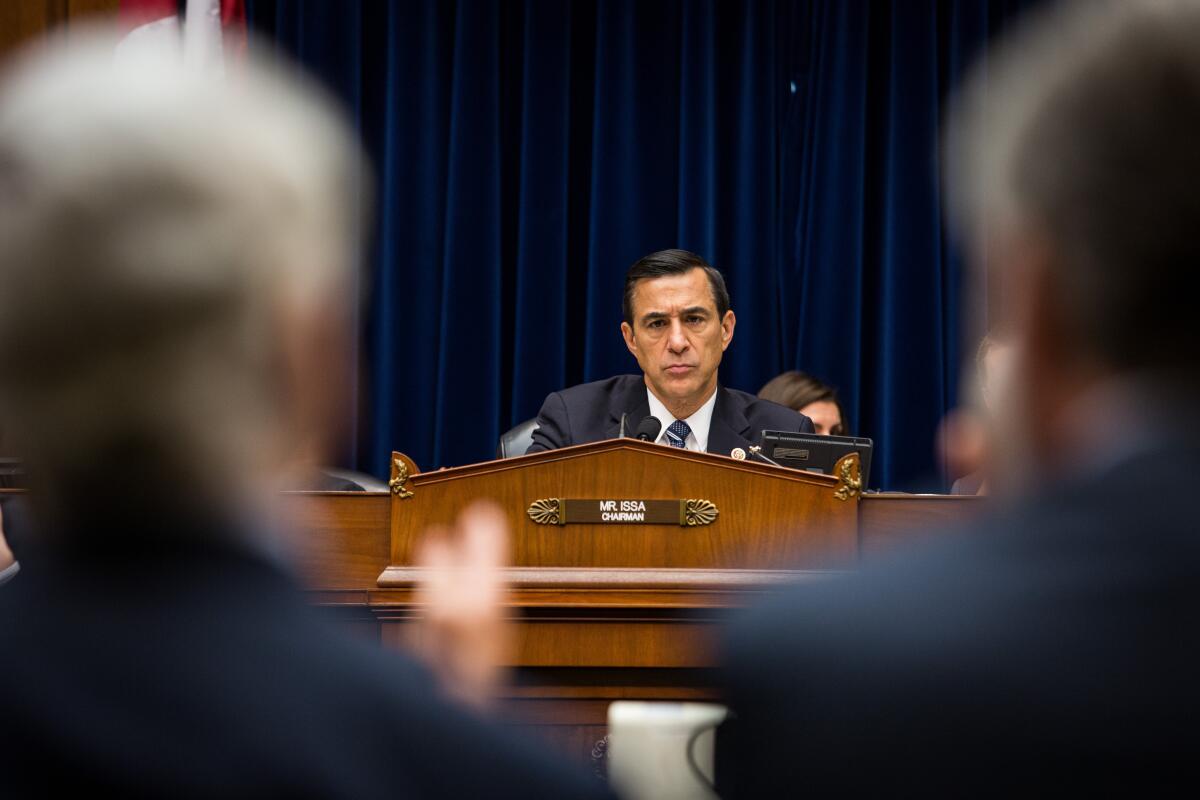
Chairman Darrell Issa (R-Bonsall) listens to testimony from witnesses during a House Oversight Committee hearing entitled “Reviews of the Benghazi Attack and Unanswered Questions,” in the Rayburn House Office Building on Capitol Hill in 2013 in Washington.
(Drew Angerer / Getty Images)
Issa’s decision to forgo a run for reelection came as a surprise Friday, even though speculation has swirled about his future after the newly drawn congressional districts put him in a seat where Democratic voters outnumber Republicans. That was a major downgrade from his current district, which swallows up right-leaning eastern San Diego County and the conservative pockets of Temecula and Murrieta.
“This decision has been on my mind for a while and I didn’t make it lightly,” Issa said in a statement. “But after a quarter-century in Congress — and before that, a quarter-century in business — it’s the right time for a new chapter and new challenges.”
Democrats celebrated the departure of Issa, who helped fund the successful 2003 recall of California Democratic Gov. Gray Davis, and led the congressional investigation of the 2012 attack on the U.S. diplomatic mission in Benghazi during the Obama administration.
“After over two decades of disastrous representation, Darrell Issa is once again running for the exits — and good riddance,” said Anna Elsasser, spokesperson for the Democratic Congressional Campaign Committee.
Several Democrats had already announced plans to challenge Issa, including San Diego City Councilmember Marni Lynn von Wilpert.
Proposition 50 also split the sprawling district held by Kiley, a Republican from Rocklin, into six pieces, leaving the Northern California congressman and frequent Newsom critic with few good options.
Over the following months Kiley posted on social media to announce — like the dating show “The Bachelor” — where he would not run until it came down to two districts: a safe Republican seat that would force Kiley into a primary with longtime Rep. Tom McClintock (R-Elk Grove) or a district with a 9-point Democratic registration advantage.
Kiley chose to avoid challenging McClintock and delivered his final rose to the new 6th District along with a twist: On Friday the congressman announced he would run as an independent candidate rather than a Republican.
Rep. Kevin Kiley (R-Rocklin) in his office in Washington in 2025.
(Richard Pierrin / For The Times)
In a lengthy social media post and accompanying video, Kiley said he has become “frustrated, sometimes disgusted, by the hyper-partisanship in Congress” and that he answers to constituents, “not party leaders.”
But without a political party behind him, Kiley’s campaign is “entirely his burden,” said Republican strategist Matt Rexroad. “He’s not going to get the party endorsement. He’s really on his own.”
Without a letter denoting a political party next to their name on the ballot, independent candidates have historically gotten lost in the mix.
One other candidate, a Christian author named Michael Stansfield, confirmed Friday that he filed to run for the seat as a Republican, giving Kiley automatic competition for conservative votes.
Several Democrats have already announced campaigns for the seat — which lumps conservative suburbs of Sacramento with liberal-leaning ones closer to the capital city — including former state Sen. Richard Pan, Sacramento Dist. Atty. Thien Ho, West Sacramento Mayor Martha Guerrero and Lauren Babb, a public affairs leader for Planned Parenthood clinics in California and Nevada.
For some longtime Democrats such as Rep. Brad Sherman, the addition of new GOP voters could help them fend off challenges from younger progressive candidates.
Half a dozen Democrats, mostly younger progressives, have filed paperwork to challenge Sherman (D-Sherman Oaks), 71, who has represented parts of the San Fernando Valley for nearly 30 years.
The 32nd District remains solidly blue post-Proposition 50, but a nearly seven-point swing to the right “makes it less likely that two Democrats go to the general, which makes it less likely that [Sherman] would get beaten,” said Mitchell.
It’s a similar story for Reps. Doris Matsui (D-Sacramento), Mike Thompson (D-St. Helena) and John Garamendi (D-Walnut Grove), who are all in their 70s and 80s and facing younger, more progressive challengers.
While gaining more conservative voters may help some incumbents avoid facing another Democrat in November, the threat of such a faceoff is pushing them to be more active on the campaign trail, Rexroad said.
“You’re seeing more activity by Doris Matsui and Mike Thompson and John Garamendi as a result of them being challenged, because they like their seats and they’d like to hold on to them,” Rexroad said.
Times staff writer Seema Mehta contributed to this report.
Lakers center Jaxson Hayes, left, dives for a loose ball next to Knicks forward OG Anunoby in the first half Sunday.
(Robert Gauthier / Los Angeles Times)
Hayes crawled across the floor for loose balls. Marcus Smart stepped in front of driving opponents. Jarred Vanderbilt leaped into the laps of front-row fans.
With energy and focus from every player, the Lakers delivered one of their best defensive efforts of the season despite circumstances that could have made Sunday’s game a snoozer.
The Lakers were playing their third game in four days. Losing an hour of sleep because of daylight saving time had Rui Hachimura sleepwalking into the arena Sunday morning for a 12:30 p.m. tip. Hoping to wake himself up, the Lakers forward said he got into the hot tub when he arrived.
Players tried to hype themselves up in the locker room by blasting music. Instead of listing three defensive keys before the game, coaches whittled the game plan to one focus: multiple efforts.
“It wasn’t gonna be an offensive game,” coach JJ Redick said. “This was gonna be a gritty, tough game that we had to win with effort. And we did that.”
Smart led that effort with a game-high plus-27 in 29 minutes and 17 seconds. He drew two charges. His signature moment didn’t even show up in the game play-by-play. After Luka Doncic turned the ball over with 2.2 seconds remaining in the third quarter, Smart hustled back to force Jordan Clarkson to pass the ball at the buzzer, keeping the Knicks from getting a last-second layup attempt. Smart walked to the bench with his arms extended like a defensive back who had just broken up a touchdown pass.
The Knicks were held to less than 100 points for only the seventh time and had their fourth-worst three-point shooting performance of the season, going eight for 34. The Lakers went nearly five minutes without scoring in the fourth quarter, but held on by forcing eight turnovers.
“It was not a perfect game,” said Doncic, who led the Lakers with 35 points on 11-for-25 shooting. “But we fight at the defensive end. I think we did a great job. It says a lot about the team, bringing this much energy in a game like this.”
My husband and I celebrate our 40th wedding anniversary in April! Years ago we planned to go to Paris (as we did on our 25th), but now our 17-year-old dog can’t be left alone with a dog sitter for that long. And look, our cat is 15! Any recommendations for a special dinner (we live in the Pasadena/Highland Park area) and maybe a little escapade where we would only be gone for shorter bursts? Hints: We love theater, movies, the beach, laughing and food that is divine, but not so rich you can’t stand up after. I also can’t eat dairy. — Diane Kelber
Looking for things to do in L.A.? Ask us your questions and our expert guides will share highly specific recommendations.
Here’s what we suggest:
First and foremost, congratulations on 40 years of marriage! That’s a milestone definitely worth celebrating. Also, I hear you on not wanting to leave your dog for an extended period of time. Although you won’t be able to make it to Paris this time, hopefully we can bring glimpses of the romantic city to you here in L.A. I’ve compiled a list of spots for you to create your own adventure.
If you look closely enough, you can find slices of Europe in L.A. Or as my colleague Christopher Reynolds once put it, places that aim to “feed travel dreams or remind someone of home.” A prime example of this are the many French restaurants in the city where you can indulge in as many macarons, steak frites and beef bourguignon as you’d like. Two standout spots are Camélia and Pasjoli, both featured on the L.A. Times list of 101 Best Restaurants. Located in the downtown Arts District, Camélia merges French and Japanese cuisines. On the menu is uni pasta, hanger steak au poivre and a dry-aged burger with fries, which restaurant critic Bill Addison says doesn’t require any twists because “it’s simply a fantastic burger.”
Restaurant critic Jenn Harris says the Santa Monica-based Pasjoli “straddles the line between destination dining and the kind of neighborhood restaurant everybody wants to have down the street.” The eatery is best known for its tableside pressed duck, which the chef prepares in a theatrical fashion during dinner service. But if you’re not into duck, there are several other popular dishes on the menu, including French onion soup, steak frites, sole meuniere and what Harris calls “the best grilled cheese sandwich in the known universe” (though this might be a better option for your husband).
If you prefer a more laid-back vibe that makes you feel like you’ve been teleported to Saint-Germain-des-Prés in Paris, check out Figaro Bistrot in Los Feliz. As I wrote in a guide about neighborhood, the restaurant embodies the Parisian way of dining: guests linger over wine and good conversation.
Another L.A. spot that is reminiscent of Europe is the the Getty Center in Brentwood. Designed by architect Richard Meier, the sprawling hilltop complex is gleaming with manicured gardens, breathtaking city views and a museum, making it the perfect backdrop for a romantic date. Bring a blanket, your favorite snacks and have a picnic on the lawn near the central garden. The best part is that it’s free to visit (though reservations are required and parking rates vary depending on the time of day). For a more intimate experience, check out the Getty Villa in Malibu, modeled after the Villa dei Papiri in Herculaneum, Italy.
For a picturesque date that feels like you’ve been plopped onto a movie set, consider the Gondola Getaway in Long Beach. Here, a gondolier takes you on a loop around an enchanting residential Naples Island. Years ago, I went on a date there and I’ve been wanting to go back ever since.
Now for some rapid fire recommendations: Since you’re into theater, my colleague Lisa Boone suggests the Pasadena Playhouse, a Tony Award-winning theater, which is close to home for you. Times outdoors reporter Jaclyn Cosgrove also recommends drinks and dinner on the charming balcony at Checker Hall in Highland Park. Afterward, you can check out a live show next door at the Lodge Room. And because you love laughing, consider checking out Hollywood Improv, which hosts multiple events throughout the week.
Now, I know that these experiences aren’t Paris, but I hope they might help bring you and your husband a bit of what travelers feel when they’re there: excitement, adventure, passion and most importantly love. And when you’re with that special someone, I think you can capture those emotions no matter where you are. Happy anniversary!
A COUPLE flew to the Alps for a day of skiing – which was still cheaper than a day out in London.
Hannah West, 39, and her husband Simon 52, flew to the French Alps to enjoy fondue and five hours of skiing.
Sign up for the Travel newsletter
Thank you!
Hannah West and her husband Simon decided to head skiing just for the dayCredit: SWNSThe couple claim it cost less than a fancy day out in London would have with a showCredit: SWNS
The duo, from Brighton, flew from Gatwick Airport to Geneva last month 6:10am and returned the same evening at 9:30pm.
The day trip included a day of skiing in La Clusaz – including ski gear hire – as well as some fondue, wine and desert.
Hannah said: “We got in five hours of skiing which I think is how much most people would do in a day anyway.
“The fact that we got to do that much skiing and it’s something we will never forget, I think it’s totally worth it.”
If the couple were to do another activity in the day, this could set them back anywhere between £30 and £100 each, and then, of course, add on having lunch out and getting London transport around the city.
It adds up quickly.
She also explained how she has seen a lot of people head off on city day trips, but “wanted to see if it was possible to do it for a ski trip”.
Full cost of the day ski trip vs day in London
Ski holiday
Return flights: £164.99 each
Ski day pass: £44.66 each
Ski gear: £22.75 each
Car hire: £30 each
Food and drink: £30.50 each
Airport car parking: £15.84 each
Fuel: £7.31 each
Tolls: £5.35 each
= £335.90 each
Day out in London
Return train tickets: £42.70 each
Unlimited Zone 1 and 2 travel: £8.90 each
Lunch out: £20 each
Attraction tickets: £30 each on average
Dinner out: £50 each
Drinks at a pub: £25 each
Best theatre tickets: £160 each
= £336.60 each
The couple from Brighton drove up to London Gatwick Airport and returned in the eveningCredit: SWNSThe even managed to enjoy fondue as well as skiingCredit: SWNS
Hannah said: “The whole day felt magical and I felt like I was beaming the whole time.
“I couldn’t believe it was possible, the whole day I was on a high. It was the best date day.”
“This is such a great opportunity to have an amazing date day with your partner – to do something you both really love together and have a really special day you’re going to remember forever.”
To save even more money, Hannah admitted that they could have booked their flights further in advance or booked as part of a group.
She added: “It’s not about replacing a week-long ski holiday, or am I suggesting this is something to do on a regular basis.
“But if you’re time-poor, or don’t have childcare for a week away, you can still have an amazing, special day together.”
Ryu Je-gang, head of Policy Division 2 at the Korean Confederation of Trade Unions, speaks during an interview with Asia Today at the union’s office in Seoul on Feb. 23. Photo by Asia Today
March 8 (Asia Today) — A senior labor official said South Korea’s revised labor law should be implemented carefully, emphasizing precise enforcement rather than rapid expansion when it takes effect Monday.
Ryu Je-gang, head of Policy Division 2 at the Korean Confederation of Trade Unions, said the success of the legislation will depend largely on how enforcement decrees and interpretation guidelines function in practice.
“The success of the system depends less on the articles themselves and more on how enforcement rules work in the field,” Ryu said in an interview with Asia Today. “Refining the scope of application, criteria and support systems should take priority over expanding the law too quickly.”
The legislation, commonly known as the “Yellow Envelope Law,” revises Articles 2 and 3 of South Korea’s Trade Union Act and will take effect Monday.
Supporters say the amendment expands the concept of employer responsibility, allowing subcontracted workers to demand negotiations with a principal contractor even without a direct employment contract.
Ryu described the change as opening “the door for negotiations with the primary employer.”
Previously, restructuring measures such as mergers, divisions or asset transfers were often excluded from collective bargaining on the grounds they were management decisions, he said. The new framework could help address disputes related to layoffs and restructuring.
Business groups have warned the legislation could increase labor disputes by limiting corporate claims for damages or asset seizures against unions during strikes.
Ryu rejected those concerns, saying the provisions largely reflect existing court precedents rather than introducing entirely new rules.
“I do not expect a dramatic increase in labor disputes simply because of this change,” he said.
However, he acknowledged the law may face practical limitations. Workers will still need to prove employer responsibility, and procedures such as unified bargaining channels and requests to separate bargaining units could make negotiations difficult.
“The procedural barriers remain high,” he said. “If negotiations themselves are difficult, expanding labor disputes will not be easy.”
Ryu also warned the amendment may not fully protect some categories of workers, including special employment and platform workers who often lack traditional labor contracts.
In the short term, he said the law could lead to increased demands for negotiations with companies previously seen as responsible but not directly engaged in collective bargaining.
Over the longer term, however, the changes could help ease tensions created by complex subcontracting systems.
In 1948, as the foundations of the Israeli state were being laid upon the ruins of hundreds of Palestinian villages, Albert Einstein wrote a letter to the American Friends of the Fighters for the Freedom of Israel (AFFFI), condemning the growing Zionist militancy within the settler Jewish community. “When a real and final catastrophe should befall us in Palestine the first responsible for it would be the British and the second responsible for it the terrorist organisations built up from our own ranks. I am not willing to see anybody associated with those misled and criminal people.”
Einstein — perhaps the most celebrated Jewish intellectual of the 20th century — refused to conflate his Jewish identity with the violence of Zionism. He turned down the offer to become Israel’s president, rejecting the notion that Jewish survival and self-determination should come at the cost of another people’s displacement and suffering. And yet, if Einstein were alive today, his words would likely be condemned under the current definitions of anti-Semitism adopted by many Western governments and institutions, including the controversial International Holocaust Remembrance Alliance (IHRA) definition, now endorsed by most Australian universities.
Under the IHRA definition, Einstein’s outspoken criticism of Israel — he called its founding actors “terrorists” and denounced their betrayal of Jewish ethics — would render him suspect. He would be accused not only of delegitimising Israel, but also of anti-Semitism. His moral clarity, once visionary, would today be vilified.
That is why we must untangle the threads of Zionism, colonialism and human rights.
Einstein’s resistance to Zionism was not about denying Jewish belonging or rights; it was about refusing to build those rights on ethno-nationalist violence. He understood what too many people fail to grasp today: that Zionism and Judaism are not synonymous.
Zionism is a political ideology rooted in European colonial logics, one that enforces Jewish supremacy in a land shared historically by Palestinian and other Levantine peoples. To criticise this ideology is not anti-Semitic; it is, rather, a necessary act of justice and a moral act of bearing witness. The religious symbolism that Israel uses is irrelevant in this respect. And yet, in today’s political climate, any critique of Israel — no matter how grounded it might be in international law, historical fact or humanitarian concern — is increasingly branded as anti-Semitism. This conflation shields from accountability a settler-colonial state, and it silences Palestinians and their allies from speaking out on the reality of their oppression. Billions in arms sales, stolen resources and apartheid infrastructure don’t just happen; they’re the reason that legitimate “criticism” gets rebranded as “hate”.
To understand Einstein’s critique, we must confront the truth about Zionism itself. While often framed as a movement for Jewish liberation, Zionism in practice has operated as a colonial project of erasure and domination. The Nakba was not a tragic consequence of war, it was a deliberate blueprint for dispossession and disappearance. Israeli historian Ilan Pappé has detailed how David Ben-Gurion, Israel’s first Prime Minister, approved “Plan Dalet” on 10 March, 1948. This included the mass expulsion and execution of Palestinians to create a Jewish-majority state. As Ben-Gurion himself declared chillingly: “Every attack has to end with occupation, destruction and expulsion.”
This is the basis of the Zionist state that we are told not to critique.
Einstein saw this unfolding and recoiled. In another 1948 open letter to the New York Times, he and other Jewish intellectuals described Israel’s newly formed political parties — like Herut (the precursor to Likud) — as “closely akin in… organisation, methods, political philosophy and social appeal to the Nazi and Fascist parties.”
Einstein’s words were not hyperbole, they were a warning. Having fled Nazi Germany, he had direct experience with the defining traits of Nazi fascism. “From Israel’s past actions,” he wrote, “we can judge what it may be expected to do in the future.”
Einstein warned about what many still refuse to see: a state established on principles of ethnic supremacy and expulsion could never transcend its foundation ethos. Israel’s creation in occupied Palestine is Zionism in practice; it cannot endure without employing repression until resistance is erased entirely. Hence, the Nakba wasn’t a one-off event in 1948; it evolved, funded by Washington, armed by Berlin and enabled by every government that trades Palestinian blood for political favours.
Zionism cannot be separated from the broader history of European settler-colonialism. As Patrick Wolfe explains, the ideology hijacked the rhetoric of Jewish liberation to mask its colonial reality of re-nativism, with the settlers recasting themselves as “indigenous” while painting resistance as terrorism.
The father of political Zionism, Theodor Herzl, stated in his manifesto-novel Altneuland, “To build anew, I must demolish before I construct.” To him, Palestine was not seen as a shared homeland, but as a house to be razed to the ground and rebuilt by and for Jews alone. His ideology was made possible by British imperial interests to divide and dominate post-Ottoman territories. Through ethnic partition and military alliances embellished under the 1917 Balfour Declaration to the ironic Zionist-Nazi 1933 Haavara Agreement, the Zionist project aligned perfectly with the West’s goal, as per the 1916 Sykes-Picot Agreement.
Zionism is a global power structure, not a monolithic ethnic identity.
Many Jews around the world — rabbis, scholars, students and Holocaust survivors and their descendants — continue Einstein’s legacy by saying “Not in our name”. They reject the co-option of Holocaust memory to justify genocide in Gaza. They refuse to be complicit in what the Torah forbids: the theft of land and the murder of innocents. They are not “self-hating Jews”. They are the inheritors of a prophetic tradition of justice. And they are being silenced.
Perhaps the most dangerous development today is, therefore, Israel’s insistence on linking its crimes to Jewish identity. It frames civilian massacres, apartheid policies and violations of international law as acts done in the name of all Jews and Judaism. By tying the Jewish people to the crimes of a state, Israel risks exposing Jews around the world to collective blame and retaliation.
Einstein warned against this. And if Einstein’s vision teaches us anything, it is this: Justice cannot be compromised for comfort and profit. Truth must outlast repression. And freedom must belong to all. In the end, no amount of Israel’s militarisation of terminology, propaganda or geopolitical alliances can suppress a people’s resistance forever or outlast global condemnation. The only question left is: how much more blood will be spilled before justice prevails?
The struggle for clarity today is not just academic, it is existential. Without the ability to distinguish anti-Semitism from anti-Zionism, we cannot build a future where Jews and Palestinians all live in dignity, safety and peace. Reclaiming the term “Semite” in its full meaning, encompassing both Jews and Arabs, is critical. Further isolation of Arabs from their Semitic identity has enabled the dehumanisation of Palestinians and the erasure of shared Jewish-Arab histories, especially the centuries of coexistence, the Jewish-Muslim golden ages in places like Baghdad, Granada/Andalusia, Istanbul, Damascus and Cairo.
Einstein stood up for the future for us to reclaim it.
The way forward must be rooted in truth, justice and accountability. That means unequivocally opposing anti-Semitism in all its forms, but refusing to allow the term to be manipulated as a shield for apartheid, ethnic cleansing and colonial domination. It means affirming that Jewish safety must never come at the price of Palestinian freedom, and that Palestinian resistance is not hatred; it is survival.
And if Einstein would be silenced today, who will speak tomorrow?
Why are Loose Women and Lorraine not on ITV? Huge schedule shake-up explained – The Mirror
Need to know
Loose Women and Lorraine are both taking a temporary break from ITV’s daytime schedule.
09:10, 09 Mar 2026Updated 09:12, 09 Mar 2026
Loose Women will be taking a break(Image: ITV)
Here’s everything you need to know on why Loose Women and Lorraine aren’t on ITV this week.
ITV’s daytime favourites Loose Women and Lorraine will both be taking a break from their regular slots over the next few weeks.
Loose Women presenter Kaye Adams announced the hiatus during Friday’s episode (March 6), telling viewers: “We will be back next month. Until then, take care, have a fabulous weekend and Easter, and we’ll see you very soon!”
The scheduling shake-up is to make way for Cheltenham Festival coverage, which will occupy Loose Women’s usual 12:30pm-1:30pm weekday slot.
Christine Lampard also confirmed Lorraine’s temporary departure at the end of Friday’s show (March 6).
The changes come after ITV unveiled significant restructuring for its daytime programming last year, resulting in 200 job losses.
Both Lorraine and Loose Women will now broadcast for just 30 weeks annually as part of the cost-cutting measures.
With both shows off air, Good Morning Britain will be extended by an additional 30 minutes, finishing at 10am. The replacement programming for Loose Women following the Cheltenham Festival coverage has yet to be announced.
Fans will have to wait several weeks before their favourite daytime shows return to screens.
HOLIDAYS to Dubai have been left in chaos following the Iran conflict, with thousands of flights cancelled after a number of drone attacks on the city in recent weeks.
So here is everything you need to know right now about travelling to the UAE city.
Sign up for the Travel newsletter
Thank you!
Here’s everything you need to know about travelling to Dubai right nowCredit: Getty
Is it safe to travel to Dubai right now?
Dubai remains on the no travel list, unless it is essential.
The UK Foreign Office states: “FCDO advises against all but essential travel to United Arab Emirates.
“Your travel insurance could be invalidated if you travel against advice from the Foreign, Commonwealth & Development Office (FCDO).”
While this isn’t outright ban against all travel, essential travel doesn’t usually mean holidays, but is instead things like work or essential family travel.
Emirates said: “Following the partial re‑opening of regional airspace, Emirates is operating a reduced flight schedule.
“Customers transiting in Dubai will only be accepted for travel if their connecting flight is operating.
“Please do not go to the airport unless you hold a confirmed booking for these flights.”
Virgin Atlantic briefly restarted flights from both Dubai to the UK.
However, a recent 16-hour ‘flight to nowhere’ which was forced to return to London Heathrow has led to the airline scrapping flights until the end of the season (March 28).
British Airways is also unable to operate flights to Dubai, and only has limited flights from Oman to London Heathrow.
Anyone flying with British Airways to Dubai up to March 15 can request a full refund, or change the flight date for free up to March 29.
Other areas in the Middle East such as Doha and Abu Dhabi are still being affected.
Qatar Airways is operating one flight a day to and from London Heathrow to Doha but warns that “scheduled flight operations remain temporarily suspended due to the closure of Qatari airspace”.
Etihad is operating limited flights to London Heathrow and Manchester from Abu Dhabi, but also warns that “all other scheduled commercial services to and from Abu Dhabi remain suspended.”
All non-essential travel to Dubai is still advised againstCredit: Alamy
What if I have a holiday to Dubai booked?
Most tour operators will allow Brits to cancel their holidays to Dubai for a full refund, or offer an alternative option, due to it being on the ‘only essential travel” list.
While this is not mandatory, many are cancelling holidays nonetheless.
Loveholidays is cancelling all holidays up to March 15 either to Dubai or ones that are travelling via Dubai.
They explained:”We’ve made the decision to cancel all holidays departing up to and including 15 March 2026 to countries currently on the FCDO ‘all but essential travel’ list
“This includes holidays with a connecting flight via one of these countries.
“Our team has begun processing full refunds for affected bookings in departure date order and will contact you directly with further information.”
Refunds will be processed in 3-5 working days.
They are also allowing anyone with Emirates flights up to March 31 to cancel their holidays for a full refund, while anyone flying to Dubai with Virgin Atlantic up until March 31 will have their holidays cancelled.
They are not selling any holidays to Dubai up until May, although June holidays remain unaffected.
TUI‘s latest Dubai update was on Friday, saying: “If you are due to travel to the UAE, or are scheduled to transit through, within the next seven days, our pre-travel team will contact you ahead of your departure date to discuss your options.”
On the Beach has cancelled all holidays to the UAE until tomorrow with full refunds although this is likely to be extended.
On Sunday, less than a week after agreeing to a trade with the Kansas City Chiefs for McDuffie, the Rams and McDuffie agreed to terms on a contract extension that will make him the NFL’s highest-paid player at his position, a person with knowledge of the situation said. The person requested anonymity because the trade and extension will not become official until Wednesday when the NFL’s new league year begins.
But McDuffie’s four-year deal is worth $124 million, with $100 million guaranteed, according to ESPN, making McDuffie the highest-paid cornerback in NFL history.
The Rams are no strangers to making record-setting deals. Quarterback Jared Goff, running back Todd Gurley, defensive lineman Aaron Donald and cornerback Jalen Ramsey all made history with deals they signed as Rams.
McDuffie, 25, is entering the final year of his rookie contract after being selected by the Chiefs in the first round of the 2022 draft. The former Anaheim Servite and Bellflower St. John Bosco high star was an 2023 All-Pro who helped the Chiefs win two Super Bowls.
The Rams are sending a first-round pick — the 29th overall — and fifth- and sixth-round picks in this year’s draft and a 2027 seventh-round pick to the Chiefs in exchange for McDuffie.
The Rams have made multiple moves to retain and add players to a secondary that will be key next season and beyond for an organization that has gone all in to play in Super Bowl LXI at SoFi Stadium next February.
A UH-60 Blackhawk helicopter takes off from Camp Humphreys in Pyeongtaek on Monday as the United States and South Korea kick off their Freedom Shield joint military exercise. Photo by Yonhap
SEOUL, March 9 (UPI) — The United States and South Korea began their annual Freedom Shield joint military exercise on Monday, as speculation swirled that Washington may be shifting some military assets from the Korean Peninsula to the Middle East amid its widening conflict with Iran.
About 18,000 South Korean troops will participate in the exercise, which runs through March 19 and includes command-post simulations and field training drills. U.S. Forces Korea has not disclosed the number of American personnel involved.
The drills come as local media reports have raised questions about whether U.S. military equipment stationed in South Korea could be redeployed to support operations in the Middle East.
South Korea’s Yonhap News Agency reported Sunday that U.S. C-5 and C-17 transport aircraft landed at Osan Air Base in Pyeongtaek, south of Seoul, late last month before departing between Wednesday and Saturday.
The aircraft movements followed reports that U.S. Forces Korea relocated some Patriot missile defense systems to Osan from other American bases in the country.
Two Patriot batteries deployed with USFK were temporarily rotated to the Middle East in June last year during strikes targeting Iranian nuclear facilities, before returning to South Korea in October.
The Patriot system detects, tracks and intercepts drones, cruise missiles and short-range or tactical ballistic missiles at low- to mid-range altitudes. It forms a key component of South Korea’s layered missile defense network designed to counter threats from North Korea.
U.S. Forces Korea said last week it could not comment on the relocation or movement of its assets due to operational security.
South Korea’s Defense Ministry also declined to address the reports directly during a briefing Monday.
“There is constant communication between the U.S. military and our side,” ministry spokeswoman Jeong Bit-na told reporters. “We are always communicating closely to ensure that there are no security concerns or gaps.”
She added that the Freedom Shield exercise was proceeding as planned.
“The South Korea-U.S. joint exercise is being implemented normally regardless of the situation in the Middle East, and we are thoroughly implementing it as agreed and planned,” Jeong said.
The drills come as the administration of South Korean President Lee Jae Myung seeks to stabilize relations with Pyongyang, which routinely condemns the allies’ joint exercises as rehearsals for invasion.
The number of field training exercises during this year’s Freedom Shield has been reduced to 22, down from 51 conducted during the previous iteration of the drills under the conservative government of impeached former President Yoon Suk Yeol.
North Korea recently concluded a major congress of the ruling Workers’ Party, where leader Kim Jong Unpledged to expand the country’s nuclear arsenal and improve its delivery systems and operational capabilities.
At the same time, Kim appeared to leave the door open to future negotiations with the United States, saying there was “no reason” the two sides could not improve relations if Washington abandons what he described as its hostile policy.
Kim has previously said he has “fond memories” of U.S. President Donald Trump, whom he met three times during Trump’s first term. South Korean officials have pointed to Trump’s planned visit to China later this month as a possible opportunity to revive diplomacy with Pyongyang.
Kim has continued to take a hostile tone toward Seoul, however, recently describing South Korea as “the most hostile entity.”