




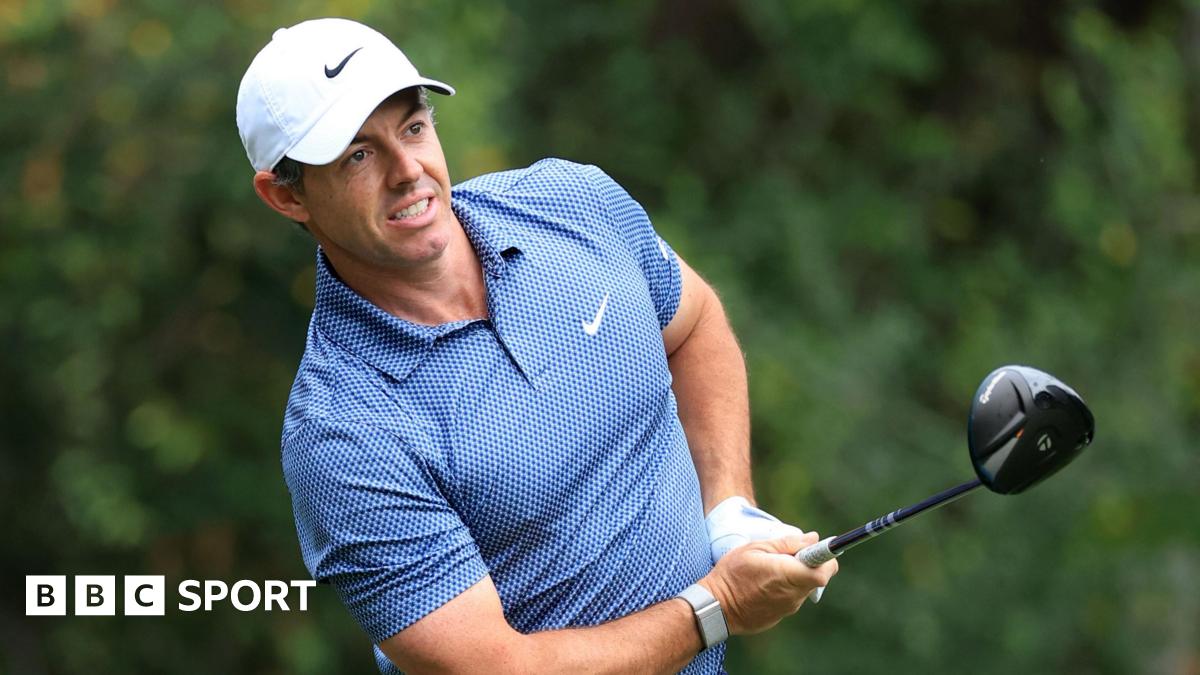
Players Championship: Rory McIlroy fit but off first-round pace at Sawgrass
Rory McIlroy recovered sufficiently from a back injury to begin his defence of the Players Championship but he ended round one seven shots off the pace.
The world number two only arrived at TPC Sawgrass on the eve of the PGA Tour’s flagship tournament, having opted to stay at home for treatment on the injury that forced him to pull out of last week’s Arnold Palmer Invitational at Bay Hill.
He showed no obvious signs of discomfort in crushing his opening drive 329 yards down the middle of the fairway, but he took 73 more shots for a two-over par total, with birdie putts on the 16th and 17th holes grazing the edge of the cup.
McIlroy’s Ryder Cup team-mate Sepp Straka is alongside three Americans setting the clubhouse pace on five under.
Austrian Straka chipped in for an eagle three on the par-five 16th in his bogey-free 67 to join Maverick McNealy, Lee Hodges and Sahith Theegala atop the leaderboard.
“We were fortunate to play in the afternoon with hardly any wind and the greens a lot softer,” said Straka, referring to the heavy rain that doused the course earlier in the day.
England’s Tommy Fleetwood was among those playing in the worst of the weather. He briefly reached five under, after a run of eagle-birdie-birdie on Sawgrass’ notoriously difficult 16th, 17th and 18th holes. He called it a “complete bonus of a stretch” of holes.
Having started on the 10th, the world number three then birdied the second but a torrential downpour that halted play for around 25 minutes checked his momentum, and successive bogeys on the fourth and fifth holes dropped him back into the pack.
He is in good company on three under, with Sweden’s Ludvig Aberg, Norwegian Viktor Hovland and American Xander Schauffele also enjoying solid starts.
The rain delay meant four players were unable to finish their opening rounds as the sun set and darkness fell. Among them is unheralded American Austin Smotherman, who will return on Friday morning to face a 15-foot birdie putt on the ninth hole – his 18th – to take the first-round lead.
In rapidly fading light, Smotherman hit his second shot on the par-five hole into the heart of the green, but while his playing partners opted to finish the hole, he decided to mark his ball and wait for the morning light.
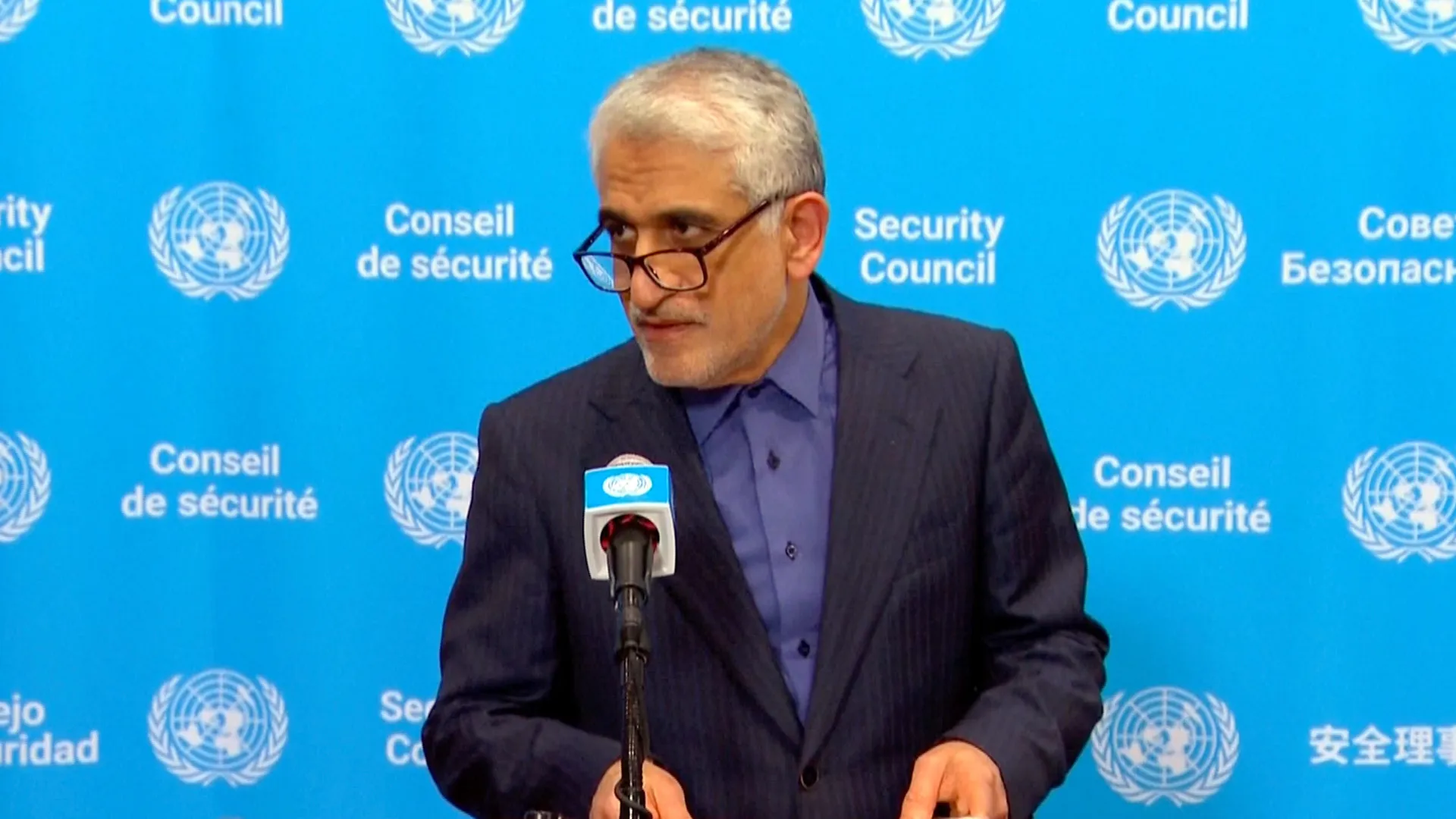
Iran envoy says Tehran will keep Strait of Hormuz open | US-Israel war on Iran
Iran’s UN ambassador Amir Saeid Iravani said Tehran will not close the Strait of Hormuz and remains committed to freedom of navigation. His remarks came after Supreme Leader Mojtaba Khamenei said the waterway would remain closed to pressure Iran’s enemies.
Published On 12 Mar 2026

UN fact-finding mission warns of continued human rights abuses in Venezuela | Human Rights News
A United Nations fact-finding mission has concluded that “there are no indicators of structural reforms or change” to improve the human rights situation in Venezuela, despite the removal of its leader in January.
On Thursday, a member of the fact-finding mission, Maria Eloisa Quintero, delivered remarks (PDF) to the UN Human Rights Council questioning whether Venezuela’s leadership would face accountability for its record of human rights abuses.
Recommended Stories
list of 3 itemsend of list
She also pointed to ongoing abuses under the government of interim President Delcy Rodriguez, who was sworn into office on January 5.
“Civic and democratic space remains severely restricted. Civil society organizations, the few remaining independent media outlets, and political actors continue to face attacks, harassment or intimidation,” Quintero wrote in her statement.
“The prospects for full guarantees necessary for free and democratic elections remain remote.”
All told, the fact-finding mission found that at least 87 people have been detained since January.
Fourteen of them were journalists who were temporarily taken into custody while covering Rodriguez’s inauguration, and another 27 were reportedly arrested for celebrating the fall of Rodriguez’s predecessor, Nicolas Maduro.
The fact-finding mission revealed that at least 15 of the recent arrests involved children.
A violation of international law
Its report was one of the first international assessments of human rights under Rodriguez’s nascent presidency.
She took office after the United States launched a military operation in the early morning hours of January 3 to abduct Venezuela’s then-President Maduro. Previously, Rodriguez had served as Maduro’s vice president.
Maduro and his wife Cilia Flores currently remain imprisoned in New York, where they face charges of drug trafficking and weapons possession.
The US has backed Rodriguez’s ascent to the presidency. Both her government and that of US President Donald Trump have said there is no immediate plan to hold a new election in Venezuela, citing the need for stability.
Quintero emphasised that it was the view of the fact-finding mission that the US operation “violated international law”, echoing the legal consensus.
“While the Mission has reasonable grounds to believe that Nicolas Maduro is responsible for crimes against humanity committed against the civilian population, this does not justify an unlawful military intervention,” Quintero wrote.
Her remarks also pointed out that, while Maduro may be gone, the rest of his government remains.
That government has faced repeated accusations that it perpetrated violence against members of Venezuela’s political opposition and others deemed critical of the country’s socialist leadership.
“The legal instruments that have long served as a basis for political persecution remain fully in force,” Quintero said.
“State institutions that played a key role in the repression — and which have been identified in previous Mission reports — have not been reviewed or reformed.”
Human rights groups have collected thousands of reports of arbitrary detention, as well as torture and extrajudicial killings, under Maduro, who served as president from 2013 until January.
Members of Venezuela’s opposition have also called for the removal of the existing government, which they say fraudulently claimed victory in the 2024 presidential race, despite vote tallies indicating otherwise.
Limits to ‘positive’ steps
At first, Quintero said the fact-finding mission found that developments under Rodriguez “initially appeared encouraging”.
She pointed to “positive” steps like the release of political prisoners and passage of an amnesty law that would lift criminal penalties for dissidents facing certain criminal charges.
But the benefits of those steps, she said, were mitigated by irregularities. The amnesty law was narrow in scope — only addressing certain accusations, made within a specific time range — and the bill never received a full, public reading.
Meanwhile, the government has claimed to release more political prisoners than has actually been verified by local human rights groups.
Quintero added that the fact-finding mission also found that 30 officials from Venezuela’s Scientific, Criminal and Forensic Investigations Corps (CICPC) — part of the national police agency — were detained for failing to produce false evidence about the US’s attack on January 3.
Their family members, she indicated, also faced government retaliation. The fact-finding mission called for more changes to be made to address the continued human rights abuses.
“A far deeper and more enduring transformation is required so that the population can trust that the long years of repression and violence have truly come to an end,” Quintero wrote.
Instead, she warned that the existing “machinery” of repression is simply “mutating” to adapt to the new reality in Venezuela, post-Maduro.

BBC drops first look at ‘violent’ thriller by Baby Reindeer creator
Baby Reindeer creator Richard Gadd is back for his first drama since the multi-award winning Netflix series.

‘Violent’ first-look at Baby Reindeer creator’s new BBC thriller(Image: BBC)
BBC is set to release an “intense” drama that explores “brotherhood, violence and the fragility of male relationships”.
In 2024, Netflix subscribers went mad for Richard Gadd ’s gripping drama Baby Reindeer revolving around a comedian dealing with his obsessive female stalker.
Now, two years on, Richard Gadd is back for the first time since the Netflix hit’s release with the BBC revealing details for its upcoming drama Half Man.
Filming for the original six-part drama wrapped up last year in and around Glasgow with the series set to launch in April on BBC One and BBC iPlayer in the UK and on HBO Max in the US.
Gadd will star in Half Man alongside BAFTA winning actor Jamie Bell, famed for All of Us Strangers and Rocket Man, with the pair portraying Ruben and Niall, respectively.
The official synopsis reads: “Niall and Ruben are brothers. Not related in blood but the closest you can get. One, fierce and loyal. The other, meek and mild-mannered. Inseparable youth.
“Brought into each other’s lives through death and circumstance, all they have is each other…
“But when Ruben turns up at Niall’s wedding three decades later, everything seems different.
“He is on edge. Shifty. Not acting like himself. And soon, an explosion of violence takes place which catapults us back through their lives, from the eighties to the present day.”
Half Man, which has been created and written by Gadd, will follow Ruben and Niall throughout the past 30 years of their lives, exploring “brotherhood, violence and the intense fragility of male relationships”.
For the latest showbiz, TV, movie and streaming news, go to the new **Everything Gossip** website.
The synopsis concludes: “After all, when things fall apart… it is sometimes the closest relationships which break the hardest.”
Gadd and Bell aren’t the only familiar faces starring in Half Man either with an abundance of other familiar faces joining the cast.
These include SAS Rogue Heroes actor Stuart Campbell, Rivals’ Charlie De Melo, The Nevers star Amy Manson, Outlander actor Tim Downie and T2 Trainspotting’s Scot Greenan, to name just a few.
Half Man will debut in April on BBC One and BBC iPlayer.
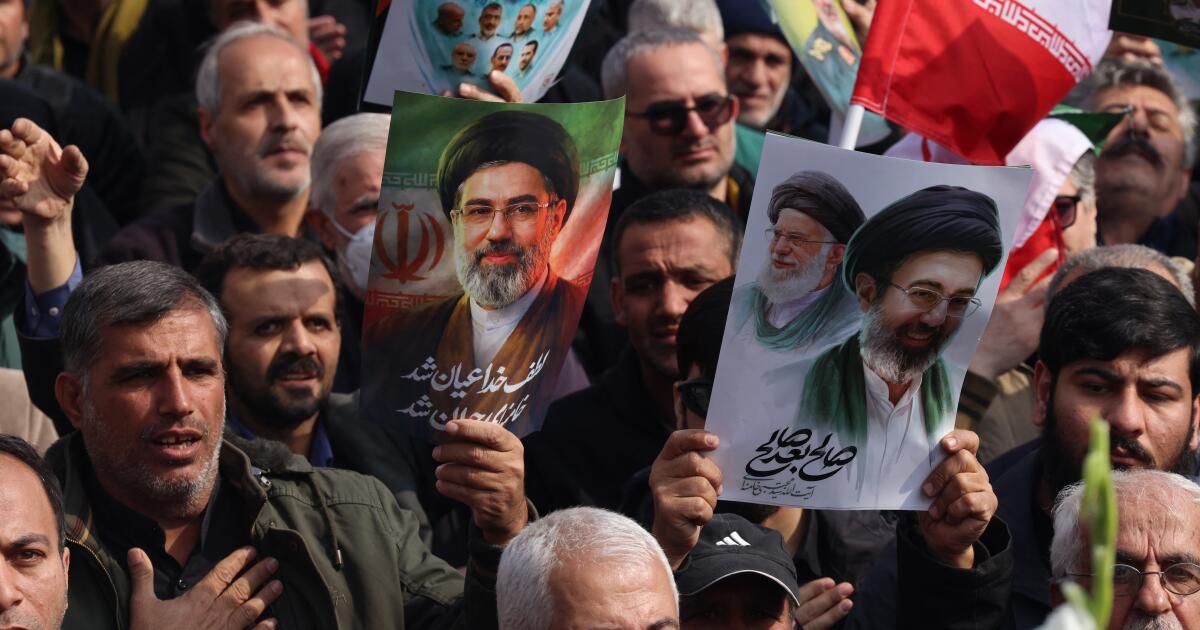
U.S. is in the dark on Mojtaba Khamenei’s views on the bomb
WASHINGTON — Days after he was named Iran’s next supreme leader, and over a week since U.S. and Israeli bombing wiped out much of his family, Mojtaba Khamenei issued his first statement on Thursday demanding vengeance against the alliance over the war it unleashed.
He called on Iranian forces to continue thwarting vital shipping traffic through the Strait of Hormuz. He vowed to open new fronts against the United States and Israel. And he warned that Gulf states hosting U.S. bases would remain targets of Iranian attack.
Yet, what concerned the White House most was what the new supreme leader didn’t say.
Khamenei made no mention of a strategic endeavor that had brought the Islamic Republic to war: Its nuclear program, suspected for decades of harboring military dimensions.
The omission was not lost on officials in the Trump administration, who told The Times they are largely in the dark over the new supreme leader’s stance on whether Iran should break out to build a nuclear weapon.
Khamenei’s deep alliance with the Islamic Revolutionary Guard Corps, which has advocated for weaponization in the past, has raised concern that the new leader will depart from his father’s long-standing position against building a bomb.
U.S. intelligence assessments long held that the late ayatollah, Ali Khamenei, had adopted a strategy of remaining at the threshold of developing a nuclear weapon while avoiding the costs and risks of actually building one. In 2003, as the United States invaded Iraq over false claims that Saddam Hussein possessed weapons of mass destruction, Khamenei issued a religious edict — a fatwa — declaring nuclear weapons to be forbidden under Islam.
That doctrine is now in doubt, with the new supreme leader wounded and stewing underground over the U.S. assault that has devastated Iran’s military and killed his father, his mother and his sister, among other family members.
Concern among U.S. officials comes as Trump has expressed interest in ending the war “very soon,” even though a stockpile of uranium — a key ingredient in the construction of nuclear weapons — remains buried but accessible to Iranian authorities.
Defense officials are skeptical that the nuclear program can be fully dismantled without sending in a substantial U.S. ground force, an escalation that Trump has sought to avoid. But ending the war with Iran’s nuclear infrastructure partially intact could have devastating repercussions. The U.S.-Israeli campaign could force the new Iranian leader to conclude that regime survival requires a nuclear deterrent, one official said.
“Even if President Trump declares victory tomorrow, and points to the damage done to Iran’s conventional military, the fact of the matter is you have a more hardline regime in place with the key ingredients for a nuclear weapon,” said Eric Brewer, deputy vice president of the nuclear materials security program at the Nuclear Threat Initiative, who noted that Tehran still has a stockpile of 60% enriched uranium — close to weapons grade — and advanced centrifuges to take it over the finish line.
“What’s the plan for day after,” Brewer added, “as Iran starts to build back, and potentially seeks nuclear weapons?”
Patrick Clawson, director of the Iran program at the Washington Institute for Near East Policy, said that Mojtaba Khamenei’s position on the nuclear program has been a stubborn mystery. Reports spreading on social media that he opposed the Joint Comprehensive Plan of Action, a nuclear deal brokered among world powers and Iran during the Obama administration, are unsubstantiated, he said.
“While Mojtaba often advised his father on domestic issues, there is much less information about his position on foreign affairs, other than opposition to Israel,” Clawson said. “I have never seen any indications he took a position about the JCPOA.”
President Trump has outlined the destruction of Iran’s nuclear capabilities as a major goal. But in closed door briefings to Congress, defense officials have been less emphatic, according to Democratic lawmakers.
On Tuesday, shortly after Khamenei was named to succeed his father, Defense Secretary Pete Hegseth warned him to disavow continued nuclear work in an exchange with reporters.
“He would be wise to heed the words of our president, which is to not pursue nuclear weapons,” Hegseth said, “and come out and state as such.”

Makai Lemon’s combine podium didn’t bother NFL team executives
Makai Lemon got another chance Thursday to demonstrate his skills for NFL scouts.
About 50 of them — representatives from each of the 32 teams — gathered at USC to spend a few hours evaluating the school’s latest class of draft prospects. Lemon, who won the Biletnikoff Award last fall as college football’s top receiver, had everyone’s attention.
“Running good routes, catching the ball, running fast,” he said of his objectives for the day. “Whatever I showcase, let them know I can do it at a high level.”
It was a more comfortable setting than Indianapolis. At the scouting combine, Lemon’s performance at the podium drew scrutiny — not for anything he said, but for how he said it. He swayed. He was measured, unhurried, visibly unbothered. Some read it as detached. Others saw something else entirely.
“We don’t want a guy who’s phony and coached up,” said one team executive, speaking on condition of anonymity. “We want a guy to be his authentic self. As long as he’s not a jerk, we love it.”
Rams general manager Les Snead, who attended Thursday’s workout of 17 USC players, put it another way. “At the combine you’re usually getting some version of a personality,” he said. “A lot of times it’s, ‘This is my interview personality,’ and that’s not necessarily who they are 365 days a year.”

USC receiver Makai Lemon catches pass during a drill at the NFL combine in Indianapolis last month.
(Julio Cortez / Associated Press)
The other USC prospects who participated in Thursday’s workouts were receivers Ja’Kobi Lane, Jaden Richardson and Jay Fair; running back Eli Sanders; tight end Lake McRee; offensive linemen J’Onre Reed and DJ Wingfield; defensive linemen Anthony Lucas and Keeshawn Silver; linebacker Eric Gentry; cornerbacks DJ Harvey and DeCarlos Nicholson; safeties Bishop Fitzgerald and Kamari Ramsey; punter Sam Johnson; and long snapper Hank Pepper.
Former Trojan linebacker Mason Cobb, who was on the team in 2024, also participated.
Lemon’s credentials are not in dispute. He finished last season with 79 catches for 1,156 yards and 11 touchdowns. At 5-foot-11 and 192 pounds he’s not big for the position, and according to a school release ran the 40 in 4.46 seconds, which is fast but not blistering. But those aren’t his main strengths.
“One of the underrated aspects when you’re watching wide receivers is toughness, and he kind of oozes toughness,” said Daniel Jeremiah, lead draft analyst for NFL Network. “He catches everything. He’s super strong physically and super strong to the ball.”
The technical detail that stands out for Jeremiah: Lemon doesn’t leave his feet to catch unless he has to. He stays grounded, keeps himself in position to do something after the ball arrives. Receivers who lunge and cradle in the air have nowhere to go. Receivers who catch with their feet under them turn completions into more yards.
“He’s got a really good feel for the game,” Jeremiah said. “I think he’s going to be a high-volume guy. I think he’ll catch 90-plus balls every year and be the quarterback’s best friend.”
Snead, who has a history of finding productive receivers that others miss — among them Cooper Kupp and Puka Nacua — is skeptical of the 40 as a measuring stick.
“You rarely see a route in football where the receiver runs straight for 40 yards and then makes his break,” he said. “Even on a go route you’re usually trying to get an edge on the defender, so you’re not running straight. The 40 might tell you how many gears you have in your body. But sometimes you need to run a route in third gear and then shift into fourth or fifth, or decelerate.”
Jeremiah ranks Lemon among the two best receivers in this draft, giving a slight edge to Ohio State’s Carnell Tate, who projects as more of a down-the-field, big-play threat. Comparisons to Detroit’s Amon-Ra St. Brown (also a former USC player) and Tampa Bay’s Emeka Egbuka have circulated. Jeremiah sees those, but also reaches back to Jarvis Landry, the former Louisiana State standout who made five Pro Bowl appearances.
“I actually think Lemon is a better player than Jarvis Landry coming out,” Jeremiah said. “When you’re instinctive, you’re tough and you catch everything, that’s a pretty high floor. Absolute worst case, you’re going to have a steady, dependable, reliable player.”
Watching from the sideline Thursday was Marqise Lee, who won the Biletnikoff in 2012 — the only other USC player to do so — and was a second-round pick of the Jacksonville Jaguars in 2014. He has spent much of the past several months as a mentor to Lemon, and when the combine criticism arrived Lee wasn’t surprised by any of it.
“My biggest thing to him was just enjoy it,” Lee said. “I know he got a lot of backlash about the media stuff and things like that, but when you know the guy, he’s not a big talker. He’s calm, he’s all about business.”
Lee believes Lemon has the skills to thrive at the next level, but knows how much context matters once a player gets there.
“The league is different until you actually get there and get the opportunity to practice and go through it,” Lee said. “Some people have a hard time adapting. Once he gets on a team I’ll be texting him: ‘How’s the comfort level? How’s the offense?’ Because that stuff matters. Offensive coordinator, people loving you — all that matters.”
Lemon, for his part, already sounds like someone who has thought about this.
“I want to go in there and be myself,” he said. “Don’t want to try to be anybody else.”
Ex-rapper Balendra Shah sweeps to power in Nepal landslide election victory | Elections News
Rastriya Swatantra Party, founded just four years ago, set to dominate new parliament with near two-thirds majority.

Published On 12 Mar 2026
A political party led by a rapper-turned-politician has won a sweeping parliamentary majority in Nepal, official results show, capping one of the most dramatic elections in the country’s recent history.
The Rastriya Swatantra Party of Balendra Shah, a 35-year-old former civil engineer and hip-hop artist known simply as “Balen”, secured 182 seats in the 275-member lower house of parliament, the Election Commission said on Thursday, with 125 won directly and a further 57 through proportional representation.
Recommended Stories
list of 2 itemsend of list
The Nepali Congress party finished in second place, with 38 seats. The Marxist party of veteran four-time Prime Minister Khadga Prasad Sharma Oli, whose government was ousted in a youth-led uprising last year, won just 25 seats.
Shah himself defeated the 74-year-old Oli in his own constituency.
Oli, who had dominated Nepali politics for years, congratulated his rival on X, wishing him a “smooth and successful” term.
The September 2025 protests that reshaped the country’s political landscape were initially set off by a government ban on social media, but rapidly swelled into a mass movement against corruption and economic stagnation, leaving at least 77 people dead.
Shah, whose music had long targeted those same grievances, emerged as a figurehead of the unrest, his song Nepal Haseko, or Nepal Smiling, accumulating more than 10 million YouTube views during the turmoil.
His path to likely prime minister, from engineer to rapper to Kathmandu’s first independent mayor in 2022, reflects a generational shift in a country where more than 40 percent of the nearly 30 million population is under 35, yet whose established party leadership has long remained in its 70s.
Shah said his victory was a signal of refusal to take “the easy way out” and a reckoning with the “problems and betrayals that have affected the country.”
The RSP, founded the same year as his mayoral win, ran a highly organised campaign backed by diaspora funding, particularly from Nepali communities in the United States.
Nepalese journalist Pranaya Rana described Shah to Al Jazeera as embodying “the outsider spirit that many young Nepalis are looking for to shake up the status quo.”
India’s Prime Minister Narendra Modi called the vote a “proud moment” in Nepal’s democratic journey, pledging close cooperation with the incoming government.
Under Nepal’s constitutional process, parties must now submit names to fill proportionally allocated seats before parliament is formally summoned by the president. A new prime minister, who will need the support of at least half of all members, is not expected to be confirmed for several days.

KC-135 Tanker Crashes In Iraq During Operation Epic Fury Sortie

A KC-135 Stratotanker that was taking part in Operation Epic Fury has crashed in Iraq, U.S. Central Command announced.
“U.S. Central Command is aware of the loss of a U.S. KC-135 refueling aircraft,” the command stated Thursday afternoon in a media release. “The incident occurred in friendly airspace during Operation Epic Fury, and rescue efforts are ongoing. Two aircraft were involved in the incident. One of the aircraft went down in western Iraq, and the second landed safely.”
“This was not due to hostile fire or friendly fire,” the CENTCOM statement added. “More information will be made available as the situation develops. We ask for continued patience to gather additional details and provide clarity for the families of service members.”
Three American crewed aircraft are known to have been lost during Operation Epic Fury prior to today’s KC-135 loss. These were F-15Es that were shot down in a bizarre friendly fire incident.
This is a developing story. We will update this post with new information as soon as we get it.
UPDATE: 6:15 PM EDT –
The Times of Israel has reported that the second aircraft involved was another KC-135. That outlet also says that the KC-135 in question was one that landed at Israel’s Ben Gurion Airport earlier in the day after declaring an in-flight emergency. Online flight tracking data shows that tanker is a KC-135RT variant, one of a small subset of KC-135Rs that are themselves capable of being refueled in flight. This, in turn, allows them to make use of tanker support themselves to remain on station longer or to conduct longer-distance missions. You can read more about these “receiver-tankers” in this past TWZ feature.
The loss of a KC-135 today appears to be the first time one of these tankers has crashed in support of combat operations since May 3, 2013, when one went down over Northern Kyrgyztan, killing all three crew aboard. That aircraft had been supporting operations over Afghanistan.
UPDATE: 7:09 PM EST –
Reuters also reports that the second aircraft was a KC-135 and added that the jet that crashed had six service members on board.
Contact the author: howard@thewarzone.com
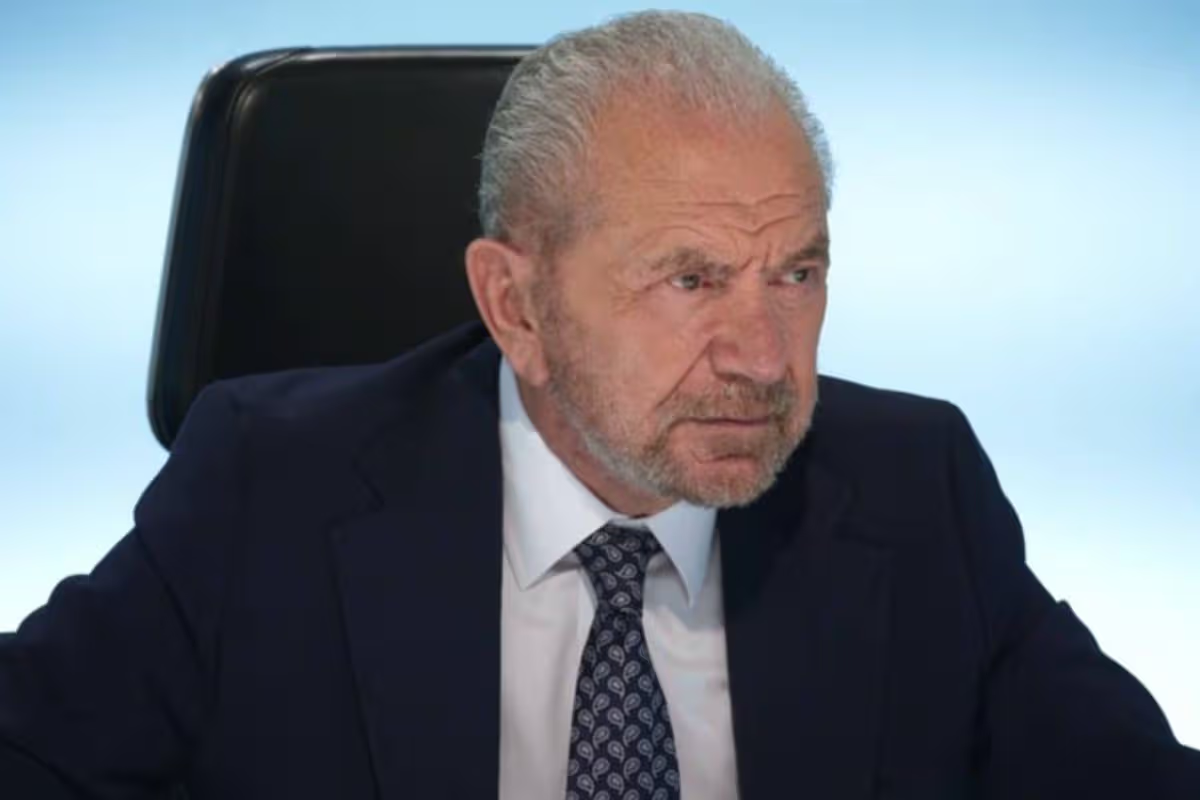
The Apprentice’s Lord Sugar calls out ‘nasty move’ as candidate admits ‘regret’
Tensions rose in The Apprentice as a candidate shared a decision he would “regret for the rest of my life”.

The Apprentice’s Lord Sugar calls out ‘nasty move’ as candidate admits ‘regret’(Image: BBC)
BBC The Apprentice said goodbye to yet another candidate this week but not before Lord Sugar addressed someone’s “slimey” actions.
In week seven of the hit BBC business show, the remaining candidates took on virtual reality fitness where they were tasked with building demos and brands before chasing investment.
Unfortunately, when it came to the boardroom, it was game over for Team Eclipse, headed up by project manager Lawrence Rosenberg who scored an investment four times lower than Team Alpha.
The drama really began in the boardroom when it came to Lawrence choosing who he would be bringing back with him.
He first decided to pick Rajan Gill for his “lack of contributions” before sharing the controversial reason for his second choice of Levi Hague.
Lawrence said: “With respect Lord Sugar, I think you have made it quite clear about your mind on Levi so I will need to bring back Levi as well.”
Prior to his decision, Lord Sugar had questioned Levi what he had achieved in the past seven weeks of the process but despite his own reservations, The Apprentice legend wasn’t happy with this “naughty”, tactic.
“This is not how this process is supposed to work, you’re supposed to bring people back in who you think did not contribute to this task.”
Lord Sugar described it as a “nasty move” with Lawrence apologetically saying that “I’ll regret it for the rest of my life”.
The Apprentice legend said he was going to be “fair” to Levi though and keep him for another week, putting him forward as next week’s project manager with the candidate laughing “happy days”.
Despite this business between Lawrence and Levi, it was actually Rajan’s turn to be fired for his lack of contributions to the task.
This didn’t stop Lord Sugar from giving Lawrence one last telling off though as he warned: “You were this close to getting out of here.”
The drama wasn’t quite over yet though as when the saved pair went back to the house, Lawrence admitted to the rest of the group that he was “beyond embarassed”, having made a “weak decision”.
Levi wasn’t going to let him off the hook just yet though as he simply stated to the remaining candidates: “Don’t ever use me as a scapegoat in there, don’t ever do that to me.”
The Apprentice continues every Thursday at 9pm on BBC One.
For the latest showbiz, TV, movie and streaming news, go to the new **Everything Gossip** website.
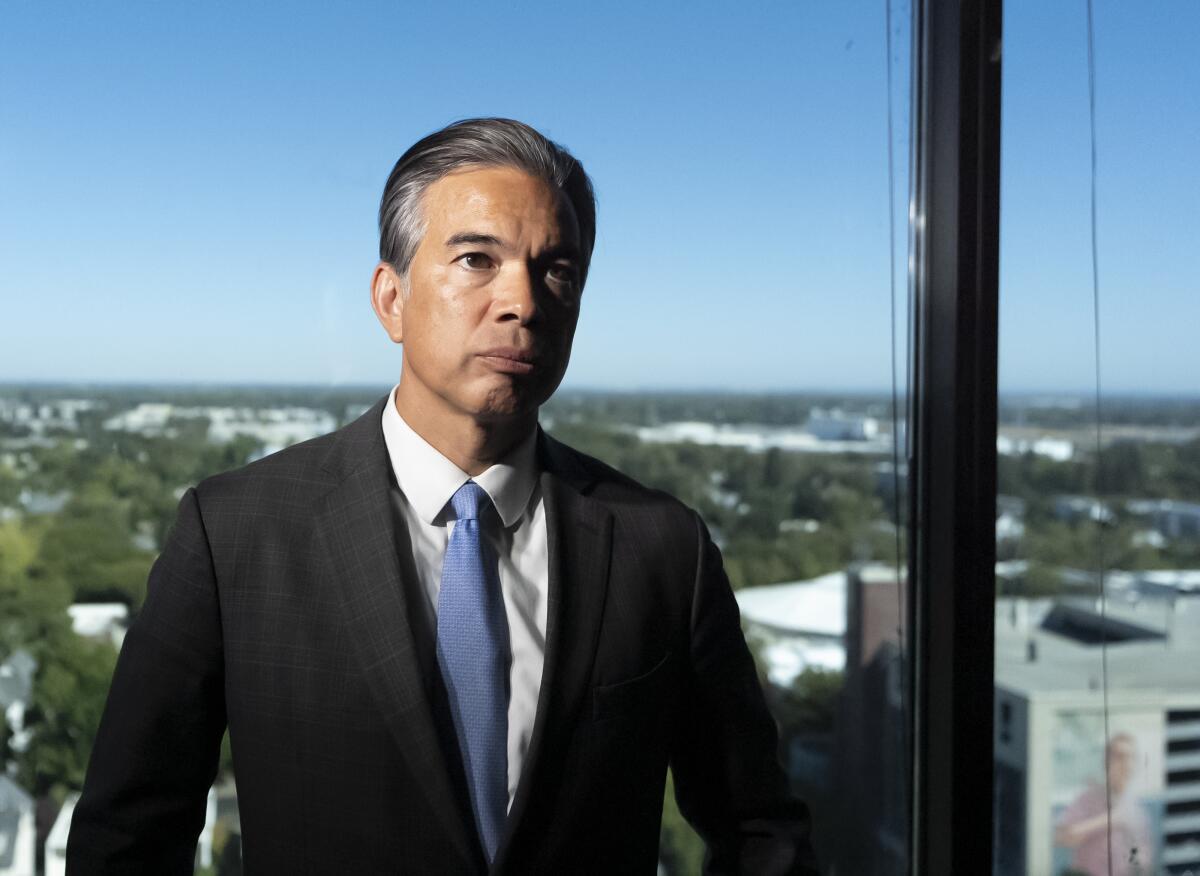
California attorney general vows to scrutinize Paramount/Warner deal
California Atty. Gen. Rob Bonta called out the federal government for largely vacating its role as antitrust regulator, saying it’s now up to California and other states to look out for consumers’ interests.
Bonta, the state’s top law enforcement officer, spoke Thursday at a Capitol Forum conference in Beverly Hills on antitrust issues and the future of Hollywood. His appearance came just days after the U.S. Department of Justice settled its case against Live Nation and Ticketmaster a week into a high-stakes trial, leaving state attorneys general to try to continue to fight that battle on their own.
The Justice Department’s about-face revealed a major fracture in antitrust enforcement. State attorneys general — particularly in Democratic-controlled states — say their role is becoming increasingly important to challenge alleged anti-competitive behavior.
President Trump has “abdicated the federal administration’s responsibilities to hold big corporations accountable to the law and protect a competitive marketplace,” Bonta said.
Bonta’s appearance comes as another major Hollywood merger appears to be sailing through its federal review with Trump’s tacit approval: Paramount Skydance’s proposed $110-billion deal for Warner Bros. Discovery.
The merger, announced late last month, has rattled Hollywood unions and some antitrust experts. It would combine legendary film studios, robust television production units and two prominent news organizations, CBS News and CNN, as well as dozens of cable channels.
“Paramount and Warner Bros. haven’t cleared regulatory scrutiny,” Bonta said. “My office has an open investigation into [the deal] and we intend to be vigorous in our review.”
California could bring its own lawsuit to block Paramount’s takeover, or join with other state attorney generals to launch legal proceedings to try thwart the deal or extract concessions — even if the Justice Department ultimately clears David Ellison’s deal.
Bonta outlined various concerns, including a continued contraction of Hollywood’s labor market, the consolidation of streaming services — Paramount+, HBO Max, Pluto and Discovery+ — and potentially higher prices and lower wages.
“There’s no industry as iconically California as the entertainment industry,” Bonta said. “It’s baked into California’s DNA.”

California Attorney General Rob Bonta vowed to drill into Paramount Skydance’s proposed takeover of Warner Bros. Discovery.
(Paul Kuroda/For The Times)
Paramount filed for Justice Department approval in December .
The maneuver started the regulatory review clock. And last month a key deadline for the Justice Department to raise concerns about Paramount’s proposed acquisition of Warner passed without comment from Washington.
Paramount has said it could finalize its deal by the end of September.
The architect of Paramount’s strategy, Chief Legal Officer Makan Delrahim, delivered his own keynote address, stressing the Ellison-family’s acquisition of Warner Bros. would not reduce competition and instead would be “a huge win for the creative community.”
“Paramount’s transaction with Warners is an opportunity to expand output, to grow the number of movies, shows and other content we are offering to the consumer,” Delrahim said, adding that will result in “more job opportunities,” including in Southern California, which is reeling from a production flight to other states and countries.
Delrahim conceded that Paramount was driven to buy Warner Bros. — it prevailed after Netflix bowed out — because Paramount is not big enough to compete in an industry dominated by technology giants.
He criticized the proposed Netflix deal, saying he doubted it would have passed regulatory muster due to Netflix’s strength in the streaming market.
Paramount still needs to win the support of Warner shareholders, and also gain regulatory approvals from the Justice Department, state attorney generals and overseas governments.
“This deal is a big win for Los Angeles, for California and for all communities that embrace filmmaking,” Delrahim said.
Tech mogul Larry Ellison has personally guaranteed the $45.7-billion in equity needed for the transaction . The company would have to take on more than $60-billion in debt — raising concerns among Hollywood workers about large-scale cost-cuts and layoffs.
“What is Paramount doing is …paying $110 billion to take out a rival,” said attorney Ethan E. Litwin, a former lawyer for TV networks, who also spoke at the conference. “When you take out a major rival in a highly concentrated industry … you are taking out competitors for projects. “
Bonta declined to say whether he would try to stop the Paramount-Warner merger.
Progressive State Leaders Committee, an affiliate of the Democratic Attorneys General Association, in December hired Rohit Chopra, a former director of the Consumer Financial Protection Bureau and former commissioner on the Federal Trade Commission, as a senior advisor. He will help coordinate efforts as the group, including Bonta, wages antirust enforcement battles.
“The federal government is just not enforcing the law,” Chopra said during Thursday’s conference. “Our states are really the last line of defense.”

Rangers & Celtic react to Old Firm fan disorder as SFA launch independent review
Rangers say “all parties must be prepared to have their actions and decision-making subjected to proper scrutiny”, with Celtic referencing “serious concerns” raised by supporters about pre-match access arrangements.
The Ibrox club have called for the review to be “thorough and wide-ranging” and to “include the broader context” around the match, from initial decisions on ticket allocation through to the post-match incidents.
Their statement adds: “The disorder that occurred on Sunday was unacceptable and we condemn it unequivocally. Safety must always come first in football, for supporters, players and everyone working in and around the game.
“There are now a number of serious issues which require proper examination. For that reason, we agree that there should be a fully independent review into the events surrounding the match.”
Rangers have vowed to represent the club and their supporters “robustly” but say they will take action – “including the potential withdrawal of ticketing privileges and stadium bans” – against anyone identified and convicted.
The club also say they are “appalled” to discover graffiti mocking the Ibrox disaster, which claimed the lives of 66 supporters in January 1971.
They add: “To desecrate their memory is vile. It is cowardly. It is shameful. This is not football rivalry and it is not banter. It is the abuse of a tragedy that claimed 66 lives.”
Meanwhile, Celtic say they are awaiting a response from the Green Brigade regarding safety and security measures – as required by the police and Glasgow City Council’s Safety Advisory Group – to allow the club “to advocate re-entry” of the banned fan group to Celtic Park.
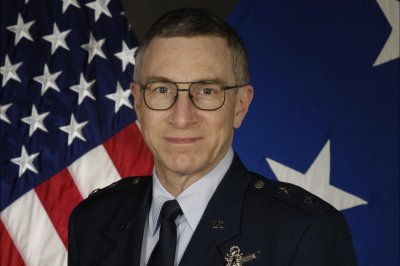
Retired U.S. Air Force major general missing in New Mexico for 2 weeks

Retired U.S. Air Force Maj. Gen. Neil McCasland has been missing since February 27. File Photo courtesy of the FBI
March 12 (UPI) — Law enforcement officials in New Mexico said they’ve been searching for a 68-year-old retired U.S. Air Force major general who was reported missing last month.
William “Neil” McCasland was last seen at his Albuquerque home Feb. 27, the Bernalillo County Sheriff’s Office said in a post on Facebook. The department issued a silver alert searching for the man, saying it wasn’t clear what kind of clothing he was wearing nor what direction he might have traveled.
“Due to his medical issues law enforcement is concerned for his safety,” the sheriff’s office said.
The FBI’s Albuquerque field office said it was unusual for McCasland to be out of touch from his family for this length of time. The FBI said it believes he left his home on foot and doesn’t expect foul play.
“We are, however, utilizing all possible resources including advanced technologies, and still considering all possible scenarios as we follow up on leads towards locating Neil,” the FBI said in a Facebook post on March 6.
The sheriff’s office said it had searched McCasland’s neighborhood, speaking to more than 600 homeowners in the area.

Hugo Chávez: Truth as a Form of Struggle
Chávez never shied away from self-criticism and taking responsibility for his actions. (Archive)
In these times when it is once again fashionable to accuse Commander Chávez of mistakes, whether real or imagined. As we mark 13 years since his untimely death on March 5, 2013, I would like to highlight the value of truth in his political actions. Truth was manifest in the responsibility he assumed for his actions; the consistency between his words and deeds; the acknowledgment of his own mistakes, when it is easier for most people to point out the mistakes of others; and his sincere efforts to correct them. To the above, I would add that when he had to make tactical and strategic shifts in the course initially set, Chávez always had the political honesty to explain in detail why he was doing so, and he courageously took responsibility for them before the people.
There are countless examples which can be found in many of his speeches. I will mention just a few. Beginning with the day of his introduction to the Venezuelan people, February 4, 1992: “Unfortunately, for now, the objectives we set for ourselves were not achieved in the capital city, that is, we here in Caracas did not manage to control power… And I, before the country and before you, take responsibility…” Then in the streets and in the 1998 election campaign: “Let’s go to the Constituent Assembly,” and on February 2, 1999, in what would be his first act of government, he signed the decree calling for the constituent process, and we went to the Constituent Assembly.
In April 2002, he surrendered to the coup leaders, without thinking about saving his own “skin”: “I am an imprisoned president; you decide what to do with me.” After his release, with a cross in his hand, he stated that “it was necessary for all sectors of the country to make a greater effort, with all the goodwill we can muster, to be able to live together in peace, accepting the rules of the game.”
In 2005, he called for the Bolivarian Revolution to take on a socialist character. In the 2006 election campaign, he said, “Let’s go for socialism!” and explained in detail why this strategic shift was necessary. He outlined the characteristics of our socialism, 21st-century Bolivarian socialism, which, as he insisted until his last public words, had to be “essentially democratic” or it would not be socialism at all.
In the elections of December 6, 2006, Commander Chávez obtained the highest number of votes and was re-elected. In December 2007, while awaiting the results of the referendum on constitutional reform and hearing reports of a close count, he called a meeting of the party leadership in Miraflores. I said to him at that meeting: “President, let’s wait for the final count, and if we lost, we lost, but if we won, we won.” He replied with a sharp look: “I don’t want a victory like that, let’s go out and acknowledge defeat now.” And that’s what he did.
In September 2010, we won a majority in the National Assembly. Without a doubt, it was a resounding political victory. But Chávez identified a warning sign: in quantitative terms, the difference in votes between Chavismo and the opposition was minimal. Once again, he assumed political responsibility. In January 2011, he published the “Strategic Lines of Political Action,” a deeply self-critical document.
Late May 2011, he told me: “Elías, I feel like something is wrong with me.” June 2011, after undergoing the necessary tests, on national television: “Cancer cells have been detected in my body.” Easter Week 2012, during a mass in Barinas, broadcast live: “We must be aware that I have an illness that limits my life… Christ, give me your cross.”
On the night of December 8, 2012, in a public address, he raised the possibility of not continuing among us and explained in detail the constitutional procedures that would have to be followed if he were to be permanently incapacitated. That day, once again, he decided to tell us the truth, no matter how hard it was:
Some colleagues told me it wasn’t necessary, or have said in recent hours that it wasn’t necessary to say this. In truth, I could have said almost everything I said tonight from Havana… But I believe that the most important thing, what my soul, my heart, and my conscience tell me, the most important thing… has been this, Nicolás. The most important thing.
“The most important thing”: telling the truth, explaining the reality to the people, the decision he had made, and the steps that needed to be taken.
But that political honesty was not just an individual value. It was the political conviction that the people formed a collective wisdom, a conscious body that knew how to understand and draw its own conclusions about situations. That is why he was so careful to keep them informed at all times.
I once heard him say: “There are those who say that you shouldn’t speak plainly to the people, because then the adversary will seize on that truth and manipulate it against you.” That, Chávez said, is to think that the people are mentally eunuchs. The people understand, more often than not, more than some leaders. For Chávez, speaking the truth was always a decisive show of trust and respect for the people.
And “most importantly,” it was also to make clear for posterity his conviction about the democratic path of the revolution he had led:
In all circumstances, we must guarantee the progress of the Bolivarian Revolution, the victorious progress of this revolution, building the new democracy that is here mandated by the people in the Constituent Assembly; building the Venezuelan path to socialism, with broad participation and ample freedom, which are being demonstrated once again in this gubernatorial election campaign, with candidates here and candidates there. Freedom, complete freedom.
With the power of truth, the truth of his project and his life, Chávez managed to accumulate immense political strength based on the moral autoritas he gained by never peddling falsehoods or shirking his responsibilities, much less in defeat or when he made mistakes. That same moral authority comes not only from consistency between words and deeds, but also from trying to act despite difficult circumstances as well as from recognizing and explaining when and why it is not possible to achieve a certain goal. I stand by that way of doing politics. With Chávez forever!
The views expressed in this article are the author’s own and do not necessarily reflect those of the Venezuelanalysis editorial staff.
Translated by Venezuelanalysis.
Source: CEDES

Amber Davies breaks silence with sharp statement amid ‘feud’ with Legally Blonde co-star
Amber Davies has broken her silence on an alleged feud with her Legally Blonde co-star Hannah Lowther amid rumours of ‘backstage tension’

Amber Davies has broken her silence (Image: BBC)
Amber Davies has broken her silence on her alleged feud with her Legally Blonde co-star Hannah Lowther. The former Love Island star has been forced to pull out of her starring role as Elle Woods.
Giving an update to fans about her ill health, she wrote on Instagram earlier today: “Ok update: after talking to my DR, being on antibiotics and trying to recover whilst doing shows is getting me and my health NOWHERE. Been working on this lingering illness for a month now so I’ll be off again from my beautiful Elle Woods.
“This is the last thing I want but there’s no other way. I fear if I keep “pushing through” I will be battling with this for longer than I need to be. I can’t wait to be back on stage and feel like me again!!!”
However, there have been rumours about a feud between Amber and her co-star Hannah Lowther. Hannah found fame on TikTok in the pandemic and is a successful musical theatre star.
Insiders have said to the Daily Mail that “tension” had developed backstage after audiences seemed to be preferring Hannah’s portrayal of Elle over Amber’s. A source said: “When Hannah goes on, the energy is completely different.
“She gives it ten times more energy than Amber ever has, and just has that sparkle that Amber lacks. Everyone backstage is professional, but it would be fair to say the atmosphere between the two girls can be a bit tense at times.”
Now, Amber has appeared to address the feud head on. Taking to Instagram to comment on Hannah taking on the role, she also shared a personal message to Hannah, writing: “An extra special appreciate message to @hannahlowther who has given me all the grace and space to be poorly and recover. The show is in safe hands ALWAYS.”
Amber previously spoke out to defend herself, given her hectic schedule in the recent months. She added: “Also I keep having to remind myself I went from Gatsby, to a last min Strictly, then to Elle so my body’s evidently fighting for its life.
“I also keep reminding myself that it’s ok to be poorly, we are human. Just a reminder there’s absolutely never a right time to be poorly in a musical theatre schedule so you must, for your own sanity, go with the flow!”
At the time of writing, Hannah has not responded to the post but confirmed she would be playing Elle this evening.
Like this s tory? F or more of the latest showbiz news and gossip, follow Mirror Celebs on TikTok , Snapchat , Instagram , Twitter , Facebook , YouTube and Threads .

Big Pork attacks California law on caging
Spring has sprung on Leo Staples’ family farm in Oklahoma, and his Berkshire pigs couldn’t be happier about it.
Weighing in at about 550 pounds, Woody, his largest hog (named by a grandson after the “Toy Story” icon) plays “like a puppy” in his free-range paddock, Staples told me, gobbling up the rye, clovers and winter peas that have grown knee-high under the Southern sun.
Swine life on Staples’ sustainable family farm is a jarring contrast to the existence of a pig on one of America’s “intensive” corporate-owned mega-farms, where some sows are confined to cages so small they literally can’t turn around or take more than a step or two in any direction.
“It’s not necessary and it hasn’t proven to be good science,” Staples, a self-described conservative Republican, said of Big Ag porcine lockups. “It’s also cruel.”
That confinement is at the heart of a congressional fight over animal welfare standards that Staples — and California — is likely to lose, though we shouldn’t.
At issue is the Save Our Bacon Act, a sneak attack backed by foreign corporations currently hidden deep inside the farm bill. It would severely curb the ability of states to enact limits on animal confinement and maybe accidentally open the door for ending all kinds of state-level food safety laws.
The SOB Act, an apt nickname, would not only cripple small family farmers such as Staples (though its supporters claim it helps family farmers), it would negate the will of California voters, potentially introduce risk into the food chain, and turn greater power of our food supply over to China.
It would also limit consumer choice at a time when more Americans — from fans of far-right Health Secretary Robert F. Kennedy Jr. to far-left granola grandmas — are demanding a say in how their food is produced.
Let’s break that down.
What is the SOB Act?
For the vegetarian hard-liners out there, it is true that Woody himself will someday likely be bacon.
But, increasingly over the past decades, meat-friendly consumers have moved toward wanting animals to “live a really great life and have one bad day,” as Nate Beaulac, another conservative Oklahoma pork farmer, describes it.
In 2018, to further that aim, about 63% of California voters passed Proposition 12, which increased the space that breeding sows were required to have, from something about the size of a small car trunk to the size of a coat closet. We’re not talking rolling acres here — just enough room to turn around. Some of these sows are basically caged for the majority of their breeding life — years — and are about the size of a black bear.
But here was the real bite in Proposition 12: No pork from any state could be sold in California if it didn’t come from a farm that met the new standard.
Overnight, the corporate breeders were locked out of the Golden State market. They sued bigly, and lost bigly in 2023 at the Supreme Court, which upheld California’s right to impose the state standard.
Big Pork tried to revive the issue with the Supreme Court in 2025 and was rebuffed. Surprise, surprise, the drums started pounding for the SOB Act shortly after (though various legislative attempts have floated since Proposition 12 was passed) backed by a Midwestern congresswoman from a Big Pork state.
The SOB Act would negate Proposition 12 (and a similar law in Massachusetts) and forbid states from making laws regarding animal confinement, according to an analysis by the Animal Law & Policy Program at Harvard Law.
That would emphatically overturn the will of the majority of California voters who want those standards.
But hey, Big Pork would make big bank.
“They want to limit American consumers’ ability to fight,” Beaulac told me. “They wanted to limit Americans’ ability to pursue any sort of change. And that is why me, not only as a farmer, but as an American and a capitalist, I’m strongly opposed to the Save Our Bacon Act, and in staunch support of Proposition 12.”
What Prop. 12 did
Beaulac was once a Californian himself, before heading to the Sooner State for college. He describes himself as a “Christian, capitalist, conservative environmentalist,” and a sustainable farmer who depends on consumers’ desire for healthy food to sell his pigs, chickens and cows.
Proposition 12, Beaulac said, “was a huge help to smaller farms, and the only people that it really hurt were the huge multinational conglomerates.”
“I mean very simply, we want the opportunity to compete,” he said.
Staples, Woody’s owner, who is also an expert in project management and environmental compliance from a previous career in the power industry, makes the case that the mega-farms can also come with mega-dangers.
“You have 100,000 pigs within two miles of each other, the chance of issues with a swine flu or natural disaster just increases,” he said. He points out that issues such as disease, groundwater contamination and waste disposal have already become problems for some large farms.
The flaws in the SOB Act don’t stop there.
The Harvard Law analysis points out that the loose language of the bill could have other consequences, maybe even gutting some state safety, labeling and cleanliness standards.
And some Republicans in Congress, including Californian Reps. David Valadao and Young Kim, oppose the measure and sent a letter to the Agriculture Committee late last year urging them to dump the act, pointing out that at least a quarter of Big Pork is owned by Chinese companies and does not represent American interests.
“Foreign-owned corporations — particularly those tied to adversarial nations — already hold a disturbing amount of control over U.S. agricultural assets,” the letter read, citing Chinese-owned Smithfield Foods, the largest pork producer in the United States.
The SOB Act “could further consolidate the influence of such foreign entities,” the letter‘s authors warned.
Armed with those arguments and others, Staples and Beaulac traveled to Washington recently to make their case against the SOB Act with lawmakers.
But, both men told me, they were met with a wall of lobbyists and money.
“It’s very eye-opening in terms of how many lobbyists are there every day,” Beaulac said. “The reality is Big Ag donates big money to the senators, and so when they need their bill to go through or they need a bill shut down, they’re going to have a lot more leeway than the small farmers.”
The lobbyists, Staples said, had the debate wrapped up tight long before the farmers even knocked the dirt off their boots and entered Congress.
“It was very obvious,” he said. “I was not prepared for what Big Ag had done, how they had prepared members of Congress to address the issues we wanted to address.”
Beaulac said he’s discouraged and fears the SOB Act will pass, but also isn’t giving up hope. He sees it as a bipartisan issue, and one he hopes for which people will stand up. This week, a social media post featuring a sad photo of a caged pig went viral, drawing attention across party lines.
“Blue, red. It doesn’t matter. People want healthy food,” Beaulac said. “They want to know how it’s raised. They genuinely care how they’re feeding their family, and it has nothing to do with who they vote for in November.”
What else you should be reading
The must-read: Thune Is in a Vise as Trump and Far Right Demand Fight on Voter Bill
The deep dive: The exodus of California’s tech billionaires from the Golden State to Florida’s Gold Coast
The L.A. Times Special: California could be attacked by drones because of Iran war, memo warns. Officials downplay threat
Stay Golden,
Anita Chabria
P.S. Here’s a post by right-wing commentator Michael Cernovich on the SOB Act, just a taste of how much some of the MAGA folks don’t like this measure.
—
Was this newsletter forwarded to you? Sign up here to get it in your inbox.

Armand Duplantis: Two-time Olympic pole vault champion breaks world record at Mondo Classic in Sweden
Duplantis, widely known by his nickname ‘Mondo’, has already won every major gold available to him, and became the first man in 68 years to retain the Olympic pole vault title at Paris 2024.
The US-born Swede, who chose to represent his mother’s homeland, has not lost a major final since the World Athletics Championship in Doha in 2019, where as a teenager he missed out to American Sam Kendricks on countback.
World record talk has largely replaced any discussion of the destination of men’s pole vault gold medals since he took the record off Lavillenie in February 2020.
How has he done it? A potent combination of lightning runway speed, technical precision in the take-off, explosive power and the bravery to embrace it as he travels far beyond the average height of a giraffe (5.5m).
It is his sprinting prowess in particular that his rivals pinpoint as a defining factor, with the higher approach speed generating greater kinetic energy and creating the foundation for greater heights.
That is something he has enhanced through specially-developed sprinting spikes which he wears for his world record attempts, which feature an unusual hooked spike in the forefoot.
His incremental centimetre-by-centimetre approach to improving the world record is by no means revolutionary; since Sergey Bubka became the first person to clear six metres 40 years ago, the record has been nudged no more than two centimetres higher at a time.
It helped that Duplantis grew up with a pole vault pit in the back garden of his childhood home in Louisiana, with his father a former elite competitor in the discipline.
The record-breaking dominance he has gone on to achieve has transcended the sport and established Duplantis – coached by his parents Greg and Helena – as the sport’s biggest star.
Moon project delays among barrage of challenges for NASA
March 12 (UPI) — The recent, new delay in NASA’s moon landing program represents the latest in a string of technical, budgetary, workforce and public perception challenges that plague the space agency, a UPI analysis shows.
When flight officials pulled the Artemis II Space Launch System and Orion spacecraft off the launch pad at Kennedy Space Center on Feb. 25 after a recurrence of helium flow problems and pushed the launch back to April at the earliest, it served as another reminder of the space agency’s current assortment of formidable problems.
Those issues include a moon program whose timeline keeps slipping; recurring technical failures and cost overruns with its flagship SLS rocket; a commercial lander — SpaceX’s Starship — that has yet to demonstrate reliability; the effective grounding of the Vulcan Centaur rocket made by United Launch Alliance; the departures of thousands of NASA workers and turnover in its top leadership positions.
The agency announced March 3 it had identified the latest problem with Artemis II as a faulty helium seal in the SLS upper stage, and that it is repairing the assembly, as well as making other fixes to the spacecraft.
But meanwhile, the lag time since the last crewed U.S. spaceflight has now stretched to three full years. This lengthy drought has prompted outside analysts and NASA officials to worry about how public support for the space program is being affected.
“When missions occur every few years, it is easy for people to lose interest,” said Burt Dicht, a leader of the National Space Society, who added he backs a newly announced NASA effort to increase the frequency of launches.
The latest delay has prompted a fresh look at some of the major challenges facing the space agency’s moon effort, as well as more general problems.
Headwinds with partners, personnel issues
One of the more pressing issues with the Artemis program is its dependence on SpaceX’s Starship Human Landing System, or HLS, as the initial human lander that will put the first U.S. astronauts on the lunar surface.
Elon Musk’s company signed a contract with NASA in 2021 to provide the lander, but struggled in 2025 to perfect the mammoth Starship V3 rocket necessary for a key element of the HLS mission, according to a report issued by NASA’s Aerospace Safety Advisory Panel and released last month.
The Starship V3 incorporates upgraded Raptor engines to provide it with the required performance for low-Earth orbit flight and on-orbit operations, and its development is deemed crucial for transferring fuel to an orbiting tanker.
How it performs will “ultimately determine the number of refueling missions required for the HLS mission,” which is now pegged at roughly 12 fueling flights, the report’s authors wrote.
“The development and test progress necessary for a version of Starship that has not yet flown in time to support a human lunar landing mission within the next few years appears daunting and, to the panel, probably not achievable,” they wrote.
SpaceX announced Feb. 26 that the first Starship V3 had left its build site at Boca Chica, Texas, and had begun prelaunch testing.
In 2023, NASA selected Blue Origin, owned by Amazon founder Jeff Bezos, to develop a second human landing system to compete with the HLS. Its Blue Moon Mark 2, to be launched aboard a New Glenn rocket, is to be tested twice and then carry a crew to the moon in late 2028.
New critical report
But NASA’s Office of Inspector General, in a report issued Tuesday, looked at both programs to carry astronauts to the moon and advised that the agency faces significant technical and programmatic risks that threaten mission timelines and crew safety.
The report said NASA is not fully adhering to “test like you fly” principles, particularly for uncrewed demonstration missions, and has not yet ensured that SpaceX’s Starship lander will meet manual control requirements for astronauts.
The inspector general also noted gaps in hazard‑mitigation planning and insufficient testing of critical systems, especially given the complexity of both SpaceX’s and Blue Origin’s lander architectures.
The report also warned that NASA the capability to rescue astronauts in the event of a life‑threatening emergency during lunar surface operations, echoing limitations from the Apollo era.
And it concluded that SpaceX and Blue Origin face technical challenges likely to cause additional delays, with SpaceX’s schedule slipping beyond its earlier 2027 target and even the revised 2028 goal remaining uncertain.
The report recommends stronger risk‑management practices, more realistic scheduling and more rigorous testing to ensure crew safety and mission success.
Meanwhile, NASA’s larger operations also could be affected by problems encountered in the new Vulcan Centaur rockets made by United Launch Alliance.
Vulcan launches halted
The U.S. Space Force last week temporarily halted all national security launches using the rocket after the same booster malfunction occurred twice, according to comments made by Col. Eric Zarybnisky at a meeting last month in Colorado.
The Vulcan Centaur program was established by ULA to reduce costs and eliminate reliance on the current workhorse Atlas V Russian-supplied RD-180 engine and is primarily meant to meet U.S. military needs.
But the program benefits NASA as well, giving it greater flexibility and transport capability for launching of payloads, the space agency said.
NASA also continues to struggle with an exodus of workers, including thousands of crucial senior staff, which some analysts believe is impacting its moon and Mars exploration goals due to a loss of expertise.
Nearly 4,000 agency employees last year chose to accept “deferred resignations” as part of the Trump administration’s efforts to slash the federal workforce — a move that reduced NASA’s employee roster by more than 20% to some 14,000, NASA spokesperson Cheryl Warner told NPR in June.
Still, even amid all of those issues, the agency was able to dodge the biggest potential bullet of them all — a proposed 24% reduction in its budget issued by the White House, which would have been the biggest cut in agency history.
That threat all but evaporated when Congress agreed on a $24.4 billion NASA spending bill in January, representing a mere 1.7% budget reduction.
The NASA administrator’s job itself remained unfilled throughout 2025, as President Donald Trump withdrew his nomination of Isaacman. Trump ultimately changed course, and Isaacman was confirmed by the Senate on Dec. 17.
Major changes for the Artemis program
Of all the difficulties faced by NASA, the technical problems and cost overruns of the Artemis program itself have emerged as perhaps the most high-profile.
The Feb. 25 postponement was the second recent delay for Artemis II, which is to send four astronauts on a “slingshot” fly-by around the moon. Last month, NASA pushed back the launch to March after engineers discovered what they called a significant hydrogen leak during a wet dress rehearsal.
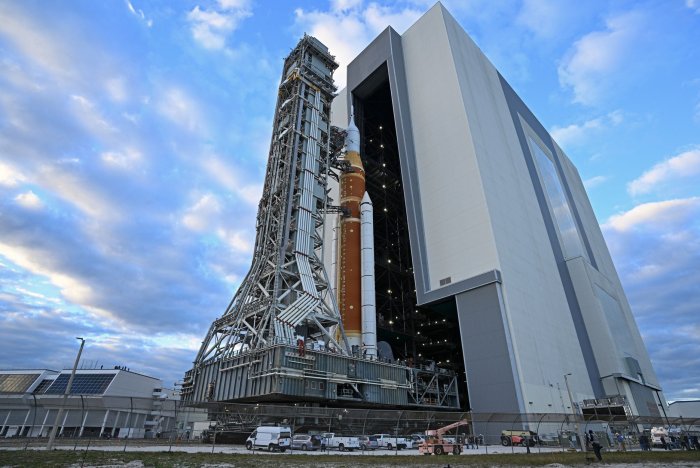
NASA said Thursday it plans to roll the Artemis II Space Launch System rocket and Orion capsule back out to the launchpad next week, aiming for a launch in April.
The rollout wis to begin March 19, with an eye at launching as early as the evening of April 1, NASA officials said during a press briefing.
The original target date for landing astronauts on the moon — 55 years after the United States first did it — was 2024. When that was announced in 2019, many observers thought the target date was too optimistic.
The effort’s total cost after NASA recently added nine new elements now exceeds $20 billion, the Government Accountability Office reported last summer. Three of those elements have racked up a total of $7 billion in cost overruns.
NASA has made efforts to get a handle on the overruns through its Moon to Mars Program Office, the GAO said, but warned that each new delay to mission dates can create a cascading effect of increased costs across multiple programs that function independently of each other.
Clear warnings
And in its report from last month, the NASA safety panel sounded clear warnings about the “ambitious timeline” for developing the Human Landing System, given its “intricate operational design” and :complex concept of operations,” as well as other serious safety concerns surrounding the Artemis program.
Taken together, the issues posed a “high safety risk,” the panel concluded, which “casts doubt on the current Artemis III timeline and the feasibility of the Artemis III mission goals.”
In the wake of the latest issues, Isaacman announced a major revamp of Artemis under which the expected moon landing was pushed back from Artemis III in 2027 to Artemis IV in 2028.
“We have to rebuild core competencies,” he told reporters Feb. 27, blaming the repeated delays on too-infrequent launch schedules (known as the “launch cadence”), which he said causes “muscle memory” to “atrophy.”
“This is just not the right pathway forward,” he asserted, while revealing that a moon landing with Artemis III in 2027 has been deemed too ambitious and will instead now be attempted with Artemis IV in 2028.
Artemis III will instead now serve as a mission to perform tests on connecting with lunar landers in low-Earth orbit, as well as to test equipment that will go on Artemis IV.
Meanwhile, to bump up the launch cadence to once every 10 months rather than every three years, Isaacman announced a standardization of the SLS rocket fleet to “essentially near ‘Block-1’ configuration.”
The idea, he said, is to reduce the complexity of the massive rocket and to “accelerate manufacturing, pull in the hardware and increase launch rate, which obviously has a direct safety consideration to it, as well. You get into a good rhythm launching with greater frequency, you get that muscle memory.”
To do that, he added, “we need to rebuild and strengthen the workforce here at NASA. … We have to rebuild core competencies. The ability to turn around our launch pads and launch with frequency greater than every three years is imperative,” he said, pointing to the histories of the Mercury, Gemini, Apollo and Space Shuttle programs, when “the average launch cadence was closer to three months.”
The decision to simplify and standardize the SLS starting with Artemis IV also means the agency will no longer need to use the $1.5 billion Mobile Launcher 2 at Kennedy Space Center, which is still under construction and has faced its own cost overruns and delays.
Experts’ reactions
Experts who have been closely following the development of Artemis expressed a range of opinions about whether the latest moves are the right ones for the moon program and the U.S. space program generally.
Kenny Evans, a fellow in science, technology and innovation policy at Rice University’s Baker Institute for Public Policy in Houston, told UPI the glitches and the resulting negative perceptions of the program are indeed tied to the drawn-out launch cadence.
“The extended periods between SLS launches have given NASA fewer chances to test out hardware — and less cover for when things go wrong,” he said. “That has long been a valid criticism of the SLS program and a source of bad press — for example, the fueling issues in prior wet dress rehearsals.
“Working out kinks, as visible and expensive as they are, should be seen as net positives rather than programmatic failures,” he said.
“Frankly I’m relieved to see the timeline revamp,” Evans added. “The Artemis schedule Isaacman inherited had absolutely no chance of meeting its prior targets, and I’ve been impressed by his willingness to address the hard truths about the program.
“In terms of safety, making Artemis III a system test will provide NASA a much needed opportunity to remove as much risk as possible before attempting a lunar landing for Artemis IV,” he said while noting he is “particularly enthusiastic” about the NASA leader’s stated commitment to strengthening its workforce, “especially in light of cuts to agency staff.”
Meanwhile, the National Space Society’s Dicht, said his interactions with students, engineers, long-time space advocates and the public have shown him there is “real enthusiasm for progress in the space program,” but that new momentum is needed.
“I believe NASA Administrator Isaacman’s proposals to improve launch cadence, strengthen the workforce and standardize the SLS are positive steps that can help stabilize the Artemis program and move it toward a sustained return to the moon,” Dicht said.
“Whether it is SLS or any other rocket, these are extraordinarily complex machines,” he said. “Increasing the cadence of launches and ensuring the workforce is well-trained and consistently engaged helps build the operational experience, or ‘muscle memory,’ that improves reliability and the likelihood of mission success.”
While there is steady and palpable excitement over humankind’s first return to the moon since 1972 among committed enthusiasts, “there remains a segment of the public, including some social media influencers, who interpret technical issues as a sign that the program is failing,” he said.
“When missions occur every few years it is easy for people to lose interest,” Dicht said. “If the program can move toward a more regular rhythm, possibly two flights per year, it will attract attention and reinforce the sense that progress is being made.”
Similar to Apollo 9
Spaceflight historian and science author Amy Shira Teitel, creator of The Vintage Space YouTube channel, said the revamp “doesn’t particularly surprise me,” noting the decision to change Artemis III’s moon landing mission into a test flight is reminiscent of Apollo 9 in March 1969.
In that mission, a three-astronaut crew carried out vital tests while in low-Earth orbit to prepare for the historic Apollo 11 moon landing four months later.
“The plan to land Artemis III while still not having the lander ready or even chosen, from what I could tell, seemed like trouble waiting to happen, so the idea of going back to Apollo 9 and testing the hardware/mission in Earth orbit seems both safe and like it should have been the first step before going to the moon,” she told UPI in emailed comments.
The author of Breaking the Chains of Gravity: The Story of Spaceflight before NASA has questioned the overall purpose, cost and broader implications of the moon-to-Mars effort, contending it lacks a compelling justification other than “going for the sake of going” while the highly successful and popular International Space Station is scheduled to be scrapped in 2030.
All of the Artemis changes, Teitel said, are “emphasizing how hard it is, and how insane it is to be looking at canceling the ISS without a replacement and just focusing on the moon-to-Mars pipeline without any kind of long-term infrastructure or planning.
“And the endless issues with SLS — why are we adding more launches?” she asked. “We know this system is flawed. It feels like retrofitting a mission into the hardware to justify the … launch cost.”

NASA’s Space Launch System rocket emerges on Saturday morning from the Vehicle Assembly Building to start its journey to Launch Complex 39B at the Kennedy Space Center in Florida. Photo by Joe Marino/UPI | License Photo

Advocates push for major probe as US boat strikes in Latin America kill 157 | Donald Trump News
Washington, DC – In September, the United States began launching dozens of deadly military strikes against alleged drug-smuggling boats in the Caribbean Sea and eastern Pacific.
Nearly half a year later, remarkably little is known about the strikes. The identities of the nearly 157 people killed have not been released. Any purported evidence against them has not been made public.
Recommended Stories
list of 3 itemsend of list
But a group of United Nations and international law experts are hoping to change that on Friday, when they testify at the Inter-American Commission on Human Rights (IACHR).
The international hearing will be the first of its kind since the strikes began on September 2, and rights advocates hope it can help lead to accountability as individual legal cases related to the strikes proceed.
Steven Watt, a senior staff lawyer with the American Civil Liberties Union’s human rights programme, said the goal of the hearing will be threefold.
“Our ask will be to conduct a fact-finding investigation into what’s going on,” Watt said.
The second aim, he continued, would be “to assert or to arrive at a conclusion that there is no armed conflict here”, in what would be a rebuke to US President Donald Trump’s previous claims.
Finally, Watt said, he hopes the proceedings will yield long-sought transparency from the Trump administration on “whether or not they have a legal justification for these boat strikes”.
“We don’t think there are any,” Watt added.
‘We don’t know the names’
The experts set to testify at Friday’s hearing said the IACHR has a unique mandate to uncover the truth behind the US strikes.
The commission, based in Guatemala City, Guatemala, is an independent investigative body within the Organization of American States, of which the US was a founding member in 1948.
While the Trump administration has claimed it has a right to carry out the deadly attacks as part of a wider military offensive against so-called “narco-terrorists”, rights groups have decried the campaign as a series of extrajudicial killings.
They argue that Trump’s deadly tactics deny those targeted of anything that approaches due process.
Legal experts have also dismissed Trump’s claims that suspects in drug-related crimes are equivalent to “unlawful combatants” in an “armed conflict”.
Few details have emerged from the air strikes. Several families have come forward, however, to informally identify the dead as their loved ones.
Victims are said to include 26-year-old Chad Joseph and 41-year-old Rishi Samaroo, who were sailing home to Trinidad and Tobago when they were killed in October, according to relatives.
A complaint filed against the US government said both men travelled often between the islands and Venezuela, where Joseph found work as a farmer and fisherman, and Samaroo laboured on a farm.
The family of Colombian national Alejandro Carranza, 42, have also said he was killed in September when the US military attacked his fishing boat off the country’s coast.
The US has yet to confirm the victims’ identities, and only two survivors have ever been rescued in the 45 reported strikes.
A clearer picture of what happened will be a significant step towards accountability, according to experts like Watt.
“[The IACHR] is uniquely positioned to identify who all these persons are,” Watt said. “We just know the numbers from the United States. We don’t know the names or the backgrounds of these people.”
The IACHR has launched a range of human rights investigations in recent decades, including probes into the 2014 mass kidnapping of 43 students in Iguala, Mexico, and a series of murders in Colombia from 1988 to 1991 dubbed the Massacre of Trujillo.
The commission has also examined US policies, including extrajudicial detentions at Guantanamo Bay, Cuba, during its so-called “global war on terror”.
The IACHR has the power to seek resolutions to human rights complaints or refer them for litigation before the Inter-American Court of Human Rights.
Just last week, the court ordered Peru to pay reparations to the family of a woman who died during a government-led forced sterilisation campaign in the 1990s.
The Carranza family has filed its own complaint to the IACHR, and the families of Joseph and Samaroo have also lodged a lawsuit against the US in a federal court in Massachusetts.
Angelo Guisado, a senior staff lawyer at the Center for Constitutional Rights (CCR), said a fuller accounting of the US actions is needed to prevent future abuses. He is among the experts testifying on Friday.
“You can’t normalise assassinating fishermen off the coast of South America,” Guisado told Al Jazeera. “That’s just sadistic and an abomination to the rules-based order that we’ve created.”
“So we hope that the commission can do some investigation.”
A war against ‘narco-terrorists’?
One of Guisado’s goals for Friday’s hearing will be to unpack the Trump administration’s argument that the attacks are necessary from a national security standpoint.
Even before the US strikes began, the Trump administration began framing the Latin American drug trade as an existential threat to the US.
As part of that re-framing, the administration borrowed messaging from its “global war on terror”, taking the unorthodox approach of labelling several cartels “foreign terrorist organisations”.
Speaking last week at a meeting of Latin American leaders, White House security adviser Stephen Miller maintained there is no “criminal justice solution” to drug cartels.
Instead, he affirmed that the US would use “hard power, military power, lethal force, to protect and defend the American homeland”, even if that meant carrying out deadly operations throughout the Western Hemisphere.
Guisado, however, noted that the administration has admitted that the targeted boats were largely carrying cocaine, not the highly addictive fentanyl responsible for the majority of US drug overdoses.
He explained that the administration has done little to prove its claims that drug traffickers are part of a coordinated effort to destabilise the US.
Such hyperbolic language, Guisado added, could be used as a smokescreen to conceal illegal actions.
“When you invoke national security interest, it seems as if scrutiny and any legitimate analysis or condemnation gets pushed to one side in favour of an ersatz martial law,” Guisado said.
“The idea that you could just proclaim anyone a narcoterrorist and do whatever you want with them is just so repugnant to our system of fairness, justice and law.”
Watt, meanwhile, said he hopes the IACHR will draw a clear “line in the sand”, separating drug crimes from what is conventionally considered an armed conflict.
He also would like to see the IACHR clearly outline the US’s human rights obligations.
“But even if there was an armed conflict — of which there isn’t — the laws of war would prohibit the type of conduct that the United States is engaging in here,” Watt explained.
“It would be an extrajudicial killing. It would be a war crime.”
Transparency or accountability
Friday’s hearing will only be an initial step towards accountability, and critics question how effective the IACHR will ultimately be.
The US has regularly shrugged off human rights probes at international forums, and it is not party to entities like the International Criminal Court in The Hague, raising barriers to the pursuit of justice.
Despite being a member of the OAS, the US has also not ratified the American Convention on Human Rights, one of the organisation’s founding documents.
It is, therefore, unclear how binding any IACHR decisions could be, although Watt argued that it is “longstanding jurisprudence of the commission that the declaration imposes obligations on non-ratifying member states”.
Still, legal experts said Friday’s hearing may yield clarity on the Trump administration’s legal argument for the boat strikes.
The IACHR has said US government representatives are set to appear at the hearing.
To date, the US Department of Justice has not released the Office of Legal Counsel’s official reasoning for the boat strikes, considered the foundational legal document for the military actions.
A separate memorandum from that office addressed the US abduction of Venezuelan President Nicolas Maduro on January 3, which it framed as a drug enforcement action.
That memo touched on the boat strikes, but it only served to raise further questions about Trump’s rationale.
“This will be an opportunity for the United States to put its case before the commission,” Watt said.
“But of course, it depends on US cooperation,” he continued. “They’re going down there, but it’ll be interesting to see what they actually say”.

Universal to keep its movies in theaters for at least five weekends
Universal Pictures will now keep its new films in theaters for at least five weekends, a reversal from the studio’s previous policy of at least 17 days that was set during the pandemic.
The change takes place immediately, the studio said Thursday. That means it will apply to its newest film, the Colleen Hoover romance “Reminders of Him,” which is out in theaters this weekend. Other upcoming films include Christopher Nolan’s “The Odyssey,” which will be released in July.
“Our windowing strategy has always been designed to evolve with the marketplace, but we firmly believe in the primacy of theatrical exclusivity and working closely with our exhibition partners to support a healthy, sustainable theatrical ecosystem,” Donna Langley, chair of NBCUniversal Entertainment, said in an email to the New York Times, which first reported the news.
Focus Features, Universal Pictures’ specialty film arm, will keep its existing theatrical exclusivity policies, which vary on a case-by-case basis. Chloé Zhao’s “Hamnet,” for instance, was in theaters for 99 days, while 2024’s “Nosferatu” played for 58 days. The minimum is 17 days.
The amount of time films are available exclusively in theaters — known as “windowing” in industry jargon — has become a contentious topic of conversation in Hollywood.
That debate ramped up during the pandemic, when some studios shortened theatrical exclusivity periods in order to move films to release for video on demand or streaming.
Prior to the pandemic, those windows could be as long as 90 days. Now, the average is around 30 days.
Theater owners have argued that shorter windows cut into box office profits and train audiences to wait to watch a movie at home. Distributors have countered that a one-size-fits-all approach doesn’t necessarily work for smaller or mid-budget films, which may find a bigger audience via at-home viewing.
At last year’s CinemaCon trade conference, top theater lobbyist Michael O’Leary called on distributors to establish a minimum 45-day window, arguing there needed to be a “clear, consistent starting point” to set moviegoers’ expectations and affirm commitment to theatrical exclusivity.
The debate has become even more fierce as box office profits still have not recovered from the pandemic. Last year, theatrical revenue in the U.S. and Canada totaled about $8.87 billion, just 1.5% above 2024’s disappointing $8.74-billion tally.
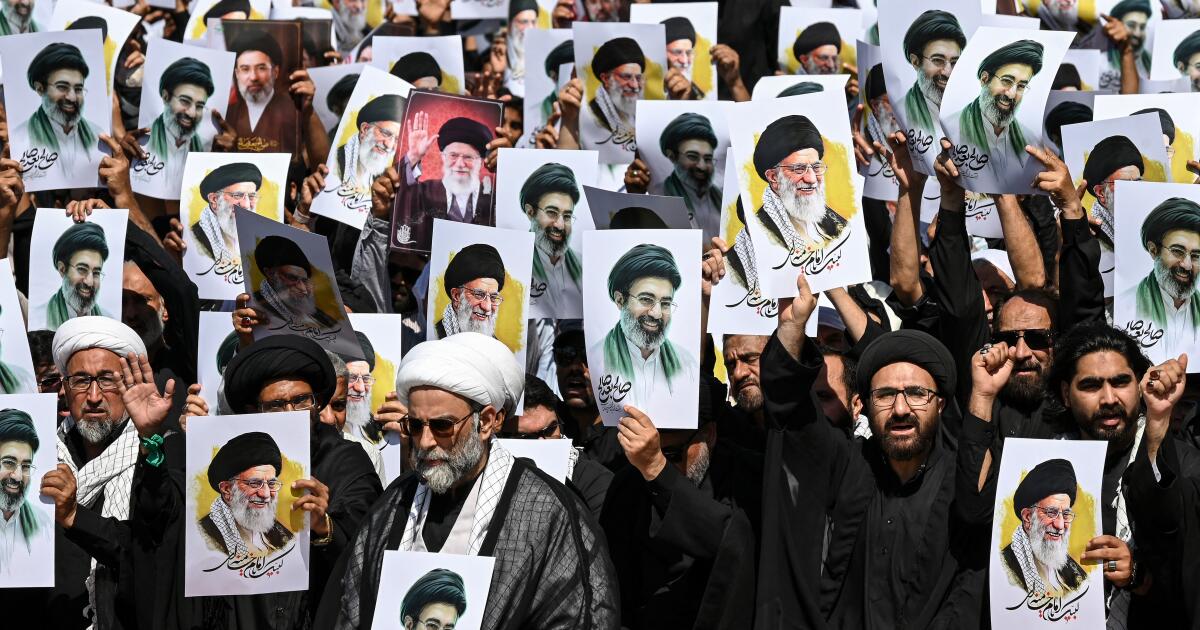
New Iranian leader Khamenei vows ‘never-ending’ revenge in first public statement
WASHINGTON — Iran’s new supreme leader, Mojtaba Khamenei, vowed retaliation Thursday against the United States and Israel and signaled that Tehran will continue to choke off the world’s most critical oil route, as the war strained global energy markets and raised new security concerns in the United States.
In his first public remarks since U.S.–Israeli strikes killed his father, former Supreme Leader Ayatollah Ali Khamenei, Mojtaba Khamenei swore revenge. The new leader, notably, did not appear in person for the televised statement. Instead, his written words were read aloud on Iranian state media.
“We will never retreat and vow to avenge the blood of our martyrs,” he said. “Our revenge will be never ending, not only for the late supreme leader, but also for the blood of all of our martyrs. … Those who killed our children will pay the price.”
The new leader expressed condolences to families who lost children in a strike on a girls school in Minab that killed more than 165 people, many of them children. He also warned that the war could expand, declaring that the continuation of the conflict “depends on the interests of the parties.”
The Associated Press, citing two sources, reported that outdated intelligence likely led to the United States carrying out the deadly missile strike on the elementary school. U.S. Central Command relied on target coordinates for the strike using outdated data provided by the Defense Intelligence Agency, according to a person familiar with the preliminary finding.
Khamenei indicated that Tehran would maintain its blockade in the Strait of Hormuz, a key choke point through which 20% of the world’s oil supply is shipped. He also said he believes in friendship with his country’s neighbors, but that attacks on U.S. military installations in the region will continue. He described maintaining pressure on the passage as a necessary part of Iran’s war strategy.
His remarks came as attacks continued to disrupt shipping and energy infrastructure across the Persian Gulf. The war sent oil up 10% Thursday as hostilities in Iran drag on.
Reports from the region said Iranian forces have intensified strikes on vessels attempting to pass through the Strait of Hormuz, leaving hundreds of ships stranded at its entrances and rattling global oil markets.
Two oil tankers were struck by explosives in Iraqi waters near the port of Basra. The Islamic Revolutionary Guard Corps claimed responsibility for the attacks, which killed at least one crew member and set both vessels ablaze, according to the Associated Press. A third unnamed vessel was reported to have been struck by an “unknown projectile” near Dubai and Jebel Ali, causing a small fire, the United Kingdom Maritime Trade Operations reported.
The latest incidents come after drone strikes targeted fuel storage facilities across the Gulf, including at energy sites in Bahrain and at the port of Salalah in Oman, an important hub for tankers seeking to bypass the Strait.
“They will pay the price. We will destroy their facilities,” Khamenei said. “It is necessary to continue our defensive activity, including continuing to close the Strait of Hormuz.”
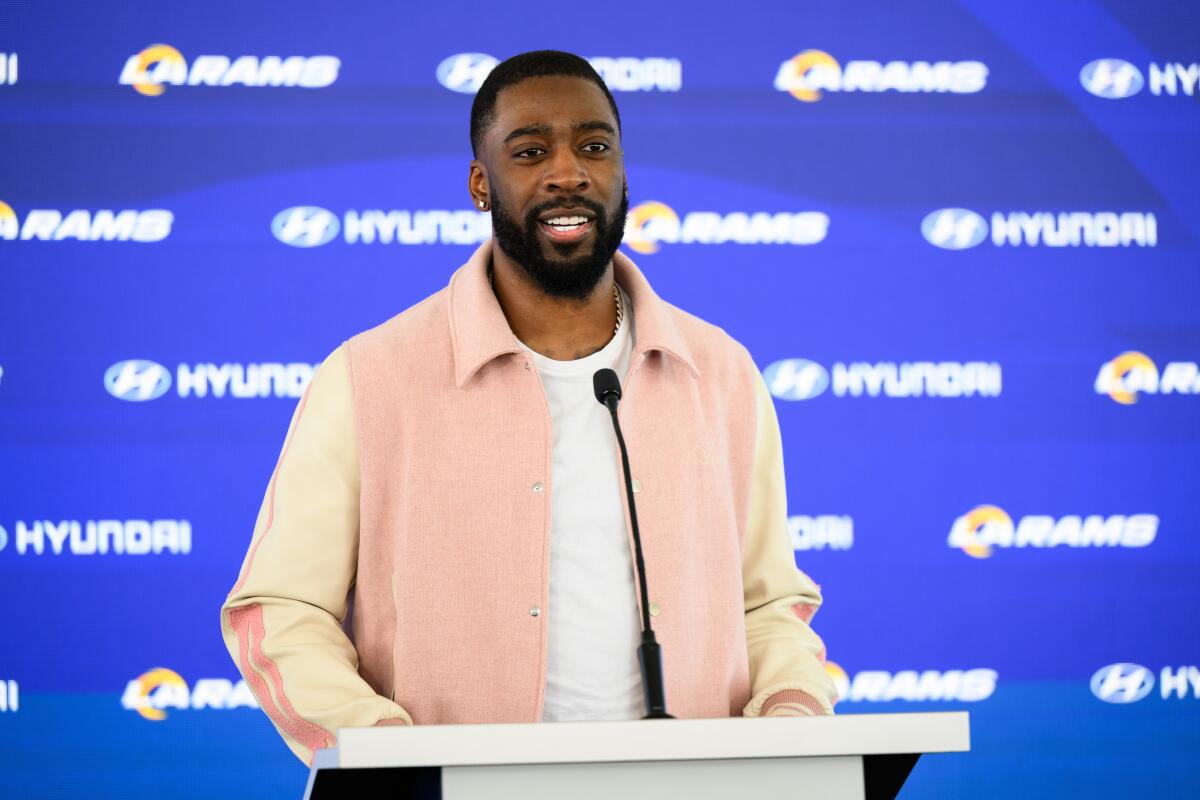
Trent McDuffie’s wish of playing for Sean McVay, Rams comes true
Trent McDuffie was a young high school player in Southern California when the Rams returned from St. Louis to Los Angeles in 2016.
During Rams training camp that summer, McDuffie watched HBO “Hard Knocks” episodes about the team with his parents, and they were enamored by coach Sean McVay.
“I remember just being like, ‘Dang, I would like to play for that guy,’” McDuffie said Thursday.
McDuffie, an All-Pro cornerback acquired by the Rams in a blockbuster trade, recalled those thoughts during an introductory news conference at the team’s facility in Woodland Hills after he signed a record-breaking four-year extension that reportedly includes $100 million in guarantees.
“Fast forward all these years, and now I’m here and it’s just a full-circle moment,” he said of getting to play for McVay. “Watched this guy, wanted to play for this guy and now this guy wants me.”
To land McDuffie, Rams general manager Les Snead sent the Kansas City Chiefs the 29th overall pick and fifth- and sixth-round picks in this year’s draft, and a 2027 third-round pick.
The Rams also signed former Chiefs cornerback Jaylen Watson to a three-year contract that includes $34 million in guarantees.
The moves were a complete departure from last year, when the Rams wrongly gambled that a young and aggressive pass rush could offset their decision to not make a single upgrade to the secondary.
The additions of McDuffie and Watson to an already deep and talented roster that features reigning NFL most valuable player Matthew Stafford, the Rams will be a favorite to play in Super Bowl LXI at SoFi Stadium in February.
And make no mistake: Like they did in 2021, the Rams will do anything possible to ensure that owner Stan Kroenke is walking the Super Bowl sideline in the stadium he built in Inglewood.
McDuffie noted that the Rams have been “knocking on the door, year-in and year-out” since his rookie season with the Chiefs in 2022. A winning culture already is in place.
“This team is ready to go,” said McDuffie, a first-round pick out of Washington who starred in high school at Anaheim Servite and Bellflower St. John Bosco highs. “I don’t think I’m coming in here with a team that doesn’t understand the value that they have.
“So those little nuggets that I feel I can just pour into guys that can get us over the hump, I’m going to do everything I can.”

Rams cornerback Jaylen Watson speaks during his introductory news conference in Woodland Hills on Thursday.
(William Liang / Associated Press)
McDuffie and Watson, a 2022 seventh-round pick, were part of Chiefs teams that won two championships in three Super Bowl appearances.
“We really learned what it takes to win a Super Bowl, get to the Super Bowl, the preparation and the time it takes to be detailed in your craft,” McDuffie said.
When news about the trade broke last week, one of the first calls McDuffie answered was from Rams star receiver Puka Nacua, a former Washington teammate.
“He was just screaming at the top of his lungs,” McDuffie said. “I’m like ‘Puka, bro, I miss this energy. I miss what you bring.’ I’m just excited to be back on the field with him.”
McDuffie and Watson also are excited about continuing their partnership, which began when they were among five defensive backs drafted by the Chiefs four years ago.
Watson, 27, grew up in Georgia but played two seasons at Ventura College before finishing his college career at Washington State.
Like McDuffie, he is happy to be back in Southern California weather.
“Everyone’s just so nice here,” Watson said of the region, before quipping, “then you’ve got your taxes.”
The 5-foot-11 McDuffie and the 6-2 Watson will give secondary coach Jimmy Lake — who coached McDuffie in college — options for matchups.
“That’s why I think me and Trent complement each other so well,” Watson said. “His strengths are short-area quickness, the small shifty guys. And my strengths are the big receivers.
“So we should be pretty diverse. We should be able to match up pretty well against a lot of different looks we get.”
McDuffie and Watson join a cornerback group that includes Emmanuel Forbes Jr. The Rams have until May 1 to determine if they will exercise a fifth-year option on Forbes, a 2023 first-round draft pick by Washington who was claimed off waivers by the Rams in 2024.
Forbes will earn about $2 million this season, but would be guaranteed $12.6 million if the Rams exercise the option.
The Rams will begin offseason workouts in April.
McDuffie is happy to be back home.
“It’s hot, the sun’s out,” he said. “It’s a beautiful thing.”

ICC prosecutor clears U.S. in sanctions against Venezuela case
The International Criminal Court in The Hague, the Netherlands, has cleared the United States of crimes against humanity against Venezuela for sanctions. File Photo by Robin Utrecht/EPA
March 12 (UPI) — The International Criminal Court Office of the Prosecutor announced Thursday that the United States did not commit crimes against humanity with its sanctions against Venezuela.
The investigation, called Venezuela II by the court, was referred to the court by Venezuela’s government in 2020, alleging that sanctions against the country had caused suffering and hardship.
The referral from now-deposed President Nicolas Maduro alleges the suffering of Venezuelans from “the application of unlawful coercive measures adopted unilaterally by the government of the United States of America against Venezuela, at least since the year 2014.”
Venezuela alleged that “murder, extermination, deportation, persecution and other inhumane acts constituting crimes against humanity” were committed, the OTP said.
The ICC prosecutor determined that the “evidential requirements of causation and intent are not met.”
The evidence “must provide a reasonable basis to believe that sanctions by the United States of America led to murder, displacement or other alleged crimes,” the OTP said.
The decision is unrelated to the January 2026 events in Venezuela, the prosecutor noted.
In January, the United States invaded Venezuela, arrested Maduro and his wife and took them to Manhattan, where they await trial on drug trafficking charges.
The ICC prosecutor said it is still investigating “Venezuela I,” a case that doesn’t involve the United States.

Supporters of ousted Venezuela’s President Nicolas Maduro carry his portrait during a rally outside the National Assembly in Caracas, Venezuela, on January 5, 2026. Photo by Jonathan Lanza/UPI | License Photo